

ISO/TS 21560:2020
(Main)General requirements of tissue-engineered medical products
General Information
- Abstract
This document specifies general requirements for tissue-engineered medical products (TEMPs), which are used in regenerative medicine. With regard to safety, this document outlines requirements for materials, manufacture, quality control, and unintentional biological effects elicited by TEMPs. This document does not address requirements for clinical trials and efficacy. This document is not applicable to tissue-engineered products used for diagnosis, ex-vivo testing or extracorporeal treatments of patients (e.g. dialysis with TEMP components). TEMPs containing viable xenogenic cells, genetically modified cells, or cells derived from abnormal cells or tissues (e.g. cancerous tissues) are also excluded from the scope. The combination of TEMPs with medical devices, with the exception of scaffolds comprised of synthetic and/or naturally-derived (e.g. animal sourced) materials, is also excluded from the scope. NOTE International, national or regional regulations or requirements, or the Pharmacopeia also apply to specific topics covered in this document.
- Status
- Published
- Publication Date
- 30-Aug-2020
- Technical Committee
- ISO/TC 150/SC 7 - Tissue-engineered medical products
- Drafting Committee
- ISO/TC 150/SC 7/WG 1 - Management of risk
- Current Stage
- 9093 - International Standard confirmed
- Start Date
- 17-May-2024
- Completion Date
- 29-Aug-2026
Buy Documents
ISO/TS 21560:2020 - General requirements of tissue-engineered medical products Released:8/31/2020
ISO/TS 21560:2020 - General requirements of tissue-engineered medical products/31/2020
Overview
ISO/TS 21560:2020 - General requirements of tissue‑engineered medical products (TEMPs) provides high‑level, safety‑focused guidance for the quality and manufacture of tissue‑engineered medical products used in regenerative medicine. The technical specification outlines expectations for materials, manufacturing processes, characterization and control strategies, and management of unintended biological effects. It does not cover clinical trial or efficacy requirements and excludes TEMPs containing viable xenogenic cells, genetically modified cells, or cells from abnormal/cancerous tissue, as well as combinations with medical devices (except synthetic or naturally‑derived scaffolds).
Key topics and technical requirements
- Materials and starting materials: requirements and considerations for cells, tissues, scaffolds, bioactive agents, excipients and ancillary materials used during manufacturing.
- Manufacturing process: controls, process validation and contamination prevention throughout the product lifecycle.
- Characterization and control strategy: defining critical quality attributes, in‑process controls and release criteria for the finished TEMP.
- Safety and unintentional biological effects: risk reduction for adventitious agents, tumorigenicity assessment, and minimizing immunogenic or deleterious excipient reactions.
- Traceability and lifecycle control: traceability of cells, critical materials and finished products across manufacturing, storage and distribution.
- Supporting elements: container‑closure system, transport considerations, and developmental/non‑clinical studies relevant to product quality and safety.
- Risk‑based approach: recommended use of risk management (referencing ISO 13022 and related documents) to determine the extent of technical documentation and controls.
Practical applications and intended users
ISO/TS 21560:2020 is aimed at organizations and professionals involved in the development, manufacture and regulation of TEMPs, including:
- Manufacturers and quality/production teams setting up GMP‑like controls for cell‑based products and scaffolds.
- Regulatory authorities and reviewers assessing quality and safety documentation for TEMPs.
- R&D and process development groups designing characterization strategies, non‑clinical studies and validation plans.
- Suppliers of ancillary materials and biomaterials who must understand material expectations and traceability needs.
- Contract development and manufacturing organizations (CDMOs) supporting TEMP production and transport.
Related standards
- ISO 13022 - application of risk management and processing practices for cell products
- ISO/TS 20399 series - ancillary materials for cellular therapeutics
- ISO 22442 series - controls and validation for animal‑sourced materials (TSE/virus concerns)
Keywords: ISO/TS 21560:2020, tissue‑engineered medical products, TEMPs, regenerative medicine, quality control, manufacturing, risk management, scaffolds, ancillary materials, traceability.
Buy Documents
ISO/TS 21560:2020 - General requirements of tissue-engineered medical products Released:8/31/2020
ISO/TS 21560:2020 - General requirements of tissue-engineered medical products/31/2020
Get Certified
Connect with accredited certification bodies for this standard

BSI Group
BSI (British Standards Institution) is the business standards company that helps organizations make excellence a habit.

TÜV Rheinland
TÜV Rheinland is a leading international provider of technical services.

TÜV SÜD
TÜV SÜD is a trusted partner of choice for safety, security and sustainability solutions.
Sponsored listings
Frequently Asked Questions
ISO/TS 21560:2020 is a technical specification published by the International Organization for Standardization (ISO). Its full title is "General requirements of tissue-engineered medical products". This standard covers: This document specifies general requirements for tissue-engineered medical products (TEMPs), which are used in regenerative medicine. With regard to safety, this document outlines requirements for materials, manufacture, quality control, and unintentional biological effects elicited by TEMPs. This document does not address requirements for clinical trials and efficacy. This document is not applicable to tissue-engineered products used for diagnosis, ex-vivo testing or extracorporeal treatments of patients (e.g. dialysis with TEMP components). TEMPs containing viable xenogenic cells, genetically modified cells, or cells derived from abnormal cells or tissues (e.g. cancerous tissues) are also excluded from the scope. The combination of TEMPs with medical devices, with the exception of scaffolds comprised of synthetic and/or naturally-derived (e.g. animal sourced) materials, is also excluded from the scope. NOTE International, national or regional regulations or requirements, or the Pharmacopeia also apply to specific topics covered in this document.
This document specifies general requirements for tissue-engineered medical products (TEMPs), which are used in regenerative medicine. With regard to safety, this document outlines requirements for materials, manufacture, quality control, and unintentional biological effects elicited by TEMPs. This document does not address requirements for clinical trials and efficacy. This document is not applicable to tissue-engineered products used for diagnosis, ex-vivo testing or extracorporeal treatments of patients (e.g. dialysis with TEMP components). TEMPs containing viable xenogenic cells, genetically modified cells, or cells derived from abnormal cells or tissues (e.g. cancerous tissues) are also excluded from the scope. The combination of TEMPs with medical devices, with the exception of scaffolds comprised of synthetic and/or naturally-derived (e.g. animal sourced) materials, is also excluded from the scope. NOTE International, national or regional regulations or requirements, or the Pharmacopeia also apply to specific topics covered in this document.
ISO/TS 21560:2020 is classified under the following ICS (International Classification for Standards) categories: 11.040.40 - Implants for surgery, prosthetics and orthotics. The ICS classification helps identify the subject area and facilitates finding related standards.
ISO/TS 21560:2020 is available in PDF format for immediate download after purchase. The document can be added to your cart and obtained through the secure checkout process. Digital delivery ensures instant access to the complete standard document.
Standards Content (Sample)
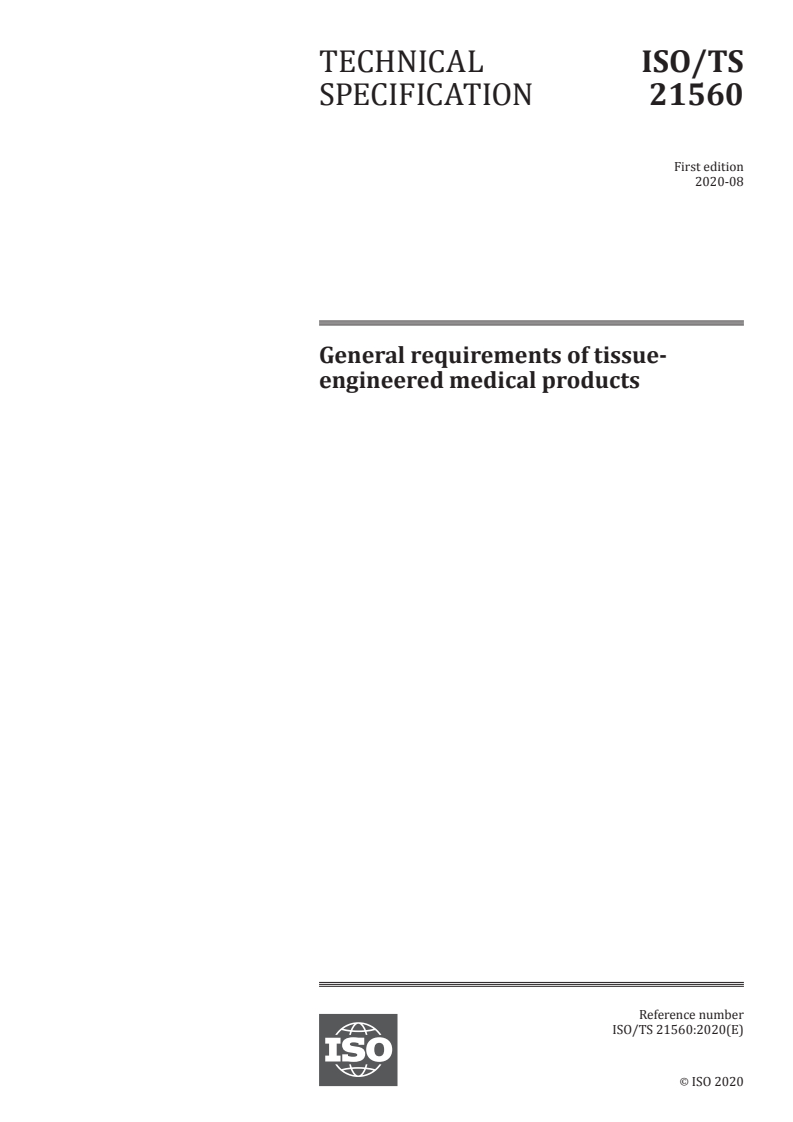
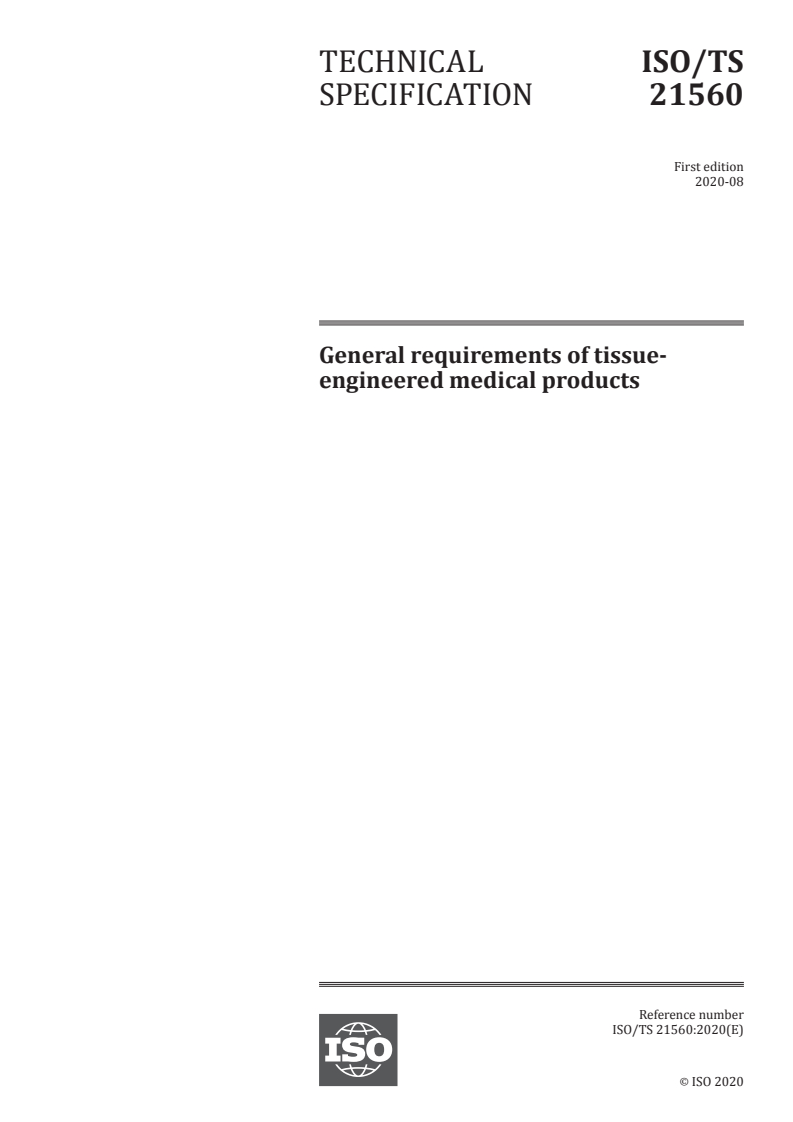
TECHNICAL ISO/TS
SPECIFICATION 21560
First edition
2020-08
General requirements of tissue-
engineered medical products
Reference number
©
ISO 2020
© ISO 2020
All rights reserved. Unless otherwise specified, or required in the context of its implementation, no part of this publication may
be reproduced or utilized otherwise in any form or by any means, electronic or mechanical, including photocopying, or posting
on the internet or an intranet, without prior written permission. Permission can be requested from either ISO at the address
below or ISO’s member body in the country of the requester.
ISO copyright office
CP 401 • Ch. de Blandonnet 8
CH-1214 Vernier, Geneva
Phone: +41 22 749 01 11
Email: copyright@iso.org
Website: www.iso.org
Published in Switzerland
ii © ISO 2020 – All rights reserved
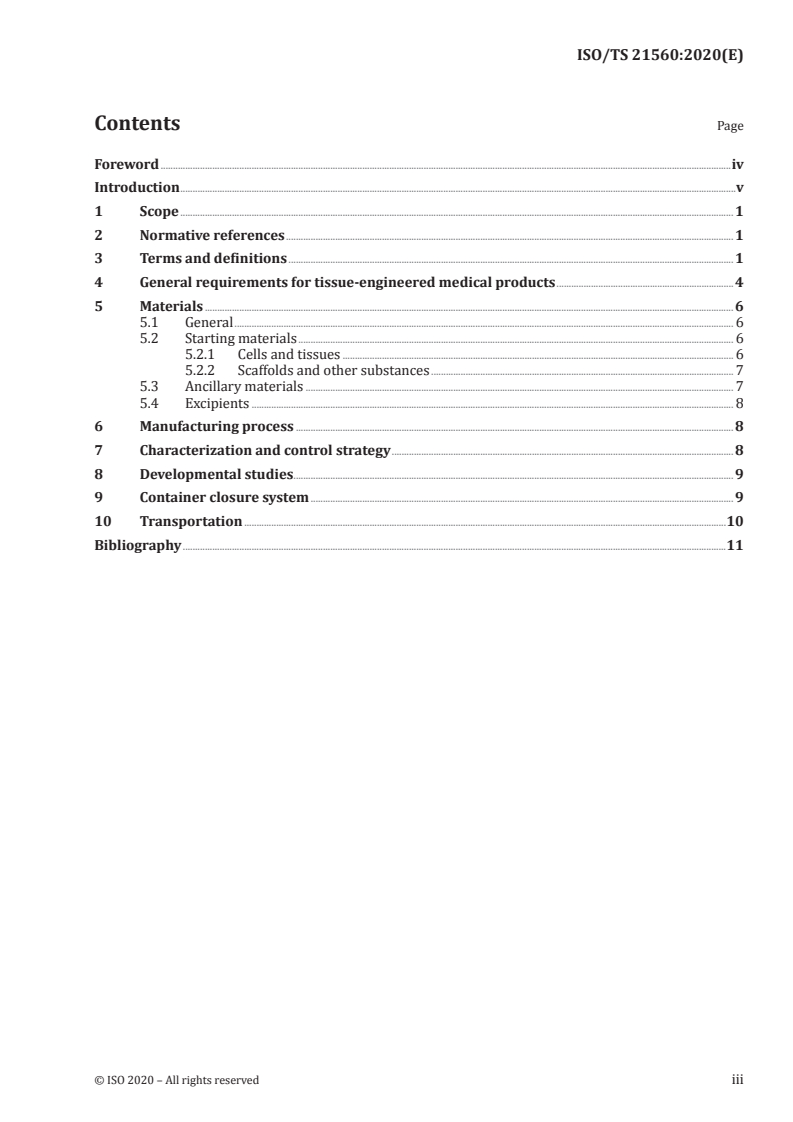
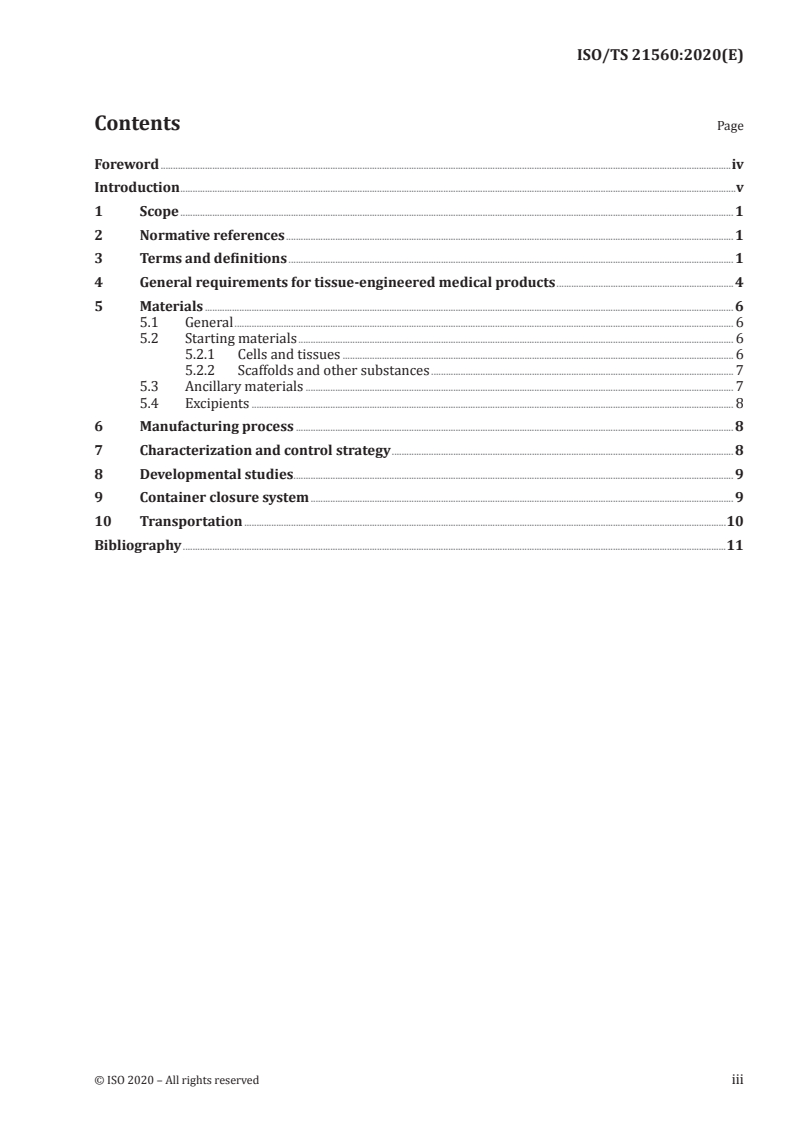
Contents Page
Foreword .iv
Introduction .v
1 Scope . 1
2 Normative references . 1
3 Terms and definitions . 1
4 General requirements for tissue-engineered medical products .4
5 Materials . 6
5.1 General . 6
5.2 Starting materials . 6
5.2.1 Cells and tissues . 6
5.2.2 Scaffolds and other substances . 7
5.3 Ancillary materials . 7
5.4 Excipients . 8
6 Manufacturing process . 8
7 Characterization and control strategy . 8
8 Developmental studies. 9
9 Container closure system . 9
10 Transportation .10
Bibliography .11
Foreword
ISO (the International Organization for Standardization) is a worldwide federation of national standards
bodies (ISO member bodies). The work of preparing International Standards is normally carried out
through ISO technical committees. Each member body interested in a subject for which a technical
committee has been established has the right to be represented on that committee. International
organizations, governmental and non-governmental, in liaison with ISO, also take part in the work.
ISO collaborates closely with the International Electrotechnical Commission (IEC) on all matters of
electrotechnical standardization.
The procedures used to develop this document and those intended for its further maintenance are
described in the ISO/IEC Directives, Part 1. In particular, the different approval criteria needed for the
different types of ISO documents should be noted. This document was drafted in accordance with the
editorial rules of the ISO/IEC Directives, Part 2 (see www .iso .org/ directives).
Attention is drawn to the possibility that some of the elements of this document may be the subject of
patent rights. ISO shall not be held responsible for identifying any or all such patent rights. Details of
any patent rights identified during the development of the document will be in the Introduction and/or
on the ISO list of patent declarations received (see www .iso .org/ patents).
Any trade name used in this document is information given for the convenience of users and does not
constitute an endorsement.
For an explanation of the voluntary nature of standards, the meaning of ISO specific terms and
expressions related to conformity assessment, as well as information about ISO's adherence to
the World Trade Organization (WTO) principles in the Technical Barriers to Trade (TBT), see
www .iso .org/ iso/ foreword .html.
This document was prepared by Technical Committee ISO/TC 150, Implants for surgery, Subcommittee
SC 7, Tissue-engineered medical products.
Any feedback or questions on this document should be directed to the user’s national standards body. A
complete listing of these bodies can be found at www .iso .org/ members .html.
iv © ISO 2020 – All rights reserved
Introduction
Advances in the field of biological sciences have made possible the generation of a new type of medical
product that when administered to the human body, may repair, replace, regenerate or enhance the
function of impaired tissues or organs.
Extensive experience acquired through the administration of living human cells has yielded solid
knowledge about the quality requirements and the risks associated with their use.
However, the development of tissue-engineered medical products (TEMPs) that are not simply obtained
from a human donor or by separating living tissues, but rather are grown from various cell sources
and are manipulated during manufacture to meet the medical needs of the patient, introduces new
challenges with regard to quality requirements and risk management for the benefit of patients.
TEMPs utilizing human material are quite diverse but share a set of common quality requirements
for their safe use. These kinds of products require special attention for contamination control, such
as infectious agents transmitting disease (e.g. hepatitis, HIV, TSE) and harmful chemicals, unintended
decomposition or degradation induced by inappropriate handling at any stage of the manufacturing
process, tumorigenic potential, induction of an immunogenic reaction in the recipient, traceability of
cells, critical materials, and the final product are key to product quality and its safe use.
This document has been developed with the objective of assisting interested parties, such as
manufacturers and regulators, establish suitable quality parameters and specifications for the final
TEMPs as well as cells, critical materials, processing steps and appropriate controls ensuring the safety
of TEMPs.
TECHNICAL SPECIFICATION ISO/TS 21560:2020(E)
General requirements of tissue-engineered medical
products
1 Scope
This document specifies general requirements for tissue-engineered medical products (TEMPs), which
are used in regenerative medicine. With regard to safety, this document outlines requirements for
materials, manufacture, quality control, and unintentional biological effects elicited by TEMPs. This
document does not address requirements for clinical trials and efficacy.
This document is not applicable to tissue-engineered products used for diagnosis, ex-vivo testing or
extracorporeal treatments of patients (e.g. dialysis with TEMP components). TEMPs containing viable
xenogenic cells, genetically modified cells, or cells derived from abnormal cells or tissues (e.g. cancerous
tissues) are also excluded from the scope. The combination of TEMPs with medical devices, with the
exception of scaffolds comprised of synthetic and/or naturally-derived (e.g. animal sourced) materials,
is also excluded from the scope.
NOTE International, national or regional regulations or requirements, or the Pharmacopeia also apply to
specific topics covered in this document.
2 Normative references
The following documents are referred to in the text in such a way that some or all of their content
constitutes requirements of this document. For dated references, only the edition cited applies. For
undated references, the latest edition of the referenced document (including any amendments) applies.
ISO 13022, Medical products containing viable human cells — Application of risk management and
requirements for processing practices
ISO/TS 20399-1, Biotechnology — Ancillary materials present during the production of cellular therapeutic
products — Part 1: General requirements
ISO/TS 20399-2, Biotechnology — Ancillary materials present during the production of cellular therapeutic
products — Part 2: Best practice guidance for ancillary material suppliers
ISO/TS 20399-3, Biotechnology — Ancillary materials present during the production of cellular therapeutic
products — Part 3: Best practice guidance for ancillary material users
ISO 22442-1, Medical devices utilizing animal tissues and their derivatives — Part 1: Application of risk
management
ISO 22442-2, Medical devices utilizing animal tissues and their derivatives — Part 2: Controls on sourcing,
collection and handling
ISO 22442-3, Medical devices utilizing animal tissues and their derivatives — Part 3: Validation of the
elimination and/or inactivation of viruses and transmissible spongiform encephalopathy (TSE) agents
ISO/TR 22442-4, Medical devices utilizing animal tissues and their derivatives — Part 4: Principles for
elimination and/or inactivation of transmissible spongiform encephalopathy (TSE) agents and validation
assays for those processes
3 Terms and definitions
For the purposes of this document, the following terms and definitions apply.
ISO and IEC maintain terminological databases for use in standardization at the following addresses:
— ISO Online browsing platform: available at https:// www .iso .org/ obp
— IEC Electropedia: available at http:// www .electropedia .org/
3.1
active substance
substance comprised of manipulated cells, engineered tissues and/or other materials in the finished
TEMP which has biological activity for its intended use
3.2
allogenic
cells, tissues, and organs in which the donor and recipient are genetically separate individuals of the
same species
[SOURCE: ASTM F2312 -11: 2020, Clause 4, modified — alternative terms have been removed.]
3.3
autologous
cells, tissues, and organs in which the donor and recipient is the same individual
[SOURCE: ASTM F2312 -11: 2020, Clause 4, modified — alternative terms have been removed.]
3.4
bioactive agent
agent (e.g. peptide or protein) produced by (and purified from) naturally occurring or recombinant
organisms, tissues or cell lines or synthetic analogs of such molecules
3.5
cellular therapeutic product
administration of cells to repair, modify or regenerate the recipient’s cells, tissues, and organs or their
structure and function, or both
[SOURCE: ASTM F2312 -11: 2010, Clause 4, modified — term has been modified from "cell therapy".]
3.5.1
cell line
progeny of a primary culture after the first subculture
Note 1 to entry: A cell line may be finite or continuous.
3.6
excipient
material that is present in the TEMP (3.18) administered to a patient, other than the active substance(s)
EXAMPLE Cryopreservation components.
3.7
finished TEMP
final formulated TEMP in its immediate container closure
3.8
genetically modified
having an altered or modified genetic material
[SOURCE: ASTM F2312 -11: 2020, Clause 4]
3.9
lifespan
period during which something exists
[SOURCE: ISO 19108:2002, 4.1.21]
2 © ISO 2020 – All rights reserved
3.10
medical device
instrument, apparatus, implement, machine, appliance, implant, reagent for in vitro use, software,
material or other similar or related article, intended by the manufacturer to be used, alone or in
combination, for human beings, for one or more of the specific medical purpose(s) of:
— diagnosis, prevention, monitoring, treatment or alleviation of disease;
— diagnosis, monitoring, treatment, alleviation of or compensation for an injury;
— investigation, replacement, modification, or support of the anatomy or of a physiological process;
— supporting or sustaining life;
— control of conception;
— disinfection of medical devices;
— providing information by means of in vitro examination of specimens derived from the human
body; and
— does not achieve its primary intended action by pharmacological, immunological or metabolic
means, in or on the human body, but which can be assisted in its intended function by such means
[SOURCE: ISO/IEC Guide 63:2019, 3.7]
3.11
medical product
medicinal product (drug), biological product, medical device or a combination of these
[SOURCE: ISO 13022:2012, 3.4]
3.12
ancillary material
AM
material that comes into contact with the TEMP during manufacturing, but is not intended to be part of
the final product formulation
Note 1 to entry: AMs exclude non-biological consumables (e.g. tissue culture flasks, bags, tubing, pipettes, needles)
and other plasticware that comes into contact with the TEMP or its components, but include consumables which
have a biological component (e.g. coated dishes or beads).
Note 2 to entry: AMs exclude cells (e.g. feeder cells).
Note 3 to entry: In some cases, AM is described as raw material.
[SOURCE: ISO/TS 20399-1:2018, 3.1]
3.13
regenerative medicine
process of repairing, replacing, or regenerating human cells, tissues or organs to restore or establish
normal function
[SOURCE: PAS 84:2012, 2.266]
3.14
scaffold
support or structural component or delivery vehicle, or matrix, consisting of synthetic and/or naturally-
derived material(s), for modulating the biological properties (including, but not limited to, adhesion,
migration, proliferation, differentiation) or transport of administered and/or endogenous cells and/or
binding/transport of bioactive agents
[SOURCE: ASTM F2312 -11: 2020, Clause 4]
3.15
starting material
cells, tissues and/or additional substances, e.g. scaffolds, biomaterials, bioactive agents, which
constitute the intended integral components of a TEMP
3.16
tissue
aggregation of specialized cells united in the performance of one or more particular function(s)
[SOURCE: ASTM F2312 -11: 2020, Clause 4]
3.17
tissue engineering
discipline that combines the principles of engineering and biology to obtain biological substitutes
intended to regenerate, replace, modify, repair, or restore the function of tissues and organs
3.18
tissue-engineered medical product
TEMP
medical product consisting of manipulated cells and/or engineered tissues, with or without a synthetic
and/or naturally-derived scaffold, that repairs, modifies, replaces, restores, or regenerates the
recipient’s cells, tissues, or organs or their structure and function, or both
[SOURCE: ASTM F2312 -11: 2020, Clause 4]
3.19
xenogenic
cells, tissues, and organs in which the donor and recipient belong to different species
[SOURCE: ASTM F2312 -11: 2020, modified — alternative terms have been removed.]
3.20
validation
confirmation, through the provision of objective evidence, that the requirements for a specific intended
use or application have been fulfilled
Note 1 to entry: The objective evidence needed for a validation is the result of a test or other form of determination
such as performing alternative calculations or reviewing documents.
Note 2 to entry: The word “validated” is used to designate the corresponding status.
Note 3 to entry: The use conditions for validation can be real or simulated.
[SOURCE: ISO 9000:2015, 3.8.13]
4 General requirements for tissue-engineered medical products
A TEMP may contain manipulated cells and/or engineered tissues, with or without a synthetic and/or
naturally-derived scaffold as defined in 3.14. The quality control of any components and the finished
TEMP shall be performed at the manufacturing processes and entire lifespan. The following aspects
should be considered when defining the critical quality parameters for TEMPs and are discussed in
further detail in this document:
— The presence of adventitious agents shall be minimized.
— The presence of deleterious excipients shall be minimized.
— The TEMP manufacturing process shall be adequately controlled and validated.
— Any necessary cell man
...
TECHNICAL ISO/TS
SPECIFICATION 21560
First edition
2020-08
General requirements of tissue-
engineered medical products
Reference number
©
ISO 2020
© ISO 2020
All rights reserved. Unless otherwise specified, or required in the context of its implementation, no part of this publication may
be reproduced or utilized otherwise in any form or by any means, electronic or mechanical, including photocopying, or posting
on the internet or an intranet, without prior written permission. Permission can be requested from either ISO at the address
below or ISO’s member body in the country of the requester.
ISO copyright office
CP 401 • Ch. de Blandonnet 8
CH-1214 Vernier, Geneva
Phone: +41 22 749 01 11
Email: copyright@iso.org
Website: www.iso.org
Published in Switzerland
ii © ISO 2020 – All rights reserved
Contents Page
Foreword .iv
Introduction .v
1 Scope . 1
2 Normative references . 1
3 Terms and definitions . 1
4 General requirements for tissue-engineered medical products .4
5 Materials . 6
5.1 General . 6
5.2 Starting materials . 6
5.2.1 Cells and tissues . 6
5.2.2 Scaffolds and other substances . 7
5.3 Ancillary materials . 7
5.4 Excipients . 8
6 Manufacturing process . 8
7 Characterization and control strategy . 8
8 Developmental studies. 9
9 Container closure system . 9
10 Transportation .10
Bibliography .11
Foreword
ISO (the International Organization for Standardization) is a worldwide federation of national standards
bodies (ISO member bodies). The work of preparing International Standards is normally carried out
through ISO technical committees. Each member body interested in a subject for which a technical
committee has been established has the right to be represented on that committee. International
organizations, governmental and non-governmental, in liaison with ISO, also take part in the work.
ISO collaborates closely with the International Electrotechnical Commission (IEC) on all matters of
electrotechnical standardization.
The procedures used to develop this document and those intended for its further maintenance are
described in the ISO/IEC Directives, Part 1. In particular, the different approval criteria needed for the
different types of ISO documents should be noted. This document was drafted in accordance with the
editorial rules of the ISO/IEC Directives, Part 2 (see www .iso .org/ directives).
Attention is drawn to the possibility that some of the elements of this document may be the subject of
patent rights. ISO shall not be held responsible for identifying any or all such patent rights. Details of
any patent rights identified during the development of the document will be in the Introduction and/or
on the ISO list of patent declarations received (see www .iso .org/ patents).
Any trade name used in this document is information given for the convenience of users and does not
constitute an endorsement.
For an explanation of the voluntary nature of standards, the meaning of ISO specific terms and
expressions related to conformity assessment, as well as information about ISO's adherence to
the World Trade Organization (WTO) principles in the Technical Barriers to Trade (TBT), see
www .iso .org/ iso/ foreword .html.
This document was prepared by Technical Committee ISO/TC 150, Implants for surgery, Subcommittee
SC 7, Tissue-engineered medical products.
Any feedback or questions on this document should be directed to the user’s national standards body. A
complete listing of these bodies can be found at www .iso .org/ members .html.
iv © ISO 2020 – All rights reserved
Introduction
Advances in the field of biological sciences have made possible the generation of a new type of medical
product that when administered to the human body, may repair, replace, regenerate or enhance the
function of impaired tissues or organs.
Extensive experience acquired through the administration of living human cells has yielded solid
knowledge about the quality requirements and the risks associated with their use.
However, the development of tissue-engineered medical products (TEMPs) that are not simply obtained
from a human donor or by separating living tissues, but rather are grown from various cell sources
and are manipulated during manufacture to meet the medical needs of the patient, introduces new
challenges with regard to quality requirements and risk management for the benefit of patients.
TEMPs utilizing human material are quite diverse but share a set of common quality requirements
for their safe use. These kinds of products require special attention for contamination control, such
as infectious agents transmitting disease (e.g. hepatitis, HIV, TSE) and harmful chemicals, unintended
decomposition or degradation induced by inappropriate handling at any stage of the manufacturing
process, tumorigenic potential, induction of an immunogenic reaction in the recipient, traceability of
cells, critical materials, and the final product are key to product quality and its safe use.
This document has been developed with the objective of assisting interested parties, such as
manufacturers and regulators, establish suitable quality parameters and specifications for the final
TEMPs as well as cells, critical materials, processing steps and appropriate controls ensuring the safety
of TEMPs.
TECHNICAL SPECIFICATION ISO/TS 21560:2020(E)
General requirements of tissue-engineered medical
products
1 Scope
This document specifies general requirements for tissue-engineered medical products (TEMPs), which
are used in regenerative medicine. With regard to safety, this document outlines requirements for
materials, manufacture, quality control, and unintentional biological effects elicited by TEMPs. This
document does not address requirements for clinical trials and efficacy.
This document is not applicable to tissue-engineered products used for diagnosis, ex-vivo testing or
extracorporeal treatments of patients (e.g. dialysis with TEMP components). TEMPs containing viable
xenogenic cells, genetically modified cells, or cells derived from abnormal cells or tissues (e.g. cancerous
tissues) are also excluded from the scope. The combination of TEMPs with medical devices, with the
exception of scaffolds comprised of synthetic and/or naturally-derived (e.g. animal sourced) materials,
is also excluded from the scope.
NOTE International, national or regional regulations or requirements, or the Pharmacopeia also apply to
specific topics covered in this document.
2 Normative references
The following documents are referred to in the text in such a way that some or all of their content
constitutes requirements of this document. For dated references, only the edition cited applies. For
undated references, the latest edition of the referenced document (including any amendments) applies.
ISO 13022, Medical products containing viable human cells — Application of risk management and
requirements for processing practices
ISO/TS 20399-1, Biotechnology — Ancillary materials present during the production of cellular therapeutic
products — Part 1: General requirements
ISO/TS 20399-2, Biotechnology — Ancillary materials present during the production of cellular therapeutic
products — Part 2: Best practice guidance for ancillary material suppliers
ISO/TS 20399-3, Biotechnology — Ancillary materials present during the production of cellular therapeutic
products — Part 3: Best practice guidance for ancillary material users
ISO 22442-1, Medical devices utilizing animal tissues and their derivatives — Part 1: Application of risk
management
ISO 22442-2, Medical devices utilizing animal tissues and their derivatives — Part 2: Controls on sourcing,
collection and handling
ISO 22442-3, Medical devices utilizing animal tissues and their derivatives — Part 3: Validation of the
elimination and/or inactivation of viruses and transmissible spongiform encephalopathy (TSE) agents
ISO/TR 22442-4, Medical devices utilizing animal tissues and their derivatives — Part 4: Principles for
elimination and/or inactivation of transmissible spongiform encephalopathy (TSE) agents and validation
assays for those processes
3 Terms and definitions
For the purposes of this document, the following terms and definitions apply.
ISO and IEC maintain terminological databases for use in standardization at the following addresses:
— ISO Online browsing platform: available at https:// www .iso .org/ obp
— IEC Electropedia: available at http:// www .electropedia .org/
3.1
active substance
substance comprised of manipulated cells, engineered tissues and/or other materials in the finished
TEMP which has biological activity for its intended use
3.2
allogenic
cells, tissues, and organs in which the donor and recipient are genetically separate individuals of the
same species
[SOURCE: ASTM F2312 -11: 2020, Clause 4, modified — alternative terms have been removed.]
3.3
autologous
cells, tissues, and organs in which the donor and recipient is the same individual
[SOURCE: ASTM F2312 -11: 2020, Clause 4, modified — alternative terms have been removed.]
3.4
bioactive agent
agent (e.g. peptide or protein) produced by (and purified from) naturally occurring or recombinant
organisms, tissues or cell lines or synthetic analogs of such molecules
3.5
cellular therapeutic product
administration of cells to repair, modify or regenerate the recipient’s cells, tissues, and organs or their
structure and function, or both
[SOURCE: ASTM F2312 -11: 2010, Clause 4, modified — term has been modified from "cell therapy".]
3.5.1
cell line
progeny of a primary culture after the first subculture
Note 1 to entry: A cell line may be finite or continuous.
3.6
excipient
material that is present in the TEMP (3.18) administered to a patient, other than the active substance(s)
EXAMPLE Cryopreservation components.
3.7
finished TEMP
final formulated TEMP in its immediate container closure
3.8
genetically modified
having an altered or modified genetic material
[SOURCE: ASTM F2312 -11: 2020, Clause 4]
3.9
lifespan
period during which something exists
[SOURCE: ISO 19108:2002, 4.1.21]
2 © ISO 2020 – All rights reserved
3.10
medical device
instrument, apparatus, implement, machine, appliance, implant, reagent for in vitro use, software,
material or other similar or related article, intended by the manufacturer to be used, alone or in
combination, for human beings, for one or more of the specific medical purpose(s) of:
— diagnosis, prevention, monitoring, treatment or alleviation of disease;
— diagnosis, monitoring, treatment, alleviation of or compensation for an injury;
— investigation, replacement, modification, or support of the anatomy or of a physiological process;
— supporting or sustaining life;
— control of conception;
— disinfection of medical devices;
— providing information by means of in vitro examination of specimens derived from the human
body; and
— does not achieve its primary intended action by pharmacological, immunological or metabolic
means, in or on the human body, but which can be assisted in its intended function by such means
[SOURCE: ISO/IEC Guide 63:2019, 3.7]
3.11
medical product
medicinal product (drug), biological product, medical device or a combination of these
[SOURCE: ISO 13022:2012, 3.4]
3.12
ancillary material
AM
material that comes into contact with the TEMP during manufacturing, but is not intended to be part of
the final product formulation
Note 1 to entry: AMs exclude non-biological consumables (e.g. tissue culture flasks, bags, tubing, pipettes, needles)
and other plasticware that comes into contact with the TEMP or its components, but include consumables which
have a biological component (e.g. coated dishes or beads).
Note 2 to entry: AMs exclude cells (e.g. feeder cells).
Note 3 to entry: In some cases, AM is described as raw material.
[SOURCE: ISO/TS 20399-1:2018, 3.1]
3.13
regenerative medicine
process of repairing, replacing, or regenerating human cells, tissues or organs to restore or establish
normal function
[SOURCE: PAS 84:2012, 2.266]
3.14
scaffold
support or structural component or delivery vehicle, or matrix, consisting of synthetic and/or naturally-
derived material(s), for modulating the biological properties (including, but not limited to, adhesion,
migration, proliferation, differentiation) or transport of administered and/or endogenous cells and/or
binding/transport of bioactive agents
[SOURCE: ASTM F2312 -11: 2020, Clause 4]
3.15
starting material
cells, tissues and/or additional substances, e.g. scaffolds, biomaterials, bioactive agents, which
constitute the intended integral components of a TEMP
3.16
tissue
aggregation of specialized cells united in the performance of one or more particular function(s)
[SOURCE: ASTM F2312 -11: 2020, Clause 4]
3.17
tissue engineering
discipline that combines the principles of engineering and biology to obtain biological substitutes
intended to regenerate, replace, modify, repair, or restore the function of tissues and organs
3.18
tissue-engineered medical product
TEMP
medical product consisting of manipulated cells and/or engineered tissues, with or without a synthetic
and/or naturally-derived scaffold, that repairs, modifies, replaces, restores, or regenerates the
recipient’s cells, tissues, or organs or their structure and function, or both
[SOURCE: ASTM F2312 -11: 2020, Clause 4]
3.19
xenogenic
cells, tissues, and organs in which the donor and recipient belong to different species
[SOURCE: ASTM F2312 -11: 2020, modified — alternative terms have been removed.]
3.20
validation
confirmation, through the provision of objective evidence, that the requirements for a specific intended
use or application have been fulfilled
Note 1 to entry: The objective evidence needed for a validation is the result of a test or other form of determination
such as performing alternative calculations or reviewing documents.
Note 2 to entry: The word “validated” is used to designate the corresponding status.
Note 3 to entry: The use conditions for validation can be real or simulated.
[SOURCE: ISO 9000:2015, 3.8.13]
4 General requirements for tissue-engineered medical products
A TEMP may contain manipulated cells and/or engineered tissues, with or without a synthetic and/or
naturally-derived scaffold as defined in 3.14. The quality control of any components and the finished
TEMP shall be performed at the manufacturing processes and entire lifespan. The following aspects
should be considered when defining the critical quality parameters for TEMPs and are discussed in
further detail in this document:
— The presence of adventitious agents shall be minimized.
— The presence of deleterious excipients shall be minimized.
— The TEMP manufacturing process shall be adequately controlled and validated.
— Any necessary cell man
...