


ISO 19440:2007
(Main)Enterprise integration — Constructs for enterprise modelling
Enterprise integration — Constructs for enterprise modelling
ISO 19440:2007 specifies the characteristics of the core constructs necessary for computer-supported modelling of enterprises conforming to ISO 19439. ISO 19440:2007 focuses on, but is not restricted to, the computer integration of the information aspects of manufacturing, including the management and control technology and the required human tasks. It does not specify how these core constructs for model-based operations are to be implemented and, in particular, it does not include the control language needed to specify and execute (internal) activity behaviour, nor the mapping between functional operations and capabilities.
Entreprise intégrée — Constructions pour la modélisation d'entreprise
L'ISO 19440:2007 spécifie les caractéristiques du noyau de constructs nécessaires pour la modélisation d'entreprise assistée par ordinateur en conformité avec l'ISO 19439. L'ISO 19440:2007 privilégie, mais ne se limite pas à l'intégration par ordinateur de l'aspect informationnel de la fabrication, y compris la gestion et le contrôle technologique et les tâches humaines. Elle ne spécifie pas la manière dont ce noyau de constructs destinés à des opérations basées sur des modèles, doivent être mis en place et, en particulier, elle n'inclut pas le langage de contrôle nécessaire pour spécifier et concrétiser un comportement (interne) d'activité, ni la mise en correspondance entre opérations fonctionnelles et aptitudes.
General Information
- Status
- Withdrawn
- Publication Date
- 18-Nov-2007
- Withdrawal Date
- 18-Nov-2007
- Technical Committee
- ISO/TC 184/SC 5 - Interoperability, integration, and architectures for enterprise systems and automation applications
- Drafting Committee
- ISO/TC 184/SC 5/WG 1 - Modelling and architecture
- Current Stage
- 9599 - Withdrawal of International Standard
- Start Date
- 27-May-2020
- Completion Date
- 12-Feb-2026
Relations
- Consolidates
EN ISO 19440:2007 - Enterprise integration - Constructs for enterprise modelling (ISO 19440:2007) - Effective Date
- 12-Feb-2026
- Consolidates
ISO 8131:1992 - Hydraulic fluid power — Single rod cylinders, 16 MPa (160 bar) compact series — Tolerances - Effective Date
- 06-Jun-2022
- Effective Date
- 16-Sep-2017
ISO 19440:2007 - Enterprise integration -- Constructs for enterprise modelling
ISO 19440:2007 - Entreprise intégrée -- Constructions pour la modélisation d'entreprise
Get Certified
Connect with accredited certification bodies for this standard

National Aerospace and Defense Contractors Accreditation Program (NADCAP)
Global cooperative program for special process quality in aerospace.
CARES (UK Certification Authority for Reinforcing Steels)
UK certification for reinforcing steels and construction.
DVS-ZERT GmbH
German welding certification society.
Sponsored listings
Frequently Asked Questions
ISO 19440:2007 is a standard published by the International Organization for Standardization (ISO). Its full title is "Enterprise integration — Constructs for enterprise modelling". This standard covers: ISO 19440:2007 specifies the characteristics of the core constructs necessary for computer-supported modelling of enterprises conforming to ISO 19439. ISO 19440:2007 focuses on, but is not restricted to, the computer integration of the information aspects of manufacturing, including the management and control technology and the required human tasks. It does not specify how these core constructs for model-based operations are to be implemented and, in particular, it does not include the control language needed to specify and execute (internal) activity behaviour, nor the mapping between functional operations and capabilities.
ISO 19440:2007 specifies the characteristics of the core constructs necessary for computer-supported modelling of enterprises conforming to ISO 19439. ISO 19440:2007 focuses on, but is not restricted to, the computer integration of the information aspects of manufacturing, including the management and control technology and the required human tasks. It does not specify how these core constructs for model-based operations are to be implemented and, in particular, it does not include the control language needed to specify and execute (internal) activity behaviour, nor the mapping between functional operations and capabilities.
ISO 19440:2007 is classified under the following ICS (International Classification for Standards) categories: 25.040.40 - Industrial process measurement and control. The ICS classification helps identify the subject area and facilitates finding related standards.
ISO 19440:2007 has the following relationships with other standards: It is inter standard links to EN ISO 19440:2007, ISO 8131:1992, ISO 19440:2020. Understanding these relationships helps ensure you are using the most current and applicable version of the standard.
ISO 19440:2007 is available in PDF format for immediate download after purchase. The document can be added to your cart and obtained through the secure checkout process. Digital delivery ensures instant access to the complete standard document.
Standards Content (Sample)
INTERNATIONAL ISO
STANDARD 19440
First edition
2007-12-01
Enterprise integration — Constructs
for enterprise modelling
Entreprise intégrée — Constructions pour la modélisation d'entreprise
Reference number
©
ISO 2007
ISO19440:2007(E)
PDF disclaimer
This PDF file may contain embedded typefaces. In accordance with Adobe's licensing policy, this file may be printed or viewed but
shall not be edited unless the typefaces which are embedded are licensed to and installed on the computer performing the editing. In
downloading this file, parties accept therein the responsibility of not infringing Adobe's licensing policy. The ISO Central Secretariat
accepts no liability in this area.
Adobe is a trademark of Adobe Systems Incorporated.
Details of the software products used to create this PDF file can be found in the General Info relative to the file; the PDF-creation
parameters were optimized for printing. Every care has been taken to ensure that the file is suitable for use by ISO member bodies. In
the unlikely event that a problem relating to it is found, please inform the Central Secretariat at the address given below.
© ISO 2007
All rights reserved. Unless otherwise specified, no part of this publication may be reproduced or utilized in any form or by any means,
electronic or mechanical, including photocopying and microfilm, without permission in writing from either ISO at the address below or
ISO's member body in the country of the requester.
ISO copyright office
Case postale 56 • CH-1211 Geneva 20
Tel. + 41 22 749 01 11
Fax + 41 22 749 09 47
E-mail copyright@iso.org
Web www.iso.org
Published in Switzerland
ii © ISO 2007 – All rights reserved
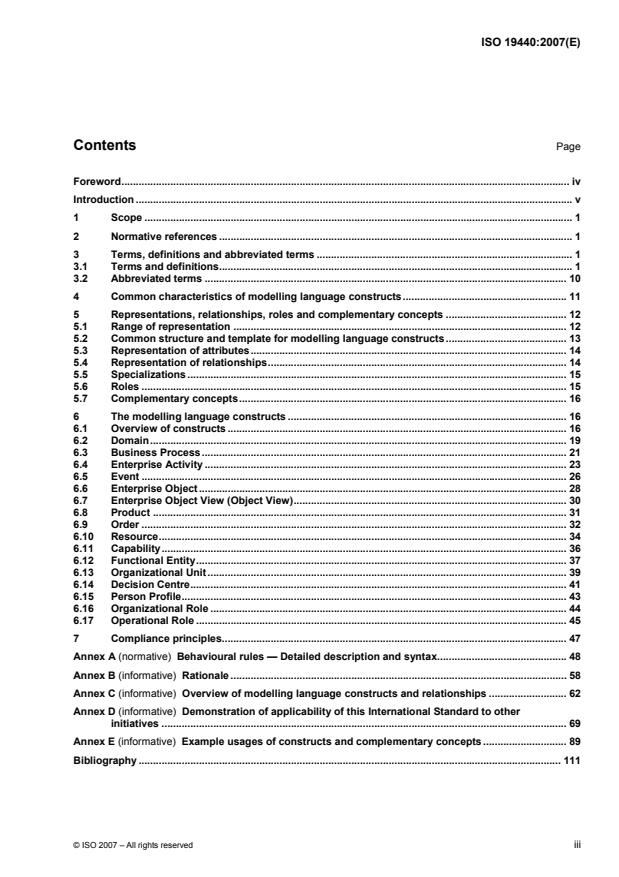
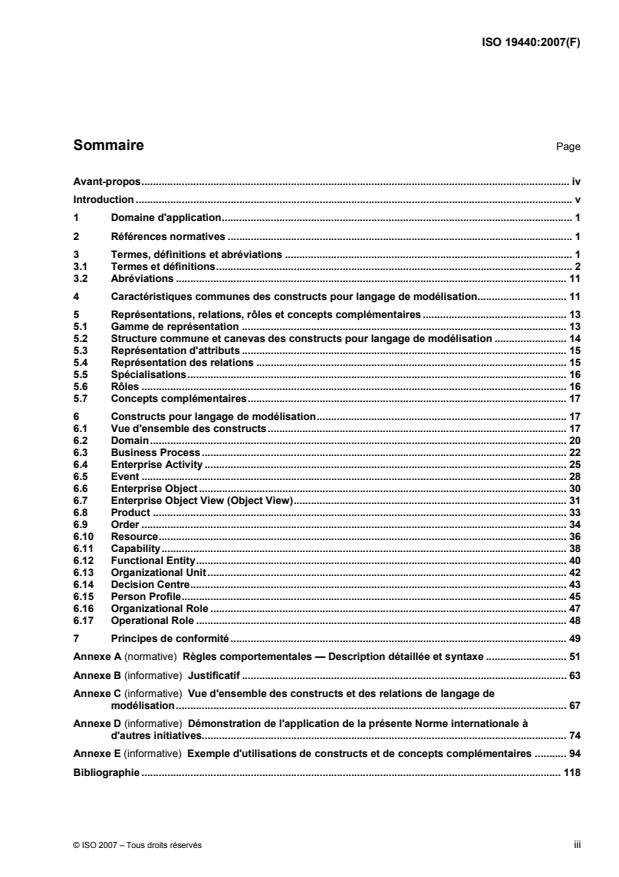
Contents Page
Foreword. iv
Introduction . v
1 Scope . 1
2 Normative references . 1
3 Terms, definitions and abbreviated terms . 1
3.1 Terms and definitions. 1
3.2 Abbreviated terms . 10
4 Common characteristics of modelling language constructs. 11
5 Representations, relationships, roles and complementary concepts . 12
5.1 Range of representation . 12
5.2 Common structure and template for modelling language constructs . 13
5.3 Representation of attributes. 14
5.4 Representation of relationships. 14
5.5 Specializations . 15
5.6 Roles . 15
5.7 Complementary concepts. 16
6 The modelling language constructs . 16
6.1 Overview of constructs . 16
6.2 Domain. 19
6.3 Business Process. 21
6.4 Enterprise Activity . 23
6.5 Event . 26
6.6 Enterprise Object. 28
6.7 Enterprise Object View (Object View). 30
6.8 Product . 31
6.9 Order . 32
6.10 Resource. 34
6.11 Capability. 36
6.12 Functional Entity. 37
6.13 Organizational Unit. 39
6.14 Decision Centre. 41
6.15 Person Profile. 43
6.16 Organizational Role . 44
6.17 Operational Role . 45
7 Compliance principles. 47
Annex A (normative) Behavioural rules — Detailed description and syntax. 48
Annex B (informative) Rationale . 58
Annex C (informative) Overview of modelling language constructs and relationships . 62
Annex D (informative) Demonstration of applicability of this International Standard to other
initiatives . 69
Annex E (informative) Example usages of constructs and complementary concepts . 89
Bibliography . 111
Foreword
ISO (the International Organization for Standardization) is a worldwide federation of national standards bodies
(ISO member bodies). The work of preparing International Standards is normally carried out through ISO
technical committees. Each member body interested in a subject for which a technical committee has been
established has the right to be represented on that committee. International organizations, governmental and
non-governmental, in liaison with ISO, also take part in the work. ISO collaborates closely with the
International Electrotechnical Commission (IEC) on all matters of electrotechnical standardization.
International Standards are drafted in accordance with the rules given in the ISO/IEC Directives, Part 2.
The main task of technical committees is to prepare International Standards. Draft International Standards
adopted by the technical committees are circulated to the member bodies for voting. Publication as an
International Standard requires approval by at least 75 % of the member bodies casting a vote.
Attention is drawn to the possibility that some of the elements of this document may be the subject of patent
rights. ISO shall not be held responsible for identifying any or all such patent rights.
ISO 19440 was prepared by the European Committee for Standardization (CEN) Technical Committee
CEN/TC 310, Advanced manufacturing technologies, in collaboration with Technical Committee ISO/TC 184,
Industrial automation systems and integration, Subcommittee SC 5, Architecture, communications and
integration frameworks, in accordance with the Agreement on technical cooperation between ISO and CEN
(Vienna Agreement).
iv © ISO 2007 – All rights reserved
Introduction
0.1 Background
This International Standard defines the generic concepts that are required to enable the creation of enterprise
models for industrial businesses and to provide support for the use of frameworks by industrial enterprises.
This International Standard builds upon ISO 19439 by defining and detailing a set of conformant user-oriented
modelling language constructs, which provide common semantics and enable the unification of models
developed by different stakeholders in the various phases of model development. Such models are aimed at
model-based support of operational decision-making and can be employed for model-based operation
monitoring and control.
The modelling language constructs defined in this International Standard can be specialized or organized or
both into structures for specific purposes, for example for an industry sector or for a particular kind of
enterprise concern such as maintenance. In turn, such structures and generic modelling language constructs
can be used for developing particular models for a particular enterprise. Annex B contains further background,
the rationale and benefit statements for this International Standard.
The general requirements that determine the characteristics of the core constructs necessary for computer-
supported modelling of enterprises are
⎯
the provision of an explicit model of Business Processes, with their dynamics, functions, information,
resources, organization and responsibilities,
⎯ sufficient detailing and qualification of enterprise components to allow the creation of a model for a
specific enterprise,
⎯ support for management of change, and
⎯ end-user-oriented representation to enable operational use.
An illustrative example shown in Annex E demonstrates the use of the modelling language constructs.
Annex B provides a rationale for construct-based enterprise modelling and sets out the background to this
International Standard and the framework for enterprise models on which it is based (see ISO 19349). The
three dimensions of this framework are described in 0.2, 0.3 and 0.4 below.
Contributions to this International Standard have been received from members of the IFAC/IFIP Task Force
on Enterprise Integration, the CIMOSA consortium and the European ATHENA research project.
NOTE Figures C.1 to C.6, D.1 to D.3 and D.5 to D.12 are computer-generated. Figures D.4 and E.1 to E.5 are line
drawings.
0.2 Dimension of enterprise model views
ISO 19439 and ISO 15704 use enterprise model views (often shortened to “model views”) to provide a
selective perception of an Enterprise that emphasizes some particular aspect of the matter under
consideration and disregards others. Specifically, they identify four enterprise model views (Function,
Information, Resource, Organization) that are to be addressed in a framework, architecture or methodology to
.
allow the modelling of the major aspects of an enterprise.Additionally, as stated in ISO 15704:2000,
A.3.1.5.3.2, “other . views may be defined if needed . and supported by the engineering tools”, e.g.
economic views, decision views, purpose views and implementation views. In this case, the constructs defined
in this International Standard can be augmented by additional attributes to support these other views, or
relevant new constructs might have to be defined. Therefore, the specifications of modelling language
constructs have to accommodate their intended usage and representation in one or several particular model
views. Automated tools are required to ensure consistency of construct instances that can appear in more
than one view.
0.3 Dimension of enterprise model phase
The life cycle of models and model components is addressed by the dimension of the enterprise model phase
in ISO 19439. This dimension is concerned with the development and evolution of the model of the domain to
be modelled, starting from the identification of the enterprise domain and progressing to a processable model
and the decommissioning thereof. Therefore, the specifications of modelling language constructs have to
accommodate their intended usage and representation in a particular model phase. Attributes of modelling
language constructs need to be adaptable and selectable for the different model phases according to the
envisioned needs.
0.4 Dimension of genericity
Relative to the dimension of genericity defined in ISO 19439, constructs reside at the generic level and can be
used at the partial and particular levels. At the partial level some attribute values can remain undefined for
partial instances (e.g. inputs/outputs for Events for Domains and inputs/outputs for Business Processes).
Such missing entries have then to be completed at the particular level.
vi © ISO 2007 – All rights reserved
INTERNATIONAL STANDARD ISO19440:2007(E)
Enterprise integration — Constructs for enterprise modelling
1 Scope
This International Standard specifies the characteristics of the core constructs necessary for computer-
supported modelling of enterprises conforming to ISO 19439.
This International Standard focuses on, but is not restricted to, the computer integration of the information
aspects of manufacturing, including the management and control technology and the required human tasks. It
does not specify how these core constructs for model-based operations are to be implemented and, in
particular, it does not include the control language needed to specify and execute (internal) activity behaviour,
nor the mapping between functional operations and capabilities.
NOTE Computer-supported modelling of enterprises can form a precursor to computer integration or human-system
intermediation.
2 Normative references
The following referenced documents are indispensable for the application of this document. For dated
references, only the edition cited applies. For undated references, the latest edition of the referenced
document (including any amendments) applies.
1)
ISO/IEC 14977, Information technology — Syntactic metalanguage — Extended BNF
ISO 19439:2006, Entreprise integration — Framework for enterprise modelling
3 Terms, definitions and abbreviated terms
3.1 Terms and definitions
For the purposes of this document, the following terms and definitions apply. Terms defined in
ISO/IEC 15288:2002, ISO 15531-1:2004, ISO 15704:2000 and ISO 19439:2006 and used in this International
Standard are repeated below for convenience.
NOTE The names of terms representing constructs are capitalized throughout this International Standard to aid the
reader in distinguishing them from general usages of the same term, specifically in order to distinguish the constructs
Capability, Domain, Enterprise Activity, Event and Resource from general usage of capability, domain (or enterprise
domain), enterprise activity, event and resource. These constructs are defined in 3.1 and specified in Clause 6.
3.1.1
aggregation
process of, or result of, combining modelling language constructs and other model components into a whole
entity
1) ISO/IEC 14977 is a freely available International Standard that can be downloaded free of charge from
http://isotc.iso.org/livelink/livelink/fetch/2000/2489/Ittf_Home/PubliclyAvailableStandards.htm.
NOTE 1 Modelling language constructs and other model components can be aggregated into more than one entity.
NOTE 2 Both Part_of and Consists_of attributes are used in the aggregation relationships described in Clause 5.
[ISO 19439:2006]
3.1.2
attribute
piece of information stating a property of an entity
[ISO 15704:2000]
3.1.3
behavioural rule
description of the logical sequencing relationships of constituent activities used in the specification of Business
Process behaviour
3.1.4
Business Process
〈enterprise modelling〉 construct that represents a partially ordered set of Business Processes or Enterprise
Activities, or both, that can be executed to realize one or more given objectives of an enterprise or a part of an
enterprise to achieve some desired end-result
3.1.5
capability
〈general〉 quality of being able to perform a given activity
[ISO 15531-1:2004]
3.1.6
Capability
〈enterprise modelling〉 construct that represents the collection of capability characteristics (expressed as
capability attributes) of either a Resource (its provided Capability) or an Enterprise Activity (its required
Capability)
NOTE Capabilities can be aggregated.
3.1.7
class
abstraction representing and encapsulating properties, relationships and behaviour, which distinguish a
collection of similar phenomena
NOTE Class is used in a very general sense without any connotation for implementation or for use with a specific
methodology.
3.1.8
classification
process of arranging abstractions into a structure, organized according to their distinguishing properties,
relationships and behaviour
3.1.9
component
〈general〉 entity that is part of, or capable of becoming part of, a larger whole
NOTE Adapted from ISO 19439:2006.
3.1.10
component
〈system〉 entity, with discrete structure within a system, that interacts with other components of the system,
thereby contributing to the system properties and characteristics
NOTE Adapted from ISO/IEC 15288:2002.
2 © ISO 2007 – All rights reserved
3.1.11
concept definition
enterprise model phase that defines the business concepts of an enterprise domain to be employed in
realizing its business objectives and its operation, including the necessary enterprise domain inputs and
outputs
[ISO 19439:2006]
3.1.12
constraint
restriction or limitation or condition placed upon a system that originates from inside or outside the system
under consideration
[ISO 19439:2006]
3.1.13
construct-based modelling language
set of constructs and rules for valid groupings, which define the syntax of the modelling language
3.1.14
construct label
literal string defined for each construct template, denoting the kind of construct
3.1.15
construct template
common structure that allows the identification and description of particular modelling language constructs
and the assignment of their properties
3.1.16
declarative rule
set of objectives and constraints combined with a non-computational set of conditions
NOTE Declarative rules can be imposed within Domains on Business Processes.
3.1.17
Decision Centre
〈enterprise modelling〉 construct that represents a set of decision-making activities that are characterized by
having the same time horizon and planning period and belonging to the same kind of functional category
NOTE The terminology used to describe aspects of Decision Centre is found in ISO 15704:2000/Amd.1:2005,
Annex C, which defines [time] horizon as “the part of the future taken into account by a decision, i.e. the horizon is six
months when a decision is taken on a time interval of six months” and [planning] period as “the time that passes between
a decision and when this decision shall be re-evaluated”.
3.1.18
decommission definition
enterprise model phase that defines the final state of a decommissioned operational system, all its
components for a particular enterprise domain and the processes employed to conduct the decommissioning,
so enabling reuse or disposition of those components
[ISO 19439:2006]
3.1.19
derivation
〈enterprise modelling〉 process of elaborating enterprise models at successive enterprise model phases from
the models established at preceding phases, reusing the available contents and extending them according to
the needs expressed for the particular model phase
3.1.20
design specification
enterprise model phase that specifies the Business Processes together with Capabilities and rules that are to
be performed to achieve the requirements
NOTE Adapted from ISO 19439:2006.
3.1.21
Domain
〈enterprise modelling〉 construct that represents the portion of an enterprise to be modelled providing for
identification of the relevant information
3.1.22
domain identification
enterprise model phase that identifies the enterprise domain to be modelled with respect to its business
objectives, the enterprise domain inputs and outputs and their respective origins and destinations
NOTE Adapted from ISO 19439:2006.
3.1.23
domain operation
enterprise model phase that encompasses the operational use of the domain model
NOTE Adapted from ISO 19439:2006.
3.1.24
enterprise activity
〈general〉 all, or part, of the lowest level of process functionality required by user objectives that consists of
functional operations performed in the enterprise that consume inputs and allocate time and resources to
produce outputs
NOTE Adapted from ISO 19439:2006.
3.1.25
Enterprise Activity
〈enterprise modelling〉 construct that represents a certain part of the lowest level of enterprise functionality
required by user objectives and identifies the inputs needed for its execution and the outputs created as a
result
3.1.26
enterprise domain
part of the enterprise considered relevant to a given set of business objectives and constraints for which an
enterprise model is to be created
NOTE In this International Standard, “enterprise domain” is abbreviated to “domain” whenever it is used as a qualifier
in such terms as “domain identification phase” and “domain model”. Other usages of “domain” have the normal dictionary
meaning.
3.1.27
enterprise model
abstraction that represents enterprise entities, their interrelationships, decomposition and detailing, to the
extent necessary to convey what the enterprise intends to accomplish and how it operates
NOTE Adapted from ISO 19439:2006.
3.1.28
enterprise model phase
life cycle phase of an enterprise model
[ISO 19439:2006]
4 © ISO 2007 – All rights reserved
3.1.29
enterprise model view
model view
selective perception or representation of an enterprise model, which emphasizes some particular aspect and
disregards others
[ISO 19439:2006]
3.1.30
Enterprise Object
〈enterprise modelling〉 construct that represents a piece of information in the enterprise and that describes a
generalized or a real or an abstract entity which can be conceptualized as being a whole
NOTE 1 The usage of Enterprise Object is restricted to those situations where only the information aspects of the entity
under consideration are relevant.
NOTE 2 All other constructs in this International Standard represent entities that have specific semantics requiring
particular attributes and additional descriptions.
NOTE 3 Adapted from ISO 19439:2006.
3.1.31
Enterprise Object View
Object View
〈enterprise modelling〉 construct that represents a collection of attributes of an Enterprise Object for some
particular purpose
NOTE The collection is defined by a selection of attributes and possibly constraints on those attributes.
3.1.32
entity
any concrete or abstract thing in the domain under consideration
[ISO 19439:2006]
3.1.33
Event
〈enterprise modelling〉 construct that represents a solicited or unsolicited fact indicating a state change in the
enterprise or its environment
NOTE An event can be associated with an Object View containing information related to the Event.
3.1.34
function view
enterprise model view that enables the representation and modification of the processes of the enterprise,
their functionalities, behaviour, inputs and outputs
[ISO 19439:2006]
3.1.35
Functional Entity
〈enterprise modelling〉 construct that is a specialization of the Resource construct, which represents an
aggregation of Resources and Operational Roles able to perform, completely on its own, a (class of)
functional operation(s) required by an Enterprise Activity and to communicate with the related control system
NOTE A characteristic of a functional entity is its ability to receive, process, store and send information.
3.1.36
functional category
grouping of entities for expression of a common purpose or capability
3.1.37
functional operation
basic unit of work and lowest level of granularity in the function view
NOTE Functional operations are identified in the design specification phase following from a decomposition of the
required capabilities of an Enterprise Activity (the task) into subtasks that can then be matched to the capabilities provided
by the assigned Functional Entities.
3.1.38
generalization
specific concept modified for a more general extent, use or purpose, or act of removing or modifying detail
from a specific concept to produce a generalization thereof
NOTE 1 Generalization is the inverse of specialization.
NOTE 2 Adapted from ISO 19439:2006.
3.1.39
generic level
collection of generic modelling language constructs for expressing descriptions that can be used to generate
models at the partial and particular levels
[ISO 19439:2006]
3.1.40
implementation description
enterprise model phase that describes the final set of processes, resources and rules implemented to achieve
the desired operational performance for execution of Business Processes and Enterprise Activities specified in
the design specification phase
[ISO 19439:2006]
3.1.41
information technology component
component that is required to undertake one or several of the collection, processing, distribution, storage or
verification of data for Enterprise Activities in the enterprise
NOTE Adapted from ISO 19439:2006.
3.1.42
information view
enterprise model view that enables the representation and modification of the enterprise information as
identified in the function view
NOTE 1 It is organized as a structure containing enterprise objects that represent the information-related entities of the
enterprise (material and information).
NOTE 2 Adapted from ISO 19439:2006.
3.1.43
instantiation
creation of instances of modelling language constructs or partial models and the possible assignment of
values to some or all attributes
NOTE A fully instantiated modelling language construct or model is one for which values have been assigned to all
attributes.
[ISO 19439:2006]
6 © ISO 2007 – All rights reserved
3.1.44
integrate
ensure the interaction between all enterprise entities that is necessary to achieve a given purpose in a given
constrained environment
NOTE Integration is the result of this method.
3.1.45
integrity rule
statement in the requirements definition phase concerning restrictions on information to ensure conformity to
real-world reality.
NOTE Integrity rules are used to define these restrictions in terms of constraints on attributes of Enterprise Objects.
3.1.46
life cycle
set of distinguishable phases and steps within phases that an entity goes through from its creation until it
ceases to exist
[ISO 19439:2006]
3.1.47
life cycle phase
stage of development in the life cycle of an entity
NOTE Adapted from ISO 19439:2006.
3.1.48
manufacturing technology component
component that is required to undertake one or several of the control, transformation, transport, storage or
verification of raw materials, parts, (sub-)assemblies and end products
NOTE Adapted from ISO 19439:2006.
3.1.49
model
abstract description of reality in any form (including mathematical, physical, symbolic, graphical, or
descriptive) that presents certain aspects of that reality
NOTE Adapted from ISO 19439:2006.
3.1.50
modelling language construct
construct
textual or graphical part of a modelling language devised to represent, in an orderly way, the diverse
information on common properties and elements of a collection of enterprise entities
NOTE Adapted from ISO 19439:2006.
3.1.51
objective
statement of preference about possible and achievable future situations that influences the choices within
some behaviour
[ISO 19439:2006]
3.1.52
occurrence
〈enterprise modelling〉 single, actual realization of a modelling language construct that represents a particular
entity in the real world at the time the model is processed
3.1.53
Operational Role
〈enterprise modelling〉 construct that represents the relevant human skills and responsibilities required to
perform those operational tasks that are assigned to the particular Operational Role
3.1.54
Order
〈enterprise modelling〉 construct that is a specialization of the Enterprise Object construct, which represents
the information for planning and control of Business Processes in an enterprise
NOTE An Order can be represented by an Object View that is associated with an Event.
3.1.55
Organizational Role
〈enterprise modelling〉 construct that represents, within a given hierarchical structure of an enterprise, the
organizationally relevant human skills and responsibilities required to perform those organizational tasks that
are assigned to the particular Organizational Role
3.1.56
Organizational Unit
〈enterprise modelling〉 construct that represents an entity of the organizational structure of an enterprise,
which is described by attributes of the organization and references to both lower- and higher-level
organizational entities
NOTE Examples of Organizational Unit could be department or division.
3.1.57
organization view
enterprise model view that enables the representation and modification of the organizational and decisional
structure of the enterprise and the responsibilities and authorities of the persons and organization units within
the enterprise
NOTE Adapted from ISO 19439:2006.
3.1.58
partial level
collection of partial models
[ISO 19439:2006]
3.1.59
partial model
model used as a reference model in a specific type of industry segment or industrial activity
NOTE 1 A partial model is comprised of modelling language constructs or other partial models. Partial models also
enable a modeller to reuse already existing models built for other domains.
NOTE 2 Adapted from ISO 19439:2006.
3.1.60
particular level
level at which a model is described for a particular, specific enterprise domain
[ISO 19439:2006]
8 © ISO 2007 – All rights reserved
3.1.61
particularization
process of specialization and instantiation by which more specific model components can be derived from
more generic ones
[ISO 19439:2006]
3.1.62
performance indicator
a metric or measure by which the achievement of an objective can be assessed
3.1.63
Person Profile
〈enterprise modelling〉 construct that represents a set of personal skills and responsibilities that are required
by an Organizational Unit or an Enterprise Activity, or both, and that are provided by a person
NOTE Person Profiles can be assigned to more than one person and conversely a person can fulfil more than one
Person Profile for more than one Organizational Unit or Enterprise Activity.
3.1.64
processable model
model with specified syntax and semantics, which can be processed by a computer (for analysis, simulation or
execution)
3.1.65
Product
〈enterprise modelling〉 construct that is a specialization of the Enterprise Object construct, which represents
the desired output or by-product of the Business Processes of an enterprise
3.1.66
relationship
association between two or more entities that is significant for some intended purpose
3.1.67
requirements definition
enterprise model phase that defines the enterprise operations needed to achieve enterprise objectives and the
conditions necessary to enable those operations, both being without reference to implementation options or
implementation decisions
NOTE Adapted from ISO 19439:2006.
3.1.68
resource
〈general〉 enterprise entity that provides some or all of the capabilities required to execute an enterprise
activity
NOTE In this International Standard, resource is used in the system theory sense of entities that provide capabilities
required by the system and are an essential part of the system itself. The resource description includes the identification
and description of consumables (such as energy, air, coolant) that are required to be present in sufficient quantities to
operate the resource. In contrast, material is reserved for process inputs that are required by the various processes, such
as raw materials, parts and assemblies. These inputs are identified in the function view, described in the information view,
and have the associated management responsibilities identified in the organization view.
[ISO 19439:2006]
3.1.69
Resource
〈enterprise modelling〉 construct that is a specialization of the Enterprise Object construct, which represents
the provided capabilities available to execute an Enterprise Activity
NOTE The Resource construct does not include human resources.
3.1.70
resource view
enterprise model view that enables the representation and modification of enterprise resources and persons
NOTE 1 The resource view is organized as a structure containing Enterprise Objects representing the set of resources
and set of persons required to execute enterprise operations.
NOTE 2 Adapted from ISO 19439:2006.
3.1.71
specialization
general concept modified for a more limited extent, specific use or purpose, or act of adding to, or modifying
details of, a general concept to produce a specialization thereof
NOTE 1 Specialization is the inverse of generalization.
NOTE 2 When referring to a class, specialization involves the construction of subclasses within a class for a particular
purpose, where the members of each subclass have one or more characteristics (attributes, relationships, behaviour or
semantics) in common which are not shared by all other members of the class. When referring to a model, it refers to the
progression from generic concepts to partial models and particular models.
NOTE 3 Adapted from ISO 19439:2006.
3.1.72
system
collection of real-world items organized for a given purpose
[ISO 19439:2006]
3.1.73
universe of discourse
collection of entities that ever have been, are, or always will be, in a selected portion of the real world or
postulated world of interest that is being described by the models
3.2 Abbreviated terms
ATHENA Advanced Technologies for interoperability of Heterogeneous Enterprise Networks and their
Applications
CIM Computer Integrated Manufacturing
GRAI Graphes à Résultats et Activités Interreliés (Graphs of Interrelated Results and Activities)
IFAC International Federation of Automatic Control
IFIP International Federation for Information Processing
ODP Open Distributed Processing
POP* Process – Organization – Product – Others
PSL Process Specification Language
XML eXtensible Markup Language
10 © ISO 2007 – All rights reserved
4 Common characteristics of modelling language constructs
Modelling languages that are based on a set of common generic modelling language constructs simplify the
creation of enterprise models, increase modelling efficiency and improve model understanding and
interoperability across organizations and even across industries. Such constructs should be capable of
representing the many different entities that exist in enterprises.
NOTE 1 The constructs defined in this International Standard are set out in Clause 6. A construct is an element of a
modelling language, the syntax and semantics of which are defined as precisely as possible for the purposes of
compliance testing as described in Clause 7. However, in its present stage of development this International Standard
does not propose a formal notation for these purposes.
Adaptation of these constructs to different stakeholder languages appropriate for their purposes might require
different forms of representation for some enterprise model phases, but such forms should maintain to the
extent possible the underlying semantics of the constructs. In addition, the set of generic modelling language
constructs may be augmented by more specialized construct classes to increase the modelling efficiency or to
address requirements of any additional modelling views.
This International Standard is concerned with business process-oriented enterprise modelling. Therefore, the
enterprise entities to be represented shall be Business Processes with their dynamics (control flow/process
behaviour), functionalities (activities, inputs/outputs, control, resources) and organizational aspects. These
entities shall be represented at the different model phases and described at the appropriate level of detail. In
addition, the representation of aggregations shall be supported not only for the Business Process/Enterprise
Activity relation, but also for the enterprise entities that are affected by those Business Processes. Function-,
information-, resource- and organization-model views shall be used to provide the foundation for user-oriented
modelling. Those model views shall allow the identification of relevant object hierarchies and relationships
between the different classes and subclasses.
[1] [9] [8] [4]
NOTE 2 EXPRESS , PSL and Petri nets are single-view languages, while the Enterprise Language of ODP ,
[10]
the ATHENA POP* and this International Standard support multi-view enterprise modelling. Petri nets target general
discrete event systems modelling, including manufacturing systems. PSL is a neutral language for specifying
manufacturing process information. EXPRESS is an abstract language (with syntax and semantics) for modelling a
population of entities and their data attributes. Petri nets, PSL and EXPRESS are formal languages that are computer
[4]
executable, while ODP’s Enterprise Language and the constructs of this International Standard are neither. ODP ,
[10]
POP* and this International Standard do not have the same viewpoints (known in this International Standard as model
views) and coverage. POP* and this International Standard adopt a more process-oriented modelling approach aimed at
producing an operational process monitoring and control model. In contrast, ODP has a broader coverage with its five
viewpoints (Enterprise, Information, Computation, Engineering and Technology). The ODP Enterprise viewpoint is most
relevant to this International Standard, focusing as it does on enterprise level concepts such as the purpose, scope and
policies of the system.
Modelling of the enterprise shall be supported at all enterprise model phases by modelling language
constructs as follows:
⎯ at the domain identification phase, to identify the contents of the domain and its inputs and outputs, in
such a way that the domain identification model can be used as the starting point for a derivation of a
consistent concept definition model;
⎯ at the concept definition phase, to define underlying missions, strategies, etc., and in such a way that the
concept definition model can be used as the starting point for a derivation of a consistent requirement
definition model;
⎯ at the requirements definition phase, to describe the Business Processes of the Domain from a business
viewpoint, in such a way that the requirements definition model can be demonstrated to be sufficient for
use as the starting point for the derivation of a consistent design specification model. Therefore the
requirements definition model shall also be capable of being processed;
⎯ at the design specification phase, to specify the Business Processes with all their components from both
a business and ICT viewpoint, in such a way that the design specification model can be demonstrated to
be sufficient for use as the starting point for a consistent derivation of an implementation description
model: therefore the design specification model shall also be capable of being processed; at the design
specification phase, constructs shall be derived from those of the requirements definition phase by
enriching them with attributes that reflect all resources and general ICT interfaces;
⎯ at the implementation description phase, to describe the Business Processes with all their components as
they are implemented in the actual system from both a business and ICT viewpoint, in such a way that
the implementation model can be demonstrated to be sufficient for use in the operation of the enterprise
for decision support and Business Process monitoring and control: therefore the implementation model
shall also be capable of being processed; at the implementation description phase, constructs shall reflect
the hardware/software platform or technology chosen to be consistent with design specification
constructs;
⎯ at the domain operation phase, to use the released model for operational purposes such as decision
support, monitoring and control;
⎯ at the decommission definition phase, to identify future use of the Business Process components, in such
a way that the decommission definition model can be used, as appropriate, as the starting point for reuse
at any model phase.
However, this does not mean there will be a different set of modelling language constructs required for each
model phase. Constructs and construct instances are carried forward to subsequent model phases by
providing an enhanced attribute list to capture additional needed information for representing and describing
the enterprise entities at those model phases or by mapping onto different construct representations.
Clause E.2 summarizes the identification and usage of constructs in each model phase.
NOTE 3 The applicability of the modelling language constructs is demonstrated in Annex D, using ODP and the
ATHENA work on POP* as examples.
5 Representations, relationships, roles and complementary concepts
5.1 Range of representation
Modelling language constructs shall be represented in a form that is both understandab
...
NORME ISO
INTERNATIONALE 19440
Première édition
2007-12-01
Entreprise intégrée — Constructions pour
la modélisation d'entreprise
Enterprise integration — Constructs for enterprise modelling
Numéro de référence
©
ISO 2007
PDF – Exonération de responsabilité
Le présent fichier PDF peut contenir des polices de caractères intégrées. Conformément aux conditions de licence d'Adobe, ce fichier
peut être imprimé ou visualisé, mais ne doit pas être modifié à moins que l'ordinateur employé à cet effet ne bénéficie d'une licence
autorisant l'utilisation de ces polices et que celles-ci y soient installées. Lors du téléchargement de ce fichier, les parties concernées
acceptent de fait la responsabilité de ne pas enfreindre les conditions de licence d'Adobe. Le Secrétariat central de l'ISO décline toute
responsabilité en la matière.
Adobe est une marque déposée d'Adobe Systems Incorporated.
Les détails relatifs aux produits logiciels utilisés pour la création du présent fichier PDF sont disponibles dans la rubrique General Info
du fichier; les paramètres de création PDF ont été optimisés pour l'impression. Toutes les mesures ont été prises pour garantir
l'exploitation de ce fichier par les comités membres de l'ISO. Dans le cas peu probable où surviendrait un problème d'utilisation,
veuillez en informer le Secrétariat central à l'adresse donnée ci-dessous.
DOCUMENT PROTÉGÉ PAR COPYRIGHT
© ISO 2007
Droits de reproduction réservés. Sauf prescription différente, aucune partie de cette publication ne peut être reproduite ni utilisée sous
quelque forme que ce soit et par aucun procédé, électronique ou mécanique, y compris la photocopie et les microfilms, sans l'accord écrit
de l'ISO à l'adresse ci-après ou du comité membre de l'ISO dans le pays du demandeur.
ISO copyright office
Case postale 56 • CH-1211 Geneva 20
Tel. + 41 22 749 01 11
Fax + 41 22 749 09 47
E-mail copyright@iso.org
Web www.iso.org
Version française parue en 2009
Publié en Suisse
ii © ISO 2007 – Tous droits réservés
Sommaire Page
Avant-propos. iv
Introduction . v
1 Domaine d'application. 1
2 Références normatives . 1
3 Termes, définitions et abréviations . 1
3.1 Termes et définitions. 2
3.2 Abréviations . 11
4 Caractéristiques communes des constructs pour langage de modélisation. 11
5 Représentations, relations, rôles et concepts complémentaires . 13
5.1 Gamme de représentation . 13
5.2 Structure commune et canevas des constructs pour langage de modélisation . 14
5.3 Représentation d'attributs . 15
5.4 Représentation des relations . 15
5.5 Spécialisations. 16
5.6 Rôles . 16
5.7 Concepts complémentaires. 17
6 Constructs pour langage de modélisation. 17
6.1 Vue d'ensemble des constructs. 17
6.2 Domain. 20
6.3 Business Process. 22
6.4 Enterprise Activity . 25
6.5 Event . 28
6.6 Enterprise Object. 30
6.7 Enterprise Object View (Object View). 31
6.8 Product . 33
6.9 Order . 34
6.10 Resource. 36
6.11 Capability. 38
6.12 Functional Entity. 40
6.13 Organizational Unit. 42
6.14 Decision Centre. 43
6.15 Person Profile. 45
6.16 Organizational Role . 47
6.17 Operational Role . 48
7 Principes de conformité. 49
Annexe A (normative) Règles comportementales — Description détaillée et syntaxe . 51
Annexe B (informative) Justificatif . 63
Annexe C (informative) Vue d'ensemble des constructs et des relations de langage de
modélisation. 67
Annexe D (informative) Démonstration de l'application de la présente Norme internationale à
d'autres initiatives. 74
Annexe E (informative) Exemple d'utilisations de constructs et de concepts complémentaires . 94
Bibliographie . 118
Avant-propos
L'ISO (Organisation internationale de normalisation) est une fédération mondiale d'organismes nationaux de
normalisation (comités membres de l'ISO). L'élaboration des Normes internationales est en général confiée
aux comités techniques de l'ISO. Chaque comité membre intéressé par une étude a le droit de faire partie du
comité technique créé à cet effet. Les organisations internationales, gouvernementales et non
gouvernementales, en liaison avec l'ISO participent également aux travaux. L'ISO collabore étroitement avec
la Commission électrotechnique internationale (CEI) en ce qui concerne la normalisation électrotechnique.
Les Normes internationales sont rédigées conformément aux règles données dans les Directives ISO/CEI,
Partie 2.
La tâche principale des comités techniques est d'élaborer les Normes internationales. Les projets de Normes
internationales adoptés par les comités techniques sont soumis aux comités membres pour vote. Leur
publication comme Normes internationales requiert l'approbation de 75 % au moins des comités membres
votants.
L'attention est appelée sur le fait que certains des éléments du présent document peuvent faire l'objet de
droits de propriété intellectuelle ou de droits analogues. L'ISO ne saurait être tenue pour responsable de ne
pas avoir identifié de tels droits de propriété et averti de leur existence.
L'ISO 19440 a été élaborée par le comité technique CEN/TC 310, Technologies d'automatisation avancée et
leurs applications du comité européen de normalisation (CEN), en collaboration avec le comité technique
ISO/TC 184, Systèmes d'automatisation et intégration, sous-comité SC 5, Architecture, communications et
structures d'intégration, conformément à l'accord de coopération technique entre l'ISO et le CEN (Accord de
Vienne).
iv © ISO 2007 – Tous droits réservés
Introduction
0.1 Fondement
La présente Norme internationale définit les concepts génériques requis afin de rendre possible la création de
modèles d'entreprise pour les activités industrielles et pour fournir l'assistance à l'utilisation de cadres de
modélisation aux entreprises industrielles. La présente Norme internationale bâtie sur l'ISO 19439 définit et
détaille un ensemble de constructs pour langage de modélisation orienté utilisateurs, conformes à cette
dernière; cet ensemble fournissant alors une sémantique commune et permettant l'unification de modèles
développés par différentes parties prenantes dans les différentes phases du développement de modèles. De
tels modèles sont appropriés à l'assistance à la prise de décision opérationnelle basée sur la modélisation et
peuvent être employés pour le contrôle et la surveillance des opérations également basés sur la modélisation.
Les constructs pour langage de modélisation définis dans la présente Norme internationale peuvent être
spécialisés et/ou organisés dans des structures adaptées à des objectifs particuliers, par exemple pour un
secteur industriel ou un type de préoccupation de l'entreprise tel que la maintenance. À leur tour, ces
structures et ces constructions pour langage de modélisation générique peuvent être utilisés pour développer
des modèles spécifiques pour une entreprise particulière. L'Annexe B contient des compléments sur le
fondement ainsi que la justification et l'exposé des avantages de la présente Norme internationale.
Les exigences générales qui déterminent les caractéristiques du noyau de constructs nécessaires à la
modélisation d'entreprise assistée par ordinateur, sont
⎯ la fourniture d'un modèle explicite de «Business Processes» avec leurs dynamiques, leurs fonctions, leur
information, leurs ressources, leur organisation et leurs responsabilités,
⎯ un niveau de qualification et de détail des composants de l'entreprise, suffisant pour autoriser la création
d'un modèle pour une entreprise spécifique,
⎯ l'assistance à la gestion des changements, et
⎯ une représentation orientée utilisateur pour rendre possible une utilisation opérationnelle.
Dans l'Annexe E, un exemple illustre l'utilisation des constructs pour langage de modélisation.
L'Annexe B fournit la justification de la modélisation d'entreprise basée sur des constructs et fixe le fondement
de la présente Norme internationale ainsi que le cadre pour la modélisation d'entreprise sur lequel elle est
basée (voir l'ISO 19349). Les trois dimensions de ce cadre sont décrites en 0.2, 0.3 et 0.4.
Les contributions à la présente Norme internationale ont été reçues des membres du groupe de travail de
l'IFAC/IFIP sur l'entreprise intégrée, du consortium CIMOSA et du projet de recherche européen ATHENA.
NOTE Les Figures C.1 à C.6, D.1 à D.3 et D.5 à D.12 sont générées par ordinateur. Les Figures D.4 et E.1 à E.5
sont des dessins au trait.
0.2 Dimension des vues pour modèle d'entreprise
L'ISO 19439 et l'ISO 15704 utilisent des vues de modèle d'entreprise (souvent raccourcies en «vue de
modèle») pour fournir une perception sélective d'une Entreprise qui accentue certains aspects particuliers du
sujet considéré et néglige les autres. Elles identifient spécifiquement quatre vues de modèle d'entreprise
(Fonction, Information, Ressource, Organisation) qui doivent être prises en compte dans un cadre de
modélisation, une architecture ou une méthodologie pour permettre la modélisation des aspects essentiels
d'une entreprise. De plus, comme spécifié dans l'ISO 15704:2000, A.3.1.5.3.2, «d'autres . vues peuvent, si
nécessaire, être définies . et bénéficier du support d'outils d'ingénierie», par exemple des vue économiques,
des vues décisions, des vues perspective, des vues implémentation. Dans ce cas, les constructs définis dans
la présente Norme internationale peuvent être enrichis par des attributs additionnels pour appuyer ces autres
vues mais on peut aussi être amené à définir de nouveaux constructs qui leur sont appropriés. Par
conséquent, les spécifications de constructs pour langage de modélisation doivent prendre en compte leur
utilisation escomptée et leur représentation dans une ou plusieurs vues particulières pour modèle. Des outils
automatisés sont nécessaires pour s'assurer de la cohérence des instances de constructs lorsqu'ils peuvent
apparaître dans plus d'une vue.
0.3 Dimension de la phase d'un modèle d'entreprise
Le cycle de vie de modèles et de composants de modèles est traité dans l'ISO 19439 par la dimension de la
phase d'un modèle d'entreprise. Cette dimension concerne le développement et l'évolution du modèle du
domaine à modéliser, depuis l'identification du domaine d'entreprise en passant par le modèle traitable par
ordinateur et jusqu'à son déclassement. En conséquence, les spécifications de constructs pour langage de
modélisation doivent prendre en compte leur utilisation escomptée et leur représentation dans une phase de
modèle particulière. Les attributs des constructs pour langage de modélisation doivent être adaptables et
sélectionnables pour des phases de modélisation différentes de manière appropriée aux besoins prévus.
0.4 Dimension de généricité
Pour ce qui concerne la dimension de généricité définie dans l'ISO 19439, les constructs se situent au niveau
générique et peuvent être utilisés aux niveaux partiels et particuliers. Au niveau partiel, certaines valeurs
d'attributs peuvent rester non définies pour des instances au niveau partiel (par exemple des entrées/sorties
pour des événements de domaines et des entrées/sorties pour des «Business Processes»). De telles entrées
manquantes doivent être complétées au niveau particulier.
vi © ISO 2007 – Tous droits réservés
NORME INTERNATIONALE ISO 19440:2007(F)
Entreprise intégrée — Constructions pour la modélisation
d'entreprise
1 Domaine d'application
La présente Norme internationale spécifie les caractéristiques du noyau de constructs nécessaires pour la
modélisation d'entreprise assistée par ordinateur en conformité avec l'ISO 19439.
La présente Norme internationale privilégie, mais ne se limite pas à l'intégration par ordinateur de l'aspect
informationnel de la fabrication, y compris la gestion et le contrôle technologique et les tâches humaines. Elle
ne spécifie pas la manière dont ce noyau de constructs destinés à des opérations basées sur des modèles,
doivent être mis en place et, en particulier, elle n'inclut pas le langage de contrôle nécessaire pour spécifier et
concrétiser un comportement (interne) d'activité, ni la mise en correspondance entre opérations fonctionnelles
et aptitudes.
NOTE La modélisation d'entreprises assistée par ordinateur peut constituer une première étape vers l'intégration
informatique ou être utilisée comme intermédiaire entre les hommes et le système.
2 Références normatives
Les documents de référence suivants sont indispensables pour l'application du présent document. Pour les
références datées, seule l'édition citée s'applique. Pour les références non datées, la dernière édition du
document de référence s'applique (y compris les éventuels amendements).
1)
ISO/CEI 14977, Technologies de l'information — Métalangage syntaxique — BNF étendu
ISO 19439:2006, Entreprise intégrée — Cadre de modélisation d'entreprise
3 Termes, définitions et abréviations
Pour les besoins du présent document, les termes et définitions suivants s'appliquent. Les termes définis
dans l'ISO/CEI 15288:2002, l'ISO 15531-1:2004, l'ISO 15704:2000 et l'ISO 19439:2006, utilisés dans la
présente Norme internationale sont répétés ci-dessous par commodité.
NOTE Les noms des termes représentant des constructs sont écrits avec une lettre initiale en majuscule tout au long
de la présente Norme internationale pour aider le lecteur à les distinguer de l'usage général des mêmes termes, en
particulier pour distinguer les constructs «Capability» (Aptitude), «Domain» (Domaine), «Enterprise Activity» (Activité
d'entreprise), «Event» (Événement) et «Resource» (Ressource) de l'utilisation générale d'aptitude, domaine (ou domaine
d'entreprise), activité d'entreprise, événement et ressource. Ces constructs sont définis en 3.1 et spécifiés dans l'Article 6.
1) L’ISO/CEI 14977 est une Norme internationale librement accessible qui peut être téléchargée gratuitement à l’adresse
suivante: http://isotc.iso.org/livelink/livelink/fetch/2000/2489/Ittf_Home/PubliclyAvailableStandards.htm
3.1 Termes et définitions
3.1.1
agrégation
processus ou résultat de combinaison de constructs pour langage de modélisation et d'autres composants de
modèle en une entité globale
NOTE 1 Les constructs pour langage de modélisation et les autres composants de modèles peuvent être agrégés en
plus d'une entité.
NOTE 2 Les attributs «Part_of» (Élément_de) et «Consists_of» (Consiste_en) sont tous les deux utilisés dans la
relation d'agrégation décrite dans l'Article 5.
[ISO 19439:2006]
3.1.2
attribut
élément d'information énonçant une propriété d'une entité
[ISO 15704:2000]
3.1.3
règle comportementale
description des relations logiques de séquencement des activités constituantes d'un «Business Process»
utilisée dans la spécification de son comportement
3.1.4
«Business Process» (Processus Métier)
〈modélisation d'entreprise〉 construct qui représente un ensemble partiellement ordonné de «Business
Processes» ou «Enterprise Activities» ou les deux, pouvant être exécuté pour réaliser un ou plusieurs
objectifs donnés d'une entreprise ou d'une partie de celle-ci afin d'atteindre un résultat escompté
3.1.5
aptitude
〈généralité〉 qualité d'être capable d'accomplir une activité donnée
[ISO 15531-1:2004]
3.1.6
«Capability» (Aptitude)
〈modélisation d'entreprise〉 construct qui représente la collection des caractéristiques d'aptitude (exprimées
comme des attributs d'aptitude) soit d'une Ressource (son Aptitude proposée) soit d'une «Enterprise Activity»
(son Aptitude demandée)
NOTE Les Aptitudes peuvent être agrégées.
3.1.7
classe
abstraction représentant et encapsulant des propriétés, des relations et des comportements, l'ensemble
différenciant ainsi une collection de phénomènes similaires
NOTE La classe est utilisée dans un sens très général sans aucune connotation relative à une implémentation ou
une utilisation liée à une méthodologie particulière.
3.1.8
classification
processus d'arrangement d'abstractions en une structure organisée par rapport aux propriétés, relations et
comportements qui les distinguent
2 © ISO 2007 – Tous droits réservés
3.1.9
composant
〈généralité〉 entité qui fait partie de, ou capable de devenir une partie d'un tout plus large
NOTE Adapté de l'ISO 19439:2006.
3.1.10
composant
〈système〉 entité avec une structure discrète à l'intérieur d'un système, qui interagit avec d'autres composants
du système, contribuant ainsi aux propriétés et aux caractéristiques de ce système
NOTE Adapté de l'ISO/CEI 15288:2002.
3.1.11
définition de concepts
phase d'un modèle d'entreprise définissant dans un domaine d'entreprise les concepts métiers à employer
dans la réalisation des objectifs métiers et dans l'exploitation de celui-ci, y compris les entrées et sorties qui
lui sont nécessaires
[ISO 19439:2006]
3.1.12
contrainte
restriction, limitation ou condition imposée à un système, qui trouve son origine à l'intérieur ou à l'extérieur
dudit système
[ISO 19439:2006]
3.1.13
langage de modélisation basé sur des constructs
ensemble de constructs et de règles pour regroupements valides, définissant la syntaxe du langage de
modélisation
3.1.14
label de construct
chaîne littérale définie pour chaque canevas de construct et indiquant son type
3.1.15
canevas de construct
structure commune qui permet l'identification et la description de constructs particuliers pour langage de
modélisation et la désignation de leurs propriétés
3.1.16
règle déclarative
ensemble d'objectifs et de contraintes combinés avec un ensemble de conditions non traitables
informatiquement
NOTE Des règles déclaratives peuvent être imposées à des «Business Processes» à l'intérieur de «Domains».
3.1.17
«Decision Centre» (Centre de Décision)
〈modélisation d'entreprise〉 construct qui représente un ensemble d'activités de prise de décision dont les
caractéristiques sont d'avoir le même horizon temporel, la même période de planification et d'appartenir au
même type de catégorie fonctionnelle
NOTE La terminologie utilisée pour décrire les aspects d'un «Decision Centre» se trouve dans
l'ISO 15704:2000/Amd.1:2005, Annexe C, qui définit l'horizon (temporel) comme «la part du futur prise en compte par une
décision, par exemple l'horizon est de six mois quand une décision est prise sur un intervalle de six mois» et la période
(de planification) comme «le temps qui passe entre le moment où une décision est prise et celui où elle doit être ré-
évaluée».
3.1.18
définition du déclassement
phase d'un modèle d'entreprise qui définit, pour un domaine d'entreprise particulier, l'état final d'un système
opérationnel déclassé, celui de tous ses composants ainsi que les processus utilisés pour conduire ce
déclassement permettant ainsi leur réutilisation ou leur abandon
[ISO 19439:2006]
3.1.19
dérivation
〈modélisation d'entreprise〉 processus d'élaboration de modèles d'entreprise à des phases successives du
modèle d'entreprise à partir des modèles établis lors de phases précédentes, en réutilisant les contenus
disponibles et en les enrichissant en accord avec les besoins exprimés pour cette phase particulière de
modèle
3.1.20
spécification conceptuelle
phase d'un modèle d'entreprise spécifiant les «Business Processes» en même temps que les «Capabilities»
et les règles qui doivent être exécutées pour répondre aux exigences
NOTE Adapté de l'ISO 19439:2006.
3.1.21
«Domain» (Domaine)
〈modélisation d'entreprise〉 construct qui représente la portion à modéliser d'une entreprise et fournit le moyen
d'identifier les informations pertinentes
3.1.22
identification de domaine
phase d'un modèle d'entreprise qui identifie le domaine d'entreprise à modéliser par rapport à ses objectifs
métier, ainsi que les entrées et sorties de ce domaine d'entreprise avec leurs origines et destinations
respectives
NOTE Adapté de l'ISO 19439:2006.
3.1.23
exploitation de domaine
phase d'un modèle d'entreprise englobant l'utilisation opérationnelle du modèle de domaine
NOTE Adapté de l'ISO 19439:2006.
3.1.24
activité d'entreprise
〈généralité〉 tout ou partie du plus bas niveau d'une fonctionnalité de processus exigée par les objectifs
utilisateurs et qui est constituée des opérations fonctionnelles réalisées dans une entreprise en consommant
des entrées, en allouant du temps et des ressources pour produire des sorties
NOTE Adapté de l'ISO 19439:2006.
3.1.25
«Enterprise Activity» (Activité d'Entreprise)
〈modélisation d'entreprise〉 construct qui représente une certaine partie du plus bas niveau d'une
fonctionnalité d'entreprise, telle que requise par les objectifs utilisateurs et qui identifie les entrées
nécessaires et les sorties créées en tant que résultat
4 © ISO 2007 – Tous droits réservés
3.1.26
domaine d'entreprise
partie de l'entreprise considérée comme pertinente pour un ensemble donné d'objectifs métiers et de
contraintes et pour laquelle il y a lieu de créer un modèle d'entreprise
NOTE Dans la présente Norme internationale, domaine d'entreprise est abrégé en «domaine» chaque fois qu'il est
utilisé en tant que qualifiant dans des termes tels que «phase d'identification de domaine» et «modèle de domaine». Les
autres utilisations de «domaine» ont la signification habituelle du dictionnaire.
3.1.27
modèle d'entreprise
abstraction qui représente des entités d'entreprise, leurs interrelations, leurs décompositions et raffinements
au niveau nécessaire pour véhiculer ce que l'entreprise projette d'accomplir et comment elle opère
NOTE Adapté de l'ISO 19439:2006.
3.1.28
phase d'un modèle d'entreprise
phase du cycle de vie d'un modèle d'entreprise
[ISO 19439:2006]
3.1.29
vue de modèle d'entreprise
vue de modèle
perception ou représentation sélective d'un modèle d'entreprise accentuant certains aspects particuliers et
négligeant les autres
[ISO 19439:2006]
3.1.30
«Enterprise Object» (Objet d'entreprise)
〈modélisation d'entreprise〉 construct qui représente un élément d'information de l'entreprise, cet élément
d'information décrivant une entité générique, réelle ou abstraite qui peut être conceptualisée comme un tout
NOTE 1 L'utilisation d'«Enterprise Object» est limitée au cas où seuls les aspects informationnels de l'entité concernée
sont pertinents.
NOTE 2 Tous les autres constructs dans la présente Norme internationale représentent des entités qui ont une
sémantique spécifique requérant des attributs et des descriptions particulières.
NOTE 3 Adapté de l'ISO 19439:2006.
3.1.31
«Enterprise Object View» (Vue d'Objet d'Entreprise)
«Object View» (Vue d'Objet)
〈modélisation d'entreprise〉 construct qui représente une collection d'attributs d'un «Enterprise Object» dans
une perspective particulière
NOTE La collection est définie par une sélection d'attributs et éventuellement de contraintes sur ces attributs.
3.1.32
entité
toute chose concrète ou abstraite dans le domaine considéré
[ISO 19439:2006]
3.1.33
«Event» (Événement)
〈modélisation d'entreprise〉 construct qui représente un fait, sollicité ou non, indiquant un changement d'état
dans l'entreprise ou son environnement
NOTE Un événement peut être associé à un «Object View» contenant des informations reliées à l'«Event».
3.1.34
vue fonctionnelle
vue de modèle d'entreprise qui permet la représentation et la modification des processus de l'entreprise, de
leurs fonctionnalités, de leur comportement, de leurs entrées et de leurs sorties
[ISO 19439:2006]
3.1.35
«Functional Entity» (Entité Fonctionnelle)
〈modélisation d'entreprise〉 construct qui est une spécialisation du construct «Resource» et qui est une
agrégation de «Resources» et «Operational Roles» capable, de lui-même, d'exécuter en entier une (classe
de) exploitation(s) fonctionnelle(s) requise par une «Enterprise Activity» et de communiquer avec le système
de contrôle correspondant
NOTE Une caractéristique d'une entité fonctionnelle est son aptitude à recevoir, traiter, mémoriser et envoyer une
information.
3.1.36
catégorie fonctionnelle
groupement d'entités pour l'expression d'un propos ou d'une aptitude commune
3.1.37
exploitation fonctionnelle
unité de travail élémentaire et plus bas niveau de granularité dans la vue fonctionnelle
NOTE Des exploitations fonctionnelles sont identifiées dans la phase de spécification conceptuelle, dérivant de la
décomposition des aptitudes requises d'une «Enterprise Activity» (la tâche) en sous-tâches qui peuvent alors être reliées
aux aptitudes proposées grâce aux «Functional Entities» affectées.
3.1.38
généralisation
concept spécifique modifié, dans le but de lui donner une extension, un usage ou un but plus général, ou acte
consistant à supprimer ou modifier des détails d'un concept spécifique pour arriver à sa généralisation
NOTE 1 La généralisation est l'inverse de la spécialisation.
NOTE 2 Adapté de l'ISO 19439:2006.
3.1.39
niveau générique
collection de constructs génériques pour langage de modélisation utilisée pour exprimer des descriptions qui
peuvent être utilisées pour générer des modèles aux niveaux partiels et particuliers
[ISO 19439:2006]
3.1.40
description d'implémentation
phase d'un modèle d'entreprise qui décrit le jeu final de processus, de ressources et de règles mises en
oeuvre pour atteindre les performances d'exploitation désirées pour l'exécution des «Business Processes» et
«Enterprise Activities» spécifiées dans la phase de spécification conceptuelle
[ISO 19439:2006]
6 © ISO 2007 – Tous droits réservés
3.1.41
composant de technologie de l'information
composant exigé pour prendre en compte un ou plusieurs des éléments suivants: la collection, le traitement,
la distribution, la mémorisation ou la vérification de données pour des «Enterprise Activities» de l'entreprise
NOTE Adapté de l'ISO 19439:2006.
3.1.42
vue informationnelle
vue de modèle d'entreprise qui permet la représentation et la modification des informations d'entreprise telles
qu'identifiées dans la vue fonctionnelle
NOTE 1 Elle est organisée comme une structure contenant des objets d'entreprise qui représentent les entités
relatives à l'information de l'entreprise (matériel et information).
NOTE 2 Adapté de l'ISO 19439:2006.
3.1.43
instanciation
création d'instances de constructs pour langage de modélisation ou modèles partiels ainsi que l'assignation
éventuelle de valeurs à certains attributs ou à tous
NOTE Un construct pour langage de modélisation ou un modèle totalement instancié est un construct ou un modèle
pour lequel des valeurs ont été assignées à tous les attributs.
[ISO 19439:2006]
3.1.44
intégrer
assurer entre toutes les entités d'une entreprise l'interaction nécessaire pour atteindre un objectif donné dans
un environnement contraint, donné
NOTE L'intégration est le résultat de cette méthode.
3.1.45
règle d'intégrité
durant la phase de définition des exigences, instruction concernant les restrictions informationnelles destinées
à assurer la conformité à la réalité du monde tangible
NOTE Des règles d'intégrité sont utilisées pour définir ces restrictions en termes de contraintes sur des attributs
d'«Enterprise Objects».
3.1.46
cycle de vie
ensemble de phases distinctes et d'étapes à l'intérieur de phases qu'une entité traverse depuis sa création
jusqu'à ce qu'elle cesse d'exister
[ISO 19439:2006]
3.1.47
phase de cycle de vie
stade de développement dans le cycle de vie d'une entité
NOTE Adapté de l'ISO 19439:2006.
3.1.48
composant de technologie de fabrication
composant requis pour entreprendre une ou plusieurs des actions suivantes: le contrôle, la transformation, le
transport, l'entreposage ou la vérification de matières premières, de pièces, de (sous) assemblages et de
produits finis
NOTE Adapté de l'ISO 19439:2006.
3.1.49
modèle
description abstraite de la réalité sous quelque forme (y compris mathématique, physique, symbolique,
graphique ou descriptive) présentant certains aspects de cette réalité
NOTE Adapté de l'ISO 19439:2006.
3.1.50
construct pour langage de modélisation
construct
partie textuelle ou graphique d'un langage de modélisation échafaudé pour représenter, de manière ordonnée,
les diverses informations sur les éléments et les propriétés communes d'une collection d'entités d'entreprise
NOTE Adapté de l'ISO 19439:2006.
3.1.51
objectif
énonciation d'une préférence au sujet d'éventuelles situations futures qui peuvent être atteintes, cette
préférence influençant le choix entre certains comportements
[ISO 19439:2006]
3.1.52
occurrence
〈modélisation d'entreprise〉 concrétisation effective et unique d'un construct pour langage de modélisation,
celle-ci représentant une entité particulière dans le monde tangible, au moment où le modèle est exécuté
3.1.53
«Operational Role» (Rôle Opérationnel)
〈modélisation d'entreprise〉 construct représentant les compétences et les responsabilités humaines adaptées
à celles des exigences qui sont requises pour accomplir les tâches opérationnelles qui lui sont assignées
3.1.54
«Order» (Commande)
〈modélisation d'entreprise〉 construct qui est une spécialisation du construct «Enterprise Object» et qui
représente les informations destinées à la planification et au contrôle de Business Processes dans une
entreprise
NOTE Un «Order» peut être représenté par un «Object View» qui est associé à un «Event».
3.1.55
«Organizational Role» (Rôle Organisationnel)
〈modélisation d'entreprise〉 construct qui représente, à l'intérieur d'une structure hiérarchique donnée d'une
entreprise, les responsabilités et compétences humaines adaptées aux exigences requises pour accomplir les
tâches organisationnelles qui lui sont assignées
8 © ISO 2007 – Tous droits réservés
3.1.56
«Organizational Unit» (Unité Organisationnelle)
〈modélisation d'entreprise〉 construct qui représente une entité de la structure organisationnelle d'une
entreprise et qui est décrit par des attributs de l'organisation ainsi que par des références aux entités
organisationnelles du niveau inférieur et du niveau supérieur
NOTE Des exemples d'«Organizational Unit» peuvent être un département ou une division.
3.1.57
vue organisationnelle
vue de modèle d'entreprise qui permet la représentation et la modification de la structure organisationnelle et
décisionnelle de l'entreprise ainsi que des responsabilités et de l'autorité des unités d'organisation et des
personnes à l'intérieur de l'entreprise
NOTE Adapté de l'ISO 19439:2006.
3.1.58
niveau partiel
collection de modèles partiels
[ISO 19439:2006]
3.1.59
modèle partiel
modèle utilisé comme modèle de référence dans un type d'industrie ou dans une activité industrielle
spécifique
NOTE 1 Un modèle partiel est formé de constructs pour langage de modélisation ou d'autres modèles partiels. Des
modèles partiels permettent aussi au modéliseur de réutiliser des modèles existants déjà et construits pour d'autres
domaines.
NOTE 2 Adapté de l'ISO 19439:2006.
3.1.60
niveau particulier
niveau auquel un modèle est décrit pour un domaine particulier et spécifique d'une entreprise
[ISO 19439:2006]
3.1.61
particularisation
processus de spécialisation et d'instanciation par lequel des composants de modèles plus spécifiques
peuvent être dérivés de composants plus génériques
[ISO 19439:2006]
3.1.62
indicateur de performance
métrique ou mesure par laquelle peut être évalué le fait qu'un objectif est atteint
3.1.63
«Person Profile» (Profil de Personne)
〈modélisation d'entreprise〉 construct qui représente un ensemble de responsabilités et de compétences
personnelles et qui sont demandées par un «Organizational Unit» ou une «Enterprise Activity» ou les deux, et
sont mises à disposition par une personne
NOTE Un «Person Profiles» peut être attribué à plus d'une personne et réciproquement une personne peut
correspondre à plus d'un «Person Profile» pour plus d'une «Organizational Unit» ou «Enterprise Activity».
3.1.64
modèle traitable par ordinateur
modèle doté d'une syntaxe et d'une sémantique spécifiées et qui peut être traité par ordinateur (pour analyse,
simulation ou exécution)
3.1.65
«Product» (Produit)
〈modélisation d'entreprise〉 construct qui est une spécialisation du construct «Enterprise Object», et qui
représente la sortie escomptée ou les produits accessoires des «Business Processes» d'une entreprise
3.1.66
relation
association entre deux ou plusieurs entités et qui est significative par rapport à un objectif escompté
3.1.67
définition des exigences
phase d'un modèle d'entreprise définissant les exploitations d'entreprise nécessaires pour qu'elle atteigne ses
objectifs, ainsi que les conditions indispensables pour permettre ces exploitations, les deux sans référence à
des options ou des décisions d'implémentation
NOTE Adapté de l'ISO 19439:2006.
3.1.68
ressource
〈généralité〉 entité d'entreprise qui fournit partiellement ou totalement les aptitudes requises par une activité
d'entreprise
NOTE Dans la présente Norme internationale, le terme ressource est utilisé avec le sens de la systémique, celui
d'une entité qui fournit les aptitudes demandées par le système et sont une part essentielle du système lui-même. La
description d'une ressource inclut l'identification et la description des consommables (tels que l'énergie, l'air, les
réfrigérants) qui sont supposés être présents en quantité suffisante pour faire fonctionner la ressource. Par opposition, le
terme matériel est réservé aux entrées de processus qui leur sont nécessaires telles que les matières premières, les
pièces et assemblages. Ces entrées sont identifiées dans la vue fonctionnelle, décrites dans la vue informationnelle et les
responsabilités de gestion qui leur sont associées sont décrites dans la vue organisationnelle.
[ISO 19439:2006]
3.1.69
«Resource» (Ressource)
〈modélisation d'entreprise〉 construct qui est une spécialisation du construct «Enterprise Object», et qui
représente les aptitudes mises à disposition pour exécuter une «Enterprise Activity»
NOTE Le construct «Resource» n'inclut pas les ressources humaines.
3.1.70
vue ressource
vue de modèle d'entreprise qui permet la représentation et la modification des personnes et des ressources
d'une entreprise
NOTE 1 La vue ressource est organisée comme une structure contenant des «Enterprise Objects» représentant le
groupe des ressources et celui des personnes nécessaires à l'exécution des opérations d'entreprise.
NOTE 2 Adapté de l'ISO 19439:2006.
3.1.71
spécialisation
concept général modifié dans le but de lui donner une extension, un usage ou un but plus restreint, ou acte
consistant à ajouter ou modifier des détails à un concept pour obtenir une spécialisation de celui-ci
NOTE 1 La spécialisation est l'inverse de la généralisation.
10 © ISO 2007 – Tous droits réservés
NOTE 2 Quand elle se réfère à une classe, la spécialisation implique à l'intérieur de celle-ci, la construction de sous-
classes correspondant à un objectif particulier et où les membres de chacune d'elles ont une ou plusieurs caractéristiques
(attributs, relations, comportement ou sémantique) en commun, non partagées par les tous autres membres de la classe.
Quand elle concerne un modèle, la spécialisation se réfère à l'évolution à partir de concepts génériques vers des modèles
partiels ou particuliers.
NOTE 3 Adapté de l'ISO 19439:2006.
3.1.72
système
collection d'éléments du monde tangible, organisée dans un but donné
[ISO 19439:2006]
3.1.73
univers du discours
collection d'entités qui ont toujours été, sont, ou seront toujours dans une portion du monde réel ou supposé,
choisie pour son intérêt pour ce qui est décrit par les modèles
3.2 Abréviations
ATHENA Advanced Technologies for interoperability of Heterogenous Enterprise Network and their
Applications (Technologies avancées pour l'interopérabilité de réseaux d'entreprises
hétérogènes et leurs applications)
CIM Computer Integrated Manufacturing (Fabrication intégrée par ordinateur)
GRAI Graphs of Interrelated Results and Activities (Graphes à Résultats et Activités Interreliés)
IFAC International Federation of Automatic Control (Fédération internationale du contrôle
automatique)
IFIP International Federation for Information Processing (Fédération internationale pour le traitement
de l'information)
ODP Open Distributed Processing (Traitement distribué ouvert)
POP* Process – Organization – Product – Others (Procédés – Organisation – Produits – Autres)
PSL Process Specification Language (Langage de spécification de procédé)
XML eXtensible Markup Language (Langage de balisage extensible)
4 Caractéristiques communes des constructs pour langage de modélisation
Les langages de modélisation qui sont basés sur un ensemble de constructs génériques communs pour
langage de modélisation, simplifient la création de modèles d'entreprise, accroissent l'efficacité de la
modélisation et améliorent la compréhension des modèles ainsi que leur interopérabilité au sein des
organisations voire même des industries. Il convient que de tels constructs soient capables de représenter les
différentes entités qui existent dans les entreprises.
NOTE 1 Les constructs définis dans la présente Norme internationale sont regroupé dans l'Article 6. Un construct est
un élément de langage de modélisation, dont la syntaxe et la sémantique sont définies aussi précisément que possible
dans la perspective d'essais de conformité, comme décrit dans l'Article 7. Néanmoins, à ce stade de son développement,
la présente Norme internationale ne propose pas de notation formelle ayant cet objectif.
Une adaptation de ces constructs aux langages de différentes parties prenantes et ajustée à leurs objectifs,
peut requérir différentes formes de représentations pour certaines phases d'un modèle d'entreprise, mais il
convient que de telles formes maintiennent autant que possible la sémantique sous-jacente au construct. De
plus, l'ensemble des constructs génériques pour langage de modélisation peut être enrichi par des classes
plus spécialisées de constructs afin d'améliorer l'efficacité de la modélisation ou de traiter des exigences de
vues de modélisation supplémentaires quelle qu'elle soit.
La présente Norme internationale concerne la modélisation d'entreprise orientée métier. Par conséquent les
entités d'entreprise à représenter doivent être des Business Processes avec leur dynamique (contrôle de
flux/comportement de processus), leurs fonctionnalités (activités, entrées/sorties, contrôle, ressources) et
leurs aspects organisationnels. Ces entités doivent être représentées aux différentes phases de modèle et
décrites
...
Questions, Comments and Discussion
Ask us and Technical Secretary will try to provide an answer. You can facilitate discussion about the standard in here.
Loading comments...