

ISO 9009:1991
(Main)Glass containers — Height and non-parallelism of finish with reference to container base — Test methods
General Information
- Abstract
Specifies test methods. Describes the principle, the apparatus, the sampling, the test procedure, the expression of results, and the contents of the test report.
- Status
- Published
- Publication Date
- 15-Dec-1991
- Technical Committee
- ISO/TC 63 - Glass containers
- Drafting Committee
- ISO/TC 63 - Glass containers
- Current Stage
- 9093 - International Standard confirmed
- Start Date
- 06-Feb-2025
- Completion Date
- 29-Aug-2026
Buy Documents

ISO 9009:1991 - Glass containers — Height and non-parallelism of finish with reference to container base — Test methods Released:12/16/1991

ISO 9009:1991 - Récipients en verre — Hauteur et non-parallélisme de la bague par rapport au fond du récipient — Méthodes d'essai Released:12/16/1991

ISO 9009:1991 - Récipients en verre — Hauteur et non-parallélisme de la bague par rapport au fond du récipient — Méthodes d'essai Released:12/16/1991
Overview
ISO 9009:1991 is an International Standard developed by ISO Technical Committee ISO/TC 63, Sub-Committee SC 2, that specifies test methods for assessing critical dimensional features of glass containers. Specifically, it focuses on determining the height and non-parallelism of the container finish relative to its base. These features are essential quality parameters in glass container manufacturing because they influence container performance, compatibility with closures, and overall product safety.
This standard outlines the principles, required apparatus, sampling methods, detailed test procedures, result expression, and necessary test report content to ensure standardized and reliable testing. The test methods combine efficiency and precision by enabling simultaneous measurement of both height and non-parallelism using the same apparatus.
Key Topics
Height Measurement
Defined as the distance between the highest point of the container's finish (top surface) and the standing surface (base). Both maximum and minimum heights are determined to understand the container's dimensional range.Non-Parallelism Determination
This refers to the difference between the maximum and minimum heights of the finish, indicating how parallel the container’s finish is relative to its base. Non-parallelism impacts sealing effectiveness and container stability.Test Apparatus
The standard describes several types of gauges usable for these tests, including:- Height gauges with vertical pillars and fixed or adjustable horizontal cross-pieces
- Window gauges combining body diameter and height measurement
- Engineering height verniers and micrometer height gauges with at least 0.1 mm accuracy
- Use of feeler gauges and spirit levels for qualitative assessments
Sampling
Sampling size and methods are to be agreed upon by relevant parties to ensure representative and reliable testing.Test Procedures
Procedures cover:- Quick checks using GO/NO GO type gauges for attribute-based results
- Precise height measurements utilizing appropriate instruments
- Measurement of non-parallelism by recording maximum and minimum finish heights with high accuracy
Result Expression
Results can be expressed as attribute compliance (number of containers meeting tolerances) or as precise dimensional measurements in millimeters.Test Reporting
Essential report information includes:- Standard reference
- Test method used
- Sample size and container type
- Manufacturing details
- Apparatus used
- Test results
- Tester’s identity and test date
Applications
ISO 9009:1991 test methods are crucial in quality assurance for manufacturers of glass containers used in diverse sectors such as:
- Food and beverage packaging
- Pharmaceutical and cosmetic containers
- Industrial and chemical glassware
Ensuring accurate height and parallelism of container finishes helps guarantee:
- Proper sealing and closure compatibility
- Mechanical stability during handling and transport
- Compliance with international quality and safety requirements
This standard supports manufacturers and quality control labs in maintaining consistent production quality and reducing product defects related to dimensional variances.
Related Standards
ISO 7348:1991 - Glass containers - Manufacture - Vocabulary; provides definitions referenced in ISO 9009 and other glass packaging standards.
Additional ISO standards within the ISO/TC 63 committee focus on various aspects of glass container manufacturing, testing, and quality criteria, complementing the dimensional measurement methods in ISO 9009.
Keywords: ISO 9009, glass containers, height measurement, non-parallelism, finish dimension, test methods, quality assurance, glass packaging, measurement apparatus, container base, ISO standards, dimensional testing, glass container quality, manufacturing standards
Buy Documents
ISO 9009:1991 - Glass containers — Height and non-parallelism of finish with reference to container base — Test methods Released:12/16/1991
ISO 9009:1991 - Récipients en verre — Hauteur et non-parallélisme de la bague par rapport au fond du récipient — Méthodes d'essai Released:12/16/1991
ISO 9009:1991 - Récipients en verre — Hauteur et non-parallélisme de la bague par rapport au fond du récipient — Méthodes d'essai Released:12/16/1991
Get Certified
Connect with accredited certification bodies for this standard

BRCGS (Brand Reputation Compliance Global Standards)
Global food safety and quality standards owner.
Sponsored listings
Frequently Asked Questions
ISO 9009:1991 is a standard published by the International Organization for Standardization (ISO). Its full title is "Glass containers — Height and non-parallelism of finish with reference to container base — Test methods". This standard covers: Specifies test methods. Describes the principle, the apparatus, the sampling, the test procedure, the expression of results, and the contents of the test report.
Specifies test methods. Describes the principle, the apparatus, the sampling, the test procedure, the expression of results, and the contents of the test report.
ISO 9009:1991 is classified under the following ICS (International Classification for Standards) categories: 55.100 - Bottles. Pots. Jars. The ICS classification helps identify the subject area and facilitates finding related standards.
ISO 9009:1991 is available in PDF format for immediate download after purchase. The document can be added to your cart and obtained through the secure checkout process. Digital delivery ensures instant access to the complete standard document.
Standards Content (Sample)
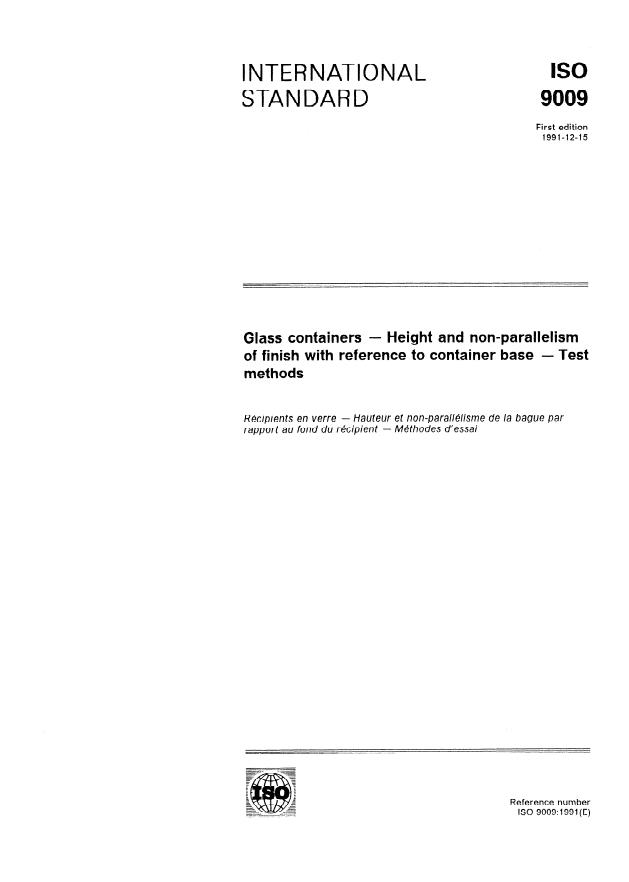
IS0
INTERNATIONAL
STANDARD 9009
First edition
- Height and non-parallelism
Glass containers
of finish with reference to container base - Test
methods
- Hauteur et non-parakYisme de la bague par-
RUpients en verre
rapport au fond du rbipient - MHhodes d’essai
------
--
Reference nutnber
I--== IS0 9009: 1991 (E)
_--.---
_ _ --_-_ _ -. -
IS0 9009:1991(E)
Foreword
IS0 (the International Organization for Standardization) is a worldwide
federation of national standards bodies (IS0 member bodies). The work
of preparing International Standards is normally carried out through IS0
technical committees. Each member body interested in a subject for
which a technical committee has been established has the right to be
represented on that committee. International organizations, govern-
mental and non-governmental, in liaison with ISO, also take part in the
work. IS0 collaborates closely with the International Electrotechnical
Commission (IEC) on all matters of electrotechnical standardization.
Draft International Standards adopted by the technical committees are
circulated to the member bodies for voting. Publication as an lnter-
national Standard requires approval by at least 75 % of the member
bodies casting a vote.
International Standard IS0 9009 was prepared by Technical Committee
ISO/TC 63, Glass containers, Sub-Committee SC 2, Test methods.
0 IS0 1991
All rights reserved. No part of this publication may be reproduced or utilized in any form
or by any means, electronic or mechanlcal, including photocopying and microfilm, without
permission in writing from the publisher.
International Organization for Standardization
Case Postale 56 l CH-1211 Geneve 20 l Switzerland
Printed in Switzerland
ii
IS0 9009:1991(E)
Introduction
The test methods specified in this International Standard refer to two
technical features of quality which are as a rule stated separately.
However, since both features affect the performance of a container and
the test methods on the two features can be carried out at the same time
using the same apparatus, the test methods have been given in one
International Standard.
.I.
III
This page intentionally left blank
INTERNATIONAL STANDARD
IS0 9009:1991(E)
Glass containers - Height and non-parallelism of finish with
reference to container base - Test methods
4 Principle
I Scope
This International Standard specifies test methods
4.1 Checking of the height of a container using
for determining the height and the non-parallelism
maximum and minimum GO/NO GO gauges or by
of finish with reference to the container base of
using an appropriate measuring instrument. Deter-
glass containers.
mination of the (maximum) height.
2 Normative reference
4.2 Determination of the non-parallelism of finish.
The following standard contains provisions which,
through reference in this text, constitute provisions
of this International Standard. At the time of publi-
5 Apparatus
cation, the edition indicated was valid. All standards
are subject to revision, and parties to agreements
based on this International Standard are encour-
5.1 For checking the height
aged to investigate the possibility of applying the
most recent edition of the standard indicated below.
Members of IEC and IS0 maintain registers of cur- Various types of gauge exist. Examples are given in
rently valid International Standards. 5.1.1 and 5.1.2 .
IS0 7348:1991, Glass containers - Manufacture -
51.1 Height gauge, consisting for example of a
Vocabulary.
baseplate with one or two vertical pillars and
3 Definitions
a) a fixed horizontal cross-piece, in which case the
distance between the baseplate and the cross-
For the purposes of this International Standard, the
piece is equival
...
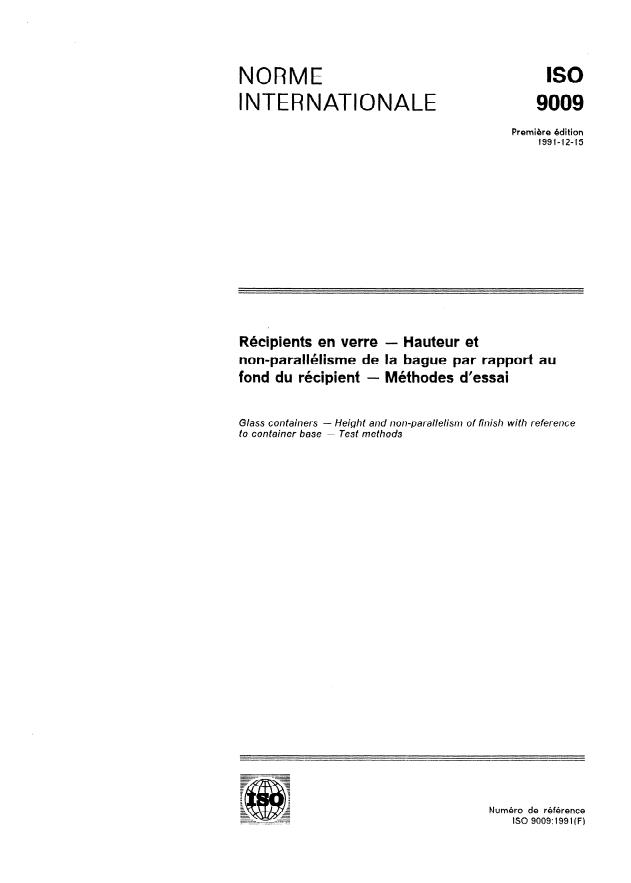
NORME
INTERNATIONALE
Première édition
Récipients en verre - Hauteur et
non-parallélisme de la bague par rapport au
fond du récipient - Méthodes d’essai
Glass containers
- Height and non -parallelism of finish with reference
to container base - Test methods
Numéro de référence
Avant-propos
L’ISO (Organisation internationale de normalisation) est une fedération
mondiale d’organismes nationaux de normalisation (comités membres
de I’ISO). L’élaboration des Normes internationales est en général
confiée aux comités techniques de I’ISO. Chaque comité membre inté-
ressé par une étude a le droit de faire partie du comite technique créé
à cet effet. Les organisations internationales, gouvernementales et non
gouvernementales, en liaison avec I’ISO participent également aux tra-
vaux. LYS0 collabore étroitement avec la Commission électrotechnique
internationale (CEI) en ce qui concerne la normalisation électrotech-
nique.
Les projets de Normes internationales adoptés par les comités techni-
ques sont soumis aux comités membres pour vote. Leur publication
comme Normes internationales requiert l’approbation de 75 % au moins
des comités membres votants.
La Norme internationale ISO 9009 a été élaborée par le comité techni-
que ISO/TC 63, Récipients en verre, sous-comité SC 2, Méthodes d’es-
sais.
0 ISO 1991
Droits de reproduction réservés, Aucune partie de cette publication ne peut être repro-
duite ni utilisée sous quelque forme que ce soit et par aucun procédé, électronique ou
mécanique, y compris la photocopie et les microfilms, sans l’accord écrit de l’éditeur.
internationale de normalisation
Organisation
Genève 20 l Suisse
Case Postale 56 l CH-1211
Imprimé en Suisse
ii
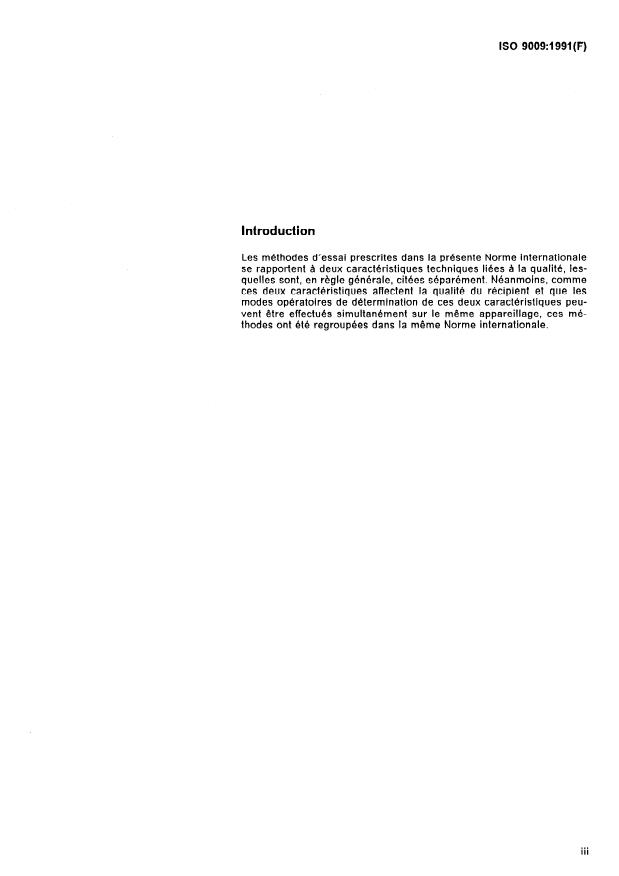
Les méthodes d’essai prescrites dans la présente Norme internationale
se rapportent à deux caractéristiques techniques liees à la qualité, les-
quelles sont, en règle générale, citees séparément. Néanmoins, comme
ces deux caractéristiques affectent la qualité du récipient et que les
modes opératoires de détermination de ces deux caractéristiques peu-
vent être effectués simultanément sur le même appareillage, ces mé-
thodes ont été regroupées dans la même Norme internationale.
. . .
III
Page blanche
NORME INTERNATIONALE
Récipients en verre
- Hauteur et non-parallélisme de la
bague par rapport au fond du récipient - Méthodes d’essai
1 Domaine d’application 4 Principe
La présente Norme internationale prescrit les mé-
thodes d’essai permettant de déterminer la hauteur
4.1 Vérification de la hauteur d’un récipient à
bague par rapport au
et le non-parallélisme de la
l’aide d’un calibre ENTRE-N’ENTRE PAS ou d’un
fond des récipients en verre.
instrument de mesure approprié. Détermination de
la hauteur (maximale).
2 Référence normative
4.2 Détermination du non-parallélisme de la ba-
La norme suivante contient des dispositions qui, par
gue.
suite de la référence qui en est faite, constituent des
dispositions valables pour la présente Norme inter-
nationale. Au moment de la publication, l’édition in-
diquée était en vigueur. Toute norme est sujette à
5 Appareillage
révision et les parties prenantes des accords fondés
sur la présente Norme internationale sont invitées
à rechercher la possibilité d’appliquer l’édition la
5.1 Contrôle de la hauteur
plus récente de la norme indiquée ci-après. Les
membres de la CEI et de I’ISO possèdent le registre
Différents types de calibres sont utilisés. Des exem-
des Normes internationales en vigueur à un moment
ples sont donnes eh 5.1.1 et 5.12.
donné.
ISO 7348:1991, Récipients en verre - Fabrication -
5.1.1 Calibre de hauteur, constitué généralement
Vocabulaire.
d’une plaque de base avec un ou deux supports
verticaux et
3 Définitions
a) une traverse horizontale fixe; dans ce cas, la
Pour les besoins de la présente Norme internatio-
distance entre la plaque de base et la traverse
nale, les définitions données dans I’ISO 7348 et les
est équivalente à la dimension à contrôler, ou
définitions suivantes s’appliquent.
b) une traverse horizontale fixe comportant un pa-
...
NORME
INTERNATIONALE
Première édition
Récipients en verre - Hauteur et
non-parallélisme de la bague par rapport au
fond du récipient - Méthodes d’essai
Glass containers
- Height and non -parallelism of finish with reference
to container base - Test methods
Numéro de référence
Avant-propos
L’ISO (Organisation internationale de normalisation) est une fedération
mondiale d’organismes nationaux de normalisation (comités membres
de I’ISO). L’élaboration des Normes internationales est en général
confiée aux comités techniques de I’ISO. Chaque comité membre inté-
ressé par une étude a le droit de faire partie du comite technique créé
à cet effet. Les organisations internationales, gouvernementales et non
gouvernementales, en liaison avec I’ISO participent également aux tra-
vaux. LYS0 collabore étroitement avec la Commission électrotechnique
internationale (CEI) en ce qui concerne la normalisation électrotech-
nique.
Les projets de Normes internationales adoptés par les comités techni-
ques sont soumis aux comités membres pour vote. Leur publication
comme Normes internationales requiert l’approbation de 75 % au moins
des comités membres votants.
La Norme internationale ISO 9009 a été élaborée par le comité techni-
que ISO/TC 63, Récipients en verre, sous-comité SC 2, Méthodes d’es-
sais.
0 ISO 1991
Droits de reproduction réservés, Aucune partie de cette publication ne peut être repro-
duite ni utilisée sous quelque forme que ce soit et par aucun procédé, électronique ou
mécanique, y compris la photocopie et les microfilms, sans l’accord écrit de l’éditeur.
internationale de normalisation
Organisation
Genève 20 l Suisse
Case Postale 56 l CH-1211
Imprimé en Suisse
ii
Les méthodes d’essai prescrites dans la présente Norme internationale
se rapportent à deux caractéristiques techniques liees à la qualité, les-
quelles sont, en règle générale, citees séparément. Néanmoins, comme
ces deux caractéristiques affectent la qualité du récipient et que les
modes opératoires de détermination de ces deux caractéristiques peu-
vent être effectués simultanément sur le même appareillage, ces mé-
thodes ont été regroupées dans la même Norme internationale.
. . .
III
Page blanche
NORME INTERNATIONALE
Récipients en verre
- Hauteur et non-parallélisme de la
bague par rapport au fond du récipient - Méthodes d’essai
1 Domaine d’application 4 Principe
La présente Norme internationale prescrit les mé-
thodes d’essai permettant de déterminer la hauteur
4.1 Vérification de la hauteur d’un récipient à
bague par rapport au
et le non-parallélisme de la
l’aide d’un calibre ENTRE-N’ENTRE PAS ou d’un
fond des récipients en verre.
instrument de mesure approprié. Détermination de
la hauteur (maximale).
2 Référence normative
4.2 Détermination du non-parallélisme de la ba-
La norme suivante contient des dispositions qui, par
gue.
suite de la référence qui en est faite, constituent des
dispositions valables pour la présente Norme inter-
nationale. Au moment de la publication, l’édition in-
diquée était en vigueur. Toute norme est sujette à
5 Appareillage
révision et les parties prenantes des accords fondés
sur la présente Norme internationale sont invitées
à rechercher la possibilité d’appliquer l’édition la
5.1 Contrôle de la hauteur
plus récente de la norme indiquée ci-après. Les
membres de la CEI et de I’ISO possèdent le registre
Différents types de calibres sont utilisés. Des exem-
des Normes internationales en vigueur à un moment
ples sont donnes eh 5.1.1 et 5.12.
donné.
ISO 7348:1991, Récipients en verre - Fabrication -
5.1.1 Calibre de hauteur, constitué généralement
Vocabulaire.
d’une plaque de base avec un ou deux supports
verticaux et
3 Définitions
a) une traverse horizontale fixe; dans ce cas, la
Pour les besoins de la présente Norme internatio-
distance entre la plaque de base et la traverse
nale, les définitions données dans I’ISO 7348 et les
est équivalente à la dimension à contrôler, ou
définitions suivantes s’appliquent.
b) une traverse horizontale fixe comportant un pa-
...