

ISO 23555-3:2024
(Main)Gas pressure safety and control devices for use in gas transmission, distribution and installations for inlet pressures up to and including 10 MPa — Part 3: Safety shut-off devices
General Information
- Abstract
This document specifies safety, constructional, performance, testing and documentation requirements of gas safety shut-off devices (SSDs). This document is applicable to SSDs with operating pressures greater than 500 kPa (5 bar) up to 10 MPa (100 bar) of nominal connection sizes up to and including DN 400 for use with fuel gases such as natural gas, manufactured gas, biomethane or liquefied petroleum gas (LPG) in commercial industrial installations, including fuel gas infrastructures. This document is applicable to SSDs for an operating temperature range from −20 °C to +60 °C; This document is applicable to: — test methods which are intended for product type tests, routine tests and batch surveillance tests; — SSDs which use the pipeline gas as a source of control energy unassisted by any external power source; — SSDs integrating on the same body a second SSD, conforming to the requirements in this document; — SSDs integrating a gas pressure regulator conforming to ISO 23555-2; — SSDs incorporating a creep (venting) relief device and/or a vent limiter conforming to the requirements in this document; This document does not apply to: — SSDs upstream from/on/in domestic gas-consuming appliances which are installed downstream of domestic gas meters; — SSDs designed to be incorporated into pressure control systems used in service lines (pipework from the main pipework in a gas infrastructure to the point of delivery of the gas) with declared volumetric flow rate ≤ 200 m3/h (n); — industrial process control valves on/off type (see IEC 60534 for information on the design, classification and tests for this type of valve); NOTE Such valves cannot be declared conformant to this document. — SSDs used in sour gas environments (gas environments containing water and H2S are considered sour) or corrosive conditions; — SSDs in service conditions with waste gases (e.g. biogas etc.), if additional information is not provided (e.g. contaminant, liquid etc.).
- Status
- Published
- Publication Date
- 13-Jun-2024
- Technical Committee
- ISO/TC 161 - Controls and protective devices for gas and/or oil
- Drafting Committee
- ISO/TC 161 - Controls and protective devices for gas and/or oil
- Current Stage
- 6060 - International Standard published
- Start Date
- 14-Jun-2024
- Due Date
- 30-Oct-2024
- Completion Date
- 14-Jun-2024
Buy Documents

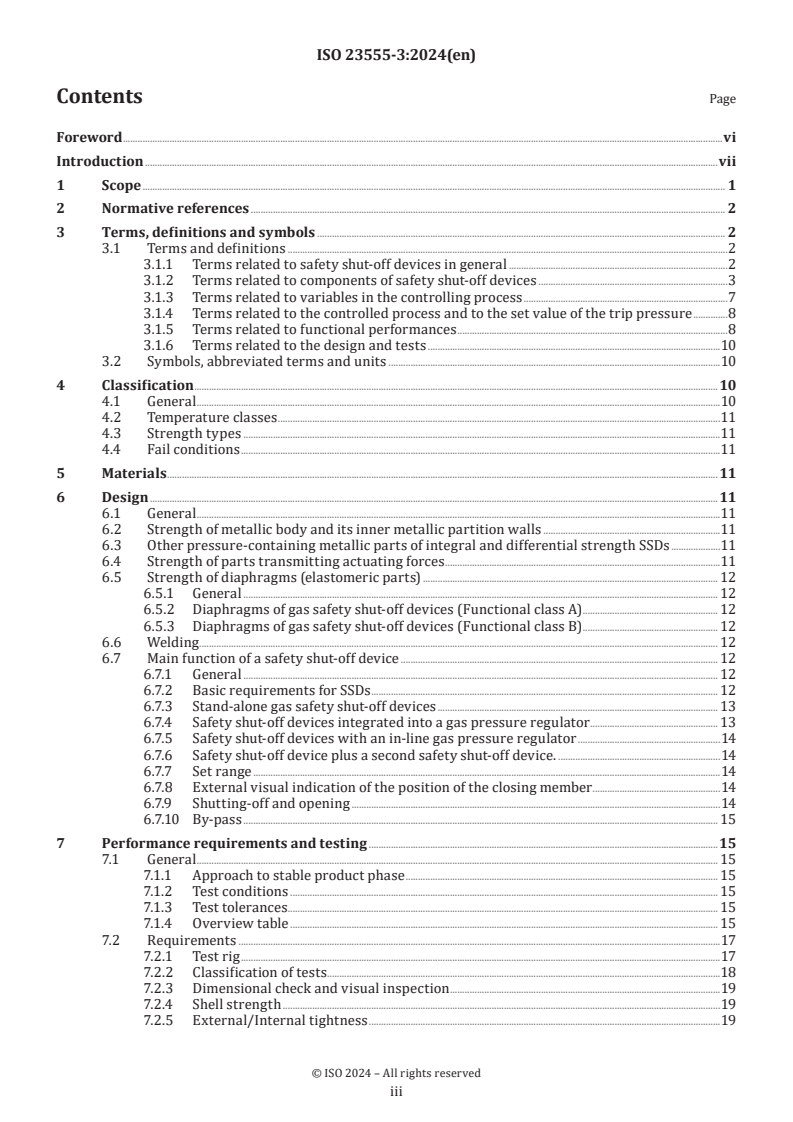
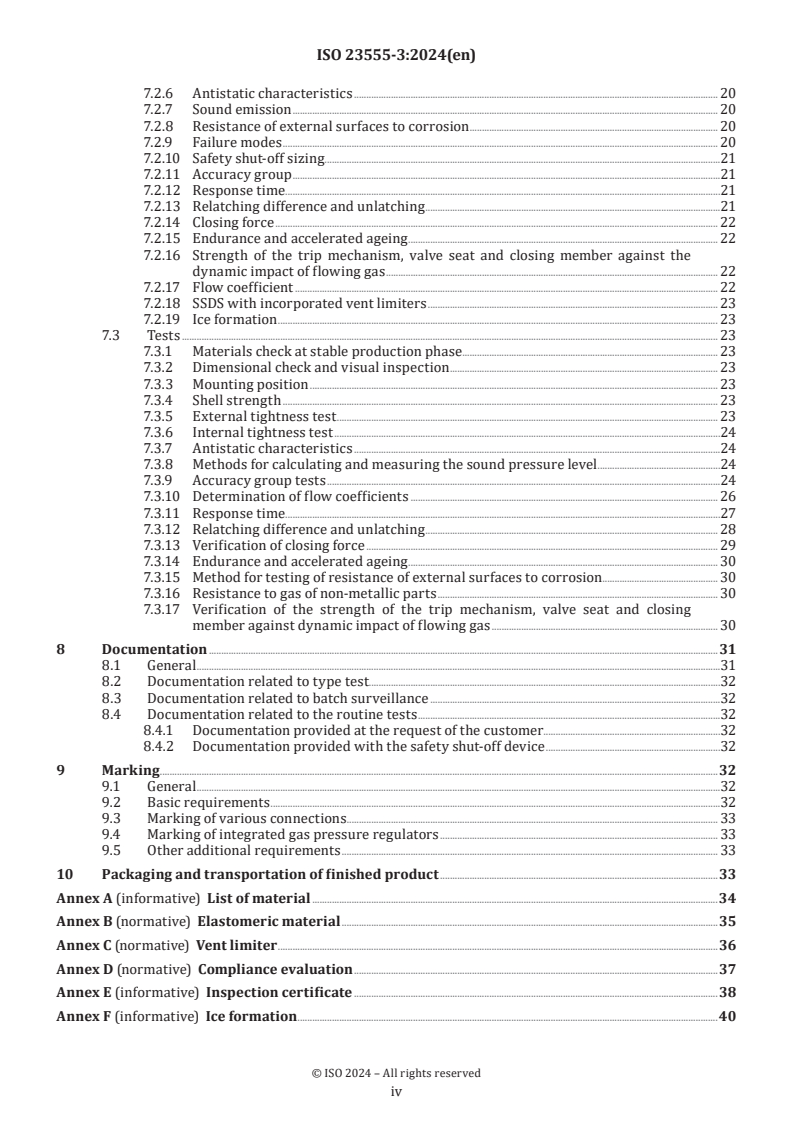
ISO 23555-3:2024 - Gas pressure safety and control devices for use in gas transmission, distribution and installations for inlet pressures up to and including 10 MPa — Part 3: Safety shut-off devices Released:14. 06. 2024
Overview
ISO 23555-3:2024 outlines the essential safety, constructional, performance, testing, and documentation requirements for gas safety shut-off devices (SSDs) in gas transmission, distribution, and industrial installations. This international standard applies to SSDs handling fuel gases-such as natural gas, manufactured gas, biomethane, and liquefied petroleum gas (LPG)-with operating pressures greater than 500 kPa (5 bar) and up to 10 MPa (100 bar), and nominal connection sizes up to DN 400. These SSDs operate within a temperature range of −20 °C to +60 °C. By providing comprehensive requirements, ISO 23555-3:2024 plays a key role in supporting safety and reliability within commercial and industrial gas infrastructures, ensuring effective protection against over-pressure and under-pressure situations.
Key Topics
Scope and Applicability
- Applies to SSDs used in industrial and commercial gas pipelines and installations.
- Covers operating pressures from 500 kPa up to 10 MPa.
- Covers connection sizes up to DN 400.
- Suitable for a temperature range of −20 °C to +60 °C.
Types of Devices
- Devices using pipeline gas as the control energy source, requiring no external power.
- SSDs integrated with a gas pressure regulator (referencing ISO 23555-2).
- SSDs including a creep relief device or vent limiter.
Excluded Applications
- Devices for domestic installations installed downstream of domestic meters.
- SSDs for service lines under 200 m³/h flow rate.
- Industrial on/off process control valves (covered by IEC 60534 standards).
- SSDs for sour or corrosive gas environments unless additional information is provided.
- Devices for environments with unspecified contaminants or liquids.
Performance and Testing
- Specifies test methods for product type, routine, and batch surveillance testing.
- Includes requirements for performance, material checks, strength, tightness, anti-static properties, and corrosion resistance.
- Emphasizes reliability through response time, trip pressure accuracy, relatching, and endurance.
Design and Safety Features
- Addresses direct and indirect acting SSDs.
- Requirements for main components like closing members, trip mechanisms, actuators, and controllers.
- Consideration for fail-safe operation and manual reopening functionalities.
- Marking, documentation, packaging, and transportation requirements ensure traceability and safe handling.
Applications
ISO 23555-3:2024 is utilized by manufacturers, engineers, and operators involved in:
- Gas transmission and distribution systems: Enhancing system safety by automatically shutting off gas flow in abnormal pressure conditions.
- Industrial gas installations: Ensuring protection for facilities using natural gas, LPG, biomethane, or manufactured gases.
- Commercial fuel gas infrastructures: Maintaining compliance and operational reliability in gas networks with pressures up to 10 MPa.
- Product conformity assessment: Guiding type testing, routine inspections, and documentation practices for SSDs.
By implementing the requirements of ISO 23555-3, stakeholders can minimize hazards, comply with international best practices, and assure the safety of gas distribution operations.
Related Standards
- ISO 23555-1: General requirements for gas pressure safety and control devices.
- ISO 23555-2: Requirements for gas pressure regulators.
- IEC 60534-2-3: Flow capacity testing for industrial process control valves.
- IEC 60534-4: Inspection and routine testing of control valves.
These associated standards offer a comprehensive framework for controlling and safeguarding gaseous fuel systems. For additional compliance or device integration, referencing these documents is recommended to support robust safety management and system interoperability.
Buy Documents
ISO 23555-3:2024 - Gas pressure safety and control devices for use in gas transmission, distribution and installations for inlet pressures up to and including 10 MPa — Part 3: Safety shut-off devices Released:14. 06. 2024
Get Certified
Connect with accredited certification bodies for this standard

DIBt (Deutsches Institut für Bautechnik)
German Institute for Building Technology.
DIN CERTCO
DIN Group product certification.

Aboma Certification B.V.
Specialized in construction, metal, and transport sectors.
Sponsored listings
Frequently Asked Questions
ISO 23555-3:2024 is a standard published by the International Organization for Standardization (ISO). Its full title is "Gas pressure safety and control devices for use in gas transmission, distribution and installations for inlet pressures up to and including 10 MPa — Part 3: Safety shut-off devices". This standard covers: This document specifies safety, constructional, performance, testing and documentation requirements of gas safety shut-off devices (SSDs). This document is applicable to SSDs with operating pressures greater than 500 kPa (5 bar) up to 10 MPa (100 bar) of nominal connection sizes up to and including DN 400 for use with fuel gases such as natural gas, manufactured gas, biomethane or liquefied petroleum gas (LPG) in commercial industrial installations, including fuel gas infrastructures. This document is applicable to SSDs for an operating temperature range from −20 °C to +60 °C; This document is applicable to: — test methods which are intended for product type tests, routine tests and batch surveillance tests; — SSDs which use the pipeline gas as a source of control energy unassisted by any external power source; — SSDs integrating on the same body a second SSD, conforming to the requirements in this document; — SSDs integrating a gas pressure regulator conforming to ISO 23555-2; — SSDs incorporating a creep (venting) relief device and/or a vent limiter conforming to the requirements in this document; This document does not apply to: — SSDs upstream from/on/in domestic gas-consuming appliances which are installed downstream of domestic gas meters; — SSDs designed to be incorporated into pressure control systems used in service lines (pipework from the main pipework in a gas infrastructure to the point of delivery of the gas) with declared volumetric flow rate ≤ 200 m3/h (n); — industrial process control valves on/off type (see IEC 60534 for information on the design, classification and tests for this type of valve); NOTE Such valves cannot be declared conformant to this document. — SSDs used in sour gas environments (gas environments containing water and H2S are considered sour) or corrosive conditions; — SSDs in service conditions with waste gases (e.g. biogas etc.), if additional information is not provided (e.g. contaminant, liquid etc.).
This document specifies safety, constructional, performance, testing and documentation requirements of gas safety shut-off devices (SSDs). This document is applicable to SSDs with operating pressures greater than 500 kPa (5 bar) up to 10 MPa (100 bar) of nominal connection sizes up to and including DN 400 for use with fuel gases such as natural gas, manufactured gas, biomethane or liquefied petroleum gas (LPG) in commercial industrial installations, including fuel gas infrastructures. This document is applicable to SSDs for an operating temperature range from −20 °C to +60 °C; This document is applicable to: — test methods which are intended for product type tests, routine tests and batch surveillance tests; — SSDs which use the pipeline gas as a source of control energy unassisted by any external power source; — SSDs integrating on the same body a second SSD, conforming to the requirements in this document; — SSDs integrating a gas pressure regulator conforming to ISO 23555-2; — SSDs incorporating a creep (venting) relief device and/or a vent limiter conforming to the requirements in this document; This document does not apply to: — SSDs upstream from/on/in domestic gas-consuming appliances which are installed downstream of domestic gas meters; — SSDs designed to be incorporated into pressure control systems used in service lines (pipework from the main pipework in a gas infrastructure to the point of delivery of the gas) with declared volumetric flow rate ≤ 200 m3/h (n); — industrial process control valves on/off type (see IEC 60534 for information on the design, classification and tests for this type of valve); NOTE Such valves cannot be declared conformant to this document. — SSDs used in sour gas environments (gas environments containing water and H2S are considered sour) or corrosive conditions; — SSDs in service conditions with waste gases (e.g. biogas etc.), if additional information is not provided (e.g. contaminant, liquid etc.).
ISO 23555-3:2024 is classified under the following ICS (International Classification for Standards) categories: 23.060.40 - Pressure regulators; 91.140.40 - Gas supply systems. The ICS classification helps identify the subject area and facilitates finding related standards.
ISO 23555-3:2024 is available in PDF format for immediate download after purchase. The document can be added to your cart and obtained through the secure checkout process. Digital delivery ensures instant access to the complete standard document.
Standards Content (Sample)
International
Standard
ISO 23555-3
First edition
Gas pressure safety and control
2024-06
devices for use in gas transmission,
distribution and installations for
inlet pressures up to and including
10 MPa —
Part 3:
Safety shut-off devices
Dispositifs de commande et de sécurité de la pression de gaz
destinés à être utilisés dans les installations de transport, de
distribution et de stockage de gaz pour des pressions en entrée
jusqu'à 10 MPa inclus —
Partie 3: Dispositifs d'arrêt de sécurité
Reference number
© ISO 2024
All rights reserved. Unless otherwise specified, or required in the context of its implementation, no part of this publication may
be reproduced or utilized otherwise in any form or by any means, electronic or mechanical, including photocopying, or posting on
the internet or an intranet, without prior written permission. Permission can be requested from either ISO at the address below
or ISO’s member body in the country of the requester.
ISO copyright office
CP 401 • Ch. de Blandonnet 8
CH-1214 Vernier, Geneva
Phone: +41 22 749 01 11
Email: copyright@iso.org
Website: www.iso.org
Published in Switzerland
ii
Contents Page
Foreword .vi
Introduction .vii
1 Scope . 1
2 Normative references . 2
3 Terms, definitions and symbols . 2
3.1 Terms and definitions .2
3.1.1 Terms related to safety shut-off devices in general .2
3.1.2 Terms related to components of safety shut-off devices .3
3.1.3 Terms related to variables in the controlling process .7
3.1.4 Terms related to the controlled process and to the set value of the trip pressure .8
3.1.5 Terms related to functional performances .8
3.1.6 Terms related to the design and tests .10
3.2 Symbols, abbreviated terms and units .10
4 Classification . 10
4.1 General .10
4.2 Temperature classes .11
4.3 Strength types .11
4.4 Fail conditions .11
5 Materials .11
6 Design .11
6.1 General .11
6.2 Strength of metallic body and its inner metallic partition walls .11
6.3 Other pressure-containing metallic parts of integral and differential strength SSDs .11
6.4 Strength of parts transmitting actuating forces .11
6.5 Strength of diaphragms (elastomeric parts) . 12
6.5.1 General . 12
6.5.2 Diaphragms of gas safety shut-off devices (Functional class A) . 12
6.5.3 Diaphragms of gas safety shut-off devices (Functional class B) . 12
6.6 Welding . . 12
6.7 Main function of a safety shut-off device . 12
6.7.1 General . 12
6.7.2 Basic requirements for SSDs . 12
6.7.3 Stand-alone gas safety shut-off devices . 13
6.7.4 Safety shut-off devices integrated into a gas pressure regulator . 13
6.7.5 Safety shut-off devices with an in-line gas pressure regulator .14
6.7.6 Safety shut-off device plus a second safety shut-off device. .14
6.7.7 Set range .14
6.7.8 External visual indication of the position of the closing member .14
6.7.9 Shutting-off and opening .14
6.7.10 By-pass . 15
7 Performance requirements and testing .15
7.1 General . 15
7.1.1 Approach to stable product phase . 15
7.1.2 Test conditions . 15
7.1.3 Test tolerances . . . 15
7.1.4 Overview table . 15
7.2 Requirements .17
7.2.1 Test rig .17
7.2.2 Classification of tests.18
7.2.3 Dimensional check and visual inspection .19
7.2.4 Shell strength .19
7.2.5 External/Internal tightness .19
iii
7.2.6 Antistatic characteristics . 20
7.2.7 Sound emission . 20
7.2.8 Resistance of external surfaces to corrosion . 20
7.2.9 Failure modes . 20
7.2.10 Safety shut-off sizing . .21
7.2.11 Accuracy group .21
7.2.12 Response time . . .21
7.2.13 Relatching difference and unlatching .21
7.2.14 Closing force . 22
7.2.15 Endurance and accelerated ageing . 22
7.2.16 Strength of the trip mechanism, valve seat and closing member against the
dynamic impact of flowing gas . 22
7.2.17 Flow coefficient . 22
7.2.18 SSDS with incorporated vent limiters . 23
7.2.19 Ice formation . 23
7.3 Tests . 23
7.3.1 Materials check at stable production phase. 23
7.3.2 Dimensional check and visual inspection . 23
7.3.3 Mounting position . 23
7.3.4 Shell strength . 23
7.3.5 External tightness test . 23
7.3.6 Internal tightness test .24
7.3.7 Antistatic characteristics .24
7.3.8 Methods for calculating and measuring the sound pressure level .24
7.3.9 Accuracy group tests .24
7.3.10 Determination of flow coefficients . 26
7.3.11 Response time . . .27
7.3.12 Relatching difference and unlatching . 28
7.3.13 Verification of closing force . 29
7.3.14 Endurance and accelerated ageing . 30
7.3.15 Method for testing of resistance of external surfaces to corrosion . 30
7.3.16 Resistance to gas of non-metallic parts . 30
7.3.17 Verification of the strength of the trip mechanism, valve seat and closing
member against dynamic impact of flowing gas . 30
8 Documentation .31
8.1 General .31
8.2 Documentation related to type test.32
8.3 Documentation related to batch surveillance .32
8.4 Documentation related to the routine tests .32
8.4.1 Documentation provided at the request of the customer .32
8.4.2 Documentation provided with the safety shut-off device .32
9 Marking . .32
9.1 General .32
9.2 Basic requirements .32
9.3 Marking of various connections . 33
9.4 Marking of integrated gas pressure regulators . 33
9.5 Other additional requirements . 33
10 Packaging and transportation of finished product .33
Annex A (informative) List of material .34
Annex B (normative) Elastomeric material .35
Annex C (normative) Vent limiter .36
Annex D (normative) Compliance evaluation .37
Annex E (informative) Inspection certificate .38
Annex F (informative) Ice formation .40
iv
Annex G (informative) Pressure drop . 41
Annex H (informative) Alternative test method for verification of the strength of the trip
mechanism, valve seat and closing member .42
Annex I (informative) Sizing equation.45
Annex J (informative) Order specification .46
Annex K (informative) Acceptance test .48
Annex L (informative) Suitability of safety shut-off device for damp operating conditions —
Test procedure, requirement and acceptance criteria .49
Bibliography .50
v
Foreword
ISO (the International Organization for Standardization) is a worldwide federation of national standards
bodies (ISO member bodies). The work of preparing International Standards is normally carried out through
ISO technical committees. Each member body interested in a subject for which a technical committee
has been established has the right to be represented on that committee. International organizations,
governmental and non-governmental, in liaison with ISO, also take part in the work. ISO collaborates closely
with the International Electrotechnical Commission (IEC) on all matters of electrotechnical standardization.
The procedures used to develop this document and those intended for its further maintenance are described
in the ISO/IEC Directives, Part 1. In particular, the different approval criteria needed for the different types
of ISO document should be noted. This document was drafted in accordance with the editorial rules of the
ISO/IEC Directives, Part 2 (see www.iso.org/directives).
ISO draws attention to the possibility that the implementation of this document may involve the use of (a)
patent(s). ISO takes no position concerning the evidence, validity or applicability of any claimed patent
rights in respect thereof. As of the date of publication of this document, ISO had not received notice of (a)
patent(s) which may be required to implement this document. However, implementers are cautioned that
this may not represent the latest information, which may be obtained from the patent database available at
www.iso.org/patents. ISO shall not be held responsible for identifying any or all such patent rights.
Any trade name used in this document is information given for the convenience of users and does not
constitute an endorsement.
For an explanation of the voluntary nature of standards, the meaning of ISO specific terms and expressions
related to conformity assessment, as well as information about ISO's adherence to the World Trade
Organization (WTO) principles in the Technical Barriers to Trade (TBT), see www.iso.org/iso/foreword.html.
This document was prepared by Technical Committee ISO/TC 161, Controls and protective devices for gaseous
and liquid fuels.
A list of all parts in the ISO 23555 series can be found on the ISO website.
Any feedback or questions on this document should be directed to the user’s national standards body. A
complete listing of these bodies can be found at www.iso.org/members.html.
vi
Introduction
This document is designed to be used in combination with ISO 23555-1 and it applies to the specific control
covered by this document.
Where necessary, this document builds on the provisions of ISO 23555-1 by stating in the corresponding clause:
— “with the following modification”;
— “with the following addition”;
— “is replaced by the following”; or
— “is not applicable”.
In order to identify requirements that are specific to this document and that are not already covered by
ISO 23555-1, this document contains certain clauses or subclauses that are additional to the structure of
ISO 23555-1. These subclauses are indicated by the introductory sentence: “Subclause (or Annex) specific to
this document.”.
To ensure the global relevance of this document, the differing requirements resulting from practical
experience and installation practices in various regions of the world have been taken into account.
This document is intended to provide a basic framework of requirements.
vii
International Standard ISO 23555-3:2024(en)
Gas pressure safety and control devices for use in gas
transmission, distribution and installations for inlet
pressures up to and including 10 MPa —
Part 3:
Safety shut-off devices
1 Scope
This document specifies safety, constructional, performance, testing and documentation requirements of
gas safety shut-off devices (SSDs).
1)
This document is applicable to SSDs with operating pressures greater than 500 kPa (5 bar ) up to 10 MPa
(100 bar) of nominal connection sizes up to and including DN 400 for use with fuel gases such as natural
gas, manufactured gas, biomethane or liquefied petroleum gas (LPG) in commercial industrial installations,
including fuel gas infrastructures.
This document is applicable to SSDs for an operating temperature range from −20 °C to +60 °C;
This document is applicable to:
— test methods which are intended for product type tests, routine tests and batch surveillance tests;
— SSDs which use the pipeline gas as a source of control energy unassisted by any external power source;
— SSDs integrating on the same body a second SSD, conforming to the requirements in this document;
— SSDs integrating a gas pressure regulator conforming to ISO 23555-2;
— SSDs incorporating a creep (venting) relief device and/or a vent limiter conforming to the requirements
in this document;
This document does not apply to:
— SSDs upstream from/on/in domestic gas-consuming appliances which are installed downstream of
domestic gas meters;
— SSDs designed to be incorporated into pressure control systems used in service lines (pipework from the
main pipework in a gas infrastructure to the point of delivery of the gas) with declared volumetric flow
rate ≤ 200 m /h (n);
— industrial process control valves on/off type (see IEC 60534 for information on the design, classification
and tests for this type of valve);
NOTE Such valves cannot be declared conformant to this document.
— SSDs used in sour gas environments (gas environments containing water and H S are considered sour)
or corrosive conditions;
— SSDs in service conditions with waste gases (e.g. biogas etc.), if additional information is not provided
(e.g. contaminant, liquid etc.).
5 2
1) 1 bar = 0,1 MPa = 10 Pa; 1 MPa = 1 N/mm .
2 Normative references
The following documents are referred to in the text in such a way that some or all of their content constitutes
requirements of this document. For dated references, only the edition cited applies. For undated references,
the latest edition of the referenced document (including any amendments) applies.
ISO 23555-1,, Gas pressure safety and control devices for use in gas transmission, distribution and installations
for inlet pressures up to and including 10 MPa — Part 1: General requirements
IEC 60534-2-3, Industrial-process control valves – Part 2-3: Flow capacity – Test procedures
IEC 60534-4:2006, Industrial-process control valves - Part 4: Inspection and routine testing
3 Terms, definitions and symbols
For the purposes of this document, the terms and definitions given in ISO 23555-1 and the following apply.
ISO and IEC maintain terminology databases for use in standardization at the following addresses:
— ISO Online browsing platform: available at https:// www .iso .org/ obp
— IEC Electropedia: available at https:// www .electropedia .org/
3.1 Terms and definitions
3.1.1 Terms related to safety shut-off devices in general
3.1.1.1
gas safety shut-off device
device whose function is to stay in the open position under normal operating conditions and to shut-off
the gas flow automatically and completely when the monitored pressure exceeds the pre-set values (over-
pressure monitoring and/or under-pressure monitoring)
3.1.1.2
direct acting gas safety shut-off device
safety shut-off device (SSD) in which the pressure-detecting element is directly connected to the trip
mechanism
Note 1 to entry: See Figure 1.
3.1.1.3
indirect acting gas safety shut-off device
safety shut-off device (SSD) without mechanical connection between the pressure detecting element and the
trip mechanism and where (pressure) energy from an internal or external source is used for activating the
trip mechanism and moving the closing element
Note 1 to entry: See Figures 2, 3 and 4.
3.1.1.4
gas cut-off device
safety shut-off device (SSD) designed to shut off the gas flow, which responds dynamically slower than a
slam shut device when the monitored pressure exceeds the pre-set values
3.1.1.5
gas slam shut device
safety shut-off device (SSD) designed to quickly shut off the gas flow when the monitored pressure exceeds
the pre-set values
EXAMPLE Spring or weight-loaded SSD.
3.1.1.6
auxiliary pressure source
energy coming from pressure of the system (internal energy) or from any external source (compressed
air or gas)
3.1.2 Terms related to components of safety shut-off devices
3.1.2.1
closing member
part which shuts off the gas flow completely
3.1.2.2
trip mechanism
mechanism which releases the closing member when activated by the controller
3.1.2.3
actuator
device activated by the trip mechanism which shuts the closing member
3.1.2.4
relatching device
device which enables the complete opening of the safety shut-off device (SSD)
3.1.2.5
controller
device which includes:
— a setting element to adjust the set value of the trip pressure;
— a pressure-detecting element which has the function to detect the feedback of the monitored pressure
(e.g. a diaphragm);
— a unit which compares the set value of the trip pressure with the monitored pressure;
— a system which gives the energy to operate the trip mechanism
3.1.2.6
bypass
device permitting manual equalization of pressure across a closed safety shut-off device (SSD)
Note 1 to entry: See examples in Figure 1 to Figure 4.
a) Pressure-containing parts group 2 b) Pressure-containing parts group 3
(ISO 23555-1:2022, 6.3.2) (ISO 23555-1:2022, 6.3.2)
Key
1 bypass 7 sensing line
2 relatching device 8 actuator
3 trip mechanism 9 sensing point at the location to be monitored
4 breather line 10 closing member
5 setting element 11 SSD body
6 controller
Figure 1 — Example of direct acting gas safety shut-off devices
Key
1 bypass 8 loading pressure line (from internal auxiliary pressure
source)
2 actuator 9 loading pressure line (from external auxiliary pressure
source)
3 relatching device 10 breather/exhaust line
4 exhaust line 11 sensing point
5 trip mechanism 12 closing member
6 controller 13 SSD body
7 sensing line
Figure 2 — Example No. 1 of an indirect acting gas safety shut-off device
Key
1 bypass 9 sensing point
2 actuator 10 closing member
3 relatching device 11 isolating valve
4 safety relief valve 12 pressure regulator
5 trip mechanism (directional control valve) 13 exhaust line
6 controller 14 breather line
7 sensing line 15 SSD body
8 loading pressure line (from internal auxiliary pressure
source)
Figure 3 — Example No. 2 of an indirect acting gas safety shut-off device
Key
1 bypass 8 loading pressure line (from external auxiliary pressure
source)
2 actuator 9 loading pressure line (from internal auxiliary pressure
source)
3 relatching device 10 breather/exhaust line
4 exhaust line 11 sensing point
5 trip mechanism 12 closing member
6 controller 13 pressure reducer (if applicable)
7 sensing line
Figure 4 — Example No. 3 of an indirect acting gas safety shut-off device
3.1.2.7
loading pressure line
line connecting the controller and/or actuator to the internal or external power source
3.1.3 Terms related to variables in the controlling process
3.1.3.1
monitored pressure
pressure monitored and safeguarded by the safety shut-off device (SSD), normally the outlet pressure of the
pressure control station/installation
3.1.3.2
maximum value
highest value to which any variable can be adjusted or to which it is limited, or which any variable may reach
during a series of measurements, or during a certain time period
Note 1 to entry: The maximum value is specified by the index "max" added to the symbol of the variable.
3.1.3.3
minimum value
lowest value to which any variable can be adjusted or to which it is limited, or which any variable may reach
during a series of measurements or during a certain time period
Note 1 to entry: The minimum value is specified by the index "min" added to the symbol of the variable.
3.1.4 Terms related to the controlled process and to the set value of the trip pressure
3.1.4.1
loading pressure
pressure of the gas from the upstream or downstream pipeline or of the air from an external source used as
an energy source for the controller and/or actuator
3.1.4.2
trip pressure
pressure value at which the closing member reaches the closed position
Note 1 to entry: The trip pressure for over-pressure monitoring is represented using the symbol p .
do
Note 2 to entry: The trip pressure for under-pressure monitoring is represented using the symbol p
du.
3.1.4.3
actual value of the trip pressure
pressure value at which the closing member of a safety shut-off device (SSD) starts to move
Note 1 to entry: The actual value of the trip pressure for over-pressure monitoring is represented using the symbol p .
dio
Note 2 to entry: The actual value of the trip pressure for under-pressure monitoring is represented using the symbol p .
diu
3.1.4.4
set point
nominal trip pressure value under specified conditions
Note 1 to entry: The set point for over-pressure monitoring is represented using the symbol p .
dso
Note 2 to entry: The set point for under-pressure monitoring is represented using the symbol p .
dsu
3.1.4.5
set range
whole range of set points which can be obtained with a safety shut-off device (SSD) by adjustment and/or
the replacement of some components (e.g. replacement of the setting mean, or pressure detecting element)
Note 1 to entry: The set range for over-pressure monitoring is represented using the symbol W .
do
Note 2 to entry: The set range for under-pressure monitoring is represented using the symbol W .
du
3.1.4.6
specific set range
whole range of set points which can be obtained with a safety shut-off device (SSD) by adjustment and
without replacement of any component
Note 1 to entry: The specific set range for over-pressure monitoring is represented using the symbol W .
dso
Note 2 to entry: The specific set range for under-pressure monitoring is represented using the symbol W .
dsu
3.1.5 Terms related to functional performances
3.1.5.1
trip pressure deviation
difference between the actual value of the trip pressure and the set point as a percentage of the set value
Note 1 to entry: See Figure 5.
3.1.5.2
accuracy group
AG
maximum permissible absolute value of trip pressure deviation
Note 1 to entry: See Figure 5.
3.1.5.3
inlet operating pressure range
b
pu
range of inlet operating pressure for which the safety shut-off device (SSD) ensures a given accuracy group
3.1.5.4
response time
t
a
time interval between attaining the permissible limit value of the trip pressure at the sensing point and
complete closure of the closing member
3.1.5.5
relatching pressure difference
Δp
w
minimum difference between the set value of the trip pressure and the monitored pressure which is required
for the correct resetting of the safety shut-off device (SSD)
Note 1 to entry: See Figure 5.
Key
X time, t
Y pressure, p
d
1 set value of trip pressure, p
dso
2 trip pressure, p
do
3 trip pressure deviation
4 accuracy group (AG)
5 relatching pressure difference, Δp
w
Figure 5 — Monitored pressure and trip pressure
3.1.5.6
pressure drop
drop in pressure, at specified operating conditions, of gas passing through the safety shut-off device (SSD)
3.1.6 Terms related to the design and tests
3.1.6.1
closing force
F
S
force created by a spring, by a weight-piece or by pressure to operate the closing member
3.1.6.2
Functional class A
class describing safety shut-off devices (SSDs) which close when damage to the pressure-detecting element
occurs or when external power fails and for which re-opening is possible only manually
3.1.6.3
Functional class B
class describing safety shut-off devices (SSDs) which do not close when damage to the pressure-detecting
element occurs but which provide suitable and reliable protection and for which re-opening is possible only
manually
3.2 Symbols, abbreviated terms and units
Table 1 summarizes the symbols, abbreviated terms and units used in this document. The symbols are listed
in alphabetic order.
Table 1 — Symbols, abbreviated terms and units
Symbol Definition Subclause Unit
Δp relatching pressure difference 3.1.5.5 bar
w
AG accuracy group 3.1.5.2 —
b inlet operating pressure range 3.1.5.3 bar
pu
F closing force 3.1.6.1 N
S
actual value of the trip pressure for over-pressure
p bar
dio
monitoring
3.1.4.3
actual value of the trip pressure for under-pressure
p bar
diu
monitoring
p trip pressure for over-pressure monitoring bar
do
3.1.4.2
p trip pressure for under-pressure monitoring bar
du
p set point for over-pressure monitoring bar
dso
3.1.4.4
p set point for under-pressure monitoring bar
dsu
t response time 3.1.5.4 sec
a
W set range for over-pressure monitoring bar
do
3.1.4.5
W set range for under-pressure monitoring bar
du
W specific set range for over-pressure monitoring bar
dso
3.1.4.6
W specific set range for under-pressure monitoring bar
dsu
5 2
NOTE 1 bar = 0,1 MPa = 10 Pa; 1 MPa = 1 N/mm .
4 Classification
4.1 General
Shall be according to ISO 23555-1:2022, 4.1 with the following addition:
— fail conditions.
4.2 Temperature classes
Shall be according to ISO 23555-1:2022, 4.2.
4.3 Strength types
Shall be according to ISO 23555-1:2022, 4.3.
4.4 Fail conditions
Subclause specific to this document.
This document considers the following closing behaviour.
SSDs are classified as either:
— Functional class A (see 3.1.6.2); or
— Functional class B (see 3.1.6.3).
5 Materials
Shall be according to ISO 23555-1:2022, Clause 5 with the following modification:
— a list of possible metallic materials is given in Annex A;
— elastomeric materials requirements shall be in accordance with Annex B.
6 Design
6.1 General
Shall be according to ISO 23555-1:2022, 6.1.
The minimum values of safety factor listed in ISO 23555-1:2022, Table 8, refer to yield strength and shall
be used to limit the stresses in the walls of metallic pressure containing parts and inner metallic partition
walls at the design pressure.
NOTE Differential pressure seal failure can be excluded based on the risk assessment in accordance with the
design documentation.
6.2 Strength of metallic body and its inner metallic partition walls
Requirements shall be according to ISO 23555-1:2022, 6.2.2; verification shall be according to
ISO 23555-1:2022, 6.2.3.
6.3 Other pressure-containing metallic parts of integral and differential strength SSDs
Requirements shall be according to ISO 23555-1:2022, 6.3.2; verification shall be according to
ISO 23555-1:2022, 6.3.3.
6.4 Strength of parts transmitting actuating forces
Requirements shall be according to ISO 23555-1:2022, 6.4.2; verification shall be according to
ISO 23555-1:2022, 6.4.3.
6.5 Strength of diaphragms (elastomeric parts)
6.5.1 General
Subclause 6.5 is specific to this document.
The strength of a diaphragm shall ensure the correct performances under stress.
6.5.2 Diaphragms of gas safety shut-off devices (Functional class A)
The diaphragms to be used in Functional class A SSDs shall conform to ISO 23555-1:2022, 6.5.2 when tested
according to ISO 23555-1:2022, 6.5.3.
6.5.3 Diaphragms of gas safety shut-off devices (Functional class B)
The diaphragms to be used in Functional class B SSDs shall have fabric reinforcement if the maximum set
point is 1 bar and above.
When the design foresees a mechanical support, during the test, the diaphragm shall be mechanically
supported accordingly.
Diaphragms used as pressure-containing parts in chambers that are subjected to a maximum differential
pressure shall withstand without bursting when tested at room temperature.
For integral strength (IS) SSDs, diaphragms shall withstand the design pressure (DP).
For differential strength (DS) SSDs, diaphragms shall withstand a specific design pressure (DPD) multiplied
by a safety factor as specified:
— for set point up to and including 5 bar: 2,5 but at least 1 bar;
— for set point from 5 bar to ≤ 16 bar: 2,0 but at least 12,5 bar;
— for set point from16 bar to ≤ 40 bar: 1,75 but at least 32 bar;
— for set point greater than 40 bar: 1,5 but at least 70 bar.
The requirements in this subclause shall be validated by test according to ISO 23555-1:2022, 6.5.3.
6.6 Welding
Shall be according to ISO 23555-1:2022, 6.6.
6.7 Main function of a safety shut-off device
6.7.1 General
Subclause 6.7 is specific to this document.
6.7.2 Basic requirements for SSDs
SSDs shall not have any continuous discharge of gas into the atmosphere, however, temporary discharges
from auxiliary devices may occur.
SSDs shall be so designed that external and internal tightness meet the requirements of 7.2.5.1 and 7.2.5.2.
If in the event of failure (e.g. of a diaphragm), leakage to the atmosphere is
...