

ISO 15099:2003
(Main)Thermal performance of windows, doors and shading devices — Detailed calculations
General Information
- Abstract
ISO 15099:2003 specifies detailed calculation procedures for determining the thermal and optical transmission properties (e.g., thermal transmittance, total solar energy transmittance) of window and door systems based on the most up-to-date algorithms and methods, and the relevant solar and thermal properties of all components. Products covered by ISO 15099:2003 include windows and doors incorporating: single and multiple glazed fenestration products with or without solar reflective, low-emissivity coatings and suspended plastic films; glazing systems with pane spacing of any width containing gases or mixtures of gases; metallic or non-metallic spacers; frames of any material and design; fenestration products tilted at any angle; shading devices; projecting products.
- Status
- Published
- Publication Date
- 06-Nov-2003
- Technical Committee
- ISO/TC 163/SC 2 - Calculation methods
- Drafting Committee
- ISO/TC 163/SC 2 - Calculation methods
- Current Stage
- 9020 - International Standard under periodical review
- Start Date
- 15-Jul-2026
- Completion Date
- 15-Jul-2026


Overview - ISO 15099:2003 (Thermal performance of windows, doors and shading devices)
ISO 15099:2003 provides detailed calculation procedures for the thermal and optical transmission properties of fenestration systems. The standard defines algorithms and methods to determine key performance metrics such as thermal transmittance (U‑value), total solar energy transmittance (Solar τ) and visible transmittance for windows, doors and shading devices. It covers single and multiple glazing, low‑emissivity and solar‑reflective coatings, gas fills, metallic and non‑metallic spacers, frames of any material, tilted products, projecting systems and slat‑type shading.
Key topics and technical requirements
- Detailed energy-balance models: Solves energy balance for each glazing layer and cavity to predict actual pane temperatures and heat flows (the standard notes this is the only ISO method that fully accounts for these interactions).
- Optical transmission calculations: Procedures for computing direct, diffuse and total solar and visible transmittance through multi‑layer glazing and shading devices.
- Frame and edge effects: Numerical methods for frame thermal transmittance, area and linear Ψ values, and meshing/geometric representation.
- Shading device models: Definitions and optics for slat‑type and other shading devices, including ventilation effects and combined thermal/solar impacts.
- Boundary conditions and heat transfer: Prescribed reference and general boundary conditions, convective and longwave radiative heat transfer, and combined convective-radiative approaches.
- Normative data and annexes: Includes gas property values, solution techniques for multi‑layer optics, and example calculations for shading optics.
Applications and who uses ISO 15099
- Window and door manufacturers - to model product thermal performance during design and to support datasheets.
- Building energy modelers and consultants - for accurate fenestration inputs in whole‑building simulations.
- Software developers - implementing detailed fenestration algorithms in thermal and energy simulation tools (standard intended for computer implementation).
- Testing laboratories and certification bodies - to compare calculated performance with hot‑box and other test methods and to produce standardized performance indices.
- Architects, facade engineers and regulators - when selecting glazing, low‑e coatings, frames and shading for energy compliance and daylighting.
Related standards
ISO 15099 references and complements standards such as ISO 9050 (glazing optical properties), ISO 10077‑2 (frame numerical methods), ISO 12567‑1 (hot box thermal transmittance) and standards on heat transfer and solar irradiance (e.g., ISO 7345, ISO 9845‑1). Use ISO 15099 when a detailed, physically consistent calculation of fenestration thermal and solar performance is required.
Relations
- Effective Date
- 25-Aug-2026
- Effective Date
- 25-Aug-2026
- Effective Date
- 25-Aug-2026
- Effective Date
- 25-Aug-2026
- Effective Date
- 06-Jun-2022
Get Certified
Connect with accredited certification bodies for this standard

DIBt (Deutsches Institut für Bautechnik)
German Institute for Building Technology.
DIN CERTCO
DIN Group product certification.

Aboma Certification B.V.
Specialized in construction, metal, and transport sectors.
Sponsored listings
Frequently Asked Questions
ISO 15099:2003 is a standard published by the International Organization for Standardization (ISO). Its full title is "Thermal performance of windows, doors and shading devices — Detailed calculations". This standard covers: ISO 15099:2003 specifies detailed calculation procedures for determining the thermal and optical transmission properties (e.g., thermal transmittance, total solar energy transmittance) of window and door systems based on the most up-to-date algorithms and methods, and the relevant solar and thermal properties of all components. Products covered by ISO 15099:2003 include windows and doors incorporating: single and multiple glazed fenestration products with or without solar reflective, low-emissivity coatings and suspended plastic films; glazing systems with pane spacing of any width containing gases or mixtures of gases; metallic or non-metallic spacers; frames of any material and design; fenestration products tilted at any angle; shading devices; projecting products.
ISO 15099:2003 specifies detailed calculation procedures for determining the thermal and optical transmission properties (e.g., thermal transmittance, total solar energy transmittance) of window and door systems based on the most up-to-date algorithms and methods, and the relevant solar and thermal properties of all components. Products covered by ISO 15099:2003 include windows and doors incorporating: single and multiple glazed fenestration products with or without solar reflective, low-emissivity coatings and suspended plastic films; glazing systems with pane spacing of any width containing gases or mixtures of gases; metallic or non-metallic spacers; frames of any material and design; fenestration products tilted at any angle; shading devices; projecting products.
ISO 15099:2003 is classified under the following ICS (International Classification for Standards) categories: 91.060.50 - Doors and windows; 91.120.10 - Thermal insulation of buildings. The ICS classification helps identify the subject area and facilitates finding related standards.
ISO 15099:2003 has the following relationships with other standards: It is inter standard links to EN ISO 52016-3:2023, EN ISO 13791:2012, EN ISO 52016-1:2017, EN ISO 52018-1:2017, ISO 15011-1:2009. Understanding these relationships helps ensure you are using the most current and applicable version of the standard.
ISO 15099:2003 is available in PDF format for immediate download after purchase. The document can be added to your cart and obtained through the secure checkout process. Digital delivery ensures instant access to the complete standard document.
Standards Content (Sample)
INTERNATIONAL ISO
STANDARD 15099
First edition
2003-11-15
Thermal performance of windows, doors
and shading devices — Detailed
calculations
Performance thermique des fenêtres, portes et stores — Calculs
détaillés
Reference number
©
ISO 2003
PDF disclaimer
This PDF file may contain embedded typefaces. In accordance with Adobe's licensing policy, this file may be printed or viewed but
shall not be edited unless the typefaces which are embedded are licensed to and installed on the computer performing the editing. In
downloading this file, parties accept therein the responsibility of not infringing Adobe's licensing policy. The ISO Central Secretariat
accepts no liability in this area.
Adobe is a trademark of Adobe Systems Incorporated.
Details of the software products used to create this PDF file can be found in the General Info relative to the file; the PDF-creation
parameters were optimized for printing. Every care has been taken to ensure that the file is suitable for use by ISO member bodies. In
the unlikely event that a problem relating to it is found, please inform the Central Secretariat at the address given below.
© ISO 2003
All rights reserved. Unless otherwise specified, no part of this publication may be reproduced or utilized in any form or by any means,
electronic or mechanical, including photocopying and microfilm, without permission in writing from either ISO at the address below or
ISO's member body in the country of the requester.
ISO copyright office
Case postale 56 • CH-1211 Geneva 20
Tel. + 41 22 749 01 11
Fax + 41 22 749 09 47
E-mail copyright@iso.org
Web www.iso.org
Published in Switzerland
ii © ISO 2003 — All rights reserved
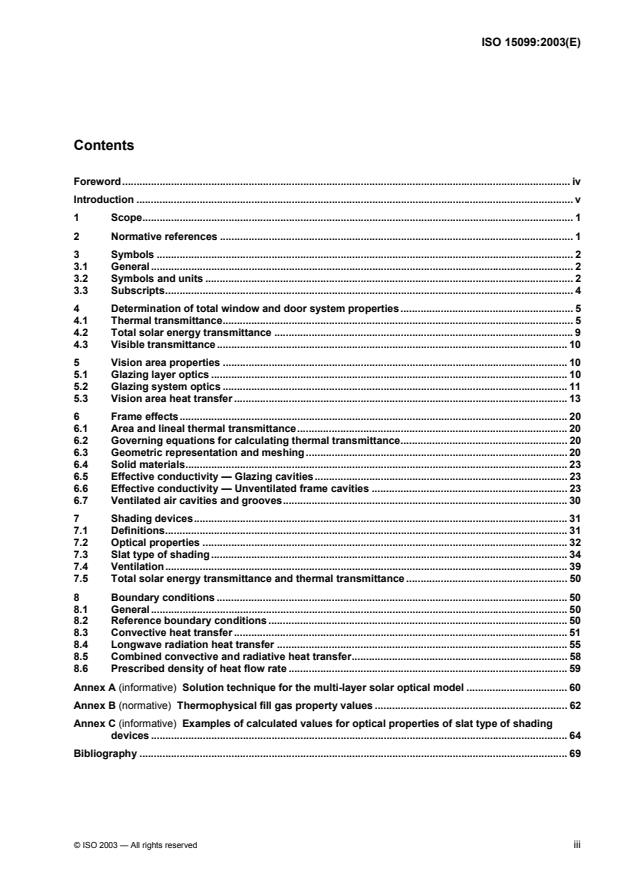
Contents
Foreword. iv
Introduction . v
1 Scope. 1
2 Normative references . 1
3 Symbols . 2
3.1 General. 2
3.2 Symbols and units . 2
3.3 Subscripts. 4
4 Determination of total window and door system properties. 5
4.1 Thermal transmittance. 5
4.2 Total solar energy transmittance . 9
4.3 Visible transmittance. 10
5 Vision area properties . 10
5.1 Glazing layer optics . 10
5.2 Glazing system optics . 11
5.3 Vision area heat transfer . 13
6 Frame effects. 20
6.1 Area and lineal thermal transmittance. 20
6.2 Governing equations for calculating thermal transmittance. 20
6.3 Geometric representation and meshing. 20
6.4 Solid materials. 23
6.5 Effective conductivity — Glazing cavities. 23
6.6 Effective conductivity — Unventilated frame cavities . 23
6.7 Ventilated air cavities and grooves. 30
7 Shading devices. 31
7.1 Definitions. 31
7.2 Optical properties . 32
7.3 Slat type of shading. 34
7.4 Ventilation. 39
7.5 Total solar energy transmittance and thermal transmittance . 50
8 Boundary conditions . 50
8.1 General. 50
8.2 Reference boundary conditions . 50
8.3 Convective heat transfer . 51
8.4 Longwave radiation heat transfer . 55
8.5 Combined convective and radiative heat transfer. 58
8.6 Prescribed density of heat flow rate . 59
Annex A (informative) Solution technique for the multi-layer solar optical model . 60
Annex B (normative) Thermophysical fill gas property values . 62
Annex C (informative) Examples of calculated values for optical properties of slat type of shading
devices . 64
Bibliography . 69
Foreword
ISO (the International Organization for Standardization) is a worldwide federation of national standards bodies
(ISO member bodies). The work of preparing International Standards is normally carried out through ISO
technical committees. Each member body interested in a subject for which a technical committee has been
established has the right to be represented on that committee. International organizations, governmental and
non-governmental, in liaison with ISO, also take part in the work. ISO collaborates closely with the
International Electrotechnical Commission (IEC) on all matters of electrotechnical standardization.
International Standards are drafted in accordance with the rules given in the ISO/IEC Directives, Part 2.
The main task of technical committees is to prepare International Standards. Draft International Standards
adopted by the technical committees are circulated to the member bodies for voting. Publication as an
International Standard requires approval by at least 75 % of the member bodies casting a vote.
Attention is drawn to the possibility that some of the elements of this document may be the subject of patent
rights. ISO shall not be held responsible for identifying any or all such patent rights.
ISO 15099 was prepared by Technical Committee ISO/TC 163, Thermal performance and energy use in the
built environment.
iv © ISO 2003 — All rights reserved
Introduction
This International Standard describes a procedure for calculating indices of merit of many window and door
products. The method provided in this International Standard allows the user to determine total window and
door product indices of merit, viz thermal transmittance, total solar energy transmittance and visible light
transmittance.
The procedures give the actual thermal performance of fenestration products for use in building energy
analysis and for the evaluation of products in specific building applications. These procedures can also be
used to produce data to compare products by using the standardized boundary conditions given either in this
International Standard or taken from the appropriate International or National Standards (e.g., ISO 12567-1,
ISO 10292, ISO 9050). This International Standard is also intended as a reference document for the
description of models used in computer programs for detailed calculation of the thermal and optical
transmission properties of window and door systems.
This International Standard gives detailed models for thermal and optical transmission in windows. These
detailed models are necessary in many types of window to get agreement between calculations and tests.
Traditionally, windows have been characterized by separately calculating the “dark” or “night-time” thermal
transmittance and the solar energy transmittance through the fenestration system. The thermal transmittance
without the effect of solar radiation is calculated using the procedures given in ISO 10292 (for the vision
portion) and the total solar energy transmittance, without taking into account the actual temperatures of the
various panes, is obtained using ISO 9050. These calculations require the use of reference conditions that are
not representative of actual conditions. In this International Standard the energy balance equations are set up
for every glazing layer taking into account the solar absorption and actual temperatures. From these energy
balance equations, the temperatures of the individual layers and gaps are determined. This is the only
standard that takes into account these complex interactions. This more detailed analysis provides results that
can then be expressed as thermal transmittance and τ -values and these values can differ from the results of
S
simpler models.
Individual indices of merit obtained using fixed reference boundary conditions are useful for comparing
products. However, the approach taken is the only way of calculating the energy performance of window
systems for other environmental conditions including those conditions that may be encountered during hot box
measurements.
Finally it must be emphasized that this International Standard is intended for use in computer programs. It was
never intended as a “simplified calculation” procedure. Simplified methods are provided in other International
Standards. It is essential that these programs produce consistent values and that they are based on a sound
standard methodology. Although more complicated than the formulae used in the simplified standards, the
formulae used in this International Standard are entirely appropriate for their intended use.
INTERNATIONAL STANDARD ISO 15099:2003(E)
Thermal performance of windows, doors and shading
devices — Detailed calculations
1 Scope
This International Standard specifies detailed calculation procedures for determining the thermal and optical
transmission properties (e.g., thermal transmittance, total solar energy transmittance) of window and door
systems based on the most up-to-date algorithms and methods, and the relevant solar and thermal properties
of all components.
Products covered by this International Standard include windows and doors incorporating:
a) single and multiple glazed fenestration products with or without solar reflective, low-emissivity coatings
and suspended plastic films;
b) glazing systems with pane spacing of any width containing gases or mixtures of gases;
c) metallic or non-metallic spacers;
d) frames of any material and design;
e) fenestration products tilted at any angle;
f) shading devices;
g) projecting products.
2 Normative references
The following referenced documents are indispensable for the application of this document. For dated
references, only the edition cited applies. For undated references, the latest edition of the referenced
document (including any amendments) applies.
ISO 7345, Thermal insulation — Physical quantities and definitions
ISO 8301, Thermal insulation — Determination of steady-state thermal resistance and related properties —
Heat flow meter apparatus
ISO 8302, Thermal insulation — Determination of steady-state thermal resistance and related properties —
Guarded hot plate apparatus
ISO 9050, Glass in building — Determination of light transmittance, solar direct transmittance, total solar
energy transmittance, ultraviolet transmittance and related glazing factors
ISO 9288, Thermal insulation — Heat transfer by radiation — Physical quantities and definitions
ISO 9845-1, Solar energy — Reference solar spectral irradiance at the ground at different receiving
conditions — Part 1: Direct normal and hemispherical solar irradiance for air mass 1,5
ISO 10077-2:2003, Thermal performance of windows, doors and shutters — Calculation of thermal
transmittance — Part 2: Numerical method for frames
ISO 10211-1, Thermal bridges in building construction — Heat flows and surface temperatures, Part 1:
General calculation methods
ISO/CIE 10526:1999, CIE standard Illuminants for colorimetry
ISO/CIE 10527, CIE standard colorimetric observers
ISO 12567-1, Thermal performance of windows and doors — Determination of thermal transmittance by hot
box method — Part 1: Complete windows and doors
EN 12898, Glass in building — Determination of the emissivity
3 Symbols
3.1 General
Symbols and units used are in accordance with ISO 7345 and ISO 9288. The terms, which are specific to this
International Standard, are listed in Table 1.
3.2 Symbols and units
Table 1 — Terms with their symbols and units
Symbol Term Unit
A
area m
A portion of absorbed solar energy by the ith glazing layer
i
A aspect ratio 1
R
b width (breadth) of a groove or slit mm
c specific heat capacity at constant pressure
J/(kg⋅K)
p
d thickness m
d thickness of glazing cavity m
g
E
irradiance
W/m
E (λ) solar spectral irradiance function (see ISO 9845-1) 1
s
colorimetric illuminance (CIE D65 function in ISO/CIE 10526:1999) lx
E (λ)
v
g acceleration due to gravity
m/s
G
parameter used in the calculation of convective heat transfer coefficients; see Equation (48) 1
2.
h surface coefficient of heat transfer
W/(m K)
H height of glazing cavity m
I total density of heat flow rate of incident solar radiation
W/m
+
I λ
()
i
spectral heat flow rate of radiant solar energy between ith and i + 1th glazing layers
W
+ −
travelling in the external ( ) or internal ( ) direction
−
I λ
()
i
2 © ISO 2003 — All rights reserved
Table 1 (continued)
Symbol Term Unit
J radiosity
W/m
l length m
molecular mass mole
ˆ
M
N 1
number of glazings + 2
Nu Nusselt number 1
P pressure Pa
q density of heat flow rate
W/m
r
reflectance: portion of incident radiation reflected such that the angle of reflection is equal 1
to the angle of incidence
R thermal resistance
m ⋅K/W
R(λ) photopic response of the eye (see ISO/CIE 10527)
universal gas constant
ℜ J/(kmol⋅K)
Ra Rayleigh number 1
Ra Rayleigh number based on length dimension x 1
x
S density of heat flow rate of absorbed solar radiation at ith glazing laver
W/m
i
t largest dimension of frame cavity perpendicular to heat flow m
perp
T thermodynamic temperature K
∆T temperature drop across ith glazing cavity, ∆T = |T − T | K
i i f,i b,i+1
u air velocity near a surface m/s
U thermal transmittance
W/(m ⋅K)
v free-stream air speed near window, mean air velocity in a gap m/s
x, y
dimensions in a Cartesian co-ordinate system 1
Z pressure loss factor 1
absorption 1
α
−1
β thermal expansion coefficient of fill gas
K
ε total hemispherical emissivity 1
angle °
γ
temperature
θ °C
−8 2 4
σ
Stefan-Boltzmann constant, 5,669 3 × 10 W/(m ⋅K )
λ thermal conductivity W/(m⋅K)
wavelength m
λ
w
µ dynamic viscosity Pa⋅s
density
ρ kg/m
τ transmittance 1
τ total solar energy transmittance: the portion of radiant solar energy incident on the
S
projected area of a fenestration product or component that becomes heat gain in the
internal conditioned space
φ parameter used in the calculation of viscosity and of thermal conductivity; 1
see Equations (62) and (67)
function used in the calculation of heat transfer; see Equation (112) 1
ϕ
heat flow rate W
Φ
Ψ linear thermal transmittance W/(m⋅K)
3.3 Subscripts
The subscripts given in Table 2 shall be applied.
Table 2 — Subscripts and meanings
Subscript Meaning
ai air
av average
b backward
bo bottom of a gap
cc condition on the cold side
cdv conduction/convection (unvented)
cg centre of glass
ch condition on the hot (warm) side
cr critical
cv convection
de divider edge glass
dif diffuse
dir direct
div divider
eff effective
eg edge of glass
eq equivalent
ex external
f frame
fr frame (using the alternative approach)
ft front
gv glass or vision portion
ht hot
hz horizontal
i counter
int internal
inl inlet of a gap
j counter
m mean
mix mixture
n counter
ne environmental (external)
ni environmental (internal)
out outlet of a gap
p panel
r radiation or radiant
red reduced radiation
s surface
sc source
sk sink
sl solar
t total
tp top of a gap
v number of gases in a gas mixture
v vertical
z at distance z
Ψ perimeter
2D coupling
4 © ISO 2003 — All rights reserved
4 Determination of total window and door system properties
4.1 Thermal transmittance
4.1.1 General
This International Standard presents procedures by which detailed computations can be used to determine
the thermal transmission properties of various product components, which are then used to determine the
thermal transmission properties of the total product. Where national standards allow, test procedures may be
used to determine component and total product properties.
The total properties for window and door products are calculated by combining the various component
properties weighted by either their respective projected areas or visible perimeter. The total properties are
each based on total projected area occupied by the product, A . The projected component areas and the
t
visible perimeter are shown in Figure 1.
Key
1 perimeter length at sight line - - - - -
Figure 1 — Schematic diagram showing the window projected areas and vision perimeter
Clause 4 describes the procedure for calculating thermal transmittance, total solar transmittance and visible
transmittance for the complete product. 4.1 describes the procedure for calculating thermal transmittance. The
effect of three-dimensional heat transfer in frames and glazing units is not considered. 4.1.4 describes an
alternative procedure for calculating edge of glass and frame thermal indices U , U , U and U , which are
de eg t fr
used in area-based calculations. Clause 5 describes the procedure for calculating the required centre-glass
properties τ and τ . Clause 6 describes the procedure for calculating the linear thermal transmittance, Ψ,
sgv gv
which accounts for the interaction between frame and glazing or opaque panel. Clause 7 contains the
procedure for dealing with shading devices and ventilated windows. Clause 8 describes the procedure for
determining and applying boundary conditions. The thermal transmittance of the fenestration product is given
by:
∑+AU ∑AU+∑l Ψ
gv gv f f Ψ
U = (1)
t
A
t
where A and A are the projected vision area and frame area, respectively. The length of the vision area
gv f
perimeter is l , and Ψ is a linear thermal transmittance that accounts for the interaction between frame and
Ψ
glazing or the interaction between frame and opaque panel (e.g., a spandrel panel).
The summations included in Equation (1) are used to account for the various sections of one particular
component type; e.g. several values of A are needed to sum the contributions of different values of U
f f
corresponding to sill, head, dividers and side jambs.
Figure 2 illustrates the division into components for the alternative approach described in 4.1.4, in which the
edge-of-glass and divider-edge areas are 63,5 mm (2,5 in) wide. The sum of all component areas equals the
total projected fenestration product area.
Key
C Centre-of-glass 1 installation clearance
E Edge-of-glass 2 projected area
F Frame 3 rough opening
D Divider 4 interior
DE Divider-edge 5 exterior
Figure 2 — Centre-of-glass, edge-of-glass, divider, divider-edge,
and frame areas for a typical fenestration product
4.1.2 Glazed area thermal transmittance
The thermal transmittance can be found by simulating a single environmental condition involving
internal/external temperature difference, with or without incident solar radiation. Without solar radiation, the
thermal transmittance is the reciprocal of the total thermal resistance.
U = (2)
gv
R
t
and when solar radiation is considered, then:
q
int I = 0
()
s
U = (3)
gv
TT−
ni ne
6 © ISO 2003 — All rights reserved
where q (I = 0) is the net density of heat flow rate through the window or door system to the internal
int s
environment for the specified conditions, but without incident solar radiation, in W/m . The condition “without
solar radiation” is used because all effects on the thermal resistances due to incident solar radiation are
incorporated in the total solar energy transmittance or τ -value [see Equation (14)], and T and T are the
S ni ne
environmental temperatures, as defined in Equation (7).
R is found by summing the thermal resistances at the external and internal boundaries, and thermal the
t
resistances of glazing cavities and glazing layers. See Figure 3.
nn
RR=+ +R + (4)
tg∑∑iiv,
hh
ex int
ii=2 =1
where the thermal resistance of the ith glazing is:
t
gv,i
R = (5)
gv,i
λ
gv,i
and the thermal resistance of the ith space, where the first space is external environment, the last space is
internal environment and the spaces in between are glazing cavities, (see Figure 3):
TT−
f,ib,i−1
R = (6)
i
q
i
where T , and T are the external and internal facing surface temperature of the ith glazing layer.
f,i b,i−1
The environmental temperature [as defined in Equation (7)] is a weighted average of the ambient air
temperature and the mean radiant temperature, T , which is determined for external and internal
rm
environment boundary conditions (see boundary conditions in 8.4.1).
Key
1 gap
2 glazing
Figure 3 — Numbering system for glazing system layers
The environmental temperature, T , is:
n
hT +hT
cv ai r rm
T = (7)
n
hh+
cv r
where h and h are determined according to the procedure given in Clause 8.
cv r
4.1.3 Frame area/edge-glass thermal indices
In order to convert the results of a two-dimensional numerical analysis to thermal transmittances, it is
necessary to record the rate of heat transfer from the internal environment to the frame and edge-glass
surfaces (in the absence of solar radiation). The linear thermal transmittance, Ψ, values and frame thermal
transmittances shall be calculated according to the following equations.
2D
Ψ=−L Ul−U l (8)
f f gv gv
2D
where L is thermal coupling coefficient determined from the actual fenestration system.
2D
L −Ul
ppp
U = (9)
f
l
f
where
2D
L is thermal coupling coefficient determined from the frame/panel insert system;
p
U is the thermal transmittance of foam insert;
p
l is the internal side exposed length of foam insert (minimum 100 mm);
p
l is the internal side projected length of the frame section;
f
l is the internal side projected length of the glass section (see Figures C.1 and C.2 of
gv
ISO 10077-2:2003, for further details on the definition of l and l ).
fr p
2D
The detailed procedure for determining L is also given in ISO 10211-1.
4.1.4 Alternative approach (see Figure 2)
An alternative method is available for calculating frame thermal transmittance, U . Using this method it is
fr
unnecessary to determine the linear thermal transmittance, Ψ. Instead, the glass area, A , is divided into
gv
centre-glass area, A , plus edge-glass area, A , and one additional thermal transmittance, U , is used to
c e eg
characterize the edge-glass area. If dividers are present then divider area, A and divider thermal
div
transmittance, U are calculated, as well as corresponding divider edge area, A and thermal transmittance,
div de
U . The following equation shall be used to calculate the total thermal transmittance:
de
UA++U A U A+ U A+ U A
∑∑cg c fr f∑ eg e∑ div div∑ de de
U = (10)
t
A
t
where U , and U can be determined from the following equations:
fr eg
Φ
fr
U = (11)
fr
lT −T
()
fni ne
Φ
eg
U = (12)
eg
lT −T
()
eg ni ne
and where l is projected length of frame area and l is the length of edge of glass area and is equal to
f eg
63,5 mm. These lengths are measured on the internal side. The quantities Φ and Φ are heat flow rates
fr eg
through frame and edge-glass areas (internal surfaces), respectively, including the effect of glass and spacer,
and both are expressed per length of frame or edge-glass. The calculations shall be performed for each
combination of frame and glazing with different spacer bars.
8 © ISO 2003 — All rights reserved
The summations included in Equation (10) are used to account for the various sections of one particular
component type; e.g., several values of A must be used to sum the contributions of different values of U
f fr
corresponding to sill, head and side jambs.
It should be noted that the two different approaches entail different definitions of frame thermal transmittance,
denoted U and U . The primary difference is that the U includes the some of the heat transfer caused by the
f fr fr
edge seal, whereas U does not. The comparison of frame properties for two different products is only
f
meaningful if the same calculation procedure has been used in both cases.
The U values for windows calculated by the two methods may differ because of differences in the way frame
t
and edge heat transfer is treated at the corners, particularly because the three dimensional effects are
neglected. This difference is more pronounced for smaller windows. The choice of l = 63,5 mm is made to
eg
reduce the discrepancy between the two alternative approaches.
4.2 Total solar energy transmittance
4.2.1 General
The total solar energy transmittance of the total fenestration product is:
ττA + A
∑∑gg f f
τ = (13)
s
A
t
where τ and τ are the individual total solar energy transmittance values of the vision area and frame area,
g f
respectively. The summations are included for the same reason that they appear in Equation (1) and shall be
applied in the same manner to account for differing sections of one particular component type.
NOTE Equation (13) includes an assumption that the solar transmittance of the edge of glass is the same as that of
the centre of glass area.
4.2.2 Vision area total solar energy transmittance
The total solar energy transmittance can be determined for conditions involving internal/external temperature
difference and any level of incident solar radiation. It is found by calculating the difference between the net
heat flow rate into the internal environment with and without incident solar radiation.
qq−=I 0
()
int int s
τ = (14)
S
I
s
where
q is the net density of heat flow rate through the window or door system to the internal
int
environment for the specified conditions, in W/m ;
q (I = 0) is the net density of heat flow rate through the window or door system to the internal
int s
environment for the specified conditions, but without incident solar radiation, in W/m .
For the equivalent expression for U, see Equation (3).
The net density of heat flow rates, q and q (I = 0) are calculated in 5.3.1 [Equation (27), for index i = int].
int int s
For a glazing assembly in which a shading device is involved, the amendments to the equations of 5.2 as
given in 7.2 shall be applied.
4.2.3 Frame total solar energy transmittance
The frame total solar energy transmittance shall be calculated using the approximate equation:
U
f
τα= (15)
ff
A
s
h
ex
A
f
where A is the developed surface area.
s
The external surface heat transfer coefficient (combined convective/radiative) at the frame, h , is
ex
h = h + h .
ex cv,ex r,ex
If the alternative method of calculating U is being used, U should be used instead of U in Equation (15).
t fr f
More detailed two-dimensional or three-dimensional calculations, including the effects of off-normal solar
radiation, shading, reflected solar radiation and solar radiation transmitted to the internal frame surfaces, can
be performed in a manner analogous to Equation (14), and subject to boundary conditions given in 8.6.
4.3 Visible transmittance
The visible transmittance of the total fenestration product is:
τ A
∑ vgv
τ = (16)
t
A
t
5 Vision area properties
5.1 Glazing layer optics
5.1.1 General
For glazing units only, the optical properties can be determined using ISO 9050. Clause 7 contains the
extensions needed to model vented windows.
5.1.2 Solar
The solar optical properties needed to describe the ith glazing are: a) the front (external side) spectral
reflectance, r (λ ); b) the back (internal side) spectral reflectance, r , (λ ); and c) the spectral
ft,i w b i w
transmittance,τ (λ ). See Figure 4.
i w
NOTE More information about r (λ ), r (λ ) and τ (λ ) can be found in [2].
ft,i w b,i w i w
Key
1 outdoor side
2 ith glazing layer
3 indoor side
Figure 4 — Outdoor and internal spectral transmittance of a glazing layer
10 © ISO 2003 — All rights reserved
The solar optical data shall be measured in accordance with ISO 9050. Intermediate values of r (λ ), r (λ )
f,i w b,i w
or τ (λ ) are found by linear interpolation.
i w
5.1.3 Long-wave
The long-wave optical properties needed to describe the ith glazing are: a) the front (external side)
hemispheric emissivity, ε ; b) the back (internal side) hemispheric emissivity, ε ; and c) the hemispheric-
ft,i b,i
hemispheric transmittance, τ . These total optical properties apply to wavelengths from 5 µm to 50 µm.
i
The long-wave reflectance data shall be measured in accordance with EN 12898. Values of the normal
emissivity resulting from this procedure shall be converted to hemispherical emissivity using the procedure
described in [3] or in EN 12898. The integration needed to convert measured spectral data to the required
total longwave optical properties, ε , ε and τ shall be carried out in accordance with [3] or EN 12898.
ft,i b,i i
Some windows are constructed with suspended or stretched layers of thin plastic film between glass panes to
make triple or quadruple glazing. When these layers are covered with a low-emissivity coating they are
generally opaque in the infrared, so that τ = 0 and hemispherical emissivity can be calculated as in [3]. For
i
partially transparent films such as polyethylene terephthalate (PET), both specular transmittance and
reflectance should be measured. Using the bulk model, the optical indices of the material can then be
calculated and used to derive the hemispherical properties.
NOTE See [4] for more information.
5.2 Glazing system optics
5.2.1 Spectral quantities
The path of incident solar radiation within the various layers of the glazing system shall be modelled by the
methods described in ISO 9050 or by any other exact method.
NOTE Depending on future modifications of ISO 9050, specific additions may be added to this International Standard
covering the effects of optical properties of products (shading devices, diffusing panes, etc.) not adequately covered by
ISO 9050.
Key
1 glazing layer
Figure 5 — Absorption of the ith glazing layer and solar spectral transmittance
Figure 5 shows how a window with n glazing layers together with the external (i = 0) and internal (i = n + 1)
spaces can be treated as an n + 2 element array. It is necessary to determine the portion of incident solar
radiation, at a given wavelength, that is absorbed at each of the glazing layers. This quantity is denoted α (λ )
i w
at the ith glazing layer. Similarly, it is necessary to determine the solar spectral transmittance of the glazing
system, τ (λ ).
s w
These quantities, α (λ ) and τ (λ ), shall be calculated in accordance with ISO 9050 while setting the
i w s w
reflectance of the conditioned space to zero. Any other method that can be shown to provide an exact solution
is acceptable.
NOTE The solution technique described in [5] is summarized in Annex A.
5.2.2 The solar spectrum
The spectral distribution of the incident solar radiation, E(λ ), is needed to calculate total optical properties
w
and various total energy flow. Values of E(λ ) are reported at N values of λ (denoted here as E(λ ) and
w sl w wj
λ , respectively). Intermediate values of E(λ ) shall be found by linear interpolation of the tabulated values.
wj w
5.2.3 Absorbed amounts of solar radiation
The total flow rate of solar radiation absorbed at the ith glazing layer, S, is determined by numerical
i
integration over the solar spectrum according to Equations (16), (17) and (18).
N −1
sl
αλλE ∆λ
ij()wsl()w w
∑ jj/1++jj/1
j=1
A = (17)
i
N −1
sl
Eλλ∆
∑ sl()w wj
jj/1+
j=1
∆=λ λλ− (18)
wwjj+1 wj
SA=×I (19)
ii sl
where A is the portion of the total incident solar radiation (on the glazing system) that is absorbed by the ith
i
glazing layer, and α (λ ) is the value of α that is representative of the wavelength band from λ to λ
i wj/j+1 i wj wj+1
and is given by
α λ =+αλ αλ (20)
ii()ww()i()w
jj/1++j j1
and
EEλλ+
( )
sw() swj+1
j
E λ = (21)
sw()
jj/1+
Values of E (λ ) are given in ISO 9845-1.
s w
12 © ISO 2003 — All rights reserved
5.2.4 Solar transmittance
The solar transmittance of the glazing system is:
N
sl−1
τλ E λ ∆λ
sl()w s()w w
∑ jj/1++jj/1 j
j=1
τ = ∆=λλ −λ (22)
sl ww w
jj+1 j
N
sl−1
Eλλ∆
∑ sw() w
jj/1+ j
j=1
where E (λ ) is given by Equation (21) and
s wj/j+1
τλ =+τλ τλ (23)
sl()w sl ( w ) sl()w
jj/1++j j1
5.2.5 Visible transmittance
Visible transmittance, τ , is calculated using a weighting function that represents the photopic response of the
vs
eye, R(λ ). R(λ ) is tabulated for N values of λ . τ is given by:
w wj vs wj vs
N
vs−1
τλ ERλ λ ∆λ
sl( w ) vs()w ()w w
∑ j/1j++jj/1 jj/1+ j
j=1
τ = ∆=λλ −λ (24)
vs ww w
jj+1 j
N
vs−1
ERλλ ∆λ
vs()w ()w w
∑ jj/1++jj/1 j
j=1
where
RRλλ+
()ww( )
jj+1
R λ = (25)
()w
jj/1+
EEλλ=+Eλ (26)
()ww() (w )
jj/1++j j1
vs vs vs
Values of E (λ ) are given in ISO/CIE 10526.
v w
and τ (λ ) is given by Equation (23).
sl w j / j+1
5.3 Vision area heat transfer
5.3.1 Glazing layer energy balance
Longwave radiative exchange between glazing layers and conductive heat transfer within each glazing layer
can be described using fundamental relations. Calculations dealing with convective heat transfer depend upon
correlations based on experimental data.
Key
1 glazing layer
2 control volume
3 slope
Figure 6 — Energy balance on glazing layer i
Figure 6 shows the ith glazing in a sloped multilayer array. The values of four variables are sought at each
glazing. These are the temperatures of the external and internal facing surfaces, T and T plus the radiant
ft,i b,i
heat leaving the front and back facing surfaces (i.e., the radiosities), J and J . In terms of these variables,
ft,i, b,i
q is:
i
qh=−T T +J−J (27)
()
iicv, ft,i b,i−−1 ft,i b,i 1
The solution is generated by applying the following four equations at each glazing:
qS=+q (28)
ii i+1
JT=+εσ τJ+rJ (29)
ft,iift, ft,i i ft,i+−1 ft,i b,i 1
JT=+εσ τJ+rJ (30)
b,iib, b,i i b,i−+1 b,i ft,i 1
t
gv,i
TT−= 2q +S (31)
()
b,iift, i+1 i
2λ
gv,i
A by-product of the analysis is the temperature profile through each glazing.
TT−
−SS
ft,iib,
ii2
Tz()=+z + z+T (32)
iib,
22λλtt
gv,iigv, gv,i gv,i
where z is the distance from the internal surface of the glazing, positive in the direction of the external side.
Equation (28) describes an energy balance imposed at the surfaces of the ith glazing. Equations (29) and (30)
define the radiosities at the ith glazing, and r =−1 τ − ε and r =−1.τ − ε
ft,ii ft,i b,ii b,i
The temperature difference across the ith glazing is given by Equation (31). It is assumed that the solar
energy is absorbed uniformly through the thickness of the glazing.
NOTE More details regarding Equation (27) to Equation (32) are given in References [5] and [35].
14 © ISO 2003 — All rights reserved
5.3.2 Interaction with the environment
The effect of boundary conditions imposed by the environment on the window shall be specified. The internal
and external temperatures, T and T are:
ft,n+1 b,0
TT= (33)
ft,n+1 ai,int
TT= (34)
b,0 ai,ex
The effect of long-wave irradiance at internal and external glazing surfaces is included by setting
JE= (35)
ft,n+1 gv,int
and JE= (36)
b,0 gv,ex
where E and E are given by Equations (159) and (152) in Clause 8, respectively.
gv,int g,ex
The effect of the convective heat transfer coefficients at the glazing surfaces is included by setting
hh= (37)
cv,n+1 cv,int
hh= (38)
cv,1 cv,ex
5.3.3 Convective heat transfer coefficient — glazing cavities
5.3.3.1 General
Convective heat transfer coefficients for the fill gas layers are determined in terms of the dimensionless
Nusselt number, Nu :
i
λ
gv,i
hN=u (39)
cv,ii
d
gv,i
where d is the thickness of the fill gas layer (or pane spacing) i, and λ is the thermal conductivity of the
gv,i gv,i
fill gas. Nu is calculated using correlations based on experimental measurements of heat transfer across
i
inclined air layers. Nu is a function of the Rayleigh number, Ra , the cavity aspect ratio, A , and the cavity
i i gv, i
slope, γ.
It should be recognized that deflection of the panes in high aspect ratio cavities can occur. This deflection may
increase or decrease the average cavity width, d. This deflection can be caused by changes in the cavity
average temperature, changes in the cavity moisture content, nitrogen absorption by the desiccant or changes
in the barometric pressure (due to elevation and/or weather changes) from the conditions during assembly.
NOTE Reference [6] discusses the effects of glass pane deflection and methods to estimate the change in the
thermal transmittance due to this deflection.
The Rayleigh number can be expressed as (omitting the “i” and “gv” subscripts for convenience):
ρβdg c ∆T
p
Ra =(dimensionless) (40)
µλ
Treating the fill gas as a perfect gas, the thermal expansion coefficient of the fill gas, β, is:
β = (41)
T
m
where T = fill gas mean temperature in kelvins.
m
The aspect ratio of the fill gas cavity i, is:
H
A = (42)
gv,i
d
gv,i
where H is the distance between the top and bottom of the fill gas cavity which is usually the same as the
height of the window view area.
Correlation to quantify convective heat transfer across glazing cavities is presented in the 5.3.3.2 to 5.3.3.6.
Each of these subclauses pertains to one particular value, or range, of tilt angle, γ.
This categorization, as a function of γ, is based on the assumption that the cavity is heated from the internal
side (i.e., T > T ). If the reverse is true (T < T ,) it is necessary to seek the appropriate correlation on
ft,i b,i−1 ft,i b,i−1
the basis of the complement of the tilt angle, 180°− γ, instead of γ and to then substitute 180°− γ instead of γ
when the calculation is carried out.
γ = 0 is horizontal glazing, heat flow upwards
γ = 90 is vertical glazing, heat flow upwards
γ = 180 is horizontal glazing, heat flow downwards
5.3.3.2 Cavities inclined at 0 u γ < 60°
•
1,6
1/3
•
1708sin (1,8γ )
()
Racos γ
1708 ()
Nu =+11,44 1− 1− + −1 (43)
i
Racos(γγ) Racos( ) 5 830
Ra < 10 and A > 20
gv,i
XX+
()
•
where X = (44)
()
NOTE For more details, see Reference [7].
5.3.3.3 Cavities inclined at γ = 60°
Nu = Nu , Nu (45)
( )
max
1/ 7
0,314
0,093 6Ra
where Nu =+1 (46)
1+ G
0,175
0,283
Nu=+0,104 Ra (47)
A
g,i
16 © ISO 2003 — All rights reserved
0,5
G = (48)
0,1
20,6
Ra
1+
3 160
NOTE For more details, see Reference [8].
5.3.3.4 Cavities inclined at 60° < γ < 90°
For layers inclined at angles between 60° and 90°, a straight-line interpolation between the results of
Equations (45) and (49) is used. These equations are valid in the ranges of:
10<
gv,i
NOTE For more details, see Reference [8].
5.3.3.5 Vertical cavities
Nu = Nu , Nu (49)
( )
max
1/ 3 4
Nu = 0,067 383 8Ra 51×<0 Ra (50)
0,413 4 44
Nu = 0,028 154Ra 10<×Rau 5 10 (51)
−10 2,298 475 5 4
Nu =+1 1,759 667 8×10 Ra Rau 10 (52)
0,272
Ra
Nu = 0,242 (53)
A
gv,i
NOTE For more details, see Reference [9].
5.3.3.6 Cavities inclined from 90° to 180°
Gas layers contained in downward facing windows are modelled using:
Nu=+11Nu −sinγ (54)
( )
v
Nu is the Nusselt number for a vertical cavity given by Equation (49).
v
NOTE For more details, see Reference [10].
5.3.3.7 Fill gas properties
The density of fill gases in windows is calculated using the perfect gas law.
...