

ISO 5938:1979
(Main)Cryolite, natural and artificial, and aluminium fluoride for industrial use — Determination of sulphur content — X-ray fluorescence spectrometric method
General Information
- Abstract
Covers a method, the orinciple of which consists in preparing tablets from a mixture of the test portion and a binder and measuring the intensity of the K line emitted by the sulphur. The measured intensity is then compared with the intensity of emission of standard tablets of known sulphur content. The method is applicable to products having sulphur contents between 0,01 and 2 % (m/m).
- Status
- Published
- Publication Date
- 30-Jun-1979
- Technical Committee
- ISO/TC 226 - Materials for the production of primary aluminium
- Drafting Committee
- ISO/TC 226/WG 4 - Smelter grade fluorides
- Current Stage
- 9093 - International Standard confirmed
- Start Date
- 02-May-2024
- Completion Date
- 29-Aug-2026
Buy Documents
ISO 5938:1979 - Cryolite, natural and artificial, and aluminium fluoride for industrial use — Determination of sulphur content — X-ray fluorescence spectrometric method Released:7/1/1979
ISO 5938:1979 - Cryolithe, naturelle et artificielle, et fluorure d'aluminium a usage industriel — Dosage du soufre — Méthode par spectrométrie de fluorescence X Released:7/1/1979
ISO 5938:1979 - Cryolithe, naturelle et artificielle, et fluorure d'aluminium a usage industriel — Dosage du soufre — Méthode par spectrométrie de fluorescence X Released:7/1/1979
Overview
ISO 5938:1979 specifies a standardized X-ray fluorescence spectrometric method for the determination of sulphur content in natural and artificial cryolite as well as aluminium fluoride used in industrial applications. This internationally recognized standard provides a reliable procedure for accurately measuring sulphur in these fluoride compounds, with sulphur concentrations ranging from 0.01% to 2% by mass. The method involves preparing tablets from a test sample mixed with a binder, followed by spectrometric measurement of the sulphur K line's fluorescence intensity. The intensity is then compared against calibrated standards with known sulphur concentrations to determine the sulphur content within the test sample.
This standard is critical for industries relying on high-purity cryolite and aluminium fluoride to ensure material quality, regulatory compliance, and optimized manufacturing processes.
Key Topics
- Sample Preparation: The test portion is finely ground and mixed with a binder (such as crystalline cellulose), then pressed into tablets to facilitate uniform X-ray fluorescence.
- X-ray Fluorescence Spectrometry: Utilizes a vacuum spectrometer with rhodium, chromium, or tungsten anticathode tubes to excite sulphur atoms and measure emitted K line intensity at 0.5373 nm wavelength.
- Calibration Curve: Standard tablets containing known sulphur concentrations are used to plot a calibration graph; this serves as a reference to quantify sulphur in test samples.
- Applicability: Suitable for fluoride material containing sulphur levels from 0.01% to 2% (m/m), catering specifically to industrial-grade cryolite and aluminium fluoride.
- Reagents: Involves high-purity anhydrous sodium sulphate standards and acetone to prevent clumping during grinding.
- Precision: Instrument settings, vacuum conditions, and operating parameters are standardized for reproducible and statistically valid sulphur measurements.
- Compliance Reporting: The test report must include sample identification, method reference, results with units, any anomalies, and deviations from the standard procedure.
Applications
ISO 5938:1979 is predominantly applied in:
- Industrial Quality Control: Monitoring the sulphur levels in cryolite and aluminium fluoride ensures materials meet purity specifications necessary for applications like aluminium production.
- Raw Material Verification: Confirms the quality of raw cryolite and aluminium fluoride supplies, avoiding sulphur-related contamination issues that can affect downstream processing.
- Process Optimization: Helps manufacturers adjust production parameters to control sulphur content within target levels, improving end-product performance.
- Regulatory Compliance: Assists companies in meeting international chemical standards and environmental regulations related to sulphur impurities.
- Research and Development: Facilitates the development of new fluoride materials by providing a reliable analytical method for sulphur determination.
Related Standards
For comprehensive chemical analysis of cryolite and aluminium fluoride, ISO 5938:1979 works in conjunction with various ISO standards, including:
- ISO 1619: Preparation and storage of test samples for cryolite.
- ISO 2925: Preparation and storage of aluminium fluoride test samples.
- ISO 1693, ISO 2362: Determination of fluorine content by modified Willard-Winter method.
- ISO 1694, ISO 2368: Photometric methods for iron content determination.
- ISO 2367, ISO 4279: Determination of sodium content by flame emission spectrophotometry.
- ISO 2830: Aluminium content by atomic absorption.
- ISO 4280: Sulphate content by barium sulphate gravimetric method.
- ISO 5930, ISO 6374: Phosphorus content determination by photometric and atomic absorption methods.
These complementary standards ensure a full chemical profile and quality assessment for industrial fluoride compounds, enhancing process control and product reliability.
By adhering to ISO 5938:1979, industries handling cryolite and aluminium fluoride gain confidence in their sulphur content analysis, optimize material performance, and maintain compliance with global standards, supporting sustainable and efficient industrial operations.
Buy Documents
ISO 5938:1979 - Cryolite, natural and artificial, and aluminium fluoride for industrial use — Determination of sulphur content — X-ray fluorescence spectrometric method Released:7/1/1979
ISO 5938:1979 - Cryolithe, naturelle et artificielle, et fluorure d'aluminium a usage industriel — Dosage du soufre — Méthode par spectrométrie de fluorescence X Released:7/1/1979
ISO 5938:1979 - Cryolithe, naturelle et artificielle, et fluorure d'aluminium a usage industriel — Dosage du soufre — Méthode par spectrométrie de fluorescence X Released:7/1/1979
Get Certified
Connect with accredited certification bodies for this standard

ECOCERT
Organic and sustainability certification.

Eurofins Food Testing Global
Global leader in food, environment, and pharmaceutical product testing.

Intertek Bangladesh
Intertek certification and testing services in Bangladesh.
Sponsored listings
Frequently Asked Questions
ISO 5938:1979 is a standard published by the International Organization for Standardization (ISO). Its full title is "Cryolite, natural and artificial, and aluminium fluoride for industrial use — Determination of sulphur content — X-ray fluorescence spectrometric method". This standard covers: Covers a method, the orinciple of which consists in preparing tablets from a mixture of the test portion and a binder and measuring the intensity of the K line emitted by the sulphur. The measured intensity is then compared with the intensity of emission of standard tablets of known sulphur content. The method is applicable to products having sulphur contents between 0,01 and 2 % (m/m).
Covers a method, the orinciple of which consists in preparing tablets from a mixture of the test portion and a binder and measuring the intensity of the K line emitted by the sulphur. The measured intensity is then compared with the intensity of emission of standard tablets of known sulphur content. The method is applicable to products having sulphur contents between 0,01 and 2 % (m/m).
ISO 5938:1979 is classified under the following ICS (International Classification for Standards) categories: 71.060.50 - Salts. The ICS classification helps identify the subject area and facilitates finding related standards.
ISO 5938:1979 is available in PDF format for immediate download after purchase. The document can be added to your cart and obtained through the secure checkout process. Digital delivery ensures instant access to the complete standard document.
Standards Content (Sample)
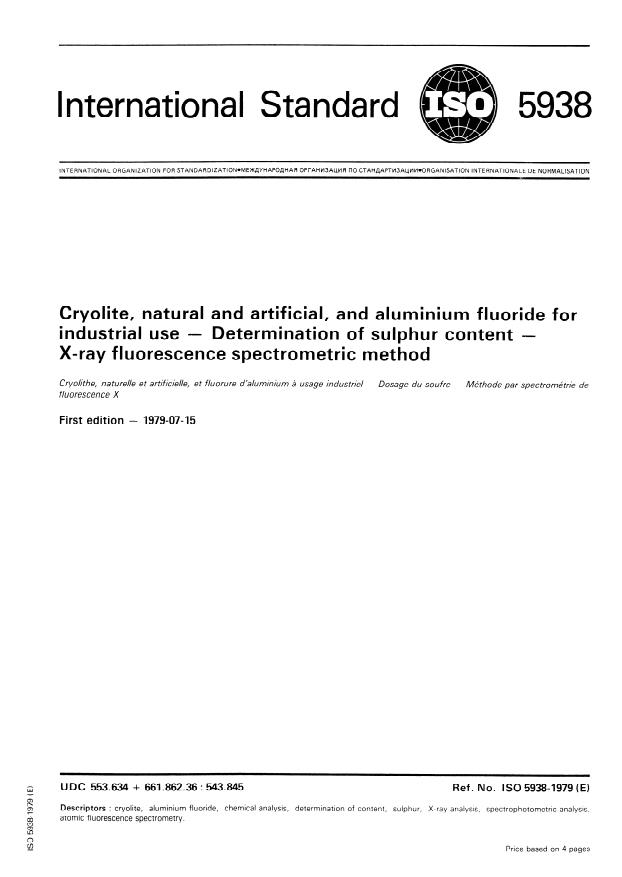
International Standard
INTERNATIONAL ORGANIZATION FOR STANDARDIZATION~MEIKC1YHAPO~HAR OPrAHtl3A~MR fl0 CTAH~APTM3A~MM*ORGANISATION INTERNATIONALE DE NORMALISATION
Cryolite, natura1 and artificial, and aluminium fluoride for
industrial use - Determination of sulphur content -
X-ray fluorescence spectrometric method
Cryolithe, na turelle et artificielle, et fluorure d ‘aluminium A usage industriel - Dosage du soufre - Methode par spectromktrie de
fluorescence X
First edition - 1979-07-15
Ref. No. ISO 5938-1979 (E)
UDC 553.634 + 661.862.36 : 543.845
Descriptors : cryolite, aluminium fluoride, Chemical analysis, determination of content, sulphur, X--ray analysrs, spectrophotometric analysis,
atomic fluorescence spectrometry.
Price based on 4 pages
Foreword
ISO (the International Organization for Standardization) is a worldwide federation of
national Standards institutes (ISO member bedies). The work of developing lnterna-
tional Standards is carried out through ISO technical committees. Every member body
interested in a subject for which a technical committee has been set up has the right to
be represented on that committee. International organizations, governmental and non-
governmental, in liaison with ISO, also take part in the work.
Draft International Standards adopted by the technical committees are circulated to
the member bodies for approval before their acceptance as International Standards by
the ISO Council.
International Standard 5938 was developed by Technical Committee ISO/TC 47,
Chemistry, and was circulated to the member bodies in September 1977.
lt has been approved by the member bodies of the following countries :
Austria Hungary Romania
Belgium India South Africa, Rep. of
Brazil Israel Sweden
Bulgaria Italy Switzerland
Turkey
Czechoslova kia Kenya
Egypt, Arab Rep. of Netherlands USA
France New Zealand USSR
Y ugoslavia
Germany, F. R. Portugal
The mem ber body of the following country expressed disapproval of the document on
technical grounds
United Kingdom
international Organkation for Standardkation, 1979
Printed in Switzerland
ISO 5938-1979 (El
INTERNATIONAL STANDARD
Cryolite, natura1 and artificial, and aluminium fluoride for
- Determination of sulphur content -
industrial use
X-ray fluorescence spectrometric method
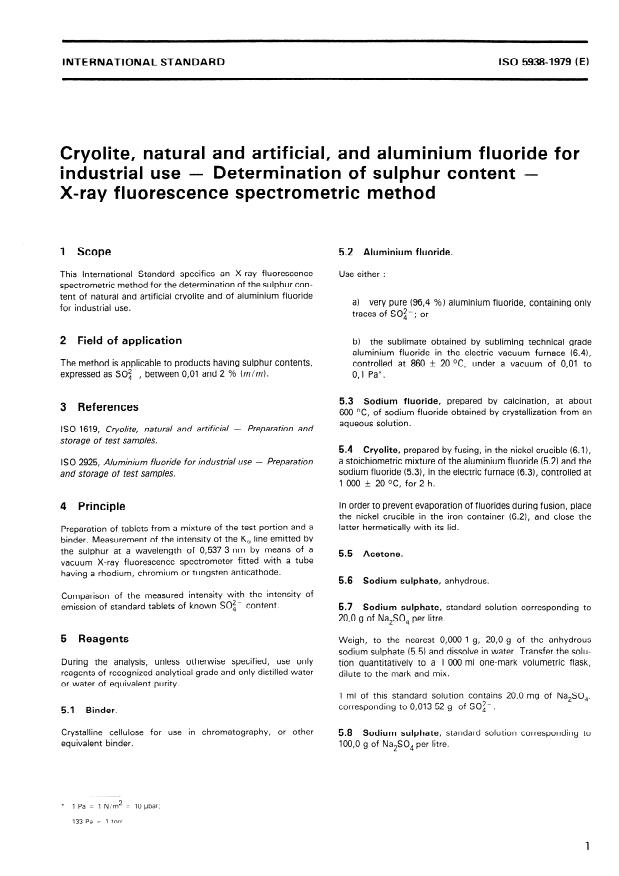
1 Scope 5.2 Aluminium fluoride.
This International Standard specifies an X-ray fluorescence Use either :
spectrometric method for the determination of the sulphur con-
tent of natura1 and artificial cryolite and of aluminium fluoride
a) very pure (96,4 %) aluminium fluoride, containing only
for industrial use.
traces of SO:-; or
2 Field of application b) the sublimate obtained by subliming technical grade
aluminium fluoride in the electric vacuum furnace (6.4),
The method is applicable to products having sulphur contents, controlled at 860 ? 20 OC, under a vacuum of 0,OI to
expressed as SO, 2-, between 0,OI and 2 % (mlm). 0,I Pa*.
5.3 Sodium fluoride, prepared by calcination, at about
3 References
600 OC, of sodium fluoride obtained by crystallization from an
aqueous Solution.
ISO 1619, Cryolite, natura1 and artificial - Reparation and
storage of test samples.
5.4 Cryolite, prepared by fusing, in the nicke1 crucible (6.1),
a stoichiometric mixture of the aluminium fluoride (5.2) and the
ISO 2925, Aluminium fluoride for industrial use - Preparation
sodium fluoride (5.3), in the electric furnace (6.3), controlled at
and storage of test samples.
1 000 k 20 OC, for 2 h.
In Order to prevent evaporation of fluorides during fusion, place
4 Principle
the nicke1 crucible in the iron Container (6.21, and close the
latter hermetically with its lid.
Preparation of tablets from a mixture of the test Portion and a
binder. Measurement of the intensity of the K, line emitted by
the sulphur at a wavelength of 0,537 3 nm by means of a
5.5 Acetone.
vacuum X-ray fluorescence spectrometer fitted with a tube
having a rhodium, chromium or tungsten anticathode.
5.6 Sodium sulphate, anhydrous.
Comparison of the measured intensity with the intensity of
emission of Standard tablets of known SO:- content. 5.7 Sodium sulphate, Standard Solution corresponding to
20,O g of Na,SO, per litre.
5 Reagents
Weigh, to the nearest 0,000 1 g, 20,O g of the anhydrous
sodium sulphate (5.5) and dissolve in water. Transfer the solu-
During the analysis, unless otherwise specified, use only
tion quantitatively to a 1 000 ml one-mark volumetric flask,
reagents of recognized analytical grade and only distilled water dilute to the mark and mix.
or water of equivalent purity.
1 ml of this Standard Solution contains 20,O mg of Na2S0,,
corresponding to 0,013 52 g of SO:-.
5.1 Binder.
Crystalline cellulose for use in chromatography, or other 5.8 Sodium sulphate, Standard Solution corresponding to
equivalent binder.
100,O g of Na2S0, per litre.
* 1 Pa = 1 N/rn2 = 10 pbar;
133 Pa = 1 torr
ISO 5938-1979 (E)
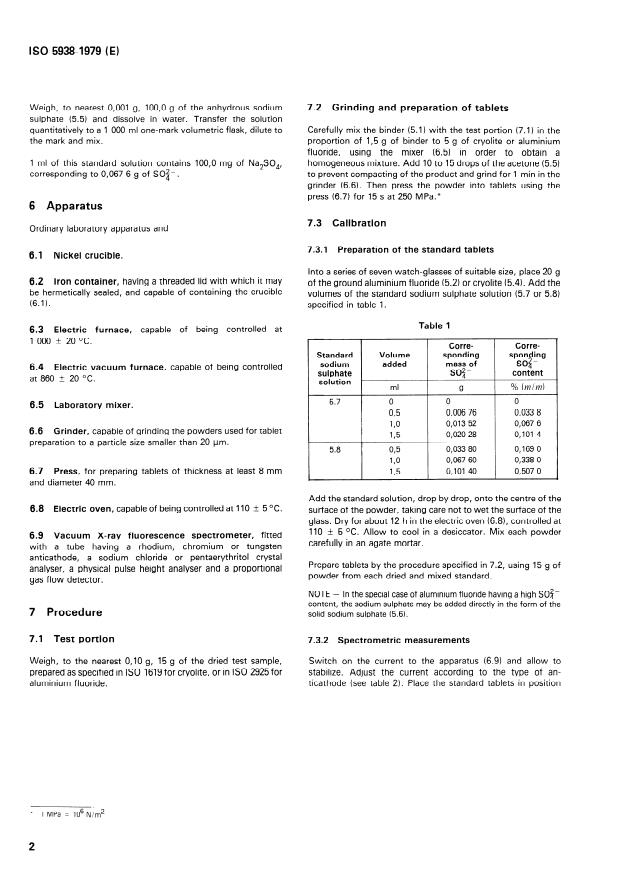
Weigh, to nearest 0,001 g, 100,O q of the anhydrous sodium
7.2 Grinding and preparation of tablets
sulphate (5.5) and dissolve in water.
Transfer the solution
quantitatively to a 1 000 ml one-mark volumetric flask, dilute to Carefully mix the binder (5.1) with the test Portion (7.1) in the
the mark and mix. Proportion of 1,5 g of binder to 5 g of cryolite or aluminium
fluoride, using the mixer (6.5) in Order to obtain a
1 ml of this Standard Solution contains 100,O mg of Na,SO,, homogeneous mixture. Add 10 to 15 drops sf the acetone (5.5)
corresponding to 0,067 6 g of SO:-.
to prevent compacting of the product and grind for 1 min in the
grinder (6.6). Then press the powder into tablets using the
press (6.7) for 15 s at 250 MPa.*
6 Apparatus
7.3 Calibration
Ordinary laboratory apparatus and
7.3.1 Preparation of the Standard tablets
6.1 Nickel crucible.
Into a series of seven watch-glasses of suitable size, place 20 g
laving a threaded lid with which it may
6.2 Iran Container,
of the ground aluminium fluoride (5.2) or cryolite (5.4). Add the
be hermetically sealed, and capable of containing the crucible
volumes of the Standard sodium sulphate Solution (5.7 or 5.8)
(6.1).
specified in table 1.
Table 1
6.3 Electric furnace, capable of being controlled at
1 000 I!I 20 OC.
Standard Volume
sodium added
6.4 Electric vacuum furnace, capable of being contra Illed
sulphate
at 860 31 20 OC.
solution
I
l
5.7 0
6.5 Laboratory mixer.
0,006 76
0,013 52
(0
6.6 Grinder, capable of grinding the powders used for tablet
0,020 28
1,5
preparation to a particle size small
...
NORME INTERNATIONALE ISO 5938-1979 (FI
FICHE D’AMENDEMENT
Publié 1980-03-01
INTERNATIONAL ORGANIZATION FOR STANDARDIZATIONWlE~YHAPQ~HAR OPrAHM3Al#lR fl0 CTAH~APTM3AIJMM.ORGANISATION INTERNATIONALE DE NORMALISATION
Cryolithe, naturelle et artificielle, et fluorure d’aluminium à usage industriel - Dosage du soufre -
Méthode par spectrométrie de fluorescence X
AMENDEMENT
MODIFICATION À L’AVANT-PROPOS (Page de couverture intérieure)
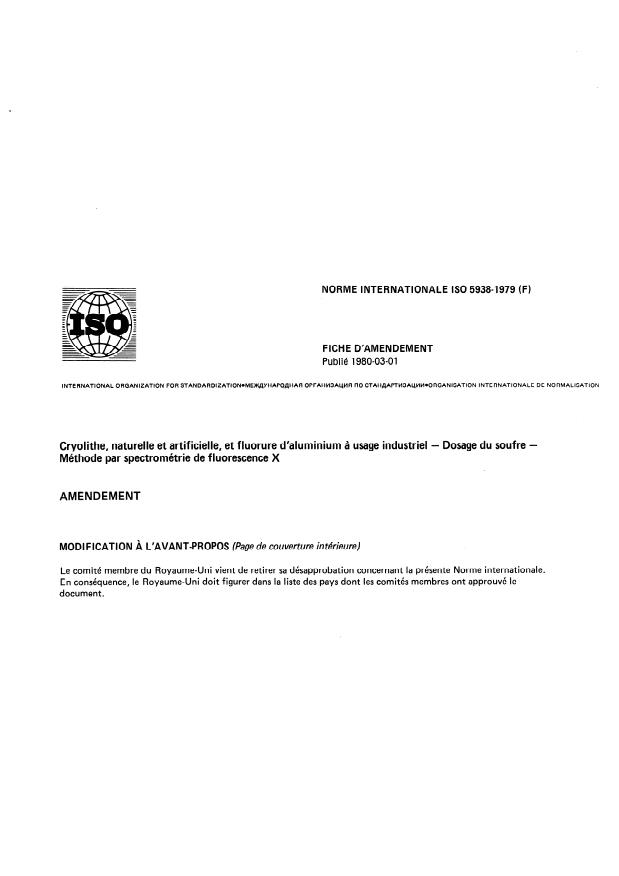
Le comité membre du Royaume-Uni vient de retirer sa désapprobation concernant la présente Norme internationale.
En conséquence, le Royaume-Uni doit figurer dans la liste des pays dont les comités membres ont approuvé le
document.
Page blanche
Norme internationale
INTERNATIONAL ORGANIZATION FOR STANDARDIZATION.ME~YHAPO~HAfl OPrAHM3A~MR IlO CTAH~APTM3Al.@Wl.ORGANISATlON INTERNATIONALE DE NORMALISATION
Cryolithe, naturelle et artificielle, et fluorure d’aluminium
à usage industriel - Dosage du soufre - Méthode par
spectrométrie de fluorescence X
Determination of sulphur content - X-ra y fluorescence
Cryolite, natural and artificial, and aluminium fluoride for industrial use -
spectrometric method
Première édition - 1979-07-15
Réf. no : ISO 59384979 (F)
CDU 553.634 + 661.862.36 : 543.845
méthode spectrophotométrique,
Descripteurs : cryolithe, fluorure d’aluminium, analyse chimique, dosage, soufre, analyse aux rayons X,
spectrométrie de fluorescence atomique.
z Prix basé sur 4 pages
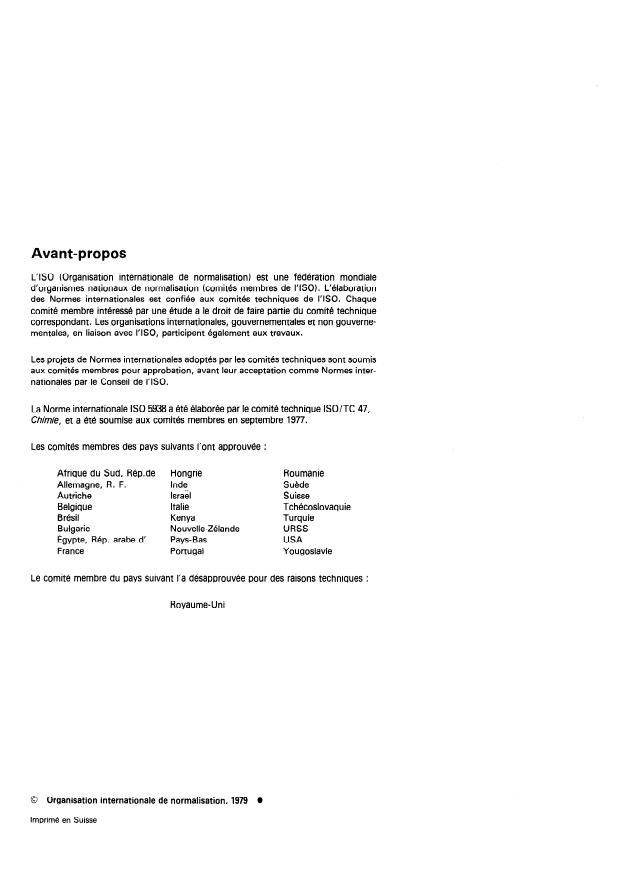
Avant-propos
L’ISO (Organisation internationale de normalisation) est une fédération mondiale
d’organismes nationaux de normalisation (comités membres de I’ISO). L’élaboration
des Normes internationales est confiée aux comités techniques de I’ISO. Chaque
comité membre intéressé par une étude a le droit de faire partie du comité technique
correspondant. Les organisations internationales, gouvernementales et non gouverne-
mentales, en liaison avec I’ISO, participent également aux travaux.
Les projets de Normes internationales adoptés par les comités techniques sont soumis
aux comités membres pour approbation, avant leur acceptation comme Normes inter-
nationales par le Conseil de I’ISO.
La Norme internationale ISO 5938 a été élaborée par le comité technique ISO/TC 47,
Chimie, et a été soumise aux comités membres en septembre 1977.
Les comités membres des pays suivants l’ont approuvée :
Afrique du Sud, Rép.de Hongrie Roumanie
Allemagne, R. F. Inde Suède
Autriche Israël
Suisse
Belgique Italie Tchécoslovaquie
Brésil Kenya Turquie
Bulgarie Nouvelle-Zélande URSS
Egypte, Rép. arabe d’ Pays-Bas USA
France
Portugal Yougoslavie
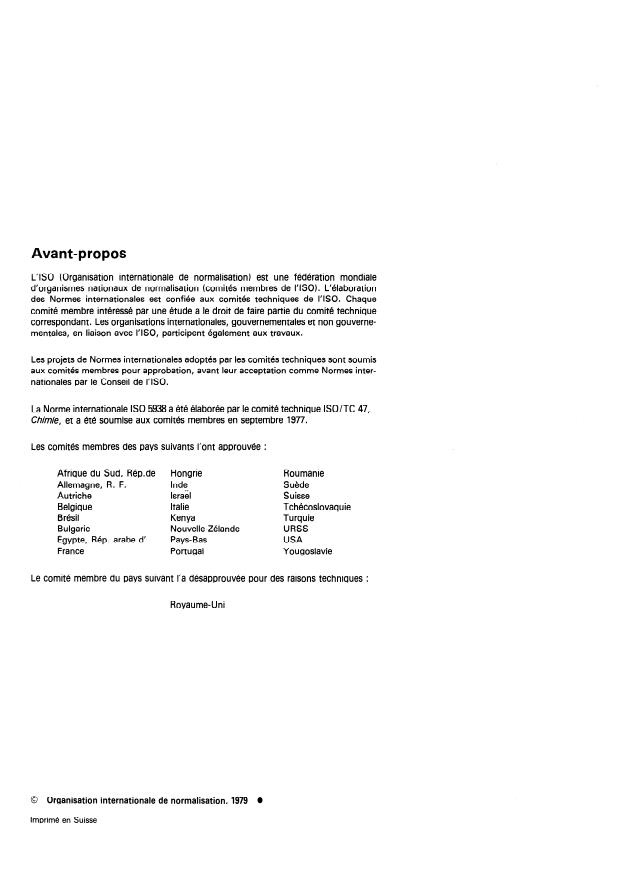
Le comité membre du pays suivant l’a désapprouvée pour des raisons techniques :
Royaume-Uni
0 Organisation internationale de normalisation, 1979 0
Imprimé en Suisse
NORME INTERNATIONALE ISO 5938-1979 (F)
Cryolithe, naturelle et artificielle, et fluorure d’aluminium
à usage industriel - Dosage du soufre - Méthode par
spectrométrie de fluorescence X
5.2 Fluorure d’aluminium
1 Objet
La présente Norme internationale spécifie une méthode par
Utiliser :
spectrométrie de fluorescence X, pour le dosage du soufre
dans la cryolithe, naturelle et artificielle, et dans le fluorure
d’aluminium à usage industriel.
a) du fluorure d’aluminium très pur (96,4 %) contenant
uniquement des traces de SO:-; ou
2 Domaine d’application
b) du sublimé obtenu par sublimation de fluorure
d’aluminium technique dans le four électrique (6.4) réglé à
La méthode est applicable aux produits dont la teneur en sou-
est comprise entre 0,Ol et 2 % (mlm). 860 + 20 OC, sous un vide de 0,Ol à 0,l Pa*.
fre, exprimé en SO:-,
5.3 Fluorure de sodium, préparé par calcination à 600 OC
3 Références
environ du fluorure de sodium obtenu par cristallisation d’une
solution aqueuse.
I S 0 1619, Cryolithe, naturelle et artificielle - Préparation et
conservation des échantillons pour essai.
5.4 Cryolithe, préparée par fusion, dans le creuset en nickel
(6.11, d’un mélange stœchiométrique formé du fluorure
I S 0 2925, Fluorure d’aluminium à usage industriel -
d’aluminium (5.2) et du fluorure de sodium (5.31, dans le four
Préparation et conservation des échantillons pour essai.
électrique (6.3) réglé à 1 000 $r 20 OC durant 2 h.
Afin d’éviter l’évaporation des fluorures pendant la fusion,
4 Principe
placer le creuset en nickel dans le récipient en fer (6.2) et fermer
hermétiquement celui-ci avec son couvercle.
Préparation de pastilles à partir d’un mélange formé d’une prise
d’essai et d’un liant. Mesurage de l’intensité de la raie K, émise
par le soufre à une longueur d’onde de 0,537 3 nm, au moyen
5.5 A&tone
d’un spectromètre pour fluorescence X sous vide, muni d’un
tube à anticathode au rhodium, au chrome ou au tungstène.
5.6 Sulfate de sodium, anhydre.
Comparaison de l’intensité mesurée avec l’intensité d’émission
de pastilles étalons de teneurs connues en SO:-.
5.7 Sulfate de sodium, solution étalon correspondant à
20,O g de Na$O, par litre.
5 Réactifs Peser, à 0,000 1 g près, 20,O g du sulfate de sodium anhydre
(5.5) et les dissoudre dans de l’eau. Transvaser quanti-
Au cours de l’analyse, sauf indications différentes, utiliser
tativement la solution dans une fiole jaugée de 1 000 ml, com-
uniquement des réactifs de qualité analytique reconnue, et pléter au volume et homogénéiser.
de l’eau distillée ou de l’eau de pureté équivalente.
1 ml de cette solution étalon contient 20,O mg de Na$iO,,
correspondant à 0,013 52 g de SO:-.
5.1 Liant
5.8 Sulfate de sodium, solution étalon correspondant à
Cellulose cristalline pour chromatographie ou autre liant
équivalent. 100,O g de Na2S0, par litre.
1 N/m2 = 10 pbar*
* lPa= I
133 Pa = 1 torr
ISO 59384979 (F)
fluorure d’aluminium, en utilisant le mélangeur (6.51, de facon à
Peser, à 0,001 g près, 100,O g du sulfate de sodium anhydre
obtenir un mélange homogène. Ajouter de 10 à 15 gouttes de
(5.5) et les dissoudre dans de l’eau. Transvaser quanti-
tativement la solution dans une fiole jaugée de 1 000 ml, com- l’acétone (5.5) afin d’éviter le compactage du produit, et broyer
durant 1 min dans le broyeur (6.6). Pastiller ensuite la poudre à
pléter au volume et homogénéiser.
la presse (6.7) durant 15 s à 250 MPa.*
1 ml de cette solution étalon contient 100,O mg de Na2S0,,
correspondant à 0,067 6 g de SO:-.
7.3 Étalonnage
6 Appareillage
7.3.1 Préparation des pastilles étalons
Matériel courant de laboratoire, et
Dans une série de sept verres de montre de dimensions con-
venables, déposer 20 g du fluorure d’aluminium (5.2) ou de
6.1 Creuset en nickel.
la cryolithe (5.4) broyés. Ajouter les volumes de la solution
étalon de sulfate de sodium (5.7 ou 5.8) indiqués dans le
tableau 1.
6.2 Récipient en fer, muni d’un couvercle fileté avec lequel
il peut être hermétiquement fermé, et pouvant contenir le creu-
set (6.1).
Tableau 1
Masse Teneur
6.3 Four électrique, réglable à 1 000 + 20 OC.
co rres-
Solution Volume corres-
étalon ajouté pondante pondante
de sulfate de SO$- de SO$-
6.4 Four électrique, sous vide réglable à 860 k 20 OC.
de sodium
% hlm)
ml
0 0 0
5.7
6.5 Mélangeur de laboratoire. !
0,5 0,006 76 0,033 8
0,067 6
w 0,013 52
6.6 Broyeur, pouvant assur
...
NORME INTERNATIONALE ISO 5938-1979 (FI
FICHE D’AMENDEMENT
Publié 1980-03-01
INTERNATIONAL ORGANIZATION FOR STANDARDIZATIONWlE~YHAPQ~HAR OPrAHM3Al#lR fl0 CTAH~APTM3AIJMM.ORGANISATION INTERNATIONALE DE NORMALISATION
Cryolithe, naturelle et artificielle, et fluorure d’aluminium à usage industriel - Dosage du soufre -
Méthode par spectrométrie de fluorescence X
AMENDEMENT
MODIFICATION À L’AVANT-PROPOS (Page de couverture intérieure)
Le comité membre du Royaume-Uni vient de retirer sa désapprobation concernant la présente Norme internationale.
En conséquence, le Royaume-Uni doit figurer dans la liste des pays dont les comités membres ont approuvé le
document.
Page blanche
Norme internationale
INTERNATIONAL ORGANIZATION FOR STANDARDIZATION.ME~YHAPO~HAfl OPrAHM3A~MR IlO CTAH~APTM3Al.@Wl.ORGANISATlON INTERNATIONALE DE NORMALISATION
Cryolithe, naturelle et artificielle, et fluorure d’aluminium
à usage industriel - Dosage du soufre - Méthode par
spectrométrie de fluorescence X
Determination of sulphur content - X-ra y fluorescence
Cryolite, natural and artificial, and aluminium fluoride for industrial use -
spectrometric method
Première édition - 1979-07-15
Réf. no : ISO 59384979 (F)
CDU 553.634 + 661.862.36 : 543.845
méthode spectrophotométrique,
Descripteurs : cryolithe, fluorure d’aluminium, analyse chimique, dosage, soufre, analyse aux rayons X,
spectrométrie de fluorescence atomique.
z Prix basé sur 4 pages
Avant-propos
L’ISO (Organisation internationale de normalisation) est une fédération mondiale
d’organismes nationaux de normalisation (comités membres de I’ISO). L’élaboration
des Normes internationales est confiée aux comités techniques de I’ISO. Chaque
comité membre intéressé par une étude a le droit de faire partie du comité technique
correspondant. Les organisations internationales, gouvernementales et non gouverne-
mentales, en liaison avec I’ISO, participent également aux travaux.
Les projets de Normes internationales adoptés par les comités techniques sont soumis
aux comités membres pour approbation, avant leur acceptation comme Normes inter-
nationales par le Conseil de I’ISO.
La Norme internationale ISO 5938 a été élaborée par le comité technique ISO/TC 47,
Chimie, et a été soumise aux comités membres en septembre 1977.
Les comités membres des pays suivants l’ont approuvée :
Afrique du Sud, Rép.de Hongrie Roumanie
Allemagne, R. F. Inde Suède
Autriche Israël
Suisse
Belgique Italie Tchécoslovaquie
Brésil Kenya Turquie
Bulgarie Nouvelle-Zélande URSS
Egypte, Rép. arabe d’ Pays-Bas USA
France
Portugal Yougoslavie
Le comité membre du pays suivant l’a désapprouvée pour des raisons techniques :
Royaume-Uni
0 Organisation internationale de normalisation, 1979 0
Imprimé en Suisse
NORME INTERNATIONALE ISO 5938-1979 (F)
Cryolithe, naturelle et artificielle, et fluorure d’aluminium
à usage industriel - Dosage du soufre - Méthode par
spectrométrie de fluorescence X
5.2 Fluorure d’aluminium
1 Objet
La présente Norme internationale spécifie une méthode par
Utiliser :
spectrométrie de fluorescence X, pour le dosage du soufre
dans la cryolithe, naturelle et artificielle, et dans le fluorure
d’aluminium à usage industriel.
a) du fluorure d’aluminium très pur (96,4 %) contenant
uniquement des traces de SO:-; ou
2 Domaine d’application
b) du sublimé obtenu par sublimation de fluorure
d’aluminium technique dans le four électrique (6.4) réglé à
La méthode est applicable aux produits dont la teneur en sou-
est comprise entre 0,Ol et 2 % (mlm). 860 + 20 OC, sous un vide de 0,Ol à 0,l Pa*.
fre, exprimé en SO:-,
5.3 Fluorure de sodium, préparé par calcination à 600 OC
3 Références
environ du fluorure de sodium obtenu par cristallisation d’une
solution aqueuse.
I S 0 1619, Cryolithe, naturelle et artificielle - Préparation et
conservation des échantillons pour essai.
5.4 Cryolithe, préparée par fusion, dans le creuset en nickel
(6.11, d’un mélange stœchiométrique formé du fluorure
I S 0 2925, Fluorure d’aluminium à usage industriel -
d’aluminium (5.2) et du fluorure de sodium (5.31, dans le four
Préparation et conservation des échantillons pour essai.
électrique (6.3) réglé à 1 000 $r 20 OC durant 2 h.
Afin d’éviter l’évaporation des fluorures pendant la fusion,
4 Principe
placer le creuset en nickel dans le récipient en fer (6.2) et fermer
hermétiquement celui-ci avec son couvercle.
Préparation de pastilles à partir d’un mélange formé d’une prise
d’essai et d’un liant. Mesurage de l’intensité de la raie K, émise
par le soufre à une longueur d’onde de 0,537 3 nm, au moyen
5.5 A&tone
d’un spectromètre pour fluorescence X sous vide, muni d’un
tube à anticathode au rhodium, au chrome ou au tungstène.
5.6 Sulfate de sodium, anhydre.
Comparaison de l’intensité mesurée avec l’intensité d’émission
de pastilles étalons de teneurs connues en SO:-.
5.7 Sulfate de sodium, solution étalon correspondant à
20,O g de Na$O, par litre.
5 Réactifs Peser, à 0,000 1 g près, 20,O g du sulfate de sodium anhydre
(5.5) et les dissoudre dans de l’eau. Transvaser quanti-
Au cours de l’analyse, sauf indications différentes, utiliser
tativement la solution dans une fiole jaugée de 1 000 ml, com-
uniquement des réactifs de qualité analytique reconnue, et pléter au volume et homogénéiser.
de l’eau distillée ou de l’eau de pureté équivalente.
1 ml de cette solution étalon contient 20,O mg de Na$iO,,
correspondant à 0,013 52 g de SO:-.
5.1 Liant
5.8 Sulfate de sodium, solution étalon correspondant à
Cellulose cristalline pour chromatographie ou autre liant
équivalent. 100,O g de Na2S0, par litre.
1 N/m2 = 10 pbar*
* lPa= I
133 Pa = 1 torr
ISO 59384979 (F)
fluorure d’aluminium, en utilisant le mélangeur (6.51, de facon à
Peser, à 0,001 g près, 100,O g du sulfate de sodium anhydre
obtenir un mélange homogène. Ajouter de 10 à 15 gouttes de
(5.5) et les dissoudre dans de l’eau. Transvaser quanti-
tativement la solution dans une fiole jaugée de 1 000 ml, com- l’acétone (5.5) afin d’éviter le compactage du produit, et broyer
durant 1 min dans le broyeur (6.6). Pastiller ensuite la poudre à
pléter au volume et homogénéiser.
la presse (6.7) durant 15 s à 250 MPa.*
1 ml de cette solution étalon contient 100,O mg de Na2S0,,
correspondant à 0,067 6 g de SO:-.
7.3 Étalonnage
6 Appareillage
7.3.1 Préparation des pastilles étalons
Matériel courant de laboratoire, et
Dans une série de sept verres de montre de dimensions con-
venables, déposer 20 g du fluorure d’aluminium (5.2) ou de
6.1 Creuset en nickel.
la cryolithe (5.4) broyés. Ajouter les volumes de la solution
étalon de sulfate de sodium (5.7 ou 5.8) indiqués dans le
tableau 1.
6.2 Récipient en fer, muni d’un couvercle fileté avec lequel
il peut être hermétiquement fermé, et pouvant contenir le creu-
set (6.1).
Tableau 1
Masse Teneur
6.3 Four électrique, réglable à 1 000 + 20 OC.
co rres-
Solution Volume corres-
étalon ajouté pondante pondante
de sulfate de SO$- de SO$-
6.4 Four électrique, sous vide réglable à 860 k 20 OC.
de sodium
% hlm)
ml
0 0 0
5.7
6.5 Mélangeur de laboratoire. !
0,5 0,006 76 0,033 8
0,067 6
w 0,013 52
6.6 Broyeur, pouvant assur
...