


ISO/IEC FDIS 17024
(Main)Conformity assessment - General requirements for bodies operating certification of persons
Conformity assessment - General requirements for bodies operating certification of persons
ISO/IEC 17024:2012 contains principles and requirements for a body certifying persons against specific requirements, and includes the development and maintenance of a certification scheme for persons.
Évaluation de la conformité — Exigences générales pour les organismes de certification procédant à la certification de personnes
L'ISO/CEI 17024:2012 comporte des exigences et des principes destinés à un organisme qui procède à la certification de personnes par rapport à des exigences spécifiques, y compris l'élaboration et le maintien d'un dispositif particulier de certification de personnes.
General Information
- Status
- Not Published
- Technical Committee
- ISO/CASCO - Committee on conformity assessment
- Drafting Committee
- ISO/CASCO - Committee on conformity assessment
- Current Stage
- 5020 - FDIS ballot initiated: 2 months. Proof sent to secretariat
- Start Date
- 28-Nov-2025
- Completion Date
- 28-Nov-2025
Relations
- Effective Date
- 28-Jan-2023
- Effective Date
- 24-Dec-2022
Overview
ISO/IEC FDIS 17024:2025, titled "Conformity assessment - General requirements for bodies operating certification of persons," is an international standard developed by ISO and IEC to establish principles and requirements for organizations that certify individuals. This standard specifies the framework for bodies involved in certifying persons against defined competency criteria, ensuring that certification schemes are developed, maintained, and operated in a consistent, reliable, and globally recognized manner.
The standard plays a critical role in conformity assessment by enhancing trust in the certification of persons. It supports the harmonization of certification processes worldwide, thereby facilitating workforce mobility and the recognition of professional qualifications across regions and industries.
Key Topics
Certification Bodies
Defines the responsibilities and structural requirements for organizations operating certification of persons, including impartiality, legal liability, management, and resource allocation.Certification Schemes
Details the development and maintenance of certification schemes - structured sets of rules and procedures outlining competence criteria for specific roles or occupations.Certification Process
Covers essential activities such as applications, assessments, examinations, certification decisions, recertification, suspension, withdrawal of certification, and the proper use of certificates and marks.Use of Artificial Intelligence (AI)
Introduces additional requirements governing the incorporation of AI technologies within certification activities to ensure fairness, transparency, and integrity.Management System Requirements
Mandates policies on impartiality, management review, internal audits, corrective actions, risk management, and safeguarding of personnel and candidate information.Terminology and Definitions
Clarifies key terms such as certification process, certification scheme, competence, assessment, examination, invigilation, and certification mark to maintain consistency in implementation.
Applications
Accreditation Bodies
ISO/IEC 17024 serves as a benchmark for accrediting organizations that certify persons, ensuring conformity to international best practices.Certification Bodies
Provides a comprehensive framework to develop, operate, and maintain certification schemes effectively, with assurance of impartiality and competence.Employers and HR Professionals
Facilitates recognition of certified competencies across borders, enabling better hiring decisions and support for professional development.Training and Educational Institutions
Aligns certification schemes with learning outcomes and competency requirements, ensuring relevance and validity of qualifications.Government and Regulatory Authorities
Acts as a reference for legislations and regulations related to the certification of professionals, promoting transparency and public confidence.Use of AI in Certification
Outlines responsible AI usage in assessments, helping organizations harness technology while maintaining integrity and ethical standards.
Related Standards
ISO/IEC 17000 - Conformity assessment - Vocabulary and general principles; provides foundational terminology supporting ISO/IEC 17024.
ISO/IEC Directives - Guidelines for preparation and maintenance of ISO/IEC documents to ensure consistent development of standards.
Regulation (EC) No 765/2008 - European regulation on accreditation and market surveillance, linked to the standard’s annex on regulatory alignment.
ISO/IEC 17024:2025 is part of the broader ISO conformity assessment family, supporting organizations in achieving consistent, transparent, and trustworthy certification of individuals. Its implementation fosters global acceptance of certified skills and promotes professional mobility, thus addressing modern workforce demands and the evolution of technology-driven industries.


ISO/IEC FDIS 17024 - Conformity assessment — General requirements for bodies operating certification of persons Released:11/26/2025



REDLINE ISO/IEC FDIS 17024 - Conformity assessment — General requirements for bodies operating certification of persons Released:11/26/2025

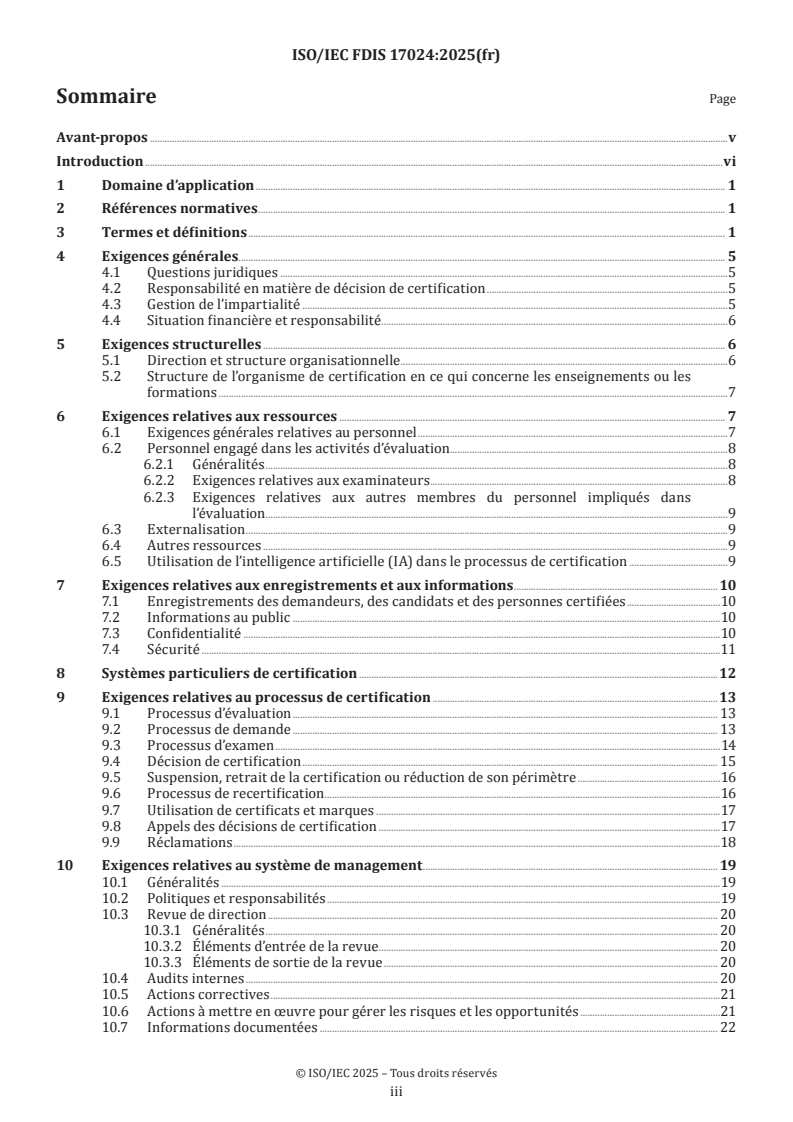

ISO/IEC FDIS 17024 - Évaluation de la conformité — Exigences générales pour les organismes de certification procédant à la certification de personnes Released:19. 12. 2025
Frequently Asked Questions
ISO/IEC FDIS 17024 is a draft published by the International Organization for Standardization (ISO). Its full title is "Conformity assessment - General requirements for bodies operating certification of persons". This standard covers: ISO/IEC 17024:2012 contains principles and requirements for a body certifying persons against specific requirements, and includes the development and maintenance of a certification scheme for persons.
ISO/IEC 17024:2012 contains principles and requirements for a body certifying persons against specific requirements, and includes the development and maintenance of a certification scheme for persons.
ISO/IEC FDIS 17024 is classified under the following ICS (International Classification for Standards) categories: 03.120.20 - Product and company certification. Conformity assessment. The ICS classification helps identify the subject area and facilitates finding related standards.
ISO/IEC FDIS 17024 has the following relationships with other standards: It is inter standard links to ISO 23905:2020, ISO/IEC 17024:2012. Understanding these relationships helps ensure you are using the most current and applicable version of the standard.
ISO/IEC FDIS 17024 is available in PDF format for immediate download after purchase. The document can be added to your cart and obtained through the secure checkout process. Digital delivery ensures instant access to the complete standard document.
Standards Content (Sample)
FINAL DRAFT
International
Standard
ISO/CASCO
Conformity assessment — General
Secretariat: ISO
requirements for bodies operating
Voting begins on:
certification of persons
2025-11-28
Évaluation de la conformité — Exigences générales pour les
Voting terminates on:
organismes de certification procédant à la certification de
2026-01-23
personnes
RECIPIENTS OF THIS DRAFT ARE INVITED TO SUBMIT,
This draft is submitted to a parallel vote in ISO and in IEC.
WITH THEIR COMMENTS, NOTIFICATION OF ANY
RELEVANT PATENT RIGHTS OF WHICH THEY ARE AWARE
AND TO PROVIDE SUPPOR TING DOCUMENTATION.
IN ADDITION TO THEIR EVALUATION AS
BEING ACCEPTABLE FOR INDUSTRIAL, TECHNO
ISO/CEN PARALLEL PROCESSING LOGICAL, COMMERCIAL AND USER PURPOSES, DRAFT
INTERNATIONAL STANDARDS MAY ON OCCASION HAVE
TO BE CONSIDERED IN THE LIGHT OF THEIR POTENTIAL
TO BECOME STAN DARDS TO WHICH REFERENCE MAY BE
MADE IN NATIONAL REGULATIONS.
Reference number
FINAL DRAFT
International
Standard
ISO/CASCO
Conformity assessment — General
Secretariat: ISO
requirements for bodies operating
Voting begins on:
certification of persons
Évaluation de la conformité — Exigences générales pour les
Voting terminates on:
organismes de certification procédant à la certification de
personnes
RECIPIENTS OF THIS DRAFT ARE INVITED TO SUBMIT,
This draft is submitted to a parallel vote in ISO and in IEC.
WITH THEIR COMMENTS, NOTIFICATION OF ANY
RELEVANT PATENT RIGHTS OF WHICH THEY ARE AWARE
AND TO PROVIDE SUPPOR TING DOCUMENTATION.
© ISO/IEC 2025
IN ADDITION TO THEIR EVALUATION AS
All rights reserved. Unless otherwise specified, or required in the context of its implementation, no part of this publication may
BEING ACCEPTABLE FOR INDUSTRIAL, TECHNO
ISO/CEN PARALLEL PROCESSING
LOGICAL, COMMERCIAL AND USER PURPOSES, DRAFT
be reproduced or utilized otherwise in any form or by any means, electronic or mechanical, including photocopying, or posting on
INTERNATIONAL STANDARDS MAY ON OCCASION HAVE
the internet or an intranet, without prior written permission. Permission can be requested from either ISO at the address below
TO BE CONSIDERED IN THE LIGHT OF THEIR POTENTIAL
or ISO’s member body in the country of the requester.
TO BECOME STAN DARDS TO WHICH REFERENCE MAY BE
MADE IN NATIONAL REGULATIONS.
ISO copyright office
CP 401 • Ch. de Blandonnet 8
CH-1214 Vernier, Geneva
Phone: +41 22 749 01 11
Email: copyright@iso.org
Website: www.iso.org
Published in Switzerland Reference number
© ISO/IEC 2025 – All rights reserved
ii
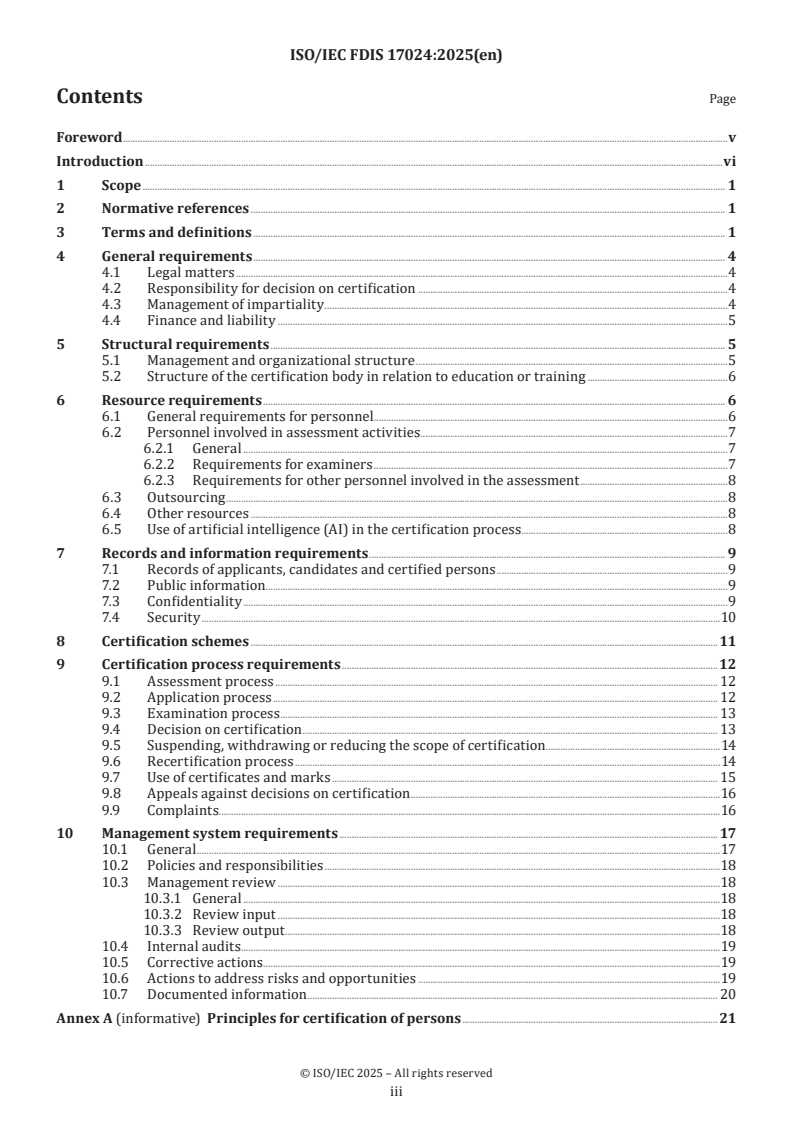
Contents Page
Foreword .v
Introduction .vi
1 Scope . 1
2 Normative references . 1
3 Terms and definitions . 1
4 General requirements . 4
4.1 Legal matters .4
4.2 Responsibility for decision on certification .4
4.3 Management of impartiality .4
4.4 Finance and liability .5
5 Structural requirements . 5
5.1 Management and organizational structure .5
5.2 Structure of the certification body in relation to education or training .6
6 Resource requirements . 6
6.1 General requirements for personnel . .6
6.2 Personnel involved in assessment activities .7
6.2.1 General .7
6.2.2 Requirements for examiners .7
6.2.3 Requirements for other personnel involved in the assessment .8
6.3 Outsourcing .8
6.4 Other resources .8
6.5 Use of artificial intelligence (AI) in the certification process . .8
7 Records and information requirements . 9
7.1 Records of applicants, candidates and certified persons .9
7.2 Public information . .9
7.3 Confidentiality .9
7.4 Security .10
8 Certification schemes .11
9 Certification process requirements .12
9.1 Assessment process . 12
9.2 Application process . 12
9.3 Examination process . 13
9.4 Decision on certification . 13
9.5 Suspending, withdrawing or reducing the scope of certification .14
9.6 Recertification process .14
9.7 Use of certificates and marks . 15
9.8 Appeals against decisions on certification .16
9.9 Complaints.16
10 Management system requirements . 17
10.1 General .17
10.2 Policies and responsibilities .18
10.3 Management review .18
10.3.1 General .18
10.3.2 Review input .18
10.3.3 Review output .18
10.4 Internal audits.19
10.5 Corrective actions .19
10.6 Actions to address risks and opportunities .19
10.7 Documented information . 20
Annex A (informative) Principles for certification of persons .21
© ISO/IEC 2025 – All rights reserved
iii
Annex B (informative) Relationship between certification activities .23
Annex ZA (informative) Relationship between this European Standard and the requirements
of Regulation (EC) No 765/2008 of the European Parliament and of the Council of 9 July
2008 setting out the requirements for accreditation and repealing Regulation (EEC) No
339/93 aimed to be covered .24
Bibliography .25
© ISO/IEC 2025 – All rights reserved
iv
Foreword
ISO (the International Organization for Standardization) is a worldwide federation of national standards
bodies (ISO member bodies). The work of preparing International Standards is normally carried out through
ISO technical committees. Each member body interested in a subject for which a technical committee
has been established has the right to be represented on that committee. International organizations,
governmental and non-governmental, in liaison with ISO, also take part in the work. ISO collaborates closely
with the International Electrotechnical Commission (IEC) on all matters of electrotechnical standardization.
The procedures used to develop this document and those intended for its further maintenance are described
in the ISO/IEC Directives, Part 1. In particular, the different approval criteria needed for the different types
of ISO documents should be noted. This document was drafted in accordance with the editorial rules of the
ISO/IEC Directives, Part 2 (see www.iso.org/directives or www.iec.ch/members_experts/refdocs).
ISO draws attention to the possibility that the implementation of this document may involve the use of (a)
patent(s). ISO takes no position concerning the evidence, validity or applicability of any claimed patent
rights in respect thereof. As of the date of publication of this document, ISO had not received notice of (a)
patent(s) which may be required to implement this document. However, implementers are cautioned that
this may not represent the latest information, which may be obtained from the patent database available at
www.iso.org/patents. ISO shall not be held responsible for identifying any or all such patent rights.
Any trade name used in this document is information given for the convenience of users and does not
constitute an endorsement.
For an explanation of the voluntary nature of standards, the meaning of ISO specific terms and expressions
related to conformity assessment, as well as information about ISO's adherence to the World Trade
Organization (WTO) principles in the Technical Barriers to Trade (TBT) see www.iso.org/iso/foreword.html.
In the IEC, see www.iec.ch/understanding-standards.
This document was prepared by the ISO Committee on Conformity Assessment (CASCO), in collaboration
with the European Committee for Standardization (CEN) Technical Committee CEN/CLC/JTC 1, Criteria for
conformity assessment bodies, in accordance with the Agreement on technical cooperation between ISO and
CEN (Vienna Agreement).
This third edition cancels and replaces the second edition (ISO/IEC 17024:2012), which has been technically
revised.
The main changes are as follows:
— additional requirements for the use of artificial intelligence (AI) in 6.5;
— alignment with the PROC/33 text that establishes common elements for standards developed by CASCO.
Any feedback or questions on this document should be directed to the user’s national standards body. A
complete listing of these bodies can be found at www.iso.org/members.html.
© ISO/IEC 2025 – All rights reserved
v
Introduction
This document has been developed with the objective of achieving and promoting a globally accepted set
of requirements and principles for bodies operating certification of persons. Certification of persons is one
means of providing assurance that the certified person meets the requirements identified in the certification
scheme. Confidence in the respective schemes for certification of persons is achieved by means of a globally
accepted process of assessment and periodic re-assessments of the competence of certified persons.
However, it is necessary to distinguish between situations where schemes for certification of persons
are justified and situations where other forms of qualification are more appropriate. The development of
schemes for certification of persons, in response to the ever-increasing velocity of technological innovation
and growing specialization of personnel, can compensate for variations in education and training and thus
facilitate the global job market. Alternatives to certification can still be necessary for job positions where
public services, official or governmental operations are concerned.
In either of the above cases, this document can serve as the basis for the recognition of the bodies operating
certification of persons, in order to facilitate their acceptance at the regional, national and international
levels. Only the harmonization of the methodologies for developing and maintaining schemes for certification
of persons can establish the environment for mutual recognition and the global exchange of personnel.
This document specifies requirements which ensure that bodies operating certification of persons operate
in a consistent, comparable and reliable manner. The requirements in this document are considered to be
general requirements for bodies operating certification of persons. Certification of persons can only occur
when there is a certification scheme. Schemes for certification of persons are based on market needs or
desires or can be required by governments.
This document can be used for accreditation or peer assessment or designation by governmental authorities,
scheme owners and others.
© ISO/IEC 2025 – All rights reserved
vi
FINAL DRAFT International Standard ISO/IEC FDIS 17024:2025(en)
Conformity assessment — General requirements for bodies
operating certification of persons
1 Scope
This document specifies principles and requirements for a body operating certification of persons and
includes the development and maintenance of a scheme for certification of persons.
NOTE 1 For the purposes of this document, the term "certification body" is used in place of the full term " body
operating certification of persons", and the term "certification scheme" is used in place of the full term “scheme for
certification of persons”.
NOTE 2 Annex A contains principles for certification of persons.
2 Normative references
The following documents are referred to in the text in such a way that some or all of their content constitutes
requirements of this document. For dated references, only the edition cited applies. For undated references,
the latest edition of the referenced document (including any amendments) applies.
ISO/IEC 17000, Conformity assessment — Vocabulary and general principles
3 Terms and definitions
For the purposes of this document, the terms and definitions given in ISO/IEC 17000 and the following apply.
ISO and IEC maintain terminology databases for use in standardization at the following addresses:
— ISO Online browsing platform: available at https:// www .iso .org/ obp
— IEC Electropedia: available at https:// www .electropedia .org/
3.1
certification process
activities by which a certification body (3.7) determines that a person fulfils certification requirements (3.4)
Note 1 to entry: Certification process includes application, assessment (3.12), decision on certification, recertification
(3.30), and issuance of certificates (3.6). It can include surveillance (3.29). Annex B can assist in the understanding of
these terms.
3.2
certification scheme
scheme for certification of persons
set of rules and procedures that specifies the competence (3.9) criteria and other requirements related to
specific categories of skills or occupations of persons and specifies the methodology(ies) for performing
certification of persons
3.3
scheme owner
organization responsible for developing and maintaining a certification scheme (3.2)
Note 1 to entry: The organization can be the certification body (3.7) itself, a governmental authority, or other bodies.
© ISO/IEC 2025 – All rights reserved
3.4
certification requirements
set of specified requirements including requirements of the certification scheme (3.2) to be fulfilled in order
to establish or maintain certification
3.5
scope of certification
specific job(s), role(s) or function(s) that a certified person (3.20) can perform competently
3.6
certificate
attestation by a certification body (3.7) indicating that the certified person (3.20) has fulfilled the certification
requirements (3.4)
Note 1 to entry: The certificate can take the form of a document, card or other medium.
3.7
certification body
body operating certification of persons
conformity assessment body performing certification of persons in accordance with certification schemes (3.2)
3.8
certification mark
mark issued by a certification body (3.7), indicating that a person has fulfilled certification requirements (3.4)
Note 1 to entry: The mark can be a logo or a symbol.
3.9
competence
ability (3.10) to apply knowledge and skills to achieve intended results
3.10
ability
person’s capacity to perform a task
3.11
qualification
demonstrated education, training or work experience
3.12
assessment
evaluation of a person's fulfilment of the certification requirements (3.4) specified in the certification scheme (3.2)
3.13
examination
part of the assessment (3.12) which measures a candidate's (3.19) competence (3.9) by one or more means,
such as written, oral, practical and observational, as defined in the certification scheme (3.2)
3.14
examiner
person competent to conduct and score an examination (3.13), where the examination requires judgement
on the competence (3.9) of persons
3.15
invigilator
person authorized by the certification body (3.7) to perform the invigilation (3.16), but does not evaluate the
competence (3.9) of the candidate (3.19)
Note 1 to entry: Other terms used in practice are, for example, proctor, test administrator, supervisor.
© ISO/IEC 2025 – All rights reserved
3.16
invigilation
process of administering an examination (3.13) or supervising candidates (3.19) during an examination
to prevent fraudulent examination behaviour, unauthorised disclosure of examination material or other
misconduct
Note 1 to entry: Invigilation can include the following: an invigilator (3.15) physically or remotely present viewing
an examination in real time, or an examiner (3.14) or invigilator physically or remotely present viewing a practical
examination which may be recorded and reviewed later.
Note 2 to entry: Invigilation by artificial intelligence (3.31) may also be used provided it meets the requirements of this
document.
3.17
personnel
individuals, internal or external, of the certification body (3.7) carrying out activities for the certification body
Note 1 to entry: These include committee members, volunteers, contractors, personnel of external bodies or persons
acting on the certification body’s behalf.
3.18
applicant
person who has submitted an application for certification
3.19
candidate
person who has fulfilled application requirements
Note 1 to entry: The application requirements can include prerequisites.
3.20
certified person
person who has fulfilled and continues to fulfil the certification requirements (3.4) after the decision to
certify has been taken by the certification body (3.7)
3.21
impartiality
objectivity with regard to the activities of the certification body (3.7), its certification process (3.1) and its outcome
Note 1 to entry: Other terms that are useful in conveying the element of impartiality are freedom from undue influence,
freedom from conflicts of interest, absence of bias (3.23), neutrality and lack of prejudice.
3.22
fairness
equal opportunity for success provided to each applicant (3.18), candidate (3.19) and certified person (3.20)
in the certification process (3.1)
Note 1 to entry: Fairness can be described as acting free from bias (3.23) towards any gender, age, race, ethnicity,
specific population (including individuals with disabilities) or any other identified characteristic.
3.23
bias
presence of any factors that can unfairly influence certification outcomes
3.24
validity
evidence that an assessment (3.12) measures what it is intended to measure, as defined by the certification
scheme (3.2)
Note 1 to entry: In this document, validity is also used in its adjective form "valid".
© ISO/IEC 2025 – All rights reserved
3.25
reliability
extent to which examination (3.13) scores are consistent across different examination times and locations,
different examination forms and different examiners (3.14)
3.26
appeal
request by applicant (3.18), candidate (3.19) or certified person (3.20) for reconsideration of any decision
made by the certification body (3.7) related to their desired certification status
3.27
complaint
expression of dissatisfaction, other than appeal (3.26), by any individual or organization to a certification
body (3.7), relating to the activities of that body or a certified person (3.20), where a response is expected
3.28
interested party
person or organization with a direct or indirect interest in the performance of a certification body (3.7) or a
certified person (3.20), or in the certification scheme (3.2)
Note 1 to entry: Interested parties can include the certified persons, conformity assessment bodies, associations
and clients, industry and trade associations, scheme owners (3.3), employers of the certified persons, regulatory
authorities, non-governmental organizations, consumers, or consumer organizations.
3.29
surveillance
periodic monitoring, during the validity (3.24) period of certification, of a certified person's (3.20)
performance to ensure continued compliance with the certification scheme (3.2)
3.30
recertification
process for certification renewal to confirm continued competence (3.9) of a certified person (3.20)
3.31
artificial intelligence
AI
autonomous system that performs functions normally associated with human intelligence, such as
reasoning, learning and self-improvement
4 General requirements
4.1 Legal matters
The certification body shall be a legal entity, or a defined part of a legal entity, such that it can be held legally
responsible for its certification activities. A governmental certification body is deemed to be a legal entity
on the basis of its governmental status.
4.2 Responsibility for decision on certification
The certification body shall be responsible for, shall retain authority for, and shall not delegate, its decisions
relating to certification, including the granting, maintaining, recertifying, expanding and reducing the scope
of the certification, and suspending, reinstating or withdrawing the certification.
4.3 Management of impartiality
4.3.1 Certification activities shall be undertaken impartially. The certification body shall document its
structure, policies and procedures to manage impartiality and to ensure that the certification activities are
undertaken impartially.
© ISO/IEC 2025 – All rights reserved
4.3.2 The certification body shall have top management commitment to impartiality. The certification
body shall have a statement publicly available without request that it understands the importance of
impartiality in carrying out its certification activities, manages conflicts of interests and ensures the
objectivity of its certification activities.
4.3.3 The certification body shall act impartially in relation to its applicants, candidates and certified
persons.
4.3.4 Policies and procedures for certification of persons shall be fair for all applicants, candidates and
certified persons.
4.3.5 When a certification body uses artificial intelligence (AI) to carry out any certification activity, it
shall document and demonstrate how it eliminates, minimizes or manages any risks to impartiality (e.g. bias).
4.3.6 The certification body shall not unfairly impede or inhibit access by applicants and candidates.
Certification shall not be restricted on the grounds of undue financial or other limiting conditions, such as
membership of an association or group.
4.3.7 The certification body shall be responsible for the impartiality of its certification activities and shall
not allow commercial, financial or other pressures to compromise its impartiality.
4.3.8 The certification body shall monitor its activities and its relationships to identify threats to its
impartiality on an ongoing basis. The monitoring shall include the relationships of its personnel and its
related bodies.
NOTE 1 A relationship can be based on ownership, governance, management, personnel, shared resources, finances,
contracts or marketing (including branding), and payment of a sales commission or other inducement for the referral
of new applicants, etc. Such relationships do not necessarily present a body with a threat to impartiality.
NOTE 2 A related body is one which is linked to the certification body by common ownership, in whole or part, or
has common members of the board of directors, contractual arrangements, common names, common staff, informal
understanding or other means, such that the related body has a vested interest in any certification decision or has a
potential ability to influence the certification process.
NOTE 3 Threats to impartiality can be either actual or perceived.
4.3.9 If a threat to impartiality is identified, its effect shall be eliminated or minimized so that the
impartiality is not compromised.
4.3.10 The certification body shall identify, analyse, monitor, document and eliminate or minimize potential
conflicts of interest arising from its certification activities. The certification body shall document and be
able to demonstrate how it eliminates, minimizes or manages such conflicts of interest. All potential sources
of conflicts of interest that are identified, whether they arise from within the certification body, such as
assigning responsibilities to personnel, or from the activities of other persons, bodies or organizations, shall
be covered.
4.4 Finance and liability
The certification body shall have the financial resources necessary for the operation of certification activities
and have adequate arrangements (e.g. insurance or reserves) to cover associated liabilities.
5 Structural requirements
5.1 Management and organizational structure
5.1.1 The certification body shall be structured and managed so as to safeguard impartiality.
© ISO/IEC 2025 – All rights reserved
5.1.2 The certification body shall document its organizational structure, describing the duties,
responsibilities and authorities of management, its personnel and any committees. When the certification
body is a defined part of a legal entity, documentation of the organizational structure shall include the line of
authority and the relationship to other parts within the same legal entity.
The certification body shall determine responsibility for the following:
a) policies and procedures relating to the operation of the certification body;
b) finances of the certification body;
c) resources for certification activities;
d) development and maintenance of the certification schemes;
e) assessment activities;
f) decisions on certification, including the granting, maintaining, recertifying, expanding, reducing,
suspending, reinstating or withdrawing of the certification;
g) contractual arrangements.
5.2 Structure of the certification body in relation to education or training
5.2.1 Completion of education or training may be a prerequisite for certification, however education or
training prerequisites shall not compromise impartiality or reduce the certification requirements.
5.2.2 A certification body shall not state or imply that certification would be simpler, easier or less
expensive if any specific education or training services are used.
5.2.3 Offering education or training and certification of persons within the same legal entity or a related
body constitutes a threat to impartiality. In such a case the certification body shall:
a) identify and document the associated threats to its impartiality on an ongoing basis: the certification
body shall have a documented process to demonstrate how it eliminates or minimizes those threats;
b) demonstrate that all processes performed by the certification body are independent of education or
training to ensure that confidentiality, information security and impartiality are not compromised;
c) not give the impression that the use of both services would provide any advantage to the applicant;
d) not require the applicant to complete education or training offered within the same legal entity or
related body as an exclusive prerequisite when alternative education or training with an equivalent
outcome exists;
e) ensure that personnel do not serve as an examiner or invigilator of a specific candidate they have trained
unless the certification body can demonstrate how it controls for conflicts of interest and impartiality.
6 Resource requirements
6.1 General requirements for personnel
6.1.1 The certification body shall manage and be responsible for the performance of all personnel involved
in certification activities.
6.1.2 All personnel of the certification body that could influence the certification activities shall act
impartially.
© ISO/IEC 2025 – All rights reserved
6.1.3 The certification body shall have access to a sufficient number of competent persons to perform its
certification activities.
6.1.4 The certification body shall have a process for managing competence of its personnel.
6.1.5 The certification body shall specify the competence requirements for personnel involved in the
certification process and shall have up to date documented information demonstrating competence of its
personnel.
NOTE Documented information can include qualifications, certifications, training, education, skills, professional
affiliations, professional status, competence and known conflicts of interest.
6.1.6 The certification body shall provide its personnel with documented instructions describing their
duties and responsibilities. These instructions shall be kept up to date.
6.1.8 Personnel, including any committee members, contractors, personnel of external bodies or personnel
acting on the certification body's behalf, shall keep confidential all information obtained or created during
the performance of the body's certification activities, except where authorized by the applicant, candidate
or certified person. The certification body shall be aware of applicable legal requirements which can require
the disclosure of this type of information.
6.1.9 The certification body shall maintain records of its personnel’s agreement to comply with the policies
and procedures defined by the certification body, including those relating to confidentiality, impartiality
and conflicts of interests.
6.1.10 When a certification body certifies a person it employs or it contracts, the certification body shall
adopt procedures to maintain impartiality.
6.2 Personnel involved in assessment activities
6.2.1 General
The certification body shall require its personnel to declare potential or known conflicts of interest with
any applicant, candidate or certified person.
6.2.2 Requirements for examiners
6.2.2.1 Examiners shall meet the requirements of the certification body. The selection and approval
processes shall ensure that examiners:
a) have competence in the field to be examined;
b) understand the relevant certification scheme;
c) are able to apply the examination procedures and documents;
d) have the skills to conduct the examination;
e) have declared any known conflicts of interest to ensure impartial judgements are made.
6.2.2.2 The certification body shall have procedures to ensure that where interpretation or translation is
used by the examiner it does not affect the validity, reliability and fairness of the examination.
6.2.2.3 The certification body shall monitor the performance of the examiners and the reliability and
fairness of the examiners' judgements. Where deficiencies are found, corrective actions shall be taken. The
results of monitoring and any corrective actions taken shall be supported by evidence.
© ISO/IEC 2025 – All rights reserved
NOTE Monitoring procedures for examiners can include, for example, on-site observation, review of examiners'
reports, feedback from candidates.
6.2.2.4 If an examiner has potential or known conflicts of interest in the examination of a candidate or
certified person, the certification body shall undertake measures to ensure that the confidentiality and
impartiality of the examination are not compromised. These measures shall be recorded.
6.2.3 Requirements for other personnel involved in the assessment
If other personnel involved in the assessment (e.g. invigilators, persons who develop content for examinations)
have potential conflicts of interest in the assessment of a candidate or certified person, the certification
body shall undertake measures to ensure that confidentiality and impartiality of the assessment are not
compromised. These measures shall be recorded.
6.3 Outsourcing
6.3.1 The certification body shall have a legally enforceable agreement covering the arrangements,
ensuring confidentiality and avoiding conflicts of interest, with each body that provides outsourced services
related to certification activities.
NOTE For the purposes of this document, the terms “outsourcing” and “subcontracting” are considered to be
synonyms.
6.3.2 When a certification body outsources services related to certification activities, the certification
body shall:
a) take full responsibility for all outsourced services;
b) ensure that the body conducting outsourced services is competent and conforms to this document;
c) assess and monitor the performance of the bodies conducting outsourced services in accordance with
its documented procedures;
d) have records to demonstrate that the bodies conducting outsourced services meet all requirements
relevant to the outsourced services;
e) maintain a list of the bodies conducting outsourced services.
6.4 Other resources
The certification body shall use adequate premises, including examination sites, equipment and resources
for carrying out its certification activities.
6.5 Use of artificial intelligence (AI) in the certification process
If artificial intelligence (AI) is used to perform any part of the certification process, the certification body shall:
a) verify, manage and monitor AI on an ongoing basis to ensure the intended results;
b) validate outcomes of AI with subject matter experts;
c) ensure personnel have the necessary competence in the oversight and use of AI;
d) provide human oversight of AI;
NOTE ISO/IEC 42105 provides additional information on human oversight.
e) demonstrate the validity, reliability and fairness of the use of AI;
© ISO/IEC 2025 – All rights reserved
f) disclose its use of AI and obtain acknowledgement by the individual (applicant, candidate or certified
person), where communication or interaction with AI is performed.
7 Records and information requirements
7.1 Records of applicants, candidates and certified persons
7.1.1 The certification body shall maintain records of applicants, candidates and certified persons. The
records shall confirm the status of a certified person. The records shall demonstrate that the certification
or recertification process has been effectively completed, particularly with respect to application forms,
assessment reports (which include examination records) and other documented information relating to
granting, maintaining, recertifying, expanding and reducing the scope, and suspending or withdrawing
certification.
7.1.2 The records shall be identified, managed, safeguarded from unauthorized access, and disposed of in
such a way as to ensure the integrity of the certification process and the confidentiality of the information.
The records shall be kept for an appropriate period of time, for a minimum of one full certification cycle, or
longer as required by recognition arrangements or other obligations.
7.2 Public information
7.2.1 The certification body shall provide information, upon request, as to whether an individual holds a
current, valid certification and the scope of that certification.
7.2.2 The certification body shall make publicly available without request:
a) scope of the certification;
b) prerequisites, if applicable;
c) application requirements;
d) initial certification requirements;
e) surveillance requirements, if applicable;
f) recertification interval and requirements;
g) description of the certification process, including the assessments.
7.2.3 Information provided by the certification body, including marketing or promotional communication,
shall be accurate and not misleading.
7.3 Confidentiality
7.3.1 The certification body shall establish documented policies and procedures for the maintenance and
release of information.
7.3.2 The certification body shall have policies and procedures to ensure data privacy and data protection.
7.3.3 The certification body shall be responsible, through legally enforceable agreements, for the
management of all information obtained or created during the performance of certification activities. The
certification body shall inform the applicant, candidate or certified person, in advance, of the information
it intends to place in the public domain. Except for information that the applicant, candidate or certified
person makes publicly available, or when agreed between the certification body and applicant, candidate
© ISO/IEC 2025 – All rights reserved
or certified person, all other information is considered proprietary information and shall be regarded as
confidential.
7.3.4 When the certification body is required by law or authorized by contractual arrangements to release
confidential information, the applicant, candidate or certified person concerned shall be notified of the
information released, unless prohibited by law.
7.3.5 The certification body shall ensure that the activities of related bodies do not compromise
confidentiality.
7.3.6 The certification body shall identify threats to the confidentiality of the information. If a threat is
identified its effect shall be elimi
...
ISO/CASCO
Secretariat: ISO
Date: 2025-06-2311-05
Conformity assessment — General requirements for bodies
operating certification of persons
Évaluation de la conformité — Exigences générales pour les organismes de certification procédant à la
certification de personnes
FDIS stage
© ISO/IEC 2025
All rights reserved. Unless otherwise specified, or required in the context of its implementation, no part of this publication
may be reproduced or utilized otherwise in any form or by any means, electronic or mechanical, including photocopying,
or posting on the internet or an intranet, without prior written permission. Permission can be requested from either ISO
at the address below or ISO’s member body in the country of the requester.
ISO copyright office
CP 401 • Ch. de Blandonnet 8
CH-1214 Vernier, Geneva
Phone: + 41 22 749 01 11
EmailE-mail: copyright@iso.org
Website: www.iso.org
Published in Switzerland
© ISO/IEC 2025 – All rights reserved
ii
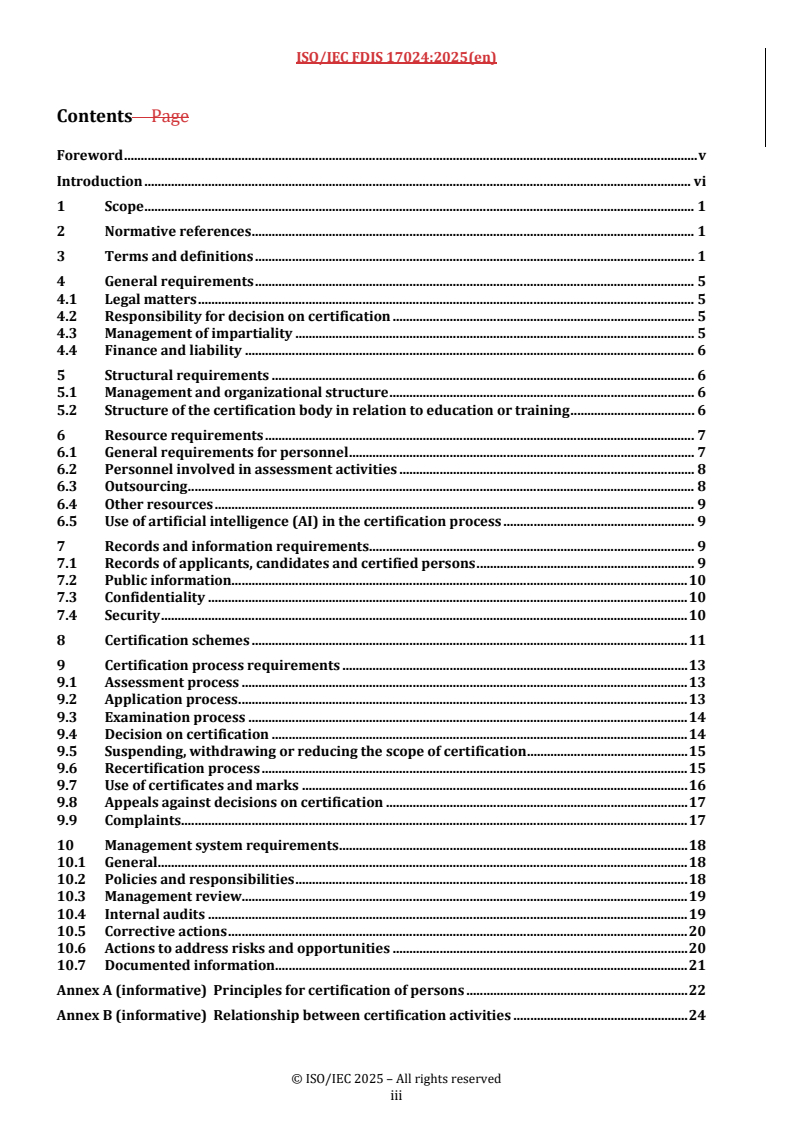
Contents Page
Foreword . v
Introduction . vi
1 Scope . 1
2 Normative references . 1
3 Terms and definitions . 1
4 General requirements . 5
4.1 Legal matters . 5
4.2 Responsibility for decision on certification . 5
4.3 Management of impartiality . 5
4.4 Finance and liability . 6
5 Structural requirements . 6
5.1 Management and organizational structure . 6
5.2 Structure of the certification body in relation to education or training . 6
6 Resource requirements . 7
6.1 General requirements for personnel . 7
6.2 Personnel involved in assessment activities . 8
6.3 Outsourcing . 8
6.4 Other resources . 9
6.5 Use of artificial intelligence (AI) in the certification process . 9
7 Records and information requirements . 9
7.1 Records of applicants, candidates and certified persons . 9
7.2 Public information. 10
7.3 Confidentiality . 10
7.4 Security . 10
8 Certification schemes . 11
9 Certification process requirements . 13
9.1 Assessment process . 13
9.2 Application process . 13
9.3 Examination process . 14
9.4 Decision on certification . 14
9.5 Suspending, withdrawing or reducing the scope of certification . 15
9.6 Recertification process . 15
9.7 Use of certificates and marks . 16
9.8 Appeals against decisions on certification . 17
9.9 Complaints . 17
10 Management system requirements . 18
10.1 General. 18
10.2 Policies and responsibilities . 18
10.3 Management review. 19
10.4 Internal audits . 19
10.5 Corrective actions . 20
10.6 Actions to address risks and opportunities . 20
10.7 Documented information . 21
Annex A (informative) Principles for certification of persons . 22
Annex B (informative) Relationship between certification activities . 24
© ISO/IEC 2025 – All rights reserved
iii
Annex ZA (informative) Relationship between this European Standard and the requirements of
Regulation (EC) No 765/2008 of the European Parliament and of the Council of 9 July
2008 setting out the requirements for accreditation and repealing Regulation (EEC) No
339/93 aimed to be covered . 26
Bibliography . 27
© ISO/IEC 2025 – All rights reserved
iv
Foreword
ISO (the International Organization for Standardization) is a worldwide federation of national standards
bodies (ISO member bodies). The work of preparing International Standards is normally carried out through
ISO technical committees. Each member body interested in a subject for which a technical committee has been
established has the right to be represented on that committee. International organizations, governmental and
non-governmental, in liaison with ISO, also take part in the work. ISO collaborates closely with the
International Electrotechnical Commission (IEC) on all matters of electrotechnical standardization.
The procedures used to develop this document and those intended for its further maintenance are described
in the ISO/IEC Directives, Part 1. In particular, the different approval criteria needed for the different types of
ISO documents should be noted. This document was drafted in accordance with the editorial rules of the
ISO/IEC Directives, Part 2 (see www.iso.org/directives or www.iec.ch/members_experts/refdocs).
ISO draws attention to the possibility that the implementation of this document may involve the use of (a)
patent(s). ISO takes no position concerning the evidence, validity or applicability of any claimed patent rights
in respect thereof. As of the date of publication of this document, ISO had not received notice of (a) patent(s)
which may be required to implement this document. However, implementers are cautioned that this may not
represent the latest information, which may be obtained from the patent database available at
www.iso.org/patents. ISO shall not be held responsible for identifying any or all such patent rights.
Any trade name used in this document is information given for the convenience of users and does not
constitute an endorsement.
For an explanation of the voluntary nature of standards, the meaning of ISO specific terms and expressions
related to conformity assessment, as well as information about ISO's adherence to the World Trade
Organization (WTO) principles in the Technical Barriers to Trade (TBT) see www.iso.org/iso/foreword.html.
In the IEC, see www.iec.ch/understanding-standards.
This document was prepared by the ISO Committee on Conformity Assessment (CASCO), in collaboration with
the European Committee for Standardization (CEN) Technical Committee CEN/CLC/JTC 1, Criteria for
conformity assessment bodies, in accordance with the Agreement on technical cooperation between ISO and
CEN (Vienna Agreement).
This third edition cancels and replaces the second edition (ISO/IEC 17024:2012), which has been technically
revised.
The main changes are as follows:
— — additional requirements for the use of artificial intelligence (AI) in 6.56.5;;
— — alignment with the PROC/33 text, that establishes common elements for standards developed by
CASCO.
Any feedback or questions on this document should be directed to the user’s national standards body. A
complete listing of these bodies can be found at www.iso.org/members.html.
© ISO/IEC 2025 – All rights reserved
v
Introduction
This document has been developed with the objective of achieving and promoting a globally accepted set of
requirements and principles for bodies operating certification of persons. Certification of persons is one
means of providing assurance that the certified person meets the requirements identified in the certification
scheme. Confidence in the respective schemes for certification of persons is achieved by means of a globally
accepted process of assessment and periodic re-assessments of the competence of certified persons.
However, it is necessary to distinguish between situations where schemes for certification of persons are
justified and situations where other forms of qualification are more appropriate. The development of schemes
for certification of persons, in response to the ever-increasing velocity of technological innovation and
growing specialization of personnel, can compensate for variations in education and training and thus
facilitate the global job market. Alternatives to certification can still be necessary for job positions where
public services, official or governmental operations are concerned.
In either of the above cases, this document can serve as the basis for the recognition of the bodies operating
certification of persons, in order to facilitate their acceptance at the regional, national and international levels.
Only the harmonization of the methodologies for developing and maintaining schemes for certification of
persons can establish the environment for mutual recognition and the global exchange of personnel.
This document specifies requirements which ensure that bodies operating certification of persons operate in
a consistent, comparable and reliable manner. The requirements in this document are considered to be
general requirements for bodies operating certification of persons. Certification of persons can only occur
when there is a certification scheme. Schemes for certification of persons are based on market needs or desires
or can be required by governments.
This document can be used for accreditation or peer assessment or designation by governmental authorities,
scheme owners and others.
© ISO/IEC 2025 – All rights reserved
vi
FINAL DRAFT International Standard ISO/IEC FDIS 17024:2025(en)
Conformity assessment — General requirements for bodies operating
certification of persons
1 Scope
This document specifies principles and requirements for a body operating certification of persons and
includes the development and maintenance of a scheme for certification of persons.
NOTE 1 For the purposes of this document, the term "certification body" is used in place of the full term " body
operating certification of persons", and the term "certification scheme" is used in place of the full term “scheme for
certification of persons”.
NOTE 2 Annex AAnnex A contains principles for certification of persons.
2 Normative references
The following documents are referred to in the text in such a way that some or all of their content constitutes
requirements of this document. For dated references, only the edition cited applies. For undated references,
the latest edition of the referenced document (including any amendments) applies.
ISO/IEC 17000, Conformity assessment — Vocabulary and general principles
3 Terms and definitions
For the purposes of this document, the terms and definitions given in ISO/IEC 17000 and the following apply.
ISO and IEC maintain terminology databases for use in standardization at the following addresses:
— — ISO Online browsing platform: available at https://www.iso.org/obp
— — IEC Electropedia: available at https://www.electropedia.org/
3.1 3.1
certification process
activities by which a certification body (3.7(3.7)) determines that a person fulfils certification requirements
(3.4(3.4))
Note 1 to entry: Certification process includes application, assessment (3.12(3.12),), decision on certification,
recertification (3.30(3.30),), and issuance of certificates (3.6(3.6).). It can include surveillance (3.29(3.29). The figure (B1)
in Annex B). Annex B can assist in the understanding of these terms.
3.2 3.2
certification scheme
scheme for certification of persons
set of rules and procedures that specifies the competence (3.9(3.9)) criteria and other requirements related to
specific categories of skills or occupations of persons and specifies the methodology(ies) for performing
certification of persons
© ISO/IEC 2025 – All rights reserved
3.3 3.3
scheme owner
organization responsible for developing and maintaining a certification scheme (3.2(3.2))
Note 1 to entry: The organization can be the certification body (3.7(3.7)) itself, a governmental authority, or other bodies.
3.4 3.4
certification requirements
set of specified requirements including requirements of the certification scheme (3.2(3.2)) to be fulfilled in
order to establish or maintain certification
3.5 3.5
scope of certification
specific job(s), role(s),) or function(s) that a certified person (3.20(3.19) is able to) can perform competently
3.6 3.6
certificate
attestation by a certification body (3.7(3.7)) indicating that the certified person (3.20(3.20)) has fulfilled the
certification requirements (3.4(3.4))
Note 1 to entry: The certificate can take the form of a document, card or other medium.
3.7 3.7
certification body
body operating certification of persons
conformity assessment body operatingperforming certification of persons in accordance with certification
schemes (3.2(3.2))
3.8 3.8
certification mark
mark issued by a certification body (3.7(3.7),), indicating that a person has fulfilled certification requirements
(3.4(3.4))
Note 1 to entry: The mark can be a logo or a symbol.
3.9 3.9
competence
ability (3.10) to apply knowledge and skills to achieve intended results
3.10 3.10
ability
person’s capacity to perform a task
3.11 3.11
qualification
demonstrated education, training or work experience
3.12 3.12
assessment
evaluation of a person's fulfilment of the certification requirements (3.4(3.4)) specified in the certification
scheme (3.2(3.2))
© ISO/IEC 2025 – All rights reserved
ISO/IEC DISFDIS 17024:2025(en)
3.13 3.13
examination
part of the assessment (3.12(3.12)) which measures a candidate's (3.19(3.19)) competence (3.9(3.9)) by one
or more means, such as written, oral, practical and observational, as defined in the certification scheme
(3.2(3.2))
3.14 3.14
examiner
person competent to conduct and score an examination (3.13(3.13),), where the examination requires
judgement on the competence (3.9(3.9)) of persons
3.15 3.15
invigilator
person authorized by the certification body (3.7(3.7)) to perform the invigilation (3.16(3.16),), but does not
evaluate the competence (3.9(3.9)) of the candidate (3.19(3.19))
Note 1 to entry: Other terms used in practice are, for example are, proctor, test administrator, supervisor.
3.16 3.16
invigilation
process of administering an examination (3.13(3.13)) or supervising candidates (3.19(3.19)) during an
examination (3.13) to prevent fraudulent examination behaviour, unauthorised disclosure of examination
material or other misconduct
Note 1 to entry: Invigilation can include the following: an invigilator (3.15(3.15)) physically or remotely present viewing
an examination (3.13) in real time, or an examiner (3.14(3.14)) or invigilator physically or remotely present viewing a
practical examination which may be recorded and reviewed later.
Note 2 to entry: Invigilation by artificial intelligence (3.31(3.31)) may also be used provided it meets the requirements of
this document.
3.17 3.17
personnel
individuals, internal or external, of the certification body (3.7(3.7)) carrying out activities for the certification
body
Note 1 to entry: These include committee members, volunteers, contractors, personnel of external bodies or persons
acting on the certification body’s behalf.
3.18 3.18
applicant
person who has submitted an application for certification
3.19 3.19
candidate
person who has fulfilled application requirements
Note 1 to entry: The application requirements can include prerequisites.
3.20 3.20
certified person
person who has fulfilled and continues to fulfil the certification requirements (3.4(3.4)) after the decision to
certify has been taken by the certification body (3.7(3.7))
© ISO/IEC 2025 – All rights reserved
3.21 3.21
impartiality
objectivity with regard to the activities of the certification body (3.7(3.7),), its certification process (3.1(3.1))
and its outcome
Note 1 to entry: Other terms that are useful in conveying the element of impartiality are freedom from undue influence,
freedom from conflicts of interest, absence of bias (3.23(3.23),), neutrality and lack of prejudice.
3.22 3.22
fairness
equal opportunity for success provided to each applicant (3.18(3.18),), candidate (3.19(3.19)) and certified
person (3.20(3.20)) in the certification process (3.1(3.1))
Note 1 to entry: Fairness can be described as acting free from bias (3.23(3.23)) towards any gender, age, race, ethnicity,
specific population (including individuals with disabilities) or any other identified characteristic.
3.23 3.23
bias
presence of any factors that can unfairly influence certification outcomes
3.24 3.24
validity
evidence that an assessment (3.12(3.12)) measures what it is intended to measure, as defined by the
certification scheme (3.2(3.2))
Note 1 to entry: In this document, validity is also used in its adjective form "valid".
3.25 3.25
reliability
extent to which examination (3.13(3.13)) scores are consistent across different examination times and
locations, different examination forms and different examiners (3.14(3.14))
3.26 3.26
appeal
request by applicant (3.18(3.18),), candidate (3.19(3.19)) or certified person (3.20(3.20)) for reconsideration
of any decision made by the certification body (3.7(3.7)) related to their desired certification status
3.27 3.27
complaint
expression of dissatisfaction, other than appeal (3.26(3.26),), by any individual or organization to a
certification body (3.7(3.7),), relating to the activities of that body or a certified person (3.20(3.20),), where a
response is expected
3.28 3.28
interested party
person or organization with a direct or indirect interest in the performance of a certification body (3.7(3.7))
or a certified person (3.20(3.20),), or in the certification scheme (3.2(3.2))
Note 1 to entry: Interested parties can include the certified persons, conformity assessment bodies, associations and
clients, industry and trade associations, scheme owners (3.3,), employers of the certified persons, regulatory authorities,
non-governmental organizations, consumers, or consumer organizations.
3.29 3.29
surveillance
periodic monitoring, during the validity (3.24) period of certification, of a certified person's (3.20(3.20))
performance to ensure continued compliance with the certification scheme (3.2(3.2))
© ISO/IEC 2025 – All rights reserved
ISO/IEC DISFDIS 17024:2025(en)
3.30 3.30
recertification
process for certification renewal to confirm continued competence (3.9(3.9)) of a certified person (3.20(3.20))
3.31 3.31
artificial intelligence
AI
autonomous system that performs functions normally associated with human intelligence, such as reasoning,
learning, and self-improvement
4 General requirements
4.1 Legal matters
The certification body shall be a legal entity, or a defined part of a legal entity, such that it can be held legally
responsible for its certification activities. A governmental certification body is deemed to be a legal entity on
the basis of its governmental status.
4.2 Responsibility for decision on certification
The certification body shall be responsible for, shall retain authority for, and shall not delegate, its decisions
relating to certification, including the granting, maintaining, recertifying, expanding and reducing the scope of
the certification, and suspending, reinstating or withdrawing the certification.
4.3 Management of impartiality
4.3.1 4.3.1 Certification activities shall be undertaken impartially. The certification body shall document
its structure, policies and procedures to manage impartiality and to ensure that the certification activities are
undertaken impartially.
4.3.2 4.3.2 The certification body shall have top management commitment to impartiality. The
certification body shall have a statement publicly available without request that it understands the importance
of impartiality in carrying out its certification activities, manages conflicts of interests and ensures the
objectivity of its certification activities.
4.3.3 4.3.3 The certification body shall act impartially in relation to its applicants, candidates and certified
persons.
4.3.4 4.3.4 Policies and procedures for certification of persons shall be fair for all applicants, candidates
and certified persons.
4.3.5 4.3.5 When a certification body uses artificial intelligence (AI) to carry out any certification activity,
it shall document and demonstrate how it eliminates, minimizes or manages any risks to impartiality (e.g.
bias).
4.3.6 4.3.6 The certification body shall not unfairly impede or inhibit access by applicants and candidates.
Certification shall not be restricted on the grounds of undue financial or other limiting conditions, such as
membership of an association or group.
4.3.7 4.3.7 The certification body shall be responsible for the impartiality of its certification activities and
shall not allow commercial, financial or other pressures to compromise its impartiality.
4.3.8 4.3.8 The certification body shall monitor its activities and its relationships to identify threats to its
impartiality on an ongoing basis. The monitoring shall include the relationships of its personnel and its related
bodies.
© ISO/IEC 2025 – All rights reserved
NOTE 1 A relationship can be based on ownership, governance, management, personnel, shared resources, finances,
contracts or marketing (including branding), and payment of a sales commission or other inducement for the referral of
new applicants, etc. Such relationships do not necessarily present a body with a threat to impartiality.
NOTE 2 A related body is one which is linked to the certification body by common ownership, in whole or part, or has
common members of the board of directors, contractual arrangements, common names, common staff, informal
understanding or other means, such that the related body has a vested interest in any certification decision or has a
potential ability to influence the certification process.
NOTE 3 Threats to impartiality can be either actual or perceived.
4.3.9 4.3.9 If a threat to impartiality is identified, its effect shall be eliminated or minimized so that the
impartiality is not compromised.
4.3.10 4.3.10 The certification body shall identify, analyse, monitor, document and eliminate or minimize
potential conflicts of interest arising from its certification activities. The certification body shall document and
be able to demonstrate how it eliminates, minimizes or manages such conflicts of interest. All potential sources
of conflicts of interest that are identified, whether they arise from within the certification body, such as
assigning responsibilities to personnel, or from the activities of other persons, bodies or organizations, shall
be covered.
4.4 Finance and liability
The certification body shall have the financial resources necessary for the operation of certification activities
and have adequate arrangements (e.g. insurance or reserves) to cover associated liabilities.
5 Structural requirements
5.1 Management and organizational structure
5.1.1 5.1.1 The certification body shall be structured and managed so as to safeguard impartiality.
5.1.2 5.1.2 The certification body shall document its organizational structure, describing the duties,
responsibilities and authorities of management, its personnel and any committees. When the certification
body is a defined part of a legal entity, documentation of the organizational structure shall include the line of
authority and the relationship to other parts within the same legal entity.
The certification body shall determine responsibility for the following:
a) a) policies and procedures relating to the operation of the certification body;
b) b) finances of the certification body;
c) c) resources for certification activities;
d) d) development and maintenance of the certification schemes;
e) e) assessment activities;
f) f) decisions on certification, including the granting, maintaining, recertifying, expanding,
reducing, suspending, reinstating or withdrawing of the certification;
g) g) contractual arrangements.
5.2 Structure of the certification body in relation to education or training
5.2.1 5.2.1 Completion of education or training may be a prerequisite for certification, however education
or training prerequisites shall not compromise impartiality or reduce the certification requirements.
© ISO/IEC 2025 – All rights reserved
ISO/IEC DISFDIS 17024:2025(en)
5.2.2 5.2.2 A certification body shall not state or imply that certification would be simpler, easier or less
expensive if any specific education or training services are used.
5.2.3 5.2.3 Offering education or training and certification of persons within the same legal entity or a
related body constitutes a threat to impartiality. In such a case the certification body shall:
a) a) identify and document the associated threats to its impartiality on an ongoing basis: the
certification body shall have a documented process to demonstrate how it eliminates or minimizes those
threats;
b) b) demonstrate that all processes performed by the certification body are independent of
education or training to ensure that confidentiality, information security and impartiality are not
compromised;
c) c) not give the impression that the use of both services would provide any advantage to the
applicant;
d) d) not require the applicant to complete education or training offered within the same legal entity
or related body as an exclusive prerequisite when alternative education or training with an equivalent
outcome exists;
e) e) ensure that personnel do not serve as an examiner or invigilator of a specific candidate they
have trained unless the certification body can demonstrate how it controls for conflicts of interest and
impartiality.
6 Resource requirements
6.1 General requirements for personnel
6.1.1 6.1.1 The certification body shall manage and be responsible for the performance of all personnel
involved in certification activities.
6.1.2 6.1.2 All personnel of the certification body that could influence the certification activities shall act
impartially.
6.1.3 6.1.3 The certification body shall have access to a sufficient number of competent persons to
perform its certification activities.
6.1.4 6.1.4 The certification body shall have a process for managing competence of its personnel.
6.1.5 6.1.5 The certification body shall specify the competence requirements for personnel involved in the
certification process and shall have up to date documented information demonstrating competence of its
personnel.
NOTE Documented information can include qualifications, certifications, training, education, skills, professional
affiliations, professional status, competence and known conflicts of interest.
6.1.6 6.1.6 The certification body shall provide its personnel with documented instructions describing
their duties and responsibilities. These instructions shall be kept up to date.
6.1.7 6.1.8 Personnel, including any committee members, contractors, personnel of external bodies or
personnel acting on the certification body's behalf, shall keep confidential all information obtained or created
during the performance of the body's certification activities, except where authorized by the applicant,
candidate or certified person. The certification body shall be aware of applicable legal requirements which
can require the disclosure of this type of information.
© ISO/IEC 2025 – All rights reserved
6.1.8 6.1.9 The certification body shall maintain records of its personnel’s agreement to comply with the
policies and procedures defined by the certification body, including those relating to confidentiality,
impartiality and conflicts of interests.
6.1.9 6.1.10 When a certification body certifies a person it employs or it contracts, the certification body
shall adopt procedures to maintain impartiality.
6.2 Personnel involved in assessment activities
6.2.1 General
The certification body shall require its personnel to declare potential or known conflicts of interest with any
applicant, candidate or certified person.
6.2.2 Requirements for examiners
6.2.2.1 6.2.2.1 Examiners shall meet the requirements of the certification body. The selection
and approval processes shall ensure that examiners:
a) a) have competence in the field to be examined;
b) b) understand the relevant certification scheme;
c) c) are able to apply the examination procedures and documents;
d) d) have the skills to conduct the examination;
e) e) have declared any known conflicts of interest to ensure impartial judgements are made.
6.2.2.2 6.2.2.2 The certification body shall have procedures to ensure that where
interpretation or translation is used by the examiner it does not affect the validity, reliability and fairness of
the examination.
2.2.3 The certification body shall monitor the performance of the examiners and the
6.2.2.3 6.
reliability and fairness of the examiners' judgements. Where deficiencies are found, corrective actions shall be
taken. The results of monitoring and any corrective actions taken shall be supported by evidence.
NOTE Monitoring procedures for examiners can include, for example, on-site observation, review of examiners'
reports, feedback from candidates.
6.2.2.4 6.2.2.4 If an examiner has potential or known conflicts of interest in the examination
of a candidate or certified person, the certification body shall undertake measures to ensure that the
confidentiality and impartiality of the examination are not compromised. These measures shall be recorded.
6.2.3 Requirements for other personnel involved in the assessment
If other personnel involved in the assessment (e.g. invigilators, persons who develop content for
examinations) have potential conflicts of interest in the assessment of a candidate or certified person, the
certification body shall undertake measures to ensure that confidentiality and impartiality of the assessment
are not compromised. These measures shall be recorded.
6.3 Outsourcing
6.3.1 6.3.1 The certification body shall have a legally enforceable agreement covering the arrangements,
ensuring confidentiality and avoiding conflicts of interest, with each body that provides outsourced services
related to certification activities.
© ISO/IEC 2025 – All rights reserved
ISO/IEC DISFDIS 17024:2025(en)
NOTE For the purposes of this document, the terms “outsourcing” and “subcontracting” are considered to be
synonyms.
6.3.2 6.3.2 When a certification body outsources services related to certification activities, the
certification body shall:
a) a) take full responsibility for all outsourced services;
b) b) ensure that the body conducting outsourced services is competent and conforms to this
document;
c) c) assess and monitor the performance of the bodies conducting outsourced services in
accordance with its documented procedures;
d) d) have records to demonstrate that the bodies conducting outsourced services meet all
requirements relevant to the outsourced services;
e) e) maintain a list of the bodies conducting outsourced services.
6.4 Other resources
The certification body shall use adequate premises, including examination sites, equipment and resources for
carrying out its certification activities.
6.5 Use of artificial intelligence (AI) in the certification process
If artificial intelligence (AI) is used to perform any part of the certification process, the certification body shall:
a) a) verify, manage and monitor AI on an ongoing basis to ensure the intended results;
b) b) validate outcomes of AI with subject matter experts;
c) c) ensure personnel have the necessary competence in the oversight and use of AI;
d) d) provide human oversight of AI;
NOTE ISO/IEC 42105 provides additional information on human oversight.
e) e) demonstrate the validity, reliability and fairness of the use of AI;
f) f) disclose its use of AI and obtain acknowledgement by the individual (applicant, candidate or
certified person), where communication or interaction with AI is performed.
7 Records and information requirements
7.1 Records of applicants, candidates and certified persons
7.1.1 7.1.1 The certification body shall maintain records of applicants, candidates and certified persons.
The records shall confirm the status of a certified person. The records shall demonstrate that the certification
or recertification process has been effectively completed, particularly with respect to application forms,
assessment reports (which include examination records) and other documented information relating to
granting, maintaining, recertifying, expanding and reducing the scope, and suspending or withdrawing
certification.
7.1.2 7.1.2 The records shall be identified, managed, safeguarded from unauthorized access, and disposed
of in such a way as to ensure the integrity of the certification process and the confidentiality of the information.
© ISO/IEC 2025 – All rights reserved
The records shall be kept for an appropriate period of time, for a minimum of one full certification cycle, or
longer as required by recognition arrangements or other obligations.
7.2 Public information
7.2.1 7.2.1 The certification body shall provide information, upon request, as to whether an individual
holds a current, valid certification and the scope of that certification.
7.2.2 7.2.2 The certification body shall make publicly available without request:
a) a) scope of the certification;
b) b) prerequisites, if applicable;
c) c) application requirements;
d) d) initial certification requirements;
e) e) surveillance requirements, if applicable;
f) f) recertification interval and requirements;
g) g) description of the certification process, including the assessments.
7.2.3 7.2.3 Information provided by the certification body, including marketing or promotional
communication, shall be accurate and not misleading.
7.3 Confidentiality
7.3.1 7.3.1 The certification body shall establish documented policies and procedures for the maintenance
and release of information.
7.3.2 7.3.2 The certification body shall have policies and procedures to ensure data privacy and data
protection.
7.3.3 7.3.3 The certification body shall be responsible, through legally enforceable agreements, for the
management of all information obtained or created during the performance of certification activities. The
certification body shall inform the applicant, candidate or certified person, in advance, of the information it
intends to place in the public domain. Except for information that the applicant, candidate or certified person
makes publicly available, or when agreed between the certification body and applicant, candidate or certified
person, all other information is considered proprietary information and shall be regarded as confidential.
7.3.4 7.3.3 When the certification body is required by law or authorized by contractual arrangements to
release confidential information, the applicant, candidate or certified person concerned shall be notified of the
information released, unless prohibited by law.
7.3.5 7.3.4 The certification body shall ensure that the activities of related bodies do not compromise
confidentiality.
7.3.6 7.3.5 The certification body shall identify threats to the confidentiality of the information. If a threat
is identified its effect shall be eliminated or minimised so that confidentiality is not compromised.
7.4 Security
7.4.1 7.4.1 The certification body shall establish and document policies and procedures necessary to
ensure security throughout its certification activities and shall have measures in place to take corrective
actions when security breaches occur.
© ISO/IEC 2025 – All rights reserved
ISO/IEC DISFDIS 17024:2025(en)
7.4.2 7.4.2 The certification body shall identify security threats impacting the effectiveness of the
certification activities including those associated with the use of technology. If a threat is identified its effect
shall be eliminated or minimised so that the security of the certification process is not compromised.
7.4.3 7.4.3 Policies and procedures related to security shall include provisions to ensure the security of
examination materials, taking into account the following:
a) a) the locations or handling of the materials (e.g. transportation, electronic delivery, disposal,
storage, examination site);
b) b) the nature of the materials (e.g. electronic, paper, test equipment);
c) c) the steps in the examination process (e.g. development, administration, results reporting);
d) d) the threats arising from repeated use of examination materials.
7.4.4 7.4.4 Certification bodies shall prevent fraudulent examination behaviour, unauthorised disclosure
of examination material or other misconduct by:
a) a) requiring candidates to sign a non-disclosure agreement or other agreement indicating their
commitment not to release confidential examination materials or participate in fraudulent practices;
b) b) conducting invigilation; invigilation in real time shall be required unless the certification body
can demonstrate how the other requirements of this clause are met;
c) c) confirming the identity of the candidate, as part of the examination;
d) d) implementing procedures to prevent any unauthorized aids from being brought into the
examination;
e) e) preventing candidates from gaining access to unauthorized aids during the examination;
f) f) monitoring examination results for indications of cheating.
7.4.5 7.4.5 The certification body shall identify the threats to the security of examination materials. If a
threat is identified, its effect shall be eliminated or minimised so that the integrity of the examination materials
is not compromised.
8 Certification schemes
8.1 8.1 There shall be a certification scheme for each category of certification of persons.
8.2 8.2 A certification scheme shall contain the following:
a) a) scope of certification;
b) b) job and task description;
c) c) required competence;
d) d) required abilities (if applicable);
e) e) prerequisites (if applicable);
f) f) code of conduct (if applicable).
NOTE 1 Abilities can include physical capabilities such as vision, hearing and mobility.
© ISO/IEC 2025 – All rights reserved
NOTE 2 Prerequisites can be specific qualifications, work experience, etc. and can be met at application or anytime
before the certification decision.
NOTE 3 A code of conduct describes the ethical or personal behaviour required by the certification scheme.
8.3 8.3 A certification scheme shall include the following certification process requirements:
a) a) criteria for initial certification and recertification;
b) b) assessment methods for initial certification and recertification;
c) c) surveillance methods and criteria (if applicable);
d) d) criteria for suspending and withdrawing certification;
e) e) criteria for changing the scope or level of certification (if applicable).
8.4 8.4 The certif
...
PROJET FINAL
Norme
internationale
ISO/CASCO
Évaluation de la conformité —
Secrétariat: ISO
Exigences générales pour les
Début de vote:
organismes de certification
2025-11-28
procédant à la certification de
Vote clos le:
personnes
2026-01-23
Conformity assessment — General requirements for bodies
operating certification of persons
LES DESTINATAIRES DU PRÉSENT PROJET SONT
INVITÉS À PRÉSENTER, AVEC LEURS OBSERVATIONS,
NOTIFICATION DES DROITS DE PROPRIÉTÉ DONT ILS
AURAIENT ÉVENTUELLEMENT CONNAISSANCE ET À
FOURNIR UNE DOCUMENTATION EXPLICATIVE.
Ce projet est soumis à un vote parallèle à ISO et à IEC.
OUTRE LE FAIT D’ÊTRE EXAMINÉS POUR
ÉTABLIR S’ILS SONT ACCEPTABLES À DES FINS
INDUSTRIELLES, TECHNOLOGIQUES ET COM-MERCIALES,
AINSI QUE DU POINT DE VUE DES UTILISATEURS, LES
PROJETS DE NORMES
TRAITEMENT PARALLÈLE ISO/CEN
INTERNATIONALES DOIVENT PARFOIS ÊTRE CONSIDÉRÉS
DU POINT DE VUE DE LEUR POSSI BILITÉ DE DEVENIR DES
NORMES POUVANT
SERVIR DE RÉFÉRENCE DANS LA RÉGLEMENTATION
NATIONALE.
Numéro de référence
PROJET FINAL
Norme
internationale
ISO/CASCO
Évaluation de la conformité —
Secrétariat: ISO
Exigences générales pour les
Début de vote:
organismes de certification
2025-11-28
procédant à la certification de
Vote clos le:
personnes
2026-01-23
Conformity assessment — General requirements for bodies
operating certification of persons
LES DESTINATAIRES DU PRÉSENT PROJET SONT
INVITÉS À PRÉSENTER, AVEC LEURS OBSERVATIONS,
NOTIFICATION DES DROITS DE PROPRIÉTÉ DONT ILS
AURAIENT ÉVENTUELLEMENT CONNAISSANCE ET À
FOURNIR UNE DOCUMENTATION EXPLICATIVE.
Ce projet est soumis à un vote parallèle à ISO et à IEC.
DOCUMENT PROTÉGÉ PAR COPYRIGHT
OUTRE LE FAIT D’ÊTRE EXAMINÉS POUR
ÉTABLIR S’ILS SONT ACCEPTABLES À DES FINS
© ISO/IEC 2025
INDUSTRIELLES, TECHNOLOGIQUES ET COM-MERCIALES,
AINSI QUE DU POINT DE VUE DES UTILISATEURS, LES
Tous droits réservés. Sauf prescription différente ou nécessité dans le contexte de sa mise en œuvre, aucune partie de cette
PROJETS DE NORMES
publication ne peut être reproduite ni utilisée sous quelque forme que ce soit et par aucun procédé, électronique ou mécanique, TRAITEMENT PARALLÈLE ISO/CEN
INTERNATIONALES DOIVENT PARFOIS ÊTRE CONSIDÉRÉS
y compris la photocopie, ou la diffusion sur l’internet ou sur un intranet, sans autorisation écrite préalable. Une autorisation peut DU POINT DE VUE DE LEUR POSSI BILITÉ DE DEVENIR DES
NORMES POUVANT
être demandée à l’ISO à l’adresse ci-après ou au comité membre de l’ISO dans le pays du demandeur.
SERVIR DE RÉFÉRENCE DANS LA RÉGLEMENTATION
NATIONALE.
ISO copyright office
Case postale 401 • Ch. de Blandonnet 8
CH-1214 Vernier, Genève
Tél.: +41 22 749 01 11
E-mail: copyright@iso.org
Web: www.iso.org
Publié en Suisse
Numéro de référence
© ISO/IEC 2025 – Tous droits réservés
ii
Sommaire Page
Avant-propos .v
Introduction .vi
1 Domaine d’application . 1
2 Références normatives . 1
3 Termes et définitions . 1
4 Exigences générales . . 5
4.1 Questions juridiques .5
4.2 Responsabilité en matière de décision de certification .5
4.3 Gestion de l’impartialité .5
4.4 Situation financière et responsabilité.6
5 Exigences structurelles . 6
5.1 Direction et structure organisationnelle .6
5.2 Structure de l’organisme de certification en ce qui concerne les enseignements ou les
formations .7
6 Exigences relatives aux ressources . 7
6.1 Exigences générales relatives au personnel .7
6.2 Personnel engagé dans les activités d’évaluation.8
6.2.1 Généralités .8
6.2.2 Exigences relatives aux examinateurs .8
6.2.3 Exigences relatives aux autres membres du personnel impliqués dans
l’évaluation . .9
6.3 Externalisation .9
6.4 Autres ressources .9
6.5 Utilisation de l’intelligence artificielle (IA) dans le processus de certification .9
7 Exigences relatives aux enregistrements et aux informations .10
7.1 Enregistrements des demandeurs, des candidats et des personnes certifiées .10
7.2 Informations au public .10
7.3 Confidentialité .10
7.4 Sécurité .11
8 Systèmes particuliers de certification .12
9 Exigences relatives au processus de certification .13
9.1 Processus d’évaluation . 13
9.2 Processus de demande . 13
9.3 Processus d’examen .14
9.4 Décision de certification . 15
9.5 Suspension, retrait de la certification ou réduction de son périmètre .16
9.6 Processus de recertification .16
9.7 Utilisation de certificats et marques .17
9.8 Appels des décisions de certification .17
9.9 Réclamations .18
10 Exigences relatives au système de management . 19
10.1 Généralités .19
10.2 Politiques et responsabilités .19
10.3 Revue de direction . 20
10.3.1 Généralités . 20
10.3.2 Éléments d’entrée de la revue . 20
10.3.3 Éléments de sortie de la revue . 20
10.4 Audits internes . 20
10.5 Actions correctives .21
10.6 Actions à mettre en œuvre pour gérer les risques et les opportunités .21
10.7 Informations documentées . 22
© ISO/IEC 2025 – Tous droits réservés
iii
Annexe A (informative) Principes de certification des personnes .23
Annexe B (informative) Relations entre les activités de certification .25
Annex ZA (informative) Relation entre la présente Norme européenne et les exigences
concernées du règlement (CE) n° 765/2008 du Parlement européen et du Conseil
du 9 juillet 2008 fixant les prescriptions relatives à l’accréditation et abrogeant le
règlement (CEE) n° 339/93 .26
Bibliographie .27
© ISO/IEC 2025 – Tous droits réservés
iv
Avant-propos
L’ISO (Organisation internationale de normalisation) est une fédération mondiale d’organismes nationaux
de normalisation (comités membres de l’ISO). L’élaboration des Normes internationales est en général
confiée aux comités techniques de l’ISO. Chaque comité membre intéressé par une étude a le droit de faire
partie du comité technique créé à cet effet. Les organisations internationales, gouvernementales et non
gouvernementales, en liaison avec l’ISO participent également aux travaux. L’ISO collabore étroitement avec
la Commission électrotechnique internationale (IEC) en ce qui concerne la normalisation électrotechnique.
Les procédures utilisées pour élaborer le présent document et celles destinées à sa mise à jour sont
décrites dans les Directives ISO/IEC, Partie 1. Il convient, en particulier de prendre note des différents
critères d’approbation requis pour les différents types de documents ISO. Le présent document
a été rédigé conformément aux règles de rédaction données dans les Directives ISO/IEC, Partie 2
(voir www.iso.org/directives ou www.iec.ch/members_experts/refdocs).
L’ISO attire l’attention sur le fait que la mise en application du présent document peut entraîner l’utilisation
d’un ou de plusieurs brevets. L’ISO ne prend pas position quant à la preuve, à la validité et à l’applicabilité de
tout droit de brevet revendiqué à cet égard. À la date de publication du présent document, l’ISO n’avait pas
reçu notification qu’un ou plusieurs brevets pouvaient être nécessaires à sa mise en application. Toutefois,
il y a lieu d’avertir les responsables de la mise en application du présent document que des informations
plus récentes sont susceptibles de figurer dans la base de données de brevets, disponible à l’adresse
www.iso.org/brevets. L’ISO ne saurait être tenue pour responsable de ne pas avoir identifié de tels droits de
propriété et averti de leur existence.
Les appellations commerciales éventuellement mentionnées dans le présent document sont données pour
information, par souci de commodité, à l’intention des utilisateurs et ne sauraient constituer un engagement.
Pour une explication de la nature volontaire des normes, la signification des termes et expressions spécifiques
de l’ISO liés à l’évaluation de la conformité, ou pour toute information au sujet de l’adhésion de l’ISO aux
principes de l’Organisation mondiale du commerce (OMC) concernant les obstacles techniques au commerce
(OTC), voir www.iso.org/iso/avant-propos. Pour l’IEC, voir www.iec.ch/understanding-standards.
Le présent document a été élaboré par le Comité ISO pour l’évaluation de la conformité (CASCO),
en collaboration avec le comité technique CEN/CLC/JTC 1, Critères applicables aux organismes d’évaluation
de la conformité, du Comité européen de normalisation (CEN), conformément à l’Accord de coopération
technique entre l’ISO et le CEN (Accord de Vienne).
Cette troisième édition annule et remplace la deuxième édition (ISO/IEC 17024:2012), qui a fait l’objet d’une
révision technique.
Les principales modifications sont les suivantes:
— ajout d’exigences relatives à l’utilisation de l’intelligence artificielle (IA) en 6.5;
— alignement sur le texte de PROC/33, qui établit des éléments communs aux normes élaborées par le
CASCO.
Il convient que l’utilisateur adresse tout retour d’information ou toute question concernant le présent
document à l’organisme national de normalisation de son pays. Une liste exhaustive desdits organismes se
trouve à l’adresse www.iso.org/fr/members.html.
© ISO/IEC 2025 – Tous droits réservés
v
Introduction
Le présent document a été élaboré dans le but d’aboutir à un ensemble d’exigences et de principes acceptés à
l’échelle internationale pour les organismes procédant à la certification de personnes, et de promouvoir ces
exigences et principes. La certification de personnes est un moyen permettant de garantir que la personne
certifiée satisfait aux exigences identifiées dans le système particulier de certification. La confiance dans
les différents systèmes particuliers de certification est obtenue au moyen d’un processus d’évaluation et de
réévaluation périodique des compétences des personnes certifiées.
Cependant, il est nécessaire de distinguer les situations où des systèmes particuliers de certification de
personnes sont justifiés, de celles où d’autres formes de qualification sont plus appropriées. Afin de répondre
au développement toujours plus rapide des innovations technologiques et à la spécialisation croissante des
personnes, l’élaboration de systèmes particuliers de certification de personnes peut pallier les différences
d’enseignement et de formation et favoriser ainsi le marché mondial du travail. Il peut toutefois être
nécessaire de recourir à des solutions autres que la certification pour des postes relevant de services publics
ou d’opérations officielles ou gouvernementales.
Dans les deux cas susmentionnés, il est possible de s’appuyer sur le présent document pour reconnaître les
organismes procédant à la certification de personnes afin de faciliter l’acceptation de ces organismes aux
niveaux régional, national et international. Seule l’harmonisation des méthodologies d’élaboration et de
maintien des systèmes particuliers de certification de personnes peut créer un environnement permettant
une reconnaissance mutuelle et les échanges de personnel au niveau mondial.
Le présent document spécifie des exigences permettant de garantir un fonctionnement homogène,
comparable et fiable des organismes procédant à la certification de personnes. Les exigences énoncées
dans le présent document sont considérées comme des exigences générales auxquelles doivent répondre les
organismes procédant à la certification de personnes. La certification de personnes n’est possible que lorsqu’il
existe un système particulier de certification. Les systèmes particuliers de certification de personnes sont
établis selon les besoins ou les souhaits du marché ou peuvent être exigés par les gouvernements.
Le présent document peut être utilisé pour une accréditation, une évaluation par des pairs ou une désignation
par des autorités gouvernementales, des propriétaires d’un système particulier et d’autres entités.
© ISO/IEC 2025 – Tous droits réservés
vi
PROJET FINAL Norme internationale ISO/IEC FDIS 17024:2025(fr)
Évaluation de la conformité — Exigences générales pour les
organismes de certification procédant à la certification de
personnes
1 Domaine d’application
Le présent document spécifie des principes et des exigences destinés à un organisme qui procède à la
certification de personnes et relatifs à l’élaboration et au maintien d’un système particulier de certification
de personnes.
NOTE 1 Pour les besoins du présent document, le terme «organisme de certification» est utilisé à la place du terme
complet «organisme procédant à la certification de personnes» et le terme «système particulier de certification» est
utilisé à la place du terme complet «système particulier de certification de personnes».
NOTE 2 L’Annexe A contient les principes de certification des personnes.
2 Références normatives
Les documents suivants sont cités dans le texte de sorte qu’ils constituent, pour tout ou partie de leur
contenu, des exigences du présent document. Pour les références datées, seule l’édition citée s’applique. Pour
les références non datées, la dernière édition du document de référence s’applique (y compris les éventuels
amendements).
ISO/IEC 17000, Évaluation de la conformité — Vocabulaire et principes généraux
3 Termes et définitions
Pour les besoins du présent document, les termes et définitions de l’ISO/IEC 17000 ainsi que les suivants
s’appliquent.
L’ISO et l’IEC tiennent à jour des bases de données terminologiques destinées à être utilisées en normalisation,
consultables aux adresses suivantes:
— ISO Online browsing platform: disponible à l’adresse https:// www .iso .org/ obp
— IEC Electropedia: disponible à l’adresse https:// www .electropedia .org/
3.1
processus de certification
activités par lesquelles un organisme de certification (3.7) établit qu’une personne répond aux exigences de
certification (3.4)
Note 1 à l'article: Un processus de certification comprend les étapes de demande, d’évaluation (3.12) et de décision de
certification, de recertification (3.30) et d’émission de certificats (3.6). Il peut comprendre une phase de surveillance
(3.29). L’Annexe B peut faciliter la compréhension de ces termes.
3.2
système particulier de certification
système particulier de certification de personnes
ensemble de règles et procédures qui spécifie les critères de compétence (3.9) ainsi que d’autres exigences
relatives à des catégories spécifiques de savoir-faire ou de profession des personnes et qui spécifie la ou les
méthodologies de certification desdites personnes
© ISO/IEC 2025 – Tous droits réservés
3.3
propriétaire d’un système particulier
organisation responsable de l’élaboration et du maintien d’un système particulier de certification (3.2)
Note 1 à l'article: Cette organisation peut être l’organisme de certification (3.7) lui-même, une autorité gouvernementale
ou d’autres organismes.
3.4
exigences de certification
ensemble des exigences spécifiées, incluant les exigences énoncées dans le système particulier de certification
(3.2), à satisfaire pour que soit délivrée ou maintenue une certification
3.5
périmètre de la certification
mission(s), rôle(s) ou fonction(s) spécifique(s) qu’une personne certifiée (3.20) peut exécuter avec compétence
3.6
certificat
attestation émise par un organisme de certification (3.7), indiquant que la personne certifiée (3.20) a satisfait
aux exigences de certification (3.4)
Note 1 à l'article: Le certificat peut se présenter sous la forme d’un document, d’une carte ou d’un autre support.
3.7
organisme de certification
organisme procédant à la certification de personnes
organisme d’évaluation de la conformité assurant la certification de personnes selon des systèmes particuliers
de certification (3.2)
3.8
marque de certification
marque émise par un organisme de certification (3.7), indiquant qu’une personne a satisfait aux exigences de
certification (3.4)
Note 1 à l'article: La marque peut être un logo ou un symbole.
3.9
compétence
aptitude (3.10) à mettre en pratique des connaissances et des savoir-faire pour obtenir les résultats attendus
3.10
aptitude
capacité d’une personne à réaliser une tâche
3.11
qualification
enseignement, formation ou expérience professionnelle démontrés
3.12
évaluation
appréciation du respect par une personne des exigences de certification (3.4) spécifiées dans le système
particulier de certification (3.2)
3.13
examen
partie de l’évaluation (3.12) permettant de mesurer les compétences (3.9) d’un candidat (3.19) par un ou
plusieurs moyens, tels que des épreuves écrites, orales, pratiques et d’observation, définis dans le système
particulier de certification (3.2)
© ISO/IEC 2025 – Tous droits réservés
3.14
examinateur
personne possédant les compétences permettant de diriger et noter un examen (3.13), lorsque l’examen
exige de juger des compétences (3.9) des personnes
3.15
surveillant
personne habilitée par l’organisme de certification (3.7) à assurer la surveillance (3.16), mais qui n’évalue pas
les compétences (3.9) du candidat (3.19)
Note 1 à l'article: D’autres termes sont utilisés en pratique, par exemple «appariteur», «administrateur d’examen»,
«superviseur».
3.16
surveillance
processus de gestion d’un examen (3.13) ou de supervision des candidats (3.19) au cours d’un examen pour
prévenir tout comportement frauduleux lors de l’examen, toute divulgation non autorisée du matériel
d’examen ou tout autre comportement répréhensible
Note 1 à l'article: La surveillance peut consister en la supervision d’un examen en temps réel par un surveillant
(3.15) présent physiquement ou à distance, ou en la supervision par un examinateur (3.14) ou un surveillant présent
physiquement ou à distance d’un examen pratique pouvant être enregistré et examiné ultérieurement.
Note 2 à l'article: La surveillance par intelligence artificielle (3.31) est également admise à condition qu’elle réponde
aux exigences du présent document.
3.17
personnel
personnes, internes ou externes à l’organisme de certification (3.7) réalisant des activités pour le compte de
l’organisme de certification
Note 1 à l'article: Le personnel comprend les membres des comités, les bénévoles, les sous-traitants, le personnel
d’organismes externes ou les personnes agissant au nom de l’organisme de certification.
3.18
demandeur
personne ayant déposé une demande de certification
3.19
candidat
personne qui a satisfait aux exigences relatives à la demande
Note 1 à l'article: Il est possible que des prérequis fassent partie des exigences relatives à la demande.
3.20
personne certifiée
personne ayant satisfait et satisfaisant toujours aux exigences de certification (3.4) après que l’organisme de
certification (3.7) a pris la décision de délivrer une certification
3.21
impartialité
objectivité par rapport aux activités de l’organisme de certification (3.7), à son processus de certification (3.1)
et au(x) résultat(s) de ce dernier
Note 1 à l'article: Parmi les autres termes utiles utilisés pour véhiculer la notion d’impartialité figurent «absence de
toute influence indue», «absence de tout conflit d’intérêts», «absence de parti pris», «neutralité» et «absence de préjugé
(3.23)».
© ISO/IEC 2025 – Tous droits réservés
3.22
équité
égalité des chances de réussite assurée à chaque demandeur (3.18), candidat (3.19) et personne certifiée
(3.20) dans le cadre du processus de certification (3.1)
Note 1 à l'article: L’équité peut être décrite comme l’absence de parti pris à l’égard du genre, de l’âge, de la race, de
l’origine ethnique, d’une population spécifique (y compris les personnes en situation de handicap) ou de toute autre
caractéristique identifiée.
3.23
préjugé
présence de tout facteur pouvant influer, de façon arbitraire, sur les résultats de la certification
3.24
validité
preuve qu’une évaluation (3.12) mesure ce qu’elle est censée mesurer, tel que défini dans le système particulier
de certification (3.2)
Note 1 à l'article: Dans le présent document, le terme «validité» est également utilisé sous sa forme adjectivale «valide».
3.25
fiabilité
mesure dans laquelle les notes de l’examen (3.13) sont cohérentes à divers moments et dans divers lieux
d’examen, sous différentes formes et avec des examinateurs (3.14) différents
3.26
appel
demande adressée par un demandeur (3.18), un candidat (3.19) ou une personne certifiée (3.20) de
reconsidérer toute décision prise par l’organisme de certification (3.7) concernant le statut de la certification
visée
3.27
réclamation
expression d’une insatisfaction, autre qu’un appel (3.26), émise par toute personne ou organisation auprès
d’un organisme de certification (3.7), relative aux activités de cet organisme ou d’une personne certifiée
(3.20), à laquelle une réponse est attendue
3.28
partie intéressée
personne ou organisation ayant un intérêt direct ou indirect dans les performances d’un organisme de
certification (3.7) ou d’une personne certifiée (3.20), ou dans le système particulier de certification (3.2)
Note 1 à l'article: Les parties intéressées peuvent comprendre notamment les personnes certifiées, des organismes
d’évaluation de la conformité, des associations et des clients, des associations professionnelles de l’industrie et du
commerce, des propriétaires d’un système particulier (3.3), des employeurs des personnes certifiées, des autorités
réglementaires, des organisations non gouvernementales, des consommateurs ou des associations de consommateurs.
3.29
surveillance
contrôles périodiques, pendant la période de validité (3.24) de la certification, des performances d’une
personne certifiée (3.20) pour s’assurer du maintien de sa conformité au système particulier de certification
(3.2)
3.30
recertification
procédure de renouvellement d’une certification visant à confirmer le maintien des compétences (3.9) d’une
personne certifiée (3.20)
© ISO/IEC 2025 – Tous droits réservés
3.31
intelligence artificielle
IA
système autonome exécutant des fonctions habituellement associées à l’intelligence humaine, telles que le
raisonnement, l’apprentissage et l’auto-amélioration
4 Exigences générales
4.1 Questions juridiques
L’organisme de certification doit être une entité juridique ou une partie définie d’une entité juridique, de
façon à ce qu’il puisse assumer la responsabilité juridique de ses activités de certification. Un organisme
gouvernemental de certification est considéré comme une entité juridique en vertu de son statut
gouvernemental.
4.2 Responsabilité en matière de décision de certification
L’organisme de certification doit être responsable et doit conserver son pouvoir décisionnel, qu’il ne
doit pas déléguer, en matière de certification, notamment en ce qui concerne la délivrance, le maintien,
le renouvellement, l’extension et la réduction du périmètre de la certification ainsi que la suspension,
le rétablissement ou le retrait de cette dernière.
4.3 Gestion de l’impartialité
4.3.1 Les activités de certification doivent être menées avec impartialité. L’organisme de certification doit
documenter sa structure, ses politiques et ses procédures de gestion de l’impartialité et garantir que les
activités de certification sont entreprises avec impartialité.
4.3.2 La direction de l’organisme de certification doit s’engager à exercer ses activités en toute impartialité.
L’organisme de certification doit disposer d’une déclaration accessible au public sans demande préalable, par
laquelle il reconnaît l’importance de l’impartialité dans l’exercice de ses activités de certification, il assure la
gestion des conflits d’intérêts et il garantit l’objectivité de ses activités de certification.
4.3.3 L’organisme de certification doit agir en toute impartialité avec les demandeurs, les candidats et les
personnes certifiées.
4.3.4 Les politiques et les procédures de certification de personnes doivent être équitables pour tous les
demandeurs, les candidats et les personnes certifiées.
4.3.5 Lorsqu’un organisme de certification utilise l’intelligence artificielle (IA) pour accomplir toute
activité de certification, il doit documenter et attester de la manière dont il élimine, réduit au minimum ou
gère tout risque en matière d’impartialité (par exemple, préjugés).
4.3.6 L’organisme de certification ne doit pas empêcher ou interdire, de façon arbitraire, l’accès des
demandeurs et des candidats à une certification. L’accès à la certification ne doit pas être restreint pour des
raisons financières indues ou pour d’autres conditions restrictives, comme l’adhésion à une association ou à
un groupe.
4.3.7 L’organisme de certification doit être responsable de l’impartialité de ses activités de certification
et ne doit pas permettre que des pressions commerciales, financières ou d’autres types de pressions
compromettent son impartialité.
4.3.8 L’organisme de certification doit surveiller en permanence ses activités et suivre l’évolution de ses
relations afin d’identifier les menaces pesant sur son impartialité. Cette surveillance doit porter sur les
relations de son personnel et de ses organismes apparentés.
© ISO/IEC 2025 – Tous droits réservés
NOTE 1 Une relation peut reposer sur la propriété, la gouvernance, la direction, le personnel, les ressources
partagées, les finances, les contrats ou la commercialisation (y compris la création et la promotion d’une marque)
ainsi que sur le paiement de commissions sur les ventes ou d’autres incitations à présenter de nouveaux demandeurs,
etc. De telles relations ne représentent pas nécessairement une menace pour l’impartialité de l’organisme.
NOTE 2 Un organisme apparenté est une entité liée à l’organisme de certification par une propriété commune,
totale ou partielle, ou partageant des membres du conseil d’administration, des accords contractuels, des éléments
communs dans le nom, du personnel en commun, un accord informel ou toute autre ressource, de sorte que l’organisme
apparenté ait un intérêt direct dans toute décision de certification ou dispose potentiellement de la capacité d’influer
sur le processus de certification.
NOTE 3 Les menaces pour l’impartialité peuvent être des menaces réelles ou des menaces perçues.
4.3.9 Si une menace pour l’impartialité de l’organisme est identifiée, ses effets doivent être éliminés ou
réduits au minimum afin que l’impartialité ne soit pas compromise.
4.3.10 L’organisme de certification doit identifier, analyser, surveiller, documenter et éliminer ou réduire
au minimum les conflits d’intérêts potentiels résultant de ses activités de certification. L’organisme de
certification doit documenter et être en mesure de démontrer la façon dont il élimine, réduit au minimum ou
gère ces conflits d’intérêts. Toutes les sources potentielles de conflits d’intérêts identifiées, qu’elles résultent
d’activités internes à l’organisme de certification, telles que l’attribution de responsabilités au personnel, ou
d’activités d’autres personnes, organismes ou organisations, doivent être prises en considération.
4.4 Situation financière et responsabilité
L’organisme de certification doit avoir les ressources financières nécessaires à l’exercice de ses activités de
certification et disposer de provisions suffisantes (par exemple, assurances ou réserves financières) pour
couvrir les responsabilités découlant de ses activités.
5 Exigences structurelles
5.1 Direction et structure organisationnelle
5.1.1 L’organisme de certification doit être structuré et géré de façon à préserver son impartialité.
5.1.2 L’organisme de certification doit documenter sa structure organisationnelle, en décrivant les
obligations, les responsabilités et les pouvoirs de la direction, de son personnel ainsi que de tout comité.
Lorsque l’organisme de certification est une partie définie d’une entité juridique, la documentation se
rapportant à la structure organisationnelle doit indiquer son rang hiérarchique et sa relation avec les autres
parties de ladite entité juridique.
L’organisme de certification doit déterminer les responsabilités en ce qui concerne les éléments suivants:
a) les politiques et procédures relatives au fonctionnement de l’organisme de certification;
b) les finances de l’organisme de certification;
c) les ressources affectées aux activités de certification;
d) l’élaboration et le maintien des systèmes particuliers de certification;
e) les activités d’évaluation;
f) les décisions prises en ce qui concerne la certification, ceci incluant la délivrance, le maintien,
le renouvellement, l’extension, la réduction, la suspension, le rétablissement ou le retrait de la
certification;
g) les dispositions contractuelles.
© ISO/IEC 2025 – Tous droits réservés
5.2 Structure de l’organisme de certification en ce qui concerne les enseignements ou les
formations
5.2.1 Le suivi d’enseignements ou d’une formation peut être un prérequis à la certification, cette condition
ne devant toutefois pas compromettre l’impartialité ni réduire les exigences de certification.
5.2.2 Un organisme de certification ne doit pas déclarer ou laisser entendre que la certification serait
moins complexe, plus facile ou moins coûteuse en cas d’utilisation de services d’enseignement ou de
formation spécifiques.
5.2.3 Le fait de proposer des enseignements ou des formations et une certification de personnes au sein
d’une même entité juridique ou d’un organisme apparenté constitue une menace pour l’impartialité. Dans un
tel cas, l’organisme de certification:
a) doit identifier et documenter en permanence les menaces pesant sur son impartialité: l’organisme de
certification doit posséder un processus documenté pour attester de la manière dont il élimine ou réduit
au minimum ces menaces;
b) doit démontrer que tous les processus mis en œuvre par l’organisme de certification sont indépendants
des enseignements des formations afin de garantir que la confidentialité, la sécurité des informations et
l’impartialité ne sont pas compromises;
c) ne doit pas donner l’impression que l’utilisation de ces deux services conférerait un avantage quelconque
au demandeur;
d) ne doit pas exiger comme seul prérequis que le demandeur suive les enseignements ou la formation
dispensés au sein de la même entité juridique ou d’un organisme apparenté, alors même qu’il existe
d’autres enseignements ou formations offrant des résultats équivalents;
e) doit garantir que son personnel n’est pas désigné comme examinateur ou surveillant d’un candidat
spécifique qu’il a formé à moins que l’organisme de certification puisse attester de la manière dont il
garantit l’absence de conflits d’intérêts et l’impartialité.
6 Exigences relatives aux ressources
6.1 Exigences générales relatives au personnel
6.1.1 L’organisme de certification doit gérer et être responsable des performances de tous les membres du
personnel engagés dans les activités de certification.
6.1.2 L’ensemble du personnel de l’organisme de certification susceptible d’influer sur les activités de
certification doit agir avec impartialité.
6.1.3 L’organisme de certification doit avoir accès à un nombre suffisant de personnes compétentes pour
réaliser ses activités de certification.
6.1.4 L’organisme de certification doit mettre en place un processus de gestion des compétences de son
personnel.
6.1.5 L’organisme de certification doit spécifier les exigences en matière de compétences demandées au
personnel impliqué dans le processus de certification et doit disposer d’informations documentées à jour
attestant des compétences de son personnel.
NOTE Les informations documentées peuvent inclure les qualifications, les certifications, les formations,
les enseignements, les savoir-faire, les affiliations professionnelles, le statut professionnel, les compétences et les
conflits d’intérêts connus.
© ISO/IEC 2025 – Tous droits réservés
6.1.6 L’organisme de certification doit fournir à son personnel des instructions documentées décrivant les
fonctions et les responsabilités qui lui incombent. Ces instructions doivent être tenues à jour.
6.1.8 Le personnel, y compris tous les membres des comités, les sous-traitants, le personnel d’organismes
externes ou le personnel agissant au nom de l’organisme de certification, doit préserver la confidentialité
de toutes les informations obtenues ou générées au cours des activités de certification, sauf autorisation du
demandeur, du candidat ou de la personne certifiée. L’organisme de certification doit connaître les exigences
légales applicables qui peuvent exiger la divulgation de ce type d’informations.
6.1.9 L’organisme de certification doit tenir à jour des enregistrements attestant de l’engagement de
son personnel à se conformer aux politiques et aux procédures définies par l’organisme de certification, y
compris à celles relatives à la confidentialité, à l’impartialité et aux conflits d’intérêts.
6.1.10 Lorsqu’un organisme de certification délivre une certification pour une personne qu’il emploie
ou avec laquelle il a passé un contrat, il doit mettre en place des procédures permettant de préserver son
impartialité.
6.2 Personnel engagé dans les activités d’évaluation
6.2.1 Généralités
L’organisme de certification doit exiger de chaque membre de son personnel qu’il déclare tout conflit
d’intérêts potentiel ou connu avec un quelconque demandeur ou candidat ou une quelconque personne
certifiée.
6.2.2 Exigences relatives aux examinateurs
6.2.2.1 Les examinateurs doivent satisfaire aux exigences de l’organisme de certification. Les processus
de sélection et de qualification des examinateurs doivent garantir que ces derniers:
a) possèdent des compétences dans le domaine de l’examen;
b) comprennent le système particulier de certification applicable;
c) sont à même de mettre en application les procédures et les documents relatifs à l’examen;
d) possèdent les savoir-faire nécessaires à la réalisation de l’examen;
e) ont déclaré les éventuels conflits d’intérêts connus pour garantir l’impartialité des jugements rendus.
6.2.2.2 L’organisme de certification doit disposer de procédures visant à garantir que, lorsque l’examinateur
fait appel à un interprète ou à un traducteur, la validité de l’examen, ainsi que sa fiabilité et son équité sont
assurées.
6.2.2.3 L’organisme de certification doit suivre les performances des examinateurs et évaluer la fiabilité
et l’équité de leurs jugements. Si des dysfonctionnements sont observés, des actions correctives doivent être
entreprises. Les résultats de la surveillance ainsi que ceux de toute action corrective entreprise doivent être
étayés par des preuves.
NOTE Les procédures de surveillance des examinateurs peuvent consister, par exemple, en des observations en
situation, une étude de leurs rapports, des remontées d’informations des candidats.
6.2.2.4 S’il existe des conflits d’intérêts potentiels ou connus entre l’examinateur et une personne certifiée
ou un candidat à l’examen, l’organisme de certification doit prendre les mesures nécessaires pour garantir
que la confidentialité et l’impartialité de l’examen ne sont pas compromises. Les mesures prises doivent être
enregistrées.
© ISO/IEC 2025 – Tous droits réservés
6.2.3 Exigences relatives aux autres membres du personnel impliqués dans l’évaluation
S’il existe des conflits d’intérêts potentiels entre d’autres membres du personnel impliqués dans l’évaluation
(par exemple, les surveillants, les personnes ayant élaboré le contenu de l’examen) et une personne certifiée
ou un candidat à l’examen, l’organisme de certification doit prendre les mesures nécessaires pour garantir
que la confidentialité et l’impartialité de l’examen ne sont pas compromises. Les mesures pri
...
Questions, Comments and Discussion
Ask us and Technical Secretary will try to provide an answer. You can facilitate discussion about the standard in here.
Loading comments...