


ISO 3882:2003
(Main)Metallic and other inorganic coatings — Review of methods of measurement of thickness
Metallic and other inorganic coatings — Review of methods of measurement of thickness
ISO 3882:2003 reviews methods for measuring the thickness of metallic and other inorganic coatings on both metallic and non-metallic substrates. It is limited to tests already specified, or to be specified, in International Standards, and excludes certain tests that are used for special applications.
Revêtements métalliques et autres revêtements inorganiques — Vue d'ensemble sur les méthodes de mesurage de l'épaisseur
L'ISO 3882:2003 donne une vue d'ensemble des méthodes de mesure de l'épaisseur de revêtements métalliques et autres revêtements inorganiques déposés sur des substrats métalliques ou non métalliques. Elle se limite aux essais déjà spécifiés, ou qui devront être spécifiés, dans des Normes internationales, et elle exclut certains essais utilisés à des fins spéciales.
General Information
- Status
- Withdrawn
- Publication Date
- 24-Apr-2003
- Technical Committee
- ISO/TC 107 - Metallic and other inorganic coatings
- Drafting Committee
- ISO/TC 107 - Metallic and other inorganic coatings
- Current Stage
- 9599 - Withdrawal of International Standard
- Start Date
- 10-Jan-2024
- Completion Date
- 12-Feb-2026
Relations
- Effective Date
- 12-Feb-2026
- Effective Date
- 06-Jun-2022
- Effective Date
- 06-Jun-2022
- Effective Date
- 15-Apr-2008
ISO 3882:2003 - Metallic and other inorganic coatings -- Review of methods of measurement of thickness
ISO 3882:2003 - Revetements métalliques et autres revetements inorganiques -- Vue d'ensemble sur les méthodes de mesurage de l'épaisseur
Get Certified
Connect with accredited certification bodies for this standard

National Aerospace and Defense Contractors Accreditation Program (NADCAP)
Global cooperative program for special process quality in aerospace.
CARES (UK Certification Authority for Reinforcing Steels)
UK certification for reinforcing steels and construction.
DVS-ZERT GmbH
German welding certification society.
Sponsored listings
Frequently Asked Questions
ISO 3882:2003 is a standard published by the International Organization for Standardization (ISO). Its full title is "Metallic and other inorganic coatings — Review of methods of measurement of thickness". This standard covers: ISO 3882:2003 reviews methods for measuring the thickness of metallic and other inorganic coatings on both metallic and non-metallic substrates. It is limited to tests already specified, or to be specified, in International Standards, and excludes certain tests that are used for special applications.
ISO 3882:2003 reviews methods for measuring the thickness of metallic and other inorganic coatings on both metallic and non-metallic substrates. It is limited to tests already specified, or to be specified, in International Standards, and excludes certain tests that are used for special applications.
ISO 3882:2003 is classified under the following ICS (International Classification for Standards) categories: 25.220.20 - Surface treatment; 25.220.40 - Metallic coatings. The ICS classification helps identify the subject area and facilitates finding related standards.
ISO 3882:2003 has the following relationships with other standards: It is inter standard links to EN ISO 3882:2003, ISO 6944:1985, ISO 3882:2024, ISO 3882:1986. Understanding these relationships helps ensure you are using the most current and applicable version of the standard.
ISO 3882:2003 is available in PDF format for immediate download after purchase. The document can be added to your cart and obtained through the secure checkout process. Digital delivery ensures instant access to the complete standard document.
Standards Content (Sample)
INTERNATIONAL ISO
STANDARD 3882
Third edition
2003-04-15
Metallic and other inorganic coatings —
Review of methods of measurement of
thickness
Revêtements métalliques et autres revêtements inorganiques — Vue
d'ensemble sur les méthodes de mesurage de l'épaisseur
Reference number
©
ISO 2003
PDF disclaimer
This PDF file may contain embedded typefaces. In accordance with Adobe's licensing policy, this file may be printed or viewed but
shall not be edited unless the typefaces which are embedded are licensed to and installed on the computer performing the editing. In
downloading this file, parties accept therein the responsibility of not infringing Adobe's licensing policy. The ISO Central Secretariat
accepts no liability in this area.
Adobe is a trademark of Adobe Systems Incorporated.
Details of the software products used to create this PDF file can be found in the General Info relative to the file; the PDF-creation
parameters were optimized for printing. Every care has been taken to ensure that the file is suitable for use by ISO member bodies. In
the unlikely event that a problem relating to it is found, please inform the Central Secretariat at the address given below.
© ISO 2003
All rights reserved. Unless otherwise specified, no part of this publication may be reproduced or utilized in any form or by any means,
electronic or mechanical, including photocopying and microfilm, without permission in writing from either ISO at the address below or
ISO's member body in the country of the requester.
ISO copyright office
Case postale 56 • CH-1211 Geneva 20
Tel. + 41 22 749 01 11
Fax + 41 22 749 09 47
E-mail copyright@iso.org
Web www.iso.org
Published in Switzerland
ii © ISO 2003 — All rights reserved
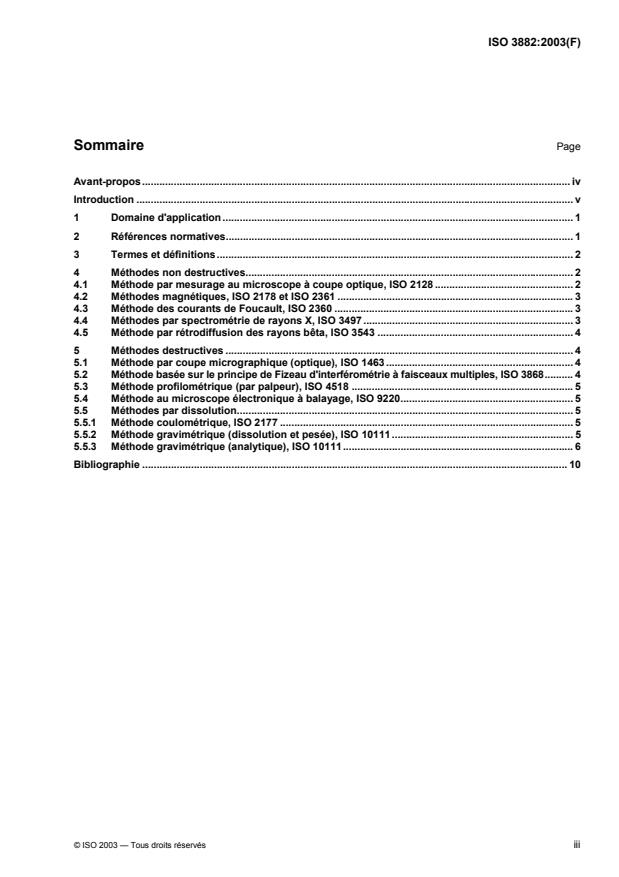
Contents Page
Foreword. iv
Introduction . v
1 Scope. 1
2 Normative references. 1
3 Terms and definitions. 2
4 Non-destructive methods. 2
4.1 Split beam microscope (light section) method, ISO 2128. 2
4.2 Magnetic methods, ISO 2178 and ISO 2361. 2
4.3 Eddy current method, ISO 2360. 3
4.4 X-ray spectrometric methods, ISO 3497. 3
4.5 Beta backscatter method, ISO 3543 . 3
5 Destructive methods. 4
5.1 Microscopical (optical) method, ISO 1463. 4
5.2 Fizeau multiple-beam interferometry method, ISO 3868. 4
5.3 Profilometric (stylus) method, ISO 4518. 4
5.4 Scanning electron microscope method, ISO 9220 . 4
5.5 Dissolution methods. 5
5.5.1 Coulometric method, ISO 2177. 5
5.5.2 Gravimetric (strip and weigh) method, ISO 10111. 5
5.5.3 Gravimetric (analytical) method, ISO 10111. 5
Bibliography . 9
Foreword
ISO (the International Organization for Standardization) is a worldwide federation of national standards bodies
(ISO member bodies). The work of preparing International Standards is normally carried out through ISO
technical committees. Each member body interested in a subject for which a technical committee has been
established has the right to be represented on that committee. International organizations, governmental and
non-governmental, in liaison with ISO, also take part in the work. ISO collaborates closely with the
International Electrotechnical Commission (IEC) on all matters of electrotechnical standardization.
International Standards are drafted in accordance with the rules given in the ISO/IEC Directives, Part 2.
The main task of technical committees is to prepare International Standards. Draft International Standards
adopted by the technical committees are circulated to the member bodies for voting. Publication as an
International Standard requires approval by at least 75 % of the member bodies casting a vote.
Attention is drawn to the possibility that some of the elements of this document may be the subject of patent
rights. ISO shall not be held responsible for identifying any or all such patent rights.
ISO 3882 was prepared by Technical Committee ISO/TC 107, Metallic and other inorganic coatings,
Subcommittee SC 2, Test methods.
This third edition cancels and replaces the second edition (ISO 3882:1986), which has been technically
revised.
iv © ISO 2003 — All rights reserved
Introduction
This International Standard summarizes the various methods used for the measurement of coating thickness
and describes their working principles. Methods of measuring coating thickness may be either destructive or
non-destructive (see Table 1). The information given in Table 2 will assist in the choice of typical instrumental
methods suitable for thickness measurements. For all instrumental methods, manufacturers’ instructions
should be followed.
The thickness ranges covered by the different methods depend on the coating materials, thickness of the
coating, substrates and instruments used (see Table 3); e.g., although X-ray spectrometry can be used to
measure the thickness of a chromium coating, thicknesses of 20 µm or more cannot be measured with
sufficient precision. Similarly, while magnetic methods may be used to measure the thickness of a gold
coating over a magnetic steel substrate, many magnetic instruments do not have the sensitivity to measure
accurately thicknesses of gold coatings less than 2 µm.
Where a referee method is required the appropriate coating specification should be consulted.
INTERNATIONAL STANDARD ISO 3882:2003(E)
Metallic and other inorganic coatings — Review of methods of
measurement of thickness
1 Scope
This International Standard reviews methods for measuring the thickness of metallic and other inorganic
coatings on both metallic and non-metallic substrates (see Tables 1, 2 and 3). It is limited to tests already
specified, or to be specified, in International Standards, and excludes certain tests that are used for special
applications.
Table 1 — Methods of measuring coating thickness
Non-destructive Destructive
a
Split beam microscope (light section) ISO 2128 Microscopical (optical) ISO 1463
b
Magnetic ISO 2178 Fizeau multiple-beam interferometry ISO 3868
and ISO 2361
b
Eddy current ISO 2360 Profilometric (stylus) ISO 4518
X-ray spectrometric ISO 3497 Scanning electron microscope ISO 9220
Beta backscatter ISO 3543 Dissolution methods:
Gravimetic strip and weigh method and
gravimetric analytical method ISO 10111
Coulometric method ISO 2177
a
Can be destructive in some applications.
b
Can be non-destructive in some applications.
2 Normative references
The following referenced documents are indispensable for the application of this document. For dated
references, only the edition cited applies. For undated references, the latest edition of the referenced
document (including any amendments) applies.
ISO 1463, Metallic and oxide coatings — Measurement of coating thickness — Microscopical method
ISO 2064, Metallic and other inorganic coatings — Definitions and conventions concerning the measurement
of thickness
ISO 2128, Anodizing of aluminium and its alloys — Determination of thickness of anodic oxide coatings —
Non-destructive measurement by split-beam microscope
ISO 2177, Metallic coatings — Measurement of coating thickness — Coulometric method by anodic dissolution
ISO 2178, Non-magnetic coatings on magnetic substrates — Measurement of coating thickness — Magnetic
method
ISO 2360, Non-conductive coatings on non-magnetic basis materials — Measurement of coating thickness —
Amplitude-sensitive eddy current method
ISO 2361, Electrodeposited nickel coatings on magnetic and non-magnetic substrates — Measurement of
coating thickness — Magnetic method
ISO 3497, Metallic coatings — Measurement of coating thickness — X-ray spectrometric methods
ISO 3543, Metallic and non-metallic coatings — Measurement of thickness — Beta backscatter method
ISO 3868, Metallic and other non-organic coatings — Measurement of coating thicknesses — Fizeau-multiple
beam interferometry method
ISO 4518, Metallic coatings — Measurement of coating thickness — Profilometric method
ISO 9220, Metallic coatings — Measurement of coating thickness — Scanning electron microscope method
ISO 10111, Metallic and other inorganic coatings — Measurement of mass per unit area — Review of
gravimetric and chemical analysis methods
3 Terms and definitions
For the purposes of this document, the terms and definitions given in ISO 2064 apply.
4 Non-destructive methods
4.1 Split beam microscope (light section) method, ISO 2128
This equipment, originally designed for the measurement of surface roughness, is used for measuring the
thickness of transparent and translucent coatings, in particular, anodic oxide coatings on aluminium. A light
beam is projected on to the surface at an angle of 45°. Part of the beam is reflected from the surface of the
coating and the rest penetrates the coating and is reflected from the coating/metal substrate interface. The
distance that separates the two images observed in the eyepiece of the microscope is proportional to the
thickness of the coating and can be measured by means of a vernier screw which controls a calibrated
graticule. The method can be used where sufficient light is reflected from the coating/metal substrate interface
to give a clear image in the microscope. For transparent or translucent coatings, such as anodic oxide films,
this method is non-destructive.
For measuring the thickness of opaque coatings, a small area of the coating is removed and in this application
the method is destructive. The step between the surface of the coating and the basis metal produces a
deflection of the light beam which gives an absolute measure of the coating thickness.
The method is not suitable for hard anodic coatings or for coatings that are very thin (less than 2 µm thick), very
thick (greater than 100 µm thick) or rough. It is not suitable for coatings on heavily shot-blasted surfaces. Other
methods such as eddy current (ISO 2360), interference microscope (ISO 3868) and microscopical (ISO 1463)
may be applicable for thickness measurement where the split beam microscope method cannot be used.
The method is best suited to small parts because of the ease with which they can be set up on the microscope
stage.
The measurement uncertainty of the method is usually less than 10 % of the thickness.
4.2 Magnetic methods, ISO 2178 and ISO 2361
Instruments for these methods measure either the magnetic attraction between a magnet and the basis metal,
as influenced by the presence of the coating, or the reluctance of a magnetic flux path passing through the
coating and the basis metal.
All instruments using magnetic methods are sensitive to the magnetic condition and properties of the test
specimen, surface curvature, surface cleanliness, surface roughness, and thickness of the basis metal and of
the coating.
2 © ISO 2003 — All rights reserved
These methods are limited in practice to non-magnetic coatings on a magnetic substrate (see ISO 2178) and
to electroplated nickel coatings on a magnetic or non-magnetic substrate (see ISO 2361).
The measurement uncertainty of the method is less than 10 % of the thickness or 1,5 µm, whichever is the
greater.
4.3 Eddy current method, ISO 2360
ISO 2360 describes an amplitude method and is based on differences in electrical conductivity between
coatings and substrates. The method is used primarily for measuring the thickness of non-conductive coatings
on non-magnetic metals and of single layer metal coatings on non-conductors. If this method is used for
measuring thicknesses of metallic coatings on metallic substrates, great care is necessary if acceptable
results are to be obtained.
The method is ideal for rapid determination of anodic coating thickness measurements on aluminium and its
alloys and is well suited for use in field measurements. For autocatalytic nickel coatings, this method gives
erratic measurements due to variations in conductivity of the coatings with changes in phosphorous content.
ISO 2360 only covers the measurement of the thickness of a non-conductive coating on a non-magnetic basis
metal.
The measurement uncertainty of the method is usually less than 10 % of the thickness or 0,5 µm, whichever is
the greater.
4.4 X-ray spectrometric methods, ISO 3497
These methods use emission and absorption X-ray spectrometry for determining
...
NORME ISO
INTERNATIONALE 3882
Troisième édition
2003-04-15
Revêtements métalliques et autres
revêtements inorganiques — Vue
d'ensemble sur les méthodes de
mesurage de l'épaisseur
Metallic and other inorganic coatings — Review of methods of
measurement of thickness
Numéro de référence
©
ISO 2003
PDF – Exonération de responsabilité
Le présent fichier PDF peut contenir des polices de caractères intégrées. Conformément aux conditions de licence d'Adobe, ce fichier
peut être imprimé ou visualisé, mais ne doit pas être modifié à moins que l'ordinateur employé à cet effet ne bénéficie d'une licence
autorisant l'utilisation de ces polices et que celles-ci y soient installées. Lors du téléchargement de ce fichier, les parties concernées
acceptent de fait la responsabilité de ne pas enfreindre les conditions de licence d'Adobe. Le Secrétariat central de l'ISO décline toute
responsabilité en la matière.
Adobe est une marque déposée d'Adobe Systems Incorporated.
Les détails relatifs aux produits logiciels utilisés pour la création du présent fichier PDF sont disponibles dans la rubrique General Info
du fichier; les paramètres de création PDF ont été optimisés pour l'impression. Toutes les mesures ont été prises pour garantir
l'exploitation de ce fichier par les comités membres de l'ISO. Dans le cas peu probable où surviendrait un problème d'utilisation,
veuillez en informer le Secrétariat central à l'adresse donnée ci-dessous.
© ISO 2003
Droits de reproduction réservés. Sauf prescription différente, aucune partie de cette publication ne peut être reproduite ni utilisée sous
quelque forme que ce soit et par aucun procédé, électronique ou mécanique, y compris la photocopie et les microfilms, sans l'accord écrit
de l'ISO à l'adresse ci-après ou du comité membre de l'ISO dans le pays du demandeur.
ISO copyright office
Case postale 56 • CH-1211 Geneva 20
Tel. + 41 22 749 01 11
Fax. + 41 22 749 09 47
E-mail copyright@iso.org
Web www.iso.org
Publié en Suisse
ii © ISO 2003 — Tous droits réservés
Sommaire Page
Avant-propos. iv
Introduction . v
1 Domaine d'application. 1
2 Références normatives. 1
3 Termes et définitions . 2
4 Méthodes non destructives. 2
4.1 Méthode par mesurage au microscope à coupe optique, ISO 2128 . 2
4.2 Méthodes magnétiques, ISO 2178 et ISO 2361 .3
4.3 Méthode des courants de Foucault, ISO 2360 . 3
4.4 Méthodes par spectrométrie de rayons X, ISO 3497 . 3
4.5 Méthode par rétrodiffusion des rayons bêta, ISO 3543 . 4
5 Méthodes destructives. 4
5.1 Méthode par coupe micrographique (optique), ISO 1463 . 4
5.2 Méthode basée sur le principe de Fizeau d'interférométrie à faisceaux multiples, ISO 3868. 4
5.3 Méthode profilométrique (par palpeur), ISO 4518 .5
5.4 Méthode au microscope électronique à balayage, ISO 9220. 5
5.5 Méthodes par dissolution. 5
5.5.1 Méthode coulométrique, ISO 2177 . 5
5.5.2 Méthode gravimétrique (dissolution et pesée), ISO 10111. 5
5.5.3 Méthode gravimétrique (analytique), ISO 10111. 6
Bibliographie . 10
Avant-propos
L'ISO (Organisation internationale de normalisation) est une fédération mondiale d'organismes nationaux de
normalisation (comités membres de l'ISO). L'élaboration des Normes internationales est en général confiée
aux comités techniques de l'ISO. Chaque comité membre intéressé par une étude a le droit de faire partie du
comité technique créé à cet effet. Les organisations internationales, gouvernementales et non
gouvernementales, en liaison avec l'ISO participent également aux travaux. L'ISO collabore étroitement avec
la Commission électrotechnique internationale (CEI) en ce qui concerne la normalisation électrotechnique.
Les Normes internationales sont rédigées conformément aux règles données dans les Directives ISO/CEI,
Partie 2.
La tâche principale des comités techniques est d'élaborer les Normes internationales. Les projets de Normes
internationales adoptés par les comités techniques sont soumis aux comités membres pour vote. Leur
publication comme Normes internationales requiert l'approbation de 75 % au moins des comités membres
votants.
L'attention est appelée sur le fait que certains des éléments du présent document peuvent faire l'objet de
droits de propriété intellectuelle ou de droits analogues. L'ISO ne saurait être tenue pour responsable de ne
pas avoir identifié de tels droits de propriété et averti de leur existence.
L'ISO 3882 a été élaborée par le comité technique ISO/TC 107, Revêtements métalliques et autres
revêtements inorganiques, sous-comité SC 2, Méthodes d'essai.
Cette troisième édition annule et remplace la deuxième édition (ISO 3882:1986), qui a fait l'objet d'une
révision technique.
iv © ISO 2003 — Tous droits réservés
Introduction
La présente Norme internationale résume les diverses méthodes utilisées pour le mesurage de l'épaisseur
des revêtements et décrit leurs principes de travail. Les méthodes de mesurage de l'épaisseur des
revêtements peuvent être destructives ou non destructives (voir Tableau 1). Les données figurant au
Tableau 2 aideront à choisir la méthode instrumentale propre adaptée au mesurage de l'épaisseur. Pour
toutes les méthodes instrumentales, il convient de suivre les indications du constructeur.
Les gammes d'épaisseurs couvertes par les différentes méthodes dépendent du matériau de revêtement, de
l'épaisseur du revêtement, du substrat et des instruments (voir Tableau 3) utilisés. Par exemple, bien que la
spectrométrie de rayons X puisse être utilisée pour mesurer l'épaisseur d'un revêtement de chrome, les
épaisseurs de 20 µm ou plus ne peuvent pas être mesurées avec une précision suffisante. De même, alors
que les méthodes magnétiques peuvent être utilisées pour mesurer l'épaisseur d'un revêtement d'or déposé
sur un substrat d'acier magnétique, beaucoup d'instruments magnétiques n'ont pas la sensibilité suffisante
pour mesurer avec précision des épaisseurs de revêtements d'or inférieures à 2 µm.
Quand une méthode de référence est exigée, il convient de consulter les spécifications propres au revêtement.
NORME INTERNATIONALE ISO 3882:2003(F)
Revêtements métalliques et autres revêtements inorganiques —
Vue d'ensemble sur les méthodes de mesurage de l'épaisseur
1 Domaine d'application
La présente Norme internationale donne une vue d'ensemble des méthodes de mesure de l'épaisseur de
revêtements métalliques et autres revêtements inorganiques déposés sur des substrats métalliques ou non
métalliques (voir Tableaux 1, 2 et 3). Elle se limite aux essais déjà spécifiés, ou qui devront être spécifiés,
dans des Normes internationales, et elle exclut certains essais utilisés à des fins spéciales.
Tableau 1 — Méthodes de mesure de l'épaisseur d'un revêtement
Non destructives Destructives
a
Microscope à coupe optique (coupe ISO 2128 Coupe micrographique (optique) ISO 1463
optique)
b
Magnétiques ISO 2178 et Méthode basée sur le principe de Fizeau ISO 3868
ISO 2361 d'interférométrie à faisceaux multiples
b
Courants de Foucault ISO 2360 Méthode profilométrique (par palpeur) ISO 4518
Spectrométrie de rayons X ISO 3497 Méthode au microscope électronique à balayage ISO 9220
Rétrodiffusion des rayons bêta ISO 3543 Méthodes par dissolution:
Méthode gravimétrique (par élimination du ISO 10111
revêtement et par le poids) et méthode
analytique gravimétrique
Méthode coulométrique ISO 2177
a
Peut être destructive dans certains cas d'application.
b
Peut être non destructive dans certains cas d'application.
2 Références normatives
Les documents de référence suivants sont indispensables pour l'application du présent document. Pour les
références datées, seule l'édition citée s'applique. Pour les références non datées, la dernière édition du
document de référence s'applique (y compris les éventuels amendements).
ISO 1463, Revêtements métalliques et couches d'oxyde — Mesurage de l'épaisseur — Méthode par coupe
micrographique
ISO 2064, Revêtements métalliques et autres revêtements inorganiques — Définitions et principes
concernant le mesurage de l'épaisseur
ISO 2128, Anodisation de l'aluminium et de ses alliages — Détermination de l'épaisseur des couches
anodiques — Méthode non destructive, par microscope à coupe optique
ISO 2177, Revêtements métalliques — Mesurage de l'épaisseur — Méthode coulométrique par dissolution
anodique
ISO 2178, Revêtements métalliques non magnétiques sur métal de base magnétique — Mesurage de
l'épaisseur du revêtement — Méthode magnétique
ISO 2360, Revêtements non conducteurs sur matériaux de base non magnétiques — Mesurage de
l'épaisseur de revêtement — Méthode par courants de Foucault basée sur des variations d'amplitude
ISO 2361, Revêtements électrolytiques de nickel sur métal de base magnétique et non magnétique —
Mesurage de l'épaisseur — Méthode magnétique
ISO 3497, Revêtements métalliques — Mesurage de l'épaisseur du revêtement — Méthodes par
spectrométrie de rayons X
ISO 3543, Revêtements métalliques et non métalliques — Mesurage de l'épaisseur — Méthode par
rétrodiffusion des rayons bêta
ISO 3868, Revêtements métalliques et autres revêtements non organiques — Mesurage de l'épaisseur —
Méthode basée sur le principe de Fizeau d'interférométrie à faisceaux multiples
ISO 4518, Revêtements métalliques — Mesurage de l'épaisseur — Méthode profilométrique
ISO 9220, Revêtements métalliques — Mesurage de l'épaisseur de revêtement — Méthode au microscope
électronique à balayage
ISO 10111, Revêtements métalliques et autres revêtements inorganiques — Mesurage de la masse
surfacique — Présentation des méthodes d'analyse gravimétrique et chimique
3 Termes et définitions
Pour les besoins du présent document, les termes et définitions donnés dans l'ISO 2064 s'appliquent.
4 Méthodes non destructives
4.1 Méthode par mesurage au microscope à coupe optique, ISO 2128
L'appareillage servait à l'origine à mesurer la rugosité superficielle, mais il est aussi utilisé pour mesurer
l'épaisseur de revêtements transparents et translucides, notamment les couches d'oxydation anodique sur
l'aluminium. Un faisceau lumineux est projeté sur une surface sous un angle de 45°. Une partie de ce
faisceau est réfléchie par la surface du revêtement, pendant que l'autre pénètre à travers le revêtement et est
réfléchie par l'interface entre le revêtement et le métal de base. La distance qui sépare les deux images
observées dans l'oculaire du microscope est proportionnelle à l'épaisseur du revêtement et peut être mesurée
à l'aide d'une vis micrométrique comportant un réticule étalonné. La méthode est utilisable si l'interface entre
le revêtement et le métal de base réfléchit suffisamment de lumière pour donner une image claire au
microscope. Pour les revêtements transparents ou translucides, tels que les couches d'oxydation anodique,
cette méthode est non destructive.
Pour mesurer l'épaisseur des revêtements opaques, enlever une petite partie du revêtement et, dans ce cas,
la méthode est destructive. Le décrochement entre la surface du revêtement et le métal de base produit une
déflection du rayon lumineux représentant la valeur absolue de l'épaisseur de revêtement.
La présente méthode ne convient pas aux revêtements anodiques durs et aux revêtements très fins (moins de
2 µm d'épaisseur), épais (plus de 100 µm d'épaisseur) ou rugueux. Elle ne convient pas aux revêtements qui
recouvrent des surfaces fortement grenaillées. D'autres méthodes, telles que celle des courants de Foucault
(ISO 2360), celle du microscope interférométrique (ISO 3868) ou celle de la coupe micrographique
(ISO 1463) peuvent s'appliquer pour le mesurage de l'épaisseur lorsque la méthode du microscope à coupe
optique ne peut pas être utilisée.
2 © ISO 2003 — Tous droits réservés
La présente méthode convient mieux aux petites pièces à cause de la facilité avec laquelle elles peuvent être
placées sur la platine porte-objet.
L'incertitude de mesurage de la présente méthode est en général inférieure à 10 % de l'épaisseur.
4.2 Méthodes magnétiques, ISO 2178 et ISO 2361
Les instruments pour ce type de méthodes mesurent soit l'attraction magnétique, entre un aimant et le métal
de base, influencée par la présence du revêtement, soit la réluctance d'un flux magnétique traversant le
revêtement et le métal de base.
Tous les instruments utilisés par les méthodes magnétiques sont sensibles au magnétisme et aux propriétés
de l'éprouvette d'essai, à la courbure, à la netteté, à la rugosité de la surface, à l'épaisseur du métal de base
et à celle du revêtement.
En pratique, ces méthodes sont limitées aux revêtements non magnétiques sur métal de base magnétique
(voir ISO 2178) et aux dépôts électrolytiques de nickel sur métal de base magnétique ou non magnétique (voir
ISO 2361).
L'incertitude de mesurage de la méthode est inférieure à 10 % de l'épaisseur ou à 1,5 µm, la plus grande de
ces valeurs étant retenue.
4.3 Méthode des courants de Foucault, ISO 2360
L'ISO 2360 donne une méthode des amplitudes et elle est fondée sur les différences de conductivité
électrique entre le revêtement et le substrat. Elle sert principalement à mesurer l'épaisseur des revêtements
non conducteurs déposés sur des métaux non magnétiques et des revêtements métalliques monocouches
déposés sur des non-conducteurs. Pour obtenir des résultats acceptables, il est nécessaire d'opérer avec le
plus grand soin pour le mesurage de l'épaisseur des revêtements métalliques sur des métaux.
La méthode est idéale pour une rapide détermination de l'épaisseur des couches anodiques déposées sur
l'aluminium et ses alliages, et elle convient bien à l'utilisation des mesurages de champ. Pour des
revêtements de nickel autocatalytiques, cette méthode donne des mesurages erronés dus aux variations de
conductivité des revêtements en fonction des changements de teneur en phosphore.
L'ISO 2360 ne traite que du mesurage de l'épaisseur des revêtements non conducteurs, déposés sur des
substrats non magnétiques.
L'incertitude de mesurage de la méthode est généralement inférieure à 10 % de l'épaisseur ou à 0,5 µm, la
plus grande de ces valeurs étant retenue.
...
Questions, Comments and Discussion
Ask us and Technical Secretary will try to provide an answer. You can facilitate discussion about the standard in here.
Loading comments...