


ISO 25550:2022
(Main)Ageing societies — General requirements and guidelines for an age-inclusive workforce
Ageing societies — General requirements and guidelines for an age-inclusive workforce
This document provides requirements and guidelines to achieve an age-inclusive workforce, which has the potential of adding value for organizations, workers, communities and other stakeholders. This document enables organizations and other stakeholders to develop, implement, maintain and support an age-inclusive workforce. It provides opportunities for older workers, working internal or external to the organization, to be productive. This document is applicable to all organizations regardless of type or size, and to all work arrangements and all forms of relationships between organizations and workers. While organizations need to be inclusive of all workers regardless of age, these requirements and guidelines focus specifically on older workers. NOTE It does not imply that younger workers are excluded. Organizations can tailor these requirements and guidelines according to their own role and specific context.
Titre manque
General Information
- Status
- Published
- Publication Date
- 09-Feb-2022
- Technical Committee
- ISO/TC 314 - Ageing societies
- Drafting Committee
- ISO/TC 314/WG 1 - Ageing workforce
- Current Stage
- 6060 - International Standard published
- Start Date
- 10-Feb-2022
- Due Date
- 08-Oct-2021
- Completion Date
- 10-Feb-2022
Overview
ISO 25550:2022, "Ageing societies - General requirements and guidelines for an age‑inclusive workforce," provides a structured framework to help organizations develop, implement, maintain and support an age‑inclusive workforce. Applicable to all organization types, sizes and work arrangements, the standard focuses on enabling opportunities for older workers while promoting inclusion for employees of all ages. It sets out both requirements and recommendations so organizations can tailor actions to their context.
Key topics and technical requirements
ISO 25550 organizes guidance across practical workplace domains. Core topics include:
- Guiding principles for age‑inclusion and anti‑ageism
- Leadership and organizational culture: age‑inclusive governance, communications, positive image of ageing, recognition of older workers
- Workforce planning, recruitment and re‑entry: planning for demographics, inclusive hiring and return‑to‑work processes
- Work allocation and work design: responsiveness to individual capability, flexible work arrangements and job design
- Health and wellbeing: workplace health management, physical and mental health, dementia considerations, health promotion, occupational health and safety, risk assessment and ergonomic workplace design
- Career development: continual career planning, training and development solutions, enabling job changes and career breaks
- Knowledge management and intergenerational collaboration: preserving institutional knowledge, mentoring and co‑working across age groups
- Digitalization and innovation: inclusive digital tools, training for technology adoption, co‑creation/co‑design of solutions
The standard distinguishes mandatory requirements (clauses that organizations should implement) from recommendations (good practice guidance), enabling scalable adoption.
Practical applications - who uses it
ISO 25550 is directly useful for:
- HR leaders and talent managers designing age‑diverse policies and workforce planning
- Occupational health & safety (OHS) professionals and ergonomists implementing risk assessments and workplace design
- Line managers and senior leadership shaping inclusive culture and communication strategies
- Learning & development teams creating age‑inclusive training and digital upskilling programs
- Public sector bodies, policymakers and workforce planners addressing demographic change
- Consultants, labour unions and community stakeholders advising on re‑entry and retention of older workers
Adopting ISO 25550 supports retention of experienced staff, reduces ageism, improves productivity and strengthens business continuity.
Related standards
ISO 25550 is designed to align with broader organizational and health/safety management practices. Organizations commonly integrate it with existing occupational health, safety and people management frameworks to create a coherent, age‑inclusive approach.
Keywords: ISO 25550, age‑inclusive workforce, ageing societies, older workers, workplace inclusion, workforce planning, occupational health, ergonomic workplace design, digitalization of workplaces.

Get Certified
Connect with accredited certification bodies for this standard

BSI Group
BSI (British Standards Institution) is the business standards company that helps organizations make excellence a habit.

Bureau Veritas
Bureau Veritas is a world leader in laboratory testing, inspection and certification services.

DNV
DNV is an independent assurance and risk management provider.
Sponsored listings
Frequently Asked Questions
ISO 25550:2022 is a standard published by the International Organization for Standardization (ISO). Its full title is "Ageing societies — General requirements and guidelines for an age-inclusive workforce". This standard covers: This document provides requirements and guidelines to achieve an age-inclusive workforce, which has the potential of adding value for organizations, workers, communities and other stakeholders. This document enables organizations and other stakeholders to develop, implement, maintain and support an age-inclusive workforce. It provides opportunities for older workers, working internal or external to the organization, to be productive. This document is applicable to all organizations regardless of type or size, and to all work arrangements and all forms of relationships between organizations and workers. While organizations need to be inclusive of all workers regardless of age, these requirements and guidelines focus specifically on older workers. NOTE It does not imply that younger workers are excluded. Organizations can tailor these requirements and guidelines according to their own role and specific context.
This document provides requirements and guidelines to achieve an age-inclusive workforce, which has the potential of adding value for organizations, workers, communities and other stakeholders. This document enables organizations and other stakeholders to develop, implement, maintain and support an age-inclusive workforce. It provides opportunities for older workers, working internal or external to the organization, to be productive. This document is applicable to all organizations regardless of type or size, and to all work arrangements and all forms of relationships between organizations and workers. While organizations need to be inclusive of all workers regardless of age, these requirements and guidelines focus specifically on older workers. NOTE It does not imply that younger workers are excluded. Organizations can tailor these requirements and guidelines according to their own role and specific context.
ISO 25550:2022 is classified under the following ICS (International Classification for Standards) categories: 03.100.30 - Management of human resources. The ICS classification helps identify the subject area and facilitates finding related standards.
ISO 25550:2022 is available in PDF format for immediate download after purchase. The document can be added to your cart and obtained through the secure checkout process. Digital delivery ensures instant access to the complete standard document.
Standards Content (Sample)
INTERNATIONAL ISO
STANDARD 25550
First edition
2022-02
Ageing societies — General
requirements and guidelines for an
age-inclusive workforce
Reference number
© ISO 2022
All rights reserved. Unless otherwise specified, or required in the context of its implementation, no part of this publication may
be reproduced or utilized otherwise in any form or by any means, electronic or mechanical, including photocopying, or posting on
the internet or an intranet, without prior written permission. Permission can be requested from either ISO at the address below
or ISO’s member body in the country of the requester.
ISO copyright office
CP 401 • Ch. de Blandonnet 8
CH-1214 Vernier, Geneva
Phone: +41 22 749 01 11
Email: copyright@iso.org
Website: www.iso.org
Published in Switzerland
ii
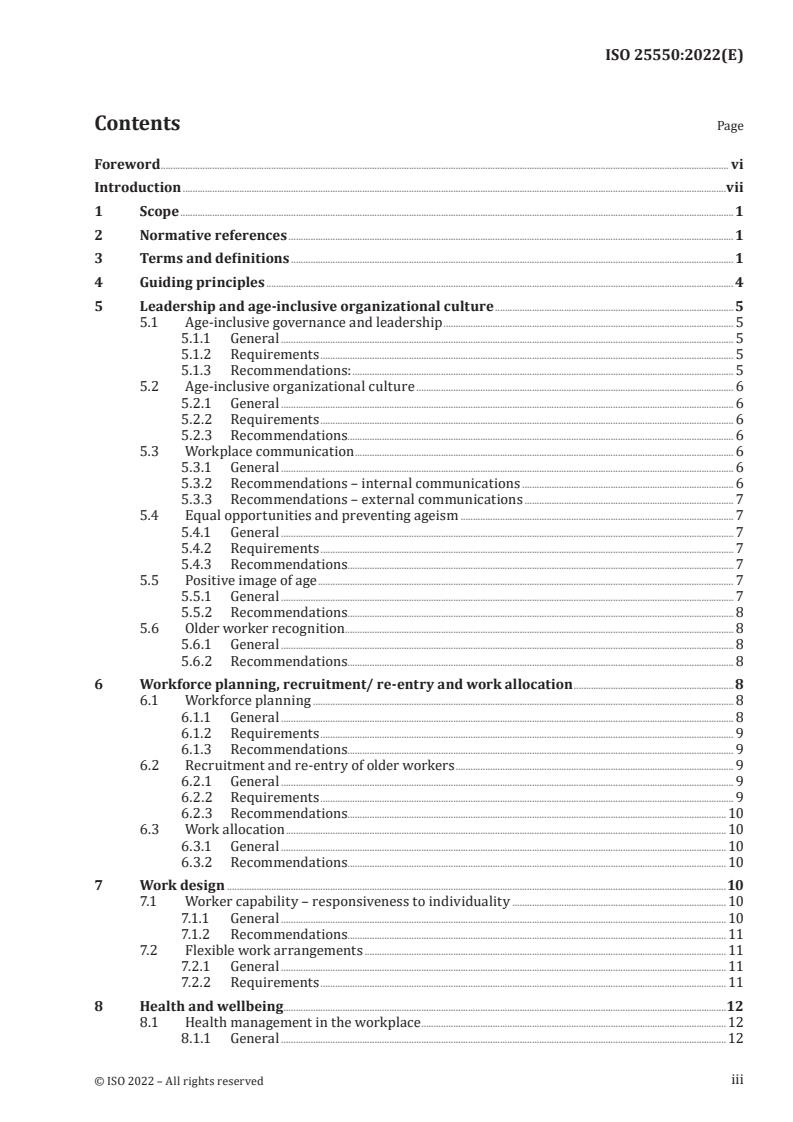
Contents Page
Foreword . vi
Introduction .vii
1 Scope . 1
2 Normative references . 1
3 Terms and definitions . 1
4 Guiding principles . 4
5 Leadership and age-inclusive organizational culture . 5
5.1 Age-inclusive governance and leadership . 5
5.1.1 General . 5
5.1.2 Requirements . 5
5.1.3 Recommendations: . 5
5.2 Age-inclusive organizational culture . 6
5.2.1 General . 6
5.2.2 Requirements . 6
5.2.3 Recommendations. 6
5.3 Workplace communication . 6
5.3.1 General . 6
5.3.2 Recommendations – internal communications . 6
5.3.3 Recommendations – external communications . 7
5.4 Equal opportunities and preventing ageism . 7
5.4.1 General . 7
5.4.2 Requirements . 7
5.4.3 Recommendations. 7
5.5 Positive image of age . 7
5.5.1 General . 7
5.5.2 Recommendations. 8
5.6 Older worker recognition . . 8
5.6.1 General . 8
5.6.2 Recommendations. 8
6 Workforce planning, recruitment/ re-entry and work allocation .8
6.1 Workforce planning . 8
6.1.1 General . 8
6.1.2 Requirements . 9
6.1.3 Recommendations. 9
6.2 Recruitment and re-entry of older workers . 9
6.2.1 General . 9
6.2.2 Requirements . 9
6.2.3 Recommendations. 10
6.3 Work allocation . 10
6.3.1 General . 10
6.3.2 Recommendations. 10
7 Work design .10
7.1 Worker capability – responsiveness to individuality . 10
7.1.1 General . 10
7.1.2 Recommendations. 11
7.2 Flexible work arrangements . 11
7.2.1 General . 11
7.2.2 Requirements . 11
8 Health and wellbeing . .12
8.1 Health management in the workplace .12
8.1.1 General .12
iii
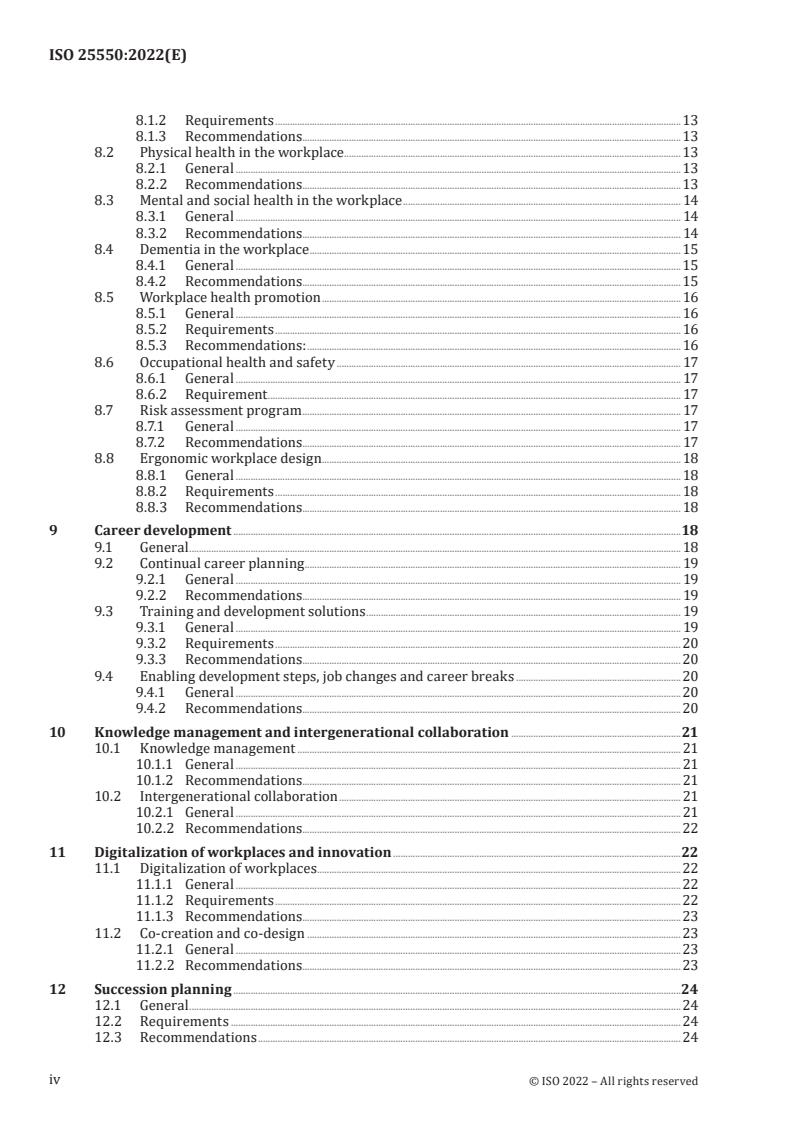
8.1.2 Requirements .13
8.1.3 Recommendations.13
8.2 Physical health in the workplace . . 13
8.2.1 General .13
8.2.2 Recommendations.13
8.3 Mental and social health in the workplace . 14
8.3.1 General . 14
8.3.2 Recommendations. 14
8.4 Dementia in the workplace . 15
8.4.1 General .15
8.4.2 Recommendations. 15
8.5 Workplace health promotion . 16
8.5.1 General . 16
8.5.2 Requirements . 16
8.5.3 Recommendations: . 16
8.6 Occupational health and safety . 17
8.6.1 General . 17
8.6.2 Requirement . 17
8.7 Risk assessment program . 17
8.7.1 General . 17
8.7.2 Recommendations. 17
8.8 Ergonomic workplace design. 18
8.8.1 General . 18
8.8.2 Requirements . 18
8.8.3 Recommendations. 18
9 Career development .18
9.1 General . 18
9.2 Continual career planning . 19
9.2.1 General . 19
9.2.2 Recommendations. 19
9.3 Training and development solutions . 19
9.3.1 General . 19
9.3.2 Requirements . 20
9.3.3 Recommendations. 20
9.4 Enabling development steps, job changes and career breaks . 20
9.4.1 General .20
9.4.2 Recommendations.20
10 Knowledge management and intergenerational collaboration .21
10.1 Knowledge management . 21
10.1.1 General . 21
10.1.2 Recommendations. 21
10.2 Intergenerational collaboration . 21
10.2.1 General . 21
10.2.2 Recommendations. 22
11 Digitalization of workplaces and innovation .22
11.1 Digitalization of workplaces . .22
11.1.1 General .22
11.1.2 Requirements . 22
11.1.3 Recommendations.23
11.2 Co-creation and co-design . 23
11.2.1 General .23
11.2.2 Recommendations. 23
12 Succession planning .24
12.1 General . 24
12.2 Requirements . 24
12.3 Recommendations . 24
iv
13 Transition to retirement .24
13.1 Transition planning . 24
13.1.1 General . 24
13.1.2 Recommendations. 24
13.2 Transition to retirement and individualized solutions . 25
13.2.1 General . 25
13.2.2 Requirement . 25
13.2.3 Recommendation . 25
13.3 Coaching for retirement life preparation . 25
13.3.1 General . 25
13.3.2 Recommendations.25
14 Continuing in the workforce .26
14.1 General . 26
14.2 Continue working, inclusion and maintaining contact . 26
14.2.1 General . 26
14.2.2 Recommendation . 26
14.3 Individualized working options . 26
14.3.1 General . 26
14.3.2 Recommendations. 26
15 The value of the ageing workforce’s ecosystem to the organization .27
15.1 General . 27
15.2 Older workers . 27
15.3 Community groups .28
15.3.1 General .28
15.3.2 Recommendations.28
15.4 Senior entrepreneurs, self-employment, micro-enterprises .28
15.4.1 General .28
15.4.2 Recommendations for senior entrepreneurship .29
15.4.3 Recommendations for self-employed, micro-enterprises and sub-
contractors .29
16 Financial literacy planning and benefits and rewards .29
16.1 Financial literacy . 29
16.1.1 General .29
16.1.2 Recommendations.30
16.2 Benefits and rewards . 30
16.2.1 General .30
16.2.2 Recommendations. 30
17 Continual improvement - assessment tools .30
17.1 General .30
17.2 Recommendations . 31
Annex A (informative) Concepts and effects of ageing .32
Annex B (informative) Individual continual career development planning .35
Annex C (informative) Assessment tools for an age-inclusive workforce.36
Annex D (informative) Examples of metrics to measure success and outcomes.39
Annex E (informative) Recommendations and solutions for small and medium-sized
organizations .42
Annex F (normative) Summary of the requirements . 44
Bibliography .46
v
Foreword
ISO (the International Organization for Standardization) is a worldwide federation of national standards
bodies (ISO member bodies). The work of preparing International Standards is normally carried out
through ISO technical committees. Each member body interested in a subject for which a technical
committee has been established has the right to be represented on that committee. International
organizations, governmental and non-governmental, in liaison with ISO, also take part in the work.
ISO collaborates closely with the International Electrotechnical Commission (IEC) on all matters of
electrotechnical standardization.
The procedures used to develop this document and those intended for its further maintenance are
described in the ISO/IEC Directives, Part 1. In particular, the different approval criteria needed for the
different types of ISO documents should be noted. This document was drafted in accordance with the
editorial rules of the ISO/IEC Directives, Part 2 (see www.iso.org/directives).
Attention is drawn to the possibility that some of the elements of this document may be the subject of
patent rights. ISO shall not be held responsible for identifying any or all such patent rights. Details of
any patent rights identified during the development of the document will be in the Introduction and/or
on the ISO list of patent declarations received (see www.iso.org/patents).
Any trade name used in this document is information given for the convenience of users and does not
constitute an endorsement.
For an explanation of the voluntary nature of standards, the meaning of ISO specific terms and
expressions related to conformity assessment, as well as information about ISO's adherence to
the World Trade Organization (WTO) principles in the Technical Barriers to Trade (TBT), see
www.iso.org/iso/foreword.html.
This document was prepared by Technical Committee ISO/TC 314, Ageing societies.
Any feedback or questions on this document should be directed to the user’s national standards body. A
complete listing of these bodies can be found at www.iso.org/members.html.
vi
Introduction
0.1 An ageing workforce
Everyone ages. Age is a continuum. The younger worker of today will become the older worker of
tomorrow. Workers expect to live longer. Creating ways for people to have meaningful, productive
multi-stage and multidimensional careers is a major opportunity to engage workers across generations
for individuals, organizations and communities.
Proactive organizations are tapping into older workers by extending their career models, creating new
development paths, and inventing roles to accommodate these workers. This can encourage active
participation of older workers and increase the organization’s reputation and image in society. This
also creates a more balanced workplace, where experience is shared and intergenerational harmony
is promoted. Applying these requirements and guidelines can help build a strong multi-generational
workforce and minimize the risk of age discrimination. Organizations with an age-inclusive workforce
can become more productive and have a competitive advantage if these guidelines are followed.
The benefits of older workers to the organization can include but are not limited to:
— reductions in absenteeism, burnout, turnover, recruitment costs and workplace injuries;
— improvements in innovations, accessibility, staff engagement, motivation, retention and productivity;
— the synergy gained by linking new and existing skills of the workforce that can raise the organization’s
productivity and capacity for innovation;
— cost effectiveness when the organization invests in skills and health for an age-inclusive workforce;
— solving labour workforce shortages;
— improving the corporate image of the organization.
0.2 Applying this document
[24]
The Later Life Workplace Index (LLWI) was used as the initial starting point for this document.
The LLWI consists of nine dimensions covering age-inclusive organizational culture and leadership,
as well as more specific age-inclusive practices regarding work design, health management, individual
development, knowledge management, transition to retirement, continued employment options,
and health and retirement coverage. This document provides general requirements and guidelines
to support the business case for an age-inclusive workforce and contributes to the UN Sustainable
Development Goals (SDGs)- Agenda 2030, including, but not limited to #3-‘Good health and wellbeing’,
#4-‘Quality education’, #5-‘Gender equality’, #8-‘Decent work and economic growth’, #9-‘Industry,
innovation and infrastructure’, and #10-‘Reduced inequalities’.
The COVID-19 pandemic has highlighted several emerging issues impacting older workers. These are
described in ISO/PAS 45005.
An age-inclusive workforce is interdisciplinary in nature, complex and it depends on many stakeholders
and systems. As such, there are documents linked to older workers, e.g. ISO 30415: and ISO/TR 30406.
This document can be used in connection with an organization’s management systems, human resource
programs, occupational health and safety programs, diversity and inclusion programs, Corporate Social
Responsibility or on its own in the absence of a formal workplace program to support an age-inclusive
workforce. Annex F provides the user with an overview of some key topics and their relevance.
0.3 A roadmap
Figure 1 explains how this document is structured.
vii
Figure 1 — Roadmap to implementing guidelines and requirements for an age-inclusive
workforce
viii
INTERNATIONAL STANDARD ISO 25550:2022(E)
Ageing societies — General requirements and guidelines
for an age-inclusive workforce
1 Scope
This document provides requirements and guidelines to achieve an age-inclusive workforce, which has
the potential of adding value for organizations, workers, communities and other stakeholders. This
document enables organizations and other stakeholders to develop, implement, maintain and support
an age-inclusive workforce. It provides opportunities for older workers, working internal or external to
the organization, to be productive.
This document is applicable to all organizations regardless of type or size, and to all work arrangements
and all forms of relationships between organizations and workers.
While organizations need to be inclusive of all workers regardless of age, these requirements and
guidelines focus specifically on older workers.
NOTE It does not imply that younger workers are excluded. Organizations can tailor these requirements
and guidelines according to their own role and specific context.
2 Normative references
There are no normative references in this document.
3 Terms and definitions
For the purposes of this document, the following terms and definitions apply.
ISO and IEC maintain terminology databases for use in standardization at the following addresses:
— ISO Online browsing platform: available at https:// www .iso .org/ obp
— IEC Electropedia: available at https:// www .electropedia .org/
3.1
ageing society
demographics of an older population that shifts overtime
3.2
accessibility
extent to which products, systems, services, environments and facilities can be used by people from a
population with the widest range of user needs, characteristics and capabilities to achieve identified
goals in identified contexts of use
[SOURCE: ISO 9241-112:2017, 3.15, modified — Note to entry has been deleted.]
3.3
worker
person performing work or work-related activities that are under the control of the organization
Note 1 to entry: Persons perform work or work-related activities under various arrangements, paid or unpaid,
such as regularly or temporarily, intermittently or seasonally, casually or on a part-time basis.
Note 2 to entry: Workers include top management, managerial, and non-managerial persons.
Note 3 to entry: The work or work-related activities performed under the control of the organization can be
performed by workers employed by the organization, workers of external providers, contractors, individuals,
agency workers, and by other people to the extent the organization shares control over their work or work-
related activities, according to the context of the organization.
[SOURCE: ISO 45001:2018, 3.3]
3.4
workforce
people who provide a service or labour to contribute to business or organizational outcomes
[SOURCE: ISO 30400:2016, 10.1]
3.5
ageing workforce
changes in the number of older people in the workforce (3.4)
Note 1 to entry: the specific age of being older will vary by country, industry, and other factors.
3.6
workplace
area(s) in which the workers' (3.3) activities are carried out
[SOURCE: ISO/TR 25901-1:2016, 2.1.8.35]
3.7
organizational culture
values, beliefs and practices that influence the conduct and behaviour of people and organizations
[SOURCE: ISO 30400:2016, 3.2]
3.8
human capital
value of the collective knowledge, skills and abilities of an organization's workers (3.3)
[SOURCE: ISO 30400:2016, 4.1, modified — "people" has been replaced with "workers".]
3.9
stakeholder
person or organization that can affect, be affected by, or perceive itself to be affected by a decision or
activity
EXAMPLE Customers, owners, people in an organization, suppliers, bankers, unions, work councils,
partners, or society that can include competitive or pressure groups.
[SOURCE: ISO 30400:2016, 5.1]
3.10
diversity
characteristics of differences and similarities between people
Note 1 to entry: Diversity includes factors that influence the identities and perspectives that people bring when
interacting at work.
Note 2 to entry: Diversity can foster learning from others who are not the same, about dignity, respect and
inclusiveness for everyone, and about creating workplace (3.6) environments and practices that foster learning
from others to gain advantages of diverse perspectives.
[SOURCE: ISO 30400:2016, 9.1]
3.11
inclusion
process of including all stakeholders (3.9) in organizational contexts
Note 1 to entry: Organizational policies, processes and practices that are fair and impartially applied can support
an age-inclusive workplace (3.6).
Note 2 to entry: This involves the entire workforce (3.4) having access to opportunities and resources to enable
their contribution to the organization.
Note 3 to entry: This involves stakeholders (3.9) from different groups being accepted, welcomed, enabled to have
a voice, and to develop a sense of belonging.
[SOURCE: ISO 30400:2016, 9.5, modified — "practice" replaced with "process", Notes to entry deleted,
new Notes to entry added.]
3.12
financial literacy
ability to identify, retrieve, evaluate and use financial information effectively
3.13
wellbeing
state of being comfortable, healthy and happy
[SOURCE: ISO 17679:2016, 3.3, modified — "feeling" replaced with "state", Note to entry deleted.]
3.14
succession planning
process for identifying and developing current workers (3.3) with the potential to fill key positions in
the organization
[SOURCE: ISO 30400:2016, 4.11, modified — "employees" replaced with "workers".]
3.15
age-inclusive
including all stakeholders (3.9) in organizational contexts where people of diverse ages are treated
fairly and equally and included in all aspects of the organization
3.16
age-inclusive workforce
workers (3.3) of diverse ages who all are treated fairly and equally and are included in organizational
processes
3.17
ageism
stereotyping, prejudice, and discrimination against people on the basis of their age
Note 1 to entry: Ageism takes many forms, including prejudicial attitudes, discriminatory practices, or
institutional policies and practices that perpetuate stereotypical beliefs.
[23]
[SOURCE: WHO, 2021 ]
3.18
work allocation
allocation
process of analysing and assigning work to all workers (3.3), regardless of age
3.19
health literacy
ability to recognize, identify, retrieve, evaluate and use health information effectively
3.20
knowledge management
combination of processes, actions, methodologies and solutions that enable the creation, maintenance,
distribution and access to organizational knowledge
Note 1 to entry: This is of particular importance with an ageing workforce (3.5) to allow transfer between
different generations of workers (3.3). A knowledge management system includes the organization’s knowledge
management culture, structure, governance and leadership; roles and responsibilities; planning technology,
processes and operation, etc.
[SOURCE: ISO 30400:2016, 14.1, modified — Note to entry added.]
4 Guiding principles
The organization provides an age-inclusive workforce that takes the following guiding principles
into account at stages of planning, design, operation and evaluation and is aimed at all workers and
stakeholders (see Table 1). The organization has the leadership and guiding principles, based on the
underlying principles of social responsibility, to support and implement an age-inclusive workforce
policy and develops an organizational culture to support this policy.
NOTE The organization can consult ISO 26000, which provides guidance on the underlying principles of
social responsibility, engaging stakeholders, and integrating socially responsible behaviour into the organization
such as an age-inclusive workforce.
Table 1 — Guiding principles
Guiding Principle Details
Decency of work The organization supports and takes actions that demonstrate that their workplace pro-
vides employment and decent work for all workers. The organization values employees
and creates a meaningful work environment.
Leadership and The organization’s leadership demonstrates integrity by endorsing and ensuring strategies,
integrity operations and values regarding an age-inclusive workforce are implemented.
Inclusiveness The organization includes all workers (throughout the worker’s life-cycle) regardless of
age, disability, gender, sexual orientation, religion, race, colour, ethnicity, socioeconomic
status or any other status. This includes being a non-discriminatory organization that is
open and trustworthy, values and recognizes workers and their perspectives, and provides
opportunities to participate and contribute to the organization.
Health, wellbeing, The organization ensures that the h
...
Questions, Comments and Discussion
Ask us and Technical Secretary will try to provide an answer. You can facilitate discussion about the standard in here.
Loading comments...