

ISO 13400-2:2019
(Main)Road vehicles — Diagnostic communication over Internet Protocol (DoIP) — Part 2: Transport protocol and network layer services
General Information
- Abstract
This document specifies the requirements for secured and unsecured diagnostic communication between client DoIP entity and server(s) installed in the vehicle using Internet protocol (IP) as well as the transmission control protocol (TCP) and user datagram protocol (UDP). This includes the definition of vehicle gateway requirements (e.g. for integration into an existing computer network) and test equipment (client DoIP entity) requirements (e.g. to detect and establish communication with a vehicle). This document specifies features that are used to detect a vehicle in a network and enable communication with the vehicle gateway as well as with its sub-components during the various vehicle states. These features are separated into two types: mandatory and optional. This document specifies the following mandatory features: — vehicle network integration (IP address assignment); — vehicle announcement and vehicle discovery; — vehicle basic status information retrieval (e.g. diagnostic power mode); — connection establishment (e.g. concurrent communication attempts), connection maintenance and vehicle gateway control; — data routing to and from the vehicle's sub-components; — error handling (e.g. physical network disconnect). This document specifies the following optional features: — DoIP entity status monitoring; — transport layer security (TLS); — DoIP entity firewall capabilities.
- Status
- Withdrawn
- Publication Date
- 12-Dec-2019
- Technical Committee
- ISO/TC 22/SC 31 - Data communication
- Drafting Committee
- ISO/TC 22/SC 31/WG 2 - Vehicle diagnostic protocols
- Current Stage
- 9599 - Withdrawal of International Standard
- Start Date
- 13-Jun-2025
- Completion Date
- 29-Aug-2026
Buy Documents

ISO 13400-2:2019 - Road vehicles — Diagnostic communication over Internet Protocol (DoIP) — Part 2: Transport protocol and network layer services/13/2019


ISO 13400-2:2019 - Road vehicles -- Diagnostic communication over Internet Protocol (DoIP)
Overview - ISO 13400-2:2019 (DoIP Transport & Network Layer Services)
ISO 13400-2:2019 specifies transport protocol and network-layer requirements for Diagnostic communication over Internet Protocol (DoIP) in road vehicles. It defines how a client DoIP entity (test equipment, diagnostic tool) and vehicle server(s) communicate over IP using TCP and UDP, both in unsecured and secured (TLS) sessions. The standard covers vehicle gateway requirements, vehicle discovery, IP address assignment and error handling to enable reliable diagnostic access across modern in‑vehicle networks.
Key technical topics and requirements
The standard separates features into mandatory and optional categories and includes requirements for both client and vehicle gateway implementations. Major topics include:
- Mandatory features
- Vehicle network integration (IP address assignment / DHCP)
- Vehicle announcement and discovery mechanisms
- Retrieval of vehicle basic status (e.g., diagnostic power mode)
- Connection establishment, maintenance and gateway control (including concurrent attempts)
- Data routing to/from vehicle sub‑components (gateway routing)
- Error handling (physical network disconnects, socket handling)
- Optional features
- DoIP entity status monitoring
- Transport Layer Security (TLS) for secure sessions
- DoIP entity firewall capabilities
- Transport and network protocols: TCP, UDP, IP, ARP, IPv6 NDP, ICMP
- Application-layer behaviors: DHCP-based IP assignment, DoIP message structures, alive checks, diagnostic message acknowledgement
- Socket management, inactivity timers, and data link (MAC-layer) considerations
- Conformance, service primitives and interoperability testing guidance
Practical applications and who uses this standard
ISO 13400-2 is intended for anyone designing or operating IP‑based vehicle diagnostic systems:
- Automotive OEMs and subsystem suppliers (ECU and gateway design)
- Diagnostic tool and test-equipment manufacturers (DoIP client implementations)
- Workshop diagnostics and remote service providers (secure and unsecured remote access)
- Vehicle network architects integrating gateways between in‑vehicle buses and IP interfaces
- Test labs and certification bodies validating DoIP conformance and interoperability Practical use cases include in‑vehicle diagnostics, ECU software updates, calibration, manufacturing and service diagnostics, and remote diagnostic services over IP.
Related standards
- Part of the ISO 13400 DoIP series (see other parts of the ISO 13400 family for application-layer profiles and additional services)
- Developed by ISO/TC 22 (Road vehicles), SC 31 (Data communication)
ISO 13400-2:2019 is essential for implementing robust, interoperable DoIP transport and network layer services that meet modern vehicle diagnostic and security needs.
Relations
- Effective Date
- 06-Jun-2022
- Effective Date
- 14-Oct-2023
- Effective Date
- 28-Oct-2017
Buy Documents
ISO 13400-2:2019 - Road vehicles — Diagnostic communication over Internet Protocol (DoIP) — Part 2: Transport protocol and network layer services/13/2019
ISO 13400-2:2019 - Road vehicles -- Diagnostic communication over Internet Protocol (DoIP)
Get Certified
Connect with accredited certification bodies for this standard

TÜV Rheinland
TÜV Rheinland is a leading international provider of technical services.

TÜV SÜD
TÜV SÜD is a trusted partner of choice for safety, security and sustainability solutions.

DEKRA Certification Inc.
DEKRA US certification services.
Sponsored listings
Frequently Asked Questions
ISO 13400-2:2019 is a standard published by the International Organization for Standardization (ISO). Its full title is "Road vehicles — Diagnostic communication over Internet Protocol (DoIP) — Part 2: Transport protocol and network layer services". This standard covers: This document specifies the requirements for secured and unsecured diagnostic communication between client DoIP entity and server(s) installed in the vehicle using Internet protocol (IP) as well as the transmission control protocol (TCP) and user datagram protocol (UDP). This includes the definition of vehicle gateway requirements (e.g. for integration into an existing computer network) and test equipment (client DoIP entity) requirements (e.g. to detect and establish communication with a vehicle). This document specifies features that are used to detect a vehicle in a network and enable communication with the vehicle gateway as well as with its sub-components during the various vehicle states. These features are separated into two types: mandatory and optional. This document specifies the following mandatory features: — vehicle network integration (IP address assignment); — vehicle announcement and vehicle discovery; — vehicle basic status information retrieval (e.g. diagnostic power mode); — connection establishment (e.g. concurrent communication attempts), connection maintenance and vehicle gateway control; — data routing to and from the vehicle's sub-components; — error handling (e.g. physical network disconnect). This document specifies the following optional features: — DoIP entity status monitoring; — transport layer security (TLS); — DoIP entity firewall capabilities.
This document specifies the requirements for secured and unsecured diagnostic communication between client DoIP entity and server(s) installed in the vehicle using Internet protocol (IP) as well as the transmission control protocol (TCP) and user datagram protocol (UDP). This includes the definition of vehicle gateway requirements (e.g. for integration into an existing computer network) and test equipment (client DoIP entity) requirements (e.g. to detect and establish communication with a vehicle). This document specifies features that are used to detect a vehicle in a network and enable communication with the vehicle gateway as well as with its sub-components during the various vehicle states. These features are separated into two types: mandatory and optional. This document specifies the following mandatory features: — vehicle network integration (IP address assignment); — vehicle announcement and vehicle discovery; — vehicle basic status information retrieval (e.g. diagnostic power mode); — connection establishment (e.g. concurrent communication attempts), connection maintenance and vehicle gateway control; — data routing to and from the vehicle's sub-components; — error handling (e.g. physical network disconnect). This document specifies the following optional features: — DoIP entity status monitoring; — transport layer security (TLS); — DoIP entity firewall capabilities.
ISO 13400-2:2019 is classified under the following ICS (International Classification for Standards) categories: 43.040.10 - Electrical and electronic equipment; 43.180 - Diagnostic, maintenance and test equipment. The ICS classification helps identify the subject area and facilitates finding related standards.
ISO 13400-2:2019 has the following relationships with other standards: It is inter standard links to ISO 13400-2:2019/Amd 1:2023, ISO 13400-2:2025, ISO 13400-2:2012. Understanding these relationships helps ensure you are using the most current and applicable version of the standard.
ISO 13400-2:2019 is available in PDF format for immediate download after purchase. The document can be added to your cart and obtained through the secure checkout process. Digital delivery ensures instant access to the complete standard document.
Standards Content (Sample)
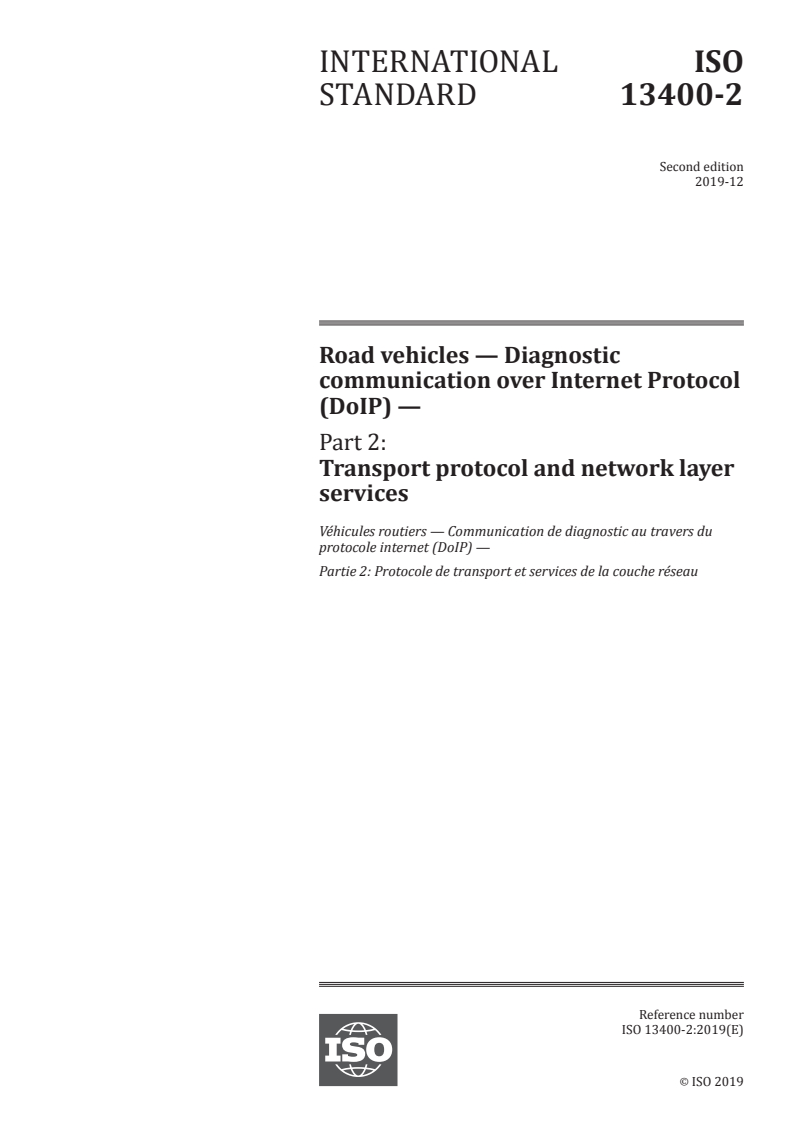
INTERNATIONAL ISO
STANDARD 13400-2
Second edition
2019-12
Road vehicles — Diagnostic
communication over Internet Protocol
(DoIP) —
Part 2:
Transport protocol and network layer
services
Véhicules routiers — Communication de diagnostic au travers du
protocole internet (DoIP) —
Partie 2: Protocole de transport et services de la couche réseau
Reference number
©
ISO 2019
© ISO 2019
All rights reserved. Unless otherwise specified, or required in the context of its implementation, no part of this publication may
be reproduced or utilized otherwise in any form or by any means, electronic or mechanical, including photocopying, or posting
on the internet or an intranet, without prior written permission. Permission can be requested from either ISO at the address
below or ISO’s member body in the country of the requester.
ISO copyright office
CP 401 • Ch. de Blandonnet 8
CH-1214 Vernier, Geneva
Phone: +41 22 749 01 11
Fax: +41 22 749 09 47
Email: copyright@iso.org
Website: www.iso.org
Published in Switzerland
ii © ISO 2019 – All rights reserved
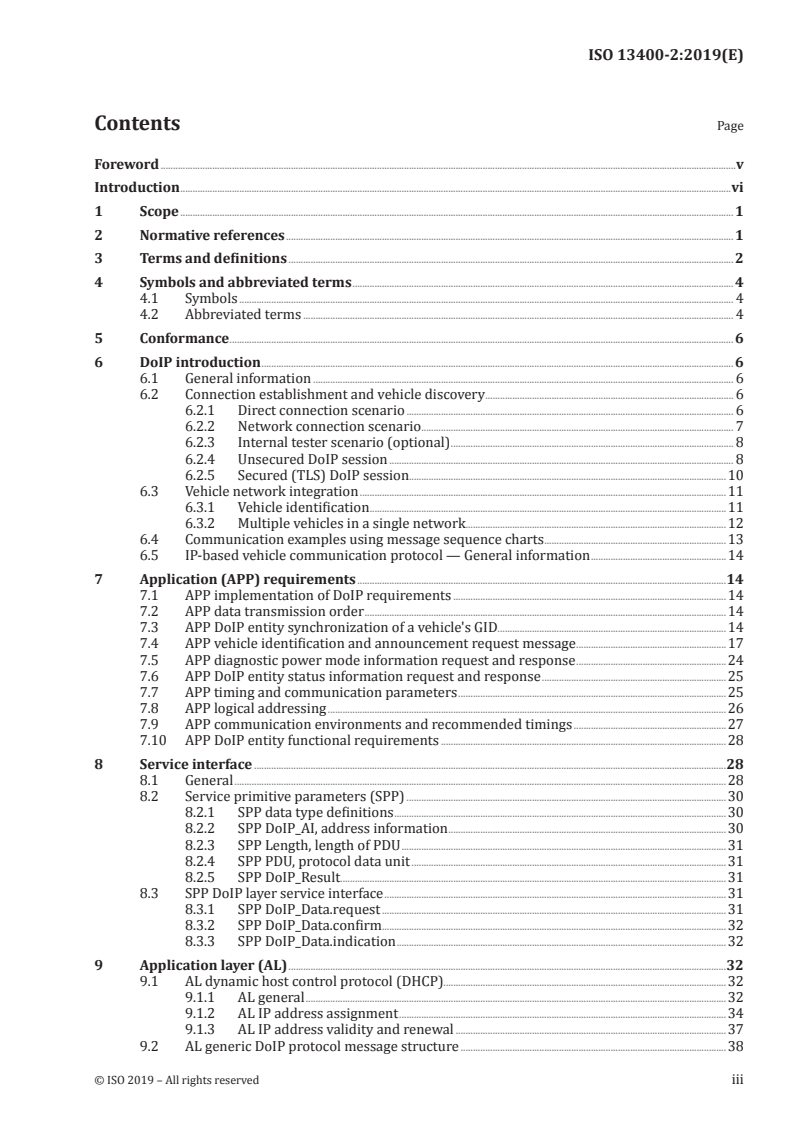
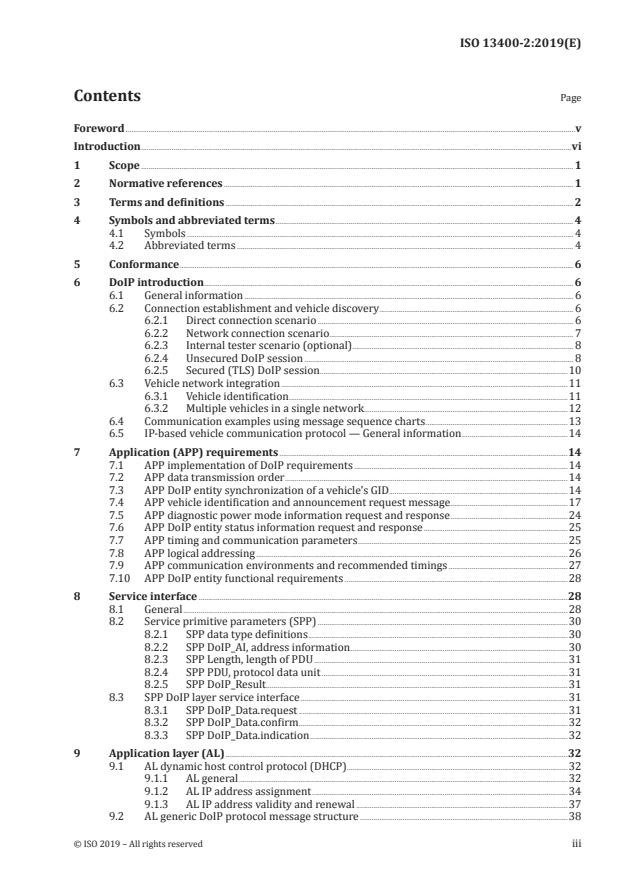
Contents Page
Foreword .v
Introduction .vi
1 Scope . 1
2 Normative references . 1
3 Terms and definitions . 2
4 Symbols and abbreviated terms . 4
4.1 Symbols . 4
4.2 Abbreviated terms . 4
5 Conformance . 6
6 DoIP introduction . 6
6.1 General information . 6
6.2 Connection establishment and vehicle discovery . 6
6.2.1 Direct connection scenario . 6
6.2.2 Network connection scenario . 7
6.2.3 Internal tester scenario (optional) . 8
6.2.4 Unsecured DoIP session . 8
6.2.5 Secured (TLS) DoIP session.10
6.3 Vehicle network integration .11
6.3.1 Vehicle identification .11
6.3.2 Multiple vehicles in a single network.12
6.4 Communication examples using message sequence charts .13
6.5 IP-based vehicle communication protocol — General information .14
7 Application (APP) requirements .14
7.1 APP implementation of DoIP requirements .14
7.2 APP data transmission order .14
7.3 APP DoIP entity synchronization of a vehicle's GID.14
7.4 APP vehicle identification and announcement request message .17
7.5 APP diagnostic power mode information request and response .24
7.6 APP DoIP entity status information request and response .25
7.7 APP timing and communication parameters .25
7.8 APP logical addressing .26
7.9 APP communication environments and recommended timings .27
7.10 APP DoIP entity functional requirements .28
8 Service interface .28
8.1 General .28
8.2 Service primitive parameters (SPP) .30
8.2.1 SPP data type definitions .30
8.2.2 SPP DoIP_AI, address information .30
8.2.3 SPP Length, length of PDU .31
8.2.4 SPP PDU, protocol data unit .31
8.2.5 SPP DoIP_Result.31
8.3 SPP DoIP layer service interface .31
8.3.1 SPP DoIP_Data.request .31
8.3.2 SPP DoIP_Data.confirm.32
8.3.3 SPP DoIP_Data.indication .32
9 Application layer (AL) .32
9.1 AL dynamic host control protocol (DHCP).32
9.1.1 AL general .32
9.1.2 AL IP address assignment .34
9.1.3 AL IP address validity and renewal .37
9.2 AL generic DoIP protocol message structure .38
9.3 AL handling of UDP packets and TCP data .43
9.4 AL supported payload types over TCP and UDP ports .43
9.5 AL diagnostic message and diagnostic message acknowledgement .44
9.6 AL alive check request and alive check response .49
10 Transport layer security (TLS) .50
10.1 TLS secure diagnostic communication .50
10.2 TLS DoIP application profile .52
10.2.1 TLS general .52
10.2.2 TLS accepted TLS versions for DoIP .52
10.2.3 TLS accepted cipher suites .52
10.2.4 TLS accepted TLS extensions .53
11 Transport layer (TL) .54
11.1 TL transmission control protocol (TCP) .54
11.2 TL user datagram protocol (UDP) .57
11.3 TL handling of UDP messages .61
12 Network layer (NL) .61
12.1 NL internet protocol (IP) .61
12.2 NL IPv4 address resolution protocol (ARP).61
12.3 NL IPv6 neighbour discovery protocol (NDP) .62
12.4 NL internet control message protocol (ICMP) .62
12.5 NL IP-based vehicle communication protocol .63
12.6 NL socket handling .68
12.6.1 NL connection states .68
12.6.2 NL general inactivity timer .70
12.6.3 NL initial inactivity timer .71
12.6.4 NL socket handler and alive check .72
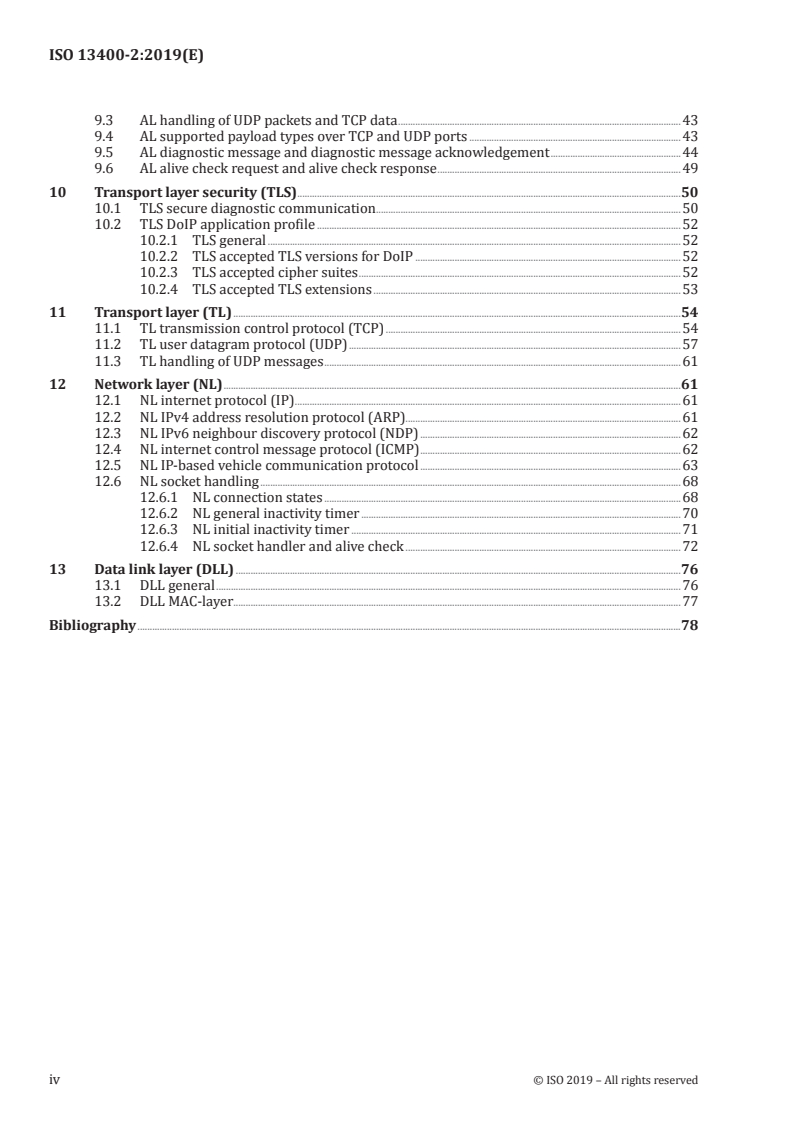
13 Data link layer (DLL) .76
13.1 DLL general .76
13.2 DLL MAC-layer .77
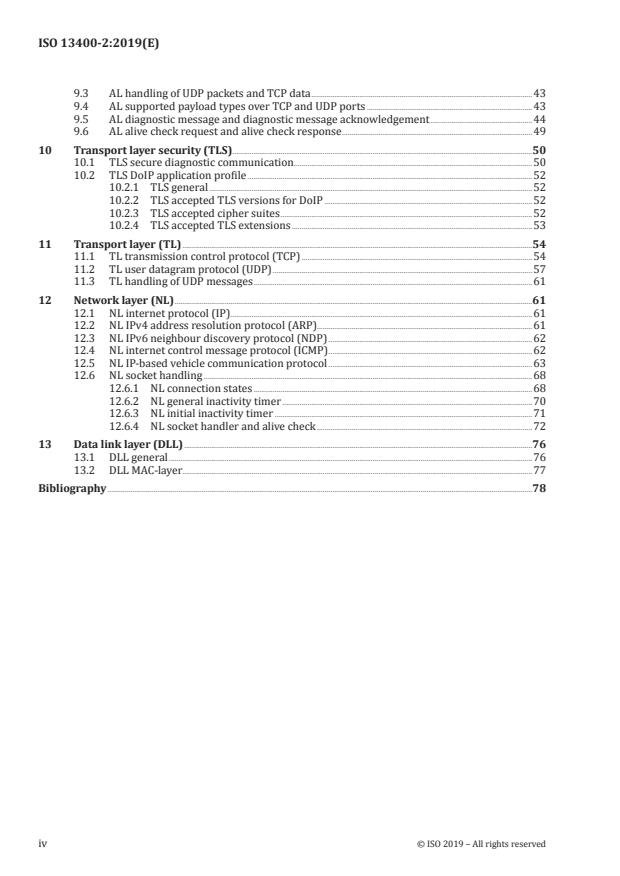
Bibliography .78
iv © ISO 2019 – All rights reserved
Foreword
ISO (the International Organization for Standardization) is a worldwide federation of national standards
bodies (ISO member bodies). The work of preparing International Standards is normally carried out
through ISO technical committees. Each member body interested in a subject for which a technical
committee has been established has the right to be represented on that committee. International
organizations, governmental and non-governmental, in liaison with ISO, also take part in the work.
ISO collaborates closely with the International Electrotechnical Commission (IEC) on all matters of
electrotechnical standardization.
The procedures used to develop this document and those intended for its further maintenance are
described in the ISO/IEC Directives, Part 1. In particular, the different approval criteria needed for the
different types of ISO documents should be noted. This document was drafted in accordance with the
editorial rules of the ISO/IEC Directives, Part 2 (see www .iso .org/ directives).
Attention is drawn to the possibility that some of the elements of this document may be the subject of
patent rights. ISO shall not be held responsible for identifying any or all such patent rights. Details of
any patent rights identified during the development of the document will be in the Introduction and/or
on the ISO list of patent declarations received (see www .iso .org/ patents).
Any trade name used in this document is information given for the convenience of users and does not
constitute an endorsement.
For an explanation of the voluntary nature of standards, the meaning of ISO specific terms and
expressions related to conformity assessment, as well as information about ISO's adherence to the
World Trade Organization (WTO) principles in the Technical Barriers to Trade (TBT) see www .iso .org/
iso/ foreword .html.
This document was prepared by Technical Committee ISO/TC 22, Road vehicles, Subcommittee SC 31,
Data communication.
This second edition cancels and replaces the first edition (ISO 13400-2:2012), which has been
technically revised.
The main changes compared to the previous edition are as follows:
— addition of TLS (Transport Layer Security);
— major restructuring of document content.
A list of all parts in the ISO 13400 series can be found on the ISO website.
Any feedback or questions on this document should be directed to the user’s national standards body. A
complete listing of these bodies can be found at www .iso .org/ members .html.
Introduction
Vehicle diagnostic communication has been developed starting with the introduction of the first
legislated emissions-related diagnostics and has evolved over the years, now covering various use
cases ranging from emission-related diagnostics to vehicle-manufacturer-specific applications like
calibration or electronic component software updates.
With the introduction of new in-vehicle network communication technologies, the interface between
the vehicle's servers and the client DoIP entity has been adapted several times to address the specific
characteristics of each new network communication technology requiring optimized data link layer
definitions and transport protocol developments in order to make the new in-vehicle networks usable
for diagnostic communication.
With increasing memory size of servers, the demand to update this increasing amount of software
and an increasing number of functions provided by these control units, technology of the connecting
network and buses has been driven to a level of complexity and speed similar to computer networks.
Various applications (x-by-wire, infotainment) require high band-width and real-time networks (like
FlexRay, MOST), which cannot be adapted to provide the direct interface to a vehicle. This requires
gateways to route and convert messages between the in-vehicle networks and the vehicle interface to
client DoIP entity.
All parts of ISO 13400 are applicable to vehicle diagnostic systems implemented on an IP communication
network.
The ISO 13400 series has been established in order to define common requirements for vehicle
diagnostic systems implemented on an IP communication link.
Although primarily intended for diagnostic systems, ISO 13400 has been developed to also meet
requirements from other IP-based systems needing a transport protocol and network layer services.
The intent of the ISO 13400 series is to describe a standardized vehicle interface which
— separates in-vehicle network technology from the client DoIP entity vehicle interface requirements
to allow for a long-term stable external vehicle communication interface,
— utilizes existing industry standards to define a long-term stable state-of-the-art communication
standard usable for legislated diagnostic communication as well as for manufacturer-specific
use cases,
— can easily be adapted to new physical and data link layers, including wired and wireless connections,
by using existing adaptation layers, and
— allows connections of vehicle-internal and vehicle-external DoIP entities.
To achieve this, it is based on the Open Systems Interconnection (OSI) Basic Reference Model specified
[1]
in ISO/IEC 7498-1 and ISO/IEC 10731 , which structures communication systems into seven layers.
Figure 1 illustrates an overview of communication frameworks beyond the scope of this document
including related standards:
[3] [4]
— Vehicle diagnostic communication framework, which is composed of ISO 14229-1 , ISO 14229-2 ,
[5]
and ISO 14229-5 .
[6]
— Presentation layer standards, for example vehicle manufacturer- (VM-) specific or ISO 22901 ODX .
[2]
— OSI lower layers framework, which is composed of ISO 13400-3 and ISO 13400-4 .
[5]
The ISO 13400 series and ISO 14229-5 are based on the conventions specified in the OSI Service
[1]
Conventions (ISO/IEC 10731) as they apply for all layers and the diagnostic services.
vi © ISO 2019 – All rights reserved
Figure 1 — DoIP document reference according to OSI model
Figure 2 illustrates vehicle network architecture schematics from a functional viewpoint.
Figure 2 — Vehicle network architecture schematics (functional view)
This protocol standard is implemented by one or more DoIP entities, depending on the vehicle’s network
architecture. Figure 2 illustrates a client 1 (external client), which is connected to the DoIP edge node
and a client 2 (internal client) in the vehicle's internal network. If not stated otherwise, the DoIP client
entities are assumed to behave the same regardless to which network they are connected.
If necessary, this document distinguishes between an “internal client” and “external client” to apply a
requirement or statement.
In this document, the requirements are assigned a unique number of the form "X.DoIP-yyy", allowing
for easier requirement tracking and reference.
— X = OSI layer number; and
— DoIP-yyy = requirement number; and
— xL = x = OSI layer abbrevation[8 = APP, 7 = AL, 6 = PL, 5 = SL, 4 = TL, 3 = NL, 2 = DLL, 1 = PHY, 0 = SPP].
NOTE Requirements in this document are not numbered sequentially because the order of individual
requirements changed during document development.
Requirements formulated as “The vehicle shall implement …” imply that this is a requirement for all
DoIP entities to implement the required functionality if not explicitly stated otherwise. If multiple
DoIP entities are present on a vehicle network, implementation details may differ slightly for each DoIP
entity (e.g. for identification purposes), so that the client DoIP entity is able to identify the individual
DoIP gateways that support this protocol standard.
viii © ISO 2019 – All rights reserved
Where reference is made to RFC documents, note that the forms “shall/shall not” are used to express
requirements in these documents.
INTERNATIONAL STANDARD ISO 13400-2:2019(E)
Road vehicles — Diagnostic communication over Internet
Protocol (DoIP) —
Part 2:
Transport protocol and network layer services
1 Scope
This document specifies the requirements for secured and unsecured diagnostic communication
between client DoIP entity and server(s) installed in the vehicle using Internet protocol (IP) as well as
the transmission control protocol (TCP) and user datagram protocol (UDP). This includes the definition
of vehicle gateway requirements (e.g. for integration into an existing computer network) and test
equipment (client DoIP entity) requirements (e.g. to detect and establish communication with a vehicle).
This document specifies features that are used to detect a vehicle in a network and enable
communication with the vehicle gateway as well as with its sub-components during the various vehicle
states. These features are separated into two types: mandatory and optional.
This document specifies the following mandatory features:
— vehicle network integration (IP address assignment);
— vehicle announcement and vehicle discovery;
— vehicle basic status information retrieval (e.g. diagnostic power mode);
— connection establishment (e.g. concurrent communication attempts), connection maintenance and
vehicle gateway control;
— data routing to and from the vehicle's sub-components;
— error handling (e.g. physical network disconnect).
This document specifies the following optional features:
— DoIP entity status monitoring;
— transport layer security (TLS);
— DoIP entity firewall capabilities.
2 Normative references
The following documents are referred to in the text in such a way that some or all of their content
constitutes requirements of this document. For dated references, only the edition cited applies. For
undated references, the latest edition of the referenced document (including any amendments) applies.
ISO/IEC 7498-1:1994, Information processing systems — Open systems interconnection — Basic
reference model
ISO 13400-3, Road vehicles — Diagnostic communication over Internet Protocol (DoIP) — Part 3: Wired
vehicle interface based on IEEE 802.3
ISO/IEC/IEEE 8802-3, Information technology — Telecommunications and information exchange between
systems — Local and metropolitan area networks — Specific requirements — Part 3: Standard for Ethernet
IETF RFC 768, User Datagram Protocol
IETF RFC 791:1981, Internet Protocol — DARPA Internet Program — Protocol Specification
IETF RFC 792, Internet Control Message Protocol — DARPA Internet Program — Protocol Specification
IETF RFC 793, Transmission Control Protocol — DARPA Internet Program — Protocol Specification
IETF RFC 826, An Ethernet Address Resolution Protocol
IETF RFC 1122, Requirements for Internet Hosts — Communication Layers
IETF RFC 2131, Dynamic Host Configuration Protocol
IETF RFC 2132, DHCP Options and BOOTP Vendor Extensions
IETF RFC 2460, Internet Protocol, Version 6 (IPv6) — Specification
IETF RFC 2375, IPv6 Multicast Address Assignments
IETF RFC 3315, Dynamic Host Configuration Protocol for IPv6 (DHCPv6)
IETF RFC 3484, Default Address Selection for Internet Protocol version 6 (IPv6)
IETF RFC 3927, Dynamic Configuration of IPv4 Link-Local Addresses
IETF RFC 4291, IP Version 6 Addressing Architecture
IETF RFC 4443, Internet Control Message Protocol (ICMP v6) for the Internet Protocol Version 6 (IPv6)
Specification
IETF RFC 4492, Elliptic Curve Cryptography (ECC) Cipher Suites for Transport Layer Security (TLS)
IETF RFC 4702, The Dynamic Host Configuration Protocol (DHCP) Client Fully Qualified Domain Name
(FQDN) Option
IETF RFC 4861, Neighbor Discovery for IP version 6 (IPv6)
IETF RFC 4862, IPv6 Stateless Address Autoconfiguration
IETF RFC 5246, The Transport Layer Security (TLS) Protocol Version 1.2
IETF RFC 8446:2018, The Transport Layer Security (TLS) Protocol Version 1.3
3 Terms and definitions
For the purposes of this document, the terms and definitions given in ISO/IEC 7498-1 and the
following apply.
ISO and IEC maintain terminological databases for use in standardization at the following addresses:
— ISO Online browsing platform: available at https:// www .iso .org/ obp
— IEC Electropedia: available at http:// www .electropedia .org/
2 © ISO 2019 – All rights reserved
3.1
diagnostic power mode
abstract vehicle internal power supply state, which affects the diagnostic capabilities of all servers on
the in-vehicle networks and which identifies the state of all servers of all gateway sub-networks that
allow diagnostic communication
Note 1 to entry: The intent is to provide information to the client DoIP entity about whether diagnostics can be
performed on the connected vehicle or whether the vehicle needs to be put into a different diagnostic power
mode (i.e. technician interaction required). In this document, the following states are relevant: Not Ready (not all
servers accessible via DoIP can communicate), Ready (all servers accessible via DoIP can communicate) and Not
Supported (the Diagnostic Information Power Mode Information Request message is not supported).
3.2
DoIP edge node
host (3.4) inside the vehicle, where an Ethernet activation line in accordance with ISO 13400-3 is
terminated and where the link from the first node/host in the external network is terminated
[SOURCE: ISO 13400-3:2011, 3.1.2, modified — definition editorially revised.]
3.3
DoIP entity certificate
certificate issued by an intermediate CA (3.5)to the DoIP entity presented during the TLS handshake to
the client DoIP entity to verify the authenticity of this DoIP entity
3.4
host
node connected to the IP-based network
3.5
intermediate certificate authority
intermediate CA
authority, which issues subordinal certificates to another intermediate CA or DoIP entities
3.6
intermediate certificate
certificate either stored in the client DoIP entity or is presented during authentication together with
the end node certificate to complete the chain of trust
3.7
invalid source address
address outside the reserved range for client(s) DoIP entity
3.8
logical address
address identifying a diagnostic application layer entity
3.9
network node
device connected to the IP-based network (e.g. Ethernet) and which communicates using Internet
protocol but does not implement the DoIP protocol
Note 1 to entry: Some network nodes might also be connected to a vehicle sub-network (3.14), but they are not
DoIP gateways as they don’t implement the DoIP protocol. Consequently, these network nodes do not interact
with (e.g. respond to) DoIP-compliant client DoIP entity.
3.10
root certificate authority
authority, which acts as the root of trust
Note 1 to entry: Typically issues intermediate certificates (3.6) to allow an intermediate CA (3.5) to further submit
certificates.
3.11
root certificate
certificate created by the root certificate authority (3.10) and used as the trust anchor
Note 1 to entry: It is securely stored and used by all entities that wants to validate end node certificates (e.g. from
the DoIP entity) together with all necessary intermediate certificates (3.6) in the chain of trust.
3.12
socket
unique identification, as defined in IETF RFC 147, to or from which information is transmitted in
the network
3.13
unknown source address
address not listed in the connection table entry
3.14
vehicle sub-network
network not directly connected to the IP-based network
Note 1 to entry: Data can only be sent to and from a vehicle sub-network through the connecting DoIP gateway.
4 Symbols and abbreviated terms
4.1 Symbols
payload length, given in bytes
number of concurrent DoIP TCP sessions that the client DoIP entity is required to support
in order to connect to one or more DoIP entities
number of concurrent DoIP TCP sessions that the DoIP entity needs to support in order to
accept 1 to N concurrent connections to one or more items of the client DoIP entity
, number of individual servers in a vehicle sub-network
number of individual DoIP gateways in a vehicle network
number of individual in-vehicle network nodes
number of individual vehicle DoIP nodes in a vehicle network
number of individual vehicle external network nodes
4.2 Abbreviated terms
AL application layer
Alt alternative
APP application
ARP address resolution protocol
ASCII American standard code for information interchange
Auto-MDI(X) automatic medium-dependent interface crossover
CA certificate authority
4 © ISO 2019 – All rights reserved
CAN controller area network
CF consecutive frame
DHCP dynamic host control protocol
DLL data link layer
DNS domain name system
DoIP diagnostic communication over Internet Protocol
EID entity identification
FF first frame
FMI failure mode indicator
GID group identification
GUI graphical user interface
GW gateway
IANA Internet assigned numbers authority
ICMP Internet control message protocol
IETF RFC Internet Engineering Task Force Request for Comments
IP Internet protocol
IPv4 Internet protocol version 4 (see IETF RFC 791)
IPv6 Internet protocol version 6 (see IETF RFC 2460)
MAC media access control
MSC message sequence chart
MTU maximum transport unit
NDP neighbour discovery protocol
NL network layer
OSI open systems interconnection
PKI public key Infrastructure
SA source address
SDU service data unit
SF single frame
SPN suspect parameter number
SPP service primitive parameter
TA target address
TCP transmission control protocol
TL transport layer
TLS transport layer security
UDP user datagram protocol
VIN vehicle identification number (see ISO 3779)
VM vehicle manufacturer
XOR exclusive or
5 Conformance
This document is based on the conventions discussed in the OSI Service Conventions as specified in
[1]
ISO/IEC 10731 as they apply to diagnostic services.
6 DoIP introduction
6.1 General information
This subclause gives an example of a standard workflow of a straightforward DoIP session. In order to
keep this introduction as helpful as possible for a reader new to DoIP, exceptions and errors that might
occur during a DoIP session are not covered here. Two possible network environments—networked
and directly connected—are explained. The figures provide a better understanding of the comprised
DoIP components, mechanisms and sequences that allow a proper DoIP session.
As only the connection and the vehicle discovery (see 7.4) differ between the direct connection and the
networked scenarios, the homogeneous parts of the DoIP session are described in Figure 11 for both
scenarios.
6.2 Connection establishment and vehicle discovery
6.2.1 Direct connection scenario
In a direct connection scenario with no networking infrastructure, a “crossover” Ethernet cable is used
or Auto-MDI(X) is supported by the Ethernet controller by either the client DoIP entity or the DoIP
entity (server), in order to directly connect the vehicle to the client DoIP entity.
It is assumed that, in such a scenario, no DHCP server is present. Thus, although initiated, the DHCP
process is not successful. Rather, a locally valid IP address is determined by the auto-configuration
mechanism and afterwards configured for both interfaces involved.
As soon as the DoIP entity’s interface is configured with the obtained IP address, the DoIP entity
broadcasts its vehicle identification number (VIN), entity identification (EID), group identification (GID),
and logical address through a vehicle announcement message (see 7.4). The message is broadcasted
(UDP) three times with the destination port UDP_DISCOVERY.
Depending on whether the client DoIP entity is configured in time for TCP/IP communication to receive
the initial vehicle announcement messages, the client DoIP entity may poll for a vehicle using the vehicle
identification request message. The Auto-IP mechanism might be delayed on the client DoIP entity as
some operating systems start the Auto-IP only after DHCP has failed. As the DoIP entity initiates both
mechanisms in parallel, it is likely that its IP configuration is completed quickly and the client DoIP
entity does not receive the initial vehicle announcement.
Figure 3 shows the connection and vehicle discovery in a direct connection scenario.
6 © ISO 2019 – All rights reserved
Figure 3 — Connection and vehicle discovery in a direct connection scenario
6.2.2 Network connection scenario
The connection and vehicle discovery process is slightly different in a networked scenario. The physical
connections to the network are not necessarily synchronized in time. Accordingly, the points in
time when the interfaces are configured and accessible for a TCP/IP connection attempt might differ
significantly.
In certain network scenarios, there can be multiple vehicles sending vehicle announcement messages. If
the vehicle’s DoIP entity does not send a vehicle announcement message, the client DoIP entity can poll
for the vehicle announcement message by sending vehicle identification request messages.
Figure 4 depicts the connection and vehicle discovery in a networked scenario.
Figure 4 — Connection and vehicle discovery in a networked scenario
6.2.3 Internal tester scenario (optional)
Use cases like "Over-The-Air" OTA software update or remote diagnostics use vehicle internal test
equipment. Internal test equipment can omit dynamic IP address assignment via DHCP or AutoIP to
enable minimal interface startup times by using static IP address configuration. This also applies to
vehicle announcements on vehicle-internal IP interfaces .
6.2.4 Unsecured DoIP session
The step “add vehicle to list” (see Figure 5) is not covered by this document and thus it is not mandatory
or may not even be necessary. Nevertheless, it is likely, that the vehicle announcement message
broadcast in the previous step is processed in some way. For example, the vehicle somehow indicates to
be “ready” or an automated process is initiated based on the information that a vehicle is now available
for a DoIP session.
Although in the networked scenario there is still the networking equipment between the client and the
DoIP entity, the communication is now logically directly between the two communication endpoints.
Thus, no network is shown in Figure 5.
The first step in order to initiate a connection between the client DoIP entity and the DoIP entity in the
vehicle is to open a socket (destination port is TCP_DATA). This is done prior to any message exchange.
Therefore, a DoIP entity provides the resources to handle the incoming communication request (e.g.
socket resources). The DoIP entity provides sufficient resources to handle the specified number of
concurrently supported DoIP sessions () plus one extra socket (see DoIP-002). If more than
connection attempts arrive at the same time, it is possible that no more resources are free and the
connection attempt is refused (because there are no longer any sockets in the listening state
because of DoIP protocol handling).
Once a socket is established, some initializing steps are performed. An initial inactivity timer (see
12.6.3) and a general inactivity timer (see 12.6.2) is assigned and started. Additionally, it is necessary
to ensure that no arriving data, except the routing activation request message, is routed or processed
by setting the connection state to “initialize” (see 12.6.1.3). All subsequent messages are exchanged
8 © ISO 2019 – All rights reserved
through this TCP_DATA socket. This connection handling is also applied by the DoIP entity in case of
secure TLS-based communication and the corresponding TCP_DATA TLS socket (see 6.2.5).
To activate routing on the initialized connection, the client sends a routing activation request message
(see 12.5.2) to the DoIP entity. If the client DoIP entity is eligible and if there are fewer than active
connections registered, the corresponding initial timer is stopped and—assuming that no additional
authentication or confirmation or secure TLS connection is required—the socket state changes to
“registered [routing active]”. Now valid DoIP messages (e.g. DoIP diagnostic messages) are routed or
processed. This is reported to the client DoIP entity by a positive routing activation response message.
The general inactivity timer is restarted and remains active.
When receiving any kind of data, the DoIP entity first calls the DoIP header handler. If the payload
consists of a diagnostic message (identified through the payload type 8001 in the generic DoIP header,
see 9.5), the diagnostic message handler is called to process the payload.
When a diagnostic message arrives, the DoIP confirmation is sent to the calling client DoIP entity
immediately after the message has successfully passed the diagnostic message handler (confirmation
acknowledgement), in essence the message has passed through the corresponding internal routing
mechanism but has not yet been processed by the DoIP gateway or forwarded to the final non DoIP server.
In the case of an ISO 14229-1 conform diagnostic message payload, the destination server DoIP
entity sends a diagnostic response back to the client DoIP entity. This behaviour is described by the
corresponding diagnostic protocol encapsulated by the DoIP message and thus is not within the scope
of this document.
When a connection is no longer required by the client DoIP entity, it always closes through TCP/IP
protocol mechanisms. The DoIP entity then initiates a finalization process for the connection. That
finalization frees the corresponding resources so that the socket is available for a new connection. If
the connection is not closed, the resources are freed after a timeout based on the general inactivity
timer or after the performance of an alive check.
Figure 5 depicts the unsecured DoIP session example.
Figure 5 — Unsecured DoIP session example
6.2.5 Secured (TLS) DoIP session
For a secured TCP connection, the TLS dedicated TCP_DATA port is used. As for the unsecured DoIP
session case, the first step in order to initiate a secure TLS connection between the client DoIP entity
and the DoIP entity, is to open a TLS socket (destination port is TLS TCP_DATA). This is done prior
to any message exchange. Therefore, a DoIP entity provides the resources to handle the incoming
communication request (e.g. socket resources). The DoIP entity provides sufficient resources to handle
the specified number of concurrently supported DoIP sessions secured with TLS () plus one extra
socket (see [DoIP-159]). If more than connection attempts do arrive at the same time, it is
possible that no more resources are available and the connection attempt is refused (because
there are no longer any sockets in the listening state rather than because of DoIP protocol handling).
Once a socket is established, the TLS protocol specific handshake initializing steps is performed by the
client DoIP entity and the DoIP entity. After the TLS handshake is successfully completed, all subsequent
messages are exchanged through this TLS TCP_DATA socket (e.g. routing activation and DoIP diagnostic
messages).
Figure 6 shows the DoIP session secured with TLS example.
10 © ISO 2019 – All rights reserved
Figure 6 — Secured DoIP session with TLS example
When the secured TCP connection is no longer required by the client DoIP entity, it always closes
cleanly through TLS and TCP/IP protocol mechanisms (see e.g. TLS 1.2 RFC 5246:2008, 7.2.1, TLS 1.3
RFC 8446:2018, 6.1). The DoIP entity also destroys any TLS related information of the current session
and make available the corresponding resources so that the TLS socket is available for a new connection.
6.3 Vehicle network integration
6.3.1 Vehicle identification
Vehicle identification specifies how a vehicle and its DoIP entities can be discovered and associated
with their IP addresses on t
...
INTERNATIONAL ISO
STANDARD 13400-2
Second edition
2019-12
Road vehicles — Diagnostic
communication over Internet Protocol
(DoIP) —
Part 2:
Transport protocol and network layer
services
Véhicules routiers — Communication de diagnostic au travers du
protocole internet (DoIP) —
Partie 2: Protocole de transport et services de la couche réseau
Reference number
©
ISO 2019
© ISO 2019
All rights reserved. Unless otherwise specified, or required in the context of its implementation, no part of this publication may
be reproduced or utilized otherwise in any form or by any means, electronic or mechanical, including photocopying, or posting
on the internet or an intranet, without prior written permission. Permission can be requested from either ISO at the address
below or ISO’s member body in the country of the requester.
ISO copyright office
CP 401 • Ch. de Blandonnet 8
CH-1214 Vernier, Geneva
Phone: +41 22 749 01 11
Fax: +41 22 749 09 47
Email: copyright@iso.org
Website: www.iso.org
Published in Switzerland
ii © ISO 2019 – All rights reserved
Contents Page
Foreword .v
Introduction .vi
1 Scope . 1
2 Normative references . 1
3 Terms and definitions . 2
4 Symbols and abbreviated terms . 4
4.1 Symbols . 4
4.2 Abbreviated terms . 4
5 Conformance . 6
6 DoIP introduction . 6
6.1 General information . 6
6.2 Connection establishment and vehicle discovery . 6
6.2.1 Direct connection scenario . 6
6.2.2 Network connection scenario . 7
6.2.3 Internal tester scenario (optional) . 8
6.2.4 Unsecured DoIP session . 8
6.2.5 Secured (TLS) DoIP session.10
6.3 Vehicle network integration .11
6.3.1 Vehicle identification .11
6.3.2 Multiple vehicles in a single network.12
6.4 Communication examples using message sequence charts .13
6.5 IP-based vehicle communication protocol — General information .14
7 Application (APP) requirements .14
7.1 APP implementation of DoIP requirements .14
7.2 APP data transmission order .14
7.3 APP DoIP entity synchronization of a vehicle's GID.14
7.4 APP vehicle identification and announcement request message .17
7.5 APP diagnostic power mode information request and response .24
7.6 APP DoIP entity status information request and response .25
7.7 APP timing and communication parameters .25
7.8 APP logical addressing .26
7.9 APP communication environments and recommended timings .27
7.10 APP DoIP entity functional requirements .28
8 Service interface .28
8.1 General .28
8.2 Service primitive parameters (SPP) .30
8.2.1 SPP data type definitions .30
8.2.2 SPP DoIP_AI, address information .30
8.2.3 SPP Length, length of PDU .31
8.2.4 SPP PDU, protocol data unit .31
8.2.5 SPP DoIP_Result.31
8.3 SPP DoIP layer service interface .31
8.3.1 SPP DoIP_Data.request .31
8.3.2 SPP DoIP_Data.confirm.32
8.3.3 SPP DoIP_Data.indication .32
9 Application layer (AL) .32
9.1 AL dynamic host control protocol (DHCP).32
9.1.1 AL general .32
9.1.2 AL IP address assignment .34
9.1.3 AL IP address validity and renewal .37
9.2 AL generic DoIP protocol message structure .38
9.3 AL handling of UDP packets and TCP data .43
9.4 AL supported payload types over TCP and UDP ports .43
9.5 AL diagnostic message and diagnostic message acknowledgement .44
9.6 AL alive check request and alive check response .49
10 Transport layer security (TLS) .50
10.1 TLS secure diagnostic communication .50
10.2 TLS DoIP application profile .52
10.2.1 TLS general .52
10.2.2 TLS accepted TLS versions for DoIP .52
10.2.3 TLS accepted cipher suites .52
10.2.4 TLS accepted TLS extensions .53
11 Transport layer (TL) .54
11.1 TL transmission control protocol (TCP) .54
11.2 TL user datagram protocol (UDP) .57
11.3 TL handling of UDP messages .61
12 Network layer (NL) .61
12.1 NL internet protocol (IP) .61
12.2 NL IPv4 address resolution protocol (ARP).61
12.3 NL IPv6 neighbour discovery protocol (NDP) .62
12.4 NL internet control message protocol (ICMP) .62
12.5 NL IP-based vehicle communication protocol .63
12.6 NL socket handling .68
12.6.1 NL connection states .68
12.6.2 NL general inactivity timer .70
12.6.3 NL initial inactivity timer .71
12.6.4 NL socket handler and alive check .72
13 Data link layer (DLL) .76
13.1 DLL general .76
13.2 DLL MAC-layer .77
Bibliography .78
iv © ISO 2019 – All rights reserved
Foreword
ISO (the International Organization for Standardization) is a worldwide federation of national standards
bodies (ISO member bodies). The work of preparing International Standards is normally carried out
through ISO technical committees. Each member body interested in a subject for which a technical
committee has been established has the right to be represented on that committee. International
organizations, governmental and non-governmental, in liaison with ISO, also take part in the work.
ISO collaborates closely with the International Electrotechnical Commission (IEC) on all matters of
electrotechnical standardization.
The procedures used to develop this document and those intended for its further maintenance are
described in the ISO/IEC Directives, Part 1. In particular, the different approval criteria needed for the
different types of ISO documents should be noted. This document was drafted in accordance with the
editorial rules of the ISO/IEC Directives, Part 2 (see www .iso .org/ directives).
Attention is drawn to the possibility that some of the elements of this document may be the subject of
patent rights. ISO shall not be held responsible for identifying any or all such patent rights. Details of
any patent rights identified during the development of the document will be in the Introduction and/or
on the ISO list of patent declarations received (see www .iso .org/ patents).
Any trade name used in this document is information given for the convenience of users and does not
constitute an endorsement.
For an explanation of the voluntary nature of standards, the meaning of ISO specific terms and
expressions related to conformity assessment, as well as information about ISO's adherence to the
World Trade Organization (WTO) principles in the Technical Barriers to Trade (TBT) see www .iso .org/
iso/ foreword .html.
This document was prepared by Technical Committee ISO/TC 22, Road vehicles, Subcommittee SC 31,
Data communication.
This second edition cancels and replaces the first edition (ISO 13400-2:2012), which has been
technically revised.
The main changes compared to the previous edition are as follows:
— addition of TLS (Transport Layer Security);
— major restructuring of document content.
A list of all parts in the ISO 13400 series can be found on the ISO website.
Any feedback or questions on this document should be directed to the user’s national standards body. A
complete listing of these bodies can be found at www .iso .org/ members .html.
Introduction
Vehicle diagnostic communication has been developed starting with the introduction of the first
legislated emissions-related diagnostics and has evolved over the years, now covering various use
cases ranging from emission-related diagnostics to vehicle-manufacturer-specific applications like
calibration or electronic component software updates.
With the introduction of new in-vehicle network communication technologies, the interface between
the vehicle's servers and the client DoIP entity has been adapted several times to address the specific
characteristics of each new network communication technology requiring optimized data link layer
definitions and transport protocol developments in order to make the new in-vehicle networks usable
for diagnostic communication.
With increasing memory size of servers, the demand to update this increasing amount of software
and an increasing number of functions provided by these control units, technology of the connecting
network and buses has been driven to a level of complexity and speed similar to computer networks.
Various applications (x-by-wire, infotainment) require high band-width and real-time networks (like
FlexRay, MOST), which cannot be adapted to provide the direct interface to a vehicle. This requires
gateways to route and convert messages between the in-vehicle networks and the vehicle interface to
client DoIP entity.
All parts of ISO 13400 are applicable to vehicle diagnostic systems implemented on an IP communication
network.
The ISO 13400 series has been established in order to define common requirements for vehicle
diagnostic systems implemented on an IP communication link.
Although primarily intended for diagnostic systems, ISO 13400 has been developed to also meet
requirements from other IP-based systems needing a transport protocol and network layer services.
The intent of the ISO 13400 series is to describe a standardized vehicle interface which
— separates in-vehicle network technology from the client DoIP entity vehicle interface requirements
to allow for a long-term stable external vehicle communication interface,
— utilizes existing industry standards to define a long-term stable state-of-the-art communication
standard usable for legislated diagnostic communication as well as for manufacturer-specific
use cases,
— can easily be adapted to new physical and data link layers, including wired and wireless connections,
by using existing adaptation layers, and
— allows connections of vehicle-internal and vehicle-external DoIP entities.
To achieve this, it is based on the Open Systems Interconnection (OSI) Basic Reference Model specified
[1]
in ISO/IEC 7498-1 and ISO/IEC 10731 , which structures communication systems into seven layers.
Figure 1 illustrates an overview of communication frameworks beyond the scope of this document
including related standards:
[3] [4]
— Vehicle diagnostic communication framework, which is composed of ISO 14229-1 , ISO 14229-2 ,
[5]
and ISO 14229-5 .
[6]
— Presentation layer standards, for example vehicle manufacturer- (VM-) specific or ISO 22901 ODX .
[2]
— OSI lower layers framework, which is composed of ISO 13400-3 and ISO 13400-4 .
[5]
The ISO 13400 series and ISO 14229-5 are based on the conventions specified in the OSI Service
[1]
Conventions (ISO/IEC 10731) as they apply for all layers and the diagnostic services.
vi © ISO 2019 – All rights reserved
Figure 1 — DoIP document reference according to OSI model
Figure 2 illustrates vehicle network architecture schematics from a functional viewpoint.
Figure 2 — Vehicle network architecture schematics (functional view)
This protocol standard is implemented by one or more DoIP entities, depending on the vehicle’s network
architecture. Figure 2 illustrates a client 1 (external client), which is connected to the DoIP edge node
and a client 2 (internal client) in the vehicle's internal network. If not stated otherwise, the DoIP client
entities are assumed to behave the same regardless to which network they are connected.
If necessary, this document distinguishes between an “internal client” and “external client” to apply a
requirement or statement.
In this document, the requirements are assigned a unique number of the form "X.DoIP-yyy", allowing
for easier requirement tracking and reference.
— X = OSI layer number; and
— DoIP-yyy = requirement number; and
— xL = x = OSI layer abbrevation[8 = APP, 7 = AL, 6 = PL, 5 = SL, 4 = TL, 3 = NL, 2 = DLL, 1 = PHY, 0 = SPP].
NOTE Requirements in this document are not numbered sequentially because the order of individual
requirements changed during document development.
Requirements formulated as “The vehicle shall implement …” imply that this is a requirement for all
DoIP entities to implement the required functionality if not explicitly stated otherwise. If multiple
DoIP entities are present on a vehicle network, implementation details may differ slightly for each DoIP
entity (e.g. for identification purposes), so that the client DoIP entity is able to identify the individual
DoIP gateways that support this protocol standard.
viii © ISO 2019 – All rights reserved
Where reference is made to RFC documents, note that the forms “shall/shall not” are used to express
requirements in these documents.
INTERNATIONAL STANDARD ISO 13400-2:2019(E)
Road vehicles — Diagnostic communication over Internet
Protocol (DoIP) —
Part 2:
Transport protocol and network layer services
1 Scope
This document specifies the requirements for secured and unsecured diagnostic communication
between client DoIP entity and server(s) installed in the vehicle using Internet protocol (IP) as well as
the transmission control protocol (TCP) and user datagram protocol (UDP). This includes the definition
of vehicle gateway requirements (e.g. for integration into an existing computer network) and test
equipment (client DoIP entity) requirements (e.g. to detect and establish communication with a vehicle).
This document specifies features that are used to detect a vehicle in a network and enable
communication with the vehicle gateway as well as with its sub-components during the various vehicle
states. These features are separated into two types: mandatory and optional.
This document specifies the following mandatory features:
— vehicle network integration (IP address assignment);
— vehicle announcement and vehicle discovery;
— vehicle basic status information retrieval (e.g. diagnostic power mode);
— connection establishment (e.g. concurrent communication attempts), connection maintenance and
vehicle gateway control;
— data routing to and from the vehicle's sub-components;
— error handling (e.g. physical network disconnect).
This document specifies the following optional features:
— DoIP entity status monitoring;
— transport layer security (TLS);
— DoIP entity firewall capabilities.
2 Normative references
The following documents are referred to in the text in such a way that some or all of their content
constitutes requirements of this document. For dated references, only the edition cited applies. For
undated references, the latest edition of the referenced document (including any amendments) applies.
ISO/IEC 7498-1:1994, Information processing systems — Open systems interconnection — Basic
reference model
ISO 13400-3, Road vehicles — Diagnostic communication over Internet Protocol (DoIP) — Part 3: Wired
vehicle interface based on IEEE 802.3
ISO/IEC/IEEE 8802-3, Information technology — Telecommunications and information exchange between
systems — Local and metropolitan area networks — Specific requirements — Part 3: Standard for Ethernet
IETF RFC 768, User Datagram Protocol
IETF RFC 791:1981, Internet Protocol — DARPA Internet Program — Protocol Specification
IETF RFC 792, Internet Control Message Protocol — DARPA Internet Program — Protocol Specification
IETF RFC 793, Transmission Control Protocol — DARPA Internet Program — Protocol Specification
IETF RFC 826, An Ethernet Address Resolution Protocol
IETF RFC 1122, Requirements for Internet Hosts — Communication Layers
IETF RFC 2131, Dynamic Host Configuration Protocol
IETF RFC 2132, DHCP Options and BOOTP Vendor Extensions
IETF RFC 2460, Internet Protocol, Version 6 (IPv6) — Specification
IETF RFC 2375, IPv6 Multicast Address Assignments
IETF RFC 3315, Dynamic Host Configuration Protocol for IPv6 (DHCPv6)
IETF RFC 3484, Default Address Selection for Internet Protocol version 6 (IPv6)
IETF RFC 3927, Dynamic Configuration of IPv4 Link-Local Addresses
IETF RFC 4291, IP Version 6 Addressing Architecture
IETF RFC 4443, Internet Control Message Protocol (ICMP v6) for the Internet Protocol Version 6 (IPv6)
Specification
IETF RFC 4492, Elliptic Curve Cryptography (ECC) Cipher Suites for Transport Layer Security (TLS)
IETF RFC 4702, The Dynamic Host Configuration Protocol (DHCP) Client Fully Qualified Domain Name
(FQDN) Option
IETF RFC 4861, Neighbor Discovery for IP version 6 (IPv6)
IETF RFC 4862, IPv6 Stateless Address Autoconfiguration
IETF RFC 5246, The Transport Layer Security (TLS) Protocol Version 1.2
IETF RFC 8446:2018, The Transport Layer Security (TLS) Protocol Version 1.3
3 Terms and definitions
For the purposes of this document, the terms and definitions given in ISO/IEC 7498-1 and the
following apply.
ISO and IEC maintain terminological databases for use in standardization at the following addresses:
— ISO Online browsing platform: available at https:// www .iso .org/ obp
— IEC Electropedia: available at http:// www .electropedia .org/
2 © ISO 2019 – All rights reserved
3.1
diagnostic power mode
abstract vehicle internal power supply state, which affects the diagnostic capabilities of all servers on
the in-vehicle networks and which identifies the state of all servers of all gateway sub-networks that
allow diagnostic communication
Note 1 to entry: The intent is to provide information to the client DoIP entity about whether diagnostics can be
performed on the connected vehicle or whether the vehicle needs to be put into a different diagnostic power
mode (i.e. technician interaction required). In this document, the following states are relevant: Not Ready (not all
servers accessible via DoIP can communicate), Ready (all servers accessible via DoIP can communicate) and Not
Supported (the Diagnostic Information Power Mode Information Request message is not supported).
3.2
DoIP edge node
host (3.4) inside the vehicle, where an Ethernet activation line in accordance with ISO 13400-3 is
terminated and where the link from the first node/host in the external network is terminated
[SOURCE: ISO 13400-3:2011, 3.1.2, modified — definition editorially revised.]
3.3
DoIP entity certificate
certificate issued by an intermediate CA (3.5)to the DoIP entity presented during the TLS handshake to
the client DoIP entity to verify the authenticity of this DoIP entity
3.4
host
node connected to the IP-based network
3.5
intermediate certificate authority
intermediate CA
authority, which issues subordinal certificates to another intermediate CA or DoIP entities
3.6
intermediate certificate
certificate either stored in the client DoIP entity or is presented during authentication together with
the end node certificate to complete the chain of trust
3.7
invalid source address
address outside the reserved range for client(s) DoIP entity
3.8
logical address
address identifying a diagnostic application layer entity
3.9
network node
device connected to the IP-based network (e.g. Ethernet) and which communicates using Internet
protocol but does not implement the DoIP protocol
Note 1 to entry: Some network nodes might also be connected to a vehicle sub-network (3.14), but they are not
DoIP gateways as they don’t implement the DoIP protocol. Consequently, these network nodes do not interact
with (e.g. respond to) DoIP-compliant client DoIP entity.
3.10
root certificate authority
authority, which acts as the root of trust
Note 1 to entry: Typically issues intermediate certificates (3.6) to allow an intermediate CA (3.5) to further submit
certificates.
3.11
root certificate
certificate created by the root certificate authority (3.10) and used as the trust anchor
Note 1 to entry: It is securely stored and used by all entities that wants to validate end node certificates (e.g. from
the DoIP entity) together with all necessary intermediate certificates (3.6) in the chain of trust.
3.12
socket
unique identification, as defined in IETF RFC 147, to or from which information is transmitted in
the network
3.13
unknown source address
address not listed in the connection table entry
3.14
vehicle sub-network
network not directly connected to the IP-based network
Note 1 to entry: Data can only be sent to and from a vehicle sub-network through the connecting DoIP gateway.
4 Symbols and abbreviated terms
4.1 Symbols
payload length, given in bytes
number of concurrent DoIP TCP sessions that the client DoIP entity is required to support
in order to connect to one or more DoIP entities
number of concurrent DoIP TCP sessions that the DoIP entity needs to support in order to
accept 1 to N concurrent connections to one or more items of the client DoIP entity
, number of individual servers in a vehicle sub-network
number of individual DoIP gateways in a vehicle network
number of individual in-vehicle network nodes
number of individual vehicle DoIP nodes in a vehicle network
number of individual vehicle external network nodes
4.2 Abbreviated terms
AL application layer
Alt alternative
APP application
ARP address resolution protocol
ASCII American standard code for information interchange
Auto-MDI(X) automatic medium-dependent interface crossover
CA certificate authority
4 © ISO 2019 – All rights reserved
CAN controller area network
CF consecutive frame
DHCP dynamic host control protocol
DLL data link layer
DNS domain name system
DoIP diagnostic communication over Internet Protocol
EID entity identification
FF first frame
FMI failure mode indicator
GID group identification
GUI graphical user interface
GW gateway
IANA Internet assigned numbers authority
ICMP Internet control message protocol
IETF RFC Internet Engineering Task Force Request for Comments
IP Internet protocol
IPv4 Internet protocol version 4 (see IETF RFC 791)
IPv6 Internet protocol version 6 (see IETF RFC 2460)
MAC media access control
MSC message sequence chart
MTU maximum transport unit
NDP neighbour discovery protocol
NL network layer
OSI open systems interconnection
PKI public key Infrastructure
SA source address
SDU service data unit
SF single frame
SPN suspect parameter number
SPP service primitive parameter
TA target address
TCP transmission control protocol
TL transport layer
TLS transport layer security
UDP user datagram protocol
VIN vehicle identification number (see ISO 3779)
VM vehicle manufacturer
XOR exclusive or
5 Conformance
This document is based on the conventions discussed in the OSI Service Conventions as specified in
[1]
ISO/IEC 10731 as they apply to diagnostic services.
6 DoIP introduction
6.1 General information
This subclause gives an example of a standard workflow of a straightforward DoIP session. In order to
keep this introduction as helpful as possible for a reader new to DoIP, exceptions and errors that might
occur during a DoIP session are not covered here. Two possible network environments—networked
and directly connected—are explained. The figures provide a better understanding of the comprised
DoIP components, mechanisms and sequences that allow a proper DoIP session.
As only the connection and the vehicle discovery (see 7.4) differ between the direct connection and the
networked scenarios, the homogeneous parts of the DoIP session are described in Figure 11 for both
scenarios.
6.2 Connection establishment and vehicle discovery
6.2.1 Direct connection scenario
In a direct connection scenario with no networking infrastructure, a “crossover” Ethernet cable is used
or Auto-MDI(X) is supported by the Ethernet controller by either the client DoIP entity or the DoIP
entity (server), in order to directly connect the vehicle to the client DoIP entity.
It is assumed that, in such a scenario, no DHCP server is present. Thus, although initiated, the DHCP
process is not successful. Rather, a locally valid IP address is determined by the auto-configuration
mechanism and afterwards configured for both interfaces involved.
As soon as the DoIP entity’s interface is configured with the obtained IP address, the DoIP entity
broadcasts its vehicle identification number (VIN), entity identification (EID), group identification (GID),
and logical address through a vehicle announcement message (see 7.4). The message is broadcasted
(UDP) three times with the destination port UDP_DISCOVERY.
Depending on whether the client DoIP entity is configured in time for TCP/IP communication to receive
the initial vehicle announcement messages, the client DoIP entity may poll for a vehicle using the vehicle
identification request message. The Auto-IP mechanism might be delayed on the client DoIP entity as
some operating systems start the Auto-IP only after DHCP has failed. As the DoIP entity initiates both
mechanisms in parallel, it is likely that its IP configuration is completed quickly and the client DoIP
entity does not receive the initial vehicle announcement.
Figure 3 shows the connection and vehicle discovery in a direct connection scenario.
6 © ISO 2019 – All rights reserved
Figure 3 — Connection and vehicle discovery in a direct connection scenario
6.2.2 Network connection scenario
The connection and vehicle discovery process is slightly different in a networked scenario. The physical
connections to the network are not necessarily synchronized in time. Accordingly, the points in
time when the interfaces are configured and accessible for a TCP/IP connection attempt might differ
significantly.
In certain network scenarios, there can be multiple vehicles sending vehicle announcement messages. If
the vehicle’s DoIP entity does not send a vehicle announcement message, the client DoIP entity can poll
for the vehicle announcement message by sending vehicle identification request messages.
Figure 4 depicts the connection and vehicle discovery in a networked scenario.
Figure 4 — Connection and vehicle discovery in a networked scenario
6.2.3 Internal tester scenario (optional)
Use cases like "Over-The-Air" OTA software update or remote diagnostics use vehicle internal test
equipment. Internal test equipment can omit dynamic IP address assignment via DHCP or AutoIP to
enable minimal interface startup times by using static IP address configuration. This also applies to
vehicle announcements on vehicle-internal IP interfaces .
6.2.4 Unsecured DoIP session
The step “add vehicle to list” (see Figure 5) is not covered by this document and thus it is not mandatory
or may not even be necessary. Nevertheless, it is likely, that the vehicle announcement message
broadcast in the previous step is processed in some way. For example, the vehicle somehow indicates to
be “ready” or an automated process is initiated based on the information that a vehicle is now available
for a DoIP session.
Although in the networked scenario there is still the networking equipment between the client and the
DoIP entity, the communication is now logically directly between the two communication endpoints.
Thus, no network is shown in Figure 5.
The first step in order to initiate a connection between the client DoIP entity and the DoIP entity in the
vehicle is to open a socket (destination port is TCP_DATA). This is done prior to any message exchange.
Therefore, a DoIP entity provides the resources to handle the incoming communication request (e.g.
socket resources). The DoIP entity provides sufficient resources to handle the specified number of
concurrently supported DoIP sessions () plus one extra socket (see DoIP-002). If more than
connection attempts arrive at the same time, it is possible that no more resources are free and the
connection attempt is refused (because there are no longer any sockets in the listening state
because of DoIP protocol handling).
Once a socket is established, some initializing steps are performed. An initial inactivity timer (see
12.6.3) and a general inactivity timer (see 12.6.2) is assigned and started. Additionally, it is necessary
to ensure that no arriving data, except the routing activation request message, is routed or processed
by setting the connection state to “initialize” (see 12.6.1.3). All subsequent messages are exchanged
8 © ISO 2019 – All rights reserved
through this TCP_DATA socket. This connection handling is also applied by the DoIP entity in case of
secure TLS-based communication and the corresponding TCP_DATA TLS socket (see 6.2.5).
To activate routing on the initialized connection, the client sends a routing activation request message
(see 12.5.2) to the DoIP entity. If the client DoIP entity is eligible and if there are fewer than active
connections registered, the corresponding initial timer is stopped and—assuming that no additional
authentication or confirmation or secure TLS connection is required—the socket state changes to
“registered [routing active]”. Now valid DoIP messages (e.g. DoIP diagnostic messages) are routed or
processed. This is reported to the client DoIP entity by a positive routing activation response message.
The general inactivity timer is restarted and remains active.
When receiving any kind of data, the DoIP entity first calls the DoIP header handler. If the payload
consists of a diagnostic message (identified through the payload type 8001 in the generic DoIP header,
see 9.5), the diagnostic message handler is called to process the payload.
When a diagnostic message arrives, the DoIP confirmation is sent to the calling client DoIP entity
immediately after the message has successfully passed the diagnostic message handler (confirmation
acknowledgement), in essence the message has passed through the corresponding internal routing
mechanism but has not yet been processed by the DoIP gateway or forwarded to the final non DoIP server.
In the case of an ISO 14229-1 conform diagnostic message payload, the destination server DoIP
entity sends a diagnostic response back to the client DoIP entity. This behaviour is described by the
corresponding diagnostic protocol encapsulated by the DoIP message and thus is not within the scope
of this document.
When a connection is no longer required by the client DoIP entity, it always closes through TCP/IP
protocol mechanisms. The DoIP entity then initiates a finalization process for the connection. That
finalization frees the corresponding resources so that the socket is available for a new connection. If
the connection is not closed, the resources are freed after a timeout based on the general inactivity
timer or after the performance of an alive check.
Figure 5 depicts the unsecured DoIP session example.
Figure 5 — Unsecured DoIP session example
6.2.5 Secured (TLS) DoIP session
For a secured TCP connection, the TLS dedicated TCP_DATA port is used. As for the unsecured DoIP
session case, the first step in order to initiate a secure TLS connection between the client DoIP entity
and the DoIP entity, is to open a TLS socket (destination port is TLS TCP_DATA). This is done prior
to any message exchange. Therefore, a DoIP entity provides the resources to handle the incoming
communication request (e.g. socket resources). The DoIP entity provides sufficient resources to handle
the specified number of concurrently supported DoIP sessions secured with TLS () plus one extra
socket (see [DoIP-159]). If more than connection attempts do arrive at the same time, it is
possible that no more resources are available and the connection attempt is refused (because
there are no longer any sockets in the listening state rather than because of DoIP protocol handling).
Once a socket is established, the TLS protocol specific handshake initializing steps is performed by the
client DoIP entity and the DoIP entity. After the TLS handshake is successfully completed, all subsequent
messages are exchanged through this TLS TCP_DATA socket (e.g. routing activation and DoIP diagnostic
messages).
Figure 6 shows the DoIP session secured with TLS example.
10 © ISO 2019 – All rights reserved
Figure 6 — Secured DoIP session with TLS example
When the secured TCP connection is no longer required by the client DoIP entity, it always closes
cleanly through TLS and TCP/IP protocol mechanisms (see e.g. TLS 1.2 RFC 5246:2008, 7.2.1, TLS 1.3
RFC 8446:2018, 6.1). The DoIP entity also destroys any TLS related information of the current session
and make available the corresponding resources so that the TLS socket is available for a new connection.
6.3 Vehicle network integration
6.3.1 Vehicle identification
Vehicle identification specifies how a vehicle and its DoIP entities can be discovered and associated
with their IP addresses on t
...