


ISO 17510-1:2002/Cor 1:2004
(Corrigendum)Sleep apnoea breathing therapy — Part 1: Sleep apnoea breathing therapy devices — Technical Corrigendum 1
Sleep apnoea breathing therapy — Part 1: Sleep apnoea breathing therapy devices — Technical Corrigendum 1
Thérapie respiratoire de l'apnée du sommeil — Partie 1: Dispositifs de thérapie respiratoire de l'apnée du sommeil — Rectificatif technique 1
General Information
- Status
- Withdrawn
- Publication Date
- 11-Feb-2004
- Withdrawal Date
- 11-Feb-2004
- Current Stage
- 9599 - Withdrawal of International Standard
- Start Date
- 25-Sep-2007
- Completion Date
- 12-Feb-2026
Relations
- Effective Date
- 12-Feb-2026
- Effective Date
- 06-Jun-2022
- Consolidated By
ISO 8623:2015 - Tall-oil fatty acids for paints and varnishes — Test methods and characteristic values - Effective Date
- 06-Jun-2022
- Corrects
ISO 17510-1:2002 - Sleep apnoea breathing therapy — Part 1: Sleep apnoea breathing therapy devices - Effective Date
- 06-Jun-2022
- Revised
ISO 17510-1:2007 - Sleep apnoea breathing therapy — Part 1: Sleep apnoea breathing therapy equipment - Effective Date
- 15-Apr-2008
- Child
ISO 17510-1:2002 - Sleep apnoea breathing therapy — Part 1: Sleep apnoea breathing therapy devices - Effective Date
- 15-Apr-2008


Get Certified
Connect with accredited certification bodies for this standard

BSI Group
BSI (British Standards Institution) is the business standards company that helps organizations make excellence a habit.

TÜV Rheinland
TÜV Rheinland is a leading international provider of technical services.

TÜV SÜD
TÜV SÜD is a trusted partner of choice for safety, security and sustainability solutions.
Sponsored listings
Frequently Asked Questions
ISO 17510-1:2002/Cor 1:2004 is a standard published by the International Organization for Standardization (ISO). Its full title is "Sleep apnoea breathing therapy — Part 1: Sleep apnoea breathing therapy devices — Technical Corrigendum 1". This standard covers: Sleep apnoea breathing therapy — Part 1: Sleep apnoea breathing therapy devices — Technical Corrigendum 1
Sleep apnoea breathing therapy — Part 1: Sleep apnoea breathing therapy devices — Technical Corrigendum 1
ISO 17510-1:2002/Cor 1:2004 is classified under the following ICS (International Classification for Standards) categories: 11.040.10 - Anaesthetic, respiratory and reanimation equipment. The ICS classification helps identify the subject area and facilitates finding related standards.
ISO 17510-1:2002/Cor 1:2004 has the following relationships with other standards: It is inter standard links to EN ISO 17510-1:2002/AC:2003, ISO/IEC 13874:1995, ISO 8623:2015, ISO 17510-1:2002, ISO 17510-1:2007; is excused to ISO 17510-1:2002. Understanding these relationships helps ensure you are using the most current and applicable version of the standard.
ISO 17510-1:2002/Cor 1:2004 is available in PDF format for immediate download after purchase. The document can be added to your cart and obtained through the secure checkout process. Digital delivery ensures instant access to the complete standard document.
Standards Content (Sample)
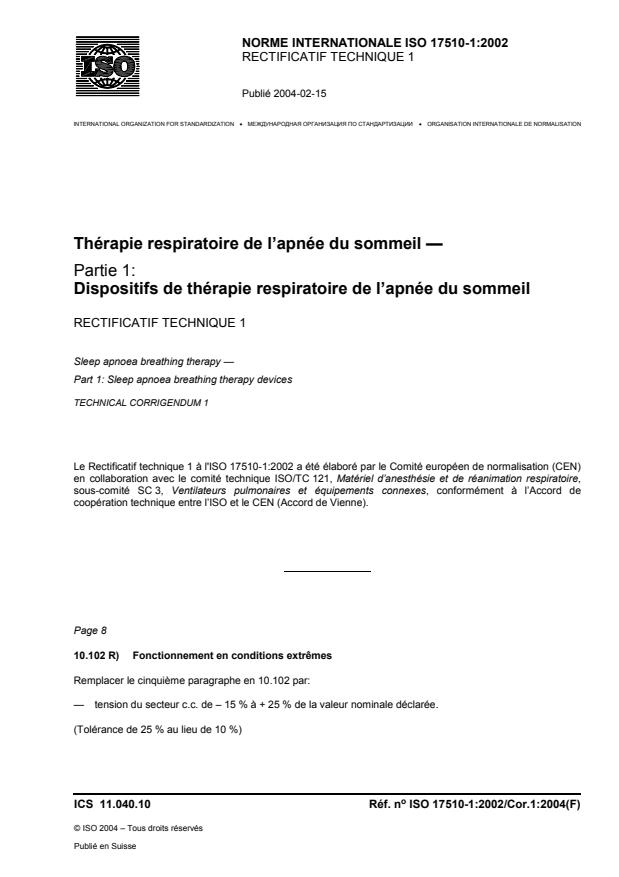
NORME INTERNATIONALE ISO 17510-1:2002
RECTIFICATIF TECHNIQUE 1
Publié 2004-02-15
INTERNATIONAL ORGANIZATION FOR STANDARDIZATION • МЕЖДУНАРОДНАЯ ОРГАНИЗАЦИЯ ПО СТАНДАРТИЗАЦИИ • ORGANISATION INTERNATIONALE DE NORMALISATION
Thérapie respiratoire de l’apnée du sommeil —
Partie 1:
Dispositifs de thérapie respiratoire de l’apnée du sommeil
RECTIFICATIF TECHNIQUE 1
Sleep apnoea breathing therapy —
Part 1: Sleep apnoea breathing therapy devices
TECHNICAL CORRIGENDUM 1
Le Rectificatif technique 1 à l'ISO 17510-1:2002 a été élaboré par le Comité européen de normalisation (CEN)
en collaboration avec le comité technique ISO/TC
...
This May Also Interest You
This document specifies requirements for masks and accessories, including any connecting element, that are required to connect the patient-connection port of sleep apnoea breathing therapy equipment to a patient for the application of sleep apnoea breathing therapy (e.g. nasal masks, exhaust ports and headgear). This document applies to masks and their accessories used to connect sleep apnoea breathing therapy equipment to the patient. The requirements in this document take priority over the requirements in ISO 18190. This document does not cover oral appliances. NOTE This document has been prepared to address the relevant essential principles[14] and labelling principles[15] of the International Medical Devices Regulators Forum (IMDRF) as indicated in Annex I.
- Standard36 pagesEnglish languagesale 15% off
- Standard37 pagesFrench languagesale 15% off
- 25-Nov-2025
- 11.040.10
- ISO/TC 121/SC 3
This document is applicable to the basic safety and essential performance of sleep apnoea breathing therapy equipment, hereafter referred to as ME equipment, intended to alleviate the symptoms of patients who suffer from obstructive sleep apnoea by delivering a therapeutic breathing pressure to the respiratory tract of the patient. Sleep apnoea breathing therapy equipment is intended for use in the home healthcare environment by lay operators as well as in professional healthcare institutions. Sleep apnoea breathing therapy equipment is not considered to utilize a physiologic closed-loop-control system unless it uses a physiological patient variable to adjust the therapy settings. This document excludes sleep apnoea breathing therapy equipment intended for use with neonates. This document is applicable to ME equipment or an ME system intended for those patients who are not dependent on artificial ventilation. This document is not applicable to ME equipment or an ME system intended for those patients who are dependent on artificial ventilation such as patients with central sleep apnoea. This document is also applicable to those accessories intended by their manufacturer to be connected to sleep apnoea breathing therapy equipment, where the characteristics of those accessories can affect the basic safety or essential performance of the sleep apnoea breathing therapy equipment. Masks and application accessories intended for use during sleep apnoea breathing therapy are additionally addressed by ISO 17510. Refer to Figure AA.1 for items covered further under this document. If a clause or subclause is specifically intended to be applicable to ME equipment only, or to ME systems only, the title and content of that clause or subclause will say so. If that is not the case, the clause or subclause applies both to ME equipment and to ME systems, as relevant. Hazards inherent in the intended physiological function of ME equipment or ME systems within the scope of this document are not covered by specific requirements in this document except in 7.2.13 and 8.4.1 of the general standard. NOTE 2 See also 4.2 of the general standard. This document does not specify the requirements for: – ventilators or accessories intended for critical care ventilators for ventilator-dependent patients, which are given in ISO 80601‑2‑12. – ventilators or accessories intended for anaesthetic applications, which are given in ISO 80601-2-13. – ventilators or accessories intended for home care ventilators for ventilator-dependent patients, which are given in ISO 80601-2-72. – ventilators or accessories intended for emergency and transport, which are given in ISO 80601-2-84. – ventilators or accessories intended for home-care ventilatory support, which are given in ISO 80601‑2-79 and ISO 80601‑2‑80. – high-frequency ventilators[23], which are given in ISO 80601-2-87. – respiratory high flow equipment, which are given in ISO 80601‑2‑90; NOTE 3 ISO 80601-2-80 ventilatory support equipment can incorporate high-flow therapy operational mode, but such a mode is only for spontaneously breathing patients. – user-powered resuscitators, which are given in ISO 10651-4; – gas-powered emergency resuscitators, which are given in ISO 10651-5; – oxygen therapy constant flow ME equipment; and – cuirass or “iron-lung” ventilation equipment.
- Standard78 pagesEnglish languagesale 15% off
- Standard83 pagesFrench languagesale 15% off
- 20-Nov-2025
- 11.040.10
- ISO/TC 121/SC 3
NOTE 1 There is guidance or rationale for this subclause contained in Clause AA.2. This document applies to the basic safety and essential performance of ventilatory support equipment, as defined in 201.3.302, for ventilatory insufficiency, as defined in 201.3.302, hereafter also referred to as ME equipment, in combination with its accessories: — intended for use in the home healthcare environment; NOTE 2 In the home healthcare environment, the supply mains driving the ventilatory support equipment is often not reliable. NOTE 3 Such ventilatory support equipment can also be used in professional health care facilities. — intended for use by a lay operator; — intended for use with patients who have ventilatory insufficiency or failure, the most fragile of which would likely experience injury with the loss of this artificial ventilation; — intended for transit-operable use; and — not intended for patients who are dependent on artificial ventilation for their immediate life support. EXAMPLE 1 Patients with moderate to severe chronic obstructive pulmonary disease (COPD), moderate amyotrophic lateral sclerosis (ALS), severe bronchopulmonary dysplasia or muscular dystrophy. Ventilatory support equipment is not considered to use a physiologic closed-loop control system unless it uses a physiological patient variable to adjust the artificial ventilation therapy settings. This document is also applicable to those accessories intended by their manufacturer to be connected to the ventilator breathing system of ventilatory support equipment for ventilatory insufficiency, where the characteristics of those accessories can affect the basic safety or essential performance of the ventilatory support equipment for ventilatory insufficiency. EXAMPLE 2 Breathing sets, connectors, water traps, expiratory valve, humidifier, breathing system filter, external electrical power source, distributed alarm system. If a clause or subclause is specifically intended to be applicable to ME equipment only, or to ME systems only, the title and content of that clause or subclause will say so. If that is not the case, the clause or subclause applies both to ME equipment and to ME systems, as relevant. Hazards inherent in the intended physiological function of ME equipment or ME systems within the scope of this document are not covered by specific requirements in this document except in IEC 60601‑1:2005+AMD1:2012+AMD2:2020, 7.2.13 and 8.4.1. NOTE 4 Additional information can be found in IEC 60601‑1:2005+AMD1:2012+AMD2:2020, 4.2. NOTE 5 See ISO/TR 21954 for guidance on the selection of the appropriate ventilator for a given patient. This document does not specify the requirements for: — ventilators or accessories for ventilator-dependent patients intended for critical care applications, which are given in ISO 80601‑2‑12; — ventilators or accessories intended for anaesthetic applications, which are given in ISO 80601‑2‑13; — ventilators or accessories intended for the emergency medical services environment, which are given in ISO 80601‑2‑84; — ventilators or accessories intended for ventilator-dependent patients in the home healthcare environment, which are given in ISO 80601‑2‑72; — ventilatory support equipment or accessories intended for ventilatory impairment, which are given in ISO 80601‑2‑79; — sleep apnoea therapy ME equipment, which are given in ISO 80601‑2‑70; — high-frequency jet ventilators (HFJVs), which are given in ISO 80601‑2‑87; — high-frequency oscillatory ventilators (HFOVs); — respiratory high flow equipment, which are given in ISO 80601‑2‑90; NOTE 6 Ventilatory support equipment can incorporate high-flow therapy operational mode, but such a mode is only for spontaneously breathing patients. — user-powered resuscitators, which are given in ISO 10651-4; — gas-powered emergency resuscitators, which are given in ISO 10651-5; — oxygen therapy constant flow ME equipment; and — cuirass or “iron-lung” ventilation equipment
- Standard120 pagesEnglish languagesale 15% off
- Standard130 pagesFrench languagesale 15% off
- 27-Aug-2024
- 11.040.10
- ISO/TC 121/SC 3
NOTE 1 There is guidance or rationale for this subclause contained in Clause AA.2. This document applies to the basic safety and essential performance of ventilatory support equipment, as defined in 201.3.302, for ventilatory impairment, as defined in 201.3.300, hereafter also referred to as ME equipment, in combination with its accessories: — intended for use in the home healthcare environment; NOTE 2 In the home healthcare environment, the supply mains driving the ventilatory support equipment is often not reliable. NOTE 3 Such ventilatory support equipment can also be used in professional health care facilities. — intended for use by a lay operator; — intended for use with patients who have ventilatory impairment, the most fragile of these patients, would not likely experience injury with the loss of this artificial ventilation; and — not intended for patients who are dependent on artificial ventilation for their immediate life support. EXAMPLE 1 Patients with mild to moderate chronic obstructive pulmonary disease (COPD). Ventilatory support equipment is not considered to use a physiologic closed-loop control system unless it uses a physiological patient variable to adjust the artificial ventilation therapy settings. This document is also applicable to those accessories intended by their manufacturer to be connected to the breathing system of ventilatory support equipment for ventilatory impairment, where the characteristics of those accessories can affect the basic safety or essential performance of the ventilatory support equipment for ventilatory impairment. EXAMPLE 2 Breathing sets, connectors, water traps, expiratory valve, humidifier, breathing system filter, external electrical power source, distributed alarm system. If a clause or subclause is specifically intended to be applicable to ME equipment only, or to ME systems only, the title and content of that clause or subclause will say so. If that is not the case, the clause or subclause applies both to ME equipment and to ME systems, as relevant. Hazards inherent in the intended physiological function of ME equipment or ME systems within the scope of this document are not covered by specific requirements in this document except in IEC 60601‑1:2005+AMD1:2012+AMD2:2020, 7.2.13 and 8.4.1. NOTE 4 Additional information can be found in IEC 60601‑1:2005+AMD1:2012+AMD2:2020, 4.2. NOTE 5 See ISO/TR 21954 for guidance on the selection of the appropriate ventilator for a given patient. This document does not specify the requirements for: — ventilators or accessories for ventilator-dependent patients intended for critical care applications, which are given in ISO 80601‑2‑12; — ventilators or accessories intended for anaesthetic applications, which are given in ISO 80601‑2‑13; — ventilators or accessories intended for the emergency medical services environment, which are given in ISO 80601‑2‑84; — ventilators or accessories intended for ventilator-dependent patients in the home healthcare environment, which are given in ISO 80601‑2‑72; — ventilatory support equipment or accessories intended for ventilatory insufficiency, which are given in ISO 80601‑2‑80; — sleep apnoea therapy ME equipment, which are given in ISO 80601‑2‑70; — high-frequency jet ventilators (HFJVs), which are given in ISO 80601‑2‑87; — high-frequency oscillatory ventilators (HFOVs); — respiratory high flow equipment, which are given in ISO 80601‑2‑90; NOTE 6 Ventilatory support equipment can incorporate high-flow therapy operational mode, but such a mode is only for spontaneously breathing patients. — user-powered resuscitators, which are given in ISO 10651-4; — gas-powered emergency resuscitators, which are given in ISO 10651-5; — oxygen therapy constant flow ME equipment; and — cuirass or “iron-lung” ventilation equipment.
- Standard107 pagesEnglish languagesale 15% off
- Standard118 pagesFrench languagesale 15% off
- 27-Aug-2024
- 11.040.10
- ISO/TC 121/SC 3
- Standard5 pagesEnglish languagesale 15% off
- Standard5 pagesFrench languagesale 15% off
- 26-Mar-2024
- 11.040.10
- ISO/TC 121/SC 3
This document specifies tests for substances leached by liquid water condensing in gas pathways of a medical device, its parts or accessories, which are intended to provide respiratory care or supply substances via the respiratory tract to a patient in all environments. The chemical characterization methods described in this document apply to chemical substances that could leach from the medical device, its parts or accessories into the condensate. This document establishes verifiable acceptance criteria for these tests. The identity and quantity of each chemical released is intended for toxicological risk assessment as described in ISO 18562-1:2024. This document addresses potential contamination of the gas stream arising from the gas pathways, which deliver breathing gas to the patient. This document applies over the expected lifetime of the medical device in normal use and takes into account the effects of any intended processing. This document does not address biological evaluation of the surfaces of gas pathways that have direct contact with the patient. The requirements for direct contact surfaces are found in the ISO 10993 series. Medical devices, parts or accessories containing gas pathways that are addressed by this document include, but are not limited to, ventilators, anaesthesia workstations (including gas mixers), breathing systems, oxygen conserving devices, oxygen concentrators, nebulizers, low-pressure hose assemblies, humidifiers, heat and moisture exchangers, respiratory gas monitors, respiration monitors, masks, medical respiratory personal protective equipment, mouth pieces, resuscitators, breathing tubes, breathing systems filters, Y-pieces and any breathing accessories intended to be used with such devices. The enclosed chamber of an incubator, including the mattress, and the inner surface of an oxygen hood are considered to be gas pathways and are also addressed by this document. This document does not address contamination already present in the gas supplied from the gas sources while medical devices are in normal use. EXAMPLE Contamination arriving at the medical device from gas sources such as medical gas pipeline systems (including the non-return valves in the pipeline outlets), outlets of pressure regulators connected or integral to a medical gas cylinder, or room air taken into the medical device. This document does not address contact with drugs or anaesthetic agents. If a medical device or accessory is intended to be used with anaesthetic agents or drugs, then additional testing can be required. This document is intended to quantify hazardous water-soluble substances that are leached from the medical device, its parts or accessories by condensate and then conveyed by that liquid to the patient.
- Standard16 pagesEnglish languagesale 15% off
- Standard17 pagesFrench languagesale 15% off
- 07-Mar-2024
- 11.040.10
- ISO/TC 121/SC 3
This document specifies tests for the emissions of volatile organic substances from the gas pathways of a medical device, its parts or accessories, which are intended to provide respiratory care or supply substances via the respiratory tract to a patient in all environments. The tests of this document are intended to quantify emissions of volatile organic substances that are added to the respirable gas stream by the materials of the gas pathway. This document establishes acceptance criteria for these tests. NOTE Gaseous emission of volatile organic substances includes emissions of volatile organic compounds, semi-volatile organic compounds and very volatile organic compounds. This document addresses potential contamination of the gas stream arising from the gas pathways of medical devices or accessories, which is then conducted to the patient. This document applies over the expected lifetime of the medical device in normal use and takes into account the effects of any intended processing. This document does not address biological evaluation of the surfaces of gas pathways that are in direct contact with the patient. The requirements for direct contact surfaces are found in the ISO 10993 series. Medical devices, parts or accessories containing gas pathways that are addressed by this document include, but are not limited to, ventilators, anaesthesia workstations (including gas mixers), breathing systems, oxygen conserving devices, oxygen concentrators, nebulizers, low-pressure hose assemblies, humidifiers, heat and moisture exchangers, respiratory gas monitors, respiration monitors, masks, medical respiratory personal protective equipment, mouth pieces, resuscitators, breathing tubes, breathing systems filters, Y-pieces and any breathing accessories intended to be used with such devices. The enclosed chamber of an incubator, including the mattress, and the inner surface of an oxygen hood are considered to be gas pathways and are also addressed by this document. This document does not address contamination already present in the gas supplied from the gas sources while medical devices are in normal use. EXAMPLE Contamination arriving at the medical device from gas sources such as medical gas pipeline systems (including the non-return valves in the pipeline outlets), outlets of pressure regulators connected or integral to a medical gas cylinder or room air taken into the medical device is not addressed by ISO 18562 series. This document is intended to be read in conjunction with ISO 18562-1.
- Standard15 pagesEnglish languagesale 15% off
- Standard16 pagesFrench languagesale 15% off
- 07-Mar-2024
- 11.040.10
- ISO/TC 121/SC 3
This document specifies tests for the emissions of particulate matter from the gas pathways of a medical device, its parts or accessories, which are intended to provide respiratory care or supply substances via the respiratory tract to a patient in all environments. The tests of this document are intended to quantify particles from 0,25 µm diameter to 10 µm diameter that are emitted by the medical device, its parts or accessories into the respirable gas stream. This document establishes acceptance criteria for these tests. This document does not address nanoparticles. Insufficient data exist to establish exposure limits for particles less than 0,25 µm diameter. This document does not address particles larger than 10 µm diameter. These particles are deposited in the nasal cavity. Additional information can be needed for medical devices or accessories that bypass the nose. This is outside the scope of this document but can be required by some authorities having jurisdiction. This document therefore adopts the same approach as the US Environmental Protection Agency (EPA) in setting limits based solely on particle size and not their chemistry. This document addresses potential contamination of the gas stream arising from the gas pathways, which is then conducted to the patient. This document applies over the expected lifetime of the medical device in normal use and takes into account the effects of any intended processing. This document does not address biological evaluation of the particles that are deliberately released by a nebulizer (i.e. the therapeutic agent). This document does not address biological evaluation of the surfaces of gas pathways that have direct contact with the patient. The requirements for direct contact surfaces are found in the ISO 10993 series. Medical devices, parts or accessories, containing gas pathways that are addressed by this document, include, but are not limited to, ventilators, anaesthesia workstations (including gas mixers), breathing systems, oxygen conserving devices, oxygen concentrators, nebulizers, low-pressure hose assemblies, humidifiers, heat and moisture exchangers, respiratory gas monitors, respiration monitors, masks, medical respiratory personal protective equipment, mouth pieces, resuscitators, breathing tubes, breathing systems filters, Y-pieces, and any breathing accessories intended to be used with such devices. The enclosed chamber of an incubator, including the mattress, and the inner surface of an oxygen hood are considered to be gas pathways and are also addressed by this document. This document does not address contamination already present in the gas supplied from the gas sources while medical devices are in normal use. EXAMPLE Contamination arriving at the medical device from gas sources such as medical gas pipeline systems (including the non-return valves in the pipeline outlets), outlets of pressure regulators connected or integral to a medical gas cylinder or room air taken into the medical device is not addressed by ISO 18562 (all parts).
- Standard16 pagesEnglish languagesale 15% off
- Standard16 pagesFrench languagesale 15% off
- 07-Mar-2024
- 11.040.10
- ISO/TC 121/SC 3
This document specifies: — the general principles governing the biological evaluation within a risk management process of the gas pathways of a medical device, its parts or accessories, which are intended to provide respiratory care or supply substances via the respiratory tract to a patient in all environments; — the general categorization of gas pathways based on the nature and duration of their contact with the gas stream; — the evaluation of existing relevant data from all sources; — the identification of gaps in the available data set on the basis of a risk analysis; — the identification of additional data sets necessary to analyse the biological safety of the gas pathway; — the assessment of the biological safety of the gas pathway. This document covers general principles regarding biocompatibility assessment of medical device materials, which make up the gas pathway, in normal use and normal condition. This document does not cover biological hazards arising from mechanical damage. The other parts of ISO 18562 cover specific tests that address potentially hazardous substances that are added to the respirable gas stream and establish acceptance criteria for these substances. This document addresses potential contamination of the gas stream arising from the gas pathways within the medical device, which might then be conducted to the patient. This document applies over the expected lifetime of the medical device when operated according to the instructions for use. This includes degradation arising from exposure to environmental conditions as well as cleaning, disinfection and sterilisation (i.e. processing). It also includes user action or inaction (omission) that leads to an unintended or unexpected outcome (result) (i.e. use error). It does not include conscious/intentional action or inaction that violates the instructions for use and is beyond reasonable risk control by the manufacturer (i.e. abnormal use). This document does not address biological evaluation of the surfaces of medical devices that have direct contact with the patient or user. The requirements for direct contact surfaces are found in the ISO 10993 series. Medical devices, parts or accessories containing gas pathways that are addressed by this document include, but are not limited to, ventilators, anaesthesia workstations (including gas mixers), breathing systems, oxygen conserving equipment, oxygen concentrators, nebulizers, low-pressure hose assemblies, humidifiers, heat and moisture exchangers, respiratory gas monitors, respiration monitors, masks, medical respiratory personal protective equipment, mouth pieces, resuscitators, breathing tubes, breathing system filters and Y-pieces as well as any breathing accessories intended to be used with such medical devices. The enclosed chamber of an incubator, including the mattress, and the inner surface of an oxygen hood are considered to be gas pathways and are also addressed by this document. This document does not address contamination already present in the gas supplied from the gas sources while medical devices are in normal use. EXAMPLE Contamination arriving at the medical device from gas sources such as medical gas pipeline systems (including the non-return valves in the pipeline outlets), outlets of pressure regulators connected or integral to a medical gas cylinder, or room air taken into the medical device is not addressed by ISO 18562 (all parts).
- Standard34 pagesEnglish languagesale 15% off
- Standard35 pagesFrench languagesale 15% off
- 07-Mar-2024
- 11.040.10
- ISO/TC 121/SC 3
This document applies to the basic safety and essential performance of an EMS ventilator in combination with its accessories, hereafter also referred to as ME equipment: ¾ intended for patients who need differing levels of support from artificial ventilation including ventilator-dependent patients; ¾ intended to be operated by a healthcare professional operator; ¾ intended for use in the EMS environment; and ¾ intended for invasive or non-invasive ventilation. NOTE 2 An EMS ventilator can also be used for transport within a professional healthcare facility. An EMS ventilator is not considered to use a physiologic closed loop-control system unless it uses a physiological patient variable to adjust the artificial ventilation therapy settings. This document is also applicable to those accessories intended by their manufacturer to be connected to the ventilator breathing system, or to an EMS ventilator, where the characteristics of those accessories can affect the basic safety or essential performance of the EMS ventilator. NOTE 3 If a clause or subclause is specifically intended to be applicable to ME equipment only, or to ME systems only, the title and content of that clause or subclause will say so. If that is not the case, the clause or subclause applies both to ME equipment and to ME systems, as relevant. Hazards inherent in the intended physiological function of ME equipment or ME systems within the scope of this document are not covered by specific requirements in this document except in IEC 60601‑1:2005+AMD1:2012+AMD2:2020, 7.2.13 and 8.4.1. NOTE 4 Additional information can be found in IEC 60601-1:2005+AMD1:2012+AMD2:2020, 4.2. This document does not specify the requirements for the following: NOTE 5 See ISO/TR 21954 for guidance on the selection of the appropriate ventilator for a given patient. ¾ ventilators or accessories intended for ventilator-dependent patients in critical care applications, which are given in ISO 80601-2-12. ¾ ventilators or accessories intended for ventilator-dependent patients in the home healthcare environment, which are given in ISO 80601-2-72. ¾ ventilators or accessories intended for anaesthetic applications, which are given in ISO 80601‑2‑13. ¾ ventilators or accessories intended for ventilatory support equipment (intended only to augment the ventilation of spontaneously breathing patients), which are given in ISO 80601‑2-79 and ISO 80601-2-80. ¾ obstructive sleep apnoea therapy ME equipment, which are given in ISO 80601‐2‐70. ¾ user-powered resuscitators, which are given in ISO 10651‐4. ¾ gas-powered emergency resuscitators, which are given in ISO 10651‐5. ¾ continuous positive airway pressure (CPAP) ME equipment. ¾ high‐frequency jet ventilators (HFJVs), which are given in ISO 80601-2-87. ¾ high‐frequency oscillatory ventilators (HFOVs) REF _Ref69393406 \r \h \* MERGEFORMAT [44] 08D0C9EA79F9BACE118C8200AA004BA90B02000000080000000D0000005F00520065006600360039003300390033003400300036000000 , which are given in ISO 80601-2-87. NOTE 6 An EMS ventilator can incorporate high-frequency jet or high-frequency oscillatory ventilation-modes. ¾ respiratory high-flow therapy equipment, which are given in ISO 80601-2-90. NOTE 7 An EMS ventilator can incorporate high-flow therapy operational mode, but such a mode is only for spontaneously breathing patients. ¾ oxygen therapy constant flow ME equipment. ¾ cuirass or “iron‐lung” ventilators.
- Standard138 pagesEnglish languagesale 15% off
- Standard148 pagesFrench languagesale 15% off
- 02-Nov-2023
- 11.040.10
- ISO/TC 121/SC 3
Questions, Comments and Discussion
Ask us and Technical Secretary will try to provide an answer. You can facilitate discussion about the standard in here.
Loading comments...