

ISO 7170:2021
(Main)Furniture — Storage units — Test methods for the determination of strength, durability and stability
General Information
- Abstract
This document specifies test methods for determining the strength, durability and stability of storage units, when fully assembled prior to use, including their movable and non-movable parts. Acceptance criteria for the strength, durability and stability of the storage furniture is not specified by the test methods. Instead, suggested loads, cycles and forces are provided in Annex B, depending on the applicability of the furniture.
- Status
- Published
- Publication Date
- 19-Sep-2021
- Technical Committee
- ISO/TC 136 - Furniture
- Current Stage
- 9020 - International Standard under periodical review
- Start Date
- 15-Jul-2026
- Completion Date
- 15-Jul-2026
Buy Documents
ISO 7170:2021 - Furniture -- Storage units -- Test methods for the determination of strength, durability and stability
ISO 7170:2021 - Furniture — Storage units — Test methods for the determination of strength, durability and stability Released:3/7/2022
Overview
ISO 7170:2021 - "Furniture - Storage units - Test methods for the determination of strength, durability and stability" defines standardized test methods for assessing storage furniture when fully assembled prior to use. It covers both movable and non‑movable parts (shelves, doors, extension elements, castors, etc.). The standard provides detailed procedures for applying forces, loading, tolerances, test apparatus and reporting, but does not set pass/fail acceptance criteria. Instead, Annex B supplies suggested loads, cycles and forces (for example for domestic use), while Annex A gives guidance on choosing appropriate test parameters.
Key technical topics and requirements
- General test conditions: preparation, force application, prevention of movement and measurement tolerances.
- Test equipment and apparatus: specifications for jigs, loading devices and slam‑shut apparatus.
- Non‑movable parts: tests for shelves (retention, deflection, shelf support strength), tops/bottoms (sustained/static loads), clothes rails and structural strength (underframes, legs, drop tests).
- Movable parts: pivoted doors, sliding doors, roll fronts, flaps and extension elements - strength, durability, slam‑shut/open and interlock tests.
- Locking/latching mechanisms: strength and durability tests for locks and latches.
- Other elements: trays, coat hooks, units mounted to the building or floor, and castor/wheel behaviour.
- Stability testing: comprehensive stability procedures including unloaded/loaded conditions, opening of doors/extension elements, dynamic tests for castored units and anti‑overturning device strength.
- Documentation: required content of the test report.
- Informative annexes (Annex C rationale; Annex D apparatus) explain test selection and specific equipment.
Practical applications - who uses ISO 7170
- Furniture manufacturers and designers: validate product strength, durability and stability during development.
- Independent test laboratories and certification bodies: perform reproducible tests for technical files and conformity assessment.
- Retailers and specifiers: verify supplier claims and support product selection for safety and performance.
- Regulators and safety assessors: reference test methods for consumer protection and accident investigation.
- Procurement and contract furniture buyers: specify test methods in tenders and quality requirements.
Applying ISO 7170 helps reduce product failures, improve consumer safety (anti‑overturning performance), and provide consistent, reproducible test evidence for marketing or compliance purposes.
Related standards
Consult other ISO furniture and safety standards and relevant national regulations for complementary test criteria and acceptance limits. Annex B of ISO 7170 gives suggested loads for domestic use; users should adapt loads and acceptance criteria to market, application and regulatory requirements.
Keywords: ISO 7170, furniture test methods, storage units, strength durability stability, shelf test, stability test, extension elements, domestic furniture testing.
Relations
- Effective Date
- 26-Nov-2021
- Effective Date
- 23-Apr-2020
Buy Documents
ISO 7170:2021 - Furniture -- Storage units -- Test methods for the determination of strength, durability and stability
ISO 7170:2021 - Furniture — Storage units — Test methods for the determination of strength, durability and stability Released:3/7/2022
Frequently Asked Questions
ISO 7170:2021 is a standard published by the International Organization for Standardization (ISO). Its full title is "Furniture — Storage units — Test methods for the determination of strength, durability and stability". This standard covers: This document specifies test methods for determining the strength, durability and stability of storage units, when fully assembled prior to use, including their movable and non-movable parts. Acceptance criteria for the strength, durability and stability of the storage furniture is not specified by the test methods. Instead, suggested loads, cycles and forces are provided in Annex B, depending on the applicability of the furniture.
This document specifies test methods for determining the strength, durability and stability of storage units, when fully assembled prior to use, including their movable and non-movable parts. Acceptance criteria for the strength, durability and stability of the storage furniture is not specified by the test methods. Instead, suggested loads, cycles and forces are provided in Annex B, depending on the applicability of the furniture.
ISO 7170:2021 is classified under the following ICS (International Classification for Standards) categories: 97.140 - Furniture. The ICS classification helps identify the subject area and facilitates finding related standards.
ISO 7170:2021 has the following relationships with other standards: It is inter standard links to ISO 7171:2019, ISO 7170:2005. Understanding these relationships helps ensure you are using the most current and applicable version of the standard.
ISO 7170:2021 is available in PDF format for immediate download after purchase. The document can be added to your cart and obtained through the secure checkout process. Digital delivery ensures instant access to the complete standard document.
Standards Content (Sample)
INTERNATIONAL ISO
STANDARD 7170
Third edition
2021-09
Furniture — Storage units — Test
methods for the determination of
strength, durability and stability
Ameublement — Éléments de rangement — Méthodes d'essai pour la
détermination de la résistance, de la durabilité et de la stabilité
Reference number
©
ISO 2021
© ISO 2021
All rights reserved. Unless otherwise specified, or required in the context of its implementation, no part of this publication may
be reproduced or utilized otherwise in any form or by any means, electronic or mechanical, including photocopying, or posting
on the internet or an intranet, without prior written permission. Permission can be requested from either ISO at the address
below or ISO’s member body in the country of the requester.
ISO copyright office
CP 401 • Ch. de Blandonnet 8
CH-1214 Vernier, Geneva
Phone: +41 22 749 01 11
Email: copyright@iso.org
Website: www.iso.org
Published in Switzerland
ii © ISO 2021 – All rights reserved
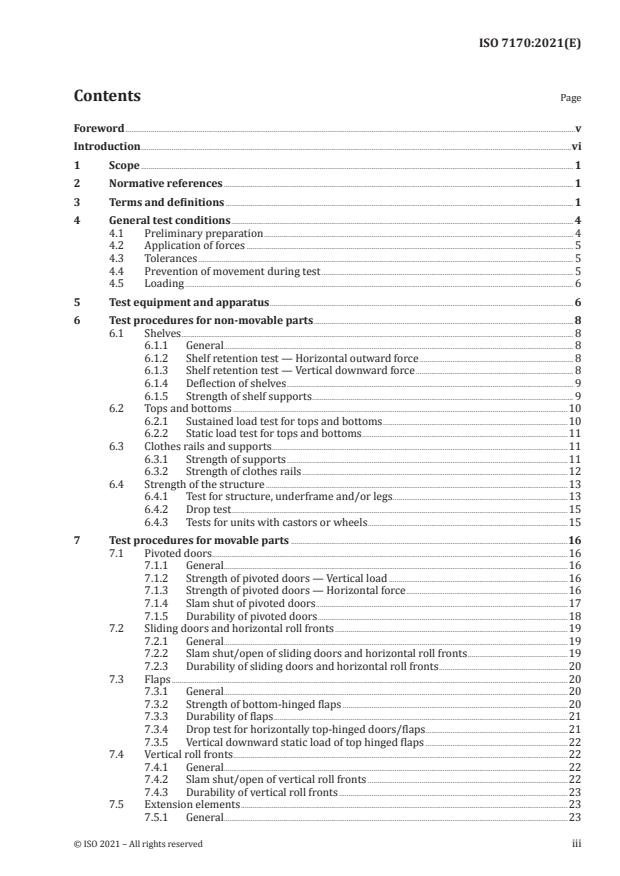
Contents Page
Foreword .v
Introduction .vi
1 Scope . 1
2 Normative references . 1
3 Terms and definitions . 1
4 General test conditions . 4
4.1 Preliminary preparation . 4
4.2 Application of forces . 5
4.3 Tolerances . 5
4.4 Prevention of movement during test . 5
4.5 Loading . 6
5 Test equipment and apparatus . 6
6 Test procedures for non-movable parts . 8
6.1 Shelves . 8
6.1.1 General. 8
6.1.2 Shelf retention test — Horizontal outward force . 8
6.1.3 Shelf retention test — Vertical downward force . 8
6.1.4 Deflection of shelves . 9
6.1.5 Strength of shelf supports . 9
6.2 Tops and bottoms .10
6.2.1 Sustained load test for tops and bottoms .10
6.2.2 Static load test for tops and bottoms .11
6.3 Clothes rails and supports.11
6.3.1 Strength of supports .11
6.3.2 Strength of clothes rails .12
6.4 Strength of the structure .13
6.4.1 Test for structure, underframe and/or legs .13
6.4.2 Drop test .15
6.4.3 Tests for units with castors or wheels .15
7 Test procedures for movable parts .16
7.1 Pivoted doors .16
7.1.1 General.16
7.1.2 Strength of pivoted doors — Vertical load .16
7.1.3 Strength of pivoted doors — Horizontal force .16
7.1.4 Slam shut of pivoted doors .17
7.1.5 Durability of pivoted doors .18
7.2 Sliding doors and horizontal roll fronts .19
7.2.1 General.19
7.2.2 Slam shut/open of sliding doors and horizontal roll fronts .19
7.2.3 Durability of sliding doors and horizontal roll fronts .20
7.3 Flaps .20
7.3.1 General.20
7.3.2 Strength of bottom-hinged flaps .20
7.3.3 Durability of flaps .21
7.3.4 Drop test for horizontally top-hinged doors/flaps .21
7.3.5 Vertical downward static load of top hinged flaps .22
7.4 Vertical roll fronts .22
7.4.1 General.22
7.4.2 Slam shut/open of vertical roll fronts .22
7.4.3 Durability of vertical roll fronts .23
7.5 Extension elements .23
7.5.1 General.23
7.5.2 Strength of extension elements .23
7.5.3 Durability of extension elements .24
7.5.4 Slam shut of extension elements.26
7.5.5 Slam open of extension elements .26
7.5.6 Strength of bottoms in extension elements .27
7.5.7 Interlock test .27
7.6 Locking and latching mechanism test .27
7.6.1 General.27
7.6.2 Strength test for locking and latching mechanisms for extension elements .28
7.6.3 Locking and latching mechanisms for doors, flaps and roll fronts .28
7.6.4 Locking and latching mechanism durability test .28
8 Trays .28
8.1 General .28
8.2 Sustained load test for trays .28
8.3 Drop test for trays .28
9 Strength of coat hooks .29
10 Units mounted to the building or other structure .29
10.1 Units not supported by the floor .29
10.1.1 General.29
10.1.2 Movable parts, shelf supports, tops and bottoms .30
10.1.3 Static load .30
10.1.4 Dislodgement test .31
10.1.5 Sideward detachment test .31
10.2 Units supported by the floor .32
11 Stability tests .32
11.1 General .32
11.2 Doors, extension elements and flaps closed, all storage units unloaded .33
11.2.1 Units that are, or can be adjusted to, a height of 1 000 mm or less .33
11.2.2 Units that are, or can be adjusted to, a height of more than 1 000 mm .33
11.3 Opening doors, extension elements and flaps, all storage units unloaded .34
11.4 Doors, extension elements and flaps opened and unlocked .35
11.4.1 All storage areas unloaded and all doors, extension elements and flaps open .35
11.4.2 All storage areas unloaded with overturning load .36
11.4.3 All storage areas loaded with overturning load .37
11.4.4 Storage areas partly loaded .38
11.5 Doors, extension elements and flaps closed and locked, all storage units loaded.39
11.6 Dynamic stability test for units with castors .40
11.7 Strength test for anti-overturning device .41
11.8 Additional stability test methods for TV furniture .42
11.8.1 Determination of TV template .42
11.8.2 Stability of TV-furniture with one door and/or extension element opened .42
11.8.3 Stability of TV furniture with doors and extension elements closed —
Storage areas unloaded .42
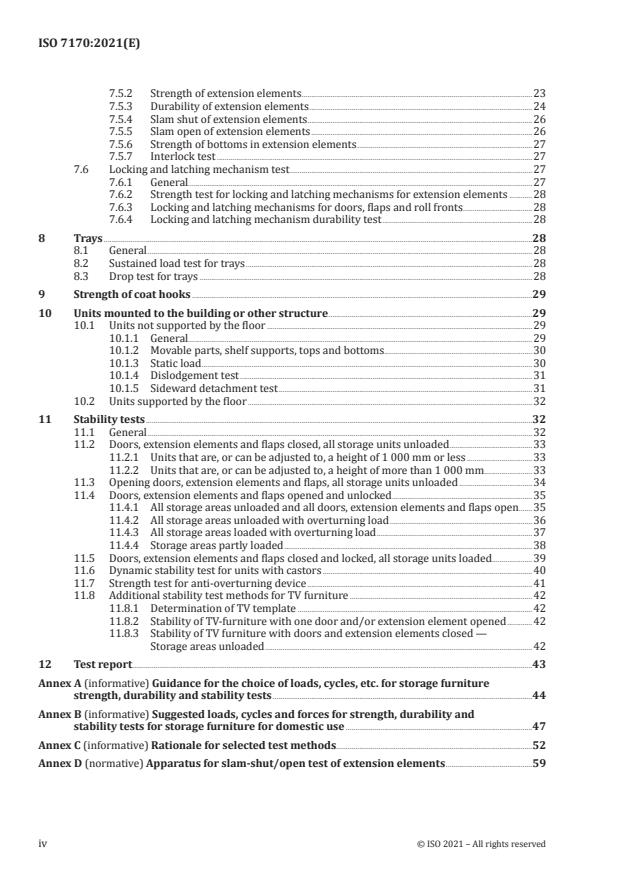
12 Test report .43
Annex A (informative) Guidance for the choice of loads, cycles, etc. for storage furniture
strength, durability and stability tests .44
Annex B (informative) Suggested loads, cycles and forces for strength, durability and
stability tests for storage furniture for domestic use .47
Annex C (informative) Rationale for selected test methods .52
Annex D (normative) Apparatus for slam-shut/open test of extension elements .59
iv © ISO 2021 – All rights reserved
Foreword
ISO (the International Organization for Standardization) is a worldwide federation of national standards
bodies (ISO member bodies). The work of preparing International Standards is normally carried out
through ISO technical committees. Each member body interested in a subject for which a technical
committee has been established has the right to be represented on that committee. International
organizations, governmental and non-governmental, in liaison with ISO, also take part in the work.
ISO collaborates closely with the International Electrotechnical Commission (IEC) on all matters of
electrotechnical standardization.
The procedures used to develop this document and those intended for its further maintenance are
described in the ISO/IEC Directives, Part 1. In particular, the different approval criteria needed for the
different types of ISO documents should be noted. This document was drafted in accordance with the
editorial rules of the ISO/IEC Directives, Part 2 (see www .iso .org/ directives).
Attention is drawn to the possibility that some of the elements of this document may be the subject of
patent rights. ISO shall not be held responsible for identifying any or all such patent rights. Details of
any patent rights identified during the development of the document will be in the Introduction and/or
on the ISO list of patent declarations received (see www .iso .org/ patents).
Any trade name used in this document is information given for the convenience of users and does not
constitute an endorsement.
For an explanation of the voluntary nature of standards, the meaning of ISO specific terms and
expressions related to conformity assessment, as well as information about ISO's adherence to the
World Trade Organization (WTO) principles in the Technical Barriers to Trade (TBT), see www .iso .org/
iso/ foreword .html.
This document was prepared by Technical Committee ISO/TC 136, Furniture.
This third edition cancels and replaces the second edition (ISO 7170:2005), which has been technically
revised, and ISO 7171:2019, which has been merged into this document.
The main changes compared to the previous edition are as follows:
— addition of the Introduction;
— normative reference ISO 48-5:2018 replaces ISO 7619-2:2010;
— deletion of the pneumatic slamming apparatus for slam open and slam shut tests of extension
elements;
— introduction of sideward detachment tests for units mounted to the building or other structure;
— introduction of a stability test for units with doors, extension elements and flaps, opened and
unlocked with storage areas partly loaded;
— introduction of definitions, figures and additional an stability test method for units intended to
support a TV-set;
— revision of the guidance for the choice of loads, cycles, etc. for strength, durability and stability
testing in Annex A;
— loads and forces for different applications have been merged in Annex B.
Any feedback or questions on this document should be directed to the user’s national standards body. A
complete listing of these bodies can be found at www .iso .org/ members .html.
Introduction
This document has been developed with the objective of promoting relevant test methods for
determining the strength, durability and stability of storage furniture, simulating normal functional
use, as well as foreseeable misuse, that might reasonably be expected to occur. The tests are designed to
evaluate properties without regard to materials, design/construction or manufacturing processes and
intended to demonstrate the ability of the item to give satisfactory service in its intended environment.
The test results are only valid for the unit/component tested. These results can be used to represent
the performance of production models prior to use, provided that the tested unit/component is
representative of the production model. Only when properly justified, they can be used for failure
analysis of a unit that has been in use.
The strength and durability tests do not assess the structure of the building, e.g. the strength of wall
hanging cabinets includes only the cabinet and the parts used for the attachment. The wall and the
attachment into the wall are not included.
Assessment of ageing and environmental degradation is not included.
vi © ISO 2021 – All rights reserved
INTERNATIONAL STANDARD ISO 7170:2021(E)
Furniture — Storage units — Test methods for the
determination of strength, durability and stability
1 Scope
This document specifies test methods for determining the strength, durability and stability of storage
units, when fully assembled prior to use, including their movable and non-movable parts.
Acceptance criteria for the strength, durability and stability of the storage furniture is not specified by
the test methods. Instead, suggested loads, cycles and forces are provided in Annex B, depending on the
applicability of the furniture.
2 Normative references
The following documents are referred to in the text in such a way that some or all of their content
constitutes requirements of this document. For dated references, only the edition cited applies. For
undated references, the latest edition of the referenced document (including any amendments) applies.
ISO 48-5:2018, Rubber, vulcanized or thermoplastic — Determination of hardness — Part 5: Indentation
hardness by IRHD pocket meter method
3 Terms and definitions
For the purposes of this document, the following terms and definitions apply.
ISO and IEC maintain terminological databases for use in standardization at the following addresses:
— ISO Online browsing platform: available at https:// www .iso .org/ obp
— IEC Electropedia: available at https:// www .electropedia .org/
3.1
adjustable friction stay
component (3.7) to hold open a door or a flap (3.13) with a feature that keeps the door or flap open
without any further assistance at a multitude of positions
3.2
bracket
rigid device to prevent overturning
Note 1 to entry: Normally made of metal; not a flexible device such as strap or cable tie.
3.3
built-in stop
device of the component (3.7) that limits the travel of extension element (3.12) or doors
3.4
catch device
device that keeps or pulls a component (3.7) in place but does not require a second action in order to
release it
EXAMPLE A magnetic catch or a self-closing-mechanism.
3.5
clear height
unobstructed height above the top of the bottom surface, or the structure of the unit (3.27)
Note 1 to entry: For example, the top of the extension element (3.12) below and the lower edge of the extension
element above (see Figure 1).
Key
1 structure of the unit
2 extension element
H clear height
Figure 1 — Clear height
3.6
coat hook
component (3.7) to support an outer garment
3.7
component
part of a unit (3.27) including hardware, e.g. extension element (3.12), door and flap (3.13)
3.8
configuration
arrangement of components (3.7) in a particular figure, form or combination
3.9
damper mechanism
mechanism that gently brings the component (3.7) to a stop
3.10
distance device
device intended to keep an item of wall-mounted furniture vertical
3.11
excessive heating
result of repeated friction such that a component (3.7) is adversely compromised
2 © ISO 2021 – All rights reserved
3.12
extension element
component (3.7) that can be pulled out and pushed in
EXAMPLE Drawers, suspended pocket files, keyboard tray (3.25).
3.13
flap
horizontally hinged door, which opens upwards or downwards
3.14
free-standing unit
unit (3.27) not intended to be attached to a load bearing structure
3.15
height adjustment device
adjustable device intended to enable height adjustment of a unit (3.27), such as a work surface
3.16
interlock
device that restrains the opening of more than one extension element (3.12) at a time
3.17
latching mechanism
mechanism that retains an extension element (3.12) or a door in the closed position and that requires a
second action to release it and can require a key or a combination in order to activate it
3.18
levelling device
adjustable device intended to keep an item of furniture horizontal with a limitation of 40 mm of vertical
range
EXAMPLE Adjustable feet or similar.
3.19
locking mechanism
mechanism that limits access to the interior of a unit (3.27) or a storage element and that requires a key
or a combination in order to activate it or to make it possible to activate it
3.20
overturn
condition where an unrestricted storage unit (3.27) does not return to its upright normal position
3.21
runners
component (3.7) that is used to facilitate the movement of an extension element (3.12)
Note 1 to entry: Includes smooth surfaces, roller and ball bearing slides.
3.22
self-locking stay
component (3.7) to hold open a door or a flap (3.13) with a feature that keeps the door or flap open
without any further assistance
3.23
structural member
component (3.7) to enhance the strength of the assembled unit (3.27)
3.24
suspended filing pockets
extension element (3.12) usually without a bottom such that contents are suspended by a frame
3.25
tray
storage element that is designed, under normal use, to be removed from the storage unit (3.27) and
used independently
3.26
TV-furniture
unit (3.27) intended to, or marketed for, supporting a monitor, TV set or similar item
3.27
unit
complete furniture intended to be tested
EXAMPLE Bookcases, wardrobes, cabinets, wall-mounted or exterior-mounted elements, free-standing and
mobile pedestals, lateral and vertical files.
3.28
wall attachment device
device including the component that is attached to the cabinet and the component that is attached to
the wall
Note 1 to entry: A component that is attached to the cabinet is, for example, a suspension bracket (3.2).
Note 2 to entry: A component that is attached to the wall is, for example, a hook, a rail.
3.29
worst case
condition most likely to cause failure, e.g. the configuration (3.8) of a unit (3.27) most likely to cause it
to overturn (3.20)
4 General test conditions
4.1 Preliminary preparation
The unit(s)/component(s) shall be tested as delivered. The unit(s)/component(s) shall be assembled
and/or configured according to the instructions supplied. Unless otherwise stated, the most adverse
configuration (3.8) shall be used for each test. If mounting or assembly instructions are not supplied,
the mounting or assembly method shall be recorded in the test report. Fittings shall be tightened before
testing and shall not be re-tightened unless specifically required in the manufacturer’s instructions. If
the configuration needs to be changed in order to produce the worst-case (3.26) conditions, this shall
be recorded in the test report.
During testing, the unit shall be placed on the floor and levelled, unless otherwise specified. The
levelling device (3.18) shall be set to the mid position but not more than 13 mm from fully closed.
A combination of tests can be necessary to cover the properties of multifunction components (e.g. a
receding door shall be tested both as a sliding door and as a pivoted door).
Unless otherwise specified by the manufacturer, the sample for test shall be stored in indoor ambient
conditions for at least 24 h immediately prior to testing.
The tests shall be carried out in indoor ambient conditions at a temperature between 15 °C and 27 °C. If
during a test the temperature is outside of the range of 15 °C to 27 °C, the maximum and/or minimum
temperature shall be recorded in the test report.
In addition, the test for deflection of shelves (6.1.4) and sustained load tests (6.2.1) except metal, stone
and glass shelves, shall be carried out at a relative humidity of 45 % to 55 %. If during a test the relative
humidity is outside this range, the maximum and/or minimum shall be recorded in the test report.
4 © ISO 2021 – All rights reserved
If a test cannot be carried out as specified (e.g. because a loading pad cannot be used for the application
of a force due to the design of a product), the test shall be carried out as closely as possible to that
specified.
Before beginning the testing, visually inspect the unit thoroughly. Record any defects so that they are
not assumed to have been caused by the tests. Carry out measurements, if specified.
It is not necessary that all tests be carried out on the same unit, but all tests specified for a particular
component shall be carried out on the same component.
In Annex C, rationale for selected test methods is provided.
4.2 Application of forces
The test forces shall be applied sufficiently slowly to ensure that negligible dynamic force is applied.
Unless otherwise specified, each specified force shall be maintained for not less than 10 s and not more
than 15 s.
The test forces in durability tests shall be applied at a rate to ensure that excessive heating (3.11) does
not occur. Unless otherwise specified, each test force shall be maintained for (2 ± 1) s.
Forces shall be applied in a manner that ensures normal functioning of self-closing and damping
mechanisms. The forces can be replaced by masses. The relationship 10 N = 1 kg shall be used.
In Annex B, loads, forces and cycles are suggested to ensure that the test methods are of use where
no requirements document is available, or to assist in the development of one. See also Annex A for
guidance to develop requirements documents.
4.3 Tolerances
Unless otherwise stated, the following tolerances are applicable to the test equipment:
— forces: ± 5 % of the nominal force;
— velocities: ± 10 % of the nominal velocity;
— masses: ± 1 % of the nominal mass;
— dimensions: all dimensions less than 200 mm shall have an accuracy of ± 1 mm of the nominal
dimension; the other dimensions shall have an accuracy of ± 0,5 %; the dimension of the spherical
curvature of 300 mm radius on the loading pad (5.5) shall have an accuracy of ± 5 mm;
— angles: ± 2° of the nominal angles.
The accuracy for the positioning of loading pads shall be ± 5 mm.
Test forces, masses, dimensions, velocities and angles used to perform the test shall be targeted at the
nominal values specified and shall be subjected to the above tolerances.
NOTE For the purposes of uncertainty measurement, test results are not considered to be adversely affected
when the above tolerances are met.
4.4 Prevention of movement during test
If a free-standing unit (3.14) tends to overbalance during the tests specified in Clauses 6 and 7, load the
unit until this tendency stops, unless otherwise specified.
If a free-standing unit tends to slide during the tests specified in Clauses 6 and 7, with the exception of
6.4.2 and 6.4.3, the unit shall be restrained by stops (5.4).
4.5 Loading
Unless otherwise specified, for strength and durability tests, all storage components that are not
subject to testing shall be uniformly loaded according to Table 1.
Table 1 — Loads for strength and durability tests
Component Load
All horizontal storage areas, including shelves, bottoms, tops and flaps 0,65 kg/dm
Extension element (3.12), tray (3.25) and baskets 0,2 kg/dm
a
Suspended filing pockets (3.24) 1,5 kg/dm
Clothes rails 2 kg/dm
b 3
Storage area/-volume for heavy appliances (e.g. refrigerator, washing machine) 0,5 kg/ dm
a
Measured perpendicular to the plane of the filing pockets.
b
Maximum load 200 kg per unit.
Unless otherwise specified, for stability tests, all storage components shall be uniformly loaded with
the specified load(s) according to Table 2.
Table 2 — Loads for stability tests
Component Load
All horizontal storage areas, including shelves, bottoms, tops and flaps 0,325 kg/dm
Extension elements, trays and baskets with clear height (3.5), H ≤ 1 dm 0,2 kg/dm
Extension elements, trays and baskets with clear height (3.5), (0,2667 – 0,0667H) kg/dm
H between 1 dm and 2,5 dm (H in dm)
Extension elements, trays and baskets with clear height (3.5), H ≥ 2,5 dm 0,1 kg/dm
a
Suspended filing pockets (3.24) 1,25 kg/dm
Clothes rails 2 kg/dm
Storage area/-volume for heavy appliances (e.g. refrigerator, washing ma-
b 3
0,5 kg/ dm
chine)
a
Measured perpendicular to the plane of the filing pockets.
b
Maximum load 100 kg per unit.
5 Test equipment and apparatus
5.1 Unless otherwise specified, the tests can be applied by any suitable device, because results are
dependent only upon correctly applied forces and not on the apparatus.
The equipment shall not inhibit deformation of the unit/component, i.e. it shall be able to move so that
it can follow the deformation of the unit/component during testing, so that the loads are always applied
at the specified points and in the specified directions.
5.2 Floor surface, a rigid, horizontal and flat surface.
5.3 Wall surface, shall be rigid, vertical and flat.
5.4 Stops, devices to prevent the article from sliding but not tilting, not higher than 12 mm, except in
cases where the design of the unit necessitates the use of higher stops, in which case the lowest stop that
prevents the item from moving shall be used. For stability tests, the lowest height that prevents the item
from moving shall be used.
6 © ISO 2021 – All rights reserved
5.5 Loading pad, a rigid disc 100 mm in diameter, with a flat face and a 12 mm front edge blend radius.
Where space prevents the use of a 100 mm diameter loading pad, a 50 mm diameter loading pad with
similar properties can be used.
5.6 Apparatus for slam shut/open of extension elements, as given in Annex D.
5.7 Masses, shall be designed so that they do not reinforce the structure or re-distribute the stresses.
NOTE For the deflection of shelves (6.1.4), steel masses with a mass of 1 000 g and with a length of 85 mm, a
width of 50 mm, and a thickness of 30 mm are suitable.
5.8 Spherical objects, such as glass marbles with 10 mm to 15 mm diameter. They shall be loosely
packed in a flexible bag large enough to allow them to move in the bag during the test.
NOTE A bag that is approximately 50 % filled is considered loosely packed.
5.9 Loads for suspended filing pockets (3.24), shall be loaded with paper or an equivalent alternative
as shown in Figure 21.
5.10 Steel impact plates, 200 mm in length, with one surface faced with a 3 mm thick layer of rubber
with a hardness of (85 ± 10) IRHD according to ISO 48-5:2018. Other properties of steel impact plates
are as defined in Table 3.
Table 3 — Steel impact plates
Plate parameter Unit Plate no. 1 Plate no. 2
Mass (excluding rubber) kg 1,7 2,5
Approximate width mm 109 160
Approximate thickness mm 10 10
Length mm 200 200
5.11 Obstacles for castor durability tests, use two steel strips 50 mm wide and 2 mm high with the
edges having a radius of 2 mm, 500 mm apart and parallel on the floor surface and perpendicular to the
test direction.
5.12 TV Template, two templates constructed as frame or box as shown in Figure 2, with dimensions
as defined in Table 4, able to support a load acting through the centre of gravity of the TV template. The
weight of the unloaded template shall be (10 ± 0,2) kg.
The centre of gravity of the unloaded template shall be the geometric centre of the unloaded template.
When a load is added to the template, the variation of the position of the centre of gravity to that of the
unloaded template shall be restricted to 5 mm.
When testing, the template shall remain in its initial position.
Key
l length
h height
d depth
Figure 2 — TV template
Table 4 — TV template dimensions
Parameter TV template 1 TV template 2
length (mm) 710 ± 2 1 100 ± 2
height (mm) 400 ± 2 620 ± 2
depth (mm) 65 ± 10 65 ± 10
6 Test procedures for non-movable parts
6.1 Shelves
6.1.1 General
For units with an indeterminate number of shelves, unless otherwise specified, divide the internal
height of the unit, in millimetres, by 200 and take the nearest integer. This number, minus one, shall
then be the number of shelves to be fitted.
The number of shelves (N) that shall be fitted is calculated by the following formula:
Nh= integer of /200 −1
()
where h is the internal height of the unit.
6.1.2 Shelf retention test — Horizontal outward force
This test is only applicable to shelves that are movable within the unit.
Apply the horizontal outward force specified to the middle of the front edge of the shelf.
6.1.3 Shelf retention test — Vertical downward force
This test is only applicable to shelves that are not fixed.
8 © ISO 2021 – All rights reserved
By means of a 50 mm diameter loading pad (5.5), apply the vertical downward force specified to a point
25 mm from the front edge of the shelf at the position most likely to cause failure.
6.1.4 Deflection of shelves
Testing of the deflection of shelves, which are not made of metal, glass or stone, shall be carried out in a
controlled humidity atmosphere (4.1).
Place the shelf on its supports in the unit.
The deflection of the shelf shall be measured at a point 10 mm from the front edge where the deflection
is greatest.
The deflection shall be measured to an accuracy of ± 0,1 mm with reference to a straight line parallel to
the front edge drawn between two adjacent supports.
Load the shelf uniformly (see Figure 3) with the load specified and apply for
— one hour for shelves made of metal, glass and stone, and
— one week for all other shelves.
At the same points as specified above, measure and record the deflection under load to an accuracy
of ± 0,1 mm and as a percentage of the distance between the supports.
Dimension in millimetres
Key
1 load
d deflection
Figure 3 — Deflection test of shelves
6.1.5 Strength of shelf supports
Load the shelf uniformly with half the load specified for the deflection of shelf test (6.1.4), except at
220 mm from one support, where the impact plate (5.10) shall be tipped over 10 times over the support
(see Figure 4). The striking surface of the impact plate (5.10) shall be that faced with rubber. All
supports of the shelf shall be tested.
If the clear height (3.5) is less than 205 mm, the test is not carried out.
This test is not applicable to shelves, tops and bottoms that are fully supported by the structure of the
unit or have a length of less than 230 mm.
This test shall be carried out on all horizontal surface (e.g. shelves, tops and bottoms that can be used
as storage area).
Dimensions in millimetres
Key
1 load
2 steel impact plate
3 shelf support
h length of impact plate
Figure 4 — Strength test of shelf support
6.2 Tops and bottoms
6.2.1 Sustained load test for tops and bottoms
This test is applicable to all tops and bottoms that are not completely supported by the floor during use.
The sustained load test shall be carried out in a humidity-controlled atmosphere (4.1).
The deflection of the top or bottom shall be measured where it is greatest.
The deflection shall be measured and recorded with reference to a straight line drawn between two
adjacent supports to an accuracy of ± 0,1 mm and as a percentage of the distance between the supports.
Load all components intended for storage purposes, with the specified load(s) in Table 1.
Load the top or bottom uniformly (see Figure 5) with the load specified and apply for
— one hour for tops and bottoms made of metal, glass and stone; review on enquiry, and
— one week for all other tops and bottoms.
Measure and record the deflection under load as specified above.
10 © ISO 2021 – All rights reserved
Dimension in millimetres
Key
1 load
d deflection
Figure 5 — Sustained load — Deflection test of shelves
6.2.2 Static load test for tops and bottoms
This test is only applicable to tops that are ≤ 1 000 mm from the floor and to bottoms that are not
completely supported by the floor during use where the clear height (3.5) is 1 600 mm or more.
Load all components intended for storage purposes, with the specified load(s) in Table 1. Apply through
the loading pad (5.5) the specified vertical downward force 10 times at the worst-case position but not
less than 50 mm from the edges.
Record the loading point.
6.3 Clothes rails and supports
6.3.1 Strength of supports
When clothes rails are structurally interconnected, all the clothes rails shall be loaded.
The span of a clothes rail is the distance between consecutive supports.
Place the rail on its supports in the unit.
Load all components intended for storage purposes, with the specified load(s) in Table 1.
Each support shall be loaded consecutively. End supports shall be loaded with the specified load placed
as close as possible to the support. Intermediate supports shall be loaded with double the specified load
placed as close as possible to the support (see Figure 6).
The force shall be applied for 1 h.
a) End supports
b) Intermediate supports
Key
1 load
2 clothes rails
3 end support
4 intermediate support
Figure 6 — Strength and test of clothes rail supports
6.3.2 Strength of clothes rails
Place the rail on its supports in the unit.
Load all parts components for storage purposes, with the specified load(s) in Table 1
Load the rail uniformly with the load specified (see Figure 7) and apply for
— one hour for metal rails, and
— one week for all other rails.
12 © ISO 2021 – All rights reserved
...
INTERNATIONAL ISO
STANDARD 7170
Third edition
2021-09
Corrected version
2022-03
Furniture — Storage units — Test
methods for the determination of
strength, durability and stability
Ameublement — Éléments de rangement — Méthodes d'essai pour la
détermination de la résistance, de la durabilité et de la stabilité
Reference number
© ISO 2021
All rights reserved. Unless otherwise specified, or required in the context of its implementation, no part of this publication may
be reproduced or utilized otherwise in any form or by any means, electronic or mechanical, including photocopying, or posting on
the internet or an intranet, without prior written permission. Permission can be requested from either ISO at the address below
or ISO’s member body in the country of the requester.
ISO copyright office
CP 401 • Ch. de Blandonnet 8
CH-1214 Vernier, Geneva
Phone: +41 22 749 01 11
Email: copyright@iso.org
Website: www.iso.org
Published in Switzerland
ii
Contents Page
Foreword .v
Introduction . vi
1 Scope . 1
2 Normative references . 1
3 Terms and definitions . 1
4 General test conditions .4
4.1 Preliminary preparation . 4
4.2 Application of forces . 5
4.3 Tolerances . 5
4.4 Prevention of movement during test . 5
4.5 Loading . 6
5 Test equipment and apparatus .6
6 Test procedures for non-movable parts . 8
6.1 Shelves . 8
6.1.1 General . 8
6.1.2 Shelf retention test — Horizontal outward force . 8
6.1.3 Shelf retention test — Vertical downward force . 8
6.1.4 Deflection of shelves . 9
6.1.5 Strength of shelf supports . 9
6.2 Tops and bottoms . 10
6.2.1 Sustained load test for tops and bottoms. 10
6.2.2 Static load test for tops and bottoms. 11
6.3 Clothes rails and supports . 11
6.3.1 Strength of supports . 11
6.3.2 Strength of clothes rails .12
6.4 Strength of the structure .13
6.4.1 Test for structure, underframe and/or legs .13
6.4.2 Drop test . 14
6.4.3 Tests for units with castors or wheels . 15
7 Test procedures for movable parts .15
7.1 Pivoted doors . 15
7.1.1 General .15
7.1.2 Strength of pivoted doors — Vertical load . 15
7.1.3 Strength of pivoted doors — Horizontal force . 16
7.1.4 Slam shut of pivoted doors . 17
7.1.5 Durability of pivoted doors . 17
7.2 Sliding doors and horizontal roll fronts . . 18
7.2.1 General . 18
7.2.2 Slam shut/open of sliding doors and horizontal roll fronts . 18
7.2.3 Durability of sliding doors and horizontal roll fronts . 19
7.3 Flaps . 20
7.3.1 General .20
7.3.2 Strength of bottom-hinged flaps . 20
7.3.3 Durability of flaps . 21
7.3.4 Drop test for horizontally top-hinged doors/flaps . 21
7.3.5 Vertical downward static load of top hinged flaps .22
7.4 Vertical roll fronts .22
7.4.1 General .22
7.4.2 Slam shut/open of vertical roll fronts . 22
7.4.3 Durability of vertical roll fronts . 23
7.5 Extension elements . 23
7.5.1 General .23
iii
7.5.2 Strength of extension elements. 23
7.5.3 Durability of extension elements . 24
7.5.4 Slam shut of extension elements . 26
7.5.5 Slam open of extension elements . 26
7.5.6 Strength of bottoms in extension elements . 27
7.5.7 Interlock test . 27
7.6 Locking and latching mechanism test . 27
7.6.1 General . 27
7.6.2 Strength test for locking and latching mechanisms for extension elements . 27
7.6.3 Locking and latching mechanisms for doors, flaps and roll fronts .28
7.6.4 Locking and latching mechanism durability test .28
8 Trays .28
8.1 General .28
8.2 Sustained load test for trays . .28
8.3 Drop test for trays .28
9 Strength of coat hooks .29
10 Units mounted to the building or other structure .29
10.1 Units not supported by the floor .29
10.1.1 General .29
10.1.2 Movable parts, shelf supports, tops and bottoms .30
10.1.3 Static load .30
10.1.4 Dislodgement test . 31
10.1.5 Sideward detachment test . 31
10.2 Units supported by the floor . 32
11 Stability tests .32
11.1 General . 32
11.2 Doors, extension elements and flaps closed, all storage units unloaded .33
11.2.1 Units that are, or can be adjusted to, a height of 1 000 mm or less .33
11.2.2 Units that are, or can be adjusted to, a height of more than 1 000 mm .33
11.3 Opening doors, extension elements and flaps, all storage units unloaded .34
11.4 Doors, extension elements and flaps opened and unlocked . 35
11.4.1 All storage areas unloaded and all doors, extension elements and flaps open . 35
11.4.2 All storage areas unloaded with overturning load.36
11.4.3 All storage areas loaded with overturning load . 37
11.4.4 Storage areas partly loaded .38
11.5 Doors, extension elements and flaps closed and locked, all storage units loaded .39
11.6 Dynamic stability test for units with castors .40
11.7 Strength test for anti-overturning device . 41
11.8 Additional stability test methods for TV furniture . 42
11.8.1 Determination of TV template . 42
11.8.2 Stability of TV-furniture with one door and/or extension element opened . 42
11.8.3 Stability of TV furniture with doors and extension elements closed —
Storage areas unloaded . 42
12 Test report .43
Annex A (informative) Guidance for the choice of loads, cycles, etc. for storage furniture
strength, durability and stability tests . 44
Annex B (informative) Suggested loads, cycles and forces for strength, durability and
stability tests for storage furniture for domestic use .47
Annex C (informative) Rationale for selected test methods .52
Annex D (normative) Apparatus for slam-shut/open test of extension elements .59
iv
Foreword
ISO (the International Organization for Standardization) is a worldwide federation of national standards
bodies (ISO member bodies). The work of preparing International Standards is normally carried out
through ISO technical committees. Each member body interested in a subject for which a technical
committee has been established has the right to be represented on that committee. International
organizations, governmental and non-governmental, in liaison with ISO, also take part in the work.
ISO collaborates closely with the International Electrotechnical Commission (IEC) on all matters of
electrotechnical standardization.
The procedures used to develop this document and those intended for its further maintenance are
described in the ISO/IEC Directives, Part 1. In particular, the different approval criteria needed for the
different types of ISO documents should be noted. This document was drafted in accordance with the
editorial rules of the ISO/IEC Directives, Part 2 (see www.iso.org/directives).
Attention is drawn to the possibility that some of the elements of this document may be the subject of
patent rights. ISO shall not be held responsible for identifying any or all such patent rights. Details of
any patent rights identified during the development of the document will be in the Introduction and/or
on the ISO list of patent declarations received (see www.iso.org/patents).
Any trade name used in this document is information given for the convenience of users and does not
constitute an endorsement.
For an explanation of the voluntary nature of standards, the meaning of ISO specific terms and
expressions related to conformity assessment, as well as information about ISO's adherence to
the World Trade Organization (WTO) principles in the Technical Barriers to Trade (TBT), see
www.iso.org/iso/foreword.html.
This document was prepared by Technical Committee ISO/TC 136, Furniture.
This third edition cancels and replaces the second edition (ISO 7170:2005), which has been technically
revised, and ISO 7171:2019, which has been merged into this document.
The main changes compared to the previous edition are as follows:
— addition of the Introduction;
— normative reference ISO 48-5:2018 replaces ISO 7619-2:2010;
— deletion of the pneumatic slamming apparatus for slam open and slam shut tests of extension
elements;
— introduction of sideward detachment tests for units mounted to the building or other structure;
— introduction of a stability test for units with doors, extension elements and flaps, opened and
unlocked with storage areas partly loaded;
— introduction of definitions, figures and additional an stability test method for units intended to
support a TV-set;
— revision of the guidance for the choice of loads, cycles, etc. for strength, durability and stability
testing in Annex A;
— loads and forces for different applications have been merged in Annex B.
Any feedback or questions on this document should be directed to the user’s national standards body. A
complete listing of these bodies can be found at www.iso.org/members.html.
This corrected version of ISO 7170:2021 incorporates the following correction:
— The length of the TV template 2 in Table 4 has been corrected to "1110 mm".
v
Introduction
This document has been developed with the objective of promoting relevant test methods for
determining the strength, durability and stability of storage furniture, simulating normal functional
use, as well as foreseeable misuse, that might reasonably be expected to occur. The tests are designed to
evaluate properties without regard to materials, design/construction or manufacturing processes and
intended to demonstrate the ability of the item to give satisfactory service in its intended environment.
The test results are only valid for the unit/component tested. These results can be used to represent
the performance of production models prior to use, provided that the tested unit/component is
representative of the production model. Only when properly justified, they can be used for failure
analysis of a unit that has been in use.
The strength and durability tests do not assess the structure of the building, e.g. the strength of wall
hanging cabinets includes only the cabinet and the parts used for the attachment. The wall and the
attachment into the wall are not included.
Assessment of ageing and environmental degradation is not included.
vi
INTERNATIONAL STANDARD ISO 7170:2021(E)
Furniture — Storage units — Test methods for the
determination of strength, durability and stability
1 Scope
This document specifies test methods for determining the strength, durability and stability of storage
units, when fully assembled prior to use, including their movable and non-movable parts.
Acceptance criteria for the strength, durability and stability of the storage furniture is not specified by
the test methods. Instead, suggested loads, cycles and forces are provided in Annex B, depending on the
applicability of the furniture.
2 Normative references
The following documents are referred to in the text in such a way that some or all of their content
constitutes requirements of this document. For dated references, only the edition cited applies. For
undated references, the latest edition of the referenced document (including any amendments) applies.
ISO 48-5:2018, Rubber, vulcanized or thermoplastic — Determination of hardness — Part 5: Indentation
hardness by IRHD pocket meter method
3 Terms and definitions
For the purposes of this document, the following terms and definitions apply.
ISO and IEC maintain terminological databases for use in standardization at the following addresses:
— ISO Online browsing platform: available at https:// www .iso .org/ obp
— IEC Electropedia: available at https:// www .electropedia .org/
3.1
adjustable friction stay
component (3.7) to hold open a door or a flap (3.13) with a feature that keeps the door or flap open
without any further assistance at a multitude of positions
3.2
bracket
rigid device to prevent overturning
Note 1 to entry: Normally made of metal; not a flexible device such as strap or cable tie.
3.3
built-in stop
device of the component (3.7) that limits the travel of extension element (3.12) or doors
3.4
catch device
device that keeps or pulls a component (3.7) in place but does not require a second action in order to
release it
EXAMPLE A magnetic catch or a self-closing-mechanism.
3.5
clear height
unobstructed height above the top of the bottom surface, or the structure of the unit (3.27)
Note 1 to entry: For example, the top of the extension element (3.12) below and the lower edge of the extension
element above (see Figure 1).
Key
1 structure of the unit
2 extension element
H clear height
Figure 1 — Clear height
3.6
coat hook
component (3.7) to support an outer garment
3.7
component
part of a unit (3.27) including hardware, e.g. extension element (3.12), door and flap (3.13)
3.8
configuration
arrangement of components (3.7) in a particular figure, form or combination
3.9
damper mechanism
mechanism that gently brings the component (3.7) to a stop
3.10
distance device
device intended to keep an item of wall-mounted furniture vertical
3.11
excessive heating
result of repeated friction such that a component (3.7) is adversely compromised
3.12
extension element
component (3.7) that can be pulled out and pushed in
EXAMPLE Drawers, suspended pocket files, keyboard tray (3.25).
3.13
flap
horizontally hinged door, which opens upwards or downwards
3.14
free-standing unit
unit (3.27) not intended to be attached to a load bearing structure
3.15
height adjustment device
adjustable device intended to enable height adjustment of a unit (3.27), such as a work surface
3.16
interlock
device that restrains the opening of more than one extension element (3.12) at a time
3.17
latching mechanism
mechanism that retains an extension element (3.12) or a door in the closed position and that requires a
second action to release it and can require a key or a combination in order to activate it
3.18
levelling device
adjustable device intended to keep an item of furniture horizontal with a limitation of 40 mm of vertical
range
EXAMPLE Adjustable feet or similar.
3.19
locking mechanism
mechanism that limits access to the interior of a unit (3.27) or a storage element and that requires a key
or a combination in order to activate it or to make it possible to activate it
3.20
overturn
condition where an unrestricted storage unit (3.27) does not return to its upright normal position
3.21
runners
component (3.7) that is used to facilitate the movement of an extension element (3.12)
Note 1 to entry: Includes smooth surfaces, roller and ball bearing slides.
3.22
self-locking stay
component (3.7) to hold open a door or a flap (3.13) with a feature that keeps the door or flap open
without any further assistance
3.23
structural member
component (3.7) to enhance the strength of the assembled unit (3.27)
3.24
suspended filing pockets
extension element (3.12) usually without a bottom such that contents are suspended by a frame
3.25
tray
storage element that is designed, under normal use, to be removed from the storage unit (3.27) and
used independently
3.26
TV-furniture
unit (3.27) intended to, or marketed for, supporting a monitor, TV set or similar item
3.27
unit
complete furniture intended to be tested
EXAMPLE Bookcases, wardrobes, cabinets, wall-mounted or exterior-mounted elements, free-standing and
mobile pedestals, lateral and vertical files.
3.28
wall attachment device
device including the component that is attached to the cabinet and the component that is attached to
the wall
Note 1 to entry: A component that is attached to the cabinet is, for example, a suspension bracket (3.2).
Note 2 to entry: A component that is attached to the wall is, for example, a hook, a rail.
3.29
worst case
condition most likely to cause failure, e.g. the configuration (3.8) of a unit (3.27) most likely to cause it
to overturn (3.20)
4 General test conditions
4.1 Preliminary preparation
The unit(s)/component(s) shall be tested as delivered. The unit(s)/component(s) shall be assembled
and/or configured according to the instructions supplied. Unless otherwise stated, the most adverse
configuration (3.8) shall be used for each test. If mounting or assembly instructions are not supplied,
the mounting or assembly method shall be recorded in the test report. Fittings shall be tightened before
testing and shall not be re-tightened unless specifically required in the manufacturer’s instructions. If
the configuration needs to be changed in order to produce the worst-case (3.26) conditions, this shall
be recorded in the test report.
During testing, the unit shall be placed on the floor and levelled, unless otherwise specified. The
levelling device (3.18) shall be set to the mid position but not more than 13 mm from fully closed.
A combination of tests can be necessary to cover the properties of multifunction components (e.g. a
receding door shall be tested both as a sliding door and as a pivoted door).
Unless otherwise specified by the manufacturer, the sample for test shall be stored in indoor ambient
conditions for at least 24 h immediately prior to testing.
The tests shall be carried out in indoor ambient conditions at a temperature between 15 °C and 27 °C. If
during a test the temperature is outside of the range of 15 °C to 27 °C, the maximum and/or minimum
temperature shall be recorded in the test report.
In addition, the test for deflection of shelves (6.1.4) and sustained load tests (6.2.1) except metal, stone
and glass shelves, shall be carried out at a relative humidity of 45 % to 55 %. If during a test the relative
humidity is outside this range, the maximum and/or minimum shall be recorded in the test report.
If a test cannot be carried out as specified (e.g. because a loading pad cannot be used for the application
of a force due to the design of a product), the test shall be carried out as closely as possible to that
specified.
Before beginning the testing, visually inspect the unit thoroughly. Record any defects so that they are
not assumed to have been caused by the tests. Carry out measurements, if specified.
It is not necessary that all tests be carried out on the same unit, but all tests specified for a particular
component shall be carried out on the same component.
In Annex C, rationale for selected test methods is provided.
4.2 Application of forces
The test forces shall be applied sufficiently slowly to ensure that negligible dynamic force is applied.
Unless otherwise specified, each specified force shall be maintained for not less than 10 s and not more
than 15 s.
The test forces in durability tests shall be applied at a rate to ensure that excessive heating (3.11) does
not occur. Unless otherwise specified, each test force shall be maintained for (2 ± 1) s.
Forces shall be applied in a manner that ensures normal functioning of self-closing and damping
mechanisms. The forces can be replaced by masses. The relationship 10 N = 1 kg shall be used.
In Annex B, loads, forces and cycles are suggested to ensure that the test methods are of use where
no requirements document is available, or to assist in the development of one. See also Annex A for
guidance to develop requirements documents.
4.3 Tolerances
Unless otherwise stated, the following tolerances are applicable to the test equipment:
— forces: ± 5 % of the nominal force;
— velocities: ± 10 % of the nominal velocity;
— masses: ± 1 % of the nominal mass;
— dimensions: all dimensions less than 200 mm shall have an accuracy of ± 1 mm of the nominal
dimension; the other dimensions shall have an accuracy of ± 0,5 %; the dimension of the spherical
curvature of 300 mm radius on the loading pad (5.5) shall have an accuracy of ± 5 mm;
— angles: ± 2° of the nominal angles.
The accuracy for the positioning of loading pads shall be ± 5 mm.
Test forces, masses, dimensions, velocities and angles used to perform the test shall be targeted at the
nominal values specified and shall be subjected to the above tolerances.
NOTE For the purposes of uncertainty measurement, test results are not considered to be adversely affected
when the above tolerances are met.
4.4 Prevention of movement during test
If a free-standing unit (3.14) tends to overbalance during the tests specified in Clauses 6 and 7, load the
unit until this tendency stops, unless otherwise specified.
If a free-standing unit tends to slide during the tests specified in Clauses 6 and 7, with the exception of
6.4.2 and 6.4.3, the unit shall be restrained by stops (5.4).
4.5 Loading
Unless otherwise specified, for strength and durability tests, all storage components that are not
subject to testing shall be uniformly loaded according to Table 1.
Table 1 — Loads for strength and durability tests
Component Load
All horizontal storage areas, including shelves, bottoms, tops and flaps 0,65 kg/dm
Extension element (3.12), tray (3.25) and baskets 0,2 kg/dm
a
Suspended filing pockets (3.24) 1,5 kg/dm
Clothes rails 2 kg/dm
b 3
Storage area/-volume for heavy appliances (e.g. refrigerator, washing machine) 0,5 kg/ dm
a
Measured perpendicular to the plane of the filing pockets.
b
Maximum load 200 kg per unit.
Unless otherwise specified, for stability tests, all storage components shall be uniformly loaded with
the specified load(s) according to Table 2.
Table 2 — Loads for stability tests
Component Load
All horizontal storage areas, including shelves, bottoms, tops and flaps 0,325 kg/dm
Extension elements, trays and baskets with clear height (3.5), H ≤ 1 dm 0,2 kg/dm
Extension elements, trays and baskets with clear height (3.5), (0,2667 – 0,0667H) kg/dm
H between 1 dm and 2,5 dm (H in dm)
Extension elements, trays and baskets with clear height (3.5), H ≥ 2,5 dm 0,1 kg/dm
a
Suspended filing pockets (3.24) 1,25 kg/dm
Clothes rails 2 kg/dm
Storage area/-volume for heavy appliances (e.g. refrigerator, washing ma-
b 3
0,5 kg/ dm
chine)
a
Measured perpendicular to the plane of the filing pockets.
b
Maximum load 100 kg per unit.
5 Test equipment and apparatus
5.1 Unless otherwise specified, the tests can be applied by any suitable device, because results are
dependent only upon correctly applied forces and not on the apparatus.
The equipment shall not inhibit deformation of the unit/component, i.e. it shall be able to move so that
it can follow the deformation of the unit/component during testing, so that the loads are always applied
at the specified points and in the specified directions.
5.2 Floor surface, a rigid, horizontal and flat surface.
5.3 Wall surface, shall be rigid, vertical and flat.
5.4 Stops, devices to prevent the article from sliding but not tilting, not higher than 12 mm, except
in cases where the design of the unit necessitates the use of higher stops, in which case the lowest stop
that prevents the item from moving shall be used. For stability tests, the lowest height that prevents the
item from moving shall be used.
5.5 Loading pad, a rigid disc 100 mm in diameter, with a flat face and a 12 mm front edge blend
radius. Where space prevents the use of a 100 mm diameter loading pad, a 50 mm diameter loading pad
with similar properties can be used.
5.6 Apparatus for slam shut/open of extension elements, as given in Annex D.
5.7 Masses, shall be designed so that they do not reinforce the structure or re-distribute the stresses.
NOTE For the deflection of shelves (6.1.4), steel masses with a mass of 1 000 g and with a length of 85 mm, a
width of 50 mm, and a thickness of 30 mm are suitable.
5.8 Spherical objects, such as glass marbles with 10 mm to 15 mm diameter. They shall be loosely
packed in a flexible bag large enough to allow them to move in the bag during the test.
NOTE A bag that is approximately 50 % filled is considered loosely packed.
5.9 Loads for suspended filing pockets (3.24), shall be loaded with paper or an equivalent
alternative as shown in Figure 21.
5.10 Steel impact plates, 200 mm in length, with one surface faced with a 3 mm thick layer of rubber
with a hardness of (85 ± 10) IRHD according to ISO 48-5:2018. Other properties of steel impact plates
are as defined in Table 3.
Table 3 — Steel impact plates
Plate parameter Unit Plate no. 1 Plate no. 2
Mass (excluding rubber) kg 1,7 2,5
Approximate width mm 109 160
Approximate thickness mm 10 10
Length mm 200 200
5.11 Obstacles for castor durability tests, use two steel strips 50 mm wide and 2 mm high with the
edges having a radius of 2 mm, 500 mm apart and parallel on the floor surface and perpendicular to the
test direction.
5.12 TV Template, two templates constructed as frame or box as shown in Figure 2, with dimensions
as defined in Table 4, able to support a load acting through the centre of gravity of the TV template. The
weight of the unloaded template shall be (10 ± 0,2) kg.
The centre of gravity of the unloaded template shall be the geometric centre of the unloaded template.
When a load is added to the template, the variation of the position of the centre of gravity to that of the
unloaded template shall be restricted to 5 mm.
When testing, the template shall remain in its initial position.
Key
l length
h height
d depth
Figure 2 — TV template
Table 4 — TV template dimensions
Parameter TV template 1 TV template 2
length (mm) 710 ± 2 1 110 ± 2
height (mm) 400 ± 2 620 ± 2
depth (mm) 65 ± 10 65 ± 10
6 Test procedures for non-movable parts
6.1 Shelves
6.1.1 General
For units with an indeterminate number of shelves, unless otherwise specified, divide the internal
height of the unit, in millimetres, by 200 and take the nearest integer. This number, minus one, shall
then be the number of shelves to be fitted.
The number of shelves (N) that shall be fitted is calculated by the following formula:
Nh= integer of /200 −1
()
where h is the internal height of the unit.
6.1.2 Shelf retention test — Horizontal outward force
This test is only applicable to shelves that are movable within the unit.
Apply the horizontal outward force specified to the middle of the front edge of the shelf.
6.1.3 Shelf retention test — Vertical downward force
This test is only applicable to shelves that are not fixed.
By means of a 50 mm diameter loading pad (5.5), apply the vertical downward force specified to a point
25 mm from the front edge of the shelf at the position most likely to cause failure.
6.1.4 Deflection of shelves
Testing of the deflection of shelves, which are not made of metal, glass or stone, shall be carried out in a
controlled humidity atmosphere (4.1).
Place the shelf on its supports in the unit.
The deflection of the shelf shall be measured at a point 10 mm from the front edge where the deflection
is greatest.
The deflection shall be measured to an accuracy of ± 0,1 mm with reference to a straight line parallel to
the front edge drawn between two adjacent supports.
Load the shelf uniformly (see Figure 3) with the load specified and apply for
— one hour for shelves made of metal, glass and stone, and
— one week for all other shelves.
At the same points as specified above, measure and record the deflection under load to an accuracy
of ± 0,1 mm and as a percentage of the distance between the supports.
Dimension in millimetres
Key
1 load
d deflection
Figure 3 — Deflection test of shelves
6.1.5 Strength of shelf supports
Load the shelf uniformly with half the load specified for the deflection of shelf test (6.1.4), except at
220 mm from one support, where the impact plate (5.10) shall be tipped over 10 times over the support
(see Figure 4). The striking surface of the impact plate (5.10) shall be that faced with rubber. All
supports of the shelf shall be tested.
If the clear height (3.5) is less than 205 mm, the test is not carried out.
This test is not applicable to shelves, tops and bottoms that are fully supported by the structure of the
unit or have a length of less than 230 mm.
This test shall be carried out on all horizontal surface (e.g. shelves, tops and bottoms that can be used
as storage area).
Dimensions in millimetres
Key
1 load
2 steel impact plate
3 shelf support
h length of impact plate
Figure 4 — Strength test of shelf support
6.2 Tops and bottoms
6.2.1 Sustained load test for tops and bottoms
This test is applicable to all tops and bottoms that are not completely supported by the floor during use.
The sustained load test shall be carried out in a humidity-controlled atmosphere (4.1).
The deflection of the top or bottom shall be measured where it is greatest.
The deflection shall be measured and recorded with reference to a straight line drawn between two
adjacent supports to an accuracy of ± 0,1 mm and as a percentage of the distance between the supports.
Load all components intended for storage purposes, with the specified load(s) in Table 1.
Load the top or bottom uniformly (see Figure 5) with the load specified and apply for
— one hour for tops and bottoms made of metal, glass and stone; review on enquiry, and
— one week for all other tops and bottoms.
Measure and record the deflection under load as specified above.
Dimension in millimetres
Key
1 load
d deflection
Figure 5 — Sustained load — Deflection test of shelves
6.2.2 Static load test for tops and bottoms
This test is only applicable to tops that are ≤ 1 000 mm from the floor and to bottoms that are not
completely supported by the floor during use where the clear height (3.5) is 1 600 mm or more.
Load all components intended for storage purposes, with the specified load(s) in Table 1. Apply through
the loading pad (5.5) the specified vertical downward force 10 times at the worst-case position but not
less than 50 mm from the edges.
Record the loading point.
6.3 Clothes rails and supports
6.3.1 Strength of supports
When clothes rails are structurally interconnected, all the clothes rails shall be loaded.
The span of a clothes rail is the distance between consecutive supports.
Place the rail on its supports in the unit.
Load all components intended for storage purposes, with the specified load(s) in Table 1.
Each support shall be loaded consecutively. End supports shall be loaded with the specified load placed
as close as possible to the support. Intermediate supports shall be loaded with double the specified load
placed as close as possible to the support (see Figure 6).
The force shall be applied for 1 h.
a) End supports
b) Intermediate supports
Key
1 load
2 clothes rails
3 end support
4 intermediate support
Figure 6 — Strength and test of clothes rail supports
6.3.2 Strength of clothes rails
Place the rail on its supports in the unit.
Load all parts components for storage purposes, with the specified load(s) in Table 1
Load
...