

ISO 10348:1993
(Main)Photography — Processing wastes — Determination of silver content
General Information
- Abstract
Three analytical procedures are given with two supporting sample treatment methodologies: a flame atomic absorption spectroscopy (AAS) method and two potentiometric iodide titration (PT) methods. The choice of treatment is dependent on the analysis method and form of sample. The AAS method allows cyanogen iodide-treated or preserved samples to be analyzed directly, the PT method requires one of two digestion procedures given.
- Status
- Published
- Publication Date
- 03-Feb-1993
- Technical Committee
- ISO/TC 42 - Photography
- Drafting Committee
- ISO/TC 42 - Photography
- Current Stage
- 9093 - International Standard confirmed
- Start Date
- 20-Dec-2023
- Completion Date
- 29-Aug-2026
Overview
ISO 10348:1993 - "Photography - Processing wastes - Determination of silver content" specifies laboratory methods for measuring silver in photographic processing effluents. The standard describes three analytical procedures (one flame atomic absorption spectroscopy (AAS) method and two potentiometric iodide titration (PT) methods) plus two sample‑treatment routes (cyanogen iodide stabilization and two digestion procedures). It covers sampling, preservation, reagent preparation, apparatus, procedures, calculations and safety precautions specific to photographic wastes.
Key topics and technical requirements
- Analytical methods
- Flame AAS: measures silver atom absorption; can directly analyze samples preserved with cyanogen iodide (CNI) after appropriate dilution and calibration.
- Potentiometric iodide titration (PT): two PT procedures using an iodide titrant and a silver/iodide-sensitive electrode; titration requires digestion to solubilize silver and remove interferences.
- Sample treatment
- Cyanogen iodide (CNI) preservation is the preferred stabilizer for silver in photographic effluents (prevents acid‑induced precipitation that occurs with nitric acid).
- Digestion A: for low‑salt, low‑solids effluents - includes concentration and a boiling step.
- Digestion B: for high‑solids or heavily contaminated samples - more vigorous digestion to recover particulate silver.
- Performance and limits
- Practical lower limits cited: AAS ≈ 0.1 mg/L; PT (Digestion A) ≈ 0.2 mg/L under specified conditions. Inter‑laboratory 95% confidence limits and precision data for Digestion A and AAS are provided in the standard.
- Safety and handling
- Detailed hazard warnings (CNI is hazardous; risk of hydrogen cyanide evolution during digestion). Mandatory safety practices include fume hood use, protective equipment, and the strict prohibition of pipetting by mouth (use bulb/plunger).
- Supporting information
- Annex A gives reagent preparation (CNI, silver standards, iodide/silver titrants) and the standard lists normative references for glassware, sampling and reagent quality.
Applications and users
- Who uses it
- Photographic laboratories, environmental compliance units, industrial wastewater analysts, contract testing labs and regulatory agencies concerned with silver discharge from photographic processing.
- Practical applications
- Routine monitoring of photographic effluents for regulatory compliance.
- In‑house or outsourced analysis to quantify dissolved and particulate silver.
- Method selection guidance (AAS for rapid analysis of CNI‑preserved samples; PT for samples needing digestion).
Related standards
Relevant referenced standards include sampling and laboratory‑ware and reagent quality norms such as ISO 5667 (water sampling), ISO 835 (pipettes), ISO 1042 (volumetric flasks), ISO 3696 (water for analysis) and ISO 6353 (reagents).
Keywords: ISO 10348:1993, silver determination, photographic processing wastes, cyanogen iodide, AAS, potentiometric iodide titration, sample preservation, digestion methods, photographic effluents, wastewater analysis.
Get Certified
Connect with accredited certification bodies for this standard

CIS Institut d.o.o.
Personal Protective Equipment (PPE) certification body. Notified Body NB-2890 for EU Regulation 2016/425 PPE.

Kiwa BDA Testing
Building and construction product certification.
Kmetijski inštitut Slovenije
Agricultural Institute of Slovenia. Soil testing, plant health, agricultural product analysis.
Sponsored listings
Frequently Asked Questions
ISO 10348:1993 is a standard published by the International Organization for Standardization (ISO). Its full title is "Photography — Processing wastes — Determination of silver content". This standard covers: Three analytical procedures are given with two supporting sample treatment methodologies: a flame atomic absorption spectroscopy (AAS) method and two potentiometric iodide titration (PT) methods. The choice of treatment is dependent on the analysis method and form of sample. The AAS method allows cyanogen iodide-treated or preserved samples to be analyzed directly, the PT method requires one of two digestion procedures given.
Three analytical procedures are given with two supporting sample treatment methodologies: a flame atomic absorption spectroscopy (AAS) method and two potentiometric iodide titration (PT) methods. The choice of treatment is dependent on the analysis method and form of sample. The AAS method allows cyanogen iodide-treated or preserved samples to be analyzed directly, the PT method requires one of two digestion procedures given.
ISO 10348:1993 is classified under the following ICS (International Classification for Standards) categories: 13.030.30 - Special wastes; 37.040.30 - Photographic chemicals. The ICS classification helps identify the subject area and facilitates finding related standards.
ISO 10348:1993 is available in PDF format for immediate download after purchase. The document can be added to your cart and obtained through the secure checkout process. Digital delivery ensures instant access to the complete standard document.
Standards Content (Sample)
INTERNATIONAL IS0
STANDARD 10348
First edition
1993-02-01
- Processing wastes -
Photography
Determination of silver content
- Dgtermina tion de la teneur
Photographie - Effluents de traitement
en argent
Reference number
IS0 10348:-I 993(E)
- -
IS0 10348:1993(E)
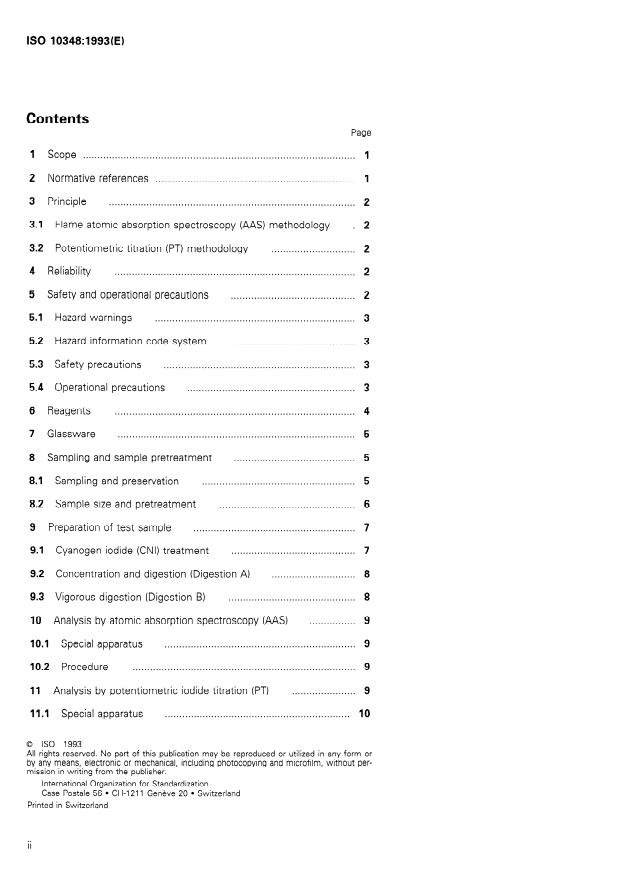
Contents
Page
1 scope . 1
2 Normative references . 1
3 Principle . 2
. 2
3.1 Flame atomic absorption spectroscopy (AAS) methodology
3.2 Potentiometric titration (PT) methodology . 2
4 Reliability . 2
........................................... 2
5 Safety and operational precautions
5.1 Hazard warnings . 3
5.2 Hazard information code system . 3
.................................................................. 3
5.3 Safety precautions
..........................................................
5.4 Operational precautions 3
6 Reagents . 4
7 Glassware .
8 Sampling and sample pretreatment . 5
8.1 Sampling and preservation . 5
8.2 Sample size and pretreatment .
9 Preparation of test sample . 7
9.1 Cyanogen iodide (CNI) treatment . 7
9.2 Concentration and digestion (Digestion A) . 8
9.3 Vigorous digestion (Digestion B) . 8
10 Analysis by atomic absorption spectroscopy (AAS) . 9
................................... 9
10.1 Special apparatus . . . . . . . . . . . . . . . . . . . . . . . . . . . . . .
................................... 9
10.2 Procedure . . . . . . . . . . . . . . . . . . . . . . . . . . . . . . . . . . . . . . . . .
...................... 9
11 Analysis by potentiometric iodide titration PT)
11 .I Special apparatus . . . . . . . . . .~.~.~.
0 IS0 1993
All rights reserved. No part of this publication may be reproduced or utilized in any form or
by any means, electronic or mechanical, including photocopying and microfilm, without per-
mission in writing from the publisher.
International Organization for Standardization
Case Postale 56 l CH-1211 Geneve 20 l Switzerland
Printed in Switzerland
II
IS0 10348:1993(E)
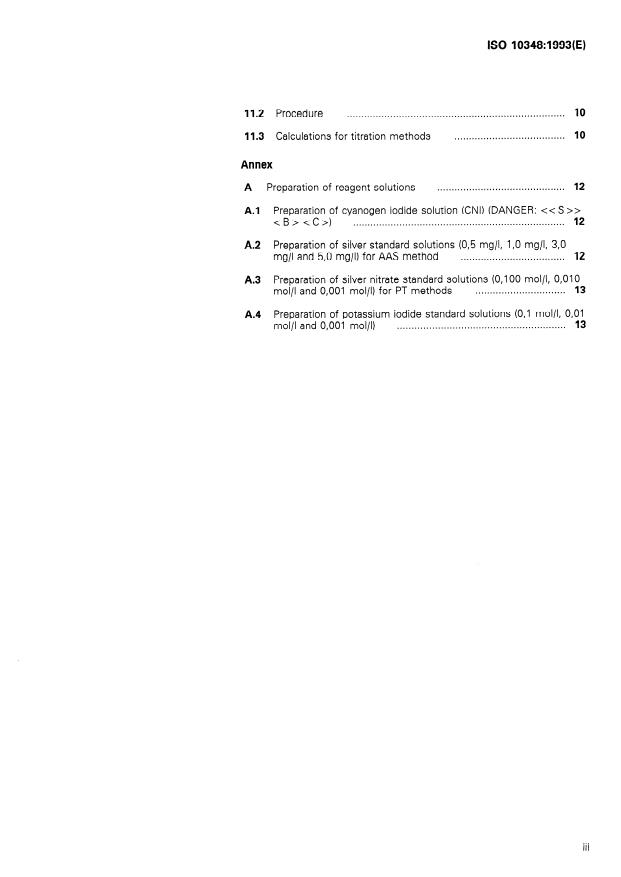
11.2 Procedure . . . . . . . . . . . . . . . . . . . . . . . . . . . . . . . . . . . . . . . . . . . . . . . . . . . . . . . . . . . . . . . . . . . . . . . . . . . 10
11.3 Calculations for titration methods . . . . . . . . . . . . . . . . . . . . . . . . . . . . . . . . . . . . . . 10
Annex
A Preparation of reagent solutions . . . . . . . . . . . . . . . . . . . . . . . . . . . . . . . . . . . . . . . . . . . . 12
A.1 Preparation of cyanogen iodide solution (CNI) (DANGER: << S >>
. . . . . . . . . . . . . . . . . . . . . . . . . . . . . . . . . . . . . . . . . . . . . . . . . . . . . . . . . . . . . . . . . . . . . . . . .
) 12
A.2 Preparation of silver standard solutions (0,5 mg/l, I,0 mg/l, 3,0
. . . . . . . . . . . . . . . . . . . . . . . . . . . . . . . . . . . . 12
mg/l and 5,0 mg/l) for AAS method
A.3 Preparation of silver nitrate standard solutions (0,100 mol/l, 0,010
mol/l and 0,001 mol/l) for PT methods . . . . . . . . . . . . . . . . . . . . . . . . . . . . . . . 13
A.4 Preparation of potassium iodide standard solutions (0,l mol/l, 0,Ol
mol/l and 0,001 mol/l) . . . . . . . . . . . . . . . . . . . . . . . . . . . . . . . . . . . . . . . . . . . . . . . . . . . . . . . . . . 13
IS0 10348:1993(E)
Foreword
IS0 (the International Organization for Standardization) is a worldwide
federation of national standards bodies (IS0 member bodies). The work
of preparing International Standards is normally carried out through IS0
technical committees. Each member body interested in a subject for
which a technical committee has been established has the right to be
represented on that committee. International organizations, governmental
and non-governmental, in liaison with ISO, also take part in the work. IS0
collaborates closely with the International Electrotechnical Commission
(I EC) on all matters of electrotechnical standardization.
Draft International Standards adopted by the technical committees are
circulated to the member bodies for voting. Publication as an International
Standard requires approval by at least 75 % of the member bodies casting
a vote.
International Standard IS0 10348 was prepared by Technical Committee
lSO/TC 42, Photography.
Annex A forms an integral part of this International Standard.
IS0 10348:1993(E)
Introduction
This International Standard is one of a series devoted to the analysis of
photographic wastes; it encompasses the field of analysis of silver in
photographic effluents.
Analysis for silver in photographic products and effluents presents unique
problems in sampling, handling and treatment. These problems are not
always adequately covered in standard references. It is the purpose of this
International Standard to provide methodology both for sample handling
and for the analysis of silver in effluents. Some of the chemicals specified
in the test procedures are caustic, toxic or otherwise hazardous. Specific
warning, caution and danger notices are noted for particularly hazardous
materials but normal precautions required during the performance of any
chemical procedure shall be exercised at all times.
In the case of effluents, the photographic laboratory can best establish its
conformity to regulations by appropriate chemical analysis. In some cases,
in-house analyses will be possible; often the use of an outside laboratory
will be required.
Silver in photographic processing wastes originates as a soluble thiosulfate
or other complex. Other waste components, however, may interact, re-
sulting in an unstable system containing varying amounts of soluble forms
of silver. Waste samples to be analysed for heavy metals are normally
stabilized by acidification with nitric acid. This treatment is unsatisfactory
for silver in effluents containing photographic processing wastes. Since
thiosulfate is unstable in acid solutions, the conventional treatment can
actually promote the formation of insoluble silver. Cyanogen iodide (CNI)
solution is the effective preservative for silver in these effluents?
This International Standard includes flame atomic absorption spectroscopy
(AAS) and two potentiometric iodide titration (PT) methods of analysis. The
method employed will dictate the way in which the sample is preserved
and treated. Samples to be analysed by the AAS method are normally
ready for analysis, once stabilized with CNI solution. The iodide titration
methods, however, require a digestion to solubilize the silver and remove
interfering species followed by a boiling step (for Digestion A) to concen-
trate the sample. The standard digestion methods for AK, which rec-
ommend the use of hydrochloric acid, are not suitable for the preparation
of samples for silver analysis.
I) Owerbach, D. The use of cyanogen iodide (CNI) as a stabilizing agent for silver
in photographic processing effluents. Journal of Applied photographjc Engineering,
4(l), pp. 2-24, 1978.
V
This page intentionally left blank
INTERNATIONAL STANDARD IS0 10348: 1993(E)
Photography - Processing wastes - Determination
of silver content
IS0 835-l : 1981, Laboratory glassware - Graduated
1 Scope
pipettes - Part I: General requirements.
This International Standard gives methods for deter-
IS0 835-2: 1981, Laboratory glassware - Graduated
mining the silver content in photographic effluents
pipettes - Part 2: Pipettes for which no waiting time
from photographic processing wastes. Sampling, .
is specified.
sample preservation and analytical methodology are
included.
IS0 835-3: 1981, Laboratory glassware - Graduated
pipettes - Part 3: Pipettes for which a waiting time
Three analytical procedures are given with two sup-
porting sample treatment methodologies: of 15 s is specified.
IS0 835-4: 1981, Laboratory glassware - Graduated
a) a flame atomic absorption spectroscopy (MS)
pipettes - Part 4: Blow-out pipettes.
method;
IS0 1042:1983, Laboratory glassware - One-mark
b) two potentiometric iodide titration (PT) methods.
volumetric flasks.
The choice of treatment is dependent on the analysis
method and form of sample. Where MS is the cho-
IS0 3696: 1987, Water for analytical laboratory use -
sen method for analysis, cyanogen iodide-treated or
Specification and test methods.
preserved samples may be analysed directly. For the
PT method, two digestion procedures are given: Di-
IS0 4788:1980, Laboratory glassware - Graduated
gestion A for effluents with low salt content, and Di-
measuring cylinders.
gestion B for samples with high solids content.
IS0 5667-l : 1980, Water quality - Sampling -
Part 1: Guidance on the design of sampling pro-
grammes.
2 Normative references
IS0 5667-2:1991, Water quality - Sampling -
The following standards contain provisions which,
Part 2: Guidance on sampling techniques.
through reference in this text, constitute provisions
of this International Standard. At the time of publi-
IS0 5667-3: -*I Water quality - Sampling - Part 3:
cation, the editions indicated were valid. All standards
Guidance on ’ the preservation and handling of
are subject to revision, and parties to agreements
samples.
based on this International Standard are encouraged
to investigate the possibility of applying the most re-
IS0 6353-l : 1982, Reagents for chemical analysis -
cent editions of the standards indicated below.
Part 1: General test methods
Members of IEC and IS0 maintain registers of cur-
rently valid International Standards.
IS0 6353-2:1983, Reagents for chemical analysis -
Part 2: Specifications - First series.
IS0 385-l : 1984, Laboratory glassware - Burettes -
Part I: General requirements.
IS0 6353-3:1987, Reagents for chemical analysis -
Part 3: Specifications - Second series.
IS0 648: 1977, Laboratory glassware - One-mark
pipettes.
2) To be published. (Revision of IS0 5667-3:1985)
IS0 10348:1993(E)
F
is the Faraday constant;
3 Principle
is the concentration of silver ions.
%I
3.1 Flame atomic absorption spectroscopy
In the presence of an excess of iodide ions, the silver
(AAS) methodology
ion concentration, cAg, is given by
A silver-containing lamp, when heated to excitation, cAg = KSPh
generates a spectrum which includes the ultraviolet
where
emission bands of the silver atom. The silver ions in
a solution aspirated into a flame will absorb the silver
is the solubility product for silver iodide;
QP
emission bands when light from the lamp is passed
through the flame, according to a Beer’s law relation-
is the concentration of iodide ions.
Cl
ship:
A sharp change in potential is obtained during the
cAg = kmbg(+))
titration as the solution progresses from one with sil-
ver ions in excess to one with iodide ions in excess.
where
is the concentration of silver ions;
4 Reliability
z is the transmittance of light through the
The practical lower limits (approximate) for silver
flame at the specified wavelength aspir-
analyses are the following
ated with the sample;
is the transmittance of light through the
Direct flame AAS O,l mg/l
flame at the specified wavelength aspir-
PT, Digestion A (sample 500 ml;
ated with a silver-free reference sample;
titrant 0,001 mol/l potassium iodide) 02 w/l
k is a constant.
PT, Digestion B (sample I,0 ml;
100 mg/l
titrant 0,001 mol/l potassium iodide)
A calibration curve is normally generated to define the
relationship specifically.
The 20 confidence limits for Digestion A, as deter-
mined through inter-laboratory tests, are equal to
+ 0,12 mg/l for samples containing 0,2 mg/l to
3.2 Potentiometric titration (PT)
4,0 mg/l of silver in effluent samples. These results
methodology
are based on seventeen data points obtained from six
different laboratories 3) . This value is true for both
The titration of a solution containing silver ions with
potentiometric iodide titration methods using either
an iodide solution will form a precipitate of silver
the manual method (pH-meter) or the automatic
iodide in accordance with the reaction:
titrimeter method with a titrant addition rate of
0,l ml/min.
Ag’ + I- -+ Agl(solid)
The 20 confidence limits for the flame AAS method
A silver electrode, either prepared from a silver billet
are equal to + 0,007 mg/l for samples containing
(11 .I .2) or an iodide-selective electrode, with an ap-
0,02 mg/l to 0,05 mg/l of silver in photographic
propriate reference electrode will generate a potential
effluents, when directly aspirated after a five-fold
in the presence of a solution containing silver ions in
sample volume reduction.
accordance with the Nernst equation:
E = h!?O + o,023(RT/nF>~log(cAg)
5 Safety and operational precautions
where
The test procedure for silver analysis given in this
International Standard requires careful technique by
E is the measured potential, in volts;
an experienced operator. It requires care in sample
is the base potential, including the refer-
EO storage and safe handling of both the sample and re-
ence electrode contribution, in volts;
agent solutions due to the hazards and/or toxicity of
the cyanogen iodide stabilizing agent and other sol-
R is the universal gas constant;
utions. Due to the vigorous agitation and possible loss
by splashing in the potentiometric iodide titration,
T is the thermodynamic temperature;
careful monitoring of the procedure is required. The
n is the number of electrons transferred; unique requirements and the large number of items
3) For an explanation on how the data were treated, see the ASTM Handbook on Statistical Methods. Copies are available from
ASTM, 1916 Race Street, Philadelphia, PA 19103, USA.
IS0 10348:1993(E)
in separate categories result in the following safety
<< S >> May be fatal if swallowed. If swallowed,
and operational precautions. obtain medical attention immediately.
Will burn. Keep away from heat, sparks and
open flame. Use with adequate ventilation.
5.1 Hazard warnings
CO> Oxidizer. Contact with other material may
cause fire. Do not store near combustible
Some of the chemicals specified in the test pro- materials.
cedures are caustic, toxic or otherwise hazardous.
Safe laboratory practice for the handling of chemicals
5.3 Safety precautions
requires the use of safety glasses or goggles, rubber
gloves and other protective apparel such as face
ALL PIPETTE OPERATIONS SHALL BE PER-
masks or aprons where appropriate. Specific danger
FORMED WITH A PIPETTE BULB OR PLUNGER
notices are given in the text and footnotes for par-
PIPETTE. Failure to observe this warning notice
ticularly dangerous materials, but normal precautions
can result in cyanide poisoning. THIS IS A CRITI-
are required during the performance of any chemical
CAL SAFETY WARNING!
procedure at all times. The first time that a hazardous
material is noted in the test procedure section, the
Digestion procedures shall be performed in a fume
hazard will be indicated by the word “DANGER” fol-
hood. Hydrogen cyanide or other toxic substances
lowed by a symbol consisting of angle brackets
can be evolved.
‘I< 9’ containing a letter which designates the spe-
cific hazard. A double bracket “<< >>I’ will be used
Safety glasses shall be for all laboratory
for particularly perilous situations. In subsequent
work.
statements involving handling of these hazardous
materials, only the hazard symbol consisting of the
decomposed by treat-
Cyanogen iodide may be
brackets and letter(s) will be displayed. Furthermore,
ment with sodium hypoch llorite.
for a given material, the hazard symbols will be used
only once in a single paragraph.
5.4 Operational precautions
Detailed warnings for handling chemicals and their
diluted solutions are beyond the scope of this Inter-
5.4.1 The cyanogen iodide (CNI) silver solvent shall
national Standard.
be added to the bulk sample a sufficient time before
the test sample is taken, to ensure complete dissol-
Employers shall provide training and health and
ution of occluded or precipitated silver. If a bulk sam-
safety information in conformance with legal re-
ple is acidic, it shall be neutralized before CNI is
quirements.
added. The minimum reaction time after CNI addition
is 1 h. CNI may be added at the bulk sampling time.
The hazard symbol system used in this International
The treated sample is stable indefinitely.
Standard is intended to provide information to the
users and is not meant for compliance with any legal
requirements for labelling as these vary from country
5.4.2 Bulk samples containing large quantities of sil-
to country.
ver, to be dissolved by the addition of large volumes
of CNI (up to 20 % addition), shall have the original
It is strongly recommended that anyone using
bulk sample volumes recorded at the bulk sampling
these chemicals obtain from the manufacturer
time before the addition of CNI. When tested, the di-
pertinent information about the hazards, hand-
lution factor given in 8.2.3 shall be used with the AAS
ling, use and disposal of these chemicals.
value to find the true concentration of the sample. The
recommended reaction time is overnight for samples
with large silver concentrations resulting from
particulate matter. Representative samples, including
5.2 Hazard information code system solids and particulate matter, shall be taken for true
silver values. Representative sampling shall also take
Harmful if inhaled. Avoid breathing dust, into account adsorption of silver or precipitation of
vapour, mist or gas. Use only with adequate silver species on the container walls. Appropriate
ventilation. treatment of the container when removing the sample
is necessary.
Harmful if contact occurs. Avoid contact
with eyes, skin or clothing. Wash thor-
5.4.3 Where CNI preservation is used, the sample
oughly after handling.
container material is not of significant concern. In
these cases, plastic containers are preferred to avoid Harmful if swallowed. Wash thoroughly af-
ter handling. If swallowed, obtain medical breakage. In any event, sample containers shall be
attention immediately. properly cleaned (see 5.4.5).
0348:1993(E)
5.4.4 Analyses of samples for dissolved silver re-
The discharge of reagents shall conform to applicable
quire
mmediate filtration after sampling and the use environmental regulations.
of support apparatus that will not affect the silver
Purity: Reagents used in the test procedures shall be
concentration after filtration. A 0,45 pm membrane
certified reagent-grade chemicals and shall meet ap-
filter medium with a stainless steel support is an ac-
propriate standards or be chemicals of a purity ac-
ceptable system. Fritted glass and ceramic filter el-
ceptable for the analysis. See IS0 6353-1, IS0 6353-2
ements may absorb silver from the filtrate and are not
and IS0 6353-3.
recommended.
Whenever water is specified without other qualifiers
5.4.5 All glassware and containers shall be cleaned
in the test procedures, only distilled water or water
by soaking with a 1 % to 2 % CNI solution or con-
of equal purity shall be used. See IS0 3696.
centrated nitric acid for a minimum of 4 h to prevent
absorbed silver from being released from the con-
Strength of solutions: When a standardized solution
tainer walls and becoming part of the sample during
is required, its concentration should be expressed in
digestion. The containers shall then be rinsed several
moles per litre. The number of significant figures to
times with distilled water.
which the molar concentration is known should be
sufficient to ensure that the reagent does not limit the
reliability of the test method.
5.4.6 Digestions shall be carried to completion in
order to eliminate interfering materials that react with
When a standardized solution is not required, its con-
the potassium iodide titrant.
centration should be expressed in grams per litre to
the appropriate number of significant figures.
5.4.7 The titration rate with potassium iodide shall
not exceed 0,l ml/min until the end-point is ap-
When a solution is to be diluted, its dilution is indi-
proached. The final titration rate shall not exceed
cated by (X+ Y), meaning that X volumes of reagent,
0,05 ml/min. In cases of low silver concentrations
or concentrated solution, is to be diluted with Y vol-
and, therefore, slow chemical reaction rates, faster
umes of distilled or deionized water.
titration rates will result in apparent high values.
These titration rates apply to automatic titration
6.1 Reagents for atomic absorption spectroscopy
equipment as well.
WW
5.4.8 The specified silver electrode cleaning and
6.1.1 Cyanogen iodide solution (CNI) (DANGER:
coating procedure shall be performed to provide the
<< S >>-< B > < C >)4!
correct coating depth of sulfide. Excess time in the
sulfide reagent can overcoat the electrode, resulting
6.1.2 Silver (Ag) standard solutions, 0,5 mg
in slow reaction and apparent high values. I
I,0 mg/l, 3,0 mg/l and 5,0 mg/l.4)
5.4.9 The digested sample volume, immediately be-
fore titration, should be 150 ml or less. A larger vol-
6.2 Reagents for potentiometric titrations (PT)
ume may degrade the potentiometric break required
for determining the end-point of the titration, es-
6.2.1 Acetic acid (CH3COOH glacia
pecially for samples low in silver.
z I,05 g/ml (DANGER: < C > -c B >).
P
5.4.10 The sample shall be stirred vigorously during
6.2.2 Ammonium hydroxide
titration to assist reaction completion. Failure to do so
p = 0,91 g/ml (DANGER: < C > < B >).
can result in invalid values for the analysis.
6.2.3 Hydrogen peroxide (H202), 30 % (m/m) (ap-
5.4.11 All containers shall be labelled and dated.
proximately) (DANGER: < C > < B > < 0 >).
Appropriate warning labels shall be affixed to the
containers.
6.2.4 Nitric acid (HNO& 70 % (m/m) (approxi-
mately) (DANGER: < C > < B > < 0 >).
6 Reagents
6.2.5 Potassium iodide standard solutions (KU,
Handling and labelling: Reagents shall be handled in 0,l mol/l, 0,Ol mol/l and 0,001 mol/L4)
conformity with health and safety precautions as
shown on containers or as given in other sources of
6.2.6 Potassium nitrate solution (KNO$, satu-
such information. Proper labelling of prepared re-
rated.
agents includes chemical name, date of preparation,
expiration date, restandardization date, name of Add 50 g of potassium nitrate to 100 ml of water. Stir
preparer, and adequate health and safety precautions. for 5 min then warm to room temperature. Maintain
4) Procedures for the preparation of these solutions are given in annex A.
IS0 10348:1993(E)
an excess of undissolved potassium nitrate crystals in treatment, and the less vigorous Digestion A method
the reagent container. is preferred where applicable. Samples with a high
solids content require the more vigorous Digestion B
method for PT and AAS when the CNI method is not
6.2.7 Silver nitrate (AgN03) standard solutions,
suitable for the latter.
0,100 mol/l, 0,010 mol/l and 0,001 mol/L4)
6.2.8 Sulfuric acid (H2SO4), p z I,84 g/ml (DAN- 8.1 Sampling and preservation
GER: << C >>).
It is necessary that the analysis be carried out on a
representative sample and the sampling of a process
7 Glassware
effluent or a plant effluent can encompass many dif-
ficulties and due care shall be exercised. See es-
All glassware subject to heating shall be of heat-
pecially IS0 5667-1, IS0 5667-2 and IS0 5667-3.
resistant borosilicate glass.5)
Sampling shall be carried out in conformance with
regulatory requirements. Sampling should be carried
Pipettes and other volumetric glassware shall meet
out under typical operating conditions and normally
the volume requirements of Class A glassware as
should be representative of the overall plant effluent.
specified in IS0 385-1, IS0 648, IS0 835-1,
Daily samples that are truly representative of the
IS0 835-2, IS0 835-3, IS0 835-4, IS0 1042 and
effluents require sampling over 24 h and sampling
IS0 4788.
that is proportional to flow rate. Samples taken during
a sudden discharge or during another non-routine op-
8 Sampling and sample pretreatment
eration will not yield results representative of the
normal operation.
This International Standard covers a choice of analyti-
cal methods and sample preparation procedures. In The method of analysis and desired result will deter-
order to ensure that the analysis yields a meaningful mine the need for sample preservation. It is generally
result, it is necessary that the proper choices and de- recommended that all effluent samples intended for
cisions are made from among the options. It is, silver analysis be treated with CNI. It should be noted
therefore, the intent of this clause to provide a sys- that samples treated with CNI, intended for shipment,
tematic and rational approach to making the choices may be in violation of transport regulations and, if so,
consistent with the material type and analysis tech- the CNI treatment can be carried out after arrival. It is
nique for only necessary that the treatment be carried out at
least 1 h before the analysis. Normal treatment with
a) representative sampling; CNI for stabilization requires the addition of CNI at a
rate of 1,O ml of CNI solution per 100 ml of sample.
b) sample size determination;
CNI is used to stabilize samples for AAS analysis. Af-
ter CNI stabilization, such samples can normally be
c) sample preparation.
directly used for aspiration. CNI is used for PT sam-
Table 1 provides an overview of the choices based on ples to prevent loss of material by absorption to the
sample type treatment and analysis method. For AAS, container walls. Since PT analysis requires a digestive
any sample treatment is useable but CNI is preferred procedure, CNI stabilization is not required, provided
that there is no loss of silver due to absorption.
for simplicity where applicable. PT requires a digestion
Table
1 - Operational flowchart
Subclause Treatment Subclause
Sample type Analysis method
Low-salt effluents
AAS 10.2 CNI
8.2.2 or 8.2.3
AAS or PT 10.2 or 11.2 Digestion
A 9.2
AAS or PT 10.2 or 1 I .2 Digestion
B 9.3
Digestion B 9.3
High-solids effluents AAS or PT 10.2 or 11.2
5) Pyrex@ is an example of suitable glassware available commercially. This information is given for the convenience of users
of this International Standard and does not constitute an endorsement by IS0 of this product.
IS0 10348:1993(E)
8.2 Sample size and pretreatment real value, the problem encountered will be of having
less silver than is desired. This can result in values
near or below the working limits and correction will
The practical lower limits for the analysis techniques
require resampling and retreatment. On the other
are 0,l mg/l for AAS and 0,2 mg/l for PT (see 9.2.2,
hand, if the estimate made is lower than the actual
Digestion A). A minimum sample volume for AAS is
value, a solution would be obtained that is outside the
10 ml and this is equivalent to 0,001 mg of silver. PT
working range of the analysis on the high side. In this
requires a minimum titration equivalent to 1 ml of
case, a simple dilution would provide a solution that
0,001 mol/l potassium iodide solution. This is equiv-
is in the working range of the procedure. For this
alent to 0,l mg of silver; therefore, at 0,2 mg/l an in-
reason, it is preferrable to bias the estimate of the
itial sample of 500 ml is required for the titration of
silver content lower than expected.
silver. The analytical techniques may be extended into
lower ranges (0,l mg/l to 0,2 mg/l) when trying to
Determination of the sample size according to the
avoid the concentration step, or where the amount
type of sample and its pretreatment is considered in
of sample is limited.
8.2.1. The actual analysis requires calibration
measurements as well as sample measurements. The
The procedures given in this International Standard
preparation of calibration samples is given in
...