


ISO/IEC 24771:2009
(Main)Information technology — Telecommunications and information exchange between systems — MAC/PHY standard for ad hoc wireless network to support QoS in an industrial work environment
Information technology — Telecommunications and information exchange between systems — MAC/PHY standard for ad hoc wireless network to support QoS in an industrial work environment
ISO/IEC 24771:2009 defines a protocol for the physical layer (PHY) and the data link layer in order to construct a reliable and high-speed data transmission network between devices on industrial sites such as factories and plants. This network specification provides a standardized protocol to provide a framework for various industrial devices to establish a simple, low-cost, energy-efficient, and high-speed network between them. In order to fulfil the service requirements of the factories and large plants, this network specification is designed to enable devices to establish a network by themselves without the help of any infrastructure and to reliably exchange various kinds of data, including real-time audio and video data, between them. In addition to high transmission rates, Quality of Service (QoS) for multimedia data - such as video - is also provided. The devices mentioned in ISO/IEC 24771:2009 refer to equipment that can be used on industrial sites such as factories and automated assembly lines. Devices include PLC (Programmable Logic Controller), and CNC (Computerized Numerical Controller) and manufacturing robots. However, beyond such conventional devices, devices mentioned in this document include personal IT devices that workers may carry and use while working, including cellular phones, personal industrial digital assistants (PDA), and laptop PCs.
Technologies de l'information — Télécommunications et échange d'information entre systèmes — Norme MAC/PHY pour un réseau ad hoc sans fil qui supporte QoS dans un environnement de travail industriel
General Information
- Status
- Withdrawn
- Publication Date
- 23-Mar-2009
- Withdrawal Date
- 23-Mar-2009
- Current Stage
- 9599 - Withdrawal of International Standard
- Start Date
- 04-Aug-2014
- Completion Date
- 14-Feb-2026
Relations
- Effective Date
- 06-Aug-2011


Get Certified
Connect with accredited certification bodies for this standard

BSI Group
BSI (British Standards Institution) is the business standards company that helps organizations make excellence a habit.

NYCE
Mexican standards and certification body.
Sponsored listings
Frequently Asked Questions
ISO/IEC 24771:2009 is a standard published by the International Organization for Standardization (ISO). Its full title is "Information technology — Telecommunications and information exchange between systems — MAC/PHY standard for ad hoc wireless network to support QoS in an industrial work environment". This standard covers: ISO/IEC 24771:2009 defines a protocol for the physical layer (PHY) and the data link layer in order to construct a reliable and high-speed data transmission network between devices on industrial sites such as factories and plants. This network specification provides a standardized protocol to provide a framework for various industrial devices to establish a simple, low-cost, energy-efficient, and high-speed network between them. In order to fulfil the service requirements of the factories and large plants, this network specification is designed to enable devices to establish a network by themselves without the help of any infrastructure and to reliably exchange various kinds of data, including real-time audio and video data, between them. In addition to high transmission rates, Quality of Service (QoS) for multimedia data - such as video - is also provided. The devices mentioned in ISO/IEC 24771:2009 refer to equipment that can be used on industrial sites such as factories and automated assembly lines. Devices include PLC (Programmable Logic Controller), and CNC (Computerized Numerical Controller) and manufacturing robots. However, beyond such conventional devices, devices mentioned in this document include personal IT devices that workers may carry and use while working, including cellular phones, personal industrial digital assistants (PDA), and laptop PCs.
ISO/IEC 24771:2009 defines a protocol for the physical layer (PHY) and the data link layer in order to construct a reliable and high-speed data transmission network between devices on industrial sites such as factories and plants. This network specification provides a standardized protocol to provide a framework for various industrial devices to establish a simple, low-cost, energy-efficient, and high-speed network between them. In order to fulfil the service requirements of the factories and large plants, this network specification is designed to enable devices to establish a network by themselves without the help of any infrastructure and to reliably exchange various kinds of data, including real-time audio and video data, between them. In addition to high transmission rates, Quality of Service (QoS) for multimedia data - such as video - is also provided. The devices mentioned in ISO/IEC 24771:2009 refer to equipment that can be used on industrial sites such as factories and automated assembly lines. Devices include PLC (Programmable Logic Controller), and CNC (Computerized Numerical Controller) and manufacturing robots. However, beyond such conventional devices, devices mentioned in this document include personal IT devices that workers may carry and use while working, including cellular phones, personal industrial digital assistants (PDA), and laptop PCs.
ISO/IEC 24771:2009 is classified under the following ICS (International Classification for Standards) categories: 35.110 - Networking. The ICS classification helps identify the subject area and facilitates finding related standards.
ISO/IEC 24771:2009 has the following relationships with other standards: It is inter standard links to ISO/IEC 24771:2014. Understanding these relationships helps ensure you are using the most current and applicable version of the standard.
ISO/IEC 24771:2009 is available in PDF format for immediate download after purchase. The document can be added to your cart and obtained through the secure checkout process. Digital delivery ensures instant access to the complete standard document.
Standards Content (Sample)
INTERNATIONAL ISO/IEC
STANDARD 24771
First edition
2009-04-01
Information technology —
Telecommunications and information
exchange between systems —
MAC/PHY standard for ad hoc wireless
network to support QoS in an industrial
work environment
Technologies de l'information — Télécommunications et échange
d'information entre systèmes — Norme MAC/PHY pour un réseau ad
hoc sans fil qui supporte QoS dans un environnement de travail
industriel
Reference number
©
ISO/IEC 2009
PDF disclaimer
This PDF file may contain embedded typefaces. In accordance with Adobe's licensing policy, this file may be printed or viewed but
shall not be edited unless the typefaces which are embedded are licensed to and installed on the computer performing the editing. In
downloading this file, parties accept therein the responsibility of not infringing Adobe's licensing policy. The ISO Central Secretariat
accepts no liability in this area.
Adobe is a trademark of Adobe Systems Incorporated.
Details of the software products used to create this PDF file can be found in the General Info relative to the file; the PDF-creation
parameters were optimized for printing. Every care has been taken to ensure that the file is suitable for use by ISO member bodies. In
the unlikely event that a problem relating to it is found, please inform the Central Secretariat at the address given below.
© ISO/IEC 2009
All rights reserved. Unless otherwise specified, no part of this publication may be reproduced or utilized in any form or by any means,
electronic or mechanical, including photocopying and microfilm, without permission in writing from either ISO at the address below or
ISO's member body in the country of the requester.
ISO copyright office
Case postale 56 • CH-1211 Geneva 20
Tel. + 41 22 749 01 11
Fax + 41 22 749 09 47
E-mail copyright@iso.org
Web www.iso.org
Published in Switzerland
ii © ISO/IEC 2009 – All rights reserved
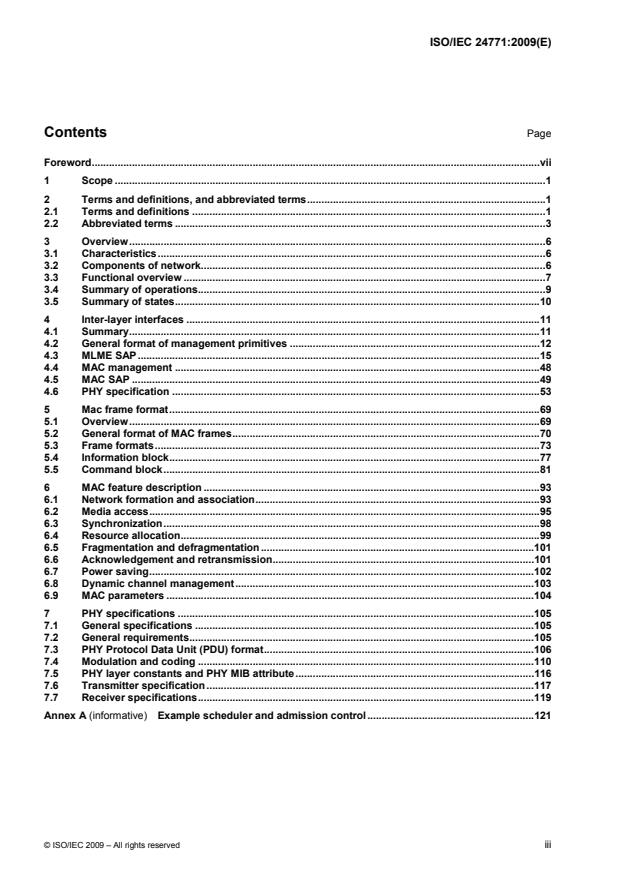
Contents Page
Foreword.vii
1 Scope .1
2 Terms and definitions, and abbreviated terms.1
2.1 Terms and definitions .1
2.2 Abbreviated terms .3
3 Overview.6
3.1 Characteristics.6
3.2 Components of network.6
3.3 Functional overview .7
3.4 Summary of operations.9
3.5 Summary of states.10
4 Inter-layer interfaces .11
4.1 Summary.11
4.2 General format of management primitives .12
4.3 MLME SAP.15
4.4 MAC management .48
4.5 MAC SAP .49
4.6 PHY specification .53
5 Mac frame format.69
5.1 Overview.69
5.2 General format of MAC frames.70
5.3 Frame formats.73
5.4 Information block.77
5.5 Command block.81
6 MAC feature description .93
6.1 Network formation and association.93
6.2 Media access.95
6.3 Synchronization.98
6.4 Resource allocation.99
6.5 Fragmentation and defragmentation .101
6.6 Acknowledgement and retransmission.101
6.7 Power saving.102
6.8 Dynamic channel management.103
6.9 MAC parameters .104
7 PHY specifications .105
7.1 General specifications .105
7.2 General requirements.105
7.3 PHY Protocol Data Unit (PDU) format.106
7.4 Modulation and coding .110
7.5 PHY layer constants and PHY MIB attribute.116
7.6 Transmitter specification.117
7.7 Receiver specifications.119
Annex A (informative) Example scheduler and admission control.121
© ISO/IEC 2009 – All rights reserved iii
List of Figures
Figure 1 - Network .7
Figure 2 - Superframe .8
Figure 3 - Protocol stack configuration.12
Figure 4 - Format of MAC frame.70
Figure 5 - Format of frame control fields .70
Figure 6 - Format of stream ID field.72
Figure 7 - Beacon frame format.73
Figure 8 - Immediate acknowledgement frame format.75
Figure 9 - Delayed acknowledgement frame payload format.75
Figure 10 - Format of record for stream-m .75
Figure 11 - Format of record for stream-m .76
Figure 12 - Data frame format .76
Figure 13 - RTS frame format.76
Figure 14 - CTS frame format.77
Figure 15 - Information block format.77
Figure 16 - Station UID information block format .78
Figure 17 - Station name information block format .78
Figure 18 - Station type information block format.78
Figure 19 - Network synchronization information block format .78
Figure 20 - Capability information block format.79
Figure 21 - Capability fields format.79
Figure 22 - Maximum support timeslot information block format .79
Figure 23 - Maximum transmit power information block format .80
Figure 24 - Resource allocation information block format.80
Figure 25 - Resource allocation block format.80
Figure 26 - New master notification information block format.81
Figure 27 - Sleep state notification information block format .81
Figure 28 - Command block format.81
Figure 29 - Associate request command block format.83
Figure 30 - Associate response command block format .83
Figure 31 - Disassociate request payload format.84
Figure 32 - Master handover command block format.85
Figure 33 - Resource allocation request command block format.85
Figure 34 - Resource allocation request record format.85
Figure 35 - Resource allocation response command block format.86
Figure 36 - Resource allocation modification command block format.87
Figure 37 - Resource allocation modification request record format.87
Figure 38 - Resource allocation termination command block format.87
Figure 39 - Delayed acknowledgement resynchronization command block format.88
Figure 40 - Delayed acknowledgement resynchronization command record format .88
Figure 41 - Sleep state request command block format.88
Figure 42 - Sleep state response command block format.89
Figure 43 - Activation indication command block format.89
Figure 44 - Transmit power adjustment command block format.89
Figure 45 - Station information request command block format .90
Figure 46 - Station information response command block format.90
Figure 47 - Station information block format .90
Figure 48 - Data query command block format.91
Figure 49 - Channel state request command block format .91
Figure 50 - Channel state response command block format .91
Figure 51 - Remote channel scan request command block format.92
Figure 52 - Remote channel scan response command block format.92
Figure 53 - Channel information block format .92
Figure 54 - Application specific command format .93
iv © ISO/IEC 2009 – All rights reserved
Figure 55 - Association Process. 95
Figure 56 - Inter-frame space in the allocated time slots . 98
Figure 57 - Superframe synchronization . 98
Figure 58 - Stream connection process for synchronized data transmission. 100
Figure 59 - Operating frequency channels . 105
Figure 60 - PHY Protocol Data Unit (PDU) format . 107
Figure 61 - Preamble format. 108
Figure 62 - PHY Header . 108
Figure 63 - LFSR generating the (15,10) shortened Hamming code . 109
Figure 64 - LFSR circuit generating the HEC . 109
Figure 65 - Scrambler Block Diagram . 110
Figure 66 - QPSK modulation. 111
Figure 67 - RATE1 block diagram . 112
Figure 68 - RATE2 block diagram . 112
Figure 69 - RATE3 block diagram . 114
Figure 70 - RATE4 block diagram . 114
Figure 71 - Preamble modulation . 115
Figure 72 - Header modulation. 115
Figure 73 - Payload modulation. 115
Figure 74 - Signal constellation- of QPSK. 116
Figure 75 - Error vector calculation. 117
Figure 76 - Transmit power spectrum mask . 118
Figure 77 - Transmitter RF response time. 119
Figure A.1 - Stream info table in master. 121
Figure A.2 - Calculation of ATS Position . 121
Figure A.3 - Fragmentation of ATS(a) and enhance for it(b). 122
Figure A.4 - Slot allocation algorithm. 123
© ISO/IEC 2009 – All rights reserved v
List of Tables
Table 1 - General management primitive overview.12
Table 2 - MLME/PLME general management primitive parameters .13
Table 3 - MLME primitive summary.15
Table 4 - MLME-RESET primitive parameters.15
Table 5 - MLME-SCAN primitive parameters.17
Table 6 - PiconetDescription elements.17
Table 7 - MLME-START primitive parameters .19
Table 8 - MLME-SYNCH primitive parameters .20
Table 9 - MLME-ASSOCIATE.primitive parameters .22
Table 10 - MLME-DISASSOCIATE primitive parameters .25
Table 11 - MLME-Master-HANDOVER primitive parameters .27
Table 12 - MLME-MASTER-INFO primitive parameters .29
Table 13 - MLME-PROBE primitive parameters .31
Table 14 - MLME-CREATE-STREAM, MLME-MODIFY-STREAM, MLME-TERMINATE-STREAM primitive
parameters .33
Table 15 - MLME-CHANNEL-STATUS primitive parameters .37
Table 16 - MLME-REMOTE-SCAN primitive parameters .40
Table 17 - RemotePiconetDescription elements.40
Table 18 - MLME-NETWORK-PARM-CHANGE primitive parameters .43
Table 19 - MLME-TX-POWER-CHANGE primitive parameters.44
Table 20 - MLME-SLEEP primitive parameters .46
Table 21 - MAC MIB master group parameters .48
Table 22 - MAC MIB attribute group parameters .48
Table 23 - MAC MIB association group parameters .49
Table 24 - MAC SAP primitive summary.49
Table 25 - MAC-ASYNC-DATA and MAC-ISOCH-DATA primitive parameters .50
Table 26 - PD-SAP primitives.53
Table 27 - PD-SAP parameters.54
Table 28 - PLME-SAP primitives.63
Table 29 - PLME-CCA.confirm parameters.64
Table 30 - Physical layer enumerated values .69
Table 31 - Frame types .70
Table 32 - Usage codes by frame type .73
Table 33 - Beacon frame body .74
Table 34 - Setting the control field of the beacon frame.74
Table 35 - Setting the control field of the beacon frame.75
Table 36 - Information blocks .77
Table 37 - Command types .82
Table 38 - Order of preference when comparing capability .84
Table 39 - MAC layer parameters .104
Table 40 - Center frequency of 10 channels .105
Table 41 - PHY layer timing parameters .106
Table 42 - Interframe space parameter.106
Table 43 - CAZAC sequence.107
Table 44 - Forward Error Correction.108
Table 45 - Constant Envelope Coding .109
Table 46 - Data rate according to modulation type .115
Table 47 - PHY layer constants.116
Table 48 - PHY MIB characteristics group parameters.116
Table 49 - Transmit PSD limits.118
Table 50 - Transmit power.119
vi © ISO/IEC 2009 – All rights reserved
Foreword
ISO (the International Organization for Standardization) and IEC (the International Electrotechnical
Commission) form the specialized system for worldwide standardization. National bodies that are members of
ISO or IEC participate in the development of International Standards through technical committees
established by the respective organization to deal with particular fields of technical activity. ISO and IEC
technical committees collaborate in fields of mutual interest. Other international organizations, governmental
and non-governmental, in liaison with ISO and IEC, also take part in the work. In the field of information
technology, ISO and IEC have established a joint technical committee, ISO/IEC JTC 1.
International Standards are drafted in accordance with the rules given in the ISO/IEC Directives, Part 2.
The main task of the joint technical committee is to prepare International Standards. Draft International
Standards adopted by the joint technical committee are circulated to national bodies for voting. Publication as
an International Standard requires approval by at least 75 % of the national bodies casting a vote.
Attention is drawn to the possibility that some of the elements of this document may be the subject of patent
rights. ISO and IEC shall not be held responsible for identifying any or all such patent rights.
ISO/IEC 24771 was prepared by Joint Technical Committee ISO/IEC JTC 1, Information technology,
Subcommittee SC 6, Telecommunications and information exchange between systems.
© ISO/IEC 2009 – All rights reserved vii
INTERNATIONAL STANDARD ISO/IEC 24771
Information technology — Telecommunications and information
exchange between systems — MAC/PHY standard for ad hoc
wireless network to support QoS in an industrial work
environment
1 Scope
This International Standard defines a protocol for the physical layer (PHY) and the data link layer in order to
construct a reliable and high-speed data transmission network between devices on industrial sites such as
factories and plants. This network specification provides a standardized protocol to provide a framework for
various industrial devices to establish a simple, low-cost, energy-efficient, and high-speed network between
them. In order to fulfil the service requirements of the factories and large plants, this network specification is
designed to enable devices to establish a network by themselves without the help of any infrastructure and to
reliably exchange various kinds of data, including real-time audio and video data, between them. In addition to
high transmission rates, Quality of Service (QoS) for multimedia data - such as video - is also provided.
The devices mentioned in this International Standard refer to equipment that can be used on industrial sites
such as factories and automated assembly lines. Devices include PLC (Programmable Logic Controller), and
CNC (Computerized Numerical Controller) and manufacturing robots. However, beyond such conventional
devices, devices mentioned in this document include personal IT devices that workers may carry and use
while working, including cellular phones, personal industrial digital assistants (PDA), and laptop PCs.
2 Terms and definitions, and abbreviated terms
For the purposes of this document, the following terms and definitions, and abbreviated terms apply.
2.1 Terms and definitions
2.1.1
access control
control process to prevent unauthorized use of resources or bandwidth
2.1.2
ad hoc network
network that is spontaneously formed usually without system installation
NOTE Such networks are mainly characterized by time and space limitations.
2.1.3
association
service used to connect authorized devices in the network
2.1.4
authentication
device verification process allowing devices within the network to connect to one another
2.1.5
coverage area
territory over which two devices can achieve acceptable quality and performance while exchanging data
2.1.6
dissociation
service used in an established network
© ISO/IEC 2009 – All rights reserved 1
2.1.7
frame
format of bits in a data exchange
2.1.8
K
prefix indicating multiplication by 1024
2.1.9
Kµs
unit of 1024 µs
2.1.10
k
prefix indicating multiplication by 1000
2.1.11
logical channel
data link channel sitting distinctly above the physical layer
2.1.12
master
station that manages the network by periodically transmitting a beacon packet
2.1.13
MAC management protocol data unit
MMPDU
data unit exchanged between two media access control apparatuses in order to implement the media access
control management protocol
2.1.14
MAC protocol data unit
MPDU
data unit exchanged between two media access control apparatuses by means of utilizing the physical layer
services
2.1.15
MAC service data unit
MSDU
data unit transmitted between media access control service access points
2.1.16
mobile device
device that utilizes communication networks while in motion
2.1.17
packet
structure of bits sent in one data transmission
2.1.18
portable device
station that is normally portable but must be in a fixed location in order to link to the communication network
2.1.19
slave
station in the network other than the master
2.1.20
station
device that can operate according to this International Standard
2 © ISO/IEC 2009 – All rights reserved
2.2 Abbreviated terms
ARQ automatic repeat request
ARQN automatic repeat request N
ASN.1 abstract syntax notation 1
BER bit error rate
CAP contention access period
CCA clear channel assessment
CDMA code division multiple access
CODEC coder/decoder
CRC cyclic redundancy check
CTS clear to send
DA destination address
DBPSK differential binary phase shift keying
DCE data communication equipment
DLL data link layer
DOQPSK differential offset quadrature phase shift keying
DQPSK differential quadrature phase shift keying
FCS frame check sequence
FEC forward error correction
FER frame error rate
HCS header check sequence
IETF internet engineering task force
IDU interface data unit
IP internet protocol
ISM industrial scientific medicine
IWN industrial wireless network
LAN local area network
LFSR linear feedback shift register
LLC logical link control
LM link manager
© ISO/IEC 2009 – All rights reserved 3
LME layer management entity
LMP link manager protocol
LSB least significant bit
MAC medium access control
Master network coordinator
MC-CDMA multi-code CDMA
MCDU MAC command data unit
MCPDU MAC command protocol data unit
MDF management-defined field
MIB management information base
MLME MAC layer management entity
MPDU MAC protocol data unit
MSB most significant bit
MSC message sequence chart
MSDU MAC service data unit
MTU maximum transmission unit
NID network ID
PAN personal area network
PAR project authorization request
PDU protocol data unit
PER packet error ratio
PHY physical layer
PIB PAN information base
PLME physical layer management entity
PN pseudo noise
PPDU PHY protocol data unit
PPM parts per million
PRNG pseudo random number generator
PSDU PHY service data unit
QAM quadrature amplitude modulation
4 © ISO/IEC 2009 – All rights reserved
QoS quality of service
QPSK quadrature phase shift keying
OQPSK offset quadrature phase shift keying
RF radio frequency
RFC request for comments
RSSI received signal strength indication
RTS request to send
RTX response timeout expired
RX receive or receiver
SAP service access point
SDP service discovery protocol
SDU service data unit
SEQN sequential numbering scheme
SME station management entity
SQ signal quality
SRC short retry count
SRES signed response
SS station service
TA transmitter address
TCM trellis coded modulation
TDD time division duplex
TDMA time division multiple access
TX transmit or transmitter
TXE transmit enable
WAN wide area network
WLAN wireless local area network
WM wireless medium
© ISO/IEC 2009 – All rights reserved 5
3 Overview
This section defines the general attributes of the industrial wireless network and describes the attributes of the
physical layer and data link layer. The physical layer is built upon a binary CDMA, and the data link layer is
composed of the media access control (MAC) layer.
3.1 Characteristics
This International Standard is designed for the construction and management of an optimal network for
industrial use applications.
3.1.1 Ad hoc network
This International Standard is based upon an ad hoc network that can be established even without a network
infrastructure. A network is made up of two kinds of devices - a master and a slave, which is differentiated
according to their functions. All stations can function as a master or a slave and one of them is selected as a
master based on the device layout and its capabilities. An independent network structure is feasible without
requiring infrastructure.
3.1.2 Quality of service
The number of devices participating in an industrial wireless network changes vastly over time due to the
channel conditions and industrial mobile device operation characteristics of a wireless environment. The
bandwidth allocated to each device and the transmission delay time also have a significant effect, making it
difficult to support real-time multimedia traffic services that require a certain quality of service.
This document requires one station in the network to be the master, which allocates and controls resources
and thereby manages the connection quality of each network traffic.
3.1.3 Binary CDMA technology
This International Standard uses Binary-CDMA technology so that it has strong noise resistance, inherent
advantage of CDMA, and has another good capability of changing bandwidth finely,
and thereby has the advantages of noise resistance and finely tuned and flexible resource allocation.
First, Binary-CDMA possesses superior noise resistance that is characteristic of CDMA technology, and this is
an outstanding attribute in a wireless network environment which, unlike a wireline network, has a high noise
factor. In addition, the nature of Binary CDMA makes it possible to adjust the bandwidth by changing the
number of codes used, thereby allowing flexible and finely-tuned resource allocation.
3.2 Components of network
The components of a network can be roughly depicted as shown in Figure 1. The primary component is the
station. The first station trying to connect or establish a network becomes the master of the network and helps
other stations to associate with it by periodically transmitting beacons. It also takes responsibilities such as
quality of service and power management. The network is made up of two or more stations operating on the
same wireless frequency channel in an industrial activity area.
3.2.1 Station
The station is the primary component of the network and is classified as either master or slave depending on
its role. The master assumes full management, and no more than one can exist in a particular network. The
master controls slaves by broadcasting beacons. Slaves send or receive data as directed by the master. To
acquire time slots for data transfer, slaves make resource allocation requests to the master during the
contention period.
6 © ISO/IEC 2009 – All rights reserved
Data
Slave Slave
Beacon Data Beacon
Master
Data
Beacon Beacon
Data
Slave
Slave
Figure 1 - Network
3.2.2 Resources
Stations in the network should acquire time slots from master to perform their aimed job – exchanging data.
After a station acquired rights to use some time slots from master, it can transmit packets exclusively during
assigned time slots. In this sense, this International Standard depicts time slots as resources, which stations in
the network share and compete for. Time slots are supervised by the master and are distributed according to
requests from slaves at the discretion of the master.
3.3 Functional overview
The media access control layer provides the following services:
- Network synchronization
- Data transmission
- Power management
- Change of the master
Data transmission and reception between stations are possible under different standards of quality of service.
3.3.1 Network synchronization
The network is established once the master transmits the beacon packet. The beacon packet contains the
status information of the network, and all slaves in the network use this information to sync with the network.
The superframe is roughly composed of three parts as shown in Figure 2, and each period has a variable
length. (The allocation period must be a multiple of the timeslot length.)
© ISO/IEC 2009 – All rights reserved 7
Beacon Contention Allocation period
period period
Time slot 1 Time slot 2 ··· Time slot n
Figure 2 - Superframe
a) beacon period: the master transmits the beacon packet containing the network status information to the
slaves.
b) contention period: the slaves and master send command packets such as associate/disassociate/grant
packets, resource request/grant packets, and connect request/grant packets in a random access fashion.
c) allocation period: this is divided into multiple time slots, each allotted for one station. The station receiving
the time slot can send synchronous/asynchronous data or command packets during that interval.
3.3.2 Data transmission
For data transmission, two types of connections – synchronous and asynchronous - are supported.
Asynchronous connections, which have minimal overhead when establishing connections but do not have a
guaranteed bandwidth, are primarily used when transmitting general data that is relatively insensitive to delays.
Synchronous connections, which carry a large overhead when establishing connections but have a
guaranteed bandwidth, are used to transmit data for real-time services such as audio and video.
This International Standard manages communication quality in three characteristics – delay, data rate, BER.
Each device defines the communication quality of data stream to send in these three parameters and sends
the defined quality parameters to master to get channel time allocation. Master collects communication
request from slaves and allocate time slots to streams in order that each stream can be transmitted satisfying
each one’s needed communication quality. Afterward a master monitors quality of communication of stream to
check whether it meets initial QoS request. If the communication quality deteriorates below initial request
quality, master changes time slot allocation to meet initial QoS request.
This International Standard covers MAC-to-MAC QoS within 1-hop network that MAC layer can control.
3.3.2.1 QoS parameter
Data transfers in this International Standard are differentiated as streams which are largely divided into
synchronous stream and asynchronous stream, depending on whether a stream has QoS characteristic or not.
Synchronous stream has 3 QoS parameter – Period, Data size to transmit per each period, BER, while
asynchronous stream have only data size as a parameter.
Synchronous stream in this International Standard manages QoS with the following three parameters.
- Period: the period with which master allocates time slot. Each device is assigned at least a time slot within
this period so that this value is equal to maximum delay.
- Data size to transmit per each period: the size of data that a slave will send during each period. Combined
with period, this value decides data rate.
- BER: This value defines quality of communication in Bit Error Rate
Using above QoS parameters, devices can define their communication request with detail characteristics.
3.3.2.2 Maintenance of QoS
A master of a network manages communication resource (time slots) centrally. Master collects network
information (usage status of allocated time slots, channel quality of each channel) and c
...
Questions, Comments and Discussion
Ask us and Technical Secretary will try to provide an answer. You can facilitate discussion about the standard in here.
Loading comments...