

ISO/IEC 23090-18:2024
(Main)Information technology — Coded representation of immersive media — Part 18: Carriage of geometry-based point cloud compression data
General Information
- Abstract
This document specifies a media format that enables the storage and delivery of geometry-based point cloud compression data. The geometry-based point cloud compression data can be timed or non-timed. It supports flexible extraction of geometry-based point cloud compression data at delivery or decoding time.
- Status
- Published
- Publication Date
- 11-Jan-2024
- Technical Committee
- ISO/IEC JTC 1/SC 29 - Coding of audio, picture, multimedia and hypermedia information
- Drafting Committee
- ISO/IEC JTC 1/SC 29/WG 3 - MPEG Systems
- Current Stage
- 6060 - International Standard published
- Start Date
- 12-Jan-2024
- Due Date
- 25-Feb-2023
- Completion Date
- 12-Jan-2024

Overview - ISO/IEC 23090-18:2024 (G‑PCC carriage)
ISO/IEC 23090-18:2024 defines a media format for carriage of geometry‑based point cloud compression (G‑PCC) data, enabling storage and delivery of both timed and non‑timed point cloud bitstreams. The standard describes how compressed geometry‑based point cloud data is encapsulated, signalled and grouped to support flexible extraction at delivery time or at decode time. Key delivery ecosystems covered include ISOBMFF (ISO Base Media File Format), DASH (Dynamic Adaptive Streaming over HTTP) and MMT (MPEG Media Transport).
Keywords: ISO/IEC 23090-18, G‑PCC, point cloud compression, ISOBMFF, DASH, MMT, geometry-based point cloud.
Key technical topics and requirements
- Overall architecture and brands/sample entry types: defines referenceable code points, sample entry types, box types, brands and URNs to identify G‑PCC content in container files.
- Volumetric media support: structures for volumetric visual media headers, sample entries and grouping for immersive assets.
- Timed (streaming) G‑PCC in ISOBMFF: decoder configuration records/boxes, component information, single‑track and multi‑track encapsulation, tiled bitstream encapsulation and track referencing for tiled point cloud delivery.
- Non‑timed G‑PCC storage: image items, tile items and item properties for non‑timed (file) delivery and content interchange.
- Metadata signalling: spatial region and viewport information (static and dynamic), metadata structures for partial delivery and recommended viewports.
- Delivery signalling for streaming: DASH MPD descriptors, GPCC preselection, multi‑version support, and MMT asset descriptors/messages (asset group metadata, asset selection, view change feedback).
- Entity and sample grouping: track reference types, entity grouping, sample grouping and tile inventory definitions to support selective extraction.
Practical applications and who uses it
ISO/IEC 23090-18 is intended for implementers and integrators in immersive media and 3D workflows:
- Codec and container implementers building G‑PCC encoders/decoders and ISOBMFF/DASH/MMT toolchains.
- Streaming platform and CDN engineers enabling adaptive delivery of 3D/volumetric content.
- Application developers for AR/VR, volumetric video, telepresence, gaming and 3D mapping who need standardized storage and streaming formats.
- Device manufacturers integrating point cloud playback or spatial media support on headsets, mobile and automotive platforms.
- Content creators and production tool vendors managing tiled/region‑of‑interest delivery and viewport signalling.
Related standards
- Other parts of the ISO/IEC 23090 series on coded representation of immersive media and the G‑PCC codec specifications are complementary and often referenced for codec semantics, profiles and bitstream syntax.
This standard enables interoperable, efficient carriage and signalling of compressed point cloud geometry for modern immersive delivery scenarios.
Relations
- Effective Date
- 19-Aug-2023
- Effective Date
- 06-Jun-2022
Get Certified
Connect with accredited certification bodies for this standard

BSI Group
BSI (British Standards Institution) is the business standards company that helps organizations make excellence a habit.

NYCE
Mexican standards and certification body.
Sponsored listings
Frequently Asked Questions
ISO/IEC 23090-18:2024 is a standard published by the International Organization for Standardization (ISO). Its full title is "Information technology — Coded representation of immersive media — Part 18: Carriage of geometry-based point cloud compression data". This standard covers: This document specifies a media format that enables the storage and delivery of geometry-based point cloud compression data. The geometry-based point cloud compression data can be timed or non-timed. It supports flexible extraction of geometry-based point cloud compression data at delivery or decoding time.
This document specifies a media format that enables the storage and delivery of geometry-based point cloud compression data. The geometry-based point cloud compression data can be timed or non-timed. It supports flexible extraction of geometry-based point cloud compression data at delivery or decoding time.
ISO/IEC 23090-18:2024 is classified under the following ICS (International Classification for Standards) categories: 35.040.40 - Coding of audio, video, multimedia and hypermedia information. The ICS classification helps identify the subject area and facilitates finding related standards.
ISO/IEC 23090-18:2024 has the following relationships with other standards: It is inter standard links to ISO/IEC 23090-18:2024/Amd 2:2026, ISO/IEC 23090-18:2024/Amd 1:2024. Understanding these relationships helps ensure you are using the most current and applicable version of the standard.
ISO/IEC 23090-18:2024 is available in PDF format for immediate download after purchase. The document can be added to your cart and obtained through the secure checkout process. Digital delivery ensures instant access to the complete standard document.
Standards Content (Sample)
International
Standard
ISO/IEC 23090-18
First edition
Information technology — Coded
2024-01
representation of immersive
media —
Part 18:
Carriage of geometry-based point
cloud compression data
Technologies de l'information — Représentation codée de média
immersifs —
Partie 18: Transport des données de compression des nuages de
points basée sur la géométrie
Reference number
© ISO/IEC 2024
All rights reserved. Unless otherwise specified, or required in the context of its implementation, no part of this publication may
be reproduced or utilized otherwise in any form or by any means, electronic or mechanical, including photocopying, or posting on
the internet or an intranet, without prior written permission. Permission can be requested from either ISO at the address below
or ISO’s member body in the country of the requester.
ISO copyright office
CP 401 • Ch. de Blandonnet 8
CH-1214 Vernier, Geneva
Phone: +41 22 749 01 11
Email: copyright@iso.org
Website: www.iso.org
Published in Switzerland
© ISO/IEC 2024 – All rights reserved
ii
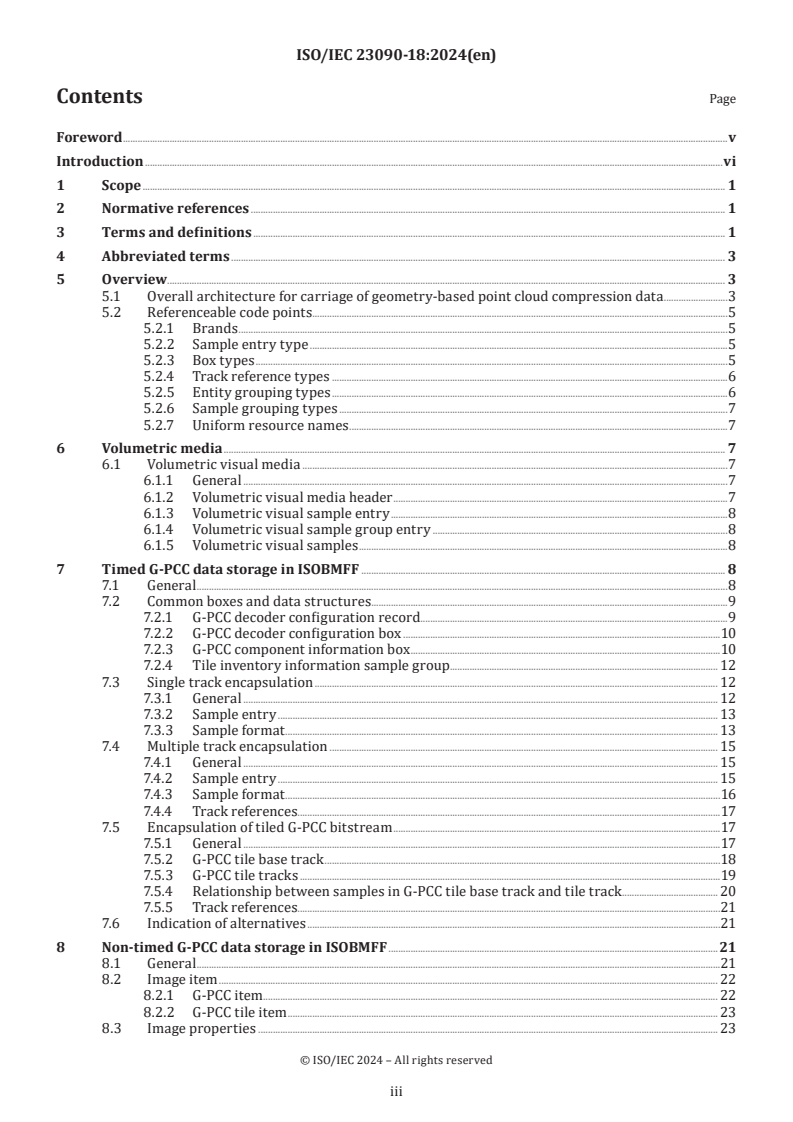
Contents Page
Foreword .v
Introduction .vi
1 Scope . 1
2 Normative references . 1
3 Terms and definitions . 1
4 Abbreviated terms . 3
5 Overview . 3
5.1 Overall architecture for carriage of geometry-based point cloud compression data .3
5.2 Referenceable code points.5
5.2.1 Brands .5
5.2.2 Sample entry type .5
5.2.3 Box types .5
5.2.4 Track reference types .6
5.2.5 Entity grouping types .6
5.2.6 Sample grouping types .7
5.2.7 Uniform resource names .7
6 Volumetric media . 7
6.1 Volumetric visual media .7
6.1.1 General .7
6.1.2 Volumetric visual media header .7
6.1.3 Volumetric visual sample entry .8
6.1.4 Volumetric visual sample group entry .8
6.1.5 Volumetric visual samples .8
7 Timed G-PCC data storage in ISOBMFF . 8
7.1 General .8
7.2 Common boxes and data structures .9
7.2.1 G-PCC decoder configuration record .9
7.2.2 G-PCC decoder configuration box .10
7.2.3 G-PCC component information box .10
7.2.4 Tile inventory information sample group . 12
7.3 Single track encapsulation . 12
7.3.1 General . 12
7.3.2 Sample entry . 13
7.3.3 Sample format . 13
7.4 Multiple track encapsulation . 15
7.4.1 General . 15
7.4.2 Sample entry . 15
7.4.3 Sample format .16
7.4.4 Track references.17
7.5 Encapsulation of tiled G-PCC bitstream .17
7.5.1 General .17
7.5.2 G-PCC tile base track .18
7.5.3 G-PCC tile tracks .19
7.5.4 Relationship between samples in G-PCC tile base track and tile track . 20
7.5.5 Track references.21
7.6 Indication of alternatives .21
8 Non-timed G-PCC data storage in ISOBMFF .21
8.1 General .21
8.2 Image item . 22
8.2.1 G-PCC item . . 22
8.2.2 G-PCC tile item . 23
8.3 Image properties . 23
© ISO/IEC 2024 – All rights reserved
iii
8.3.1 G-PCC configuration item property . 23
8.3.2 G-PCC component information item property .24
8.3.3 G-PCC spatial region item property .24
8.3.4 sub-sample item property . 25
8.3.5 G-PCC tile information item property . 25
8.4 Entity grouping . 26
8.4.1 Viewport association . 26
9 Signalling of metadata in ISOBMFF .26
9.1 G-PCC Spatial region information . 26
9.1.1 Information structure . 26
9.1.2 Signalling of static spatial region information . 29
9.1.3 Signalling of dynamic spatial region information . 29
9.2 G-PCC viewport information .32
9.2.1 General .32
9.2.2 Information structure .32
9.2.3 Signalling of static viewport information . 35
9.2.4 Signalling of dynamic viewport information . 36
10 Encapsulation and signalling in DASH . .37
10.1 Single-track mode .37
10.1.1 General .37
10.2 Multi-track mode .37
10.2.1 General .37
10.2.2 DASH MPD descriptors . 38
10.2.3 GPCC Preselection .41
10.2.4 Supporting multiple versions of GPCC data .41
10.3 Partial delivery and access .41
10.3.1 Signalling of static spatial regions.41
10.3.2 Signalling of dynamic spatial regions . .43
10.3.3 Tiled G-PCC data encapsulation and signalling .43
10.4 Signalling recommended viewports .45
10.4.1 Signalling of static recommended viewports .45
10.4.2 Signalling of dynamic recommended viewports .47
11 Encapsulation and signalling in MMT . 47
11.1 Encapsulation of G-PCC bitstream for MMT streaming .47
11.2 MMT signalling descriptors .47
11.2.1 Asset reference descriptor .47
11.2.2 G-PCC Asset descriptor . 48
11.3 MMT application-specific signalling messages . 49
11.3.1 General . 49
11.3.2 GPCC Asset Group Metadata Message . 50
11.3.3 GPCC Asset Selection Message .52
11.3.4 GPCC View Change Feedback Message . 53
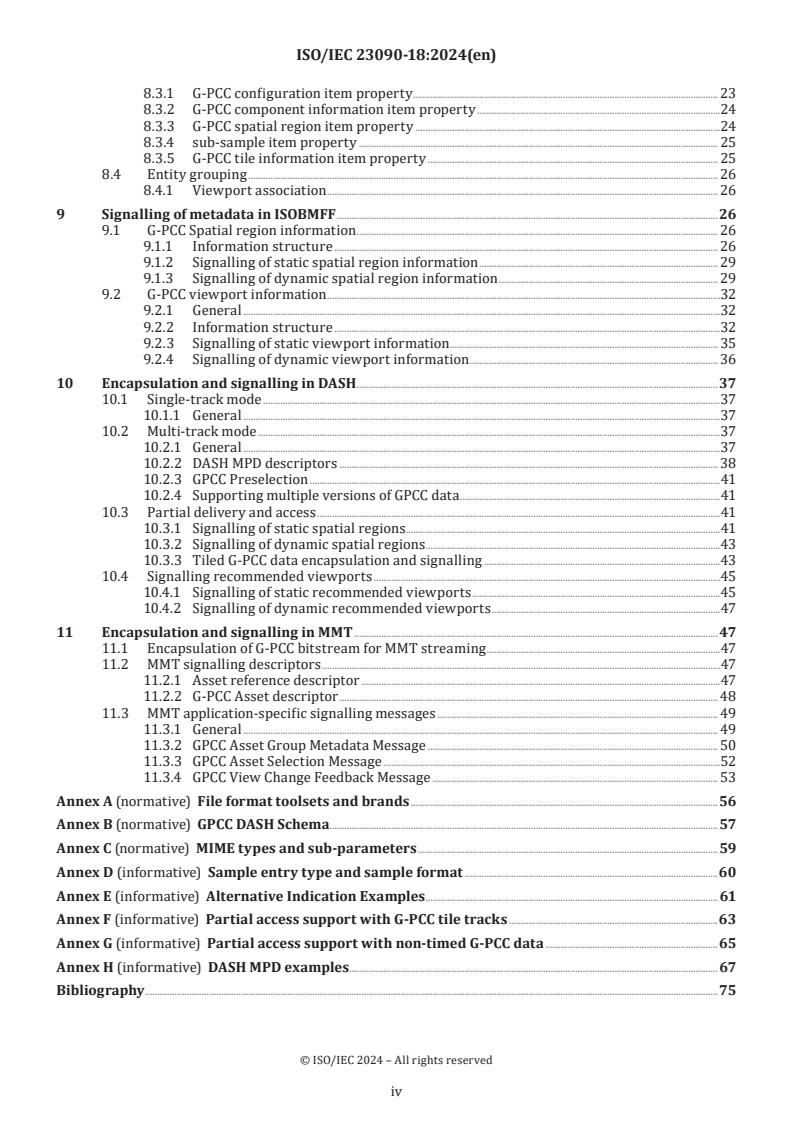
Annex A (normative) File format toolsets and brands .56
Annex B (normative) GPCC DASH Schema.57
Annex C (normative) MIME types and sub-parameters .59
Annex D (informative) Sample entry type and sample format .60
Annex E (informative) Alternative Indication Examples . 61
Annex F (informative) Partial access support with G-PCC tile tracks .63
Annex G (informative) Partial access support with non-timed G-PCC data .65
Annex H (informative) DASH MPD examples . 67
Bibliography .75
© ISO/IEC 2024 – All rights reserved
iv
Foreword
ISO (the International Organization for Standardization) and IEC (the International Electrotechnical
Commission) form the specialized system for worldwide standardization. National bodies that are
members of ISO or IEC participate in the development of International Standards through technical
committees established by the respective organization to deal with particular fields of technical activity.
ISO and IEC technical committees collaborate in fields of mutual interest. Other international organizations,
governmental and non-governmental, in liaison with ISO and IEC, also take part in the work.
The procedures used to develop this document and those intended for its further maintenance are described
in the ISO/IEC Directives, Part 1. In particular, the different approval criteria needed for the different types
of document should be noted. This document was drafted in accordance with the editorial rules of the ISO/
IEC Directives, Part 2 (see www.iso.org/directives or www.iec.ch/members_experts/refdocs).
ISO and IEC draw attention to the possibility that the implementation of this document may involve the
use of (a) patent(s). ISO and IEC take no position concerning the evidence, validity or applicability of any
claimed patent rights in respect thereof. As of the date of publication of this document, ISO and IEC had
received notice of (a) patent(s) which may be required to implement this document. However, implementers
are cautioned that this may not represent the latest information, which may be obtained from the patent
database available at www.iso.org/patents and https://patents.iec.ch. ISO and IEC shall not be held
responsible for identifying any or all such patent rights.
Any trade name used in this document is information given for the convenience of users and does not
constitute an endorsement.
For an explanation of the voluntary nature of standards, the meaning of ISO specific terms and expressions
related to conformity assessment, as well as information about ISO's adherence to the World Trade
Organization (WTO) principles in the Technical Barriers to Trade (TBT) see www.iso.org/iso/foreword.html.
In the IEC, see www.iec.ch/understanding-standards.
This document was prepared by Joint Technical Committee ISO/IEC JTC 1, Information technology,
Subcommittee SC 29, Coding of audio, picture, multimedia and hypermedia information.
A list of all parts in the ISO/IEC 23090 series can be found on the ISO and IEC websites.
Any feedback or questions on this document should be directed to the user’s national standards
body. A complete listing of these bodies can be found at www.iso.org/members.html and
www.iec.ch/national-committees.
© ISO/IEC 2024 – All rights reserved
v
Introduction
Advances in 3D capturing and rendering technologies have unleashed a new wave of innovation in Virtual/
Augmented/Mixed reality (VR/AR/MR) content creation and communication. Point clouds have arisen as
one of the main representations for such applications. Geometry-based point cloud compression data is
used for representing sparse dynamically varying point clouds such as those used in vehicular LiDAR or 3D
mapping, as well as dense static point clouds used in cultural heritage, and industrial applications.
This document addresses technologies defining the carriage of geometry-based point cloud compression
data for storage and delivery purposes. This document includes(but is not limited to):
— Storage of geometry-based point cloud compression data and the associated metadata using the ISO Base
Media File Format (ISOBMFF) as specified in ISO/IEC 14496-12;
— Storage of non-timed geometry-based point cloud compression data and the associated metadata using
HEVC Image File Format (HEIF) as specified in ISO/IEC 23008-12;
— Encapsulation, signalling, and streaming of geometry-based compression data in a media streaming
system, for example, dynamic adaptive streaming over HTTP (DASH) as specified in ISO/IEC 23009-1 or
MPEG media transport (MMT) as specified in ISO/IEC 23008-1.
© ISO/IEC 2024 – All rights reserved
vi
International Standard ISO/IEC 23090-18:2024(en)
Information technology — Coded representation of
immersive media —
Part 18:
Carriage of geometry-based point cloud compression data
1 Scope
This document specifies a media format that enables the storage and delivery of geometry-based point cloud
compression data. The geometry-based point cloud compression data can be timed or non-timed. It supports
flexible extraction of geometry-based point cloud compression data at delivery or decoding time.
2 Normative references
The following documents are referred to in the text in such a way that some or all of their content constitutes
requirements of this document. For dated references, only the edition cited applies. For undated references,
the latest edition of the referenced document (including any amendments) applies.
ISO/IEC 9834-1, (Rec. ITU-T X.660), Information technology — Procedures for the operation of object identifier
registration authorities — Part 1: General procedures and top arcs of the international object identifier tree
ISO/IEC 9834-8, (Rec. ITU-T X.667), Information technology — Procedures for the operation of object identifier
registration authorities — Part 8: Generation of universally unique identifiers (UUIDs) and their use in object
identifiers
ISO/IEC 14496-12, Information technology — Coding of audio-visual objects — Part 12: ISO base media file
format
ISO/IEC 23008-1:2023, Information technology — High efficiency coding and media delivery in heterogeneous
environments — Part 1: MPEG media transport (MMT)
ISO/IEC 23008-12:2022, Information technology — MPEG systems technologies — Part 12: Image File Format
ISO/IEC 23009-1:2022, Information technology — Dynamic adaptive streaming over HTTP (DASH) — Part 1:
Media presentation description and segment formats
ISO/IEC 23090-9:2023, Information technology — Coded representation of immersive media (MPEG-I) — Part
9: Geometry-based point cloud compression
IEEE 754-2019, IEEE Standard for Floating-Point Arithmetic.
W3C Recommendation, XML schema part 1: Structures
W3C Recommendation, XML schema part 2: Datatypes
3 Terms and definitions
For the purposes of this document, the terms and definitions given in ISO/IEC 23090-9 and the following
apply.
ISO and IEC maintain terminology databases for use in standardization at the following addresses:
— ISO Online browsing platform: available at https:// www .iso .org/ obp
© ISO/IEC 2024 – All rights reserved
— IEC Electropedia: available at https:// www .electropedia .org/
3.1
attribute track
volumetric visual track which carries ADUs of one instance of a particular attribute component of coded
point cloud frames
3.2
attribute tile track
G-PCC tile track (3.10) which carries ADUs of one instance of a particular attribute component corresponding
to one or more G-PCC tiles
3.3
G-PCC bitstream
sequence of bits of the coded point cloud sequence
Note 1 to entry: G-PCC bitstream is specified in ISO/IEC 23090-9.
3.4
G-PCC bitstream track
volumetric visual track which carries the entire coded point cloud sequence
3.5
G-PCC content
volumetric visual media that that consists of one or more point cloud frames
Note 1 to entry: Each point cloud frame includes a number of points, identified by their positions in 3D space, and the
associated attributes (e.g. colour) at a particular time instance.
3.6
G-PCC component track
volumetric visual track which carries DUs of one instance of a particular G-PCC component
Note 1 to entry: There are two types of G-PCC component tracks: one is geometry track (3.7) and the other is attribute
track (3.1).
3.7
geometry track
volumetric visual track which carries GDUs of the coded point cloud frames
3.8
geometry tile track
G-PCC tile track (3.10) which carries GDUs of one or more G-PCC tiles
3.9
G-PCC player
application responsible for receiving files/segments or accessing files locally, decapsulating files/segments,
decoding the G-PCC bitstream, reconstructing point cloud frames from the decoded G-PCC bitstream, and
rendering the point cloud frames
3.10
G-PCC tile track
volumetric visual track which carries either any of DUs corresponding to one or more G-PCC tiles
3.11
G-PCC tile base track
volumetric visual track which carries DUs which can be applied across the associated G-PCC tile tracks (3.10)
© ISO/IEC 2024 – All rights reserved
4 Abbreviated terms
ADU attribute data unit (specified in ISO/IEC 23090-9)
APS attribute parameter set (specified in ISO/IEC 23090-9)
DASH dynamic adaptive streaming over HTTP (specified in ISO/IEC 23009-1)
DU data unit (specified in ISO/IEC 23090-9)
FBDU frame boundary marker data unit (specified in ISO/IEC 23090-9)
FSAP frame-specific attribute properties (specified in ISO/IEC 23090-9)
GDU geometry data unit (specified in ISO/IEC 23090-9)
GPS geometry parameter set (specified in ISO/IEC 23090-9)
HTTP Hyper-text transfer protocol
HEIF HEVC image format (specified in ISO/IEC 23008-12)
ISOBMFF ISO base media file format (specified in ISO/IEC 14496-12)
MMT MPEG media transport (specified in ISO/IEC 23008-1)
SPS sequence parameter set (specified in ISO/IEC 23090-9)
5 Overview
5.1 Overall architecture for carriage of geometry-based point cloud compression data
Geometry-based point cloud compression (G-PCC) provides the method for efficiently compressing the
point cloud sequence which consists of one or more point cloud frames. Each point cloud frame consists of
a number of points and each point is a tuple of a three-dimensional position and attribute values for every
attribute present in the point cloud.
The coded point cloud sequence forms a G-PCC bitstream comprising of data represents a volumetric
encoding of point clouds consisting of a sequence of point cloud frames. Each point cloud frame includes a
number of points, identified by their positions in 3D space, and their associated attributes at a particular
time instance. The number of points can vary from one frame to another.
parameter sets and slices of coded point cloud frames. Every slice includes a GDU which codes the slice
geometry and ADUs or defaulted attribute DUs which code the slice attributes. The group of slices may be
associated with spatial regions in a point cloud to aid spatial access.
Figure 1 shows the overall architecture for a typical content flow process for carriage of G-PCC data and it is
applicable to both live and on-demand use cases.
© ISO/IEC 2024 – All rights reserved
Figure 1 — Overall architecture flow process of for carriage of G-PCC data
A real-world visual scene (A) is captured by a set of cameras or a camera device with multiple lenses and
sensors. A virtual visual scene (A) is also captured by virtual camera. The acquisition results in a point cloud
sequence comprising of one or more point cloud frames (B). The point cloud sequence can be timed or non-
timed. Each point cloud frame includes a set of points, identified by their positions in a three-dimensional
Cartesian coordinate system, and associated attributes at a particular time instance. All points in the same
point cloud frame have the same number of attributes. The number of points may vary from one frame
to another. Each point cloud frame is coded as a sequence of slices and each slice comprises a sequence of
encapsulated DUs. One or multiple point cloud frames are multiplexed into a G-PCC bitstream(E). The G-PCC
bitstream are then encapsulated into a media file for file playback (F) or a sequence of an initialization
segment and media segments for streaming (F ), according to a particular media container file format. The
s
metadata which can contribute to interpret and to consume the point cloud frames is encapsulated into the
file or the segments. The point cloud metadata can describe, for example, the mapping between points to
spatial regions within a point cloud. The segments F are delivered using a delivery mechanism to a G-PCC
s
player.
The file that the file encapsulator outputs (F) is identical to the file that the file decapsulator inputs (F').
The G-PCC player processes the file (F’) or the received segments (F’ ) and extracts the G-PCC bitstream (E’)
s
and parses the metadata. The G-PCC bitstream is then decoded into one or multiple point cloud frames (D’)
and the point clouds are reconstructed from the decoded point cloud frames (D’). The reconstructed point
clouds are rendered and displayed onto the screen of a head-mounted display or any other display device
based on the viewport information, such as the current viewing position, viewing orientation, or the field of
view information, which is determined by various types of sensors. Besides being used by the G-PCC player
to access the appropriate part of the point clouds, the viewport information can also be used for determining
which tracks are extracted from the file. In viewport-dependent delivery, the viewport information is also
passed to the strategy module, which determines the segments to be received based on the current viewport.
This process is applicable to both live and on-demand use cases.
The following interfaces are specified in this document:
— F/F’: media file including the specification of the track formats in Clause 7 for timed G-PCC data, in
Clause 8 for non-timed G-PCC data, and in Clause 9 for metadata in ISOBMFF.
— Clause 10 specifies the delivery related interfaces for DASH delivery.
— Clause 11 specifies the delivery related interfaces for MMT delivery.
© ISO/IEC 2024 – All rights reserved
The other interfaces in Figure 1 are not specified in this document.
5.2 Referenceable code points
5.2.1 Brands
The brands are used in this document to indicate conformance points to an encapsulation mode and a
specific set of tools that are defined in this document. It may be indicated in the FileTypeBox.
The brands specified in this document are listed in Table 1 and defined in Annex A.
Table 1 — Brands specified in this document
Subclause in this
Brand identifier Description
document
gpst
A.2.1 Single track encapsulation
gpmt
A.2.2 Multiple track encapsulation
gppa
A.2.3 Encapsulation with partial access support
gpci
A.3 Non-timed G-PCC encapsulation
5.2.2 Sample entry type
The sample entry type specified in this document are listed in Table 2.
Table 2 — Sample entry types specified in this document
Subclause in this
Sample entry type Description
document
gpe1
7.3.2 For use with the single track encapsulation with all parameter set data
units carrying SPS, GPS, and APS carried in decoder configuration record
gpeg
7.3.2 For use with the single track encapsulation with all parameter set data
units carrying SPS, GPS, and APS carried in decoder configuration record
and in track samples
gpc1
7.4.2 For use with the multiple track encapsulation with all parameter set data
units carrying SPS, GPS, and APS carried in decoder configuration record
gpcg
7.4.2 For use with the multiple track encapsulation with all parameter set data
units carrying SPS, GPS, and APS carried in decoder configuration record
and in track samples
gpeb
7.5.2.1 For use with a tile base track with G-PCC tile track(s) containing DUs of
all components
gpcb
7.5.2.1 For use with a tile base track with G-PCC tile track(s) containing DUs of
one instance of a particular component
gpt1
7.5.3.1 For use with a G-PCC tile track
gpdr
9.1.3.2 For use with a timed metadata track indicating the dynamic spatial regions
that are dynamically changing over time
gpdv
9.2.4.2 For use with a timed metadata track indicating viewport information that
are dynamically changing over time
5.2.3 Box types
The box types specified in this document are listed in bold in Table 3. Mandatory boxes are marked with an
asterisk. Box types without a four-character code are marked with ‘-‘ in the structure.
© ISO/IEC 2024 – All rights reserved
Table 3 — Box types specified in this document and their relation to boxes not specified in this
document
Box types, structure, and cross-reference
moov * ISOBMFF container for all the metadata
trak * ISOBMFF container for an individual track or stream
mdia * ISOBMFF container for the media information in a track
minf * ISOBMFF media information container
stbl * ISOBMFF sample table box, container for the time/space map
stsd * ISOBMFF sample descriptions (codec types, initialization etc.)
- ISOBMFF visual sample entry
- 6.1.3 volumetric visual sample entry
gpcC 7.2.2 G-PCC decoder configuration box
ginf 7.2.3 G-PCC component information box
gptC 7.5.3.1 G-PCC tile configuration box
gpsr 8.3.3 Static spatial region information box
gvpC 9.2.3 Viewport information Configuration Box
gpdr 9.1.3.2 Dynamic spatial region timed metadata sample entry
gpsr 8.3.3 Static spatial region information box
gpdv 9.2.4.2 Viewport information timed metadata sample entry
gvpC 9.2.3 Viewport information Configuration Box
meta ISOBMFF Metadata
grpl ISOBMFF group list box
vpta 8.4.1 Viewport association box
iprp ISOBMFF item properties box
ipco ISOBMFF item property container box
gpcC 8.3.1 G-PCC configuration item property
ginf 8.3.2 G-PCC component information item property
gpsr 8.3.3 G-PCC spatial region item property
gpti 8.3.4 G-PCC tile information item property
5.2.4 Track reference types
The track reference types specified in this document are listed in Table 4.
Table 4 — Track reference types specified in this document
Track reference Subclause in this Description
type document
gpca
7.4.4 Referenced track is an attribute track
gpbt
7.5.5 Referenced track is a G-PCC tile track
5.2.5 Entity grouping types
The entity grouping types specified in this document are listed in Table 5.
Table 5 — Entity grouping types specified in this document
Entity groping Subclause in this
Description
type document
vpta
8.4.1 Viewport association between G-PCC items and the viewport information
timed metadata track
© ISO/IEC 2024 – All rights reserved
5.2.6 Sample grouping types
The sample grouping types specified in this document are listed in Table 6.
Table 6 — sample grouping types specified in this document
Sample grouping Subclause in this
Description
type document
gtii
7.2.4 Tile inventory sample group
5.2.7 Uniform resource names
The URNs specified in this document are listed in Table 7.
Table 7 — URNs specified in this document
Subclause in this
URN Description
document
urn:mpeg:mpegI:gpcc:2023
10.2.2.1 Namespace for the XML elements and
attributes specified in this document
urn:mpeg:mpegI:gpcc:2023:component
10.2.2.2 Scheme identifier for the G-PCC component
DASH MPD descriptor
urn:mpeg:mpegI:gpcc:2023:gpc
10.2.2.3 Scheme identifier for the G-PCC content
DASH MPD descriptor
urn:mpeg:mpegI:gpcc:2023:gpsr
10.3.1 Scheme identifier for the G-PCC static
spatial region DASH MPD descriptor
urn:mpeg:mpegI:gpcc:2023:tileID
10.3.3.1 Scheme identifier for the G-PCC tile id
DASH MPD descriptor
urn:mpeg:mpegI:gpcc:2023:rv
10.4.1 Scheme identifier for the static recom-
mended viewports DASH MPD descriptor
urn:mpeg:mmt:app:gpcc:2023
11.3.1 Scheme identifier for the MMT G-PCC
specific signalling messages
6 Volumetric media
6.1 Volumetric visual media
6.1.1 General
A volumetric visual track shall be identified by the volumetric visual media handler type 'volv' in the
HandlerBox of the MediaBox, as defined in ISO/IEC 14496-12, and by a volumetric visual media header as
defined in subclause 6.1.2.
Multiple volumetric visual tracks can be present in the file.
6.1.2 Volumetric visual media header
6.1.2.1 Definition
Box Type: 'vvhd'
Container: MediaInformationBox
Mandatory: Yes
Quantity: Exactly one
© ISO/IEC 2024 – All rights reserved
Volumetric visual tracks shall use a VolumetricVisualMediaHeaderBox in the MediaInformationBox as
defined in ISO/IEC 14496-12.
6.1.2.2 Syntax
aligned(8) class VolumetricVisualMediaHeaderBox
extends FullBox('vvhd', version = 0, 1) {
}
6.1.2.3 Semantics
version is an integer that specifies the version of this box.
6.1.3 Volumetric visual sample entry
6.1.3.1 Definition
Volumetric visual tracks shall use a VolumetricVisualSampleEntry.
6.1.3.2 Syntax
class VolumetricVisualSampleEntry(codingname)
extends SampleEntry (codingname){
unsigned int(8)[32] compressorname;
// other boxes from derived specifications
}
6.1.3.3 Semantics
compressorname is a name, for informative purposes. It is formatted in a fixed 32-byte field, with the first
byte set to the number of bytes to be displayed, followed by that number of bytes of displayable data
encoded using UTF-8, and then padding to complete 32 bytes total (including the size byte). The field
may be set to 0.
6.1.4 Volumetric visual sample group entry
abstract class VolumetricVisualSampleGroupEntry (unsigned int(32) grouping_type)
extends SampleGroupDescriptionEntry (grouping_type)
{
}
6.1.5 Volumetric visual samples
The format of a volumetric visual sample is defined by the coding system.
7 Timed G-PCC data storage in ISOBMFF
7.1 General
This clause specifies the below encapsulation of G-PCC bitstream in tracks within a file, and only one of the
below encapsulations shall be used at the same time.
— Single track encapsulation of G-PCC bitstream, where one track carries the entire coded point cloud
sequence, as specified in subclause 7.3.
— Multiple track encapsulation, where the coded bitstream of single G-PCC component of the point cloud
sequence is encapsulated into a separate track, as specified in subclause 7.4.
— Encapsulation with G-PCC tile tracks, where DUs of one or more G-PCC tiles are encapsulated into a
separate track, as specified in subclause 7.5.
© ISO/IEC 2024 – All rights reserved
The order of G-PCC slices and DUs of the output G-PCC bitstream after decapsulation should be maintained
as the order of G-PCC slices and DUs of the original G-PCC bitstream.
Annex D provides a summary of the sample entry types and sample formats for tracks defined in this
document.
7.2 Common boxes and data structures
7.2.1 G-PCC decoder configuration record
7.2.1.1 Definition
This subclause specifies the G-PCC decoder configuration information for ISO/IEC 23090-9 content.
This G-PCC decoder configuration record contains the information for configuration and initialization of
G-PCC decoder. It contains a configurationVersion field. This edition of this document defines version 1
of this record. Incompatible changes to the record will be indicated by a change of configuration version
number. Compatible extensions to this record will extend it and will not change the configuration version
number. The G-PCC player shall not attempt to decode this record or the G-PCC bitstreams to which it applies
if the value of configurationVersion is not supported or recogni
...