

ISO 15674:2016
(Main)Cardiovascular implants and artificial organs — Hard-shell cardiotomy/venous reservoir systems (with/without filter) and soft venous reservoir bags
General Information
- Abstract
ISO 15674:2016 specifies requirements for sterile, single-use, extracorporeal hard-shell cardiotomy/venous reservoir systems and soft venous reservoir bags intended for use as a blood reservoir during cardiopulmonary bypass (CPB) surgery. It applies only to the blood reservoir aspects for multifunctional systems which can have integral parts such as blood-gas exchangers (oxygenators), blood filters, defoamers, blood pumps, etc.
- Status
- Published
- Publication Date
- 14-Aug-2016
- Technical Committee
- ISO/TC 150/SC 2 - Cardiovascular implants and extracorporeal systems
- Drafting Committee
- ISO/TC 150/SC 2/WG 4 - Blood gas exchangers
- Current Stage
- 9093 - International Standard confirmed
- Start Date
- 02-May-2023
- Completion Date
- 29-Aug-2026
Buy Documents

ISO 15674:2016 - Cardiovascular implants and artificial organs -- Hard-shell cardiotomy/venous reservoir systems (with/without filter) and soft venous reservoir bags

ISO 15674:2016 - Cardiovascular implants and artificial organs — Hard-shell cardiotomy/venous reservoir systems (with/without filter) and soft venous reservoir bags/15/2016
Overview
ISO 15674:2016 - Cardiovascular implants and artificial organs - Hard-shell cardiotomy/venous reservoir systems (with/without filter) and soft venous reservoir bags - specifies requirements for sterile, single‑use extracorporeal blood reservoirs used during cardiopulmonary bypass (CPB) surgery. The standard covers the blood reservoir aspects of both hard‑shell and soft‑bag reservoirs and applies to multifunctional systems only insofar as the reservoir function is concerned (oxygenators, pumps and other integral parts are out of scope for this document).
Key topics and requirements
ISO 15674:2016 focuses on biological, physical and performance characteristics, and on testing and labeling. Major technical points include:
- Sterility and non‑pyrogenicity: Blood pathways must be sterile and non‑pyrogenic; compliance verified per the standard’s test clauses.
- Biocompatibility: All parts in contact with blood must meet biocompatibility requirements (referenced to ISO 10993 series).
- Blood pathway integrity: Soft‑bag and sealed hard‑shell reservoirs shall not leak when tested.
- Volume controls: Static, dynamic and priming volumes must be measured and reported within manufacturer tolerances; minimum and maximum volumes identified.
- Connectors and interfaces: Connectors must allow secure connections to standard tubing sizes or conform to referenced connector figures.
- Performance metrics: Includes testing and documentation of
- blood cell damage at maximum flow,
- air‑handling capacity,
- defoaming characteristics,
- filtration efficiency (for reservoirs with filters),
- break‑through volume,
- volume calibration and dynamic priming volume across flow ranges.
- Shelf life, packaging and labeling: Requirements for unit and shipping containers, information on product labels and accompanying documents.
Applications and users
ISO 15674:2016 is practical for:
- Manufacturers of hard‑shell cardiotomy/venous reservoir systems and soft venous reservoir bags - to design, test and document CPB blood reservoirs for regulatory submissions.
- Quality, regulatory and R&D teams - to structure validation protocols, biocompatibility testing and shelf‑life studies.
- Test laboratories - to perform performance and integrity tests specified by the standard.
- Hospitals, perfusionists and procurement specialists - to assess product compliance, labeling and suitability for clinical CPB use.
Keywords: ISO 15674:2016, cardiotomy/venous reservoir systems, soft venous reservoir bags, cardiopulmonary bypass (CPB), blood reservoir, sterile single‑use, priming volume, filtration efficiency, biocompatibility.
Related standards
ISO 15674 references and aligns with several normative standards used in testing and documentation, including:
- ISO 10993‑1, ISO 10993‑7, ISO 10993‑11 (biological evaluation)
- ISO 11135, ISO 11137‑1, ISO 17665‑1 (sterilization)
- ISO 11607‑1 / ‑2 (packaging for terminally sterilized medical devices)
Use ISO 15674:2016 to ensure blood reservoir design and testing meet recognized international safety and performance expectations for CPB applications.
Relations
- Effective Date
- 04-Dec-2021
Buy Documents
ISO 15674:2016 - Cardiovascular implants and artificial organs -- Hard-shell cardiotomy/venous reservoir systems (with/without filter) and soft venous reservoir bags
ISO 15674:2016 - Cardiovascular implants and artificial organs — Hard-shell cardiotomy/venous reservoir systems (with/without filter) and soft venous reservoir bags/15/2016
Get Certified
Connect with accredited certification bodies for this standard

BSI Group
BSI (British Standards Institution) is the business standards company that helps organizations make excellence a habit.

TÜV Rheinland
TÜV Rheinland is a leading international provider of technical services.

TÜV SÜD
TÜV SÜD is a trusted partner of choice for safety, security and sustainability solutions.
Sponsored listings
Frequently Asked Questions
ISO 15674:2016 is a standard published by the International Organization for Standardization (ISO). Its full title is "Cardiovascular implants and artificial organs — Hard-shell cardiotomy/venous reservoir systems (with/without filter) and soft venous reservoir bags". This standard covers: ISO 15674:2016 specifies requirements for sterile, single-use, extracorporeal hard-shell cardiotomy/venous reservoir systems and soft venous reservoir bags intended for use as a blood reservoir during cardiopulmonary bypass (CPB) surgery. It applies only to the blood reservoir aspects for multifunctional systems which can have integral parts such as blood-gas exchangers (oxygenators), blood filters, defoamers, blood pumps, etc.
ISO 15674:2016 specifies requirements for sterile, single-use, extracorporeal hard-shell cardiotomy/venous reservoir systems and soft venous reservoir bags intended for use as a blood reservoir during cardiopulmonary bypass (CPB) surgery. It applies only to the blood reservoir aspects for multifunctional systems which can have integral parts such as blood-gas exchangers (oxygenators), blood filters, defoamers, blood pumps, etc.
ISO 15674:2016 is classified under the following ICS (International Classification for Standards) categories: 11.040.40 - Implants for surgery, prosthetics and orthotics. The ICS classification helps identify the subject area and facilitates finding related standards.
ISO 15674:2016 has the following relationships with other standards: It is inter standard links to ISO 15674:2016/Amd 1:2020. Understanding these relationships helps ensure you are using the most current and applicable version of the standard.
ISO 15674:2016 is available in PDF format for immediate download after purchase. The document can be added to your cart and obtained through the secure checkout process. Digital delivery ensures instant access to the complete standard document.
Standards Content (Sample)
INTERNATIONAL ISO
STANDARD 15674
Third edition
2016-08-15
Cardiovascular implants and artificial
organs — Hard-shell cardiotomy/
venous reservoir systems (with/
without filter) and soft venous
reservoir bags
Implants cardiovasculaires et organes artificiels — Systèmes
réservoirs de cardiotomie/veineux à paroi dure (avec/sans filtre) et
sacs réservoirs veineux mous
Reference number
©
ISO 2016
© ISO 2016, Published in Switzerland
All rights reserved. Unless otherwise specified, no part of this publication may be reproduced or utilized otherwise in any form
or by any means, electronic or mechanical, including photocopying, or posting on the internet or an intranet, without prior
written permission. Permission can be requested from either ISO at the address below or ISO’s member body in the country of
the requester.
ISO copyright office
Ch. de Blandonnet 8 • CP 401
CH-1214 Vernier, Geneva, Switzerland
Tel. +41 22 749 01 11
Fax +41 22 749 09 47
copyright@iso.org
www.iso.org
ii © ISO 2016 – All rights reserved
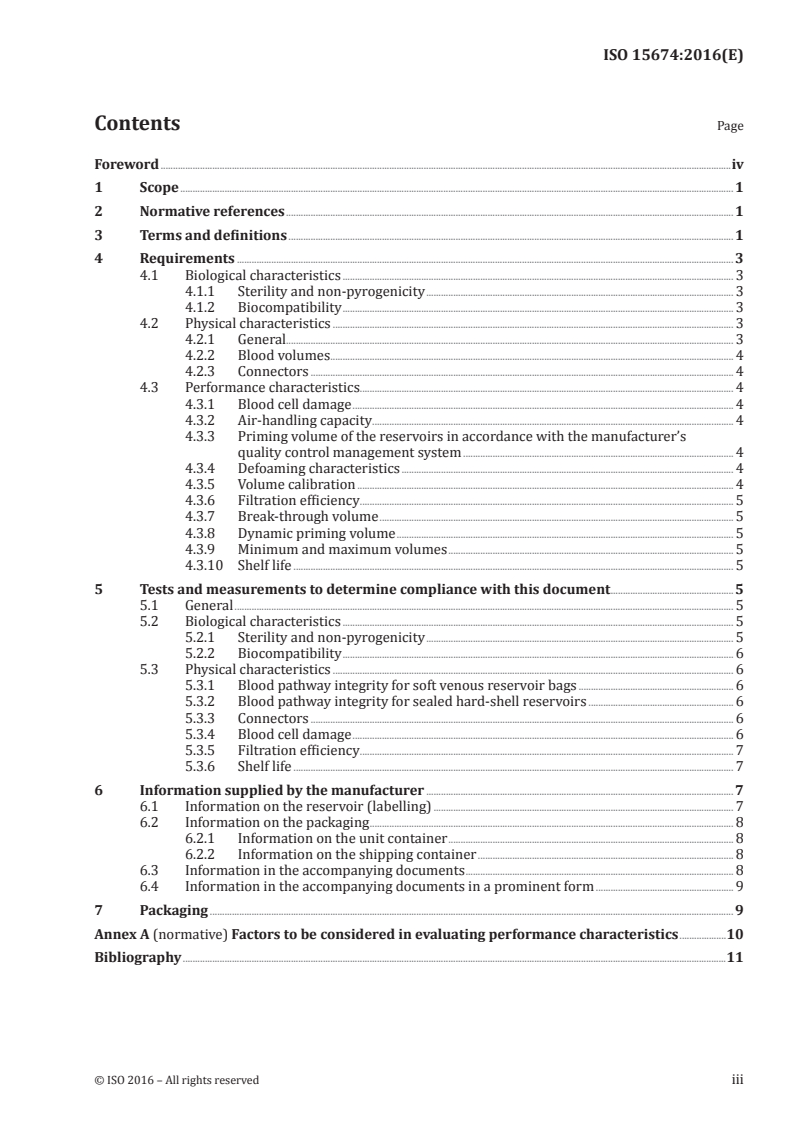
Contents Page
Foreword .iv
1 Scope . 1
2 Normative references . 1
3 Terms and definitions . 1
4 Requirements . 3
4.1 Biological characteristics . 3
4.1.1 Sterility and non-pyrogenicity . 3
4.1.2 Biocompatibility . 3
4.2 Physical characteristics . 3
4.2.1 General. 3
4.2.2 Blood volumes . 4
4.2.3 Connectors . 4
4.3 Performance characteristics. 4
4.3.1 Blood cell damage . 4
4.3.2 Air-handling capacity . . 4
4.3.3 Priming volume of the reservoirs in accordance with the manufacturer’s
quality control management system . 4
4.3.4 Defoaming characteristics . 4
4.3.5 Volume calibration . 4
4.3.6 Filtration efficiency . . 5
4.3.7 Break-through volume . 5
4.3.8 Dynamic priming volume . 5
4.3.9 Minimum and maximum volumes . 5
4.3.10 Shelf life . 5
5 Tests and measurements to determine compliance with this document .5
5.1 General . 5
5.2 Biological characteristics . 5
5.2.1 Sterility and non-pyrogenicity . 5
5.2.2 Biocompatibility . 6
5.3 Physical characteristics . 6
5.3.1 Blood pathway integrity for soft venous reservoir bags . 6
5.3.2 Blood pathway integrity for sealed hard-shell reservoirs . 6
5.3.3 Connectors . 6
5.3.4 Blood cell damage . 6
5.3.5 Filtration efficiency . . 7
5.3.6 Shelf life . 7
6 Information supplied by the manufacturer . 7
6.1 Information on the reservoir (labelling) . 7
6.2 Information on the packaging . 8
6.2.1 Information on the unit container . 8
6.2.2 Information on the shipping container . 8
6.3 Information in the accompanying documents . 8
6.4 Information in the accompanying documents in a prominent form . 9
7 Packaging . 9
Annex A (normative) Factors to be considered in evaluating performance characteristics .10
Bibliography .11
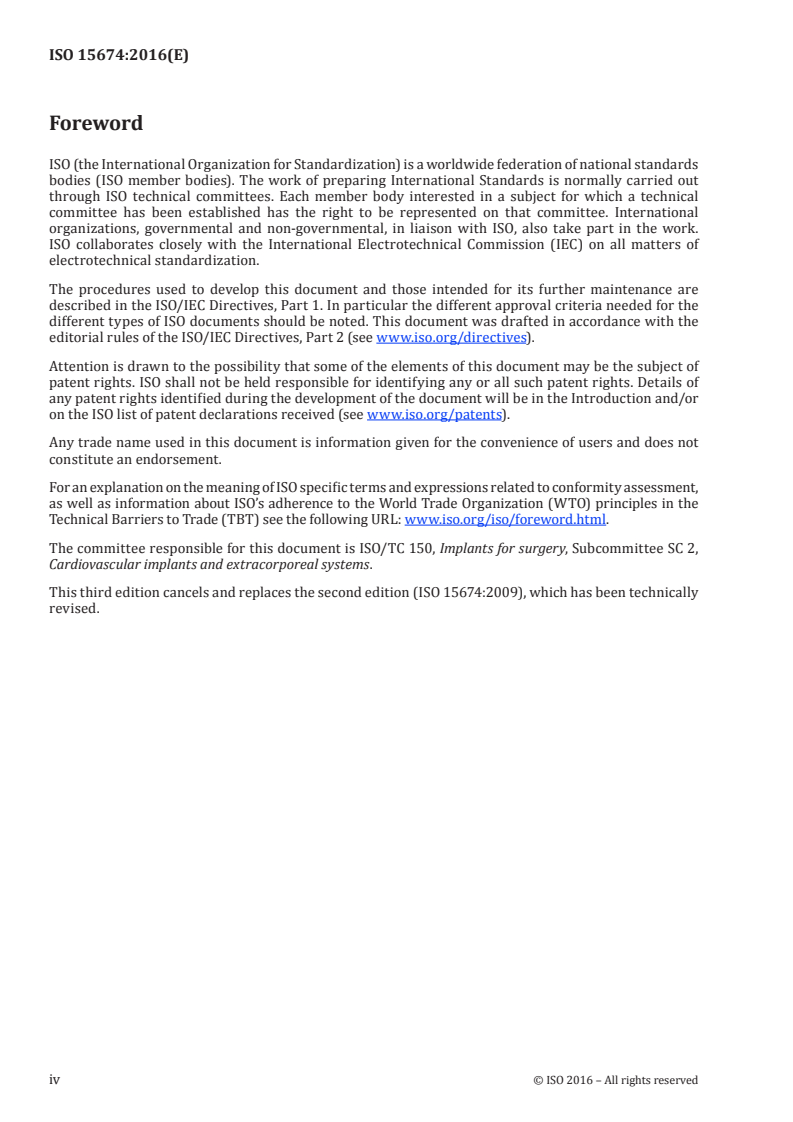
Foreword
ISO (the International Organization for Standardization) is a worldwide federation of national standards
bodies (ISO member bodies). The work of preparing International Standards is normally carried out
through ISO technical committees. Each member body interested in a subject for which a technical
committee has been established has the right to be represented on that committee. International
organizations, governmental and non-governmental, in liaison with ISO, also take part in the work.
ISO collaborates closely with the International Electrotechnical Commission (IEC) on all matters of
electrotechnical standardization.
The procedures used to develop this document and those intended for its further maintenance are
described in the ISO/IEC Directives, Part 1. In particular the different approval criteria needed for the
different types of ISO documents should be noted. This document was drafted in accordance with the
editorial rules of the ISO/IEC Directives, Part 2 (see www.iso.org/directives).
Attention is drawn to the possibility that some of the elements of this document may be the subject of
patent rights. ISO shall not be held responsible for identifying any or all such patent rights. Details of
any patent rights identified during the development of the document will be in the Introduction and/or
on the ISO list of patent declarations received (see www.iso.org/patents).
Any trade name used in this document is information given for the convenience of users and does not
constitute an endorsement.
For an explanation on the meaning of ISO specific terms and expressions related to conformity assessment,
as well as information about ISO’s adherence to the World Trade Organization (WTO) principles in the
Technical Barriers to Trade (TBT) see the following URL: www.iso.org/iso/foreword.html.
The committee responsible for this document is ISO/TC 150, Implants for surgery, Subcommittee SC 2,
Cardiovascular implants and extracorporeal systems.
This third edition cancels and replaces the second edition (ISO 15674:2009), which has been technically
revised.
iv © ISO 2016 – All rights reserved
INTERNATIONAL STANDARD ISO 15674:2016(E)
Cardiovascular implants and artificial organs — Hard-
shell cardiotomy/venous reservoir systems (with/without
filter) and soft venous reservoir bags
1 Scope
This document specifies requirements for sterile, single-use, extracorporeal hard-shell
cardiotomy/venous reservoir systems and soft venous reservoir bags intended for use as a blood
reservoir during cardiopulmonary bypass (CPB) surgery.
This document applies only to the blood reservoir aspects for multifunctional systems which can have
integral parts such as blood-gas exchangers (oxygenators), blood filters, defoamers, blood pumps, etc.
2 Normative references
The following documents are referred to in the text in such a way that some or all of their content
constitutes requirements of this document. For dated references, only the edition cited applies. For
undated references, the latest edition of the referenced document (including any amendments) applies.
ISO 10993-1, Biological evaluation of medical devices — Part 1: Evaluation and testing within a risk
management process
ISO 10993-7, Biological evaluation of medical devices — Part 7: Ethylene oxide sterilization residuals
ISO 10993-11, Biological evaluation of medical devices — Part 11: Tests for systemic toxicity
ISO 11135, Sterilization of health-care products — Ethylene oxide — Requirements for the development,
validation and routine control of a sterilization process for medical devices
ISO 11137-1, Sterilization of health care products — Radiation — Part 1: Requirements for development,
validation and routine control of a sterilization process for medical devices
ISO 11607-1, Packaging for terminally sterilized medical devices — Part 1: Requirements for materials,
sterile barrier systems and packaging systems
ISO 11607-2, Packaging for terminally sterilized medical devices — Part 2: Validation requirements for
forming, sealing and assembly processes
ISO 14937, Sterilization of health care products — General requirements for characterization of a sterilizing
agent and the development, validation and routine control of a sterilization process for medical devices
ISO 17665-1, Sterilization of health care products — Moist heat — Part 1: Requirements for the development,
validation and routine control of a sterilization process for medical devices
3 Terms and definitions
For the purposes of this document, the following terms and definitions apply.
ISO and IEC maintain terminological databases for use in standardization at the following addresses:
— ISO Online browsing platform: available at http://www.iso.org/obp
— IEC Electropedia: available at http://www.electropedia.org/
3.1
hard-shell cardiotomy reservoir
extracorporeal device consisting of rigid walls designed to collect, defoam and filter suctioned blood
3.2
hard-shell venous reservoir
extracorporeal device consisting of rigid walls designed to collect and defoam venous blood
3.3
soft-bag venous reservoir
extracorporeal device consisting of collapsible, pliable walls designed to collect venous blood
3.4
hard-shell cardiotomy/venous reservoir system
extracorporeal device designed to function simultaneously as both a venous reservoir and cardiotomy
reservoir
3.5
blood-gas exchanger
oxygenator
extracorporeal device designed to supplement, or be a substitute for, the respiratory function of the lungs
3.6
integral part
part that is connected to the reservoir or is part of the reservoir system that cannot normally be
separated by the user
3.7
operating variable
setting of controls which affects the function of the device
3.8
static volume
priming volume present in the device at zero flow
3.9
break-through volume
volume of fluid that, when added during the initial priming of the dry device (as received from the
manufacturer), must be exceeded before fluid first exits the device
3.10
sealed hard-shell reservoir
hard-shell reservoir that may be operated at either positive or negative pressure
3.12
dynamic priming volume
amount of fluid volume that is contained inside the defoamer/filter compartment at a specified flow
rate and, for soft bag reservoir, depending on the head pressure and the position of the compression
mechanism
Note 1 to entry: The dynamic priming volume can be affected by negative pressure applied to a hard-shell
reservoir.
3.13
platelet reduction
percentage reduction of platelets contained in a circuit as a function of time
3.14
plasma-free haemoglobin level
concentration of plasma-free haemoglobin in a circuit as a function of
...
INTERNATIONAL ISO
STANDARD 15674
Third edition
2016-08-15
Cardiovascular implants and artificial
organs — Hard-shell cardiotomy/
venous reservoir systems (with/
without filter) and soft venous
reservoir bags
Implants cardiovasculaires et organes artificiels — Systèmes
réservoirs de cardiotomie/veineux à paroi dure (avec/sans filtre) et
sacs réservoirs veineux mous
Reference number
©
ISO 2016
© ISO 2016, Published in Switzerland
All rights reserved. Unless otherwise specified, no part of this publication may be reproduced or utilized otherwise in any form
or by any means, electronic or mechanical, including photocopying, or posting on the internet or an intranet, without prior
written permission. Permission can be requested from either ISO at the address below or ISO’s member body in the country of
the requester.
ISO copyright office
Ch. de Blandonnet 8 • CP 401
CH-1214 Vernier, Geneva, Switzerland
Tel. +41 22 749 01 11
Fax +41 22 749 09 47
copyright@iso.org
www.iso.org
ii © ISO 2016 – All rights reserved
Contents Page
Foreword .iv
1 Scope . 1
2 Normative references . 1
3 Terms and definitions . 1
4 Requirements . 3
4.1 Biological characteristics . 3
4.1.1 Sterility and non-pyrogenicity . 3
4.1.2 Biocompatibility . 3
4.2 Physical characteristics . 3
4.2.1 General. 3
4.2.2 Blood volumes . 4
4.2.3 Connectors . 4
4.3 Performance characteristics. 4
4.3.1 Blood cell damage . 4
4.3.2 Air-handling capacity . . 4
4.3.3 Priming volume of the reservoirs in accordance with the manufacturer’s
quality control management system . 4
4.3.4 Defoaming characteristics . 4
4.3.5 Volume calibration . 4
4.3.6 Filtration efficiency . . 5
4.3.7 Break-through volume . 5
4.3.8 Dynamic priming volume . 5
4.3.9 Minimum and maximum volumes . 5
4.3.10 Shelf life . 5
5 Tests and measurements to determine compliance with this document .5
5.1 General . 5
5.2 Biological characteristics . 5
5.2.1 Sterility and non-pyrogenicity . 5
5.2.2 Biocompatibility . 6
5.3 Physical characteristics . 6
5.3.1 Blood pathway integrity for soft venous reservoir bags . 6
5.3.2 Blood pathway integrity for sealed hard-shell reservoirs . 6
5.3.3 Connectors . 6
5.3.4 Blood cell damage . 6
5.3.5 Filtration efficiency . . 7
5.3.6 Shelf life . 7
6 Information supplied by the manufacturer . 7
6.1 Information on the reservoir (labelling) . 7
6.2 Information on the packaging . 8
6.2.1 Information on the unit container . 8
6.2.2 Information on the shipping container . 8
6.3 Information in the accompanying documents . 8
6.4 Information in the accompanying documents in a prominent form . 9
7 Packaging . 9
Annex A (normative) Factors to be considered in evaluating performance characteristics .10
Bibliography .11
Foreword
ISO (the International Organization for Standardization) is a worldwide federation of national standards
bodies (ISO member bodies). The work of preparing International Standards is normally carried out
through ISO technical committees. Each member body interested in a subject for which a technical
committee has been established has the right to be represented on that committee. International
organizations, governmental and non-governmental, in liaison with ISO, also take part in the work.
ISO collaborates closely with the International Electrotechnical Commission (IEC) on all matters of
electrotechnical standardization.
The procedures used to develop this document and those intended for its further maintenance are
described in the ISO/IEC Directives, Part 1. In particular the different approval criteria needed for the
different types of ISO documents should be noted. This document was drafted in accordance with the
editorial rules of the ISO/IEC Directives, Part 2 (see www.iso.org/directives).
Attention is drawn to the possibility that some of the elements of this document may be the subject of
patent rights. ISO shall not be held responsible for identifying any or all such patent rights. Details of
any patent rights identified during the development of the document will be in the Introduction and/or
on the ISO list of patent declarations received (see www.iso.org/patents).
Any trade name used in this document is information given for the convenience of users and does not
constitute an endorsement.
For an explanation on the meaning of ISO specific terms and expressions related to conformity assessment,
as well as information about ISO’s adherence to the World Trade Organization (WTO) principles in the
Technical Barriers to Trade (TBT) see the following URL: www.iso.org/iso/foreword.html.
The committee responsible for this document is ISO/TC 150, Implants for surgery, Subcommittee SC 2,
Cardiovascular implants and extracorporeal systems.
This third edition cancels and replaces the second edition (ISO 15674:2009), which has been technically
revised.
iv © ISO 2016 – All rights reserved
INTERNATIONAL STANDARD ISO 15674:2016(E)
Cardiovascular implants and artificial organs — Hard-
shell cardiotomy/venous reservoir systems (with/without
filter) and soft venous reservoir bags
1 Scope
This document specifies requirements for sterile, single-use, extracorporeal hard-shell
cardiotomy/venous reservoir systems and soft venous reservoir bags intended for use as a blood
reservoir during cardiopulmonary bypass (CPB) surgery.
This document applies only to the blood reservoir aspects for multifunctional systems which can have
integral parts such as blood-gas exchangers (oxygenators), blood filters, defoamers, blood pumps, etc.
2 Normative references
The following documents are referred to in the text in such a way that some or all of their content
constitutes requirements of this document. For dated references, only the edition cited applies. For
undated references, the latest edition of the referenced document (including any amendments) applies.
ISO 10993-1, Biological evaluation of medical devices — Part 1: Evaluation and testing within a risk
management process
ISO 10993-7, Biological evaluation of medical devices — Part 7: Ethylene oxide sterilization residuals
ISO 10993-11, Biological evaluation of medical devices — Part 11: Tests for systemic toxicity
ISO 11135, Sterilization of health-care products — Ethylene oxide — Requirements for the development,
validation and routine control of a sterilization process for medical devices
ISO 11137-1, Sterilization of health care products — Radiation — Part 1: Requirements for development,
validation and routine control of a sterilization process for medical devices
ISO 11607-1, Packaging for terminally sterilized medical devices — Part 1: Requirements for materials,
sterile barrier systems and packaging systems
ISO 11607-2, Packaging for terminally sterilized medical devices — Part 2: Validation requirements for
forming, sealing and assembly processes
ISO 14937, Sterilization of health care products — General requirements for characterization of a sterilizing
agent and the development, validation and routine control of a sterilization process for medical devices
ISO 17665-1, Sterilization of health care products — Moist heat — Part 1: Requirements for the development,
validation and routine control of a sterilization process for medical devices
3 Terms and definitions
For the purposes of this document, the following terms and definitions apply.
ISO and IEC maintain terminological databases for use in standardization at the following addresses:
— ISO Online browsing platform: available at http://www.iso.org/obp
— IEC Electropedia: available at http://www.electropedia.org/
3.1
hard-shell cardiotomy reservoir
extracorporeal device consisting of rigid walls designed to collect, defoam and filter suctioned blood
3.2
hard-shell venous reservoir
extracorporeal device consisting of rigid walls designed to collect and defoam venous blood
3.3
soft-bag venous reservoir
extracorporeal device consisting of collapsible, pliable walls designed to collect venous blood
3.4
hard-shell cardiotomy/venous reservoir system
extracorporeal device designed to function simultaneously as both a venous reservoir and cardiotomy
reservoir
3.5
blood-gas exchanger
oxygenator
extracorporeal device designed to supplement, or be a substitute for, the respiratory function of the lungs
3.6
integral part
part that is connected to the reservoir or is part of the reservoir system that cannot normally be
separated by the user
3.7
operating variable
setting of controls which affects the function of the device
3.8
static volume
priming volume present in the device at zero flow
3.9
break-through volume
volume of fluid that, when added during the initial priming of the dry device (as received from the
manufacturer), must be exceeded before fluid first exits the device
3.10
sealed hard-shell reservoir
hard-shell reservoir that may be operated at either positive or negative pressure
3.12
dynamic priming volume
amount of fluid volume that is contained inside the defoamer/filter compartment at a specified flow
rate and, for soft bag reservoir, depending on the head pressure and the position of the compression
mechanism
Note 1 to entry: The dynamic priming volume can be affected by negative pressure applied to a hard-shell
reservoir.
3.13
platelet reduction
percentage reduction of platelets contained in a circuit as a function of time
3.14
plasma-free haemoglobin level
concentration of plasma-free haemoglobin in a circuit as a function of
...