

ISO 6904:2024
(Main)Traditional Chinese Medicine — General requirements for the ultrafine powder of herbs
General Information
- Abstract
This document specifies general requirements for ultrafine powder of herbs to ensure their quality and safety. This document applies to ultrafine powder of herbs that are sold and used as natural medicines in international trade, including finished products derived from this powder.
- Status
- Published
- Publication Date
- 21-Apr-2024
- Technical Committee
- ISO/TC 249 - Traditional Chinese medicine
- Drafting Committee
- ISO/TC 249 - Traditional Chinese medicine
- Current Stage
- 6060 - International Standard published
- Start Date
- 22-Apr-2024
- Due Date
- 10-May-2024
- Completion Date
- 22-Apr-2024
Overview
ISO 6904:2024, titled Traditional Chinese Medicine - General requirements for the ultrafine powder of herbs, is an international standard developed by ISO to set consistent quality and safety benchmarks for ultrafine herbal powders used in traditional Chinese medicine (TCM). This standard applies to ultrafine powders sold and utilized as natural medicines in global markets, including finished products derived from these powders such as granules, capsules, and tablets.
The standard addresses the critical need to guarantee the safety, efficacy, and quality consistency of ultrafine powders prepared from herbal decoction pieces, facilitating their international trade and consumer safety. By introducing unified testing, identification, and packaging requirements, ISO 6904:2024 supports manufacturers, regulators, and consumers in ensuring that TCM ultrafine powders meet rigorous global standards.
Key Topics
Scope and Applicability
Applies to herbal powders with a particle size distribution (D90) not exceeding 45 µm, processed using modern pulverization techniques. These powders must originate from traditionally used decoction pieces verified through scientific research.Identification and Assay
Chemical components specific to each herb are defined and tested for authenticity using chromatographic methods like thin-layer chromatography (TLC), DNA molecular identification, and microscopic techniques.Quality Control Parameters
The standard sets detailed quality requirements including:- Assay limits for active constituents to ensure consistent potency
- Determination of extractives (water, ethanol, and/or ether-based) for chemical profiling
- Moisture content limits aligned with regional or national pharmacopoeia requirements
- Uniform appearance to avoid discoloration and ensure product consistency
Safety Testing
Extensive safety parameters cover:- Pesticide residues
- Heavy metals content as per ISO/TC 249 guidelines
- Sulfur dioxide residues
- Mycotoxins and microbial contamination tests
- Specific toxic substances such as aristolochic acids and aconitum alkaloids
Particle Size Distribution
Measurement of particle size distribution via dynamic light scattering (DLS) confirms the fine pulverization essential for effective and safe medicine absorption.Packaging and Labeling
Requirements ensure that finished products and powders are properly labeled, facilitating traceability and compliance with regulatory authorities.
Applications
ISO 6904:2024 has practical applications across various sectors that manufacture, regulate, or distribute TCM herbal products:
Traditional Chinese Medicine Manufacturers
Producers can apply this standard to enhance powder product formulations, ensuring consistent quality and safety for international markets.Quality Assurance and Regulatory Bodies
Testing laboratories and regulators use ISO 6904 to establish uniform testing protocols and acceptance criteria for herbal powders imported or manufactured domestically.International Trade and Export
Harmonizing quality standards encourages global trade of ultrafine herbal powders by reducing trade barriers linked to quality and safety concerns.Healthcare Providers and Consumers
The standard promotes safer consumption by certifying that ultrafine powders meet identified chemical profiles and are free from hazardous contaminants.
Related Standards
ISO 6904:2024 references and complements several other ISO standards pertinent to Traditional Chinese Medicine and herbal product quality control:
- ISO 18664 - Determination of heavy metals in herbal medicines
- ISO 19609-2 - Identity testing of herbal constituents
- ISO 21371 - Labelling requirements for oral and topical products
- ISO 22258 - Determination of pesticide residues via gas chromatography
- ISO 22283 - Determination of aflatoxins in natural products
- ISO 22467 - Microorganism determination methods for natural products
- ISO 22590 - Determination of sulfur dioxide residues
- ISO 23190 - Determination of aristolochic acids by HPLC
- ISO 23191 - Determination of selected Aconitum alkaloids by HPLC
- ISO 23723 - General requirements for herbal raw material and materia medica
Together, these standards provide a comprehensive framework to ensure the quality, safety, and efficacy of traditional Chinese medicinal products in the form of ultrafine powders.
Keywords: ISO 6904:2024, Traditional Chinese Medicine, ultrafine powder of herbs, quality and safety standards, herbal powder particle size, pesticide residue testing, heavy metals in herbal medicine, mycotoxin analysis, herbal medicine packaging, TCM quality assurance, international herbal trade standards.
Get Certified
Connect with accredited certification bodies for this standard

BSI Group
BSI (British Standards Institution) is the business standards company that helps organizations make excellence a habit.

TÜV Rheinland
TÜV Rheinland is a leading international provider of technical services.

TÜV SÜD
TÜV SÜD is a trusted partner of choice for safety, security and sustainability solutions.
Sponsored listings
Frequently Asked Questions
ISO 6904:2024 is a standard published by the International Organization for Standardization (ISO). Its full title is "Traditional Chinese Medicine — General requirements for the ultrafine powder of herbs". This standard covers: This document specifies general requirements for ultrafine powder of herbs to ensure their quality and safety. This document applies to ultrafine powder of herbs that are sold and used as natural medicines in international trade, including finished products derived from this powder.
This document specifies general requirements for ultrafine powder of herbs to ensure their quality and safety. This document applies to ultrafine powder of herbs that are sold and used as natural medicines in international trade, including finished products derived from this powder.
ISO 6904:2024 is classified under the following ICS (International Classification for Standards) categories: 11.120.10 - Medicaments. The ICS classification helps identify the subject area and facilitates finding related standards.
ISO 6904:2024 is available in PDF format for immediate download after purchase. The document can be added to your cart and obtained through the secure checkout process. Digital delivery ensures instant access to the complete standard document.
Standards Content (Sample)
International
Standard
ISO 6904
First edition
Traditional Chinese Medicine —
2024-04
General requirements for the
ultrafine powder of herbs
Médecine traditionnelle chinoise — Exigences générales relatives
à la poudre ultrafine d'herbes médicinales
Reference number
© ISO 2024
All rights reserved. Unless otherwise specified, or required in the context of its implementation, no part of this publication may
be reproduced or utilized otherwise in any form or by any means, electronic or mechanical, including photocopying, or posting on
the internet or an intranet, without prior written permission. Permission can be requested from either ISO at the address below
or ISO’s member body in the country of the requester.
ISO copyright office
CP 401 • Ch. de Blandonnet 8
CH-1214 Vernier, Geneva
Phone: +41 22 749 01 11
Email: copyright@iso.org
Website: www.iso.org
Published in Switzerland
ii
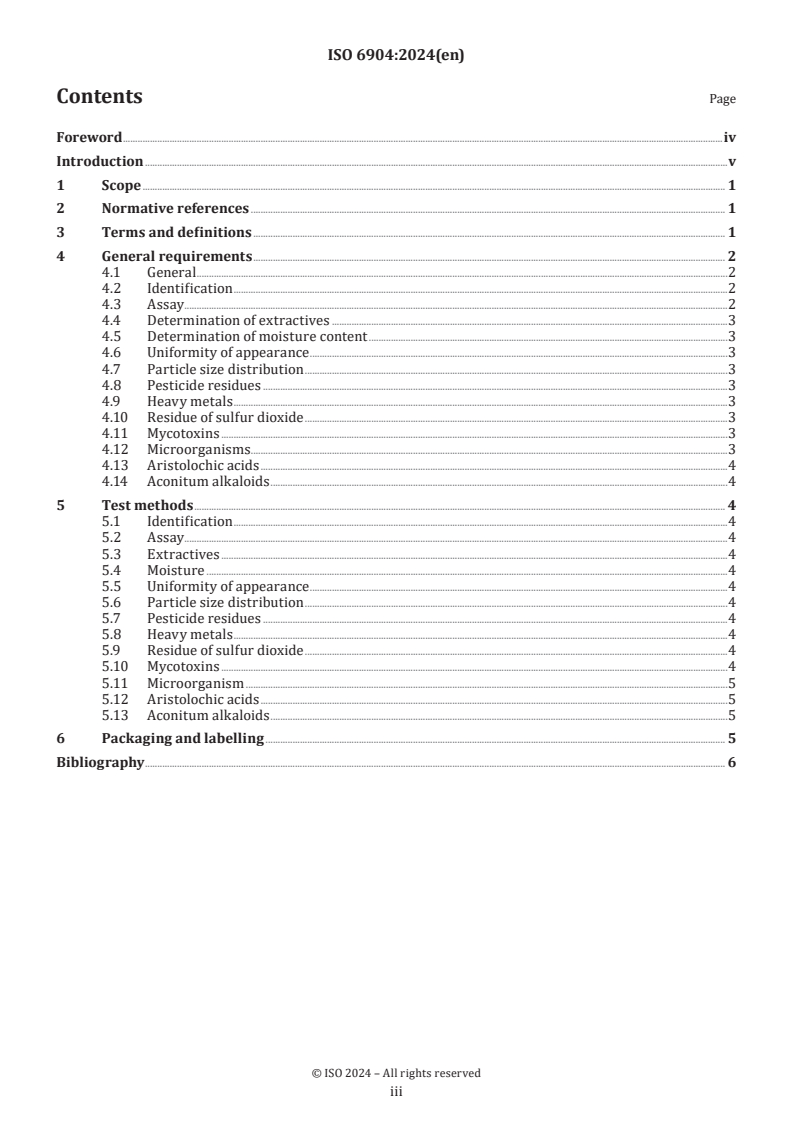
Contents Page
Foreword .iv
Introduction .v
1 Scope . 1
2 Normative references . 1
3 Terms and definitions . 1
4 General requirements . 2
4.1 General .2
4.2 Identification .2
4.3 Assay .2
4.4 Determination of extractives .3
4.5 Determination of moisture content .3
4.6 Uniformity of appearance .3
4.7 Particle size distribution .3
4.8 Pesticide residues .3
4.9 Heavy metals .3
4.10 Residue of sulfur dioxide .3
4.11 Mycotoxins .3
4.12 Microorganisms .3
4.13 Aristolochic acids .4
4.14 Aconitum alkaloids .4
5 Test methods . 4
5.1 Identification .4
5.2 Assay .4
5.3 Extractives .4
5.4 Moisture .4
5.5 Uniformity of appearance .4
5.6 Particle size distribution .4
5.7 Pesticide residues .4
5.8 Heavy metals .4
5.9 Residue of sulfur dioxide .4
5.10 Mycotoxins .4
5.11 Microorganism .5
5.12 Aristolochic acids .5
5.13 Aconitum alkaloids .5
6 Packaging and labelling . 5
Bibliography . 6
iii
Foreword
ISO (the International Organization for Standardization) is a worldwide federation of national standards
bodies (ISO member bodies). The work of preparing International Standards is normally carried out through
ISO technical committees. Each member body interested in a subject for which a technical committee
has been established has the right to be represented on that committee. International organizations,
governmental and non-governmental, in liaison with ISO, also take part in the work. ISO collaborates closely
with the International Electrotechnical Commission (IEC) on all matters of electrotechnical standardization.
The procedures used to develop this document and those intended for its further maintenance are described
in the ISO/IEC Directives, Part 1. In particular, the different approval criteria needed for the different types
of ISO document should be noted. This document was drafted in accordance with the editorial rules of the
ISO/IEC Directives, Part 2 (see www.iso.org/directives).
ISO draws attention to the possibility that the implementation of this document may involve the use of (a)
patent(s). ISO takes no position concerning the evidence, validity or applicability of any claimed patent
rights in respect thereof. As of the date of publication of this document, ISO had not received notice of (a)
patent(s) which may be required to implement this document. However, implementers are cautioned that
this may not represent the latest information, which may be obtained from the patent database available at
www.iso.org/patents. ISO shall not be held responsible for identifying any or all such patent rights.
Any trade name used in this document is information given for the convenience of users and does not
constitute an endorsement.
For an explanation of the voluntary nature of standards, the meaning of ISO specific terms and expressions
related to conformity assessment, as well as information about ISO's adherence to the World Trade
Organization (WTO) principles in the Technical Barriers to Trade (TBT), see www.iso.org/iso/foreword.html.
This document was prepared by Technical Committee ISO/TC 249, Traditional Chinese medicine.
Any feedback or questions on this document should be directed to the user’s national standards body. A
complete listing of these bodies can be found at www.iso.org/members.html.
iv
Introduction
Ultrafine powder of herbs is an innovative development of the traditional powder form of decoction pieces
that have been used commonly in traditional Chinese medicine for over 2 000 years. Ultrafine powder of
herbs is prepared by pulverizing decoction pieces into ultrafine powder, followed by systematic quality
analyses, which can increase the utilization efficiency, ensure consistency of quality and guarantee the
safety of Chinese medicines. Ultrafine powder of herbs can be directly taken orally but is more commonly
used as a raw material in the preparation of finished products. This is done by turning ultrafine powder of
herbs into dosage form, such as granules, capsules or tablets, in order to achieve longer storage times and
make its use more convenient.
Ultrafine powder of herbs and its products are becoming increasingly popular due to the obvious advantages
in safety control
...