

ISO 4140:1979
(Main)Ferrochromium and ferrosilicochromium — Determination of chromium content — Potentiometric method
General Information
- Abstract
The method is applicable to all grades of these ferroalloys. Specifies principle, reagents, apparatus, sample, procedure, expression of results and test report.
- Status
- Published
- Publication Date
- 31-Aug-1979
- Technical Committee
- ISO/TC 132 - Ferroalloys
- Drafting Committee
- ISO/TC 132 - Ferroalloys
- Current Stage
- 9093 - International Standard confirmed
- Start Date
- 25-Mar-2022
- Completion Date
- 29-Aug-2026
Buy Documents
ISO 4140:1979 - Ferrochromium and ferrosilicochromium -- Determination of chromium content -- Potentiometric method
ISO 4140:1979 - Ferrochromium and ferrosilicochromium — Determination of chromium content — Potentiometric method/1/1979
ISO 4140:1979 - Ferro-chrome et ferro-silico-chrome -- Dosage du chrome -- Méthode potentiométrique
ISO 4140:1979 - Ferro-chrome et ferro-silico-chrome — Dosage du chrome — Méthode potentiométrique/1/1979
ISO 4140:1979 - Ferro-chrome et ferro-silico-chrome — Dosage du chrome — Méthode potentiométrique/1/1979
Overview
ISO 4140:1979 specifies a standardized potentiometric method for the precise determination of chromium content in ferrochromium and ferrosilicochromium alloys. This international standard applies to all grades of these ferroalloys, providing a comprehensive procedure that includes sample preparation, reagents, apparatus, titration, and calculation of results. Developed by the ISO Technical Committee on Ferroalloys (ISO/TC 132), this method ensures consistent and reliable chromium analysis crucial in quality control and industrial applications.
Key Topics
Scope and Applicability
The method is applicable to all grades of ferrochromium and ferrosilicochromium, both of which are widely used in steelmaking and alloy production.Principle of Method
Determination involves fusion or acid dissolution of the sample, followed by oxidation of chromium with ammonium persulphate in the presence of silver ions. Potentiometric titration with ammonium iron(II) sulphate quantifies total chromium and vanadium. Vanadium is reoxidized and measured, allowing chromium content to be calculated by difference.Reagents Used
Key reagents include sodium peroxide, ammonium persulphate, silver nitrate, phosphoric acid, nitrite acid, and potassium permanganate. Each reagent is prepared with defined concentrations to ensure accuracy.Apparatus Requirements
Standard laboratory equipment such as nickel or porcelain crucibles, potentiometer with calomel/platinum electrodes, motor-driven stirrer, and volumetric flasks are specified for reproducibility.Sample Preparation
Samples must be prepared according to ISO 3713 to guarantee representativeness and proper dissolution during analysis.Procedure
Outlines detailed fusion or acid dissolution steps, oxidation, titration process, endpoint detection via potentiometric measurement, and oxidation-reduction reactions for chromium and vanadium.Expression of Results
Chromium content is expressed as a percentage by mass, calculated based on titration volumes and sample mass with an accuracy confidence limit of ±0.20% for chromium contents near 70%.Test Report Essentials
Reports must include method reference, expression mode, observed anomalies, and any deviations from the prescribed standard.
Applications
Materials Quality Control
Ensures precise chromium content measurement in ferroalloys, vital for steel manufacturers and alloy producers to meet composition specifications.Industrial Metallurgy
Supports consistent production of ferrochromium and ferrosilicochromium with predictable performance in downstream steelmaking.Chemical Analysis Laboratories
Provides a reliable potentiometric testing protocol for certified reference labs analyzing chromium in complex alloy matrices.Research and Development
Assists in experimental analysis of chromium content in new ferroalloy formulations and quality assurance during product development.
Related Standards
ISO 3713: Sampling and Preparation of Ferroalloys
Defines sampling protocols ensuring test portions meet homogeneity requirements for accurate analysis in ISO 4140.ISO Standards on Chemical Analysis of Alloys
ISO 4140 complements other ISO methods covering related metals and alloy constituents analysis by volumetric and potentiometric techniques.International Ferroalloy Industry Guidelines
Aligns with global best practices for chemical characterization and quality verification used by ferroalloy producers and consumers.
Keywords: ISO 4140, chromium determination, ferrochromium analysis, ferrosilicochromium, potentiometric titration, ferroalloy chemical analysis, chromium content testing, ammonium iron(II) sulphate titration, metallurgical standards, alloy quality control
Relations
- Consolidated By
ISO 11111-1:2005 - Textile machinery — Safety requirements — Part 1: Common requirements - Effective Date
- 06-Jun-2022
Buy Documents
ISO 4140:1979 - Ferrochromium and ferrosilicochromium -- Determination of chromium content -- Potentiometric method
ISO 4140:1979 - Ferrochromium and ferrosilicochromium — Determination of chromium content — Potentiometric method/1/1979
ISO 4140:1979 - Ferro-chrome et ferro-silico-chrome -- Dosage du chrome -- Méthode potentiométrique
ISO 4140:1979 - Ferro-chrome et ferro-silico-chrome — Dosage du chrome — Méthode potentiométrique/1/1979
ISO 4140:1979 - Ferro-chrome et ferro-silico-chrome — Dosage du chrome — Méthode potentiométrique/1/1979
Get Certified
Connect with accredited certification bodies for this standard

Element Materials Technology
Materials testing and product certification.

Inštitut za kovinske materiale in tehnologije
Institute of Metals and Technology. Materials testing, metallurgical analysis, NDT.
Sponsored listings
Frequently Asked Questions
ISO 4140:1979 is a standard published by the International Organization for Standardization (ISO). Its full title is "Ferrochromium and ferrosilicochromium — Determination of chromium content — Potentiometric method". This standard covers: The method is applicable to all grades of these ferroalloys. Specifies principle, reagents, apparatus, sample, procedure, expression of results and test report.
The method is applicable to all grades of these ferroalloys. Specifies principle, reagents, apparatus, sample, procedure, expression of results and test report.
ISO 4140:1979 is classified under the following ICS (International Classification for Standards) categories: 77.100 - Ferroalloys. The ICS classification helps identify the subject area and facilitates finding related standards.
ISO 4140:1979 has the following relationships with other standards: It is inter standard links to ISO 11111-1:2005. Understanding these relationships helps ensure you are using the most current and applicable version of the standard.
ISO 4140:1979 is available in PDF format for immediate download after purchase. The document can be added to your cart and obtained through the secure checkout process. Digital delivery ensures instant access to the complete standard document.
Standards Content (Sample)
International Standard
INTERNATIONAL ORGANIZATION FOR STANDARDIZATION*ME)I(flYHAPOjIHAR OPTAHM3AL&lR i-l0 CTAH~APTM3A~MM.ORGANISATION INTERNATIONALE DE NORMALISATION
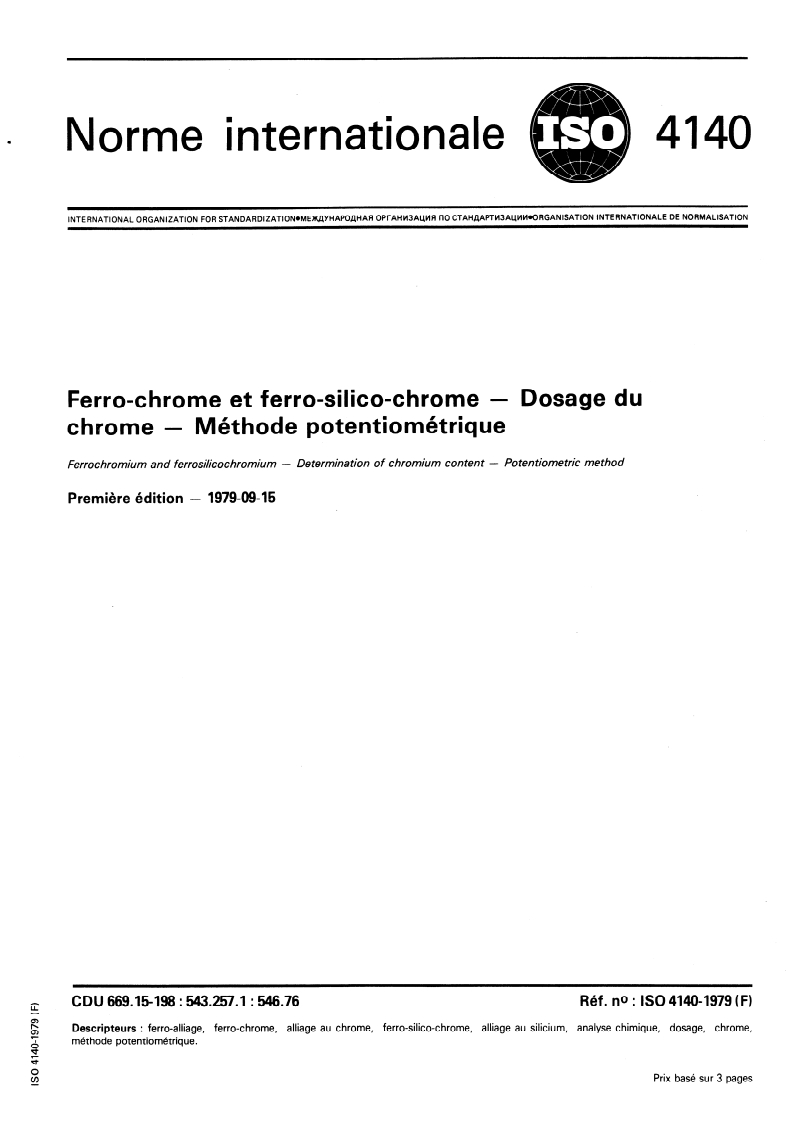
Ferrochromium and ferrosilicochromium - Determination
of chromium content - Potentiometric method
Ferro-chrome et ferro-silico-chrome - Dosage du chrome - Methode potentiombtrique
First edition - 1979-09-15
UDC 669.15-198 : 543.257.1 : 546.76 Ref. No. ISO 4140-1979 (E)
Descriptors : ferroalloys, ferrochromium, chromium containing alloys, ferrosilicochromium, Silicon containing alloys, Chemical analysis,
determination of content, chromium, potentiometric analysis.
Price based on 3 pages
Foreword
ISO (the International Organization for Standardization) is a worldwide federation of
national Standards institutes (ISO member bodies). The work of developing Interna-
tional Standards is carried out through ISO technical committees. Every member body
interested in a subject for which a technical committee has been set up has the right to
be represented on that committee. International organizations, governmental and non-
governmental, in liaison with ISO, also take part in the work.
Draft International Standards adopted by the technical committees are circulated to
the member bodies for approval before their acceptance as International Standards by
the ISO Council.
International Standard ISO 4140 was developed by Technical Committee ISO/TC 132,
Ferroaloys, and was circulated to the member bodies in January 1978.
lt has been approved by the member bodies of the following countries :
Australia India South Africa, Rep. of
Austria Iran Spain
Bulgaria Italy Sweden
Canada Japan Turkey
Czechoslovakia Mexico United Kingdom
Egypt, Arab Rep. of Norway USA
France Poland USSR
Germany, F. R. Y ugoslavia
Romania
No member body expressed disapproval of the document.
International Organization for Standardization, 1979
Printed in Switzerland
INTERNATIONAL STANDARD ISO 4140-1979 (E)
Ferrochromium and ferrosilicochromium - Determination
of chromium content - Potentiometric method
4.2 Sodium carbonate.
1 Scope and field of application
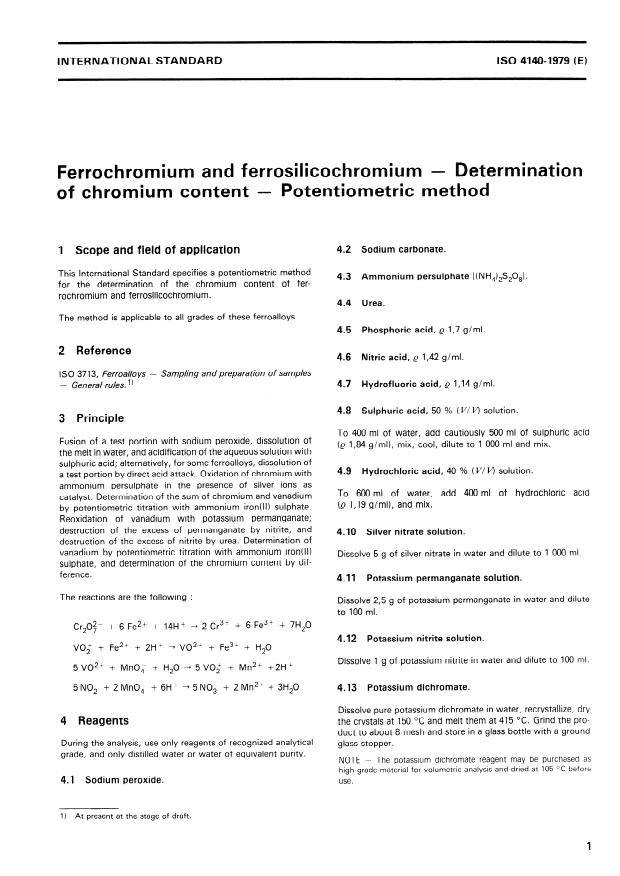
This International Standard specifies a potentiometric method
4.3 Ammonium persulphate [(NH,),S,O,l.
for the determination of the chromium content of fer-
rochromium and ferrosilicochromium.
4.4 Urea.
The method is applicable to all grades of these ferroalloys.
4.5 Phosphoric acid, ,Q 1,7 g/ml.
2 Reference
4.6 Nitrit acid, Q 1,42 g/ml.
I S 0 3713, Ferroalio ys - Sampling and preparation of samples
4.7 Hydrofluoric acid, Q 1,14 g/ml.
- General wies. ‘)
4.8 Sulphuric acid, 50 % (Vl v) Solution.
3 Principle
To 400 ml of water, add cautiously 500 ml of sulphuric acid
Fusion of a test Portion with sodium Peroxide, dissolution of
(Q 1,84 g/ml), mix, cool, dilute to 1 000 ml and mix.
the melt in water, and acidification of the aqueous Solution with
sulphuric acid; alternatively, for some ferroalloys, dissolution of
4.9 Hydrochlorit acid, 40 % (V/ v) Solution.
a test Portion by direct acid attack. Oxidation of chromium with
ammonium persulphate in the presence of silver ions as
add 400 ml of hydrochloric acid
To 600 ml of water,
catalyst. Determination of the sum of chromium and vanadium
(Q 1,19 g/ml), and mix.
by potentiometric titration with ammonium iron( II) sulphate.
Reoxidation of vanadium with potassium permanganate;
destruction of the excess of permanganate by nitrite, and
4.10 Silver nitrate Solution.
destruction of the excess of nitrite by Urea. Determination of
vanadium by potentiometric titration with ammonium iron( II)
Dissolve 5 g of silver nitrate in water and dilute to 1 000 ml.
sulphate, and determination of the chromium content by dif-
ference.
4.11 Potassium permanganate solution.
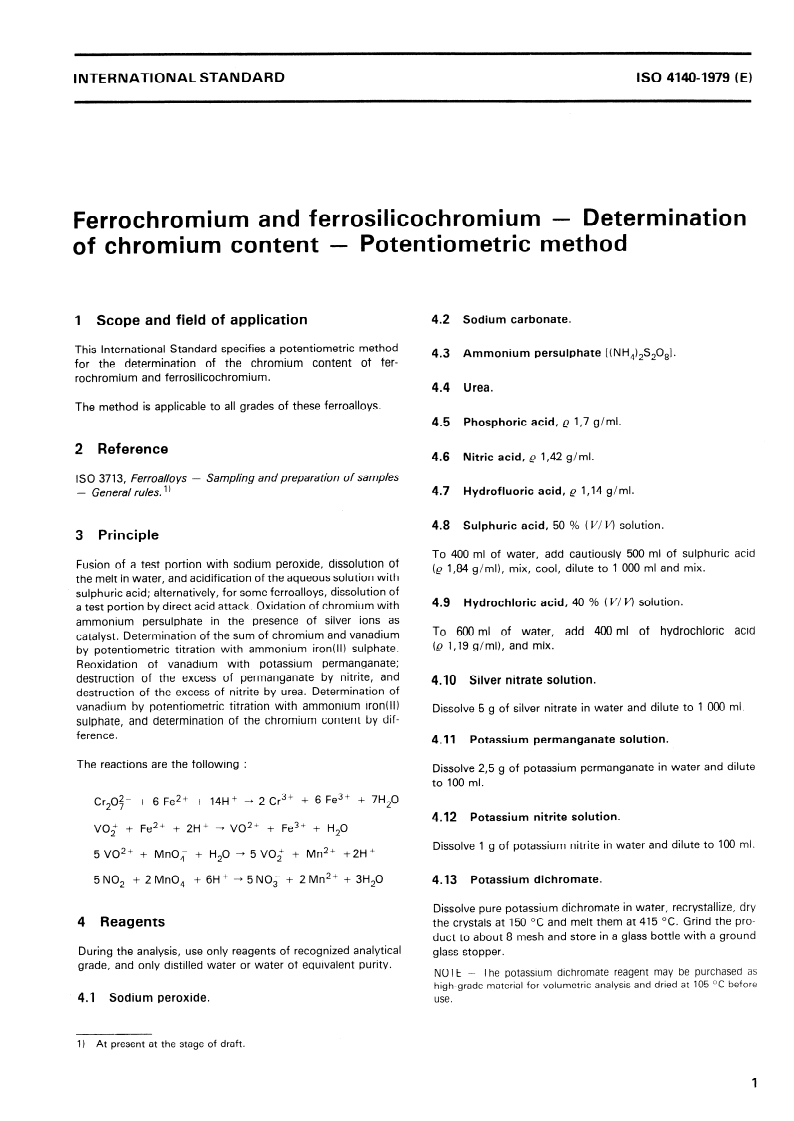
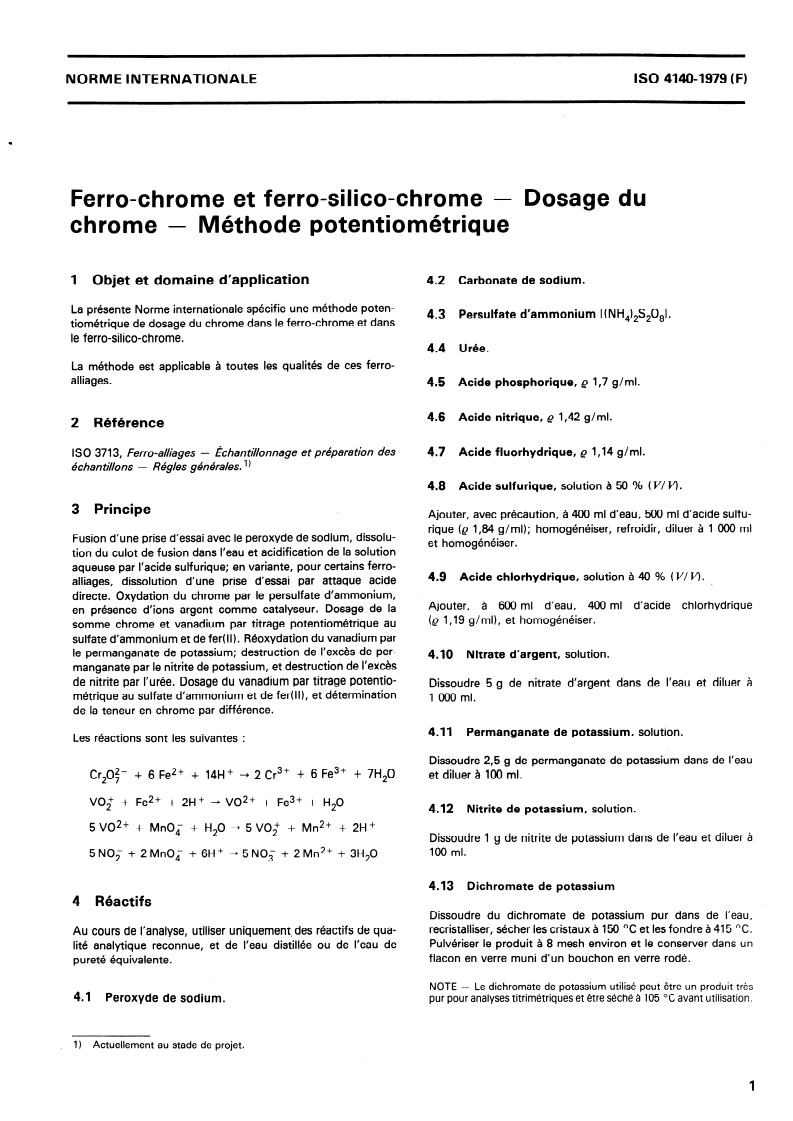
The reactions are the following :
Dissolve 2,5 g of potassium permanganate in water and dilute
to 100 ml.
Cr207- + 6 Fe2+ + 14H+ --+ 2 Cr3’ + 6 Fe3+ + 7H20
4.12 Potassium nitrite Solution.
VO; + Fe2+ + 2H+ -+ V02+ + Fe3+ + H,O
Dissolve 1 g of potassium nitrite in water and dilute to 100 ml.
5 V02+ + MnOg + H,O -+ 5 VO; + Mn2’ +2H’
5NOy + 2MnOg + 6H+ -5NO; + 2Mn2+ + SH,0 4.13 Potassium dichromate.
Dissolve pure potassium dichromate in water, recrystallize, dry
4 Reagents the crystals at 150 OC and melt them at 415 OC. Grind the pro-
duct to about 8 mesh and store in a glass bottle with a ground
During the analysis, use only reagents of recognized analytical
glass stopper.
grade, and only distilled water or water of equivalent purity.
NOTE - The potassictm dichromate reagent may be purchased as
high-grade material for volumetric analysis and dried at 105 OC before
4.1 Sodium Peroxide. use.
1) At present at the Stage of draft.
-1979 (El
IS
7 Prscedure
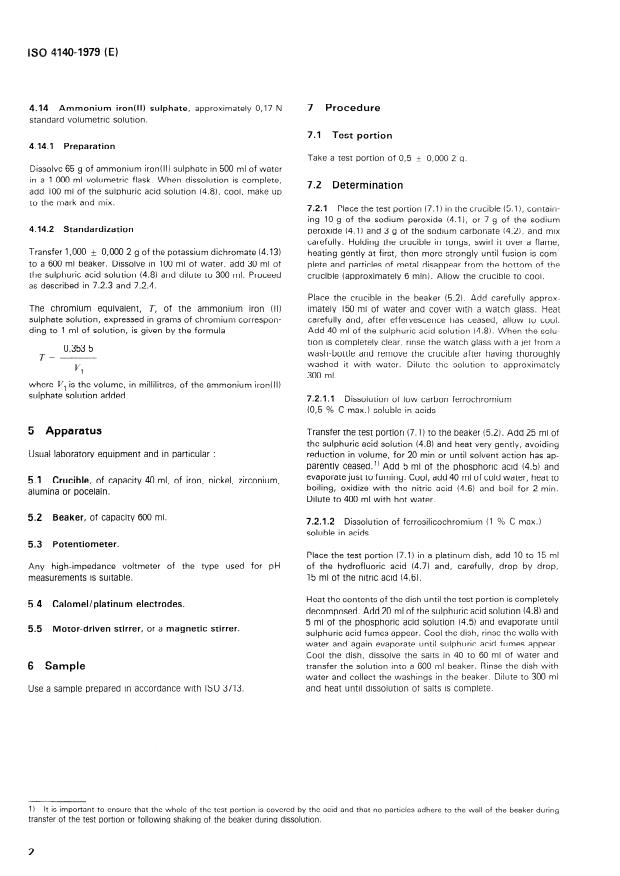
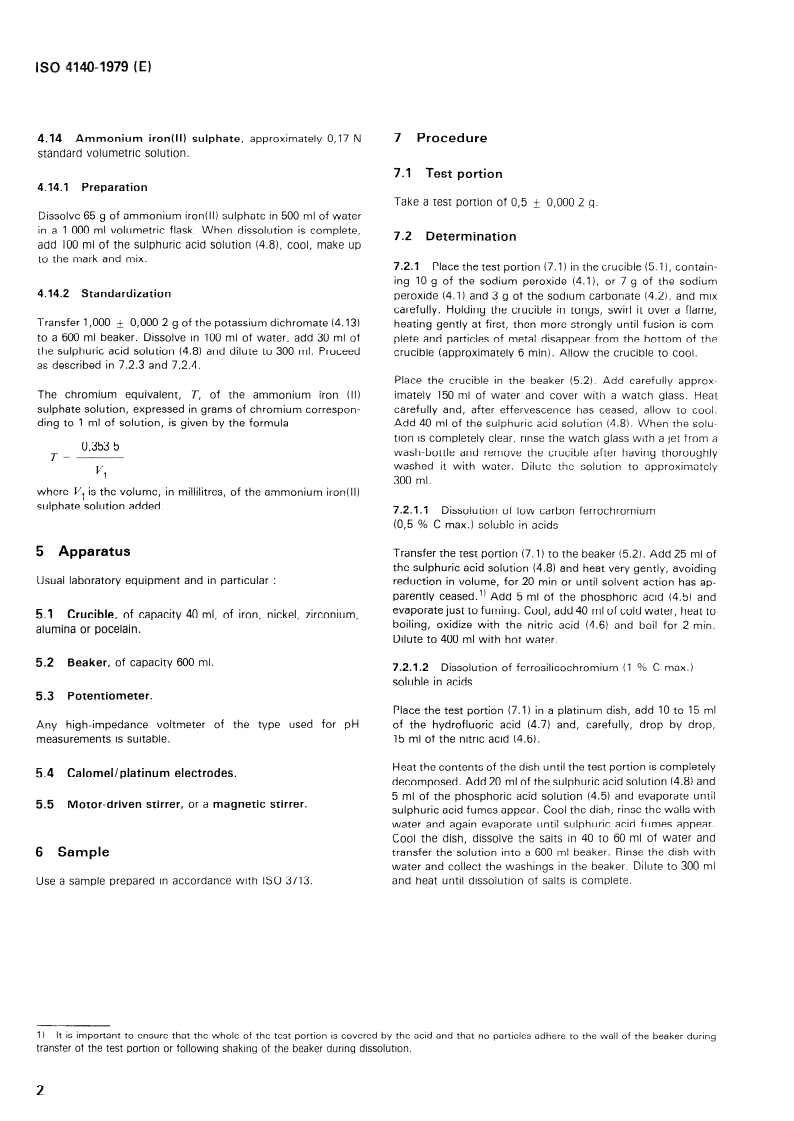
4.14 Ammonium ironW) suIphate, approximately 0,17 N
Standard volumetric solution.
7.1 Test portion
4.14.1 Preparation
Take a test portion of 0,5 * 0,000 2 g.
Dissolve 65 g of ammonium iron(ll1 sulphate in 500 ml of water
in a 1 000 ml volumetric flask. When dissolution is complete,
7.2 Determination
add 100 ml of the sulphuric acid Solution (4.8), cool, make up
to the mark and mix.
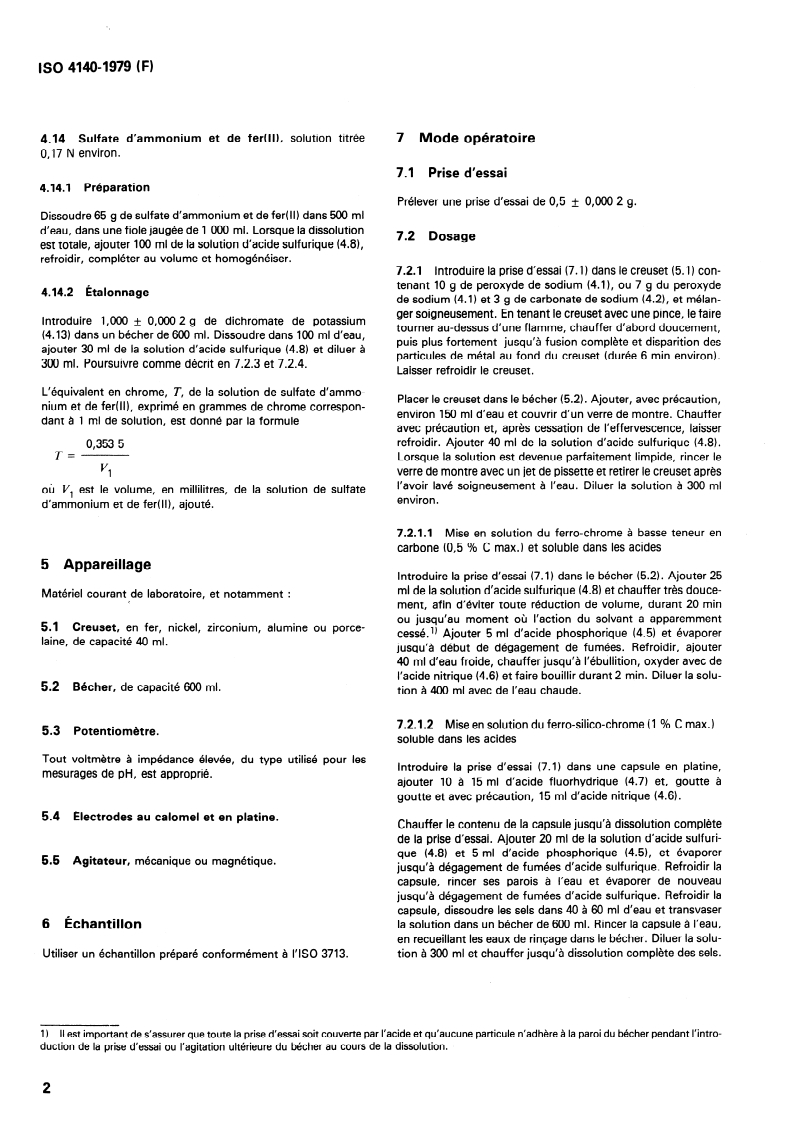
72.1 Place the test Portion (7.1) in the crucible (5.11, contain-
ing 10 g of the sodium peroxide (4.1), or 7 g sf the sodium
4.142 Standardkation
peroxide (4.1) and 3 g of the sodium carbonate (4.2), and mix
carefully. Holding the crucible in tongs, swirl it over a flame,
Transfer 1,000 & 0,000 2 g of the potassium dichromate (4.13) heating gently at first, then more strongly until fusion is com-
to a 600 ml beaker. Dissolve in 100 ml of water, add 30 ml sf
plete and particles of metal disappear from the bottom of the
the sulphuric acid Solution (4.8) and dilute to 300 ml. Proceed
crucible (approximately 6 min). Allow the crucible to cool.
as described in 72.3 and 72.4.
Place the crucible in the beaker (5.2). Add carefully
...
International Standard
INTERNATIONAL ORGANIZATION FOR STANDARDIZATION*ME)I(flYHAPOjIHAR OPTAHM3AL&lR i-l0 CTAH~APTM3A~MM.ORGANISATION INTERNATIONALE DE NORMALISATION
Ferrochromium and ferrosilicochromium - Determination
of chromium content - Potentiometric method
Ferro-chrome et ferro-silico-chrome - Dosage du chrome - Methode potentiombtrique
First edition - 1979-09-15
UDC 669.15-198 : 543.257.1 : 546.76 Ref. No. ISO 4140-1979 (E)
Descriptors : ferroalloys, ferrochromium, chromium containing alloys, ferrosilicochromium, Silicon containing alloys, Chemical analysis,
determination of content, chromium, potentiometric analysis.
Price based on 3 pages
Foreword
ISO (the International Organization for Standardization) is a worldwide federation of
national Standards institutes (ISO member bodies). The work of developing Interna-
tional Standards is carried out through ISO technical committees. Every member body
interested in a subject for which a technical committee has been set up has the right to
be represented on that committee. International organizations, governmental and non-
governmental, in liaison with ISO, also take part in the work.
Draft International Standards adopted by the technical committees are circulated to
the member bodies for approval before their acceptance as International Standards by
the ISO Council.
International Standard ISO 4140 was developed by Technical Committee ISO/TC 132,
Ferroaloys, and was circulated to the member bodies in January 1978.
lt has been approved by the member bodies of the following countries :
Australia India South Africa, Rep. of
Austria Iran Spain
Bulgaria Italy Sweden
Canada Japan Turkey
Czechoslovakia Mexico United Kingdom
Egypt, Arab Rep. of Norway USA
France Poland USSR
Germany, F. R. Y ugoslavia
Romania
No member body expressed disapproval of the document.
International Organization for Standardization, 1979
Printed in Switzerland
INTERNATIONAL STANDARD ISO 4140-1979 (E)
Ferrochromium and ferrosilicochromium - Determination
of chromium content - Potentiometric method
4.2 Sodium carbonate.
1 Scope and field of application
This International Standard specifies a potentiometric method
4.3 Ammonium persulphate [(NH,),S,O,l.
for the determination of the chromium content of fer-
rochromium and ferrosilicochromium.
4.4 Urea.
The method is applicable to all grades of these ferroalloys.
4.5 Phosphoric acid, ,Q 1,7 g/ml.
2 Reference
4.6 Nitrit acid, Q 1,42 g/ml.
I S 0 3713, Ferroalio ys - Sampling and preparation of samples
4.7 Hydrofluoric acid, Q 1,14 g/ml.
- General wies. ‘)
4.8 Sulphuric acid, 50 % (Vl v) Solution.
3 Principle
To 400 ml of water, add cautiously 500 ml of sulphuric acid
Fusion of a test Portion with sodium Peroxide, dissolution of
(Q 1,84 g/ml), mix, cool, dilute to 1 000 ml and mix.
the melt in water, and acidification of the aqueous Solution with
sulphuric acid; alternatively, for some ferroalloys, dissolution of
4.9 Hydrochlorit acid, 40 % (V/ v) Solution.
a test Portion by direct acid attack. Oxidation of chromium with
ammonium persulphate in the presence of silver ions as
add 400 ml of hydrochloric acid
To 600 ml of water,
catalyst. Determination of the sum of chromium and vanadium
(Q 1,19 g/ml), and mix.
by potentiometric titration with ammonium iron( II) sulphate.
Reoxidation of vanadium with potassium permanganate;
destruction of the excess of permanganate by nitrite, and
4.10 Silver nitrate Solution.
destruction of the excess of nitrite by Urea. Determination of
vanadium by potentiometric titration with ammonium iron( II)
Dissolve 5 g of silver nitrate in water and dilute to 1 000 ml.
sulphate, and determination of the chromium content by dif-
ference.
4.11 Potassium permanganate solution.
The reactions are the following :
Dissolve 2,5 g of potassium permanganate in water and dilute
to 100 ml.
Cr207- + 6 Fe2+ + 14H+ --+ 2 Cr3’ + 6 Fe3+ + 7H20
4.12 Potassium nitrite Solution.
VO; + Fe2+ + 2H+ -+ V02+ + Fe3+ + H,O
Dissolve 1 g of potassium nitrite in water and dilute to 100 ml.
5 V02+ + MnOg + H,O -+ 5 VO; + Mn2’ +2H’
5NOy + 2MnOg + 6H+ -5NO; + 2Mn2+ + SH,0 4.13 Potassium dichromate.
Dissolve pure potassium dichromate in water, recrystallize, dry
4 Reagents the crystals at 150 OC and melt them at 415 OC. Grind the pro-
duct to about 8 mesh and store in a glass bottle with a ground
During the analysis, use only reagents of recognized analytical
glass stopper.
grade, and only distilled water or water of equivalent purity.
NOTE - The potassictm dichromate reagent may be purchased as
high-grade material for volumetric analysis and dried at 105 OC before
4.1 Sodium Peroxide. use.
1) At present at the Stage of draft.
-1979 (El
IS
7 Prscedure
4.14 Ammonium ironW) suIphate, approximately 0,17 N
Standard volumetric solution.
7.1 Test portion
4.14.1 Preparation
Take a test portion of 0,5 * 0,000 2 g.
Dissolve 65 g of ammonium iron(ll1 sulphate in 500 ml of water
in a 1 000 ml volumetric flask. When dissolution is complete,
7.2 Determination
add 100 ml of the sulphuric acid Solution (4.8), cool, make up
to the mark and mix.
72.1 Place the test Portion (7.1) in the crucible (5.11, contain-
ing 10 g of the sodium peroxide (4.1), or 7 g sf the sodium
4.142 Standardkation
peroxide (4.1) and 3 g of the sodium carbonate (4.2), and mix
carefully. Holding the crucible in tongs, swirl it over a flame,
Transfer 1,000 & 0,000 2 g of the potassium dichromate (4.13) heating gently at first, then more strongly until fusion is com-
to a 600 ml beaker. Dissolve in 100 ml of water, add 30 ml sf
plete and particles of metal disappear from the bottom of the
the sulphuric acid Solution (4.8) and dilute to 300 ml. Proceed
crucible (approximately 6 min). Allow the crucible to cool.
as described in 72.3 and 72.4.
Place the crucible in the beaker (5.2). Add carefully
...
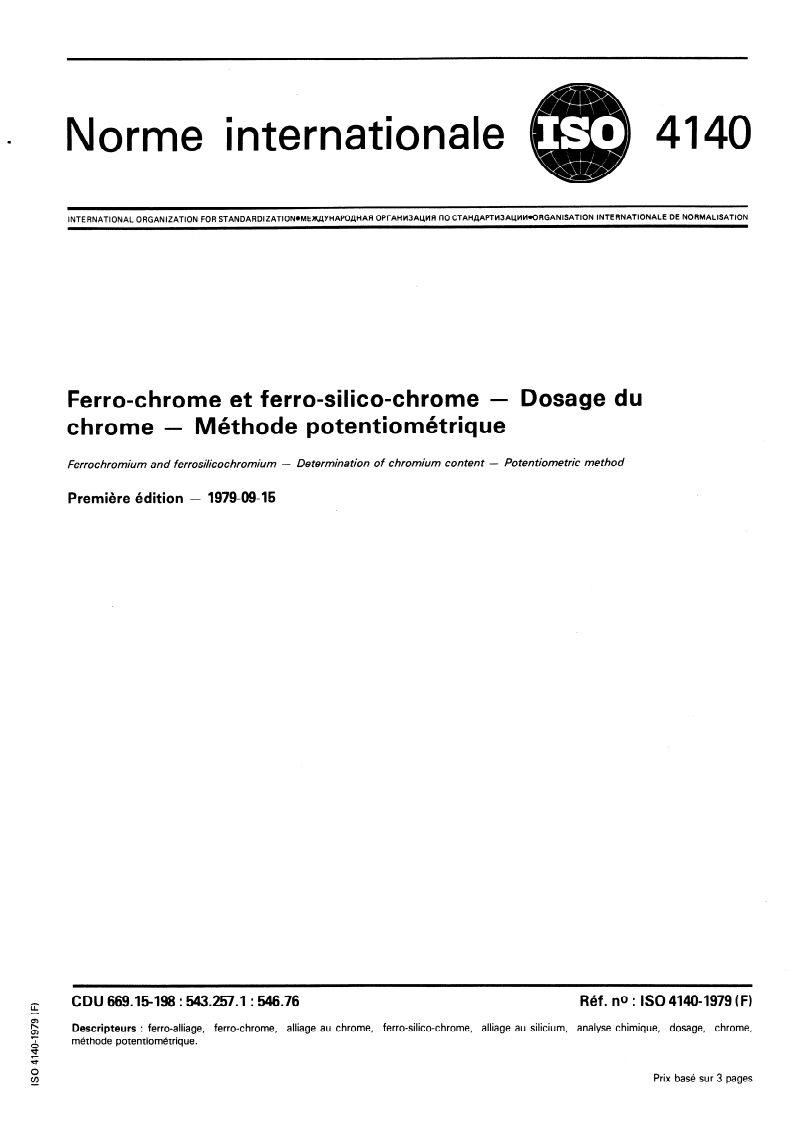
Norme internationale
INTERNATIONAL ORGANIZATION FOR STANDARDIZATIONWVIE~YHAPOAHAR OPrAHM3ALWlR Il0 CTAH~APTH3ALWMORGANISATION INTERNATIONALE DE NORMALISATION
Ferro-chrome et ferro-silice-chrome - Dosage du
chrome - Méthode potentiométrique
Ferrochromium and ferrosilicochromium - De termina tion of chromium content - Po ten tiome trie me thod
Première édition - 4979-09-15
CDU 669.15198: 543257.1 : 546.76 Réf. no : ISO 4140-1979 (F)
Descripteurs : ferro-alliage, ferro-chrome, alliage au chrome, ferro-silice-chrome, alliage au silicium, analyse chimique, dosage, chrome,
méthode potentiométrique.
Prix basé sur 3 pages
Avant-propos
L’ISO (Organisation internationale de normalisation) est une fédération mondiale
d’organismes nationaux de normalisation (comités membres de I’ISO). L’élaboration
des Normes internationales est confiée aux comités techniques de I’ISO. Chaque
comité membre intéressé par une étude a le droit de faire partie du comité technique
correspondant. Les organisations internationales, gouvernementales et non gouverne-
mentales, en liaison avec I’ISO, participent également aux travaux.
Les projets de Normes internationales adoptés par les comités techniques sont soumis
aux comités membres pour approbation, avant leur acceptation comme Normes inter-
nationales par le Conseil de I’ISO.
La Norme internationale ISO 4140 a été élaborée par le comité technique ISO/TC 132,
Ferro-aNages, et a été soumise aux comités membres en janvier 1978.
Les comités membres des pays suivants l’ont approuvée :
Afrique du Sud, Rép. d’
France Roumanie
Allemagne, R. F. Inde Royaume-Uni
Australie
Iran Suède
Autriche Italie
Tchécoslovaquie
Bulgarie Japon Turquie
Canada Mexique URSS
Egypte, Rép. arabe d’ Norvège USA
Espagne
Pologne Yougoslavie
Aucun comité membre ne l’a désapprouvée.
0 Organisation internationale de normalisation, 1979
Imprimé en Suisse
ISO 4140-1979 (F)
NORME INTERNATIONALE
Ferro-chrome et ferro-silice-chrome - Dosage du
chrome - Méthode potentiométrique
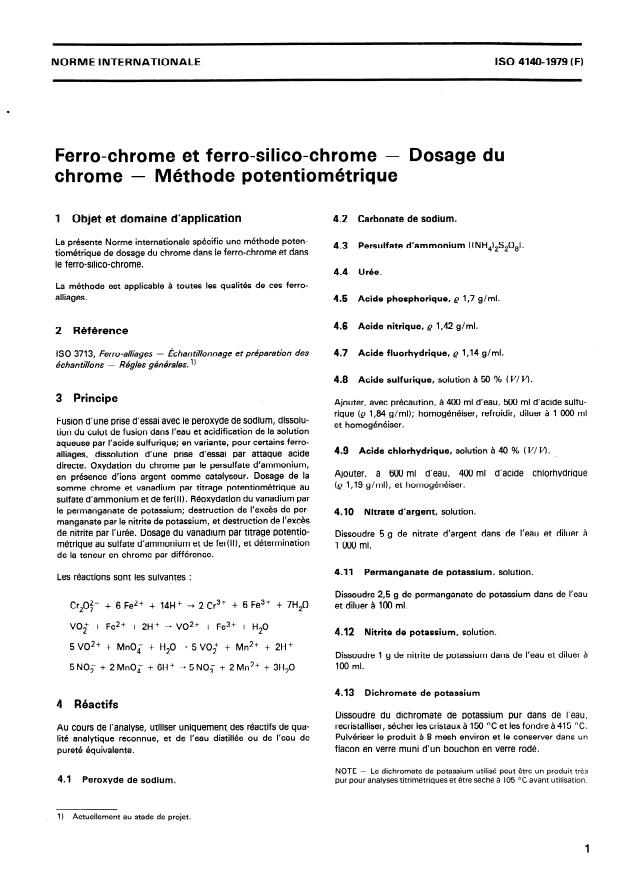
1 Objet et domaine d’application 4.2 Carbonate de sodium.
La présente Norme internationale spécifie une méthode poten-
4.3 Persulfate d’ammonium [(NH,),S,O,l.
tiométrique de dosage du chrome dans le ferro-chrome et dans
le ferro-silice-chrome.
4.4 Urée.
La méthode est applicable à toutes les qualités de ces ferro-
alliages.
4.5 Acide phosphorique, Q 1,7 g/ml.
4.6 Acide nitrique, Q 1,42 g/ml.
2 Référence
fluorhydrique, Q 1,14 g/ml.
I S 0 3713, Ferro-alliages - Échan tHonnage et préparation des 4.7 Acide
échan tiVons - Régles générales. ‘)
4.8 Acide sulfurique, solution & 50 % ( vl v).
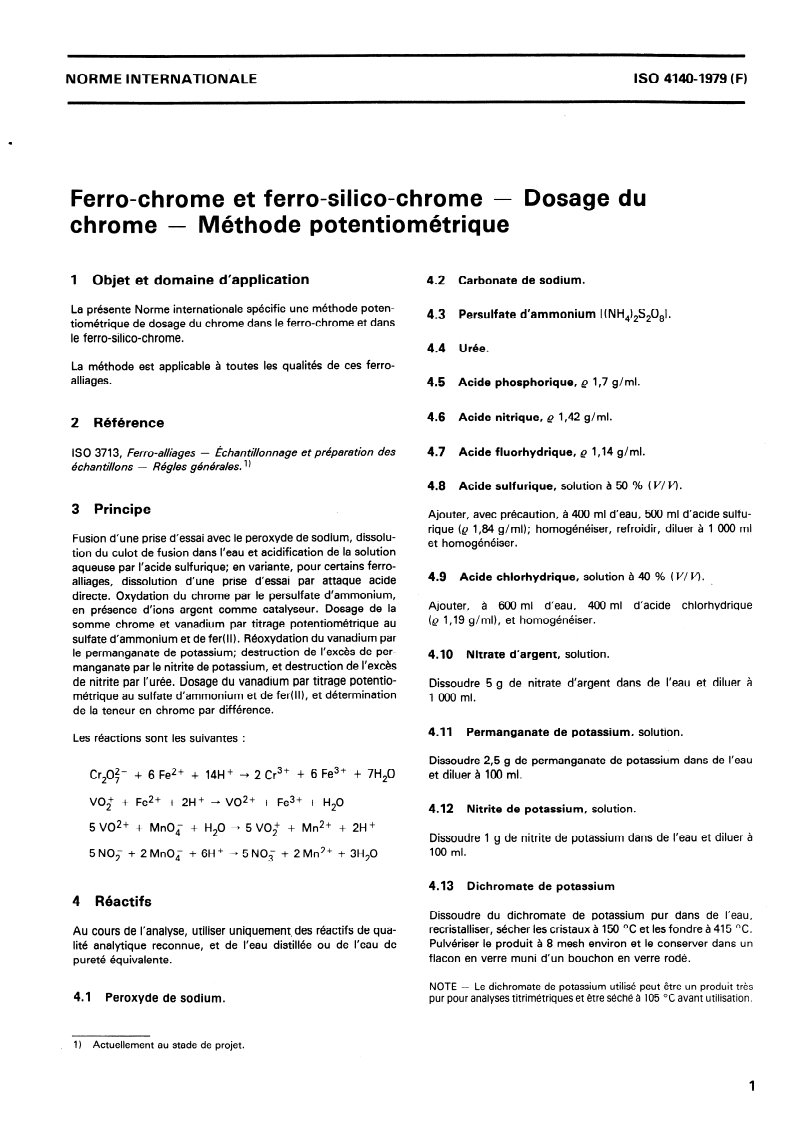
3 Principe
Ajouter, avec précaution, à 400 ml d’eau, 500 ml d’acide sulfu-
rique (Q 1,84 g/ml); homogénéiser, refroidir, diluer à 1 000 ml
Fusion d’une prise d’essai avec le peroxyde de sodium, dissolu-
et homogénéiser.
tion du culot de fusion dans l’eau et acidification de la solution
aqueuse par l’acide sulfurique; en variante, pour certains ferro-
4.9 Acide chlorhydrique, solution à 40 % ( v/ U.
alliages, dissolution d’une prise d’essai par attaque acide
directe. Oxydation du chrome par le persulfate d’ammonium,
Ajouter, à 600 ml d’eau, 400 ml d’acide chlorhydrique
en présence d’ions argent comme catalyseur. Dosage de la
(Q 1,19 g/ml), et homogénéiser.
somme chrome et vanadium par titrage potentiométrique au
sulfate d’ammonium et de fer(ll). Réoxydation du vanadium par
le permanganate de potassium; destruction de l’excès de per-
4.10 Nitrate d’argent, solution.
manganate par le nitrite de potassium, et destruction de l’excès
de nitrite par l’urée. Dosage du vanadium par titrage potentio-
Dissoudre 5 g de nitrate d’argent dans de l’eau et diluer à
métrique au sulfate d’ammonium et de fer(ll), et détermination
1 000 ml.
de la teneur en chrome par différence.
4.11 Permanganate de potassium, solution.
Les réactions sont les suivantes :
Dissoudre 2,5 g de permanganate de potassium dans de l’eau
+ 6 Fe2+ + 14H+ -+ 2 Cr3+ + 6 Fe3+ + 7H20
CrzO;- et diluer à 100 ml.
VO; + Fe2+ + 2H+ -+ V02+ + Fe3+ + H,O
4.12 Nitrite de potassium, solution.
5 V02+ + Mn04 + H20 --+ 5 VO; + Mn2+ + 2H+
Dissoudre 1 g de nitrite de potassium dans de l’eau et diluer à
100 ml.
5NO? + 2MnO; + 6H+ + 5N03 + 2Mn2+ + 3H,O
4.13 Dichromate de potassium
4 Réactifs
Dissoudre du dichromate de potassium pur dans de l’eau,
recristalliser, sécher les cristaux à 150 OC et les fondre à 415 OC.
Au cours de l’analyse, utiliser uniquement, des réactifs de qua-
Pulvériser le produit à 8 mesh environ et le conserver dans un
lité analytique reconnue, et de l’eau distillée ou de l’eau de
flacon en verre muni d’un bouchon en verre rodé.
pureté équivalente.
NOTE - Le dichromate de potassium utilisé peut être un produit très
4.1 Peroxyde de sodium. pur pour analyses titrimétriques et être séché à 105 OC avant utilisation.
1) Actuellement au stade de projet.
1so4140-1979 W-1
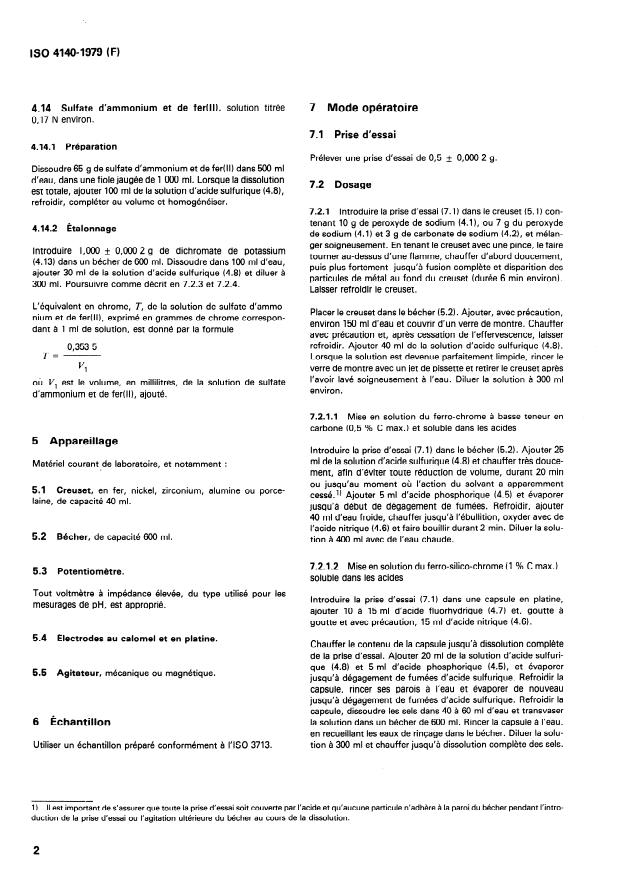
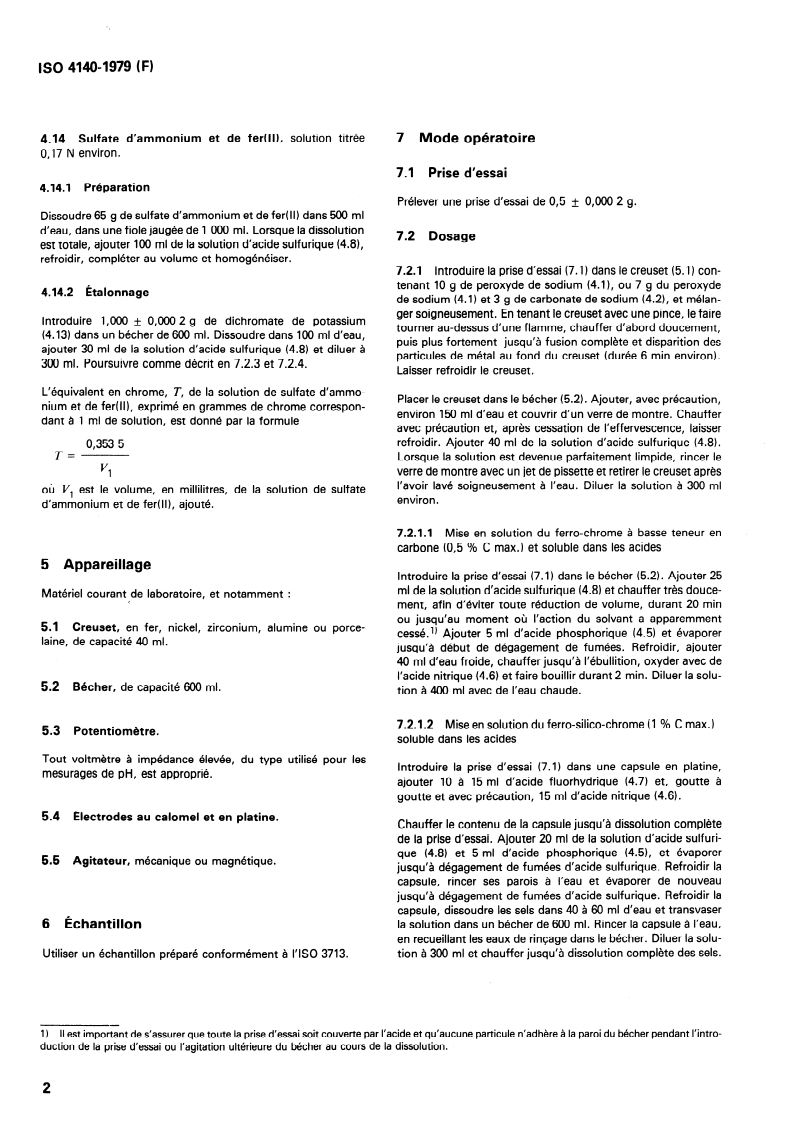
4.14 Sulfate d’ammonium et de fer(H), solution titrée 7 Mode opératoire
0,17 N environ.
7.1 Prise d’essai
4.14.1 Préparation
Prélever une prise d’essai de 0,5 + 0,000 2 g.
Dissoudre 65 g de sulfate d’ammonium et de fer( II) dans 500 ml
d’eau, dans une fiole jaugée de 1 000 ml. Lorsque la dissolution
7.2 Dosage
est totale, ajouter 100 ml de la solution d’acide sulfurique (4.81,
refroidir, compléter au volume et homogénéiser.
7.2.1 Introduire la prise d’essai (7.1) dans le creuset (5.1) con-
tenant 10 g de peroxyde de sodium (4.11, ou 7 g du peroxyde
4.14.2 Étalonnage
de sodium (4.1) et 3 g de carbonate de sodium (4.21, et mélan-
ger soigneusement. En tenant le creuset avec une pince, le faire
Introduire 1,000 -t 0,000 2 g de dichromate de potassium
tourner au-dessus d’une flamme, chauffer d’abord doucement,
(4.13) dans un bécher de 600 ml. Dissoudre dans 100 ml d’eau,
puis plus fortement jusqu’à fusion complète et disparition des
ajouter 30 ml de la solution d’acide sulfurique (4.8) et diluer à
particules de métal au fond du creuset (durée 6 min environ).
300 ml. Poursuivre comme décrit en 7.2.3 et 7.2.4.
Laisser refroidir le creuset.
L’équivalent en chrome, T, de la solution de sulfate d’ammo-
Placer le creuset dans le bécher (5.2). Ajouter, avec précaution,
nium et de fer(ll), exprimé en grammes de chrome correspon-
environ 150 ml d’eau et couvrir d’un verre de montre. Chauffer
dant à 1 ml de solution, est donné par la formule
avec précaution et, après cessation de l’effervescence, laisser
refroidir. Ajouter 40 ml de la soluti
...
Norme internationale
INTERNATIONAL ORGANIZATION FOR STANDARDIZATIONWVIE~YHAPOAHAR OPrAHM3ALWlR Il0 CTAH~APTH3ALWMORGANISATION INTERNATIONALE DE NORMALISATION
Ferro-chrome et ferro-silice-chrome - Dosage du
chrome - Méthode potentiométrique
Ferrochromium and ferrosilicochromium - De termina tion of chromium content - Po ten tiome trie me thod
Première édition - 4979-09-15
CDU 669.15198: 543257.1 : 546.76 Réf. no : ISO 4140-1979 (F)
Descripteurs : ferro-alliage, ferro-chrome, alliage au chrome, ferro-silice-chrome, alliage au silicium, analyse chimique, dosage, chrome,
méthode potentiométrique.
Prix basé sur 3 pages
Avant-propos
L’ISO (Organisation internationale de normalisation) est une fédération mondiale
d’organismes nationaux de normalisation (comités membres de I’ISO). L’élaboration
des Normes internationales est confiée aux comités techniques de I’ISO. Chaque
comité membre intéressé par une étude a le droit de faire partie du comité technique
correspondant. Les organisations internationales, gouvernementales et non gouverne-
mentales, en liaison avec I’ISO, participent également aux travaux.
Les projets de Normes internationales adoptés par les comités techniques sont soumis
aux comités membres pour approbation, avant leur acceptation comme Normes inter-
nationales par le Conseil de I’ISO.
La Norme internationale ISO 4140 a été élaborée par le comité technique ISO/TC 132,
Ferro-aNages, et a été soumise aux comités membres en janvier 1978.
Les comités membres des pays suivants l’ont approuvée :
Afrique du Sud, Rép. d’
France Roumanie
Allemagne, R. F. Inde Royaume-Uni
Australie
Iran Suède
Autriche Italie
Tchécoslovaquie
Bulgarie Japon Turquie
Canada Mexique URSS
Egypte, Rép. arabe d’ Norvège USA
Espagne
Pologne Yougoslavie
Aucun comité membre ne l’a désapprouvée.
0 Organisation internationale de normalisation, 1979
Imprimé en Suisse
ISO 4140-1979 (F)
NORME INTERNATIONALE
Ferro-chrome et ferro-silice-chrome - Dosage du
chrome - Méthode potentiométrique
1 Objet et domaine d’application 4.2 Carbonate de sodium.
La présente Norme internationale spécifie une méthode poten-
4.3 Persulfate d’ammonium [(NH,),S,O,l.
tiométrique de dosage du chrome dans le ferro-chrome et dans
le ferro-silice-chrome.
4.4 Urée.
La méthode est applicable à toutes les qualités de ces ferro-
alliages.
4.5 Acide phosphorique, Q 1,7 g/ml.
4.6 Acide nitrique, Q 1,42 g/ml.
2 Référence
fluorhydrique, Q 1,14 g/ml.
I S 0 3713, Ferro-alliages - Échan tHonnage et préparation des 4.7 Acide
échan tiVons - Régles générales. ‘)
4.8 Acide sulfurique, solution & 50 % ( vl v).
3 Principe
Ajouter, avec précaution, à 400 ml d’eau, 500 ml d’acide sulfu-
rique (Q 1,84 g/ml); homogénéiser, refroidir, diluer à 1 000 ml
Fusion d’une prise d’essai avec le peroxyde de sodium, dissolu-
et homogénéiser.
tion du culot de fusion dans l’eau et acidification de la solution
aqueuse par l’acide sulfurique; en variante, pour certains ferro-
4.9 Acide chlorhydrique, solution à 40 % ( v/ U.
alliages, dissolution d’une prise d’essai par attaque acide
directe. Oxydation du chrome par le persulfate d’ammonium,
Ajouter, à 600 ml d’eau, 400 ml d’acide chlorhydrique
en présence d’ions argent comme catalyseur. Dosage de la
(Q 1,19 g/ml), et homogénéiser.
somme chrome et vanadium par titrage potentiométrique au
sulfate d’ammonium et de fer(ll). Réoxydation du vanadium par
le permanganate de potassium; destruction de l’excès de per-
4.10 Nitrate d’argent, solution.
manganate par le nitrite de potassium, et destruction de l’excès
de nitrite par l’urée. Dosage du vanadium par titrage potentio-
Dissoudre 5 g de nitrate d’argent dans de l’eau et diluer à
métrique au sulfate d’ammonium et de fer(ll), et détermination
1 000 ml.
de la teneur en chrome par différence.
4.11 Permanganate de potassium, solution.
Les réactions sont les suivantes :
Dissoudre 2,5 g de permanganate de potassium dans de l’eau
+ 6 Fe2+ + 14H+ -+ 2 Cr3+ + 6 Fe3+ + 7H20
CrzO;- et diluer à 100 ml.
VO; + Fe2+ + 2H+ -+ V02+ + Fe3+ + H,O
4.12 Nitrite de potassium, solution.
5 V02+ + Mn04 + H20 --+ 5 VO; + Mn2+ + 2H+
Dissoudre 1 g de nitrite de potassium dans de l’eau et diluer à
100 ml.
5NO? + 2MnO; + 6H+ + 5N03 + 2Mn2+ + 3H,O
4.13 Dichromate de potassium
4 Réactifs
Dissoudre du dichromate de potassium pur dans de l’eau,
recristalliser, sécher les cristaux à 150 OC et les fondre à 415 OC.
Au cours de l’analyse, utiliser uniquement, des réactifs de qua-
Pulvériser le produit à 8 mesh environ et le conserver dans un
lité analytique reconnue, et de l’eau distillée ou de l’eau de
flacon en verre muni d’un bouchon en verre rodé.
pureté équivalente.
NOTE - Le dichromate de potassium utilisé peut être un produit très
4.1 Peroxyde de sodium. pur pour analyses titrimétriques et être séché à 105 OC avant utilisation.
1) Actuellement au stade de projet.
1so4140-1979 W-1
4.14 Sulfate d’ammonium et de fer(H), solution titrée 7 Mode opératoire
0,17 N environ.
7.1 Prise d’essai
4.14.1 Préparation
Prélever une prise d’essai de 0,5 + 0,000 2 g.
Dissoudre 65 g de sulfate d’ammonium et de fer( II) dans 500 ml
d’eau, dans une fiole jaugée de 1 000 ml. Lorsque la dissolution
7.2 Dosage
est totale, ajouter 100 ml de la solution d’acide sulfurique (4.81,
refroidir, compléter au volume et homogénéiser.
7.2.1 Introduire la prise d’essai (7.1) dans le creuset (5.1) con-
tenant 10 g de peroxyde de sodium (4.11, ou 7 g du peroxyde
4.14.2 Étalonnage
de sodium (4.1) et 3 g de carbonate de sodium (4.21, et mélan-
ger soigneusement. En tenant le creuset avec une pince, le faire
Introduire 1,000 -t 0,000 2 g de dichromate de potassium
tourner au-dessus d’une flamme, chauffer d’abord doucement,
(4.13) dans un bécher de 600 ml. Dissoudre dans 100 ml d’eau,
puis plus fortement jusqu’à fusion complète et disparition des
ajouter 30 ml de la solution d’acide sulfurique (4.8) et diluer à
particules de métal au fond du creuset (durée 6 min environ).
300 ml. Poursuivre comme décrit en 7.2.3 et 7.2.4.
Laisser refroidir le creuset.
L’équivalent en chrome, T, de la solution de sulfate d’ammo-
Placer le creuset dans le bécher (5.2). Ajouter, avec précaution,
nium et de fer(ll), exprimé en grammes de chrome correspon-
environ 150 ml d’eau et couvrir d’un verre de montre. Chauffer
dant à 1 ml de solution, est donné par la formule
avec précaution et, après cessation de l’effervescence, laisser
refroidir. Ajouter 40 ml de la soluti
...
Norme internationale
INTERNATIONAL ORGANIZATION FOR STANDARDIZATIONWVIE~YHAPOAHAR OPrAHM3ALWlR Il0 CTAH~APTH3ALWMORGANISATION INTERNATIONALE DE NORMALISATION
Ferro-chrome et ferro-silice-chrome - Dosage du
chrome - Méthode potentiométrique
Ferrochromium and ferrosilicochromium - De termina tion of chromium content - Po ten tiome trie me thod
Première édition - 4979-09-15
CDU 669.15198: 543257.1 : 546.76 Réf. no : ISO 4140-1979 (F)
Descripteurs : ferro-alliage, ferro-chrome, alliage au chrome, ferro-silice-chrome, alliage au silicium, analyse chimique, dosage, chrome,
méthode potentiométrique.
Prix basé sur 3 pages
Avant-propos
L’ISO (Organisation internationale de normalisation) est une fédération mondiale
d’organismes nationaux de normalisation (comités membres de I’ISO). L’élaboration
des Normes internationales est confiée aux comités techniques de I’ISO. Chaque
comité membre intéressé par une étude a le droit de faire partie du comité technique
correspondant. Les organisations internationales, gouvernementales et non gouverne-
mentales, en liaison avec I’ISO, participent également aux travaux.
Les projets de Normes internationales adoptés par les comités techniques sont soumis
aux comités membres pour approbation, avant leur acceptation comme Normes inter-
nationales par le Conseil de I’ISO.
La Norme internationale ISO 4140 a été élaborée par le comité technique ISO/TC 132,
Ferro-aNages, et a été soumise aux comités membres en janvier 1978.
Les comités membres des pays suivants l’ont approuvée :
Afrique du Sud, Rép. d’
France Roumanie
Allemagne, R. F. Inde Royaume-Uni
Australie
Iran Suède
Autriche Italie
Tchécoslovaquie
Bulgarie Japon Turquie
Canada Mexique URSS
Egypte, Rép. arabe d’ Norvège USA
Espagne
Pologne Yougoslavie
Aucun comité membre ne l’a désapprouvée.
0 Organisation internationale de normalisation, 1979
Imprimé en Suisse
ISO 4140-1979 (F)
NORME INTERNATIONALE
Ferro-chrome et ferro-silice-chrome - Dosage du
chrome - Méthode potentiométrique
1 Objet et domaine d’application 4.2 Carbonate de sodium.
La présente Norme internationale spécifie une méthode poten-
4.3 Persulfate d’ammonium [(NH,),S,O,l.
tiométrique de dosage du chrome dans le ferro-chrome et dans
le ferro-silice-chrome.
4.4 Urée.
La méthode est applicable à toutes les qualités de ces ferro-
alliages.
4.5 Acide phosphorique, Q 1,7 g/ml.
4.6 Acide nitrique, Q 1,42 g/ml.
2 Référence
fluorhydrique, Q 1,14 g/ml.
I S 0 3713, Ferro-alliages - Échan tHonnage et préparation des 4.7 Acide
échan tiVons - Régles générales. ‘)
4.8 Acide sulfurique, solution & 50 % ( vl v).
3 Principe
Ajouter, avec précaution, à 400 ml d’eau, 500 ml d’acide sulfu-
rique (Q 1,84 g/ml); homogénéiser, refroidir, diluer à 1 000 ml
Fusion d’une prise d’essai avec le peroxyde de sodium, dissolu-
et homogénéiser.
tion du culot de fusion dans l’eau et acidification de la solution
aqueuse par l’acide sulfurique; en variante, pour certains ferro-
4.9 Acide chlorhydrique, solution à 40 % ( v/ U.
alliages, dissolution d’une prise d’essai par attaque acide
directe. Oxydation du chrome par le persulfate d’ammonium,
Ajouter, à 600 ml d’eau, 400 ml d’acide chlorhydrique
en présence d’ions argent comme catalyseur. Dosage de la
(Q 1,19 g/ml), et homogénéiser.
somme chrome et vanadium par titrage potentiométrique au
sulfate d’ammonium et de fer(ll). Réoxydation du vanadium par
le permanganate de potassium; destruction de l’excès de per-
4.10 Nitrate d’argent, solution.
manganate par le nitrite de potassium, et destruction de l’excès
de nitrite par l’urée. Dosage du vanadium par titrage potentio-
Dissoudre 5 g de nitrate d’argent dans de l’eau et diluer à
métrique au sulfate d’ammonium et de fer(ll), et détermination
1 000 ml.
de la teneur en chrome par différence.
4.11 Permanganate de potassium, solution.
Les réactions sont les suivantes :
Dissoudre 2,5 g de permanganate de potassium dans de l’eau
+ 6 Fe2+ + 14H+ -+ 2 Cr3+ + 6 Fe3+ + 7H20
CrzO;- et diluer à 100 ml.
VO; + Fe2+ + 2H+ -+ V02+ + Fe3+ + H,O
4.12 Nitrite de potassium, solution.
5 V02+ + Mn04 + H20 --+ 5 VO; + Mn2+ + 2H+
Dissoudre 1 g de nitrite de potassium dans de l’eau et diluer à
100 ml.
5NO? + 2MnO; + 6H+ + 5N03 + 2Mn2+ + 3H,O
4.13 Dichromate de potassium
4 Réactifs
Dissoudre du dichromate de potassium pur dans de l’eau,
recristalliser, sécher les cristaux à 150 OC et les fondre à 415 OC.
Au cours de l’analyse, utiliser uniquement, des réactifs de qua-
Pulvériser le produit à 8 mesh environ et le conserver dans un
lité analytique reconnue, et de l’eau distillée ou de l’eau de
flacon en verre muni d’un bouchon en verre rodé.
pureté équivalente.
NOTE - Le dichromate de potassium utilisé peut être un produit très
4.1 Peroxyde de sodium. pur pour analyses titrimétriques et être séché à 105 OC avant utilisation.
1) Actuellement au stade de projet.
1so4140-1979 W-1
4.14 Sulfate d’ammonium et de fer(H), solution titrée 7 Mode opératoire
0,17 N environ.
7.1 Prise d’essai
4.14.1 Préparation
Prélever une prise d’essai de 0,5 + 0,000 2 g.
Dissoudre 65 g de sulfate d’ammonium et de fer( II) dans 500 ml
d’eau, dans une fiole jaugée de 1 000 ml. Lorsque la dissolution
7.2 Dosage
est totale, ajouter 100 ml de la solution d’acide sulfurique (4.81,
refroidir, compléter au volume et homogénéiser.
7.2.1 Introduire la prise d’essai (7.1) dans le creuset (5.1) con-
tenant 10 g de peroxyde de sodium (4.11, ou 7 g du peroxyde
4.14.2 Étalonnage
de sodium (4.1) et 3 g de carbonate de sodium (4.21, et mélan-
ger soigneusement. En tenant le creuset avec une pince, le faire
Introduire 1,000 -t 0,000 2 g de dichromate de potassium
tourner au-dessus d’une flamme, chauffer d’abord doucement,
(4.13) dans un bécher de 600 ml. Dissoudre dans 100 ml d’eau,
puis plus fortement jusqu’à fusion complète et disparition des
ajouter 30 ml de la solution d’acide sulfurique (4.8) et diluer à
particules de métal au fond du creuset (durée 6 min environ).
300 ml. Poursuivre comme décrit en 7.2.3 et 7.2.4.
Laisser refroidir le creuset.
L’équivalent en chrome, T, de la solution de sulfate d’ammo-
Placer le creuset dans le bécher (5.2). Ajouter, avec précaution,
nium et de fer(ll), exprimé en grammes de chrome correspon-
environ 150 ml d’eau et couvrir d’un verre de montre. Chauffer
dant à 1 ml de solution, est donné par la formule
avec précaution et, après cessation de l’effervescence, laisser
refroidir. Ajouter 40 ml de la soluti
...