

ISO 5223:1995
(Main)Test sieves for cereals
General Information
- Abstract
Specifies requirements for test sieves for the laboratory determination of foreign matter in a sample of cereals. Does not apply to test sieves for testing cereals for insect infestation. Cancels and replaces the second edition, which has been technically revised.
- Status
- Published
- Publication Date
- 16-Aug-1995
- Technical Committee
- ISO/TC 34/SC 4 - Cereals and pulses
- Drafting Committee
- ISO/TC 34/SC 4 - Cereals and pulses
- Current Stage
- 9093 - International Standard confirmed
- Start Date
- 12-Dec-2023
- Completion Date
- 29-Aug-2026
Buy Documents

ISO 5223:1995 - Test sieves for cereals Released:8/17/1995
ISO 5223:1995 - Tamis de contrôle pour céréales Released:8/17/1995
ISO 5223:1995 - Tamis de contrôle pour céréales Released:8/17/1995
ISO 5223:1995 – Test Sieves for Cereals
Overview
ISO 5223:1995 is an international standard established by the International Organization for Standardization (ISO) that specifies requirements for test sieves used in the laboratory determination of foreign matter in cereal samples. This standard focuses on sieves designed to separate undesirable substances from cereals and is essential for quality control in agricultural food products. It replaces the earlier 1983 edition with technical revisions and does not apply to sieves used to detect insect infestation in grains.
The standard was developed by ISO Technical Committee 34 on Agricultural Food Products, specifically the Subcommittee for Cereals and Pulses, in cooperation with the International Association for Cereal Science and Technology (ICC). It provides clear specifications for dimensions, materials, and construction of test sieves typically employed in cereal testing laboratories.
Key Topics
Scope and Application
- Test sieves for laboratory use in identifying foreign matter in cereal samples.
- Covers sieves with specific nominal aperture sizes, including long rounded apertures and round apertures.
- Excludes use for insect infestation detection.
Sieve Types and Sizes
- Long rounded apertures ranging from 1.00 mm × 20.0 mm up to 3.55 mm × 20.0 mm.
- Round apertures with a nominal diameter of 4.50 mm primarily for separating broken maize grains.
Material and Construction
- Sieves must be made entirely of metal.
- The sieving medium can be stainless steel, plated mild steel, or other suitable materials.
- Apertures must be cleanly formed and securely attached to the frame to prevent detachment.
- Frames are circular with a nominal internal diameter of 200 mm ± 1 mm, designed for smooth assembly with lids and receivers.
- Frame depth ranges between 25 mm and 55 mm, with shallower depths (25-35 mm) recommended for manual onsite operations.
Aperture Arrangement and Quality
- Long rounded apertures arranged in linear rows with specific pitch and tolerances.
- Round apertures arranged in staggered rows to ensure efficient separation.
- Aperture sizes must be verified for dimensional accuracy using magnification techniques.
- Aperture pitch and plate thickness also subjected to strict quality checks.
Markings and Identification
- Each sieve must have a clear identification label detailing the ISO reference, nominal aperture size, manufacturer/supplier name, and sieve number.
- Officially tested sieves carry identifiable certification marks.
Applications
Quality Control in Grain Processing
Test sieves conforming to ISO 5223 are critical tools for cereal laboratories assessing the purity and quality of grain lots by mechanically separating foreign matter, such as shriveled kernels or broken grains.Cereal Trade and Commercial Inspection
The sieves enable consistent evaluation of grain batches, supporting accurate commercial valuation and compliance with trade agreements.Research and Development
Researchers working on cereal quality and processing utilize these sieves for precise sample preparation and analysis.Calibration and Standardization
Ensures uniformity in sieve characteristics, enabling reliable and reproducible test results across different laboratories and geographies.
Related Standards
- ISO 2395:1990 – Vocabulary for test sieves and test sieving terminology, providing standardized definitions to support ISO 5223.
- ISO 3310-2:1990 – Specifies technical requirements and testing methods for test sieves with perforated metal plates, referenced for round aperture sieves in ISO 5223.
- ISO 683-13:1986 – Details material properties for stainless and alloy steels appropriate for manufacturing sieve plates.
Keywords: ISO 5223, test sieves for cereals, cereal quality control, laboratory sieves, sieve aperture sizes, agricultural food standards, foreign matter determination, grain testing equipment, stainless steel sieves, sieve dimensional specifications, cereal sample analysis, ISO standards for test sieves.
Relations
- Effective Date
- 09-Feb-2026
- Effective Date
- 09-Feb-2026
- Effective Date
- 09-Feb-2026
- Effective Date
- 09-Feb-2026
- Effective Date
- 06-Jun-2022
- Effective Date
- 15-Apr-2008
- Effective Date
- 15-Apr-2008
Buy Documents
ISO 5223:1995 - Test sieves for cereals Released:8/17/1995
ISO 5223:1995 - Tamis de contrôle pour céréales Released:8/17/1995
ISO 5223:1995 - Tamis de contrôle pour céréales Released:8/17/1995
Get Certified
Connect with accredited certification bodies for this standard

BSI Group
BSI (British Standards Institution) is the business standards company that helps organizations make excellence a habit.

Bureau Veritas
Bureau Veritas is a world leader in laboratory testing, inspection and certification services.

DNV
DNV is an independent assurance and risk management provider.
Sponsored listings
Frequently Asked Questions
ISO 5223:1995 is a standard published by the International Organization for Standardization (ISO). Its full title is "Test sieves for cereals". This standard covers: Specifies requirements for test sieves for the laboratory determination of foreign matter in a sample of cereals. Does not apply to test sieves for testing cereals for insect infestation. Cancels and replaces the second edition, which has been technically revised.
Specifies requirements for test sieves for the laboratory determination of foreign matter in a sample of cereals. Does not apply to test sieves for testing cereals for insect infestation. Cancels and replaces the second edition, which has been technically revised.
ISO 5223:1995 is classified under the following ICS (International Classification for Standards) categories: 67.260 - Plants and equipment for the food industry. The ICS classification helps identify the subject area and facilitates finding related standards.
ISO 5223:1995 has the following relationships with other standards: It is inter standard links to EN 15585:2008, EN 16378:2013, EN 15587:2008+A1:2013, EN 15587:2008, ISO 5223:1995/Amd 1:1999, ISO 5223:1983; is excused to ISO 5223:1995/Amd 1:1999. Understanding these relationships helps ensure you are using the most current and applicable version of the standard.
ISO 5223:1995 is available in PDF format for immediate download after purchase. The document can be added to your cart and obtained through the secure checkout process. Digital delivery ensures instant access to the complete standard document.
Standards Content (Sample)
ISO
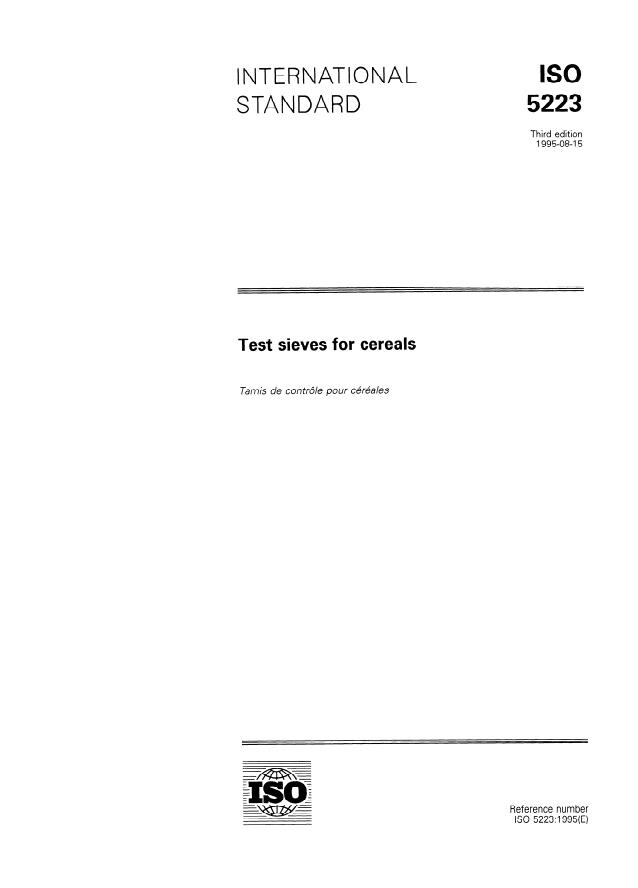
INTERNATIONAL
STANDARD
Third edition
1995-08-15
Test sieves for cereals
Tamis de contr6le pour ckrbales
Reference number
ISO 52237 995(E)
ISO 5223: 1995(E)
Foreword
ISO (the International Organization for Standardization) is a worldwide
federation of national Standards bodies (ISO member bodies). The work
of preparing International Standards is normally carried out through ISO
technical committees. Esch member body interested in a subject for
which a technical committee has been established has the right to be
represented on that committee. International organizations, governmental
and non-governmental, in liaison with ISO, also take part in the work. ISO
collaborates closely with the International Electrotechnical Commission
(1 EC) on all matters of electrotechnical standardization.
Draft International Standards adopted by the technical committees are
circulated to the member bodies for voting. Publication as an International
Standard requires approval by at least 75 % of the member bodies casting
a vote.
International Standard ISO 5223 was prepared by Technical Committee
lSO/TC 34, Agricultural food products, Subcommittee SC 4, Cereals and
pulses, in collaboration with the International Association for Cereal Sci-
ence and Technology (ICC).
This third edition cancels and replaces the second edition
(ISO 5223:1983), which has been technically revised.
0 ISO 1995
All rights reserved. Unless otherwise specified, no part of this publication may be reproduced
or utilized in any form or by any means, electronie or mechanical, including photocopying and
microfilm, without Permission in writing from the publisher.
International Organization for Standardization
Case Postale 56 l CH-1 211 Geneve 20 l Switzerland
Printed in Switzerland
ii
0 ISO
ISO 5223: 1995(E)
Introduction
The commercial value of a batch of cereals is affected by the presence
of undesirable substances. The amount of these substances in a Sample
is measured by carrying out various separating processes, of which the
principal one is test sieving.
The test sieving procedure is carried out under conditions determined by
commercial practice, contracts or official regulations, with low accuracy.
Consequently, more often than not, the only dimensions given for test
sieves are the diameter or the width of the apertures in the perforated
plate. The other features of test sieves are not normally specified, despite
their effect on the results.
Therefore, this international Standard describes those test sieves most
frequently used in commerce.
. . .
Ill
This page intentionally left blank
INTERNATIONAL STANDARD 0 ISO
Test sieves for cereals
2 Normative references
1 Scope
This International Standard specifies requirements for The following Standards contain provisions which,
test sieves to be used for the laboratory determination through reference in this text, constitute provisions
of undesirable substances in a Sample of cereals and of this International Standard. At the time of publi-
which pass through test sieves of the following nom- cation, the editions indicated were valid. All Standards
inal sizes: are subject to revision, and Parties to agreements
based on this International Standard are encouraged
a) test sieves with long rounded apertures:
to investigate the possibility of applying the most re-
cent editions of the Standards indicated below.
1,OO mm x 20,O mm
Members of IEC and ISO maintain registers of cur-
1,70 mm x 20,O mm
rently valid International Standards.
1,80 mm x 20,O mm
1,90 mm x 20,O mm
ISO 2395:1990, Test sieves and test sieving -
2,00 mm x 20,O mm
Vocabulary.
2,20 mm x 20,O mm
2,50 mm x 20,O mm
2,80 mm x 20,O mm ISO 331 O-2: 1990, Test sieves - Technical require-
3,55 mm x 20,O mm
Part 2: Test sieves of perforated
men ts and testing -
me tal pla te.
b) test sieves with round apertures:
diameter 4,50 mm
3 Definitions
Test sieves with long rounded apertures listed in a)
For the purposes of this International Standard, the
are used in particular for separating “shrivelled” ker-
definitions given in ISO 2395 apply.
nels from rye, durum wheat, common wheat and
barley, with the exception of those with apertures of
diameters 2,50 mm and 2,80 mm, which are usually
4 Requirements
used for the calibration of malting barley.
Test sieves with round apertures of diameter
4. ‘1 General
4,50 mm are used for separating broken grains from
maize.
All Parts shall be made of metal. A cover and a re-
This International Standard does not apply to test ceiver, made of the same metal and gauge as the
sieve frame, shall be used.
sieves used for testing grain for insect infestation.
@Zl ISO
In the case of test sieves with long rounded aper- The apertures shall be arranged in lines as shown in
tures, test sieving is carried out using one or more figure 1.
test sieves. In the latter case, the test sieves shall
There shall be no Part-Slots at the junction of the
have different nominal aperture sizes and shall con-
sieving medium with sieve frame.
stitute a regular or irregular set of test sieves.
4.2 Sieving medium
4.22 Test sieves with round apertures
The sieving medium shall consist of stainless steel,
Unless otherwise specif
...
NORME
ISO
INTERNATIONALE
Troisième édition
1995-08-15
Tamis de contrôle pour céréales
Test sieves for cereals
Numéro de référence
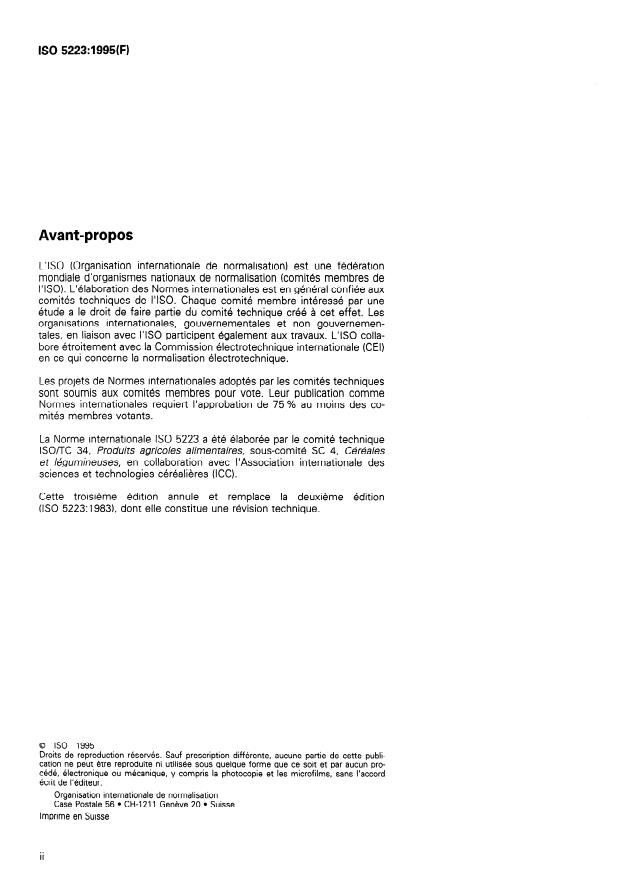
Avant-propos
LYS0 (Organisation internationale de normalisation) est une fédération
mondiale d’organismes nationaux de normalisation (comités membres de
I’ISO). L’élaboration des Normes internationales est en général confiée aux
comités techniques de I’ISO. Chaque comité membre intéressé par une
étude a le droit de faire partie du comité technique créé à cet effet. Les
organisations internationales, gouvernementales et non gouvernemen-
tales, en liaison avec I’ISO participent également aux travaux. L’ISO colla-
bore étroitement avec la Commission électrotechnique internationale (CEI)
en ce qui concerne la normalisation électrotechnique.
Les projets de Normes internationales adoptés par les comités techniques
sont soumis aux comités membres pour vote. Leur publication comme
Normes internationales requiert l’approbation de 75 % au moins des co-
mités membres votants.
La Norme internationale ISO 5223 a été élaborée par le comité technique
lSO/TC 34, Produits agricoles alimentaires, sous-comité SC 4, Céréales
et Iégumineuses, en collaboration avec l’Association internationale des
sciences et technologies céréalières (ICC).
Cette troisième édition annule et remplace la deuxième édition
(ISO 5223:1983), dont elle constitue une révision technique.
0 ISO 1995
Droits de reproduction réservés. Sauf prescription différente, aucune partie de cette publi-
cation ne peut être reproduite ni utilisée sous quelque forme que ce soit et par aucun pro-
cédé, électronique ou mécanique, y compris la photocopie et les microfilms, sans l’accord
écrit de l’éditeur.
Organisation internationale de normalisation
Case Postale 56 l Cl-l-l 211 Genève 20 l Suisse
Imprimé en Suisse
ii
0 ISO
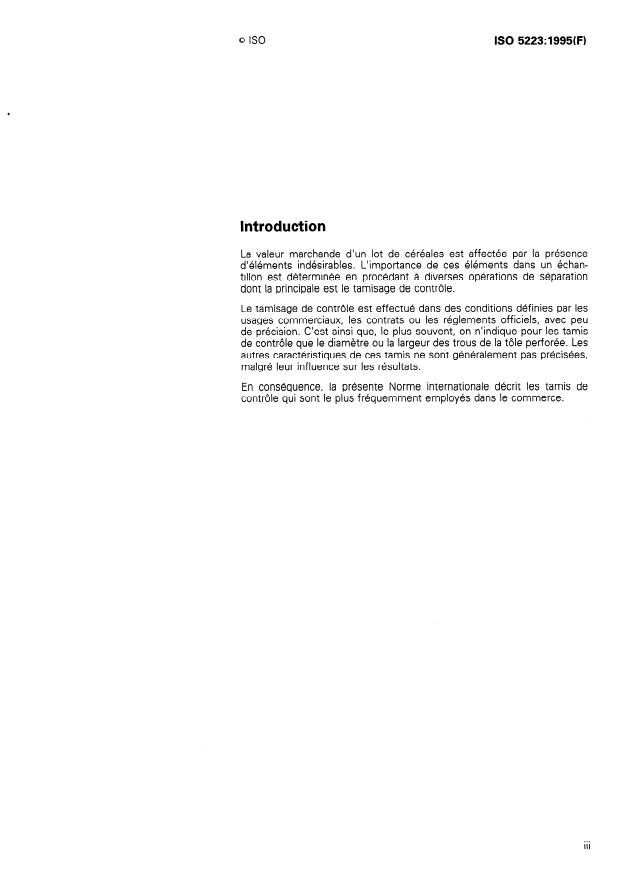
Introduction
La valeur marchande d’un lot de céréales est affectée par la présence
d’éléments indésirables. L’importance de ces éléments dans un échan-
tillon est déterminée en procédant à diverses opérations de séparation
dont la principale est le tamisage de contrôle.
Le tamisage de contrôle est effectué dans des conditions définies par les
usages commerciaux, les contrats ou les réglements officiels, avec peu
de précision. C’est ainsi que, le plus souvent, on n’indique pour les tamis
de contrôle que le diamètre ou la largeur des trous de la tôle perforée. Les
autres caractéristiques de ces tamis ne sont généralement pas précisées,
malgré leur influence sur les résultats.
En conséquence, la présente Norme internationale décrit les tamis de
contrôle qui sont le plus fréquemment employés dans le commerce.
Page blanche
NORME INTERNATIONALE 0 60 ISO 5223:1995(F)
Tamis de contrôle pour céréales
tuent des dispositions valables pour la présente
1 Domaine d’application
Norme internationale. Au moment de la publication,
les éditions indiquées étaient en vigueur. Toute
La présente Norme internationale prescrit les carac-
norme est sujette à révision et les parties prenantes
téristiques des tamis de contrôle à utiliser pour la dé-
des accords fondés sur la présente Norme internatio-
termination, en laboratoire, des éléments indésirables
nale sont invitées à rechercher la possibilité d’appli-
dans un échantillon de céréales, et passant au travers
quer les éditions les plus récentes des normes
de tamis de contrôle ayant la forme et les dimensions
indiquées ci-après. Les membres de la CEI et de I’ISO
suivantes:
possèdent le registre des Normes internationales en
a) tamis de contrôle à trous longs arrondis: vigueur à un moment donné.
1,OO mm x 20,O mm
ISO 2395:1990, Tamis et tamisage de contrôle -
1,70 mm x 20,O mm
Vocabulaire.
1,80 mm x 20,O mm
1,90 mm x 20,O mm
ISO 33 1 O-2: 1990, Tamis de contrôle - Exigences
2,00 mm x 20,O mm
techniques et vérifications - Partie 2: Tamis de
2,20 mm x 20,O mm
contrôle en tôles métalliques perforées.
2,50 mm x 20,O mm
2,80 mm x 20,O mm
3,55 mm x 20,O mm
3 Définitions
b) tamis de contrôle à trous ronds:
Pour les besoins de la présente Norme internationale,
les définitions données dans I’ISO 2395 s’appliquent.
4,50 mm de diamètre
Les tamis de contrôle à trous longs arrondis ayant les
4 Prescriptions
dimensions indiquées en a) sont utilisés en particulier
pour séparer les grains ((échaudés) du seigle, du blé
4.1 Généralités
dur, du blé tendre et de l’orge, à l’exception des tamis
de 2,50 mm et 2,80 mm qui sont généralement utili-
Toutes les pièces doivent être en métal. Un couvercle
sés pour le calibrage des orges de brasserie.
et un réceptacle, en un même métal et de même ca-
librage que la monture, doivent être utilisés.
Les tamis de contrôle à trous ronds de 4,50 mm de
diamètre sont utilisés pour séparer les grains brisés
Dans le cas des tamis de contrôle à trous longs ar-
du maïs.
rondis, le tamisage de contrôle est effectué avec un
ou plusieurs tamis de contrôle. Dans ce dernier cas,
La présente Norme internationale n’est pas applicable
les tamis doivent avoir des ouvertures nominales de
aux tamis utilisés pour les méthodes de recherche et
tailles différentes et constituer une série régulière ou
de détermination de I’infestation due aux insectes.
irrégulière de tamis de contrôle.
2 Références normatives
4.2 Fond de tamis
Les normes suivantes contiennent des dispositions Le fond de tamis doit être constitué par une tôle per-
qui, par suite de la référence qui en est faite, consti- forée en acier inoxydable, acier doux revêtu ou autre
Q ISO
matériau approprié l) . Elle doit être rendue solidaire de II ne doit y avoir aucune rainure partielle à la jonction
la monture par soudage, ou autre technique, d
...
NORME
ISO
INTERNATIONALE
Troisième édition
1995-08-15
Tamis de contrôle pour céréales
Test sieves for cereals
Numéro de référence
Avant-propos
LYS0 (Organisation internationale de normalisation) est une fédération
mondiale d’organismes nationaux de normalisation (comités membres de
I’ISO). L’élaboration des Normes internationales est en général confiée aux
comités techniques de I’ISO. Chaque comité membre intéressé par une
étude a le droit de faire partie du comité technique créé à cet effet. Les
organisations internationales, gouvernementales et non gouvernemen-
tales, en liaison avec I’ISO participent également aux travaux. L’ISO colla-
bore étroitement avec la Commission électrotechnique internationale (CEI)
en ce qui concerne la normalisation électrotechnique.
Les projets de Normes internationales adoptés par les comités techniques
sont soumis aux comités membres pour vote. Leur publication comme
Normes internationales requiert l’approbation de 75 % au moins des co-
mités membres votants.
La Norme internationale ISO 5223 a été élaborée par le comité technique
lSO/TC 34, Produits agricoles alimentaires, sous-comité SC 4, Céréales
et Iégumineuses, en collaboration avec l’Association internationale des
sciences et technologies céréalières (ICC).
Cette troisième édition annule et remplace la deuxième édition
(ISO 5223:1983), dont elle constitue une révision technique.
0 ISO 1995
Droits de reproduction réservés. Sauf prescription différente, aucune partie de cette publi-
cation ne peut être reproduite ni utilisée sous quelque forme que ce soit et par aucun pro-
cédé, électronique ou mécanique, y compris la photocopie et les microfilms, sans l’accord
écrit de l’éditeur.
Organisation internationale de normalisation
Case Postale 56 l Cl-l-l 211 Genève 20 l Suisse
Imprimé en Suisse
ii
0 ISO
Introduction
La valeur marchande d’un lot de céréales est affectée par la présence
d’éléments indésirables. L’importance de ces éléments dans un échan-
tillon est déterminée en procédant à diverses opérations de séparation
dont la principale est le tamisage de contrôle.
Le tamisage de contrôle est effectué dans des conditions définies par les
usages commerciaux, les contrats ou les réglements officiels, avec peu
de précision. C’est ainsi que, le plus souvent, on n’indique pour les tamis
de contrôle que le diamètre ou la largeur des trous de la tôle perforée. Les
autres caractéristiques de ces tamis ne sont généralement pas précisées,
malgré leur influence sur les résultats.
En conséquence, la présente Norme internationale décrit les tamis de
contrôle qui sont le plus fréquemment employés dans le commerce.
Page blanche
NORME INTERNATIONALE 0 60 ISO 5223:1995(F)
Tamis de contrôle pour céréales
tuent des dispositions valables pour la présente
1 Domaine d’application
Norme internationale. Au moment de la publication,
les éditions indiquées étaient en vigueur. Toute
La présente Norme internationale prescrit les carac-
norme est sujette à révision et les parties prenantes
téristiques des tamis de contrôle à utiliser pour la dé-
des accords fondés sur la présente Norme internatio-
termination, en laboratoire, des éléments indésirables
nale sont invitées à rechercher la possibilité d’appli-
dans un échantillon de céréales, et passant au travers
quer les éditions les plus récentes des normes
de tamis de contrôle ayant la forme et les dimensions
indiquées ci-après. Les membres de la CEI et de I’ISO
suivantes:
possèdent le registre des Normes internationales en
a) tamis de contrôle à trous longs arrondis: vigueur à un moment donné.
1,OO mm x 20,O mm
ISO 2395:1990, Tamis et tamisage de contrôle -
1,70 mm x 20,O mm
Vocabulaire.
1,80 mm x 20,O mm
1,90 mm x 20,O mm
ISO 33 1 O-2: 1990, Tamis de contrôle - Exigences
2,00 mm x 20,O mm
techniques et vérifications - Partie 2: Tamis de
2,20 mm x 20,O mm
contrôle en tôles métalliques perforées.
2,50 mm x 20,O mm
2,80 mm x 20,O mm
3,55 mm x 20,O mm
3 Définitions
b) tamis de contrôle à trous ronds:
Pour les besoins de la présente Norme internationale,
les définitions données dans I’ISO 2395 s’appliquent.
4,50 mm de diamètre
Les tamis de contrôle à trous longs arrondis ayant les
4 Prescriptions
dimensions indiquées en a) sont utilisés en particulier
pour séparer les grains ((échaudés) du seigle, du blé
4.1 Généralités
dur, du blé tendre et de l’orge, à l’exception des tamis
de 2,50 mm et 2,80 mm qui sont généralement utili-
Toutes les pièces doivent être en métal. Un couvercle
sés pour le calibrage des orges de brasserie.
et un réceptacle, en un même métal et de même ca-
librage que la monture, doivent être utilisés.
Les tamis de contrôle à trous ronds de 4,50 mm de
diamètre sont utilisés pour séparer les grains brisés
Dans le cas des tamis de contrôle à trous longs ar-
du maïs.
rondis, le tamisage de contrôle est effectué avec un
ou plusieurs tamis de contrôle. Dans ce dernier cas,
La présente Norme internationale n’est pas applicable
les tamis doivent avoir des ouvertures nominales de
aux tamis utilisés pour les méthodes de recherche et
tailles différentes et constituer une série régulière ou
de détermination de I’infestation due aux insectes.
irrégulière de tamis de contrôle.
2 Références normatives
4.2 Fond de tamis
Les normes suivantes contiennent des dispositions Le fond de tamis doit être constitué par une tôle per-
qui, par suite de la référence qui en est faite, consti- forée en acier inoxydable, acier doux revêtu ou autre
Q ISO
matériau approprié l) . Elle doit être rendue solidaire de II ne doit y avoir aucune rainure partielle à la jonction
la monture par soudage, ou autre technique, d
...