


ISO 6107-3:1985
(Main)Water quality — Vocabulary
Water quality — Vocabulary
Qualité de l'eau — Vocabulaire
General Information
- Status
- Withdrawn
- Publication Date
- 13-Nov-1985
- Withdrawal Date
- 13-Nov-1985
- Technical Committee
- ISO/TC 147/SC 1 - Terminology
- Drafting Committee
- ISO/TC 147/SC 1 - Terminology
- Current Stage
- 9599 - Withdrawal of International Standard
- Start Date
- 10-Jun-1993
- Completion Date
- 14-Feb-2026
Relations
- Effective Date
- 06-Jun-2022
- Effective Date
- 15-Apr-2008
Get Certified
Connect with accredited certification bodies for this standard

NSF International
Global independent organization facilitating standards development and certification.

CIS Institut d.o.o.
Personal Protective Equipment (PPE) certification body. Notified Body NB-2890 for EU Regulation 2016/425 PPE.

Kiwa BDA Testing
Building and construction product certification.
Sponsored listings
Frequently Asked Questions
ISO 6107-3:1985 is a standard published by the International Organization for Standardization (ISO). Its full title is "Water quality — Vocabulary". This standard covers: Water quality — Vocabulary
Water quality — Vocabulary
ISO 6107-3:1985 is classified under the following ICS (International Classification for Standards) categories: 01.040.13 - Environment. Health protection. Safety (Vocabularies); 13.060.01 - Water quality in general. The ICS classification helps identify the subject area and facilitates finding related standards.
ISO 6107-3:1985 has the following relationships with other standards: It is inter standard links to ISO 2580-1:2002, ISO 6107-3:1993. Understanding these relationships helps ensure you are using the most current and applicable version of the standard.
ISO 6107-3:1985 is available in PDF format for immediate download after purchase. The document can be added to your cart and obtained through the secure checkout process. Digital delivery ensures instant access to the complete standard document.
Standards Content (Sample)
INTERNATIONAL STANDARD
NORME INTERNATIONALE
@ 610713
MEXFJYHAPOflHblÜl CTAHAAPT atqj!j!j
INTERNATIONAL ORGANIZATION FOR STANDARDIZATION*ME)YHAPOfiHAR OPrAHHJAUMR fl0 CTAHfiAPTM3AUMM.ORGANlSATlON INTERNATIONALE DE NORMALISATION
Water quality - Vocabulary - Part 3
c
First edition - 1985-11-15
Qualité de l'eau - Vocabulaire - Partie 3
Première édition - 1985-11-15
KarieciBo BOAbl - CJlOBâpb - qâCTb 3
nepeoe LI~A~HH~ - 1985-11-15
Wasserbeschaffenheit - Begriffe - Teil 3
\ __
Erste Ausgabe - 1985-11-15
I
-a
a-
25 UDC/CDU/YAK 614.777 : 001.4 Ref. No./Réf. no : IS0 6107/3-1985 (E/F/R)
@2
CCbiJlKa No: MCO 6107/3-1985 (A/@/P)
#E -4
Descriptors : water, quality, vocabulary. / Descripteurs : eau, qualité, vocabulaire. /AecKpwnTopbi : Bona i
O
Price based on 23 pages/Prix basé sur 23 pages/ueHa paccLiHTaHa Ha 23 CTD
sz
Foreword
IS0 (the International Organization for Standardization) is a worldwide federation of national
standards bodies (IS0 member bodies). The work of preparing International Standards is nor-
mally carried out through IS0 technical committees. Each member body interested in a subject
for which a technical committee has been established has the right to be represented on that
Committee. International organizations, governmental and non-governmental, in liaison with
ISO, also take part in the work.
Draft International Standards adopted by the technical committees are circulated to the member
IS0 Council. They
bodies for approval before their acceptance as International Standards by the
are approved in accordance with IS0 procedures requiring at least 75 % approval by the member
bodies voting.
International Standard IS0 6107/3 was prepared by Technical Committee ISO/TC 147, Wafer
quality.
Y
Avant-propos
L'ISO (Organisation internationale de normalisation) est une fédération mondiale d'organismes
nationaux de normalisation (comités membres de I'ISO). L'élaboration des Normes inter-
nationales est confiée aux comités techniques de I'ISO. Chaque comité membre intéressé par une
à cet effet. Les organisations inter-
étude a le droit de faire partie du comité technique créé
nationales, gouvernementales et non gouvernementales, en liaison avec l'lS0, participent égale-
ment aux travaux.
Les projets de Normes internationales adoptés par les comités techniques sont soumis aux comi-
tés membres pour approbation, avant leur acceptation comme Normes internationales par le
Conseil de I'ISO. Les Normes internationales sont approuvées conformément aux procédures de
I'ISO qui requièrent l'approbation de 75 YO au moins des comités membres votants.
La Norme internationale IS0 6107/3 a été élaborée par le comité technique ISO/TC 147, Qualifé
de l'eau.
BBeAeHHe
International Organization for Standardization, 1985 0
O
(Cl Organisation internationale de normalisation, 1985 0
MexAyHapoANan Opran~aaqun no Cian~aprnaaq~~, 1985 0
O
Printed in Switzerland/ Imprimé en SuisseiHînaHo B UleeMqapw
INTERNATIONAL STANDARD
IS0 6107/3-1985 (E/F/R)
NORME INTERNATIONALE
HCO 6107/3-1985 (A/@/P)
MEXAYHAPOAHbla CTAHAAPT
-
Water quality - Vocabulary - Part 3
Qualité de l'eau - Vocabulaire - Partie 3
Wasserbeschaffenheit - Begriffe - Teil 3
k
IS0 6107/3-1985 (E/F/R)
HCO 6107/3-1985 (A/@/P)
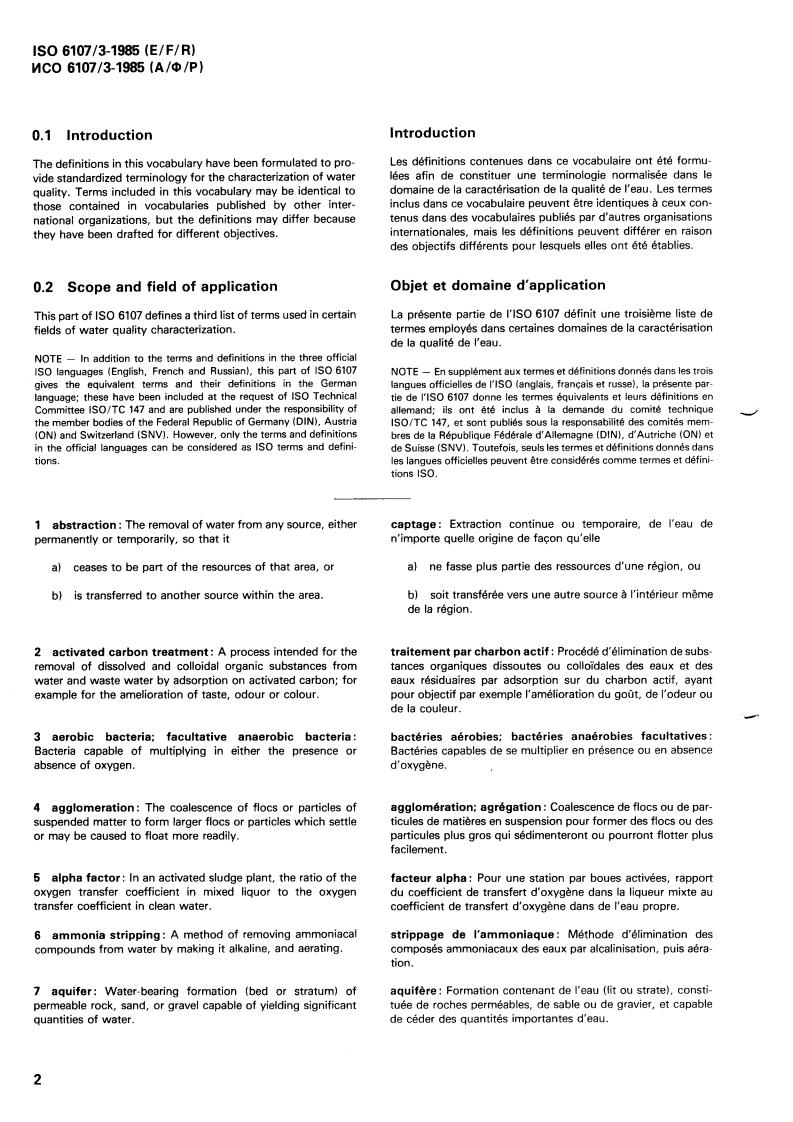
Introduction
0.1 Introduction
Les définitions contenues dans ce vocabulaire ont été formu-
The definitions in this vocabulary have been formulated to pro-
lées afin de constituer une terminologie normalisée dans le
vide standardized terminology for the characterization of water
domaine de la caractérisation de la qualité de l’eau. Les termes
quality. Terms included in this vocabulary may be identical to
inclus dans ce vocabulaire peuvent être identiques à ceux con-
those contained in vocabularies published by other inter-
tenus dans des vocabulaires publiés par d’autres organisations
national organizations, but the definitions may differ because
internationales, mais les définitions peuvent différer en raison
they have been drafted for different objectives.
des objectifs différents pour lesquels elles ont été établies.
Objet et domaine d‘application
0.2 Scope and field of application
La présente partie de I’ISO 6107 définit une troisième liste de
This part of IS0 6107 defines a third list of terms used in certain
termes employés dans certaines domaines de la caractérisation
fields of water quality characterization.
de la qualité de l’eau.
NOTE - In addition to the terms and definitions in the three official
IS0 languages (English, French and Russian), this part of IS0 6107 NOTE - En supplément aux termes et définitions donnés dans les trois
gives the equivalent terms and their definitions in the German langues officielles de I‘ISO (anglais, francais et russe), la présente par-
language; these have been included at the request of IS0 Technical tie de I’ISO 6107 donne les termes équivalents et leurs définitions en
Committee ISO/TC 147 and are published under the responsibility of allemand; ils ont été inclus à la demande du comité technique -
of the Federal Republic of Germany (DIN), Austria ISO/TC 147, et sont publiés sous la responsabilité des comités mem-
the member bodies
(ON) and Switzerland (SNV). However, only the terms and definitions bres de la République Fédérale d’Allemagne (DIN), d’Autriche (ON) et
in the official languages can be considered as IS0 terms and defini- de Suisse (SNV). Toutefois, seuls les termes et définitions donnés dans
tions. les langues officielles peuvent être considérés comme termes et défini-
tions ISO.
1 abstraction : The removal of water from any source, either captage : Extraction continue ou temporaire, de l‘eau de
permanently or temporarily, so that it n’importe quelle origine de facon qu’elle
ceases to be part of the resources of that area, or a) ne fasse plus partie des ressources d’une region, ou
ai
is transferred to another source within the area. soit transférée vers une autre source à l’intérieur même
b) b)
de la région.
2 activated carbon treatment: A process intended for the traitement par charbon actif: Procédé d’élimination de subs-
removal of dissolved and colloidal organic substances from tances organiques dissoutes ou colloïdales des eaux et des
water and waste water by adsorption on activated carbon; for eaux résiduaires par adsorption sur du charbon actif, ayant
example for the amelioration of taste, odour or colour. pour objectif par exemple l‘amélioration du goût, de l’odeur ou
de la couleur.
e‘
3 aerobic bacteria; facultative anaerobic bacteria : bactéries aérobies; bactéries anaérobies facultatives :
Bacteria capable of multiplying in either the presence or Bactéries capables de se multiplier en présence ou en absence
absence of oxygen.
d’oxygène.
4 agglomeration: The coalescence of flocs or particles of agglomération; agrégation : Coalescence de flocs ou de par-
suspended matter to form larger flocs or particles which settle ticules de matières en suspension pour former des flocs ou des
particules plus gros qui sédimenteront ou pourront flotter plus
or may be caused to float more readily.
facilement.
5 alpha factor : In an activated sludge plant, the ratio of the facteur alpha : Pour une station par boues activées, rapport
oxygen transfer coefficient in mixed liquor to the oxygen du coefficient de transfert d‘oxygène dans la liqueur mixte au
transfer coefficient in clean water.
coefficient de transfert d’oxygène dans de l‘eau propre.
6 ammonia stripping: A method of removing ammoniacal strippage de l’ammoniaque : Méthode d‘élimination des
composés ammoniacaux des eaux par alcalinisation, puis aéra-
compounds from water by making it alkaline, and aerating.
tion.
7 aquifer: Water-bearing formation (bed or stratum) of aquifère: Formation contenant de l‘eau (lit ou strate), consti-
tuée de roches perméables, de sable ou de gravier, et capable
permeable rock, sand, or gravel capable of yielding significant
quantities of water. de céder des quantités importantes d‘eau.
IS0 6107/3-1985 (E/F/R)
VlCO 6107/3-1985 (A/@/P)
Vorbemerkung
O1 BeeAeHHe
Die Definitionen dieser Begriffsnorrn wurden formuliert, urn ei-
OnpepeneHm, npmepeHHbie B HacToflqeM cnoeape, paiibi
ne genorrnte Terminologie für die Charakterisierung der Was-
c qen bo CT~H~~PTM~~L~IM TepMuHonorMu, xapa~~ep~3yioqeM
serbeschaffenheit zu errnoglichen. Die Benennungen konnen
Kâ'4eCTBO BOpbl. TePMMHbl, BKIlO'4eHHble B AaHHbIM CilOBapb,
mit solchen anderer internationaler Organisationen überein-
MOrYT 6blTb HpeHTM'4Hbl COpepXa~MMCR B CnOBapRX, ony6n~-
stirnmen, die in Begriffsnorrnen publiziert worden Sind, die De-
KOBaHHblX flPYrMMM MeXpyHapOpHbiMM OPraHM3aqMRMM, HO
finitionen konnen jedoch abweichen, da sie unter verschiede-
OnpeflWleHMR MOrYT H OTllM'4aTbCR, T.K. OHM COCTaBneHbl AflR
nen Zielsetzungen erstellt wurden.
pasnilqnbix qeneM.
Zweck und Anwendungsbereich
Dieser Teil der IS0 6107 stellt eine Liste von Begriffen mit ihren
Definitionen auf, die in bestimmten Gebieten für die Charakteri-
sierung der Wasserbeschaffenheit benutzt werden.
ANMERKUNG - Zuçatzlich zu den Begriffen und Definitionen in den
IS0 (Englisch, Franzosiçch und Russisch),
drei offiziellen Sprachen der
enthalt die vorliegende Internationale Norm die entsprechenden Begrif-
fe und Definitionen in deutçcher Sprache; diese wurden zur Inforrna-
tion auf Wunsch des Technischen Kornitees ISO/TC 147 aufgenorn-
men. lhre Übereinstirnrnung wurde von den Mitgliedçkorperschafen
der Bundesrepublik Deutschland (DIN), Oçterreichs (ON) und der
Schweiz (SNV) geprüft. Es konnen jedoch nur die in den offiziellen
Sprachen angegebenen Begriffe und Definitionen als ISO-Begriffe und
ISO-Definitionen angesehen werden.
1 0~60~: OT6OP npo6 BOpbl M3 MCTOrHMKa nu60 nOCTORH- Entnahrne : Zeitweilige Oder permanente Herausnahme von
Wasser aus irgendeinern Wasservorkornrnen, so da13 es
HO, n~60 BpeMeHHO, TaKMM 06pa30M '4TO BOpa
a) nepecTaeT 6bi~b racTbio pecypcoe Aa"oi;i aKBaTo- a) nicht rnehr Teil des Wasservorkornrnens in dern ent-
sprechended Gebiet ist, oder
PMM, MnH
b) einern anderen Vorkomrnen in diesern Gebiet zugeführt
6) nepe6pacbisae~c~ B ppyroM MCTO~HMK B npepenax
3TOM aKEaTOpMM. wird.
2 06pa60TKa aKTnenpoeaHHbiM yrnem: npoqecc, npeAHa- Aktivkohlebehandlung : Verfahren zur Entfernung von orga-
snarenbril pnn yAaneHuR opraHwrecwx seqec-re (pacTBopeH- nischen Stoffen (gelost Oder kolloidal) aus Wasser Oder Abwas-
HblX MnM KOnJlOMpHblX) M3 BOpbl n)lTeM apcop6q~~ Ha âKTMBM- ser rnittels Adsorption an Aktivkohle, z. B. zur Verbesserung
poaaHHoM yrne, HanpMMep, pnR ynyquietiwn BKyca, aanaxa wu des Geschrnacks, Geruchs Oder der Farbe.
k., UseTa.
aerobe Bakterien; fakultativ anaerobe Bakterien : Bakte-
rien, die sich sowohl in Gegenwart als auch in Abwesenheit von
Sauerstoff verrnehren konnen.
4 arnomepaqnu: Coepwewe xnonbes MnM qacTuq 8388- Agglomeration; Aggregation : Die Vereinigung von Flocken
tue"bix seuec-re, B pe3ynb~a~e qero 06pa3YioTCR 60flbtuMe Oder Teilchen suspendierter Stoffe zu groBeren Flocken Oder
XnOnbR MiiM raCTMubl, KOTOPble OCaXpaioTCR HaMHOrO 6bi- Partikeln. die sich schneller absetzen Oder aufschwirnrnen.
cTpee.
5 anb@a.@aKTop : OwoweHMe KO~@@M~M~HT~ nepeHoca
Alpha-Faktor : Verhaltnis des Sauerstoff übergangskoeffizien-
Klicnopo~aBMnosoMcMecM~~o3@@)Muue~~ynepenoca~m- ten irn Belebtschlarnm-Abwasser-Gernisch zu dem in reinern
nopopa B MCT TOM eoAe Ha cTaHuMn a3paq~~.
Wasser unter sonst gleichen Bedingungen.
6 oirowa aMMmaKa : MeTOA ypanewa aMMuawbix coeAM- Ammoniakaustreibung : Verfahren zur Entfernung von Am-
rnoniurnverbindungen aus Wasser durch Alkalisieren und Be-
He"M ~3 BOA nyTeM nopqenarueanwi M nocnefiyioqero
npopyeaHuR repes HMX eospyxa. Iüften.
7 eoAoHocnbi6i cno6i : npoHMqaeMbih cnow rpywa, necKa,
Grundwasserraum; Aquifer : Wasserfü hrende Formation
nopoflbi unu rpaeufl, co4epxaqui;i 3naw~enb~bie KonMre-
(Schicht Oder Bett) von durchlassigern Gestein, Sand Oder
CTBa BOpbl.
Kies, aus der bedeutende Mengen Wasser gewonnen werden
konnen.
IS0 6107/3-1985 (E/F/R)
MCO 6107/3-1985 (A/@/P)
8 autotrophic bacteria; chemolithotrophic bacteria: bactéries autotrophes: bactéries chimiolithotrophes :
Bacteria which are able to multiply by using inorganic matter as Bactéries capables de se multiplier en utilisant la matière miné-
the only source of carbon and nitrogen. rale comme unique source de carbone et d’azote.
lavage à contre-courant: Opération de lavage d’un filtre,
9 backwashing: The operation of cleaning a filter with
avec de l’eau, ou de l’air et de l’eau, consistant à inverser le
water, or with air and water, by reversing the direction of flow.
sens du courant.
facteur bêta : Dans une station par boues activées, rapport de
10 beta factor : In an activated sludge plant, the ratio of the
la valeur de saturation en oxygène dans la liqueur mixte à la
oxygen saturation value in mixed liquor to the oxygen satu-
valeur de saturation en oxygène dans l’eau propre à tempéra-
ration value in clean water at the same temperature and at-
mospheric pressure. ture et SOUS pression atmosphérique identiques.
11 biodegradation : Molecular degradation of organic mat- biodégradation : Dégradation moléculaire d’une matière orga-
nique, en milieu généralement aqueux, résultant des actions
ter resulting from the complex actions of living organisms, or-
complexes d’organismes vivants.
dinarily in an aqueous medium.
12 biofilm (of a sand filter) : The film, consisting of living film biologique (d’un filtre de sable) : Film qui se compose
organisms, which forms on the surface of a slow sand filter and d’organismes vivants, qui prend forme sur la surface d’un filtre
de sable à filtration lente et qui est considéré comme fournis-
which is considered to provide an important part of the effec-
tive filtering zone. sant une partie importante de la zone effective de filtration.
13 biomass : The total mass of living material in a given body biomasse : Masse totale de matière vivante dans une masse
of water. d’eau donnée.
14 biota : The living components of an aquatic system. biote : Ensemble des organismes vivants de tout système aqua-
tique.
15 biotic index: A numerical value used to describe the biota indice biotique : Valeur numérique utilisée pour décrire le
of a water body, serving to indicate its biological quality. biote d’une masse d’eau, et utilisée pour en indiquer la qualité
biologique.
16 catchment area; catchment basin : The area draining bassin récepteur : Bassin drainant naturellement vers un
naturally to a water course or to a given point. cours d’eau ou un endroit donné.
17 chemical tracer: A chemical substance added to, or traceur chimique: Produit chimique, ajouté à l’eau ou s‘y
trouvant naturellement, qui permet d’en suivre l‘itinéraire.
naturally present in, water to allow flow to be followed.
Y
18 chemolithotrophic bacteria : See 8, autotrophic bactéries chimiolithotrophes : Voir 8, bactéries autotrophes.
bacteria.
19 connate water: Interstitial water of the same geological
eau connée: Eau intersticielle du même âge géologique que la
age as the surrounding rock or bed, often of poor quality and
roche ou le lit environnants, souvent de qualité médiocre et
unfit for normal use (for example potable purposes, industrial
impropre à une utilisation normale (par exemple utilisation
and agricultural use).
comme eau potable ou à des fins industrielles ou agricoles).
20 cross connection : A connection between pipes which
jonction fautive: jonction : Raccordement entre des canalisa-
may cause the transfer of polluted water into a potable water
tions qui peut être la cause du passage d’une eau polluée dans
supply with consequent hazard to public health.
un réseau d’alimentation en eau potable et qui a pour conse-
quence un risque pour la santé publique.
This term is also used to describe a legitimate connection be-
tween different distribution systems.
Ce terme est aussi utilisé pour décrire un raccordement normal
entre différents systèmes de distribution.
21 decantation : The withdrawal of the supernatant liquor : Retrait de la liqueur surnageante après sédimen-
décantation
after settlement of suspended solids, or after separation from a tation des matières solides en suspension ou après séparation
liquid of higher density.
d’un liquide de plus forte densité.
IS0 6107/3-1985 (E/F/R)
MCO 6107/3-1985 (A/@/P)
autotrophe Bakterien; chemolithotrophe Bakterien : Bak-
terien, die sich verrnehren konnen, indem Sie nur anorganische
Stoffe als Kohlenstoff- und Stickstoffquelle verwenden.
Rückspülung; Gegenstromspülung : Verfahren zur Reini-
gung eines Filters mit Wasser Oder Wasser und Luft in der dem
Filtrationsvorgang entgegengesetzten Strornungsrichtung.
relative Sauerstoffsattigung; Beta-Faktor: Verhaltnis der
Sauerstoffsattigungskonzentration irn Belebtschlarnrn-Wasser-
Gernisch zu dern in reinern Wasser bei gleicher Ternperatur und
Druck erhaltenen Wert.
11 6~onor~rec~oe pa3nome~~e : MOfleKyflRpHOe pa~no- biologischer Abbau : Molekularer Abbau organischer Sub-
mewe oprannqecmx seqecTa E pe3ynb~a~e m~3~e~e~~enb- stanz durch lebende Organismen, normalerweise irn wagrigen
Medium.
HOCTM opra~~s~oe E BOAHOH cpeAe.
Filterhaut; Schmutzdecke; Biofilm (auf Sandfilter) : Zurn
Teil aus lebenden Organismen bestehende Haut an der Ober-
flache eines Langsamfilters, die einen wichtigen Teil der Filter-
zone darstellt.
E AaHHoM
13 6~omacca: 06qa~ Macca mMBoro seqecTsa Biomasse : Die gesamte lebende Masse in einem vorgegebe-
eoaoe~e. nen Wasserkorper.
14 6~o~a : >)
Lebensgemeinschaft; Biota; Biozonose : Die lebenden Be-
standteile eines aquatischen Systems.
15 6HOTHWCKHM HHAeKC: qMCfleHHaR EeflM'4MHâ, KOTOpaR biotischer Index : Numerischer Wert zur Beschreibung der Le-
Mcnon b3ye~c~ Ann onMca~M~6HoTbI eoAoeMa, xapa~~epu3yo- bensgemeinschaft in einem Wasserkorper, der dessen biologi-
qaR ee 6~onor~rec~oe KaqecTEo. sche Qualitat anzeigt.
16 BO~OC6OpHâR nnoqaAb; eOAOC6OpHbih 6acceHn : flfl0- Einzugsgebiet : Gebiet, in dem Wasser Oder Abwasser einern
WaAb eCTeCTEeHHOr0 EOAOCTOKâ A0 EOflOTOKâ MflM AaHHOIh
bestirnmten Wasserlauf Oder einem bestimmten Punkt mit na-
ero TO~KM. türlichem Gefalle zugeführt wird.
chemischer Markierungsstoff : Dern Wasser zugesetzte
Oder in ihrn bereits vorhandene chernische Substanz, die es
gestattet, seinen Flu8 zu verfolgen.
chemolithotrophe Bakterien : Siehe 8, autotrophe ûakte-
rien.
19 pennuoebie BoRbi: flopoeaq BoAa TaKoro me reonorw- juveniles Wasser; Porenwasser : Porenwasser gleichen geo-
qecKoro ~o~pac~a, Ka)< M oKpymaioqaR nopoAa nnM maw,
logischen Alters wie das umgebende Gestein, haufig von gerin-
lracTo HMJKO~O KarecTsa M HenpMroAHaR AnR 06biqHOrO MC- ger Qualitat und daher für den normalen Gebrauch (2.B. als
nOflb30EâHMR (HanpMMep, AflR nMTbR, IlPOMblliJfleHHOrO M Ceflb- Trinkwasser, lndustriewasser Oder Wasser für landwirtschaftli-
CKOX03R~CTEeHHOrO MCnOJl b30EaHMR).
Che Zweckei nicht geeignet.
Querverbindung : Rohrleitungsverbindungen, die das Eindrin-
gen von verunreinigtern Wasser in Trinkwasseverteilungsleitun-
gen errnoglichen und dadurch eine Gesundheitsgefahrdung
herbeiführen konnen.
Die Bezeichnung wird auch für zulassige Verbindungen zwi-
schen verschiedenen Verteilersysternen gebraucht.
Dekantation : Die Entnahrne der überstehenden Flüssigkeit,
nachdem sich suspendierte Feststoffe Oder eine Flüssigkeit ho-
herer Dichte abgesetzt haben.
IS0 6107/3-1985 (E/F/R)
WCO 6107/3-1985 (A/@/P)
durée de rétention : Voir 65.
22 detention time : See 65, retention period.
I
zone de drainage: Zone drainant un ou plusieurs points et
23 drainage area : The area draining to one or more points,
1 the boundaries of which are specified by a duly appointed dont les limites sont fixées par une autorité dûment désignée.
1 authority.
24 dynamic toxicity test : See 84.1 essai dynamique de toxicité : Voir 84.1.
25 dystrophic water: Water which is poor in nutrients and eau dystrophique : Eaux pauvres en substances nutritives et
contains a high concentration of humic substances. contenant une grande quantité de substances humiques.
26 ecology : The study of the interrelation of living organisms écologie : Étude des interrelations entre les organismes vivants
et leur environnement.
and their environment.
27 ecosystem : A system in which, by the interaction of the écosystème : Système dans lequel il existe des échanges cycli-
different organisms present and their environment, there is a ques de matières et d’énergie dus aux interactions entre les dif-
cyclic interchange of materials and energy. férents organismes présents et leur environnement.
Y
28 effluent polishing : See 83.1 polissage des effluents: Voir 83.1.
lessivage; lixiviation : Procédé de conditionnement au cours
29 elutriation: A conditioning process by which sludge is
washed with either fresh water or plant effluent to reduce the duquel la boue est lavée soit avec de l’eau douce soit avec
l’effluent de la station et destiné à réduire l’alcalinité de la boue,
alkalinity of the sludge, particularly by removing ammoniacal
particulièrement par élimination des composés ammoniacaux,
compounds, thereby reducing the amount of coagulant re-
ce qui permet de réduire la quantité de coagulant nécessaire.
quired.
30 euphotic zone: The upper layer of a body of water where zone euphotique : Couche supérieure d‘une masse d‘eau où la
light penetration is sufficient to support effective photosyn- pénétration de la lumière est suffisante pour permettre le phé-
thesis. nomène de photosynthèse.
flow-through toxicity test: See 84.1. essai de toxicité avec renouvellement continu : Voir 84.1
32 fresh water: Naturally occurring water having a low con- eau douce : Eau ayant naturellement une faible concentration
centration of salts, or generally accepted as suitable for en sels ou considérée généralement comme apte au captage et
abstraction and treatment to produce potable water. au traitement destiné à la production d‘eau potable.
33 halocline: A layer in a stratified body of water in which halocline : Couche d‘une masse d‘eau stratifiée dans laquelle
le gradient de salinité est maximal.
the salinity gradient is at a maximum.
: Nombre utilisé pour indiquer la coloration de
34 Hazen number: A number used to indicate the colour of nombre Hazen
sol- l’eau, l‘unité étalon étant la couleur produite par une solution
water, the standard unit being the colour produced by a
ution containing 1 mg of platinum per litre [in the form of contenant 1 mg de platine par litre [SOUS la forme d’hydrogéno-
hexachloroplatinate(IV)1 en présence de 2 mg de chlorure de
hydrogen hexachloroplatinate (IV)], in the presence of 2 mg of
cobalt(l1) chloride hexahydrate per litre. cobalt( II) hexahydraté par litre.
NOTE - See also standard unit (of colour), defined in IS0 7887, NOTE - Voir également unité étalon (de couleur) définie dans
Water quality - Examination and determination of colour. I’ISO 7887. Qualité de l’eau - Examen et détermination de la couleur.
boue humique : Film microbien qui, provenant d’un filtre bio-
35 humus sludge : The microbial film which sloughs off from
a biological filter and is normally separated in a final settling logique, est normalement séparé dans un bassin de sédimenta-
tank. tion finale.
hydrographie: Science appliquée qui traite de l‘étude et des
36 hydrography : The applied science concerned with the
study and measurement of seas, lakes, rivers and other waters. mesures relatives aux mers, aux lacs, aux rivières et aux autres
cours d’eau.
NOTE - In some countries, this term is synonymous with physical
and chemical oceanography. NOTE -- Dans certains pays, ce terme est synonyme du terme océa-
nographie physique et chimique.
IS0 6107/3-1985 (E/F/R)
MCO 6107/3-1985 (A/@/P)
Behandlungszeit : Siehe 65, Aufenthaltszeit.
22 epemw sa~epxnsann~ : CM. 65, nepuod sadepxueauu~
Entwhserungsgebiet : Gebiet, das zu einem Oder mehreren
23 nnoqanb eoffoc6opa: flnoqaab so~oc60pa ,qo oaHoro
Punkten entwassert, und dessen Grenzen durch eine Fachbe-
Mnu donee ny~i<~oa, rpaHMqbi ~o~opoù cneqw@MrHbi B npeae-
horde festgelegt werden.
nax yi
24 ~HHaMHiIeCKH# TOUCHKO~OrHiIeCKH# TeCT: CM. 84.1 dynamischer Toxizitatstest : Siehe 84.1.
dystrophes Wasser : Nahrstoffarmes Wasser mit einem ho-
hen Gehalt an Huminstoffen.
Okologie : Die Lehre von der Wechselbeziehung zwischen le-
benden Organismen und ihrer Umgebung.
Okosystem : System, in dem durch Wechselwirkung zwi-
schen den verschiedenen Organismen und ihrer Umwelt ein
kreislaufartiger Austausch von Materie und Energie besteht.
Ablaufschonung : Siehe 83.1,
Auçwaschung : Konditionierungsvorgang, bei dem Schlamm
entweder mit Frischwasser Oder mit gereinigtem Abwasser aus-
gewaschen wird, urn die Basizitat des Schlamms herabzuset-
zen, besonders durch Entfernung der Ammoniumverbindun-
gen. Dadurch wird die Menge des benotigten Flockungsmittels
herabgesetzt .
euphotische Zone : Die obere Schicht eines Wasserkorpers,
in der die tichtdurchlassigkeit für eine wirksame Photosynthese
ausreichend ist.
84.1.
31 TOKCHKOnOrHiIeCUH# TeCT nOCpenCT8OM CTOiIW blX 80A : Durchflusçtest: Siehe
CM. 84.1.
32 npecnaw eona: Boga aoaHbix 06heKTO6, meoqaq "3- : Natür-
Rohwasser; natürlich reines Wasse; Frischwasçer
uyo KoHqeHTpaqMo coneù Mnu McnonbsyeMaR nocne sa6opa M lich vorkommendes Wasser mit einer geringen Salzkonzentra-
o6pa60~w ,qnq nMTbR tion, daç generell für die Entnahme und Aufbereitung als Trink-
wasser geeignet ist.
Halokline : Schicht in einem geschichteten Wasserkorper, in
der der Salzgradient sein Maximum beçitzt.
Hazen-Zahl : Zahlenwert zur Kennzeichnung der Farbe von
Wasser. AIS Standardwert gilt die Farbe, die von einer Losung
von 1 mg/l Platin [in Form von Hexachloroplatinat (IV)-lonenl
in Gegenwart von 2 mg/l CobaIt(I1)-chloridhexahydrat erzeugt
wird.
IlPMMWAHME - CM TaKxe TepMMH crnaudaprnuan edunuya (qeeTa),
ANMERKUNG - Siehe auch Standardwert (einer Farbe), definiert in
onpeAeneHHbiü E MCO 7887 Kariecrnso EOdb! - Mcnbirnawue U onpe- IS0 7887, Wasserbeschaffenheit - Prüfung und Bestimmung der
denenue yserna Farbe.
Tropfkorperschlamm: Filterschlamm : Der mikrobiologi-
sche Rasen, der sich im Tropfkorper ablost und normalerweise
in einem Nachklarbecken abgesondert wird.
Hydrographie: Die Wissenschaft, die sich mit dem Studium
und der quantitativen Untersuchung von Meeren, Seen, Flüs-
sen und anderen Gewassern befasst.
ANMERKUNG - In gewissen Landern wird dieser Begriff alç Syno-
IlPMMEqAHME - B HeKOTOPblX CTpaHaX 3TOT TePMUH RBnReTCR CUHO-
nuMoM TepMuHa
IS0 6107/3-1985 (E/F/R)
MCO 6107/3-1985 (A/Q/P)
hydrology: The applied science concerned with the water hydrologie : Science appliquée au cycle de l'eau, des précipita-
3ï
cycle of precipitation, run-off or infiltration and storage, tions, de l'écoulement ou de l'infiltration et des réserves en eau,
de l'évaporation et de la reprécipitation.
evaporation and re-precipitation.
hydrométrie : Mesure et analyse du flux de l'eau.
38 hydrometry : The measurement and analysis of the flow
of water.
39 lmhoff cone: Conical transparent vessel, usually of cône d'imhoff : Récipient conique transparent d'une capacité
capacity 1 litre and graduated near its apex, used for determin- de 1 litre en général et gradué près de son sommet, utilisé pour
ing the volume of settleable matter in waters. la détermination du volume des matières décantables dans les
eaux.
40 lethal concentration (LC50): The concentration of a concentration létale (CW) : Concentration d'une substance
toxic substance which kills one half of a group of test organ- toxique qui tue la moitié du lot d'organismes d'essai. Générale-
isms. Usually the exposure to the substance is continuous and ment, l'exposition de la substance est réalisée de facon conti-
the LC50 is defined by reference to a specified exposure nue et la CL50 se définit par référence à une période d'exposi-
-
tion donnée.
period.
NOTE - The term median lethal concentration is used in some NOTE - Le terme concentration létale médiane est utilisé dans cer-
countries. tains pays.
41 littoral zone: The shallow marginal zone of a body of zone littorale: Zone marginale peu profonde d'une masse
water where light penetrates to the bottom; usually colonized d'eau où la lumière pénètre jusqu'au fond; en général colonisée
by rooted vegetation. par des végétaux à racines.
42 macrophytes : Large water plants. macrophytes : Grandes plantes aquatiques.
bilan massique: Relation entre l'entrée et la sortie d'une subs-
43 mass balance: The relationship between input and out-
put of a specified substance in a defined system, for example in tance donnée dans un système défini, par exemple dans un lac,
a lake, river or sewage treatment works, taking into account the une rivière ou une station de traitement d'eaux usées, qui prend
en compte la formation ou la décomposition de cette substance
formation or decomposition of that substance in the system.
dans le système.
44 maturation pond : A large shallow basin used for the fur- bassin de maturation : Grand bassin peu profond, utilisé pour
.-
ther treatment of sewage which has already received biological le traitement complémentaire des eaux usées ayant déjà subi un
treatment and from which the solids formed in biological treat- traitement biologique et dont les matières solides formées lors
ment have been removed. du traitement biologique ont été éliminées.
45 mesophilic digestion : Anaerobic digestion of sludge at a digestion mésophile : Digestion anaérobie des boues à une
temperature of from 20 to 40 OC, thereby encouraging the température de 20 à 40 OC, permettant de stimuler la croissance
growth of micro-organisms which grow best in this des micro-organismes se multipliant de facon optimale à ces
temperature range, for example mesophilic micro-organisms. niveaux de température, par exemple les micro-organismes
mésophiles.
46 mesotrophic water: A water of intermediate nutrient mésotrophie; eau mésotrophe: Eau dans un état nutritif
status, naturally occurring or due to nutrient enrichment, be- intermédiaire, apparaissant naturellement ou dû à un enrichis-
tween oligotrophic and eutrophic states. (See IS0 6107f l and sement nutritif, entre les états oligofrophe et eutrophe. (Voir
IS0 6107/2.) IS0 6107/1 et IS0 6107/2.)
minéralisation : Dégradation de la matière organique sous
47 mineralization : The breakdown of organic matter to car-
bon dioxide, water and the hydrides, oxides or mineral salts of forme de gaz carbonique, d'eau, d'hydrures, d'oxydes ou de
sels minéraux de tous les autres éléments présents.
any other elements present.
IS0 6107/3-1985 (E/F/R)
MCO 6107/3-1985 (A/Q/P)
37 rH4ponorw : npMKnaflqHaFi Hayi
qeHMeM rqqponorMrecKoro qu'
wie Speicherung, Verdunstung und erneutern Niederschlag be-
@Mn bTpaqMM M HaKonneHMq, ucnapewri M noeTopHoro 6 bina-
ReHuR ocanqi
38 rnApomeTpna: Ms~epenue M aHanus ToKa eodbi. Hydrometrie : Die Messung und Analyse des Wasserflusses.
Imhoff-Trichter : Konisches, transparentes Gefass, norrnaler-
weise mit einern Nennvolurnen von 1 I und einer Skala an der
Spitze, das für die Bestirnrnung der absetzbaren Stoffe irn
Wasser benutzt wird.
iethale Konzentration (LCW) : Die statistisch errnittelte Kon-
zentration einer Substanz, die die Halfte einer Gruppe von Test-
organisrnen totet. Norrnalerweise werden die Testorganisrnen
der Substanz kontinuierlich ausgesetzt und der LCW-Wert wird
i
in Bezug zu einer bestirnrnten Aussetzungszeit definiert.
nPMMEqAHME - TepMMH CpedHnn nemanbHau uo~qe~mpaqun npM- ANMERKUNG - In gewissen Landern wird der Begriff rnittlere lethale
Konzentration verwendet.
MeHfleTCfl ô HeKOTOPbIX CTpâHâX
41 nwopanbnaw 301ia: MenKaq np~6pem~a~ soHa EIOAO-
Litoralzone; Uferzone : Die flache Randzone eines Gewas-
eMa, rfle ceeT RocTuraeT flqHa; o6bir~o noKpbiTa KopHesoM pa-
sers, in der Licht bis zurn Boden vordringt und die norrnalenivei-
CTMTen bHOCTb 10
se mit bodenwurzelnden Pflanzen bewachsen ist.
Makrophyten : Hohere Wasserpflanzen.
43 Bananc Macc: B~~MMOCBR~~ MemAy nocTynneweM M Massenbilanz : Das Verhaltnis zwischen der zugeführten und
pacxoAoM onpefleneHHoro eeqecTea e orpaHMre"oM cMcTe- der abgeführten Masse eines bestirnrnten Stoffs, Z.B. in einern
Me, Hanpmep, E osepe, peKe MnM me E eoRoorMcTiibix coopy- See, Flu8 Oder einer Klaranlage, unter Berücksichtigung der
Bildung Oder Zersetzung des betreffenden Stoffs in diesern Sy-
me~mx, c yqe~ou 06pa30eaHMR MnM pacnafla 3~0ro eeqec~ea
E cMcTeMe. stem.
Schonungsteich : Grosses, flaches Becken, das für die weite-
re Behandlung von bereits biologisch vorbehandeltern Abwas-
ser dient; die bei der biologischen Vorbehandlung des Abwas-
sers entstandenen Feststoffe Sind bereits abgetrennt.
45 meso+wnbnoe AHrepHpoeanwe: A~a3po6~oe AMrepn- mesophile Faulung : Anaerober Abbau von Schlarnrn bei
Ternperaturen zwischen 20 und 40 OC, durch den das Wachs-
poeawe Mna npM TeMnepa~ype OT 20 40 40 OC, conpoeoxqaio-
qeecq POCTOM MMKPOOP~~HM~MOEI, pacTyUwx nyqwe ecero E turn von Mikroorganisrnen, die sich bei diesen Ternperaturen
am besten verrnehren, z.B. von rnesophilen Mikroorganisrnen,
TOM ~~ana30~e TeMnepaTyp, Hanp. ~e3o@~nb~bix MMKPOOP-
~~HMJMOEI. begünstigt wird.
46 rne3o~po@na~ BoRa : BoAa, coflepmawe nMTaTenb- mesotrophes Wasser : Wasser mit einern Nahrstoffzustand
HblX EeueCTE E KOTOPOA HaXOAMTCR MWKflY OJ7UZOi77pO@JHb/M U zwischen oligotroph und eutroph, wobei die Nahrstoffkonzen-
e8i77pO@HblM COCTORHMRMM (CM. MCO 610711 M MCO 610712.) tration entweder natürlich bedingt Oder die Folge von
Nahrstoffeintrag ist. (Siehe IS0 6107/1 und IS0 6107/2.)
47 m~nepanu3aq~ : PacnaA OpraHwqecKoro eeqec-rsa AO
Mineralisierung : Der Abbau organischer Materie zu Kohlen-
06pa306aHMR ~~BYOKMCM yrnepofla, eoflbi M rMppMAo6, oKMceM
dioxid und Wasser sowie den Hydriden, Oxiden Oder Mineral-
MiiH MMHepaflbHblX COJleÜ flio6biX flPYrMX flPMCYTCTEYiouMX
salzen anderer Elernente.
3iieMeHTOE.
IS0 6107/3-1985 (E/F/R)
MCO 6107/3-1985 (A/@/P)
liqueur mixte : Mélange d'eaux usées et de boues activées qui
48 mixed liquor: A mixture of sewage and activated sludge
undergoing circulation and aeration in the aeration tank or subit un recyclage et une aération dans le bassin ou le canal
d'aération d'un ouvrage de traitement par boues activées.
channel of an activated-sludge plant.
49 mixed liquor suspended solids; MLSS : The concentra- matières solides en suspension dans la liqueur mixte:
tion of solids, expressed in a specified dried form, in the mixed Concentration des matières solides dans la liqueur mixte, expri-
liquor. mée en matière sèche déterminée dans des conditions définies.
bilan azote : Voir 43, bilan massique.
50 nitrogen balance : See 43, mass balance.
51 nitrogen cycle: The cycle of processes by which nitrogen
cycle de l'azote: Cycle des processus par lesquels l'azote et
and its compounds are utilized and transformed in nature. ses composés sont utilisés et transformés dans la nature.
52 nutrient removal : Biological, physical and chemical pro- élimination des nutriments : Procédés biologiques, physi-
cesses used in water and waste-water treatment specifically for ques et chimiques utilisés dans les traitements des eaux et des
U
the removal of compounds of nitrogen and phosphorus.
eaux résiduaires, en particulier pour l'élimination des composés
azotés ou phosphorés.
53 oxidation ditch (channel) : A system for treating crude chenal d'oxydation; fosse d'oxydation : Système de traite-
ment des eaux d'égout brutes OU décantées, souvent sous
or settled sewage, often taking the form of parallel channels
joined at the ends to form a closed circuit and equipped with forme de canaux parallèles qui se rejoignent à chaque extrémité
aeration rotors. pour former un circuit fermé et qui sont équipés de rotors
d'aération.
54 oxygen balance : See 43, mass balance. bilan en oxygène : Voir 43, bilan massique.
55 oxygen deficit: The difference between the actual déficit en oxygène : Différence entre la concentration en oxy-
dissolved oxygen concentration of an aqueous system and its gène dissous réelle et la valeur de saturation en oxygène dans
oxygen saturation value. un milieu aqueux.
56 oxygen saturation value : The concentration of dissolv- valeur de saturation en oxygène : Concentration en oxygène
ed oxygen in equilibrium, either with air (natural systems) or dissous en équilibre soit avec l'air (dans des systèmes naturels),
with pure oxygen (oxygen waste-water treatment systems); it soit avec l'oxygène pur (dans des systèmes de traitements par
varies with temperature, partial pressure of oxygen and salinity. oxygène des eaux usées). Elle varie avec la température, la
pression partielle en oxygène et la salinité.
57 phosphorus balance : See 43, mass balance. bilan phosphore : Voir 43, bilan massique,
58 photosynthesis: The synthesis of organic matter from photosynthèse: Synthèse de matière organique à partir de
carbon dioxide and water in the presence of light by living gaz carbonique et d'eau, en présence de lumière par des orga-
organisms, employing photochemically reactive pigments. nismes vivants utilisant des pigments réagissant photochimi-
quement.
59 plug-flow system : A system which achieves complete système A courant continu : Système qui assure un mélange
mixing in the cross-section of a channel but allows for no diffu- complet dans la section transversale d'un canal mais qui ne per-
sion in the direction of flow. met aucune diffusion dans le sens du courant d'eau,
60 polychlorinated biphenyls; PCB : By convention, a col- polychlorés biphényls; PCB : Par convention, terme global
lective term for biphenyls having chlorine substituents. In prac- pour les biphényls chlorés par substitution. En pratique, il com-
tice it also includes monochlorinated biphenyls. prend également les biphényls monochlorés.
NOTE - Many polychlorinated biphenyls are persistent in nature, ac- NOTE - Beaucoup de polychlorés biphényls sont persistants dans la
cumulate in the food chain, and some of them have long-term adverse nature, s'accumulent dans la chaîne alimentaire. Certains ont des
effects on living organisms. effets à long terme sur les organismes vivants.
61 ponding : The occurrence of pools of liquid on a biological engorgement : Formation de poches de liquide dans un filtre
filter caused by blockage of its interstices. biologique, dû au colmatage des pores.
IS0 6107/3-1985 (E/F/R)
MCO 6107/3-1985 (A/O/P)
Gemisch von belebtem Schlamm und Abwasser:
Belebtschlamm-Abwassergemisch : Mischung von Abwas-
ser und Belebtschlamm, die durch Durchmischen und Belüften
im Belüftungsbecken Oder -graben einer Schlarnmbelebung-
sanlage bewegt wird.
Schlammkonzentration im belebten Schlamm (MLSS) :
Die Konzentration an Feststoffen, ausgedrückt als die nach ei-
nern bestirnrnten Verfahren erhaltene Trockensubstanzkonzen-
tration irn Gernisch von belebtem Schlarnm und Abwasser.
Stickstoffbilanz : Siehe 43, Massenbiianz.
50 a3OTHbiÜ 6ananc: CM. 43, 6ana~c MaCC.
Stickstoffkreislauf : Der Ablauf von Prozessen, in denen
Stickstoff und seine Verbindungen in der Natur gebraucht und
urngesetzt werden.
Nahrstoffentfernung : Biologische, physikalische und chemi-
sche Verfahren, die bei der Wasser- und Abwasserbehandlung
speziell für die Entfernung von Stickstoff- und Phosphorverbin-
dungen eingesetzt wird.
Oxidationsgraben : Anlage zur Behandlung von rohern Oder
vorgereinigtern Abwasser, die in parallele, am Ende rniteinander
verbundene Kanale geleitet werden, wobei ein Ringsystern ent-
steht, das mit einem Oder mehreren Belüftungsrotoren verse-
hen ist.
54 Kmcnopoç(nbih 6ananc: CM. 43, 6ananc Macc. Sauerstoffbilanz : Siehe 43, Massenbiianz.
Sauerstoffdefizit : Die Differenz zwischen der Konzentration
an gelostern Sauerstoff und seinern Sauerstoffsattigungswert
in einern aquatischen System.
56 no~aaa~enb nacbiqenmri Kwcnopofiom : KOHLpHTpaqMR
Sauerstoffsattigungswert : Die Konzentration an gelostem
pacTeopeHHoro KMcnopoRa e paenoeecm, n~60 BO~P~XOM Sauerstoff entweder irn Gleichgewicht mit Luft (natürliches Sy-
(IlpMpOAHbIe CMCTeMbl), 171.160 '4MCTblM KMCnOpOAOM (CMCTeMbl stem) Oder mit reinern Sauerstoff (Sauerstoff-Abwasser-
a3paqMM CTO'4HblX BOA). OHa M3MeHReTCR C M3MeHeHMeM TeM-
behandlungssystern); sie variiert mit der Ternperatur, dern Par-
nepaiypbi,napqManbHoroRaeneHm KMcnopoAaMconeHocTM. tialdruck und dern Salzgehalt.
!57 6ananc @oc@opa : CU. 43, 6ananc Macc. Phosphorbilanz : Siehe 43, Massenbiianz.
Photosynthese : Die Synthese organischer Materie durch le-
bende Organismen aus Kohlenstoffdioxid und Wasser in Ge-
genwart von Licht unter Beteiligung photochemisch reaktiver
Pigmente.
59 cmcTeMa pexma mAeanbnoro CMewenma : CMcTeMa, Pfropfen-Stromungssystem : System mit vollstandiger Ver-
AocTMraoqaR nonHorocMeWeHMR E nonepewoMceqewM Ka- mischung irn Querprofil (Querschnittl eines Grabens, ohne Ver-
iiana. HO He Aonyc~aoqaR AM@@Y~MH e HanpaeneHMM no~oKa. rnischung in der Fliei3richtung.
polychlorierte Biphenyle; PCB : Auf Konvention beruhender
Sarnrnelbegriff für chlorsubstituierte Biphenyle. In der Praxis
beinhaltet der Begriff auch die rnonochlorierten Biphenyle.
ANMERKUNG - Viele von ihnen Sind in der Natur persistent, reichern
sich in der Nahrungskette an und haben auf lange Sicht negative Ein-
flüsse auf lebende Organismen.
61 OTcTameaHme : 3a~epx~ea~~e WIAKOCTM eonoehna Ha Pfützenbildung : Flüssigkeitslachen auf einern biologischen
~MO~O~MU~CKOM @MnbTpe BcneAcTeue 3acopeHuR ero nop.
Filter (Tropfkorper), verrursacht durch Verstopfung der Poren.
IS0 6107/3-1985 (E/F/R)
MCO 6107/3-1985 (A/@/P)
postchloration : Chloration succédant au traitement des eaux
62 post-chlorination : Chlorination following water or
ou des eaux résiduaires.
waste-water treatment.
ô3 putrefaction : The uncontrolled decomposition of organic putréfaction : Décomposition incontrôlée des matières organi-
ques due à l'action microbienne anaérobie, avec production
matter due to anaerobic microbial action, with the production
of offensive odour. d'une odeur nauséabonde.
ô4 recirculation: Return of a portion of partially or fully recyclage : Retour d'une partie des eaux résiduaires ayant subi
un traitement partiel ou complet provenant de n'importe quel
treated waste from any unit process in a waste-water treatment
system to a preceding unit process. stade de traitement dans un système de traitement des eaux
résiduaires vers un stade de traitement précédent.
durée de rétention: Durée théorique au cours de laquelle
65 retention period; detention time : The theoretical
period during which water or waste water is retained in a par- l'eau ou les eaux résiduaires sont retenues dans une unité ou un
système particulier de traitement et calculée en fonction d'un
ticular unit or system as calculated from a specified flow.
courant donné.
66 roughing filter: A biological filter operating at con- filtre dégrossisseur : Filtre biologique opérant à des débits de
-
siderably higher than normal organic or hydraulic loading rates, charge considérablement plus élevés que les débits de charge
intended to reduce the excess concentration of readily à réduire
organiques ou hydrauliques normaux et destiné
degradable organic substances in high-strength industrial l'excès de concentration des substances organiques facilement
wastes. dégradables dans les eaux industrielles à forte charge.
67 saprobic : Associated with decaying organic matter. saprobie : Associé à la matière organique en décomposition
...
Questions, Comments and Discussion
Ask us and Technical Secretary will try to provide an answer. You can facilitate discussion about the standard in here.
Loading comments...