

ISO 4407:2025
(Main)Hydraulic fluid power — Fluid contamination — Determination of particulate contamination by the counting method using an optical microscope
General Information
- Abstract
This document specifies acceptable methods for determining the level of particulate contamination in a known volume of fluid used in power systems by counting the number of particles captured on the surface of a filter membrane using an optical microscope. It includes accepted methods of particle counting utilising image analysis software or manual counting. The aim of this document is to regulate a uniform, non-subjective filter membrane method of particle counting that will ensure that the classification standard result is achieved by analysing, where feasible, the entire effective filtration area (EFA) of the filter membrane. The resolution and accuracy of the results will be dependent upon the optical system used, whether image capture analysis software is used, and when opting for the manual counting method, the capabilities of the operator. All fluids that can be successfully vacuumed through the appropriate pore sized filter membrane will be able to use the following 2 methods of membrane filter analysis: — Automated counting (see Annex A): automated detection, size classification and counting of particles on a membrane filter by using an optical microscope and image analysing software. — Manual counting (see Annex B): manual detection, size classification and counting of particles on a membrane filter using an optical microscope.
- Status
- Published
- Publication Date
- 15-Dec-2025
- Technical Committee
- ISO/TC 131/SC 6 - Contamination control
- Drafting Committee
- ISO/TC 131/SC 6 - Contamination control
- Current Stage
- 6060 - International Standard published
- Start Date
- 16-Dec-2025
- Due Date
- 07-Nov-2025
- Completion Date
- 16-Dec-2025
Overview
ISO 4407:2025 - Hydraulic fluid power - Fluid contamination - Determination of particulate contamination by the counting method using an optical microscope - defines uniform, non‑subjective methods for measuring particulate contamination in hydraulic and power-system fluids by capturing particles on a filter membrane and counting them with an optical microscope. The standard covers both automated counting (image analysis software) and manual counting, and emphasizes analysing the entire effective filtration area (EFA) where feasible to ensure consistent classification results.
Key topics and requirements
- Scope: Applicable to fluids that can be vacuumed through an appropriately pore-sized filter membrane.
- Counting methods:
- Automated counting (Annex A): image capture, thresholding, automated sizing and counting using image analysis software.
- Manual counting (Annex B): microscopy‑based visual sizing and statistical counting by a trained operator.
- Sample preparation & filtration: Requirements for sample handling, vacuum filtration, and membrane preparation to avoid contamination (blank analysis).
- Microscope & calibration: Calibration procedures for microscopes and validation of the automated system; resolution and accuracy depend on optical system and software.
- Effective filtration area (EFA) and measured filtration area (MFA): Determination and reporting rules to ensure representative counts.
- Particle sizing: Particle size defined by maximum Feret diameter; definitions for fibres and other terms provided.
- Verification & reporting: Validation of results, threshold settings, and example report formats (Annexes A–E).
- Safety & compatibility: Guidance on solvents, mountants and handling; users must observe safety and regulatory limits.
Practical applications and users
ISO 4407:2025 is used to:
- Monitor and control fluid contamination in hydraulic systems, lubrication systems and power‑transfer fluids.
- Support condition monitoring, maintenance planning and root‑cause analysis by quantifying particulate levels.
- Verify cleanliness of fluids from suppliers and after filtration, repairs or component assembly.
Primary users:
- Contamination control laboratories and test houses
- Hydraulic system designers and maintenance engineers
- Quality assurance teams in manufacturing and OEMs
- Fluid suppliers and filtration system vendors
Related standards
- ISO 5598 - Fluid power systems and components - Vocabulary (terms used)
- ISO 3722 - Hydraulic fluid power - Fluid sample containers - Cleaning methods
- ISO 4406 - Particle contamination classification (used as reference for classification accuracy)
Keywords: ISO 4407:2025, hydraulic fluid power, fluid contamination, particulate contamination, optical microscope, automated counting, image analysis software, manual counting, filter membrane, effective filtration area (EFA).
Relations
- Effective Date
- 12-Nov-2022
Get Certified
Connect with accredited certification bodies for this standard

Institut za varilstvo d.o.o. (Welding Institute)
Slovenia's leading welding institute since 1952. ISO 3834, EN 1090, pressure equipment certification, NDT personnel, welder qualification. Only IIW Au
Sponsored listings
Frequently Asked Questions
ISO 4407:2025 is a standard published by the International Organization for Standardization (ISO). Its full title is "Hydraulic fluid power — Fluid contamination — Determination of particulate contamination by the counting method using an optical microscope". This standard covers: This document specifies acceptable methods for determining the level of particulate contamination in a known volume of fluid used in power systems by counting the number of particles captured on the surface of a filter membrane using an optical microscope. It includes accepted methods of particle counting utilising image analysis software or manual counting. The aim of this document is to regulate a uniform, non-subjective filter membrane method of particle counting that will ensure that the classification standard result is achieved by analysing, where feasible, the entire effective filtration area (EFA) of the filter membrane. The resolution and accuracy of the results will be dependent upon the optical system used, whether image capture analysis software is used, and when opting for the manual counting method, the capabilities of the operator. All fluids that can be successfully vacuumed through the appropriate pore sized filter membrane will be able to use the following 2 methods of membrane filter analysis: — Automated counting (see Annex A): automated detection, size classification and counting of particles on a membrane filter by using an optical microscope and image analysing software. — Manual counting (see Annex B): manual detection, size classification and counting of particles on a membrane filter using an optical microscope.
This document specifies acceptable methods for determining the level of particulate contamination in a known volume of fluid used in power systems by counting the number of particles captured on the surface of a filter membrane using an optical microscope. It includes accepted methods of particle counting utilising image analysis software or manual counting. The aim of this document is to regulate a uniform, non-subjective filter membrane method of particle counting that will ensure that the classification standard result is achieved by analysing, where feasible, the entire effective filtration area (EFA) of the filter membrane. The resolution and accuracy of the results will be dependent upon the optical system used, whether image capture analysis software is used, and when opting for the manual counting method, the capabilities of the operator. All fluids that can be successfully vacuumed through the appropriate pore sized filter membrane will be able to use the following 2 methods of membrane filter analysis: — Automated counting (see Annex A): automated detection, size classification and counting of particles on a membrane filter by using an optical microscope and image analysing software. — Manual counting (see Annex B): manual detection, size classification and counting of particles on a membrane filter using an optical microscope.
ISO 4407:2025 is classified under the following ICS (International Classification for Standards) categories: 23.100.60 - Filters, seals and contamination of fluids. The ICS classification helps identify the subject area and facilitates finding related standards.
ISO 4407:2025 has the following relationships with other standards: It is inter standard links to ISO 4407:2002. Understanding these relationships helps ensure you are using the most current and applicable version of the standard.
ISO 4407:2025 is available in PDF format for immediate download after purchase. The document can be added to your cart and obtained through the secure checkout process. Digital delivery ensures instant access to the complete standard document.
Standards Content (Sample)
International
Standard
ISO 4407
Third edition
Hydraulic fluid power — Fluid
2025-12
contamination — Determination of
particulate contamination by the
counting method using an optical
microscope
Transmissions hydrauliques — Pollution des fluides —
Détermination de la pollution particulaire par comptage au
microscope optique
Reference number
© ISO 2025
All rights reserved. Unless otherwise specified, or required in the context of its implementation, no part of this publication may
be reproduced or utilized otherwise in any form or by any means, electronic or mechanical, including photocopying, or posting on
the internet or an intranet, without prior written permission. Permission can be requested from either ISO at the address below
or ISO’s member body in the country of the requester.
ISO copyright office
CP 401 • Ch. de Blandonnet 8
CH-1214 Vernier, Geneva
Phone: +41 22 749 01 11
Email: copyright@iso.org
Website: www.iso.org
Published in Switzerland
ii
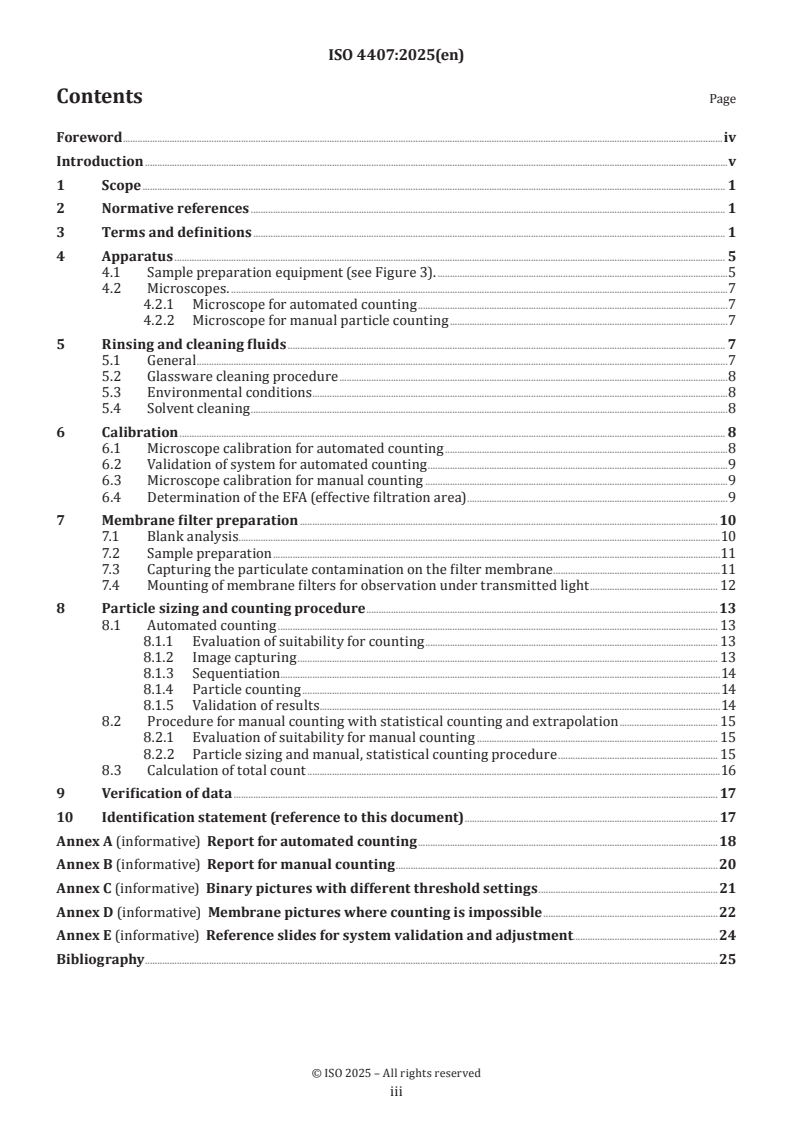
Contents Page
Foreword .iv
Introduction .v
1 Scope . 1
2 Normative references . 1
3 Terms and definitions . 1
4 Apparatus . 5
4.1 Sample preparation equipment (see Figure 3). .5
4.2 Microscopes. .7
4.2.1 Microscope for automated counting .7
4.2.2 Microscope for manual particle counting .7
5 Rinsing and cleaning fluids . 7
5.1 General .7
5.2 Glassware cleaning procedure .8
5.3 Environmental conditions .8
5.4 Solvent cleaning .8
6 Calibration . 8
6.1 Microscope calibration for automated counting .8
6.2 Validation of system for automated counting .9
6.3 Microscope calibration for manual counting .9
6.4 Determination of the EFA (effective filtration area) .9
7 Membrane filter preparation . 10
7.1 Blank analysis.10
7.2 Sample preparation .11
7.3 Capturing the particulate contamination on the filter membrane .11
7.4 Mounting of membrane filters for observation under transmitted light . 12
8 Particle sizing and counting procedure .13
8.1 Automated counting . 13
8.1.1 Evaluation of suitability for counting . 13
8.1.2 Image capturing . 13
8.1.3 Sequentiation . . .14
8.1.4 Particle counting .14
8.1.5 Validation of results.14
8.2 Procedure for manual counting with statistical counting and extrapolation . 15
8.2.1 Evaluation of suitability for manual counting . 15
8.2.2 Particle sizing and manual, statistical counting procedure . 15
8.3 Calculation of total count .16
9 Verification of data . 17
10 Identification statement (reference to this document) . 17
Annex A (informative) Report for automated counting .18
Annex B (informative) Report for manual counting .20
Annex C (informative) Binary pictures with different threshold settings .21
Annex D (informative) Membrane pictures where counting is impossible .22
Annex E (informative) Reference slides for system validation and adjustment.24
Bibliography .25
iii
Foreword
ISO (the International Organization for Standardization) is a worldwide federation of national standards
bodies (ISO member bodies). The work of preparing International Standards is normally carried out through
ISO technical committees. Each member body interested in a subject for which a technical committee
has been established has the right to be represented on that committee. International organizations,
governmental and non-governmental, in liaison with ISO, also take part in the work. ISO collaborates closely
with the International Electrotechnical Commission (IEC) on all matters of electrotechnical standardization.
The procedures used to develop this document and those intended for its further maintenance are described
in the ISO/IEC Directives, Part 1. In particular, the different approval criteria needed for the different types
of ISO document should be noted. This document was drafted in accordance with the editorial rules of the
ISO/IEC Directives, Part 2 (see www.iso.org/directives).
ISO draws attention to the possibility that the implementation of this document may involve the use of (a)
patent(s). ISO takes no position concerning the evidence, validity or applicability of any claimed patent
rights in respect thereof. As of the date of publication of this document, ISO had not received notice of (a)
patent(s) which may be required to implement this document. However, implementers are cautioned that
this may not represent the latest information, which may be obtained from the patent database available at
www.iso.org/patents. ISO shall not be held responsible for identifying any or all such patent rights.
Any trade name used in this document is information given for the convenience of users and does not
constitute an endorsement.
For an explanation of the voluntary nature of standards, the meaning of ISO specific terms and expressions
related to conformity assessment, as well as information about ISO's adherence to the World Trade
Organization (WTO) principles in the Technical Barriers to Trade (TBT), see www.iso.org/iso/foreword.html.
This document was prepared by Technical Committee ISO/TC 131, Fluid power system, Subcommittee SC 6,
Contamination control.
This third edition cancels and replaces the second edition (ISO 4407:2002) which has been technically
revised.
The main changes are as follows:
— more detailed procedure for automated particle counting by image analysing software.
Any feedback or questions on this document should be directed to the user’s national standards body. A
complete listing of these bodies can be found at www.iso.org/members.html.
iv
Introduction
Fluids are used for a multitude of reasons over an array of industries. Whether they are used for hydraulic
power, lubricating or operational fluids, the presence of particulate contamination adversely affects
the fluids properties. This reduces the fluids capabilities and performance that can lead to damage of
components, equipment and eventual system failure.
The level of contamination in a fluid has a direct impact upon its performance and reliability.
Quantitative determination of particulate contamination requires precision in obtaining a representative
sample of the fluid to accurately ascertain the level of contamination. The method of particle counting using
an optical microscope is an accepted means of determining the extent of contamination. The accuracy of
particle counting can be affected by the different techniques and methods used. The accuracy when using
the automated method described in this document is typically in a range of +/- one ISO code according to
ISO 4406.
This document details procedures that are acceptable methods for each step of the process of removing
particulate contamination from a fluid for analysis to achieve a uniform method, both manual and
automated, for particle counting. These steps include sample preparation, vacuum filtration, filter membrane
preparation and, both manual and automated counting methods.
v
International Standard ISO 4407:2025(en)
Hydraulic fluid power — Fluid contamination —
Determination of particulate contamination by the counting
method using an optical microscope
WARNING — The use of this document may involve hazardous materials, operations, and equipment.
This document does not purport to address all the safety issues associated with its use. It is the
responsibility of the user of this document to establish appropriate safety and health practices and
determine the applicability of regulative limitations prior to use.
1 Scope
This document specifies acceptable methods for determining the level of particulate contamination in a
known volume of fluid used in power systems by counting the number of particles captured on the surface
of a filter membrane using an optical microscope. It includes accepted methods of particle counting utilising
image analysis software or manual counting.
The aim of this document is to regulate a uniform, non-subjective filter membrane method of particle
counting that will ensure that the classification standard result is achieved by analysing, where feasible, the
entire effective filtration area (EFA) of the filter membrane.
The resolution and accuracy of the results will be dependent upon the optical system used, whether image
capture analysis software is used, and when opting for the manual counting method, the capabilities of the
operator.
All fluids that can be successfully vacuumed through the appropriate pore sized filter membrane will be
able to use the following 2 methods of membrane filter analysis:
— Automated counting (see Annex A): automated detection, size classification and counting of particles on
a membrane filter by using an optical microscope and image analysing software.
— Manual counting (see Annex B): manual detection, size classification and counting of particles on a
membrane filter using an optical microscope.
2 Normative references
The following documents are referred to in the text in such a way that some or all of their content constitutes
requirements of this document. For dated references, only the edition cited applies. For undated references,
the latest edition of the referenced document (including any amendments) applies.
ISO 3722, Hydraulic fluid power — Fluid sample containers — Qualifying and controlling cleaning methods
ISO 5598, Fluid power systems and components — Vocabulary
3 Terms and definitions
For the purposes of this document, the terms and definitions given in ISO 5598 and the following apply.
ISO and IEC maintain terminology databases for use in standardization at the following addresses:
— ISO Online browsing platform: available at https:// www .iso .org/ obp
— IEC Electropedia: available at https:// www .electropedia .org/
3.1
blank analysis
counting resulting from contaminants introduced from other sources, such as reagents, cleaning of
glassware and preparation of the membrane filter when performing a blank analysis
Note 1 to entry: See 7.1).
3.2
effective filtration area
EFA
circular area of the membrane filter open to flow during filtration of liquid
3.3
effective filtration diameter
EFD
longest chord length of the membrane filter open to flow during filtration of liquid
Note 1 to entry: Both the EFA and the effective filtration diameter (EFD) are determined in 8.2.
3.4
measured filtration area
MFA
area that the software has analysed when using the automated counting method
3.5
fibre
particle longer than 100 µm with a length-to-width ratio greater than or equal to 10:1
3.6
fixative fluid
fluid that, as a result of a heat curing process, causes a membrane filter to adhere to a glass base slide, can
generate an opaque residue
3.7
grid square
square with side of nominally 3,1 mm printed on membrane filters
Note 1 to entry: Gridded membrane filters cannot be used in combination with automated image analysis techniques.
3.8
image analysis software
image analysis system with integrated software to automatically size, count and tabulate the particulate
contamination captured on membrane filter
Note 1 to entry: A video image of the particle is digitally recreated based upon the difference in the grey scale contrast
of the particle and background. The sizing is either automatically determined or manually on the video screen.
3.9
mountant fluid
fluid that when heated, causes a membrane filter, previously treated with fixative liquid, to become
transparent and to adhere to the cover slip
3.10
particle size
size of particle as defined by the particle’s maximum Feret diameter
Figure 1 — Particle indicating the maximum Feret diameter
3.11
required cleanliness level
RCL
permitted level of particulate contamination within a given area on the surface of the membrane filter
3.12
solvent
fluid that is physically and chemically compatible with and miscible in the sample fluid
Note 1 to entry: A solvent is used for diluting the sample fluid and can be used for cleaning and rinsing the apparatus.
The solvent should be chemically compatible with the apparatus, especially the membrane filter and should not
dissolve the particles.
3.13
statistical counting
counting and sizing particles using a proportion of the membrane filter’s surface, whereby at least
150 particles are counted over a total of at least 10 separate fields of view.
Note 1 to entry: Statistical counting requires an even distribution of particles over the complete surface and membrane
filters should be rejected for counting if this is not achieved.
3.14
threshold setting
level at which the grayscale value of an image pixel is determined by an automated image analysing software
to belong to a particle or to the background
3.15
card insert
piece of card that is place inside of the slide mount to ensure the membrane filter is held flat
3.16
slide mount
two-piece vessel to secure the membrane filter in position and to prevent cross contamination
3.17
unit area
proportion of membrane filter that is counted for statistical purposes (manual counting)
Note 1 to entry: For manual counting the unit area is defined as the area of the membrane filter bound in the horizontal
plane by two adjacent vertical membrane filter grid lines and in the vertical plane by two parallel lines either on the
ocular micrometre eyepiece or drawn on a projection screen. Examples are given in Figure 2. For image analysis this is
a fixed field of view defined by the optical and electronic systems.
Key
1 grid square
2 width of grid square (mm)
3 length of grid square (mm)
4 full grid square
5 unit area on a gridded membrane
6 graticule height used for defining unit area (µm)
7 unit area
8 width of un-gridded unit area on membrane
9 effective filtration diameter of membrane
Figure 2 — Examples of unit areas
4 Apparatus
4.1 Sample preparation equipment (see Figure 3).
Key
1 laminar flow cabinet
2 waste container
3 sample bottle
4 vacuum pump
5 filter housing
6 vacuum manifold
7 fluid funnel
8 filter membrane housing box
9 clamp
10 tweezers
11 card insert
12 filter membranes
13 filter membrane housing (2 parts)
Figure 3 — Recommended equipment for capturing the particulate contamination on the membrane
filter
4.1.1 Filtration system, consisting of
— a vacuum filtration manifold or filtration flask to support the membrane holder funnel. In relation to
the vacuum manifold, this may be singular or multiple dependent upon the number of fluid samples
required.
— a membrane holder funnel relevant to the size of membrane filters used for vacuum filtration of the
particulate contamination (typically 25 mm or 47 mm). This supports the membrane filter ensuring that
it is sealed correctly and provides an even, flat support structure for the sample fluid to pass through the
membrane filter.
— a funnel to retain the sample fluid. The volume capacity is dependent upon the volume of fluid required
for analysis.
— a clamp to secure the membrane holder funnel to the funnel providing a seal so as the sample fluid is
retained in the funnel until filtration commences.
— a connection to earth. Every effort shall be made to ensure that the filtration system is bonded to earth
to prevent static build up.
4.1.2 Graduated vessel, for collecting the volume of fluid that is required for analysis. The accuracy of the
graduations should be ±2 %.
4.1.3 Membrane filters.
— Shall be compatible with the sample fluid and any solvents/chemicals used in the processes
— Shall be non-gridded for automated counting and gridded for manual counting with a pore size ≤ 3 µm.
— Various membrane filter diameters can be used. The choice of diameter shall be dependent upon the level
of expected particulate contamination within the fluid sample (as not to over-populate the membrane
filter resulting in overlapping particles) and the method of particle counting chosen (automated via
image analysis software or manual counting).
— Membrane filters for manual counting have a printed grid square formation. For the image analysis
software method, a plain white membrane must be used. For both types of particle counting, appropriate
membrane filters should be selected which have a smooth and flat surface to ensure that the membrane
does not produce shadows which could affect the optical particle capture.
— The colour for the membrane filter chosen shall take into consideration the maximum contrast of
particulate contamination to be analysed. For example, if most of the particles are expected to be dark,
a white membrane filter should be used.
— Only measurements with the same membrane pore size shall be used for comparison.
4.1.4 Membrane filter slide mounts (optional for manual counting).
A method of encasing the membrane filter can be used, where viable. This provides two key advantages:
— they ensure that no further cross contamination from airborne particulate contamination is possible;
— they aid in holding the membrane filter flat. This is crucial for image analysis software to ensure that the
EFA remains in focus.
4.1.5 Suitable sample bottles, that includes, as a minimum, the nominal capacity with the known volume
of sample required for analysis and include a screw cap. Every precaution shall be taken to avoid using a seal
on the cap that is not compatible with the fluid sample that is to be analysed. These can breakdown during
agitation of the sample and cause undue cross contamination of the sample fluid.
4.1.6 Stage micrometer, graduated in 0,1 mm and 0,01 mm scale divisions, calibrated and traceable to
national standards.
4.1.7 Tweezers, flat-bladed and, ideally, manufactured from stainless steel where possible.
4.1.8 Vacuum pump, able to establish a vacuum required to draw the fluid through the membrane filter
at a sufficient rate.
4.1.9 Oven (optional), may be required if the membrane filter appears to be translucent/transparent.
Every precaution is to be made to ensure that it is safe to place the fluid into the oven and expose it to the
temperatures and environment of the oven.
4.1.10 Ultrasonic bath (optional), may be required in certain fluid types to breakdown agglomerates.
4.2 Microscopes.
4.2.1 Microscope for automated counting
It shall be able to accurately identify particles of the minimum size required by the chosen reporting
standard. The microscope shall be equipped with at least the following:
— The optical microscope can accept the attachment of a camera. The camera shall have an optical pixel
resolution of 1 µm/pixel (5 µm per 5 pixels) or better (meaning a resolution smaller than 1 µm/pixel).
The reference for optical resolution is to be at least 5 µm.
— The optical microscope shall include incidental lighting with a polarisation filter to ensure uniform
illumination of the field of view of the camera and optics. The field of view is the entire image of the
camera displayed on the monitor/screen.
— The camera shall be a minimum of 8 bit to ensure the depth of the illumination intensity is sufficient.
— An X-Y stage with a range of movement to view the entire membrane filter diameter. It is mandatory that
the X-Y movement be motorised for automated counting and controlled via the image analysis software.
— Z axis movement is required to ensure that the membrane filter is in focus for an accurate analysis.
— A stage holder with adapter (i.e. card insert or drum adapter) to keep the membrane flat and in focus.
— A laptop/PC to run the automated image analysis software and to view the live feed of the optical
microscope camera
4.2.2 Microscope for manual particle counting
It shall include:
— fine and course focus control on the Z axis;
— sufficient lighting to ensure uniform illumination of the field of view of the camera and/or optics;
— a mechanical stage capable of scanning the complete area of the membrane filter being used for the
analysis. The stage must also have a method for holding the membrane filter slide mount in a secure
position;
— a calibrated graticule of which the smallest division shall not sub-tend a distance larger than the smallest
particle to be counted at a particular magnification, and with suitable graduations.
5 Rinsing and cleaning fluids
5.1 General
— Propan-2-ol (Isopropyl Alcohol) or equivalent for use with water-based fluids for the rinsing of the
membrane filter preparation equipment and dilution of the fluid sample, if required. Alternatively,
distilled or demineralized water is used, when the use of solvents is not suitable.
— Petroleum spirit or equivalent for use with oil based fluids for the rinsing of the membrane filter
preparation equipment and the dilution of the fluid, if required.
WARNING — Exercise all necessary precautions when using solvents as detailed in their respective
safety data sheets (SDS). This includes following all company and local requirements for use and
disposal.
5.2 Glassware cleaning procedure
Clean and validate the cleanliness level of the filtration apparatus, graduated cylinders, bottles, glass slides,
with cover slips and membrane filter holders in accordance with ISO 3722. The final liquid used for the flush
should be either filtered petroleum spirit (or similar solvent) for petroleum based or synthetic oils, propan-
2-ol or demineralized water for water-based liquids.
The required cleanliness level (RCL) of the volumetric glassware with cleanliness levels lower than 0,5 %
of the number of concentration of particles (larger than the smallest particle size of interest) expected to
be observed in the samples. All liquids used for rinsing shall be filtered through a 1 µm or finer membrane
filter.
5.3 Environmental conditions
Every precaution should be taken not to introduce any form of cross contamination. This includes airborne
and particulate contamination from the individual carrying out the sample analysis preparation (clothing,
hands, PPE). If feasible, the sample preparation and analysis should be carried out with a laminar flow
cabinet.
Ensure all apparatus for the filter membrane patch preparation is cleaned and, should it be required, that a
blank analysis has been carried out.
5.4 Solvent cleaning
Pass a known volume of compatible solvent through a membrane filter, that is at least the same micron pore
size as the filter membrane that is to be used for the sample analysis and place into a known clean container.
Use this solvent to perform the blank analysis, flushing of glass hardware and dilution.
6 Calibration
6.1 Microscope calibration for automated counting
A calibration is recommended to be carried out at least annually or whenever any adjustment or movement
has been made to the system in relation to major components including the stage, camera, optics or a
relocation of the system. The stage micrometer (4.1.6) used to carry out the calibration must have a
recalibration's certification every five years.
For systems utilising image analysing software, refer to the manufacturer’s recommendations for calibration.
The calibration shall verify:
— Measurement of the scale divisions on the graticule (for correct particle sizing).
— Stage alignment of the automatic stage. This stage alignment verification ensures that the automated
analysis does not split particles when crossing over more than one field of vision of the camera assembly.
— Camera alignment with the stage axis and that optical axis is perpendicular to the level of the x-y axis of
the stage.
— Camera orientation.
The camera measures the light intensity of each pixel of the captured image and converts it into digital values
i.e. 0 for no illumination (black) and at least 255 for the full illumination (white). The conversion process
should be linear. Depending on the manufacturing process and type of camera, the conversion calculation
process could drift, resulting in a lower resolution for dark or light areas of the image. Even the sensitivity
and convertin
...