

ISO 18464:2025
(Main)Hydraulic fluid power — Design methodology for energy efficient systems
General Information
- Abstract
This document specifies a design methodology for hydraulic systems that can be operated with the lowest possible energy consumption while maintaining the intended functionality of the stationary or mobile machinery in which they are installed. This document takes into account the duty cycles of the application. The definition of the duty cycles is not part of this document.
- Status
- Published
- Publication Date
- 30-Apr-2025
- Technical Committee
- ISO/TC 131/SC 9 - Installations and systems
- Drafting Committee
- ISO/TC 131/SC 9 - Installations and systems
- Current Stage
- 6060 - International Standard published
- Start Date
- 01-May-2025
- Due Date
- 27-Sep-2025
- Completion Date
- 01-May-2025

Overview
ISO 18464:2025 - Hydraulic fluid power - Design methodology for energy efficient systems - specifies a structured design methodology to minimise the energy consumption of hydraulic systems while maintaining required machine functionality. It applies to stationary and mobile machinery and requires designers to account for application duty cycles (definition of duty cycles is outside the standard). The document treats the hydraulic system including prime movers within the system boundary and focuses on energy performance during operation.
Key topics and technical requirements
- Design methodology and process: A stepwise approach that integrates energy consumption as a primary design criterion alongside functional requirements.
- Duty-cycle based design: Actuator and control design must be based on time transients of force/speed (linear actuators) or torque/rotation speed (rotary actuators).
- Actuator dimensioning: Select and size actuators to match load and speed requirements - avoid oversizing and aim to minimise the difference between working and supply pressure.
- Control strategies: Use pump flow rate control or adjust system supply pressure to match demand. Prioritise recovery and regenerative concepts where applicable and minimise control/auxiliary power (e.g., PWM to reduce holding current).
- Hydraulic power supplies: Feed only the hydraulic energy required by the duty cycle; use prime mover speed control with fixed/variable displacement pumps; avoid prolonged idle pump operation; consider accumulators for peak power when net energy savings are achieved.
- Power distribution (piping): Design for laminar flow, avoid abrupt diameter changes, prefer bent pipes over elbow connectors to reduce pressure loss (see Annex B for recommendations).
- Hydraulic fluid selection: Choose the lowest practical viscosity meeting functional and temperature-range requirements while respecting component manufacturer guidance and wear considerations.
- Auxiliary components: Account for cooling/heating, filters, sensors and valves; dimension for minimal pressure loss.
- Energy calculation and rating: Provides an energy accounting method over duty cycles, including recuperated energy and energy stored in accumulators, using integrals of primary power supply and recuperation transients; component efficiency maps should be considered.
Applications and users
ISO 18464:2025 is intended for:
- Hydraulic system designers and OEMs (mobile and stationary machinery)
- System integrators and control engineers optimizing energy performance
- Product managers and sustainability engineers targeting reduced operational energy use
- Procurement and compliance teams evaluating energy-efficient hydraulic solutions
Typical machine applications include presses, clamps, heavy-motion drives (e.g., excavators), hydrostatic transmissions and mass compensation systems.
Related standards
- ISO 5598 - Fluid power systems and components - Vocabulary (normative reference used by ISO 18464).
- Prepared by ISO/TC 131 (Fluid power systems), Subcommittee SC 9 (Installations and systems).
Keywords: ISO 18464, hydraulic fluid power, energy efficient systems, hydraulic systems design, duty cycles, actuator dimensioning, hydraulic power supplies, piping design, hydraulic fluid viscosity.
Get Certified
Connect with accredited certification bodies for this standard

Institut za varilstvo d.o.o. (Welding Institute)
Slovenia's leading welding institute since 1952. ISO 3834, EN 1090, pressure equipment certification, NDT personnel, welder qualification. Only IIW Au
Sponsored listings
Frequently Asked Questions
ISO 18464:2025 is a standard published by the International Organization for Standardization (ISO). Its full title is "Hydraulic fluid power — Design methodology for energy efficient systems". This standard covers: This document specifies a design methodology for hydraulic systems that can be operated with the lowest possible energy consumption while maintaining the intended functionality of the stationary or mobile machinery in which they are installed. This document takes into account the duty cycles of the application. The definition of the duty cycles is not part of this document.
This document specifies a design methodology for hydraulic systems that can be operated with the lowest possible energy consumption while maintaining the intended functionality of the stationary or mobile machinery in which they are installed. This document takes into account the duty cycles of the application. The definition of the duty cycles is not part of this document.
ISO 18464:2025 is classified under the following ICS (International Classification for Standards) categories: 23.100.01 - Fluid power systems in general. The ICS classification helps identify the subject area and facilitates finding related standards.
ISO 18464:2025 is available in PDF format for immediate download after purchase. The document can be added to your cart and obtained through the secure checkout process. Digital delivery ensures instant access to the complete standard document.
Standards Content (Sample)
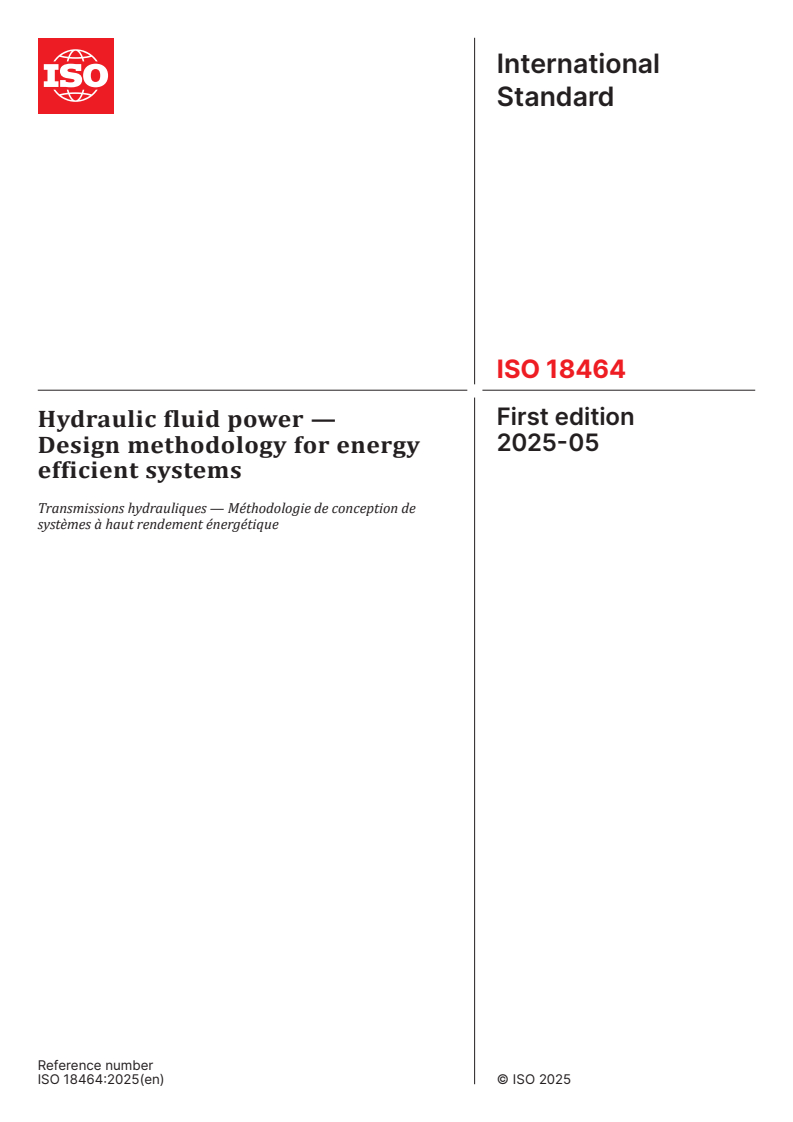
International
Standard
ISO 18464
First edition
Hydraulic fluid power —
2025-05
Design methodology for energy
efficient systems
Transmissions hydrauliques — Méthodologie de conception de
systèmes à haut rendement énergétique
Reference number
© ISO 2025
All rights reserved. Unless otherwise specified, or required in the context of its implementation, no part of this publication may
be reproduced or utilized otherwise in any form or by any means, electronic or mechanical, including photocopying, or posting on
the internet or an intranet, without prior written permission. Permission can be requested from either ISO at the address below
or ISO’s member body in the country of the requester.
ISO copyright office
CP 401 • Ch. de Blandonnet 8
CH-1214 Vernier, Geneva
Phone: +41 22 749 01 11
Email: copyright@iso.org
Website: www.iso.org
Published in Switzerland
ii
Contents Page
Foreword .iv
Introduction .v
1 Scope . 1
2 Normative references . 1
3 Terms and definitions . 1
4 Symbols and abbreviated terms. 1
5 Design methodology . 2
5.1 General .2
5.2 Application based actuator design .3
5.3 Actuator dimensioning .4
5.4 Control design .4
5.5 Design of hydraulic power supplies .4
5.6 Design of hydraulic power distribution (piping) .4
5.7 Selection of the hydraulic fluid .5
5.8 Auxiliary components .5
5.9 Calculation method of required energy supply .5
5.10 Rating and comparison method of energy consumption.6
Annex A (informative) Example overview of energy demand of duty cycle and different
hydraulic system designs . 7
Annex B (informative) Recommendations for energy-efficient hydraulic piping . 8
Bibliography .10
iii
Foreword
ISO (the International Organization for Standardization) is a worldwide federation of national standards
bodies (ISO member bodies). The work of preparing International Standards is normally carried out through
ISO technical committees. Each member body interested in a subject for which a technical committee
has been established has the right to be represented on that committee. International organizations,
governmental and non-governmental, in liaison with ISO, also take part in the work. ISO collaborates closely
with the International Electrotechnical Commission (IEC) on all matters of electrotechnical standardization.
The procedures used to develop this document and those intended for its further maintenance are described
in the ISO/IEC Directives, Part 1. In particular, the different approval criteria needed for the different types
of ISO document should be noted. This document was drafted in accordance with the editorial rules of the
ISO/IEC Directives, Part 2 (see www.iso.org/directives).
ISO draws attention to the possibility that the implementation of this document may involve the use of (a)
patent(s). ISO takes no position concerning the evidence, validity or applicability of any claimed patent
rights in respect thereof. As of the date of publication of this document, ISO had not received notice of (a)
patent(s) which may be required to implement this document. However, implementers are cautioned that
this may not represent the latest information, which may be obtained from the patent database available at
www.iso.org/patents. ISO shall not be held responsible for identifying any or all such patent rights.
Any trade name used in this document is information given for the convenience of users and does not
constitute an endorsement.
For an explanation of the voluntary nature of standards, the meaning of ISO specific terms and expressions
related to conformity assessment, as well as information about ISO's adherence to the World Trade
Organization (WTO) principles in the Technical Barriers to Trade (TBT), see www.iso.org/iso/foreword.html.
This document was prepared by Technical Committee ISO/TC 131, Fluid power systems, Subcommittee SC 9,
Installations and systems.
Any feedback or questions on this document should be directed to the user’s national standards body. A
complete listing of these bodies can be found at www.iso.org/members.html.
iv
Introduction
As environmental impact is a common challenge for all products and as natural resources become scarce,
environmental performance criteria for hydraulic systems need to be defined and the use of these criteria
needs to be specified.
Based on relevant considerations, ISO 18464 is focused on environmental impacts related to the energy
consumed by hydraulic systems during operation and defines a design process for hydraulic systems
including energy consumption as a key criterion.
Energy consumption of hydraulic systems is primarily defined by the type of machine, e.g. lathes, injection
moulding machines and excavators, their duty cycles and the architecture of hydraulic systems.
Additionally, the level of energy consumption is a function of the requirements of the machine, duty cycle
and frequency of use by the operator. It is only when the machines are adapted for specific applications (e.g.
working cycle, control precision, level of automation) in an optimal manner, that energy efficient concepts
can have the most positive impact.
Typical applications for hydraulics in machines are
— clamping applications with high force,
— press applications with high force,
— motion, acceleration and braking of heavy loads,
— hydraulic mass compensation, and
— hydrostatic transmission.
v
International Standard ISO 18464:2025(en)
Hydraulic fluid power — Design methodology for energy
efficient systems
1 Scope
This document specifies a design methodology for hydraulic systems that can be operated with the lowest
possible energy consumption while maintaining the intended functionality of the stationary or mobile
machinery in which they are installed.
This document takes into account the duty cycles of the application. The definition of the duty cycles is not
part of this document.
2 Normative references
The following documents are referred to in the text in such a way that some or all of their content constitutes
requirements of this document. For dated references, only the edition cited applies. For undated references,
the latest edition of the referenced document (including any amendments) applies.
ISO 5598, Fluid power systems and components — Vocabulary
3 Terms and definitions
For the purposes of this document, the terms and definitions given in ISO 5598 and the following apply.
ISO and IEC maintain terminology databases for use in standardization at the following addresses:
— ISO Online browsing platform: available at https:// www .iso .org/ obp
— IEC Electropedia: available at https:// www .electropedia .org/
3.1
hydraulic system
arrangement of interconnected components including one or more prime movers, that generates, transmits,
controls and converts hydraulic fluid power
4 Symbols and abbreviated terms
The symbols used throughout this document are shown in Table 1.
Table 1 — List of symbols
Symbol Abbreviated term
d inner diameter of piping
amount of energy stored in hydraulic accumulators or other energy storage devices at the end of the
E
a,e
stabilised duty cycle, if energy storage devices are part of hydraulic systems
E amount of energy stored in hydraulic accumulators or other energy storage devices at the beginning of
a,s
the stabilised duty cycle, if energy storage devices are part of hydraulic systems
energy consumption of the hydraulic system over the considered duty cycle
E
c,in
E energy consumption for a specific duty cycle, i
c,in,i
TTabablele 1 1 ((ccoonnttiinnueuedd))
Symbol Abbreviated term
E energy which is fed back from the hydraulic system into the primary power source, e.g. the electrical
r
grid, or an electrical battery
E primary energy supply of the hydraulic system:
s,in
— primary energy supply for the prime mover of hydraulic systems (chemical, e.g. energy content
of fuel, electrical energy or a combination of these), for prime movers delivering energy in
parallel into others than the considered hydraulic systems and are controlled independently
of these hydraulic systems, see 5.1, second paragraph;
— primary energy supply for heating/cooling (heating or cooling power and coolant flow
power);
— primary energy supply for controls and auxiliary functions (i.e. valves, sensors, electronics,
filtration, etc.)
energy value of the hydraulic system design variant for mix of defined duty cycles
E
v
N number of duty cycles, i
i
recuperation power transient during duty cycle
Pt()
r
P primary power supply transient during duty cycle
s,in
Q flow rate
Re Reynolds number
t end time of duty cycle transient
dc,e
start time of duty cycle transient
t
dc,s
v flow velocity
ΔP power loss
Δp pressure loss
5 Design methodology
5.1 General
For the design of energy efficient hydraulic systems, typical duty cycles and functional requirements of
the machines hydraulic systems are designed for shall be used. The boundaries of hydraulic systems shall
include the prime movers. Nevertheless, for the efficiency comparison of hydraulic systems, the type of
prime movers (electrical, combustion or any others) is fixed for the application of this document.
NOTE Prime movers can have a significant effect on the overall efficiency of the machines for which the hydraulic
systems are designed for. This document is not intended for energy type sel
...