

ISO/IEC 19785-4:2025
(Main)Information technology — Common Biometric Exchange Formats Framework — Part 4: Security block format specifications
General Information
- Abstract
This document specifies security block (SB) formats (see ISO/IEC 19785-1) registered in accordance with ISO/IEC 19785-2 as formats defined by the Common Biometric Exchange Formats Framework (CBEFF) biometric organization ISO/IEC JTC 1/SC 37. This document also specifies registered SB format identifiers. NOTE The SB format identifier is recorded in the standard biometric header (SBH) of a patron format (or defined by that patron format as the only available SB format). The general-purpose SB format specifies whether the biometric data block (BDB) is encrypted or the SBH and BDB have integrity applied (or both). The general-purpose SB format can include ACBio instances (see ISO/IEC 24761). This SB provides all necessary security parameters, including those used for encryption or integrity. This document does not restrict the algorithms and parameters used for encryption or integrity, but it provides for the recording of such algorithms and parameter values. This document does not cover profiling to determine what algorithms and parameter ranges can be used by the generator of an SB for a particular application area, and hence what algorithms and parameter ranges have to be supported by the user of an SB. The second SB format is more limited but simpler. In particular, it cannot contain ACBio instances and does not support encryption of the BDB. The general-purpose SB format in XML provides for specification of whether the BDB is encrypted or the SBH and BDB have integrity applied (or both).
- Status
- Published
- Publication Date
- 24-Jul-2025
- Technical Committee
- ISO/IEC JTC 1/SC 37 - Biometrics
- Drafting Committee
- ISO/IEC JTC 1/SC 37/WG 2 - Biometric technical interfaces
- Current Stage
- 6060 - International Standard published
- Start Date
- 25-Jul-2025
- Due Date
- 22-Sep-2025
- Completion Date
- 25-Jul-2025

Overview
ISO/IEC 19785-4:2025 specifies security block (SB) formats and registered SB format identifiers for the Common Biometric Exchange Formats Framework (CBEFF). It defines how biometric data blocks (BDBs) and the standard biometric header (SBH) can be protected for integrity and/or confidentiality, and records the security parameters needed to interpret those protections. The standard provides ASN.1 and XML SB formats and uses the Cryptographic Message Syntax (CMS, RFC 5652) as the basis for message protection, with specific adaptations for biometric exchange.
Key topics and technical requirements
- SB format registration and identifiers: Defines how SB formats are identified and recorded in the SBH of a CBEFF patron format.
- General-purpose SB format (ASN.1): An extensible format supporting encryption and/or integrity protection of the BDB and SBH; can include optional ACBio instances (see ISO/IEC 24761) to convey authentication context.
- Signature-only SB format (ASN.1): A simpler SB limited to integrity (signatures) and not supporting encryption or ACBio instances.
- XML general-purpose SB: Provides an XML schema alternative that indicates whether the BDB is encrypted and/or integrity-protected.
- Use of CMS (RFC 5652): Modifies EnvelopedData, EncryptedData, SignedData, and AuthenticatedData structures to meet biometric-specific needs while preserving CMS principles.
- Security parameters recording: The standard does not mandate specific cryptographic algorithms or parameter values, but it requires the recording of algorithm identifiers and parameter values so receivers can interpret protections.
- Conformance, versioning and domain of use: Includes provisions for format version identifiers, conformance statements, and domains of use defined by the SB owner.
- Scope exclusions: The document does not perform profiling (i.e., it does not prescribe which algorithms or parameter ranges must be used in specific application domains).
Applications and practical value
- Secure biometric interchange between systems (e.g., AFIS, border control, eID, mobile biometrics).
- Interoperability for vendors and integrators by standardizing how integrity and encryption metadata are packaged with biometric data.
- Telebiometric authentication deployments that require authentication context (ACBio) to assess security level of biometric assertions.
- Government and identity programs that must audit and verify the origin and integrity of biometric evidence.
Who should use this standard
- Biometric system architects and implementers
- Identity management and e-government solution providers
- Security architects defining biometric protection policies
- Vendors of biometric data exchange formats and SDKs
- Standards bodies and integrators working with CBEFF patron formats
Related standards
- ISO/IEC 19785-1 (CBEFF core framework)
- ISO/IEC 19785-2 (CBEFF registration procedures)
- ISO/IEC 24761 (Authentication Context for Biometrics - ACBio)
- RFC 5652 (Cryptographic Message Syntax - CMS)
Relations
- Effective Date
- 17-Feb-2024
Get Certified
Connect with accredited certification bodies for this standard

BSI Group
BSI (British Standards Institution) is the business standards company that helps organizations make excellence a habit.

NYCE
Mexican standards and certification body.
Sponsored listings
Frequently Asked Questions
ISO/IEC 19785-4:2025 is a standard published by the International Organization for Standardization (ISO). Its full title is "Information technology — Common Biometric Exchange Formats Framework — Part 4: Security block format specifications". This standard covers: This document specifies security block (SB) formats (see ISO/IEC 19785-1) registered in accordance with ISO/IEC 19785-2 as formats defined by the Common Biometric Exchange Formats Framework (CBEFF) biometric organization ISO/IEC JTC 1/SC 37. This document also specifies registered SB format identifiers. NOTE The SB format identifier is recorded in the standard biometric header (SBH) of a patron format (or defined by that patron format as the only available SB format). The general-purpose SB format specifies whether the biometric data block (BDB) is encrypted or the SBH and BDB have integrity applied (or both). The general-purpose SB format can include ACBio instances (see ISO/IEC 24761). This SB provides all necessary security parameters, including those used for encryption or integrity. This document does not restrict the algorithms and parameters used for encryption or integrity, but it provides for the recording of such algorithms and parameter values. This document does not cover profiling to determine what algorithms and parameter ranges can be used by the generator of an SB for a particular application area, and hence what algorithms and parameter ranges have to be supported by the user of an SB. The second SB format is more limited but simpler. In particular, it cannot contain ACBio instances and does not support encryption of the BDB. The general-purpose SB format in XML provides for specification of whether the BDB is encrypted or the SBH and BDB have integrity applied (or both).
This document specifies security block (SB) formats (see ISO/IEC 19785-1) registered in accordance with ISO/IEC 19785-2 as formats defined by the Common Biometric Exchange Formats Framework (CBEFF) biometric organization ISO/IEC JTC 1/SC 37. This document also specifies registered SB format identifiers. NOTE The SB format identifier is recorded in the standard biometric header (SBH) of a patron format (or defined by that patron format as the only available SB format). The general-purpose SB format specifies whether the biometric data block (BDB) is encrypted or the SBH and BDB have integrity applied (or both). The general-purpose SB format can include ACBio instances (see ISO/IEC 24761). This SB provides all necessary security parameters, including those used for encryption or integrity. This document does not restrict the algorithms and parameters used for encryption or integrity, but it provides for the recording of such algorithms and parameter values. This document does not cover profiling to determine what algorithms and parameter ranges can be used by the generator of an SB for a particular application area, and hence what algorithms and parameter ranges have to be supported by the user of an SB. The second SB format is more limited but simpler. In particular, it cannot contain ACBio instances and does not support encryption of the BDB. The general-purpose SB format in XML provides for specification of whether the BDB is encrypted or the SBH and BDB have integrity applied (or both).
ISO/IEC 19785-4:2025 is classified under the following ICS (International Classification for Standards) categories: 35.240.15 - Identification cards. Chip cards. Biometrics. The ICS classification helps identify the subject area and facilitates finding related standards.
ISO/IEC 19785-4:2025 has the following relationships with other standards: It is inter standard links to ISO/IEC 19785-4:2010. Understanding these relationships helps ensure you are using the most current and applicable version of the standard.
ISO/IEC 19785-4:2025 is available in PDF format for immediate download after purchase. The document can be added to your cart and obtained through the secure checkout process. Digital delivery ensures instant access to the complete standard document.
Standards Content (Sample)
International
Standard
ISO/IEC 19785-4
Second edition
Information technology — Common
2025-07
Biometric Exchange Formats
Framework —
Part 4:
Security block format specifications
Technologies de l'information — Cadre de formats d'échange
biométriques communs —
Partie 4: Spécifications de format de bloc de sécurité
Reference number
© ISO/IEC 2025
All rights reserved. Unless otherwise specified, or required in the context of its implementation, no part of this publication may
be reproduced or utilized otherwise in any form or by any means, electronic or mechanical, including photocopying, or posting on
the internet or an intranet, without prior written permission. Permission can be requested from either ISO at the address below
or ISO’s member body in the country of the requester.
ISO copyright office
CP 401 • Ch. de Blandonnet 8
CH-1214 Vernier, Geneva
Phone: +41 22 749 01 11
Email: copyright@iso.org
Website: www.iso.org
Published in Switzerland
© ISO/IEC 2025 – All rights reserved
ii
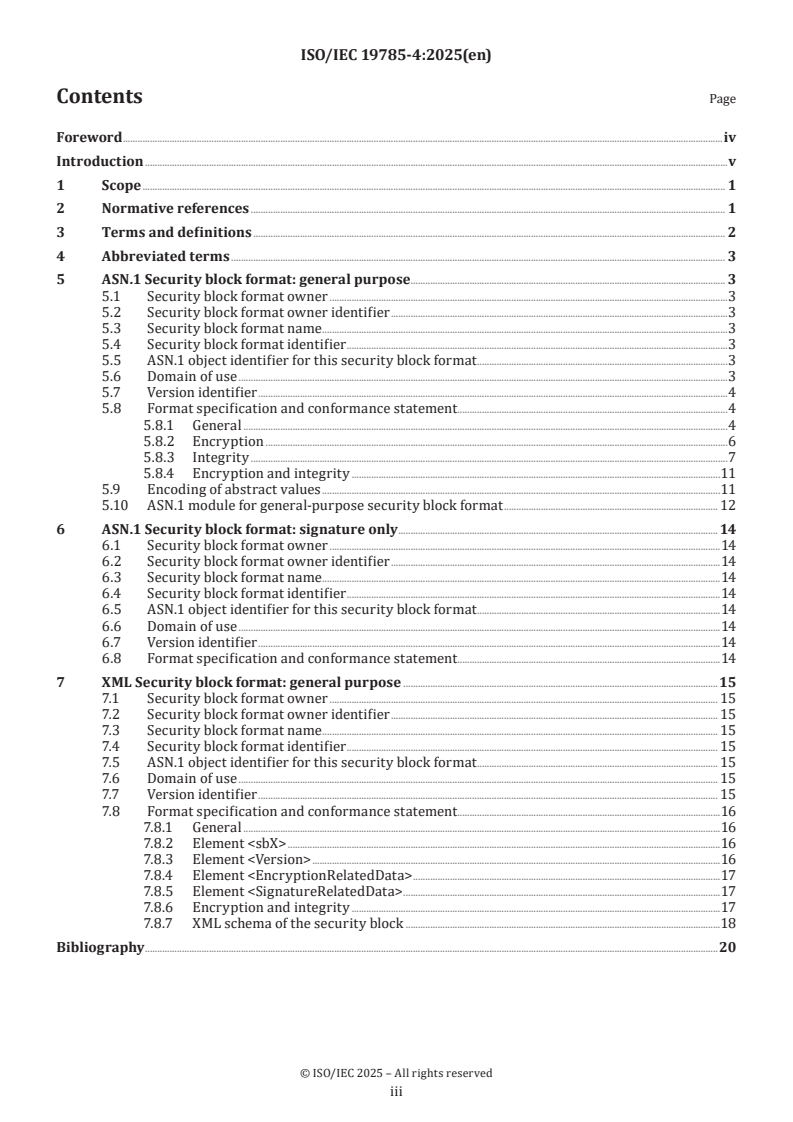
Contents Page
Foreword .iv
Introduction .v
1 Scope . 1
2 Normative references . 1
3 Terms and definitions . 2
4 Abbreviated terms . 3
5 ASN.1 Security block format: general purpose . 3
5.1 Security block format owner .3
5.2 Security block format owner identifier .3
5.3 Security block format name .3
5.4 Security block format identifier .3
5.5 ASN.1 object identifier for this security block format .3
5.6 Domain of use .3
5.7 Version identifier .4
5.8 Format specification and conformance statement .4
5.8.1 General .4
5.8.2 Encryption .6
5.8.3 Integrity .7
5.8.4 Encryption and integrity .11
5.9 Encoding of abstract values .11
5.10 ASN.1 module for general-purpose security block format . 12
6 ASN.1 Security block format: signature only . 14
6.1 Security block format owner .14
6.2 Security block format owner identifier .14
6.3 Security block format name .14
6.4 Security block format identifier .14
6.5 ASN.1 object identifier for this security block format .14
6.6 Domain of use .14
6.7 Version identifier .14
6.8 Format specification and conformance statement .14
7 XML Security block format: general purpose .15
7.1 Security block format owner . 15
7.2 Security block format owner identifier . 15
7.3 Security block format name . . 15
7.4 Security block format identifier . 15
7.5 ASN.1 object identifier for this security block format . 15
7.6 Domain of use . 15
7.7 Version identifier . 15
7.8 Format specification and conformance statement .16
7.8.1 General .16
7.8.2 Element .16
7.8.3 Element .16
7.8.4 Element .17
7.8.5 Element .17
7.8.6 Encryption and integrity .17
7.8.7 XML schema of the security block .18
Bibliography .20
© ISO/IEC 2025 – All rights reserved
iii
Foreword
ISO (the International Organization for Standardization) and IEC (the International Electrotechnical
Commission) form the specialized system for worldwide standardization. National bodies that are
members of ISO or IEC participate in the development of International Standards through technical
committees established by the respective organization to deal with particular fields of technical activity.
ISO and IEC technical committees collaborate in fields of mutual interest. Other international organizations,
governmental and non-governmental, in liaison with ISO and IEC, also take part in the work.
The procedures used to develop this document and those intended for its further maintenance are described
in the ISO/IEC Directives, Part 1. In particular, the different approval criteria needed for the different types
of document should be noted. This document was drafted in accordance with the editorial rules of the ISO/
IEC Directives, Part 2 (see www.iso.org/directives or www.iec.ch/members_experts/refdocs).
ISO and IEC draw attention to the possibility that the implementation of this document may involve the
use of (a) patent(s). ISO and IEC take no position concerning the evidence, validity or applicability of any
claimed patent rights in respect thereof. As of the date of publication of this document, ISO and IEC had not
received notice of (a) patent(s) which may be required to implement this document. However, implementers
are cautioned that this may not represent the latest information, which may be obtained from the patent
database available at www.iso.org/patents and https://patents.iec.ch. ISO and IEC shall not be held
responsible for identifying any or all such patent rights.
Any trade name used in this document is information given for the convenience of users and does not
constitute an endorsement.
For an explanation of the voluntary nature of standards, the meaning of ISO specific terms and expressions
related to conformity assessment, as well as information about ISO's adherence to the World Trade
Organization (WTO) principles in the Technical Barriers to Trade (TBT) see www.iso.org/iso/foreword.html.
In the IEC, see www.iec.ch/understanding-standards.
This document was prepared by Joint Technical Committee ISO/IEC JTC 1, Information technology,
Subcommittee SC 37, Biometrics.
This second edition cancels and replaces the first edition (ISO/IEC 19785-4:2010), which has been technically
revised. It also incorporates the Technical Corrigendum ISO/IEC 19785-4:2010/Cor. 1:2013.
The main changes are as follows:
— the SB formats in ASN.1 were specified in Clauses 5 and 6;
— the SB format for general purpose in XML was added as Clause 7;
— formats which were defined in ISO/IEC 19785-4:2010, but are now considered deprecated, have been
listed in the Introduction.
A list of all parts in the ISO/IEC 19785 series can be found on the ISO and IEC websites.
Any feedback or questions on this document should be directed to the user’s national standards
body. A complete listing of these bodies can be found at www.iso.org/members.html and
www.iec.ch/national-committees.
© ISO/IEC 2025 – All rights reserved
iv
Introduction
Biometric verification and identification are important techniques for the authentication and identification
of an individual. It is essential for biometric data used in biometric verification and identification to come
from a trusted source with no interference in transmission. This relates to the data's integrity. It can also be
necessary to keep the data secret. This relates to the encryption of the data depending on security policy.
This document provides for both the integrity and encryption of biometric data.
NOTE The term "security policy" in this context relates to security technology rather than contracts or law.
Security policy is determined in and applied to an organization or system.
To ensure interoperability, the Common Biometric Exchange Formats Framework (CBEFF) was specified in
ISO/IEC 19785-1 to associate metadata with one or more biometric data blocks (BDBs). In ISO/IEC 19785-1,
the options for integrity and encryption and the concept of a security block (SB) to contain security
information related to these options are defined, but the format and detailed content of SBs are not specified.
There are several sequential steps for specifying a security block, starting from a CBEFF patron format.
First, the patron format can determine that the abstract value of the CBEFF data element CBEFF_BDB_
encryption_options is fixed as NO ENCRYPTION and that the CBEFF data element CBEFF_BIR_integrity_
options is fixed as NO INTEGRITY. In this case, there is no need for an SB in the patron format.
If the patron format requires the inclusion of an SB in some circumstances, the SB format is specified in
this document where the SB format is identified by the CBEFF data elements CBEFF_SB_format_owner and
CBEFF_SB_format_type that can be included in the patron format.
Besides the SB formats defined in this document, there are many possible CBEFF SB formats that meet
different needs. For example, ISO/IEC 24713-3 specifies the requirements for an SB format for the Seafarers'
Identity Document according to the International Labour Organization. The SB format specified in Clause 5
is designed to be as general as possible. The SB format specified in Clause 6 is designed to provide a basic
security provision and supports integrity only.
This document specifies three SB formats.
The first SB format specifies a general-purpose security block format with optional elements for encryption
and integrity. This format uses RFC 5652 Cryptographic Message Syntax (CMS). Modifications have
been made to EnvelopedData, EncryptedData, SignedData, and AuthenticatedData to meet the needs and
requirements for expressing the security of biometric information in conformance with the CBEFF. The
second SB format is a signature-only security block format, which is also defined using RFC 5652. The third
is a general-purpose security block format in XML with optional elements for encryption and integrity.
The general-purpose security block format specified in this document also contains optional authentication
context for biometrics (ACBio) instances, as specified in ISO/IEC 24761. ACBio instances also use the CMS
scheme outlined in RFC 5652. Including ACBio instances helps determine the security levels of the systems
producing the result of biometric verification. The optional use of ACBio instances is an important part of
[8]
the provision of a telebiometric authentication infrastructure .
The PER-encoded general-purpose security block format, the XER-encoded general-purpose security
block format, the DER-encoded signature-only security block format, the PER-encoded signature-only
security block format, and the XER-encoded signature-only security block format, which were specified in
the previous edition of this document, have been removed as they are considered deprecated and are not
recommended for use in new implementations
© ISO/IEC 2025 – All rights reserved
v
International Standard ISO/IEC 19785-4:2025(en)
Information technology — Common Biometric Exchange
Formats Framework —
Part 4:
Security block format specifications
1 Scope
This document specifies security block (SB) formats (see ISO/IEC 19785-1) registered in accordance with
ISO/IEC 19785-2 as formats defined by the Common Biometric Exchange Formats Framework (CBEFF)
biometric organization ISO/IEC JTC 1/SC 37. This document also specifies registered SB format identifiers.
NOTE The SB format identifier is recorded in the standard biometric header (SBH) of a patron format (or defined
by that patron format as the only available SB format).
The general-purpose SB format specifies whether the biometric data block (BDB) is encrypted or the SBH
and BDB have integrity applied (or both). The general-purpose SB format can include ACBio instances (see
ISO/IEC 24761). This SB provides all necessary security parameters, including those used for encryption or
integrity.
This document does not restrict the algorithms and parameters used for encryption or integrity, but it
provides for the recording of such algorithms and parameter values.
This document does not cover profiling to determine what algorithms and parameter ranges can be used by
the generator of an SB for a particular application area, and hence what algorithms and parameter ranges
have to be supported by the user of an SB.
The second SB format is more limited but simpler. In particular, it cannot contain ACBio instances and does
not support encryption of the BDB.
The general-purpose SB format in XML provides for specification of whether the BDB is encrypted or the
SBH and BDB have integrity applied (or both).
2 Normative references
The following documents are referred to in the text in such a way that some or all of their content constitutes
requirements of this document. For dated references, only the edition cited applies. For undated references,
the latest edition of the referenced document (including any amendments) applies.
ISO/IEC 19785-1, Information technology — Common Biometric Exchange Formats Framework — Part 1: Data
element specification
ISO/IEC 19785-3, Information technology — Common Biometric Exchange Formats Framework — Part 3:
Patron format specifications
ISO/IEC 24761, Information technology — Security techniques — Authentication context for biometrics
RFC 5652, Cryptographic Message Syntax (CMS), September 2009
RFC 6268, Additional New ASN.1 Modules for Cryptographic Message Syntax (CMS) and the Public Key
Infrastructure Using X.509 (PKIX), July 2011
XML Encryption Syntax and Processing Version 1.1, April 2013
© ISO/IEC 2025 – All rights reserved
XML Signature Syntax and Processing Version 2.0, July 2015
3 Terms and definitions
For the purposes of this document, the terms and definitions given in ISO/IEC 19785-1 and the following apply.
ISO and IEC maintain terminology databases for use in standardization at the following addresses:
— ISO Online browsing platform: available at https:// www .iso .org/ obp
— IEC Electropedia: available at https:// www .electropedia .org/
3.1
ACBio instance
report generated by a BPU compliant to ISO/IEC 24761 to show the validity of the execution result of one or
more subprocesses executed in the BPU
[SOURCE: ISO/IEC 24761:2019, 3.1, modified — "this document" has been replaced with "ISO/IEC 24761".]
3.2
BioAPI Unit
abstraction of a hardware or software resource that is directly managed by a biometric service provider
(BSP) or BioAPI function provider (BFP)
Note 1 to entry: BioAPI Units are categorized and include sensor units, archive units, matching algorithm units and
processing algorithm units.
Note 2 to entry: The term "matching" is replaced with "comparison" in the current biometric vocabulary defined in
ISO/IEC 2382-37.
[SOURCE: ISO/IEC 19784-1:2018, 4.7, modified — Note 2 to entry has been added.]
3.3
biometric processing unit
BPU
trusted implementation of a collection of biometric subprocesses implemented in a single physical unit
Note 1 to entry: A BPU commonly comprises biometric subprocesses that are sequential in the process flow for a
biometric verification.
Note 2 to entry: Application/service requirements typically require BPU subprocesses to meet a uniform level of
security assurance. In ACBio, assurance is achieved through a BPU evaluation process that is authenticated by means
of an X.509 certificate embedded in an ACBio instance.
[SOURCE: ISO/IEC 24761:2019, 3.3]
3.4
message authentication code
MAC
string of bits which is the output of a MAC algorithm
Note 1 to entry: A MAC is sometimes called a cryptographic check value (see for example ISO 7498-2).
[SOURCE: ISO/IEC 9797-1:2011, 3.9]
© ISO/IEC 2025 – All rights reserved
4 Abbreviated terms
ACBio authentication context for biometrics
BDB biometric data block
BER Basic Encoding Rules
BIR biometric information record
CBEFF Common Biometric Exchange Formats Framework
CRL certificate revocation list
SB security block
SBH standard biometric header
XML eXtensible Markup Language
5 ASN.1 Security block format: general purpose
5.1 Security block format owner
ISO/IEC JTC 1/SC 37.
5.2 Security block format owner identifier
257 (0101Hex). This identifier has been assigned to ISO/IEC JTC 1/SC 37 as a CBEFF biometric organization
in accordance with ISO/IEC 19785-2.
5.3 Security block format name
ISO/IEC JTC 1/SC 37 CBEFF general-purpose security block format.
5.4 Security block format identifier
7 (0007 Hex). This has been registered in accordance with ISO/IEC 19785-2 when BER encodings are applied
(see ISO/IEC 8825-1).
5.5 ASN.1 object identifier for this security block format
{iso(1) registration-authority(1) cbeff(19785) organizations(0) jtc-sc37 (257) sb-formats(3)
general-purpose-ber(7)}
or, in XML value notation,
1.1.19785.0.257.3.7
5.6 Domain of use
The general-purpose security block is designed for applications that require either integrity or encryption
or both. It is also designed for optional inclusion of ACBio instances.
© ISO/IEC 2025 – All rights reserved
5.7 Version identifier
This SB format specification has a version identifier of (major 1, minor 0).
5.8 Format specification and conformance statement
5.8.1 General
5.8.1.1 In this document, a CBEFF SB is defined as the ASN.1 type CBEFFSecurityBlock which is a
sequence of the ASN.1 type CBEFFSecurityBlockElement.
CBEFFSecurityBlock ::= SEQUENCE OF CBEFFSecurityBlockElement
CBEFFSecurityBlockElement ::= CHOICE {
elementCBEFFSB ContentInfoCBEFFSB,
subBlockForACBio SubBlockForACBio,
accumulatedACBioInstances ACBioInstances
}
5.8.1.2 There are three alternatives for the type CBEFFSecurityBlockElement. These are
ContentInfoCBEFFSB, SubBlockForACBio, or ACBioInstances. CBEFFSecurityBlockElement carries
information about the integrity of the concatenation of the SBH and the BDB or the encryption of the BDB.
SubBlockForACBio and ACBioInstances carry information on the ACBio which is specified in ISO/IEC 24761.
5.8.1.3 The type ContentInfoCBEFFSB is defined as:
ContentInfoCBEFFSB ::= SEQUENCE {
contentType CONTENT-TYPE.&id({ContentTypeCBEFF}),
content [0] EXPLICIT CONTENT-TYPE.&Type
({ContentTypeCBEFF}{@contentType})
}
NOTE This type replaces the type ContentInfo in RFC 6268. The first component of this type can take only four
object identifiers, namely id-envelopeRelatedData, id-encryptionRelatedData, id-signatureRelatedData, or
id-authenticationRelatedData. The type ContentInfo in RFC 6268 can take other object identifiers.
This type can occur twice at most in the CBEFFSecurityBlock sequence, once to support integrity and once
to support encryption.
The type ContentInfoCBEFFSB is composed of two components, contentType and content. The first
component contentType is an object identifier, which indicates the type of content in the second component
content. The value of contentType takes one of the following four object identifiers: id-envelopeRelatedData,
id-encryptionRelatedData, id-signatureRelatedData, or id-authenticationRelatedData. This is done by
the following definition of ContentTypeCBEFF and that of the four CONTENT-TYPEs. Here, type CONTENT-TYPE
associates an object identifier with an ASN.1 type.
ContentTypeCBEFF CONTENT-TYPE ::= { envelopeRelatedData | encryptionRelatedData |
signatureRelatedData | authenticationRelatedData}
envelopeRelatedData CONTENT-TYPE ::= {
EnvelopeRelatedData
IDENTIFIED BY id-envelopeRelatedData
}
encryptionRelatedData CONTENT-TYPE ::= {
EncryptionRelatedData
IDENTIFIED BY id-encryptionRelatedData
}
signatureRelatedData CONTENT-TYPE ::= {
© ISO/IEC 2025 – All rights reserved
SignatureRelatedData
IDENTIFIED BY id-signatureRelatedData
}
authenticationRelatedData CONTENT-TYPE ::= {
AuthenticationRelatedData
IDENTIFIED BY id-authenticationRelatedData
}
These four object identifier names are defined as follows:
id-envelopeRelatedData OBJECT IDENTIFIER ::= {
iso(1) standard(0) cbeff(19785) contentType(1) envelopeRelatedData(1)
}
id-encryptionRelatedData OBJECT IDENTIFIER ::= {
iso(1) standard(0) cbeff(19785) contentType(1) encryptionRelatedData(2)
}
id-signatureRelatedData OBJECT IDENTIFIER ::= {
iso(1) standard(0) cbeff(19785) contentType(1) signatureRelatedData(3)
}
id-authenticationRelatedData OBJECT IDENTIFIER ::= {
iso(1) standard(0) cbeff(19785) contentType(1) authenticationRelatedData(4)
}
id-envelopeRelatedData or id-encryptionRelatedData shall be taken in the field contentType of type
ContentInfoCBEFFSB if the data element CBEFF_BDB_encryption_options (see ISO/IEC 19785-1) is present
and contains the encoding for ENCRYPTION.
id-signatureRelatedData or id-authenticationRelatedData shall be taken in the field contentType of type
ContentInfoCBEFFSB if the data element CBEFF_BIR_integrity_options (see ISO/IEC 19785-1) is present and
contains the encoding for INTEGRITY.
5.8.1.4 The second alternative subBlockForACBio of type SubBlockForACBio shall be used if a BPU of a
BioAPI unit generates and outputs an ACBio instance. This data shall be exchanged with the successive BPU
of BioAPI unit. The type SubBlockForACBio is defined as follows:
SubBlockForACBio ::= SEQUENCE {
bpuIOIndex INTEGER,
acbioInstance [0] EXPLICIT ACBioInstance
}
The first component bpuIOIndex is the BPU IO index for the output from a BPU and is transferred to the
next BPU as the BPU IO index for the input to the second BPU. The second component is the ACBio instance
generated by the first BPU. For details, see ISO/IEC 24761.
5.8.1.5 The third alternative accumulatedACBioInstances of type ACBioInstances shall be used to record
all ACBio instances except the most recent, which is recorded in a dataset of type SubBlockForACBio. The
type ACBioInstances is a sequence of type ACBioInstance, which shall be as specified in ISO/IEC 24761.
ACBioInstances ::= SEQUENCE OF ACBioInstance
5.8.1.6 There are three options for using an SB:
1) ENCRYPTION is set for CBEFF_BDB_encryption_options (or required by the patron format);
2) INTEGRITY is set for CBEFF_BIR_integrity_options (or required by the patron format);
© ISO/IEC 2025 – All rights reserved
3) both are set (or either is required by the patron format).
5.8.2 Encryption
5.8.2.1 General
If the CBEFF_BDB_encryption_options abstract value in the SBH specifies ENCRYPTION, the SB shall contain
a component of type ContentInfoCBEFFSB, the value of whose first component is id-envelopeRelatedData
or id-encryptionRelatedData. As shown in the definition of ContentInfoCBEFFSB in 5.8.1.3, the type of its
second component is determined by the value of the first component, i.e. EnvelopeRelatedData is taken for
id-envelopeRelatedData and EncryptionRelatedData for id-encryptionRelatedData. The BDB contains an
encrypted form of the biometric data.
NOTE 1 The selection of EnvelopeRelatedData and EncryptionRelatedData is dependent on the key
management used (see RFC 5652 for a discussion on key management).
NOTE 2 Data elements in the SBH related to the BDB do not indicate the attributes of the encrypted BDB. They
indicate the attributes of the original BDB (the biometric data before encryption).
5.8.2.2 envelopeRelatedData content type
5.8.2.2.1 The envelopeRelatedData content type associates an object identifier id-envelopeRelatedData
with an ASN.1 type EnvelopeRelatedData as described in 5.8.1.3.
EnvelopeRelatedData consists of the content-encryption algorithm and encrypted content-encryption keys
for one or more recipients. The encrypted biometric data is contained in the BDB. Any biometric data can be
encrypted for an arbitrary number of recipients using any of the supported key management techniques for
each recipient.
NOTE For details of key management, see RFC 5652.
A recipient decrypts one of the encrypted content-encryption keys in the data of the type EnvelopeRelatedData
and then decrypts the encrypted biometric data stored in the BDB with the recovered content-encryption key.
5.8.2.2.2 Type EnvelopeRelatedData is defined as follows:
EnvelopeRelatedData::= SEQUENCE {
version CBEFFSBVersion DEFAULT v1,
originatorInfo [0] IMPLICIT OriginatorInfo OPTIONAL,
recipientInfos RecipientInfos,
encryptedContentRelatedInfo EncryptedContentRelatedInfo
}
version is the syntax version number of type CBEFFSBVersion defined as follows:
CBEFFSBVersion ::= INTEGER { v1(1) } ( v1, . )
The field originatorInfo of type OriginatorInfo can provide information about the originator. It is
present only if required by the key management algorithm. It may contain certificates and CRLs. The type
...