

ISO 13153:2012
(Main)Framework of the design process for energy-saving single-family residential and small commercial buildings
General Information
- Abstract
ISO 13153:2012 specifies a framework of the design process for energy-saving single-family residential and small commercial buildings, with the energy consumption ratio as the key criterion. It is intended to assist in the development of design guidelines for practitioners who design energy-related parts of buildings.
- Status
- Published
- Publication Date
- 21-Aug-2012
- Technical Committee
- ISO/TC 205 - Building environment design
- Drafting Committee
- ISO/TC 205/WG 2 - Design of energy-efficient buildings
- Current Stage
- 9093 - International Standard confirmed
- Start Date
- 28-Feb-2024
- Completion Date
- 29-Aug-2026


Overview
ISO 13153:2012 provides a structured framework for the design process of energy-saving single-family residential and small commercial buildings, using the energy consumption ratio as the primary performance criterion. The standard is intended to help suppliers of design guidelines and building designers produce quantitative, practicable guidance so energy-related design decisions can be evaluated and implemented consistently.
Key topics and requirements
- Energy consumption ratio: Defined as the ratio of predicted energy consumption for a particular energy use to a reference energy consumption. This is the central metric for comparing design options.
- Elemental technologies: Groups of energy-saving design methods or specifications (e.g., envelope insulation, HVAC, lighting) that demonstrably reduce energy use relative to a reference specification.
- Specifications and levels: Options for each elemental technology are given levels (e.g., LEVEL 0 = reference specification). Suppliers must provide quantitative energy consumption ratios for each option.
- Predicted and reference energy consumption: The standard requires prediction of energy use in primary energy terms, taking actual component performance and equipment efficiency into account.
- Design process flow & core decisions:
- Provisional selection of elemental technologies relevant to the project.
- Provisional selection of specifications for those technologies to enable quantitative evaluation.
- Final selection of specification options after checking predicted energy savings and cost-effectiveness.
- Interactions and system effects: Guidance on evaluating combined effects of multiple elemental technologies and on predicting total building energy consumption using reference consumptions and ratios.
- Special topics covered: Prerequisite design conditions, cogeneration and photovoltaic (PV) cells, experimental estimation considering actual usage, and symbols/units for calculations (see included tables and annexes).
Practical applications
- Develop or update design guidelines, checklists and specification libraries that enable designers to compare energy-saving options quantitatively.
- Support early-stage design decisions (project definition, option screening) for residential and small commercial projects.
- Enable smaller-scale practitioners to adopt best-practice energy-saving choices without bespoke simulation by relying on standardized reference specifications and energy consumption ratios.
- Assess cost-effectiveness by linking predicted energy reductions to initial cost increases and running-cost savings.
Who should use this standard
- Building designers and architects working on single-family residences and small commercial buildings.
- Suppliers and authors of design guidelines and specification documents.
- Energy consultants and regulators creating performance-based guidance or compliance pathways for small building projects.
Related standards
- ISO 16813 - Indoor environment - General principles
- ISO 16818 - Energy efficiency - Terminology
- ISO 23045 - Guidelines to assess energy efficiency of new buildings
Keywords: ISO 13153:2012, energy consumption ratio, energy-saving design, elemental technology, single-family residential, small commercial buildings, design guidelines.
Get Certified
Connect with accredited certification bodies for this standard

DIBt (Deutsches Institut für Bautechnik)
German Institute for Building Technology.
DIN CERTCO
DIN Group product certification.

Aboma Certification B.V.
Specialized in construction, metal, and transport sectors.
Sponsored listings
Frequently Asked Questions
ISO 13153:2012 is a standard published by the International Organization for Standardization (ISO). Its full title is "Framework of the design process for energy-saving single-family residential and small commercial buildings". This standard covers: ISO 13153:2012 specifies a framework of the design process for energy-saving single-family residential and small commercial buildings, with the energy consumption ratio as the key criterion. It is intended to assist in the development of design guidelines for practitioners who design energy-related parts of buildings.
ISO 13153:2012 specifies a framework of the design process for energy-saving single-family residential and small commercial buildings, with the energy consumption ratio as the key criterion. It is intended to assist in the development of design guidelines for practitioners who design energy-related parts of buildings.
ISO 13153:2012 is classified under the following ICS (International Classification for Standards) categories: 91.040.01 - Buildings in general. The ICS classification helps identify the subject area and facilitates finding related standards.
ISO 13153:2012 is available in PDF format for immediate download after purchase. The document can be added to your cart and obtained through the secure checkout process. Digital delivery ensures instant access to the complete standard document.
Standards Content (Sample)
INTERNATIONAL ISO
STANDARD 13153
First edition
2012-09-01
Framework of the design process for
energy-saving single-family residential
and small commercial buildings
Cadre général d'un processus de conception d'habitations individuelles
et de petits bâtiments commerciaux permettant d'économiser de
l'énergie
Reference number
©
ISO 2012
© ISO 2012
All rights reserved. Unless otherwise specified, no part of this publication may be reproduced or utilized in any form or by any means,
electronic or mechanical, including photocopying and microfilm, without permission in writing from either ISO at the address below or
ISO's member body in the country of the requester.
ISO copyright office
Case postale 56 CH-1211 Geneva 20
Tel. + 41 22 749 01 11
Fax + 41 22 749 09 47
E-mail copyright@iso.org
Web www.iso.org
Published in Switzerland
ii © ISO 2012 – All rights reserved
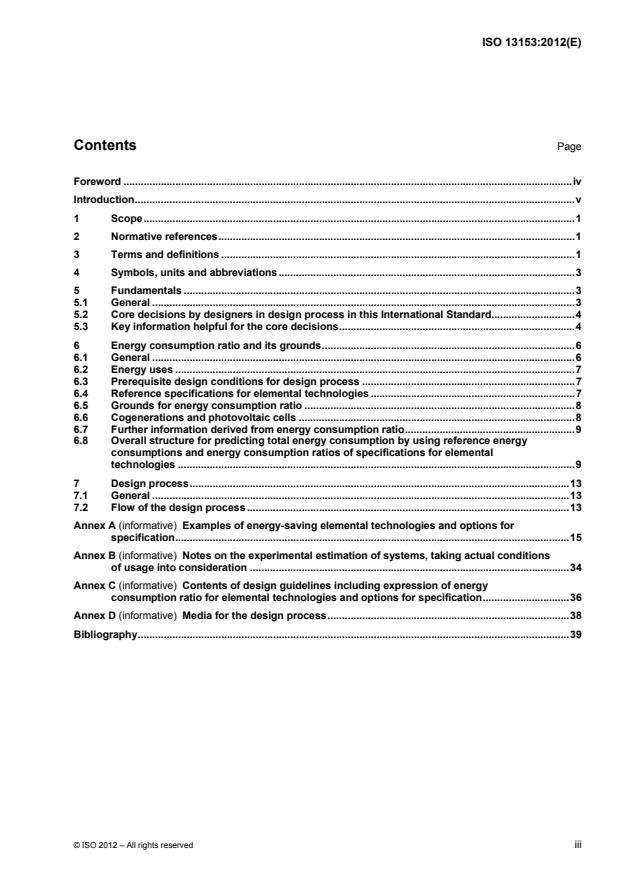
Contents Page
Foreword . iv
Introduction . v
1 Scope . 1
2 Normative references . 1
3 Terms and definitions . 1
4 Symbols, units and abbreviations . 3
5 Fundamentals . 3
5.1 General . 3
5.2 Core decisions by designers in design process in this International Standard. 4
5.3 Key information helpful for the core decisions . 4
6 Energy consumption ratio and its grounds . 6
6.1 General . 6
6.2 Energy uses . 7
6.3 Prerequisite design conditions for design process . 7
6.4 Reference specifications for elemental technologies . 7
6.5 Grounds for energy consumption ratio . 8
6.6 Cogenerations and photovoltaic cells . 8
6.7 Further information derived from energy consumption ratio . 9
6.8 Overall structure for predicting total energy consumption by using reference energy
consumptions and energy consumption ratios of specifications for elemental
technologies . 9
7 Design process . 13
7.1 General . 13
7.2 Flow of the design process . 13
Annex A (informative) Examples of energy-saving elemental technologies and options for
specification . 15
Annex B (informative) Notes on the experimental estimation of systems, taking actual conditions
of usage into consideration . 34
Annex C (informative) Contents of design guidelines including expression of energy
consumption ratio for elemental technologies and options for specification . 36
Annex D (informative) Media for the design process . 38
Bibliography . 39
Foreword
ISO (the International Organization for Standardization) is a worldwide federation of national standards bodies
(ISO member bodies). The work of preparing International Standards is normally carried out through ISO
technical committees. Each member body interested in a subject for which a technical committee has been
established has the right to be represented on that committee. International organizations, governmental and
non-governmental, in liaison with ISO, also take part in the work. ISO collaborates closely with the
International Electrotechnical Commission (IEC) on all matters of electrotechnical standardization.
International Standards are drafted in accordance with the rules given in the ISO/IEC Directives, Part 2.
The main task of technical committees is to prepare International Standards. Draft International Standards
adopted by the technical committees are circulated to the member bodies for voting. Publication as an
International Standard requires approval by at least 75 % of the member bodies casting a vote.
Attention is drawn to the possibility that some of the elements of this document may be the subject of patent
rights. ISO shall not be held responsible for identifying any or all such patent rights.
ISO 13153 was prepared by Technical Committee ISO/TC 205, Building environment design.
iv © ISO 2012 – All rights reserved
Introduction
This International Standard provides the framework for a design process for single-family residential and small
commercial buildings, characterized by the “energy consumption ratio” as the key criterion. The design
process, or design guidelines explaining the design process, is prepared by suppliers of the design guidelines
for designers of buildings as a whole system, building envelopes or building equipment, all of which are deeply
related to the energy performance of buildings. Designers play the most important role in the wide propagation
of energy-saving technologies because they often make the final decisions on whether energy-saving
technologies should be adopted or not, and which energy-saving technologies should be adopted in actual
building projects.
INTERNATIONAL STANDARD ISO 13153:2012(E)
Framework of the design process for energy-saving
single-family residential and small commercial buildings
1 Scope
This International Standard specifies a framework of the design process for energy-saving single-family
residential and small commercial buildings, with the energy consumption ratio as the key criterion. It is
intended to assist in the development of design guidelines for practitioners who design energy-related parts of
buildings.
This International Standard is applicable only to the design process for single-family residential and small
commercial buildings.
2 Normative references
The following referenced documents are indispensable for the application of this document. For dated
references, only the edition cited applies. For undated references, the latest edition of the referenced
document (including any amendments) applies.
ISO 16813, Building environment design — Indoor environment — General principles
ISO 16818, Building environment design — Energy efficiency — Terminology
ISO 23045, Building environment design — Guidelines to assess energy efficiency of new buildings
3 Terms and definitions
For the purposes of this document, the terms and definitions given in ISO 16813, ISO 16818 and ISO 23045
and the following apply.
3.1
analogical inference
prediction of energy consumption or effectiveness in energy saving of a certain specification of a certain
elemental technology on the basis of a design process or design guidelines, where the prerequisite design
condition does not agree completely with that of the building project of concern
3.2
design condition
condition which affects functions of energy-saving elemental technologies and is taken into account in order to
design the building concerned
3.3
designer
general designer
practitioner who designs buildings and equipment, and does not necessarily have expertise in energy-related
aspects of buildings
3.4
design guidelines
media which include information on how to design buildings and on the design process
3.5
design process
course of actions performed by designers to produce a set of specifications and drawings
3.6
energy consumption ratio
ratio of predicted energy consumption for a certain energy use to the reference energy consumption
3.7
elemental technology
energy-saving elemental technology
group of design methods or specifications which constitute a common function in buildings and are proved to
reduce energy consumption when compared with a reference method and specification
3.8
energy use
purpose of the equipment for which energy is used
EXAMPLE Space heating, space cooling, ventilation, domestic hot water, lighting, cooking, consumer electronics,
etc.
3.9
predicted energy consumption
energy consumption in primary energy for a particular energy use or a sum of energy uses, which is predicted
by taking actual performance of building components and actual efficiency of equipment into consideration as
much as possible
3.10
project definition
process of providing the relevant information for designers and others to define the scope of the work
NOTE The project definition lists the given constraints, which cannot be revised, and the project requirements, the
theories and assumptions. All of these might not be completely defined at this stage. Some of these may be revised in
response to feedback from later stages of the design process.
3.11
reference energy consumption
predicted energy consumption of a building with reference specifications for elemental technologies
3.12
reference specification for elemental technology
reference specification
specification whose energy performance is regarded as a reference standard
3.13
specification
information which specifies the construction of a part of buildings or the requirements for installed equipment
3.14
supplier of design guidelines
expert who produces and supplies design guidelines for designers by using his/her expertise on energy-
related aspects of buildings
2 © ISO 2012 – All rights reserved
4 Symbols, units and abbreviations
Table 1 — Symbols, units and abbreviations
Symbol Quantity Unit
E reference annual energy consumption in primary energy for energy use “i” GJ/a
i
E predicted annual energy consumption in primary energy taking power GJ/a
T
generation by photovoltaic cells into consideration
ET elemental technology
EU energy use
e predicted annual electrical load kWh/a
e
e predicted annual energy consumption for energy use “i” GJ/a
i
e predicted power generation by photovoltaic cells GJ/a
PV
e predicted total annual energy consumption for energy use “1”, “2”, , “N” GJ/a
T
e predicted annual energy consumption in primary energy for energy use “i”, GJ/a
i,j,k
when the level of option “k” of the elemental technology “j” is adopted
e predicted annual energy consumption in primary energy for energy use “i”, GJ/a
i,j k + j k + + j k
1 j 2 j n j
1 2 n
when the level of option “k ” of the elemental technology “j ”, the level of option
j
“k ” of the elemental technology “j ”, and the level of option “k ” of the
j 2 j
2 n
elemental technology “j ” are adopted
n
L predicted annual heat load for domestic hot water GJ/a
dhw
L predicted annual heat load for hot-water space heating GJ/a
h
N number of energy uses with which the design process deals -
n number of elemental technologies that are effective in saving each energy use -
r energy consumption ratio for energy use “i”, when the level of option “k” of the -
i,j,k
elemental technology “j” is adopted
r energy consumption ratio for energy use “i”, when the level of option “k ” of the -
i,j ,k j
n j n
n
elemental technology “j ” is adopted
n
r energy consumption ratio for energy use “i”, when evaluating the interaction -
i,j ,k +j ,k
1 j 2 j
1 2
among options of multiple elemental technologies (the level of option “k ” of
j
+ +j ,k
n j
n
the elemental technology “j ”, the level of option “k” of the elemental
j
technology “j ”, and the level of option “k ” of the elemental technology “j ”)
j
2 n
n
5 Fundamentals
5.1 General
The design process, whose framework is given by this International Standard, has its own characteristics. The
primary characteristic is being equipped with quantitative information on the energy-saving effectiveness of
design options. It comes from the fact that there are still many designers who are engaged mainly in
small-scale building projects and cannot carry out their own tailor-made evaluation of the design options by
themselves. The following shows the decisions by those designers, who are assisted by the design process
and the design guidelines as their media. In this International Standard, “elemental technology” and
“specification” are fundamental concepts in the design process.
5.2 Core decisions by designers in design process in this International Standard
5.2.1 Provisional selection of elemental technologies
In the design process for energy conservation in buildings, the provisional selection of elemental technologies,
which are to be evaluated for their effectiveness before the final selection, shall be made. The number of
provisionally selected elemental technologies depends on design conditions.
EXAMPLE In cold climates, the insulation of the building envelope is selected as an elemental technology, which
contributes to energy conservation in space heating energy. Other examples of the elemental technologies are given in
A.2.
5.2.2 Provisional selection of specification for the elemental technology
After the selection of a certain elemental technology, the specification for the elemental technology shall be
provisionally selected so that the effect of the design on energy consumption can be quantitatively evaluated.
NOTE Examples of specifications for elemental technologies are given in Annex A.
EXAMPLE The performance of the insulation of the building envelope is dependent on thermal resistance of
insulation materials, thermal transmittance of windows and construction method affecting the air movement in or through
the building envelope. Options for overall specification of the envelope from the viewpoint of the insulation are prescribed
by those parameters.
5.2.3 Final selection of the options for specifications to be adopted in the building project
After checking predicted energy consumption or the reduction of energy consumption from the reference
specifications, and after checking the balance between initial cost increase and running cost reduction,
designers make the final selection on the options for specifications of elemental technologies if they give
satisfactory results from the viewpoint of energy conservation and cost-effectiveness.
5.3 Key information helpful for the core decisions
5.3.1 Characteristics of elemental technologies
The elemental technologies, which are covered by the design process according to this International Standard,
shall be clearly defined and explained in the design guidelines in plain terms with explanations of technical
terms in engineering fields with which general designers of buildings may not be familiar. Technologies for
energy conservation in buildings are not necessarily well-known to general designers of buildings. In order to
propagate such technologies, even basic information shall be provided in design guidelines so that the
designers can understand how each elemental technology can reduce energy consumption.
5.3.2 Characteristics of options of specifications for elemental technologies
It is necessary not only to let designers know of the existence and characteristics of elemental technologies
for energy conservation in buildings, but also to give them enough knowledge about specifications for the
elemental technologies. Among the options, the reference specification shall be included and explained so
that the designers can evaluate each option in comparison with the reference specification.
Specification options are accompanied with requirements and warnings (e.g., higher skill level of workers,
indispensability of heavier maintenance, etc.), which shall be followed by the designers or installers to assure
the performance of the options. The descriptions of options for specifications shall clearly stipulate how to
design and construct/install the part of the buildings. If the designers or installers cannot follow such
requirements and warnings in their circumstance, they cannot adopt the options, however large an energy
reduction they can make.
4 © ISO 2012 – All rights reserved
5.3.3 Quantitative information on the effectiveness of each option for specification
The reduction of energy consumption is the most important objective of the design process prescribed in this
International Standard. Therefore, the information on the predicted reduction of energy is the key information,
which shall be prepared by suppliers of the design process and its medium. The predicted reduction shall be
expressed by the energy consumption ratio, which is defined by the ratio of predicted energy consumption to
the reference energy consumption as for a related energy use.
All options of specifications for each elemental technology shall be named “LEVEL 0”, “LEVEL 1”, “LEVEL 2”
and so on. “LEVEL 0” shall be allocated to the reference specification as a standard level. Options with
smaller energy consumption ratios shall be given a level with a higher number. If there are any specifications
with a predicted energy consumption higher than the standard level included in the options, they shall be
named “LEVEL -1”, “LEVEL -2” and so on.
The relationship among the reference energy consumption, the energy consumption ratio and the predicted
energy consumption is as expressed in Equation (1).
eEr (1)
ij,,k i i,j,k
where
e is the predicted energy consumption for energy use “i” (GJ/a), when the level of option “k” of the
i,j,k
elemental technology “j” is adopted;
E is the reference energy consumption for energy use “i” (GJ/a);
i
r is the energy consumption ratio for use “i”, when the level of option “k” of the elemental
i,j,k
technology “j” is adopted.
The reality and reliability of the method of predicting energy consumption is crucial for designers. For this
reason, the grounds for the prediction shall be explained within the design guideline, as specified in 6.5.
In cases where plural elemental technologies are effective in reducing energy consumption for a common
energy use, prediction by multiplying energy consumption ratios for those plural elemental technologies is
acceptable as an approximation, as shown in Equation (2).
eEr r r (2)
ij,,kj k j k i ij,k i,j,k i,j,k
12j jnj 1j 2j nj
12nn1 2
where
e is the predicted energy consumption for energy use “i” (GJ/a), when the level of
ij, kj k j k
12jj nj
12 n
option “ k ” of the elemental technology “j ”, the level of option “ k ” of the
j j
1 2
elemental technology “j ”, and the level of option “ k ” of the elemental technology
j
n
“j ” are adopted;
n
E is the reference energy consumption for energy use “i” (GJ/a);
i
r is the energy consumption ratio for energy use “i”, when the level of option “ k ” of
ij,,k j
nj n
n
the elemental technology “j ” is adopted.
n
If the interaction of different elemental technologies on the effectiveness in energy saving is to be taken into
consideration, the energy consumption ratio evaluating combined effectiveness can also be used as
expressed in Equation (3).
eEr (3)
i,,jkjk jk i ijkj kjk
12j jnj 12j j nj
12n 12n
where
e is the predicted energy consumption for energy use “i” (GJ/a), when the level of
ij, kj k j k
12j nj
12j n
option “ k ” of the elemental technology “j ”, the level of option “ k ” of the
j j
1 2
elemental technology “j ”, . and the level of option “ k ” of the elemental
j
n
technology “j ” are adopted;
n
E is the reference energy consumption for energy use “i” (GJ/a);
i
is the energy consumption ratio for energy use “i” evaluating combined
r
ij, kj k j k
12j jnj
12 n
effectiveness in energy saving, when the level of option “ k ” of the elemental
j
technology “j ”, the level of option “ k ” of the elemental technology “j ”, . and the
1 2
j
level of option “ k ” of the elemental technology “j ” are adopted.
n
j
n
5.3.4 Prediction of total energy consumption by using reference energy consumption and energy
consumption ratios
The total energy consumption is predicted by summing up predicted energy consumptions for energy uses of
concern, as shown in Equation (4).
N
ee (4)
T i
i=1
where
e is the predicted total energy consumption for energy use “1”, “2”, ., “N” (GJ/a);
T
e is the predicted energy consumption for energy use “i” (GJ/a) and can be calculated using
i
Equation (1), (2) or (3).
5.3.5 Initial cost of each option for specifications
The payback period of implemented elemental technologies is useful information for designers and clients.
When actual prices of products and labour costs are not available, price lists of products supplied by
manufacturers or any existing database for construction labour cost are used, with an additional explanation
on the source of the information.
5.3.6 Merits of elemental technologies other than energy conservation
Depending on design conditions, some elemental technologies may need a longer payback period. Even in
that situation, designers may choose such kinds of elemental technologies because of merits other than
energy conservation and cost effectiveness, such as the improvement of the indoor environment. Due to such
diverse values of the elemental technologies, merits other than energy conservation shall be included in the
explanation of the elemental technologies.
6 Energy consumption ratio and its grounds
6.1 General
As defined in Clauses 3 and 4, the energy consumption ratio contains information on the change of energy
consumption for a related energy use, when a certain specification of a certain elemental technology is
6 © ISO 2012 – All rights reserved
adopted under the prerequisite design conditions. The ratio shall be determined beforehand by suppliers of
the design guidelines, which describe a particular design process for energy-saving buildings.
6.2 Energy uses
The various energy uses in buildings include space heating, space cooling, domestic hot water, ventilation,
lighting, consumer electronics and cooking. The effect of a certain elemental technology for energy saving
appears primarily in one of those energy uses. Therefore, when designers evaluate a certain elemental
technology and its options for specifications, they concentrate on a single related energy use to check the
performance of the options. When designers attempt to reduce the overall energy consumption, they should
try to reduce different energy uses by checking different elemental technologies and their options for
specifications, one by one.
6.3 Prerequisite design conditions for design process
Energy performance of technologies is often dependent on prerequisite design conditions, even if the
technologies are energy-saving in general. In order to supply practical and simple design guidelines, design
conditions, under which the effects of elemental technologies are quantified, shall be limited and clearly
described. The design guidelines shall be focused on similar climatic zones (ideally a single climatic zone), a
limited building type, use and size. This is a disadvantage of the design process and the design guidelines
outlined in this International Standard, especially when compared with simulation programs, which can be
applied to a wider range of design conditions. However, it is indispensable to limit the applicable design
conditions so as to be able to prepare design processes and guidelines that are easy to use for those not
familiar with simulation programs. Preparing the design process and design guidelines individually for different
design conditions, and so that they cover a wide range of design conditions, allows general designers to
choose the design process and guidelines most suited to their own building project, with limited analogical
inference.
The prerequisite design conditions include the following:
climatic conditions, which are represented by climatic zones or factors, such as dry-bulb temperature,
humidity, solar radiation, wind speed and direction;
building shape;
construction type (wooden, brick, reinforced-concrete, or steel construction);
building lot (size and orientation) and surrounding conditions (adjacent buildings, environmental quality
and security);
lifestyle of occupants (occupancy, hot water usage, lighting pattern, use of electric appliances, window
opening behaviour, and requirement for indoor temperature and humidity) for residential buildings;
building use and occupancy (working hours, number of occupants, hot water usage, lighting pattern, use
of electric appliances, and requirement for indoor temperature and humidity) for small commercial
buildings; and,
internal heat gain due to occupants’ metabolism, artificial lighting, electric appliances.
6.4 Reference specifications for elemental technologies
Designers choose a specification by comparing options. Among those options for specifications there shall be
a standard one, which is the reference specification representing a typical specification at a certain time under
the prerequisite design conditions.
EXAMPLE If a certain usual specification for houses built in 2000 is chosen, the designers get the information on
how much energy can be saved by using the energy consumption ratio of each option for the elemental technology,
comparing to the standard houses built in 2000.
6.5 Grounds for energy consumption ratio
The following methods, or their combinations, shall be used as the basis for predicting energy consumption.
6.5.1 Numerical simulations
If the relationship among parameters by which energy consumption is determined has been found in theory
and validated by any facts, it can be used to predict the energy consumption in computer simulations or in
simpler calculation methods. In some numerical simulations, there may be input data which is difficult to obtain
with proofs and is usually given a value as an assumption. Especially as an input data for energy efficiency of
equipment, a value measured under a rating condition is usually substituted, but the correspondence and
discrepancy between the rating condition and the actual condition when the equipment is used shall be
carefully checked by the suppliers of the design guidelines.
6.5.2 Experiments
Experiments are important for the estimation of the energy efficiency of equipment, because the efficiency
data obtained under rating conditions is insufficient when the actual conditions differ significantly with regard
to key factors having a large influence on energy efficiency.
For experiments where the actual energy efficiency of equipment is to be determined, the actual usage pattern
of the equipment by occupants shall be modelled and applied.
NOTE Some notes are given in Annex B.
6.5.3 Field surveys
Field surveys provide direct information for actual conditions in buildings. The direct information includes
occupants’ behaviour (occupancy, usage of equipment and appliances, window opening), indoor environment
(temperature, humidity, illuminance) and actual behaviour of equipment and appliances (input/output and
related conditions).
6.6 Cogenerations and photovoltaic cells
The output from the cogenerations and photovoltaic cells is used for multiple energy uses, and the energy
consumption ratio is not an appropriate index.
For cogenerations, the total energy consumption in buildings, including energy consumed by the cogeneration
itself is predicted by the function of annual heat and electricity load. The function is obtained from the
experiment of the cogenerations with patterns of heat and electricity load. The energy consumption when
using the cogenerations can be predicted using Equation (5).
eCeC()L LC (5)
T1 e 2 dhw h 3
where
e is the predicted total energy consumption (GJ/a);
T
e is the predicted electrical load (kWh/a);
e
L is the predicted heat load for domestic hot water (GJ/a);
dhw
L is the predicted heat load for hot-water space heating (GJ/a);
h
C , C , C are constants.
1 2 3
8 © ISO 2012 – All rights reserved
For photovoltaic cells, an annual amount of power generation is predicted by installed peak power (kW ),
p
estimated system losses (%) and annual solar radiation on installed PV panels (kWh/m ). The annual amount
is to be deducted from the total energy consumption of the building, as shown in Equation (6).
E e e (6)
T = T - PV
where
E is the predicted total energy consumption taking power generation by photovoltaic cells into
T
consideration (GJ/a);
e is the predicted total energy consumption without taking power generation by photovoltaic cells into
T
consideration (GJ/a);
e is the predicted power generation by photovoltaic cells (GJ/a).
PV
6.7 Further information derived from energy consumption ratio
The CO emission due to consumed energy is calculated from energy consumption by using a conversion
factor given in terms of CO emission per unit of consumed energy.
Running cost for consumed energy is also calculated from energy consumption and the rating system for the
energy.
If there are different conversion factors or rating systems according to time, energy consumption within each
time zone shall be predicted.
6.8 Overall structure for predicting total energy consumption by using reference energy
consumptions and energy consumption ratios of specifications for elemental technologies
Table 2 shows the relationship among the parameters described above. In this case, six energy uses, EU ,
EU , , EU , are dealt with in the design process, three elemental technologies are effective in reducing each
2 6
energy use, 18 elemental technologies are dealt with as a whole in the design process, and four levels plus
one reference level of specification are available for each elemental technology. In reality, the number of
elemental technologies for each energy use can be different, and the number of levels of specification can
also be different for each elemental technology. At the bottom of Table 2, four levels of power generation by
photovoltaic cells are given with the amount of generated energy in addition to the reference level, namely,
“LEVEL 0”. The number of the levels depends on cases.
The energy consumption ratios given in Table 2 are determined using Equation (2) and are based on the
assumption that the interaction between plural elemental technologies effective in reducing a common energy
use can be negligible.
EXAMPLE An example of Table 2 is contained in Table A.1.
Table 3 shows how the parameters shown in Table 2 are used in the calculation for predicting energy
consumption for each energy use and total energy consumption. After selecting specifications for all
technological elements listed in Table 2, energy consumption ratios are inserted in the calculation formulas
shown in the second column. The reduction rate shown in the row of the subtotal means the ratio of energy
reduced owing to the selected specifications except for photovoltaic cells. The reduction rate shown in the row
of the total means the overall effectiveness of selected elemental technologies including the photovoltaic cells.
NOTE An example of Table 3 is contained in Table A.2.
Table 2 — Energy use parameters
Energy Reference Elemental Energy consumption ratio of each “LEVEL” of
use energy technology specification
consumption
EU ET
LEVEL 0 LEVEL 1 LEVEL 2 LEVEL 3 LEVEL 4
i j
E (GJ/a)
i
(r = 1,0)
i,j,0
EU E ET r r r r r
1 1 1 1,1,0 1,1,1 1,1,2 1,1,3 1,1,4
ET r r r r r
2 1,2,0 1,2,1 1,2,2 1,2,3 1,2,4
ET r r r r r
3 1,3,0 1,3,1 1,3,2 1,3,3 1,3,4
EU E ET r r r r r
2 2 4 2,4,0 2,4,1 2,4,2 2,4,3 2,4,4
ET r r r r r
5 2,5,0 2,5,1 2,5,2 2,5,3 2,5,4
ET r r r r r
6 2,6,0 2,6,1 2,6,2 2,6,3 2,6,4
EU E ET r r r r r
3 3 7 3,7,0 3,7,1 3,7,2 3,7,3 3,7,4
ET r r r r r
8 3,8,0 3,8,1 3,8,2 3,8,3 3,8,4
ET r r r r r
9 3,9,0 3,9,1 3,9,2 3,9,3 3,9,4
EU E ET r r r r r
4 4 10 4,10,0 4,10,1 4,10,2 4,10,3 4,10,4
ET r r r r r
11 4,11,0 4,11,1 4,11,2 4,11,3 4,11,4
ET r r r r r
12 4,12,0 4,12,1 4,12,2 4,12,3 4,12,4
EU E ET r r r r r
5 5 13 5,13,0 5,13,1 5,13,2 5,13,3 5,13,4
ET r r r r r
14 5,14,0 5,14,1 5,14,2 5,14,3 5,14,4
ET r r r r r
15 5,15,0 5,15,1 5,15,2 5,15,3 5,15,4
EU E ET r r r r r
6 6 16 6,16,0 6,16,1 6,16,2 6,16,3 6,16,4
ET r r r r r
17 6,17,0 6,17,1 6,17,2 6,17,3 6,17,4
ET r r r r r
18 6,18,0 6,18,1 6,18,2 6,18,3 6,18,4
Total E
i
Photovoltaic
e e e e e
PV0 PV1 PV2 PV3 PV4
power
(0 GJ/a)
generation
(GJ/a)
10 © ISO 2012 – All rights reserved
Table 3 — Calculation for predicting energy consumption for each energy use and total energy
consumption, E , on the basis of reference energy consumptions and energy consumption ratios
T
in Table 1
Energy use Calculation formula for Predicted energy Reference Reduction rate
predicting energy consumption or energy
EU
i
consumption power generation consumption
(GJ/a) (GJ/a)
EU Er r r e E 1- e /E
1 1,1k11+2k12+3k13 1 1,1k11+2k12+3k13 1
1 1,1,k11 1,2,k12 1,3,k13
EU Er r r e E 1- e /E
2 2,1k21+2k22+3k23 2 2,1k21+2k22+3k23 1
2 2,1,k21 2,2,k22 2,3,k23
EU Er r r e E 1- e /E
3 3,1k31+2k32+3k33 3 3,1k31+2k32+3k33 1
3 3,1,k31 3,2,k32 3,3,k33
EU Er r r e E 1- e /E
4 4,1k41+2k42+3k43 4 4,1k41+2k42+3k43 1
4 4,1,k41 4,2,k42 4,3,k43
EU Er r r e E 1- e /E
5 5,1k51+2k52+3k53 5 5,1k51+2k52+3k53 1
5 5,1,k51 5,2,k52 5,3,k53
EU Er r r e E 1- e /E
6 6,1k61+2k62+3k63 6 6,1k61+2k62+3k63 1
6 6,1,k61 6,2,k62 6,3,k63
Subtotal - e E 1- e /E
T
i T i
Photovoltaic e
PVj
power -
generation
Total e -e E
E 1- E /E
T PVj T
i T i
Start
Assumptions
Design conditions
Project definition
Constraints
Goals for energy saving
and/or reduction of CO
emission
Evaluation of
project definition
NO
YES
Identifying prerequisite design
conditions
Judgement of
applicability of design
NO
guidelines
YES Availability of more
suitable design
Identifying reference energy
YES
guidelines
consumption for energy uses
NO
Provisional selection of elemental
Identifying risks due to application
technologies (conceptual design)
of the design process with
correspondent prerequisite design
Provisional selection of options for
conditions
specification (detail design)
Activate analogical inference
Identifying energy consumption
ratio and estimation of energy
consumption
Estimation of CO emission
Estimation of initial and running
cost
Judgement of
appropriateness of
NO choices for design
YES
Final selection of the options
for specifications (End of
design)
Figure 1 — Flow of design process with the energy consumption ratio as a criterion
12 © ISO 2012 – All rights reserved
7 Design process
7.1 General
The structure of the design process is prescribed in the following subclauses. The flow of the design process
is shown in Figure 1.
7.2 Flow of the design process
7.2.1 Project definition
Project definition is the process in which designers obtain the information to define the scope of their work.
The project definition lists the given constraints, the project requirements and assumptions, according to
ISO 16813. In the project definition, goals for energy conservation and/or reduction of CO emission are
defined. The goals are to be referred to in the later stage when judging the appropriateness of design choices.
7.2.2 Evaluation of project definition
The consistency of the content of the constraints, the requirements and the assumptions shall be verified at
this stage. The feasibility of the given requirements under the constraints and the assumptions shall also be
verified. The major concern is whether or not the project definition is adequate and optimal under the given
constraints.
7.2.3 Identifying prerequisite design conditions
In this process, the correspondence between prerequisite design conditions of the design process and design
conditions for a particular building project shall be checked. The design conditions are a part of the project
definition, which is focused only on the energy-related project definition.
7.2.4 Judgement of applicability of design guidelines and analogical inference, if necessary
If the prerequisite design conditions of the design guidelines correspond well to the design conditions of the
project, the design process described in the design guidelines is judged to be applicable to the project. If not,
the designer is to search for any other appropriate design guidelines. If the designer cannot find an
appropriate design guideline, it is acceptable to utilize available design guidelines by making the analogical
inference from the information in the design guidelines. In the analogical inference, there is a risk of misuse of
the information on the effectiveness of a certain specification of a certain elemental technology, whose
effectiveness changes considerably between the prerequisite design conditions and design conditions of the
project. Therefore, such risk shall be explained as a caution to designers, and information on influential design
conditions, which determine the effectiveness of elemental technologies, shall be given in design guidelines,
even if it is not quantitative.
7.2.5 Identifying reference energy consumption for energy uses
The profile of energy consumptions for different uses is fundamental when a designer selects elemental
technologies to be adopted. The resources of clients should be used for the reduction of energy use across
larger applications, because the adoption of the same elemental technologies across larger applications will
result in increased energy reductions.
7.2.6 Provisional selection of elemental technologies
To start evaluating and predicting energy consumption, a provisional decision to select some of the elemental
technologies shall be made by designers at this stage. The selection and the evaluation are done iteratively,
before reaching the final selection, by which satisfactory results for predicted energy consumption and for
other constraints are obtained. In the selection of elemental technologies, explanations of the characteristics
of those elements, and energy consumption ratios of options for the elements, help designers’ judgement.
7.2.7 Provisional selection of options for specification
Once certain elemental technologies are selected, one of the options for specifications of each elemental
technology shall be provisionally selected at this stage. In the selection, the energy consumption ratio, the
CO emission, the initial cost increase, the requirements and warnings of each option are briefly referred to by
designers.
7.2.8 Identifying energy consumption ratio and estimation of energy consumption
The energy consumption ratio of each option for specification shall be identified by designers at this stage. As
already stated, the energy consumption ratios shall be prepared by suppliers of the design guidelines and
given in the design guidelines in a plain and understandable way.
Once the energy consumption ratio is identified, the energy consumption can be predicted using Equation (1),
(2) or (3).
7.2.9 Estimation of CO emission
In parallel with the prediction of energy consumption, the method to estimate the CO emission shall be given
in the design process and the estimation shall be done at this stage. For that purpose, the predicted energy
consumption shall be divided into consumptions of different energy carriers, such as electricity, gases and oil.
In addition, conversion factors for each energy carrier shall be given for the design process.
7.2.10 Estimation of initial and running cost
In parallel with the prediction of energy consumption and the estimation of CO emission, the method to
estimate costs shall be given in the design process and done at this stage. The cost estimation is a matter of
global concern for the propagation of energy-saving technologies, but needs a detailed survey for local prices
of products and labour as well as prices of energy carriers, which are sometimes sold on unique rating
systems of local companies. In order to avoid complexity, simplified methods for the estimation are acceptable
(e.g., national average price of a certain energy carrier), but assumptions for any simplified method shall be
explained.
7.2.11 Judgement of appropriateness of choices for design
After the selections of elemental technologies and their options for specifications, their energy consumption,
CO emission and cost shall be estimated. If any of the estimated results are unsatisfactory, the selections
and estimations are repeated by designers. Once some satisfactory combination of elemental technologies
and their options for specifications are found, final judgement of the combination as a design solution for this
design process shall be made at this stage.
All stages, from the project definition to the cost estimation, shall be reviewed to confirm correctness. If any
mistake is found, it shall be corrected and the estimation shall be redone in stages.
...