

ISO 3452-1:2021
(Main)Non-destructive testing — Penetrant testing — Part 1: General principles
General Information
- Abstract
This document specifies a method of penetrant testing used to detect discontinuities, e.g. cracks, laps, folds, porosity and lack of fusion, which are open to the surface of the material to be tested using white light or UV-A (365 nm) radiation. It is mainly applied to metallic materials, but can also be performed on other materials, provided that they are inert to the test media and not excessively porous (castings, forgings, welds, ceramics, etc.) This document also includes requirements for process and control testing, but is not intended to be used for acceptance criteria. It gives neither information relating to the suitability of individual test systems for specific applications nor requirements for test equipment. NOTE 1 Methods for determining and monitoring the essential properties of penetrant testing products to be used are specified in ISO 3452-2 and ISO 3452-3. NOTE 2 The term "discontinuity" is used in this document in the sense that no evaluation concerning acceptability or non-acceptability is included. NOTE 3 CEN/TR 16638 addresses penetrant testing using actinic blue light.
- Status
- Published
- Publication Date
- 20-May-2021
- Technical Committee
- ISO/TC 135/SC 2 - Surface methods
- Drafting Committee
- ISO/TC 135/SC 2 - Surface methods
- Current Stage
- 9060 - Close of review
- Completion Date
- 02-Dec-2031
Buy Documents



ISO 3452-1:2021 - Non-destructive testing -- Penetrant testing

ISO 3452-1:2021 - Non-destructive testing — Penetrant testing — Part 1: General principles/21/2021




ISO 3452-1:2021 - Essais non destructifs -- Examen par ressuage

ISO 3452-1:2021 - Essais non destructifs — Examen par ressuage — Partie 1: Principes généraux/21/2021
Overview
ISO 3452-1:2021 - "Non‑destructive testing - Penetrant testing - Part 1: General principles" - defines the general principles and process requirements for penetrant testing (PT), a surface non‑destructive testing (NDT) method used to reveal surface‑open discontinuities (e.g., cracks, laps, folds, porosity, lack of fusion) under white light or UV‑A (365 nm). The standard is primarily aimed at metallic materials but can be applied to other inert, non‑excessively porous materials (castings, forgings, welds, ceramics). It covers methodology, safety, personnel competence, process and control testing, and reporting - but it is not intended to provide acceptance criteria or to specify suitability of individual test systems.
Key Topics and Requirements
- Scope & applicability: Detects surface‑open discontinuities using visible or fluorescent penetrants; applicable mainly to metals and compatible non‑metals.
- Personnel & competence: Testing must be performed by trained, proficient personnel; certification to ISO 9712 or an equivalent system is recommended.
- Safety: Guidance on handling flammable/volatile penetrant products, ventilation, skin/mucous membrane protection, UV‑A source maintenance and general safe implementation.
- Process sequence (main stages):
- Written test procedure and documentation
- Precleaning (mechanical and chemical) and drying
- Penetrant application and specified penetration time
- Excess penetrant removal (water, solvent, emulsifier methods)
- Developing (dry, water‑suspendable, solvent‑based, water‑soluble, peelable, and the new “no developer” procedure)
- Inspection (viewing conditions per ISO 3059) and recording
- Post‑cleaning and corrosion protection; retesting rules
- Products, sensitivity and designation: Requirements for penetrant product families, sensitivity levels, and product compatibility (with materials and other PT products).
- Process & control tests: Requirements for verifying process effectiveness (see Annex B) and for reference blocks (ISO 3452‑3).
- Documentation & reporting: Minimum content for test reports and example reporting format (Annex C).
Practical Applications and Users
- Used by NDT inspectors, quality engineers, inspection companies, and maintenance teams in industries such as aerospace, automotive, oil & gas, power generation, foundries and welding fabrication.
- Typical uses: inspection of welds, castings, forgings, machined parts and ceramic components for surface defects during manufacturing, in‑service inspection and maintenance.
- Valuable for organizations establishing standard PT procedures, training programs, process controls and safety practices.
Related Standards
- ISO 3452‑2: Testing of penetrant materials
- ISO 3452‑3: Reference test blocks
- ISO 3452‑4: Equipment
- ISO 3452‑5 / 3452‑6: High / low temperature PT
- ISO 3059: Viewing conditions for PT and magnetic particle testing
- ISO 12706: Vocabulary for penetrant testing
- ISO 9712: Personnel certification for NDT
Keywords: ISO 3452-1, penetrant testing, penetrant inspection, non‑destructive testing (NDT), fluorescent penetrant, UV‑A 365 nm, process control, NDT standards.
Relations
- Effective Date
- 09-Feb-2026
- Effective Date
- 09-Feb-2026
- Effective Date
- 09-Feb-2026
- Effective Date
- 09-Feb-2026
- Effective Date
- 09-Feb-2026
- Effective Date
- 09-Feb-2026
- Effective Date
- 09-Feb-2026
- Effective Date
- 09-Feb-2026
- Effective Date
- 09-Feb-2026
- Effective Date
- 09-Feb-2026
- Effective Date
- 12-Feb-2026
- Effective Date
- 06-Jun-2022
- Effective Date
- 21-Apr-2018
Buy Documents
ISO 3452-1:2021 - Non-destructive testing -- Penetrant testing
ISO 3452-1:2021 - Non-destructive testing — Penetrant testing — Part 1: General principles/21/2021
ISO 3452-1:2021 - Essais non destructifs -- Examen par ressuage
ISO 3452-1:2021 - Essais non destructifs — Examen par ressuage — Partie 1: Principes généraux/21/2021
Get Certified
Connect with accredited certification bodies for this standard

IMP NDT d.o.o.
Non-destructive testing services. Radiography, ultrasonic, magnetic particle, penetrant, visual inspection.
Inštitut za kovinske materiale in tehnologije
Institute of Metals and Technology. Materials testing, metallurgical analysis, NDT.
Q Techna d.o.o.
NDT and quality assurance specialist. 30+ years experience. NDT personnel certification per ISO 9712, nuclear and thermal power plant inspections, QA/
Sponsored listings
Frequently Asked Questions
ISO 3452-1:2021 is a standard published by the International Organization for Standardization (ISO). Its full title is "Non-destructive testing — Penetrant testing — Part 1: General principles". This standard covers: This document specifies a method of penetrant testing used to detect discontinuities, e.g. cracks, laps, folds, porosity and lack of fusion, which are open to the surface of the material to be tested using white light or UV-A (365 nm) radiation. It is mainly applied to metallic materials, but can also be performed on other materials, provided that they are inert to the test media and not excessively porous (castings, forgings, welds, ceramics, etc.) This document also includes requirements for process and control testing, but is not intended to be used for acceptance criteria. It gives neither information relating to the suitability of individual test systems for specific applications nor requirements for test equipment. NOTE 1 Methods for determining and monitoring the essential properties of penetrant testing products to be used are specified in ISO 3452-2 and ISO 3452-3. NOTE 2 The term "discontinuity" is used in this document in the sense that no evaluation concerning acceptability or non-acceptability is included. NOTE 3 CEN/TR 16638 addresses penetrant testing using actinic blue light.
This document specifies a method of penetrant testing used to detect discontinuities, e.g. cracks, laps, folds, porosity and lack of fusion, which are open to the surface of the material to be tested using white light or UV-A (365 nm) radiation. It is mainly applied to metallic materials, but can also be performed on other materials, provided that they are inert to the test media and not excessively porous (castings, forgings, welds, ceramics, etc.) This document also includes requirements for process and control testing, but is not intended to be used for acceptance criteria. It gives neither information relating to the suitability of individual test systems for specific applications nor requirements for test equipment. NOTE 1 Methods for determining and monitoring the essential properties of penetrant testing products to be used are specified in ISO 3452-2 and ISO 3452-3. NOTE 2 The term "discontinuity" is used in this document in the sense that no evaluation concerning acceptability or non-acceptability is included. NOTE 3 CEN/TR 16638 addresses penetrant testing using actinic blue light.
ISO 3452-1:2021 is classified under the following ICS (International Classification for Standards) categories: 19.100 - Non-destructive testing. The ICS classification helps identify the subject area and facilitates finding related standards.
ISO 3452-1:2021 has the following relationships with other standards: It is inter standard links to EN ISO 15614-5:2024, EN ISO 17635:2025, EN ISO 13680:2025, EN ISO 13703-2:2023, EN ISO 15614-11:2025, EN ISO 3452-2:2021, EN 3043:2025, EN ISO 10855-3:2024, EN ISO 15614-2:2025, EN ISO 10855-1:2024, EN ISO 3452-1:2021, ISO/TS 15638-18:2013, ISO 3452-1:2013. Understanding these relationships helps ensure you are using the most current and applicable version of the standard.
ISO 3452-1:2021 is available in PDF format for immediate download after purchase. The document can be added to your cart and obtained through the secure checkout process. Digital delivery ensures instant access to the complete standard document.
Standards Content (Sample)
INTERNATIONAL ISO
STANDARD 3452-1
Third edition
2021-05
Non-destructive testing — Penetrant
testing —
Part 1:
General principles
Essais non destructifs — Examen par ressuage —
Partie 1: Principes généraux
Reference number
©
ISO 2021
© ISO 2021
All rights reserved. Unless otherwise specified, or required in the context of its implementation, no part of this publication may
be reproduced or utilized otherwise in any form or by any means, electronic or mechanical, including photocopying, or posting
on the internet or an intranet, without prior written permission. Permission can be requested from either ISO at the address
below or ISO’s member body in the country of the requester.
ISO copyright office
CP 401 • Ch. de Blandonnet 8
CH-1214 Vernier, Geneva
Phone: +41 22 749 01 11
Email: copyright@iso.org
Website: www.iso.org
Published in Switzerland
ii © ISO 2021 – All rights reserved
Contents Page
Foreword .v
1 Scope . 1
2 Normative references . 1
3 Terms and definitions . 1
4 Safety precautions . 2
5 General principles . 2
5.1 Personnel . 2
5.2 Description of the method . 2
5.3 Process sequence . 2
5.4 Equipment . 3
5.5 Effectiveness . 3
6 Products, sensitivity and designation . 3
6.1 Product family . 3
6.2 Testing products . 3
6.3 Sensitivity . 3
6.4 Designation . 4
7 Compatibility . 4
7.1 General . 4
7.2 Compatibility of penetrant testing products . 4
7.3 Compatibility of penetrant testing products and the material to be tested . 4
8 Test procedure . 5
8.1 Written test procedure . 5
8.2 Precleaning . 5
8.2.1 General. 5
8.2.2 Mechanical precleaning . 5
8.2.3 Chemical precleaning . 5
8.2.4 Drying . 5
8.3 Temperature . 5
8.4 Application of penetrant . 6
8.4.1 Methods of application . 6
8.4.2 Penetration time . 6
8.5 Excess penetrant removal . 6
8.5.1 General. 6
8.5.2 Water . 6
8.5.3 Solvents . 6
8.5.4 Emulsifier . 6
8.5.5 Water and solvent . 7
8.5.6 Excess penetrant removal check . 7
8.5.7 Drying after excess penetrant removal. 7
8.6 Developing . 7
8.6.1 General. 7
8.6.2 Dry developer . 8
8.6.3 Water-suspendable developer . 8
8.6.4 Solvent-based developer . 8
8.6.5 Water soluble developer . 8
8.6.6 Water- or solvent-based for special application (e.g. peelable developer) . 8
8.6.7 No developer (type I only) . 8
8.7 Inspection . 9
8.7.1 General. 9
8.7.2 Viewing conditions . 9
8.7.3 Wipe-off technique. 9
8.7.4 Recording .10
8.8 Post cleaning and corrosion protection.10
8.8.1 Post cleaning.10
8.8.2 Corrosion protection .10
8.9 Retesting .10
9 Test report .10
Annex A (normative) Main stages of standard penetrant examination .12
Annex B (normative) Process and control tests .14
Annex C (informative) Example test report .22
Bibliography .23
iv © ISO 2021 – All rights reserved
Foreword
ISO (the International Organization for Standardization) is a worldwide federation of national standards
bodies (ISO member bodies). The work of preparing International Standards is normally carried out
through ISO technical committees. Each member body interested in a subject for which a technical
committee has been established has the right to be represented on that committee. International
organizations, governmental and non-governmental, in liaison with ISO, also take part in the work.
ISO collaborates closely with the International Electrotechnical Commission (IEC) on all matters of
electrotechnical standardization.
The procedures used to develop this document and those intended for its further maintenance are
described in the ISO/IEC Directives, Part 1. In particular, the different approval criteria needed for the
different types of ISO documents should be noted. This document was drafted in accordance with the
editorial rules of the ISO/IEC Directives, Part 2 (see www .iso .org/ directives).
Attention is drawn to the possibility that some of the elements of this document may be the subject of
patent rights. ISO shall not be held responsible for identifying any or all such patent rights. Details of
any patent rights identified during the development of the document will be in the Introduction and/or
on the ISO list of patent declarations received (see www .iso .org/ patents).
Any trade name used in this document is information given for the convenience of users and does not
constitute an endorsement.
For an explanation of the voluntary nature of standards, the meaning of ISO specific terms and
expressions related to conformity assessment, as well as information about ISO's adherence to the
World Trade Organization (WTO) principles in the Technical Barriers to Trade (TBT), see www .iso .org/
iso/ foreword .html.
This document was prepared by Technical Committee ISO/TC 135, Non-destructive testing,
Subcommittee SC 2, Surface methods, in collaboration with the European Committee for Standardization
(CEN) Technical Committee CEN/TC 138, Non-destructive testing, in accordance with the Agreement on
technical cooperation between ISO and CEN (Vienna Agreement).
This third edition cancels and replaces the second edition (ISO 3452-1:2013) which has been technically
revised.
The main changes compared to the previous edition are as follows:
— clarification of understanding of product family;
— addition of the new procedure “no developer”;
— technical revision according to the state of the art.
A list of all parts in the ISO 3452 series can be found on the ISO website.
Any feedback or questions on this document should be directed to the user’s national standards body. A
complete listing of these bodies can be found at www .iso .org/ members .html.
INTERNATIONAL STANDARD ISO 3452-1:2021(E)
Non-destructive testing — Penetrant testing —
Part 1:
General principles
1 Scope
This document specifies a method of penetrant testing used to detect discontinuities, e.g. cracks, laps,
folds, porosity and lack of fusion, which are open to the surface of the material to be tested using white
light or UV-A (365 nm) radiation. It is mainly applied to metallic materials, but can also be performed
on other materials, provided that they are inert to the test media and not excessively porous (castings,
forgings, welds, ceramics, etc.)
This document also includes requirements for process and control testing, but is not intended to be
used for acceptance criteria. It gives neither information relating to the suitability of individual test
systems for specific applications nor requirements for test equipment.
NOTE 1 Methods for determining and monitoring the essential properties of penetrant testing products to be
used are specified in ISO 3452-2 and ISO 3452-3.
NOTE 2 The term "discontinuity" is used in this document in the sense that no evaluation concerning
acceptability or non-acceptability is included.
NOTE 3 CEN/TR 16638 addresses penetrant testing using actinic blue light.
2 Normative references
The following documents are referred to in the text in such a way that some or all of their content
constitutes requirements of this document. For dated references, only the edition cited applies. For
undated references, the latest edition of the referenced document (including any amendments) applies.
ISO 3059, Non-destructive testing — Penetrant testing and magnetic particle testing — Viewing conditions
ISO 3452-2, Non-destructive testing — Penetrant testing — Part 2: Testing of penetrant materials
ISO 3452-3, Non-destructive testing — Penetrant testing — Part 3: Reference test blocks
ISO 3452-4, Non-destructive testing — Penetrant testing — Part 4: Equipment
ISO 3452-5, Non-destructive testing — Penetrant testing — Part 5: Penetrant testing at temperatures
higher than 50 degrees C
ISO 3452-6, Non-destructive testing — Penetrant testing — Part 6: Penetrant testing at temperatures
lower than 10 degrees C
ISO 12706, Non-destructive testing — Penetrant testing — Vocabulary
3 Terms and definitions
For the purposes of this document, the terms and definitions given in ISO 12706 apply.
ISO and IEC maintain terminological databases for use in standardization at the following addresses:
— ISO Online browsing platform: available at https:// www .iso .org/ obp
— IEC Electropedia: available at http:// www .electropedia .org/
4 Safety precautions
As penetrant inspection techniques often require the use of harmful, flammable and/or volatile
materials, safety regulations (e.g. optical radiation legislation) shall be taken into account.
Prolonged or repeated contact of these materials with the skin or any mucous membrane should be
avoided. Working areas shall be adequately ventilated and sited away from sources of heat, sparks or
naked flames, taking into account all applicable safety regulations.
The penetrant testing products and equipment shall be used with care and always in compliance with
the instructions supplied by the manufacturer.
UV-A sources shall always be maintained in a good condition.
Care shall be taken to ensure the safe implementation of the method.
5 General principles
5.1 Personnel
Testing shall be carried out by proficient, suitably trained and qualified personnel and, where applicable,
shall be supervised by competent personnel nominated by the employer or, by delegation of the
employer to the inspection company in charge of testing. To demonstrate appropriate qualification, it
is recommended that personnel be certified according to ISO 9712 or an equivalent formalized system.
Penetrant testing operations, unless otherwise agreed, shall be authorized by a competent supervisory
individual (Level 3 or equivalent) approved by the employer.
5.2 Description of the method
Prior to penetrant testing, the surface to be inspected shall be clean and dry. Suitable penetrant is then
applied to the test area and enter discontinuities open to the surface. After the appropriate penetration
time has elapsed, the excess penetrant is removed from the surface and the developer applied. The
developer absorbs the penetrant that has entered and remains in the discontinuities and may give a
clearly visible enhanced indication of the discontinuity.
Should complementary non-destructive testing (NDT) be required, it is preferable that the penetrant
inspection be performed first, so as not to introduce contaminants into open discontinuities. If
penetrant inspection is used following another NDT technique or method, the surface shall be cleaned
carefully to remove contaminants before application.
5.3 Process sequence
The penetrant process shall be continuous with no undue delays between the stages. If process
parameters are not met, surfaces shall be cleaned and reprocessed.
Testing generally proceeds through the following stages:
a) preparation and precleaning (see 8.2);
b) application of penetrant (see 8.4);
c) excess penetrant removal (see 8.5);
d) application of developer (see 8.6);
e) inspection (see 8.7);
2 © ISO 2021 – All rights reserved
f) postcleaning and corrosion protection (see 8.8).
The process shall be as given in Annex A.
5.4 Equipment
The equipment used for carrying out penetrant testing depends on the number, size, weight and shape
of the parts to be tested. The equipment shall be as specified in ISO 3452-4.
5.5 Effectiveness
The effectiveness of the penetrant testing depends upon many factors, including
a) types of penetrant materials and testing equipment;
b) surface preparation and condition;
c) material under examination and expected discontinuities;
d) temperature of the test surface;
e) penetration and development time;
f) viewing conditions.
Control checks shall be carried out to demonstrate that the correct testing parameters are used in
accordance with Annex B.
6 Products, sensitivity and designation
6.1 Product family
Various test systems exist in penetrant testing. The penetrant system and the product family shall be
selected according to the application. Various factors have an impact on the effectiveness and sensitivity
of the process, e.g. the surface roughness and condition, size and shape of the parts to be tested and
the sensitivity level of the product family. For example, using a high sensitivity penetrant on a rough
surface may result in a less sensitive test than using a lower sensitive penetrant.
A product family is understood as a combination of the following penetrant testing materials: penetrant,
excess penetrant remover (except method A) and developer. A product family may be defined by the
manufacturer, user or inspection authority and the testing materials do not necessarily have to be from
the same manufacturer, but shall be type tested in accordance with ISO 3452-2.
6.2 Testing products
The products used for testing are given in Table 1.
6.3 Sensitivity
Sensitivity levels shall be determined according to ISO 3452-2. By using specific product families,
different sensitivity levels may be achieved. ISO 3452-2 describes penetrant baseline sensitivity and
product family sensitivity.
6.4 Designation
The product family to be used for penetrant testing is given a designation comprising the type, the
method and the form for the testing products, and a figure which indicates the sensitivity level achieved
by testing according to ISO 3452-2.
EXAMPLE A product family comprising a fluorescent penetrant (I), water as the excess penetrant remover
(A), and a dry-powder developer (a), and having a system sensitivity of level 2 gives the following penetrant
testing system designation when using ISO 3452-1 and ISO 3452-2: product family ISO 3452-2, IAa Level 2.
Table 1 — Testing products/procedures
Penetrant Excess penetrant remover Developer
Type Denomination Method Denomination Form Denomination
I Fluorescent A Water a Dry
II Colour contrast B Lipophilic emulsifier b Water-soluble
III Dual purpose (fluo- C Solvent c Water-suspendable
rescent and colour
D Hydrophilic emulsifier d Solvent-based (non-aque-
contrast)
ous for type I)
a
E Water and solvent e Solvent-based (non-aque-
ous for Types II and III)
f Special application
b
g No developer (type I only)
NOTE For specific cases, it is necessary to use penetrant testing products complying with particular requirements with
regards to flammability, sulfur, halogen and sodium content and other contaminants. See ISO 3452-2.
a
Method E relates to the use of two products, both water and solvent. Penetrant materials qualified for method A are
also considered qualified for method E.
b
For form g, development time is required, see 8.6.1.
7 Compatibility
7.1 General
The penetrant testing products shall be compatible with each other and the material to be tested. The
use for which the part or parts is designed shall also be considered.
7.2 Compatibility of penetrant testing products
Drag-out losses shall be replaced with the same product, which may be from a different batch.
7.3 Compatibility of penetrant testing products and the material to be tested
7.3.1 In most cases the compatibility can be assessed prior to use by means of the corrosion tests
detailed in ISO 3452-2.
7.3.2 The wettability of the test surface using the selected penetrant testing product shall be
established before testing. When parts are not visible during penetrant application (e.g. automated
systems), the wettability of the penetrant on the test surface shall be visually checked before testing on a
representative sample.
7.3.3 The chemical or physical properties of some non-metallic materials can be adversely affected
by the penetrant testing products; their compatibility shall be established before inspecting parts
manufactured from, and assemblies that include, such materials.
4 © ISO 2021 – All rights reserved
7.3.4 In situations where contamination can occur, it is essential to ensure that the penetrant testing
products do not have a deleterious effect on fuels, lubricants, hydraulic fluids, etc.
7.3.5 For parts associated with peroxide rocket fuel, explosive stores (these include all items containing
explosive propellant, initiating or pyrotechnic materials), oxygen equipment or nuclear applications, the
compatibility of penetrant testing products shall be given special consideration.
8 Test procedure
8.1 Written test procedure
All testing shall be performed in accordance with an approved written documentation, either
specifically prepared or included in the relevant product standard. The written test procedure shall
also include all relevant parameters for testing, e.g. temperatures, times, pressures. When generating
test procedures, the product manufacturer's recommendations shall be taken into account.
8.2 Precleaning
8.2.1 General
Contaminants such as scale, rust, oil, grease, paint and water shall be removed — if necessary using
mechanical or chemical methods, or a combination of these. Precleaning shall ensure that the test
surface is free from residues and that it allows the penetrant to enter any discontinuity. The cleaned
area shall be large enough to prevent interference from areas adjacent to the actual test surface.
8.2.2 Mechanical precleaning
Scale, slag, rust, etc. shall be removed using suitable methods such as brushing, rubbing, abrasion,
blasting or high-pressure blasting (water or ice pellets). These methods remove contaminants from the
surface and generally are incapable of removing contaminants from within surface discontinuities. In
all cases care shall be taken to ensure that the discontinuities are not masked by plastic deformation
or clogging from abrasive materials. If necessary to ensure that discontinuities are open to the surface,
subsequent etching treatment shall be carried out, followed by adequate rinsing and drying.
8.2.3 Chemical precleaning
Chemical precleaning shall be carried out, using suitable chemical cleaning agents, to remove residues
such as grease, oil, paint or etching materials.
Residues from chemical precleaning processes can react with a penetrant and greatly reduce its
sensitivity. Therefore, chemical agents shall be removed from the surface under examination, after the
cleaning process, using suitable cleaning methods.
8.2.4 Drying
As the final stage of precleaning, the parts to be tested shall be thoroughly dried, so that neither water
nor solvent remains on the test surface and in the discontinuities.
8.3 Temperature
The testing materials, the test surface and the ambient temperature shall be within the range from
10 °C to 50 °C, except for the drying process (8.2.4). Rapid temperature changes can cause condensation,
which may interfere with the process and should be avoided.
For temperatures outside the range from 10 °C to 50 °C, inspection shall be carried out in accordance
with ISO 3452-5 or ISO 3452-6, as applicable.
8.4 Applicatio
...
INTERNATIONAL ISO
STANDARD 3452-1
Third edition
2021-05
Non-destructive testing — Penetrant
testing —
Part 1:
General principles
Essais non destructifs — Examen par ressuage —
Partie 1: Principes généraux
Reference number
©
ISO 2021
© ISO 2021
All rights reserved. Unless otherwise specified, or required in the context of its implementation, no part of this publication may
be reproduced or utilized otherwise in any form or by any means, electronic or mechanical, including photocopying, or posting
on the internet or an intranet, without prior written permission. Permission can be requested from either ISO at the address
below or ISO’s member body in the country of the requester.
ISO copyright office
CP 401 • Ch. de Blandonnet 8
CH-1214 Vernier, Geneva
Phone: +41 22 749 01 11
Email: copyright@iso.org
Website: www.iso.org
Published in Switzerland
ii © ISO 2021 – All rights reserved
Contents Page
Foreword .v
1 Scope . 1
2 Normative references . 1
3 Terms and definitions . 1
4 Safety precautions . 2
5 General principles . 2
5.1 Personnel . 2
5.2 Description of the method . 2
5.3 Process sequence . 2
5.4 Equipment . 3
5.5 Effectiveness . 3
6 Products, sensitivity and designation . 3
6.1 Product family . 3
6.2 Testing products . 3
6.3 Sensitivity . 3
6.4 Designation . 4
7 Compatibility . 4
7.1 General . 4
7.2 Compatibility of penetrant testing products . 4
7.3 Compatibility of penetrant testing products and the material to be tested . 4
8 Test procedure . 5
8.1 Written test procedure . 5
8.2 Precleaning . 5
8.2.1 General. 5
8.2.2 Mechanical precleaning . 5
8.2.3 Chemical precleaning . 5
8.2.4 Drying . 5
8.3 Temperature . 5
8.4 Application of penetrant . 6
8.4.1 Methods of application . 6
8.4.2 Penetration time . 6
8.5 Excess penetrant removal . 6
8.5.1 General. 6
8.5.2 Water . 6
8.5.3 Solvents . 6
8.5.4 Emulsifier . 6
8.5.5 Water and solvent . 7
8.5.6 Excess penetrant removal check . 7
8.5.7 Drying after excess penetrant removal. 7
8.6 Developing . 7
8.6.1 General. 7
8.6.2 Dry developer . 8
8.6.3 Water-suspendable developer . 8
8.6.4 Solvent-based developer . 8
8.6.5 Water soluble developer . 8
8.6.6 Water- or solvent-based for special application (e.g. peelable developer) . 8
8.6.7 No developer (type I only) . 8
8.7 Inspection . 9
8.7.1 General. 9
8.7.2 Viewing conditions . 9
8.7.3 Wipe-off technique. 9
8.7.4 Recording .10
8.8 Post cleaning and corrosion protection.10
8.8.1 Post cleaning.10
8.8.2 Corrosion protection .10
8.9 Retesting .10
9 Test report .10
Annex A (normative) Main stages of standard penetrant examination .12
Annex B (normative) Process and control tests .14
Annex C (informative) Example test report .22
Bibliography .23
iv © ISO 2021 – All rights reserved
Foreword
ISO (the International Organization for Standardization) is a worldwide federation of national standards
bodies (ISO member bodies). The work of preparing International Standards is normally carried out
through ISO technical committees. Each member body interested in a subject for which a technical
committee has been established has the right to be represented on that committee. International
organizations, governmental and non-governmental, in liaison with ISO, also take part in the work.
ISO collaborates closely with the International Electrotechnical Commission (IEC) on all matters of
electrotechnical standardization.
The procedures used to develop this document and those intended for its further maintenance are
described in the ISO/IEC Directives, Part 1. In particular, the different approval criteria needed for the
different types of ISO documents should be noted. This document was drafted in accordance with the
editorial rules of the ISO/IEC Directives, Part 2 (see www .iso .org/ directives).
Attention is drawn to the possibility that some of the elements of this document may be the subject of
patent rights. ISO shall not be held responsible for identifying any or all such patent rights. Details of
any patent rights identified during the development of the document will be in the Introduction and/or
on the ISO list of patent declarations received (see www .iso .org/ patents).
Any trade name used in this document is information given for the convenience of users and does not
constitute an endorsement.
For an explanation of the voluntary nature of standards, the meaning of ISO specific terms and
expressions related to conformity assessment, as well as information about ISO's adherence to the
World Trade Organization (WTO) principles in the Technical Barriers to Trade (TBT), see www .iso .org/
iso/ foreword .html.
This document was prepared by Technical Committee ISO/TC 135, Non-destructive testing,
Subcommittee SC 2, Surface methods, in collaboration with the European Committee for Standardization
(CEN) Technical Committee CEN/TC 138, Non-destructive testing, in accordance with the Agreement on
technical cooperation between ISO and CEN (Vienna Agreement).
This third edition cancels and replaces the second edition (ISO 3452-1:2013) which has been technically
revised.
The main changes compared to the previous edition are as follows:
— clarification of understanding of product family;
— addition of the new procedure “no developer”;
— technical revision according to the state of the art.
A list of all parts in the ISO 3452 series can be found on the ISO website.
Any feedback or questions on this document should be directed to the user’s national standards body. A
complete listing of these bodies can be found at www .iso .org/ members .html.
INTERNATIONAL STANDARD ISO 3452-1:2021(E)
Non-destructive testing — Penetrant testing —
Part 1:
General principles
1 Scope
This document specifies a method of penetrant testing used to detect discontinuities, e.g. cracks, laps,
folds, porosity and lack of fusion, which are open to the surface of the material to be tested using white
light or UV-A (365 nm) radiation. It is mainly applied to metallic materials, but can also be performed
on other materials, provided that they are inert to the test media and not excessively porous (castings,
forgings, welds, ceramics, etc.)
This document also includes requirements for process and control testing, but is not intended to be
used for acceptance criteria. It gives neither information relating to the suitability of individual test
systems for specific applications nor requirements for test equipment.
NOTE 1 Methods for determining and monitoring the essential properties of penetrant testing products to be
used are specified in ISO 3452-2 and ISO 3452-3.
NOTE 2 The term "discontinuity" is used in this document in the sense that no evaluation concerning
acceptability or non-acceptability is included.
NOTE 3 CEN/TR 16638 addresses penetrant testing using actinic blue light.
2 Normative references
The following documents are referred to in the text in such a way that some or all of their content
constitutes requirements of this document. For dated references, only the edition cited applies. For
undated references, the latest edition of the referenced document (including any amendments) applies.
ISO 3059, Non-destructive testing — Penetrant testing and magnetic particle testing — Viewing conditions
ISO 3452-2, Non-destructive testing — Penetrant testing — Part 2: Testing of penetrant materials
ISO 3452-3, Non-destructive testing — Penetrant testing — Part 3: Reference test blocks
ISO 3452-4, Non-destructive testing — Penetrant testing — Part 4: Equipment
ISO 3452-5, Non-destructive testing — Penetrant testing — Part 5: Penetrant testing at temperatures
higher than 50 degrees C
ISO 3452-6, Non-destructive testing — Penetrant testing — Part 6: Penetrant testing at temperatures
lower than 10 degrees C
ISO 12706, Non-destructive testing — Penetrant testing — Vocabulary
3 Terms and definitions
For the purposes of this document, the terms and definitions given in ISO 12706 apply.
ISO and IEC maintain terminological databases for use in standardization at the following addresses:
— ISO Online browsing platform: available at https:// www .iso .org/ obp
— IEC Electropedia: available at http:// www .electropedia .org/
4 Safety precautions
As penetrant inspection techniques often require the use of harmful, flammable and/or volatile
materials, safety regulations (e.g. optical radiation legislation) shall be taken into account.
Prolonged or repeated contact of these materials with the skin or any mucous membrane should be
avoided. Working areas shall be adequately ventilated and sited away from sources of heat, sparks or
naked flames, taking into account all applicable safety regulations.
The penetrant testing products and equipment shall be used with care and always in compliance with
the instructions supplied by the manufacturer.
UV-A sources shall always be maintained in a good condition.
Care shall be taken to ensure the safe implementation of the method.
5 General principles
5.1 Personnel
Testing shall be carried out by proficient, suitably trained and qualified personnel and, where applicable,
shall be supervised by competent personnel nominated by the employer or, by delegation of the
employer to the inspection company in charge of testing. To demonstrate appropriate qualification, it
is recommended that personnel be certified according to ISO 9712 or an equivalent formalized system.
Penetrant testing operations, unless otherwise agreed, shall be authorized by a competent supervisory
individual (Level 3 or equivalent) approved by the employer.
5.2 Description of the method
Prior to penetrant testing, the surface to be inspected shall be clean and dry. Suitable penetrant is then
applied to the test area and enter discontinuities open to the surface. After the appropriate penetration
time has elapsed, the excess penetrant is removed from the surface and the developer applied. The
developer absorbs the penetrant that has entered and remains in the discontinuities and may give a
clearly visible enhanced indication of the discontinuity.
Should complementary non-destructive testing (NDT) be required, it is preferable that the penetrant
inspection be performed first, so as not to introduce contaminants into open discontinuities. If
penetrant inspection is used following another NDT technique or method, the surface shall be cleaned
carefully to remove contaminants before application.
5.3 Process sequence
The penetrant process shall be continuous with no undue delays between the stages. If process
parameters are not met, surfaces shall be cleaned and reprocessed.
Testing generally proceeds through the following stages:
a) preparation and precleaning (see 8.2);
b) application of penetrant (see 8.4);
c) excess penetrant removal (see 8.5);
d) application of developer (see 8.6);
e) inspection (see 8.7);
2 © ISO 2021 – All rights reserved
f) postcleaning and corrosion protection (see 8.8).
The process shall be as given in Annex A.
5.4 Equipment
The equipment used for carrying out penetrant testing depends on the number, size, weight and shape
of the parts to be tested. The equipment shall be as specified in ISO 3452-4.
5.5 Effectiveness
The effectiveness of the penetrant testing depends upon many factors, including
a) types of penetrant materials and testing equipment;
b) surface preparation and condition;
c) material under examination and expected discontinuities;
d) temperature of the test surface;
e) penetration and development time;
f) viewing conditions.
Control checks shall be carried out to demonstrate that the correct testing parameters are used in
accordance with Annex B.
6 Products, sensitivity and designation
6.1 Product family
Various test systems exist in penetrant testing. The penetrant system and the product family shall be
selected according to the application. Various factors have an impact on the effectiveness and sensitivity
of the process, e.g. the surface roughness and condition, size and shape of the parts to be tested and
the sensitivity level of the product family. For example, using a high sensitivity penetrant on a rough
surface may result in a less sensitive test than using a lower sensitive penetrant.
A product family is understood as a combination of the following penetrant testing materials: penetrant,
excess penetrant remover (except method A) and developer. A product family may be defined by the
manufacturer, user or inspection authority and the testing materials do not necessarily have to be from
the same manufacturer, but shall be type tested in accordance with ISO 3452-2.
6.2 Testing products
The products used for testing are given in Table 1.
6.3 Sensitivity
Sensitivity levels shall be determined according to ISO 3452-2. By using specific product families,
different sensitivity levels may be achieved. ISO 3452-2 describes penetrant baseline sensitivity and
product family sensitivity.
6.4 Designation
The product family to be used for penetrant testing is given a designation comprising the type, the
method and the form for the testing products, and a figure which indicates the sensitivity level achieved
by testing according to ISO 3452-2.
EXAMPLE A product family comprising a fluorescent penetrant (I), water as the excess penetrant remover
(A), and a dry-powder developer (a), and having a system sensitivity of level 2 gives the following penetrant
testing system designation when using ISO 3452-1 and ISO 3452-2: product family ISO 3452-2, IAa Level 2.
Table 1 — Testing products/procedures
Penetrant Excess penetrant remover Developer
Type Denomination Method Denomination Form Denomination
I Fluorescent A Water a Dry
II Colour contrast B Lipophilic emulsifier b Water-soluble
III Dual purpose (fluo- C Solvent c Water-suspendable
rescent and colour
D Hydrophilic emulsifier d Solvent-based (non-aque-
contrast)
ous for type I)
a
E Water and solvent e Solvent-based (non-aque-
ous for Types II and III)
f Special application
b
g No developer (type I only)
NOTE For specific cases, it is necessary to use penetrant testing products complying with particular requirements with
regards to flammability, sulfur, halogen and sodium content and other contaminants. See ISO 3452-2.
a
Method E relates to the use of two products, both water and solvent. Penetrant materials qualified for method A are
also considered qualified for method E.
b
For form g, development time is required, see 8.6.1.
7 Compatibility
7.1 General
The penetrant testing products shall be compatible with each other and the material to be tested. The
use for which the part or parts is designed shall also be considered.
7.2 Compatibility of penetrant testing products
Drag-out losses shall be replaced with the same product, which may be from a different batch.
7.3 Compatibility of penetrant testing products and the material to be tested
7.3.1 In most cases the compatibility can be assessed prior to use by means of the corrosion tests
detailed in ISO 3452-2.
7.3.2 The wettability of the test surface using the selected penetrant testing product shall be
established before testing. When parts are not visible during penetrant application (e.g. automated
systems), the wettability of the penetrant on the test surface shall be visually checked before testing on a
representative sample.
7.3.3 The chemical or physical properties of some non-metallic materials can be adversely affected
by the penetrant testing products; their compatibility shall be established before inspecting parts
manufactured from, and assemblies that include, such materials.
4 © ISO 2021 – All rights reserved
7.3.4 In situations where contamination can occur, it is essential to ensure that the penetrant testing
products do not have a deleterious effect on fuels, lubricants, hydraulic fluids, etc.
7.3.5 For parts associated with peroxide rocket fuel, explosive stores (these include all items containing
explosive propellant, initiating or pyrotechnic materials), oxygen equipment or nuclear applications, the
compatibility of penetrant testing products shall be given special consideration.
8 Test procedure
8.1 Written test procedure
All testing shall be performed in accordance with an approved written documentation, either
specifically prepared or included in the relevant product standard. The written test procedure shall
also include all relevant parameters for testing, e.g. temperatures, times, pressures. When generating
test procedures, the product manufacturer's recommendations shall be taken into account.
8.2 Precleaning
8.2.1 General
Contaminants such as scale, rust, oil, grease, paint and water shall be removed — if necessary using
mechanical or chemical methods, or a combination of these. Precleaning shall ensure that the test
surface is free from residues and that it allows the penetrant to enter any discontinuity. The cleaned
area shall be large enough to prevent interference from areas adjacent to the actual test surface.
8.2.2 Mechanical precleaning
Scale, slag, rust, etc. shall be removed using suitable methods such as brushing, rubbing, abrasion,
blasting or high-pressure blasting (water or ice pellets). These methods remove contaminants from the
surface and generally are incapable of removing contaminants from within surface discontinuities. In
all cases care shall be taken to ensure that the discontinuities are not masked by plastic deformation
or clogging from abrasive materials. If necessary to ensure that discontinuities are open to the surface,
subsequent etching treatment shall be carried out, followed by adequate rinsing and drying.
8.2.3 Chemical precleaning
Chemical precleaning shall be carried out, using suitable chemical cleaning agents, to remove residues
such as grease, oil, paint or etching materials.
Residues from chemical precleaning processes can react with a penetrant and greatly reduce its
sensitivity. Therefore, chemical agents shall be removed from the surface under examination, after the
cleaning process, using suitable cleaning methods.
8.2.4 Drying
As the final stage of precleaning, the parts to be tested shall be thoroughly dried, so that neither water
nor solvent remains on the test surface and in the discontinuities.
8.3 Temperature
The testing materials, the test surface and the ambient temperature shall be within the range from
10 °C to 50 °C, except for the drying process (8.2.4). Rapid temperature changes can cause condensation,
which may interfere with the process and should be avoided.
For temperatures outside the range from 10 °C to 50 °C, inspection shall be carried out in accordance
with ISO 3452-5 or ISO 3452-6, as applicable.
8.4 Applicatio
...
NORME ISO
INTERNATIONALE 3452-1
Troisième édition
2021-05
Essais non destructifs — Examen par
ressuage —
Partie 1:
Principes généraux
Non-destructive testing — Penetrant testing —
Part 1: General principles
Numéro de référence
©
ISO 2021
DOCUMENT PROTÉGÉ PAR COPYRIGHT
© ISO 2021
Tous droits réservés. Sauf prescription différente ou nécessité dans le contexte de sa mise en œuvre, aucune partie de cette
publication ne peut être reproduite ni utilisée sous quelque forme que ce soit et par aucun procédé, électronique ou mécanique,
y compris la photocopie, ou la diffusion sur l’internet ou sur un intranet, sans autorisation écrite préalable. Une autorisation peut
être demandée à l’ISO à l’adresse ci-après ou au comité membre de l’ISO dans le pays du demandeur.
ISO copyright office
Case postale 401 • Ch. de Blandonnet 8
CH-1214 Vernier, Genève
Tél.: +41 22 749 01 11
E-mail: copyright@iso.org
Web: www.iso.org
Publié en Suisse
ii © ISO 2021 – Tous droits réservés
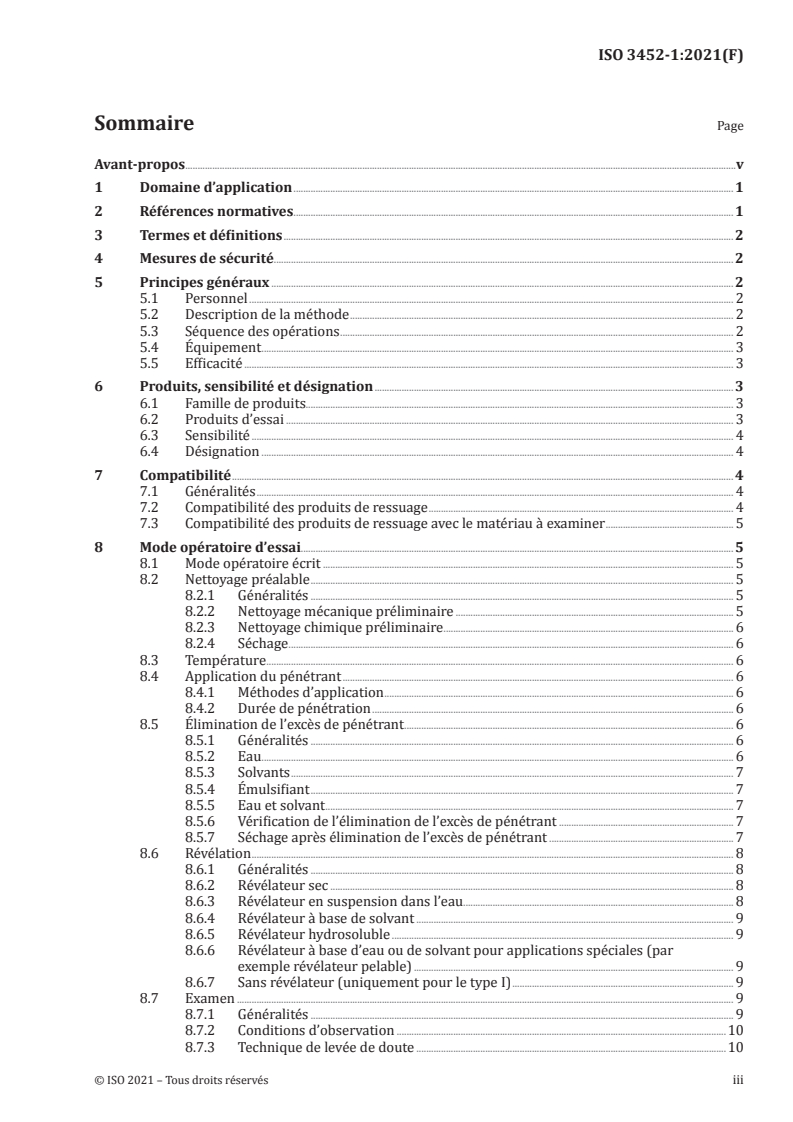
Sommaire Page
Avant-propos .v
1 Domaine d’application . 1
2 Références normatives . 1
3 Termes et définitions . 2
4 Mesures de sécurité . 2
5 Principes généraux . 2
5.1 Personnel . 2
5.2 Description de la méthode . 2
5.3 Séquence des opérations . 2
5.4 Équipement . 3
5.5 Efficacité . 3
6 Produits, sensibilité et désignation . 3
6.1 Famille de produits. 3
6.2 Produits d’essai . 3
6.3 Sensibilité . 4
6.4 Désignation . 4
7 Compatibilité . 4
7.1 Généralités . 4
7.2 Compatibilité des produits de ressuage . 4
7.3 Compatibilité des produits de ressuage avec le matériau à examiner . 5
8 Mode opératoire d’essai. 5
8.1 Mode opératoire écrit . 5
8.2 Nettoyage préalable . 5
8.2.1 Généralités . 5
8.2.2 Nettoyage mécanique préliminaire . 5
8.2.3 Nettoyage chimique préliminaire . 6
8.2.4 Séchage . 6
8.3 Température . 6
8.4 Application du pénétrant . 6
8.4.1 Méthodes d’application . 6
8.4.2 Durée de pénétration . 6
8.5 Élimination de l’excès de pénétrant . 6
8.5.1 Généralités . 6
8.5.2 Eau . . . 6
8.5.3 Solvants . 7
8.5.4 Émulsifiant . 7
8.5.5 Eau et solvant . 7
8.5.6 Vérification de l’élimination de l’excès de pénétrant . 7
8.5.7 Séchage après élimination de l’excès de pénétrant . 7
8.6 Révélation . 8
8.6.1 Généralités . 8
8.6.2 Révélateur sec . 8
8.6.3 Révélateur en suspension dans l’eau. 8
8.6.4 Révélateur à base de solvant . 9
8.6.5 Révélateur hydrosoluble . 9
8.6.6 Révélateur à base d’eau ou de solvant pour applications spéciales (par
exemple révélateur pelable) . 9
8.6.7 Sans révélateur (uniquement pour le type I) . 9
8.7 Examen . 9
8.7.1 Généralités . 9
8.7.2 Conditions d’observation .10
8.7.3 Technique de levée de doute .10
8.7.4 Enregistrement .10
8.8 Nettoyage final et protection contre la corrosion .10
8.8.1 Nettoyage final .10
8.8.2 Protection contre la corrosion .11
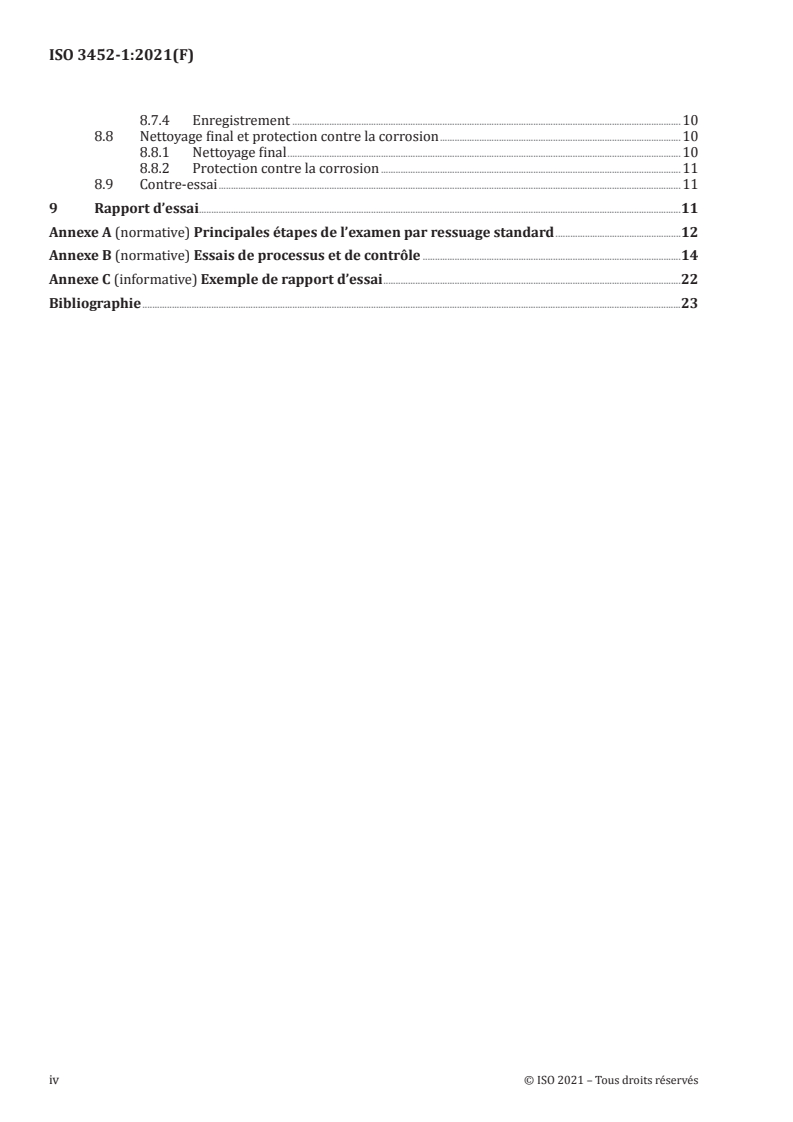
8.9 Contre-essai .11
9 Rapport d’essai .11
Annexe A (normative) Principales étapes de l’examen par ressuage standard .12
Annexe B (normative) Essais de processus et de contrôle .14
Annexe C (informative) Exemple de rapport d’essai .22
Bibliographie .23
iv © ISO 2021 – Tous droits réservés
Avant-propos
L'ISO (Organisation internationale de normalisation) est une fédération mondiale d'organismes
nationaux de normalisation (comités membres de l'ISO). L'élaboration des Normes internationales est
en général confiée aux comités techniques de l'ISO. Chaque comité membre intéressé par une étude
a le droit de faire partie du comité technique créé à cet effet. Les organisations internationales,
gouvernementales et non gouvernementales, en liaison avec l'ISO participent également aux travaux.
L'ISO collabore étroitement avec la Commission électrotechnique internationale (IEC) en ce qui
concerne la normalisation électrotechnique.
Les procédures utilisées pour élaborer le présent document et celles destinées à sa mise à jour sont
décrites dans les Directives ISO/IEC, Partie 1. Il convient, en particulier, de prendre note des différents
critères d'approbation requis pour les différents types de documents ISO. Le présent document a été
rédigé conformément aux règles de rédaction données dans les Directives ISO/IEC, Partie 2 (voir www
.iso .org/ directives).
L'attention est attirée sur le fait que certains des éléments du présent document peuvent faire l'objet de
droits de propriété intellectuelle ou de droits analogues. L'ISO ne saurait être tenue pour responsable
de ne pas avoir identifié de tels droits de propriété et averti de leur existence. Les détails concernant
les références aux droits de propriété intellectuelle ou autres droits analogues identifiés lors de
l'élaboration du document sont indiqués dans l'Introduction et/ou dans la liste des déclarations de
brevets reçues par l'ISO (voir www .iso .org/ brevets).
Les appellations commerciales éventuellement mentionnées dans le présent document sont données
pour information, par souci de commodité, à l’intention des utilisateurs et ne sauraient constituer un
engagement.
Pour une explication de la nature volontaire des normes, la signification des termes et expressions
spécifiques de l'ISO liés à l'évaluation de la conformité, ou pour toute information au sujet de l'adhésion
de l'ISO aux principes de l’Organisation mondiale du commerce (OMC) concernant les obstacles
techniques au commerce (OTC), voir www .iso .org/ avant -propos.
Le présent document a été élaboré par le comité technique ISO/TC 135, Essais non destructifs, sous-
comité SC 2, Moyens d’examens superficiels, en collaboration avec le comité technique du Comité
Européen de Normalisation (CEN), CEN/TC 138, Essais non destructifs, conformément à l’Accord de
coopération technique entre l’ISO et le CEN (Accord de Vienne).
Cette troisième édition annule et remplace la deuxième édition (ISO 3452-1:2013) qui a fait l’objet d’une
révision technique.
Les principales modifications par rapport à l’édition précédente sont les suivantes:
— clarification de la notion de famille de produits;
— ajout d’un nouveau mode opératoire «sans révélateur»;
— mise à jour technique selon les règles de l’art.
Une liste de toutes les parties de la série ISO 3452 se trouve sur le site web de l’ISO.
Il convient que l’utilisateur adresse tout retour d’information ou toute question concernant le présent
document à l’organisme national de normalisation de son pays. Une liste exhaustive desdits organismes
se trouve à l’adresse www .iso .org/ fr/ members .html.
NORME INTERNATIONALE ISO 3452-1:2021(F)
Essais non destructifs — Examen par ressuage —
Partie 1:
Principes généraux
1 Domaine d’application
Le présent document spécifie une méthode d’examen par ressuage utilisée pour localiser des
discontinuités, telles que fissures, replis, plis, porosités et manque de liaison, ouvertes et débouchant à
la surface du matériau à examiner, à l’aide d’une lumière blanche ou d’un rayonnement UV-A (365 nm).
Cette méthode est principalement appliquée aux matériaux métalliques mais peut également être
utilisée pour d’autres matériaux, à condition que ces derniers ne soient pas attaqués par les produits
utilisés et ne soient pas excessivement poreux (pièces moulées ou forgées, soudures, céramiques, etc.).
Le présent document comprend également les exigences applicables aux essais de processus et de
contrôle, mais ne définit pas de critères d’acceptation. Il ne donne ni information relative à l’aptitude
à l’emploi de systèmes de ressuage spécifiques à des applications particulières, ni exigences relatives à
l’équipement d’essai.
NOTE 1 Les méthodes de détermination et de contrôle des propriétés principales des produits de ressuage à
utiliser sont spécifiées dans l’ISO 3452-2 et l’ISO 3452-3.
NOTE 2 Dans le présent document, le terme «discontinuité» ne sous-entend aucune évaluation en matière
d’acceptabilité ou de non-acceptabilité.
NOTE 3 Les examens par ressuage à la lumière bleue actinique sont abordés par le rapport technique CEN/
TR 16638.
2 Références normatives
Les documents suivants sont cités dans le texte de sorte qu’ils constituent, pour tout ou partie de leur
contenu, des exigences du présent document. Pour les références datées, seule l’édition citée s’applique.
Pour les références non datées, la dernière édition du document de référence s'applique (y compris les
éventuels amendements).
ISO 3059, Essais non destructifs — Contrôle par ressuage et contrôle par magnétoscopie — Conditions
d'observation
ISO 3452-2, Essais non destructifs — Examen par ressuage — Partie 2: Essai des produits de ressuage
ISO 3452-3, Essais non destructifs — Examen par ressuage — Partie 3: Pièces de référence
ISO 3452-4, Essais non destructifs — Examen par ressuage — Partie 4: Équipement
ISO 3452-5, Essais non destructifs — Examen par ressuage — Partie 5: Examen par ressuage à des
températures supérieures à 50 degrés C
ISO 3452-6, Essais non destructifs — Examen par ressuage — Partie 6: Examen par ressuage à des
températures inférieures à 10 degrés C
ISO 12706, Essais non destructifs — Contrôle par ressuage — Vocabulaire
3 Termes et définitions
Pour les besoins du présent document, les termes et les définitions de l’ISO 12706 s’appliquent.
L’ISO et l’IEC tiennent à jour des bases de données terminologiques destinées à être utilisées en
normalisation, consultables aux adresses suivantes:
— ISO Online browsing platform: disponible à l’adresse https:// www .iso .org/ obp
— IEC Electropedia: disponible à l’adresse https:// www .electropedia .org/
4 Mesures de sécurité
Les techniques d’examen par ressuage exigeant souvent l’utilisation de produits nocifs, inflammables
et/ou volatils, certaines mesures de sécurité (par exemple, législation sur les rayonnements optiques)
doivent être prises en compte.
Il convient d’éviter un contact prolongé ou répété de ces produits avec la peau ou toute muqueuse.
Conformément à toutes les réglementations applicables en matière de sécurité, les zones de travail
doivent être suffisamment aérées et éloignées des sources de chaleur, des étincelles ou des flammes
nues.
Les produits de ressuage et l’équipement doivent être utilisés avec prudence et toujours en conformité
avec les instructions fournies par le fabricant.
Les sources UV-A doivent toujours être conservées en bon état.
Veiller à ce que la méthode soit mise en œuvre en toute sécurité.
5 Principes généraux
5.1 Personnel
L’essai doit être effectué par un personnel expérimenté, convenablement formé et qualifié et, le cas
échéant, doit être supervisé par un personnel compétent nommé par l’employeur ou, par délégation
de l’employeur à par l’organisme de contrôle chargé de l’essai. Pour démontrer sa qualification, il est
recommandé que le personnel soit certifié selon l’ISO 9712 ou un système formalisé équivalent. Sauf
accord contraire, les opérations d’essais non destructifs doivent être autorisées par un contrôleur
compétent (Niveau 3 ou équivalent), approuvé par l’employeur.
5.2 Description de la méthode
Avant l’examen par ressuage, nettoyer et sécher la surface à examiner. Appliquer ensuite le pénétrant
approprié sur la surface et le laisser pénétrer dans les discontinuités ouvertes débouchant à la surface.
Après une durée de pénétration appropriée, éliminer l’excès de pénétrant de la surface, puis appliquer
le révélateur. Le révélateur, en absorbant le pénétrant qui est entré dans les discontinuités, peut donner
une indication renforcée, clairement visible, de la discontinuité.
Si un essai non destructif (END) complémentaire est requis, il est préférable que l’examen par ressuage
soit effectué en premier afin d’éviter d’introduire des contaminants dans les discontinuités ouvertes.
Si le ressuage suit une autre technique ou méthode d’END, nettoyer soigneusement la surface avant
l’application afin d’éliminer les contaminants.
5.3 Séquence des opérations
Le processus de ressuage doit être continu, sans retard injustifié entre les étapes. Si les paramètres du
processus ne sont pas conformes, les surfaces doivent être nettoyées et retraitées.
2 © ISO 2021 – Tous droits réservés
Un examen passe généralement par les étapes suivantes:
a) préparation et nettoyage préliminaire (voir 8.2);
b) application du pénétrant (voir 8.4);
c) élimination de l’excès de pénétrant (voir 8.5);
d) application du révélateur (voir 8.6);
e) examen (voir 8.7);
f) nettoyage final et protection (voir 8.8).
Le processus doit être tel qu’indiqué à l’Annexe A.
5.4 Équipement
L’équipement utilisé pour l’exécution de l’examen par ressuage dépend du nombre, des dimensions, du
poids et de la forme des pièces à examiner. L’équipement doit être tel que spécifié dans l’ISO 3452-4.
5.5 Efficacité
L’efficacité de l’examen par ressuage dépend de nombreux facteurs, dont:
a) les types de pénétrants et d’équipements de contrôle;
b) l’état et la préparation de la surface;
c) les matériaux soumis à examen et les discontinuités attendues;
d) la température de la surface à examiner;
e) la durée de pénétration et la durée de révélation;
f) les conditions d’observation.
Des vérifications doivent être réalisées pour démontrer que les paramètres d’essai appropriés ont été
utilisés conformément à l’Annexe B.
6 Produits, sensibilité et désignation
6.1 Famille de produits
Il existe différents systèmes pour l’examen par ressuage. Le système d’examen par ressuage et la
famille de produits doivent être choisis en fonction de l’application. Plusieurs facteurs ont un impact sur
l’efficacité et la sensibilité du processus, par exemple la rugosité et l’état de la surface, les dimensions et
la forme des pièces à examiner ainsi que le niveau de sensibilité de la famille de produits. Par exemple,
l’utilisation d’un pénétrant de sensibilité haute sur une surface rugueuse peut donner un essai moins
sensible qu’avec un pénétrant de sensibilité inférieure.
Une famille de produits sous-entend une combinaison des produits de ressuage suivants: pénétrant,
produit d’élimination de l’excès de pénétrant (sauf méthode A) et révélateur. Une famille de produits
peut être définie par le fabricant, l’utilisateur ou l’autorité de contrôle et les produits de ressuage ne
doivent pas nécessairement provenir d’un seul et même fabricant, mais doivent être soumis à un essai
de type conformément à l’ISO 3452-2.
6.2 Produits d’essai
Les produits de ressuage sont indiqués dans le Tableau 1.
6.3 Sensibilité
Les niveaux de sensibilité doivent être déterminés conformément à l’ISO 3452-2. L’utilisation de
familles de produits spécifiques permet d’obtenir différents niveaux de sensibilité. L’ISO 3452-2 décrit
la sensibilité de référence d’un pénétrant et la sensibilité d’une famille de pénétrant.
6.4 Désignation
La famille de produits à utiliser pour l’examen par ressuage se voit attribuer une désignation, composée
du type, de la méthode et de la forme du produit, plus un chiffre indiquant le niveau de sensibilité obtenu
selon l’essai spécifié dans l’ISO 3452-2.
EXEMPLE Une famille de produits comprenant un pénétrant fluorescent (I), de l’eau comme produit
d’élimination de l’excès de pénétrant (A) et un révélateur sec poudreux (a), et ayant une sensibilité du système de
niveau 2, donne la désignation du système d’examen par ressuage suivante lors de l’utilisation de l’ISO 3452-1 et
de l’ISO 3452-2: famille de produits ISO 3452-2, IAa Niveau 2.
Tableau 1 — Produits/modes opératoires d’essai
Produit d’élimination de l’excès
Pénétrant Révélateur
de pénétrant
Type Dénomination Méthode Dénomination Forme Dénomination
I Pénétrant fluorescent A Eau a Sec
II Pénétrant coloré B Émulsifiant lipophile b Hydrosoluble
III Pénétrant mixte (péné- C Solvant c Suspension dans l’eau
trant fluorescent et
D Émulsifiant hydrophile d À base de solvant (non
coloré)
aqueux pour le type I)
a
E Eau et solvant e À base de solvant (non
aqueux pour les types II
et III)
f Applications spéciales
b
g Sans révélateur (unique-
ment pour le type I)
NOTE Dans certains cas spécifiques, il est nécessaire d’utiliser un produit de ressuage répondant à des exigences
particulières en ce qui concerne l’inflammabilité, la teneur en soufre, en halogènes, en sodium et autres contaminants.
Voir l’ISO 3452-2.
a
La méthode E concerne l’utilisation de deux produits, l’eau et le solvant. Les pénétrants qualifiés pour la méthode A
sont également considérés qualifiés pour la méthode E.
b
Pour la forme g, la durée de révélation est requise, voir 8.6.1.
7 Compatibilité
7.1 Généralités
Les produits de ressuage doivent être compatibles entre eux et avec le matériau à examiner. L’utilisation
pour laquelle la ou les pièces sont conçues doit également être prise en compte.
7.2 Compatibilité des produits de ressuage
Les pertes par entraînement doivent être compensées par des produits identiques, pouvant provenir
d’un lot différent.
4 © ISO 2021 – Tous droits réservés
7.3 Compatibilité des produits de ressuage avec le matériau à examiner
7.3.1 Dans la majeure partie des cas, la compatibilité peut être évaluée avant usage au moyen des
essais de corrosion décrits dans l’ISO 3452-2.
7.3.2 La mouillabilité de la surface à examiner à l’aide du produit de ressuage sélectionné doit être
établie avant essai. Lorsque les pièces ne sont pas visibles pendant l’application du pénétrant (par
exemple, systèmes automatisés), la mouillabilité du pénétrant sur la surface à examiner doit être
visuellement contrôlée avant essai sur un échantillon représentatif.
7.3.3 Les propriétés chimiques ou physiques de certains matériaux non métalliques pouvant être
affectées par les produits de ressuage, leur compatibilité doit être vérifiée avant le contrôle des pièces
fabriquées dans ces matériaux ou des ensembles les comprenant.
7.3.4 Dans le cas où une contamination peut se produire, il est essentiel de s’assurer que les produits
de ressuage n’ont pas d’effet délétère sur les combustibles, les lubrifiants, les fluides hydrauliques, etc.
7.3.5 La compatibilité des produits de ressuage doit faire l’objet d’une attention particulière lorsqu’ils
sont en contact avec des pièces associées aux combustibles au peroxyde des fusées, aux enveloppes
d’explosifs (tout ce qui renferme des produits pyrotechniques de propulsion ou d’amorçage), aux
équipements utilisant de l’oxygène ou aux applications nucléaires.
8 Mode opératoire d’essai
8.1 Mode opératoire écrit
Tous les essais doivent être réalisés conformément à une documentation écrite approuvée, spécialement
préparée ou incluse dans la norme produit appropriée. Le mode opératoire d’essai doit également
inclure tous les paramètres pertinents pour l’essai, par exemple les températures, les durées, les
pressions. Lors de l’application des modes opératoires d’essai, les recommandations des fabricants de
produits doivent être prises en compte.
8.2 Nettoyage préalable
8.2.1 Généralités
Les contaminants tels que calamine, rouille, huile, graisse, peinture et eau doivent être enlevés, si
nécessaire en recourant à des méthodes mécaniques ou chimiques, ou en combinant ces méthodes. Un
nettoyage préalable doit garantir que la surface à examiner est exempte de résidus pour permettre aux
pénétrants d’entrer dans toute discontinuité. La surface nettoyée doit être suffisamment grande pour
prévenir une interférence des surfaces adjacentes à la surface à examiner.
8.2.2 Nettoyage mécanique préliminaire
La calamine, les inclusions de laitier, la rouille, etc. doivent être éliminées en recourant à des méthodes
appropriées telles que brossage, frottage, abrasion, sablage ou sablage à haute pression (eau ou granules
de glace). Ces méthodes éliminent les contaminants de la surface mais sont généralement incapables
d’éliminer les contaminants dans les discontinuités de surface. Dans tous les cas, il faut s’assurer que les
discontinuités ne sont pas masquées par une déformation plastique ou par colmatage par des matières
abrasives. Le cas échéant, pour s’assurer que les discontinuités sont ouvertes en surface, un décapage
chimique complémentaire doit être exécuté, suivi d’un rinçage et d’un séchage adéquats.
8.2.3 Nettoyage chimique préliminaire
Le nettoyage chimique préliminaire doit être effectué en utilisant des agents de nettoyage chimiques
appropriés pour éliminer les résidus tels que graisse, huile, peinture ou produits chimiques de décapage.
Les résidus provenant des nettoyages chimiques préliminaires peuvent réagir avec le pénétrant et
diminuer fortement sa sensibilité. Par conséquent, les agents chimiques doivent être éliminés de la
surface examinée, après le nettoyage, en utilisant des méthodes de nettoyage appropriées.
8.2.4 Séchage
Au stade final du nettoyage préliminaire, les pièces à examiner doivent être soigneusement séchées de
manière qu’il ne reste ni eau ni solvant sur la surface à examiner et dans les discontinuités.
8.3 Température
À l’exception du séchage (8.2.4), les températures des produits de ressuage, de la surface à examiner
ainsi que la température ambiante doivent être comprises entre 10 °C et 50 °C. Il convient d’éviter les
brusques variations de température qui peuvent engendrer une condensation susceptible de perturber
le processus.
Pour les températures en dehors de la plage comprise entre 10 °C et 50 °C, l’examen doit être réalisé
conformément à l’ISO 3452-5 ou à l’ISO 3452-6, selon le cas.
8.4 Application du pénétrant
8.4.1 Méthodes d’application
Le pénétrant peut être appliqué sur la pièce à examiner au pinceau, par pulvérisation, arrosage,
trempage ou immersion.
Le pénétrant doit rester sur la surface à examiner pendant toute la durée de pénétration.
8.4.2 Durée de pénétration
La durée appropriée de pénétration dépend des propriétés du pénétrant, de la température d’application,
du matériau de la pièce à examiner et des discontinuités à détecter.
La durée de pénétration doit être comprise entre 5 min et 60 min, et elle ne doit pas être inférieure à
la durée recommandée par le fabricant pour la sensibilité requise. La durée de pénétration doit être
définie dans le mode opératoire d’essai écrit.
8.5 Élimination de l’excès de pénétrant
8.5.1 Généralités
Le produit d’élimination doit être appliqué de manière à maintenir le pénétrant dans les discontinuités.
8.5.2 Eau
Lorsque l’eau est utilisée pour l’élimination, elle doit être appliquée par essuyage, immersion ou
pulvérisation. Veiller à éviter tout excès de rinçage, par exemple dû à une pulvérisation à haute pression,
une durée excessive ou une
...
NORME ISO
INTERNATIONALE 3452-1
Troisième édition
2021-05
Essais non destructifs — Examen par
ressuage —
Partie 1:
Principes généraux
Non-destructive testing — Penetrant testing —
Part 1: General principles
Numéro de référence
©
ISO 2021
DOCUMENT PROTÉGÉ PAR COPYRIGHT
© ISO 2021
Tous droits réservés. Sauf prescription différente ou nécessité dans le contexte de sa mise en œuvre, aucune partie de cette
publication ne peut être reproduite ni utilisée sous quelque forme que ce soit et par aucun procédé, électronique ou mécanique,
y compris la photocopie, ou la diffusion sur l’internet ou sur un intranet, sans autorisation écrite préalable. Une autorisation peut
être demandée à l’ISO à l’adresse ci-après ou au comité membre de l’ISO dans le pays du demandeur.
ISO copyright office
Case postale 401 • Ch. de Blandonnet 8
CH-1214 Vernier, Genève
Tél.: +41 22 749 01 11
E-mail: copyright@iso.org
Web: www.iso.org
Publié en Suisse
ii © ISO 2021 – Tous droits réservés
Sommaire Page
Avant-propos .v
1 Domaine d’application . 1
2 Références normatives . 1
3 Termes et définitions . 2
4 Mesures de sécurité . 2
5 Principes généraux . 2
5.1 Personnel . 2
5.2 Description de la méthode . 2
5.3 Séquence des opérations . 2
5.4 Équipement . 3
5.5 Efficacité . 3
6 Produits, sensibilité et désignation . 3
6.1 Famille de produits. 3
6.2 Produits d’essai . 3
6.3 Sensibilité . 4
6.4 Désignation . 4
7 Compatibilité . 4
7.1 Généralités . 4
7.2 Compatibilité des produits de ressuage . 4
7.3 Compatibilité des produits de ressuage avec le matériau à examiner . 5
8 Mode opératoire d’essai. 5
8.1 Mode opératoire écrit . 5
8.2 Nettoyage préalable . 5
8.2.1 Généralités . 5
8.2.2 Nettoyage mécanique préliminaire . 5
8.2.3 Nettoyage chimique préliminaire . 6
8.2.4 Séchage . 6
8.3 Température . 6
8.4 Application du pénétrant . 6
8.4.1 Méthodes d’application . 6
8.4.2 Durée de pénétration . 6
8.5 Élimination de l’excès de pénétrant . 6
8.5.1 Généralités . 6
8.5.2 Eau . . . 6
8.5.3 Solvants . 7
8.5.4 Émulsifiant . 7
8.5.5 Eau et solvant . 7
8.5.6 Vérification de l’élimination de l’excès de pénétrant . 7
8.5.7 Séchage après élimination de l’excès de pénétrant . 7
8.6 Révélation . 8
8.6.1 Généralités . 8
8.6.2 Révélateur sec . 8
8.6.3 Révélateur en suspension dans l’eau. 8
8.6.4 Révélateur à base de solvant . 9
8.6.5 Révélateur hydrosoluble . 9
8.6.6 Révélateur à base d’eau ou de solvant pour applications spéciales (par
exemple révélateur pelable) . 9
8.6.7 Sans révélateur (uniquement pour le type I) . 9
8.7 Examen . 9
8.7.1 Généralités . 9
8.7.2 Conditions d’observation .10
8.7.3 Technique de levée de doute .10
8.7.4 Enregistrement .10
8.8 Nettoyage final et protection contre la corrosion .10
8.8.1 Nettoyage final .10
8.8.2 Protection contre la corrosion .11
8.9 Contre-essai .11
9 Rapport d’essai .11
Annexe A (normative) Principales étapes de l’examen par ressuage standard .12
Annexe B (normative) Essais de processus et de contrôle .14
Annexe C (informative) Exemple de rapport d’essai .22
Bibliographie .23
iv © ISO 2021 – Tous droits réservés
Avant-propos
L'ISO (Organisation internationale de normalisation) est une fédération mondiale d'organismes
nationaux de normalisation (comités membres de l'ISO). L'élaboration des Normes internationales est
en général confiée aux comités techniques de l'ISO. Chaque comité membre intéressé par une étude
a le droit de faire partie du comité technique créé à cet effet. Les organisations internationales,
gouvernementales et non gouvernementales, en liaison avec l'ISO participent également aux travaux.
L'ISO collabore étroitement avec la Commission électrotechnique internationale (IEC) en ce qui
concerne la normalisation électrotechnique.
Les procédures utilisées pour élaborer le présent document et celles destinées à sa mise à jour sont
décrites dans les Directives ISO/IEC, Partie 1. Il convient, en particulier, de prendre note des différents
critères d'approbation requis pour les différents types de documents ISO. Le présent document a été
rédigé conformément aux règles de rédaction données dans les Directives ISO/IEC, Partie 2 (voir www
.iso .org/ directives).
L'attention est attirée sur le fait que certains des éléments du présent document peuvent faire l'objet de
droits de propriété intellectuelle ou de droits analogues. L'ISO ne saurait être tenue pour responsable
de ne pas avoir identifié de tels droits de propriété et averti de leur existence. Les détails concernant
les références aux droits de propriété intellectuelle ou autres droits analogues identifiés lors de
l'élaboration du document sont indiqués dans l'Introduction et/ou dans la liste des déclarations de
brevets reçues par l'ISO (voir www .iso .org/ brevets).
Les appellations commerciales éventuellement mentionnées dans le présent document sont données
pour information, par souci de commodité, à l’intention des utilisateurs et ne sauraient constituer un
engagement.
Pour une explication de la nature volontaire des normes, la signification des termes et expressions
spécifiques de l'ISO liés à l'évaluation de la conformité, ou pour toute information au sujet de l'adhésion
de l'ISO aux principes de l’Organisation mondiale du commerce (OMC) concernant les obstacles
techniques au commerce (OTC), voir www .iso .org/ avant -propos.
Le présent document a été élaboré par le comité technique ISO/TC 135, Essais non destructifs, sous-
comité SC 2, Moyens d’examens superficiels, en collaboration avec le comité technique du Comité
Européen de Normalisation (CEN), CEN/TC 138, Essais non destructifs, conformément à l’Accord de
coopération technique entre l’ISO et le CEN (Accord de Vienne).
Cette troisième édition annule et remplace la deuxième édition (ISO 3452-1:2013) qui a fait l’objet d’une
révision technique.
Les principales modifications par rapport à l’édition précédente sont les suivantes:
— clarification de la notion de famille de produits;
— ajout d’un nouveau mode opératoire «sans révélateur»;
— mise à jour technique selon les règles de l’art.
Une liste de toutes les parties de la série ISO 3452 se trouve sur le site web de l’ISO.
Il convient que l’utilisateur adresse tout retour d’information ou toute question concernant le présent
document à l’organisme national de normalisation de son pays. Une liste exhaustive desdits organismes
se trouve à l’adresse www .iso .org/ fr/ members .html.
NORME INTERNATIONALE ISO 3452-1:2021(F)
Essais non destructifs — Examen par ressuage —
Partie 1:
Principes généraux
1 Domaine d’application
Le présent document spécifie une méthode d’examen par ressuage utilisée pour localiser des
discontinuités, telles que fissures, replis, plis, porosités et manque de liaison, ouvertes et débouchant à
la surface du matériau à examiner, à l’aide d’une lumière blanche ou d’un rayonnement UV-A (365 nm).
Cette méthode est principalement appliquée aux matériaux métalliques mais peut également être
utilisée pour d’autres matériaux, à condition que ces derniers ne soient pas attaqués par les produits
utilisés et ne soient pas excessivement poreux (pièces moulées ou forgées, soudures, céramiques, etc.).
Le présent document comprend également les exigences applicables aux essais de processus et de
contrôle, mais ne définit pas de critères d’acceptation. Il ne donne ni information relative à l’aptitude
à l’emploi de systèmes de ressuage spécifiques à des applications particulières, ni exigences relatives à
l’équipement d’essai.
NOTE 1 Les méthodes de détermination et de contrôle des propriétés principales des produits de ressuage à
utiliser sont spécifiées dans l’ISO 3452-2 et l’ISO 3452-3.
NOTE 2 Dans le présent document, le terme «discontinuité» ne sous-entend aucune évaluation en matière
d’acceptabilité ou de non-acceptabilité.
NOTE 3 Les examens par ressuage à la lumière bleue actinique sont abordés par le rapport technique CEN/
TR 16638.
2 Références normatives
Les documents suivants sont cités dans le texte de sorte qu’ils constituent, pour tout ou partie de leur
contenu, des exigences du présent document. Pour les références datées, seule l’édition citée s’applique.
Pour les références non datées, la dernière édition du document de référence s'applique (y compris les
éventuels amendements).
ISO 3059, Essais non destructifs — Contrôle par ressuage et contrôle par magnétoscopie — Conditions
d'observation
ISO 3452-2, Essais non destructifs — Examen par ressuage — Partie 2: Essai des produits de ressuage
ISO 3452-3, Essais non destructifs — Examen par ressuage — Partie 3: Pièces de référence
ISO 3452-4, Essais non destructifs — Examen par ressuage — Partie 4: Équipement
ISO 3452-5, Essais non destructifs — Examen par ressuage — Partie 5: Examen par ressuage à des
températures supérieures à 50 degrés C
ISO 3452-6, Essais non destructifs — Examen par ressuage — Partie 6: Examen par ressuage à des
températures inférieures à 10 degrés C
ISO 12706, Essais non destructifs — Contrôle par ressuage — Vocabulaire
3 Termes et définitions
Pour les besoins du présent document, les termes et les définitions de l’ISO 12706 s’appliquent.
L’ISO et l’IEC tiennent à jour des bases de données terminologiques destinées à être utilisées en
normalisation, consultables aux adresses suivantes:
— ISO Online browsing platform: disponible à l’adresse https:// www .iso .org/ obp
— IEC Electropedia: disponible à l’adresse https:// www .electropedia .org/
4 Mesures de sécurité
Les techniques d’examen par ressuage exigeant souvent l’utilisation de produits nocifs, inflammables
et/ou volatils, certaines mesures de sécurité (par exemple, législation sur les rayonnements optiques)
doivent être prises en compte.
Il convient d’éviter un contact prolongé ou répété de ces produits avec la peau ou toute muqueuse.
Conformément à toutes les réglementations applicables en matière de sécurité, les zones de travail
doivent être suffisamment aérées et éloignées des sources de chaleur, des étincelles ou des flammes
nues.
Les produits de ressuage et l’équipement doivent être utilisés avec prudence et toujours en conformité
avec les instructions fournies par le fabricant.
Les sources UV-A doivent toujours être conservées en bon état.
Veiller à ce que la méthode soit mise en œuvre en toute sécurité.
5 Principes généraux
5.1 Personnel
L’essai doit être effectué par un personnel expérimenté, convenablement formé et qualifié et, le cas
échéant, doit être supervisé par un personnel compétent nommé par l’employeur ou, par délégation
de l’employeur à par l’organisme de contrôle chargé de l’essai. Pour démontrer sa qualification, il est
recommandé que le personnel soit certifié selon l’ISO 9712 ou un système formalisé équivalent. Sauf
accord contraire, les opérations d’essais non destructifs doivent être autorisées par un contrôleur
compétent (Niveau 3 ou équivalent), approuvé par l’employeur.
5.2 Description de la méthode
Avant l’examen par ressuage, nettoyer et sécher la surface à examiner. Appliquer ensuite le pénétrant
approprié sur la surface et le laisser pénétrer dans les discontinuités ouvertes débouchant à la surface.
Après une durée de pénétration appropriée, éliminer l’excès de pénétrant de la surface, puis appliquer
le révélateur. Le révélateur, en absorbant le pénétrant qui est entré dans les discontinuités, peut donner
une indication renforcée, clairement visible, de la discontinuité.
Si un essai non destructif (END) complémentaire est requis, il est préférable que l’examen par ressuage
soit effectué en premier afin d’éviter d’introduire des contaminants dans les discontinuités ouvertes.
Si le ressuage suit une autre technique ou méthode d’END, nettoyer soigneusement la surface avant
l’application afin d’éliminer les contaminants.
5.3 Séquence des opérations
Le processus de ressuage doit être continu, sans retard injustifié entre les étapes. Si les paramètres du
processus ne sont pas conformes, les surfaces doivent être nettoyées et retraitées.
2 © ISO 2021 – Tous droits réservés
Un examen passe généralement par les étapes suivantes:
a) préparation et nettoyage préliminaire (voir 8.2);
b) application du pénétrant (voir 8.4);
c) élimination de l’excès de pénétrant (voir 8.5);
d) application du révélateur (voir 8.6);
e) examen (voir 8.7);
f) nettoyage final et protection (voir 8.8).
Le processus doit être tel qu’indiqué à l’Annexe A.
5.4 Équipement
L’équipement utilisé pour l’exécution de l’examen par ressuage dépend du nombre, des dimensions, du
poids et de la forme des pièces à examiner. L’équipement doit être tel que spécifié dans l’ISO 3452-4.
5.5 Efficacité
L’efficacité de l’examen par ressuage dépend de nombreux facteurs, dont:
a) les types de pénétrants et d’équipements de contrôle;
b) l’état et la préparation de la surface;
c) les matériaux soumis à examen et les discontinuités attendues;
d) la température de la surface à examiner;
e) la durée de pénétration et la durée de révélation;
f) les conditions d’observation.
Des vérifications doivent être réalisées pour démontrer que les paramètres d’essai appropriés ont été
utilisés conformément à l’Annexe B.
6 Produits, sensibilité et désignation
6.1 Famille de produits
Il existe différents systèmes pour l’examen par ressuage. Le système d’examen par ressuage et la
famille de produits doivent être choisis en fonction de l’application. Plusieurs facteurs ont un impact sur
l’efficacité et la sensibilité du processus, par exemple la rugosité et l’état de la surface, les dimensions et
la forme des pièces à examiner ainsi que le niveau de sensibilité de la famille de produits. Par exemple,
l’utilisation d’un pénétrant de sensibilité haute sur une surface rugueuse peut donner un essai moins
sensible qu’avec un pénétrant de sensibilité inférieure.
Une famille de produits sous-entend une combinaison des produits de ressuage suivants: pénétrant,
produit d’élimination de l’excès de pénétrant (sauf méthode A) et révélateur. Une famille de produits
peut être définie par le fabricant, l’utilisateur ou l’autorité de contrôle et les produits de ressuage ne
doivent pas nécessairement provenir d’un seul et même fabricant, mais doivent être soumis à un essai
de type conformément à l’ISO 3452-2.
6.2 Produits d’essai
Les produits de ressuage sont indiqués dans le Tableau 1.
6.3 Sensibilité
Les niveaux de sensibilité doivent être déterminés conformément à l’ISO 3452-2. L’utilisation de
familles de produits spécifiques permet d’obtenir différents niveaux de sensibilité. L’ISO 3452-2 décrit
la sensibilité de référence d’un pénétrant et la sensibilité d’une famille de pénétrant.
6.4 Désignation
La famille de produits à utiliser pour l’examen par ressuage se voit attribuer une désignation, composée
du type, de la méthode et de la forme du produit, plus un chiffre indiquant le niveau de sensibilité obtenu
selon l’essai spécifié dans l’ISO 3452-2.
EXEMPLE Une famille de produits comprenant un pénétrant fluorescent (I), de l’eau comme produit
d’élimination de l’excès de pénétrant (A) et un révélateur sec poudreux (a), et ayant une sensibilité du système de
niveau 2, donne la désignation du système d’examen par ressuage suivante lors de l’utilisation de l’ISO 3452-1 et
de l’ISO 3452-2: famille de produits ISO 3452-2, IAa Niveau 2.
Tableau 1 — Produits/modes opératoires d’essai
Produit d’élimination de l’excès
Pénétrant Révélateur
de pénétrant
Type Dénomination Méthode Dénomination Forme Dénomination
I Pénétrant fluorescent A Eau a Sec
II Pénétrant coloré B Émulsifiant lipophile b Hydrosoluble
III Pénétrant mixte (péné- C Solvant c Suspension dans l’eau
trant fluorescent et
D Émulsifiant hydrophile d À base de solvant (non
coloré)
aqueux pour le type I)
a
E Eau et solvant e À base de solvant (non
aqueux pour les types II
et III)
f Applications spéciales
b
g Sans révélateur (unique-
ment pour le type I)
NOTE Dans certains cas spécifiques, il est nécessaire d’utiliser un produit de ressuage répondant à des exigences
particulières en ce qui concerne l’inflammabilité, la teneur en soufre, en halogènes, en sodium et autres contaminants.
Voir l’ISO 3452-2.
a
La méthode E concerne l’utilisation de deux produits, l’eau et le solvant. Les pénétrants qualifiés pour la méthode A
sont également considérés qualifiés pour la méthode E.
b
Pour la forme g, la durée de révélation est requise, voir 8.6.1.
7 Compatibilité
7.1 Généralités
Les produits de ressuage doivent être compatibles entre eux et avec le matériau à examiner. L’utilisation
pour laquelle la ou les pièces sont conçues doit également être prise en compte.
7.2 Compatibilité des produits de ressuage
Les pertes par entraînement doivent être compensées par des produits identiques, pouvant provenir
d’un lot différent.
4 © ISO 2021 – Tous droits réservés
7.3 Compatibilité des produits de ressuage avec le matériau à examiner
7.3.1 Dans la majeure partie des cas, la compatibilité peut être évaluée avant usage au moyen des
essais de corrosion décrits dans l’ISO 3452-2.
7.3.2 La mouillabilité de la surface à examiner à l’aide du produit de ressuage sélectionné doit être
établie avant essai. Lorsque les pièces ne sont pas visibles pendant l’application du pénétrant (par
exemple, systèmes automatisés), la mouillabilité du pénétrant sur la surface à examiner doit être
visuellement contrôlée avant essai sur un échantillon représentatif.
7.3.3 Les propriétés chimiques ou physiques de certains matériaux non métalliques pouvant être
affectées par les produits de ressuage, leur compatibilité doit être vérifiée avant le contrôle des pièces
fabriquées dans ces matériaux ou des ensembles les comprenant.
7.3.4 Dans le cas où une contamination peut se produire, il est essentiel de s’assurer que les produits
de ressuage n’ont pas d’effet délétère sur les combustibles, les lubrifiants, les fluides hydrauliques, etc.
7.3.5 La compatibilité des produits de ressuage doit faire l’objet d’une attention particulière lorsqu’ils
sont en contact avec des pièces associées aux combustibles au peroxyde des fusées, aux enveloppes
d’explosifs (tout ce qui renferme des produits pyrotechniques de propulsion ou d’amorçage), aux
équipements utilisant de l’oxygène ou aux applications nucléaires.
8 Mode opératoire d’essai
8.1 Mode opératoire écrit
Tous les essais doivent être réalisés conformément à une documentation écrite approuvée, spécialement
préparée ou incluse dans la norme produit appropriée. Le mode opératoire d’essai doit également
inclure tous les paramètres pertinents pour l’essai, par exemple les températures, les durées, les
pressions. Lors de l’application des modes opératoires d’essai, les recommandations des fabricants de
produits doivent être prises en compte.
8.2 Nettoyage préalable
8.2.1 Généralités
Les contaminants tels que calamine, rouille, huile, graisse, peinture et eau doivent être enlevés, si
nécessaire en recourant à des méthodes mécaniques ou chimiques, ou en combinant ces méthodes. Un
nettoyage préalable doit garantir que la surface à examiner est exempte de résidus pour permettre aux
pénétrants d’entrer dans toute discontinuité. La surface nettoyée doit être suffisamment grande pour
prévenir une interférence des surfaces adjacentes à la surface à examiner.
8.2.2 Nettoyage mécanique préliminaire
La calamine, les inclusions de laitier, la rouille, etc. doivent être éliminées en recourant à des méthodes
appropriées telles que brossage, frottage, abrasion, sablage ou sablage à haute pression (eau ou granules
de glace). Ces méthodes éliminent les contaminants de la surface mais sont généralement incapables
d’éliminer les contaminants dans les discontinuités de surface. Dans tous les cas, il faut s’assurer que les
discontinuités ne sont pas masquées par une déformation plastique ou par colmatage par des matières
abrasives. Le cas échéant, pour s’assurer que les discontinuités sont ouvertes en surface, un décapage
chimique complémentaire doit être exécuté, suivi d’un rinçage et d’un séchage adéquats.
8.2.3 Nettoyage chimique préliminaire
Le nettoyage chimique préliminaire doit être effectué en utilisant des agents de nettoyage chimiques
appropriés pour éliminer les résidus tels que graisse, huile, peinture ou produits chimiques de décapage.
Les résidus provenant des nettoyages chimiques préliminaires peuvent réagir avec le pénétrant et
diminuer fortement sa sensibilité. Par conséquent, les agents chimiques doivent être éliminés de la
surface examinée, après le nettoyage, en utilisant des méthodes de nettoyage appropriées.
8.2.4 Séchage
Au stade final du nettoyage préliminaire, les pièces à examiner doivent être soigneusement séchées de
manière qu’il ne reste ni eau ni solvant sur la surface à examiner et dans les discontinuités.
8.3 Température
À l’exception du séchage (8.2.4), les températures des produits de ressuage, de la surface à examiner
ainsi que la température ambiante doivent être comprises entre 10 °C et 50 °C. Il convient d’éviter les
brusques variations de température qui peuvent engendrer une condensation susceptible de perturber
le processus.
Pour les températures en dehors de la plage comprise entre 10 °C et 50 °C, l’examen doit être réalisé
conformément à l’ISO 3452-5 ou à l’ISO 3452-6, selon le cas.
8.4 Application du pénétrant
8.4.1 Méthodes d’application
Le pénétrant peut être appliqué sur la pièce à examiner au pinceau, par pulvérisation, arrosage,
trempage ou immersion.
Le pénétrant doit rester sur la surface à examiner pendant toute la durée de pénétration.
8.4.2 Durée de pénétration
La durée appropriée de pénétration dépend des propriétés du pénétrant, de la température d’application,
du matériau de la pièce à examiner et des discontinuités à détecter.
La durée de pénétration doit être comprise entre 5 min et 60 min, et elle ne doit pas être inférieure à
la durée recommandée par le fabricant pour la sensibilité requise. La durée de pénétration doit être
définie dans le mode opératoire d’essai écrit.
8.5 Élimination de l’excès de pénétrant
8.5.1 Généralités
Le produit d’élimination doit être appliqué de manière à maintenir le pénétrant dans les discontinuités.
8.5.2 Eau
Lorsque l’eau est utilisée pour l’élimination, elle doit être appliquée par essuyage, immersion ou
pulvérisation. Veiller à éviter tout excès de rinçage, par exemple dû à une pulvérisation à haute pression,
une durée excessive ou une
...