

ISO 50002-2:2025
(Main)Energy audits — Part 2: Guidance for conducting an energy audit using ISO 50002-1 in buildings
General Information
- Abstract
This document gives guidance on how to apply ISO 50002-1 to carry out energy audits of a building or group of buildings (new or existing). It is intended to be used in conjunction with, and is supplementary to, ISO 50002-1. This document does not apply to other areas such as process audits (see ISO 50002-3), specific energy systems (e.g. compressed air) or transport. This document is applicable to buildings and can be used independently or in conjunction with ISO 50002-3.
- Status
- Published
- Publication Date
- 01-Jun-2025
- Technical Committee
- ISO/TC 301 - Energy management and energy savings
- Drafting Committee
- ISO/TC 301 - Energy management and energy savings
- Current Stage
- 6060 - International Standard published
- Start Date
- 02-Jun-2025
- Due Date
- 06-Dec-2024
- Completion Date
- 02-Jun-2025



Overview
ISO 50002-2:2025 - "Energy audits - Part 2: Guidance for conducting an energy audit using ISO 50002-1 in buildings" provides targeted guidance on applying ISO 50002-1 specifically to audits of buildings (single or groups, new or existing). It is supplementary to ISO 50002-1 and focuses on the particularities of built environments - building fabric, envelope and technical building systems - while excluding process audits, specific isolated systems (e.g., compressed air) and transport (see ISO 50002-3).
Key topics and technical requirements
This guidance expands on the general requirements of ISO 50002-1 with building-specific topics, including:
- Audit planning - clarifying owner/operator/tenant relationships, defining audit objectives (energy reduction, GHG/emissions, indoor environment quality), scope and boundaries, and estimating audit cost.
- Initial agreement and meetings - conducting opening and closing meetings to align stakeholders and verify findings.
- Data collection - collecting building energy data, operational information and benchmarking values; Annex A lists typical data that can be collected.
- Measurement plan - preparing preliminary data analysis and a targeted measurement plan for energy end uses and technical systems.
- Site visit and fieldwork - managing on-site inspection of building fabric, services and controls.
- Analysis and evaluation - assessing current energy performance, identifying and evaluating energy performance improvement opportunities, and prioritizing actions.
- Reporting - structuring audit reports with required content to support decision-making.
- Competence of the energy auditor - ensuring auditors have building-specific technical knowledge.
Key definitions included: building, building envelope, building fabric, building service, and technical building system - all central for accurate scoping and analysis.
Practical applications and who should use this standard
ISO 50002-2 is intended for:
- Energy auditors and consultants conducting energy audits in buildings
- Facilities managers and building owners seeking to reduce energy use, costs and GHG emissions
- Building operators and tenants involved in multi-stakeholder properties
- Organizations integrating audit outcomes into an Energy Management System (EnMS), including ISO 50001-aligned programs
Practical uses:
- Developing measurement plans and site visit protocols for commercial, institutional or residential buildings
- Identifying energy efficiency measures, improving occupant comfort, informing asset management and capital investment decisions
- Benchmarking building energy performance against national or international reference data
Related standards
- ISO 50002-1 - General requirements with guidance for use (normative reference)
- ISO 50002-3 - Process audits (separate, for non-building processes)
- ISO 50001 - Energy management systems (EnMS) - for implementing audit findings into ongoing management
Keywords: ISO 50002-2, energy audit, buildings, ISO 50002-1, building energy performance, technical building systems, building envelope, energy efficiency.
Relations
- Effective Date
- 06-Jun-2022
Get Certified
Connect with accredited certification bodies for this standard

DNV
DNV is an independent assurance and risk management provider.

Lloyd's Register
Lloyd's Register is a global professional services organisation specialising in engineering and technology.
DNV Energy Systems
Energy and renewable energy certification.
Sponsored listings
Frequently Asked Questions
ISO 50002-2:2025 is a standard published by the International Organization for Standardization (ISO). Its full title is "Energy audits — Part 2: Guidance for conducting an energy audit using ISO 50002-1 in buildings". This standard covers: This document gives guidance on how to apply ISO 50002-1 to carry out energy audits of a building or group of buildings (new or existing). It is intended to be used in conjunction with, and is supplementary to, ISO 50002-1. This document does not apply to other areas such as process audits (see ISO 50002-3), specific energy systems (e.g. compressed air) or transport. This document is applicable to buildings and can be used independently or in conjunction with ISO 50002-3.
This document gives guidance on how to apply ISO 50002-1 to carry out energy audits of a building or group of buildings (new or existing). It is intended to be used in conjunction with, and is supplementary to, ISO 50002-1. This document does not apply to other areas such as process audits (see ISO 50002-3), specific energy systems (e.g. compressed air) or transport. This document is applicable to buildings and can be used independently or in conjunction with ISO 50002-3.
ISO 50002-2:2025 is classified under the following ICS (International Classification for Standards) categories: 27.015 - Energy efficiency. Energy conservation in general. The ICS classification helps identify the subject area and facilitates finding related standards.
ISO 50002-2:2025 has the following relationships with other standards: It is inter standard links to ISO 50002:2014. Understanding these relationships helps ensure you are using the most current and applicable version of the standard.
ISO 50002-2:2025 is available in PDF format for immediate download after purchase. The document can be added to your cart and obtained through the secure checkout process. Digital delivery ensures instant access to the complete standard document.
Standards Content (Sample)
SLOVENSKI STANDARD
01-december-2025
Energetske presoje - 2. del: Navodilo za izvajanje energetskega pregleda v stavbah
z uporabo standarda ISO 50002-1
Energy audits - Part 2: Guidance for conducting an energy audit using ISO 50002-1 in
buildings
Audits énergétiques - Partie 2: Recommandations pour la conduite d'un audit
énergétique selon l'ISO 50002-1 dans des bâtiments
Ta slovenski standard je istoveten z: ISO 50002-2:2025
ICS:
03.100.70 Sistemi vodenja Management systems
27.015 Energijska učinkovitost. Energy efficiency. Energy
Ohranjanje energije na conservation in general
splošno
2003-01.Slovenski inštitut za standardizacijo. Razmnoževanje celote ali delov tega standarda ni dovoljeno.
International
Standard
ISO 50002-2
First edition
Energy audits —
2025-06
Part 2:
Guidance for conducting an
energy audit using ISO 50002-1 in
buildings
Audits énergétiques —
Partie 2: Recommandations pour la conduite d'un audit
énergétique selon l'ISO 50002-1 dans des bâtiments
Reference number
© ISO 2025
All rights reserved. Unless otherwise specified, or required in the context of its implementation, no part of this publication may
be reproduced or utilized otherwise in any form or by any means, electronic or mechanical, including photocopying, or posting on
the internet or an intranet, without prior written permission. Permission can be requested from either ISO at the address below
or ISO’s member body in the country of the requester.
ISO copyright office
CP 401 • Ch. de Blandonnet 8
CH-1214 Vernier, Geneva
Phone: +41 22 749 01 11
Email: copyright@iso.org
Website: www.iso.org
Published in Switzerland
ii
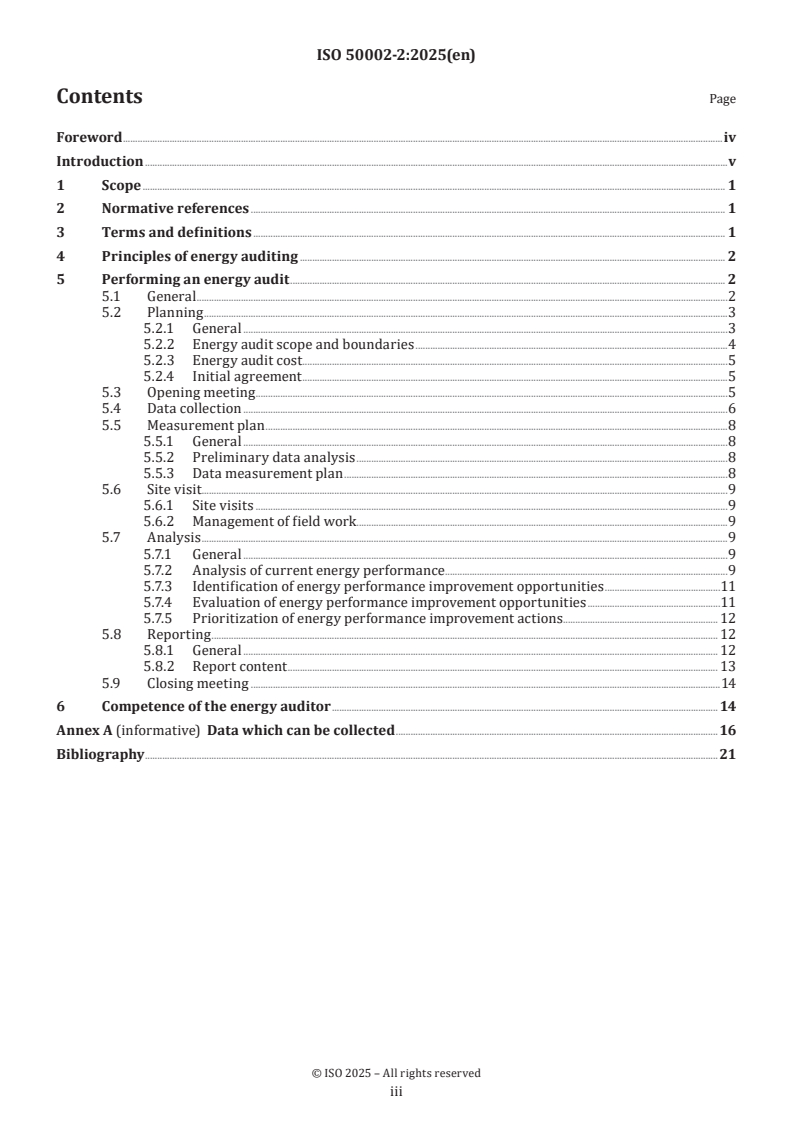
Contents Page
Foreword .iv
Introduction .v
1 Scope . 1
2 Normative references . 1
3 Terms and definitions . 1
4 Principles of energy auditing . 2
5 Performing an energy audit . 2
5.1 General .2
5.2 Planning .3
5.2.1 General .3
5.2.2 Energy audit scope and boundaries .4
5.2.3 Energy audit cost . .5
5.2.4 Initial agreement .5
5.3 Opening meeting .5
5.4 Data collection .6
5.5 Measurement plan .8
5.5.1 General .8
5.5.2 Preliminary data analysis .8
5.5.3 Data measurement plan .8
5.6 Site visit . .9
5.6.1 Site visits .9
5.6.2 Management of field work .9
5.7 Analysis .9
5.7.1 General .9
5.7.2 Analysis of current energy performance .9
5.7.3 Identification of energy performance improvement opportunities .11
5.7.4 Evaluation of energy performance improvement opportunities .11
5.7.5 Prioritization of energy performance improvement actions . . 12
5.8 Reporting . 12
5.8.1 General . 12
5.8.2 Report content . 13
5.9 Closing meeting .14
6 Competence of the energy auditor . 14
Annex A (informative) Data which can be collected .16
Bibliography .21
iii
Foreword
ISO (the International Organization for Standardization) is a worldwide federation of national standards
bodies (ISO member bodies). The work of preparing International Standards is normally carried out through
ISO technical committees. Each member body interested in a subject for which a technical committee
has been established has the right to be represented on that committee. International organizations,
governmental and non-governmental, in liaison with ISO, also take part in the work. ISO collaborates closely
with the International Electrotechnical Commission (IEC) on all matters of electrotechnical standardization.
The procedures used to develop this document and those intended for its further maintenance are described
in the ISO/IEC Directives, Part 1. In particular, the different approval criteria needed for the different types
of ISO document should be noted. This document was drafted in accordance with the editorial rules of the
ISO/IEC Directives, Part 2 (see www.iso.org/directives).
ISO draws attention to the possibility that the implementation of this document may involve the use of (a)
patent(s). ISO takes no position concerning the evidence, validity or applicability of any claimed patent
rights in respect thereof. As of the date of publication of this document, ISO had not received notice of (a)
patent(s) which may be required to implement this document. However, implementers are cautioned that
this may not represent the latest information, which may be obtained from the patent database available at
www.iso.org/patents. ISO shall not be held responsible for identifying any or all such patent rights.
Any trade name used in this document is information given for the convenience of users and does not
constitute an endorsement.
For an explanation of the voluntary nature of standards, the meaning of ISO specific terms and expressions
related to conformity assessment, as well as information about ISO's adherence to the World Trade
Organization (WTO) principles in the Technical Barriers to Trade (TBT), see www.iso.org/iso/foreword.html.
This document was prepared by Technical Committee ISO/TC 301, Energy management and energy savings.
A list of all parts in the ISO 50002 series can be found on the ISO website.
Any feedback or questions on this document should be directed to the user's national standards body. A
complete listing of these bodies can be found at www.iso.org/members.html.
iv
Introduction
An energy audit can help an organization identify opportunities to improve energy efficiency. It can be
part of a site-wide energy management system (EnMS). Energy audits in buildings can help to achieve
improvements such as:
— energy conservation;
— energy efficiency;
— improved occupant comfort, health and well-being;
— sustainability goals and targets;
— climate resilience.
The benefits to the organization can include:
— reduced energy and operating costs;
— improved information for asset management;
— wiser investment strategy based on energy audit results;
— meeting organizational goals related to greenhouse gas (GHG), emissions reduction net zero, materials
use, productivity and occupant satisfaction.
The use and operation of buildings requires the provision of services such as heating, cooling, ventilation,
lighting, domestic hot water, transportation systems (e.g. elevators, escalators, moving walkways) in
buildings, information systems and processes. In addition, the operation of buildings typically involves
other energy end uses such as appliances or plug loads within the building.
A building's energy consumption depends on:
— local climate conditions;
— the characteristics of the building envelope;
— the age and typology of the building(s)
— the designed indoor environment conditions;
— the characteristics and settings of the technical building systems;
— activities and processes in the building;
— occupant behaviour and operational regime.
When dealing with buildings, the audited objects are sometimes similar, technically simple and numerous
(e.g. in the residential sector), but can also be unique, complex and highly technical (such as hospitals,
swimming pools and spas, etc.).
Energy audits in buildings may include the whole building, parts of the building or some particular
technical system.
Energy performance indicators (benchmark values, if available) or average statistical specific energy
consumption data are usually published nationally for different building types and ages. This information
can be used in the analysis to provide comparative energy performance evaluation. Where this information
is not available, comparable data can be found for similar climates through international sources (e.g. the
International Energy Agency (IEA)).
NOTE The energy audits covered by this document can be independent from building energy performance
certification.
v
Energy audits and energy saving opportunities identified in energy audits are best implemented in the
context of an EnMS, such as one consistent with ISO 50001. Whether or not an organization has an EnMS
in place, organizations are more likely to achieve the intended outcomes of an energy audit when their top
management supports the audit objective(s) and agrees to provide sufficient resources for the audit process
and post-audit activities.
vi
International Standard ISO 50002-2:2025(en)
Energy audits —
Part 2:
Guidance for conducting an energy audit using ISO 50002-1 in
buildings
1 Scope
This document gives guidance on how to apply ISO 50002-1 to carry out energy audits of a building or
group of buildings (new or existing). It is intended to be used in conjunction with, and is supplementary to,
ISO 50002-1.
This document does not apply to other areas such as process audits (see ISO 50002-3), specific energy
systems (e.g. compressed air) or transport.
This document is applicable to buildings and can be used independently or in conjunction with ISO 50002-3.
2 Normative references
The following documents are referred to in the text in such a way that some or all of their content constitutes
requirements of this document. For dated references, only the edition cited applies. For undated references,
the latest edition of the referenced document (including any amendments) applies.
ISO 50002-1, Energy audits — Part 1: General requirements with guidance for use
3 Terms and definitions
For the purposes of this document, the terms and definitions given in ISO 50002-1 and the following apply.
ISO and IEC maintain terminology databases for use in standardization at the following addresses:
— ISO Online browsing platform: available at https:// www .iso .org/ obp
— IEC Electropedia: available at https:// www .electropedia .org/
3.1
building
construction as a whole, including its envelope and all technical building systems (3.5), for which energy can
be used to condition the indoor climate, and to provide domestic hot water, illumination and other services
related to the use of the building and the activities performed within the building
Note 1 to entry: The term can refer to the building as a whole or to parts thereof that have been designed or altered to
be used separately.
Note 2 to entry: The building can include its site location and related external environment.
Note 3 to entry: Processes within the building (e.g. chilling of food in supermarkets) are addressed in ISO 50002-3.
To the extent that the energy use of such processes affects, or is affected by, the building, they can be included in the
scope of the energy audit process described in this document.
3.2
building envelope
elements of a building (3.1) that enclose conditioned spaces through which thermal energy can be transferred
to or from the exterior, or to or from unconditioned spaces
3.3
building fabric
all physical elements of a building (3.1), excluding technical building systems (3.5)
EXAMPLE Roofs, walls, floors, doors, gates and internal partitions.
Note 1 to entry: It includes elements both inside and outside of the thermal envelope, including the thermal envelope itself.
Note 2 to entry: The fabric determines the thermal transmission, the thermal envelope airtightness and (nearly all of)
the thermal mass of the building (apart from the thermal mass of furniture and technical building systems). The fabric
also makes the building wind and water tight. The building fabric is sometimes described as the building as such, i.e.
the building without any technical building system.
[SOURCE: ISO 52000-1:2017, 3.1.5]
3.4
building service
service provided by the technical building systems (3.5) and by appliances to condition the indoor
environment (thermal comfort, air quality, visual and acoustic quality) and other services related to the use
of the building (3.1) (such as escalators/elevators)
3.5
technical building system
technical equipment for heating, cooling, ventilation, humidification, dehumidification, domestic hot water,
lighting, information systems including building automation and control, and on-site energy production
Note 1 to entry: A technical building system can refer to one or to several building services (3.4) (e.g. heating system
including heating, domestic hot water system and controls).
Note 2 to entry: A technical building system is composed of different subsystems and includes controls.
Note 3 to entry: Electricity and thermal energy production can include cogeneration, wind power, photovoltaic
systems, district energy, heat pumps and other renewable energy sources, within the agreed scope of the energy audit.
Note 4 to entry: ISO 52000-1 provides definitions of specific technical building systems.
[SOURCE: ISO 52000-1:2017, 3.3.13, modified — “information systems including” added and “on-site energy”
replaced “electricity” in the definition. Example changed in Note 1 to entry. Notes 2 and 3 to entry expanded.
Note 4 to entry added.]
4 Principles of energy auditing
The principles of ISO 50002-1 apply.
5 Performing an energy audit
5.1 General
The general requirements of ISO 50002-1 apply.
5.2 Planning
5.2.1 General
When planning an energy audit for a building, the relationships between the owner, operator and tenant
should be clarified. Their roles and responsibilities in a building can be different. For example, a building
can be owner-operated, occupied and maintained by a single organization. A building can also be owned,
operated, maintained and occupied by different organizations and/or tenants.
The audit client should specify the objectives of the energy audit, and the level of detail and thoroughness
required.
Considerations for the energy audit objective(s) include:
a) reducing energy consumption and costs;
b) reducing environmental impacts such as GHG emissions;
c) checking or ensuring the indoor environment for quality of health and well-being (comfort, indoor air
quality and illuminance levels);
d) awareness of relevant legislation and voluntary obligations and commitments;
e) limitations on improving energy performance in controlled buildings (e.g. historical or culturally
significant buildings);
f) evaluating potential options for use of renewable energy and/or storage.
ISO 50002-1:2025, Annex A, describes three different types of energy audit, each having a different level of
detail and thoroughness. The level of detail agreed by the parties will have an impact on:
— application;
— business needs;
— data collection;
— analysis;
— opportunities identification;
— opportunities evaluation;
— outputs;
— the time on-site.
When planning for the energy audit, the audit client should identify all the interested parties, their roles
in the building, their needs and expectations from the energy audit, and their respective influence on the
energy audit. A breakdown of interested parties and their typical roles in an energy audit are shown in
Table 1.
Table 1 — Interested parties and their typical roles in a building energy audit
Interested party Possible recipient of Data provider Involved in the Involved in the
the energy audit meetings field work
Building or apartment X X X
owner
Property manager X X X
Facilities manager X X X X
Engineering services X X X
manager
Operation and X X X
maintenance staff
Security staff X (x) (x)
Occupant/tenant y y y y
Staff (who work in the (x) Partly
building
permanently)
Temporary occupants
(patients, clients in a
shop)
Contractors and y y y
safety personnel
Commercial X Sometimes No, unless the X
recipient
Residential (x) No, unless the X
recipient
Key
X: direct involvement
(x): indirect involvement
y: as appropriate
5.2.2 Energy audit scope and boundaries
The energy audit scope and boundaries should be defined and agreed between the energy auditor and the
audit client. At a minimum:
a) the audit client should have operational control of, and have an ability to influence and seek the
cooperation of, the tenants;
b) the energy audit scope should cover energy uses within the building and/or the interaction of energy
uses with other energy use within the building (optimization of some energy use while excluding others
can give misleading results);
c) where the scope of an audit includes only parts of a building, such as a tenancy, the audit scope may need
to account for interactions with the base building (such as the building envelope) or technical systems
(e.g. shared space heating or cooling systems).
Considerations for the energy audit scope and boundaries include:
— collection of buildings/campus, buildings from a list of buildings or parts of a building;
— interdependencies and interactions between the building fabric, energy use inside the building, and the
building services and technical building systems;
— energy use outside the building affecting or impacting on those inside the building;
— where appropriate, energy performance indicators that can be used;
— criteria for evaluating and ranking opportunities for improving energy performance (e.g. simple payback,
internal rate of return, decarbonization, non-energy benefits);
— constraints that can impact the energy performance of the buildings such as purpose or legal;
— on-site and renewable energy generation.
A joint site visit between the audit client and the energy auditor can facilitate the definition of energy audit
scope and energy audit objective(s).
5.2.3 Energy audit cost
The audit client should note that all of the above items affect the energy audit costs. Other factors that can
affect energy audit costs include:
— the availability of both energy performance data and equipment-related data;
— the extent to which longer payback opportunities are investigated;
— the availability of previous energy audit reports/studies;
— the complexity of the building and whether processes and equipment are unusual or custom designed;
— excessive disruption and/or changes to the planned energy audit.
The organization should ensure that the scope of the energy audit and expected energy audit cost are
reasonable (from the organization's perspective) in relation to the potential benefits of the energy audit.
5.2.4 Initial agreement
Once the above has been established, the energy auditor and the audit client should agree on the energy audit
time, audit client representative during the energy audit and resources for the energy audit. Involvement
and cooperation from the audit client and various interested parties in the energy audit process is critical to
the success of the energy audit and the achievement of energy audit objective(s).
5.3 Opening meeting
During the opening meeting the energy auditor should consider collecting preliminary information, if
readily available, about the building from the organization. This helps to prepare for the later energy audit
activities. Information to be collected can include:
a) set-points and operational limits of indoor environmental conditions (such as temperatures, air flows,
air quality, illuminance and noise) and any seasonal variations;
b) occupancy patterns for the different range of activities within the building;
c) comments from any occupants or other parties on the operational performance of the building and
the level of the building service (e.g. history and log of occupant complaints related to the building's
operation and conditions);
d) the energy performance rating for the building (e.g. energy performance certificate, Leadership in
Energy and Environmental Design (LEED) ratings);
e) whether any building occupant awareness or motivation programmes have been implemented;
f) any previous energy audit reports;
g) operating and maintenance practices, regimes and record-keeping.
During the opening meeting, the energy auditor should review the outputs of the energy audit planning with
the organization and confirm that the energy audit can progress. This review can include:
— confirming the scope and boundaries of the energy audit;
— timing of site visits, e.g. whether within or outside normal working hours (or preferably both);
— level of occupant/tenant engagement;
— areas of restricted access;
— potential health hazards and risks;
— confirmation of any unusual conditions that can affect the energy audit.
During the opening meeting, it is also important to make arrangements and agreements with the
organization on access to the building.
5.4 Data collection
The energy auditor should collect and collate the appropriate energy data to support the energy audit
objective(s), required energy audit scope and level of thoroughness of the energy audit. This includes:
a) building:
1) building plans;
2) building zoning:
i) asset register;
ii) building energy consumption and performance records;
iii) records, documents, permits on modelled or actual energy performance (e.g. LEED certificates,
Building Research Establishment Environmental Assessment Methodology (BREEAM) ratings
energy performance certificates);
b) building envelope:
1) thermal transmittance (U-value) and possible improvements and restrictions (accessibility, height,
possible resulting thermal bridges, conflicts with building use and appearance);
2) shading and possible improvements and restrictions (for glazed elements and cooling);
3) thermal inertia of the building;
4) air tightness;
5) joints and thermal bridges;
NOTE 1 This is not the same as an indoor spaces visit. The focus here is on the building elements and
their properties.
c) building systems (for each within the scope of the energy audit):
1) functional diagram;
2) control diagram;
3) operating settings list:
i) system inspection reports;
ii) mechanical and electrical schematics;
4) operating schedules;
d) exist
...
International
Standard
ISO 50002-2
First edition
Energy audits —
2025-06
Part 2:
Guidance for conducting an
energy audit using ISO 50002-1 in
buildings
Audits énergétiques —
Partie 2: Recommandations pour la conduite d'un audit
énergétique selon l'ISO 50002-1 dans des bâtiments
Reference number
© ISO 2025
All rights reserved. Unless otherwise specified, or required in the context of its implementation, no part of this publication may
be reproduced or utilized otherwise in any form or by any means, electronic or mechanical, including photocopying, or posting on
the internet or an intranet, without prior written permission. Permission can be requested from either ISO at the address below
or ISO’s member body in the country of the requester.
ISO copyright office
CP 401 • Ch. de Blandonnet 8
CH-1214 Vernier, Geneva
Phone: +41 22 749 01 11
Email: copyright@iso.org
Website: www.iso.org
Published in Switzerland
ii
Contents Page
Foreword .iv
Introduction .v
1 Scope . 1
2 Normative references . 1
3 Terms and definitions . 1
4 Principles of energy auditing . 2
5 Performing an energy audit . 2
5.1 General .2
5.2 Planning .3
5.2.1 General .3
5.2.2 Energy audit scope and boundaries .4
5.2.3 Energy audit cost . .5
5.2.4 Initial agreement .5
5.3 Opening meeting .5
5.4 Data collection .6
5.5 Measurement plan .8
5.5.1 General .8
5.5.2 Preliminary data analysis .8
5.5.3 Data measurement plan .8
5.6 Site visit . .9
5.6.1 Site visits .9
5.6.2 Management of field work .9
5.7 Analysis .9
5.7.1 General .9
5.7.2 Analysis of current energy performance .9
5.7.3 Identification of energy performance improvement opportunities .11
5.7.4 Evaluation of energy performance improvement opportunities .11
5.7.5 Prioritization of energy performance improvement actions . . 12
5.8 Reporting . 12
5.8.1 General . 12
5.8.2 Report content . 13
5.9 Closing meeting .14
6 Competence of the energy auditor . 14
Annex A (informative) Data which can be collected .16
Bibliography .21
iii
Foreword
ISO (the International Organization for Standardization) is a worldwide federation of national standards
bodies (ISO member bodies). The work of preparing International Standards is normally carried out through
ISO technical committees. Each member body interested in a subject for which a technical committee
has been established has the right to be represented on that committee. International organizations,
governmental and non-governmental, in liaison with ISO, also take part in the work. ISO collaborates closely
with the International Electrotechnical Commission (IEC) on all matters of electrotechnical standardization.
The procedures used to develop this document and those intended for its further maintenance are described
in the ISO/IEC Directives, Part 1. In particular, the different approval criteria needed for the different types
of ISO document should be noted. This document was drafted in accordance with the editorial rules of the
ISO/IEC Directives, Part 2 (see www.iso.org/directives).
ISO draws attention to the possibility that the implementation of this document may involve the use of (a)
patent(s). ISO takes no position concerning the evidence, validity or applicability of any claimed patent
rights in respect thereof. As of the date of publication of this document, ISO had not received notice of (a)
patent(s) which may be required to implement this document. However, implementers are cautioned that
this may not represent the latest information, which may be obtained from the patent database available at
www.iso.org/patents. ISO shall not be held responsible for identifying any or all such patent rights.
Any trade name used in this document is information given for the convenience of users and does not
constitute an endorsement.
For an explanation of the voluntary nature of standards, the meaning of ISO specific terms and expressions
related to conformity assessment, as well as information about ISO's adherence to the World Trade
Organization (WTO) principles in the Technical Barriers to Trade (TBT), see www.iso.org/iso/foreword.html.
This document was prepared by Technical Committee ISO/TC 301, Energy management and energy savings.
A list of all parts in the ISO 50002 series can be found on the ISO website.
Any feedback or questions on this document should be directed to the user's national standards body. A
complete listing of these bodies can be found at www.iso.org/members.html.
iv
Introduction
An energy audit can help an organization identify opportunities to improve energy efficiency. It can be
part of a site-wide energy management system (EnMS). Energy audits in buildings can help to achieve
improvements such as:
— energy conservation;
— energy efficiency;
— improved occupant comfort, health and well-being;
— sustainability goals and targets;
— climate resilience.
The benefits to the organization can include:
— reduced energy and operating costs;
— improved information for asset management;
— wiser investment strategy based on energy audit results;
— meeting organizational goals related to greenhouse gas (GHG), emissions reduction net zero, materials
use, productivity and occupant satisfaction.
The use and operation of buildings requires the provision of services such as heating, cooling, ventilation,
lighting, domestic hot water, transportation systems (e.g. elevators, escalators, moving walkways) in
buildings, information systems and processes. In addition, the operation of buildings typically involves
other energy end uses such as appliances or plug loads within the building.
A building's energy consumption depends on:
— local climate conditions;
— the characteristics of the building envelope;
— the age and typology of the building(s)
— the designed indoor environment conditions;
— the characteristics and settings of the technical building systems;
— activities and processes in the building;
— occupant behaviour and operational regime.
When dealing with buildings, the audited objects are sometimes similar, technically simple and numerous
(e.g. in the residential sector), but can also be unique, complex and highly technical (such as hospitals,
swimming pools and spas, etc.).
Energy audits in buildings may include the whole building, parts of the building or some particular
technical system.
Energy performance indicators (benchmark values, if available) or average statistical specific energy
consumption data are usually published nationally for different building types and ages. This information
can be used in the analysis to provide comparative energy performance evaluation. Where this information
is not available, comparable data can be found for similar climates through international sources (e.g. the
International Energy Agency (IEA)).
NOTE The energy audits covered by this document can be independent from building energy performance
certification.
v
Energy audits and energy saving opportunities identified in energy audits are best implemented in the
context of an EnMS, such as one consistent with ISO 50001. Whether or not an organization has an EnMS
in place, organizations are more likely to achieve the intended outcomes of an energy audit when their top
management supports the audit objective(s) and agrees to provide sufficient resources for the audit process
and post-audit activities.
vi
International Standard ISO 50002-2:2025(en)
Energy audits —
Part 2:
Guidance for conducting an energy audit using ISO 50002-1 in
buildings
1 Scope
This document gives guidance on how to apply ISO 50002-1 to carry out energy audits of a building or
group of buildings (new or existing). It is intended to be used in conjunction with, and is supplementary to,
ISO 50002-1.
This document does not apply to other areas such as process audits (see ISO 50002-3), specific energy
systems (e.g. compressed air) or transport.
This document is applicable to buildings and can be used independently or in conjunction with ISO 50002-3.
2 Normative references
The following documents are referred to in the text in such a way that some or all of their content constitutes
requirements of this document. For dated references, only the edition cited applies. For undated references,
the latest edition of the referenced document (including any amendments) applies.
ISO 50002-1, Energy audits — Part 1: General requirements with guidance for use
3 Terms and definitions
For the purposes of this document, the terms and definitions given in ISO 50002-1 and the following apply.
ISO and IEC maintain terminology databases for use in standardization at the following addresses:
— ISO Online browsing platform: available at https:// www .iso .org/ obp
— IEC Electropedia: available at https:// www .electropedia .org/
3.1
building
construction as a whole, including its envelope and all technical building systems (3.5), for which energy can
be used to condition the indoor climate, and to provide domestic hot water, illumination and other services
related to the use of the building and the activities performed within the building
Note 1 to entry: The term can refer to the building as a whole or to parts thereof that have been designed or altered to
be used separately.
Note 2 to entry: The building can include its site location and related external environment.
Note 3 to entry: Processes within the building (e.g. chilling of food in supermarkets) are addressed in ISO 50002-3.
To the extent that the energy use of such processes affects, or is affected by, the building, they can be included in the
scope of the energy audit process described in this document.
3.2
building envelope
elements of a building (3.1) that enclose conditioned spaces through which thermal energy can be transferred
to or from the exterior, or to or from unconditioned spaces
3.3
building fabric
all physical elements of a building (3.1), excluding technical building systems (3.5)
EXAMPLE Roofs, walls, floors, doors, gates and internal partitions.
Note 1 to entry: It includes elements both inside and outside of the thermal envelope, including the thermal envelope itself.
Note 2 to entry: The fabric determines the thermal transmission, the thermal envelope airtightness and (nearly all of)
the thermal mass of the building (apart from the thermal mass of furniture and technical building systems). The fabric
also makes the building wind and water tight. The building fabric is sometimes described as the building as such, i.e.
the building without any technical building system.
[SOURCE: ISO 52000-1:2017, 3.1.5]
3.4
building service
service provided by the technical building systems (3.5) and by appliances to condition the indoor
environment (thermal comfort, air quality, visual and acoustic quality) and other services related to the use
of the building (3.1) (such as escalators/elevators)
3.5
technical building system
technical equipment for heating, cooling, ventilation, humidification, dehumidification, domestic hot water,
lighting, information systems including building automation and control, and on-site energy production
Note 1 to entry: A technical building system can refer to one or to several building services (3.4) (e.g. heating system
including heating, domestic hot water system and controls).
Note 2 to entry: A technical building system is composed of different subsystems and includes controls.
Note 3 to entry: Electricity and thermal energy production can include cogeneration, wind power, photovoltaic
systems, district energy, heat pumps and other renewable energy sources, within the agreed scope of the energy audit.
Note 4 to entry: ISO 52000-1 provides definitions of specific technical building systems.
[SOURCE: ISO 52000-1:2017, 3.3.13, modified — “information systems including” added and “on-site energy”
replaced “electricity” in the definition. Example changed in Note 1 to entry. Notes 2 and 3 to entry expanded.
Note 4 to entry added.]
4 Principles of energy auditing
The principles of ISO 50002-1 apply.
5 Performing an energy audit
5.1 General
The general requirements of ISO 50002-1 apply.
5.2 Planning
5.2.1 General
When planning an energy audit for a building, the relationships between the owner, operator and tenant
should be clarified. Their roles and responsibilities in a building can be different. For example, a building
can be owner-operated, occupied and maintained by a single organization. A building can also be owned,
operated, maintained and occupied by different organizations and/or tenants.
The audit client should specify the objectives of the energy audit, and the level of detail and thoroughness
required.
Considerations for the energy audit objective(s) include:
a) reducing energy consumption and costs;
b) reducing environmental impacts such as GHG emissions;
c) checking or ensuring the indoor environment for quality of health and well-being (comfort, indoor air
quality and illuminance levels);
d) awareness of relevant legislation and voluntary obligations and commitments;
e) limitations on improving energy performance in controlled buildings (e.g. historical or culturally
significant buildings);
f) evaluating potential options for use of renewable energy and/or storage.
ISO 50002-1:2025, Annex A, describes three different types of energy audit, each having a different level of
detail and thoroughness. The level of detail agreed by the parties will have an impact on:
— application;
— business needs;
— data collection;
— analysis;
— opportunities identification;
— opportunities evaluation;
— outputs;
— the time on-site.
When planning for the energy audit, the audit client should identify all the interested parties, their roles
in the building, their needs and expectations from the energy audit, and their respective influence on the
energy audit. A breakdown of interested parties and their typical roles in an energy audit are shown in
Table 1.
Table 1 — Interested parties and their typical roles in a building energy audit
Interested party Possible recipient of Data provider Involved in the Involved in the
the energy audit meetings field work
Building or apartment X X X
owner
Property manager X X X
Facilities manager X X X X
Engineering services X X X
manager
Operation and X X X
maintenance staff
Security staff X (x) (x)
Occupant/tenant y y y y
Staff (who work in the (x) Partly
building
permanently)
Temporary occupants
(patients, clients in a
shop)
Contractors and y y y
safety personnel
Commercial X Sometimes No, unless the X
recipient
Residential (x) No, unless the X
recipient
Key
X: direct involvement
(x): indirect involvement
y: as appropriate
5.2.2 Energy audit scope and boundaries
The energy audit scope and boundaries should be defined and agreed between the energy auditor and the
audit client. At a minimum:
a) the audit client should have operational control of, and have an ability to influence and seek the
cooperation of, the tenants;
b) the energy audit scope should cover energy uses within the building and/or the interaction of energy
uses with other energy use within the building (optimization of some energy use while excluding others
can give misleading results);
c) where the scope of an audit includes only parts of a building, such as a tenancy, the audit scope may need
to account for interactions with the base building (such as the building envelope) or technical systems
(e.g. shared space heating or cooling systems).
Considerations for the energy audit scope and boundaries include:
— collection of buildings/campus, buildings from a list of buildings or parts of a building;
— interdependencies and interactions between the building fabric, energy use inside the building, and the
building services and technical building systems;
— energy use outside the building affecting or impacting on those inside the building;
— where appropriate, energy performance indicators that can be used;
— criteria for evaluating and ranking opportunities for improving energy performance (e.g. simple payback,
internal rate of return, decarbonization, non-energy benefits);
— constraints that can impact the energy performance of the buildings such as purpose or legal;
— on-site and renewable energy generation.
A joint site visit between the audit client and the energy auditor can facilitate the definition of energy audit
scope and energy audit objective(s).
5.2.3 Energy audit cost
The audit client should note that all of the above items affect the energy audit costs. Other factors that can
affect energy audit costs include:
— the availability of both energy performance data and equipment-related data;
— the extent to which longer payback opportunities are investigated;
— the availability of previous energy audit reports/studies;
— the complexity of the building and whether processes and equipment are unusual or custom designed;
— excessive disruption and/or changes to the planned energy audit.
The organization should ensure that the scope of the energy audit and expected energy audit cost are
reasonable (from the organization's perspective) in relation to the potential benefits of the energy audit.
5.2.4 Initial agreement
Once the above has been established, the energy auditor and the audit client should agree on the energy audit
time, audit client representative during the energy audit and resources for the energy audit. Involvement
and cooperation from the audit client and various interested parties in the energy audit process is critical to
the success of the energy audit and the achievement of energy audit objective(s).
5.3 Opening meeting
During the opening meeting the energy auditor should consider collecting preliminary information, if
readily available, about the building from the organization. This helps to prepare for the later energy audit
activities. Information to be collected can include:
a) set-points and operational limits of indoor environmental conditions (such as temperatures, air flows,
air quality, illuminance and noise) and any seasonal variations;
b) occupancy patterns for the different range of activities within the building;
c) comments from any occupants or other parties on the operational performance of the building and
the level of the building service (e.g. history and log of occupant complaints related to the building's
operation and conditions);
d) the energy performance rating for the building (e.g. energy performance certificate, Leadership in
Energy and Environmental Design (LEED) ratings);
e) whether any building occupant awareness or motivation programmes have been implemented;
f) any previous energy audit reports;
g) operating and maintenance practices, regimes and record-keeping.
During the opening meeting, the energy auditor should review the outputs of the energy audit planning with
the organization and confirm that the energy audit can progress. This review can include:
— confirming the scope and boundaries of the energy audit;
— timing of site visits, e.g. whether within or outside normal working hours (or preferably both);
— level of occupant/tenant engagement;
— areas of restricted access;
— potential health hazards and risks;
— confirmation of any unusual conditions that can affect the energy audit.
During the opening meeting, it is also important to make arrangements and agreements with the
organization on access to the building.
5.4 Data collection
The energy auditor should collect and collate the appropriate energy data to support the energy audit
objective(s), required energy audit scope and level of thoroughness of the energy audit. This includes:
a) building:
1) building plans;
2) building zoning:
i) asset register;
ii) building energy consumption and performance records;
iii) records, documents, permits on modelled or actual energy performance (e.g. LEED certificates,
Building Research Establishment Environmental Assessment Methodology (BREEAM) ratings
energy performance certificates);
b) building envelope:
1) thermal transmittance (U-value) and possible improvements and restrictions (accessibility, height,
possible resulting thermal bridges, conflicts with building use and appearance);
2) shading and possible improvements and restrictions (for glazed elements and cooling);
3) thermal inertia of the building;
4) air tightness;
5) joints and thermal bridges;
NOTE 1 This is not the same as an indoor spaces visit. The focus here is on the building elements and
their properties.
c) building systems (for each within the scope of the energy audit):
1) functional diagram;
2) control diagram;
3) operating settings list:
i) system inspection reports;
ii) mechanical and electrical schematics;
4) operating schedules;
d) existing design, operation and maintenance documents and information, such as:
1) as-built building plans, together with details of any modifications if available;
2) any external factors that can influence the energy performance of the building (e.g. shading by
adjacent trees or buildings);
3) indications of supplied building services (e.g. which rooms or zones are h
...