

ISO 19292:2014
(Main)Ships and marine technology — Lifesaving and fire protection — Point-type resettable flame detectors for ships
General Information
- Abstract
ISO 19292:2014 specifies requirements, test methods, and performance criteria for point-type, resettable flame detectors that operate using radiation from a flame, for use in fire detection systems installed on ships. ISO 19292:2014 references ISO 7240-10 for requirements common to both terrestrial and marine applications and adds the requirements applicable to installations in the shipboard environment.
- Status
- Published
- Publication Date
- 17-Mar-2014
- Technical Committee
- ISO/TC 8/SC 1 - Maritime safety
- Drafting Committee
- ISO/TC 8/SC 1/WG 3 - Fire protection
- Current Stage
- 9093 - International Standard confirmed
- Start Date
- 09-Sep-2024
- Completion Date
- 29-Aug-2026

Overview
ISO 19292:2014 - Ships and marine technology - Lifesaving and fire protection - Point-type resettable flame detectors for ships - specifies performance criteria, test methods and maritime requirements for point-type, resettable flame detectors that operate by sensing radiation from a flame. Intended for fire detection systems installed on ships, the standard references ISO 7240-10 for common terrestrial/marine requirements and supplements it with shipboard-specific environmental and electromagnetic compatibility (EMC) tests needed for reliable marine flame detectors.
Key topics and technical requirements
ISO 19292:2014 focuses on functional performance and robustness of flame detectors in the shipboard environment. Key technical topics include:
- Scope and references: Aligns with ISO 7240-10 and ISO 7240-1; normative test standards include IEC 60068 series (environmental) and IEC 61000 series / CISPR 16 (EMC).
- Environmental conditioning tests:
- Dry heat (operational): conditioning up to (70 ± 2) °C for 2 h, with functional checks.
- Cold (operational): conditioning to (5 ± 3) °C, and for external/exposed detectors to (−25 ± 3) °C, 2 h.
- Damp heat: cyclic conditioning at (55 ± 2) °C, 95% RH for 24 h cycles.
- Salt mist: cyclic sodium chloride exposure to simulate corrosive marine atmospheres.
- Vibration (sinusoidal): operational vibration testing per IEC 60068-2-6.
- EMC and electrical robustness:
- Electrostatic discharge (IEC 61000-4-2), radiated RF immunity, conducted disturbance immunity (IEC 61000-4-6), burst/fast transient, surge immunity (IEC 61000-4-5), and radiated emissions.
- Tests for variation in supply parameters, high voltage, power-supply failure and insulation resistance.
- Performance criteria:
- Functional verification during and after conditioning; no false alarms or faults during transitions.
- Response point stability - example: ratio of maximum to minimum response points (Dmax/Dmin) shall not exceed 1.26 for certain tests.
Practical applications and users
ISO 19292:2014 is used by:
- Detector manufacturers to design, test and certify marine-rated, point-type resettable flame detectors.
- Shipbuilders and system integrators specifying fire detection systems for SOLAS-regulated vessels and installations subject to the FSS Code.
- Classification societies and maritime regulators assessing compliance for shipboard fire detection equipment.
- Test laboratories conducting environmental and EMC testing for marine approvals.
- Ship operators and safety engineers selecting robust flame detectors for engine rooms, cargo spaces and open-deck installations.
Adopting ISO 19292 helps ensure reliable flame detection in harsh shipboard conditions, reducing false alarms and improving crew safety and regulatory compliance.
Related standards
- ISO 7240-10:2012 (Point-type flame detectors)
- ISO 7240-1 (General and definitions)
- IEC 60068-2 series (environmental tests)
- IEC 61000-4 series and CISPR 16 (EMC testing)
Get Certified
Connect with accredited certification bodies for this standard

DNV
DNV is an independent assurance and risk management provider.

Lloyd's Register
Lloyd's Register is a global professional services organisation specialising in engineering and technology.

FSC International
Forest Stewardship Council certification.
Sponsored listings
Frequently Asked Questions
ISO 19292:2014 is a standard published by the International Organization for Standardization (ISO). Its full title is "Ships and marine technology — Lifesaving and fire protection — Point-type resettable flame detectors for ships". This standard covers: ISO 19292:2014 specifies requirements, test methods, and performance criteria for point-type, resettable flame detectors that operate using radiation from a flame, for use in fire detection systems installed on ships. ISO 19292:2014 references ISO 7240-10 for requirements common to both terrestrial and marine applications and adds the requirements applicable to installations in the shipboard environment.
ISO 19292:2014 specifies requirements, test methods, and performance criteria for point-type, resettable flame detectors that operate using radiation from a flame, for use in fire detection systems installed on ships. ISO 19292:2014 references ISO 7240-10 for requirements common to both terrestrial and marine applications and adds the requirements applicable to installations in the shipboard environment.
ISO 19292:2014 is classified under the following ICS (International Classification for Standards) categories: 47.020.99 - Other standards related to shipbuilding and marine structures. The ICS classification helps identify the subject area and facilitates finding related standards.
ISO 19292:2014 is available in PDF format for immediate download after purchase. The document can be added to your cart and obtained through the secure checkout process. Digital delivery ensures instant access to the complete standard document.
Standards Content (Sample)
INTERNATIONAL ISO
STANDARD 19292
First edition
2014-03-15
Ships and marine technology —
Lifesaving and fire protection — Point-
type resettable flame detectors for
ships
Navires et technologie maritime — Sauvetage et protection contre le
feu — Détecteurs de flamme ponctuels réglables pour navires
Reference number
©
ISO 2014
© ISO 2014
All rights reserved. Unless otherwise specified, no part of this publication may be reproduced or utilized otherwise in any form
or by any means, electronic or mechanical, including photocopying, or posting on the internet or an intranet, without prior
written permission. Permission can be requested from either ISO at the address below or ISO’s member body in the country of
the requester.
ISO copyright office
Case postale 56 • CH-1211 Geneva 20
Tel. + 41 22 749 01 11
Fax + 41 22 749 09 47
E-mail copyright@iso.org
Web www.iso.org
Published in Switzerland
ii © ISO 2014 – All rights reserved
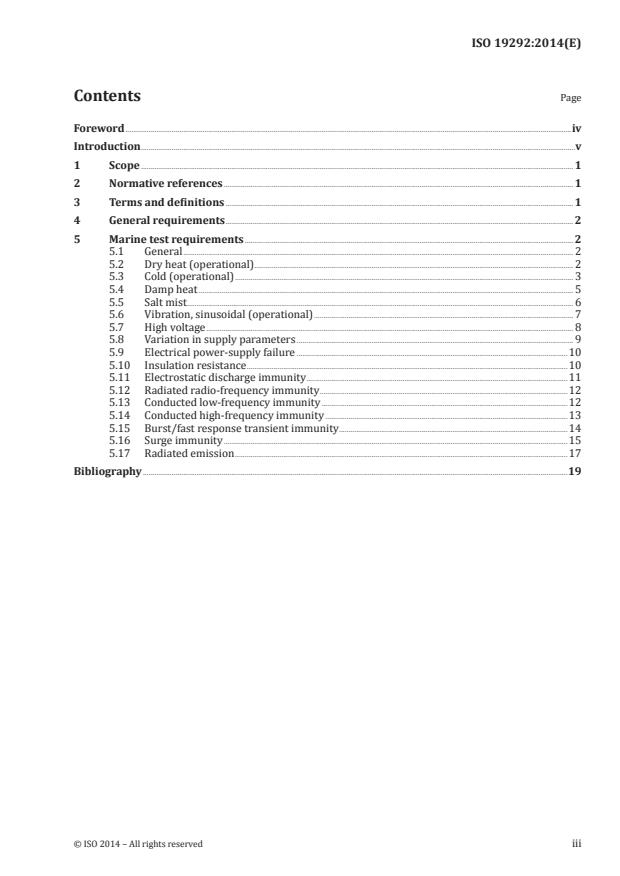
Contents Page
Foreword .iv
Introduction .v
1 Scope . 1
2 Normative references . 1
3 Terms and definitions . 1
4 General requirements . 2
5 Marine test requirements . 2
5.1 General . 2
5.2 Dry heat (operational) . 2
5.3 Cold (operational) . 3
5.4 Damp heat . 5
5.5 Salt mist . 6
5.6 Vibration, sinusoidal (operational) . 7
5.7 High voltage . 8
5.8 Variation in supply parameters . 9
5.9 Electrical power-supply failure .10
5.10 Insulation resistance .10
5.11 Electrostatic discharge immunity .11
5.12 Radiated radio-frequency immunity .12
5.13 Conducted low-frequency immunity .12
5.14 Conducted high-frequency immunity .13
5.15 Burst/fast response transient immunity .14
5.16 Surge immunity .15
5.17 Radiated emission .17
Bibliography .19
Foreword
ISO (the International Organization for Standardization) is a worldwide federation of national standards
bodies (ISO member bodies). The work of preparing International Standards is normally carried out
through ISO technical committees. Each member body interested in a subject for which a technical
committee has been established has the right to be represented on that committee. International
organizations, governmental and non-governmental, in liaison with ISO, also take part in the work.
ISO collaborates closely with the International Electrotechnical Commission (IEC) on all matters of
electrotechnical standardization.
The procedures used to develop this document and those intended for its further maintenance are
described in the ISO/IEC Directives, Part 1. In particular the different approval criteria needed for the
different types of ISO documents should be noted. This document was drafted in accordance with the
editorial rules of the ISO/IEC Directives, Part 2 (see www.iso.org/directives).
Attention is drawn to the possibility that some of the elements of this document may be the subject of
patent rights. ISO shall not be held responsible for identifying any or all such patent rights. Details of
any patent rights identified during the development of the document will be in the Introduction and/or
on the ISO list of patent declarations received (see www.iso.org/patents).
Any trade name used in this document is information given for the convenience of users and does not
constitute an endorsement.
For an explanation on the meaning of ISO specific terms and expressions related to conformity
assessment, as well as information about ISO’s adherence to the WTO principles in the Technical Barriers
to Trade (TBT) see the following URL: Foreword - Supplementary information
The committee responsible for this document is ISO/TC 8, Ships and marine technology, Subcommittee
SC 1, Lifesaving and fire protection.
iv © ISO 2014 – All rights reserved
Introduction
The 1974 International Convention for the Safety of Life at Sea (SOLAS 1974), as amended, and its
associated International Code for Fire Safety Systems (FSS Code) require certain ships to be fitted with
fixed fire detection and fire alarm systems, and provide general requirements for such systems.
This International Standard has been developed to supplement the provisions of SOLAS 1974 and the
FSS Code by specifying detailed performance criteria and test methods for point-type resettable flame
detectors for use in fire detection on ships.
This International Standard has been prepared by Sub-committee ISO/TC 8/SC 1 for point-type,
resettable flame detectors on board ships to replace Annex A of ISO 7240-10:2007. This International
Standard is based on the performance standards for terrestrial flame detectors in ISO 7240-10 and
provides alternative requirements for flame detectors for use in marine applications.
INTERNATIONAL STANDARD ISO 19292:2014(E)
Ships and marine technology — Lifesaving and fire
protection — Point-type resettable flame detectors for
ships
1 Scope
This International Standard specifies requirements, test methods, and performance criteria for point-
type, resettable flame detectors that operate using radiation from a flame, for use in fire detection
systems installed on ships. This International Standard references ISO 7240-10 for requirements common
to both terrestrial and marine applications and adds the requirements applicable to installations in the
shipboard environment.
2 Normative references
The following documents, in whole or in part, are normatively referenced in this document and are
indispensable for its application. For dated references, only the edition cited applies. For undated
references, the latest edition of the referenced document (including any amendments) applies.
ISO 7240-1, Fire detection and alarm systems — Part 1: General and definitions
ISO 7240-10:2012, Fire detection and alarm systems — Part 10: Point-type flame detectors
IEC 60068-2-1, Environmental testing — Part 2-1: Tests — Test A: Cold
IEC 60068-2-2, Environmental testing — Part 2-2: Tests — Test B: Dry heat
IEC 60068-2-6, Environmental testing — Part 2-6: Tests — Test Fc: Vibration (sinusoidal)
IEC 60068-2-30, Environmental testing — Part 2-30: Tests — Test Db and guidance: Damp heat, cyclic (12
+ 12-hour cycle)
IEC 60068-2-52, Environmental testing — Part 2-52: Tests — Test Kb: Salt mist, cyclic (sodium, chloride
solution)
IEC 61000-4-2, Ed. 1.2:2001 (b) Electromagnetic compatibility (EMC) — Part 4-2: Testing and measurement
techniques — Electrostatic discharge immunity test
IEC 61000-4-4:2004, Electromagnetic compatibility (EMC) — Part 4-4: Testing and measurement
techniques — Electrical fast transient/burst immunity test
IEC 61000-4-5:2005, Electromagnetic compatibility (EMC) — Part 4-5: Testing and measurement techniques
— Surge immunity test
IEC 61000-4-6:2006, Electromagnetic compatibility (EMC) — Part 4-6: Testing and measurement
techniques — Immunity to conducted disturbances, induced by radio-frequency fields
CISPR 16-1, Specification for radio disturbance and immunity measurement apparatus and methods — Part
1-1: Radio disturbance and immunity measuring apparatus — Measuring apparatus
CISPR 16-2, Specification for radio disturbance and immunity measurement apparatus and methods — Part
2-1: Methods of measurement of disturbance and immunity — Conducted disturbance measurements
3 Terms and definitions
For the purposes of this document, the terms and definitions given in ISO 7240-1 and ISO 7240-10 apply.
4 General requirements
The apparatus shall comply with all of the requirements of ISO 7240-10:2012 with the exception of 5.7
to 5.17 and Annex D. In lieu of 5.7 to 5.17 of ISO 7240-10:2012, point-type flame detectors for ships shall
meet the requirements of Clause 5 of this International Standard.
5 Marine test requirements
5.1 General
Flame detectors classified for marine applications shall be tested according to the test schedule specified
in Table 1.
Table 1 — Test schedule for marine applications
Test Subclause Specimen number(s)
Reproducibility ISO 7240-10:2012, All specimens
5.2
Repeatability ISO 7240-10:2012, 1
5.3
Directional dependence ISO 7240-10:2012, 1
5.4
Fire sensitivity ISO 7240-10:2012, All specimens
5.5
Dazzling (operational) ISO 7240-10:2012, 1
5.6
Dry heat (operational) 5.2 2
Cold (operational) 5.3 2
Damp heat 5.4 6
Salt mist 5.5 5
Vibration, sinusoidal (operational) 5.6 4
High voltage 5.7 7
Variation in supply parameters 5.8 1
Electrical power-supply failure 5.9 1
a
Insulation resistance 5.10 2, 6
Electrostatic discharge immunity 5.11 1
Radiated radio-frequency immunity 5.12 3
Conducted low-frequency immunity 5.13 3
Conducted high-frequency immunity 5.14 3
Burst/fast response transient immunity 5.15 3
Surge immunity 5.16 8
Radiated emission 5.17 1
a
Measurements shall be performed before and after the relevant environmental tests.
5.2 Dry heat (operational)
5.2.1 Object of test
The object of the test is to demonstrate the ability of the specimen to function correctly at high ambient
temperatures appropriate to the anticipated service environment.
2 © ISO 2014 – All rights reserved
5.2.2 Test procedure and apparatus
5.2.2.1 General
The test apparatus and procedure specified in IEC 60068-2-2, Test Bb, and by 5.2.2.2 to 5.2.2.4 below
shall be used.
5.2.2.2 State of the specimen during conditioning
Mount the specimen as specified in ISO 7240-10:2012, 5.1.3 and connect it to supply and monitoring
equipment as specified in ISO 7240-10:2012, 5.1.2.
5.2.2.3 Conditioning
Apply the following conditioning:
— temperature: Starting at an initial air temperature of (23 ± 5) °C, increase the air temperature
to (70 ± 2) °C;
— duration: Maintain the temperature for 2 h.
NOTE Test Bb specifies rates of change of temperature of ≤1 °C/min for the transitions to and from the
conditioning temperature.
5.2.2.4 Measurements during conditioning
Monitor the specimen during the conditioning period to detect any alarm or fault signals. During the
last 30 min of the conditioning, subject the specimen to the reduced functional test in accordance with
ISO 7240-10:2012, 5.1.7.
5.2.2.5 Final measurements
After the recovery period of at least 1 h at standard atmospheric conditions, measure the response point
of the specimen in accordance with ISO 7240-10:2012, 5.1.6.
Designate the greater of the response points measured in this test and that measured for the same
specimen in the reproducibility test as D and the lesser as D .
max min
5.2.3 Requirements
No alarm or fault signals shall be given during the transition to the conditioning temperature or during
the conditioning.
The specimen shall give an alarm signal in response to the reduced function test.
The ratio point values D : D shall be not greater than 1,26.
max min
5.3 Cold (operational)
5.3.1 Object of test
The object of the test is to demonstrate the ability of the specimen to function correctly at low ambient
temperatures appropriate to the anticipated service temperature.
5.3.2 Test procedure
5.3.2.1 Reference
The test apparatus and procedure specified in IEC 60068-2-1, Test Ab, and by 5.3.2.2 to 5.3.2.4 below
shall be used.
5.3.2.2 State of the specimen during conditioning
Mount the specimen as specified in ISO 7240-10:2012, 5.1.3 and connect it to supply and monitoring
equipment as specified in ISO 7240-10:2012, 5.1.2.
Measure insulation resistance as specified in 5.10.2.3.
5.3.2.3 Conditioning
Apply the following conditioning:
— temperature: (5 ± 3) °C;
— duration: 2 h.
For detectors intended for installation on open decks or exposure to the outside weather, apply the
following conditioning:
— temperature: (−25 ± 3) °C;
— duration: 2 h.
NOTE Test Ab specifies rates of change of temperature of ≤1 °C/min for the transitions to and from the
conditioning temperature.
5.3.2.4 Measurements during conditioning
Monitor the specimen during the conditioning period to detect any alarm or fault signals. During the
last 30 min of the conditioning, subject the specimen to the reduced functional test in accordance with
ISO 7240-10:2012, 5.1.7.
5.3.2.5 Final measurements
After the recovery period of at least 1 h at standard atmospheric conditions, measure the response point
of the specimen in accordance with ISO 7240-10:2012, 5.1.6.
Designate the greater of the response points measured in this test and that measured for the same
specimen in the reproducibility test as D and the lesser as D .
max min
Measure insulation resistance as specified in 5.10.2.3.
5.3.3 Requirements
No alarm or fault signals shall be given during the transition to or the period at the conditioning
temperature.
The specimen shall give an alarm signal in response to the reduced functional test.
The ratio D : D shall be not greater than 1,26.
max min
The insulation resistance shall comply with 5.10.3.
4 © ISO 2014 – All rights reserved
5.4 Damp heat
5.4.1 Object of test
The object of the test is to demonstrate the ability of the specimen to function in an environment with
high relative humidity where condensation on the equipment can occur.
5.4.2 Test procedure
5.4.2.1 Reference
The test apparatus and procedure specified in IEC 60068-2-30, Test Db, and by 5.4.2.2 to 5.4.2.4 below
shall be used.
5.4.2.2 State of the specimen during conditioning
Mount the specimen as specified in ISO 7240-10:2012, 5.1.3.
During the first 12 h of the conditioning, connect the specimen to supply and monitoring equipment as
specified in ISO 7240-10:2012, 5.1.2.
During the second 12 h of conditioning, do not supply the specimen with power.
NOTE Any self-test feature intended to monitor the transmission of the detector window can be disabled
during this test.
Measure insulation resistance as specified in 5.10.2.3.
5.4.2.3 Conditioning
The following severity of conditioning shall be applied:
— temperature: (55 ± 2) °C;
— relative humidity: (95 ± 5) %;
— duration: 24 h;
— number of cycles: 2.
5.4.2.4 Measurements during conditioning
Monitor the specimen during the conditioning period to detect any alarm or fault signals. During the first
2 h of conditioning, subject the specimen to the reduced functional test described in ISO 7240-10:2012,
5.1.7.
During the last 2 h of conditioning, subject the specimen to the reduced functional test described in
ISO 7240-10:2012, 5.1.7.
5.4.2.5 Final measurements
After the recovery period of at least 1 h at standard atmospheric conditions, measure the response point
of the specimen in accordance with ISO 7240-10:2012, 5.1.6.
Designate the greater of the response points measured in this test and that measured for the same
specimen in the reproducibility test as D , and the lesser as D .
max min
Measure insulation resistance as specified in 5.10.2.3.
5.4.3 Requirements
No alarm or fault signals shall be given during the transition to or the period at the conditioning
temperature.
The specimen shall give an alarm signal in response to the reduced functional tests.
The ratio D : D shall be not greater than 1,26.
max min
The insulation resistance shall comply with 5.10.3.
5.5 Salt mist
5.5.1 Object of test
The object of the test is to demonstrate the ability of the specimen to withstand the corrosive effects of
salt mist.
5.5.2 Test procedure
5.5.2.1 Reference
The test apparatus and procedure specified in IEC 60068-2-52, Test Kb shall be used, but carry out the
conditioning as specified in 5.5.2.3 below.
5.5.2.2 State of the specimen during conditioning
Mount the specimen as specified in ISO 7240-10:2012, 5.1.3. Do not supply it with power during the
conditioning.
Measure insulation resistance as specified in 5.10.2.3.
5.5.2.3 Conditioning
Apply the following conditioning:
— NaCl spray solution: 2 h;
— standing time after spray: 7 d;
— number of cycles: four.
5.5.2.4 Measurements during conditioning
After the seventh day of each cycle, measure the response point as specified in ISO 7240-10:2012, 5.1.5.
5.5.2.5 Final measurements
Immediately after the conditioning, measure the response point as specified in ISO 7240-10:2012, 5.1.5.
Designate the greater of the response points measured in this test, and that measured for the same
specimen in the reproducibility test as D , and the lesser as D .
max min
Measure insulation resistance as specified in 5.10.2.3.
5.5.3 Requirements
No fault signal attributable to the endurance conditioning shall be given on reconnection of the specimen.
The ratio D : D shall not be greater than 1,26
...