

ISO 8791-4:2021
(Main)Paper and board — Determination of roughness/smoothness (air leak methods) — Part 4: Print-surf method
General Information
- Abstract
This document specifies a method for determining the roughness of paper and board using an apparatus which conforms to the Print-surf method, as defined in this document. It is applicable to all printing papers and boards with which it is possible to form a substantially airtight seal against the guard lands of the measuring head.
- Status
- Published
- Publication Date
- 06-May-2021
- Technical Committee
- ISO/TC 6/SC 2 - Test methods and quality specifications for paper and board
- Drafting Committee
- ISO/TC 6/SC 2/WG 25 - Surface roughness
- Current Stage
- 9060 - Close of review
- Completion Date
- 02-Dec-2031
Buy Documents



ISO 8791-4:2021 - Paper and board -- Determination of roughness/smoothness (air leak methods)



ISO 8791-4:2021 - Paper and board — Determination of roughness/smoothness (air leak methods) — Part 4: Print-surf method/7/2021



ISO 8791-4:2021 - Papier et carton -- Détermination de la rugosité/du lissé (méthodes du débit d'air)

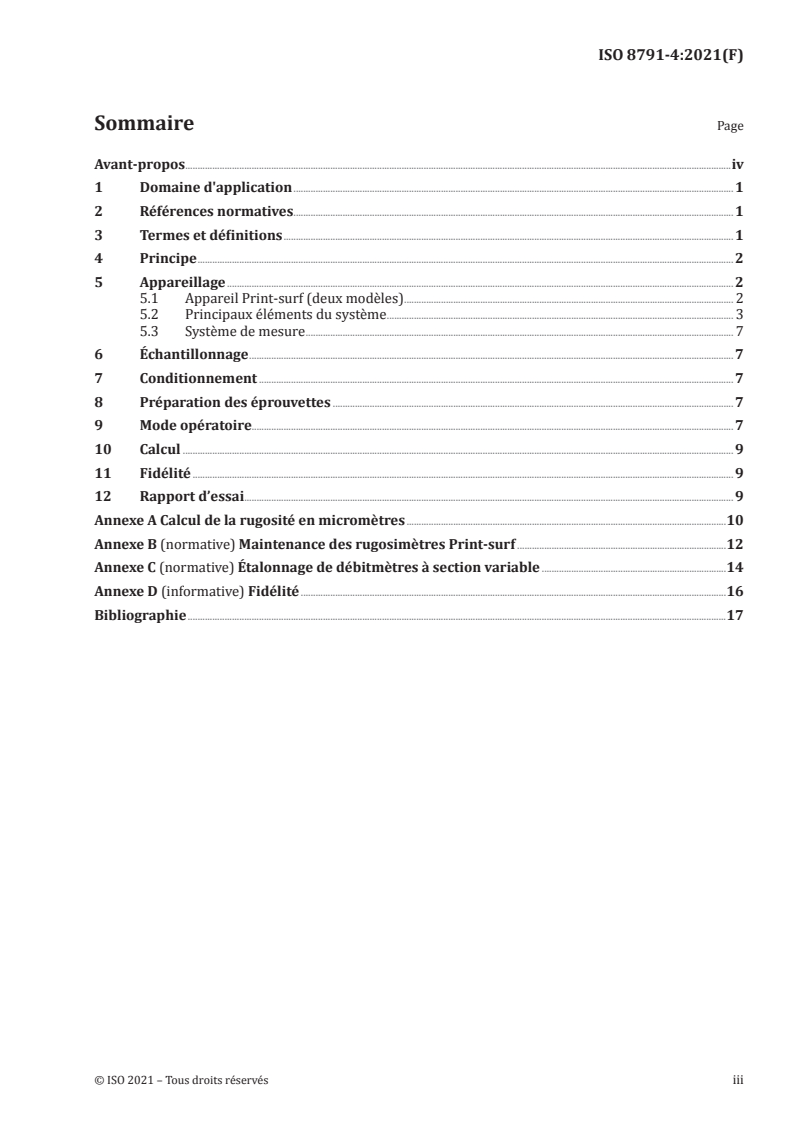

ISO 8791-4:2021 - Papier et carton — Détermination de la rugosité/du lissé (méthodes du débit d'air) — Partie 4: Méthode Print-surf/7/2021
Overview
ISO 8791-4:2021 - Paper and board: Determination of roughness/smoothness (air leak methods) - Part 4: Print‑surf method specifies the standardized Print‑surf method for measuring the surface roughness of printing papers and boards. The method quantifies the mean air gap between a flat circular measuring land and the sheet surface by measuring air flow or pressure drop. It applies where a substantially airtight seal can be formed against the sensing‑head guard lands.
Key topics and technical requirements
- Measurement principle: Air leak (Print‑surf) method - air flows across the measuring land; flow rate or pressure differential is converted to a roughness value expressed in micrometres.
- Instrument types:
- Variable‑area flowmeter: standard pressure (6.2 kPa or 19.6 kPa) across the measuring land; flowmeters calibrated to show the “cube root mean cube gap” (see Annex A).
- Impedance type: controlled pressure source and fluidic impedance with pressure transducers; typically displays 0.6 µm to 6.0 µm to 0.1 µm resolution.
- Sensing head geometry: three concentric annular lands - measuring land width 51.0 µm ± 1.5 µm, effective length 98.0 mm ± 0.5 mm; guard lands ≥ 1 000 µm; radial spacing between guard lands 152 µm ± 10 µm.
- Clamping pressures: standard clamping pressures of 980 kPa ± 30 kPa and 1 960 kPa ± 30 kPa (instrumentation and protective‑collar spring force must be accounted for).
- Backings: two resilient backings are specified:
- Soft backing: offset blanket assembly, ≈2 000 µm thick, apparent hardness 83 IRHD ± 6.
- Hard backing: polyester film assembly, apparent hardness 95 IRHD ± 2.
- Sampling and test pieces: sample selection per ISO 186; conditioning per ISO 187; at least 10 test pieces per side, 100 mm × 100 mm each.
- Calibration and maintenance: procedures and requirements for calibration (Annex C) and maintenance of testers (Annex B); precision data in Annex D.
Applications and users
- Primary use: objective measurement of surface roughness/smoothness to assess printability, ink transfer, and runnability for printing papers and boards.
- Who uses it:
- Paper and board manufacturers - quality control and specification verification.
- Printing houses and prepress labs - selecting substrates and optimizing press settings.
- Test labs and standards organizations - accredited roughness testing and inter‑laboratory comparisons.
- R&D teams - formulation, coating and surface treatment development.
- Practical value: provides repeatable, instrument‑based roughness metrics that correlate with tactile properties and printing performance; useful for acceptance criteria, process control and supplier communication.
Related standards
- ISO 186 - Sampling to determine average quality (referenced).
- ISO 187 - Standard atmosphere for conditioning and testing (referenced).
Keywords: ISO 8791-4:2021, Print‑surf method, paper roughness, air leak methods, roughness measurement, paper smoothness, printing paper testing, paper and board standards.
Relations
- Effective Date
- 30-Jun-2018
Buy Documents
ISO 8791-4:2021 - Paper and board -- Determination of roughness/smoothness (air leak methods)
ISO 8791-4:2021 - Paper and board — Determination of roughness/smoothness (air leak methods) — Part 4: Print-surf method/7/2021
ISO 8791-4:2021 - Papier et carton -- Détermination de la rugosité/du lissé (méthodes du débit d'air)
ISO 8791-4:2021 - Papier et carton — Détermination de la rugosité/du lissé (méthodes du débit d'air) — Partie 4: Méthode Print-surf/7/2021
Get Certified
Connect with accredited certification bodies for this standard

Control Union Certifications
Global certification for agriculture and sustainability.

Gozdarski inštitut Slovenije
Slovenian Forestry Institute. Forest management certification support, timber testing.
Sponsored listings
Frequently Asked Questions
ISO 8791-4:2021 is a standard published by the International Organization for Standardization (ISO). Its full title is "Paper and board — Determination of roughness/smoothness (air leak methods) — Part 4: Print-surf method". This standard covers: This document specifies a method for determining the roughness of paper and board using an apparatus which conforms to the Print-surf method, as defined in this document. It is applicable to all printing papers and boards with which it is possible to form a substantially airtight seal against the guard lands of the measuring head.
This document specifies a method for determining the roughness of paper and board using an apparatus which conforms to the Print-surf method, as defined in this document. It is applicable to all printing papers and boards with which it is possible to form a substantially airtight seal against the guard lands of the measuring head.
ISO 8791-4:2021 is classified under the following ICS (International Classification for Standards) categories: 85.060 - Paper and board. The ICS classification helps identify the subject area and facilitates finding related standards.
ISO 8791-4:2021 has the following relationships with other standards: It is inter standard links to ISO 8791-4:2007. Understanding these relationships helps ensure you are using the most current and applicable version of the standard.
ISO 8791-4:2021 is available in PDF format for immediate download after purchase. The document can be added to your cart and obtained through the secure checkout process. Digital delivery ensures instant access to the complete standard document.
Standards Content (Sample)
INTERNATIONAL ISO
STANDARD 8791-4
Third edition
2021-05
Paper and board — Determination
of roughness/smoothness (air leak
methods) —
Part 4:
Print-surf method
Papier et carton — Détermination de la rugosité/du lissé (méthodes
du débit d'air) —
Partie 4: Méthode Print-surf
Reference number
©
ISO 2021
© ISO 2021
All rights reserved. Unless otherwise specified, or required in the context of its implementation, no part of this publication may
be reproduced or utilized otherwise in any form or by any means, electronic or mechanical, including photocopying, or posting
on the internet or an intranet, without prior written permission. Permission can be requested from either ISO at the address
below or ISO’s member body in the country of the requester.
ISO copyright office
CP 401 • Ch. de Blandonnet 8
CH-1214 Vernier, Geneva
Phone: +41 22 749 01 11
Email: copyright@iso.org
Website: www.iso.org
Published in Switzerland
ii © ISO 2021 – All rights reserved
Contents Page
Foreword .iv
1 Scope . 1
2 Normative references . 1
3 Terms and definitions . 1
4 Principle . 1
5 Apparatus . 2
5.1 Print-surf tester (two types) . 2
5.2 Principal components of the system . 3
5.3 Measuring system . 7
6 Sampling . 7
7 Condition . 7
8 Preparation of test pieces . 7
9 Procedure. 7
10 Calculation . 9
11 Precision . 9
12 Test report . 9
Annex A Calculation of roughness in micrometres .10
Annex B (normative) Maintenance of Print-surf roughness testers .12
Annex C (normative) Calibration of variable-area flowmeters .14
Annex D (informative) Precision .16
Bibliography .17
Foreword
ISO (the International Organization for Standardization) is a worldwide federation of national standards
bodies (ISO member bodies). The work of preparing International Standards is normally carried out
through ISO technical committees. Each member body interested in a subject for which a technical
committee has been established has the right to be represented on that committee. International
organizations, governmental and non-governmental, in liaison with ISO, also take part in the work.
ISO collaborates closely with the International Electrotechnical Commission (IEC) on all matters of
electrotechnical standardization.
The procedures used to develop this document and those intended for its further maintenance are
described in the ISO/IEC Directives, Part 1. In particular, the different approval criteria needed for the
different types of ISO documents should be noted. This document was drafted in accordance with the
editorial rules of the ISO/IEC Directives, Part 2 (see www .iso .org/ directives).
Attention is drawn to the possibility that some of the elements of this document may be the subject of
patent rights. ISO shall not be held responsible for identifying any or all such patent rights. Details of
any patent rights identified during the development of the document will be in the Introduction and/or
on the ISO list of patent declarations received (see www .iso .org/ patents).
Any trade name used in this document is information given for the convenience of users and does not
constitute an endorsement.
For an explanation of the voluntary nature of standards, the meaning of ISO specific terms and
expressions related to conformity assessment, as well as information about ISO's adherence to the
World Trade Organization (WTO) principles in the Technical Barriers to Trade (TBT), see www .iso .org/
iso/ foreword .html.
This document was prepared by Technical Committee ISO/TC 6, Paper, board and pulps, Subcommittee
SC 2, Test methods and quality specifications for paper and board.
This third edition cancels and replaces the second edition (ISO 8791-4:2007), which has been technically
revised.
The main changes compared to the previous edition are as follows:
— Annex D and Annex E describing the calibration of Print-surf instruments have been removed;
— some minor editorial changes have been made.
A list of all parts in the ISO 8791 series can be found on the ISO website.
Any feedback or questions on this document should be directed to the user’s national standards body. A
complete listing of these bodies can be found at www .iso .org/ members .html.
iv © ISO 2021 – All rights reserved
INTERNATIONAL STANDARD ISO 8791-4:2021(E)
Paper and board — Determination of roughness/
smoothness (air leak methods) —
Part 4:
Print-surf method
1 Scope
This document specifies a method for determining the roughness of paper and board using an apparatus
which conforms to the Print-surf method, as defined in this document. It is applicable to all printing
papers and boards with which it is possible to form a substantially airtight seal against the guard lands
of the measuring head.
2 Normative references
The following documents are referred to in the text in such a way that some or all of their content
constitutes requirements of this document. For dated references, only the edition cited applies. For
undated references, the latest edition of the referenced document (including any amendments) applies.
ISO 186, Paper and board — Sampling to determine average quality
ISO 187, Paper, board and pulps — Standard atmosphere for conditioning and testing and procedure for
monitoring the atmosphere and conditioning of samples
3 Terms and definitions
For the purposes of this document, the following terms and definitions apply.
ISO and IEC maintain terminological databases for use in standardization at the following addresses:
— ISO Online browsing platform: available at https:// www .iso .org/ obp
— IEC Electropedia: available at http:// www .electropedia .org/
3.1
print-surf roughness
mean gap between a sheet of paper or board and a flat circular land pressed against it under specified
conditions
Note 1 to entry: The mean gap is expressed as the cube root mean cube gap calculated as specified in Annex A.
The Print-surf roughness is expressed directly as the average value of roughness, in micrometres.
3.2
print-surf compressibility
K
percentage decrease in surface roughness when measurements are made consecutively at the two
standard clamping pressures specified in this document
4 Principle
The test piece is placed between a circular flat metal sensing surface and a resilient backing, and inner
and outer circular lands form a seal with the test piece. Under the influence of a pressure difference,
air flows across the measuring land between the measuring land and the test piece. The rate of air
flow is measured on a variable-area flowmeter, or the pressure difference across the measuring land is
compared to the pressure difference across a known impedance. In both cases, the result is expressed
as the air gap, in micrometres.
5 Apparatus
5.1 Print-surf tester (two types)
5.1.1 Print-surf tester, which operates according to one of the following principles.
5.1.1.1 Variable-area flowmeter type, in which a standard pressure difference is created across the
measuring land and the air-flow rate is measured on a variable-area flowmeter. The air-flow rate varies
with roughness and the flow rate is converted to roughness, in micrometres. The flow diagram for this
type of instrument is shown in Figure 1.
Key
1 incoming air — 300 kPa to 600 kPa
2 filter
3 pressure-regulator valve
4 6,2 kPa or 19,6 kPa
5 on/off valve
6 flow indicator tubes
7 to atmosphere
8 sensing head and clamping device
Figure 1 — Flow diagram for variable-area flowmeter type
5.1.1.2 Impedance type, in which the air from the controlled pressure source passes first through
a fluidic impedance and then through the sensing head, after which it discharges to atmosphere.
The pressure differences across the fluidic impedance and across the land are each measured by a
2 © ISO 2021 – All rights reserved
transducer. These pressure differences vary with roughness and the signals are converted to roughness,
in micrometres. The flow diagram for this type of instrument is shown in Figure 2.
Key
1 incoming air — 300 kPa to 600 kPa
2 filter
3 pressure-regulator valve
4 19,6 kPa
5 fluidic impedance
6 pressure transducer
7 analogue signal
8 to atmosphere
9 sensing head and clamping device
Figure 2 — Flow diagram for impedance instrument type
5.1.2 The procedures for maintaining these testers in good working order given in Annex B apply.
5.2 Principal components of the system
5.2.1 Air supply, in which the air from the controlled pressure source passes first through a fluidic
impedance and then through a pressure transducer.
5.2.2 Sensing-head pressure regulator, allowing setting of the sensing-head differential pressure
to 19,6 kPa ± 0,1 kPa or, on variable-area flowmeter instruments only, to either 6,2 kPa ± 0,1 kPa or
19,6 kPa ± 0,1 kPa.
5.2.3 Sensing head, (see Figures 3 and 4), consisting of three concentric, annular lands composed
of suitable material which have coplanar, polished surfaces. The centre or measuring land shall be
51,0 µm ± 1,5 µm wide and have an effective length of 98,0 mm ± 0,5 mm. The two guard lands shall
each be at least 1 000 µm wide at any point, and the radial distance between them at any point shall be
152 µm ± 10 µm. The measuring land shall be centred between them to within ±10 µm.
The lands shall be mounted in an airtight mounting, constructed so that air can be passed into the gap
between one guard land and the measuring land, and exhausted from the gap between the measuring
land and the other guard land. The back of the mounting shall be flat and form a ground mating surface
with the flat surface of a manifold fitted with air inlet and outlet ports.
A spring-loaded protective collar may be fitted outside the guard lands. If such a protective collar is
fitted, the force exerted by the loading spring shall be taken into account when setting the clamping
pressure.
NOTE In many instruments fitted with the protective collar, the force exerted by the loading spring is 9,8 N.
Key
1 measuring land
2 guard lands
3 passage air connected to air supply
4 passage leading to flowmeters or atmosphere
5 fluidic impedance
Figure 3 — Plan of the measuring and guard lands of the sensing head
4 © ISO 2021 – All rights reserved
Key
1 paper
2 resilient backing
3 measuring land
4 regulated low-pressure air
5 to flowmeters or atmosphere
Figure 4 — The sensing head sectioned on two radii
5.2.4 Backing holders, consisting of rigid metal discs of known mass, each recessed to accommodate
a resilient backing at least 10 mm greater in diameter than the outside diameter of the outer guard land.
The mass of both the resilient backing and the holder shall be allowed for in the initial adjustment of the
clamping pressure.
It has been observed that high-stiffness papers and boards can interact negatively with the flat metal
backing holder and cause erroneously high roughness results. This problem can be solved by using
a modified backing holder which relieves those areas of the backing holder not directly below the
measuring land, as shown in Figure 5.
Key
1 resilient backing
2 paper
3 regulated low-pressure air
4 measuring lands
5 to flowmeters or atmosphere
6 new modified clamp platen showing machined cut-away
Figure 5 — The sensing head sectioned on two radii showing cut-away platen
5.2.5 Two resilient backings, of different types, which can be held in the recessed holders by means
of double-sided adhesive tape:
5.2.5.1 Soft backing, resilient, consisting of an offset printing blanket composed of a layer of synthetic
rubber, at least 600 µm thick, bonded to a fabric backing giving an overall thickness of 2 000 µm ± 200 µm.
The apparent hardness of the complete backing shall be 83 IRHD ± 6 IRHD (International Rubber
Hardness Degrees).
5.2.5.2 Hard backing, resilient, usually made from a polyester film bonded at its periphery to cork,
offset blanket or similar material. A small exhaust hole shall be provided to prevent air being trapped
between the film and the backing. The apparent hardness of the assembly shall be 95 IRHD ± 2 IRHD.
5.2.6 Clamping mechanism, allowing clamping of the resilient backing at pressures of either
980 kPa ± 30 kPa or 1960 kPa ± 30 kPa, the pressure being calculated from the total area of the measuring
and guard lands.
NOTE 1 On some earlier instruments, these values can be displayed on the gauge as 10 kgf/cm and 20 kgf/
cm .
6 © ISO 2021 – All rights reserved
Note that the spring loading in the protective collar (5.2.3) and the weight of the backing and its holder
need to be taken into account. The rate of clamping shall be such that the pressure reaches 90 % of its
final value in about 0,4 s, and 99 % of its final value in about
...
INTERNATIONAL ISO
STANDARD 8791-4
Third edition
2021-05
Paper and board — Determination
of roughness/smoothness (air leak
methods) —
Part 4:
Print-surf method
Papier et carton — Détermination de la rugosité/du lissé (méthodes
du débit d'air) —
Partie 4: Méthode Print-surf
Reference number
©
ISO 2021
© ISO 2021
All rights reserved. Unless otherwise specified, or required in the context of its implementation, no part of this publication may
be reproduced or utilized otherwise in any form or by any means, electronic or mechanical, including photocopying, or posting
on the internet or an intranet, without prior written permission. Permission can be requested from either ISO at the address
below or ISO’s member body in the country of the requester.
ISO copyright office
CP 401 • Ch. de Blandonnet 8
CH-1214 Vernier, Geneva
Phone: +41 22 749 01 11
Email: copyright@iso.org
Website: www.iso.org
Published in Switzerland
ii © ISO 2021 – All rights reserved
Contents Page
Foreword .iv
1 Scope . 1
2 Normative references . 1
3 Terms and definitions . 1
4 Principle . 1
5 Apparatus . 2
5.1 Print-surf tester (two types) . 2
5.2 Principal components of the system . 3
5.3 Measuring system . 7
6 Sampling . 7
7 Condition . 7
8 Preparation of test pieces . 7
9 Procedure. 7
10 Calculation . 9
11 Precision . 9
12 Test report . 9
Annex A Calculation of roughness in micrometres .10
Annex B (normative) Maintenance of Print-surf roughness testers .12
Annex C (normative) Calibration of variable-area flowmeters .14
Annex D (informative) Precision .16
Bibliography .17
Foreword
ISO (the International Organization for Standardization) is a worldwide federation of national standards
bodies (ISO member bodies). The work of preparing International Standards is normally carried out
through ISO technical committees. Each member body interested in a subject for which a technical
committee has been established has the right to be represented on that committee. International
organizations, governmental and non-governmental, in liaison with ISO, also take part in the work.
ISO collaborates closely with the International Electrotechnical Commission (IEC) on all matters of
electrotechnical standardization.
The procedures used to develop this document and those intended for its further maintenance are
described in the ISO/IEC Directives, Part 1. In particular, the different approval criteria needed for the
different types of ISO documents should be noted. This document was drafted in accordance with the
editorial rules of the ISO/IEC Directives, Part 2 (see www .iso .org/ directives).
Attention is drawn to the possibility that some of the elements of this document may be the subject of
patent rights. ISO shall not be held responsible for identifying any or all such patent rights. Details of
any patent rights identified during the development of the document will be in the Introduction and/or
on the ISO list of patent declarations received (see www .iso .org/ patents).
Any trade name used in this document is information given for the convenience of users and does not
constitute an endorsement.
For an explanation of the voluntary nature of standards, the meaning of ISO specific terms and
expressions related to conformity assessment, as well as information about ISO's adherence to the
World Trade Organization (WTO) principles in the Technical Barriers to Trade (TBT), see www .iso .org/
iso/ foreword .html.
This document was prepared by Technical Committee ISO/TC 6, Paper, board and pulps, Subcommittee
SC 2, Test methods and quality specifications for paper and board.
This third edition cancels and replaces the second edition (ISO 8791-4:2007), which has been technically
revised.
The main changes compared to the previous edition are as follows:
— Annex D and Annex E describing the calibration of Print-surf instruments have been removed;
— some minor editorial changes have been made.
A list of all parts in the ISO 8791 series can be found on the ISO website.
Any feedback or questions on this document should be directed to the user’s national standards body. A
complete listing of these bodies can be found at www .iso .org/ members .html.
iv © ISO 2021 – All rights reserved
INTERNATIONAL STANDARD ISO 8791-4:2021(E)
Paper and board — Determination of roughness/
smoothness (air leak methods) —
Part 4:
Print-surf method
1 Scope
This document specifies a method for determining the roughness of paper and board using an apparatus
which conforms to the Print-surf method, as defined in this document. It is applicable to all printing
papers and boards with which it is possible to form a substantially airtight seal against the guard lands
of the measuring head.
2 Normative references
The following documents are referred to in the text in such a way that some or all of their content
constitutes requirements of this document. For dated references, only the edition cited applies. For
undated references, the latest edition of the referenced document (including any amendments) applies.
ISO 186, Paper and board — Sampling to determine average quality
ISO 187, Paper, board and pulps — Standard atmosphere for conditioning and testing and procedure for
monitoring the atmosphere and conditioning of samples
3 Terms and definitions
For the purposes of this document, the following terms and definitions apply.
ISO and IEC maintain terminological databases for use in standardization at the following addresses:
— ISO Online browsing platform: available at https:// www .iso .org/ obp
— IEC Electropedia: available at http:// www .electropedia .org/
3.1
print-surf roughness
mean gap between a sheet of paper or board and a flat circular land pressed against it under specified
conditions
Note 1 to entry: The mean gap is expressed as the cube root mean cube gap calculated as specified in Annex A.
The Print-surf roughness is expressed directly as the average value of roughness, in micrometres.
3.2
print-surf compressibility
K
percentage decrease in surface roughness when measurements are made consecutively at the two
standard clamping pressures specified in this document
4 Principle
The test piece is placed between a circular flat metal sensing surface and a resilient backing, and inner
and outer circular lands form a seal with the test piece. Under the influence of a pressure difference,
air flows across the measuring land between the measuring land and the test piece. The rate of air
flow is measured on a variable-area flowmeter, or the pressure difference across the measuring land is
compared to the pressure difference across a known impedance. In both cases, the result is expressed
as the air gap, in micrometres.
5 Apparatus
5.1 Print-surf tester (two types)
5.1.1 Print-surf tester, which operates according to one of the following principles.
5.1.1.1 Variable-area flowmeter type, in which a standard pressure difference is created across the
measuring land and the air-flow rate is measured on a variable-area flowmeter. The air-flow rate varies
with roughness and the flow rate is converted to roughness, in micrometres. The flow diagram for this
type of instrument is shown in Figure 1.
Key
1 incoming air — 300 kPa to 600 kPa
2 filter
3 pressure-regulator valve
4 6,2 kPa or 19,6 kPa
5 on/off valve
6 flow indicator tubes
7 to atmosphere
8 sensing head and clamping device
Figure 1 — Flow diagram for variable-area flowmeter type
5.1.1.2 Impedance type, in which the air from the controlled pressure source passes first through
a fluidic impedance and then through the sensing head, after which it discharges to atmosphere.
The pressure differences across the fluidic impedance and across the land are each measured by a
2 © ISO 2021 – All rights reserved
transducer. These pressure differences vary with roughness and the signals are converted to roughness,
in micrometres. The flow diagram for this type of instrument is shown in Figure 2.
Key
1 incoming air — 300 kPa to 600 kPa
2 filter
3 pressure-regulator valve
4 19,6 kPa
5 fluidic impedance
6 pressure transducer
7 analogue signal
8 to atmosphere
9 sensing head and clamping device
Figure 2 — Flow diagram for impedance instrument type
5.1.2 The procedures for maintaining these testers in good working order given in Annex B apply.
5.2 Principal components of the system
5.2.1 Air supply, in which the air from the controlled pressure source passes first through a fluidic
impedance and then through a pressure transducer.
5.2.2 Sensing-head pressure regulator, allowing setting of the sensing-head differential pressure
to 19,6 kPa ± 0,1 kPa or, on variable-area flowmeter instruments only, to either 6,2 kPa ± 0,1 kPa or
19,6 kPa ± 0,1 kPa.
5.2.3 Sensing head, (see Figures 3 and 4), consisting of three concentric, annular lands composed
of suitable material which have coplanar, polished surfaces. The centre or measuring land shall be
51,0 µm ± 1,5 µm wide and have an effective length of 98,0 mm ± 0,5 mm. The two guard lands shall
each be at least 1 000 µm wide at any point, and the radial distance between them at any point shall be
152 µm ± 10 µm. The measuring land shall be centred between them to within ±10 µm.
The lands shall be mounted in an airtight mounting, constructed so that air can be passed into the gap
between one guard land and the measuring land, and exhausted from the gap between the measuring
land and the other guard land. The back of the mounting shall be flat and form a ground mating surface
with the flat surface of a manifold fitted with air inlet and outlet ports.
A spring-loaded protective collar may be fitted outside the guard lands. If such a protective collar is
fitted, the force exerted by the loading spring shall be taken into account when setting the clamping
pressure.
NOTE In many instruments fitted with the protective collar, the force exerted by the loading spring is 9,8 N.
Key
1 measuring land
2 guard lands
3 passage air connected to air supply
4 passage leading to flowmeters or atmosphere
5 fluidic impedance
Figure 3 — Plan of the measuring and guard lands of the sensing head
4 © ISO 2021 – All rights reserved
Key
1 paper
2 resilient backing
3 measuring land
4 regulated low-pressure air
5 to flowmeters or atmosphere
Figure 4 — The sensing head sectioned on two radii
5.2.4 Backing holders, consisting of rigid metal discs of known mass, each recessed to accommodate
a resilient backing at least 10 mm greater in diameter than the outside diameter of the outer guard land.
The mass of both the resilient backing and the holder shall be allowed for in the initial adjustment of the
clamping pressure.
It has been observed that high-stiffness papers and boards can interact negatively with the flat metal
backing holder and cause erroneously high roughness results. This problem can be solved by using
a modified backing holder which relieves those areas of the backing holder not directly below the
measuring land, as shown in Figure 5.
Key
1 resilient backing
2 paper
3 regulated low-pressure air
4 measuring lands
5 to flowmeters or atmosphere
6 new modified clamp platen showing machined cut-away
Figure 5 — The sensing head sectioned on two radii showing cut-away platen
5.2.5 Two resilient backings, of different types, which can be held in the recessed holders by means
of double-sided adhesive tape:
5.2.5.1 Soft backing, resilient, consisting of an offset printing blanket composed of a layer of synthetic
rubber, at least 600 µm thick, bonded to a fabric backing giving an overall thickness of 2 000 µm ± 200 µm.
The apparent hardness of the complete backing shall be 83 IRHD ± 6 IRHD (International Rubber
Hardness Degrees).
5.2.5.2 Hard backing, resilient, usually made from a polyester film bonded at its periphery to cork,
offset blanket or similar material. A small exhaust hole shall be provided to prevent air being trapped
between the film and the backing. The apparent hardness of the assembly shall be 95 IRHD ± 2 IRHD.
5.2.6 Clamping mechanism, allowing clamping of the resilient backing at pressures of either
980 kPa ± 30 kPa or 1960 kPa ± 30 kPa, the pressure being calculated from the total area of the measuring
and guard lands.
NOTE 1 On some earlier instruments, these values can be displayed on the gauge as 10 kgf/cm and 20 kgf/
cm .
6 © ISO 2021 – All rights reserved
Note that the spring loading in the protective collar (5.2.3) and the weight of the backing and its holder
need to be taken into account. The rate of clamping shall be such that the pressure reaches 90 % of its
final value in about 0,4 s, and 99 % of its final value in about
...
NORME ISO
INTERNATIONALE 8791-4
Troisième édition
2021-05
Papier et carton — Détermination
de la rugosité/du lissé (méthodes du
débit d'air) —
Partie 4:
Méthode Print-surf
Paper and board — Determination of roughness/smoothness (air
leak methods) —
Part 4: Print-surf method
Numéro de référence
©
ISO 2021
DOCUMENT PROTÉGÉ PAR COPYRIGHT
© ISO 2021
Tous droits réservés. Sauf prescription différente ou nécessité dans le contexte de sa mise en œuvre, aucune partie de cette
publication ne peut être reproduite ni utilisée sous quelque forme que ce soit et par aucun procédé, électronique ou mécanique,
y compris la photocopie, ou la diffusion sur l’internet ou sur un intranet, sans autorisation écrite préalable. Une autorisation peut
être demandée à l’ISO à l’adresse ci-après ou au comité membre de l’ISO dans le pays du demandeur.
ISO copyright office
Case postale 401 • Ch. de Blandonnet 8
CH-1214 Vernier, Genève
Tél.: +41 22 749 01 11
E-mail: copyright@iso.org
Web: www.iso.org
Publié en Suisse
ii © ISO 2021 – Tous droits réservés
Sommaire Page
Avant-propos .iv
1 Domaine d'application . 1
2 Références normatives . 1
3 Termes et définitions . 1
4 Principe . 2
5 Appareillage . 2
5.1 Appareil Print-surf (deux modèles) . 2
5.2 Principaux éléments du système . 3
5.3 Système de mesure . 7
6 Échantillonnage . 7
7 Conditionnement . 7
8 Préparation des éprouvettes . 7
9 Mode opératoire. 7
10 Calcul . 9
11 Fidélité . 9
12 Rapport d’essai . 9
Annexe A Calcul de la rugosité en micromètres .10
Annexe B (normative) Maintenance des rugosimètres Print-surf .12
Annexe C (normative) Étalonnage de débitmètres à section variable .14
Annexe D (informative) Fidélité .16
Bibliographie .17
Avant-propos
L'ISO (Organisation internationale de normalisation) est une fédération mondiale d'organismes
nationaux de normalisation (comités membres de l'ISO). L'élaboration des Normes internationales est
en général confiée aux comités techniques de l'ISO. Chaque comité membre intéressé par une étude
a le droit de faire partie du comité technique créé à cet effet. Les organisations internationales,
gouvernementales et non gouvernementales, en liaison avec l'ISO participent également aux travaux.
L'ISO collabore étroitement avec la Commission électrotechnique internationale (IEC) en ce qui
concerne la normalisation électrotechnique.
Les procédures utilisées pour élaborer le présent document et celles destinées à sa mise à jour sont
décrites dans les Directives ISO/IEC, Partie 1. Il convient, en particulier, de prendre note des différents
critères d'approbation requis pour les différents types de documents ISO. Le présent document a été
rédigé conformément aux règles de rédaction données dans les Directives ISO/IEC, Partie 2 (voir www
.iso .org/ directives).
L'attention est attirée sur le fait que certains des éléments du présent document peuvent faire l'objet de
droits de propriété intellectuelle ou de droits analogues. L'ISO ne saurait être tenue pour responsable
de ne pas avoir identifié de tels droits de propriété et averti de leur existence. Les détails concernant
les références aux droits de propriété intellectuelle ou autres droits analogues identifiés lors de
l'élaboration du document sont indiqués dans l'Introduction et/ou dans la liste des déclarations de
brevets reçues par l'ISO (voir www .iso .org/ brevets).
Les appellations commerciales éventuellement mentionnées dans le présent document sont données
pour information, par souci de commodité, à l’intention des utilisateurs et ne sauraient constituer un
engagement.
Pour une explication de la nature volontaire des normes, la signification des termes et expressions
spécifiques de l'ISO liés à l'évaluation de la conformité, ou pour toute information au sujet de l'adhésion
de l'ISO aux principes de l’Organisation mondiale du commerce (OMC) concernant les obstacles
techniques au commerce (OTC), voir www .iso .org/ avant -propos.
Le présent document a été élaboré par le comité technique ISO/TC 6, Papiers, cartons et pâtes, sous-
comité SC 2, Méthodes d'essais et spécifications de qualité des papiers et cartons.
Cette troisième édition annule et remplace la deuxième édition (ISO 8791-4:2007), qui a fait l'objet
d'une révision technique.
Les principales modifications par rapport à l’édition précédente sont les suivantes:
— l'Annexe D et l’Annexe E décrivant l'étalonnage des instruments Print-surf ont été supprimées;
— quelques modifications rédactionnelles mineures ont été apportées.
Une liste de toutes les parties de la série ISO 8791 se trouve sur le site web de l’ISO.
Il convient que l’utilisateur adresse tout retour d’information ou toute question concernant le présent
document à l’organisme national de normalisation de son pays. Une liste exhaustive desdits organismes
se trouve à l’adresse www .iso .org/ fr/ members .html.
iv © ISO 2021 – Tous droits réservés
NORME INTERNATIONALE ISO 8791-4:2021(F)
Papier et carton — Détermination de la rugosité/du lissé
(méthodes du débit d'air) —
Partie 4:
Méthode Print-surf
1 Domaine d'application
Le présent document spécifie une méthode de détermination de la rugosité du papier et du carton à
l'aide d'un appareil conforme à la méthode Print-surf, telle que définie dans le présent document.
Elle s'applique à tous les papiers et cartons d'impression permettant de former un joint sensiblement
étanche à l'air contre les anneaux de sécurité de la tête de mesure.
2 Références normatives
Les documents suivants sont cités dans le texte de sorte qu’ils constituent, pour tout ou partie de leur
contenu, des exigences du présent document. Pour les références datées, seule l’édition citée s’applique.
Pour les références non datées, la dernière édition du document de référence s'applique (y compris les
éventuels amendements).
ISO 186, Papier et carton — Échantillonnage pour déterminer la qualité moyenne
ISO 187, Papier, carton et pâtes — Atmosphère normale de conditionnement et d'essai et méthode de
surveillance de l'atmosphère et de conditionnement des échantillons
3 Termes et définitions
Pour les besoins du présent document, les termes et définitions suivants s’appliquent.
L’ISO et l’IEC tiennent à jour des bases de données terminologiques destinées à être utilisées en
normalisation, consultables aux adresses suivantes:
— ISO Online browsing platform: disponible à l’adresse https:// www .iso .org/ obp
— IEC Electropedia: disponible à l’adresse http:// www .electropedia .org/
3.1
rugosité Print-surf
interstice moyen entre une feuille de papier ou de carton et un anneau circulaire plat exerçant une
pression contre celle-ci dans des conditions spécifiées
Note 1 à l'article: L'interstice moyen est exprimé par la racine cubique de l'interstice cubique moyen calculée
comme spécifié dans l'Annexe A. La rugosité Print-surf est exprimée directement par la valeur moyenne de la
rugosité, en micromètres.
3.2
compressibilité Print-surf
K
pourcentage de diminution de la rugosité de surface lorsque des mesurages consécutifs sont effectués
aux deux pressions de serrage standard spécifiées dans le présent document
4 Principe
L'éprouvette est placée entre une surface métallique circulaire plane de détection et un fond résilient, et
les anneaux circulaires interne et externe forment un joint avec l'éprouvette. Sous l'effet d'une différence
de pression, l'air s'écoule à travers l'anneau de mesure entre l'anneau de mesure et l'éprouvette. Le débit
de l'air est mesuré sur un débitmètre à section variable, ou la différence de pression à travers l'anneau
de mesure est comparée à la différence de pression à travers une impédance connue. Dans les deux cas,
le résultat est exprimé par l'interstice d'air, en micromètres.
5 Appareillage
5.1 Appareil Print-surf (deux modèles)
5.1.1 Appareil Print-surf, qui fonctionne selon l'un des principes suivants.
5.1.1.1 Instrument du type débitmètre à section variable, dans lequel une différence de pression
standard est créée à travers l'anneau de mesure et le débit d'air est mesuré sur un débitmètre à section
variable. Le débit d'air varie en fonction de la rugosité et le débit est converti en rugosité, en micromètres.
La représentation schématique pour ce type d'instrument est présentée sur la Figure 1.
Légende
1 air entrant — 300 kPa à 600 kPa
2 filtre
3 soupape de régulation de pression
4 6,2 kPa ou 19,6 kPa
5 soupape de marche/arrêt
6 tubes indicateurs de débit
7 vers l'atmosphère
8 tête de détection et dispositif de serrage
Figure 1 — Représentation schématique pour l'instrument du type débitmètre à section
variable
5.1.1.2 Instrument du type à impédance, dans lequel l'air provenant de la source de pression
contrôlée traverse tout d'abord une impédance fluidique puis une tête de détection, avant d'être évacué
vers l'atmosphère. Les différences de pression à travers l'impédance fluidique et à travers l'anneau sont
chacune mesurées par un transducteur. Ces différences de pression varient en fonction de la rugosité
2 © ISO 2021 – Tous droits réservés
et les signaux sont convertis en rugosité, en micromètres. La représentation schématique pour ce type
d'instrument est présentée sur la Figure 2.
Légende
1 air entrant — 300 kPa à 600 kPa
2 filtre
3 soupape de régulation de pression
4 19,6 kPa
5 impédance fluidique
6 transducteur de pression
7 signal analogique
8 vers l'atmosphère
9 tête de détection et dispositif de serrage
Figure 2 — Représentation schématique pour l'instrument du type à impédance
5.1.2 Les procédures suivies pour maintenir ces appareils pour essais en bon état de marche sont
indiquées dans l'Annexe B.
5.2 Principaux éléments du système
5.2.1 Système d'alimentation en air, dans lequel l'air provenant de la source de pression contrôlée
traverse tout d'abord une impédance fluidique puis un transducteur de pression.
5.2.2 Régulateur de pression de la tête de détection, permettant le réglage de la pression
différentielle de la tête de détection à 19,6 kPa ± 0,1 kPa ou, sur les instruments du type débitmètre à
section variable uniquement, soit à 6,2 kPa ± 0,1 kPa, soit à 19,6 kPa ± 0,1 kPa.
5.2.3 Tête de détection, (voir Figures 3 et 4), constituée de trois anneaux concentriques composés
d'un matériau approprié et ayant des surfaces polies coplanaires. L'anneau central ou anneau de mesure
doit avoir une largeur de 51,0 µm ± 1,5 µm et une longueur effective de 98,0 mm ± 0,5 mm. Les deux
anneaux de sécurité doivent chacun avoir une largeur d'au moins 1 000 µm en tout point, et la distance
radiale entre eux en tout point doit être de 152 µm ± 10 µm. L'anneau de mesure doit être centré entre
eux à ± 10 µm.
Les anneaux doivent être montés d'une manière étanche à l'air permettant le passage de l'air dans
l'interstice entre un anneau de sécurité et l'anneau de mesure et son évacuation par l'interstice entre
l'anneau de mesure et l'autre anneau de sécurité. Le dos du dispositif de montage doit être plat et former
une surface de contact avec la surface plane d'un manifold doté d'orifices d'entrée et de sortie d'air.
Un collier de protection à ressort peut être installé à l'extérieur des anneaux de sécurité. Si un tel collier
de protection est installé, la force exercée par le ressort de chargement doit être prise en compte lors du
réglage de la pression de serrage.
NOTE Dans de nombreux instruments équipés du collier de protection, la force exercée par le ressort de
chargement est de 9,8 N.
Légende
1 anneau de mesure
2 anneaux de sécurité
3 passage d'air raccordé à l'alimentation en air
4 passage menant aux débitmètres ou à l'atmosphère
5 impédance fluidique
Figure 3 — Plan des anneaux de mesure et de sécurité de la tête de détection
4 © ISO 2021 – Tous droits réservés
Légende
1 papier
2 fond résilient
3 anneau de mesure
4 air à basse pression régulée
5 vers les débitmètres ou l'atmosphère
Figure 4 — Tête de détection en section transversale suivant deux rayons
5.2.4 Supports de fond, constitués de disques métalliques rigides de masse connue, chacun évidé pour
recevoir un fond résilient d'un diamètre au moins 10 mm supérieur au diamètre extérieur de l'anneau
de sécurité externe. La masse du fond résilient et du support doit être prévue dans l'ajustage initial de la
pression de serrage.
Il a été observé que les papiers et cartons à rigidité élevée peuvent présenter une interaction négative
avec le support de fond métallique plat et conduire à des résultats indiquant une rugosité faussement
élevée. Ce problème peut être résolu à l'aide d'un support de fond modifié qui libère les zones du support
de fond qui ne sont pas situées directement sous l'anneau de mesure, tel qu'indiqué sur la Figure 5.
Légende
1 fond résilient
2 papier
3 air à basse pression régulée
4 anneaux de mesure
5 vers les débitmètres ou l'atmosphère
6 nouvelle platine de serrage modifiée montrant une découpe usinée
Figure 5 — Tête de détection en section transversale suivant deux rayons montrant une
découpe usinée
5.2.5 Deux fonds résilients, de différents types, pouvant être maintenus dans les supports évidés à
l'aide d'un ruban adhésif double face.
5.2.5.1 Fond souple, résilient, constitué d’un blanchet d’impression offset composé d'une couche de
caoutchouc synthétique, d'au moins 600 µm d'épaisseur, collée à un fond en tissu, ayant une épaisseur
globale de 2 000 µm ± 200 µm. La dureté apparente du fond complet doit être de 83 IRHD ± 6 IRHD
(International Rubber Hardness Degrees).
5.2.5.2 Fond rigide, résilient, habituellement constitué d'un film polyester sur la périphérie duquel
est collé du liège, un blanchet offset ou un matériau similaire. Un petit trou d'échappement doit être
prévu pour empêcher le piégeage de l'air entre le film et le fond. La dureté apparente de l'ensemble doit
être de 95 IRHD ± 2 IRHD.
5.2.6 Mécanisme de serrage, permettant le serrage du fond résilient à des pressions
de 980 kPa ± 30 kPa ou de 1 960 kPa ± 30 kPa, la pression étant calculée d'après la surface totale des
anneaux de mesure et de sécurité.
NOTE 1 Sur certains instruments des anciennes générations, les valeurs correspondantes affichées sur le
2 2
manomètre peuvent être 10 kgf/cm et 20 kgf/cm .
6 © ISO 2021 – Tous droits réservés
Il est à noter que la charge du ressort dans le collier à ressort (5.2.3) et le poids du fond et de son support
doivent être pris en compte. Le taux de serrage doit être tel que la pression atteint 90 % de sa valeur
finale en environ 0,4 s, et 99 % de sa valeur finale en environ 0,8 s.
NOTE 2 Une troisième pression de 490 kPa (5 kgf/cm ) est disponible sur la plupart des instruments, mais
ne doit pas être appliquée dans le cadre du présent document en raison d'une tendance de l'air à fuir sous les
anneaux de sécurité.
Les systèmes de mesure par débitmètre à section variable doivent comporter un manomètre installé
sur l'instru
...
NORME ISO
INTERNATIONALE 8791-4
Troisième édition
2021-05
Papier et carton — Détermination
de la rugosité/du lissé (méthodes du
débit d'air) —
Partie 4:
Méthode Print-surf
Paper and board — Determination of roughness/smoothness (air
leak methods) —
Part 4: Print-surf method
Numéro de référence
©
ISO 2021
DOCUMENT PROTÉGÉ PAR COPYRIGHT
© ISO 2021
Tous droits réservés. Sauf prescription différente ou nécessité dans le contexte de sa mise en œuvre, aucune partie de cette
publication ne peut être reproduite ni utilisée sous quelque forme que ce soit et par aucun procédé, électronique ou mécanique,
y compris la photocopie, ou la diffusion sur l’internet ou sur un intranet, sans autorisation écrite préalable. Une autorisation peut
être demandée à l’ISO à l’adresse ci-après ou au comité membre de l’ISO dans le pays du demandeur.
ISO copyright office
Case postale 401 • Ch. de Blandonnet 8
CH-1214 Vernier, Genève
Tél.: +41 22 749 01 11
E-mail: copyright@iso.org
Web: www.iso.org
Publié en Suisse
ii © ISO 2021 – Tous droits réservés
Sommaire Page
Avant-propos .iv
1 Domaine d'application . 1
2 Références normatives . 1
3 Termes et définitions . 1
4 Principe . 2
5 Appareillage . 2
5.1 Appareil Print-surf (deux modèles) . 2
5.2 Principaux éléments du système . 3
5.3 Système de mesure . 7
6 Échantillonnage . 7
7 Conditionnement . 7
8 Préparation des éprouvettes . 7
9 Mode opératoire. 7
10 Calcul . 9
11 Fidélité . 9
12 Rapport d’essai . 9
Annexe A Calcul de la rugosité en micromètres .10
Annexe B (normative) Maintenance des rugosimètres Print-surf .12
Annexe C (normative) Étalonnage de débitmètres à section variable .14
Annexe D (informative) Fidélité .16
Bibliographie .17
Avant-propos
L'ISO (Organisation internationale de normalisation) est une fédération mondiale d'organismes
nationaux de normalisation (comités membres de l'ISO). L'élaboration des Normes internationales est
en général confiée aux comités techniques de l'ISO. Chaque comité membre intéressé par une étude
a le droit de faire partie du comité technique créé à cet effet. Les organisations internationales,
gouvernementales et non gouvernementales, en liaison avec l'ISO participent également aux travaux.
L'ISO collabore étroitement avec la Commission électrotechnique internationale (IEC) en ce qui
concerne la normalisation électrotechnique.
Les procédures utilisées pour élaborer le présent document et celles destinées à sa mise à jour sont
décrites dans les Directives ISO/IEC, Partie 1. Il convient, en particulier, de prendre note des différents
critères d'approbation requis pour les différents types de documents ISO. Le présent document a été
rédigé conformément aux règles de rédaction données dans les Directives ISO/IEC, Partie 2 (voir www
.iso .org/ directives).
L'attention est attirée sur le fait que certains des éléments du présent document peuvent faire l'objet de
droits de propriété intellectuelle ou de droits analogues. L'ISO ne saurait être tenue pour responsable
de ne pas avoir identifié de tels droits de propriété et averti de leur existence. Les détails concernant
les références aux droits de propriété intellectuelle ou autres droits analogues identifiés lors de
l'élaboration du document sont indiqués dans l'Introduction et/ou dans la liste des déclarations de
brevets reçues par l'ISO (voir www .iso .org/ brevets).
Les appellations commerciales éventuellement mentionnées dans le présent document sont données
pour information, par souci de commodité, à l’intention des utilisateurs et ne sauraient constituer un
engagement.
Pour une explication de la nature volontaire des normes, la signification des termes et expressions
spécifiques de l'ISO liés à l'évaluation de la conformité, ou pour toute information au sujet de l'adhésion
de l'ISO aux principes de l’Organisation mondiale du commerce (OMC) concernant les obstacles
techniques au commerce (OTC), voir www .iso .org/ avant -propos.
Le présent document a été élaboré par le comité technique ISO/TC 6, Papiers, cartons et pâtes, sous-
comité SC 2, Méthodes d'essais et spécifications de qualité des papiers et cartons.
Cette troisième édition annule et remplace la deuxième édition (ISO 8791-4:2007), qui a fait l'objet
d'une révision technique.
Les principales modifications par rapport à l’édition précédente sont les suivantes:
— l'Annexe D et l’Annexe E décrivant l'étalonnage des instruments Print-surf ont été supprimées;
— quelques modifications rédactionnelles mineures ont été apportées.
Une liste de toutes les parties de la série ISO 8791 se trouve sur le site web de l’ISO.
Il convient que l’utilisateur adresse tout retour d’information ou toute question concernant le présent
document à l’organisme national de normalisation de son pays. Une liste exhaustive desdits organismes
se trouve à l’adresse www .iso .org/ fr/ members .html.
iv © ISO 2021 – Tous droits réservés
NORME INTERNATIONALE ISO 8791-4:2021(F)
Papier et carton — Détermination de la rugosité/du lissé
(méthodes du débit d'air) —
Partie 4:
Méthode Print-surf
1 Domaine d'application
Le présent document spécifie une méthode de détermination de la rugosité du papier et du carton à
l'aide d'un appareil conforme à la méthode Print-surf, telle que définie dans le présent document.
Elle s'applique à tous les papiers et cartons d'impression permettant de former un joint sensiblement
étanche à l'air contre les anneaux de sécurité de la tête de mesure.
2 Références normatives
Les documents suivants sont cités dans le texte de sorte qu’ils constituent, pour tout ou partie de leur
contenu, des exigences du présent document. Pour les références datées, seule l’édition citée s’applique.
Pour les références non datées, la dernière édition du document de référence s'applique (y compris les
éventuels amendements).
ISO 186, Papier et carton — Échantillonnage pour déterminer la qualité moyenne
ISO 187, Papier, carton et pâtes — Atmosphère normale de conditionnement et d'essai et méthode de
surveillance de l'atmosphère et de conditionnement des échantillons
3 Termes et définitions
Pour les besoins du présent document, les termes et définitions suivants s’appliquent.
L’ISO et l’IEC tiennent à jour des bases de données terminologiques destinées à être utilisées en
normalisation, consultables aux adresses suivantes:
— ISO Online browsing platform: disponible à l’adresse https:// www .iso .org/ obp
— IEC Electropedia: disponible à l’adresse http:// www .electropedia .org/
3.1
rugosité Print-surf
interstice moyen entre une feuille de papier ou de carton et un anneau circulaire plat exerçant une
pression contre celle-ci dans des conditions spécifiées
Note 1 à l'article: L'interstice moyen est exprimé par la racine cubique de l'interstice cubique moyen calculée
comme spécifié dans l'Annexe A. La rugosité Print-surf est exprimée directement par la valeur moyenne de la
rugosité, en micromètres.
3.2
compressibilité Print-surf
K
pourcentage de diminution de la rugosité de surface lorsque des mesurages consécutifs sont effectués
aux deux pressions de serrage standard spécifiées dans le présent document
4 Principe
L'éprouvette est placée entre une surface métallique circulaire plane de détection et un fond résilient, et
les anneaux circulaires interne et externe forment un joint avec l'éprouvette. Sous l'effet d'une différence
de pression, l'air s'écoule à travers l'anneau de mesure entre l'anneau de mesure et l'éprouvette. Le débit
de l'air est mesuré sur un débitmètre à section variable, ou la différence de pression à travers l'anneau
de mesure est comparée à la différence de pression à travers une impédance connue. Dans les deux cas,
le résultat est exprimé par l'interstice d'air, en micromètres.
5 Appareillage
5.1 Appareil Print-surf (deux modèles)
5.1.1 Appareil Print-surf, qui fonctionne selon l'un des principes suivants.
5.1.1.1 Instrument du type débitmètre à section variable, dans lequel une différence de pression
standard est créée à travers l'anneau de mesure et le débit d'air est mesuré sur un débitmètre à section
variable. Le débit d'air varie en fonction de la rugosité et le débit est converti en rugosité, en micromètres.
La représentation schématique pour ce type d'instrument est présentée sur la Figure 1.
Légende
1 air entrant — 300 kPa à 600 kPa
2 filtre
3 soupape de régulation de pression
4 6,2 kPa ou 19,6 kPa
5 soupape de marche/arrêt
6 tubes indicateurs de débit
7 vers l'atmosphère
8 tête de détection et dispositif de serrage
Figure 1 — Représentation schématique pour l'instrument du type débitmètre à section
variable
5.1.1.2 Instrument du type à impédance, dans lequel l'air provenant de la source de pression
contrôlée traverse tout d'abord une impédance fluidique puis une tête de détection, avant d'être évacué
vers l'atmosphère. Les différences de pression à travers l'impédance fluidique et à travers l'anneau sont
chacune mesurées par un transducteur. Ces différences de pression varient en fonction de la rugosité
2 © ISO 2021 – Tous droits réservés
et les signaux sont convertis en rugosité, en micromètres. La représentation schématique pour ce type
d'instrument est présentée sur la Figure 2.
Légende
1 air entrant — 300 kPa à 600 kPa
2 filtre
3 soupape de régulation de pression
4 19,6 kPa
5 impédance fluidique
6 transducteur de pression
7 signal analogique
8 vers l'atmosphère
9 tête de détection et dispositif de serrage
Figure 2 — Représentation schématique pour l'instrument du type à impédance
5.1.2 Les procédures suivies pour maintenir ces appareils pour essais en bon état de marche sont
indiquées dans l'Annexe B.
5.2 Principaux éléments du système
5.2.1 Système d'alimentation en air, dans lequel l'air provenant de la source de pression contrôlée
traverse tout d'abord une impédance fluidique puis un transducteur de pression.
5.2.2 Régulateur de pression de la tête de détection, permettant le réglage de la pression
différentielle de la tête de détection à 19,6 kPa ± 0,1 kPa ou, sur les instruments du type débitmètre à
section variable uniquement, soit à 6,2 kPa ± 0,1 kPa, soit à 19,6 kPa ± 0,1 kPa.
5.2.3 Tête de détection, (voir Figures 3 et 4), constituée de trois anneaux concentriques composés
d'un matériau approprié et ayant des surfaces polies coplanaires. L'anneau central ou anneau de mesure
doit avoir une largeur de 51,0 µm ± 1,5 µm et une longueur effective de 98,0 mm ± 0,5 mm. Les deux
anneaux de sécurité doivent chacun avoir une largeur d'au moins 1 000 µm en tout point, et la distance
radiale entre eux en tout point doit être de 152 µm ± 10 µm. L'anneau de mesure doit être centré entre
eux à ± 10 µm.
Les anneaux doivent être montés d'une manière étanche à l'air permettant le passage de l'air dans
l'interstice entre un anneau de sécurité et l'anneau de mesure et son évacuation par l'interstice entre
l'anneau de mesure et l'autre anneau de sécurité. Le dos du dispositif de montage doit être plat et former
une surface de contact avec la surface plane d'un manifold doté d'orifices d'entrée et de sortie d'air.
Un collier de protection à ressort peut être installé à l'extérieur des anneaux de sécurité. Si un tel collier
de protection est installé, la force exercée par le ressort de chargement doit être prise en compte lors du
réglage de la pression de serrage.
NOTE Dans de nombreux instruments équipés du collier de protection, la force exercée par le ressort de
chargement est de 9,8 N.
Légende
1 anneau de mesure
2 anneaux de sécurité
3 passage d'air raccordé à l'alimentation en air
4 passage menant aux débitmètres ou à l'atmosphère
5 impédance fluidique
Figure 3 — Plan des anneaux de mesure et de sécurité de la tête de détection
4 © ISO 2021 – Tous droits réservés
Légende
1 papier
2 fond résilient
3 anneau de mesure
4 air à basse pression régulée
5 vers les débitmètres ou l'atmosphère
Figure 4 — Tête de détection en section transversale suivant deux rayons
5.2.4 Supports de fond, constitués de disques métalliques rigides de masse connue, chacun évidé pour
recevoir un fond résilient d'un diamètre au moins 10 mm supérieur au diamètre extérieur de l'anneau
de sécurité externe. La masse du fond résilient et du support doit être prévue dans l'ajustage initial de la
pression de serrage.
Il a été observé que les papiers et cartons à rigidité élevée peuvent présenter une interaction négative
avec le support de fond métallique plat et conduire à des résultats indiquant une rugosité faussement
élevée. Ce problème peut être résolu à l'aide d'un support de fond modifié qui libère les zones du support
de fond qui ne sont pas situées directement sous l'anneau de mesure, tel qu'indiqué sur la Figure 5.
Légende
1 fond résilient
2 papier
3 air à basse pression régulée
4 anneaux de mesure
5 vers les débitmètres ou l'atmosphère
6 nouvelle platine de serrage modifiée montrant une découpe usinée
Figure 5 — Tête de détection en section transversale suivant deux rayons montrant une
découpe usinée
5.2.5 Deux fonds résilients, de différents types, pouvant être maintenus dans les supports évidés à
l'aide d'un ruban adhésif double face.
5.2.5.1 Fond souple, résilient, constitué d’un blanchet d’impression offset composé d'une couche de
caoutchouc synthétique, d'au moins 600 µm d'épaisseur, collée à un fond en tissu, ayant une épaisseur
globale de 2 000 µm ± 200 µm. La dureté apparente du fond complet doit être de 83 IRHD ± 6 IRHD
(International Rubber Hardness Degrees).
5.2.5.2 Fond rigide, résilient, habituellement constitué d'un film polyester sur la périphérie duquel
est collé du liège, un blanchet offset ou un matériau similaire. Un petit trou d'échappement doit être
prévu pour empêcher le piégeage de l'air entre le film et le fond. La dureté apparente de l'ensemble doit
être de 95 IRHD ± 2 IRHD.
5.2.6 Mécanisme de serrage, permettant le serrage du fond résilient à des pressions
de 980 kPa ± 30 kPa ou de 1 960 kPa ± 30 kPa, la pression étant calculée d'après la surface totale des
anneaux de mesure et de sécurité.
NOTE 1 Sur certains instruments des anciennes générations, les valeurs correspondantes affichées sur le
2 2
manomètre peuvent être 10 kgf/cm et 20 kgf/cm .
6 © ISO 2021 – Tous droits réservés
Il est à noter que la charge du ressort dans le collier à ressort (5.2.3) et le poids du fond et de son support
doivent être pris en compte. Le taux de serrage doit être tel que la pression atteint 90 % de sa valeur
finale en environ 0,4 s, et 99 % de sa valeur finale en environ 0,8 s.
NOTE 2 Une troisième pression de 490 kPa (5 kgf/cm ) est disponible sur la plupart des instruments, mais
ne doit pas être appliquée dans le cadre du présent document en raison d'une tendance de l'air à fuir sous les
anneaux de sécurité.
Les systèmes de mesure par débitmètre à section variable doivent comporter un manomètre installé
sur l'instru
...