


ISO/TR 4011:1976
(Main)Road vehicles — Apparatus for measurement of the opacity of exhaust gas from diesel engines
Road vehicles — Apparatus for measurement of the opacity of exhaust gas from diesel engines
Véhicules routiers — Dispositif pour le mesurage de l'opacité des gaz d'échappement des moteurs diesel
General Information
- Status
- Withdrawn
- Publication Date
- 31-May-1976
- Withdrawal Date
- 31-May-1976
- Technical Committee
- ISO/TC 22 - Road vehicles
- Drafting Committee
- ISO/TC 22 - Road vehicles
- Current Stage
- 9599 - Withdrawal of International Standard
- Start Date
- 23-Sep-1999
- Completion Date
- 14-Feb-2026
Relations
- Effective Date
- 15-Apr-2008
Get Certified
Connect with accredited certification bodies for this standard

TÜV Rheinland
TÜV Rheinland is a leading international provider of technical services.

TÜV SÜD
TÜV SÜD is a trusted partner of choice for safety, security and sustainability solutions.

AIAG (Automotive Industry Action Group)
American automotive industry standards and training.
Sponsored listings
Frequently Asked Questions
ISO/TR 4011:1976 is a technical report published by the International Organization for Standardization (ISO). Its full title is "Road vehicles — Apparatus for measurement of the opacity of exhaust gas from diesel engines". This standard covers: Road vehicles — Apparatus for measurement of the opacity of exhaust gas from diesel engines
Road vehicles — Apparatus for measurement of the opacity of exhaust gas from diesel engines
ISO/TR 4011:1976 is classified under the following ICS (International Classification for Standards) categories: 13.040.50 - Transport exhaust emissions; 43.180 - Diagnostic, maintenance and test equipment. The ICS classification helps identify the subject area and facilitates finding related standards.
ISO/TR 4011:1976 has the following relationships with other standards: It is inter standard links to ISO 11614:1999. Understanding these relationships helps ensure you are using the most current and applicable version of the standard.
ISO/TR 4011:1976 is available in PDF format for immediate download after purchase. The document can be added to your cart and obtained through the secure checkout process. Digital delivery ensures instant access to the complete standard document.
Standards Content (Sample)
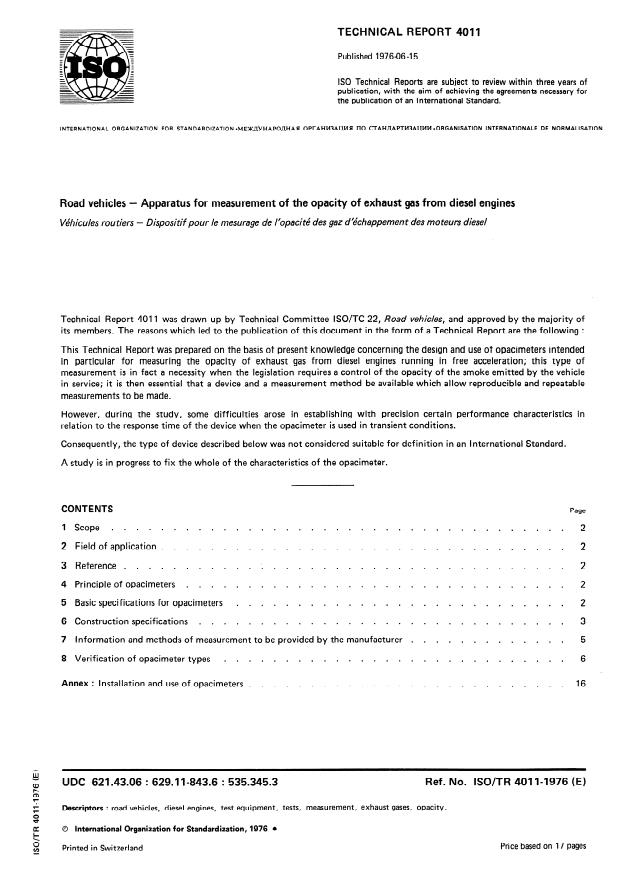
INTERNATIONAL ORGANIZATION FOR STANDARDIZATION .MEX~‘YHAPOAHAR OPTAHM3ALWI I-IO CTAHAAPTM3AIJWW.ORGANISATION INTERNATIONALE DE NORMALISATION
Road vehicles - Apparatus for measurement of the opacity of exhaust gas from diesel engines
Vkhicules rou tiers - Dispositif pour te mew-age de l’opacite’ des gaz d%khappement des moteurs diesel
Technical Report 4011 was drawn up by Technical Committee ISO/TC 22, Road vehicles, and approved by the majority of
its members. The reasons which led to the publication of this document in the form of a Technical Report are the following :
This Technical Report was prepared on the basis of present knowledge concerning the design and use of opacimeters intended
in particular for measuring the opacity of exhaust gas from diesel engines running in free acceleration; this type of
measurement is in fact a necessity when the legislation requires a control of the opacity of the smoke emitted by the vehicle
in service; it is then essential that a device and a measurement method be available which allow reproducible and repeatable
measurements to be made.
However, during the study, some difficulties arose in establishing with precision certain performance characteristics in
relation to the response time of the device when the opacimeter is used in transient conditions.
Consequently, the type of device described below was not considered suitable for definition in an International Standard.
A study is in progress to fix the whole of the characteristics of the opacimeter.
CONTENTS
Page
1 Scope . . . . . . . . . . . . . . . . . . . . . . . . . . . . . . . . . . . . .
2 Field of application . . . . . . . . . . . . . . . . . . . . . . . . . . . . . . . . .
3 Reference . . . . . . . . . . . ; . . . . . . . . . . . . . . . . . . . . . . . . 2
4 Principle of opacimeters . . . . . . . . . . . . . . . . . . . . . . . . . . . . . . . 2
5 Basic specifications for opacimeters . . . . . . . . . . . . . . . . . . . . . . . . . . . 2
6 Construction specifications . . . . . . . . . . . . . . . . . . . . . . . . . . . . . .
7 Information and methods of measurement to be provided by the manufacturer . . . . . . . . . . . . . 5
8 Verification of opacimeter types . . . . . . . . . . . . . . . . . . . . . . . . . . . . 6
Annex : Installation and use of opacimeters . . . . . . . . . . . . . . . . . . . . . . . . . . 16
A
UDC 621.43.06 : 629.1 l-843.6 : 535.345.3 Ref. No. ISO/TR 4011-1976 (E)
tests, measurement, exhaust gases, opacity.
Descriptors : road vehicles, diesel engines, test equipment,
0 International Organization for Standardization, 1976 l
Price based on 17 pages
Printed in Switzerland
IS0/TR 4011-1976 (El
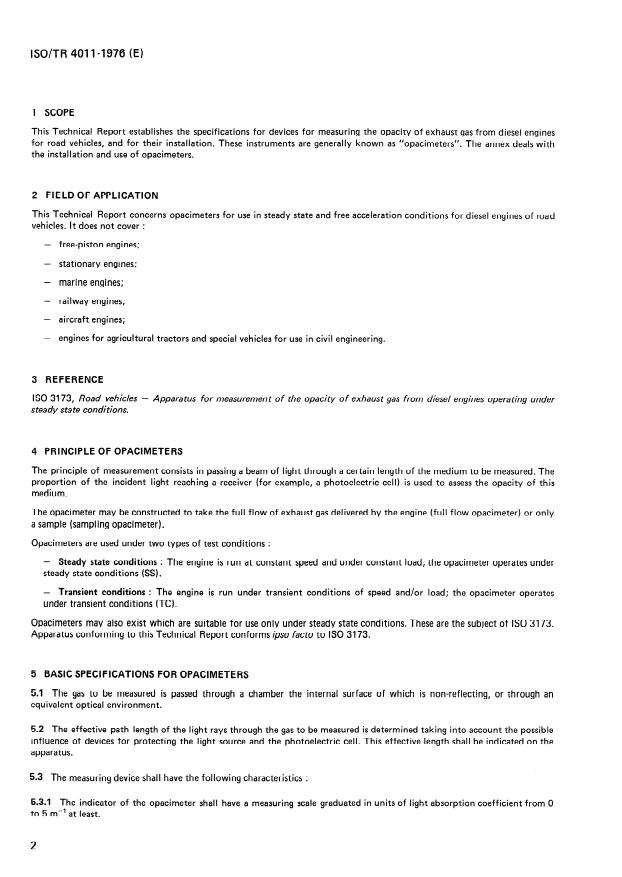
1 SCOPE
This Technical Report establishes the specifications for devices for measuring the opacity of exhaust gas from diesel engines
for road vehicles, and for their installation. These instruments are generally known as “opacimeters”. The annex deals with
the installation and use of opacimeters.
2 FIELD OF APPLICATION
This Technical Report concerns opacimeters for use in steady state and free acceleration conditions for diesel engines of road
vehicles. It does not cover :
- free-piston engines;
- stationary engines;
- marine engines;
-
railway engines;
-
aircraft engines;
-
engines for agricultural tractors and special vehicles for use in civil engineering.
3 REFERENCE
IS0 3173, Road vehicles - Apparatus for measurement of the opacity of exhaust from diesel engines operating under
gas
steady state conditions.
4 PRINCIPLE OF OPACIMETERS
The principle of measurement consists in passing a beam of light through a certain length of the medium to be measured. The
proportion of the incident light reaching a receiver (for example, a photoelectric cell) is used to assess the opacity of this
medium.
The opacimeter may be constructed to take the full flow of exhaust gas deli vered by the engine (full flow opaci meter) or only
a sample (sampl ing opacimeter).
Qpacimeters are used under two types of test conditions :
The engine is run at constant speed and under constant load; the opacimeter operates under
- Steady state conditions :
steady state conditions (SS).
- Trans ient conditions : The engine is run under transient conditions of speed and/or load; the opacimeter operates
under tra nsient conditions
(TC).
Opacimeters may also exist which are suitable for use only under steady state conditions. These are the subject of IS0 3173.
Apparatus conforming to this Technical Report conforms ipso facto to IS0 3173.
5 BASIC SPECIFICATIONS FOR OPACIMETERS
an
5.1 The gas to be measured is passed through a chamber the internal surface of which is non-reflecting, or through
equivalent optical environment.
5.2 The effective path length of the light rays through the gas to be measured is determined taking into account the possible
influence of devices for protecting the light source and the photoelectric cell. This effective length shall be indicated on the
apparatus.
5.3 The measuring device shall have the following characteristics :
5.3.1 The indicator of the opacimeter shall have a measuring scale graduated in units of light absorption coefficient from 0
to 5 m-’ at least.
ISO/TR 4011-1976 (E)
5.32 The indicator shall allow a light absorption coefficient to be read between 0 and 3 m-’ with a precision of 0,05 m-’ at
least.
5.3.3 The measuring device (for transient conditions only) shall allow the maximum opacity to be stored for at least 5 s and
allow instantaneous cancellation of the value stored. This value shall not decay by more than I % during this time. The peak
hold device shall be able to be switched out of circuit.
5.4 The total absolute uncertainty shall be less than :
0,2 m-l for a light absorption coefficient between 0 and 3 m-‘;
0,5 m-’ for a light absorption coefficient between 3 and 5 m-l.
6 CONSTRUCTION SPECIFICATIONS
6.1 General
The design shall be such that in steady state conditions the smoke chamber is filled with a uniform smoke and the pipes and
fittings and devices for bringing the gases into the measuring chamber do not include any sharp bends where soot could
accumulate.
or the
The impingement on the receiver of stray I igh t due to internal reflection effects of diffusion shal I be reduced to a
faces in matt black and by ropriate general layout).
mini mum (for exa mple by coating the internal sur
an aPP
6.2 Measuring zone of the smoke chamber
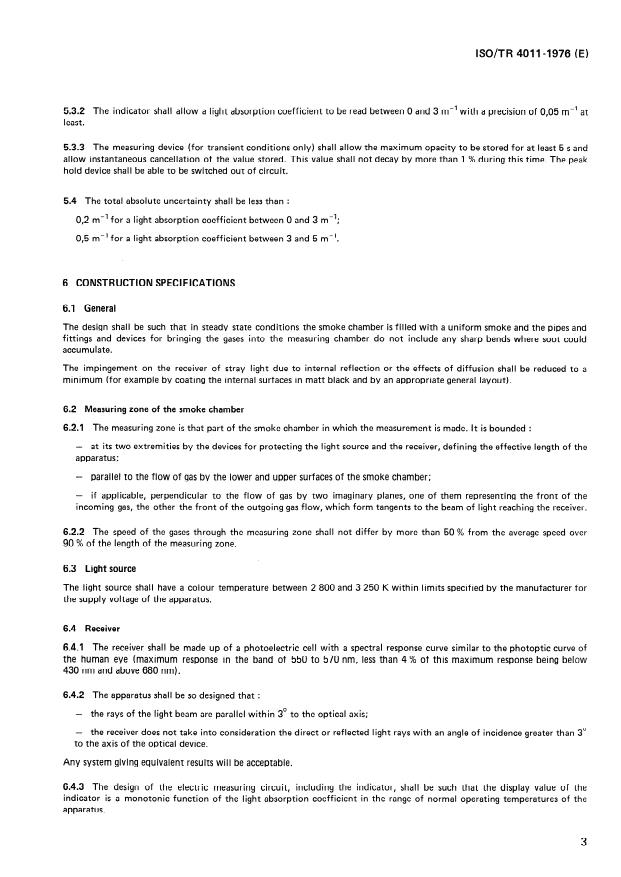
6.2.1 The measuring zone is that part of the smoke chamber in which the measurement is made. It is bounded :
- at its two extremities by the devices for protecting the light source and the receiver, defining the effective length of the
apparatus;
- parallel to the flow of gas by the lower and upper surfaces of the smoke chamber;
-
inary planes, one of them representing the
if applicable, perpendicular to the flow of gas by two imag front of the
‘h ich form tangents to the beam of light reaching the receiver.
incom ing gas, the other the front of th e outgoing gas flow, w
6.2.2 The speed of the gases through the measuring zone shall not differ by more than 50 % from the average speed over
90 % of the length of the measuring zone.
6.3 Light source
The light source shall have a colour temperature between 2 800 and 3 250 K within limits specified by the manufacturer for
the supply voltage of the apparatus.
6.4 Receiver
6.4.1 The receiver shall be made up of a photoelectric cell with a spectral response curve similar to the photoptic curve of
the human eye (maximum response in the band of 550 to 570 nm, less than 4 % of this maximum response being below
430 nm and above 680 nm).
6.4.2 The apparatus shall be so designed that :
- the rays of the light beam are parallel within 3” to the optical axis;
-
the receiver does not reflected light rays with an angle of incidence greater than 3”
take into consideration the direct or
to the axis of the optical device.
Any system giving equivalent results will be acceptable.
6.4.3 The design of the electric measuring circuit, including the indicator, shall be such that the display value of the
indicator is a monotonic function of the light absorption coefficient in the range of normal operating temperatures of the
apparatus.
/TR 4011-1976 (E)
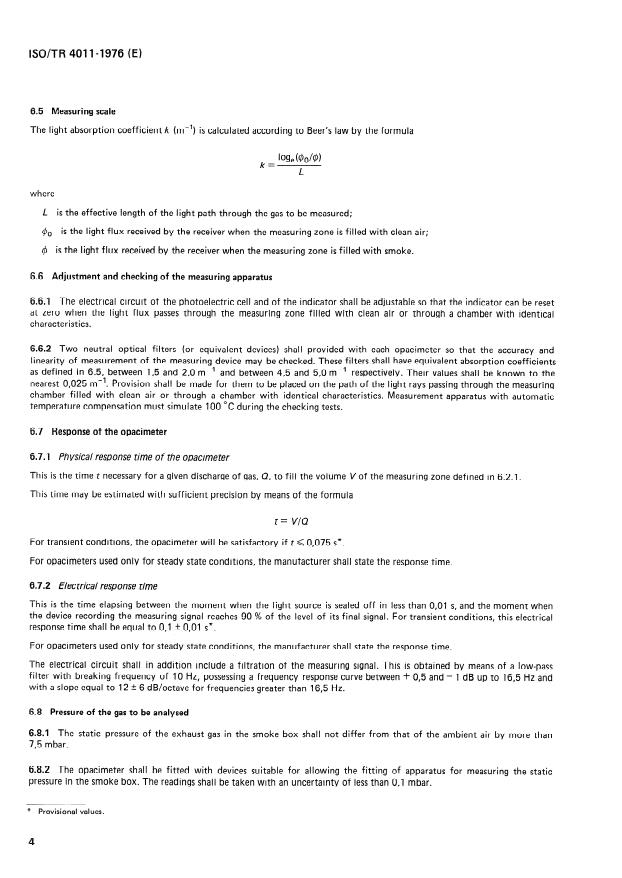
.5 Measuring scale
The light absorption coefficient k (m-l) is calculated according to Beer’s law by the formula
log, (&l/G)
k=
fiwhere
1 is the effective length of the light path through the gas to be measured;
is the light flux received by the receiver when the measuring zone is filled with clean air;
$I is the light flux received by the receiver when the measuring zone is filled with smoke.
6.6 Adjustment and checking of the measuring apparatus
.6.1 The electrical circuit of the photoelectric cell and of the indicator shall be adjustable so that the indicator can be reset
at zero when the light flux passes through the measuring zone filled with clean air or through a chamber with identical
characteristics.
.6.2 Two neutral optical filters (or equivalent devices) shall provided with each opacimeter so that the accuracy and
linearity of measurement of the measuring device may be checked. These filters shall have equivalent absorption coefficients
respectively. Their values shall be known to the
as defined in 6.5, between I,5 and 2,0 m-’ and between 4,5 and 5,0 m-’
nearest 0,025 m-l. Provision shall be made for them to be placed on the path of the light rays passing through the measuring
chamber filled with clean air or through a chamber with identical characteristics. Measurement apparatus with automatic
temperature compensation must simulate 100 “C during the checking tests.
Response of the opacimeter
Physical response time of the opacime ter
This is the time t necessary fo ra given discharge of gas, Q, to fill the volume V of the measuring zone defined in 6.2. 1.
This time may be estimated with sufficient precision by means of the formula
t- v/a
For transient conditions, the opacimeter will be satisfactory if t < 0,075 s*.
For opacimeters used only for steady state conditions, the manufacturer shall state the response time.
.7.2 Electrical response time
This is the time elapsing between the moment when the light source is sealed off in less than 0,Ol s, and the moment when
the device recording the measuring signal reaches 90 % of the level of its final signal. For transient conditions, this electrical
response time shall be equal to 0,l + 0,Ol s*.
For opacimeters used only for steady state conditions, the manufacturer shall state the response time.
The electrical circuit shall in addition include a filtration of the measuring signal. This is obtained by means of a low-pass
filter with breaking frequency of IO Hz, possessing a frequency response curve between -I- 0,5 and - 1 dB up to 16,5 Hz and
vvith a slope equal to 12 + 6 dB/octave for frequencies greater than 16,5 Hz.
.8 Pressure of the gas to be analysed
6.8.1 The static pressure of the exhaust gas in the smoke box shall not differ from that of the ambient air by more than
7,5 mbar.
th e fitting for measuring the static
.8.2 The opacimeter shall be fitted with devices suitab e for all owing of apparatus
pressure in of less than
the smoke b ox. The readings shal I be take n with an uncer tainty 0,l mbar.
* Provisional values.
ISO/TR 4011-1976 (E)
6.9 Temperature of the gas to be analysed
6.9.1 The opacimeter shall be fitted with the devices necessary for estimating the average temperature of the gas in the
measuring chamber; the manufacturer shall specify the limits of operation. The uncertainty of measurement shall be taken
into account when calculating the total measuring uncertainty of the apparatus.
6.9.2 At all points of the measuring chamber, the temperature of the test gas at the instant of measurement of opacity shall
be not less than 60 ‘C and the average temperature in the chamber shall be not greater than 400 “C. The range of normal use
shall be indicated by the manufacturer.
6.9.3 The opacimeter reading must be corrected to 100 “C by means of the formula
k =k
corrected
where t is the temperature, in degrees Celsius, of the test gas.
6.9.4 The thermal time-constant of the device for measuring temperature shall be
-
indicated by the manufacturer;
-
commensurate with the recommended operating time of the instrument for steady state use;
- less than 5 s for opacimeters used in transient conditions.
temperature between the
The thermal time-co nstant is the time necessary for the sensor to reach 63 % of the difference in
initi al state a nd the f inal state in still air.
6.10 Details of design
Any devices which may be situated upstream of the measuring zone shall not affect the opacity properties of the gas entering
the chamber by more than 0,05 m-’ for a gas with an opacity of I,7 m-‘.
6.11 Total measurement uncertainty
The total measurement uncertainty Ak is given by the formula
Ak= C (Aki)2
J i
where the Ak; are principally the following uncertainties :
a) error due to the geometry of the apparatus (effective length);
b) error due to the optical and electrical devices (including soiling of lamp and photoelectric cell) :
-
zero error and sensitivity error of the measuring device;
-
error due to the indicator;
-
error due to measurement and correction for average temperature.
Ak shall not exceed 0,2 m-‘.
Errors due to parameters other than those mentioned in this specification shall also be taken into account if it is considered
that their influence is I i kely to be significant.
7 INFORMATION AND METHODS OF MEASUREMENT TO BE PROVIDED BY THE MANUFACTURER
7.1 Handbook for maintenance and use to be provided with each apparatus
This document shall deal with the following points :
7.1.1 Technical description of the opacimeter, including a diagram of the optical and electrical devices and dimensional
sketches of the measuring chamber and the adjacent areas, with tolerances.
/TR4011-1976 (E)
7.1.2 Information on the maintenance of the opacimeter, and in particular, the cleaning interwais and ail the special
operating precautions peculiar to the given model, including whether the opacimeter is designed to operate continuously or
intermittently and, in the latter case, the time necessary for passing smoke through the opacimeter before a correct
measurement can be taken (operating time).
List of the periodic checks which the apparatus requires.
7.4.3 Effective length of the smoke column used to calculate the light absorption coefficient.
7.1.4 Operating limits of the light source, i.e. either :
a) limits of voltage at the terminals of the light source and instructions on its life, or
b) limits of reading with a gauging colour filter provided with each opacimeter.
of corresponding ambient and exhaust gas
7Yl.5 Total precision of the apparatus as defined in 6.1 ‘l and the range
temperatures.
Minimum flow of gas into the smoke chamber corresponding to the time of maximum physical response imposed in
6.7.1 and the maximum flow of gas into the smoke chamber corresponding to the maximum gas pressures allowed by the
manufacturer.
7.1.7 Instructions relating to limits on fittings which may be attached to the opacimeter exit, giving equivalent orifices.
Data to be provided for the conformity check of the type of opaeimetea
7.2.1 Temperature of the surface of the photoelectric cell above which its response features change significantly.
7.22 Relationship between the temperature indicated by the measuring device and the average temperature in the smoke
chamber.
7.23 Nominal supply voltage limits within which the opacimeter will operate satisfactorily (separate limits must be given for
each supply point where more than one exists).
Response time of the electric measuring circuit necessary for reaching 98 % of the level of continuous signal following
X2.4
sealing off of the light source in less than 6,Ol s.
7.2.5 Relationship between the static pressure and the gas flow in the smoke chamber.
7.3 Methods of measurement used in the conformity check of the type of opacimeter
The opacimeter must allow the attachment of instruments necessary for measuring the following parameters :
a) static pressure of the exhaust gas in the smoke box;
b) temperature at the point specified by the manufacturer for measuring the gas temperature;
.
c) voltage of the lamp (unless a particular m.ethod using a colour filter is laid down for checking the colour temperature ) B
d) output current of the photoelectric cell.
ERIFICATION OF OPACIMETER TYPES
This clause gives details of the procedures to be adopted to check that an opacimeter of a given type corresponds to the
requirements of clauses 5, 6 and 7. It deals with opacimeters in general. When possible, each heading includes a reference to
the corresponding sub-clause of clauses 5, 6 and 7 to which the test refers The checks cannot, however, cover all the possible
models of opacimeter. It will rest therefore with the organization approving a given type of opacimeter to check the possible
influence of the devices which belong ‘to each apparatus.
ISO/TR 401 I-1976 (E)
8.2 General considerations
In order to verify that a particular type of opacimeter corresponds to the specification, it is necessary first to check that
certain instruments and certain controls required by the specification are properly fitted on the opacimeter and that certain
operational limits and certain data are properly specified by the manufacturer. The verification test consists then in checking
that the properties of the instruments are as required by the specification and that, within the limits claimed by the
manufacturer, the opacimeter actually satisfies the requirements of the specification. For the checking tests, certain
instruments may be necessary in addition to those which are normally fitted on the opacimeter.
In fields where well-known experimental techniques already exist (aerodynamic, thermometric, optical and electrical, for
example), the tests are not described in detail, but in other cases detailed instructions are given. Other methods will, however,
be accepted if they are of equivalent precision and comply with the response conditions of the method described. If recording
instruments are used, it is essential to take into account their influence on the response or the sensitivity of the circuit.
8.3 Definitions
The following symbols are used :
k : light absorption coefficient of the gas in units per metre (m-l);
L : effective length of the smoke column taken into consideration in the measuring chamber;
Go : incident light flux reaching the receiver in the absence of smoke;
$I : incident light flux reaching the receiver when the measuring chamber is filled by the gas to be analysed.
8.4 Information and methods of measurement (7)
Check that the information and methods of measurement provided by the manufacturer are in accordance with the
requirements of clause 7 of this specification.
8.5 Basic specifications for opacimeters (5)
Check that the technical features of the opacimeter are in accordance with the requirements of clause 5 of this specification.
8.6 Verification of the components and adjustments
8.6.1 Co/our temperature (6.3)
Check that in the conditions indicated by the manufacturer (for example voltage at the terminals of the electric bulb or
reading with a coloured checking filter) the colour temperature of the light source is between 2 800 and 3 250 K.
8.6.2 Response of the photoelectric cell to different wavelengths and different temperatures (6.4.1)
Check that the combined characteristic of the photoelectric cell and the filter has a maximum response in the range of 550 to
570 nm and a response less than 4 % of this maximum below 430 nm and above 680 nm.
8.6.3 Devices for adjusting zero and checking the measuring circuit (6.6)
be adjusted satisfactorily over the whole range of supply voltages
a) Check that the zero of the instru ment can specified
nufacture
the ma r in accordance wi th 7.2.3.
bY
Check that the devices provided by the manufacturer for checking the operation of the measuring circuit of the
W
opacimeter are in accordance with the requirements of 6.6.2.
8.6.4 Indicator of the opacimeter (5.3)
Check that the indicator of the opacimeter is in accordance with the requirements of 5.3.
8.6.5 Static pressure measurement in the smoke chamber (6.8.2)
Check that the opacimeter is in accordance with the requirements of 6.8.2.
8.6.6 Optical design (6.4.2)
Check from the technical description of the apparatus given in 7.1 .I, and from actual tests, that the optical &vice is designated
so that the opacimeter is in accordance with the requirements of 6.4.2. Check that the optical components of the opacimeter
submitted for test and their dimensional position comply with the description.
ISO/-i-R 401 I-1976 (E)
8.7 Verification of the flow characteristics with respect to the internal design
8.7.1 Temperature distribution (6.9)
8.7.1.1 OBJECT
In order to determine the opacity of the gas at 100 ‘C, it is necessary to demonstrate that the temperature gauge provided by
the manufacturer does, in fact, estimate the average temperature of the gas in the measuring chamber. This is shown by
comparison of the readings on the temperature gauge and the results of measurements of temperature distribution in the
measuring chamber.
This test also checks that the minumum and maximum temperatures of the gas are those specified in 6.9.2.
8.7.1.2 PREPARATION OF THE TEST
The temperature distribution shall be measured at 11 points distributed equally along the axis of the measuring chamber over
90 % of its length. All the thermometers must be enclosed in tubes providing good thermal insulation without obstructing the
flow of gas. A satisfactory method is, for example, the technique which consists in placing in the axis of the smoke chamber a
thermoelectric couple the wires of which, about 0,l mm in diameter, are connected end to end; with this system, however, it
may prove necessary to use a dummy bulb and a photoelectric cell with holes in it to allow passage of the wires.
8.7.1.3 TEST PROCEDURE
With the opacimeter fed with exhaust gas or hot air, measure the temperature distribution, point by point, along the axis of
the measuring chamber in the following steady state conditions :
a) minimum temperature and minimum flow of gas recommended by the manufacturer;
maximum temperature and minimum flow of gas recommended by the manufacturer;
b)
cl maximum temperature and maximum flow of gas recommended by the manufacturer,
8.7.1.4 EVALUATION
Plot the temperature distribution along the axis of the measuring chamber, then :
Calculate the average absolute temperature c, Tb and K, in kelvins, in the three types of conditions by means of the
a)
formula
T=-
‘i (l/T)
Calculate the error Ak,- = 3 [ (T,Jy) - where T,,, is the temperature i ndicated on the provided by the
CWKF
manufacturer. This value will be required the calcu lation of total uncertainty in 8.10.
b) Check that, in the three types of test conditions, at each of the 11 points of temperature measurement,
II - T/71 < 0,03
c) Check that at no point is the measured temperature less than 60 ‘C, and check that T is not greater than 120 “C.
8.7.2 Velocity distribution of the gas to be analysed (6.2.2)
8.7.2.1 OBJECT
It is necessary to ensure that the flow of gas in the measuring chamber is sufficiently uniform in order to avoid the mixing of
the clean air in there with the puff of smoke entering. This check is carried out by comparing the velocities at different points
in the flow of gas.
.7.2.2 PREPARATION OF TEST
The velocity distribution shall be measured at 11 points uniformly distributed along the axis of the measuring chamber over
90 % of its length.
ISO/TR 4011-1976 (E)
8.7.2.3 TEST PRO
...
Questions, Comments and Discussion
Ask us and Technical Secretary will try to provide an answer. You can facilitate discussion about the standard in here.
Loading comments...