

ISO/IEC TR 24030:2024
(Main)Information technology — Artificial intelligence (AI) — Use cases
General Information
- Abstract
This document provides a collection of representative use cases of AI applications in a variety of domains.
- Status
- Published
- Publication Date
- 07-Apr-2024
- Technical Committee
- ISO/IEC JTC 1/SC 42 - Artificial intelligence
- Drafting Committee
- ISO/IEC JTC 1/SC 42 - Artificial intelligence
- Current Stage
- 9092 - International Standard to be revised
- Start Date
- 15-Apr-2025
- Completion Date
- 29-Aug-2026


Overview
ISO/IEC TR 24030:2024 - Information technology - Artificial intelligence (AI) - Use cases is a Technical Report (second edition, April 2024) that compiles a broad collection of representative AI use cases across many domains. Rather than prescribing mandatory rules, it provides structured, practical examples and a standardized use‑case template to help practitioners, decision‑makers and standards developers describe, compare and analyse real‑world AI applications.
Key topics and structure
This report organizes and explains use cases with consistent fields and guidance. Major technical topics include:
- Application domains and deployment models - classification of AI use across sectors and how systems are deployed (cloud, edge, embedded, hybrid).
- Use‑case template fields - structured elements such as ID, name, objectives, narrative, stakeholders, data characteristics, Key Performance Indicators (KPIs), features, threats & vulnerabilities, challenges, and trustworthiness considerations.
- Trustworthiness and societal concerns - sections addressing safety, robustness, privacy, ethical issues and alignment with Sustainable Development Goals (SDGs).
- Guidance for contributors - how to submit and document use cases and opportunities for future standardization.
- Statistics and analysis - aggregated breakdowns by domain, task and societal impact to identify trends and gaps.
The report also contains many concrete use‑case summaries (e.g., agriculture, healthcare, fintech, ICT, robotics, education, energy, e‑commerce) allowing comparisons of functional requirements and risks.
Practical applications
ISO/IEC TR 24030:2024 is useful for:
- AI system architects and engineers - to benchmark functional needs, data characteristics and KPIs across comparable deployments.
- Product managers and solution teams - to justify design choices, identify risk vectors and prioritize trustworthiness features.
- Regulators and procurement officers - to understand typical use‑case narratives and assess compliance, safety and societal impacts.
- Standards developers and researchers - to discover recurring patterns and standardization opportunities across domains.
- Domain specialists (healthcare, agritech, fintech, ICT, robotics, education, energy) - to map sector‑specific examples to operational workflows and governance needs.
Practical benefits include faster requirements capture, improved interoperability planning, better risk assessment and clearer alignment with ethical and SDG considerations.
Related standards (context)
ISO/IEC TR 24030 complements other ISO/IEC AI work by ISO/IEC JTC 1/SC 42 and can be used alongside AI governance, data quality and risk‑management standards to form a coherent toolkit for developing trustworthy AI.
Keywords: ISO/IEC TR 24030:2024, AI use cases, artificial intelligence, use‑case template, deployment models, KPIs, trustworthiness, standards, SDGs.
Relations
- Effective Date
- 06-Jun-2022
Get Certified
Connect with accredited certification bodies for this standard

BSI Group
BSI (British Standards Institution) is the business standards company that helps organizations make excellence a habit.

NYCE
Mexican standards and certification body.
Sponsored listings
Frequently Asked Questions
ISO/IEC TR 24030:2024 is a technical report published by the International Organization for Standardization (ISO). Its full title is "Information technology — Artificial intelligence (AI) — Use cases". This standard covers: This document provides a collection of representative use cases of AI applications in a variety of domains.
This document provides a collection of representative use cases of AI applications in a variety of domains.
ISO/IEC TR 24030:2024 is classified under the following ICS (International Classification for Standards) categories: 35.020 - Information technology (IT) in general. The ICS classification helps identify the subject area and facilitates finding related standards.
ISO/IEC TR 24030:2024 has the following relationships with other standards: It is inter standard links to ISO/IEC TR 24030:2021. Understanding these relationships helps ensure you are using the most current and applicable version of the standard.
ISO/IEC TR 24030:2024 is available in PDF format for immediate download after purchase. The document can be added to your cart and obtained through the secure checkout process. Digital delivery ensures instant access to the complete standard document.
Standards Content (Sample)
Technical
Report
ISO/IEC TR 24030
Second edition
Information technology — Artificial
2024-04
intelligence (AI) — Use cases
Technologies de l'information — Intelligence artificielle (IA) —
Cas pratiques
Reference number
© ISO/IEC 2024
All rights reserved. Unless otherwise specified, or required in the context of its implementation, no part of this publication may
be reproduced or utilized otherwise in any form or by any means, electronic or mechanical, including photocopying, or posting on
the internet or an intranet, without prior written permission. Permission can be requested from either ISO at the address below
or ISO’s member body in the country of the requester.
ISO copyright office
CP 401 • Ch. de Blandonnet 8
CH-1214 Vernier, Geneva
Phone: +41 22 749 01 11
Email: copyright@iso.org
Website: www.iso.org
Published in Switzerland
© ISO/IEC 2024 – All rights reserved
ii
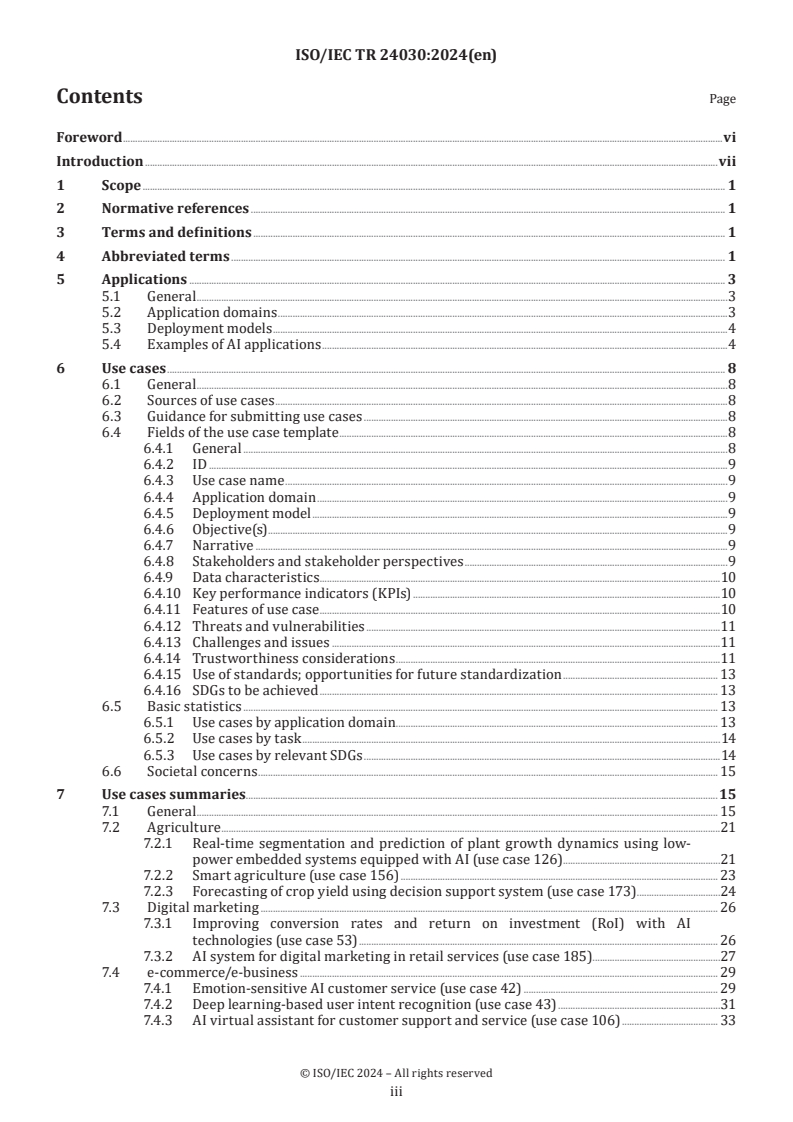
Contents Page
Foreword .vi
Introduction .vii
1 Scope . 1
2 Normative references . 1
3 Terms and definitions . 1
4 Abbreviated terms . 1
5 Applications . 3
5.1 General .3
5.2 Application domains .3
5.3 Deployment models .4
5.4 Examples of AI applications .4
6 Use cases . 8
6.1 General .8
6.2 Sources of use cases .8
6.3 Guidance for submitting use cases .8
6.4 Fields of the use case template .8
6.4.1 General .8
6.4.2 ID .9
6.4.3 Use case name .9
6.4.4 Application domain .9
6.4.5 Deployment model .9
6.4.6 Objective(s) .9
6.4.7 Narrative .9
6.4.8 Stakeholders and stakeholder perspectives .9
6.4.9 Data characteristics . .10
6.4.10 Key performance indicators (KPIs) .10
6.4.11 Features of use case .10
6.4.12 Threats and vulnerabilities .11
6.4.13 Challenges and issues .11
6.4.14 Trustworthiness considerations .11
6.4.15 Use of standards; opportunities for future standardization . 13
6.4.16 SDGs to be achieved . 13
6.5 Basic statistics . 13
6.5.1 Use cases by application domain. 13
6.5.2 Use cases by task .14
6.5.3 Use cases by relevant SDGs .14
6.6 Societal concerns . 15
7 Use cases summaries.15
7.1 General . 15
7.2 Agriculture .21
7.2.1 Real-time segmentation and prediction of plant growth dynamics using low-
power embedded systems equipped with AI (use case 126) .21
7.2.2 Smart agriculture (use case 156) . 23
7.2.3 Forecasting of crop yield using decision support system (use case 173) .24
7.3 Digital marketing . 26
7.3.1 Improving conversion rates and return on investment (RoI) with AI
technologies (use case 53) . 26
7.3.2 AI system for digital marketing in retail services (use case 185).27
7.4 e-commerce/e-business . 29
7.4.1 Emotion-sensitive AI customer service (use case 42) . 29
7.4.2 Deep learning-based user intent recognition (use case 43) .31
7.4.3 AI virtual assistant for customer support and service (use case 106) . 33
© ISO/IEC 2024 – All rights reserved
iii
7.4.4 Customer relation management (CRM) (use case 157) . 34
7.5 Education . 36
7.5.1 A recommendation system for industrial training (use case 23) . 36
7.5.2 An intelligent marking system (use case 83) . 38
7.5.3 Intelligent educational robot (use case 84) . 40
7.5.4 AI system to intelligent campus (use case 85).41
7.5.5 AI adaptive learning platform for personalized learning (use case 102) .43
7.5.6 AI adaptive learning mobile app (use case 124).45
7.6 Energy . 46
7.6.1 Smart energy grid (use case 166). 46
7.7 Fintech . 48
7.7.1 Detection of fraud based on collusion (use case 20) . 48
7.7.2 Virtual bank assistant (use case 57) . 49
7.7.3 Forecasting prices of commodities (use case 91) .51
7.7.4 Financial advice and asset management with AI (use case 114) .52
7.7.5 Loan in 7 minutes (use case 119) . 54
7.7.6 Predictive risk intelligence (use case 164) . 55
7.8 Healthcare .57
7.8.1 AI system to predict post-operative visual acuity for LASIK surgeries (use case
24) .57
7.8.2 AI system to quality control of electronic medical record (EMR) in real time
(use case 50) .59
7.8.3 Discharge summary classifier (use case 79) . 60
7.8.4 Generation of clinical pathways (use case 80) .62
7.8.5 Hospital management tools (use case 81). 63
7.8.6 Predicting relapse of a dialysis patient during treatment (use case 87) . 64
7.8.7 Instant triaging of wounds (use case 89) . 66
7.8.8 Detection of fraudulent medical claims (use case 90) . 68
7.8.9 AI platform for chest CT-scan analysis (early stage lung cancer detection) (use
case 105) . 69
7.8.10 Neural network formation of 3D-models orthopaedic insoles (use case 121) .71
7.8.11 Search of undiagnosed patients (use case 127). 72
7.8.12 A clinical decision support system (use case 131) . 73
7.8.13 Symptom assessment (hypothetical) (use case 134) .76
7.8.14 Making using evidence-based medicine and AI (use case 167) . 77
7.8.15 AI-service for blood cells and bone marrow scans analysis (use case 168) . 79
7.8.16 AI-service for chest X-ray and chest CT (use case 169) . 81
7.8.17 Intelligent video analytics system (use case 170) . 83
7.8.18 Retrospective analysis (use case 172) . 84
7.8.19 Robotization of the federal hotlines on COVID-19 issues (use case 174) . 85
7.8.20 Use of computer vision innovative technologies for analysis of medical images
and further application (use case 175) . 87
7.9 Home and service robotics . 89
7.9.1 Device control using AI consisting of cloud computing and embedded system
(use case 132) . 89
7.10 ICT .91
7.10.1 AI system to help mobile phones to have better picture effect (use case 32).91
7.10.2 Product failure prediction for critical IT infrastructure (use case 86) . 93
7.10.3 AI-based optimized field dispatch (use case 151) . 94
7.10.4 Wireless network failure prediction (use case 152) . 96
7.10.5 AI performance evaluation of AI-powered messaging bots (use case 176) . 97
7.11 Insurance . 100
7.11.1 AI services for health insurance companies (use case 161) . 100
7.12 Knowledge management . 102
7.12.1 Water crystal mapping (use case 77) . 102
7.12.2 AI system with a digital knowledge centre for utilizing the knowledge in the
organization (use case 187) . 104
7.13 L egal . 106
7.13.1 AI contract management (use case 120) . 106
© ISO/IEC 2024 – All rights reserved
iv
7.14 Manufacturing . 108
7.14.1 Quality assurance solution based on AI, to detect defects on wind turbines
blades (use case 4) . 108
7.14.2 Generative design of mechanical parts (use case 15) .110
7.14.3 Powering remote drilling command centre (use case 36) . 111
7.14.4 Quality improvement of adhesive products, based on AI (use case 37) . 113
7.14.5 Empowering autonomous flow meter control- reducing time taken to “proving
of meters” (use case 40) .114
7.14.6 Improvement of productivity of semiconductor manufacturing (use case 82) .116
7.14.7 AI decryption of magnetograms (use case 104) .119
7.14.8 Analysing and predicting acid treatment effectiveness of bottom hole zone (use
case 110) . 120
7.14.9 Automatic classification tool for full size core (use case 112) . 122
7.14.10 Collaborative AI to assist workers with production and assembly in factories
(use case 179) . 124
7.15 Media and entertainment . 126
7.15.1 Video on demand publishing intelligence platform (use case 58) . . 126
7.15.2 AI system for promoting DX in customer attraction services at a museum (use
case 178) . 128
7.16 Public sector . 129
7.16.1 AI ideally matches children to daycare centres (use case 7) .129
7.16.2 Open spatial data set for developing AI algorithms based on remote sensing
(satellite, drone, aerial imagery) data (use case 122) . 131
7.16.3 Smart city (use case 165) . 133
7.16.4 AI tool for species categorization for wildlife population monitoring (use case
177) . 135
7.17 Security . 137
7.17.1 Non-intrusive detection of malware (use case 93) . 137
7.17.2 Detect pickpockets in a crowd - training with privacy-sensitive data (use case
181) . .138
7.18 Transportation . 140
7.18.1 Enhancing traffic management efficiency and infraction detection accuracy
with AI technologies (use case 29) . 140
7.18.2 AI system for traffic signal optimization based on multi-source data fusion (use
case 49) .142
7.18.3 Dynamic routing software as a service (SaaS) based on artificial intelligence
(use case 92) . 144
7.18.4 Misbehaviour detection (MBD) for V2X (use case 182) .145
7.18.5 AI system to estimate or predict congestion length for traffic signal control
(use case 183) .147
7.18.6 Traffic signal control using artificial intelligence (use case 184) . 148
7.18.7 AI system for predicting rivers’ water levels during flooding (use case 186) . 149
7.19 Work and life . 152
7.19.1 Recommendation algorithm for improving member experience and
discoverability of resorts in the booking portal of a hotel chain (use case 28) . 152
7.19.2 Improving the quality of online interaction (use case 88) . . 153
7.19.3 Business use of IoT for surveillance (use case 162) . 155
7.19.4 Video surveillance (use case 180) . 157
Annex A (informative) Use case template .159
Annex B (informative) Use cases list of ISO/IEC TR 24030:2021 and ISO/IEC TR 24030:— .162
Bibliography .168
© ISO/IEC 2024 – All rights reserved
v
Foreword
ISO (the International Organization for Standardization) and IEC (the International Electrotechnical
Commission) form the specialized system for worldwide standardization. National bodies that are
members of ISO or IEC participate in the development of International Standards through technical
committees established by the respective organization to deal with particular fields of technical activity.
ISO and IEC technical committees collaborate in fields of mutual interest. Other international organizations,
governmental and non-governmental, in liaison with ISO and IEC, also take part in the work.
The procedures used to develop this document and those intended for its further maintenance are described
in the ISO/IEC Directives, Part 1. In particular, the different approval criteria needed for the different types
of document should be noted. This document was drafted in accordance with the editorial rules of the ISO/
IEC Directives, Part 2 (see www.iso.org/directives or www.iec.ch/members_experts/refdocs).
ISO and IEC draw attention to the possibility that the implementation of this document may involve the
use of (a) patent(s). ISO and IEC take no position concerning the evidence, validity or applicability of any
claimed patent rights in respect thereof. As of the date of publication of this document, ISO and IEC had not
received notice of (a) patent(s) which may be required to implement this document. However, implementers
are cautioned that this may not represent the latest information, which may be obtained from the patent
database available at www.iso.org/patents and https://patents.iec.ch. ISO and IEC shall not be held
responsible for identifying any or all such patent rights.
Any trade name used in this document is information given for the convenience of users and does not
constitute an endorsement.
For an explanation of the voluntary nature of standards, the meaning of ISO specific terms and expressions
related to conformity assessment, as well as information about ISO's adherence to the World Trade
Organization (WTO) principles in the Technical Barriers to Trade (TBT) see www.iso.org/iso/foreword.html.
In the IEC, see www.iec.ch/understanding-standards.
This document was prepared by Joint Technical Committee ISO/IEC JTC 1, Information technology,
Subcommittee SC 42, Artificial intelligence.
This second edition cancels and replaces the first edition (ISO/IEC TR 24030:2021), which has been
technically revised.
The main changes are as follows:
— selection of 51 “in operation” use cases from Annex A (informative), Collected use cases of
ISO/IEC TR 24030:2021;
— collection and selection of 30 additional use cases;
— enhanced the use case submission form and the structure of use case description in Clause 7 to describe
the desirable information of use cases;
— updated the statistics in 6.5 to reflect the use cases in this document;
— removed the subclauses that are no longer suitable for the use cases in this document (e.g. 6.6.3, Annex A
and Annex C in the first edition);
— removed most of the terms from Clause 3 to leave two definitions in this document.
Any feedback or questions on this document should be directed to the user’s national standards
body. A complete listing of these bodies can be found at www.iso.org/members.html and
www.iec.ch/national-committees.
© ISO/IEC 2024 – All rights reserved
vi
Introduction
This document provides a collection of artificial intelligence (AI) use cases in a variety of domains.
In total, 187 AI use cases were submitted by experts between July 2018 and the end of June 2022. In this
document, the term “use cases” means “use cases selected from those submitted”. This document selected
81 in-operation use cases from all submissions.
The rationale for this document is as follows:
— illustrating the applicability of the AI standardization work across a variety of application domains;
— input to and reference for AI standardization work;
— sharing the collected use cases in support of AI standardization work with external organizations and
internal entities to foster collaboration;
— reach out to new stakeholders interested in AI applicability;
— liaising with organizations to collect requirements for AI through use cases;
— by investigating use cases, it is possible to find new technical requirements (standardized demands) in
the market, which can accelerate the pace of transformation of scientific and technological achievements.
While a bottom-up approach was used to collect use cases, a top-down approach is used in this document to
identify AI applications, their deployment models and their application domains, as shown in 5.2
The first step taken to collect use cases was to identify application domains of AI systems (described in
Clause 5) and to provide a use case template (described in 6.4 and Annex A). Contributors were requested to
submit use cases using the provided template.
To improve the quality of use cases, guidance has been provided to contributors. This guidance includes
acceptable sources (described in 6.3) and the characteristics of the AI systems (described in 6.4) that are
used to develop use cases.
In this document, 6.5 includes basic statistics of use cases. Subclause 6.6 introduces societal concerns that
affect many use cases.
The use cases were grouped and categorized according to the identified application domains. In this
document, use cases are grouped, categorized and summarized according to the identified application
domains in Clause 7. Use cases of specific application domains and their original submissions can be found at
https://standards.iso.org/iso-iec/tr/24030/ed-2/en.
[6]
The perspectives of security and privacy in the AI use cases can be found in ISO/IEC TR 27563 .
[6]
ISO/IEC TR 27563 includes a security and privacy analysis of the use cases in ISO/IEC TR 24030:2021. It
is mentioned that the analysis was carried out independently from the use cases in ISO/IEC TR 24030:2021
contributors and therefore that it does not necessarily reflect their views.
AI is an emerging field with use cases and solutions with a wide range of maturity and success. The descriptions
are given for the convenience of users of this document and does not constitute an endorsement by ISO.
© ISO/IEC 2024 – All rights reserved
vii
Technical Report ISO/IEC TR 24030:2024(en)
Information technology — Artificial intelligence (AI) — Use cases
1 Scope
This document provides a collection of representative use cases of AI applications in a variety of domains.
2 Normative references
There are no normative references in this document.
3 Terms and definitions
For the purposes of this document, the following terms and definitions apply.
ISO and IEC maintain terminology databases for use in standardization at the following addresses:
— ISO Online browsing platform: available at https:// www .iso .org/ obp
— IEC Electropedia: available at https:// www .electropedia .org/
3.1
artificial intelligence
AI
research and development of mechanisms and applications of AI systems (3.2)
Note 1 to entry: Research and development can take place across any number of fields such as computer science, data
science, natural sciences, humanities, mathematics and natural sciences.
[SOURCE: ISO/IEC 22989:2022, 3.1.3]
3.2
artificial intelligence system
AI system
engineered system that generates outputs such as content, forecasts, recommendations or decisions for a
given set of human-defined objectives
Note 1 to entry: The engineered system can use various techniques and approaches related to artificial intelligence to
develop a model to represent data, knowledge, processes, etc. which can be used to conduct tasks.
Note 2 to entry: AI systems are designed to operate with varying levels of automation.
[SOURCE: ISO/IEC 22989:2022, 3.1.4]
4 Abbreviated terms
For the purposes of this document, the following abbreviated terms apply. The abbreviated terms are
extracted from use cases.
© ISO/IEC 2024 – All rights reserved
AUC area under the curve
BERT bidirectional encoder representations from transformers
CNN convolutional neural network
COBIT control objective for information and related technology
CRISP-DM cross-industry standard process for data mining
CRM customer relations management
CSV comma separated values
CT computed tomography
CV computer vision
DICOM digital imaging and communications in medicine
DL deep learning
EHR electronic health record
GDPR general data protection regulation
GPU graphics processing unit
ICT information and communication technology
ISP internet service provider
ITIL information technology infrastructure library
KPIs key performance indicators
LSTM long-short-term memory network
ML machine learning
NLP natural language processing
NLU natural language understanding
PACS picture archiving and communication system
RMSE root mean square error
RNN recurrent neural network
ROC receiver operating characteristic
SaaS software as a service
SIS smart information systems
SVM support vector machine
UT ultrasonic testing
XGBoost extreme gradient boosting
© ISO/IEC 2024 – All rights reserved
5 Applications
5.1 General
This clause identifies AI applications from the perspectives of their application domains and deployment models.
5.2 Application domains
Eighteen application domains were considered as target domains for the use cases. The classifications of the
application domains are based on the categories in References [16] and [17].
— agriculture: this domain refers to the science or practice of farming, including cultivation of the soil for
the growing of crops and the rearing of animals to provide food or other products (see ISO 20670:2018,
[7]
3.2 );
— digital marketing: this domain refers to the applications of marketing that uses the Internet and online
based digital technologies such as desktop computers, mobile phones and other digital media and
platforms to promote products and services;
— e-commerce/e-business (electronic commerce / electronic business): this domain is a category of business
transactions, involving two or more Persons, enacted through electronic data interchange, based on
a monetary and for-profit basis. Persons can be individuals, organizations or public administrations.
The underlying principles and characteristics of e-commerce and e-business include: 1) being business
transaction based (of both a financial and non-financial nature); 2) using information technology
(computers and telecommunications); 3) interchanging electronic data involving establishment of
commitments among persons;
— education: this domain refers to the applications that can provide processes by which an individual or
group of people conveys, transfers or obtains knowledge about a subject or concept (see ISO 30422:2022,
[8]
3.9 );
— energy: this domain refers to the industry that is the totality of all of the industries involved in the
production and sale of energy, including fuel extraction, manufacturing, refining and distribution;
— fintech: this domain refers to the companies whose line of business combines software and technology
to deliver financial services. the emergence of fintech companies can reshape and improve finance by
[20]
cutting costs and expanding access to financial services ;
— healthcare: this domain refers to the applications that provide activities, services, or supplies related to
[9]
the health of an individual (see ISO/TR 14639-2:2014, 2.31 );
— home and service robotics: this domain refers to the science and practice of designing, manufacturing
and applying robots that performs useful tasks for humans or equipment excluding industrial automation
[10]
applications (see ISO 8373:2021, 3.7, 3.10 );
— ICT (Information and Communications Technology): this domain refers to group of applications using
information and communications (telecommunications) technologies for gathering, storing, retrieving,
[11]
processing, analysing and transmitting information (see ISO/IEC TR 24704:2004, 3.1.5 and
[12]
ISO/IEC 29138-1:2018, 3.3 );
— insurance: this domain provides an effective mechanism for protection and risk management and limits
or relieves the financial burden on the insured by mitigating the effects of unpredictable events such as
illness, accident, death and natural disasters. Insurance companies pool different types of risk and use
statistical analysis to project losses within a given class;
— knowledge management: this domain refers to the applications that provide combination of processes,
actions, methodologies, and solutions that enable the creation, maintenance, distribution and access to
[13]
knowledge (see ISO/IEC 30145-2:2020, 3.7 );
© ISO/IEC 2024 – All rights reserved
— legal: this domain refers to the applications that are used in the legal services industry provide expert
advice in all aspects of the law, including contract, corporate, criminal, family and estate, tax and tort
[21]
law ;
— manufacturing: this domain refers to the industry that is industries transforming goods, that is, mainly
manufacturing industries in their own right, but they also concern the repair and installation of industrial
[22]
equipment and subcontracting operations for third parties ;
— media and entertainment: this domain comprises businesses that produce, distribute and offer ancillary
digital services and products for motion pictures, television programs and commercials along with
streaming content, music, video and audio recordings, broadcast, radio, text and book publishing, eSports
[23]
and video games sectors ;
— public sector: this domain refers to businesses and industries that are owned or controlled by the
government;
— security: this domain refers to the industry that is made up of companies that manufacture and sell
security products. The industry also includes licensed security agents, as well as associations that
[24]
regulate security agencies, services and products ;
— transportation: this domain encompasses the movement of humans, animals and goods from one place
to another. “Transportation” can be subdivided into “transportation infrastructure”, “transportation
vehicles” and “transportation operations”;
— work and life: this domain refers to the industries in which digital technologies have had profound
impacts, good and bad, and other sectors in which automation will likely experience major changes in the
near future. Many of these changes have been driven strongly by “routine” digital technologies, including
[17]
enterprise resource planning, networking, information processing and search .
5.3 Deployment models
This document considers the use of AI applications and lists the following possible deployment models of AI
applications.
— cloud services;
— cyber-physical systems;
— embedded systems;
— hybrid (embedded systems and cloud services, or on-premise systems and cloud services);
— on-premise systems;
— social networks.
5.4 Examples of AI applications
Examples of AI applications are listed in Table 1. These application examples were derived from the “Artificial
[16]
Intelligence White Paper” . Each example in Table 1 has an application domain, deployment mode and
short description.
The applications in Table 1 are the result of a top-down approach and can be considered to be indicative for
collecting use cases. Not all the applications are necessarily addressed by the collected use cases.
Table 1 — Examples of AI applications
Application domain Application Deployment model Short description
Cloud services Monitor and manage field conditions.
Agricultural automa-
Agriculture
Accumulate weed or insect patterns
tion
On-premise systems
and eliminate them.
© ISO/IEC 2024 – All rights reserved
TTabablele 1 1 ((ccoonnttiinnueuedd))
Application domain Application Deployment model Short description
Learn about the best practices from
Craftsmanship skill
Agriculture Cloud services craftsmen and provide feedback to
transfer
others.
Cultivation manage- Monitor the field condition and man-
Agriculture On-premise systems
ment age the irrigation condition.
Learn about the best practices and
Manufacturing Construction planning Cloud services
apply them to future planning.
Cloud services
Provide autonomous construction
Manufacturing Robot construction
robots to construction sites.
On-premise systems
Accumulate normal signal patterns to
Cloud services
learn normal signals.
Abnormality or mal-
Manufacturing
function prediction
Find out abnormal s
...