


ISO/IEC 10021-7:1990
(Main)Information technology — Text Communication — Message-Oriented Text Interchange Systems (MOTIS) — Part 7: Interpersonal Messaging System
Information technology — Text Communication — Message-Oriented Text Interchange Systems (MOTIS) — Part 7: Interpersonal Messaging System
Technologies de l'information — Communication de texte — Systèmes d'échange de texte en mode message — Partie 7: Système de messagerie de personne à personne
General Information
- Status
- Withdrawn
- Publication Date
- 12-Dec-1990
- Withdrawal Date
- 12-Dec-1990
- Current Stage
- 9599 - Withdrawal of International Standard
- Start Date
- 08-Dec-2003
- Completion Date
- 14-Feb-2026
Relations
- Effective Date
- 06-Jun-2022
- Effective Date
- 06-Jun-2022
- Effective Date
- 06-Jun-2022
- Effective Date
- 06-Jun-2022
- Effective Date
- 06-Jun-2022
- Effective Date
- 06-Jun-2022
- Effective Date
- 06-Jun-2022
- Effective Date
- 06-Jun-2022
- Effective Date
- 15-Apr-2008
- Effective Date
- 18-Dec-2008
- Effective Date
- 18-Dec-2008
- Effective Date
- 15-Apr-2008
- Effective Date
- 15-Apr-2008
- Effective Date
- 15-Apr-2008
- Effective Date
- 15-Apr-2008
Get Certified
Connect with accredited certification bodies for this standard

BSI Group
BSI (British Standards Institution) is the business standards company that helps organizations make excellence a habit.

NYCE
Mexican standards and certification body.
Sponsored listings
Frequently Asked Questions
ISO/IEC 10021-7:1990 is a standard published by the International Organization for Standardization (ISO). Its full title is "Information technology — Text Communication — Message-Oriented Text Interchange Systems (MOTIS) — Part 7: Interpersonal Messaging System". This standard covers: Information technology — Text Communication — Message-Oriented Text Interchange Systems (MOTIS) — Part 7: Interpersonal Messaging System
Information technology — Text Communication — Message-Oriented Text Interchange Systems (MOTIS) — Part 7: Interpersonal Messaging System
ISO/IEC 10021-7:1990 is classified under the following ICS (International Classification for Standards) categories: 35.240.20 - IT applications in office work. The ICS classification helps identify the subject area and facilitates finding related standards.
ISO/IEC 10021-7:1990 has the following relationships with other standards: It is inter standard links to ISO/IEC 10021-7:1990/Amd 1:1994, ISO/IEC 10021-7:1990/Amd 3:1994, ISO/IEC 10021-7:1990/Cor 6:1993, ISO/IEC 10021-7:1990/Cor 5:1992, ISO/IEC 10021-7:1990/Cor 7:1994, ISO/IEC 10021-7:1990/Cor 8:1994, ISO/IEC 10021-7:1990/Cor 4:1992, ISO/IEC 10021-7:1990/Cor 9:1994, ISO/IEC 10021-7:1997; is excused to ISO/IEC 10021-7:1990/Amd 1:1994, ISO/IEC 10021-7:1990/Amd 3:1994, ISO/IEC 10021-7:1990/Cor 8:1994, ISO/IEC 10021-7:1990/Cor 7:1994, ISO/IEC 10021-7:1990/Cor 9:1994, ISO/IEC 10021-7:1990/Cor 6:1993. Understanding these relationships helps ensure you are using the most current and applicable version of the standard.
ISO/IEC 10021-7:1990 is available in PDF format for immediate download after purchase. The document can be added to your cart and obtained through the secure checkout process. Digital delivery ensures instant access to the complete standard document.
Standards Content (Sample)
I N TE R NAT I O NA L ISO/IEC
IO021 -7
STANDARD
First edition
1990- 12-01
Information technology - Text Communication
- Message-Oriented Text Interchange Systems
(MOTIS) -
Part 7:
Interpersonal Messaging System
Technologies de l'information - Communication de texte - Systèmes d'échange
de texte en mode message -
Partie 7: Système de messagerie de personne à personne
Reference number
ISOIIEC 10021-7 : 1990 (E)
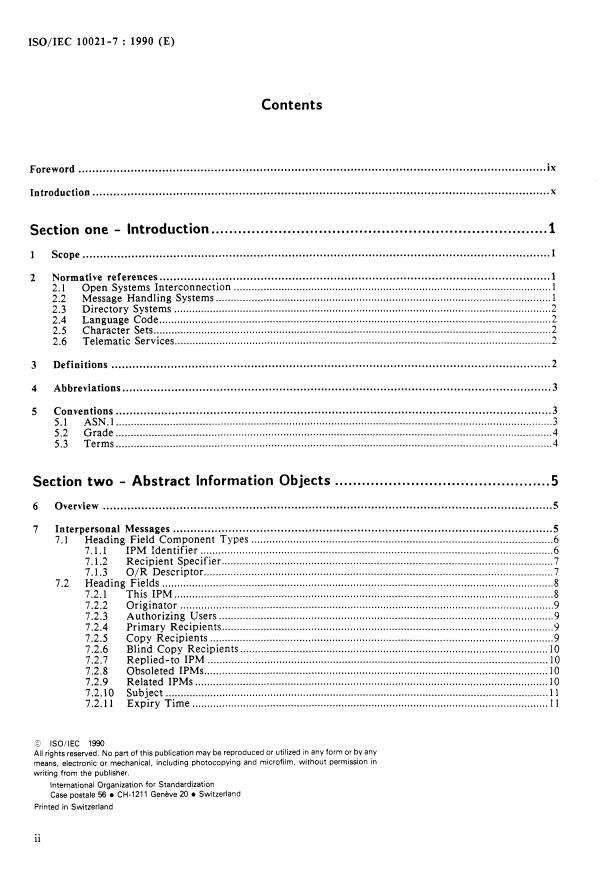
ISO/IEC 10021-7 : 1990 (E)
Contents
Foreword . ix
Introduction . x
Section one . Introduction . 1
Scope . 1
Normative references . 1
2.1 Open Systems Interconnection . 1
2.2 Message Handling Systems . 1
2.3 Directory Systems . 2
2.4 Language Code . 2
2.5 Character Sets . 2
2.6 Telematic Services . 2
Definitions . 2
Abbreviations . 3
Conventions . 3
5.1 ASN.1 . 3
5.2 Grade . 4
5.3 Terms . 4
Section two . Abstract Information Objects . 5
6 Overview . 5
7 Interpersonal Messages . 5
Heading Field Component Types . 6
7.1
7.1.1 IPM Identifier . 6
7.1.2 Recipient Specifier . 7
7.1.3 O/R Descriptor . 7
7.2 Heading Fields . 8
7.2.1 This IPM . 8
7.2.2 Originator . 9
7.2.3 Authorizing Users . 9
7.2.4 Primary Recipients .
7.2.5 Copy Recipients . 9
7.2.6 Blind Copy Recipients . 10
7.2.7 Replied-to IPM . 10
7.2.8 Obsoleted IPMs . 10
7.2.9 Related IPMs . 10
7.2.10 Subject . 11
7.2.1 1 Expiry Time . 11
E ISOilEC 1990
All rights reserved . No part of this publication may be reproduced or utilized in any form or by any
means. electronic or mechanical. including photocopying and microfilm. without permission in
writing from the publisher .
International Organization for Standardization
56 CH-1211 Genève 20 Switzerland
Case postale
Printed in Switzerland
..
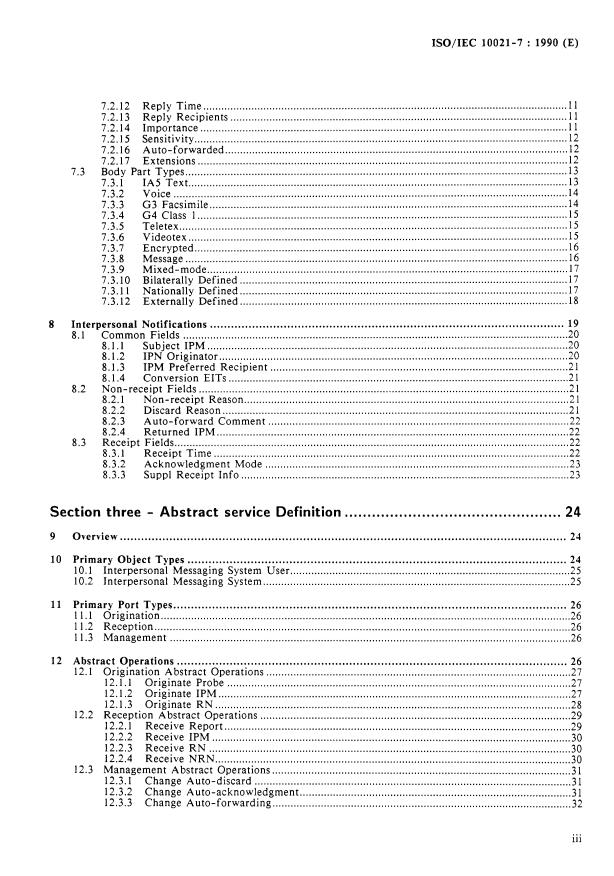
ISO/IEC 10021-7 : 1990 (E)
7.2.12 Reply Time . 11
7.2.13 Reply Recipients . 11
7.2.14 Importance . 11
7.2.15 Sensitivity . 12
7.2.16 Auto-forwarded . 12
........................................................................................................................... 12
7.2.17 Extensions
7.3 Body Part Types . 13
7.3.1 IA5 Text . 13
7.3.2 Voice . 14
7.3.3 G3 Facsimile . 14
7.3.4 G4 Class 1 . 15
7.3.5 Teletex . 15
7.3.6 Videotex . 15
7.3.7 Encrypted . 16
7.3.8 Message . 16
7.3.9 Mixed-mode . 17
7.3.1 O Bilaterally Defined . 17
Nationally Defined . 17
7.3.1 1
7.3.12 Externally Defined . 18
8 Interpersonal Notifications . 19
8.1 Common Fields . 20
8.1.1 Subject IPM . 20
8.1.2 IPN Originator . 20
8.1.3 IPM Preferred Recipient . 21
8.1.4 Conversion EITs . 21
8.2 Non-receipt Fields . 21
8.2.1 Non-receipt Reason . 21
8.2.2 Discard Reason . 21
8.2.3 Auto-forward Comment . 22
8.2.4 Returned IPM . 22
8.3 Receipt Fields . 22
8.3.1 Receipt Time . 22
8.3.2 Acknowledgment Mode . 23
8.3.3 Suppl Receipt Info . 23
Section three . Abstract service Definition . 24
9 Overview . 24
10 Primary Object Types . 24
10.1 Interpersonal Messaging System User . 25
10.2 Interpersonal Messaging System . 25
11 Primary Port Types . 26
11.1 Origination . 26
11.2 Reception . 26
11.3 Management . 26
Abstract Operations . 26
12.1 Origination Abstract Operations . 27
12.1.1 Originate Probe . 27
12.1.2 Originate IPM . 27
12.1.3 Originate RN . 28
12.2 Reception Abstract Operations . 29
12.2.1 Receive Report . 29
12.2.2 Receive IPM . 30
12.2.3 Receive RN . 30
12.2.4 Receive NRN . 30
12.3 Management Abstract Operations . 31
12.3.1 Change Auto-discard . 31
12.3.2 Change Auto-acknowledgment . 31
................................................................................................... 32
12.3.3 Change Auto-forwarding
...
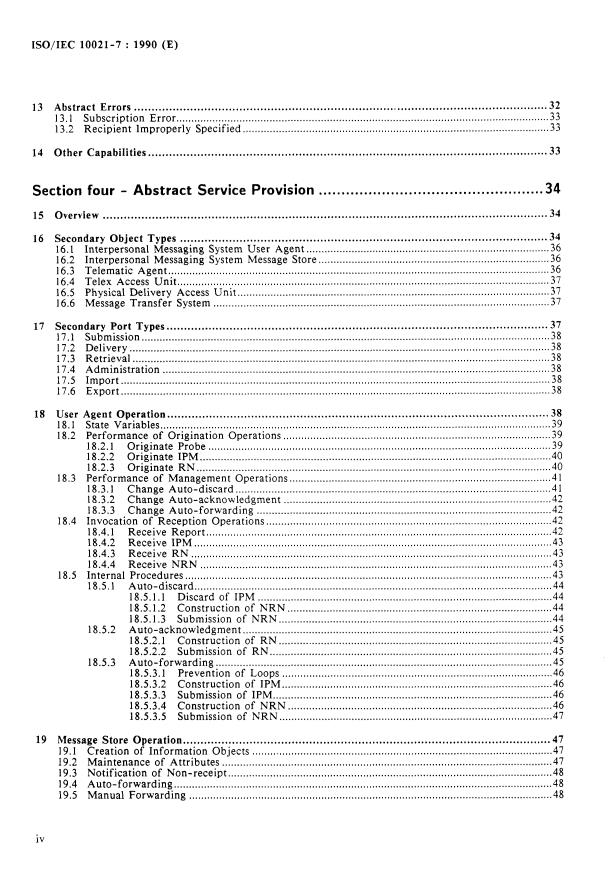
ISO/IEC 10021-7 : 1990 (E)
13 Abstract Errors . 32
13.1 Subscription Error . 33
13.2 Recipient Improperly Specified . 33
14 Other Capabilities . 33
Section four . Abstract Service Provision . 34
15 Overview . 34
16 Secondary Object Types . 34
Interpersonal Messaging System User Agent . 36
16.1
16.2 Interpersonal Messaging System Message Store . 36
16.3 Telematic Agent . 36
16.4 Telex Access Unit . 37
16.5 Physical Delivery Access Unit . 37
16.6 Message Transfer System . 37
Secondary Port Types . 37
17.1 Submission . 38
17.2 Delivery . 38
17.3 Retrieval . 38
17.4 Administration . 38
............................................................................................................................................... 38
17.5 Import
17.6 Export . 38
18 User Agent Operation . 38
18.1 State Variables . 39
18.2 Performance of Origination Operations . 39
18.2.1 Originate Probe . 39
18.2.2 Originate IPM . 40
18.2.3 Originate RN . 40
18.3 Performance of Management Operations . 41
18.3.1 Change Auto-discard . 41
18.3.2 Change Auto-acknowledgment . 42
18.3.3 Change Auto-forwarding . 42
18.4 Invocation of Reception Operations . 42
18.4.1 Receive Report . 42
IPM . 43
18.4.2 Receive
18.4.3 Receive RN . 43
18.4.4 Receive NRN . 43
18.5 Internal Procedures . 43
18.5.1 Auto-discard . 44
18.5.1.1 Discard of IPM . 44
of NRN . 44
18.5.1.2 Construction
18.5.1.3 Submission of NRN . 44
18.5.2 Auto-acknowledgment . 45
18.5.2.1 Construction of RN . 45
18.5.2.2 Submission of RN . 45
18.5.3 Auto-forwarding . 45
18.5.3.1 Prevention of Loops . 46
18.5.3.2 Construction of IPM . 46
18.5.3.3 Submission of IPM . 46
18.5.3.4 Construction of NRN . 46
18.5.3.5 Submission of NRN . 47
19 Message Store Operation . 47
19.1 Creation of Information Objects . 47
19.2 Maintenance of Attributes . 47
19.3 Notification of Non-receipt . 48
19.4 Auto-forwarding . 48
19.5 Manual Forwarding . 48
iv
ISO/IEC 10021-7 : 1990 (E)
20 Message Contents . 49
20.1 Content . 49
20.2 Content Type . 49
20.3 Content Length . 5~
20.4 Encoded Information Types . 50
21 Port Realization . 51
22 Conformance . 51
22.1 Origination Versus Reception . 51
22.2 Statement Requirements . 51
22.3 Static Requirements . 51
22.4 Dynamic Requirements . 52
Annexes . 53
A Heading Extensions . 53
A . 1 Incomplete Copy . 53
A.2 Languages . 53
B Extended Body Part Types . 54
B.1 Equivalents of Basic Body Part Types . 54
B.2 General Text . 55
C Message Store Attributes . 56
C.l Summary Attributes . 58
C.l.l IPM Entry Type . 58
C.1.2 IPM Synopsis . 59
C.2 Heading Attributes . 60
C.2.1 Heading . 60
C.2.2 Heading Analyses . 60
C.2.3 Heading Fields . 61
C.2.4 Heading Sub-fields . 62
C.2.5 Heading Extensions . 62
C.3 Body Attributes . 63
C.3.1 Body . 63
C.3.2 Basic Body Parts . 63
C.3.3 Basic Body Part Parameters Components . 64
C.3.4 Basic Body Part Data Components . 65
C.3.5 Extended Body Part Types . 65
C.3.6 Extended Body Parts . 65
C.4 Notification Attributes . 66
C.4.1 Common Fields . 66
............................................................................................................. 66
C.4.2 Non-receipt Fields
C.4.3 Receipt Fields . 67
D Reference Definition of Object Identifiers . 68
E Reference Definition of Abstract Information Objects . 72
F
Reference Definition of Functional Objects . 79
G Reference Definition of Abstract Service . 82
H Reference Definition of Heading Extensions . 85
I Reference Definition of Extended Body Part Types . 86
1.1 Equivalents of Basic Body Part Types . 86
1.2 General Text . 87
J Reference Definition of Message Store Attributes . 89
V
ISO/IEC 10021-7 : 1990 (E)
K
Reference Definition of Upper Bounds . 97
L
Support of the Interpersonal Messaging Service . 98
L . 1 Support of Recipient Specifier Components . 98
L.2 Support of Heading Fields . 99
L.3 Support of Body Aspects . 99
M Differences Between ISO/IEC 10021-7 and CCITT Recommendation X.420 . 100
N
Summary of Changes to 1984 CCITT Specification . 101
O Index . 102
vi
ISO/IEC 10021-7 : 1990 (E)
List of Figures
1 An Interpersonal Message . 6
2 An Interpersonal Notification . 20
The Interpersonal Messaging Environment . 25
4 The Interpersonal Messaging System . 35
vii
ISO/IEC 10021-7 : 1990 (E)
List of Tables
1 Uses of the ASN.l Notation . . . . . . . . . . . . . 3
2 Interpersonal Messaging Basic EITs and NBPs . . . . . 50
C.l Summary of MS Attributes . . . 57-58
L.l Support of Recipient Specifier Components . . . . . . . . . 98
L.2 Support of Heading Fields . . . . . . . . 99
L.3 Support of Body Aspects . . . . . . . . . . . . . 99
viii
ISO/IEC 10021-7 : 1990 (E)
Foreword
IS0 (the International Organization for Standardization) and IEC (the International
Electrotechnical Commission) form the specialized system for worldwide standardiz-
ation. National bodies that are members of IS0 or IEC participate in the development
of International Standards through technical committees established by the respective
organization to deal with particular fields of technical activity. IS0 and IEC technical
committees collaborate in fields of mutual interest. Other international organizations,
governmental and non-governmental, in liaison with IS0 and IEC, also take part in the
work.
In the field of information technology, IS0 and IEC have established a joint technical
JTC 1. Draft International Standards adopted by the joint
committee, ISO/IEC
technical committee are circulated to national bodies for voting. Publication as an
International Standard requires approval by at least 75 Yo of the national bodies casting
a vote.
International Standard ISO/IEC 10021-7 was prepared by Joint Technical Committee
ISO/IEC JTC 1, information technology.
ISO/IEC 10021-7 consists of the following parts, under the general title: Information
- Text Communication - Message-Oriented Text interchange Systems
technology
(MOTIS) -
- Part I: System and Service Overview
- Part 2: Overall Architecture
- Part 3: Abstract Service Definition Conventions
- Part 4: Message Transfer System: Abstract Service Definition and Procedures
- Part 5: Message Store: Abstract Service Definition
- Part 6: Protocol Specifications
- Part 7: Interpersonal Messaging System
Annexes A, B, C, D, E, F, G, H, I, J and L form an integral part of this part of
ISO/IEC 10021. Annexes K, M, N and O are for information only.
ix
ISO/IEC 10021-7 : 1990 (E)
Introduction
is one of a number of parts of ISO/IEC 10021 (the International
This part of ISO/IEC 10021
Standards for Message-Oriented Text Interchange Systems (MOTIS)). ISO/IEC 1002 1 provides a
comprehensive blueprint for a Message Handling System (MHS) realized by any number of cooperating
open systems.
The purpose of an MHS is to enable users to exchange messages on a store-and-forward basis. A
message submitted on behalf of one user, the originator, is conveyed by the Message Transfer System
(MTS) and subsequently delivered to the agents of one or more additional users, the recipients. Access
units (AUs) link the MTS to communication systems of other kinds (e.g., postal systems). A user is
assisted in the preparation, storage, and display of messages by a user agent (UA). Optionally, it is
assisted in the storage of messages by a message store (MS). The MTS comprises a number of message
transfer agents (MTAs) which collectively perform the store-and-forward message transfer function.
This part of ISO/IEC 1002 1 defines the Message Handling application called Znterpersoizal Messaging,
specifying in the process the message content type and associated procedures known as P2.
The text of this part of ISO/IEC 10021 is the subject of joint CCITT-IS0 agreement. The corresponding
CCITT specification is Recommendation X.420.
X
ISO/IEC 10021-7 : 1990 (E)
INTERNATIONAL STANDARD
Information technology - Text Communication -
Message-Oriented Text Interchange Systems (MOTIS) -
Part 7 : Interpersonal Messaging System
Section one - Introduction
1 Scope
This part of ISO/IEC 10021 defines Interpersonal Messaging, a form of hdssage Handling tailored for
ordinary interpersonal business or private correspondence.
This part of ISO/IEC 10021 is one of a series on Message Handling. ISO/IEC 10021-2 constitutes the
introduction to the series and identifies the other documents in it.
The architectural basis and foundation for Message Handling are defined in still other International
Standards. ISO/IEC 10021 -2 identifies those documents as well.
This part of ISO/IEC 10021 is structured as follows. Section one is this introduction. Section two defines
the kinds of information objects exchanged in Interpersonal Messaging. Section three defines the
associated abstract service. Section four specifies how it is provided. Annexes provide important
supplemental information.
The requirements for conformance to this part of ISO/IEC 10021 are given in clause 22.
2 Normative references
The following standards contain provisions which, through reference in this text, constitute provisions
of this part of ISO/IEC 10021. At the time of publication, the editions indicated were valid. All
standards are subject to revision, and parties to agreements based on this part of ISO/IEC 10021 are
encouraged to investigate the possibility of applying the most recent editions of the standards listed
below. Members of IS0 and IEC maintain registers of currently valid International Standards.
2.1 Open Systems Interconnection
This part of ISO/IEC 10021 cites the following OS1 specification:
IS0 8824: 1990, Information processing systems - Open Systems Interconnection - Specification of
Abstract Syntax Notation One (ASN.1).
IS0 8825: 1990, Information processing systems - Open Systems Interconnection - Specification of
Basic Encoding Rules for Abstract Syntax Notation One (ASN.1).
2.2 Message Handling Systems
This part of ISO/IEC 10021 cites the following Message Handling System specifications:
ISO/IEC 1002 1: 1990, In formation technology - Text communication - Message-Oriented Text
Interchange Systems (MOTIS) -
Part I: Service and system overview.
ISO/IEC 10021-7 : 1990 (E)
Part 2: Overall architecture.
3: Abstract service definition conventions.
Part
Part 4: Message trans fer system : Abstract service definition and procedures.
Part 5: Message store : Abstract service definition.
Part 6: Protocol specifications.
Message handling systems: Encoded in formation type conversion rules.
CCITT X.408: 1988
Message handling systems: Interpersonal messaging user agent layer.
CCITT X.420: 1984
2.3 Directory Systems
This part of ISO/IEC 10021 cites the following Directory System specification:
ISO/IEC 9594-2:1990, in formation technology - Open Systems interconnection - The Directory - Part 2:
Models.
2.4 Language Code
This part of ISO/IEC 10021 cites the following Language Code specification:
IS0 639: 1988, Code for the representation of names of languages.
2.5 Character Sets
This part of ISO/IEC 10021 cites the following Character Set specifications:
Data processing - Procedure for registration of escape sequences.
IS0 2375:1985,
Information processing - 8-bit single-byte coded graphic character sets - Part 1:
IS0 8859- 1:1987,
Latin alphabet No. I.
2.6 Telematic Services
This part of ISO/IEC 10021 cites the following Telematic Service specifications:
CCITT T.4:1988, Standardization of group 3 facsimile apparatus for document transmission.
CCITT T.30: 1988, Procedures for document facsimile transmission in the general switched telephone
net work.
CCITT T. 100: 1988, International information exchange for interactive videotex.
CCITT T.lO1: 1988, International interworking for videotex services.
CCITT T.330:1988, Telematic access to IPMS.
3 Definit ions
For the purposes of this part of ISO/IEC 10021, the definitions given in ISO/IEC 10021-2 apply.
ISO/IEC 10021-7 : 1990 (E)
4 Abbreviations
For the purposes of this part of ISO/IEC 10021, the abbreviations given in ISO/IEC 10021-2 apply.
5 Conventions
This part of ISO/IEC 10021 uses the descriptive conventions identified below.
5.1 ASN.l
the following ASN.l-based descriptive
This part of ISO/IEC 10021 uses for the indicated purposes
conventions:
To define the information objects of Interpersonal Messaging, and other data types and values of
a)
all kinds, ASN.1 itself.
To define the functional objects of Interpersonal Messaging, the OBJECT and REFINE macros
b)
of ISO/IEC 10021-3.
c> To define the abstract service of Interpersonal Messaging, the PORT and
ABSTRACT-OPERATION and -ERROR macros of ISO/IEC 10021 -3.
To define the headirtg extertsions, the HEADING-EXTENSION macro of clause 7.2.17.
d)
e> To define extended body part types, the EXTENDED-BODY-PART-TYPE macro of clause
7.3.12.
To define MS attributes, the ATTRIBUTE macro of ISO/IEC 9594-2.
f)
The various uses of the ASN.1 notation are summarized in Table 1. With the two exceptions evident
from the table, whenever ASN.l is employed, it appears both in the body of this part of ISO/IEC 10021
to aid the exposition, and again, largely redundantly, in an annex for reference.
Table 1
Uses of the ASN.l Notation
If differences are found between the ASN.1 used in the exposition and that supplied for reference, a
specification error is indicated.
ASN.1 tags are implicit throughout the ASN.1 module the annex defines; the module is definitive in that
respect.
NOTES
1. The use of ASN.l to describe a class or piece of information does not in itself imply that that information is transported between
open systems. The fact that the information, by virtue of its description in ASN.l and of ASN.1'8 Basic Encoding Rules, has a concrete
transfer syntax may be immaterial. Information actually conveyed between systems is designated as such by its inclusion in an
application protocol.
ISO/IEC 10021-7 : 1990 (E)
2. The use of the ABSTRACT-OPERATION and -ERROR macros, derived from the correspondingly named macros of Remote
Operations, does not imply that the abstract operations and errom are invoked and reported across the boundary between open
systems. The fact that the abstract operations and errors, by virtue of their description using these macros and with minimal
additional specification, actually could be invoked via ROS is immaterial in the present context.
5.2 Grade
This part of ISO/IEC 10021 uses the concept of grade as developed in ISO/IEC 10021-2.
5.3 Terms
Throughout this part of ISO/IEC 10021, terms are rendered in bold when defined, in iralic when
referenced prior to their definitions, without emphasis upon all other occasions.
Terms that are proper nouns are capitalized, generic terms are not.
ISO/IEC 10021-7 : 1990 (E)
Section two - Abstract Information Objects
6 Overview
This section abstractly describes the information objects that users exchange in Interpersonal Messaging.
They are of two kinds, interpersonal messages (ZPMs) and interpersonal notifications (IPNs). One of the
latter acknowledges a user's receipt of one of the former.
Informationûbject ::= CHOICE C
ip [O1 IPM,
ipn [ll IPN)
This section covers the following topics:
a) Interpersonal messages;
b) Interpersonal notifications.
NOTES
tor" and "recipient" anticir tes the fact that IPkfs and IPNS are
1. The uae, throughout this section, of words such aa "origin
conveyed between-users as the contents of messages (see clause 20). These words, therefore, refer to the roles users and DLs play in
such transmittals.
2. An IPM may appear (see clause 7.3.8) in the Body of another IPM which itself is conveyed as the content of a message. The
words "originator" and "recipient" shall be understood in the context of an IPM's conveyance a6 the (entire) content of a message,
not as a component of the Body of another IPM so conveyed.
3. An IPM or IPN makes various assertions about its own transmittal (e.g., who originates the message containing it). Furthermore,
an IPN makes assertions about the transmittal of the IPkf to which it responds. All of these assertions are unverified.
7 Interpersonal Messages
An interpersonal message (IPM) is a member of the primary class of information object conveyed
between users in Interpersonal Messaging.
IPM ::= SEQUENCE C
heading Heading,
body Body)
It has the following components:
Heading: A Set of heading fields (or fields), each an information item that gives a characteristic
a)
of the IPM (e.g., its importance).
Body: A Sequence of body parts, each an information object that the IPM is intended to convey
b)
between users (e.g., a document).
Body ::= SEQUENCE OF BodyPart
The structure of an IPM is depicted in Figure 1.
ISO/IEC 10021-7 : 1990 (E)
/
Field 1
/ I
O
O
1 HEADING
I Field n I
Body-Part 1
BODY
Body-Part 2
I
-
Body-Part 3
o.
-
Figure 1
An Interpersonal Message
This clause defines and describes the most prominent Heading field component types and the defined
Heading fields and body part types.
NOTE - An IPM may be likened to a business memo. In fact, the terms "Heading" and "Body" appeal to that analogy.
7.1 Heading Field Component Types
Information items of several kinds appear throughout the Heading. These Heading field component
types--IPM identi fier, recipient specifier, and O/R descriptor--are defined and described below.
7.1.1 IPM Identifier
An IPM identifier is an information item that unambiguously and uniquely identifies an IPM,
distinguishing it from all other IPMs ever conveyed by any user.
IPMIdentifier ::= [APPLIC
...
Questions, Comments and Discussion
Ask us and Technical Secretary will try to provide an answer. You can facilitate discussion about the standard in here.
Loading comments...