

ISO 22316:2017
(Main)Security and resilience — Organizational resilience — Principles and attributes
General Information
- Abstract
ISO 22316:2017 provides guidance to enhance organizational resilience for any size or type of organization. It is not specific to any industry or sector. ISO 22316:2017 can be applied throughout the life of an organization. ISO 22316:2017 does not promote uniformity in approach across all organizations, as specific objectives and initiatives are tailored to suit an individual organization's needs.
- Status
- Published
- Publication Date
- 28-Mar-2017
- Technical Committee
- ISO/TC 292 - Security and resilience
- Drafting Committee
- ISO/TC 292/WG 2 - Continuity and organizational resilience
- Current Stage
- 9092 - International Standard to be revised
- Start Date
- 03-Feb-2023
- Completion Date
- 29-Aug-2026
Overview
ISO 22316:2017 - Security and resilience - Organizational resilience - Principles and attributes - provides guidance to enhance organizational resilience for any size or type of organization. It is sector‑agnostic and applicable throughout an organization’s life. The standard establishes core principles and describes the attributes and activities that support resilience, without prescribing a single uniform approach. ISO 22316:2017 emphasizes alignment between strategy, leadership, culture, and risk‑informed decision making to help organizations absorb, adapt and respond to change.
Key topics and requirements
ISO 22316:2017 focuses on principles and attributes rather than prescriptive controls. Core elements include:
Foundational principles
- Align behaviour with a shared vision and purpose
- Maintain an up‑to‑date understanding of organizational context
- Ability to absorb, adapt and respond to change
- Good governance and coordinated management
- Diversity of skills, leadership, knowledge and experience
- Coordination across management disciplines and technical expertise
- Effective risk management
Attributes for organizational resilience
- Shared vision and clarity of purpose: communicate vision, align objectives, review strategy
- Understanding and influencing context: monitor internal/external environment and interdependencies
- Effective and empowered leadership: develop adaptive leaders, assign roles, share lessons learned
- Culture supportive of resilience: define values, encourage innovation, empower reporting of threats/opportunities
- Shared information and knowledge: value learning and information sharing
- Availability of resources; development and coordination of management disciplines; continual improvement; ability to anticipate and manage change
Evaluation and improvement
- Assess organizational requirements and gaps
- Monitor, review and report on resilience factors using appropriate methods
- Annex A outlines relevant management disciplines that contribute to resilience
Practical applications
ISO 22316:2017 is a guidance tool for organizations seeking to strengthen their ability to withstand disruptions and change. Typical uses:
- Designing or improving enterprise resilience strategies and governance
- Integrating resilience thinking into strategic planning, risk management and business continuity
- Developing leadership programs and cultural change initiatives that support resilience
- Establishing monitoring, assessment and reporting processes for resilience performance
Who should use it
- Senior leaders and executives responsible for strategy and governance
- Risk, business continuity, and security managers
- Organizational development and HR professionals (culture and leadership)
- Consultants and advisors working on resilience, continuity and crisis management
Related standards
- ISO 22300 (Societal security - Terminology) is referenced for terms and definitions used in ISO 22316:2017.
Keywords: ISO 22316:2017, organizational resilience, security and resilience, resilience attributes, resilience principles, risk management, leadership, organizational culture.
Get Certified
Connect with accredited certification bodies for this standard

BSI Group
BSI (British Standards Institution) is the business standards company that helps organizations make excellence a habit.

Bureau Veritas
Bureau Veritas is a world leader in laboratory testing, inspection and certification services.

DNV
DNV is an independent assurance and risk management provider.
Sponsored listings
Frequently Asked Questions
ISO 22316:2017 is a standard published by the International Organization for Standardization (ISO). Its full title is "Security and resilience — Organizational resilience — Principles and attributes". This standard covers: ISO 22316:2017 provides guidance to enhance organizational resilience for any size or type of organization. It is not specific to any industry or sector. ISO 22316:2017 can be applied throughout the life of an organization. ISO 22316:2017 does not promote uniformity in approach across all organizations, as specific objectives and initiatives are tailored to suit an individual organization's needs.
ISO 22316:2017 provides guidance to enhance organizational resilience for any size or type of organization. It is not specific to any industry or sector. ISO 22316:2017 can be applied throughout the life of an organization. ISO 22316:2017 does not promote uniformity in approach across all organizations, as specific objectives and initiatives are tailored to suit an individual organization's needs.
ISO 22316:2017 is classified under the following ICS (International Classification for Standards) categories: 03.100.01 - Company organization and management in general. The ICS classification helps identify the subject area and facilitates finding related standards.
ISO 22316:2017 is available in PDF format for immediate download after purchase. The document can be added to your cart and obtained through the secure checkout process. Digital delivery ensures instant access to the complete standard document.
Standards Content (Sample)
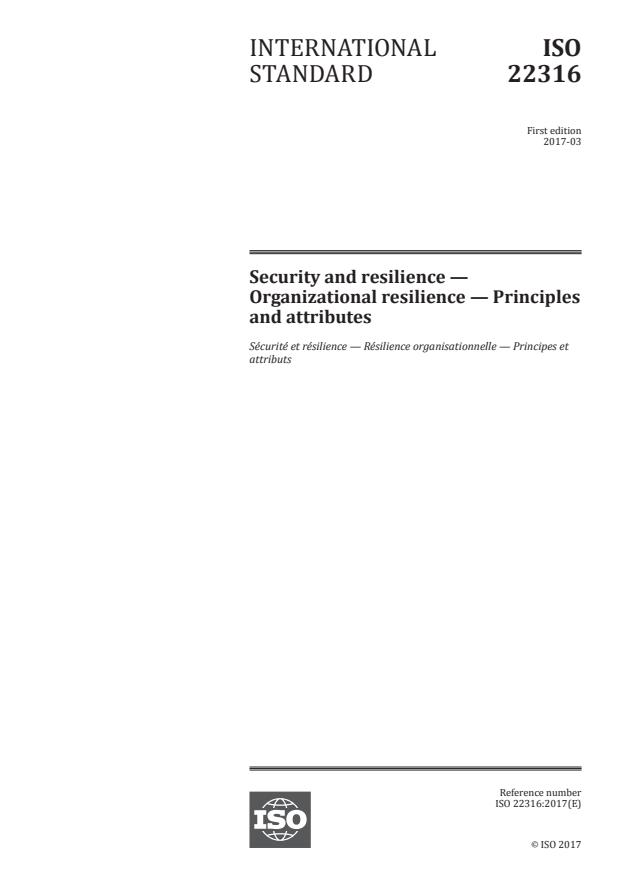
INTERNATIONAL ISO
STANDARD 22316
First edition
2017-03
Security and resilience —
Organizational resilience — Principles
and attributes
Sécurité et résilience — Résilience organisationnelle — Principes et
attributs
Reference number
©
ISO 2017
© ISO 2017, Published in Switzerland
All rights reserved. Unless otherwise specified, no part of this publication may be reproduced or utilized otherwise in any form
or by any means, electronic or mechanical, including photocopying, or posting on the internet or an intranet, without prior
written permission. Permission can be requested from either ISO at the address below or ISO’s member body in the country of
the requester.
ISO copyright office
Ch. de Blandonnet 8 • CP 401
CH-1214 Vernier, Geneva, Switzerland
Tel. +41 22 749 01 11
Fax +41 22 749 09 47
copyright@iso.org
www.iso.org
ii © ISO 2017 – All rights reserved
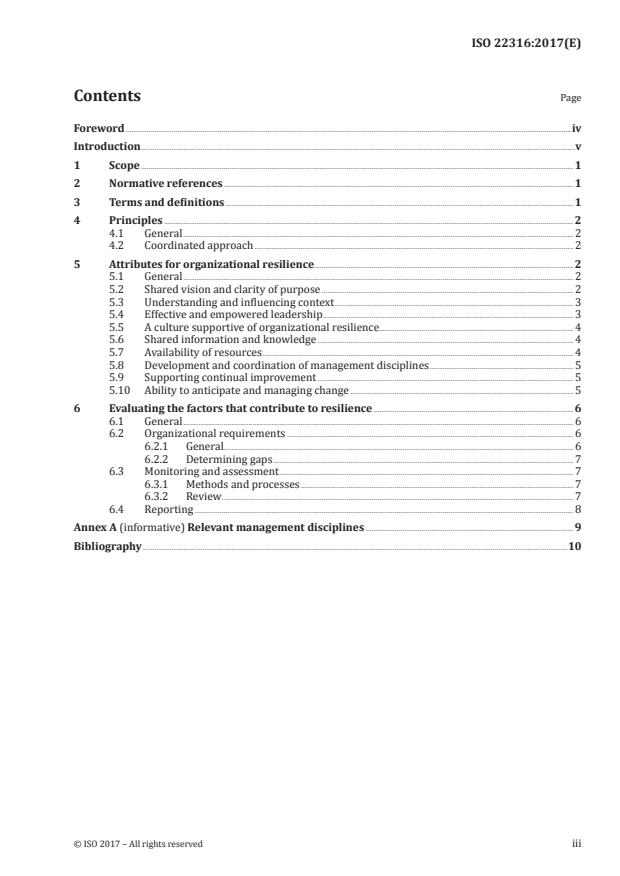
Contents Page
Foreword .iv
Introduction .v
1 Scope . 1
2 Normative references . 1
3 Terms and definitions . 1
4 Principles . 2
4.1 General . 2
4.2 Coordinated approach . 2
5 Attributes for organizational resilience. 2
5.1 General . 2
5.2 Shared vision and clarity of purpose . 2
5.3 Understanding and influencing context . 3
5.4 Effective and empowered leadership . 3
5.5 A culture supportive of organizational resilience . 4
5.6 Shared information and knowledge . 4
5.7 Availability of resources . 4
5.8 Development and coordination of management disciplines . 5
5.9 Supporting continual improvement . 5
5.10 Ability to anticipate and managing change . 5
6 Evaluating the factors that contribute to resilience . 6
6.1 General . 6
6.2 Organizational requirements . 6
6.2.1 General. 6
6.2.2 Determining gaps . 7
6.3 Monitoring and assessment . 7
6.3.1 Methods and processes . 7
6.3.2 Review . . 7
6.4 Reporting . 8
Annex A (informative) Relevant management disciplines . 9
Bibliography .10
Foreword
ISO (the International Organization for Standardization) is a worldwide federation of national standards
bodies (ISO member bodies). The work of preparing International Standards is normally carried out
through ISO technical committees. Each member body interested in a subject for which a technical
committee has been established has the right to be represented on that committee. International
organizations, governmental and non-governmental, in liaison with ISO, also take part in the work.
ISO collaborates closely with the International Electrotechnical Commission (IEC) on all matters of
electrotechnical standardization.
The procedures used to develop this document and those intended for its further maintenance are
described in the ISO/IEC Directives, Part 1. In particular the different approval criteria needed for the
different types of ISO documents should be noted. This document was drafted in accordance with the
editorial rules of the ISO/IEC Directives, Part 2 (see www .iso .org/ directives).
Attention is drawn to the possibility that some of the elements of this document may be the subject of
patent rights. ISO shall not be held responsible for identifying any or all such patent rights. Details of
any patent rights identified during the development of the document will be in the Introduction and/or
on the ISO list of patent declarations received (see www .iso .org/ patents).
Any trade name used in this document is information given for the convenience of users and does not
constitute an endorsement.
For an explanation on the voluntary nature of standards, the meaning of ISO specific terms and
expressions related to conformity assessment, as well as information about ISO’s adherence to the
World Trade Organization (WTO) principles in the Technical Barriers to Trade (TBT) see the following
URL: w w w . i s o .org/ iso/ foreword .html.
This document was prepared by Technical Committee ISO/TC 292, Security and resilience.
iv © ISO 2017 – All rights reserved
Introduction
Organizational resilience is the ability of an organization to absorb and adapt in a changing environment
to enable it to deliver its objectives and to survive and prosper. More resilient organizations can
anticipate and respond to threats and opportunities, arising from sudden or gradual changes in their
internal and external context. Enhancing resilience can be a strategic organizational goal, and is the
outcome of good business practice and effectively managing risk.
An organization’s resilience is influenced by a unique interaction and combination of strategic and
operational factors. Organizations can only be more or less resilient; there is no absolute measure or
definitive goal.
A commitment to enhanced organizational resilience contributes to:
— an improved ability to anticipate and address risks and vulnerabilities;
— increased coordination and integration of management disciplines to improve coherence and
performance;
— a greater understanding of interested parties and dependencies that support strategic goals, and
objectives.
There is no single approach to enhance an organization’s resilience. There are established management
disciplines that contribute towards resilience but, on their own, these disciplines are insufficient to
safeguard an organization’s resilience. Instead, organizational resilience is the result of the interaction
of attributes and activities, and contributions made from other technical and scientific areas of
expertise. These are influenced by the way in which uncertainty is addressed, decisions are made and
enacted, and how people work together.
This document establishes the principles for organizational resilience. It identifies the attributes and
activities that support an organization in enhancing its resilience.
This document includes:
— principles providing the foundation for enhancing an organization’s resilience;
— attributes describing the characteristics of an organization that allow the principles to be adopted;
— activities guiding the utilization, evaluation and enhancement of attributes.
INTERNATIONAL STANDARD ISO 22316:2017(E)
Security and resilience — Organizational resilience —
Principles and attributes
1 Scope
This document provides guidance to enhance organizational resilience for any size or type of
organization. It is not specific to any industry or sector. This document can be applied throughout the
life of an organization.
This document does not promote uniformity in approach across all organizations, as specific objectives
and initiatives are tailored to suit an individual organization’s needs.
2 Normative references
The following documents are referred to in the text in such a way that some or all of their content
constitutes requirements of this document. For dated references, only the edition cited applies. For
undated references, the latest edition of the referenced document (including any amendments) applies.
ISO 22300, Societal security — Terminology
3 Terms and definitions
For the purposes of this document, the terms and definitions given in ISO 22300 and the following apply.
ISO and IEC maintain terminological databases for use in standardization at the following addresses:
— ISO Online browsing platform: available at http:// www .iso .org/ obp
— IEC Electropedia: available at http:// www .electropedia .org/
3.1
management
coordinated activities to direct and control an organization
3.2
interested party
person or organization that can affect, be affected by, or perceive itself to be affected by a decision or
activity
Note 1 to entry: This can be an individual or group that has an interest in any decision or activity of an
organization.
3.3
organizational culture
collective beliefs, values, attitudes and behaviour of an organization that contribute to the unique social
and psychological environment in which it operates
3.4
organizational resilience
ability of an organization to absorb and adapt in a changing environment
3.5
values
beliefs an organization adheres to and the standards that it seeks to observe
4 Principles
4.1 General
The principles provide the foundation upon which a framework and strategy to achieve an enhanced
state of organizational resilience can be developed, implemented and evaluated.
An organization’s resilience:
a) is enhanced when behaviour is aligned with a shared vision and purpose;
b) relies upon an up-to-date understanding of an organization’s context;
c) relies upon an ability to absorb, adapt and effectively respond to change;
d) relies upon good governance and management;
e) is supported by a diversity of skills, leadership, knowledge and experience;
f) is enhanced by coordination across management disciplines and contributions from technical and
scientific areas of expertise;
g) relies upon effectively managing risk.
4.2 Coordinated approach
The organization should develop a coordinated approach that provides:
— a mandate to ensure its leaders and top management are committed to enhance organizational
resilience;
— adequate resources needed to enhance the organization’s resilience;
— appropriate governance structures to achieve the effective coordination of organizational resilience
activities;
— mechanisms to ensure investments in resilience activities are appropriate to the organization’s
internal and external context;
— systems that support the effective implementation of organizational resilience activities;
— arrangements to evaluate and enhance resilience in support of organizational requirements;
— effective communications to improve understanding and decision making.
5 Attributes for organizational resilience
5.1 General
An organization that has adopted the resilience principles will demonstrate common attributes
supported by activities, which guide their utilization, evaluation and enhancement. Such attributes
include those described in 5.2 to 5.10.
5.2 Shared vision and clarity of purpose
Organizational resilience is enhanced by a clearly articulated and understood purpose, vision and
values to provide clarity to decision making at all levels of the organization.
2 © ISO 2017 – All rights reserved
The organization should prioritize and resource the following activities:
a) articulate its vision, purpose and core values to all interested parties to provide strategic direction,
coherence and clarity in all decision-making;
b) ensure individual goals and objectives are aligned with and committed to the organization’s
purpose, vision and values;
c) monitor and review regularly the suita
...