

ISO 15676:2016
(Main)Cardiovascular implants and artificial organs — Requirements for single-use tubing packs for cardiopulmonary bypass and extracorporeal membrane oxygenation (ECMO)
General Information
- Abstract
ISO 15676:2016 specifies requirements for single-use tubing packs for cardiopulmonary bypass and extracorporeal membrane oxygenation (ECMO). This document is applicable to all medical tubing intended for cardiopulmonary bypass (CPB) and/or extracorporeal membrane oxygenation (ECMO), but specific requirements and tests are included for tubing intended for use with peristaltic pumps during (short-term, i.e. 24 h) ECMO procedures. The sterility and non-pyrogenicity provisions of this document are applicable to tubing packs labelled as "sterile". It is applicable only to the tubing aspects for multifunctional systems that may have integral components such as blood gas exchangers (oxygenators), reservoirs, blood filters, defoamers, blood pumps, etc.
- Status
- Published
- Publication Date
- 14-Aug-2016
- Technical Committee
- ISO/TC 150/SC 2 - Cardiovascular implants and extracorporeal systems
- Drafting Committee
- ISO/TC 150/SC 2/WG 4 - Blood gas exchangers
- Current Stage
- 9093 - International Standard confirmed
- Start Date
- 26-May-2023
- Completion Date
- 29-Aug-2026
Buy Documents

ISO 15676:2016 - Cardiovascular implants and artificial organs -- Requirements for single-use tubing packs for cardiopulmonary bypass and extracorporeal membrane oxygenation (ECMO)

ISO 15676:2016 - Cardiovascular implants and artificial organs — Requirements for single-use tubing packs for cardiopulmonary bypass and extracorporeal membrane oxygenation (ECMO)/15/2016
Overview
ISO 15676:2016 - "Cardiovascular implants and artificial organs - Requirements for single‑use tubing packs for cardiopulmonary bypass and extracorporeal membrane oxygenation (ECMO)" specifies safety, performance and information requirements for medical tubing used in CPB and ECMO. The standard applies to all single‑use tubing intended for extracorporeal blood circuits and focuses on tubing characteristics, testing, labelling and manufacturer reporting. It is intended to help manufacturers, regulators and clinical users ensure tubing safety and functional compatibility with extracorporeal systems.
Key topics and technical requirements
Scope and applicability
- Covers tubing packs and tubing aspects of multifunctional systems (oxygenators, reservoirs, filters, pumps, etc.).
- Includes specific provisions for tubing used with peristaltic/roller pumps in short‑term CPB and longer‑term ECMO applications.
- Sterility and non‑pyrogenicity requirements apply when tubing packs are labelled as “sterile.”
Biological requirements
- Sterility and non‑pyrogenicity verified per the standard’s test clauses.
- Biocompatibility requirements for all components contacting blood; compliance typically demonstrated in line with ISO 10993 series.
Physical and material characteristics
- Blood‑path integrity (no leakage) and dimensional conformity (inner diameter, wall thickness, segment lengths) per user specifications.
- Material properties to be tested/reported: durometer hardness, ultimate elongation, tensile strength, tear strength, brittle point, specific gravity.
Performance characteristics
- Priming volume: measured or calculated and reported across supplied tubing sizes.
- Life‑to‑failure testing and spallation (particle generation) assessment, particularly for tubing used in roller/peristaltic pumps.
- Shelf life and cleanliness reporting.
Information and packaging
- Minimum labelling and manufacturer information requirements, including technical data, packaging, and shipping details to support clinical selection and quality processes.
Applications and who uses ISO 15676:2016
- Tubing and medical device manufacturers - design verification, material selection, production QA, and regulatory submissions.
- OEMs of CPB/ECMO systems - component selection and system compatibility testing.
- Regulatory and quality teams - conformity assessment, risk management, and clinical documentation.
- Hospitals, perfusionists and clinical engineers - informed procurement, device selection (priming volume, intended pump compatibility), and safe clinical use.
Related standards (examples)
ISO 15676 references standards commonly used together for testing and sterilization, such as:
- ISO 10993 series (biological evaluation),
- ISO 11135 / ISO 11137 / ISO 17665 (sterilization processes),
- ISO 11607 (packaging for sterile devices),
- ASTM and ISO material test methods (tensile, durometer, tear tests).
ISO 15676:2016 helps bridge material and performance testing with clinical needs, enabling safer extracorporeal blood circuits and clearer manufacturer-to‑user information.
Relations
- Effective Date
- 06-Jun-2022
- Effective Date
- 29-Mar-2014
Buy Documents
ISO 15676:2016 - Cardiovascular implants and artificial organs -- Requirements for single-use tubing packs for cardiopulmonary bypass and extracorporeal membrane oxygenation (ECMO)
ISO 15676:2016 - Cardiovascular implants and artificial organs — Requirements for single-use tubing packs for cardiopulmonary bypass and extracorporeal membrane oxygenation (ECMO)/15/2016
Get Certified
Connect with accredited certification bodies for this standard

BSI Group
BSI (British Standards Institution) is the business standards company that helps organizations make excellence a habit.

TÜV Rheinland
TÜV Rheinland is a leading international provider of technical services.

TÜV SÜD
TÜV SÜD is a trusted partner of choice for safety, security and sustainability solutions.
Sponsored listings
Frequently Asked Questions
ISO 15676:2016 is a standard published by the International Organization for Standardization (ISO). Its full title is "Cardiovascular implants and artificial organs — Requirements for single-use tubing packs for cardiopulmonary bypass and extracorporeal membrane oxygenation (ECMO)". This standard covers: ISO 15676:2016 specifies requirements for single-use tubing packs for cardiopulmonary bypass and extracorporeal membrane oxygenation (ECMO). This document is applicable to all medical tubing intended for cardiopulmonary bypass (CPB) and/or extracorporeal membrane oxygenation (ECMO), but specific requirements and tests are included for tubing intended for use with peristaltic pumps during (short-term, i.e. 24 h) ECMO procedures. The sterility and non-pyrogenicity provisions of this document are applicable to tubing packs labelled as "sterile". It is applicable only to the tubing aspects for multifunctional systems that may have integral components such as blood gas exchangers (oxygenators), reservoirs, blood filters, defoamers, blood pumps, etc.
ISO 15676:2016 specifies requirements for single-use tubing packs for cardiopulmonary bypass and extracorporeal membrane oxygenation (ECMO). This document is applicable to all medical tubing intended for cardiopulmonary bypass (CPB) and/or extracorporeal membrane oxygenation (ECMO), but specific requirements and tests are included for tubing intended for use with peristaltic pumps during (short-term, i.e. 24 h) ECMO procedures. The sterility and non-pyrogenicity provisions of this document are applicable to tubing packs labelled as "sterile". It is applicable only to the tubing aspects for multifunctional systems that may have integral components such as blood gas exchangers (oxygenators), reservoirs, blood filters, defoamers, blood pumps, etc.
ISO 15676:2016 is classified under the following ICS (International Classification for Standards) categories: 11.040.40 - Implants for surgery, prosthetics and orthotics. The ICS classification helps identify the subject area and facilitates finding related standards.
ISO 15676:2016 has the following relationships with other standards: It is inter standard links to ISO 20957-9:2016/Amd 1:2019, ISO 15676:2005. Understanding these relationships helps ensure you are using the most current and applicable version of the standard.
ISO 15676:2016 is available in PDF format for immediate download after purchase. The document can be added to your cart and obtained through the secure checkout process. Digital delivery ensures instant access to the complete standard document.
Standards Content (Sample)
INTERNATIONAL ISO
STANDARD 15676
Second edition
2016-08-15
Cardiovascular implants and artificial
organs — Requirements for single-
use tubing packs for cardiopulmonary
bypass and extracorporeal membrane
oxygenation (ECMO)
Implants cardiovasculaires et organes artificiels — Exigences pour les
paquets de tubes à usage unique pour pontage cardiopulmonaire et
oxygénation des membranes extracorporelles
Reference number
©
ISO 2016
© ISO 2016, Published in Switzerland
All rights reserved. Unless otherwise specified, no part of this publication may be reproduced or utilized otherwise in any form
or by any means, electronic or mechanical, including photocopying, or posting on the internet or an intranet, without prior
written permission. Permission can be requested from either ISO at the address below or ISO’s member body in the country of
the requester.
ISO copyright office
Ch. de Blandonnet 8 • CP 401
CH-1214 Vernier, Geneva, Switzerland
Tel. +41 22 749 01 11
Fax +41 22 749 09 47
copyright@iso.org
www.iso.org
ii © ISO 2016 – All rights reserved
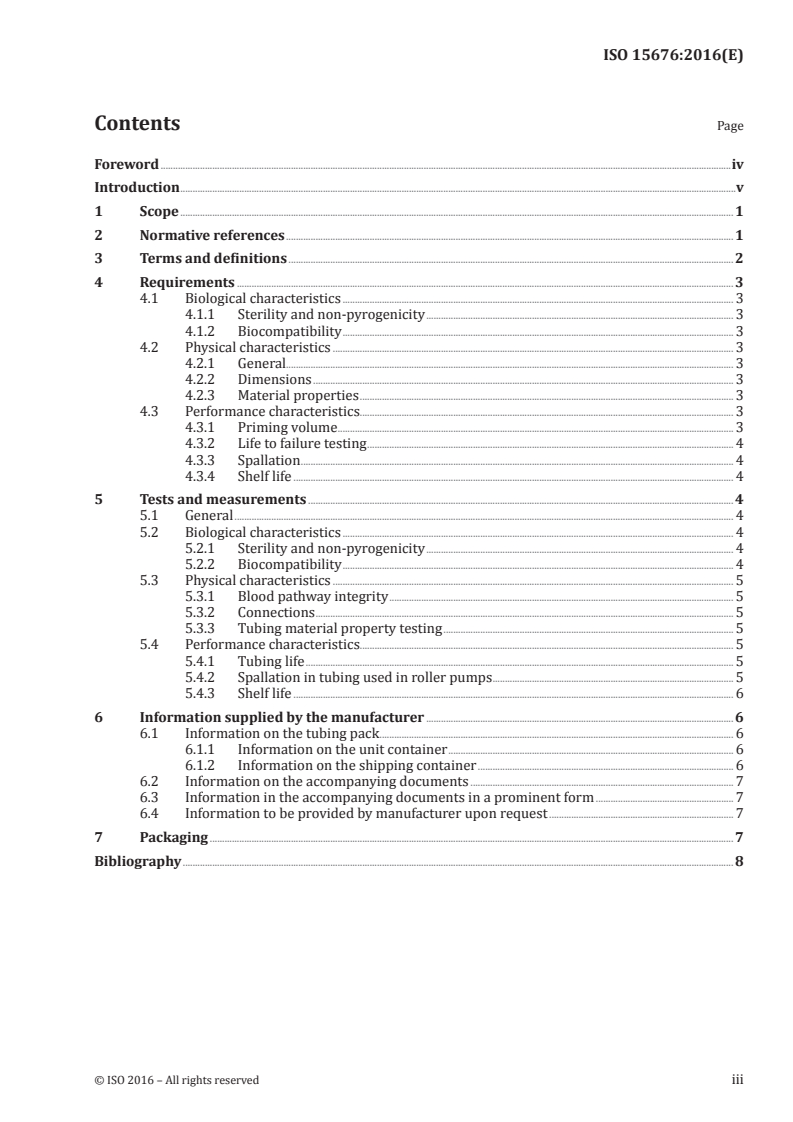
Contents Page
Foreword .iv
Introduction .v
1 Scope . 1
2 Normative references . 1
3 Terms and definitions . 2
4 Requirements . 3
4.1 Biological characteristics . 3
4.1.1 Sterility and non-pyrogenicity . 3
4.1.2 Biocompatibility . 3
4.2 Physical characteristics . 3
4.2.1 General. 3
4.2.2 Dimensions . 3
4.2.3 Material properties . 3
4.3 Performance characteristics. 3
4.3.1 Priming volume . 3
4.3.2 Life to failure testing . 4
4.3.3 Spallation . 4
4.3.4 Shelf life . 4
5 Tests and measurements . 4
5.1 General . 4
5.2 Biological characteristics . 4
5.2.1 Sterility and non-pyrogenicity . 4
5.2.2 Biocompatibility . 4
5.3 Physical characteristics . 5
5.3.1 Blood pathway integrity . 5
5.3.2 Connections . 5
5.3.3 Tubing material property testing . 5
5.4 Performance characteristics. 5
5.4.1 Tubing life . 5
5.4.2 Spallation in tubing used in roller pumps . 5
5.4.3 Shelf life . 6
6 Information supplied by the manufacturer . 6
6.1 Information on the tubing pack . 6
6.1.1 Information on the unit container . 6
6.1.2 Information on the shipping container . 6
6.2 Information on the accompanying documents . 7
6.3 Information in the accompanying documents in a prominent form . 7
6.4 Information to be provided by manufacturer upon request . 7
7 Packaging . 7
Bibliography . 8
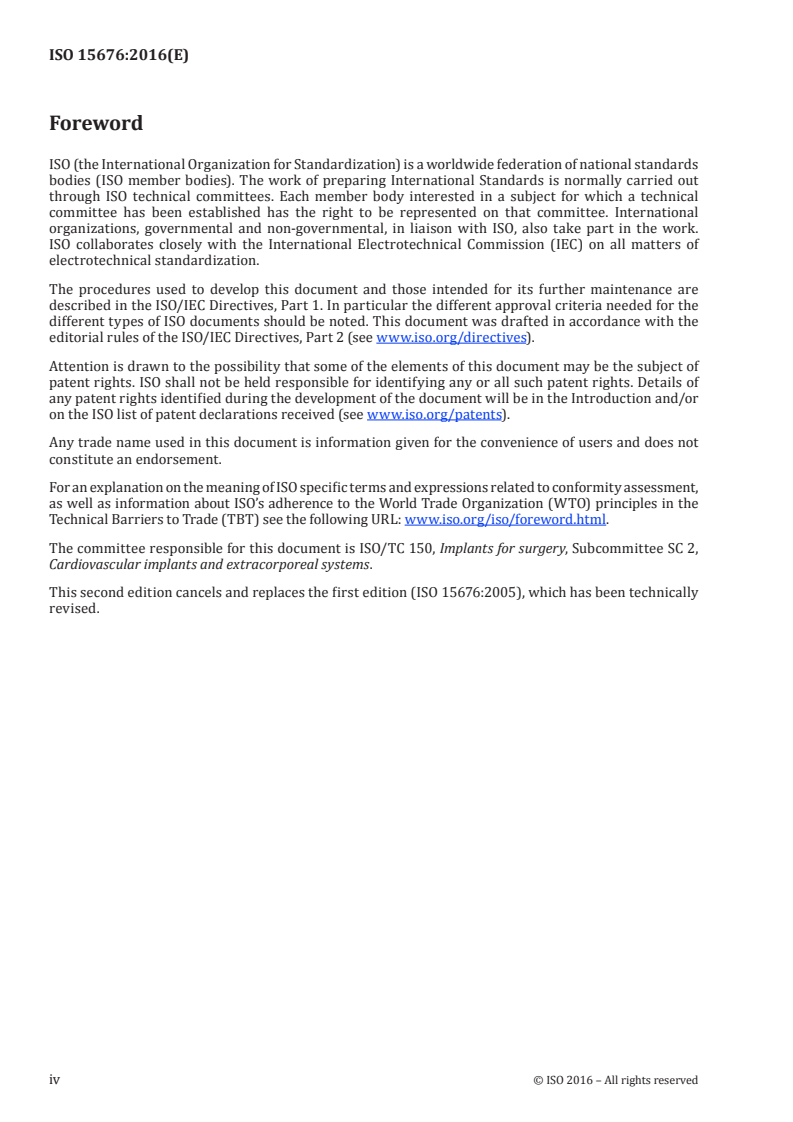
Foreword
ISO (the International Organization for Standardization) is a worldwide federation of national standards
bodies (ISO member bodies). The work of preparing International Standards is normally carried out
through ISO technical committees. Each member body interested in a subject for which a technical
committee has been established has the right to be represented on that committee. International
organizations, governmental and non-governmental, in liaison with ISO, also take part in the work.
ISO collaborates closely with the International Electrotechnical Commission (IEC) on all matters of
electrotechnical standardization.
The procedures used to develop this document and those intended for its further maintenance are
described in the ISO/IEC Directives, Part 1. In particular the different approval criteria needed for the
different types of ISO documents should be noted. This document was drafted in accordance with the
editorial rules of the ISO/IEC Directives, Part 2 (see www.iso.org/directives).
Attention is drawn to the possibility that some of the elements of this document may be the subject of
patent rights. ISO shall not be held responsible for identifying any or all such patent rights. Details of
any patent rights identified during the development of the document will be in the Introduction and/or
on the ISO list of patent declarations received (see www.iso.org/patents).
Any trade name used in this document is information given for the convenience of users and does not
constitute an endorsement.
For an explanation on the meaning of ISO specific terms and expressions related to conformity assessment,
as well as information about ISO’s adherence to the World Trade Organization (WTO) principles in the
Technical Barriers to Trade (TBT) see the following URL: www.iso.org/iso/foreword.html.
The committee responsible for this document is ISO/TC 150, Implants for surgery, Subcommittee SC 2,
Cardiovascular implants and extracorporeal systems.
This second edition cancels and replaces the first edition (ISO 15676:2005), which has been technically
revised.
iv © ISO 2016 – All rights reserved
Introduction
The intent of this document is to ensure that medical grade tubing in single-use tubing packs for the
transfer of blood and fluid during the period of cardiopulmonary bypass (CPB) and extracorporeal
membrane oxygenation (ECMO) is adequately tested for both safety and function. The user commonly
provides the specifications for the tubing pack. Furthermore, the purpose of this document is to ensure
that the tubing pack characteristics be appropriately disclosed in the labelling and manufacturing
information package. Tubing performance characteristics are specifically addressed within the context
of this document as a component part of a single-use tubing pack.
This document therefore contains recommended procedures to evaluate such medical grade tubing
intended for use during CPB procedures and ECMO. Test procedures to determine the material
characteristics, the useful life of the tubing when used in a roller pump, and cleanliness are described.
The limits for these characteristics are not specified.
This document also includes minimum reporting requirements. Ready identification of the performance
characteristics should assist the user in the selection of such medical grade tubing for the procedure
appropriate to the patient and procedure. This information may be useful in a clinic’s quality control
process that aims to improve the safety of CPB and ECMO procedures.
This document makes reference to other International Standards, which references methods for the
determination of characteristics common to medical devices.
Requirements for animal and clinical studies are not included in this document. Such studies, however,
may be part of a manufacturer’s quality system.
This document contains only those requirements that are specific to such medical grade tubing for
use during CPB and ECMO. Non-specific requirements are covered by reference to other International
Standards listed in the Normative References section.
INTERNATIONAL STANDARD ISO 15676:2016(E)
Cardiovascular implants and artificial organs —
Requirements for single-use tubing packs for
cardiopulmonary bypass and extracorporeal membrane
oxygenation (ECMO)
1 Scope
This document specifies requirements for single-use tubing packs for cardiopulmonary bypass and
extracorporeal membrane oxygenation (ECMO). This document is applicable to all medical tubing
intended for cardiopulmonary bypass (CPB) and/or extracorporeal membrane oxygenation (ECMO),
but specific requirements and tests are included for tubing intended for use with peristaltic pumps
during (short-term, i.e. <6 h duration) CPB surgery or (long-term, i.e. >24 h) ECMO procedures. The
sterility and non-pyrogenicity provisions of this document are applicable to tubing packs labelled as
“sterile”.
This document is applicable only to the tubing aspects for multifunctional systems that may have
integral components such as blood gas exchangers (oxygenators), reservoirs, blood filters, defoamers,
blood pumps, etc.
2 Normative references
The following documents are referred to in the text in such a way that some or all of their content
constitutes requirements of this document. For dated references, only the edition cited applies. For
undated references, the latest edition of the referenced document (including any amendments) applies.
ISO 34-1, Rubber, vulcanized or thermoplastic — Determination of tear strength — Part 1: Trouser, angle
and crescent test pieces
ISO 527-1, Plastics — Determination of tensile properties — Part 1: General principles
ISO 9352, Plastics — Determination of resistance to wear by abrasive wheels
ISO 10993-1, Biological evaluation of medical devices — Part 1: Evaluation and testing within a risk
management process
ISO 10993-7, Biological evaluation of medical devices — Part 7: Ethylene oxide sterilization residuals
ISO 10993-11, Biological evaluation of medical devices — Part 11: Tests for systemic toxicity
ISO 17665-1, Sterilization of health care products — Moist heat — Part 1: Requirements for the development,
validation and routine control of a sterilization process for medical devices
ISO 11135, Sterilization of health-care products — Ethylene oxide — Requirements for the development,
validation and routine control of a sterilization process for medical devices
ISO 11137-1, Sterilization of health care products — Radiation — Part 1: Requirements for development,
validation and routine control of a sterilization process for medical devices
ISO 11137-2, Sterilization of health care
...
INTERNATIONAL ISO
STANDARD 15676
Second edition
2016-08-15
Cardiovascular implants and artificial
organs — Requirements for single-
use tubing packs for cardiopulmonary
bypass and extracorporeal membrane
oxygenation (ECMO)
Implants cardiovasculaires et organes artificiels — Exigences pour les
paquets de tubes à usage unique pour pontage cardiopulmonaire et
oxygénation des membranes extracorporelles
Reference number
©
ISO 2016
© ISO 2016, Published in Switzerland
All rights reserved. Unless otherwise specified, no part of this publication may be reproduced or utilized otherwise in any form
or by any means, electronic or mechanical, including photocopying, or posting on the internet or an intranet, without prior
written permission. Permission can be requested from either ISO at the address below or ISO’s member body in the country of
the requester.
ISO copyright office
Ch. de Blandonnet 8 • CP 401
CH-1214 Vernier, Geneva, Switzerland
Tel. +41 22 749 01 11
Fax +41 22 749 09 47
copyright@iso.org
www.iso.org
ii © ISO 2016 – All rights reserved
Contents Page
Foreword .iv
Introduction .v
1 Scope . 1
2 Normative references . 1
3 Terms and definitions . 2
4 Requirements . 3
4.1 Biological characteristics . 3
4.1.1 Sterility and non-pyrogenicity . 3
4.1.2 Biocompatibility . 3
4.2 Physical characteristics . 3
4.2.1 General. 3
4.2.2 Dimensions . 3
4.2.3 Material properties . 3
4.3 Performance characteristics. 3
4.3.1 Priming volume . 3
4.3.2 Life to failure testing . 4
4.3.3 Spallation . 4
4.3.4 Shelf life . 4
5 Tests and measurements . 4
5.1 General . 4
5.2 Biological characteristics . 4
5.2.1 Sterility and non-pyrogenicity . 4
5.2.2 Biocompatibility . 4
5.3 Physical characteristics . 5
5.3.1 Blood pathway integrity . 5
5.3.2 Connections . 5
5.3.3 Tubing material property testing . 5
5.4 Performance characteristics. 5
5.4.1 Tubing life . 5
5.4.2 Spallation in tubing used in roller pumps . 5
5.4.3 Shelf life . 6
6 Information supplied by the manufacturer . 6
6.1 Information on the tubing pack . 6
6.1.1 Information on the unit container . 6
6.1.2 Information on the shipping container . 6
6.2 Information on the accompanying documents . 7
6.3 Information in the accompanying documents in a prominent form . 7
6.4 Information to be provided by manufacturer upon request . 7
7 Packaging . 7
Bibliography . 8
Foreword
ISO (the International Organization for Standardization) is a worldwide federation of national standards
bodies (ISO member bodies). The work of preparing International Standards is normally carried out
through ISO technical committees. Each member body interested in a subject for which a technical
committee has been established has the right to be represented on that committee. International
organizations, governmental and non-governmental, in liaison with ISO, also take part in the work.
ISO collaborates closely with the International Electrotechnical Commission (IEC) on all matters of
electrotechnical standardization.
The procedures used to develop this document and those intended for its further maintenance are
described in the ISO/IEC Directives, Part 1. In particular the different approval criteria needed for the
different types of ISO documents should be noted. This document was drafted in accordance with the
editorial rules of the ISO/IEC Directives, Part 2 (see www.iso.org/directives).
Attention is drawn to the possibility that some of the elements of this document may be the subject of
patent rights. ISO shall not be held responsible for identifying any or all such patent rights. Details of
any patent rights identified during the development of the document will be in the Introduction and/or
on the ISO list of patent declarations received (see www.iso.org/patents).
Any trade name used in this document is information given for the convenience of users and does not
constitute an endorsement.
For an explanation on the meaning of ISO specific terms and expressions related to conformity assessment,
as well as information about ISO’s adherence to the World Trade Organization (WTO) principles in the
Technical Barriers to Trade (TBT) see the following URL: www.iso.org/iso/foreword.html.
The committee responsible for this document is ISO/TC 150, Implants for surgery, Subcommittee SC 2,
Cardiovascular implants and extracorporeal systems.
This second edition cancels and replaces the first edition (ISO 15676:2005), which has been technically
revised.
iv © ISO 2016 – All rights reserved
Introduction
The intent of this document is to ensure that medical grade tubing in single-use tubing packs for the
transfer of blood and fluid during the period of cardiopulmonary bypass (CPB) and extracorporeal
membrane oxygenation (ECMO) is adequately tested for both safety and function. The user commonly
provides the specifications for the tubing pack. Furthermore, the purpose of this document is to ensure
that the tubing pack characteristics be appropriately disclosed in the labelling and manufacturing
information package. Tubing performance characteristics are specifically addressed within the context
of this document as a component part of a single-use tubing pack.
This document therefore contains recommended procedures to evaluate such medical grade tubing
intended for use during CPB procedures and ECMO. Test procedures to determine the material
characteristics, the useful life of the tubing when used in a roller pump, and cleanliness are described.
The limits for these characteristics are not specified.
This document also includes minimum reporting requirements. Ready identification of the performance
characteristics should assist the user in the selection of such medical grade tubing for the procedure
appropriate to the patient and procedure. This information may be useful in a clinic’s quality control
process that aims to improve the safety of CPB and ECMO procedures.
This document makes reference to other International Standards, which references methods for the
determination of characteristics common to medical devices.
Requirements for animal and clinical studies are not included in this document. Such studies, however,
may be part of a manufacturer’s quality system.
This document contains only those requirements that are specific to such medical grade tubing for
use during CPB and ECMO. Non-specific requirements are covered by reference to other International
Standards listed in the Normative References section.
INTERNATIONAL STANDARD ISO 15676:2016(E)
Cardiovascular implants and artificial organs —
Requirements for single-use tubing packs for
cardiopulmonary bypass and extracorporeal membrane
oxygenation (ECMO)
1 Scope
This document specifies requirements for single-use tubing packs for cardiopulmonary bypass and
extracorporeal membrane oxygenation (ECMO). This document is applicable to all medical tubing
intended for cardiopulmonary bypass (CPB) and/or extracorporeal membrane oxygenation (ECMO),
but specific requirements and tests are included for tubing intended for use with peristaltic pumps
during (short-term, i.e. <6 h duration) CPB surgery or (long-term, i.e. >24 h) ECMO procedures. The
sterility and non-pyrogenicity provisions of this document are applicable to tubing packs labelled as
“sterile”.
This document is applicable only to the tubing aspects for multifunctional systems that may have
integral components such as blood gas exchangers (oxygenators), reservoirs, blood filters, defoamers,
blood pumps, etc.
2 Normative references
The following documents are referred to in the text in such a way that some or all of their content
constitutes requirements of this document. For dated references, only the edition cited applies. For
undated references, the latest edition of the referenced document (including any amendments) applies.
ISO 34-1, Rubber, vulcanized or thermoplastic — Determination of tear strength — Part 1: Trouser, angle
and crescent test pieces
ISO 527-1, Plastics — Determination of tensile properties — Part 1: General principles
ISO 9352, Plastics — Determination of resistance to wear by abrasive wheels
ISO 10993-1, Biological evaluation of medical devices — Part 1: Evaluation and testing within a risk
management process
ISO 10993-7, Biological evaluation of medical devices — Part 7: Ethylene oxide sterilization residuals
ISO 10993-11, Biological evaluation of medical devices — Part 11: Tests for systemic toxicity
ISO 17665-1, Sterilization of health care products — Moist heat — Part 1: Requirements for the development,
validation and routine control of a sterilization process for medical devices
ISO 11135, Sterilization of health-care products — Ethylene oxide — Requirements for the development,
validation and routine control of a sterilization process for medical devices
ISO 11137-1, Sterilization of health care products — Radiation — Part 1: Requirements for development,
validation and routine control of a sterilization process for medical devices
ISO 11137-2, Sterilization of health care
...