

ISO/IEC 15444-2:2023
(Main)Information technology — JPEG 2000 image coding system — Part 2: Extensions
General Information
- Abstract
This document defines a set of lossless (bit-preserving) and lossy compression methods for coding continuous-tone, bi-level, grey-scale, colour digital still images, or multi-component images. This document: – specifies extended decoding processes for converting compressed image data to reconstructed image data; – specifies an extended codestream syntax containing information for interpreting the compressed image data; – specifies an extended file format; – specifies a container to store image metadata; – defines a standard set of image metadata; – provides guidance on extended encoding processes for converting source image data to compressed image data; – provides guidance on how to implement these processes in practice.
- Status
- Published
- Publication Date
- 09-Nov-2023
- Current Stage
- 6060 - International Standard published
- Start Date
- 10-Nov-2023
- Due Date
- 31-Dec-2023
- Completion Date
- 10-Nov-2023


Overview
ISO/IEC 15444-2:2023 - "Information technology - JPEG 2000 image coding system - Part 2: Extensions" defines the extended features of the JPEG 2000 ecosystem. This third-edition standard specifies both lossless (bit‑preserving) and lossy compression methods for continuous‑tone, bi‑level, grey‑scale, colour and multi‑component still images. It standardizes extended decoding processes, an extended codestream syntax, an extended file format (JPX), a metadata container and a set of image metadata, plus guidance for extended encoding and practical implementation.
Key topics and technical requirements
- Extended codestream syntax and marker segments to support richer signalling and interoperability.
- JPX extended file format: fragmentation of codestreams, multi‑codestream files, reader requirement masks and defined box structures for metadata.
- Metadata container and standard metadata set enabling robust image description, interchange and conformance checks.
- Wavelet and transform extensions: arbitrary and whole‑sample symmetric wavelet transforms, single‑sample overlap, and general decomposition support for flexible transform designs.
- Quantization and coding improvements: variable scalar quantization, trellis coded quantization (TCQ), and block coder extensions for improved rate‑distortion tradeoffs.
- Visual masking and non‑linear transforms to exploit human visual perception for better compression efficiency.
- Region of Interest (ROI) coding and extraction mechanisms to prioritize important image regions during compression and decoding.
- Multiple component transformations for multi‑channel imagery and multi‑component collections.
- Compatibility and examples: guidelines, examples (including wrapping other codestreams), and conformance rules.
Note: the standard was prepared in collaboration with ITU‑T (Rec. ITU‑T T.801) and may involve patented technologies-implementers should consult ISO/IEC patent resources.
Practical applications
- High‑quality archival storage and digital preservation (museums, libraries, archives) using lossless JPEG 2000 and metadata-rich JPX files.
- Remote sensing, medical imaging and scientific imaging where multi‑component images and ROI coding are critical.
- Broadcast, film and photography workflows requiring progressive decoding, high dynamic range support and advanced wavelet transforms.
- Software libraries, codec developers and imaging tool vendors implementing JPEG 2000 features for interoperable file exchange.
Who should use this standard
- Codec and imaging software developers, systems integrators, digital archivists, standards bodies and organizations requiring stable, interoperable image compression and metadata handling.
Related standards
- ISO/IEC 15444 series (Part 1 - baseline JPEG 2000 codestream specification) and ITU‑T Rec. T.801 (equivalent text preparation).
Before implementation, check patent notices at ISO’s patent database.
Relations
- Revises
ISO/IEC 15444-2:2021 - Information technology — JPEG 2000 image coding system — Part 2: Extensions - Effective Date
- 06-Jun-2022
Get Certified
Connect with accredited certification bodies for this standard

BSI Group
BSI (British Standards Institution) is the business standards company that helps organizations make excellence a habit.

NYCE
Mexican standards and certification body.
Sponsored listings
Frequently Asked Questions
ISO/IEC 15444-2:2023 is a standard published by the International Organization for Standardization (ISO). Its full title is "Information technology — JPEG 2000 image coding system — Part 2: Extensions". This standard covers: This document defines a set of lossless (bit-preserving) and lossy compression methods for coding continuous-tone, bi-level, grey-scale, colour digital still images, or multi-component images. This document: – specifies extended decoding processes for converting compressed image data to reconstructed image data; – specifies an extended codestream syntax containing information for interpreting the compressed image data; – specifies an extended file format; – specifies a container to store image metadata; – defines a standard set of image metadata; – provides guidance on extended encoding processes for converting source image data to compressed image data; – provides guidance on how to implement these processes in practice.
This document defines a set of lossless (bit-preserving) and lossy compression methods for coding continuous-tone, bi-level, grey-scale, colour digital still images, or multi-component images. This document: – specifies extended decoding processes for converting compressed image data to reconstructed image data; – specifies an extended codestream syntax containing information for interpreting the compressed image data; – specifies an extended file format; – specifies a container to store image metadata; – defines a standard set of image metadata; – provides guidance on extended encoding processes for converting source image data to compressed image data; – provides guidance on how to implement these processes in practice.
ISO/IEC 15444-2:2023 is classified under the following ICS (International Classification for Standards) categories: 35.040.30 - Coding of graphical and photographical information. The ICS classification helps identify the subject area and facilitates finding related standards.
ISO/IEC 15444-2:2023 has the following relationships with other standards: It is inter standard links to ISO/IEC 15444-2:2021. Understanding these relationships helps ensure you are using the most current and applicable version of the standard.
ISO/IEC 15444-2:2023 is available in PDF format for immediate download after purchase. The document can be added to your cart and obtained through the secure checkout process. Digital delivery ensures instant access to the complete standard document.
Standards Content (Sample)
INTERNATIONAL ISO/IEC
STANDARD 15444-2
Third edition
2023-11
Information technology — JPEG 2000
image coding system —
Part 2:
Extensions
Technologies de l'information — Système de codage d'images JPEG
2000 —
Partie 2: Extensions
Reference number
© ISO/IEC 2023
© ISO/IEC 2023
All rights reserved. Unless otherwise specified, or required in the context of its implementation, no part of this publication may
be reproduced or utilized otherwise in any form or by any means, electronic or mechanical, including photocopying, or posting on
the internet or an intranet, without prior written permission. Permission can be requested from either ISO at the address below
or ISO’s member body in the country of the requester.
ISO copyright office
CP 401 • Ch. de Blandonnet 8
CH-1214 Vernier, Geneva
Phone: +41 22 749 01 11
Email: copyright@iso.org
Website: www.iso.org
Published in Switzerland
ii
© ISO/IEC 2023 – All rights reserved
Foreword
ISO (the International Organization for Standardization) and IEC (the International Electrotechnical
Commission) form the specialized system for worldwide standardization. National bodies that are
members of ISO or IEC participate in the development of International Standards through technical
committees established by the respective organization to deal with particular fields of technical activity.
ISO and IEC technical committees collaborate in fields of mutual interest. Other international
organizations, governmental and non-governmental, in liaison with ISO and IEC, also take part in the
work.
The procedures used to develop this document and those intended for its further maintenance are
described in the ISO/IEC Directives, Part 1. In particular, the different approval criteria needed for the
different types of document should be noted.
ISO and IEC draw attention to the possibility that the implementation of this document may involve the
use of (a) patent(s). ISO and IEC take no position concerning the evidence, validity or applicability of any
claimed patent rights in respect thereof. As of the date of publication of this document, ISO and IEC had
received notice of (a) patent(s) which may be required to implement this document. However,
implementers are cautioned that this may not represent the latest information, which may be obtained
from the patent database available at www.iso.org/patents and https://patents.iec.ch. ISO and IEC shall
not be held responsible for identifying any or all such patent rights.
Any trade name used in this document is information given for the convenience of users and does not
constitute an endorsement.
For an explanation of the voluntary nature of standards, the meaning of ISO specific terms and
expressions related to conformity assessment, as well as information about ISO's adherence to the
World Trade Organization (WTO) principles in the Technical Barriers to Trade (TBT)
see www.iso.org/iso/foreword.html. In the IEC, see www.iec.ch/understanding-standards.
This document was prepared by ITU-T (as Rec. ITU-T T.801) and drafted in accordance with its editorial
rules, in collaboration with Joint Technical Committee ISO/IEC JTC 1, Information technology,
Subcommittee SC 29, Coding of audio, picture, multimedia and hypermedia information.
This third edition cancels and replaces the second edition (ISO/IEC 15444-2:2021), which has been
technically revised.
The main changes are as follows:
— Support for progression order extensions.
A list of all parts in the ISO/IEC 15444 series can be found on the ISO and IEC websites.
Any feedback or questions on this document should be directed to the user’s national standards body. A
complete listing of these bodies can be found at www.iso.org/members.html and www.iec.ch/national-
committees.
© ISO/IEC 2023 – All rights reserved iii
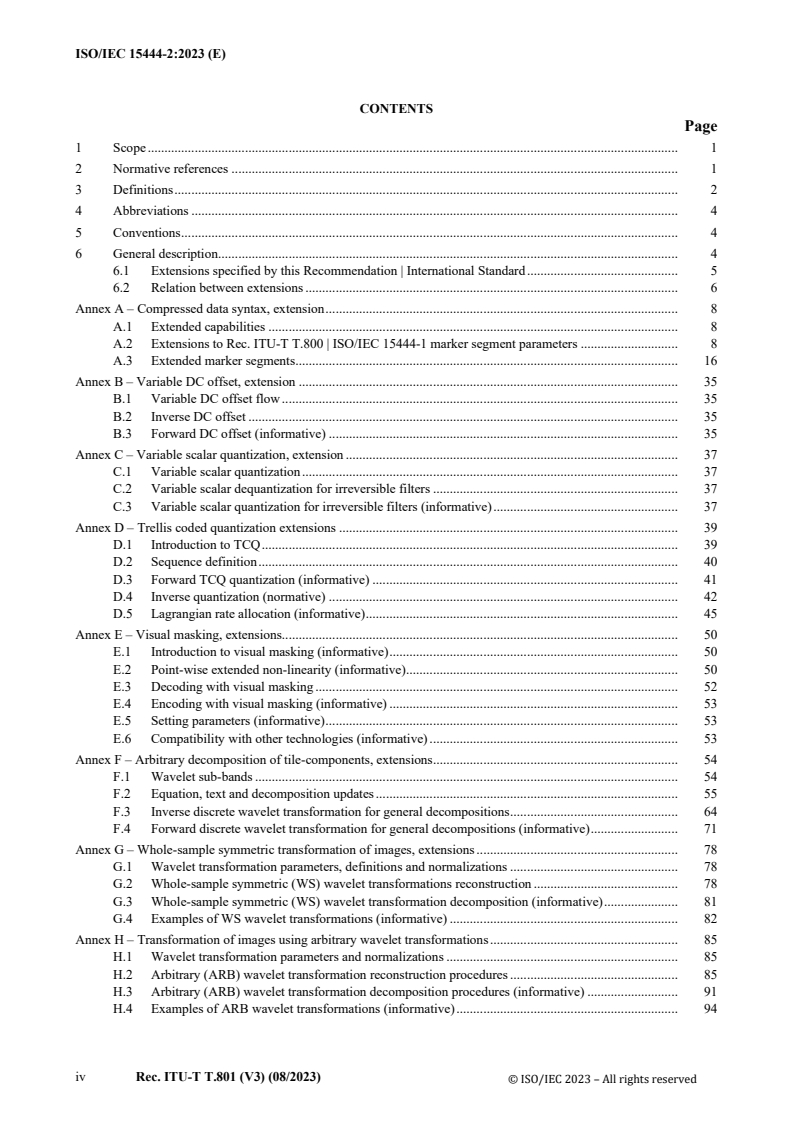
CONTENTS
Page
1 Scope . 1
2 Normative references . 1
3 Definitions . 2
4 Abbreviations . 4
5 Conventions . 4
6 General description . 4
6.1 Extensions specified by this Recommendation | International Standard . 5
6.2 Relation between extensions . 6
Annex A – Compressed data syntax, extension . 8
A.1 Extended capabilities . 8
A.2 Extensions to Rec. ITU-T T.800 | ISO/IEC 15444-1 marker segment parameters . 8
A.3 Extended marker segments . 16
Annex B – Variable DC offset, extension . 35
B.1 Variable DC offset flow . 35
B.2 Inverse DC offset . 35
B.3 Forward DC offset (informative) . 35
Annex C – Variable scalar quantization, extension . 37
C.1 Variable scalar quantization . 37
C.2 Variable scalar dequantization for irreversible filters . 37
C.3 Variable scalar quantization for irreversible filters (informative) . 37
Annex D – Trellis coded quantization extensions . 39
D.1 Introduction to TCQ . 39
D.2 Sequence definition . 40
D.3 Forward TCQ quantization (informative) . 41
D.4 Inverse quantization (normative) . 42
D.5 Lagrangian rate allocation (informative) . 45
Annex E – Visual masking, extensions. 50
E.1 Introduction to visual masking (informative) . 50
E.2 Point-wise extended non-linearity (informative) . 50
E.3 Decoding with visual masking . 52
E.4 Encoding with visual masking (informative) . 53
E.5 Setting parameters (informative) . 53
E.6 Compatibility with other technologies (informative) . 53
Annex F – Arbitrary decomposition of tile-components, extensions . 54
F.1 Wavelet sub-bands . 54
F.2 Equation, text and decomposition updates . 55
F.3 Inverse discrete wavelet transformation for general decompositions . 64
F.4 Forward discrete wavelet transformation for general decompositions (informative) . 71
Annex G – Whole-sample symmetric transformation of images, extensions . 78
G.1 Wavelet transformation parameters, definitions and normalizations . 78
G.2 Whole-sample symmetric (WS) wavelet transformations reconstruction . 78
G.3 Whole-sample symmetric (WS) wavelet transformation decomposition (informative) . 81
G.4 Examples of WS wavelet transformations (informative) . 82
Annex H – Transformation of images using arbitrary wavelet transformations . 85
H.1 Wavelet transformation parameters and normalizations . 85
H.2 Arbitrary (ARB) wavelet transformation reconstruction procedures . 85
H.3 Arbitrary (ARB) wavelet transformation decomposition procedures (informative) . 91
H.4 Examples of ARB wavelet transformations (informative) . 94
iv Rec. ITU-T T.801 (V3) (08/2023)
© ISO/IEC 2023 – All rights reserved
Page
Annex I – Single sample overlap discrete wavelet transform, code-block anchor point and progression order
extensions . 98
I.1 Introduction to single sample overlapping . 98
I.2 The code-block anchor points (CBAP) extension . 98
I.3 The SSO extension . 102
I.4 The TSSO extension . 110
I.5 Combining the SSO and TSSO extensions (informative) . 111
Annex J – Multiple component transformations, extension . 112
J.1 Introduction to multiple component transformation concepts . 112
J.2 Overview of inverse processing . 112
J.3 Transformations . 118
Annex K – Non-linear transformation . 128
K.1 Signalling the use of the non-linear transformations . 128
K.2 Non-linear transformation specifications . 129
Annex L – Region of interest coding and extraction, extensions. 133
L.1 Decoding of ROI . 133
L.2 Description of the Scaling based method . 133
L.3 Region of interest mask generation . 134
L.4 Remarks on region of interest coding . 138
Annex M – JPX extended file format syntax . 139
M.1 File format scope . 139
M.2 Introduction to JPX . 139
M.3 Greyscale/Colour/Palette/multi-component specification architecture . 142
M.4 Fragmenting the codestream between one or more files . 143
M.5 Combining multiple codestreams . 145
M.6 Using reader requirements masks to determine how a file can be used . 149
M.7 Extensions to the JPX file format . 156
M.8 Differences from the JP2 binary definition . 157
M.9 Conformance . 157
M.10 Key to graphical descriptions (informative) . 161
M.11 Defined boxes . 161
M.12 Dealing with unknown boxes . 210
M.13 Using the JPX file format in conjunction with other multi-media standards (informative) . 210
M.14 Decomposing an XML document into multiple boxes . 211
Annex N – JPX file format extended metadata definition and syntax . 213
N.1 Introduction to extended metadata . 213
N.2 Additional references for extended metadata . 213
N.3 Scope of metadata definitions . 213
N.4 Metadata syntax . 214
N.5 Defined boxes . 215
N.6 Metadata definitions . 217
N.7 Fundamental type and element definitions . 258
N.8 JPX extended metadata document type definition . 284
N.9 JPX extended metadata XML Schema . 304
Annex O – Examples and guidelines, extensions . 347
O.1 Arbitrary decomposition examples . 347
O.2 Odd Tile Low Pass First (OTLPF) convention . 368
O.3 Multiple component collection example . 369
O.4 Background to enhancement of quantization . 379
O.5 Wrapping JPEG XR (Rec. ITU-T T.832 | ISO/IEC 29199-2) Codestreams by the JPX file format . 379
O.6 Representing floating point numbers within JPEG 2000 . 382
O.7 Working with ROI Description boxes . 383
Rec. ITU-T T.801 (V3) (08/2023) v
© ISO/IEC 2023 – All rights reserved
Page
Annex P – Block coder extensions . 384
P.1 Selective arithmetic coding bypass (lazy mode) . 384
P.2 Enhancement of selective arithmetic coding bypass (fast mode) . 384
Bibliography . 386
List of Tables
Table A.1 – Syntax support for extensions . 8
Table A.2 – Capability Rsiz parameter, extended . 9
Table A.3 – Start of tile-part parameter values, extended . 9
Table A.4 – Number of tile-parts, TNsot, parameter value, extended . 9
Table A.5 – Coding style parameter values for the Scod parameter . 10
Table A.6 – Coding style parameter values of the SGcod parameter . 11
Table A.7 – Coding style parameter values of the SPcod and SPcoc parameters, extended . 11
Table A.7bis – Progression order for the SGcod and Ppoc parameters . 11
Table A.8 – Multiple component transformation for the SGcod parameters . 11
Table A.9 – Decomposition for the SPcod and SPcoc parameters, extended . 12
Table A.10 – Transformation for the SPcod and SPcoc parameters, extended . 12
Table A.11 – SSO parameters, extended . 12
Table A.11bis – SXcod parameter . 12
Table A.11ter – Progression order change, tile parameter values . 13
Table A.12 – Quantization default values for the Sqcd, Sqcc, Sqpd, and Sqpc parameters, extended . 14
Table A.13 – Quantization values (irreversible transformation only), extended . 14
Table A.14 – SPqcd, SPqcc, SPqpd, and SPqpc parameters (irreversible transformation only), extended . 14
Table A.15 – SPqcd, SPqcc, SPqpd, and SPqpc parameters (irreversible transformation only), extended . 15
Table A.16 – Region-of-interest parameter values for the Srgn parameter . 15
Table A.17 – Component index parameter value for the Crgn parameter . 15
Table A.18 – Region-of-interest values from SPrgn parameter (Srgn = 1 or Srgn = 2) . 15
Table A.19 – List of markers and marker segments . 16
Table A.20 – Variable DC offset parameter values . 17
Table A.21 – Variable DC offset parameter values for the Sdco parameter . 17
Table A.22 – Visual masking parameter values . 18
Table A.23 – Component parameter value for the Cvms parameter . 18
Table A.24 – Visual masking for the Svms parameters . 18
Table A.25 – Downsampling factor styles parameter values . 19
Table A.26 – Arbitrary decomposition styles parameter values . 20
Table A.27 – Arbitrary transformation parameter values . 21
Table A.28 – Arbitrary transformation values for the Satk parameter . 22
Table A.29 –Component bit depth definition parameter values . 23
Table A.30 – Component bit depth definition values for the Ncbd parameter . 23
Table A.31 – Component bit depth definition values for the BDcbdi parameter. 23
Table A.32 – Multiple component transformation definition parameter values . 24
Table A.33 – Multiple component transformation definition values for the Imct parameter . 24
Table A.34 – Multiple component collection parameter values . 26
Table A.35 – Multiple component collection values for the Xmcci parameter . 26
vi Rec. ITU-T T.801 (V3) (08/2023)
© ISO/IEC 2023 – All rights reserved
Page
Table A.36 – Multiple component collection values for the Nmcci parameter . 26
Table A.37 – Multiple component collection values for the Mmcci parameter . 27
Table A.38 – Multiple component collection values for the Tmcci parameter (array-based) . 27
Table A.39 – Multiple component collection values for the Tmcci parameter (wavelet-based) . 27
Table A.40 – Multiple component intermediate collection parameter values . 28
Table A.41 – Non-linearity transformation parameter values . 29
Table A.42 – Non-linearity transformation parameter values for the Cnlt parameter . 29
Table A.43 – Decoded image component bit depth parameter values for the BDnlt parameter . 29
Table A.44 – Non-linearity transformation parameter values of the Tnlt parameter . 30
Table A.45 – Non-linearity transformation parameter values of the STnlt parameter (Tnlt = 1) . 30
Table A.46 – Non-linearity transformation parameter values of the STnlt parameter (Tnlt = 2) . 30
Table A.47 – Quantization default, precinct parameter values . 32
Table A.48 – Quantization precinct component parameter values . 33
Table A.49 – Ccap2 syntax and semantics . 33
Table A.50 – Precinct length, tile-part header parameter values . 34
Table A.51 – Srlt values and semantics . 34
Table A.52 – Semantics of Jrlti values when Srlt is in the range [0, 231 – 1] . 34
Table D.1 – Parent LUTs for k > 0 in the trellis of Figure D.3 . 42
Table D.2 – Description of functional blocks in Figure D.4 . 42
Table D.3 – Description of functional blocks in Figure D.5 . 43
Table D.4 – Look-up table for A(s) . 44
Table D.5 – Look-up table for S(s,qk) . 44
Table D.6 – Description of functional blocks for Figure D.6 . 45
Table D.7 – Sub-band statistics required for LRA . 46
Table D.8 – parameters for TCQ . 46
b
Table D.9 – parameters for TCQ . 46
b
Table D.10 – parameters for SQ . 47
b
Table D.11 – parameters for SQ . 47
b
Table D.12 – Description of functional blocks in Figure D.7 . 49
Table F.1 – Updates to contexts for significance propagation and cleanup coding passes . 56
Table F.2 – Quantities for sub-band info calculation . 60
Table F.3 – S(ab) and J(ab) as a function of dS(i) . 64
Table F.4 – S(ab) and J(ab) as a function of dR(i) . 64
Table F.5 – Characteristics for sample wavelet decomposition in Figure F.14 . 65
Table G.1 – Parameters for wavelet transformations . 78
Table G.2 – Parameters of the 5-3 reversible wavelet transformation . 83
Table G.3 – Parameters of the 13-7 reversible wavelet transformation . 83
Table G.4 – Parameters of the 5-3 irreversible wavelet transformation . 84
Table G.5 – Parameters of the irreversible 7-5 wavelet transformation . 84
Table G.6 – Parameters of the irreversible 9-7 wavelet transformation . 84
Table H.1 – Additional parameters for arbitrary wavelet transformations . 85
Table H.2 – Minimum left extension length . 89
Table H.3 – Minimum right extension length . 89
Table H.4 – Parameters of the reversible Haar 2-2 wavelet transformation . 95
Rec. ITU-T T.801 (V3) (08/2023) vii
© ISO/IEC 2023 – All rights reserved
Page
Table H.5 – Parameters of the reversible 2-6 wavelet transformation . 95
Table H.6 – Parameters of the reversible 2-10 wavelet transformation . 95
Table H.7 – Parameters of the irreversible 6-10 wavelet transformation . 96
Table H.8 – Parameters of the irreversible 10-18 wavelet transformation . 96
Table M.1bis – Brand Values for JPEG XR Codestreams. 142
Table M.1 – Example expression . 151
Table M.2 – Expanded expression . 151
Table M.3 – Example factored expression . 151
Table M.4 – Example of a Reader Requirements expressions for Equations M-6 and M-7 . 153
Table M.5 – Example of a Reader Requirements box for Equations M-6 and M-7 . 153
Table M.6 – Reader Requirements table for Equations M-10 and M-11 . 154
Table M.7 – Reader Requirements box data for Equations M-10 and M-11 . 154
Table M.8 – Reader Requirements box data for Equations M-16 and M-17 . 155
Table M.9 – Example Reader Requirements box to test . 155
Table M.10 – Table intentionally left blank . 156
Table M.11 – Items which can be extended through Recommendations | International Standards . 156
Table M.12 – Items which can be extended by registration . 157
Table M.13 – Boxes defined within this Recommendation | International Standard . 163
Table M.14 – Legal values of the SFi field . 165
Table M.15 – Format of the contents of the Reader Requirements box . 167
Table M.16 – Format of the contents of the Data Reference box . 168
Table M.17 – Format of the contents of the Fragment List box . 169
Table M.18 – Format of the contents of the Cross-Reference box . 170
Table M.19 – Legal C values . 171
Table M.20 – BPC and BPCi parameters . 172
Table M.21 – Format of the contents of the Image Header box . 172
Table M.22 – Legal METH values . 176
Table M.23 – Legal APPROX values . 177
Table M.24 – Format of the contents of the Colour Specification box . 177
Table M.24bis – Nominal maximum sample values . 177
Table M.25 – Additional legal EnumCS values . 178
Table M.26 – Format of the contents of the METHDAT field for the Enumerated method . 179
Table M.27 – Format of the contents of the METHDAT field for the Any ICC method . 180
Table M.28 – Format of the contents of the METHDAT field for the Vendor Colour method . 180
Table M.28bis – Format of the METHDAT field for the Parameterized method . 181
Table M.29 – Standard illuminant values for CIELab . 182
Table M.29bis – Default Offset Values and Encoding of Offsets for the CIELab Colourspace . 182
Table M.30 – Format of the contents of the EP field for CIELab (EnumCS = 14) . 183
Table M.30bis – Default Offset Values and Encoding of Offsets for the CIEJab Colourspace . 184
Table M.31 – Format of the contents of the EP field for CIEJab (EnumCS = 19) . 184
Table M.32 – Colours indicated by the Asoci field . 185
Table M.33 – Otyp field values . 186
Table M.34 – Format of the contents of the Opacity box . 186
Table M.35 – Format of the contents of the Codestream Registration box . 188
viii Rec. ITU-T T.801 (V3) (08/2023)
© ISO/IEC 2023 – All rights reserved
Page
Table M.35bis – Allowed values for the pixel format . 189
Table M.35ter – Common floating point formats (informative) . 189
Table M.36 – Format of the contents of the Composition box . 190
Table M.37 – Format of the contents of the Composition Options box . 191
Table M.38 – Ityp field values . 192
Table M.39 – Format of the contents of the Instruction Set box . 192
Table M.40 – Format of the contents of the INSTi parameter in the Instruction Set box . 194
Table M.40bis – Encoding of the ROT field . 194
Table M.41 – Format of the contents of the Association box . 196
Table M.42 – ANi field values . 196
Table M.43 – Format of the contents of the Number List box . 196
Table M.44 – Legal Filter types . 197
Table M.45 – Format of the contents of the Binary Filter box . 198
Table M.46 – Format of the contents of the Graphics Technology Standard Output box . 199
Table M.47 – Legal Ri values . 199
Table M.48 – Allowed Rtypi values . 200
Table M.49 – Format of the contents of the ROI Description box . 200
Table M.49bis – Interpreting the 2 bit D field of Rtypi for quadrilateral refinements . 201
Table M.50 – Legal Styp values . 202
Table M.51 – Legal Ptyp values . 203
Table M.52 – Format of the contents of the Digital Signature box . 203
Table M.53 – Format of the contents of the Multiple Codestream box . 208
Table M.54 – Format of the contents of the Multiple Codestream Info box . 209
Table N.1 – Format of the contents of the Image Creation box . 215
Table N.2 – Format of the contents of the Content Description box . 216
Table N.3 – Format of the contents of the History box . 216
Table N.4 – Format of the contents of the Intellectual Property Rights box . 217
Table N.5 – Format of the contents of the Image Identifier box . 217
Table N.6 – Image Source values . 219
Table N.7 – Scene type values . 219
Table N.8 – Sensor technology values . 222
Table N.9 – Exposure program values . 228
Table N.10 – Metering mode values . 228
Table N.11 – Scene illuminant values . 229
Table N.12 – Back light values . 229
Table N.13 – Auto focus values . 230
Table N.14 – Name description values . 252
Table N.15 – Date description values . 254
Table N.16 – Additional name description values . 258
Table N.17 – Address component type values . 264
Table N.18 – Address type values . 264
Table N.19 – Phone number type values . 265
Table N.20 – Name component type values . 268
Table N.21 – Latitude reference values .
...