

ISO 11271:2022
(Main)Soil quality — Determination of redox potential — Field method
General Information
- Abstract
This document specifies a field method for the determination of soil redox potential (Eh). NOTE The electrochemical measurement of redox potential described in this document is possible only if the relevant soil horizon has a moisture status defined as fresh or wetter according to the classes presented in Annex D.
- Status
- Published
- Publication Date
- 30-Jun-2022
- Technical Committee
- ISO/TC 190/SC 3 - Chemical and physical characterization
- Drafting Committee
- ISO/TC 190/SC 3 - Chemical and physical characterization
- Current Stage
- 6060 - International Standard published
- Start Date
- 01-Jul-2022
- Due Date
- 20-Apr-2023
- Completion Date
- 01-Jul-2022

Overview
ISO 11271:2022 specifies a standardized field method for measuring soil redox potential (Eh). The standard defines the electrochemical approach for determining the oxidation–reduction status of the soil solution using an inert measuring electrode (typically a platinum electrode) and a reference electrode (usually silver/silver chloride). Measurements are only valid when the soil horizon has a moisture status classified as fresh or wetter (see Annex D).
Key topics and technical requirements
- Principle: Redox potential is an electrochemical expression of redox reaction free energy and is described by the Nernst equation; the measured mixed potential reflects multiple electroactive redox couples in soil.
- Apparatus:
- Millivoltmeter with input resistance ≥ 10 GΩ and 1 mV sensitivity.
- Platinum redox electrodes (robust for field use).
- Silver/silver chloride reference electrode in 1 mol/l or 3 mol/l KCl.
- Salt bridge, rigid rod, hand auger, cleaning materials, thermometer.
- Reagents and preparations:
- Redox buffer (e.g., quinhydrone-buffered solution or equimolar ferri/ferrocyanide) for electrode calibration.
- Agar 0.5% in KCl for salt bridge, distilled water with low conductivity, KCl storage solution matching electrode concentration.
- Procedure highlights:
- Insert platinum electrodes 2–3 cm deeper than a pre-drilled hole; install at least two electrodes per depth.
- Allow electrodes to equilibrate ≥ 30 minutes before readings; measure after 1 hour (can be 30–60 min if stability criteria met).
- Protect reference electrode temperature; record reference electrode temperature for potential correction.
- Evaluation & reporting:
- Convert measured potential to the standard hydrogen electrode scale by adding the reference electrode potential (Annex C).
- Round final Eh to the nearest 10 mV. Typical soil Eh ranges from −400 mV to +900 mV.
Practical applications and users
ISO 11271:2022 is used by:
- Soil scientists, agronomists, wetland ecologists, environmental consultants and laboratories for field assessment of soil aeration and redox status.
- Waste management and land reclamation professionals monitoring sludge, composting or disposal impacts.
- Researchers studying processes influenced by redox conditions (nutrient availability, metal mobility, greenhouse gas fluxes). Practical benefits include consistent field measurement of soil redox potential (Eh) for monitoring, regulatory reporting, and comparative studies.
Related standards
- ISO 18400 series (sampling guidance)
- ISO 11464 (soil pre-treatment)
Refer to ISO 11271:2022 Annexes (A–D) for electrode construction, reference potentials, and soil moisture classification.
Relations
- Effective Date
- 06-Jun-2022
Get Certified
Connect with accredited certification bodies for this standard

CIS Institut d.o.o.
Personal Protective Equipment (PPE) certification body. Notified Body NB-2890 for EU Regulation 2016/425 PPE.

Kiwa BDA Testing
Building and construction product certification.
Kmetijski inštitut Slovenije
Agricultural Institute of Slovenia. Soil testing, plant health, agricultural product analysis.
Sponsored listings
Frequently Asked Questions
ISO 11271:2022 is a standard published by the International Organization for Standardization (ISO). Its full title is "Soil quality — Determination of redox potential — Field method". This standard covers: This document specifies a field method for the determination of soil redox potential (Eh). NOTE The electrochemical measurement of redox potential described in this document is possible only if the relevant soil horizon has a moisture status defined as fresh or wetter according to the classes presented in Annex D.
This document specifies a field method for the determination of soil redox potential (Eh). NOTE The electrochemical measurement of redox potential described in this document is possible only if the relevant soil horizon has a moisture status defined as fresh or wetter according to the classes presented in Annex D.
ISO 11271:2022 is classified under the following ICS (International Classification for Standards) categories: 13.080.20 - Physical properties of soils. The ICS classification helps identify the subject area and facilitates finding related standards.
ISO 11271:2022 has the following relationships with other standards: It is inter standard links to ISO 11271:2002. Understanding these relationships helps ensure you are using the most current and applicable version of the standard.
ISO 11271:2022 is available in PDF format for immediate download after purchase. The document can be added to your cart and obtained through the secure checkout process. Digital delivery ensures instant access to the complete standard document.
Standards Content (Sample)
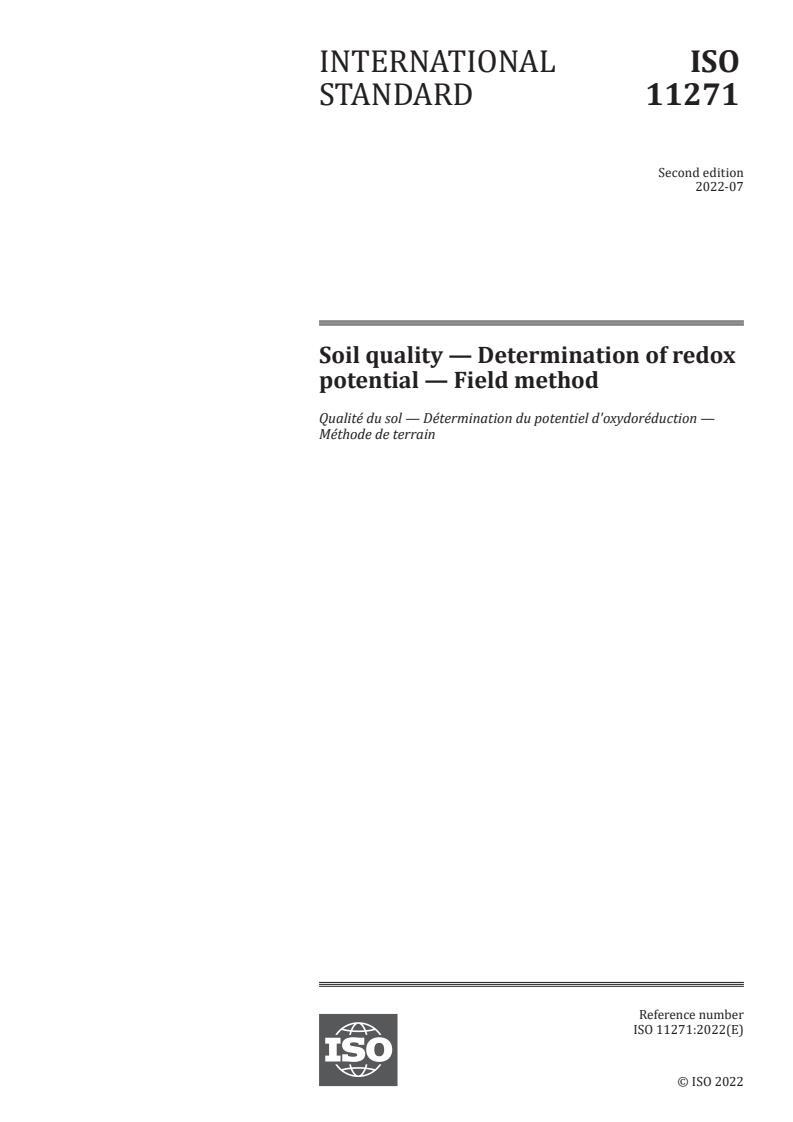
INTERNATIONAL ISO
STANDARD 11271
Second edition
2022-07
Soil quality — Determination of redox
potential — Field method
Qualité du sol — Détermination du potentiel d'oxydoréduction —
Méthode de terrain
Reference number
© ISO 2022
All rights reserved. Unless otherwise specified, or required in the context of its implementation, no part of this publication may
be reproduced or utilized otherwise in any form or by any means, electronic or mechanical, including photocopying, or posting on
the internet or an intranet, without prior written permission. Permission can be requested from either ISO at the address below
or ISO’s member body in the country of the requester.
ISO copyright office
CP 401 • Ch. de Blandonnet 8
CH-1214 Vernier, Geneva
Phone: +41 22 749 01 11
Email: copyright@iso.org
Website: www.iso.org
Published in Switzerland
ii
Contents Page
Foreword .iv
Introduction .v
1 Scope . 1
2 Normative references . 1
3 Terms and definitions . 1
4 Principle . 1
5 Apparatus . 2
6 Reagents . 3
7 Site selection and sampling . 3
8 Procedure .3
8.1 Care, cleaning and testing of the redox electrode system . 3
8.2 Preparation of site and measurement of redox potential . 4
9 Evaluation . 4
10 Expression of results . 4
11 Test report . 5
Annex A (informative) Description of the construction of redox electrodes, the salt bridge,
and their arrangement during measurement . 6
Annex B (informative) Potentials of platinum electrodes in different solutions .10
Annex C (informative) Potentials of reference electrodes .11
Annex D (informative) Soil moisture status .12
Bibliography .13
iii
Foreword
ISO (the International Organization for Standardization) is a worldwide federation of national standards
bodies (ISO member bodies). The work of preparing International Standards is normally carried out
through ISO technical committees. Each member body interested in a subject for which a technical
committee has been established has the right to be represented on that committee. International
organizations, governmental and non-governmental, in liaison with ISO, also take part in the work.
ISO collaborates closely with the International Electrotechnical Commission (IEC) on all matters of
electrotechnical standardization.
The procedures used to develop this document and those intended for its further maintenance are
described in the ISO/IEC Directives, Part 1. In particular, the different approval criteria needed for the
different types of ISO documents should be noted. This document was drafted in accordance with the
editorial rules of the ISO/IEC Directives, Part 2 (see www.iso.org/directives).
Attention is drawn to the possibility that some of the elements of this document may be the subject of
patent rights. ISO shall not be held responsible for identifying any or all such patent rights. Details of
any patent rights identified during the development of the document will be in the Introduction and/or
on the ISO list of patent declarations received (see www.iso.org/patents).
Any trade name used in this document is information given for the convenience of users and does not
constitute an endorsement.
For an explanation of the voluntary nature of standards, the meaning of ISO specific terms and
expressions related to conformity assessment, as well as information about ISO's adherence to
the World Trade Organization (WTO) principles in the Technical Barriers to Trade (TBT), see
www.iso.org/iso/foreword.html.
This document was prepared by Technical Committee ISO/TC 190, Soil quality, Subcommittee SC 3,
Chemical and physical characterization.
This second edition cancels and replaces the first edition (ISO 11271:2002), of which it constitutes a
minor revision. The changes are as follows:
— update of normative references;
— update of bibliography;
— editorially revised.
Any feedback or questions on this document should be directed to the user’s national standards body. A
complete listing of these bodies can be found at www.iso.org/members.html.
iv
Introduction
The redox potential is a physico-chemical parameter used to characterize soil aeration status in a global
way. Under field conditions, it gives information on the condition of oxidation or reduction of those
compounds which, according to cases, play an important part in plant nutrition, can induce toxicity
phenomena or intervene in gas transfers to the atmosphere (greenhouse effect). It can also be used
to a certain extent to follow soil performances in case of sludge disposal or composting, and to adjust
applications accordingly. Under laboratory conditions it can be used in order to study oxygen diffusion
phenomena to aggregate level.
v
INTERNATIONAL STANDARD ISO 11271:2022(E)
Soil quality — Determination of redox potential — Field
method
1 Scope
This document specifies a field method for the determination of soil redox potential (E ).
h
NOTE The electrochemical measurement of redox potential described in this document is possible only if
the relevant soil horizon has a moisture status defined as fresh or wetter according to the classes presented in
Annex D.
2 Normative references
There are no normative references in this document.
3 Terms and definitions
For the purposes of this document, the following terms and definitions apply.
ISO and IEC maintain terminology databases for use in standardization at the following addresses:
— ISO Online browsing platform: available at https:// www .iso .org/ obp
— IEC Electropedia: available at https:// www .electropedia .org/
3.1
redox potential (E )
h
electrochemical potential reflecting the oxidation-reduction status of a liquid chemical system (in this
case of the soil solution)
4 Principle
Redox potential is an electrochemical equivalent of the free energy of redox reactions, and for an
equilibrated single redox system of the general form:
−+
An ++eH mA≥ (1)
ox red
is given by the Nernst equation:
A
RT 2,303 mRT
0 ox
EE=+ ln − pH (2)
h
nF A nF
Red
where
A and A are the activities of the oxidized and reduced forms of the element, respectively;
ox Red
−
e refers to the electron(s) involved in the reaction;
+
H refers to the proton(s) involved in the reaction;
n and m are the numbers of electrons and protons involved in the reaction, respectively;
is the standard value of the potential in volt (V) i.e. when A = A and pH = 0;
E
ox Red
-1 -1
R is the universal gas constant (8,314 1 J mol · K );
T is the absolute temperature in kelvin (K);
-1
F is the Faraday constant (96 500 C · mol );
2,303 is the natural log of 10.
−
Redox potential is related to electron activity (e ) in the system as follows:
RT
−
E = ln ()e (3)
h
F
Users of this document unfamiliar with these electrochemical concepts should consult appropriate
texts or seek professional advice.
The electrometric determination of redox potential is analogous to the determination of pH. The
determination of E follows the principle of measuring potential differences between an inert measuring
h
electrode (usually a platinum electrode) i.e. an electrode not reacting with the solution per se, with
respect to the standard hydrogen electrode used as the reference electrode. Many redox systems are
involved in the soil solution, and the resulting potential is a mixed potential depending on the existing
electroactive redox couples. For practical reasons, a silver-silver chloride electrode is usually used
as the reference electrode, the potential of which is added to the measured potential difference (see
Annex C) in order to obtain the values expressed on the basis of the standard hydrogen electrode.
5 Apparatus
The following apparatus shall be used.
5.1 Millivoltmeter, with an input resistance not less than 10 GΩ and sensitivity of 1 mV.
5.2 A set of redox-electrodes, constructed as described in A.1.
All electrodes should be sufficiently robust for field use (see Annex A).
5.3 Reference electrode: silver/silver chloride reference electrode in 1 mol/l or 3 mol/l potassium
chloride solution.
Other reference electrodes such as the calomel electrode can also be used but are not recommended
because of the health hazard connected with the use of mercury. The potential of such reference
electrodes with respect to the standard hydrogen electrode is given in Annex B. Reference electrodes
should be stored in a potassium chloride solution (see 6.4) of the same concentration as that present in
the electrode, or directly in the salt bridge (see 5.5) containing the same concentration of potassium
chloride. It should be noted that lower concentrations of potassium chloride will reduce contamination
of the soil with this salt.
5.4 Rigid rod, (stainless steel has been found suitable), 20 cm to 100 cm in length with the diameter
2 mm greater than that of the redox electrodes (see 5.2).
The rod shall have a length which allows the redox electrodes to be inserted to the desired depth in the
soil.
5.5 Salt bridge, to connect the reference electrode with the soil (see A.2).
5.6 Hand auger, with a diameter 3 mm to 5 mm greater than that of the salt bridge.
5.7 Electrode cleaning materials: finest grade of steel wool, scouring powder and some cotton cloth
have been found suitable.
5.8 Thermometer, to measure the temperature at the location of the reference electrode (see
Clause 8) with an accuracy of 1 °C.
6 Reagents
6.1 Redox buffer solution, to calibrate the redox electrodes.
Use either buffered quinhydrone solution (prepared by adding quinhydrone to a pH buffer to
obtain a suspension), or an equimolar solution of potassium hexacyanoferrate(III) and potassium
hexacyanoferrate(II) (see Annex B).
-1
6.2 Water, with an electrical conductivity less than 0,1 mS m (equivalent to resistivity greater than
0,01 MΩ m at 25 °C).
6.3 Agar, ρ = 0,5 %, in a potassium chloride solution of the same concentration as that in the reference
electrode.
6.4 Potassium chloride solution, of the same concentration as that chosen in 5.3.
NOTE This solution is used to store the reference electrode and to add to the salt bridge, as needed.
7 Site selection and sampling
The selection and description of the place of measurement, and of samples for laboratory measurement,
should follow the guidelines given in the ISO 18400 series and ISO 11464.
8 Procedure
8.1 Care, cleaning and testing of the redox electrode system
The platinum electrodes shall be stored in air and kept clean. They shall be inspected for damage
and/or contamination at intervals of not more than one year, and every time they are used. Oils, fats
and waxes, and other chemicals likely to adhere are particularly damaging to electrode performance.
If contaminated with soil material, they shall be cleaned gently with a cotton cloth and rinsed with
distilled water. In cases of severe contamination, e.g. with oils, an appropriate solvent followed by
scouring material (see 5.7) shall be used.
The reference electrode(s) shal
...