

ISO 20421-1:2019
(Main)Cryogenic vessels — Large transportable vacuum-insulated vessels — Part 1: Design, fabrication, inspection and testing
General Information
- Abstract
This document specifies requirements for the design, fabrication, inspection and testing of large transportable vacuum-insulated cryogenic vessels of more than 450 l volume, which are permanently (fixed tanks) or not permanently (demountable tanks and portable tanks) attached to a means of transport, for one or more modes of transport. This document applies to large transportable vacuum-insulated cryogenic vessels for fluids specified in 3.1 and does not apply to vessels designed for toxic fluids. This document does not include the general vehicle requirements, e.g. running gear, brakes, lighting, etc. NOTE 1 This document does not cover specific requirements for refillable liquid-hydrogen tanks that are primarily dedicated as fuel tanks in vehicles. For fuel tanks used in land vehicles, see ISO 13985. NOTE 2 This document does not cover specific requirements for refillable liquid hydrogen and LNG tanks that are primarily dedicated as fuel tanks in vehicles. For fuel tanks used in vehicles, see ISO 13985.
- Status
- Published
- Publication Date
- 18-Jun-2019
- Technical Committee
- ISO/TC 220 - Cryogenic vessels
- Drafting Committee
- ISO/TC 220/WG 1 - Design and construction
- Current Stage
- 9092 - International Standard to be revised
- Start Date
- 22-Jun-2023
- Completion Date
- 29-Aug-2026
Buy Documents
ISO 20421-1:2019 - Cryogenic vessels -- Large transportable vacuum-insulated vessels
ISO 20421-1:2019 - Cryogenic vessels — Large transportable vacuum-insulated vessels — Part 1: Design, fabrication, inspection and testing/19/2019
Overview
ISO 20421-1:2019 - "Cryogenic vessels - Large transportable vacuum-insulated vessels - Part 1: Design, fabrication, inspection and testing" specifies requirements for the safe design, fabrication, inspection and testing of large transportable vacuum-insulated cryogenic vessels. It applies to vessels with a volume greater than 450 L that are either permanently attached (fixed tanks) or not permanently attached (demountable and portable tanks) to a means of transport and intended for one or more transport modes. The standard excludes vessels for toxic fluids and does not cover general vehicle systems (running gear, brakes, lighting). It also excludes refillable liquid-hydrogen and LNG fuel tanks dedicated to vehicle propulsion (see ISO 13985).
Key topics and technical requirements
ISO 20421-1:2019 covers the full product lifecycle from concept to operation, including:
- Design principles and options - design by calculation, pressure strengthening, and experimental methods; design loads; fatigue and corrosion allowance.
- Materials and selection - guidance on suitable materials (including specific annexes for materials such as 9 % Ni and austenitic stainless steels), material inspection and documentation.
- Mechanical, chemical and thermal requirements - mechanical load cases, pressure conditions, thermal behavior and chemical compatibility for specified cryogenic fluids.
- Fabrication practices - cutting, forming, welding qualifications, non-welded joints and manufacturing tolerances.
- Inspection and testing - quality plans, production control test plates, non‑destructive testing (NDT), pressure testing, rectification and final acceptance tests.
- Safety features and components - pressure relief devices, valves, insulation systems, inspection openings and electrical continuity.
- Documentation and marking - mandatory records, periodic inspection schedules and labelling requirements.
- Normative and informative annexes - detailed calculation methods, specific material requirements, weld details, outer-jacket relief devices and examples.
Practical applications and users
This standard is intended for organizations involved in the design, manufacture, testing and operation of large transportable cryogenic tanks, including:
- Design engineers and structural analysts developing vacuum‑insulated cryogenic vessels.
- Fabricators and welders implementing material, forming and welding provisions.
- Quality, inspection and testing personnel performing NDT and pressure tests.
- Transport operators and fleet managers ensuring periodic inspection and compliance.
- Regulators and certification bodies assessing conformity with design and safety requirements.
Use cases include transportable storage of industrial gases, cryogenic bulk distribution, and intermodal transport systems for refrigerated liquefied gases (non-toxic).
Related standards
- ISO 13985 - referenced for requirements on refillable liquid-hydrogen fuel tanks used in vehicles.
- Consult applicable transport and vehicle regulations for running-gear, braking and lighting requirements (these are outside the scope of ISO 20421-1:2019).
Keywords: ISO 20421-1:2019, cryogenic vessels, large transportable vacuum-insulated vessels, design fabrication inspection testing, cryogenic tank standards, pressure testing, non-destructive testing.
Relations
- Effective Date
- 16-Sep-2026
- Effective Date
- 01-Jan-2022
- Effective Date
- 24-Jun-2023
- Effective Date
- 04-Nov-2015
Buy Documents
ISO 20421-1:2019 - Cryogenic vessels -- Large transportable vacuum-insulated vessels
ISO 20421-1:2019 - Cryogenic vessels — Large transportable vacuum-insulated vessels — Part 1: Design, fabrication, inspection and testing/19/2019
Get Certified
Connect with accredited certification bodies for this standard

Institut za varilstvo d.o.o. (Welding Institute)
Slovenia's leading welding institute since 1952. ISO 3834, EN 1090, pressure equipment certification, NDT personnel, welder qualification. Only IIW Au
Sponsored listings
Frequently Asked Questions
ISO 20421-1:2019 is a standard published by the International Organization for Standardization (ISO). Its full title is "Cryogenic vessels — Large transportable vacuum-insulated vessels — Part 1: Design, fabrication, inspection and testing". This standard covers: This document specifies requirements for the design, fabrication, inspection and testing of large transportable vacuum-insulated cryogenic vessels of more than 450 l volume, which are permanently (fixed tanks) or not permanently (demountable tanks and portable tanks) attached to a means of transport, for one or more modes of transport. This document applies to large transportable vacuum-insulated cryogenic vessels for fluids specified in 3.1 and does not apply to vessels designed for toxic fluids. This document does not include the general vehicle requirements, e.g. running gear, brakes, lighting, etc. NOTE 1 This document does not cover specific requirements for refillable liquid-hydrogen tanks that are primarily dedicated as fuel tanks in vehicles. For fuel tanks used in land vehicles, see ISO 13985. NOTE 2 This document does not cover specific requirements for refillable liquid hydrogen and LNG tanks that are primarily dedicated as fuel tanks in vehicles. For fuel tanks used in vehicles, see ISO 13985.
This document specifies requirements for the design, fabrication, inspection and testing of large transportable vacuum-insulated cryogenic vessels of more than 450 l volume, which are permanently (fixed tanks) or not permanently (demountable tanks and portable tanks) attached to a means of transport, for one or more modes of transport. This document applies to large transportable vacuum-insulated cryogenic vessels for fluids specified in 3.1 and does not apply to vessels designed for toxic fluids. This document does not include the general vehicle requirements, e.g. running gear, brakes, lighting, etc. NOTE 1 This document does not cover specific requirements for refillable liquid-hydrogen tanks that are primarily dedicated as fuel tanks in vehicles. For fuel tanks used in land vehicles, see ISO 13985. NOTE 2 This document does not cover specific requirements for refillable liquid hydrogen and LNG tanks that are primarily dedicated as fuel tanks in vehicles. For fuel tanks used in vehicles, see ISO 13985.
ISO 20421-1:2019 is classified under the following ICS (International Classification for Standards) categories: 23.020.40 - Cryogenic vessels. The ICS classification helps identify the subject area and facilitates finding related standards.
ISO 20421-1:2019 has the following relationships with other standards: It is inter standard links to EN ISO 16924:2026, ISO 20421-1:2019/Amd 1:2022, ISO/FDIS 20421-1, ISO 20421-1:2006. Understanding these relationships helps ensure you are using the most current and applicable version of the standard.
ISO 20421-1:2019 is available in PDF format for immediate download after purchase. The document can be added to your cart and obtained through the secure checkout process. Digital delivery ensures instant access to the complete standard document.
Standards Content (Sample)
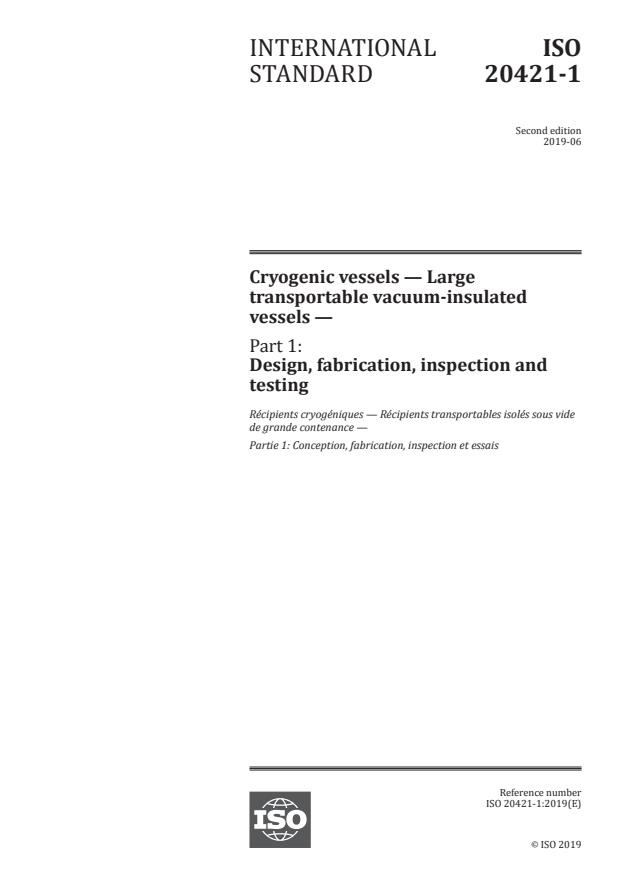
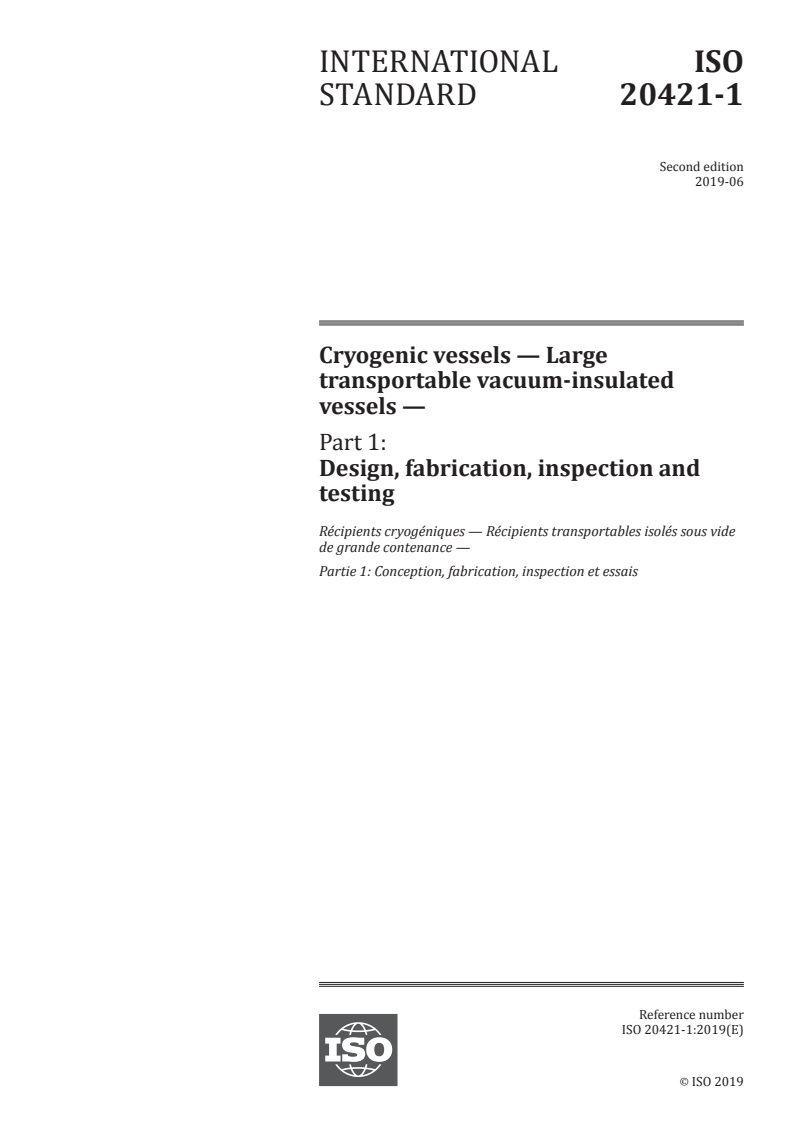
INTERNATIONAL ISO
STANDARD 20421-1
Second edition
2019-06
Cryogenic vessels — Large
transportable vacuum-insulated
vessels —
Part 1:
Design, fabrication, inspection and
testing
Récipients cryogéniques — Récipients transportables isolés sous vide
de grande contenance —
Partie 1: Conception, fabrication, inspection et essais
Reference number
©
ISO 2019
© ISO 2019
All rights reserved. Unless otherwise specified, or required in the context of its implementation, no part of this publication may
be reproduced or utilized otherwise in any form or by any means, electronic or mechanical, including photocopying, or posting
on the internet or an intranet, without prior written permission. Permission can be requested from either ISO at the address
below or ISO’s member body in the country of the requester.
ISO copyright office
CP 401 • Ch. de Blandonnet 8
CH-1214 Vernier, Geneva
Phone: +41 22 749 01 11
Fax: +41 22 749 09 47
Email: copyright@iso.org
Website: www.iso.org
Published in Switzerland
ii © ISO 2019 – All rights reserved
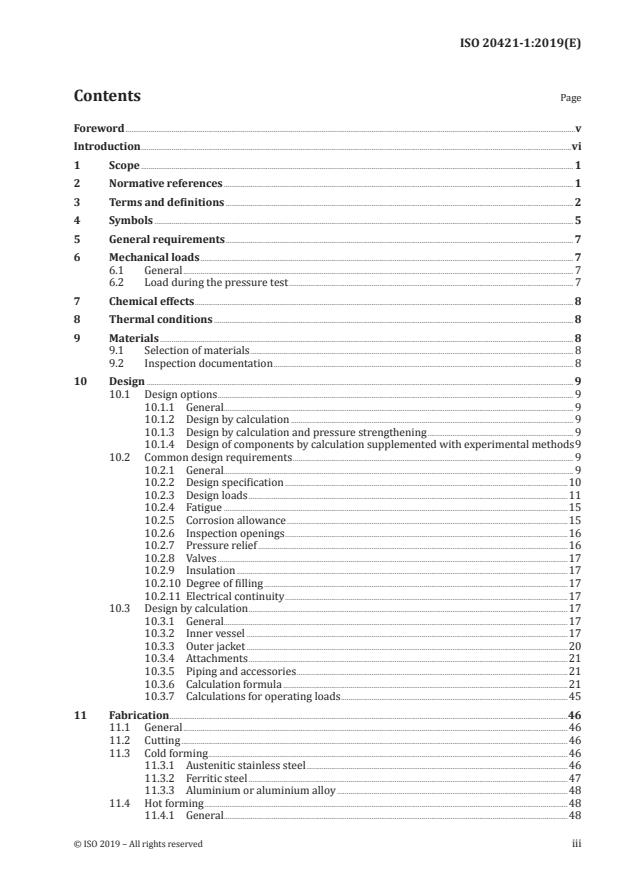
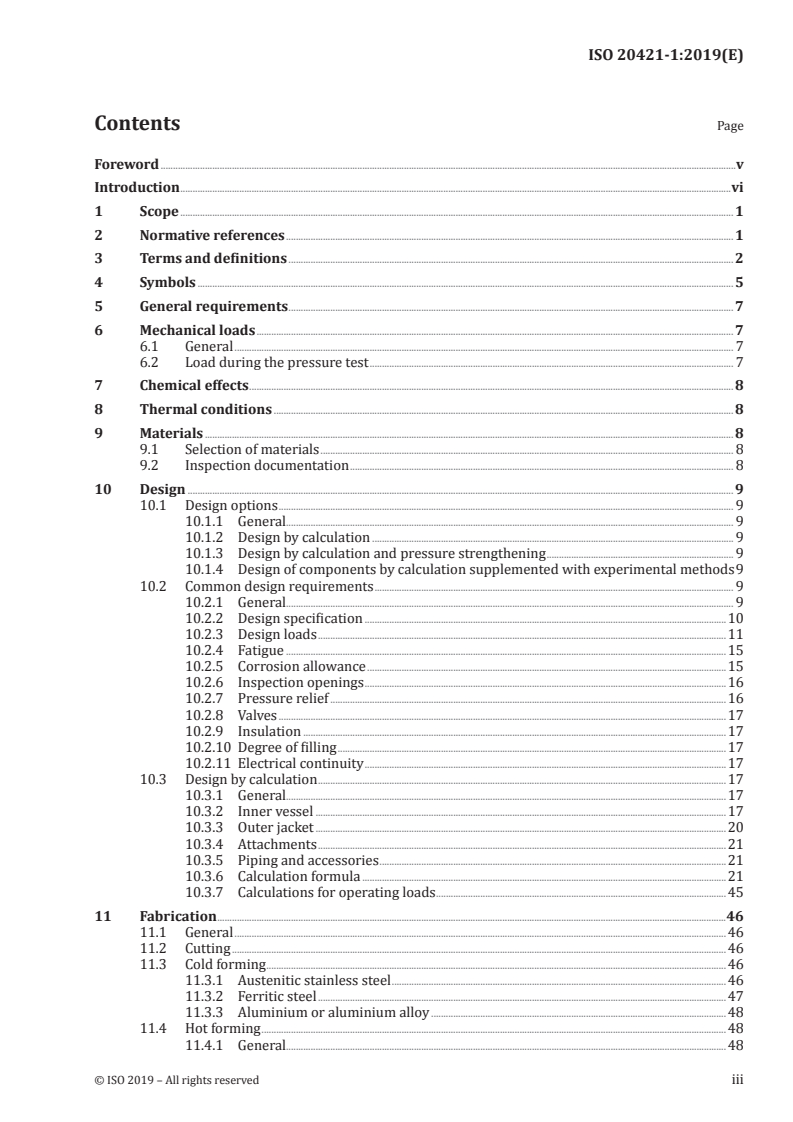
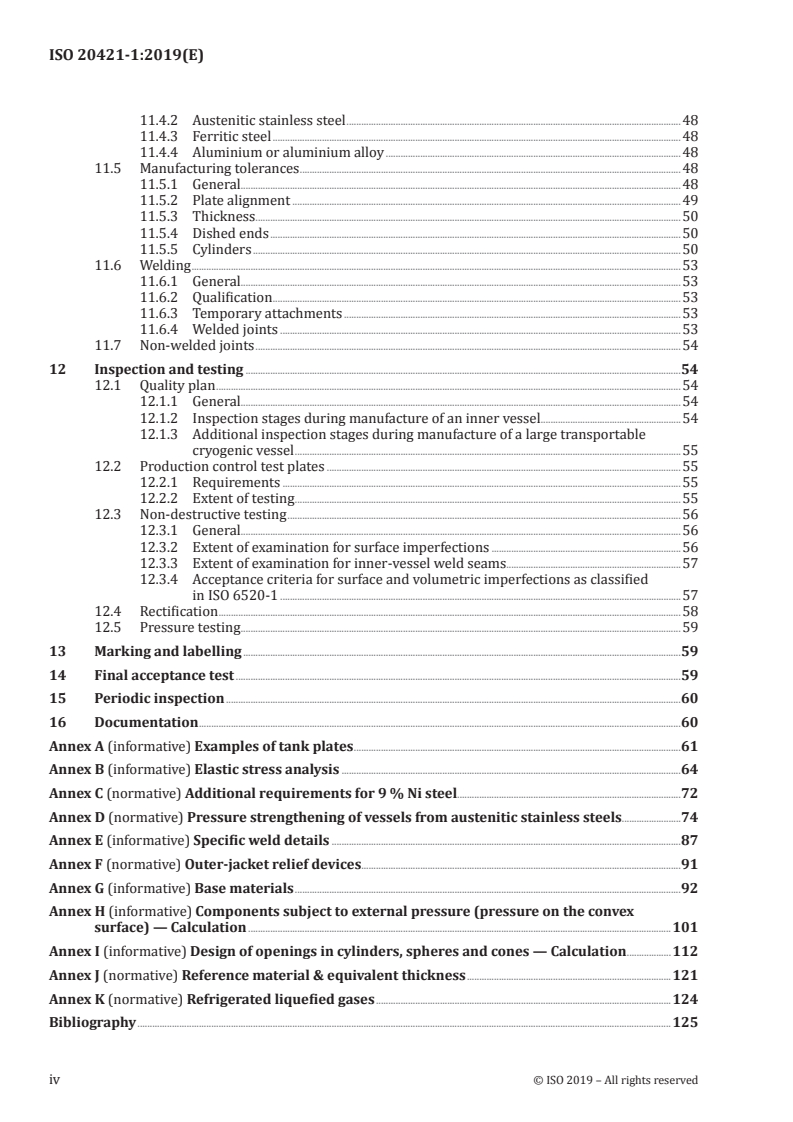
Contents Page
Foreword .v
Introduction .vi
1 Scope . 1
2 Normative references . 1
3 Terms and definitions . 2
4 Symbols . 5
5 General requirements . 7
6 Mechanical loads . 7
6.1 General . 7
6.2 Load during the pressure test . 7
7 Chemical effects . 8
8 Thermal conditions . 8
9 Materials . 8
9.1 Selection of materials . 8
9.2 Inspection documentation . 8
10 Design . 9
10.1 Design options . 9
10.1.1 General. 9
10.1.2 Design by calculation . 9
10.1.3 Design by calculation and pressure strengthening . 9
10.1.4 Design of components by calculation supplemented with experimental methods 9
10.2 Common design requirements . 9
10.2.1 General. 9
10.2.2 Design specification .10
10.2.3 Design loads .11
10.2.4 Fatigue .15
10.2.5 Corrosion allowance .15
10.2.6 Inspection openings .16
10.2.7 Pressure relief .16
10.2.8 Valves .17
10.2.9 Insulation .17
10.2.10 Degree of filling .17
10.2.11 Electrical continuity .17
10.3 Design by calculation .17
10.3.1 General.17
10.3.2 Inner vessel .17
10.3.3 Outer jacket .20
10.3.4 Attachments .21
10.3.5 Piping and accessories .21
10.3.6 Calculation formula .21
10.3.7 Calculations for operating loads .45
11 Fabrication .46
11.1 General .46
11.2 Cutting .46
11.3 Cold forming .46
11.3.1 Austenitic stainless steel .46
11.3.2 Ferritic steel .47
11.3.3 Aluminium or aluminium alloy .48
11.4 Hot forming .48
11.4.1 General.48
11.4.2 Austenitic stainless steel .48
11.4.3 Ferritic steel .48
11.4.4 Aluminium or aluminium alloy .48
11.5 Manufacturing tolerances .48
11.5.1 General.48
11.5.2 Plate alignment .49
11.5.3 Thickness .50
11.5.4 Dished ends .50
11.5.5 Cylinders .50
11.6 Welding .53
11.6.1 General.53
11.6.2 Qualification .53
11.6.3 Temporary attachments .53
11.6.4 Welded joints .53
11.7 Non-welded joints .54
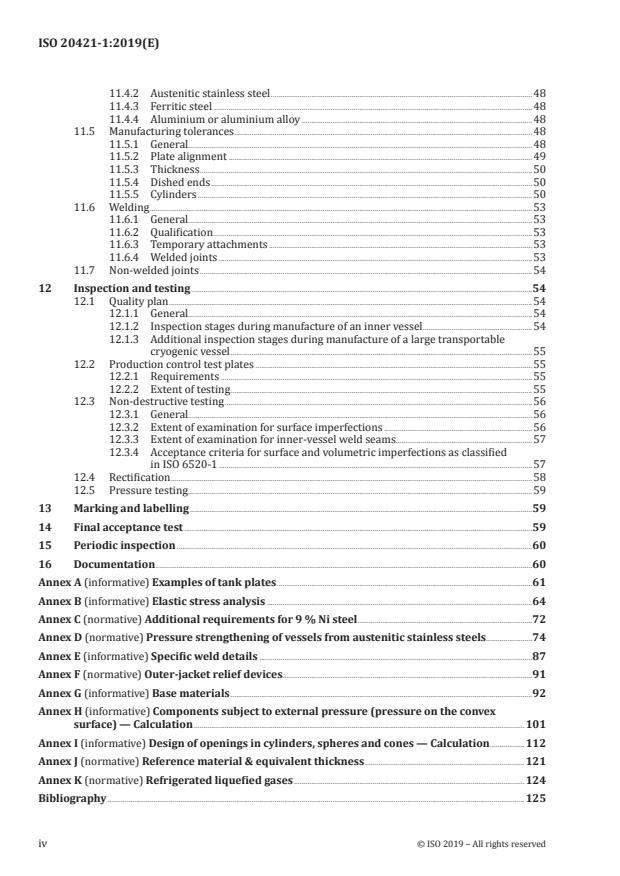
12 Inspection and testing .54
12.1 Quality plan .54
12.1.1 General.54
12.1.2 Inspection stages during manufacture of an inner vessel .54
12.1.3 Additional inspection stages during manufacture of a large transportable
cryogenic vessel .55
12.2 Production control test plates .55
12.2.1 Requirements .55
12.2.2 Extent of testing .55
12.3 Non-destructive testing .56
12.3.1 General.56
12.3.2 Extent of examination for surface imperfections .56
12.3.3 Extent of examination for inner-vessel weld seams.57
12.3.4 Acceptance criteria for surface and volumetric imperfections as classified
in ISO 6520-1 .57
12.4 Rectification .58
12.5 Pressure testing .59
13 Marking and labelling .59
14 Final acceptance test .59
15 Periodic inspection .60
16 Documentation .60
Annex A (informative) Examples of tank plates .61
Annex B (informative) Elastic stress analysis .64
Annex C (normative) Additional requirements for 9 % Ni steel.72
Annex D (normative) Pressure strengthening of vessels from austenitic stainless steels .74
Annex E (informative) Specific weld details .87
Annex F (normative) Outer-jacket relief devices.91
Annex G (informative) Base materials .92
Annex H (informative) Components subject to external pressure (pressure on the convex
surface) — Calculation .101
Annex I (informative) Design of openings in cylinders, spheres and cones — Calculation .112
Annex J (normative) Reference material & equivalent thickness .121
Annex K (normative) Refrigerated liquefied gases .124
Bibliography .125
iv © ISO 2019 – All rights reserved
Foreword
ISO (the International Organization for Standardization) is a worldwide federation of national standards
bodies (ISO member bodies). The work of preparing International Standards is normally carried out
through ISO technical committees. Each member body interested in a subject for which a technical
committee has been established has the right to be represented on that committee. International
organizations, governmental and non-governmental, in liaison with ISO, also take part in the work.
ISO collaborates closely with the International Electrotechnical Commission (IEC) on all matters of
electrotechnical standardization.
The procedures used to develop this document and those intended for its further maintenance are
described in the ISO/IEC Directives, Part 1. In particular, the different approval criteria needed for the
different types of ISO documents should be noted. This document was drafted in accordance with the
editorial rules of the ISO/IEC Directives, Part 2 (see www .iso .org/directives).
Attention is drawn to the possibility that some of the elements of this document may be the subject of
patent rights. ISO shall not be held responsible for identifying any or all such patent rights. Details of
any patent rights identified during the development of the document will be in the Introduction and/or
on the ISO list of patent declarations received (see www .iso .org/patents).
Any trade name used in this document is information given for the convenience of users and does not
constitute an endorsement.
For an explanation of the voluntary nature of standards, the meaning of ISO specific terms and
expressions related to conformity assessment, as well as information about ISO's adherence to the
World Trade Organization (WTO) principles in the Technical Barriers to Trade (TBT) see www .iso
.org/iso/foreword .html.
This document was prepared by Technical Committee ISO/TC 220, Cryogenic vessels.
Any feedback or questions on this document should be directed to the user’s national standards body. A
complete listing of these bodies can be found at www .iso .org/members .html.
This second edition cancels and replaces the first edition (ISO 20421-1:2006), which has been technically
revised. It also incorporates ISO 20421-1:2006/Cor 1:2007. The main changes compared to the previous
edition are as follows:
— Subclause 12.3 has been revised;
— Annex D has been revised;
— Chinese materials have been added in Annex G.
A list of all parts in the ISO 20421 series can be found on the ISO website.
Introduction
[1]
This document has been written so that it is suitable to be referenced in the UN Model Regulations .
This document does not include the general vehicle requirements, e.g. running gear, brakes, lighting,
etc., for which the relevant standards/regulations apply.
vi © ISO 2019 – All rights reserved
INTERNATIONAL STANDARD ISO 20421-1:2019(E)
Cryogenic vessels — Large transportable vacuum-insulated
vessels —
Part 1:
Design, fabrication, inspection and testing
1 Scope
This document specifies requirements for the design, fabrication, inspection and testing of large
transportable vacuum-insulated cryogenic vessels of more than 450 l volume, which are permanently
(fixed tanks) or not permanently (demountable tanks and portable tanks) attached to a means of
transport, for one or more modes of transport.
This document applies to large transportable vacuum-insulated cryogenic vessels for fluids specified in
3.1 and does not apply to vessels designed for toxic fluids.
This document does not include the general vehicle requirements, e.g. running gear, brakes, lighting, etc.
NOTE 1 This document does not cover specific requirements for refillable liquid-hydrogen tanks that are
primarily dedicated as fuel tanks in vehicles. For fuel tanks used in land vehicles, see ISO 13985.
NOTE 2 This document does not cover specific requirements for refillable liquid hydrogen and LNG tanks that
are primarily dedicated as fuel tanks in vehicles. For fuel tanks used in vehicles, see ISO 13985.
2 Normative references
The following documents are referred to in the text in such a way that some or all of their content
constitutes requirements of this document. For dated references, only the edition cited applies. For
undated references, the latest edition of the referenced document (including any amendments) applies.
ISO 3834-2, Quality requirements for fusion welding of metallic materials — Part 2: Comprehensive quality
requirements
ISO 4126-2, Safety devices for protection against excessive pressure — Part 2: Bursting disc safety devices
ISO 5817, Welding — Fusion-welded joints in steel, nickel, titanium and their alloys (beam welding
excluded) — Quality levels for imperfections
ISO 9606-1, Qualification testing of welders — Fusion welding — Part 1: Steels
ISO 9606-2, Qualification test of welders — Fusion welding — Part 2: Aluminium and aluminium alloys
ISO 9712, Non-destructive testing — Qualification and certification of NDT personnel
ISO 10042, Welding — Arc-welded joints in aluminium and its alloys — Quality levels for imperfections
ISO 10474:2013, Steel and steel products — Inspection documents
ISO 10675-1, Non-destructive testing of welds — Acceptance levels for radiographic testing — Part 1: Steel,
nickel, titanium and their alloys
ISO 14732, Welding personnel — Qualification testing of welding operators and weld setters for mechanized
and automatic welding of metallic materials
ISO 15613, Specification and qualification of welding procedures for metallic materials — Qualification
based on pre-production welding test
ISO 15614-1, Specification and qualification of welding procedures for metallic materials — Welding
procedure test — Part 1: Arc and gas welding of steels and arc welding of nickel and nickel alloys
ISO 15614-2, Specification and qualification of welding procedures for metallic materials — Welding
procedure test — Part 2: Arc welding of aluminium and its alloys
ISO 17635, Non-destructive testing of welds — General rules for metallic materials
ISO 17637, Non-destructive testing of welds — Visual testing of fusion-welded joints
ISO 20421-2, Cryogenic vessels — Large transportable vacuum-insulated vessels — Part 2: Operational
requirements
ISO 21010, Cryogenic vessels — Gas/material compatibility
ISO 21011, Cryogenic vessels — Valves for cryogenic service
ISO 21028-1, Cryogenic vessels — Toughness requirements for materials at cryogenic temperature —
Part 1: Temperatures below -80 degrees C
ISO 21028-2, Cryogenic vessels — Toughness requirements for materials at cryogenic temperature —
Part 2: Temperatures between -80 degrees C and -20 degrees C
ISO 21013-3, Cryogenic vessels — Pressure-relief accessories for cryogenic service — Part 3: Sizing and
capacity determination
ISO 23208, Cryogenic vessels — Cleanliness for cryogenic service
ASME VIII-2, Rules for construction of pressure vessels, Division 2, Alternative Rules
EN 13445-3, Unfired pressure vessels — Part 3: Design
3 Terms and definitions
For the purposes of this document, the following terms and definitions apply.
ISO and IEC maintain terminological databases for use in standardization at the following addresses:
— ISO Online browsing platform: available at https: //www .iso .org/obp
— IEC Electropedia: available at http: //www .electropedia .org/
3.1
cryogenic fluid
refrigerated liquefied gas
gas which is partially liquid because of its low temperature (see Table K.1)
Note 1 to entry: This includes totally evaporated liquids and supercritical fluids.
Note 2 to entry: In the context of this document, the refrigerated but non-toxic gases and gas mixtures given in
Table K.1 are referred to as cryogenic fluids.
3.2
large transportable cryogenic vessel
tank
thermally insulated vessel of more than 450 l intended for the transport of one or more cryogenic fluids
(3.1), consisting of an inner vessel (3.4), an outer jacket (3.5), all of the valves and service equipment (3.9)
together with the structural parts
Note 1 to entry: The large transportable cryogenic vessel comprises a complete assembly that is ready for service.
2 © ISO 2019 – All rights reserved
3.3
insulation
vacuum interspace between the inner vessel (3.4) and the outer jacket (3.5)
Note 1 to entry: The space may or may not be filled with material to reduce the heat transfer between the inner
vessel and the outer jacket.
3.4
inner vessel
pressure (3.16) vessel intended to contain the cryogenic fluid (3.1) to be transported
3.5
outer jacket
gas-tight enclosure which contains the inner vessel (3.4) and enables the vacuum to be established
3.6
normal operation
intended operation of the vessel at a pressure (3.16) not greater than the maximum allowable working
pressure including the handling loads (3.7)
3.7
handling load
load exerted on the transportable cryogenic vessel in all normal conditions of transport including
loading, unloading, moving and lifting
3.8
piping system
all pipes, tubes and associated components which can come in contact with cryogenic fluids (3.1)
including valves, fittings, pressure-relief devices and their supports
3.9
service equipment
measuring instruments and filling, discharge, venting, safety, heating, cooling and insulating devices
including any equipment for storing cooling fluids
3.10
manufacturer
company that carries out the final assembly, including the final
acceptance test, of the large transportable cryogenic vessel (3.2)
3.11
gross volume
internal volume of the inner vessel (3.4), excluding nozzles, pipes, etc., determined
at minimum design temperature and atmospheric pressure (3.16)
3.12
tare mass
mass of the empty large transportable cryogenic vessel (3.2)
3.13
net volume
volume of the inner vessel (3.4), below the inlet to the relief devices, excluding nozzles, pipes, etc.,
determined at minimum design temperature and atmospheric pressure (3.16)
3.14
net mass
maximum allowable mass of the cryogenic fluid (3.1) which may be filled
Note 1 to entry: The maximum allowable mass is equal to the mass of the cryogenic liquid occupying 98 % of the
net volume (3.13)of the inner vessel (3.4) under conditions of incipient opening of the relief device with the vessel
in a level attitude and the mass of the gas at the same conditions in the remaining volume of the inner vessel.
Note 2 to entry: Cryogenic liquid helium can occupy 100 % of the volume of the inner vessel at any pressure (3.16).
3.15
gross mass
sum of tare mass (3.12) plus net mass (3.14)
3.16
pressure
gauge pressure
pressure relative to atmospheric pressure
3.17
fixed tank
tank vehicle
large transportable vessel permanently attached to a vehicle or to units of running gear
3.18
demountable tank
large transportable vessel non-permanently attached to a vehicle
Note 1 to entry: When attached to the carrier vehicle, the demountable tank meets the requirements prescribed
for a fixed tank. It is designed to be lifted only when empty.
3.19
portable tank
a thermally insulated tank having a capacity of more than 450 litres fitted with service equipment (3.9)
and structural equipment necessary for the transport of refrigerated liquefied gases
Note 1 to entry: It can be lifted full and loaded and discharged without removal of structural element.
Note 2 to entry: The list of the refrigerated liquefied gases is available in Annex K.
3.20
maximum allowable working pressure
ps
maximum gauge pressure (3.16) permissible at the top of the vessel in its normal operating position
3.21
relief plate
relief plug
plate or plug retained by atmospheric pressure (3.16) which allows relief of excess internal pressure,
generally from the vacuum jacket
3.22
bursting disc device
non-reclosing pressure-relief device ruptured by differential pressure (3.16)
Note 1 to entry: It is the complete assembly of installed components including the bursting disc holder, where
appropriate.
3.23
pressure-strengthened vessel
pressure (3.16) vessel which has been subjected to a calculated and controlled internal pressure
(strengthening pressure) after completion, the wall thickness of which is calculated on the basis of the
stress at the strengthening pressure and not on the basis of the conventional design stress value of the
material used
Note 1 to entry: Pressure (3.16) vessels made from solution heat-treated material are subject to a controlled
plastic deformation during the strengthening operation as its yield point is raised. Pressure vessels made from
work-hardened material are subject to little or no plastic deformation.
4 © ISO 2019 – All rights reserved
3.24
residual elongation
original elongation of the steel minus the elongation created by the cold-forming deformation
3.25
leakproofness test
test using gas subjecting the shell and its service equipment (3.9), to an effective internal pressure (3.16)
not less than 90 % of the MAWP but not greater than the design pressure
4 Symbols
Symbol Definition Unit
b width of pad, ring or shell reinforcement mm
c allowance for corrosion mm
d diameter of opening mm
i
d outside diameter of tube or nozzle mm
a
f narrow side of rectangular or elliptical plate mm
h thickness of pad reinforcement mm
l cone length between effective stiffenings (see Figure 5) mm
c
l ligament (web) between two nozzles mm
l l′ buckling length mm
b, b
l length of nozzle reinforcement outstanding mm
s
n number of lobes —
p design pressure as defined in 10.3.2.2 —
p calculation pressure as defined in 10.2.3.1 a) bar (or MPa)
c
p allowable external pressure limited by elastic buckling bar (or MPa)
e
p strengthening pressure bar (or MPa)
k
p liquid pressure bar (or MPa)
L
p allowable external pressure limited by plastic deformation bar (or MPa)
p
p maximum allowable gauge pressure bar (or MPa)
s
p test pressure (see 6.2) bar (or MPa)
T
r radius, e.g. inside knuckle radius of dished end and cones mm
s minimum thickness mm
s required wall thickness at opening edge mm
A
s actual wall thickness mm
e
s required wall thickness outside corner area mm
g
s length of nozzle reinforcement in stand mm
n
s wall thickness of nozzle mm
S
s required wall thickness within corner area mm
t in this context, centre-to-centre distance between two nozzles mm
x (decay-length zone) distance over which governing stress is as- mm
sumed to act
x characteristic lengths (i = 1,2,3) to define corner area [Figure 7 a) and mm
i
Figure 7 b) and 10.3.6.5.4]
η factor indicative of the utilization of the permissible design stress in —
joints or factor allowing for weakenings
A cross-sectional area of reinforcing element mm
C, β design factors —
D shell diameter mm
D outside diameter, e.g. of a cylindrical shell mm
a
D outside diameter of connected cylinder (see Figure 7) mm
a1
D outside diameter at effective stiffening (see Figure 9) mm
a2
D internal diameter, e.g. of a cylindrical shell mm
i
D design diameter (see Figure 7) mm
k
D shell diameter at nozzle (see Figure 8) mm
s
E Young’s modulus N/mm
I moment of inertia of reinforcing element mm
R minimum guaranteed yield stress or 0,2 % proof stress at 20 °C (1 % N/mm
e
proof stress for austenitic steel)
R minimum guaranteed tensile strength at 20 °C N/mm
m
K material property used for design (see 10.3.2.3) N/mm
K material property at temperature T in °C (e.g. K for material property N/mm
T 20
at 20 °C (see 10.3.2.3.2)
R radius of curvature, e.g. inside crown radius of dished end mm
S safety factor at design pressure, in relation with R —
e
S safety factor against elastic buckling at design pressure —
k
S safety factor against plastic deformation —
p
Z auxiliary value —
6 © ISO 2019 – All rights reserved
v Poisson’s ratio —
u out of roundness (see 11.5.5.2) —
φ cone angle °
5 General requirements
5.1 The large transportable cryogenic vessel shall safely withstand the mechanical and thermal loads
and the chemical effects encountered during pressure test and normal operation. These requirements
are deemed to be satisfied if Clauses 6 to 12 are fulfilled. The vessel shall be marked in accordance with
Clause 13, tested in accordance with Clause 14 and operated in accordance with ISO 20421-2.
5.2 Large transportable cryogenic vessels shall be equipped with valves, pressure-relief devices, etc.,
configured and installed in such a way that the vessel can be operated safely. The number of openings in
the inner vessel for this equipment shall be kept to a minimum.
5.3 The large transportable cryogenic vessel shall be clean for the intended service in accordance with
ISO 23208.
5.4 The manufacturer shall retain the documents referred to in Clause 16, and all supporting
documentation (including that from his subcontractors, if any), for a required period (e.g. product
liability). In addition, the manufacturer shall retain all supporting and background documentation
(including that from his subcontractors, if any) which establishes that the vessel conforms to this
document.
6 Mechanical loads
6.1 General
The large transportable cryogenic vessel shall resist the mechanical loads mentioned in 10.2.3 without
such deformation which can affect safety and which can lead to leakage. This requirement can be
validated by:
— the calculation;
— the calculation and pressure-strengthening method, if allowed;
— the calculation and experimental method.
6.2 Load during the pressure test
The load exerted during the pressure test shall be calculated with Formula (1):
pp≥+13,b()1 ar or pp≥+1,30(),1 MPa (1)
TS
TS
where
p is the test pressure (in bar);
T
p is the maximum allowable pressure (in bar);
S
+1 is the allowance for external vacuum (in bar).
+0,1 is the allowance for external vacuum (in MPa).
7 Chemical effects
Due to operating temperatures and the materials of construction, the possibility of chemical action on
the inner surfaces in contact with the cryogenic fluids can be neglected.
Due to the fact that the inner vessel is inside an evacuated outer jacket, neither external corrosion of
the inner vessel, nor corrosion on the inner surfaces of the outer jacket will occur. Therefore, inspection
openings are not required in the inner vessel or the outer jacket.
Corrosion allowance is also not required on surfaces in contact with the operating fluid or exposed to
the vacuum interspace between the inner vessel and the outer jacket.
The material and the protection for the surfaces exposed to the atmosphere shall be suitable for
intended use (e.g. resistant to industrial and marine atmospheres).
8 Thermal conditions
The following thermal conditions shall be taken into account:
For the inner vessel and its associated equipment the full range of temperature expected.
For the outer jacket and equipment thereof (other than equipment covered in Clause 7):
— a minimum working temperature of −20 °C;
— a maximum working temperature of 50 °C.
NOTE 1 Some locations require lower minimum working temperature e.g. –40 °C and/or higher maximum
working temperature, e.g. +65 °C.
NOTE 2 This does not apply if the jacket is designed for a lower temperature to be marked on the nameplate.
9 Materials
9.1 Selection of materials
9.1.1 Materials which are, or can be, in contact with cryogenic fluids shall be in accordance with
ISO 21010.
9.1.2 Materials used at low temperatures shall follow the requirements of the relevant parts of
ISO 21028-1 and ISO 21028-2; for non-metallic materials, low-temperature suitability shall be validated
by an experimental method, taking into account operating temperatures.
9.1.3 The base materials, listed in Annex G, subject to meeting the extra requirements given in Clauses 5
to 16, are suitable for and may be employed in the manufacture of the cryogenic vessels, in conformance
with this document.
9.2 Inspection documentation
9.2.1 The material according to ISO 21028-1 and ISO 21028-2 shall be declared by an inspection
certificate 3.1 in accordance with ISO 10474:2013, 5.1.
9.2.2 The material manufactured to a recognized International Standard shall meet the testing
requirements of ISO 21028-1 and ISO 21028-2 and shall be declared by an inspection certificate 3.1 in
accordance with ISO 10474:2013, 5.1.
8 © ISO 2019 – All rights reserved
9.2.3 The delivery of material which is not manufactured to a recognized International Standard
shall be guaranteed by an inspection certificate 3.2 in accordance with ISO 10474:2013, 5.2 confirming
that the material fulfils the requirements in 9.1. The material manufacturer shall follow a recognized
International Standard for processing and establishing the guaranteed material properties.
9.2.4 The outer jacket and the equipment not subjected to low temperature shall be manufactured
from material suitable for the intended service.
10 Design
10.1 Design options
10.1.1 General
The design shall be carried out in accordance with one of the options given in 10.1.2, 10.1.3 or 10.1.4.
Metallic materials used at cryogenic temperatures shall meet the requirements of the relevant clauses
of ISO 21028-1 and ISO 21028-2.
In the case of 9 % Ni steel, the additional requirements in Annex C shall be satisfied.
10.1.2 Design by calculation
Calculation of all pressure- and load-bearing components shall be carried out. The pressure part
thicknesses of the inner vessel and outer jacket shall not be less than required by 10.3. Additional
calculations may be required to ensure the design is satisfactory for the operating conditions including
an allowance for dynamic loads.
10.1.3 Design by calculation and pressure strengthening
The pressure-retaining capability of inner vessels manufactured from austenitic stainless steel,
strengthened by pressure, shall be calculated in accordance with Annex D.
10.1.4 Design of components by calculation supplemented with experimental methods
Where it is not possible to design non-inner vessel components by calculation alone, planned and
controlled experimental means may be used provided that the results confirm the safety factors
required in 10.3. An example is the application of strain gauges to assess stress levels.
10.2 Common design requirements
10.2.1 General
The requirements of 10.2.2 to 10.2.7 are applicable to all vessels irrespective of the design option used.
In the event of an increase in at least one of the following parameters, the initial design process shall be
repeated to take account of these modifications:
— maximum allowable pressure;
— specific mass (density) of the densest gas for which the vessel is designed;
— maximum tare weight of the inner vessel;
— nominal length and/or diameter of the inner shell.
The initial design process shall be repeated also in the event of any change relative to:
— the type of material or grade (e.g. stainless steel to aluminium);
— the fundamental shape;
— the decrease in the minimum mechanical properties of the material being used;
— the modification of the design of an assembly method concerning any part under stress, particularly
as far as the support systems between the inner vessel and the outer jacket or the inner vessel itself
or the protective frame, if any, are concerned.
10.2.2 Design specification
To enable the design to be prepared, the following information which defines a vessel type shall be
available:
— maximum allowable pressure;
— fluids intended to be contained;
— gross volume of the inner vessel;
— dimensions and allowable weight, taking into account characteristics of the vehicle;
— location of fastening points and loads allowable on these points;
— filling and emptying rate;
— range of ambient temperature, if different from Clause 8;
— transportation mode (see Tables 2 and 3).
A design document in the form of drawings with text, if any, shall be prepared. It shall contain the
information given above plus the following where applicable:
— definition of which components are designed by calculation, b
...
INTERNATIONAL ISO
STANDARD 20421-1
Second edition
2019-06
Cryogenic vessels — Large
transportable vacuum-insulated
vessels —
Part 1:
Design, fabrication, inspection and
testing
Récipients cryogéniques — Récipients transportables isolés sous vide
de grande contenance —
Partie 1: Conception, fabrication, inspection et essais
Reference number
©
ISO 2019
© ISO 2019
All rights reserved. Unless otherwise specified, or required in the context of its implementation, no part of this publication may
be reproduced or utilized otherwise in any form or by any means, electronic or mechanical, including photocopying, or posting
on the internet or an intranet, without prior written permission. Permission can be requested from either ISO at the address
below or ISO’s member body in the country of the requester.
ISO copyright office
CP 401 • Ch. de Blandonnet 8
CH-1214 Vernier, Geneva
Phone: +41 22 749 01 11
Fax: +41 22 749 09 47
Email: copyright@iso.org
Website: www.iso.org
Published in Switzerland
ii © ISO 2019 – All rights reserved
Contents Page
Foreword .v
Introduction .vi
1 Scope . 1
2 Normative references . 1
3 Terms and definitions . 2
4 Symbols . 5
5 General requirements . 7
6 Mechanical loads . 7
6.1 General . 7
6.2 Load during the pressure test . 7
7 Chemical effects . 8
8 Thermal conditions . 8
9 Materials . 8
9.1 Selection of materials . 8
9.2 Inspection documentation . 8
10 Design . 9
10.1 Design options . 9
10.1.1 General. 9
10.1.2 Design by calculation . 9
10.1.3 Design by calculation and pressure strengthening . 9
10.1.4 Design of components by calculation supplemented with experimental methods 9
10.2 Common design requirements . 9
10.2.1 General. 9
10.2.2 Design specification .10
10.2.3 Design loads .11
10.2.4 Fatigue .15
10.2.5 Corrosion allowance .15
10.2.6 Inspection openings .16
10.2.7 Pressure relief .16
10.2.8 Valves .17
10.2.9 Insulation .17
10.2.10 Degree of filling .17
10.2.11 Electrical continuity .17
10.3 Design by calculation .17
10.3.1 General.17
10.3.2 Inner vessel .17
10.3.3 Outer jacket .20
10.3.4 Attachments .21
10.3.5 Piping and accessories .21
10.3.6 Calculation formula .21
10.3.7 Calculations for operating loads .45
11 Fabrication .46
11.1 General .46
11.2 Cutting .46
11.3 Cold forming .46
11.3.1 Austenitic stainless steel .46
11.3.2 Ferritic steel .47
11.3.3 Aluminium or aluminium alloy .48
11.4 Hot forming .48
11.4.1 General.48
11.4.2 Austenitic stainless steel .48
11.4.3 Ferritic steel .48
11.4.4 Aluminium or aluminium alloy .48
11.5 Manufacturing tolerances .48
11.5.1 General.48
11.5.2 Plate alignment .49
11.5.3 Thickness .50
11.5.4 Dished ends .50
11.5.5 Cylinders .50
11.6 Welding .53
11.6.1 General.53
11.6.2 Qualification .53
11.6.3 Temporary attachments .53
11.6.4 Welded joints .53
11.7 Non-welded joints .54
12 Inspection and testing .54
12.1 Quality plan .54
12.1.1 General.54
12.1.2 Inspection stages during manufacture of an inner vessel .54
12.1.3 Additional inspection stages during manufacture of a large transportable
cryogenic vessel .55
12.2 Production control test plates .55
12.2.1 Requirements .55
12.2.2 Extent of testing .55
12.3 Non-destructive testing .56
12.3.1 General.56
12.3.2 Extent of examination for surface imperfections .56
12.3.3 Extent of examination for inner-vessel weld seams.57
12.3.4 Acceptance criteria for surface and volumetric imperfections as classified
in ISO 6520-1 .57
12.4 Rectification .58
12.5 Pressure testing .59
13 Marking and labelling .59
14 Final acceptance test .59
15 Periodic inspection .60
16 Documentation .60
Annex A (informative) Examples of tank plates .61
Annex B (informative) Elastic stress analysis .64
Annex C (normative) Additional requirements for 9 % Ni steel.72
Annex D (normative) Pressure strengthening of vessels from austenitic stainless steels .74
Annex E (informative) Specific weld details .87
Annex F (normative) Outer-jacket relief devices.91
Annex G (informative) Base materials .92
Annex H (informative) Components subject to external pressure (pressure on the convex
surface) — Calculation .101
Annex I (informative) Design of openings in cylinders, spheres and cones — Calculation .112
Annex J (normative) Reference material & equivalent thickness .121
Annex K (normative) Refrigerated liquefied gases .124
Bibliography .125
iv © ISO 2019 – All rights reserved
Foreword
ISO (the International Organization for Standardization) is a worldwide federation of national standards
bodies (ISO member bodies). The work of preparing International Standards is normally carried out
through ISO technical committees. Each member body interested in a subject for which a technical
committee has been established has the right to be represented on that committee. International
organizations, governmental and non-governmental, in liaison with ISO, also take part in the work.
ISO collaborates closely with the International Electrotechnical Commission (IEC) on all matters of
electrotechnical standardization.
The procedures used to develop this document and those intended for its further maintenance are
described in the ISO/IEC Directives, Part 1. In particular, the different approval criteria needed for the
different types of ISO documents should be noted. This document was drafted in accordance with the
editorial rules of the ISO/IEC Directives, Part 2 (see www .iso .org/directives).
Attention is drawn to the possibility that some of the elements of this document may be the subject of
patent rights. ISO shall not be held responsible for identifying any or all such patent rights. Details of
any patent rights identified during the development of the document will be in the Introduction and/or
on the ISO list of patent declarations received (see www .iso .org/patents).
Any trade name used in this document is information given for the convenience of users and does not
constitute an endorsement.
For an explanation of the voluntary nature of standards, the meaning of ISO specific terms and
expressions related to conformity assessment, as well as information about ISO's adherence to the
World Trade Organization (WTO) principles in the Technical Barriers to Trade (TBT) see www .iso
.org/iso/foreword .html.
This document was prepared by Technical Committee ISO/TC 220, Cryogenic vessels.
Any feedback or questions on this document should be directed to the user’s national standards body. A
complete listing of these bodies can be found at www .iso .org/members .html.
This second edition cancels and replaces the first edition (ISO 20421-1:2006), which has been technically
revised. It also incorporates ISO 20421-1:2006/Cor 1:2007. The main changes compared to the previous
edition are as follows:
— Subclause 12.3 has been revised;
— Annex D has been revised;
— Chinese materials have been added in Annex G.
A list of all parts in the ISO 20421 series can be found on the ISO website.
Introduction
[1]
This document has been written so that it is suitable to be referenced in the UN Model Regulations .
This document does not include the general vehicle requirements, e.g. running gear, brakes, lighting,
etc., for which the relevant standards/regulations apply.
vi © ISO 2019 – All rights reserved
INTERNATIONAL STANDARD ISO 20421-1:2019(E)
Cryogenic vessels — Large transportable vacuum-insulated
vessels —
Part 1:
Design, fabrication, inspection and testing
1 Scope
This document specifies requirements for the design, fabrication, inspection and testing of large
transportable vacuum-insulated cryogenic vessels of more than 450 l volume, which are permanently
(fixed tanks) or not permanently (demountable tanks and portable tanks) attached to a means of
transport, for one or more modes of transport.
This document applies to large transportable vacuum-insulated cryogenic vessels for fluids specified in
3.1 and does not apply to vessels designed for toxic fluids.
This document does not include the general vehicle requirements, e.g. running gear, brakes, lighting, etc.
NOTE 1 This document does not cover specific requirements for refillable liquid-hydrogen tanks that are
primarily dedicated as fuel tanks in vehicles. For fuel tanks used in land vehicles, see ISO 13985.
NOTE 2 This document does not cover specific requirements for refillable liquid hydrogen and LNG tanks that
are primarily dedicated as fuel tanks in vehicles. For fuel tanks used in vehicles, see ISO 13985.
2 Normative references
The following documents are referred to in the text in such a way that some or all of their content
constitutes requirements of this document. For dated references, only the edition cited applies. For
undated references, the latest edition of the referenced document (including any amendments) applies.
ISO 3834-2, Quality requirements for fusion welding of metallic materials — Part 2: Comprehensive quality
requirements
ISO 4126-2, Safety devices for protection against excessive pressure — Part 2: Bursting disc safety devices
ISO 5817, Welding — Fusion-welded joints in steel, nickel, titanium and their alloys (beam welding
excluded) — Quality levels for imperfections
ISO 9606-1, Qualification testing of welders — Fusion welding — Part 1: Steels
ISO 9606-2, Qualification test of welders — Fusion welding — Part 2: Aluminium and aluminium alloys
ISO 9712, Non-destructive testing — Qualification and certification of NDT personnel
ISO 10042, Welding — Arc-welded joints in aluminium and its alloys — Quality levels for imperfections
ISO 10474:2013, Steel and steel products — Inspection documents
ISO 10675-1, Non-destructive testing of welds — Acceptance levels for radiographic testing — Part 1: Steel,
nickel, titanium and their alloys
ISO 14732, Welding personnel — Qualification testing of welding operators and weld setters for mechanized
and automatic welding of metallic materials
ISO 15613, Specification and qualification of welding procedures for metallic materials — Qualification
based on pre-production welding test
ISO 15614-1, Specification and qualification of welding procedures for metallic materials — Welding
procedure test — Part 1: Arc and gas welding of steels and arc welding of nickel and nickel alloys
ISO 15614-2, Specification and qualification of welding procedures for metallic materials — Welding
procedure test — Part 2: Arc welding of aluminium and its alloys
ISO 17635, Non-destructive testing of welds — General rules for metallic materials
ISO 17637, Non-destructive testing of welds — Visual testing of fusion-welded joints
ISO 20421-2, Cryogenic vessels — Large transportable vacuum-insulated vessels — Part 2: Operational
requirements
ISO 21010, Cryogenic vessels — Gas/material compatibility
ISO 21011, Cryogenic vessels — Valves for cryogenic service
ISO 21028-1, Cryogenic vessels — Toughness requirements for materials at cryogenic temperature —
Part 1: Temperatures below -80 degrees C
ISO 21028-2, Cryogenic vessels — Toughness requirements for materials at cryogenic temperature —
Part 2: Temperatures between -80 degrees C and -20 degrees C
ISO 21013-3, Cryogenic vessels — Pressure-relief accessories for cryogenic service — Part 3: Sizing and
capacity determination
ISO 23208, Cryogenic vessels — Cleanliness for cryogenic service
ASME VIII-2, Rules for construction of pressure vessels, Division 2, Alternative Rules
EN 13445-3, Unfired pressure vessels — Part 3: Design
3 Terms and definitions
For the purposes of this document, the following terms and definitions apply.
ISO and IEC maintain terminological databases for use in standardization at the following addresses:
— ISO Online browsing platform: available at https: //www .iso .org/obp
— IEC Electropedia: available at http: //www .electropedia .org/
3.1
cryogenic fluid
refrigerated liquefied gas
gas which is partially liquid because of its low temperature (see Table K.1)
Note 1 to entry: This includes totally evaporated liquids and supercritical fluids.
Note 2 to entry: In the context of this document, the refrigerated but non-toxic gases and gas mixtures given in
Table K.1 are referred to as cryogenic fluids.
3.2
large transportable cryogenic vessel
tank
thermally insulated vessel of more than 450 l intended for the transport of one or more cryogenic fluids
(3.1), consisting of an inner vessel (3.4), an outer jacket (3.5), all of the valves and service equipment (3.9)
together with the structural parts
Note 1 to entry: The large transportable cryogenic vessel comprises a complete assembly that is ready for service.
2 © ISO 2019 – All rights reserved
3.3
insulation
vacuum interspace between the inner vessel (3.4) and the outer jacket (3.5)
Note 1 to entry: The space may or may not be filled with material to reduce the heat transfer between the inner
vessel and the outer jacket.
3.4
inner vessel
pressure (3.16) vessel intended to contain the cryogenic fluid (3.1) to be transported
3.5
outer jacket
gas-tight enclosure which contains the inner vessel (3.4) and enables the vacuum to be established
3.6
normal operation
intended operation of the vessel at a pressure (3.16) not greater than the maximum allowable working
pressure including the handling loads (3.7)
3.7
handling load
load exerted on the transportable cryogenic vessel in all normal conditions of transport including
loading, unloading, moving and lifting
3.8
piping system
all pipes, tubes and associated components which can come in contact with cryogenic fluids (3.1)
including valves, fittings, pressure-relief devices and their supports
3.9
service equipment
measuring instruments and filling, discharge, venting, safety, heating, cooling and insulating devices
including any equipment for storing cooling fluids
3.10
manufacturer
company that carries out the final assembly, including the final
acceptance test, of the large transportable cryogenic vessel (3.2)
3.11
gross volume
internal volume of the inner vessel (3.4), excluding nozzles, pipes, etc., determined
at minimum design temperature and atmospheric pressure (3.16)
3.12
tare mass
mass of the empty large transportable cryogenic vessel (3.2)
3.13
net volume
volume of the inner vessel (3.4), below the inlet to the relief devices, excluding nozzles, pipes, etc.,
determined at minimum design temperature and atmospheric pressure (3.16)
3.14
net mass
maximum allowable mass of the cryogenic fluid (3.1) which may be filled
Note 1 to entry: The maximum allowable mass is equal to the mass of the cryogenic liquid occupying 98 % of the
net volume (3.13)of the inner vessel (3.4) under conditions of incipient opening of the relief device with the vessel
in a level attitude and the mass of the gas at the same conditions in the remaining volume of the inner vessel.
Note 2 to entry: Cryogenic liquid helium can occupy 100 % of the volume of the inner vessel at any pressure (3.16).
3.15
gross mass
sum of tare mass (3.12) plus net mass (3.14)
3.16
pressure
gauge pressure
pressure relative to atmospheric pressure
3.17
fixed tank
tank vehicle
large transportable vessel permanently attached to a vehicle or to units of running gear
3.18
demountable tank
large transportable vessel non-permanently attached to a vehicle
Note 1 to entry: When attached to the carrier vehicle, the demountable tank meets the requirements prescribed
for a fixed tank. It is designed to be lifted only when empty.
3.19
portable tank
a thermally insulated tank having a capacity of more than 450 litres fitted with service equipment (3.9)
and structural equipment necessary for the transport of refrigerated liquefied gases
Note 1 to entry: It can be lifted full and loaded and discharged without removal of structural element.
Note 2 to entry: The list of the refrigerated liquefied gases is available in Annex K.
3.20
maximum allowable working pressure
ps
maximum gauge pressure (3.16) permissible at the top of the vessel in its normal operating position
3.21
relief plate
relief plug
plate or plug retained by atmospheric pressure (3.16) which allows relief of excess internal pressure,
generally from the vacuum jacket
3.22
bursting disc device
non-reclosing pressure-relief device ruptured by differential pressure (3.16)
Note 1 to entry: It is the complete assembly of installed components including the bursting disc holder, where
appropriate.
3.23
pressure-strengthened vessel
pressure (3.16) vessel which has been subjected to a calculated and controlled internal pressure
(strengthening pressure) after completion, the wall thickness of which is calculated on the basis of the
stress at the strengthening pressure and not on the basis of the conventional design stress value of the
material used
Note 1 to entry: Pressure (3.16) vessels made from solution heat-treated material are subject to a controlled
plastic deformation during the strengthening operation as its yield point is raised. Pressure vessels made from
work-hardened material are subject to little or no plastic deformation.
4 © ISO 2019 – All rights reserved
3.24
residual elongation
original elongation of the steel minus the elongation created by the cold-forming deformation
3.25
leakproofness test
test using gas subjecting the shell and its service equipment (3.9), to an effective internal pressure (3.16)
not less than 90 % of the MAWP but not greater than the design pressure
4 Symbols
Symbol Definition Unit
b width of pad, ring or shell reinforcement mm
c allowance for corrosion mm
d diameter of opening mm
i
d outside diameter of tube or nozzle mm
a
f narrow side of rectangular or elliptical plate mm
h thickness of pad reinforcement mm
l cone length between effective stiffenings (see Figure 5) mm
c
l ligament (web) between two nozzles mm
l l′ buckling length mm
b, b
l length of nozzle reinforcement outstanding mm
s
n number of lobes —
p design pressure as defined in 10.3.2.2 —
p calculation pressure as defined in 10.2.3.1 a) bar (or MPa)
c
p allowable external pressure limited by elastic buckling bar (or MPa)
e
p strengthening pressure bar (or MPa)
k
p liquid pressure bar (or MPa)
L
p allowable external pressure limited by plastic deformation bar (or MPa)
p
p maximum allowable gauge pressure bar (or MPa)
s
p test pressure (see 6.2) bar (or MPa)
T
r radius, e.g. inside knuckle radius of dished end and cones mm
s minimum thickness mm
s required wall thickness at opening edge mm
A
s actual wall thickness mm
e
s required wall thickness outside corner area mm
g
s length of nozzle reinforcement in stand mm
n
s wall thickness of nozzle mm
S
s required wall thickness within corner area mm
t in this context, centre-to-centre distance between two nozzles mm
x (decay-length zone) distance over which governing stress is as- mm
sumed to act
x characteristic lengths (i = 1,2,3) to define corner area [Figure 7 a) and mm
i
Figure 7 b) and 10.3.6.5.4]
η factor indicative of the utilization of the permissible design stress in —
joints or factor allowing for weakenings
A cross-sectional area of reinforcing element mm
C, β design factors —
D shell diameter mm
D outside diameter, e.g. of a cylindrical shell mm
a
D outside diameter of connected cylinder (see Figure 7) mm
a1
D outside diameter at effective stiffening (see Figure 9) mm
a2
D internal diameter, e.g. of a cylindrical shell mm
i
D design diameter (see Figure 7) mm
k
D shell diameter at nozzle (see Figure 8) mm
s
E Young’s modulus N/mm
I moment of inertia of reinforcing element mm
R minimum guaranteed yield stress or 0,2 % proof stress at 20 °C (1 % N/mm
e
proof stress for austenitic steel)
R minimum guaranteed tensile strength at 20 °C N/mm
m
K material property used for design (see 10.3.2.3) N/mm
K material property at temperature T in °C (e.g. K for material property N/mm
T 20
at 20 °C (see 10.3.2.3.2)
R radius of curvature, e.g. inside crown radius of dished end mm
S safety factor at design pressure, in relation with R —
e
S safety factor against elastic buckling at design pressure —
k
S safety factor against plastic deformation —
p
Z auxiliary value —
6 © ISO 2019 – All rights reserved
v Poisson’s ratio —
u out of roundness (see 11.5.5.2) —
φ cone angle °
5 General requirements
5.1 The large transportable cryogenic vessel shall safely withstand the mechanical and thermal loads
and the chemical effects encountered during pressure test and normal operation. These requirements
are deemed to be satisfied if Clauses 6 to 12 are fulfilled. The vessel shall be marked in accordance with
Clause 13, tested in accordance with Clause 14 and operated in accordance with ISO 20421-2.
5.2 Large transportable cryogenic vessels shall be equipped with valves, pressure-relief devices, etc.,
configured and installed in such a way that the vessel can be operated safely. The number of openings in
the inner vessel for this equipment shall be kept to a minimum.
5.3 The large transportable cryogenic vessel shall be clean for the intended service in accordance with
ISO 23208.
5.4 The manufacturer shall retain the documents referred to in Clause 16, and all supporting
documentation (including that from his subcontractors, if any), for a required period (e.g. product
liability). In addition, the manufacturer shall retain all supporting and background documentation
(including that from his subcontractors, if any) which establishes that the vessel conforms to this
document.
6 Mechanical loads
6.1 General
The large transportable cryogenic vessel shall resist the mechanical loads mentioned in 10.2.3 without
such deformation which can affect safety and which can lead to leakage. This requirement can be
validated by:
— the calculation;
— the calculation and pressure-strengthening method, if allowed;
— the calculation and experimental method.
6.2 Load during the pressure test
The load exerted during the pressure test shall be calculated with Formula (1):
pp≥+13,b()1 ar or pp≥+1,30(),1 MPa (1)
TS
TS
where
p is the test pressure (in bar);
T
p is the maximum allowable pressure (in bar);
S
+1 is the allowance for external vacuum (in bar).
+0,1 is the allowance for external vacuum (in MPa).
7 Chemical effects
Due to operating temperatures and the materials of construction, the possibility of chemical action on
the inner surfaces in contact with the cryogenic fluids can be neglected.
Due to the fact that the inner vessel is inside an evacuated outer jacket, neither external corrosion of
the inner vessel, nor corrosion on the inner surfaces of the outer jacket will occur. Therefore, inspection
openings are not required in the inner vessel or the outer jacket.
Corrosion allowance is also not required on surfaces in contact with the operating fluid or exposed to
the vacuum interspace between the inner vessel and the outer jacket.
The material and the protection for the surfaces exposed to the atmosphere shall be suitable for
intended use (e.g. resistant to industrial and marine atmospheres).
8 Thermal conditions
The following thermal conditions shall be taken into account:
For the inner vessel and its associated equipment the full range of temperature expected.
For the outer jacket and equipment thereof (other than equipment covered in Clause 7):
— a minimum working temperature of −20 °C;
— a maximum working temperature of 50 °C.
NOTE 1 Some locations require lower minimum working temperature e.g. –40 °C and/or higher maximum
working temperature, e.g. +65 °C.
NOTE 2 This does not apply if the jacket is designed for a lower temperature to be marked on the nameplate.
9 Materials
9.1 Selection of materials
9.1.1 Materials which are, or can be, in contact with cryogenic fluids shall be in accordance with
ISO 21010.
9.1.2 Materials used at low temperatures shall follow the requirements of the relevant parts of
ISO 21028-1 and ISO 21028-2; for non-metallic materials, low-temperature suitability shall be validated
by an experimental method, taking into account operating temperatures.
9.1.3 The base materials, listed in Annex G, subject to meeting the extra requirements given in Clauses 5
to 16, are suitable for and may be employed in the manufacture of the cryogenic vessels, in conformance
with this document.
9.2 Inspection documentation
9.2.1 The material according to ISO 21028-1 and ISO 21028-2 shall be declared by an inspection
certificate 3.1 in accordance with ISO 10474:2013, 5.1.
9.2.2 The material manufactured to a recognized International Standard shall meet the testing
requirements of ISO 21028-1 and ISO 21028-2 and shall be declared by an inspection certificate 3.1 in
accordance with ISO 10474:2013, 5.1.
8 © ISO 2019 – All rights reserved
9.2.3 The delivery of material which is not manufactured to a recognized International Standard
shall be guaranteed by an inspection certificate 3.2 in accordance with ISO 10474:2013, 5.2 confirming
that the material fulfils the requirements in 9.1. The material manufacturer shall follow a recognized
International Standard for processing and establishing the guaranteed material properties.
9.2.4 The outer jacket and the equipment not subjected to low temperature shall be manufactured
from material suitable for the intended service.
10 Design
10.1 Design options
10.1.1 General
The design shall be carried out in accordance with one of the options given in 10.1.2, 10.1.3 or 10.1.4.
Metallic materials used at cryogenic temperatures shall meet the requirements of the relevant clauses
of ISO 21028-1 and ISO 21028-2.
In the case of 9 % Ni steel, the additional requirements in Annex C shall be satisfied.
10.1.2 Design by calculation
Calculation of all pressure- and load-bearing components shall be carried out. The pressure part
thicknesses of the inner vessel and outer jacket shall not be less than required by 10.3. Additional
calculations may be required to ensure the design is satisfactory for the operating conditions including
an allowance for dynamic loads.
10.1.3 Design by calculation and pressure strengthening
The pressure-retaining capability of inner vessels manufactured from austenitic stainless steel,
strengthened by pressure, shall be calculated in accordance with Annex D.
10.1.4 Design of components by calculation supplemented with experimental methods
Where it is not possible to design non-inner vessel components by calculation alone, planned and
controlled experimental means may be used provided that the results confirm the safety factors
required in 10.3. An example is the application of strain gauges to assess stress levels.
10.2 Common design requirements
10.2.1 General
The requirements of 10.2.2 to 10.2.7 are applicable to all vessels irrespective of the design option used.
In the event of an increase in at least one of the following parameters, the initial design process shall be
repeated to take account of these modifications:
— maximum allowable pressure;
— specific mass (density) of the densest gas for which the vessel is designed;
— maximum tare weight of the inner vessel;
— nominal length and/or diameter of the inner shell.
The initial design process shall be repeated also in the event of any change relative to:
— the type of material or grade (e.g. stainless steel to aluminium);
— the fundamental shape;
— the decrease in the minimum mechanical properties of the material being used;
— the modification of the design of an assembly method concerning any part under stress, particularly
as far as the support systems between the inner vessel and the outer jacket or the inner vessel itself
or the protective frame, if any, are concerned.
10.2.2 Design specification
To enable the design to be prepared, the following information which defines a vessel type shall be
available:
— maximum allowable pressure;
— fluids intended to be contained;
— gross volume of the inner vessel;
— dimensions and allowable weight, taking into account characteristics of the vehicle;
— location of fastening points and loads allowable on these points;
— filling and emptying rate;
— range of ambient temperature, if different from Clause 8;
— transportation mode (see Tables 2 and 3).
A design document in the form of drawings with text, if any, shall be prepared. It shall contain the
information given above plus the following where applicable:
— definition of which components are designed by calculation, b
...