


ISO/FDIS 8636-1
(Main)Machine tools — Test conditions for bridge-type milling machines — Part 1: Testing of the accuracy of fixed bridge (portal-type) machines
Machine tools — Test conditions for bridge-type milling machines — Part 1: Testing of the accuracy of fixed bridge (portal-type) machines
Machines-outils — Conditions d'essai des machines à fraiser à portique — Partie 1: Contrôle de l'exactitude des machines à portique fixe
La présente partie de l'ISO 8636 ne traite que du contrôle de la précision de la machine. Elle ne concerne ni l'examen de son fonctionnement (vibrations, bruits anormaux, points durs dans ses déplacements d'organes, etc.) ni celui de ses caractéristiques (vitesses, avances, etc.), de tels examens étant, en général effectués avant le contrôle de la précision.La présente partie de l'ISO 8636 donne également la terminologie utilisée pour les éléments principaux de la machine et indique la désignation des axes conformément à l'ISO 841.NOTE En complément des termes utilisés dans les trois langues officielles de l'ISO (anglais, français et russe), la présente partie de l'ISO 8636 donne, dans l'annexe A, les termes équivalents dans les langues allemande et italienne; ces termes sont publiés sous la responsabilité des comités membres de l'Allemagne (DIN) et de l'Italie (UNI). Toutefois, seuls les termes donnés dans les langues officielles peuvent être considérés comme étant des termes de l'ISO.
General Information
- Status
- Not Published
- Technical Committee
- ISO/TC 39/SC 2 - Test conditions for metal cutting machine tools
- Drafting Committee
- ISO/TC 39/SC 2 - Test conditions for metal cutting machine tools
- Current Stage
- 5060 - Close of voting Proof returned by Secretariat
- Start Date
- 09-Jan-2026
- Completion Date
- 08-Jan-2026
Relations
- Effective Date
- 10-Jun-2023
Overview
ISO/FDIS 8636-1:2025 is an international standard published by the International Organization for Standardization (ISO) that defines test conditions for assessing the accuracy of fixed bridge (portal-type) milling machines. It provides comprehensive guidelines for performing geometric tests and verifying the positioning accuracy and repeatability of numerically controlled linear axes on bridge-type milling machines with a fixed bridge structure. This third edition supersedes the previous 2000 edition, introducing updated references and expanded testing requirements relevant to modern machine tools.
This standard applies to fixed bridge milling machines featuring moving tables and fixed double columns, excluding single-column or fixed-table, moving-column designs. By aligning with ISO 230-1, ISO 230-2, and ISO 230-7, this standard ensures uniformity in testing machine tool accuracy under no-load or quasi-static conditions. It focuses strictly on the verification of geometric accuracy rather than operational aspects like vibration or noise.
Key Topics
Classification and components: Defines fixed bridge (portal-type) milling machines by their main structural elements, including bed, table, double columns, cross-rail or tie-piece, and spindle heads (vertical and horizontal). The standard clarifies terminology and axis designation according to ISO 841.
Geometric accuracy tests: Specifies tests for linear axes (X, Y, Z), movable cross-rails, and spindle heads to evaluate straightness, angular errors, parallelism, and positioning repeatability.
Reference standards integration: Refers to ISO 230 series standards for test codes on geometric accuracy and repeatability, ensuring comprehensive and harmonized measurement methodologies.
Updated tolerances: Introduces tolerance levels for long travel axes (up to 10,000 mm), straightness and angular errors of cross-rail and Z-axis motions, and parallelism between axes.
Exclusions and scope clarifications: Removes tests on table flatness (due to surface wear issues), tilting spindle head tests (out of scope), and machining performance tests, often covered under separate agreements or standards like ISO 10791-7.
Test sequence and environmental considerations: Addresses machine levelling, temperature effects, measuring instruments, software compensation, and minimum tolerance requirements to standardize test conditions.
Applications
ISO/FDIS 8636-1:2025 targets manufacturers, testing laboratories, and end-users of bridge-type milling machines seeking to:
Validate machine accuracy: Conduct precise geometric and positioning accuracy tests critical for ensuring machine tool quality and reliable machining outcomes.
Support quality assurance: Integrate standardized test procedures into factory acceptance testing (FAT) or commissioning phases to demonstrate conformity with global accuracy requirements.
Maintain machine performance: Utilize the standard as a baseline for periodic accuracy verification and recalibration of fixed bridge milling machines in production environments.
Facilitate procurement and specification: Use common accuracy testing criteria to communicate performance expectations between machine tool suppliers and industrial users.
Enable machine tool research and development: Developers can apply the standard to measure the performance impact of design changes on portal milling machines.
Related Standards
- ISO 230-1:2012 - Test code for machine tools - Geometric accuracy under no-load or quasi-static conditions.
- ISO 230-2:2014 - Test code - Determination of accuracy and repeatability of positioning of numerically controlled axes.
- ISO 230-7:2015 - Test code - Geometric accuracy of axes of rotation.
- ISO 841 - Designation of axes for machine tools - Provides axis naming conventions referenced in ISO 8636-1.
- ISO 10791-7 - Test procedures specifically for machining accuracy of milling machines.
Keywords: ISO 8636-1, bridge-type milling machines, fixed bridge milling, portal-type machines, machine tool accuracy tests, geometric accuracy, positioning repeatability, milling machine testing, ISO standards for machine tools, CNC machine accuracy verification.
ISO/FDIS 8636-1 - Machine tools — Test conditions for bridge-type milling machines — Part 1: Testing of the accuracy of fixed bridge (portal-type) machines Released:30. 10. 2025
REDLINE ISO/FDIS 8636-1 - Machine tools — Test conditions for bridge-type milling machines — Part 1: Testing of the accuracy of fixed bridge (portal-type) machines Released:30. 10. 2025

ISO/FDIS 8636-1 - Machines-outils — Conditions d'essai des machines à fraiser à portique — Partie 1: Contrôle de l'exactitude des machines à portique fixe Released:18. 11. 2025
Frequently Asked Questions
ISO/FDIS 8636-1 is a draft published by the International Organization for Standardization (ISO). Its full title is "Machine tools — Test conditions for bridge-type milling machines — Part 1: Testing of the accuracy of fixed bridge (portal-type) machines". This standard covers: La présente partie de l'ISO 8636 ne traite que du contrôle de la précision de la machine. Elle ne concerne ni l'examen de son fonctionnement (vibrations, bruits anormaux, points durs dans ses déplacements d'organes, etc.) ni celui de ses caractéristiques (vitesses, avances, etc.), de tels examens étant, en général effectués avant le contrôle de la précision.La présente partie de l'ISO 8636 donne également la terminologie utilisée pour les éléments principaux de la machine et indique la désignation des axes conformément à l'ISO 841.NOTE En complément des termes utilisés dans les trois langues officielles de l'ISO (anglais, français et russe), la présente partie de l'ISO 8636 donne, dans l'annexe A, les termes équivalents dans les langues allemande et italienne; ces termes sont publiés sous la responsabilité des comités membres de l'Allemagne (DIN) et de l'Italie (UNI). Toutefois, seuls les termes donnés dans les langues officielles peuvent être considérés comme étant des termes de l'ISO.
La présente partie de l'ISO 8636 ne traite que du contrôle de la précision de la machine. Elle ne concerne ni l'examen de son fonctionnement (vibrations, bruits anormaux, points durs dans ses déplacements d'organes, etc.) ni celui de ses caractéristiques (vitesses, avances, etc.), de tels examens étant, en général effectués avant le contrôle de la précision.La présente partie de l'ISO 8636 donne également la terminologie utilisée pour les éléments principaux de la machine et indique la désignation des axes conformément à l'ISO 841.NOTE En complément des termes utilisés dans les trois langues officielles de l'ISO (anglais, français et russe), la présente partie de l'ISO 8636 donne, dans l'annexe A, les termes équivalents dans les langues allemande et italienne; ces termes sont publiés sous la responsabilité des comités membres de l'Allemagne (DIN) et de l'Italie (UNI). Toutefois, seuls les termes donnés dans les langues officielles peuvent être considérés comme étant des termes de l'ISO.
ISO/FDIS 8636-1 is classified under the following ICS (International Classification for Standards) categories: 25.080.20 - Boring and milling machines. The ICS classification helps identify the subject area and facilitates finding related standards.
ISO/FDIS 8636-1 has the following relationships with other standards: It is inter standard links to ISO 8636-1:2000. Understanding these relationships helps ensure you are using the most current and applicable version of the standard.
ISO/FDIS 8636-1 is available in PDF format for immediate download after purchase. The document can be added to your cart and obtained through the secure checkout process. Digital delivery ensures instant access to the complete standard document.
Standards Content (Sample)
FINAL DRAFT
International
Standard
ISO/TC 39/SC 2
Machine tools — Test conditions for
Secretariat: ASI
bridge-type milling machines —
Voting begins on:
2025-11-13
Part 1:
Testing of the accuracy of fixed
Voting terminates on:
2026-01-08
bridge (portal-type) machines
Machines-outils — Conditions d'essai des machines à fraiser à
portique —
Partie 1: Contrôle de l'exactitude des machines à portique fixe
RECIPIENTS OF THIS DRAFT ARE INVITED TO SUBMIT,
WITH THEIR COMMENTS, NOTIFICATION OF ANY
RELEVANT PATENT RIGHTS OF WHICH THEY ARE AWARE
AND TO PROVIDE SUPPOR TING DOCUMENTATION.
IN ADDITION TO THEIR EVALUATION AS
BEING ACCEPTABLE FOR INDUSTRIAL, TECHNO-
LOGICAL, COMMERCIAL AND USER PURPOSES, DRAFT
INTERNATIONAL STANDARDS MAY ON OCCASION HAVE
TO BE CONSIDERED IN THE LIGHT OF THEIR POTENTIAL
TO BECOME STAN DARDS TO WHICH REFERENCE MAY BE
MADE IN NATIONAL REGULATIONS.
Reference number
FINAL DRAFT
International
Standard
ISO/TC 39/SC 2
Machine tools — Test conditions for
Secretariat: ASI
bridge-type milling machines —
Voting begins on:
Part 1:
Testing of the accuracy of fixed
Voting terminates on:
bridge (portal-type) machines
Machines-outils — Conditions d'essai des machines à fraiser à
portique —
Partie 1: Contrôle de l'exactitude des machines à portique fixe
RECIPIENTS OF THIS DRAFT ARE INVITED TO SUBMIT,
WITH THEIR COMMENTS, NOTIFICATION OF ANY
RELEVANT PATENT RIGHTS OF WHICH THEY ARE AWARE
AND TO PROVIDE SUPPOR TING DOCUMENTATION.
© ISO 2025
IN ADDITION TO THEIR EVALUATION AS
All rights reserved. Unless otherwise specified, or required in the context of its implementation, no part of this publication may
BEING ACCEPTABLE FOR INDUSTRIAL, TECHNO-
LOGICAL, COMMERCIAL AND USER PURPOSES, DRAFT
be reproduced or utilized otherwise in any form or by any means, electronic or mechanical, including photocopying, or posting on
INTERNATIONAL STANDARDS MAY ON OCCASION HAVE
the internet or an intranet, without prior written permission. Permission can be requested from either ISO at the address below
TO BE CONSIDERED IN THE LIGHT OF THEIR POTENTIAL
or ISO’s member body in the country of the requester.
TO BECOME STAN DARDS TO WHICH REFERENCE MAY BE
MADE IN NATIONAL REGULATIONS.
ISO copyright office
CP 401 • Ch. de Blandonnet 8
CH-1214 Vernier, Geneva
Phone: +41 22 749 01 11
Email: copyright@iso.org
Website: www.iso.org
Published in Switzerland Reference number
ii
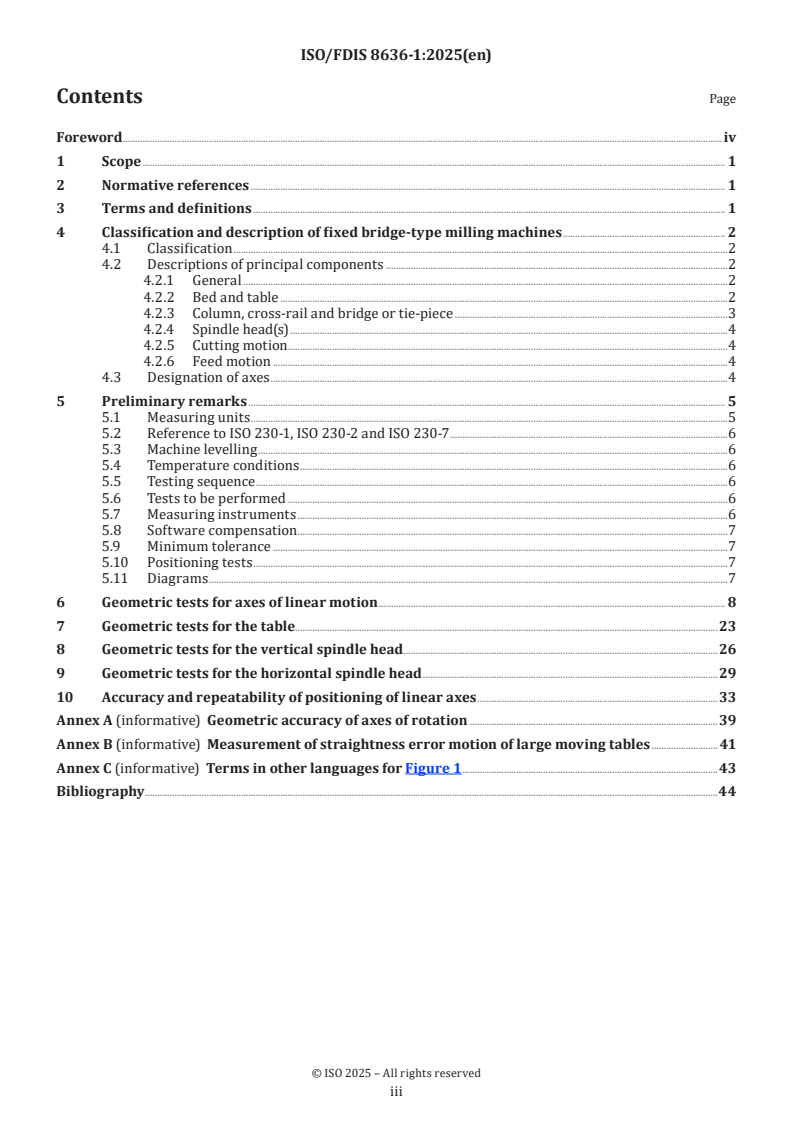
Contents Page
Foreword .iv
1 Scope . 1
2 Normative references . 1
3 Terms and definitions . 1
4 Classification and description of fixed bridge-type milling machines . 2
4.1 Classification .2
4.2 Descriptions of principal components .2
4.2.1 General .2
4.2.2 Bed and table .2
4.2.3 Column, cross-rail and bridge or tie-piece .3
4.2.4 Spindle head(s) .4
4.2.5 Cutting motion.4
4.2.6 Feed motion .4
4.3 Designation of axes .4
5 Preliminary remarks . 5
5.1 Measuring units .5
5.2 Reference to ISO 230-1, ISO 230-2 and ISO 230-7 .6
5.3 Machine levelling .6
5.4 Temperature conditions .6
5.5 Testing sequence .6
5.6 Tests to be performed .6
5.7 Measuring instruments .6
5.8 Software compensation . .7
5.9 Minimum tolerance .7
5.10 Positioning tests .7
5.11 Diagrams .7
6 G eometric tests for axes of linear motion . 8
7 G eometric tests for the table.23
8 G eometric tests for the vertical spindle head.26
9 G eometric tests for the horizontal spindle head .29
10 A ccuracy and repeatability of positioning of linear axes .33
Annex A (informative) Geometric accuracy of axes of rotation .39
Annex B (informative) Measurement of straightness error motion of large moving tables . 41
Annex C (informative) Terms in other languages for Figure 1 .43
Bibliography .44
iii
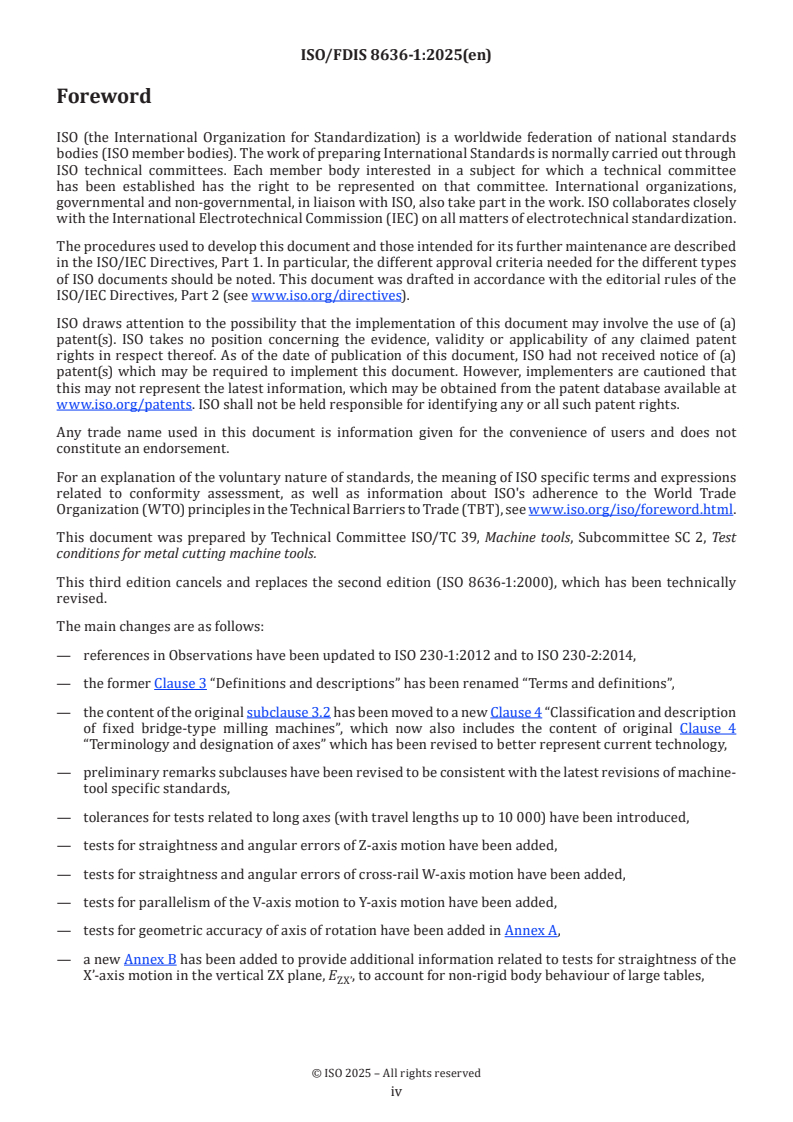
Foreword
ISO (the International Organization for Standardization) is a worldwide federation of national standards
bodies (ISO member bodies). The work of preparing International Standards is normally carried out through
ISO technical committees. Each member body interested in a subject for which a technical committee
has been established has the right to be represented on that committee. International organizations,
governmental and non-governmental, in liaison with ISO, also take part in the work. ISO collaborates closely
with the International Electrotechnical Commission (IEC) on all matters of electrotechnical standardization.
The procedures used to develop this document and those intended for its further maintenance are described
in the ISO/IEC Directives, Part 1. In particular, the different approval criteria needed for the different types
of ISO documents should be noted. This document was drafted in accordance with the editorial rules of the
ISO/IEC Directives, Part 2 (see www.iso.org/directives).
ISO draws attention to the possibility that the implementation of this document may involve the use of (a)
patent(s). ISO takes no position concerning the evidence, validity or applicability of any claimed patent
rights in respect thereof. As of the date of publication of this document, ISO had not received notice of (a)
patent(s) which may be required to implement this document. However, implementers are cautioned that
this may not represent the latest information, which may be obtained from the patent database available at
www.iso.org/patents. ISO shall not be held responsible for identifying any or all such patent rights.
Any trade name used in this document is information given for the convenience of users and does not
constitute an endorsement.
For an explanation of the voluntary nature of standards, the meaning of ISO specific terms and expressions
related to conformity assessment, as well as information about ISO's adherence to the World Trade
Organization (WTO) principles in the Technical Barriers to Trade (TBT), see www.iso.org/iso/foreword.html.
This document was prepared by Technical Committee ISO/TC 39, Machine tools, Subcommittee SC 2, Test
conditions for metal cutting machine tools.
This third edition cancels and replaces the second edition (ISO 8636-1:2000), which has been technically
revised.
The main changes are as follows:
— references in Observations have been updated to ISO 230-1:2012 and to ISO 230-2:2014,
— the former Clause 3 “Definitions and descriptions” has been renamed “Terms and definitions”,
— the content of the original subclause 3.2 has been moved to a new Clause 4 “Classification and description
of fixed bridge-type milling machines”, which now also includes the content of original Clause 4
“Terminology and designation of axes” which has been revised to better represent current technology,
— preliminary remarks subclauses have been revised to be consistent with the latest revisions of machine-
tool specific standards,
— tolerances for tests related to long axes (with travel lengths up to 10 000) have been introduced,
— tests for straightness and angular errors of Z-axis motion have been added,
— tests for straightness and angular errors of cross-rail W-axis motion have been added,
— tests for parallelism of the V-axis motion to Y-axis motion have been added,
— tests for geometric accuracy of axis of rotation have been added in Annex A,
— a new Annex B has been added to provide additional information related to tests for straightness of the
X’-axis motion in the vertical ZX plane, E , to account for non-rigid body behaviour of large tables,
ZX’
iv
— the test for table flatness (formerly G9) has been deleted because the table surface is not normally used as
a reference for the orientation of the workpiece, and, for tests made during the working life of the machine
tool, the surface might no longer be suitable for accurate measurements on these large machine tools,
— the tests for tilting spindle heads (formerly G15 and P7) have been deleted as such heads are not in the
scope of this document,
— the machining tests have been excluded considering that such tests are typically the object of agreement
between manufacturer/supplier and user, (possibly) including tests that are specified in ISO 10791-7.
A list of all parts in the ISO 8636 series can be found on the ISO website.
Any feedback or questions on this document should be directed to the user’s national standards body. A
complete listing of these bodies can be found at www.iso.org/members.html.
v
FINAL DRAFT International Standard ISO/FDIS 8636-1:2025(en)
Machine tools — Test conditions for bridge-type milling
machines —
Part 1:
Testing of the accuracy of fixed bridge (portal-type) machines
1 Scope
This document specifies, with reference to ISO 230-1 and ISO 230-2, geometric tests and tests for checking
the accuracy and repeatability of positioning of numerically controlled axes for general purpose, normal
accuracy, bridge-type milling machines with a fixed bridge (portal type). This document also specifies the
applicable tolerances corresponding to the above-mentioned tests.
This document is applicable to machines with moving tables and fixed double columns. It does not include
single-column (open sided) machines and those with fixed tables and moving columns.
This document deals only with the verification of the accuracy of the machine. It does not apply to the testing
of the machine operation (vibration, abnormal noise, stick-slip motion of components, etc.) nor to machine
characteristics (such as speeds, feeds, etc.), which are generally checked before testing the accuracy.
This document provides the terminology used for the principal components of the machine and the
designation of the axes with reference to ISO 841.
2 Normative references
The following documents are referred to in the text in such a way that some or all of their content constitutes
requirements of this document. For dated references, only the edition cited applies. For undated references,
the latest edition of the referenced document (including any amendments) applies.
ISO 230-1:2012, Test code for machine tools — Part 1: Geometric accuracy of machines operating under no-load
or quasi-static conditions
ISO 230-2:2014, Test code for machine tools — Part 2: Determination of accuracy and repeatability of positioning
of numerically controlled axes
ISO 230-7:2015, Test code for machine tools — Part 7: Geometric accuracy of axes of rotation
3 Terms and definitions
For the purposes of this document, the terms and definitions given in ISO 230-1, ISO 230-2, ISO 230-7 and
the following apply.
ISO and IEC maintain terminology databases for use in standardization at the following addresses:
— ISO Online browsing platform: available at https:// www .iso .org/ obp
— IEC Electropedia: available at https:// www .electropedia .org/
3.1
milling operation
machining operation to generate surfaces of various geometries in which the principal cutting motion is
the rotation of a cutting tool with multiple cutting edges against the non-rotating workpiece and where the
cutting energy is brought by the cutting tool rotation
Note 1 to entry: Milling operations mostly involve face milling or end milling. The tools are mounted either in the
boring spindle taper or, as for face milling cutters, on the tool-holding spindle nose.
[SOURCE: ISO 3070-2:2016, 3.2]
3.2
boring operation
operation which consists of machining the diameters of cylindrical, conical, blind or through holes, to the
required size
3.3
drilling and tapping operation
operation which consist of drilling and tapping blind or through holes
3.4
fixed bridge-type (portal-type) milling machine
double-column machine with one or more vertical spindle heads mounted on the cross-rail, above a table
which has a longitudinal traverse (X’-axis) only
Note 1 to entry: Additional horizontal spindle heads can be mounted on the columns. The horizontal spindle axes can
have a tilting capability. However, such spindle heads are beyond the scope of this document.
4 Classification and description of fixed bridge-type milling machines
4.1 Classification
These machine tools are classified into two types, depending upon their construction:
— bridge-type milling machines with cross-rail movable along Z(W-) axis and a bridge or tie-piece (see
Figure 1 Key 10) between the columns;
— bridge-type milling machines with a fixed height cross-rail which can replace the bridge or tie-piece.
4.2 Descriptions of principal components
4.2.1 General
The principal components of these machine tools are described in 4.2.2 to 4.2.6. The number indicated in
brackets corresponds to the relevant key in Figure 1.
4.2.2 Bed and table
The bed (see Figure 1 Key 1) is the fixed base of the machine which can be constructed of several parts. It
supports the Table (see Figure 1 Key 3) which moves parallel to the major axis of the bed.
Key
1 bed
2 bed slideways
3 table
4 left-hand column
5 right-hand column
6 slideways of right-hand and left-hand columns
7 cross-rail (movable or fixed)
8 vertical spindle head
9 horizontal spindle head
10 tie-piece
11 vertical spindle head saddle
12 quill or ram
13 tool-holding spindle
14 tool (milling cutter)
15 reference T-slot
R vertical motion of the horizontal spindle head (R-axis)
V horizontal motion of the horizontal spindle head (V-axis)
W movable cross-rail vertical motion (W-axis)
X’ X‘-axis
Y Y-axis
Z Z-axis
NOTE For terms in French, German, Italian, Japanese and Persian, see Annex C.
Figure 1 — Fixed bridge-type (portal-type) milling machine with variable height cross-rail
4.2.3 Column, cross-rail and bridge or tie-piece
In Figure 1, the columns (4) and (5) provide the vertical frame of the machine and are fixed on either side of
the bed.
The columns can be fitted with vertical slideways (see Figure 1 Key 6) to accommodate horizontal spindle
head (see Figure 1 Key 9) with other horizontal spindle axis.
The tie-piece (10) is a fixed piece connecting both columns at, or near, the top.
The cross-rail (see Figure 1 Key 7) has its major axis parallel to the table plane and is fitted with slideways
on which one or more vertical spindle heads (see Figure 1 Key 8) can move.
The variable height cross-rail, where available, can be moved up and down the vertical slideways (see
Figure 1 Key 6) on the columns.
In the case of machines with a fixed-height cross-rail, the latter is also fastened to the columns and can
replace the tie-piece.
4.2.4 Spindle head(s)
These heads include the spindle and drive mechanism and the means for their mounting on the cross-rail or
column. In some cases, the tool-holding spindle (see Figure 1 Key 13) can be mounted in a ram or quill (see
Figure 1 Key 12) with a feed motion for drilling, tapping, boring or milling operations.
4.2.5 Cutting motion
Cutting motion is provided by the spindles and drive mechanisms of the spindle heads.
4.2.6 Feed motion
The following feed motions can be provided with a constant or variable feed speed:
— horizontal motion of the table;
— horizontal motion of the spindle heads on the cross-rail or vertical and horizontal motions of the
horizontal heads;
— vertical motion of spindle rams or quills (if any).
NOTE 1 In general, rapid traverse is available in addition to feed motion.
NOTE 2 The vertical motion of the cross-rail (if any) is usually a motion between stationary positions.
4.3 Designation of axes
See Figures 2 to 4 for the designation of axes for different machine tools configurations.
Figure 2 — Portal type machine tool with one spindle head
a) One vertical spindle head placed on the cross- b) Two vertical spindle heads on the cross-rail
rail and one horizontal spindle head placed on the
left-hand column
Figure 3 — Portal type machine tools with two spindle heads
Figure 4 — Portal type machine tool with three spindle heads
5 Preliminary remarks
5.1 Measuring units
In this document, all linear dimensions, deviations, errors and corresponding tolerances are expressed
in millimetres; angular dimensions are expressed in degrees, and angular errors and the corresponding
tolerances are primarily expressed in ratios (e.g. 0,010/1 000), but in some cases, microradians (µrad) or
arcseconds (“) are used for clarification purposes. Formula (1) should be used for the conversion of the units
of angular errors or tolerances:
0,010/1 000 = 10 µrad ≈ 2″ (1)
5.2 Reference to ISO 230-1, ISO 230-2 and ISO 230-7
To apply this document, reference shall be made to ISO 230-1 and ISO 230-7 when required, especially for
the installation of the machine before testing, warming up of the spindle(s) and other moving components,
description of measuring methods and recommended accuracy of testing equipment.
In the “Observations” box of the tests described in Clauses 6 to 10, the instructions are preceded by a
reference to the corresponding clause(s) in ISO 230-1, ISO 230-2 or ISO 230-7 in cases where the test
concerned is in conformity with the specifications of one of those parts of the ISO 230 series.
5.3 Machine levelling
Prior to conducting tests on a machine tool, the machine tool should be levelled according to the
recommendations of the manufacturer/supplier (see ISO 230-1:2012, 6.1).
5.4 Temperature conditions
The temperature conditions throughout the tests shall be specified by agreement between the manufacturer/
supplier and user.
5.5 Testing sequence
The sequence in which the tests are presented in this document in no way defines the practical order of
testing. In order to make the mounting of instruments or gauging easier, tests may be performed in any order.
5.6 Tests to be performed
When testing a machine, it is not always necessary nor possible to carry out all the tests described in this
document. When the tests are required for acceptance purposes, it is up to the user to choose, in agreement
with the manufacturer/supplier, those tests relating to the components and/or the properties of the machine
which are of interest. ISO 230-1:2012, Annex A provides valuable information about selection of primary and
secondary axes and associated tests. These tests are to be clearly stated when ordering a machine. Simple
reference to this document for the acceptance tests, without specifying the tests to be carried out, and
without agreement on the relevant expenses, cannot be considered as binding for any contracting party.
5.7 Measuring instruments
The measuring instruments indicated in the tests described in Clauses 6 to 10 are examples only. Other
instruments measuring the same quantities and having the same, or a smaller, measurement uncertainty
can be used. Reference shall be made to ISO 230-1:2012, Clause 5, which indicates the relationship between
measurement uncertainties and the tolerances.
When a “dial gauge” is referred to, it can mean not only dial test indicators (DTI), but any type of linear
displacement sensor such as analogue or digital dial gauges, linear variable differential transformer (LVDTs),
linear scale displacement gauges, or non-contact sensors, when applicable to the test concerned.
Similarly, when a “straightedge” is referred to, it can mean any type of straightness reference artefact,
such as a granite or ceramic or steel or cast-iron straightedge, one arm of a square, one generating line on a
cylindrical square, any straight path on a reference cube, or a special, dedicated artefact manufactured to fit
in the T-slots or other references.
In the same way, when a “square” is mentioned, it can mean any type of squareness reference artefact, such
as a granite or ceramic or steel or cast-iron square, a cylindrical square, a reference cube, or, again, a special,
dedicated artefact.
When a “precision level” is referred to, it can mean any type of level such as bubble tube, digital and analogue
electronic levels.
Valuable information on measuring instruments is available in ISO/TR 230-11.
5.8 Software compensation
When built-in software facilities are available for compensating geometric, positioning, contouring and
thermal deviations, their use during these tests should be based on agreement between manufacturer/
supplier and user, with due consideration to the machine tool intended use, e.g. if the intended use of
the machine tool is with or without software compensation for geometric errors. When the software
compensation is used, this shall be stated in the test report. It shall be noted that when software
compensation is used, some machine tool axes cannot be locked for test purposes.
Valuable information on numerical compensation of geometric errors is given in ISO/TR 16907.
5.9 Minimum tolerance
By mutual agreement, manufacturer/supplier and user can establish the tolerance for a measuring length
different from that given in the tests described in Clauses 6 to 10. However, it should be considered that the
recommended minimum value of tolerance is 0,005 mm, unless otherwise specified.
In establishing the minimum tolerance, measurement uncertainty associated with the test and the
recommended instrument, shall be taken into account, see 5.7.
5.10 Positioning tests
Positioning tests for numerically controlled machines shall refer to ISO 230-2. Tolerances in this document
are given only for some parameters. The presentation of the test results shall be in accordance with
ISO 230-2.
5.11 Diagrams
For reasons of simplicity, the diagrams in Clauses 6 to 10 and in Annex A, illustrate only one type of machine.
Where applicable, the diagram box provides, for each test a), b) and c) identified in the object box, a schematic
representation of a possible test setup, including the identification of the relevant coordinate plane (e.g. XY,
YZ, ZX).
6 Geometric t ests for axes of linear motion
Object G1
Checking of the straightness of motion of the table (X’-axis) in the horizontal XY plane, E .
YX’
Diagram
Key
1 taut wire 2 microscope
Tolerance
For a measuring length up to
2 500 5 000 7 500 10 000
0,025 0,050 0,075 0,100
The local tolerance is 0,010 for any measuring length of 1 000.
For measuring lengths over 10 000, the tolerance shall be agreed between manufacturer/supplier and user.
Measurement results For a measuring length of:
Measuring instruments
Microscope and taut wire or other straightness measurement optical instruments.
Observations and references to ISO 230-1:2012, 8.2.2.1, 8.2.2.2, 8.2.2.3 and 8.2.2.4
The microscope shall be fixed on the spindle, if it can be locked, or on the spindle head.
When optical instruments are used, it should be considered that, their measurement uncertainty for long
measurement length can be higher than the measurement uncertainty of microscope and taut wire.
Measurements shall be carried out on at least six positions along the travel, with equally spaced steps not
exceeding 500. Traverse the table in the X’-axis direction and note the readings.
Measurements shall be with Y- and Z-axes at their mid travel positions or otherwise, measurement location
shall be reported.
Object G2
Checking of the straightness of motion of representative points of the table (X’-axis) in the vertical ZX plane, E .
ZX’
Diagram
Key
1 target 2 laser scanning device
Tolerance
For a measuring length up to
2 500 5 000 7 500 10 000
0,050 0,100 0,150 0,200
The local tolerance is 0,020 for any measuring length of 1 000.
For measuring lengths over 10 000, the tolerance shall be agreed between manufacturer/supplier and user.
Measurement results For a measuring length of:
Measuring instruments
Laser scanning device or straightness measurement optical instruments excluding microscope and taut wire.
Observations and references to ISO 230-1:2012, 8.2.2.1, 8.2.2.3 and 8.2.2.4
Taut wire is not recommended because of the sag of the wire.
The laser scanning device can be mounted on the spindle head so that the optical plane is parallel to the X’-axis
motion, or the lack of parallelism shall be considered in the measurement. If the instrument is mounted on
the table, small local angular errors will be improperly magnified.
The target can be mounted on a representative point on the table.
Measurements shall be carried out on at least six positions along the travel, with equally spaced steps not
exceeding 500. Traverse the table in the X’-axis direction and note the readings.
Measurements shall be with Y- and Z-axes at their mid travel positions or otherwise, measurement location
shall be reported.
The rigid body model is typically not applicable to the motion of the table.
The target shall be placed at the two ends of the table and possibly in the middle of the table. Each measure-
ment result shall be reported.
The target located at one end of the table explores the characteristics of half of the bed.
The target located in the middle of the table typically reveals different deviations from the ones located at
both ends of the table.
See Annex B for information on methods to be applied to minimize the effect of non-rigid body behaviour of
the table motion on measurement uncertainty.
Object G3
Checking of the angular errors of the table motion (X’-axis):
a) in the vertical ZX plane (E : pitch);
BX’
b) in the vertical YZ plane (E : roll).
AX’
Diagram
a) b)
Key
1 measuring level for pitch 3 measuring level for roll
2 reference level for pitch 4 reference level for roll
Tolerance
For measuring length up to
2 500 5 000 7 500 10 000
For a) 0,030/1 000 0,040/1 000 0,050/1 000 0,060/1 000
For b) 0,020/1 000 0,020/1 000 0,020/1 000 0,020/1 000
The local tolerance for a) and b) is 0,020/1 000 for any measuring length of 1 000.
For measuring lengths over 10 000, the tolerance shall be agreed between manufacturer/supplier and user.
Measurement results For a measuring length of:
a) b)
Measuring instruments
For a): precision level or optical instruments. For b): precision level.
Observations and references to ISO 230-1:2012, 8.4.2.1, 8.4.2.2 and 8.4.2.3
The measuring level or the instrument shall be placed on the table: for a), E (pitch): in the X-axis direction;
BX’
for b), E (roll): in the Y-axis direction.
AX’
If the X’-axis motion causes angular deviation of both the table and spindle head, differential measurements
of the two angular motions shall be taken.
For a) and b), measurements shall be carried out on at least six positions along the travel, with equally spaced
steps not exceeding 500 in both directions of movement.
For a) and b), the angular error to be reported is the difference between the maximum and the minimum
readings. The measurement location shall be reported.
For tests a) and b), the instrument shall be placed at the two ends and possibly in the middle of the table. The
instrument located at one end of the table explores the characteristics of half of the bed.
The instrument located in the middle of the table typically reveals different deviations from the ones located
at both ends of the table.
Object G4
Checking of the angular errors of the table motion (X’-axis) in the horizontal XY plane (E : yaw).
CX’
Diagram
Key
1 autocollimator 2 mirror
Tolerance
For measuring length up to
2 500 5 000 7 500 10 000
0,030/1 000 0,040/1 000 0,050/1 000 0,060/1 000
The local tolerance is 0,020/1 000 for any measuring length of 1 000.
For measuring lengths over 10 000, the tolerance shall be agreed between manufacturer/supplier and user.
Measurement results For a measuring length of:
Measuring instruments
Autocollimator or other optical angular measurement instrument.
Observations and references to ISO 230-1:2012, 8.4.2.2 and 8.4.2.3
The autocollimator shall be placed on the table.
Measurements shall be carried out on at least six positions along the travel, with equally spaced steps not
exceeding 500, in both directions of movement.
The angular error to be reported is the difference between the maximum and the minimum readings. The
measurement location shall be reported.
Object G5
Checking of the straightness of the horizontal motion of the spindle head on the cross-rail (Y-axis):
a) in the horizontal XY plane, E ;
XY
b) in the vertical YZ plane, E .
ZY
Diagram
a) b)
Tolerance
For measuring length up to
2 000 3 000 4 000 5 000
For a) and b) 0,020 0,030 0,040 0,050
The local tolerance for a) and b) is 0,015 for any measuring length of 800.
For measuring lengths over 5 000, the tolerance shall be agreed between manufacturer/supplier and user.
Measurement results For a measuring length of:
a) b)
Measuring instruments
Dial gauge, straightedge and gauge blocks or optical instruments.
Observations and references to ISO 230-1:2012, 8.2.2.1, 8.2.2.3, 8.2.2.4 and 8.2.2.5
Fix the movable cross-rail in mid travel and move the table in mid travel.
Set a straightedge on the table, with the reference surface approximately parallel to the Y-axis: in the hori-
zontal plane for a) and in the vertical plane for b).
If the spindle can be locked, the dial gauge may be mounted on it. If the spindle cannot be locked, the dial
gauge shall be mounted on the ram.
Traverse the spindle head in the Y-direction through the measuring length and record the readings. Typically,
the measurement length is the maximum working stroke length of the milling head in the Y-axis direction
(not the full length of cross-rail). In other cases, this shall be agreed upon between the supplier/manufac-
turer and user.
Measurements shall be carried out on at least six positions along the travel, with equally spaced steps not
exceeding 400.
Object G6
Checking of the angular errors of the horizontal motion of the spindle head (Y-axis):
a) in the vertical YZ plane, E ;
AY
b) in the vertical ZX plane, E (roll);
BY
c) in the horizontal XY plane E .
CY
Diagram
a) and c) b)
Key
1 measuring level for E 3 autocollimator for E / E 5 measuring level for E , roll
AY CY AY BY
2 reference level for E 4 mirror for E / E 6 reference level for E , roll
AY CY AY BY
Tolerance
For measuring length up to
2 000 3 000 4 000 5 000
For a), b) and c) 0,035/1 000 0,050/1 000 0,060/1 000 0,060/1 000
For a), b) and c), the local tolerance is 0,015/1 000 for any measuring length of 800.
For measuring lengths over 5 000, the tolerance shall be agreed between manufacturer/supplier and user.
Measurement results For a measuring length of:
a) b) c)
Measuring instruments
For a): Precision level or optical instruments. For b): Precision level. For c): Autocollimator or other optical
instruments.
Observations and references to ISO 230-1:2012, 8.4.2.1, 8.4.2.2 and 8.4.2.3
The level or mirror or retro-reflector shall be placed on the movable component: for a), E : the level shall
AY
be placed in the Y-axis direction; for b), E (roll): the level shall be placed in the X’-axis direction; for c), E :
BY CY
set autocollimator horizontally in the Y-axis direction.
If the Y-axis motion causes angular deviation of both the table and spindle head, differential measurements
of the two angular motions shall be taken.
Measurements shall be carried out on at least six positions along the travel, with equally spaced steps not
exceeding 400.
For a), b) and c), the angular error to be reported is the difference between the maximum and the minimum
readings.
Object G7
Checking of the straightness of the spindle head vertical motion (Z-axis):
a) in the vertical ZX plane, E ;
XZ
b) in the vertical YZ plane, E .
YZ
Diagram
a) b)
Tolerance
For measuring length up to
1 000 2 000 3 000 4 000
For a) and b) 0,015 0,020 0,030 0,040
The local tolerance for a) and b) is 0,010 for any measuring length of 600.
For measuring lengths over 4 000, the tolerance shall be agreed between manufacturer/supplier and user.
Measurement results For a measuring length of:
a) b)
Measuring instruments
Square, straightedge, adjustable blocks and dial gauge or optical instruments or microscope and taut wire.
Observations and references to ISO 230-1:2012, 8.2.2.1
Place table, movable cross-rail and spindle head at mid travel.
If used, the taut wire shall be tightened between the table and another fixed part independent from the bridge.
For a), set a straightedge parallel to X’-axis, or the lack of parallelism shall be considered in the measurement;
and then place a square on it. Fix a dial gauge on the spindle head. Lock cross-rail on columns, where possible.
Apply the stylus of the dial gauge to the square measuring in the X’-direction. Zero the dial gauge. Move the
Z-axis and record the dial gauge readings.
Measurements shall be carried out on at least six positions along the travel, with equally spaced steps not
exceeding 300.
For b), set a straightedge oriented along the Y-axis and place a square on it. Apply the stylus of the dial gauge
to the square measuring in the Y-direction. Zero the dial gauge. Move the Z-axis and record the dial gauge
readings.
Measurements shall be carried out on at least six positions along the travel, with equally spaced steps not
exceeding 300.
NOTE The test setup depicted in Diagram is also applicable to tests G11, G12 and G15. The use of the straight-
edge is optional.
Object G8
Checking of the angular errors of the spindle head vertical motion (Z-axis):
a) in the vertical YZ plane, E ;
AZ
b) in the vertical ZX plane, E .
BZ
Diagram
a) b)
Key
1 measuring level for E 3 measuring level for E
AZ BZ
2 reference level for E 4 reference level for E
AZ BZ
Tolerance
For measuring length up to
1 000 2 000 3 000 4 000
For a) and b) 0,020/1 000 0,030/1 000 0,040/1 000 0,050/1 000
The local tolerance for a) and b) is 0,015/1 000 for any measuring length of 600.
For measuring lengths over 4 000, the tolerance shall be agreed between manufacturer/supplier and user.
Measurement results For a measuring length of:
a) b)
Measuring instruments
Precision level or optical instruments.
Observations and references to ISO 230-1:2012, 8.4.2.1
The level or mirror or retro-reflector shall be placed on the movable component:
— for a), (E ): the level shall be placed in the Y-axis direction;
AZ
— for b), (E ): the level shall be placed in the X’-axis direction.
BZ
If the Z-axis motion causes angular deviation of both the table and spindle head, differential measurements
of the two angular motions shall be taken.
Measurements shall be carried out on at least six positions along the travel, with equally spaced steps not
exceeding 300.
For a) and b), the angular error to be reported is the difference between the maximum and the minimum
readings.
Object G9
Checking of the angular error of the spindle head vertical motion (Z-axis) in the horizontal XY plane,
E (roll).
CZ
Diagram
Key
1 square 2 special arm d travelled distance along Y-axis
Tolerance
For measuring length up to
1 000 2 000 3 000 4 000
0,020/1 000 0,030/1 000 0,040/1 000 0,050/1 000
The local tolerance is 0,015/1 000 for any measuring length of 600.
For measuring lengths over 4 000, the tolerance shall be agreed between manufacturer/supplier and user.
Measurement results For a measuring length of:
Measuring instruments
Square, dial gauge mounted on special arm or taut wire and microscope or sweeping laser.
Observations and references to ISO 230-1:2012, 8.4.2.4
Measure the E straightness deviation of the Z-axis by an instrument mounted on a special arm with a
XZ
horizontal offset d/2 from the spindle axis, either: by a dial gauge against a square set up as in G7 a) and in
G11 a), as depicted in Diagram, by a microscope targeting a vertical taut wire or by a target of a sweeping
laser generating an optical YZ plane. Note the readings and the relevant measuring positions on the spindle
head travel (Z-axis).
Position or turn the special arm (carrying the instrument) to the opposite side of the spindle head and move
the Y-axis of d in order to repeat the same readings against the same reference; the possible roll of the Y-axis
motion shall be measured and taken into account.
When using a sweeping laser, no Y-axis movement is required.
The instrument shall be reset, the new measurements shall be taken at the same heights of the previous
ones, and the results shall be noted.
Measurements shall be carried out on at least six positions along the travel, with equally spaced steps not
exceeding 300.
For each measurement position, calculate the algebraic difference between the two readings, and then cal-
culate the difference between maximum and minimum divided by the distance d for obtaining the angular
deviation.
Object G10
Checking of the squareness of the spindle head horizontal motion on cross-rail (Y-axis) to the table motion
(X’-axis), E .
C(0X’)Y
Diagram
Tolerance
0,040/1 000
Measurement results
Measuring instruments
Square and dial gauge or optical instruments.
Observations and references to ISO 230-1:2012, 10.3.2.2
Place the
...
ISO/DIS FDIS 8636--1:2025(en)
ISO TC 39/SC 2
Secretariat: ASI
Machine tools — Test conditions for bridge-type milling machines — Part 1: Testing of
the accuracy of fixed bridge (portal-type) machines
Date: 2025-06-3010-29
Third edition
ISO/DISFDIS 8636-1:2025(en)
All rights reserved. Unless otherwise specified, or required in the context of its implementation, no part of
this publication may be reproduced or utilized otherwise in any form or by any means, electronic or
mechanical, including photocopying, or posting on the internet or an intranet, without prior written
permission. Permission can be requested from either ISO at the address below or ISO’sISO's member body
in the country of the requester.
ISO copyright officeCopyright Office
CP 401 • Ch. de Blandonnet 8
CH-1214 Vernier, Geneva
Phone: + 41 22 749 01 11
Email: copyright@iso.org copyright@iso.org
Website: www.iso.org
Published in Switzerland.
ISO/DISFDIS 8636-1:2025(en)
Contents
Foreword . iv
1 Scope . 1
2 Normative references . 1
3 Terms and definitions . 1
4 Classification and description of fixed bridge-type milling machines . 2
4.1 Classification . 2
4.2 Descriptions of principal components . 2
4.2.1 General . 2
4.2.2 Bed and table . 2
4.2.3 Column, cross-rail and bridge or tie-piece . 3
4.2.4 Spindle head(s) . 4
4.2.5 Cutting motion . 4
4.2.6 Feed motion . 4
4.3 Designation of axes . 4
5 Preliminary remarks . 5
5.1 Measuring units . 5
5.2 Reference to ISO 230-1, ISO 230-2 and ISO 230-7 . 6
5.3 Machine levelling . 6
5.4 Temperature conditions . 6
5.5 Testing sequence . 6
5.6 Tests to be performed . 6
5.7 Measuring instruments . 6
5.8 Software compensation . 7
5.9 Minimum tolerance . 7
5.10 Positioning tests . 7
5.11 Diagrams . 7
6 Geometric tests for axes of linear motion . 8
7 Geometric tests for the table . 23
8 Geometric tests for the vertical spindle head . 26
9 Geometric tests for the horizontal spindle head . 29
10 Accuracy and repeatability of positioning of linear axes . 33
Annex A (informative) Geometric accuracy of axes of rotation . 39
Annex B (informative) Measurement of straightness error motion of large moving tables . 41
Annex C (informative) Terms in other languages for Figure 1 . 43
Bibliography . 45
ISO/DISFDIS 8636-1:2025(en)
Foreword
ISO (the International Organization for Standardization) is a worldwide federation of national standards
bodies (ISO member bodies). The work of preparing International Standards is normally carried out
through ISO technical committees. Each member body interested in a subject for which a technical
committee has been established has the right to be represented on that committee. International
organizations, governmental and non-governmental, in liaison with ISO, also take part in the work. ISO
collaborates closely with the International Electrotechnical Commission (IEC) on all matters of
electrotechnical standardization.
The procedures used to develop this document and those intended for its further maintenance are
described in the ISO/IEC Directives, Part 1. In particular, the different approval criteria needed for the
different types of ISO documents should be noted. This document was drafted in accordance with the
editorial rules of the ISO/IEC Directives, Part 2 (see www.iso.org/directives).
ISO draws attention to the possibility that the implementation of this document may involve the use of
(a) patent(s). ISO takes no position concerning the evidence, validity or applicability of any claimed
patent rights in respect thereof. As of the date of publication of this document, ISO had not received notice
of (a) patent(s) which may be required to implement this document. However, implementers are
cautioned that this may not represent the latest information, which may be obtained from the patent
database available at www.iso.org/patents. ISO shall not be held responsible for identifying any or all
such patent rights.
Any trade name used in this document is information given for the convenience of users and does not
constitute an endorsement.
For an explanation of the voluntary nature of standards, the meaning of ISO specific terms and
expressions related to conformity assessment, as well as information about ISO's adherence to the World
Trade Organization (WTO) principles in the Technical Barriers to Trade (TBT), see
www.iso.org/iso/foreword.html.
This document was prepared by Technical Committee ISO/TC 39, Machine tools, Subcommittee SC 2, Test
conditions for metal cutting machine tools.
This third edition cancels and replaces the second edition (ISO 8636-1:2000), which has been technically
revised.
The main changes are as follows:
— references in Observations have been updated to ISO 230-1:2012 and to ISO 230-2:2014,
— the originalformer Clause 3 “Definitions and descriptions” has been renamed “Terms and
definitions”,
— the content of the original subclause 3.2 has been moved to a new Clause 4 “Classification and
description of fixed bridge-type milling machines”, which now also includes the content of original
Clause 4 “Terminology and designation of axes” which has been revised to better represent current
technology,
— preliminary remarks sub-clausessubclauses have been revised to be consistent with the latest
revisions of machine-tool specific standards,
— tolerances for tests related to long axes (with travel lengths up to 10 000) have been introduced,
ISO/DISFDIS 8636-1:2025(en)
— tests for straightness and angular errors of Z-axis motion have been added,
— tests for straightness and angular errors of cross-rail W-axis motion have been added,
— tests for parallelism of the V-axis motion to Y-axis motion have been added,
— tests for geometric accuracy of axis of rotation have been added in Annex A,
— a new Annex B has been added to provide additional information related to tests for straightness of
the X’-axis motion in the vertical ZX plane, E , to account for non-rigid body behaviour of large
ZX’
tables,
— the test for table flatness (formerly G9) has been deleted because the table surface is not normally
used as a reference for the orientation of the workpiece, and, for tests made during the working life
of the machine tool, the surface might no longer be suitable for accurate measurements on these large
machine tools,
— the tests for tilting spindle heads (formerly G15 and P7) have been deleted as such heads are not in
the scope of this document. They might be considered in a future standard,
— the machining tests have been excluded considering that such tests are typically the object of
agreement between manufacturer/supplier and user, (possibly) including tests that are specified in
ISO 10791-7.
A list of all parts in the ISO 8636 series can be found on the ISO website.
Any feedback or questions on this document should be directed to the user’s national standards body. A
complete listing of these bodies can be found at www.iso.org/members.html.
FINAL DRAFT International Standard ISO/DISFDIS 8636-1:2025(en)
Machine tools –— Test conditions for bridge-type milling
machines –— Part 1: Testing of the accuracy of fixed bridge
(portal-type) machines
1 Scope
This document specifies, with reference to ISO 230-1 and ISO 230-2, geometric tests and tests for
checking the accuracy and repeatability of positioning of numerically controlled axes for general purpose,
normal accuracy, bridge-type milling machines with a fixed bridge (portal type). This document also
specifies the applicable tolerances corresponding to the above-mentioned tests.
This document is applicable to machines with moving tables and fixed double columns. It does not include
single-column (open sided) machines and those with fixed tables and moving columns.
This document deals only with the verification of the accuracy of the machine. It does not apply to the
testing of the machine operation (vibration, abnormal noise, stick-slip motion of components, etc.) nor to
machine characteristics (such as speeds, feeds, etc.), which are generally checked before testing the
accuracy.
This document provides the terminology used for the principal components of the machine and the
designation of the axes with reference to ISO 841.
2 Normative references
The following documents are referred to in the text in such a way that some or all of their content
constitutes requirements of this document. For dated references, only the edition cited applies. For
undated references, the latest edition of the referenced document (including any amendments) applies.
ISO 230--1:2012, Test code for machine tools — Part 1: Geometric accuracy of machines operating under
no-load or quasi-static conditions
ISO 230--2:2014, Test code for machine tools — Part 2: Determination of accuracy and repeatability of
positioning of numerically controlled axes
ISO 230--7:2015, Test code for machine tools — Part 7: Geometric accuracy of axes of rotation
3 Terms and definitions
For the purposes of this document, the terms and definitions given in ISO 230-1, ISO 230-2, ISO 230-7
and the following apply.
ISO and IEC maintain terminologicalterminology databases for use in standardization at the following
addresses:
— ISO Online browsing platform: available at https://www.iso.org/obp
— IEC Electropedia: available at https://www.electropedia.org/
ISO/DISFDIS 8636-1:2025(en)
3.1
milling operation
machining operation to generate surfaces of various geometries in which the principal cutting motion is
the rotation of a cutting tool with multiple cutting edges against the non-rotating workpiece and where
the cutting energy is brought by the cutting tool rotation
Note 1 to entry: Milling operations mostly involve face milling or end milling. The tools are mounted either in the
boring spindle taper or, as for face milling cutters, on the tool-holding spindle nose.
[SOURCE: ISO 3070-2:2016, 3.2]
3.2
boring operation
operation which consists of machining the diameters of cylindrical, conical, blind or through holes, to the
required size
3.3
drilling and tapping operation
operation which consist of drilling and tapping blind or through holes
3.4
fixed bridge-type (portal-type) milling machine
double-column machine with one or more vertical spindle heads mounted on the cross-rail, above a table
which has a longitudinal traverse (X’-axis) only
Note 1 to entry: Additional horizontal spindle heads can be mounted on the columns. The horizontal spindle axes
can have a tilting capability. However, such spindle heads are beyond the scope of this document.
4 Classification and description of fixed bridge-type milling machines
4.1 Classification
These machine tools are classified into two types, depending upon their construction:
— bridge-type milling machines with cross-rail movable along Z(W-) axis and a bridge or tie-piece (see
Figure 1, key Key 10) between the columns;
— bridge-type milling machines with a fixed height cross-rail which can replace the bridge or tie-piece.
4.2 Descriptions of principal components
4.2.1 General
The principal components of these machine tools are described in 4.2.2 to 4.2.6. The number indicated in
brackets corresponds to the relevant key in Figure 1.
4.2.2 Bed and table
The bed (see Figure 1 Key 1) is the fixed base of the machine which can be constructed of several parts.
It supports the table (Table (see Figure 1 Key 3) which moves parallel to the major axis of the bed.
ISO/DISFDIS 8636-1:2025(en)
Key
1 bed 12 quill or ram
2 bed slideways 13 tool-holding spindle
3 table 14 tool (milling cutter)
4 left-hand column 15 reference T-slot
5 right-hand column R vertical motion of the horizontal spindle head (R-axis)
6 slideways of right-hand and left-hand columns V horizontal motion of the horizontal spindle head(V-axis)
7 cross-rail (movable or fixed) W movable cross-rail vertical motion (W-axis)
ISO/DISFDIS 8636-1:2025(en)
8 vertical spindle head X’ X‘-axis
9 horizontal spindle head Y Y-axis
10 tie-piece Z Z-axis
11 vertical spindle head saddle
NOTE For terms in French, German, Italian, Japanese and Persian, see Annex C.
1 bed
2 bed slideways
3 table
4 left-hand column
5 right-hand column
6 slideways of right-hand and left-hand columns
7 cross-rail (movable or fixed)
8 vertical spindle head
9 horizontal spindle head
10 tie-piece
11 vertical spindle head saddle
12 quill or ram
13 tool-holding spindle
14 tool (milling cutter)
15 reference T-slot
R vertical motion of the horizontal spindle head (R-axis)
V horizontal motion of the horizontal spindle head (V-axis)
W movable cross-rail vertical motion (W-axis)
X’ X‘-axis
Y Y-axis
Z Z-axis
NOTE For terms in French, German, Italian, Japanese and Persian, see Annex C.
Figure 1 — Fixed bridge-type (portal-) -type) milling machine with variable height cross-rail
4.2.3 Column, cross-rail and bridge or tie-piece
TheIn Figure 1, the columns (4) and (5) provide the vertical frame of the machine and are fixed on either
side of the bed.
The columns can be fitted with vertical slideways (see Figure 1 Key 6) to accommodate horizontal spindle
head (see Figure 1 Key 9) with other horizontal spindle axis.
The tie-piece (10) is a fixed piece connecting both columns at, or near, the top.
ISO/DISFDIS 8636-1:2025(en)
The cross-rail (see Figure 1 Key 7) has its major axis parallel to the table plane and is fitted with slideways
on which one or more vertical spindle heads (see Figure 1 Key 8) can move.
The variable height cross-rail, where available, can be moved up and down the vertical slideways (see
Figure 1 Key 6) on the columns.
In the case of machines with a fixed-height cross-rail, the latter is also fastened to the columns and can
replace the tie-piece.
4.2.4 Spindle head(s)
These heads include the spindle and drive mechanism and the means for their mounting on the cross-rail
or column. In some cases, the tool-holding spindle (see Figure 1 Key 13) can be mounted in a ram or quill
(see Figure 1 Key 12) with a feed motion for drilling, tapping, boring or milling operations.
4.2.5 Cutting motion
Cutting motion is provided by the spindles and drive mechanisms of the spindle heads.
4.2.6 Feed motion
The following feed motions can be provided with a constant or variable feed speed:
— horizontal motion of the table;
— horizontal motion of the spindle heads on the cross-rail or vertical and horizontal motions of the
horizontal heads;
— vertical motion of spindle rams or quills (if any).
NOTE 1 In general, rapid traverse is available in addition to feed motion.
NOTE 2 The vertical motion of the cross-rail (if any) is usually a motion between stationary positions.
4.3 Designation of axes
See Figures 2 to 4 for the designation of axes for different machine tools configurations.
ISO/DISFDIS 8636-1:2025(en)
Figure 2 — Portal type machine tool with one spindle head
a) One vertical spindle head placed on the cross- b) Two vertical spindle heads on the cross-
rail, and one horizontal spindle head placed on rail
the left-hand column
Figure 3 — — Portal type machine tools with two spindle heads
ISO/DISFDIS 8636-1:2025(en)
Figure 4 — Portal type machine tool with three spindle heads
5 Preliminary remarks
5.1 Measuring units
In this document, all linear dimensions, deviations, errors and corresponding tolerances are expressed
in millimetres; angular dimensions are expressed in degrees, and angular errors and the corresponding
tolerances are primarily expressed in ratios (e.g. 0,010/1 000), but in some cases, microradians (µrad)
or arcseconds (“) are used for clarification purposes. Formula (1) should be used for the conversion of
the units of angular errors or tolerances:
0,010/1 000 = 10 µrad ≈ 2″ (1)
5.2 Reference to ISO 230-1, ISO 230-2 and ISO 230-7
To apply this document, reference shall be made to ISO 230-1 and ISO 230-7 when required, especially
for the installation of the machine before testing, warming up of the spindle(s) and other moving
components, description of measuring methods and recommended accuracy of testing equipment.
ISO/DISFDIS 8636-1:2025(en)
In the “Observations” box of the tests described in Clauses 6 to 10, the instructions are preceded by a
reference to the corresponding clause(s) in ISO 230-1, ISO 230-2 or ISO 230-7 in cases where the test
concerned is in conformity with the specifications of one of those parts of the ISO 230 series.
5.3 Machine levelling
Prior to conducting tests on a machine tool, the machine tool should be levelled according to the
recommendations of the manufacturer/supplier (see ISO 230-1:2012, 6.1).
5.4 Temperature conditions
The temperature conditions throughout the tests shall be specified by agreement between the
manufacturer/supplier and user.
5.5 Testing sequence
The sequence in which the tests are presented in this document in no way defines the practical order of
testing. In order to make the mounting of instruments or gauging easier, tests may be performed in any
order.
5.6 Tests to be performed
When testing a machine, it is not always necessary nor possible to carry out all the tests described in this
document. When the tests are required for acceptance purposes, it is up to the user to choose, in
agreement with the manufacturer/supplier, those tests relating to the components and/or the properties
of the machine which are of interest. ISO 230-1:2012, Annex A provides valuable information about
selection of primary and secondary axes and associated tests. These tests are to be clearly stated when
ordering a machine. Simple reference to this document for the acceptance tests, without specifying the
tests to be carried out, and without agreement on the relevant expenses, cannot be considered as binding
for any contracting party.
5.7 Measuring instruments
The measuring instruments indicated in the tests described in Clauses 6 to 10 are examples only. Other
instruments measuring the same quantities and having the same, or a smaller, measurement uncertainty
can be used. Reference shall be made to ISO 230-1:2012, Clause 5, which indicates the relationship
between measurement uncertainties and the tolerances.
When a “dial gauge” is referred to, it can mean not only dial test indicators (DTI), but any type of linear
displacement sensor such as analoganalogue or digital dial gauges, linear variable differential
transformer (LVDTs), linear scale displacement gauges, or non-contact sensors, when applicable to the
test concerned.
Similarly, when a “straightedge” is referred to, it can mean any type of straightness reference artefact,
such as a granite or ceramic or steel or cast-iron straightedge, one arm of a square, one generating line
on a cylindrical square, any straight path on a reference cube, or a special, dedicated artefact
manufactured to fit in the T-slots or other references.
In the same way, when a “square” is mentioned, it can mean any type of squareness reference artefact,
such as a granite or ceramic or steel or cast-iron square, a cylindrical square, a reference cube, or, again,
a special, dedicated artefact.
When a “precision level” is referred to, it can mean any type of level such as bubble tube, digital and
analogue electronic levels.
Valuable information on measuring instruments is available in ISO/TR 230-11.
ISO/DISFDIS 8636-1:2025(en)
5.8 Software compensation
When built-in software facilities are available for compensating geometric, positioning, contouring and
thermal deviations, their use during these tests should be based on agreement between
manufacturer/supplier and user, with due consideration to the machine tool intended use, e.g.,. if the
intended use of the machine tool is with or without software compensation for geometric errors. When
the software compensation is used, this shall be stated in the test report. It shall be noted that when
software compensation is used, some machine tool axes cannot be locked for test purposes.
Valuable information on numerical compensation of geometric errors is given in ISO/TR 16907.
5.9 Minimum tolerance
By mutual agreement, manufacturer/supplier and user can establish the tolerance for a measuring length
different from that given in the tests described in Clauses 6 to 10. However, it should be considered that
the recommended minimum value of tolerance is 0,005 mm, unless otherwise specified.
In establishing the minimum tolerance, measurement uncertainty associated with the test and the
recommended instrument, shall be taken into account, see 5.7.
5.10 Positioning tests
Positioning tests for numerically controlled machines shall refer to ISO 230-2. Tolerances in this
document are given only for some parameters. The presentation of the test results shall be in accordance
with ISO 230-2.
5.11 Diagrams
For reasons of simplicity, the diagrams in Clauses 6 to 10 and in Annex A, illustrate only one type of
machine.
Where applicable, the diagram box provides, for each test a), b) and c) identified in the object box, a
schematic representation of a possible test setup, including the identification of the relevant coordinate
plane (e.g. XY, YZ, ZX).
ISO/DISFDIS 8636-1:2025(en)
6 Geometric tests for axes of linear motion
Object G1
Checking of the straightness of motion of the table (X’-axis) in the horizontal XY plane, E .
YX’
Diagram
Key
1 taut wire 2 microscope
Tolerance
For a measuring length up to
2 500 5 000 7 500 10 000
0,025 0,050 0,075 0,100
The local tolerance is 0,010 for any measuring length of 1 000.
For measuring lengths over 10 000, the tolerance shall be agreed between manufacturer/supplier and user.
Measurement results: For a measuring length of:
Measuring instruments
Microscope and taut wire or other straightness measurement optical instruments.
ISO/DISFDIS 8636-1:2025(en)
Observations and references to ISO 230--1:2012, 8.2.2.1, 8.2.2.2, 8.2.2.3 and 8.2.2.4
The microscope shall be fixed on the spindle, if it can be locked, or on the spindle head.
When optical instruments are used, it should be considered that, their measurement uncertainty for long
measurement length can be higher than the measurement uncertainty of microscope and taut wire.
Measurements shall be carried out on at least six positions along the travel, with equally spaced steps not
exceeding 500. Traverse the table in the X’-axis direction and note the readings.
Measurements shall be with Y- and Z-axes at their mid travel positions or otherwise, measurement location shall
be reported.
ISO/DISFDIS 8636-1:2025(en)
Object G2
Checking of the straightness of motion of representative points of the table (X’-axis) in the vertical ZX plane, EZX’.
Diagram
Split Cells
Key
1 target 2 laser scanning device
Tolerance
For a measuring length up to
2 500 5 000 7 500 10 000
0,050 0,100 0,150 0,200
The local tolerance is 0,020 for any measuring length of 1 000.
For measuring lengths over 10 000, the tolerance shall be agreed between manufacturer/supplier and user.
Measurement results: For a measuring length of:
Measuring instruments
Laser scanning device or straightness measurement optical instruments excluding microscope and taut wire.
ISO/DISFDIS 8636-1:2025(en)
Observations and references to ISO 230--1:2012, 8.2.2.1, 8.2.2.3 and 8.2.2.4
Taut wire is not recommended because of the sag of the wire.
The laser scanning device can be mounted on the spindle head so that the optical plane is parallel to the X’-axis
motion, or the lack of parallelism shall be considered in the measurement. If the instrument is mounted on the
table, small local angular errors will be improperly magnified.
The target can be mounted on a representative point on the table.
Measurements shall be carried out on at least six positions along the travel, with equally spaced steps not
exceeding 500. Traverse the table in the X’-axis direction and note the readings.
Measurements shall be with Y- and Z-axes at their mid travel positions or otherwise, measurement location shall
be reported.
The rigid body model is typically not applicable to the motion of the table.
The target shall be placed at the two ends of the table and possibly in the middle of the table. Each measurement
result shall be reported.
The target located at one end of the table explores the characteristics of half of the bed.
The target located in the middle of the table typically reveals different deviations from the ones located at both
ends of the table.
See Annex B for information on methods to be applied to minimize the effect of non-rigid body behaviour of the
table motion on measurement uncertainty.
Object G3
Checking of the angular errors of the table motion (X’-axis):
a) in the vertical ZX plane (EBX’: pitch);
b) in the vertical YZ plane (E : roll).
AX’
Diagram
Inserted Cells
a) b)
Key
1 measuring level for pitch 3 measuring level for roll
ISO/DISFDIS 8636-1:2025(en)
2 reference level for pitch 4 reference level for roll
Tolerance
For measuring length up to
2 500 5 000 7 500 10 000
For a) 0,030/1 000 0,040/1 000 0,050/1 000 0,060/1 000
For b) 0,020/1 000 0,020/1 000 0,020/1 000 0,020/1 000
The local tolerance for a) and b) is 0,020/1 000 for any measuring length of 1 000.
For measuring lengths over 10 000, the tolerance shall be agreed between manufacturer/supplier and user.
Measurement results For a measuring length of:
a) b)
Measuring instruments
For a): precision level or optical instruments. For b): precision level.
Observations and references to ISO 230--1:2012, 8.4.2.1, 8.4.2.2 and 8.4.2.3
The measuring level or the instrument shall be placed on the table: for a), EBX’ (pitch): in the X-axis direction;
for b), E (roll): in the Y-axis direction.
AX’
If the X’-axis motion causes angular deviation of both the table and spindle head, differential measurements of the
two angular motions shall be taken.
For a) and b), measurements shall be carried out on at least six positions along the travel, with equally spaced
steps not exceeding 500 in both directions of movement.
For a) and b), the angular error to be reported is the difference between the maximum and the minimum readings.
MeasurementThe measurement location shall be reported.
For tests a) and b), the instrument shall be placed at the two ends and possibly in the middle of the table. The
instrument located at one end of the table explores the characteristics of half of the bed.
The instrument located in the middle of the table typically reveals different deviations from the ones located at
both ends of the table.
Object G4
Checking of the angular errors of the table motion (X’-axis) in the horizontal XY plane (E : yaw).
CX’
ISO/DISFDIS 8636-1:2025(en)
Diagram
Key
1 autocollimator 2 mirror
Tolerance
For measuring length up to
2 500 5 000 7 500 10 000
0,030/1 000 0,040/1 000 0,050/1 000 0,060/1 000
The local tolerance is 0,020/1 000 for any measuring length of 1 000.
For measuring lengths over 10 000, the tolerance shall be agreed between manufacturer/supplier and user.
Measurement results For a measuring length of:
Measuring instruments
Autocollimator or other optical angular measurement instrument.
Observations and references to ISO 230--1:2012, 8.4.2.2 and 8.4.2.3
The autocollimator shall be placed on the table:.
Measurements shall be carried out on at least six positions along the travel, with equally spaced steps not exceeding
500, in both directions of movement.
The angular error to be reported is the difference between the maximum and the minimum readings.
MeasurementThe measurement location shall be reported.
ISO/DISFDIS 8636-1:2025(en)
Object G5
Checking of the straightness of the horizontal motion of the spindle head on the cross-rail (Y-axis):
a) in the horizontal XY plane, EXY;
b) in the vertical YZ plane, E .
ZY
Diagram
Inserted Cells
a) b)
Tolerance
For measuring length up to
2 000 3 000 4 000 5 000
For a) and b) 0,020 0,030 0,040 0,050
The local tolerance for a) and b) is 0,015 for any measuring length of 800.
For measuring lengths over 5 000, the tolerance shall be agreed between manufacturer/supplier and user.
Measurement results For a measuring length of:
a) b)
Measuring instruments
Dial gauge, straightedge and gauge blocks or optical instruments.
Observations and references to ISO 230--1:2012, 8.2.2.1, 8.2.2.3, 8.2.2.4 and 8.2.2.5
Fix the movable cross-rail in mid travel and move the table in mid travel.
Set a straightedge on the table, with the reference surface approximately parallel to the Y-axis: in the horizontal
plane for a) and in the vertical plane for b).
If the spindle can be locked, the dial gauge may be mounted on it. If the spindle cannot be locked, the dial gauge
shall be mounted on the ram.
Traverse the spindle head in the Y-direction through the measuring length and record the readings. Typically, the
measurement length is the maximum working stroke length of the milling head in the Y-axis direction (not the full
length of cross-rail). In other cases, this shall be agreed upon between the supplier/manufacturer and user.
ISO/DISFDIS 8636-1:2025(en)
Measurements shall be carried out on at least six positions along the travel, with equally spaced steps not
exceeding 400.
ISO/DISFDIS 8636-1:2025(en)
Object G6
Checking of the angular errors of the horizontal motion of the spindle head (Y-axis):
a) in the vertical YZ plane, EAY;
b) in the vertical ZX plane, E (roll);
BY
c) in the horizontal XY plane E .
CY
Diagram
Inserted Cells
a) and c) b)
Key
1 measuring level for E 3 autocollimator for E / E 5 measuring level for E , roll
AY CY AY BY
2 reference level for EAY 4 mirror for ECY / EAY 6 reference level for EBY, roll
Tolerance
For measuring length up to
2 000 3 000 4 000 5 000
For a), b) and c) 0,035/1 000 0,050/1 000 0,060/1 000 0,060/1 000
For a), b) and c), the local tolerance is 0,015/1 000 for any measuring length of 800.
For measuring lengths over 5 000, the tolerance shall be agreed between manufacturer/supplier and user.
Measurement results For a measuring length of:
a) b) c)
Measuring instruments
For a): Precision level or optical instruments. For b): Precision level. For c): Autocollimator or other optical
instruments.
Observations and references to ISO 230--1:2012, 8.4.2.1, 8.4.2.2 and 8.4.2.3
ISO/DISFDIS 8636-1:2025(en)
The level or mirror or retro-reflector shall be placed on the movable component: for a), E : the level shall be
AY
placed in the Y-axis direction; for b), E (roll): the level shall be placed in the X’-axis direction; for c), E : set
BY CY
autocollimator horizontally in the Y-axis direction.
If the Y-axis motion causes angular deviation of both the table and spindle head, differential measurements of the
two angular motions shall be taken.
Measurements shall be carried out on at least six positions along the travel, with equally spaced steps not
exceeding 400.
For a), b) and c), the angular error to be reported is the difference between the maximum and the minimum
readings.
ISO/DISFDIS 8636-1:2025(en)
Object G7
Checking of the straightness of the spindle head vertical motion (Z-axis):
a) in the vertical ZX plane, EXZ;
b) in the vertical YZ plane, E .
YZ
Diagram
Inserted Cells
Inserted Cells
a) b)
Tolerance
For measuring length up to
1 000 2 000 3 000 4 000
For a) and b) 0,015 0,020 0,030 0,040
The local tolerance for a) and b) is 0,010 for any measuring length of 600.
For measuring lengths over 4 000, the tolerance shall be agreed between manufacturer/supplier and user.
Measurement results For a measuring length of:
a) b)
Measuring instruments
Square, straightedge, adjustable blocks and dial gauge or optical instruments or microscope and taut wire.
Observations and references to ISO 230--1:2012, 8.2.2.1
Place table, movable cross-rail and spindle head at mid travel.
If used, the taut wire shall be tightened between the table and another fixed part independent from the bridge.
For a), set a straightedge parallel to X’-axis, or the lack of parallelism shall be considered in the measurement; and
then place a square on it. Fix a dial gauge on the spindle head. Lock cross-rail on columns, where possible. Apply
the stylus of the dial gauge to the square measuring in the X’-direction. Zero the dial gauge. Move the Z-axis and
record the dial gauge readings.
Measurements shall be carried out on at least six positions along the travel, with equally spaced steps not
exceeding 300.
For b), set a straightedge oriented along the Y-axis and place a square on it. Apply the stylus of the dial gauge to
the square measuring in the Y-direction. Zero the dial gauge. Move the Z-axis and record the dial gauge readings.
Measurements shall be carried out on at least six positions along the travel, with equally spaced steps not
exceeding 300.
NOTE The test setup depicted in Diagram is also applicable to tests G11, G12 and G15. The use of the
straightedge is optional.
ISO/DISFDIS 8636-1:2025(en)
Object G8
Checking of the angular errors of the spindle head vertical motion (Z-axis):
a) in the vertical YZ plane, E ;
AZ
b) in the vertical ZX plane, E .
BZ
Diagram
Split Cells
Inserted Cells
a) b)
Key
1 measuring level for EAZ 3 measuring level for EBZ
2 reference level for E 4 reference level for E
AZ BZ
Tolerance
For measuring length up to
1 000 2 000 3 000 4 000
For a) and b) 0,020/1 000 0,030/1 000 0,040/1 000 0,050/1 000
The local tolerance for a) and b) is 0,015/1 000 for any measuring length of 600.
For measuring lengths over 4 000, the tolerance shall be agreed between manufacturer/supplier and user.
Measurement results For a measuring length of:
a) b)
Measuring instruments
Precision level or optical instruments.
ISO/DISFDIS 8636-1:2025(en)
Observations and references to ISO 230--1:2012, 8.4.2.1
The level or mirror or retro-reflector shall be placed on the movable component:
— for a), (E ): the level shall be placed in the Y-axis direction;
AZ
— for b), (E ): the level shall be placed in the X’-axis direction.
BZ
If the Z-axis motion causes angular deviation of both the table and spindle head, differential measurements of the
two angular motions shall be taken.
Measurements shall be carried out on at least six positions along the travel, with equally spaced steps not
exceeding 300.
For a) and b), the angular error to be reported is the difference between the maximum and the minimum readings.
ISO/DISFDIS 8636-1:2025(en)
Object G9
Checking of the angular error of the spindle head vertical motion (Z-axis) in the horizontal XY plane,
E (roll).
CZ
Diagram
Key
1 square 2 special arm d travelled distance along Y-axis
Tolerance
For measuring length up to
1 000 2 000 3 000 4 000
0,020/1 000 0,030/1 000 0,040/1 000 0,050/1 000
The local tolerance is 0,015/1 000 for any measuring length of 600.
For measuring lengths over 4 000, the tolerance shall be agreed between manufacturer/supplier and user.
Measurement results For a measuring length of:
Measuring instruments
Square, dial gauge mounted on special arm or taut wire and microscope or sweeping laser.
Observations and references to ISO 230--1:2012, 8.4.2.4
Measure the E straightness deviation of the Z-axis by an instrument mounted on a special arm with a horizontal
XZ
offset d/2 from the spindle axis, either: by a dial gauge against a square set up as in G7 a) and in G11 a), as depicted
in Diagram, by a microscope targeting a vertical taut wire or by a target of a sweeping laser generating an optical
YZ plane. Note the readings and the relevant measuring positions on the spindle head travel (Z-axis).
Position or turn the special arm (carrying the instrument) to the opposite side of the spindle head and move the
Y-axis of d in order to repeat the same readings against the same reference; the possible roll of the Y-axis motion
shall be measured and taken into account.
When using a sweeping laser, no Y-axis movement is required.
The instrument shall be reset, the new measurements shall be taken at the same heights of the previous ones, and
the results shall be noted.
ISO/DISFDIS 8636-1:2025(en)
Measurements shall be carried out on at least six positions along the travel, with equally spaced steps not
exceeding 300.
For each measurement position, calculate the algebraic difference between the two readings, and then calculate
the difference between maximum and minimum divided by the distance d for obtaining the angular deviation.
ISO/DISFDIS 8636-1:2025(en)
Object G10
Checking of the squareness of the spindle head horizontal motion on cross-rail (Y-axis) to the table motion (X’-
axis), E .
C(0X’)Y
Diagram
Tolerance
0,040/1 000
Measurement results
Measuring instruments
Square and dial gauge or optical instruments.
Observations and references to ISO 230--1:2012, 10.3.2.2
Place the table in mid travel.
Fix the dial gauge on the spindle head.
Set a square on the table and align one side parallel to the table motion (X’-axis), or the lack of parallelism shall be
considered in the measurement.
Place the dial gauge stylus against the other arm of the square measuring in the X’-direction. Position the Y-axis
close to one end of the square surface and zero the dial gauge.
Move the Y-axis to measure close to the other end of the square surface and note the reading.
The squareness error, E , to be reported is the ratio between the reading and the travelled distance along the
C(0X’)Y
Y-axis.
For large machines, the measurement should be repeated at the two extreme table positions, in the length
direction.
ISO/DISFDIS 8636-1:2025(en)
Object G11
Checking of the squareness of the spindle head vertical motion (Z-axis) to:
a) the X’-axis motion, EB(0X’)Z;
b) the Y-axis motion, E .
A(0Y)Z
This test is also applicable to additional vertical spindle heads on the cross-rail
...
PROJET FINAL
Norme
internationale
ISO/TC 39/SC 2
Machines-outils — Conditions
Secrétariat: ASI
d'essai des machines à fraiser à
Début de vote:
portique —
2025-11-13
Partie 1:
Vote clos le:
2026-01-08
Contrôle de l'exactitude des
machines à portique fixe
Machine tools — Test conditions for bridge-type milling
machines —
Part 1: Testing of the accuracy of fixed bridge (portal-type)
machines
LES DESTINATAIRES DU PRÉSENT PROJET SONT
INVITÉS À PRÉSENTER, AVEC LEURS OBSERVATIONS,
NOTIFICATION DES DROITS DE PROPRIÉTÉ DONT ILS
AURAIENT ÉVENTUELLEMENT CONNAISSANCE ET À
FOURNIR UNE DOCUMENTATION EXPLICATIVE.
OUTRE LE FAIT D’ÊTRE EXAMINÉS POUR
ÉTABLIR S’ILS SONT ACCEPTABLES À DES FINS
INDUSTRIELLES, TECHNOLOGIQUES ET COM-MERCIALES,
AINSI QUE DU POINT DE VUE DES UTILISATEURS, LES
PROJETS DE NORMES
INTERNATIONALES DOIVENT PARFOIS ÊTRE CONSIDÉRÉS
DU POINT DE VUE DE LEUR POSSI BILITÉ DE DEVENIR DES
NORMES POUVANT
SERVIR DE RÉFÉRENCE DANS LA RÉGLEMENTATION
NATIONALE.
Numéro de référence
PROJET FINAL
Norme
internationale
ISO/TC 39/SC 2
Machines-outils — Conditions
Secrétariat: ASI
d'essai des machines à fraiser à
Début de vote:
portique —
2025-11-13
Partie 1:
Vote clos le:
2026-01-08
Contrôle de l'exactitude des
machines à portique fixe
Machine tools — Test conditions for bridge-type milling
machines —
Part 1: Testing of the accuracy of fixed bridge (portal-type)
machines
LES DESTINATAIRES DU PRÉSENT PROJET SONT
INVITÉS À PRÉSENTER, AVEC LEURS OBSERVATIONS,
NOTIFICATION DES DROITS DE PROPRIÉTÉ DONT ILS
AURAIENT ÉVENTUELLEMENT CONNAISSANCE ET À
FOURNIR UNE DOCUMENTATION EXPLICATIVE.
DOCUMENT PROTÉGÉ PAR COPYRIGHT
OUTRE LE FAIT D’ÊTRE EXAMINÉS POUR
ÉTABLIR S’ILS SONT ACCEPTABLES À DES FINS
© ISO 2025 INDUSTRIELLES, TECHNOLOGIQUES ET COM-MERCIALES,
AINSI QUE DU POINT DE VUE DES UTILISATEURS, LES
Tous droits réservés. Sauf prescription différente ou nécessité dans le contexte de sa mise en œuvre, aucune partie de cette
PROJETS DE NORMES
INTERNATIONALES DOIVENT PARFOIS ÊTRE CONSIDÉRÉS
publication ne peut être reproduite ni utilisée sous quelque forme que ce soit et par aucun procédé, électronique ou mécanique,
DU POINT DE VUE DE LEUR POSSI BILITÉ DE DEVENIR DES
y compris la photocopie, ou la diffusion sur l’internet ou sur un intranet, sans autorisation écrite préalable. Une autorisation peut
NORMES POUVANT
être demandée à l’ISO à l’adresse ci-après ou au comité membre de l’ISO dans le pays du demandeur.
SERVIR DE RÉFÉRENCE DANS LA RÉGLEMENTATION
NATIONALE.
ISO copyright office
Case postale 401 • Ch. de Blandonnet 8
CH-1214 Vernier, Genève
Tél.: +41 22 749 01 11
E-mail: copyright@iso.org
Web: www.iso.org
Publié en Suisse Numéro de référence
ii
Sommaire Page
Avant-propos .iv
1 Domaine d'application . 1
2 Références normatives . 1
3 Termes et définitions . 1
4 Classification et description des machines à fraiser à portique fixe . 2
4.1 Classification .2
4.2 Description des principaux organes . .2
4.2.1 Généralités .2
4.2.2 Banc et table .2
4.2.3 Montant, traverse et portique ou entretoise .3
4.2.4 Tête(s) de la broche .4
4.2.5 Mouvement de coupe .4
4.2.6 Mouvement d'avance . . .4
4.3 Désignation des axes .4
5 Observations préliminaires . . 5
5.1 Unités de mesure .5
5.2 Référence à l'ISO 230-1, à l'ISO 230-2 et à l'ISO 230-7 .6
5.3 Nivellement de la machine .6
5.4 Conditions de température . .6
5.5 Ordre des essais .6
5.6 Essais à réaliser .6
5.7 Instruments de mesure .6
5.8 Compensation par logiciel .7
5.9 Tolérance minimale .7
5.10 Essais de positionnement.7
5.11 Schémas .7
6 Essais géométriques pour les axes de mouvement linéaire . 8
7 Essais géométriques pour la table .23
8 Essais géométriques pour la tête de broche verticale .26
9 Essais géométriques pour la tête de broche horizontale .29
10 Exactitude et répétabilité du positionnement des axes linéaires .33
Annexe A (informative) Exactitude géométrique des axes de rotation .44
Annexe B (informative) Mesurage de l'erreur de mouvement de rectitude des grandes tables
mobiles . 47
Annexe C (informative) Termes dans d'autres langues pour la Figure 1 .49
Bibliographie .50
iii
Avant-propos
L'ISO (Organisation internationale de normalisation) est une fédération mondiale d'organismes nationaux
de normalisation (comités membres de l'ISO). L'élaboration des Normes internationales est en général
confiée aux comités techniques de l'ISO. Chaque comité membre intéressé par une étude a le droit de faire
partie du comité technique créé à cet effet. Les organisations internationales, gouvernementales et non
gouvernementales, en liaison avec l'ISO participent également aux travaux. L'ISO collabore étroitement avec
la Commission électrotechnique internationale (IEC) en ce qui concerne la normalisation électrotechnique.
Les procédures utilisées pour élaborer le présent document et celles destinées à sa mise à jour sont
décrites dans les Directives ISO/IEC, Partie 1. Il convient, en particulier, de prendre note des différents
critères d'approbation requis pour les différents types de documents ISO. Le présent document a
été rédigé conformément aux règles de rédaction données dans les Directives ISO/IEC, Partie 2 (voir
www.iso.org/directives).
L'ISO attire l'attention sur le fait que la mise en application du présent document peut entraîner l'utilisation
d'un ou de plusieurs brevets. L'ISO ne prend pas position quant à la preuve, à la validité et à l'applicabilité de
tout droit de propriété revendiqué à cet égard. À la date de publication du présent document, l'ISO n'avait pas
reçu notification qu'un ou plusieurs brevets pouvaient être nécessaires à sa mise en application. Toutefois,
il y a lieu d'avertir les responsables de la mise en application du présent document que des informations
plus récentes sont susceptibles de figurer dans la base de données de brevets, disponible à l'adresse
www.iso.org/brevets. L’ISO ne saurait être tenue pour responsable de ne pas avoir identifié tout ou partie de
tels droits de brevet.
Les appellations commerciales éventuellement mentionnées dans le présent document sont données pour
information, par souci de commodité, à l'intention des utilisateurs et ne sauraient constituer un engagement.
Pour une explication de la nature volontaire des normes, la signification des termes et expressions
spécifiques de l'ISO liés à l'évaluation de la conformité, ou pour toute information au sujet de l'adhésion de
l'ISO aux principes de l'Organisation mondiale du commerce (OMC) concernant les obstacles techniques au
commerce (OTC), voir www.iso.org/iso/avant-propos.
Le présent document a été élaboré par le comité technique ISO/TC 39, Machines-outils, sous-comité SC 2,
Conditions de réception des machines travaillant par enlèvement de métal.
Cette troisième édition annule et remplace la seconde édition (ISO 8636-1:2000), qui a fait l'objet d'une
révision technique.
Les principales modifications sont les suivantes:
— les références dans les Observations ont été mises à jour selon l'ISO 230-1:2012 et l'ISO 230-2:2014;
— le précédent Article 3 «Définitions et descriptions» a été renommé «Termes et définitions»;
— le contenu du paragraphe 3.2 initial a été déplacé dans le nouvel Article 4, «Classification et description
des machines à fraiser à portique fixe», qui inclut désormais également le contenu de l'Article 4 d'origine
«Terminologie et désignation des axes» qui a fait l'objet d'une révision pour mieux représenter la
technologie actuelle;
— les paragraphes des remarques préliminaires ont fait l'objet d'une révision pour être cohérents avec les
dernières révisions des normes spécifiques relatives aux machines-outils;
— des tolérances pour les essais relatifs à de longs axes (avec des longueurs de course jusqu'à 10 000) ont
été introduites;
— des essais relatifs à la rectitude et aux erreurs angulaires du mouvement de l'axe Z ont été ajoutés;
— des essais relatifs à la rectitude et aux erreurs angulaires du mouvement de l'axe W de la traverse ont été
ajoutés;
iv
— des essais relatifs au parallélisme du mouvement de l'axe V par rapport au mouvement de l'axe Y ont été
ajoutés;
— des essais relatifs à l'exactitude géométrique de l'axe de rotation ont été ajoutés à l'Annexe A;
— une nouvelle Annexe B a été ajoutée pour fournir des informations supplémentaires relatives aux essais
de rectitude du mouvement de l'axe X’ dans le plan vertical ZX, E , pour tenir compte du comportement
ZX’
de corps non rigide des grandes tables;
— l'essai relatif à la planéité de la table (anciennement G9) a été supprimé, car la surface de la table n'est
normalement pas utilisée comme référence pour l'orientation de la pièce et, pour les essais réalisés
pendant la durée de vie de la machine-outil, la surface peut ne plus être adaptée à des mesurages précis
sur ces grandes machines-outils;
— les essais relatifs aux têtes de broche inclinables (anciennement G15 et P7) ont été supprimés, car de
telles têtes ne relèvent pas du domaine d'application du présent document;
— les essais d'usinage ont été exclus étant donné que ces essais font typiquement l'objet d'un accord entre
le fabricant/fournisseur et l'utilisateur, notamment (éventuellement) les essais qui sont spécifiés dans
l'ISO 10791-7.
Une liste de toutes les parties de la série ISO 8636 se trouve sur le site Web de l'ISO.
Il convient que l'utilisateur adresse tout retour d'information ou toute question concernant le présent
document à l'organisme national de normalisation de son pays. Une liste exhaustive desdits organismes se
trouve à l'adresse www.iso.org/fr/members.html.
v
PROJET FINAL Norme internationale ISO/FDIS 8636-1:2025(fr)
Machines-outils — Conditions d'essai des machines à fraiser à
portique —
Partie 1:
Contrôle de l'exactitude des machines à portique fixe
1 Domaine d'application
Le présent document spécifie, en faisant référence à l'ISO 230-1 et à l'ISO 230-2, les essais géométriques
et les essais pour le contrôle de l'exactitude et de la répétabilité de positionnement des axes à commande
numérique des machines à fraiser à portique fixe d'usage général et d'exactitude normale. Le présent
document spécifie les tolérances applicables correspondant aux essais mentionnés ci-dessus.
Le présent document est applicable aux machines à tables mobiles et à montants doubles fixes. Il ne couvre
pas les machines à montant unique (ouvertes), ni celles à tables fixes et à montants mobiles.
Le présent document ne traite que du contrôle de l'exactitude de la machine. Il ne s'applique pas au contrôle
du fonctionnement de la machine (vibrations, bruit anormal, broutage dans les mouvements d'organes,
etc.), ni aux caractéristiques de cette dernière (par exemple vitesses, avances, etc.), ces examens précédant
généralement celui de l'exactitude.
Le présent document définit la terminologie utilisée pour les principaux organes de la machine et indique la
désignation des axes conformément à l'ISO 841.
2 Références normatives
Les documents suivants sont cités dans le texte de sorte qu'ils constituent, pour tout ou partie de leur
contenu, des exigences du présent document. Pour les références datées, seule l'édition citée s'applique. Pour
les références non datées, la dernière édition du document de référence s'applique (y compris les éventuels
amendements).
ISO 230-1:2012, Code d'essai des machines-outils — Partie 1: Exactitude géométrique des machines fonctionnant
à vide ou dans des conditions quasi-statiques
ISO 230-2:2014, Code d'essai des machines-outils — Partie 2: Détermination de l'exactitude et de la répétabilité
de positionnement des axes à commande numérique
ISO 230-7:2015, Code d'essai des machines-outils — Partie 7: Exactitude géométrique des axes de rotation
3 Termes et définitions
Pour les besoins du présent document, les termes et les définitions de l'ISO 230-1, l'ISO 230-2, l'ISO 230-7
ainsi que les suivants s'appliquent.
L'ISO et l'IEC tiennent à jour des bases de données terminologiques destinées à être utilisées en normalisation,
consultables aux adresses suivantes:
— ISO Online browsing platform: disponible à l'adresse https:// www .iso .org/ obp
— IEC Electropedia: disponible à l'adresse https:// www .electropedia .org/
3.1
opération de fraisage
opération d'usinage engendrant des surfaces de géométries variées, dans laquelle le principal mouvement
de coupe est la rotation de l'outil de coupe avec des angles de coupe multiples contre la pièce qui n'est pas en
rotation et où l'énergie de coupe est transmise par la rotation de l'outil de coupe
Note 1 à l'article: Les opérations de fraisage impliquent essentiellement un fraisage frontal ou un fraisage en bout.
Les outils sont montés soit dans le cône de la broche d'alésage, soit, comme pour une fraise à surfacer, sur le nez de la
broche porte-outil.
[SOURCE: ISO 3070-2:2016, 3.2]
3.2
alésage
opération qui consiste en l'usinage, à la dimension requise, des diamètres de trous cylindriques, coniques,
borgnes ou débouchants
3.3
opération de perçage et de taraudage
opération consistant à percer et à tarauder des trous borgnes ou débouchants
3.4
machine à fraiser à portique fixe
machine à deux montants possédant une ou plusieurs têtes de broche verticales montées sur une traverse,
au-dessus d'une table possédant seulement un mouvement longitudinal (axe X’)
Note 1 à l'article: Des têtes de broche horizontales supplémentaire peuvent être montées sur les montants. Les axes des
broches horizontales ont la capacité de s'incliner. Toutefois, ces têtes de broche ne sont pas couvertes par le domaine
d'application du présent document.
4 Classification et description des machines à fraiser à portique fixe
4.1 Classification
Ces machines-outils sont classées en deux types, selon leur morphologie particulière:
— machines à fraiser à portique dont la traverse est mobile le long de l'axe Z(W-) et un portique ou une
entretoise (voir Figure 1, Légende 10) entre les montants;
— machines à fraiser à portique à traverse de hauteur fixe, celle-ci pouvant remplacer le portique ou
l'entretoise.
4.2 Description des principaux organes
4.2.1 Généralités
Les principaux organes de ces machines sont décrits aux 4.2.2 à 4.2.6. Le nombre indiqué entre parenthèses
correspond à la légende correspondante de la Figure 1.
4.2.2 Banc et table
Le banc (voir Figure 1, Légende 1) est la base fixe de la machine qui peut être constituée de plusieurs parties.
Il supporte la Table (voir Figure 1, Légende 3), qui se déplace parallèlement à l'axe principal du banc.
Légende
1 banc
2 glissières du banc
3 table
4 montant gauche
5 montant droit
6 glissières des montants droit et gauche
7 traverse (mobile ou fixe)
8 tête de broche verticale
9 tête de broche horizontale
10 entretoise
11 chariot porte-broches vertical
12 fourreau ou coulant
13 broche porte-outil
14 outil (fraise)
15 rainure à T de référence
R mouvement vertical de la tête de broche horizontale (axe R)
V mouvement horizontal de la tête de broche horizontale (axe V)
W mouvement vertical d'une traverse mobile (axe W)
X’ axe X‘
Y axe Y
Z axe Z
NOTE Pour les termes en anglais, allemand, italien, japonais et perse, voir Annexe C.
Figure 1 — Machine à fraiser à portique fixe à traverse de hauteur variable
4.2.3 Montant, traverse et portique ou entretoise
Dans la Figure 1, les montants (4) et (5) constituent le cadre vertical de la machine et sont fixés de part et
d'autre du banc.
Les montants peuvent être munis de glissières verticales (voir Figure 1 Légende 6) pouvant recevoir la tête
de broche horizontale (voir Figure 1 Légende 9) dont l'axe de broche est horizontal.
L'entretoise (10) est une pièce fixe reliant les deux montants au sommet ou proche du sommet.
La traverse (voir Figure 1 Légende 7) est une pièce dont l'axe principal est parallèle au plan de la table,
munie de glissières sur lesquelles peuvent se déplacer une ou plusieurs têtes de broche verticales (voir
Figure 1 Légende 8).
La traverse mobile, si elle existe, peut se déplacer le long des glissières verticales (voir Figure 1 Légende 6)
des montants.
Dans le cas des machines à traverse fixe, celle-ci est solidaire des montants et peut remplacer l'entretoise.
4.2.4 Tête(s) de la broche
Ces têtes comportent la broche et le mécanisme d'entraînement et les glissières permettant leur montage
sur la traverse ou les montants. Dans certains cas, la broche porte-outil (voir Figure 1, Légende 13) peut
être montée dans un coulant ou un fourreau (voir Figure 1, Légende 12) muni d'un mouvement d'avance
permettant des opérations de perçage, de taraudage, d'alésage ou de fraisage.
4.2.5 Mouvement de coupe
Le mouvement de coupe est donné par les broches et les mécanismes d'entraînement des têtes de broche.
4.2.6 Mouvement d'avance
Les mouvements d'avance suivants, à vitesse d'avance continue ou discontinue, peuvent exister sur certaines
machines:
— mouvement horizontal de la table;
— mouvement horizontal des têtes de broche sur la traverse ou mouvements verticaux et horizontaux des
têtes horizontales;
— mouvement vertical des coulants ou des fourreaux porte-broche (s'ils existent).
NOTE 1 En général, les mouvements d'avance sont complétés par des mouvements de déplacement rapide.
NOTE 2 Le mouvement vertical de la traverse mobile (le cas échéant) est généralement un mouvement entre des
positions fixes.
4.3 Désignation des axes
Voir Figures 2 à 4 pour la désignation des axes des différentes configurations de machines-outils.
Figure 2 — Machine-outil à portique avec une tête de broche
a) Une tête de broche verticale placée sur la tra- b) Deux têtes de broche verticales sur la traverse
verse et une tête de broche horizontale placée sur
le montant gauche
Figure 3 — Machines-outils à portique à deux têtes de broche
Figure 4 — Machine-outil à portique à trois têtes de broche
5 Observations préliminaires
5.1 Unités de mesure
Dans le présent document, toutes les dimensions linéaires, les écarts et toutes les tolérances correspondantes
sont exprimés en millimètres; les dimensions angulaires sont exprimées en degrés et les erreurs angulaires,
ainsi que les tolérances correspondantes, sont principalement exprimées sous forme de rapports (par
exemple, 0,010/1 000) mais, dans certains cas, les microradians (µrad) ou les secondes d'arc (“) sont utilisés
pour plus de clarté. Il convient d'utiliser la Formule (1) pour convertir les unités des erreurs angulaires ou
des tolérances:
0,010/1 000 = 10 µrad ≈ 2″ (1)
5.2 Référence à l'ISO 230-1, à l'ISO 230-2 et à l'ISO 230-7
Pour l'application du présent document, il doit être fait référence à l'ISO 230-1 et à l'ISO 230-7 si nécessaire,
notamment en ce qui concerne l'installation de la machine avant essai, la mise en température de la broche
ou des broches et des autres organes mobiles, la description des méthodes de mesure et l'exactitude
recommandée pour les appareils de contrôle.
Dans la case «Observations» des essais décrits dans les Articles 6 à 10, les instructions sont précédées d'une
référence à l'article ou aux articles correspondant(s) de l'ISO 230-1, de l'ISO 230-2 ou de l'ISO 230-7, dans les
cas où l'essai concerné est conforme aux spécifications de l'une de ces parties de la série ISO 230.
5.3 Nivellement de la machine
Avant de réaliser les essais sur une machine-outil, il convient de mettre à niveau la machine-outil
conformément aux recommandations du fabricant/fournisseur (voir l'ISO 230-1:2012, 6.1).
5.4 Conditions de température
Les conditions de température pendant les essais doivent faire l'objet d'un accord entre le fabricant/
fournisseur et l'utilisateur.
5.5 Ordre des essais
L'ordre dans lequel les essais sont présentés dans le présent document ne définit nullement l'ordre pratique
des essais. Pour faciliter le montage des instruments ou le contrôle, les essais peuvent être réalisés dans
n'importe quel ordre.
5.6 Essais à réaliser
Lors de l'essai d'une machine, il n'est pas toujours nécessaire ni possible de réaliser tous les essais décrits
dans le présent document. Lorsque les essais sont requis à des fins de réception, il appartient à l'utilisateur
de choisir, en accord avec le fabricant/fournisseur, les seuls essais correspondant aux organes et/ou aux
propriétés de la machine qui l'intéressent. L'ISO 230-1:2012, Annexe A fournit de précieuses informations
sur le choix des axes primaire et secondaire et des essais associés. Il faut que ces essais soient clairement
précisés lors de la commande de la machine. Une simple référence au présent document pour les essais de
réception, sans spécification des essais à effectuer et sans accord sur les dépenses correspondantes, ne peut
être considérée comme un engagement pour aucun des contractants.
5.7 Instruments de mesure
Les instruments de mesure indiqués dans les essais décrits dans les Articles 6 à 10 ne sont que des exemples.
D'autres instruments mesurant les mêmes grandeurs et possédant une incertitude de mesurage identique ou
inférieure peuvent être utilisés. Il doit être fait référence à l'ISO 230-1:2012, Article 5, qui indique la relation
entre les incertitudes de mesure et les tolérances.
Lorsqu'il est fait référence à un «comparateur», cela peut signifier qu'il ne s'agit pas seulement de
comparateurs à cadran (DTI), mais de tout type de capteur de déplacement linéaire comme des comparateurs
à cadran analogiques ou numériques, un transformateur différentiel à variation linéaire (LVDT), des
capteurs de déplacement à échelle linéaire ou des capteurs sans contact lorsqu'ils sont applicables à l'essai
concerné.
De manière similaire, lorsqu'il est fait référence à une «règle», cela peut signifier n'importe quel type
d'artefact de référence de la rectitude, tel qu'une règle en granit, céramique, acier ou fonte, un bras d'une
équerre, une génératrice d'une équerre cylindrique, tout trajet droit sur un cube de référence ou un artefact
spécial dédié, fabriqué pour s'adapter aux rainures T, ou à d'autres références.
De la même manière, lorsqu'une «équerre» est mentionnée, cela peut signifier tout type d'artefact de
référence de la perpendicularité, tel qu'une équerre en granit, ou en céramique, ou en acier ou en fonte, une
équerre-cylindre, un cube de référence ou, de nouveau, un artefact spécial dédié.
Lorsqu'un «niveau de précision» est mentionné, il peut s'agir de tout type de niveau tel que celui d'un tube à
bulles, ou des niveaux électroniques numériques et analogiques.
Des informations utiles sur les instruments de mesure sont disponibles dans l'ISO/TR 230-11.
5.8 Compensation par logiciel
Lorsque des logiciels intégrés permettent de compenser les écarts géométriques, de positionnement, de
contournage et thermiques, il convient que leur utilisation pendant ces essais soit basée sur un accord entre
le fabricant/fournisseur et l'utilisateur en tenant compte de l'utilisation normale de la machine-outil, par
exemple, si l'utilisation normale de la machine-outil comprend ou non une compensation par logiciel pour
les erreurs géométriques. Lorsque la compensation par logiciel est réalisée, cela doit être indiqué dans le
rapport d'essai. Il doit être noté que, lorsqu'une compensation par logiciel est utilisée, certains axes de la
machine-outil ne peuvent pas être bloqués pour les besoins de l'essai.
Des informations utiles sur la compensation numérique des erreurs géométriques sont données dans
l'ISO/TR 16907.
5.9 Tolérance minimale
Par consentement mutuel, le fabricant/fournisseur et l'utilisateur peuvent établir la tolérance pour une
longueur de mesurage différente de celle donnée dans les essais décrits dans les Articles 6 à 10. Cependant,
il convient de prendre en considération le fait que la valeur minimale de tolérance recommandée est de
0,005 mm, sauf spécification contraire.
Lors de l'établissement de la tolérance minimale, l'incertitude de mesure associée à l'essai et à l'instrument
recommandé doit être prise en compte, voir 5.7.
5.10 Essais de positionnement
Les essais de positionnement réalisés sur des machines à commande numérique doivent faire référence à
l'ISO 230-2. Le présent document ne donne des tolérances que pour certains paramètres. La présentation
des résultats des essais doit être conforme à l'ISO 230-2.
5.11 Schémas
Pour des raisons de simplicité, les schémas des Articles 6 à 10 et de l'Annexe A représentent un seul type de
machine.
Le cas échéant, la case destinée aux schémas fournit, pour chaque essai a), b) et c) identifié dans la case
destinée à l'objet, une représentation schématique d'un montage d'essai possible, y compris l'identification
du plan de coordonnées correspondant (par exemple XY, YZ, ZX).
6 Essais géométriques pour les axes de mouvement linéaire
Objet G1
Vérification de la rectitude du mouvement de la table (axe X’) dans le plan horizontal XY, E .
YX’
Schéma
Légende
1 fil tendu 2 microscope
Tolérance
Pour une longueur mesurée jusqu'à:
2 500 5 000 7 500 10 000
0,025 0,050 0,075 0,100
La tolérance locale est de 0,010 pour toute longueur mesurée de 1 000.
Pour des longueurs mesurées supérieures à 10 000, la tolérance doit faire l'objet d'un accord entre le fabri-
cant/fournisseur et l'utilisateur.
Résultats de mesure Pour une longueur mesurée de:
Instruments de mesure
Microscope et fil tendu ou autres instruments optiques de mesurage de la rectitude.
Observations et références à l'ISO 230-1:2012,8.2.2.1, 8.2.2.2, 8.2.2.3 et 8.2.2.4
Le microscope doit être fixé sur la broche, si elle peut être bloquée, ou sur la tête de broche.
Lorsque des instruments optiques sont utilisés, il convient de considérer que leur incertitude de mesure pour
une longueur de mesure longue peut être supérieure à l'incertitude de mesure du microscope et du fil tendu.
Les mesurages doivent être effectués en au moins six positions le long de la course, avec des pas régulière-
ment espacés ne dépassant pas 500. Déplacer la table transversalement dans la direction de l'axe X’ et noter
les lectures.
Les mesurages doivent être effectués avec les axes Y et Z dans leur position à mi-course, sinon l'emplacement
de mesurage doit être consigné.
Objet G2
Vérification de la rectitude du mouvement de points représentatifs de la table (axe X’) dans le plan horizon-
tal ZX vertical, E .
ZX’
Schéma
Légende
1 cible 2 dispositif de balayage à laser
Tolérance
Pour une longueur mesurée jusqu'à:
2 500 5 000 7 500 10 000
0,050 0,100 0,150 0,200
La tolérance locale est de 0,020 pour toute longueur mesurée de 1 000.
Pour des longueurs mesurées supérieures à 10 000, la tolérance doit faire l'objet d'un accord entre le fabri-
cant/fournisseur et l'utilisateur.
Résultats de mesure Pour une longueur mesurée de:
Instruments de mesure
Dispositif de balayage à laser ou instruments optiques de mesure de rectitude, hormis le microscope et les
fils tendus.
Observations et références à l'ISO 230-1:2012,8.2.2.1, 8.2.2.3 et 8.2.2.4
Le fil tendu n'est pas recommandé à cause du fléchissement du fil.
Le dispositif de balayage à laser peut être monté sur la tête de broche de sorte que le plan optique soit parallèle
au mouvement suivant l'axe X', ou le défaut de parallélisme doit être pris en considération dans le mesurage.
Si l'instrument est monté sur la table, de petites erreurs angulaires locales seront amplifiées de manière
incorrecte.
La cible peut être montée sur un point représentatif sur la table.
Les mesurages doivent être effectués en au moins six positions le long de la course, avec des pas régulière-
ment espacés ne dépassant pas 500. Déplacer la table transversalement dans la direction de l'axe X’ et noter
les lectures.
Les mesurages doivent être effectués avec les axes Y et Z dans leur position à mi-course, sinon l'emplacement
de mesurage doit être consigné.
Le modèle de corps rigide n'est généralement pas applicable au mouvement de la table.
La cible doit être placée aux deux extrémités de la table et, éventuellement, au milieu de celle-ci. Chaque
résultat de mesure doit être consigné.
La cible située à une extrémité de la table explore les caractéristiques de la moitié de la course.
La cible située au milieu de la table révèle généralement les écarts différents de ceux situés à l’une ou l'autre
extrémité de la table.
Voir l'Annexe B pour des informations sur les méthodes à appliquer pour réduire au minimum l'effet du com-
portement de corps non rigide du mouvement de la table sur l'incertitude de mesure.
Objet G3
Vérification des erreurs angulaires du mouvement de la table (axe X’):
a) dans le plan vertical ZX (E : tangage);
BX'
b) dans le plan vertical YZ (E : roulis).
AX'
Schéma
a) b)
Légende
1 niveau de mesure pour tangage 3 niveau de mesure pour roulis
2 niveau de référence pour tangage 4 niveau de référence pour roulis
Tolérance
Pour toute longueur mesurée jusqu'à:
2 500 5 000 7 500 10 000
Pour a) 0,030/1 000 0,040/1 000 0,050/1 000 0,060/1 000
Pour b) 0,020/1 000 0,020/1 000 0,020/1 000 0,020/1 000
La tolérance locale pour a) et b) est de 0,020/1 000 pour toute longueur mesurée de 1 000.
Pour des longueurs mesurées supérieures à 10 000, la tolérance doit faire l'objet d'un accord entre le fabri-
cant/fournisseur et l'utilisateur.
Résultats de mesure Pour une longueur mesurée de:
a) b)
Instruments de mesure
Pour a): niveau de précision ou instruments optiques. Pour b): niveau de précision.
Observations et références à l'ISO 230-1:2012,8.4.2.1, 8.4.2.2 et 8.4.2.3
Le niveau de mesure ou l'instrument doit être placé sur la table: pour a), E (tangage): dans la direction de
BX'
l'axe X; pour b), E (roulis): dans la direction de l'axe Y.
AX'
Lorsque le mouvement suivant l'axe X' génère un écart angulaire de la table et de la tête de broche, des mesu-
rages différentiels des deux mouvements angulaires doivent être relevés.
Pour a) et b), les mesurages doivent être effectués à au moins six positions le long de la course, avec des pas
régulièrement espacés ne dépassant pas 500 dans les deux directions de mouvement.
Pour a) et b), l'erreur angulaire à consigner est la différence entre les lectures maximale et minimale. La
position du mesurage doit être consignée.
Pour les essais a) et b), l’instrument de mesure doit être placé aux deux extrémités et, si possible, au milieu de
la table. L’instrument situé à une extrémité de la table explore les caractéristiques de la moitié de la course.
L'instrument situé au milieu de la table révèle généralement les écarts différents de ceux situés à l’une ou
l'autre extrémité de la table.
Objet G4
Vérification des erreurs angulaires du mouvement de la table (axe X’) dans le plan horizontal XY (E : lacet).
CX'
Schéma
Légende
1 autocollimateur 2 miroir
Tolérance
Pour toute longueur mesurée jusqu'à:
2 500 5 000 7 500 10 000
0,030/1 000 0,040/1 000 0,050/1 000 0,060/1 000
La tolérance locale est de 0,020/1 000 pour toute longueur mesurée de 1 000.
Pour des longueurs mesurées supérieures à 10 000, la tolérance doit faire l'objet d'un accord entre le fabri-
cant/fournisseur et l'utilisateur.
Résultats de mesure Pour une longueur mesurée de:
Instruments de mesure
Autocollimateur ou tout autre instrument de mesurage optique angulaire.
Observations et références à l'ISO 230-1:2012,8.4.2.2 et 8.4.2.3
L'autocollimateur doit être placé sur la table.
Les mesurages doivent être effectués en au moins six positions le long de la course, avec des pas régulièrement
espacés ne dépassant pas 500 dans les deux directions de mouvement.
L'erreur angulaire à consigner est la différence entre les lectures maximale et minimale. La position du
mesurage doit être consignée.
Objet G5
Vérification de la rectitude du mouvement horizontal de la tête de broche sur la traverse (axe Y):
a) dans le plan horizontal XY, E ;
XY
b) dans le plan vertical YZ, E .
ZY
Schéma
a) b)
Tolérance
Pour toute longueur mesurée jusqu'à:
2 000 3 000 4 000 5 000
Pour a) et b) 0,020 0,030 0,040 0,050
La tolérance locale pour a) et b) est de 0,015 pour toute longueur mesurée de 800.
Pour des longueurs mesurées supérieures à 5 000, la tolérance doit faire l'objet d'un accord entre le fabricant/
fournisseur et l'utilisateur.
Résultats de mesure Pour une longueur mesurée de:
a) b)
Instruments de mesure
Comparateur, règle et cales ou instruments optiques.
Observations et références à l'ISO 230-1:2012,8.2.2.1, 8.2.2.3, 8.2.2.4 et 8.2.2.5
Fixer la traverse mobile à mi-course et déplacer la table à mi-course.
Placer une règle sur la table, avec la surface de référence approximativement parallèle à l'axe Y: dans le plan
horizontal pour a) et dans le plan vertical pour b).
Si la broche peut être bloquée, le comparateur peut être monté sur celle-ci. Si la broche ne peut pas être blo-
quée, le comparateur doit être monté sur le coulant.
Déplacer de la longueur mesurée la tête de broche transversalement dans la direction Y et consigner les
lectures. De manière générale, la longueur mesurée est la longueur maximum de course de travail de la tête
de fraisage dans la direction de l'axe Y (et non pas la longueur totale de la traverse). Toute autre définition
doit faire l'objet d'un accord entre le fournisseur/constructeur et l'utilisateur.
Les mesurages doivent être effectués en au moins six positions le long de la course, avec des pas régulière-
ment espacés ne dépassant pas 400.
Objet G6
Vérification des erreurs angulaires du mouvement horizontal de la tête de broche (axe Y):
a) dans le plan vertical YZ, E ;
AY
b) dans le plan vertical ZX, E (roulis);
BY
c) dans le plan horizontal XY E .
CY
Schéma
a) et c) b)
Légende
1 niveau de mesure pour E 3 autocollimateur pour E / E 5 niveau de mesure pour E ,
AY CY AY BY
roulis
2 niveau de référence pour E 4 miroir pour E / E 6 niveau de référence pour E ,
AY CY AY BY
roulis
Tolérance
Pour toute longueur mesurée jusqu'à:
2 000 3 000 4 000 5 000
Pour a), b) et c) 0,035/1 000 0,050/1 000 0,060/1 000 0,060/1 000
Pour a), b) et c), la tolérance locale est de 0,015/1 000 pour toute longueur de mesure de 800.
Pour des longueurs mesurées supérieures à 5 000, la tolérance doit faire l'objet d'un accord entre le fabricant/
fournisseur et l'utilisateur.
Résultats de mesure Pour une longueur mesurée de:
a) b) c)
Instruments de mesure
Pour a): Niveau de précision ou instruments optiques. Pour b): Niveau de précision. Pour c): Autocollimateur
ou autres instruments optiques.
Observations et références à l'ISO 230-1:2012,8.4.2.1, 8.4.2.2 et 8.4.2.3
Le niveau ou le miroir ou le rétro-réflecteur doit être placé sur l'organe mobile: pour a), E : le niveau doit
AY
être placé dans la direction de l'axe Y; pour b), E (roulement): le niveau doit être placé dans la direction de
BY
l'axe X’; pour c), E : régler l'autocollimateur horizontalement dans la direction de l'axe Y.
CY
Lorsque le mouvement suivant l'axe Y génère un écart angulaire de la table et de la tête de broche, des mesu-
rages différentiels des deux mouvements angulaires doivent être relevés.
Les mesurages doivent être effectués en au moins six positions le long de la course, avec des pas régulière-
ment espacés ne dépassant pas 400.
Pour a), b) et c), l'erreur angulaire à consigner est la différence entre les lectures maximale et minimale.
Objet G7
Vérification de la rectitude du mouvement vertical de la tête de broche (axe Z):
a) dans le plan vertical ZX, E ;
XZ
b) dans le plan vertical YZ, E .
YZ
Schéma
a) b)
Tolérance
Pour toute longueur mesurée jusqu'à:
1 000 2 000 3 000 4 000
Pour a) et b) 0,015 0,020 0,030 0,040
La tolérance locale pour a) et b) est de 0,010 pour toute longueur mesurée de 600.
Pour des longueurs mesurées supérieures à 4 000, la tolérance doit faire l'objet d'un accord entre le fabricant/
fournisseur et l'utilisateur.
Résultats de mesure Pour une longueur mesurée de:
a) b)
Instruments de mesure
Équerre, règle, cales réglables et comparateur ou instruments optiques ou microscope et fil tendu.
Observations et références à l'ISO 230-1:2012,8.2.2.1
Placer la table, la traverse mobile et la tête de broche à mi-course.
S'il est utilisé, le fil tendu doit être serré entre la table et une autre pièce fixe indépendante du pont.
Pour a), placer une règle parallèle à l'axe X’, ou l'absence de parallélisme doit être considérée dans le mesurage;
et placer ensuite une équerre dessus. Fixer un comparateur sur la tête de broche. Bloquer la traverse sur les
montants, lorsque cela est possible. Appliquer la touche du comparateur sur l'équerre en mesurant dans la
direction X’. Mettre à zéro le comparateur. Déplacer l'axe Z et enregistrer les lectures sur le comparateur.
Les mesurages doivent être effectués en au moins six positions le long de la course, avec des pas régulière-
ment espacés ne dépassant pas 300.
Pour b), placer une règle orientée le long de l'axe Y et placer une équerre sur celle-ci. Appliquer la touche du
comparateur sur l'équerre en mesurant dans la direction Y. Mettre à zéro le comparateur. Déplacer l'axe Z et
enregistrer les lectures sur le comparateur.
Les mesurages doivent être effectués en au moins six positions le long de la course, avec des pas régulière-
ment espacés ne dépassant pas 300.
N
...
Questions, Comments and Discussion
Ask us and Technical Secretary will try to provide an answer. You can facilitate discussion about the standard in here.
Loading comments...