

ISO 1953:2025
(Main)Coal — Size analysis by sieving
General Information
- Abstract
This document specifies reference methods for the size analysis of coal by manual sieving (wet or dry), using test sieves of aperture sizes between 90 mm and 45 μm. A guide to sampling is given in Annex A. This document is applicable to all coals. It is not applicable to coke. In the case of pulverized coal which has been ground so that a high proportion passes through the test sieve of the smallest aperture size, the methods of this document determine only the mass fraction oversize expressed as a percent.
- Status
- Published
- Publication Date
- 01-Oct-2025
- Technical Committee
- ISO/TC 27/SC 1 - Coal preparation: Terminology and performance
- Drafting Committee
- ISO/TC 27/SC 1 - Coal preparation: Terminology and performance
- Current Stage
- 6060 - International Standard published
- Start Date
- 02-Oct-2025
- Due Date
- 11-Oct-2025
- Completion Date
- 02-Oct-2025
Overview
ISO 1953:2025 - "Coal - Size analysis by sieving" - is an international reference method for determining the particle-size distribution of coal by manual sieving, either dry or wet, using test sieves with apertures from 90 mm down to 45 μm. The standard specifies sampling guidance (Annex A), apparatus, preparation and division of test samples, sieving procedures, result expression and reporting. It applies to all coals (but not to coke) and, for pulverized coal that mostly passes the smallest sieve, specifies determination of the oversize mass fraction only.
Key technical topics and requirements
- Scope and applicability: Manual sieving methods for coals; wet and dry sieving; sieves with aperture sizes between 90 mm and 45 μm. Not applicable to coke.
- Apparatus and sieve series: Recommended sieve series (e.g., 125, 90, 75, 63, 50, 45, 31.5, 22.4 mm … down to 45 μm); sieves ≤ 4 mm should be metal wire cloth; alternatives for square- or round-holed screens per ISO 3310-1/2.
- Sampling and sample preparation: Gross sample taken per ISO 13909‑2 or ISO 18283; minimum gross/test sample masses are defined (see Table 1) to achieve target precisions (1 % or 2 %). Special division procedures for wet coal < 4 mm are given.
- Sieving procedure: Detailed manual and mechanical (vibratory shaker) methods for different maximum particle sizes; wet sieving methods (pressure filtration, Buchner funnel) are included.
- Quality controls: Limits on fraction mass (no fraction should exceed ~30 % of total when a complete analysis is required), guidance on selecting largest/smallest sieves (largest sieve should retain ≤ 5 % and smallest should pass ≤ 5 %), annual sieve inspection per ISO 3310, and checks for holed/worn screens.
- Drying and equilibration: Instructions for drying, air-drying at enhanced temperatures, and equilibration periods for different coal ranks.
- Reporting and presentation: Calculation methods, graphical presentation of size distributions and required test report items are specified.
Practical applications and users
ISO 1953:2025 is used to:
- Verify size specifications for coal shipments (import/export).
- Provide design and performance data for coal preparation and screening plants.
- Assess crushing plant performance and product yields.
- Select coal feeds for specific processes or equipment.
Typical users:
- Coal laboratories, quality control and QA/QC teams
- Coal preparation and processing engineers
- Mining companies, brokers and trading houses
- Equipment manufacturers and test laboratories
Related standards
- ISO 3310‑1 / ISO 3310‑2 (test sieves)
- ISO 13909 series (mechanical sampling, sample preparation)
- ISO 18283 (manual sampling)
- ISO 1213‑1 / ISO 1213‑2 (vocabulary for coal preparation and sampling/testing)
Keywords: ISO 1953:2025, coal size analysis, sieving, wet sieving, dry sieving, test sieves, coal sampling, particle-size distribution, coal preparation.
Relations
- Effective Date
- 14-Oct-2023
Get Certified
Connect with accredited certification bodies for this standard

Bureau Veritas Chile
Bureau Veritas certification services in Chile.
Bureau Veritas Peru
Bureau Veritas certification services in Peru.
BVQI Peru
Bureau Veritas certification in Peru.
Sponsored listings
Frequently Asked Questions
ISO 1953:2025 is a standard published by the International Organization for Standardization (ISO). Its full title is "Coal — Size analysis by sieving". This standard covers: This document specifies reference methods for the size analysis of coal by manual sieving (wet or dry), using test sieves of aperture sizes between 90 mm and 45 μm. A guide to sampling is given in Annex A. This document is applicable to all coals. It is not applicable to coke. In the case of pulverized coal which has been ground so that a high proportion passes through the test sieve of the smallest aperture size, the methods of this document determine only the mass fraction oversize expressed as a percent.
This document specifies reference methods for the size analysis of coal by manual sieving (wet or dry), using test sieves of aperture sizes between 90 mm and 45 μm. A guide to sampling is given in Annex A. This document is applicable to all coals. It is not applicable to coke. In the case of pulverized coal which has been ground so that a high proportion passes through the test sieve of the smallest aperture size, the methods of this document determine only the mass fraction oversize expressed as a percent.
ISO 1953:2025 is classified under the following ICS (International Classification for Standards) categories: 73.040 - Coals. The ICS classification helps identify the subject area and facilitates finding related standards.
ISO 1953:2025 has the following relationships with other standards: It is inter standard links to ISO 1953:2015. Understanding these relationships helps ensure you are using the most current and applicable version of the standard.
ISO 1953:2025 is available in PDF format for immediate download after purchase. The document can be added to your cart and obtained through the secure checkout process. Digital delivery ensures instant access to the complete standard document.
Standards Content (Sample)
International
Standard
ISO 1953
Fourth edition
Coal — Size analysis by sieving
2025-10
Charbon — Analyse granulométrique par tamisage
Reference number
© ISO 2025
All rights reserved. Unless otherwise specified, or required in the context of its implementation, no part of this publication may
be reproduced or utilized otherwise in any form or by any means, electronic or mechanical, including photocopying, or posting on
the internet or an intranet, without prior written permission. Permission can be requested from either ISO at the address below
or ISO’s member body in the country of the requester.
ISO copyright office
CP 401 • Ch. de Blandonnet 8
CH-1214 Vernier, Geneva
Phone: +41 22 749 01 11
Email: copyright@iso.org
Website: www.iso.org
Published in Switzerland
ii
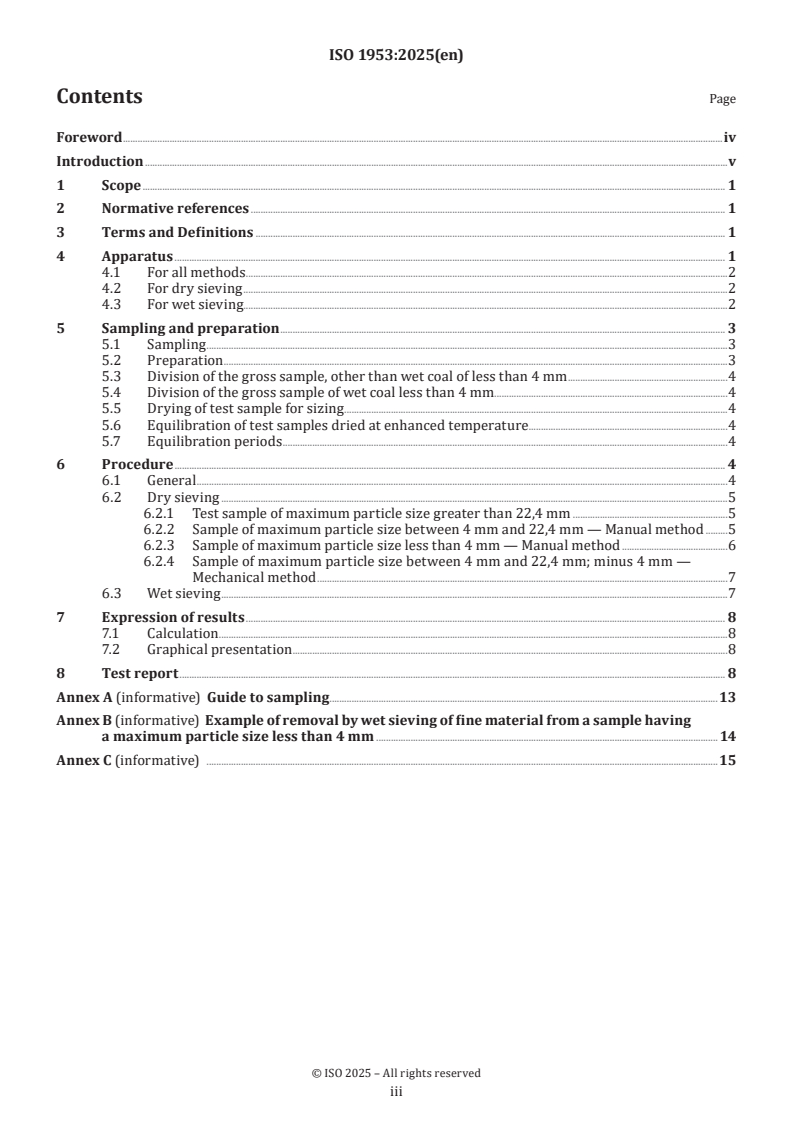
Contents Page
Foreword .iv
Introduction .v
1 Scope . 1
2 Normative references . 1
3 Terms and Definitions . 1
4 Apparatus . 1
4.1 For all methods .2
4.2 For dry sieving .2
4.3 For wet sieving.2
5 Sampling and preparation . 3
5.1 Sampling .3
5.2 Preparation .3
5.3 Division of the gross sample, other than wet coal of less than 4 mm .4
5.4 Division of the gross sample of wet coal less than 4 mm.4
5.5 Drying of test sample for sizing .4
5.6 Equilibration of test samples dried at enhanced temperature.4
5.7 Equilibration periods .4
6 Procedure . 4
6.1 General .4
6.2 Dry sieving .5
6.2.1 Test sample of maximum particle size greater than 22,4 mm .5
6.2.2 Sample of maximum particle size between 4 mm and 22,4 mm — Manual method .5
6.2.3 Sample of maximum particle size less than 4 mm — Manual method .6
6.2.4 Sample of maximum particle size between 4 mm and 22,4 mm; minus 4 mm —
Mechanical method .7
6.3 Wet sieving .7
7 Expression of results . 8
7.1 Calculation .8
7.2 Graphical presentation .8
8 Test report . 8
Annex A (informative) Guide to sampling .13
Annex B (informative) Example of removal by wet sieving of fine material from a sample having
a maximum particle size less than 4 mm . 14
Annex C (informative) .15
iii
Foreword
ISO (the International Organization for Standardization) is a worldwide federation of national standards
bodies (ISO member bodies). The work of preparing International Standards is normally carried out through
ISO technical committees. Each member body interested in a subject for which a technical committee
has been established has the right to be represented on that committee. International organizations,
governmental and non-governmental, in liaison with ISO, also take part in the work. ISO collaborates closely
with the International Electrotechnical Commission (IEC) on all matters of electrotechnical standardization.
The procedures used to develop this document and those intended for its further maintenance are described
in the ISO/IEC Directives, Part 1. In particular, the different approval criteria needed for the different types
of ISO document should be noted. This document was drafted in accordance with the editorial rules of the
ISO/IEC Directives, Part 2 (see www.iso.org/directives).
ISO draws attention to the possibility that the implementation of this document may involve the use of (a)
patent(s). ISO takes no position concerning the evidence, validity or applicability of any claimed patent
rights in respect thereof. As of the date of publication of this document, ISO had not received notice of (a)
patent(s) which may be required to implement this document. However, implementers are cautioned that
this may not represent the latest information, which may be obtained from the patent database available at
www.iso.org/patents. ISO shall not be held responsible for identifying any or all such patent rights.
Any trade name used in this document is information given for the convenience of users and does not
constitute an endorsement.
For an explanation of the voluntary nature of standards, the meaning of ISO specific terms and expressions
related to conformity assessment, as well as information about ISO's adherence to the World Trade
Organization (WTO) principles in the Technical Barriers to Trade (TBT), see www.iso.org/iso/foreword.html.
This document was prepared by Technical Committee ISO/TC 27, Coal and coke, Subcommittee SC 1, Coal
preparation: Terminology and performance.
This fourth edition cancels and replaces the third edition (ISO 1953:2015), which has been technically
revised.
The main changes are as follows:
— size analysis of coal greater than 90 mm was removed from Table 1;
— instructions provided for air drying and equilibrating different coals (examples are high rank coal, low
rank coal and lignite). Advice provided for air drying at enhanced temperatures has also been added;
— additional test report items were included;
— Gy’s formula was not suitable to determine minimum masses for sizing at various nominal top sizes and
for precision calculations in Table 1 and has been removed.
Any feedback or questions on this document should be directed to the user’s national standards body. A
complete listing of these bodies can be found at www.iso.org/members.html.
iv
Introduction
Size analysis involves the separation of a sample of coal into size fractions with defined limits. In the methods
described in this document the results are expressed in terms of the percentage mass of coal remaining
on sieves of different aperture sizes. This information can be of use in several applications, including the
following:
a) determining the size analysis of coals exported and imported internationally;
b) assessing the yields of products from run-of-mine coals;
c) providing design data for coal preparation plants;
d) checking that products from screening plants are within the required limits;
e) assessing the performance of coal-crushing plants;
f) selecting coals for processes and equipment.
v
International Standard ISO 1953:2025(en)
Coal — Size analysis by sieving
1 Scope
This document specifies reference methods for the size analysis of coal by manual sieving (wet or dry), using
test sieves of aperture sizes between 90 mm and 45 μm. A guide to sampling is given in Annex A.
This document is applicable to all coals. It is not applicable to coke.
In the case of pulverized coal which has been ground so that a high proportion passes through the test
sieve of the smallest aperture size, the methods of this document determine only the mass fraction oversize
expressed as a percent.
2 Normative references
The following documents are referred to in the text in such a way that some or all their content constitutes
requirements of this document. For dated references, only the edition cited applies. For undated references,
the latest edition of the referenced document (including any amendments) applies.
ISO 1213-1, Coal and coke — Vocabulary — Part 1: Terms relating to coal preparation
ISO 1213-2, Coal and coke — Vocabulary — Part 2: Terms relating to sampling, testing and analysis
ISO 3310-1, Test sieves — Technical requirements and testing — Part 1: Test sieves of metal wire cloth
ISO 3310-2, Test sieves — Technical requirements and testing — Part 2: Test sieves of perforated metal plate
ISO 13909-2, Coal and coke — Mechanical sampling — Part 2: Sampling of coal from moving streams
ISO 13909-4, Coal and coke — Mechanical sampling — Part 4: Preparation of test samples of coal
ISO 13909-7, Coal and coke — Mechanical sampling — Part 7: Methods for determining the precision of sampling,
sample preparation and testing
ISO 18283, Coal and coke — Manual sampling
3 Terms and Definitions
For the purposes of this document, the terms and definitions given in ISO 1213-1 and ISO 1213-2 apply.
ISO and IEC maintain terminology databases for use in standardization at the following addresses:
— ISO Online browsing platform: available at https:// www .iso .org/ obp
— IEC Electropedia: available at https:// www .electropedia .org/
4 Apparatus
The usual laboratory apparatus and the following shall be used.
4.1 For all methods
Test sieves,
a) shall be exclusively round-holed or exclusively square-holed screens in accordance with ISO 3310-1 or
ISO 3310-2;
b) the recommended series of test sieves for general purposes is 125 mm, 90 mm, 75 mm, 63 mm, 50 mm,
45 mm, 31,5 mm, 22,4 mm, 16 mm, 11,2 mm, 8 mm, 5,6 mm, 4 mm, 2 mm and 1 mm nominal aperture
sizes. With square hold-sieves, each side in mm is the recommended series. With round hole sieves, the
diameter of the sieve in mm is the recommended series. If this series is inadequate for the sizing of
graded coals, sieves from the supplementary sizes 100 mm, 80 mm, 40 mm, 25 mm, 20 mm, 12,5 mm,
10 mm and 6,3 mm may be included;
c) for samples in the range 90 mm × 75 mm, single square-hole or round-hole gauges of the required
dimensions may be used for the larger pieces. Sizes greater than 90 mm are not covered by this
document;
d) test sieves of nominal aperture size 4 mm and less should be of metal wire cloth; the recommended
series of nominal aperture sizes is 4 mm, 2,8 mm, 2 mm, 1,4 mm, 1 mm, 710 μm, 500 μm, 355 μm,
250 μm, 180 μm, 125 μm, 90 μm, 63 μm and 45 μm;
e) when a complete size analysis is required, the mass of coal in any size fraction should not exceed 30 % of
the total mass of sample being sieved, subject to the range of sieve aperture sizes available;
f) the largest aperture size sieve should be that on which not more than 5 % mass fraction of the sample
is retained, and the smallest aperture size sieve should be that through which not more than 5 % mass
fraction of the sample passes;
g) all sieves shall be checked at least once per year by the methods described in ISO 3310-1 and ISO 3310-2,
to ensure that the aperture dimensions are within the specified tolerances. All screens less than 0,5 mm
shall be visually checked for holes before size analysis commences. Worn, holed or damaged sieves can
give rise to serious errors in size analysis and shall be discarded.
Receivers, for collecting material passing through the sieves.
Weighing scale, capable of measuring the mass of the sample sieved by weighing to the nearest 0,1 %.
Trays, smooth, of non-corrodible material, of at least 400 mm × 400 mm, depending on the mass sample and
number of analyses required
Watch- or clock-glasses.
4.2 For dry sieving
Lids, to fit the test sieves.
Flat brush, for cleaning the sieves and for brushing dust from the trays.
Hardwood block, about 150 mm long with a 10 mm × 10 mm cross-section, for tapping the sieves.
Shovel or scoop.
Bump plate thin piece of square steel (5 mm thick) just larger than the dimensions of the scoop to aid
sample collection with a scoop. (Figure C.1)
Vibratory sieve shaker for mechanical sieving.
4.3 For wet sieving
Pressure filter
Buchner funnel and Buchner flask.
Filter paper.
Oven, capable of being controlled to ±5 °C in the range 30 °C to 110 °C.
5 Sampling and preparation
5.1 Sampling
a) the gross sample shall be taken in accordance with ISO 13909-2 or ISO 18283, for both dry and wet sizing;
b) it is recommended that the minimum mass of the gross sample should be at least twice the mass
indicated for the test sample for sizing in Table 1 so that a reserve test sample for sizing is retained;
c) if a coal sample is received from a third party-source for size analysis and the mass of the sample does
not meet the minimum mass for the test sample for sizing in Table 1 then the mass received shall be
clearly indicated on the test report (see Clause 8).
Table 1 — Minimum mass of sample for size analysis
Minimum mass for a preci- Minimum mass for a preci-
Nominal top size of coal
sion of 1 % sion of 2 %
mm kg kg
90 1 500 400
75 950 250
63 500 125
50 280 70
45 200 50
38 130 30
31,5 65 15
22,4 25 6
16,0 8 2
11,2 3 0,70
10,0 2 0,50
8,0 1 0,25
5,6 0,50 0,25
4,0 0,25 0,25
2,8 0,25 0,25
2,0 0,25 0,25
1,0 0,25 0,25
< 0,5 0,25 0,25
NOTE 1 The masses in Table 1 have been calculated based on the precision of the determination of
oversize, i.e. the coal above the nominal top size.
NOTE 2 Sizes and relevant masses greater than 90 mm in Table 1 have been withdrawn in
accordance with ISO 18283.
5.2 Preparation
The gross sample shall be prepared in accordance with ISO 13909-4 or ISO 18283 for both dry and wet
screening. If the coal is wet and dry sieving is to be carried out the gross sample can be divided if its mass
greatly exceeds the value given in Table 1. If the gross sample is to be dried and divided, the division shall be
carried out first whenever practicable.
5.3 Division of the gross sample, other than wet coal of less than 4 mm
Divide the gross sample by means of a suitable mechanical sample divider or riffle avoiding size degradation
and loss of dust to produce a test sample for sizing. Where a suitable mechanical sample divider or riffle is
not available, use either the flattened heap method, or the strip mixing and splitting method described in
ISO 13909-4 and ISO 18283. Determine and record the mass of all the coal not included as part of the test
sample for sizing and retain it until all analyses and calculations are complete.
5.4 Division of the gross sample of wet coal less than 4 mm
Spread the gross sample on a clean flat surface, form it into a cake 15 mm to 25 mm thick and extract a 2 kg
sample by taking not less than 20 increments, evenly spread over the cake, using an appropriate sampling
scoop and bump plate (Figure C.1 shows a diagram of the scoop and bump plate division technique) to
produce a test sample for sizing. If further division is necessary, air-dry the divided sample first, as described
in 5.5 and then proceed as described above in 5.3.
5.5 Drying of test sample for sizing
High rank coal can be air dried either at ambient temperature or at an elevated temperature not exceeding
105 °C. However, if caking or swelling tests are to be carried out subsequently on the sample, the drying
temperature should not exceed 40 °C. Low rank coal and lignite shall be air dried at ambient temperature or
at a maximum of 40 °C. If the coal is of unknown origin, it shall be air dried at ambient temperature or at a
maximum of 40 °C.
5.6 Equilibration of test samples dried at enhanced temperature
All test samples dried at enhanced temperatures (105 °C and 40 °C) shall be equilibrated in the atmosphere
where the size analysis is carried out to allow the moisture in the sample to come to equilibrium.
5.7 Equilibration periods
The time to equilibrate samples after enhanced drying varies with the rank of the coal. Tests can be carried
out to determine what the optimum time is for equilibration of the coals you are handling. However, as a
starting position, the following periods are recommended:
a) high rank coals: 2 to 3 hours;
b) low rank coals: 3 to 5 hours;
c) lignite: 5 to 10 hours.
6 Procedure
6.1 General
The following procedure applies:
a) the size analysis shall be carried out by dry sieving (6.2) or by wet sieving (6.3);
b) dry sieving is suitable for most types of coal, but wet sieving should be used if particles tend to
agglomerate;
c) a combination of wet sieving (to remove fine material) and dry sieving can be appropriate, and an
example is given in Annex B;
d) when sieving coals, wet sieving can produce different results compared to dry screening because the
coals can contain percentages of either clays or shales, or both, which can be soluble in water;
e) the range of sieves used will depend on the type of coal and the purpose of the test. For example, a
complete size analysis may be required for a run-of-mine coal or, in the simplest case, the amount of
undersize in a graded product may be required. If the results are to be presented graphically, the range
of sieves should comprise at least five different aperture
...