

ISO 20579-2:2025
(Main)Surface chemical analysis — Sample handling, preparation and mounting — Part 2: Documenting and reporting the preparation and mounting of specimens for analysis
General Information
- Abstract
This document specifies information to be reported by an analyst in a datasheet, certificate of analysis, report or other publication regarding the handling, preparation, processing and mounting of specimens for surface analysis. Appropriate sample handling with adequate documentation is needed to ensure and assess reliability and reproducibility of analyses. Such information is in addition to other details associated with specimen synthesis, processing history and characterization, and should become part of the data record (sometimes identified as provenance information) regarding the source of the material and changes that have taken place since it was originated. This document also includes normative annexes that summarize important processes and common approaches relevant to sample preparation and mounting for surface analysis. The descriptions of procedures for which records and reporting are required follow the steps that an analyst would follow from receiving the samples, to cleaning or processing outside of the analysis chamber, sample mounting and then treatments in the analysis chamber. The descriptions of the processes and their implications are intended as an aid for the analyst in understanding the reporting requirements for the specialized sample-handling conditions and approaches required for analyses by techniques such as Auger electron spectroscopy (AES), secondary-ion mass spectrometry (SIMS), and X-ray photoelectron spectroscopy (XPS). The methods described are also applicable for other analytical techniques, such as total reflection X-ray fluorescence spectroscopy (TXRF), low energy electron diffraction (LEED), some types of scanning probe microscopy (SPM) including atomic force microscopy (AFM) and scanning tunnelling microscopy (STM), ultra-violet photoelectron spectroscopy (UPS) and medium- and low-energy ion scattering (MEIS and LEIS [also called ion surface scattering, ISS]) that are sensitive to surface composition. This document does not specify the nature of instrumentation, instrument conditions (e.g., calibration or vacuum quality), or operating procedures required to ensure that the analytical measurements described have been appropriately conducted.
- Status
- Published
- Publication Date
- 17-Feb-2025
- Technical Committee
- ISO/TC 201/SC 2 - General procedures
- Drafting Committee
- ISO/TC 201/SC 2 - General procedures
- Current Stage
- 6060 - International Standard published
- Start Date
- 18-Feb-2025
- Due Date
- 17-Feb-2025
- Completion Date
- 18-Feb-2025


Overview
ISO 20579-2:2025 - Surface chemical analysis - Sample handling, preparation and mounting - Part 2: Documenting and reporting the preparation and mounting of specimens for analysis - defines the information that an analyst must record and report about how specimens are handled, prepared, processed and mounted for surface-sensitive analysis. The standard ensures provenance, traceability and reproducibility of surface analysis results by specifying the content of datasheets, certificates of analysis and reports related to sample handling. It forms part of the ISO 20579 series addressing sample history and reporting for surface chemical analysis.
Key topics and technical requirements
- Sample information record (provenance): what to collect or retain about sample origin, identifiers, history, dates and custodial changes.
- Verification of sample documentation: steps an analyst must take on receipt (confirm IDs, analysis objectives, and handling history) and to generate missing information.
- Ex situ and in situ handling: descriptions of required reporting for cleaning, processing performed outside the analysis chamber, and treatments applied inside the chamber (e.g., in situ cleaning).
- Mounting methods: documentation of how specimens are mounted for analysis, including methods that minimize alterations to surface composition.
- Post-analysis handling and storage: information to be retained after measurement to preserve data provenance.
- Normative annexes: Annex A provides approaches, issues and good practices for sample handling and mounting; Annex B summarizes sources of contamination and storage/handling practices.
- Technique applicability: guidance is targeted primarily to AES, XPS and SIMS but is also applicable to TXRF, LEED, SPM (AFM, STM), UPS, MEIS/LEIS (ISS) and other surface-sensitive methods.
- Limitations: ISO 20579-2:2025 does not prescribe instrument settings, calibration procedures, vacuum conditions or operating procedures for analytical measurements.
Practical applications and users
Who benefits:
- Surface analysts and laboratory personnel documenting sample provenance and preparation
- Lab managers, quality assurance and compliance teams needing standardized reporting
- Materials scientists, corrosion engineers, semiconductor and thin-film researchers
- Forensics, failure analysis and contract testing laboratories requiring defensible records
Practical uses:
- Creating standardized datasheets or certificates of analysis that include sample handling history
- Improving reproducibility by recording cleaning, mounting and in‑chamber treatments
- Reducing risk of contamination and misinterpretation by documenting handling steps
- Supporting traceability for regulated sectors, research publications and inter-laboratory comparisons
Related standards
- ISO 20579-1 (sample selection, handling and storage reporting)
- ISO 20579-3 and ISO 20579-4 (parts addressing biomaterials and nanomaterials)
- ISO 18115-1 / ISO 18115-2 (vocabulary for surface chemical analysis)
Keywords: ISO 20579-2:2025, surface chemical analysis, sample handling, sample preparation, specimen mounting, provenance, AES, XPS, SIMS, contamination control, documentation, reporting.
Relations
- Effective Date
- 27-Apr-2024
Get Certified
Connect with accredited certification bodies for this standard

ECOCERT
Organic and sustainability certification.

Eurofins Food Testing Global
Global leader in food, environment, and pharmaceutical product testing.

Intertek Bangladesh
Intertek certification and testing services in Bangladesh.
Sponsored listings
Frequently Asked Questions
ISO 20579-2:2025 is a standard published by the International Organization for Standardization (ISO). Its full title is "Surface chemical analysis — Sample handling, preparation and mounting — Part 2: Documenting and reporting the preparation and mounting of specimens for analysis". This standard covers: This document specifies information to be reported by an analyst in a datasheet, certificate of analysis, report or other publication regarding the handling, preparation, processing and mounting of specimens for surface analysis. Appropriate sample handling with adequate documentation is needed to ensure and assess reliability and reproducibility of analyses. Such information is in addition to other details associated with specimen synthesis, processing history and characterization, and should become part of the data record (sometimes identified as provenance information) regarding the source of the material and changes that have taken place since it was originated. This document also includes normative annexes that summarize important processes and common approaches relevant to sample preparation and mounting for surface analysis. The descriptions of procedures for which records and reporting are required follow the steps that an analyst would follow from receiving the samples, to cleaning or processing outside of the analysis chamber, sample mounting and then treatments in the analysis chamber. The descriptions of the processes and their implications are intended as an aid for the analyst in understanding the reporting requirements for the specialized sample-handling conditions and approaches required for analyses by techniques such as Auger electron spectroscopy (AES), secondary-ion mass spectrometry (SIMS), and X-ray photoelectron spectroscopy (XPS). The methods described are also applicable for other analytical techniques, such as total reflection X-ray fluorescence spectroscopy (TXRF), low energy electron diffraction (LEED), some types of scanning probe microscopy (SPM) including atomic force microscopy (AFM) and scanning tunnelling microscopy (STM), ultra-violet photoelectron spectroscopy (UPS) and medium- and low-energy ion scattering (MEIS and LEIS [also called ion surface scattering, ISS]) that are sensitive to surface composition. This document does not specify the nature of instrumentation, instrument conditions (e.g., calibration or vacuum quality), or operating procedures required to ensure that the analytical measurements described have been appropriately conducted.
This document specifies information to be reported by an analyst in a datasheet, certificate of analysis, report or other publication regarding the handling, preparation, processing and mounting of specimens for surface analysis. Appropriate sample handling with adequate documentation is needed to ensure and assess reliability and reproducibility of analyses. Such information is in addition to other details associated with specimen synthesis, processing history and characterization, and should become part of the data record (sometimes identified as provenance information) regarding the source of the material and changes that have taken place since it was originated. This document also includes normative annexes that summarize important processes and common approaches relevant to sample preparation and mounting for surface analysis. The descriptions of procedures for which records and reporting are required follow the steps that an analyst would follow from receiving the samples, to cleaning or processing outside of the analysis chamber, sample mounting and then treatments in the analysis chamber. The descriptions of the processes and their implications are intended as an aid for the analyst in understanding the reporting requirements for the specialized sample-handling conditions and approaches required for analyses by techniques such as Auger electron spectroscopy (AES), secondary-ion mass spectrometry (SIMS), and X-ray photoelectron spectroscopy (XPS). The methods described are also applicable for other analytical techniques, such as total reflection X-ray fluorescence spectroscopy (TXRF), low energy electron diffraction (LEED), some types of scanning probe microscopy (SPM) including atomic force microscopy (AFM) and scanning tunnelling microscopy (STM), ultra-violet photoelectron spectroscopy (UPS) and medium- and low-energy ion scattering (MEIS and LEIS [also called ion surface scattering, ISS]) that are sensitive to surface composition. This document does not specify the nature of instrumentation, instrument conditions (e.g., calibration or vacuum quality), or operating procedures required to ensure that the analytical measurements described have been appropriately conducted.
ISO 20579-2:2025 is classified under the following ICS (International Classification for Standards) categories: 71.040.40 - Chemical analysis. The ICS classification helps identify the subject area and facilitates finding related standards.
ISO 20579-2:2025 has the following relationships with other standards: It is inter standard links to ISO 18116:2005. Understanding these relationships helps ensure you are using the most current and applicable version of the standard.
ISO 20579-2:2025 is available in PDF format for immediate download after purchase. The document can be added to your cart and obtained through the secure checkout process. Digital delivery ensures instant access to the complete standard document.
Standards Content (Sample)
International
Standard
ISO 20579-2
First edition
Surface chemical analysis —
2025-02
Sample handling, preparation and
mounting —
Part 2:
Documenting and reporting the
preparation and mounting of
specimens for analysis
Analyse chimique des surfaces — Manipulation, préparation et
montage des échantillons —
Partie 2: Documentation et notification des données de
préparation et de montage des échantillons pour analyse
Reference number
© ISO 2025
All rights reserved. Unless otherwise specified, or required in the context of its implementation, no part of this publication may
be reproduced or utilized otherwise in any form or by any means, electronic or mechanical, including photocopying, or posting on
the internet or an intranet, without prior written permission. Permission can be requested from either ISO at the address below
or ISO’s member body in the country of the requester.
ISO copyright office
CP 401 • Ch. de Blandonnet 8
CH-1214 Vernier, Geneva
Phone: +41 22 749 01 11
Email: copyright@iso.org
Website: www.iso.org
Published in Switzerland
ii
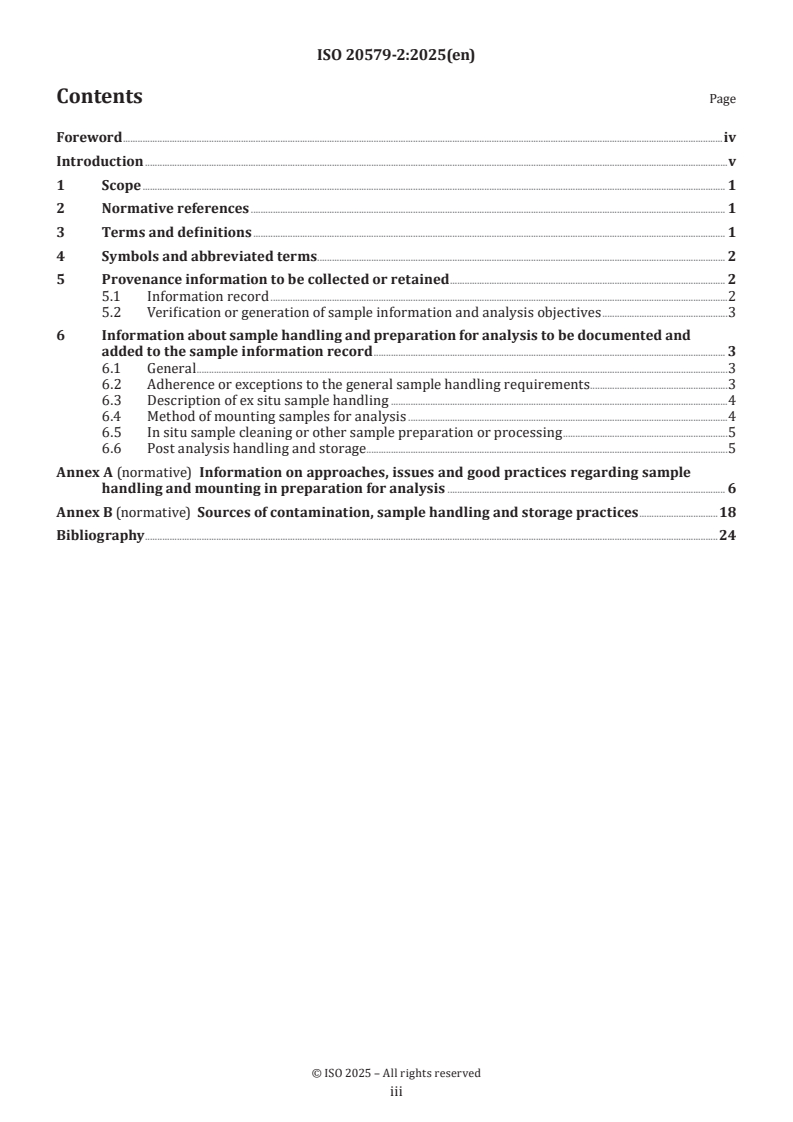
Contents Page
Foreword .iv
Introduction .v
1 Scope . 1
2 Normative references . 1
3 Terms and definitions . 1
4 Symbols and abbreviated terms. 2
5 Provenance information to be collected or retained . 2
5.1 Information record .2
5.2 Verification or generation of sample information and analysis objectives .3
6 Information about sample handling and preparation for analysis to be documented and
added to the sample information record . 3
6.1 General .3
6.2 Adherence or exceptions to the general sample handling requirements.3
6.3 Description of ex situ sample handling .4
6.4 Method of mounting samples for analysis .4
6.5 In situ sample cleaning or other sample preparation or processing .5
6.6 Post analysis handling and storage . .5
Annex A (normative) Information on approaches, issues and good practices regarding sample
handling and mounting in preparation for analysis . 6
Annex B (normative) Sources of contamination, sample handling and storage practices .18
Bibliography .24
iii
Foreword
ISO (the International Organization for Standardization) is a worldwide federation of national standards
bodies (ISO member bodies). The work of preparing International Standards is normally carried out through
ISO technical committees. Each member body interested in a subject for which a technical committee
has been established has the right to be represented on that committee. International organizations,
governmental and non-governmental, in liaison with ISO, also take part in the work. ISO collaborates closely
with the International Electrotechnical Commission (IEC) on all matters of electrotechnical standardization.
The procedures used to develop this document and those intended for its further maintenance are described
in the ISO/IEC Directives, Part 1. In particular, the different approval criteria needed for the different types
of ISO document should be noted. This document was drafted in accordance with the editorial rules of the
ISO/IEC Directives, Part 2 (see www.iso.org/directives).
ISO draws attention to the possibility that the implementation of this document may involve the use of (a)
patent(s). ISO takes no position concerning the evidence, validity or applicability of any claimed patent
rights in respect thereof. As of the date of publication of this document, ISO had not received notice of (a)
patent(s) which may be required to implement this document. However, implementers are cautioned that
this may not represent the latest information, which may be obtained from the patent database available at
www.iso.org/patents. ISO shall not be held responsible for identifying any or all such patent rights.
Any trade name used in this document is information given for the convenience of users and does not
constitute an endorsement.
For an explanation of the voluntary nature of standards, the meaning of ISO specific terms and expressions
related to conformity assessment, as well as information about ISO's adherence to the World Trade
Organization (WTO) principles in the Technical Barriers to Trade (TBT), see www.iso.org/iso/foreword.html.
This document was prepared by Technical Committee TC 201, Surface Chemical Analysis, Subcommittee SC 2,
General Procedures.
This first edition of ISO 20579-2 cancels and replaces ISO 18116:2005, which has been technically revised.
A list of all parts in the ISO 20579 series can be found on the ISO website.
Any feedback or questions on this document should be directed to the user’s national standards body. A
complete listing of these bodies can be found at www.iso.org/members.html.
iv
Introduction
0.1 General introduction to the ISO 20579 series
Because sample preparation and handling can have a significant impact on the physical and chemical
properties of a sample surface, reliable surface analysis depends upon knowing the analysis objective and
knowledge of the sample history including aspects of how the sample has been prepared, stored, processed,
and handled prior to and during analysis. The ISO 20579 series specifies information that is required to
be collected and included as part of the sample history (sample provenance information). The ISO 20579
[2]
series describes information that anyone seeking surface analysis is required to provide to an analyst
and additional information that an analyst is required to include in the sample provenance record regarding
[3]
sample handling, storage, and processing. ISO 20579-1 and ISO 20579-2 describe the information to be
recorded regarding sample selection, handling, and storage. ISO 20579-1 describes information that is
necessary for the sample provenance record and an analyst regarding sample selection and preparation
when requesting surface analysis. ISO 20579-2 indicates information about sample handling, preparation,
mounting and processing to be recorded and reported by the analyst. ISO 20579-3 and ISO 20579-4 focus
[5] [4]
on specific reporting requirements associated with biomaterials and nanomaterials, respectively. Each
part of the ISO 20579 series can be used independently of the other parts, although the general reporting
requirements described in ISO 20579-1 and ISO 20579-2 are applicable to a wide range of materials and are
not reproduced in ISO 20579-3 and ISO 20579-4.
Although primarily prepared for the surface-analysis techniques of Auger-electron spectroscopy (AES),
X-ray photoelectron spectroscopy (XPS) and secondary-ion mass spectrometry (SIMS), the methods
described in this document are also applicable to many other surface-sensitive analytical techniques such
as ion-scattering spectrometry (ISS and including low- and medium-energy scattering LEIS, MEIS), scanning
probe microscopy (SPM), low-energy electron diffraction (LEED) and electron energy-loss spectroscopy
(EELS), where specimen handling can influence surface-sensitive measurements. AES, XPS, and SIMS
are sensitive to surface layers that are typically a few nanometers thick. Such thin layers can be subject
to severe perturbations caused by specimen handling or surface treatments that can be necessary prior
to introduction into the analytical chamber. Proper handling and preparation of specimens is particularly
critical for dependable analysis. Improper handling of specimens can result in alteration of the surface
[6][7]
composition and unreliable data.
0.2 Introduction to ISO 20579-2
This document is intended for the analyst and describes information that is required to be recorded and
reported regarding the sample handling, storage, mounting and other aspects of preparing a sample for
surface analysis. This information becomes part of sample provenance record to help validate the reliability
[8]
and usefulness of data obtained from surface-analysis methods.
Although the categories of necessary reporting are similar for all specimens, the details of the required
sample handling can vary depending on the nature of the sample and analysis objectives. When the outer
surface of a specimen is to be analysed the specimen needs to be handled carefully so that the introduction
of spurious contaminants is avoided or minimized. The goal is to preserve the state of the surface during
preparation and mounting so that the analysis remains representative of the original specimen. In other
cases, sample processing is required to enable access to the surface or interface to be analysed and some
aspects of the sample handling might be less stringent. In all cases, the nature of sample handling and
preparation for the desired analyses need to be recorded and reported.
Normative annexes to this document describe methods that the surface analyst can use to minimize the
effects of specimen preparation when using any surface-sensitive analytical technique. Annexes also
describe methods to mount specimens to ensure that the desired analytical information is not compromised.
Annex A describes approaches, issues, and good practices regarding sample handling in preparation for
analysis. Annex B provides information about sources of contamination, sample handling and storage
requirements for differing analysis objectives.
v
International Standard ISO 20579-2:2025(en)
Surface chemical analysis — Sample handling, preparation
and mounting —
Part 2:
Documenting and reporting the preparation and mounting of
specimens for analysis
1 Scope
This document specifies information to be reported by an analyst in a datasheet, certificate of analysis,
report or other publication regarding the handling, preparation, processing and mounting of specimens for
surface analysis. Appropriate sample handling with adequate documentation is needed to ensure and assess
reliability and reproducibility of analyses. Such information is in addition to other details associated with
specimen synthesis, processing history and characterization, and should become part of the data record
(sometimes identified as provenance information) regarding the source of the material and changes that
have taken place since it was originated.
This document also includes normative annexes that summarize important processes and common
approaches relevant to sample preparation and mounting for surface analysis. The descriptions of
procedures for which records and reporting are required follow the steps that an analyst would follow from
receiving the samples, to cleaning or processing outside of the analysis chamber, sample mounting and then
treatments in the analysis chamber. The descriptions of the processes and their implications are intended
as an aid for the analyst in understanding the reporting requirements for the specialized sample-handling
conditions and approaches required for analyses by techniques such as Auger electron spectroscopy (AES),
secondary-ion mass spectrometry (SIMS), and X-ray photoelectron spectroscopy (XPS). The methods
described are also applicable for other analytical techniques, such as total reflection X-ray fluorescence
spectroscopy (TXRF), low energy electron diffraction (LEED), some types of scanning probe microscopy
(SPM) including atomic force microscopy (AFM) and scanning tunnelling microscopy (STM), ultra-violet
photoelectron spectroscopy (UPS) and medium- and low-energy ion scattering (MEIS and LEIS [also called
ion surface scattering, ISS]) that are sensitive to surface composition.
This document does not specify the nature of instrumentation, instrument conditions (e.g., calibration or
vacuum quality), or operating procedures required to ensure that the analytical measurements described
have been appropriately conducted.
2 Normative references
The following documents are referred to in the text in such a way that some of their content constitutes
requirements of this document. For dated references, only the edition cited applies. For undated references,
the latest edition of the referenced document (including any amendments) applies.
ISO 18115-1, Surface chemical analysis — Vocabulary — Part 1: General terms and terms used in spectroscopy
ISO 18115-2, Surface chemical analysis — Vocabulary — Part 2: Terms used in scanning-probe microscopy
3 Terms and definitions
For the purposes of this document, the terms and definitions given in ISO 18115-1 and ISO 18115-2 apply.
ISO and IEC maintain terminology databases for use in standardization at the following addresses:
— ISO Online browsing platform: available at https:// www .iso .org/ obp
— IEC Electropedia: available at https:// www .electropedia .org/
4 Symbols and abbreviated terms
AES Auger electron spectroscopy
AFM atomic force microscopy
EELS electric energy-loss spectroscopy
ESCA electron spectroscopy for chemical analysis (alternate name for XPS)
FIB focused ion beam
ID Identification
ISS ion-scattering spectroscopy
LEED low-energy electron diffraction
LEIS low energy ion-scattering
MEIS medium energy ion-scattering
PTFE polytetrafluoroethylene
SIMS secondary ion mass spectrometry
SPM scanning probe microscopy
STM scanning tunneling microscopy
TXRF total reflection X-ray fluorescence spectroscopy
UPS ultraviolet photoelectron spectroscopy
XPS X-ray photoelectron spectroscopy
5 Provenance information to be collected or retained
5.1 Information record
Clause 5 deals with a sample information record that includes the relevant sample history, sample handling
requirements, and analysis objectives. This information is usually provided by those requesting analysis. If
it is not provided with the sample, it will need to be created (see 5.2).
Surface analysis is usually undertaken to collect useful information relevant to a sample for a specific reason
at specific stages during the lifetime or history of the material. To assess the reliability and usefulness of the
analysis, it is important to retain as many relevant sample history and handling details that are available to
[8][9][10]
maintain the provenance of the sample and data related to them.
Samples are often provided to an analyst by someone seeking information about one or more samples. Such
samples should arrive with a history and the information described in ISO 20579-1 about the nature of
the sample, the analysis objective, and any special requirements (ISO 20579-1:2024, 5.2), and with unique
sample identifiers (IDs) and information, including dates, about previous handling, storage, and processing
[2]
as relevant to the analysis objectives (ISO 20579-1:2024, 5.3). Information about different types of
analysis objectives and the implications for sample handling are provided in ISO 20579-1:2024, Annex A and
summarized in Annex B of this document. Detailed information records are especially important for nano-
[4]
objects as described in ISO 20579-4:2018, Clauses 4 and 5.
Information that an analyst shall record and add to the information record regarding the further preparation
and handling of samples for surface analysis are described in Clause 6 of this document. This information,
along with data collected becomes part of the information record that provides the history of the physical
and chemical processes used on a sample that would allow assessment and replication of the measurements.
Appropriate information to be retained and passed along with analysis information will vary depending on
the nature and history of the sample and the analysis objectives as described in Clause 6. Dates should be
provided whenever possible throughout the provenance record.
5.2 Verification or generation of sample information and analysis objectives
When an analyst receives one or more specimens, a necessary step is to examine the sample documentation,
or establish it (with the owner) if not provided, including the nature of the sample(s), clear sample IDs, and
appropriate analysis objectives. It is also important to determine if the samples have been handled properly
to enable appropriate surface analysis and if relevant, that information about specific analysis areas or
regions of analysis interest have been identified and documented.
If this information was not provided, the analyst shall assemble as much information as possible to establish
a complete information record and analysis plan that will determine the sample handling and preparation
necessary to obtain the desired information from the sample(s).
A visual inspection (documented) of each sample is important to verify information, sample condition and
identification of any special features or problems such as fingerprints, adhesive, unexpected particles, or
contaminants.
6 Information about sample handling and preparation for analysis to be
documented and added to the sample information record
6.1 General
Information about the following topics shall be recorded and reported as part of the sample information record.
6.2 Adherence or exceptions to the general sample handling requirements
To maintain the stringent cleanliness required for meaningful surface analysis the general sample handling
[7][11]
protocols listed below and in A.1.1 and B.3.2 shall be followed. These generic requirements also appear
in ISO 20579-1, 2024, B.2.2 and B.2.3. Any exceptions or deviations shall be documented. Justification for
these measures and further details are provided in the Annexes of ISO 20579-1 and this document. Annex A
of this document gives some additional details about general considerations for sample handling to minimize
contamination and is summarized here.
Avoid touching the sample surface to be analysed with any material, including tools, hands, and containers,
as well as adventitious contact from gases, liquids, particulates, or outgassing materials near the surface
or present in the environment. If possible, air sensitive samples should be introduced using a glove box or a
transfer vessel and documented in the reporting.
Thoroughly document all cleaning processes. Be extremely careful with any cleaning processes to make
sure they do not alter any aspect of the sample surface important to the analysis objectives (for additional
information see A.3.2). Be very careful to use only clean, pure, non-reactive gases (never blow on the sample
by mouth) and delivery systems (including lines, nozzles, etc.) if required to dust off particulates. Note that
canned air often contains fluorinated propellants which should be avoided.
If smaller samples must be prepared for analysis, thoroughly document any cutting or sectioning procedures,
along with any associated cleaning (see A.3.3 for additional information).
Minimizing contamination also requires using cleaned sample handling tools and fixtures involved in
sample mounting. It is also relevant to consider if volatile or otherwise mobile contaminants (e.g., Zn, Na, F)
from previous samples in the vacuum system or adjacent during sample handling or storage could introduce
contamination be detrimental to the desired analysis.
Example descriptions of exceptions or issues related to general sample handling requirements are given in
EXAMPLES 1 to 3.
EXAMPLE 1 Because of the small sample size, touching the surface to be analysed with a clean mounting tool was
unavoidable.
EXAMPLE 2 Although the analysis chamber and entry system were processed/cleaned between samples, we note
that the most recent samples contained fluorine. Therefore, any fluorine identified on the current sample should be
viewed with caution.
EXAMPLE 3 Carbon tape was used to mask the sample for charge control. The tape was within the sputter area, so
during sputtering, it was redeposited onto the sample surface, resulting in carbon contamination.
6.3 Description of ex situ sample handling
Based on sample information and analysis objectives, the analyst shall determine and report the steps
followed to store or prepare the samples for analysis, including any storage, cutting, sectioning, polishing,
cleaning, or other preparation before insertion into the analysis chamber in accordance with A.3 (for ex situ
handling) and B.3 and B.4 (for handling and storage).
Example descriptions of sample storage and ex situ treatments are given in EXAMPLES 1 to 6.
EXAMPLE 1 As received samples were placed in a desiccator where they were stored for one week before analysis.
EXAMPLE 2 To facilitate AES analysis of the layered structure the sample was polished by angle lapping.
EXAMPLE 3 To minimize sample charge buildup during AES and XPS analysis, the sample was thinned by focused
ion beam milling.
EXAMPLE 4 Section was cut from corroded metal plate using a cleaned hack saw blade. Areas to be analysed were
identified in an optical photograph.
EXAMPLE 5 Metal samples were machined so that they could be fractured in the analysis chamber to determine
grain boundary composition after fracture.
EXAMPLE 6 MgO sample was heated to 800 C in air to remove organic contamination and moisture, and then was
inserted into the intro chamber within 30 seconds, before the surface temperature reached 200 C.
6.4 Method of mounting samples for analysis
The analyst shall report details of the approach to sample mounting, which depend on the sample type, the
instrument, analysis objectives, and the need for any special environmental control or in situ processing in
accordance with A.4.
Example descriptions of sample mounting are given in EXAMPLES 1 to 5.
EXAMPLE 1 Sample was mounted directly onto a specimen holder using a spring clip to ensure good connectivity
to spectrometer ground.
EXAMPLE 2 Potentially insulating sample was mounted for XPS analysis using double sided sticky tape, making
sure the sample was isolated from the specimen holder so that surface potential could be controlled by the charge
neutralization system.
EXAMPLE 3 A portion of the particles of this sample were pressed into indium foil to enable AES analysis of
individual particles.
EXAMPLE 4 A solution of nanoparticles was deposited on a silicon wafer. Multiple deposits were made until the
substrate was covered. It will be tested to determine that no signal arises from the substrate during XPS analysis.
EXAMPLE 5 Liquid sample was deposited on a LN cooled substrate.
6.5 In situ sample cleaning or other sample preparation or processing
The analyst reports details of any in situ cleaning, and other sample preparation and processing of the sample
prior to analysis, including any methods used to expose the region of analysis, in accordance with A.5.
Example descriptions of in situ cleaning and processing are given in EXAMPLES 1 to 6.
EXAMPLE 1 The high vapor pressure sample was degassed by (pre)pumping in the entry chamber (or an auxiliary
vacuum system) before insertion into the main analysis chamber.
+
EXAMPLE 2 The sample was sputter cleaned to remove the thin surface oxide layer using low energy Ar sputtering
(0,5 kV). The sputter time for the sputter conditions would have removed approximately 10 nm of SiO .
EXAMPLE 3 Using a 20 kV focused Ga ion beam in the AES system, a cross section of the sample was created to
enable analysis of the layered structure.
EXAMPLE 4 The sample was scribed inside the system to expose fresh surface for analysis.
EXAMPLE 5 The machined sample was fractured in the liquid nitrogen cooled impact fracture unit to expose grain
boundaries for analysis.
EXAMPLE 6 An argon cluster ion source was used to remove organic contamination from the sample surface before
analysis (Ar at 4 kV). An ion current density of X was applied for 30 seconds (or specify the equivalent sputter
removal of X nm of a reference material such as irganox).
6.6 Post analysis handling and storage
The analyst reports the disposition of samples after analysis, calling attention to any specific handling or
storage of samples potentially relevant to later analysis or use.
Example descriptions of post analysis sample handling or storage are given in EXAMPLES 1 to 4.
EXAMPLE 1 Samples were discarded after analysis.
EXAMPLE 2 Samples were returned to dry box storage.
EXAMPLE 3 Samples were archived at location ABC.
EXAMPLE 4 Samples were transported to lab XYZ for further characterization.
Annex A
(normative)
Information on approaches, issues and good practices regarding
sample handling and mounting in preparation for analysis
A.1 Introduction and overview
Once an analyst knows the nature of the sample, the sample history, and the analysis objectives, it is
necessary to plan the approach to preparing a sample for analysis. This includes an assessment of the samples
as received including a visual inspection of the samples, determination of storage and special handling
requirements, and consideration of other types of analysis requirements (past or future). Depending on the
nature of the samples and sample or instrument requirements the plan can involve storage of the samples
prior to analysis, some type of ex situ treatment of the sample (usually cleaning and sectioning/cutting),
must involve sample mounting for analysis, and there is sometimes the necessity for some type of in-
spectrometer (in situ) processing. Each of these items is discussed in the following sections.
A critical aspect of planning is determining what sample handling or preparation is required to be able to
examine the surface or interface of interest. If the outer surface is of importance, extremely careful sample
handling is required to avoid destroying the information. Often the surface or interface of interest lies
beneath a layer of contaminants or other material. This overlayer might require removal without perturbing
the surface or interface of interest, as covered in A.3 for ex situ methods, and in A.5 for in situ methods.
Even when the outer surface is not the subject of interest and a buried interface will be exposed, it remains
important to minimize processes or handling that add contamination to the sample, such as fingerprints, oils
or most adhesives. Such contamination can spread and contaminate a surface of interest once it is exposed
and be difficult to remove.
Additional information about sample handling, preparation and mounting can be found from multiple
[11]
sources. General information on sample handling is available from Stevie, Garcia et. al., Czanderna,
[12] [6]
Powell and Madey, and Geller. Information about specific types of materials is also available including
[13] [14] [15] [16]
for polymers, Easton et al., for Nanomaterials, Baer and Baer et al. and for GaN, Schaber, et al.
[17]
Information about contamination effects of storage containers is provided by G. Greczynski, L. Hultman
and about contamination spread in UHV conditions (relevant to storage and analysis chambers) by Elio et al.
[18][19]
and Liu et al.
A.1.1 General handing requirements for surface analysis
The degree of cleanliness required by surface-sensitive analytical techniques is much higher than for many
other forms of analysis. Therefore, consideration must be given to sample handling and analysis order (see
A.2.3) when other measurements are necessary. Sources of contamination are discussed in Annex B of this
[2] [20]
document and in ISO 20579-1:2024, Annex A, and in ASTM E-1829.
A simple high-level description of important handling requirements includes 1) specimens and mounts shall
never be in contact with the bare hand and 2) handling of the surface to be analysed should be eliminated
or minimized whenever possible. Fingerprints contain mobile species that can contaminate the surface of
interest. Hand creams, skin oils and other skin materials are not compatible with high vacuum.
Analysis order can impact surface analysis results. In almost all cases, surface analytical measurements
should be performed before use of bulk analysis methods (see A.2.3).
A.2 Assessment and planning
A.2.1 Introduction
It is important to make sure that the goals and objectives for the analysis are clearly specified. Such specific
goals are necessary for determining how samples need to be handled, stored, and processed. For samples
with special handling or storage requirements these goals usually should be specified before the samples
arrive to the analyst, since actions need to be preplanned. Upon receipt, appropriate sample storage and
handling methods shall be implemented to assure that the objectives of the analysis can be achieved.
Samples shall be adequately identified. Are there any special sample handling requirements for storage,
preparation, or analysis? Do samples require storage and, if so, how? What other analyses are required (or
have been completed)?
Special precautions can be necessary for samples that contain or might contain toxins or other hazardous
materials, and safety data sheets (SDSs) should be provided to the analyst for this type of sample.
A.2.2 Visual inspection before and after analysis
Upon receiving samples, it is good practice to conduct a visual inspection, using an optical microscope
as appropriate. At a minimum, a check should be made for residues, particles, fingerprints, adhesives,
contaminants, or other foreign matter. Record the observations in a laboratory notebook; annotated
photographs can be useful.
Specimen features that are visually apparent when the sample is outside the vacuum system might not be
observable after the sample is placed inside the surface-analysis instrument (for example through use of any
available imaging method or through viewports). It can then be necessary to physically mark the specimen
outside the area to be analyzed (e.g., by scribing or by a permanent ink marker) so that the analysis location
can be found once the specimen is inside the vacuum system. Ensure that any method of marking the sample
does not affect the subsequent measurements. Scribing a brittle material can leave unwanted detritus on
the sample that can be deposited in the instrument or that could affect the analysis. Permanent ink markers
can contaminate nearby regions by transport of volatile organics or by surface diffusion of solvent residues.
Changes that can occur during analysis can influence the data interpretation. Following any analysis, visual
examination of the specimen is recommended to look for possible effects of ion-beam sputtering, electron-
beam bombardment, X-ray irradiation, or exposure to the instrumental vacuum. Any changes should be
documented.
A.2.3 Analysis Order
It is preferable for surface chemical analysis measurements to be made before the specimen is analysed by
other techniques because such specimens can become damaged or be exposed to surface contamination. For
example, insulating specimens analysed by electron microscopy are sometimes coated to reduce charging.
Furthermore, exposure of the specimen to an electron beam (e.g., in a scanning electron microscope) can
induce damage or cause the adsorption of surface species from the residual vacuum. Such coatings or
modifications render the specimen unsuitable for subsequent surface chemical analysis. If it is not possible
to perform the surface chemical analysis first, such an analysis should be performed on a different, but
nominally identical, specimen or area of the specimen.
If multiple types of surface analysis are to be used, the order of analysis can have an impact as well. The
preferred order can vary with the analysis question and techniques to be used. ISS is the most surface
sensitive but involves the use of ion beams that can alter the surface over time. XPS is often considered to
be the least damaging and is often done before methods that have greater risk of damage or are inherently
destructive. AES does not remove material, but a focused electron beam can damage the surface. Static SIMS
and SIMS require surface sputtering which can alter or remove information that might be obtained using
XPS or ISS.
[2] [7]
Recommendations for order of analysis are also discussed in ISO 20579-1:2024, Annex B and in Lindfors.
A.2.4 Differences in handling and mounting requirements for AES, XPS, SIMS and other
surface analysis methods
Although the handling methods for AES, XPS, and SIMS are basically similar, there are some differences to
consider in planning measurements. SIMS, for examples is particularly sensitive to silicone contaminants.
[21]
Mounting requirements can differ as well, for example, during XPS analysis of powder or nanomaterial,
the particles are often packed together, but for AES, MEIS and scanning probe microscopy particles must
[14][4][15]
be in a single layer. The preparation of specimens for AES and SIMS requires attention because of
potential problems with electron or ion beam damage or charging, or both. This document will note when
specimen preparation is significantly different among the various techniques.
A.2.5 Sample charging issues
Insulating and mixed phase materials are often subject to surface charging during surface analysis. There
[22][13][23]
are multiple approaches to dealing with sample charging. When preparing an insulating specimen
for analysis important considerations and options can be undertaken in external preparation (ex situ),
during mounting or in the analysis chamber (in situ). Possible approaches to minimize charging include
thinning the sample to lower sample resistance, in situ or ex situ coating of the specimen with a conducting
material (wrapping with a foil or depositing a conducting layer in situ or ex situ), and mounting the sample
isolated from ground. The approach an analyst can take varies with the specimen, the techniques applied
and capabilities associated with the specific instrument.
A.2.6 Storage and transfer prior to analysis
Frequently, it is not possible to immediately analyse sample upon synthesis or receipt. Therefore, part of
measurement planning can include the necessity of storing samples for some time before further processing
or analysis. Depending on the nature of the sample and the required analysis, the means of storage can
vary greatly. Even in ultrahigh vacuum conditions contamination can spread from sample to sample or
[18][19]
from a sample holder to the sample. The same general principles apply in all circumstances: avoid
contamination of the surface to be analyzed, minimize changes to the sample due to environmental
conditions and document all storage and transfer conditions (see B.4).
In some cases, samples can be stored and mounted in laminar flow hoods that minimize surface dust, or in a
dry box, glove box or sealed container.
Some types of samples originate from highly specialized environments and laboratory environmental
exposure would alter the surface chemistry. Such samples can arrive in environmentally sealed containers
and should be transferred into the analysis system without atmospheric exposure. Glove boxes connected to
spectrometers or anaerobic transfer containers are often used for such samples.
Specimen transfer from an external environment to a spectrometer might take a few forms depending on
the sample type. Anaerobic transfer is briefly discussed in A.2.6.4. Issues of transfer of gassy, viscous, or
liquid samples are discussed in relation to sample mounting in A.4.6.
A.2.6.1 Storage time
If a specimen is stored before analysis, care should be taken to ensure that the surface to be analyzed has
not been contaminated during storage. Even in clean laboratory environments, surfaces can quickly become
contaminated to the depth analyzed by AES, XPS, SIMS, and other surface-sensitive analytical techniques.
[19]
For example, Liu et al. discuss the evolution of surface contamination in ultra-high vacuum.
A.2.6.2 Storage containers
Containers selected for specimen storage should not transfer contaminants to the specimen via particles,
liquids, gases, or surface diffusion. Containers that contain volatile species such as plasticizers (which can
be emitted and then contaminate the sample surface) are unsuitable. The specimen surface to be analyzed
should preferably not contact the container or any other object. Glass jars should be chosen with an
appropriate diameter and height relative to the size of a specimen to constrain/hold the specimen without
glass in contact with the surface to be analyzed. Further details about storage containers are given by G.
[17]
Greczynski and L. Hultman and in B.4 and Table B.1.
When contact with the surface is unavoidable, wrapping in clean, pre-analysed aluminium foil can be
satisfactory. Containers such as glove boxes, vacuum chambers, and desiccators are sometimes excellent
choices for storage of specimens. A vacuum desiccator can often be preferable to a normal desiccator and
shall be maintained free of grease and mechanical-pump oil.
NOTE Cross-contamination between specimens can occur if multiple specimens are stored in the same container.
A.2.6.3 Temperature and humidity
Possible temperature and humidity effects should be considered when storing or transferring specimens.
Most detrimental effects result from elevated temperatures. Additionally, low specimen temperatures and
high to moderate humidity can lead to moisture condensation on the surface.
A.2.6.4 Specimen transfer
Specially designed chambers that allow transfer of specimens from a controlled environment to a surface
[24]
analysis chamber have been reported and commercial transfer vessels are available for some systems.
[25][11]
The controlled environment could be another vacuum chamber, a glove box (dry box), a glove bag, a
reaction chamber, or a deposition chamber. This controlled environment chamber can be attached directly
to the analytical chamber with the transfer made through a permanent valve. Glove bags can be temporarily
attached to an analytical chamber with the specimen transferred by removal and then replacement of a
flange on the analytical chamber. Increasingly XPS and other surface analysis systems have entry systems
connected to glove boxes that allow samples to be handled and mounted in anaerobic environments just
prior to entry into a spectrometer.
Coatings can sometimes be applied to specimens, thereby allowing transfer in the atmosphere. The coating
is then removed by heating or by vacuum pumping in either the analytical chamber or its introduction
[26]
chamber. This concept has been successfully applied to the transfer of GaAs. Surfaces to be analyzed by
[27]
AES or SIMS can be covered with a uniform layer, such as polysilicon for silicon-based technology. In this
case, the coating is removed by sputtering during analysis; however, the influence of atomic mixing on the
analytical results needs to be considered.
The transfer of gassy, viscous or liquid samples into a spectrometer is discussed in A.4.6.
A.3 Ex situ sample handling (e.g. cleaning, cutting/sectioning, polishing, or exposing
the region of interest before insertion into the analysis chamber)
A.3.1 Introduction and overview
All samples are handled in some way in preparation for analysis and the nature of handling often impacts the
ability to obtain the desired information. As noted above, the guiding rule is do not touch or alter the surface
to be analysed to the extent possible or appropriate based on the analysis objective. Often it is possible to
simply insert a specimen into the analyser for analysis. However, there can be several reasons for which
some type of processing of the sample is needed before it can be mounted for useful analysis. These include:
a) removing a contamination layer from the surface,
b) the need to alter the size or shape of a sample to allow the region of interest to fit in the spectrometer or
become available for analysis,
c) exposing the region or interface of interest for the analysis,
d) optimizing the sample for analysis – such as thinning or coating an insulating sample for analysis to
minimize charging.
In many situations, ex situ work is required to prepare the sample for mounting and sometimes to enable in
situ processing to get to the region of interest. Therefore, in many cases, ex situ processing is necessarily a
prelude to additional in situ processing.
A.3.2 Sample cleaning techniques
High-purity solvents can be used to remove soluble contaminants or overlayers that are not of interest.
Ethanol (pure, not denatured), isopropanol, and acetone are the most used solvents, and are often used in
conjunction with ultrasonic agitation. A residue from the solvent might, however, remain on the specimen,
and acetone is hygroscopic and can lea
...