

ISO 19887-1:2024
(Main)Gaseous Hydrogen — Fuel system components for hydrogen-fuelled vehicles — Part 1: Land vehicles
General Information
- Abstract
This document establishes requirements for newly produced compressed hydrogen gas fuel system components, as listed below, that are intended for use on hydrogen gas powered land vehicles: a) check valves (see Clause 8); b) manual valves (see Clause 9); c) manual container valves (see Clause 10); d) automatic valves and automatic container valves (see Clause 11); e) hydrogen injectors (see Clause 12); f) pressure sensors, temperature sensors, and pressure gauges (see Clause 13); g) pressure regulators (see Clause 14); h) pressure relief valves (PRV) (see Clause 15); i) pressure relief devices (PRD) (see Clause 16, and refer to ISO 19882); j) excess flow valves (see Clause 17); k) gastight housing and leakage capture passages (see Clause 18); l) rigid fuel lines (see Clause 19); m) flexible fuel lines, hoses, and hose assemblies (see Clause 20); n) filter assemblies (see Clause 21); o) fittings (see Clause 22); p) non-metallic, low-pressure rigid fuel lines (see Clause 23); q) discharge line closures (see Clause 24). NOTE Other components not specifically identified here can be examined to meet the criteria of ISO 19887-1 and tested according to the appropriate functional needs. This document applies to components that have a nominal working pressure, as specified by the manufacturer, of 25 MPa, 35 MPa, 50 MPa, or 70 MPa at 15 °C, referred to in this document as the following pressure classes: a) “H25” – 25 MPa; b) “H35” – 35 MPa; c) “H50” – 50 MPa; and d) “H70” – 70 MPa. Other nominal working pressures for hydrogen gas besides those defined can be used if the qualification test requirements of this document are met. This document also applies to components downstream of the first stage of pressure reduction with a maximum operating pressure designated by the manufacturer in MPa or kPa. This document does not apply to the following: a) hydrogen gas fuel system components incorporated during the manufacture of motor vehicles originally manufactured in compliance with the international regulations on hydrogen and fuel cell vehicles, such as UN GTR No. 13, UN Regulation No. 134, UN Regulation No. 146, or IEC 62282-4-101; b) fuel containers; c) stationary power generation applications; d) container mounting hardware; e) electronic fuel management; f) refuelling receptacles; or g) components intended for liquid hydrogen.
- Status
- Published
- Publication Date
- 14-Oct-2024
- Technical Committee
- ISO/TC 197 - Hydrogen technologies
- Drafting Committee
- ISO/TC 197 - Hydrogen technologies
- Current Stage
- 6060 - International Standard published
- Start Date
- 15-Oct-2024
- Due Date
- 23-Jul-2024
- Completion Date
- 15-Oct-2024

Overview
ISO 19887-1:2024 - Gaseous Hydrogen: Fuel system components for hydrogen‑fuelled land vehicles defines safety, design, testing and qualification requirements for newly produced compressed hydrogen gas fuel system components intended for land vehicles. The standard covers a comprehensive list of components (valves, injectors, sensors, lines, regulators, PRVs/PRDs, filters, fittings, housings, closures) and applies to components with nominal working pressures typically defined as H25, H35, H50, H70 (25, 35, 50, 70 MPa at 15 °C). ISO 19887-1:2024 focuses on compressed gaseous hydrogen systems (not liquid hydrogen) and excludes fuel containers, refuelling receptacles, vehicle-integrated components already covered by specific vehicle regulations, and stationary power applications.
Keywords: ISO 19887-1:2024, gaseous hydrogen, hydrogen fuel system components, hydrogen safety standards, H70, hydrogen vehicles.
Key Topics and Technical Requirements
- Component scope - check valves, manual and automatic valves (including container valves), hydrogen injectors, pressure regulators, pressure relief valves (PRV) and devices (PRD), excess flow valves, sensors, fittings, rigid and flexible fuel lines, filter assemblies, gastight housings, discharge closures.
- Pressure classes - nominal working pressure classes H25, H35, H50, H70; other pressures permitted if test requirements are met.
- Design & materials - requirements for intended use, materials selection, threaded openings, service temperatures and declared design service life.
- Risk management - Failure Modes and Effects Analysis (FMEA) and consideration of electrical equipment and connectors.
- Marking & documentation - mandatory marking, installation and component literature requirements.
- Testing & qualification - general test methods including hydrostatic strength, leakage (internal/external), excess torque and bending resistance, continuous operation, corrosion (salt spray, cyclic), UV and atmospheric exposure, automotive fluid exposure, vibration, stress corrosion cracking, hydrogen compatibility for non‑metallics, insulation and pre‑cooled hydrogen exposure.
- Quality assurance & production inspection - production inspection plans, system‑critical component inspection and external leak testing.
Practical Applications
- Ensures safe, reliable design and qualification of compressed gaseous hydrogen fuel system components for fuel cell and hydrogen internal combustion land vehicles.
- Guides design validation, supplier qualification, type testing and production acceptance testing.
- Used by component manufacturers, OEMs, test laboratories, certification bodies and procurement teams to demonstrate compliance with hydrogen safety and performance expectations.
Who should use this standard
- Hydrogen fuel system component manufacturers and suppliers
- Automotive OEM engineers and integration teams
- Test laboratories and certification bodies
- Regulatory and compliance specialists in alternative‑fuel vehicles
- Procurement and quality assurance professionals sourcing hydrogen components
Related Standards
- ISO 19882 (referenced for PRD requirements)
- UN GTR No. 13, UN Regulation No. 134, UN Regulation No. 146 (vehicle‑level regulations)
- IEC 62282‑4‑101 (fuel cell vehicle interfaces)
For anyone working on compressed gaseous hydrogen systems for land vehicles, ISO 19887-1:2024 is a core reference for component safety, testing and certification.
Get Certified
Connect with accredited certification bodies for this standard

DNV
DNV is an independent assurance and risk management provider.

TÜV Rheinland
TÜV Rheinland is a leading international provider of technical services.

TÜV SÜD
TÜV SÜD is a trusted partner of choice for safety, security and sustainability solutions.
Sponsored listings
Frequently Asked Questions
ISO 19887-1:2024 is a standard published by the International Organization for Standardization (ISO). Its full title is "Gaseous Hydrogen — Fuel system components for hydrogen-fuelled vehicles — Part 1: Land vehicles". This standard covers: This document establishes requirements for newly produced compressed hydrogen gas fuel system components, as listed below, that are intended for use on hydrogen gas powered land vehicles: a) check valves (see Clause 8); b) manual valves (see Clause 9); c) manual container valves (see Clause 10); d) automatic valves and automatic container valves (see Clause 11); e) hydrogen injectors (see Clause 12); f) pressure sensors, temperature sensors, and pressure gauges (see Clause 13); g) pressure regulators (see Clause 14); h) pressure relief valves (PRV) (see Clause 15); i) pressure relief devices (PRD) (see Clause 16, and refer to ISO 19882); j) excess flow valves (see Clause 17); k) gastight housing and leakage capture passages (see Clause 18); l) rigid fuel lines (see Clause 19); m) flexible fuel lines, hoses, and hose assemblies (see Clause 20); n) filter assemblies (see Clause 21); o) fittings (see Clause 22); p) non-metallic, low-pressure rigid fuel lines (see Clause 23); q) discharge line closures (see Clause 24). NOTE Other components not specifically identified here can be examined to meet the criteria of ISO 19887-1 and tested according to the appropriate functional needs. This document applies to components that have a nominal working pressure, as specified by the manufacturer, of 25 MPa, 35 MPa, 50 MPa, or 70 MPa at 15 °C, referred to in this document as the following pressure classes: a) “H25” – 25 MPa; b) “H35” – 35 MPa; c) “H50” – 50 MPa; and d) “H70” – 70 MPa. Other nominal working pressures for hydrogen gas besides those defined can be used if the qualification test requirements of this document are met. This document also applies to components downstream of the first stage of pressure reduction with a maximum operating pressure designated by the manufacturer in MPa or kPa. This document does not apply to the following: a) hydrogen gas fuel system components incorporated during the manufacture of motor vehicles originally manufactured in compliance with the international regulations on hydrogen and fuel cell vehicles, such as UN GTR No. 13, UN Regulation No. 134, UN Regulation No. 146, or IEC 62282-4-101; b) fuel containers; c) stationary power generation applications; d) container mounting hardware; e) electronic fuel management; f) refuelling receptacles; or g) components intended for liquid hydrogen.
This document establishes requirements for newly produced compressed hydrogen gas fuel system components, as listed below, that are intended for use on hydrogen gas powered land vehicles: a) check valves (see Clause 8); b) manual valves (see Clause 9); c) manual container valves (see Clause 10); d) automatic valves and automatic container valves (see Clause 11); e) hydrogen injectors (see Clause 12); f) pressure sensors, temperature sensors, and pressure gauges (see Clause 13); g) pressure regulators (see Clause 14); h) pressure relief valves (PRV) (see Clause 15); i) pressure relief devices (PRD) (see Clause 16, and refer to ISO 19882); j) excess flow valves (see Clause 17); k) gastight housing and leakage capture passages (see Clause 18); l) rigid fuel lines (see Clause 19); m) flexible fuel lines, hoses, and hose assemblies (see Clause 20); n) filter assemblies (see Clause 21); o) fittings (see Clause 22); p) non-metallic, low-pressure rigid fuel lines (see Clause 23); q) discharge line closures (see Clause 24). NOTE Other components not specifically identified here can be examined to meet the criteria of ISO 19887-1 and tested according to the appropriate functional needs. This document applies to components that have a nominal working pressure, as specified by the manufacturer, of 25 MPa, 35 MPa, 50 MPa, or 70 MPa at 15 °C, referred to in this document as the following pressure classes: a) “H25” – 25 MPa; b) “H35” – 35 MPa; c) “H50” – 50 MPa; and d) “H70” – 70 MPa. Other nominal working pressures for hydrogen gas besides those defined can be used if the qualification test requirements of this document are met. This document also applies to components downstream of the first stage of pressure reduction with a maximum operating pressure designated by the manufacturer in MPa or kPa. This document does not apply to the following: a) hydrogen gas fuel system components incorporated during the manufacture of motor vehicles originally manufactured in compliance with the international regulations on hydrogen and fuel cell vehicles, such as UN GTR No. 13, UN Regulation No. 134, UN Regulation No. 146, or IEC 62282-4-101; b) fuel containers; c) stationary power generation applications; d) container mounting hardware; e) electronic fuel management; f) refuelling receptacles; or g) components intended for liquid hydrogen.
ISO 19887-1:2024 is classified under the following ICS (International Classification for Standards) categories: 27.075 - Hydrogen technologies; 43.060.40 - Fuel systems. The ICS classification helps identify the subject area and facilitates finding related standards.
ISO 19887-1:2024 is available in PDF format for immediate download after purchase. The document can be added to your cart and obtained through the secure checkout process. Digital delivery ensures instant access to the complete standard document.
Standards Content (Sample)
International
Standard
ISO 19887-1
First edition
Gaseous Hydrogen — Fuel system
2024-10
components for hydrogen-fuelled
vehicles —
Part 1:
Land vehicles
Reference number
© ISO 2024
All rights reserved. Unless otherwise specified, or required in the context of its implementation, no part of this publication may
be reproduced or utilized otherwise in any form or by any means, electronic or mechanical, including photocopying, or posting on
the internet or an intranet, without prior written permission. Permission can be requested from either ISO at the address below
or ISO’s member body in the country of the requester.
ISO copyright office
CP 401 • Ch. de Blandonnet 8
CH-1214 Vernier, Geneva
Phone: +41 22 749 01 11
Email: copyright@iso.org
Website: www.iso.org
Published in Switzerland
ii
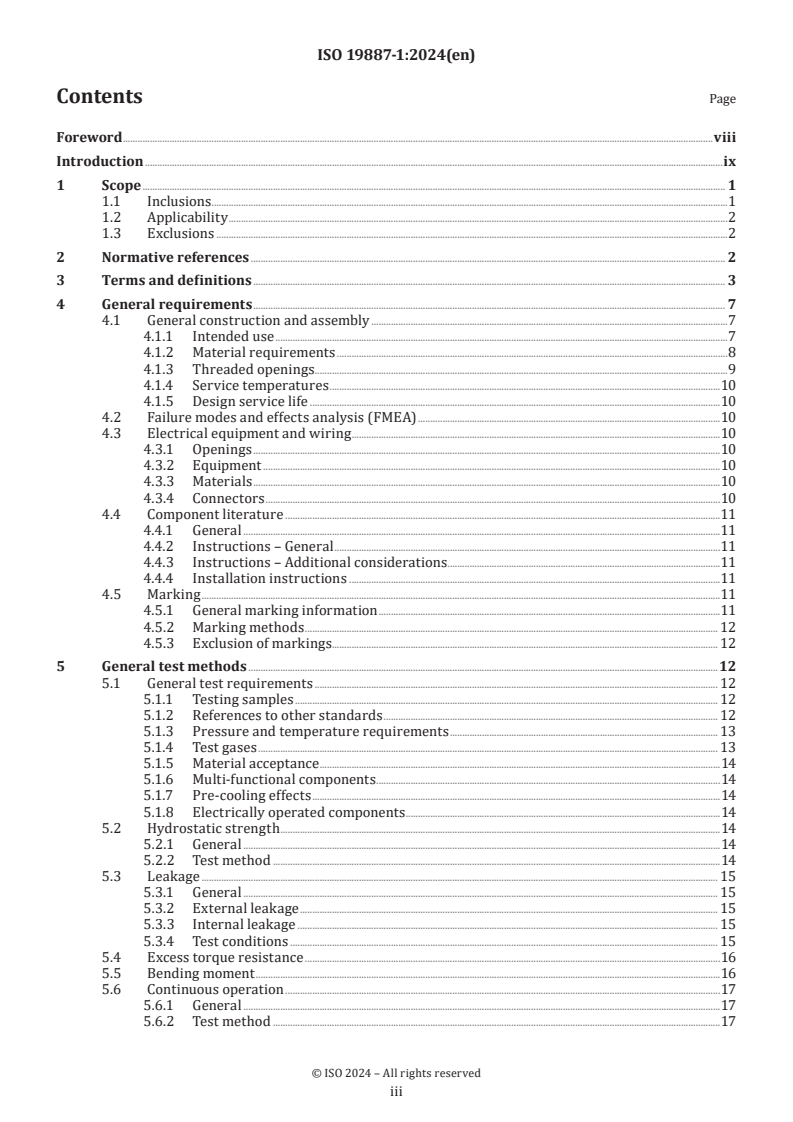
Contents Page
Foreword .viii
Introduction .ix
1 Scope . 1
1.1 Inclusions.1
1.2 Applicability .2
1.3 Exclusions .2
2 Normative references . 2
3 Terms and definitions . 3
4 General requirements . 7
4.1 General construction and assembly .7
4.1.1 Intended use .7
4.1.2 Material requirements .8
4.1.3 Threaded openings.9
4.1.4 Service temperatures .10
4.1.5 Design service life .10
4.2 Failure modes and effects analysis (FMEA) .10
4.3 Electrical equipment and wiring .10
4.3.1 Openings .10
4.3.2 Equipment .10
4.3.3 Materials .10
4.3.4 Connectors .10
4.4 Component literature .11
4.4.1 General .11
4.4.2 Instructions – General .11
4.4.3 Instructions – Additional considerations .11
4.4.4 Installation instructions .11
4.5 Marking .11
4.5.1 General marking information .11
4.5.2 Marking methods . 12
4.5.3 Exclusion of markings. 12
5 General test methods .12
5.1 General test requirements . 12
5.1.1 Testing samples . 12
5.1.2 References to other standards . 12
5.1.3 Pressure and temperature requirements . 13
5.1.4 Test gases . 13
5.1.5 Material acceptance .14
5.1.6 Multi-functional components .14
5.1.7 Pre-cooling effects .14
5.1.8 Electrically operated components .14
5.2 Hydrostatic strength .14
5.2.1 General .14
5.2.2 Test method .14
5.3 Leakage . 15
5.3.1 General . 15
5.3.2 External leakage . 15
5.3.3 Internal leakage . 15
5.3.4 Test conditions . 15
5.4 Excess torque resistance .16
5.5 Bending moment .16
5.6 Continuous operation .17
5.6.1 General .17
5.6.2 Test method .17
iii
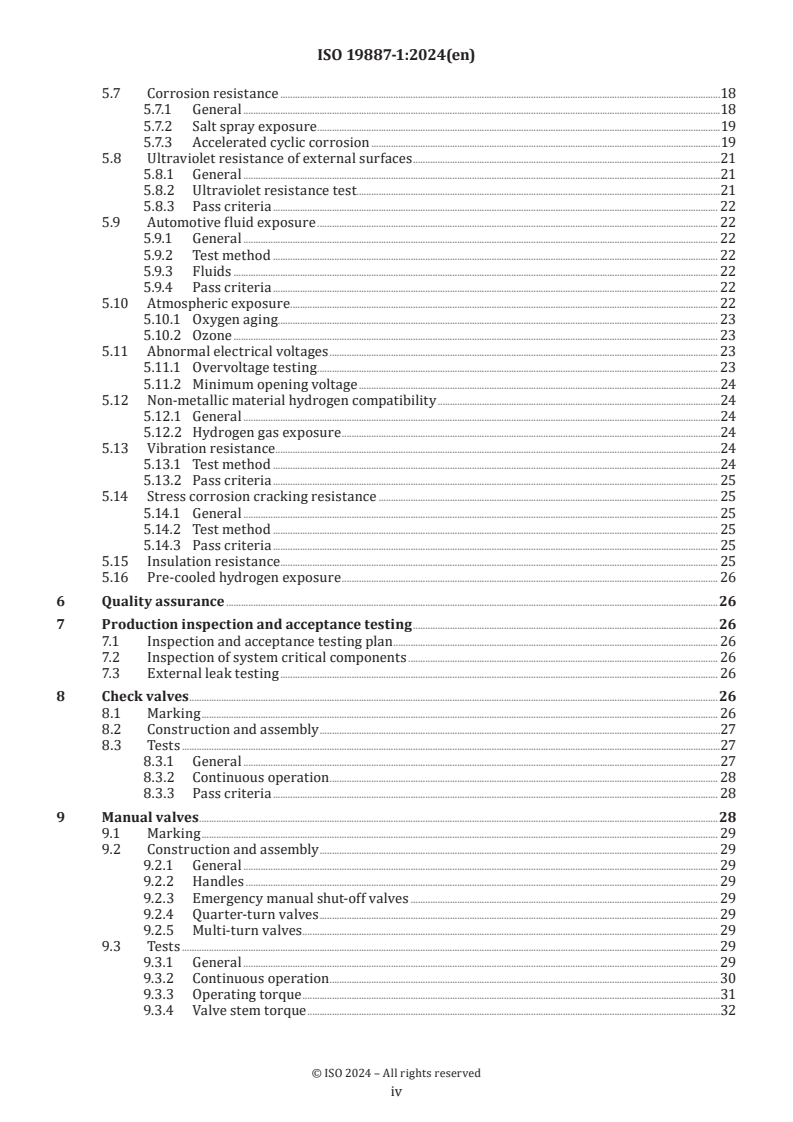
5.7 Corrosion resistance .18
5.7.1 General .18
5.7.2 Salt spray exposure .19
5.7.3 Accelerated cyclic corrosion .19
5.8 Ultraviolet resistance of external surfaces .21
5.8.1 General .21
5.8.2 Ultraviolet resistance test.21
5.8.3 Pass criteria . 22
5.9 Automotive fluid exposure . 22
5.9.1 General . 22
5.9.2 Test method . 22
5.9.3 Fluids . 22
5.9.4 Pass criteria . 22
5.10 Atmospheric exposure . . 22
5.10.1 Oxygen aging. 23
5.10.2 Ozone . 23
5.11 Abnormal electrical voltages . 23
5.11.1 Overvoltage testing . 23
5.11.2 Minimum opening voltage .24
5.12 Non-metallic material hydrogen compatibility .24
5.12.1 General .24
5.12.2 Hydrogen gas exposure .24
5.13 Vibration resistance . .24
5.13.1 Test method .24
5.13.2 Pass criteria . 25
5.14 Stress corrosion cracking resistance . 25
5.14.1 General . 25
5.14.2 Test method . 25
5.14.3 Pass criteria . 25
5.15 Insulation resistance. 25
5.16 Pre-cooled hydrogen exposure . 26
6 Quality assurance .26
7 Production inspection and acceptance testing .26
7.1 Inspection and acceptance testing plan . 26
7.2 Inspection of system critical components . 26
7.3 External leak testing . 26
8 Check valves .26
8.1 Marking . 26
8.2 Construction and assembly .27
8.3 Tests .27
8.3.1 General .27
8.3.2 Continuous operation . 28
8.3.3 Pass criteria . 28
9 Manual valves .28
9.1 Marking . 29
9.2 Construction and assembly . 29
9.2.1 General . 29
9.2.2 Handles . 29
9.2.3 Emergency manual shut-off valves . 29
9.2.4 Quarter-turn valves . 29
9.2.5 Multi-turn valves . 29
9.3 Tests . 29
9.3.1 General . 29
9.3.2 Continuous operation . 30
9.3.3 Operating torque .31
9.3.4 Valve stem torque .32
iv
10 Manual container valves .32
10.1 Marking .32
10.2 Construction and assembly .32
10.2.1 General .32
10.2.2 Handle .32
10.2.3 Quarter-turn valves . 33
10.2.4 Multi-turn valves . 33
10.2.5 Internal excess flow valve . 33
10.3 Tests . 33
10.3.1 General . 33
10.3.2 Continuous operation . 33
10.3.3 Operating torque . 34
10.3.4 Valve stem torque . 34
11 Automatic valves and automatic container valves .35
11.1 Marking . 35
11.2 Construction and assembly . 35
11.2.1 General . 35
11.2.2 De-energized position . 35
11.2.3 Shut-off valve failure position . 35
11.2.4 Internal excess flow valve . 35
11.3 Tests . 35
11.3.1 General . 35
11.3.2 Continuous operation . 36
11.3.3 Automatic valve manual override torque .37
12 Hydrogen injectors .37
12.1 Marking .37
12.2 Construction and assembly . 38
12.2.1 General . 38
12.2.2 De-energized position . 38
12.3 Tests . 38
12.3.1 General . 38
12.3.2 Continuous operation . 38
12.3.3 Insulation resistance . 39
12.3.4 Pneumatic strength . 39
12.3.5 Extreme temperature cycling . 39
13 Pressure sensors, temperature sensors, and pressure gauges .40
13.1 Marking . 40
13.2 Construction and assembly .41
13.2.1 General .41
13.2.2 Pressure gauge lens .41
13.3 Tests .41
13.3.1 General .41
13.3.2 Continuous operation .41
13.3.3 Abnormal electrical voltages.42
13.3.4 Insulation resistance .43
14 Pressure regulators . .43
14.1 Marking .43
14.2 Construction and assembly .43
14.2.1 General .43
14.2.2 Nominal outlet pressure .43
14.2.3 Pressure regulator PRV .43
14.3 Tests .43
14.3.1 General .43
14.3.2 Hydrostatic strength . 44
14.3.3 Leakage .45
14.3.4 Continuous operation .45
14.3.5 Pressure impulse .45
v
14.3.6 Pressure chamber – PRV operation . 46
15 Pressure relief valves .46
15.1 Marking . 46
15.2 Construction and assembly . 46
15.2.1 General . 46
15.2.2 Venting . . 46
15.2.3 Inspection and acceptance testing . 46
15.3 Tests . 46
15.3.1 General . 46
15.3.2 Hydrostatic strength .47
15.3.3 Leakage .47
15.3.4 Continuous operation .47
15.3.5 Opening and reseating characteristics. 48
16 Pressure relief devices .48
17 Excess flow valves . .48
17.1 Marking . 48
17.2 Construction and assembly . 49
17.3 Tests . 49
17.3.1 General . 49
17.3.2 Continuous operation . 49
17.3.3 Bypass flow . 49
18 Gastight housing and leakage capture passages .50
18.1 Marking . 50
18.2 Construction and assembly . 50
18.2.1 General . 50
18.2.2 Inspection and acceptance testing . 50
18.3 Tests . 50
18.3.1 General . 50
18.3.2 Leakage .51
18.3.3 Venting ability and pressure retention .51
18.3.4 Pull-off .52
19 Rigid fuel lines .52
19.1 Marking .52
19.2 Construction and assembly .52
19.3 Tests .52
19.3.1 General .52
19.3.2 Continuous operation . 53
19.3.3 Bending . 53
20 Flexible fuel lines, hoses, and hose assemblies .53
20.1 Markings . 54
20.1.1 General . 54
20.1.2 Bulk hoses. 54
20.1.3 Hose assemblies . 54
20.1.4 Marking surfaces . . 55
20.1.5 Date code . 55
20.2 Construction, assembly, and installation instructions . 55
20.2.1 General . 55
20.2.2 Linings . 55
20.2.3 Hose cover .
...