

ISO/TS 22726-2:2025
(Main)Intelligent transport systems — Dynamic data and map database specification for connected and automated driving system applications — Part 2: Logical data model of dynamic data
General Information
- Abstract
This document specifies a unified logical data model based on available existing dynamic information standards. The data has precise relative location references to be linked with ISO/TS 22726-1 which specifies the architecture and the logical data model of static map data for connected and automated driving applications. Dynamic event data comes from external systems and has been defined and specified independently by existing standards. Therefore, the logical data model in this document is formed to synthesize contents referring to other standards.
- Status
- Published
- Publication Date
- 26-Feb-2025
- Technical Committee
- ISO/TC 204 - Intelligent transport systems
- Drafting Committee
- ISO/TC 204/WG 3 - ITS geographic data
- Current Stage
- 6060 - International Standard published
- Start Date
- 27-Feb-2025
- Due Date
- 01-Nov-2024
- Completion Date
- 27-Feb-2025
Buy Documents

ISO/TS 22726-2:2025 - Intelligent transport systems — Dynamic data and map database specification for connected and automated driving system applications — Part 2: Logical data model of dynamic data Released:27. 02. 2025
Overview
ISO/TS 22726-2:2025 is a Technical Specification from ISO for intelligent transport systems (ITS) that defines a unified logical data model of dynamic data used in map databases for connected and automated driving applications. Published as Part 2 of the ISO/TS 22726 series (first edition, 2025), the document synthesizes and harmonizes dynamic event information defined by existing dynamic information standards and provides precise relative location referencing to be linked with ISO/TS 22726-1 (the static map architecture and logical model).
Key topics and requirements
- Unified logical data model: A generic schema that maps classes from multiple existing dynamic information standards into a common representation suitable for CAV (connected and automated vehicle) systems.
- Location referencing: Precise relative location references to align dynamic data with static map content defined in ISO/TS 22726-1.
- Modelling and conformance: Guidance on modelling approaches, mapping between standards’ classes, and conformance criteria for implementers.
- Package-based data content: Detailed logical definitions across multiple packages such as:
- DynamicInformationDataSet, Common, CodeLists
- DataManagement, DataQuality, DataTypes
- LocationReference, AreaLocation, LinearLocation, PointLocation
- SituationDataset, OperatorAction, Parking, SPaT, TrafficElement, Obstruction
- Data quality and management: Structures for expressing data provenance, update management and quality indicators relevant to dynamic event feeds.
- Traceability and use cases: Informative annexes provide traceability matrices and location-referencing use cases to support implementation.
Practical applications
ISO/TS 22726-2:2025 is intended to be used where dynamic road and traffic information must be integrated with map databases for real-time or near-real-time automated driving functions:
- OEMs and Tier‑1 suppliers: to standardize how sensor feeds, V2X messages and traffic event data are represented and consumed by AD/ADAS systems.
- Map data providers and integrators: to convert heterogeneous dynamic event feeds into a consistent logical model aligned with static map layers.
- Traffic management centers and mobility service providers: for interoperable exchange of SPaT, obstruction, parking and traffic element information.
- Software developers and system architects: to design APIs, databases and message translators that adhere to a common dynamic data model.
Related standards
- ISO/TS 22726-1 - Architecture and logical data model of static map data for connected and automated driving.
- Other domain-specific and regional dynamic information standards and V2X profiles (mapped into the unified model in this specification).
Keywords: ISO/TS 22726-2:2025, intelligent transport systems, dynamic data, logical data model, connected and automated driving, map database, location referencing, SPaT, parking, traffic data.
Relations
- Effective Date
- 12-Feb-2026
- Effective Date
- 06-Jun-2022
Buy Documents
ISO/TS 22726-2:2025 - Intelligent transport systems — Dynamic data and map database specification for connected and automated driving system applications — Part 2: Logical data model of dynamic data Released:27. 02. 2025
Get Certified
Connect with accredited certification bodies for this standard

BSI Group
BSI (British Standards Institution) is the business standards company that helps organizations make excellence a habit.

Great Wall Tianjin Quality Assurance Center
Established 1993, first batch to receive national accreditation with IAF recognition.
Hong Kong Quality Assurance Agency (HKQAA)
Hong Kong's leading certification body.
Sponsored listings
Frequently Asked Questions
ISO/TS 22726-2:2025 is a technical specification published by the International Organization for Standardization (ISO). Its full title is "Intelligent transport systems — Dynamic data and map database specification for connected and automated driving system applications — Part 2: Logical data model of dynamic data". This standard covers: This document specifies a unified logical data model based on available existing dynamic information standards. The data has precise relative location references to be linked with ISO/TS 22726-1 which specifies the architecture and the logical data model of static map data for connected and automated driving applications. Dynamic event data comes from external systems and has been defined and specified independently by existing standards. Therefore, the logical data model in this document is formed to synthesize contents referring to other standards.
This document specifies a unified logical data model based on available existing dynamic information standards. The data has precise relative location references to be linked with ISO/TS 22726-1 which specifies the architecture and the logical data model of static map data for connected and automated driving applications. Dynamic event data comes from external systems and has been defined and specified independently by existing standards. Therefore, the logical data model in this document is formed to synthesize contents referring to other standards.
ISO/TS 22726-2:2025 is classified under the following ICS (International Classification for Standards) categories: 03.220.20 - Road transport; 35.240.60 - IT applications in transport. The ICS classification helps identify the subject area and facilitates finding related standards.
ISO/TS 22726-2:2025 has the following relationships with other standards: It is inter standard links to CEN ISO/TS 22726-2:2025, ISO 22737:2021. Understanding these relationships helps ensure you are using the most current and applicable version of the standard.
ISO/TS 22726-2:2025 is available in PDF format for immediate download after purchase. The document can be added to your cart and obtained through the secure checkout process. Digital delivery ensures instant access to the complete standard document.
Standards Content (Sample)
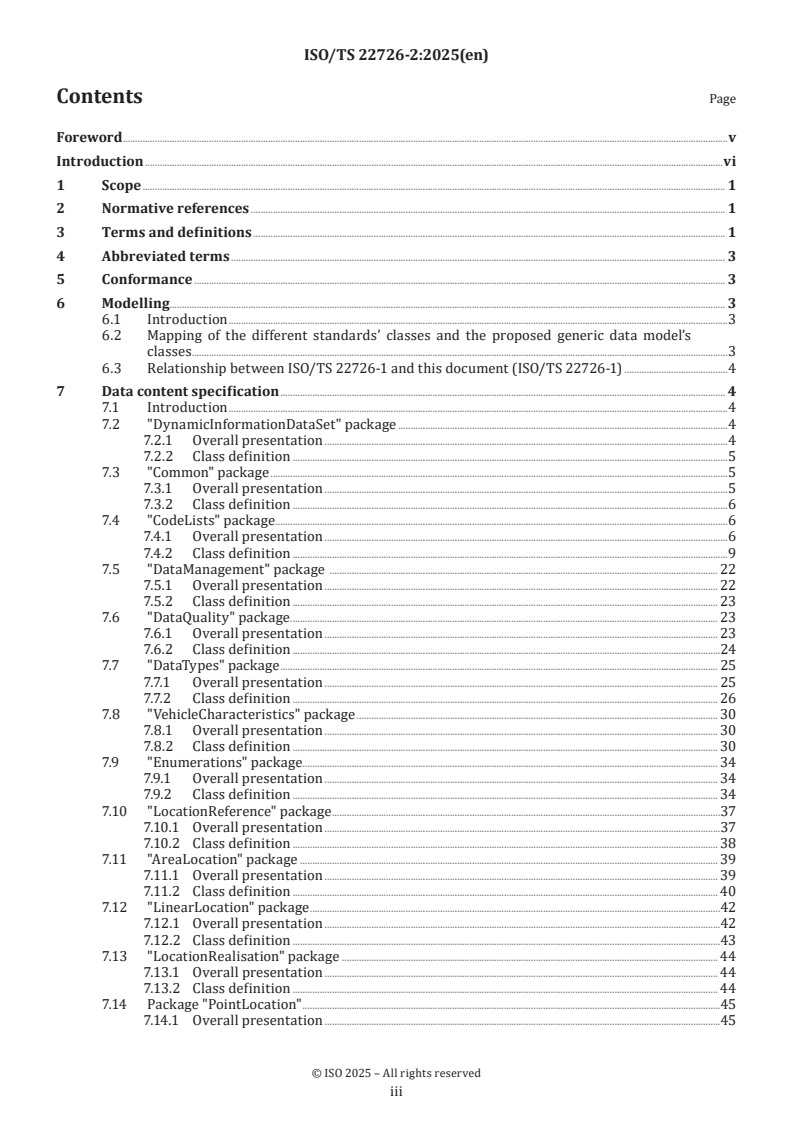
Technical
Specification
ISO/TS 22726-2
First edition
Intelligent transport systems —
Dynamic data and map database
2025-02
specification for connected
and automated driving system
applications —
Part 2:
Logical data model of dynamic data
Systèmes de transport intelligents — Spécification de
données dynamiques et de bases de données cartographiques
pour les applications de système de conduite connectées et
automatisées —
Partie 2: Modèle de données logique des données dynamiques
Reference number
© ISO 2025
All rights reserved. Unless otherwise specified, or required in the context of its implementation, no part of this publication may
be reproduced or utilized otherwise in any form or by any means, electronic or mechanical, including photocopying, or posting on
the internet or an intranet, without prior written permission. Permission can be requested from either ISO at the address below
or ISO’s member body in the country of the requester.
ISO copyright office
CP 401 • Ch. de Blandonnet 8
CH-1214 Vernier, Geneva
Phone: +41 22 749 01 11
Email: copyright@iso.org
Website: www.iso.org
Published in Switzerland
ii
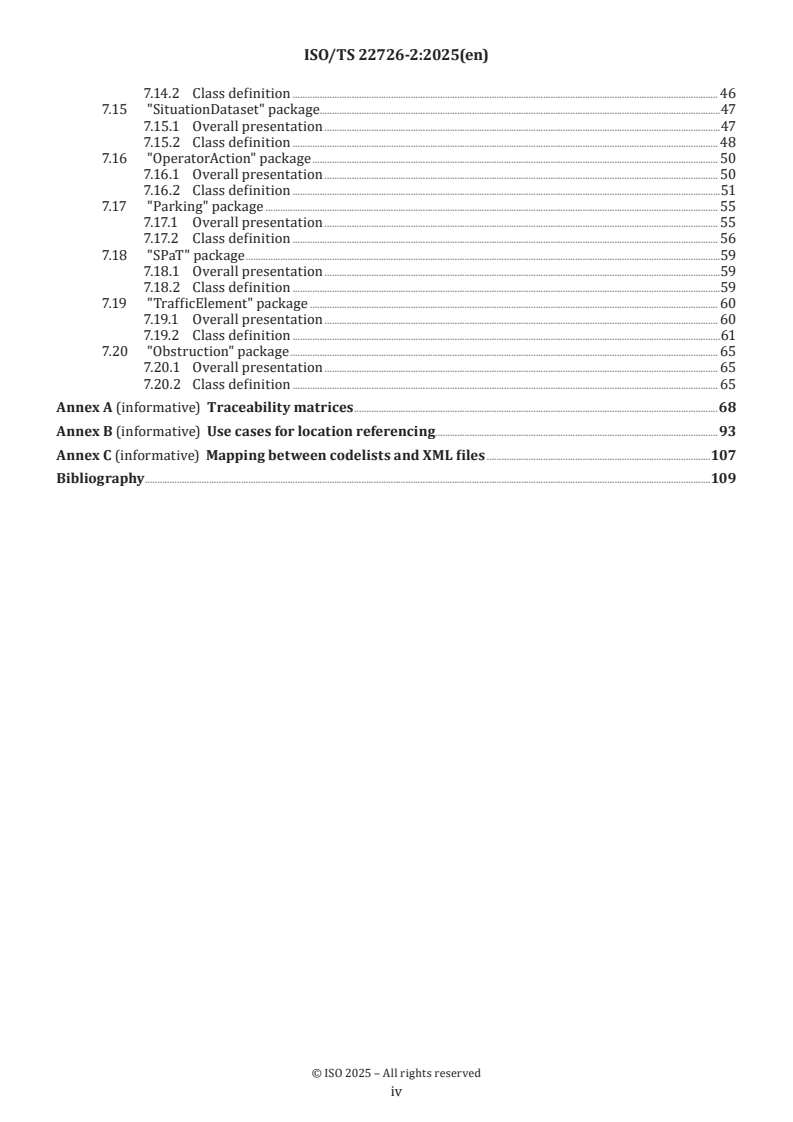
Contents Page
Foreword .v
Introduction .vi
1 Scope . 1
2 Normative references . 1
3 Terms and definitions . 1
4 Abbreviated terms . 3
5 Conformance . 3
6 Modelling. 3
6.1 Introduction .3
6.2 Mapping of the different standards’ classes and the proposed generic data model’s
classes .3
6.3 Relationship between ISO/TS 22726-1 and this document (ISO/TS 22726-1) .4
7 Data content specification . 4
7.1 Introduction .4
7.2 "DynamicInformationDataSet" package .4
7.2.1 Overall presentation .4
7.2.2 Class definition .5
7.3 "Common" package .5
7.3.1 Overall presentation .5
7.3.2 Class definition .6
7.4 "CodeLists" package . .6
7.4.1 Overall presentation .6
7.4.2 Class definition .9
7.5 "DataManagement" package . 22
7.5.1 Overall presentation . 22
7.5.2 Class definition . 23
7.6 "DataQuality" package . 23
7.6.1 Overall presentation . 23
7.6.2 Class definition .24
7.7 "DataTypes" package . 25
7.7.1 Overall presentation . 25
7.7.2 Class definition . 26
7.8 "VehicleCharacteristics" package . 30
7.8.1 Overall presentation . 30
7.8.2 Class definition . 30
7.9 "Enumerations" package. 34
7.9.1 Overall presentation . 34
7.9.2 Class definition . 34
7.10 "LocationReference" package .37
7.10.1 Overall presentation .37
7.10.2 Class definition . 38
7.11 "AreaLocation" package . 39
7.11.1 Overall presentation . 39
7.11.2 Class definition . 40
7.12 "LinearLocation" package .42
7.12.1 Overall presentation .42
7.12.2 Class definition .43
7.13 "LocationRealisation" package . 44
7.13.1 Overall presentation . 44
7.13.2 Class definition . 44
7.14 Package "PointLocation" .45
7.14.1 Overall presentation .45
iii
7.14.2 Class definition . 46
7.15 "SituationDataset" package.47
7.15.1 Overall presentation .47
7.15.2 Class definition . 48
7.16 "OperatorAction" package . 50
7.16.1 Overall presentation . 50
7.16.2 Class definition .51
7.17 "Parking" package . 55
7.17.1 Overall presentation . 55
7.17.2 Class definition . 56
7.18 "SPaT" package .59
7.18.1 Overall presentation .59
7.18.2 Class definition .59
7.19 "TrafficElement" package . 60
7.19.1 Overall presentation . 60
7.19.2 Class definition .61
7.20 "Obstruction" package . 65
7.20.1 Overall presentation . 65
7.20.2 Class definition . 65
Annex A (informative) Traceability matrices .68
Annex B (informative) Use cases for location referencing.93
Annex C (informative) Mapping between codelists and XML files .107
Bibliography .109
iv
Foreword
ISO (the International Organization for Standardization) is a worldwide federation of national standards
bodies (ISO member bodies). The work of preparing International Standards is normally carried out through
ISO technical committees. Each member body interested in a subject for which a technical committee
has been established has the right to be represented on that committee. International organizations,
governmental and non-governmental, in liaison with ISO, also take part in the work. ISO collaborates closely
with the International Electrotechnical Commission (IEC) on all matters of electrotechnical standardization.
The procedures used to develop this document and those intended for its further maintenance are described
in the ISO/IEC Directives, Part 1. In particular, the different approval criteria needed for the different types
of ISO document should be noted. This document was drafted in accordance with the editorial rules of the
ISO/IEC Directives, Part 2 (see www.iso.org/directives).
ISO draws attention to the possibility that the implementation of this document may involve the use of (a)
patent(s). ISO takes no position concerning the evidence, validity or applicability of any claimed patent
rights in respect thereof. As of the date of publication of this document, ISO had not received notice of (a)
patent(s) which may be required to implement this document. However, implementers are cautioned that
this may not represent the latest information, which may be obtained from the patent database available at
www.iso.org/patents. ISO shall not be held responsible for identifying any or all such patent rights.
Any trade name used in this document is information given for the convenience of users and does not
constitute an endorsement.
For an explanation of the voluntary nature of standards, the meaning of ISO specific terms and expressions
related to conformity assessment, as well as information about ISO's adherence to the World Trade
Organization (WTO) principles in the Technical Barriers to Trade (TBT), see www.iso.org/iso/foreword.html.
This document was prepared by Technical Committee ISO/TC 204, Intelligent transport systems, in
collaboration with the European Committee for Standardization (CEN) Technical Committee CEN/TC 278,
Intelligent transport systems, in accordance with the Agreement on technical cooperation between ISO and
CEN (Vienna Agreement).
A list of all parts in the ISO 22726 series can be found on the ISO website.
Any feedback or questions on this document should be directed to the user’s national standards body. A
complete listing of these bodies can be found at www.iso.org/members.html.
v
Introduction
In response to emerging automated driving system development, the need to define associated map
database standards has been recognized. Automated driving systems require information on the road, lane
and intersection. Conventional road networks for intelligent transport systems (ITS) use a linear modelling
method such as link and node. Due to these new requirements, automated driving systems need a data
model to express advanced features. The belt-shaped data modelling method has already been developed
based on the "belt concept" in ISO 20524-2 to provide information about the road, lane and intersection. The
concept of "map for highly automated driving" (MHAD) adopts the belt-shaped data model and harmonizes
with the conventional road model such as that of ISO/TS 22726-1.
This document can be used as a reference model for ITS, for example, connected and automated driving
system applications and applications of backend map centres which use map and map-related data.
Implementation of this document can lead to cost reductions in maintenance/expansion of map access
libraries as well as compilation/maintenance of map and map-related data for data providers and connected
and automated driving/vehicle control applications.
This document does not define or specify new standards for dynamic information. Neither does it define
procedures and/or methods for generating unified contents. It can be used for connected and automated
driving system applications. This document's data model of MHAD and that of ISO/TS 22726-1 complement
each other.
vi
Technical Specification ISO/TS 22726-2:2025(en)
Intelligent transport systems — Dynamic data and map
database specification for connected and automated driving
system applications —
Part 2:
Logical data model of dynamic data
1 Scope
This document specifies a unified logical data model based on available existing dynamic information
standards. The data has precise relative location references to be linked with ISO/TS 22726-1 which
specifies the architecture and the logical data model of static map data for connected and automated
driving applications. Dynamic event data comes from external systems and has been defined and specified
independently by existing standards. Therefore, the logical data model in this document is formed to
synthesize contents referring to other standards.
2 Normative references
The following documents are referred to in the text in such a way that some or all of their content constitutes
requirements of this document. For dated references, only the edition cited applies. For undated references,
the latest edition of the referenced document (including any amendments) applies.
ISO/IEC 19505 (all parts), Information technology — Object Management Group Unified Modeling Language
(OMG UML)
3 Terms and definitions
For the purposes of this document, the following terms and definitions apply.
ISO and IEC maintain terminology databases for use in standardization at the following addresses:
— ISO Online browsing platform: available at https:// www .iso .org/ obp
— IEC Electropedia: available at https:// www .electropedia .org/
3.1
cancellation
action which provides indication that all the element information previously sent is not considered valid,
due to an incorrect content
3.2
end
binary attribute specifying whether the situation element is finished (true) or not (false)
EXAMPLE In EN 16157-7:2018, Table A.10, if finished (i.e. end is true) the overallEndTime in the OverallPeriod
class associated with the SituationRecord is populated.
3.3
correctness
correspondence with the universe of discourse
[SOURCE: ISO 19157-1:2023, 3.4]
3.4
accuracy
closeness of agreement between a test result or measurement result and the true value
[SOURCE: ISO 19157-1:2023, 3.1 modified — Note 1 to entry has been removed.]
3.5
timeliness
degree to which an IT service delivers outcomes within time limits
Note 1 to entry: In some cases, service timeliness is affected by a combination of multiple services provided by
different service providers. For example, online shopping service is expected to provide not only timely retrieval of
newly added products on sale, but also timely delivery to the user by the parcel-delivery service provider.
[SOURCE: ISO/IEC TS 25011:2017, 3.2.6.1]
3.6
location reference
specification of a location according to a specific set of rules
3.7
location
identifiable place within a three-dimensional space
3.8
area location
location that has a two-dimensional character
3.9
linear location
location that has a one-dimensional character
3.10
line string
geometric object representing a sequence of connected line segments in a 2D or 3D space and consisting of
two or more points connected by straight line segments
Note 1 to entry: It can be used to represent a variety of features, such as roads, paths, or boundaries.
3.11
multipolygon
collection of polygons
3.12
point by coordinates
point location defined by a coordinate set with an optional bearing direction
Note 1 to entry: Adapted from EN 16157-2:2019, Table A.42.
3.13
point location
location that has a zero-dimensional character
3.14
position confidence
degree of certainty of the current location or position of an event or an object
3.15
transversal location reference
method of determining the location of a point or feature relative to a fixed reference line or centreline
3.16
universe of discourse
view of the real or hypothetical world that includes everything of interest
[SOURCE: ISO 19101-1:2014, 4.1.38]
4 Abbreviated terms
DATEX data exchange
NOTE "DATEX" refers to a European standard dealiing with data exchange for traffic
management and traffic information.
DENM decentralized environmental notification message
EV electric vehicle
IVI in-vehicle information
MHAD map for highly automated driving
VICS vehicle information and communication systems
VMS variable message sign
5 Conformance
The UML diagrams used in this document shall be in conformance with the ISO/IEC 19505 series.
6 Modelling
6.1 Introduction
This document was created by developing a generic logical data model for dynamic data services and
comparing with the data models of services of interest, namely EN 16157-2, EN 16157-3 and EN 16157-7
(DATEX II), ISO 21219-15 (TPEG2-TEC), ISO/TS 19321 (IVI), ETSI EN 302 637-3 (DENM), ISO/TS 18234-8
(TPEG1-CTT) and VICS, which is based on a Japanese national standard. The methodology uses data
modelling based on the Unified Modeling Language (UML), version 2, as specified in the ISO/IEC 19505 series.
The generic data model specified in this document does conforms to ISO 19103 and ISO 19107.
6.2 Mapping of the different standards’ classes and the proposed generic data model’s classes
The generic data model specified within this document has been compared with the data models of EN
16157-2, EN 16157-3 and EN 16157-7 (DATEX II) in the first case, ISO 21219-15 (TPEG2-TEC) in the second
case, ISO/TS 19321 (IVI) in the third case, and ETSI EN 302 637-3 (DENM) for the fourth. When relevant,
relationships have been established between classes of one of the existing specifications’ data model and the
generic logical data model of this document.
Annex A contains various matrices. The Relationship Matrix is a spreadsheet display of relationships
between elements (classes) in two different packages, one of the generic data model and the other from one
of the existing data models. The Relationship Matrices have been produced for all models.
NOTE The matrices were exported to Excel and merged into one single matrix where the corresponding classes
can be managed together. Where no UML model is available (in the case of ISO/TS 18234-8 (TPEG1-CTT) and VICS) the
classes of the specifications concerned have been added manually and the correctness of the mapping checked with
the corresponding stakeholders (Republic of Korea and Japan).
Once the classes have been mapped to each other, the corresponding data attributes and metadata have
been processed and the generic data model complemented.
6.3 Relationship between ISO/TS 22726-1 and this document (ISO/TS 22726-1)
Dynamic map data needs to be set onto the right location on a digital map. For this purpose, a map-matching
function is used which consists of using different types of location referencing systems such as point
locations, linear locations and area locations. For this reason, this document also covers the description of
the interface specifying the logical link between dynamic data and static data as specified respectively by
this document and by ISO/TS 22726-1.
The LocationRealisation package of the LocationReference package is used for this purpose. All location
reference packages (AreaLocation, LinearLocation, PointLocation) have their respective Location
Realisation class diagram implementing the interface to RoadNetworkElement specified in ISO/TS 22726-1
(see Figure 1).
Annex B presents different possible use cases in relation to location referencing.
Figure 1 — LocationRealisation class from ISO/TS 22726-1:2023
7 Data content specification
7.1 Introduction
This clause provides a detailed overview of the data packages and related data classes of the generic data
model, including their definition, structure and content.
7.2 "DynamicInformationDataSet" package
7.2.1 Overall presentation
The DynamicInformationDataSet package shall contain the different packages dealing with data sets that
can be exchanged via one the dynamic data interface considered by this document.
Figure 2 pictures the classes of the package including the relationships between them.
Figure 2 — The "DataSet" class diagram
7.2.2 Class definition
The classes belonging to the difference packages shown in Figure 2 are described by the tables appearing in
the subclause in which the package is detailed.
7.3 "Common" package
7.3.1 Overall presentation
The Common package shall comprise a collection of information including data types, reusable collections
and lists of enumerations.
Figure 3 pictures the classes of the package including the relationships between them.
Figure 3 — The "Common" class diagram
7.3.2 Class definition
The classes belonging to the difference packages shown in Figure 3 are described by the tables appearing in
the subclause in which the package is detailed.
7.4 "CodeLists" package
7.4.1 Overall presentation
The CodeLists package shall comprise a collection of code lists used by the dynamic data services.
For these classes, examples of corresponding information are provided for illustrative purposes. They
are implemented as XML files available separately and each included literal contains a numeric code, the
corresponding value in lower CamelCase notation and the definition.
Figure 4 pictures the classes of the package including the relationships between them.
Figure 4 — The "CodeLists" class diagram
Annex C summarises the different URLs implementing these codelists as XML files.
7.4.2 Class definition
The tables below define the different classes used in this package.
Table 1 defines the characteristics of the AbnormalTrafficTypeList class.
Table 1 — AbnormalTrafficTypeList Class
Class <>: AbnormalTrafficTypeList
Definition: Descriptive terms for abnormal traffic conditions specifically relating to the nature of the traffic move-
ment, implying levels of service.
Stereotypes: «CodeList»
Tagged values: asDictionary = true
codeList = https:// standards .iso .org/ iso/ ts/ 22726/ -2/ ed -1/ en/ Abn ormalTraff icTypeList .xml
Code Value Definition
(example)
0 heavyTraffic Traffic is heavy at the specified location (i.e. average speed is between 75 %
and 90 % of its free-flow level).
1 slowTraffic Traffic is slow-moving at the specified location, but not yet forming queues
(i.e. average speed is between 25 % and 75 % of its free-flow level).
...
Table 2 defines the characteristics of the AccidentTypeList class.
Table 2 — AccidentTypeList Class
Class <>: AccidentTypeList
Definition: Collection of descriptive terms for types of accidents.
Stereotypes: «CodeList»
Tagged values: asDictionary = true
codeList = https:// standards .iso .org/ iso/ ts/ 22726/ -2/ ed -1/ en/ AccidentTypeList .xml
Code Value Definition
(example)
0 accident Situations in which one or more vehicles lose control and do not recover.
This includes collisions between vehicle(s) or other road user(s), between
vehicle(s) and fixed obstacle(s), or the result of a vehicle running off the
road.
11 collision Collision of vehicle with another object of unspecified type.
...
Table 3 defines the characteristics of the AnimalPresenceTypeList class.
Table 3 — AnimalPresenceTypeList Class
Class <>: AnimalPresenceTypeList
Definition: Types of animal presence.
Stereotypes: «CodeList»
Tagged values: asDictionary = true
codeList = https:// standards .iso .org/ iso/ ts/ 22726/ -2/ ed -1/ en/ An imalPresen ceTypeList .xml
Code Value Definition
(example)
TTabablele 3 3 ((ccoonnttiinnueuedd))
0 animalOnTheRoad Traffic is potentially disrupted due to animals on the roadway.
1 herdOfAnimalsOnTheRoad Traffic is potentially disrupted due to a herd of animals on the roadway.
...
Table 4 defines the characteristics of the AuthorityOperationTypeList class.
Table 4 — AuthorityOperationTypeList Class
Class <>: AuthorityOperationTypeList
Definition: Types of authority operations.
Stereotypes: «CodeList»
Tagged values: asDictionary = true
codeList = https:// standards .iso .org/ iso/ ts/ 22726/ -2/ ed -1/ en/ Author ityOperati onTypeList .xml
Code Value Definition
(example)
2 civilEmergency A situation, perceived or actual, relating to a civil emergency which could
disrupt traffic. This includes large scale destruction, through events such as
earthquakes, insurrection and civil disobedience.
14 vehicleWeighing A permanent or temporary operation established on or adjacent to the car-
riageway for weighing of vehicles by authorities.
...
Table 5 defines the characteristics of the ChargingModeTypeList class.
Table 5 — ChargingModeTypeList Class
Class <>: ChargingModeTypeList
Definition: List of the types of electric charging modes accordingto IEC 61851 terminology.
Stereotypes: «CodeList»
Tagged values: asDictionary = true
codeList = https:// standards .iso .org/ iso/ ts/ 22726/ -2/ ed -1/ en/ ChargingModeTypeList .xml
Code Value Definition
(example)
0 ccs Charging with a combined charging solution (CCS). AC and DC are used
simultaneously.
5 mode2AC3p Mode 2, AC 3 phases.
...
Table 6 defines the characteristics of the ChargingPointUsageTypeList class.
Table 6 — ChargingPointUsageTypeList Class
Class <>: ChargingPointUsageTypeList
Definition: List of the types of usage for an electric charging point.
Stereotypes: «CodeList»
Tagged values: asDictionary = true
codeList = https:// standards .iso .org/ iso/ ts/ 22726/ -2/ ed -1/ en/ Chargi ngPointUsa geTypeList .xml
Code Value Definition
(example)
TTabablele 6 6 ((ccoonnttiinnueuedd))
4 electricVehicle Charging of electric vehicles.
5 lorryPowerConsumption Supply for lorries with power consumption, e.g. for refrigerated goods
transport.
...
Table 7 defines the characteristics of the CollisionTypeList class.
Table 7 — CollisionTypeList Class
Class <>: CollisionTypeList
Definition: Identifies a type of collision.
Stereotypes: «CodeList»
Tagged values: asDictionary = true
codeList = https:// standards .iso .org/ iso/ ts/ 22726/ -2/ ed -1/ en/ CollisionTypeList .xml
Code Value Definition
(example)
1 collisionWithAnimal Collision of vehicle with one or more animals.
2 collisionWithObstacle Collision of vehicle with an object of a stationary nature.
...
Table 8 defines the characteristics of the ConnectorFormatList class.
Table 8 — ConnectorFormatList Class
Class <>: ConnectorFormatList
Definition: A list of cable types used during the charging process.
Stereotypes: «CodeList»
Tagged values: asDictionary = true
codeList = https:// standards .iso .org/ iso/ ts/ 22726/ -2/ ed -1/ en/ ConnectorFormatList .xml
Code Value Definition
(example)
0 cableMode2 The connector is an attached cable; the user of an electric vehicle (EV)
needs to have a fitting inlet for a mode 2 cable, common for most domestic
sockets.
3 socket The connector is a socket; the EV user needs to bring a fitting plug.
...
Table 9 defines the characteristics of the ConnectorTypeList class.
Table 9 — ConnectorTypeList Class
Class <>: ConnectorTypeList
Definition: A list of commonly used connectors and charging interfaces.
Stereotypes: «CodeList»
Tagged values: asDictionary = true
codeList = https:// standards .iso .org/ iso/ ts/ 22726/ -2/ ed -1/ en/ ConnectorTypeList .xml
Code Value Definition
(example)
0 cee3 Connector CEE3 (Voltage 230 V intensity 16A)
2 chademo Connector CHAdeMO (600 V DC). Used mostly in Japan.
...
Table 10 defines the characteristics of the ConstructionWorkTypeList class.
Table 10 — ConstructionWorkTypeList Class
Class <>: ConstructionWorkTypeList
Definition: Types of works relating to construction.
Stereotypes: «CodeList»
Tagged values: asDictionary = true
codeList = https:// standards .iso .org/ iso/ ts/ 22726/ -2/ ed -1/ en/ Cons tructionWo rkTypeList .xml
Code Value Definition
(example)
0 blastingWork Blasting or quarrying work at the specified location.
4 roadWideningWork Road widening work at the specified location.
...
Table 11 defines the characteristics of the DelayBandList class.
Table 11 — DelayBandList Class
Class <>: DelayBandList
Definition: List of values as a classification of a delay banded by length (i.e. the additional travel time).
Stereotypes: «CodeList»
Tagged values: asDictionary = true
codeList = https:// standards .iso .org/ iso/ ts/ 22726/ -2/ ed -1/ en/ DelayBandList .xml
Code Value Definition
(example)
0 negligible Negligible delay.
1 upToTenMinutes Delay up to ten minutes.
...
Table 12 defines the characteristics of the DelayTypeList class.
Table 12 — DelayTypeList Class
Class <>: DelayTypeList
Definition: List of coarse values used as classifications of a delay.
Stereotypes: «CodeList»
Tagged values: asDictionary = true
codeList = https:// standards .iso .org/ iso/ ts/ 22726/ -2/ ed -1/ en/ DelayTypeList .xml
Code Value Definition
(example)
0 delays Delays on the road network as a result of any situation which causes hold-
ups.
2 longDelays Delays on the road network of unusual severity.
...
Table 13 defines the characteristics of the DeliveryUnitList class.
Table 13 — DeliveryUnitList Class
Class <>: DeliveryUnitList
Definition: List of the different units in which the delivery is measured.
Stereotypes: «CodeList»
Tagged values: asDictionary = true
codeList = https:// standards .iso .org/ iso/ ts/ 22726/ -2/ ed -1/ en/ DeliveryUnitList .xml
Code Value Definition
(example)
3 kWh Kilowatt hour.
6 usGallon US gallon (3,785 litres).
...
Table 14 defines the characteristics of the DisturbanceActivityTypeList class.
Table 14 — DisturbanceActivityTypeList Class
Class <>: DisturbanceActivityTypeList
Definition: Types of disturbance activities.
Stereotypes: «CodeList»
Tagged values: asDictionary = true
codeList = https:// standards .iso .org/ iso/ ts/ 22726/ -2/ ed -1/ en/ Disturb anceActivi tyTypeList
.xml
Code Value Definition
(example)
3 assetDestruction A situation where assets of one or more persons or authorities have been
destroyed.
9 demonstration A public protest with the potential to disrupt traffic.
...
Table 15 defines the characteristics of the DiversionManagementTypeList class.
Table 15 — DiversionManagementTypeList Class
Class <>: DiversionManagementTypeList
Definition: Management actions relating to diversion or rerouting.
Stereotypes: «CodeList»
Tagged values: asDictionary = true
codeList = https:// standards .iso .org/ iso/ ts/ 22726/ -2/ ed -1/ en/ Diversi onManageme ntTypeList
.xml
Code Value Definition
(example)
0 doNotFollowDiversion- Do not follow diversion signs.
Signs
5 followLocalDiversion Rerouted traffic is to follow local diversion.
...
Table 16 defines the characteristics of the DrivingConditionTypeList class.
Table 16 — DrivingConditionTypeList Class
Class <>: DrivingConditionTypeList
Definition: Types of the perceived driving conditions.
Stereotypes: «CodeList»
Tagged values: asDictionary = true
codeList = https:// standards .iso .org/ iso/ ts/ 22726/ -2/ ed -1/ en/ Driv ingConditi onTypeList .xml
Code Value Definition
(example)
0 impossible Current conditions are making driving impossible.
3 passableWithCare The roadway is passable to vehicles with driver care.
...
Table 17 defines the characteristics of the EnvironmentalObstructionTypeList class.
Table 17 — EnvironmentalObstructionTypeList Class
Class <>: EnvironmentalObstructionTypeList
Definition: Types of environmental obstructions.
Stereotypes: «CodeList»
Tagged values: asDictionary = true
codeList = https:// standards .iso .org/ iso/ ts/ 22726/ -2/ ed -1/ en/ En vironmenta lObstructi
onTypeList .xml
Code Value Definition
(example)
0 avalanches The road is obstructed or partially obstructed due to snow slides.
1 earthquakeDamage The road is obstructed or partially obstructed because of damage caused by
an earthquake.
...
Table 18 defines the characteristics of the EquipmentOrSystemTypeList class.
Table 18 — EquipmentOrSystemTypeList Class
Class <>: EquipmentOrSystemTypeList
Definition: Types of equipment and systems used to support the operation of the road network.
Stereotypes: «CodeList»
Tagged values: asDictionary = true
codeList = https:// standards .iso .org/ iso/ ts/ 22726/ -2/ ed -1/ en/ Equip mentOrSyst emTypeList
.xml
Code Value Definition
(example)
2 cctvCameras Closed-circuit television cameras.
9 rampControls Ramp control equipment.
...
Table 19 defines the characteristics of the FuelTypeList class.
Table 19 — FuelTypeList Class
Class <>: FuelTypeList
Definition: List of types of fuel used by a vehicle.
Stereotypes: «CodeList»
Tagged values: asDictionary = true
codeList = https:// standards .iso .org/ iso/ ts/ 22726/ -2/ ed -1/ en/ FuelTypeList .xml
Code Value Definition
(example)
1 battery Battery.
5 ethanol Ethanol.
...
Table 20 defines the characteristics of the GeneralNetworkManagementTypeList class.
Table 20 — GeneralNetworkManagementTypeList Class
Class <>: GeneralNetworkManagementTypeList
Definition: Types of network management actions.
Stereotypes: «CodeList»
Tagged values: asDictionary = true
codeList = https:// standards .iso .org/ iso/ ts/ 22726/ -2/ ed -1/ en/ Ge neralNetwo rkManageme
ntTypeList .xml
Code Value Definition
(example)
0 bridgeSwingInOperation The bridge at the specified location has swung or lifted and is therefore
temporarily closed to traffic.
4 temporaryTraffcLights Traffic is being controlled by temporary traffic lights (red-yellow-green or
red-green).
...
Table 21 defines the characteristics of the InfrastructureDamageTypeList class.
Table 21 — InfrastructureDamageTypeList Class
Class <>: InfrastructureDamageTypeList
Definition: Types of infrastructure damage which may have an effect on the road network.
Stereotypes: «CodeList»
Tagged values: asDictionary = true
codeList = https:// standards .iso .org/ iso/ ts/ 22726/ -2/ ed -1/ en/ Infrastr uctureDama geTypeList
.xml
Code Value Definition
(example)
4 damagedCrashBarrier Damage to a crash barrier that may cause traffic disruption.
11 fallenPowerCables The road is obstructed or partially obstructed by one or more fallen power
cables.
...
Table 22 defines the characteristics of the LoadTypeList class.
...