

ISO 25554:2024
(Main)Ageing societies — Guidelines for promoting wellbeing in communities
General Information
- Abstract
This document presents guidelines to establish, implement, evaluate and continuously improve wellbeing, to promote healthy ageing at the level of community and individual members. This document is applicable to any community, regardless of size, type and nature. Management of occupational safety and health is outside of the scope of this document. This document does not cover economic and financial aspects.
- Status
- Published
- Publication Date
- 11-Nov-2024
- Technical Committee
- ISO/TC 314 - Ageing societies
- Drafting Committee
- ISO/TC 314 - Ageing societies
- Current Stage
- 6060 - International Standard published
- Start Date
- 12-Nov-2024
- Due Date
- 09-Aug-2024
- Completion Date
- 12-Nov-2024
Overview
ISO 25554:2024 - Ageing societies - Guidelines for promoting wellbeing in communities provides a practical framework to plan, implement, evaluate and continuously improve wellbeing initiatives at community and individual levels. The standard supports healthy ageing, aligns with the SDG principle “leave no one behind” and references WHO concepts of wellbeing without prescribing a single definition. It is applicable to any community (cities, municipalities, businesses, neighbourhoods, interest groups) regardless of size or type. Note: management of occupational safety and health and economic/financial aspects are outside its scope.
Key topics and technical requirements
- Wellbeing concept: Communities develop their own wellbeing concept consistent with mission, values, SDGs and WHO healthy ageing principles.
- Expected outcomes: Define short-, medium- and long-term outcomes for the community and individual members with specified review points.
- Evaluation scheme:
- Wellbeing performance index for individuals and for the community, built from measurable indicators.
- Indicators selection: identify objective/subjective indicators for members and aggregated indicators or statistics for communities.
- Design and delivery of wellbeing services: plan, provide and assess services (public or third‑party) for effectiveness and efficiency; enable voluntary uptake by individuals.
- Data collection and management: collect indicator data responsibly (reporting is voluntary), manage data for monitoring and continuous improvement.
- Review and adjustment cycle: regularly evaluate indices vs. expected outcomes and revise services and indices accordingly.
- Supporting elements: sustainable management, leadership and communication for wellbeing promotion; use of digital technologies for continuous improvement (see Annex D).
- Informative annexes: practical examples (Annex A), corporate wellbeing policy example (Annex B - Kenko‑keiei), elements related to wellbeing (Annex C), IT utilization (Annex D).
Practical applications and users
Who uses ISO 25554:2024:
- Municipal planners and local governments designing age-friendly policies and community services
- Employers and HR/leaders implementing community- or workplace-linked wellbeing programmes
- Public health practitioners and social service organizations focused on healthy ageing interventions
- Community groups, NGOs and service providers developing measurable wellbeing services
- IT and data teams building indicator dashboards or digital platforms to monitor wellbeing performance
Practical uses:
- Create a community wellbeing strategy and measurable performance indices
- Select indicators and design data collection and reporting workflows
- Benchmark and continuously improve service portfolios that promote physical, mental and social wellbeing
- Facilitate cross-community sharing of methodologies and good practices
Related standards and references
- Prepared by ISO/TC 314 (Ageing societies)
- Cross-references: ISO 25550:2022 (wellbeing terminology) and ISO/TS 37151:2015 (community definitions)
- Aligns conceptually with WHO guidance on healthy ageing and UN SDGs for inclusive development
Keywords: ISO 25554:2024, ageing societies, community wellbeing, healthy ageing, wellbeing performance index, wellbeing services, indicators, continuous improvement, SDGs, WHO.
Get Certified
Connect with accredited certification bodies for this standard

BSI Group
BSI (British Standards Institution) is the business standards company that helps organizations make excellence a habit.

TÜV SÜD
TÜV SÜD is a trusted partner of choice for safety, security and sustainability solutions.

Bureau Veritas
Bureau Veritas is a world leader in laboratory testing, inspection and certification services.
Sponsored listings
Frequently Asked Questions
ISO 25554:2024 is a standard published by the International Organization for Standardization (ISO). Its full title is "Ageing societies — Guidelines for promoting wellbeing in communities". This standard covers: This document presents guidelines to establish, implement, evaluate and continuously improve wellbeing, to promote healthy ageing at the level of community and individual members. This document is applicable to any community, regardless of size, type and nature. Management of occupational safety and health is outside of the scope of this document. This document does not cover economic and financial aspects.
This document presents guidelines to establish, implement, evaluate and continuously improve wellbeing, to promote healthy ageing at the level of community and individual members. This document is applicable to any community, regardless of size, type and nature. Management of occupational safety and health is outside of the scope of this document. This document does not cover economic and financial aspects.
ISO 25554:2024 is classified under the following ICS (International Classification for Standards) categories: 03.100.01 - Company organization and management in general; 11.020.10 - Health care services in general; 13.020.20 - Environmental economics. Sustainability. The ICS classification helps identify the subject area and facilitates finding related standards.
ISO 25554:2024 is available in PDF format for immediate download after purchase. The document can be added to your cart and obtained through the secure checkout process. Digital delivery ensures instant access to the complete standard document.
Standards Content (Sample)
International
Standard
ISO 25554
First edition
Ageing societies — Guidelines
2024-11
for promoting wellbeing in
communities
Vieillissement de la population — Lignes directrices pour la
promotion du bien-être dans les collectivités
Reference number
© ISO 2024
All rights reserved. Unless otherwise specified, or required in the context of its implementation, no part of this publication may
be reproduced or utilized otherwise in any form or by any means, electronic or mechanical, including photocopying, or posting on
the internet or an intranet, without prior written permission. Permission can be requested from either ISO at the address below
or ISO’s member body in the country of the requester.
ISO copyright office
CP 401 • Ch. de Blandonnet 8
CH-1214 Vernier, Geneva
Phone: +41 22 749 01 11
Email: copyright@iso.org
Website: www.iso.org
Published in Switzerland
ii
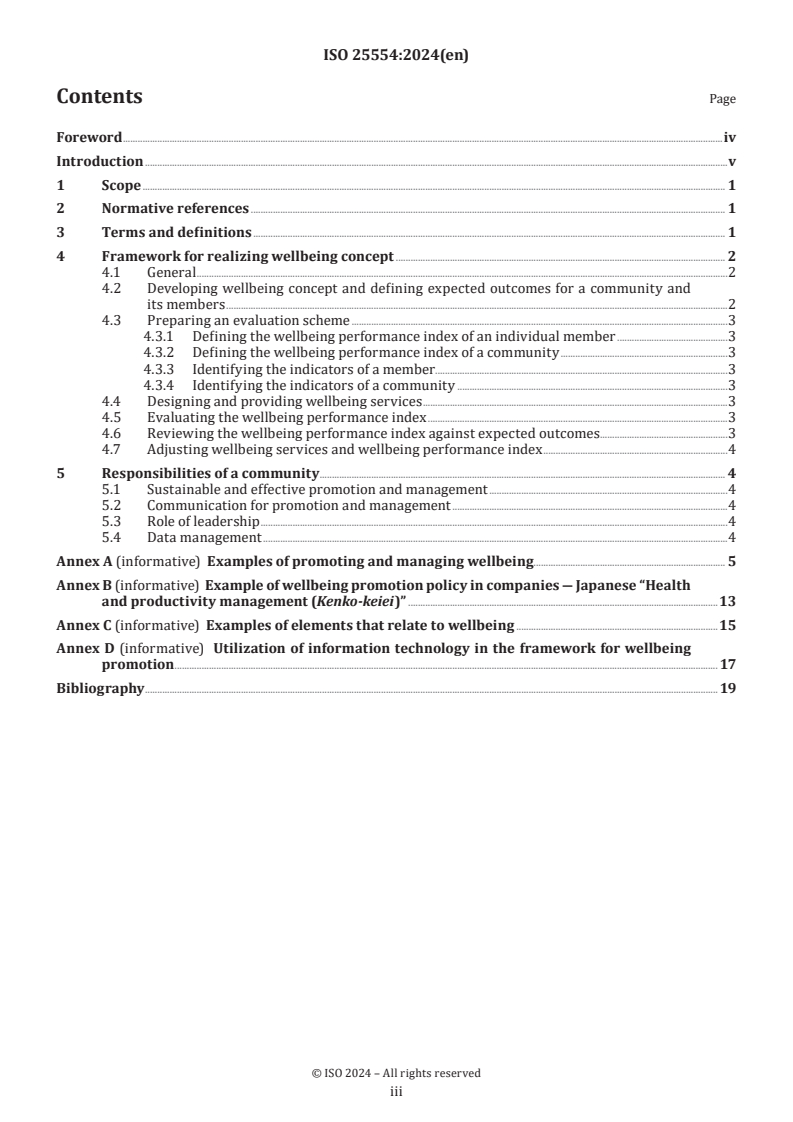
Contents Page
Foreword .iv
Introduction .v
1 Scope . 1
2 Normative references . 1
3 Terms and definitions . 1
4 Framework for realizing wellbeing concept . 2
4.1 General .2
4.2 Developing wellbeing concept and defining expected outcomes for a community and
its members .2
4.3 Preparing an evaluation scheme .3
4.3.1 Defining the wellbeing performance index of an individual member .3
4.3.2 Defining the wellbeing performance index of a community .3
4.3.3 Identifying the indicators of a member.3
4.3.4 Identifying the indicators of a community .3
4.4 Designing and providing wellbeing services .3
4.5 Evaluating the wellbeing performance index .3
4.6 Reviewing the wellbeing performance index against expected outcomes.3
4.7 Adjusting wellbeing services and wellbeing performance index .4
5 Responsibilities of a community . . 4
5.1 Sustainable and effective promotion and management .4
5.2 Communication for promotion and management .4
5.3 Role of leadership .4
5.4 Data management .4
Annex A (informative) Examples of promoting and managing wellbeing. 5
Annex B (informative) Example of wellbeing promotion policy in companies ― Japanese “Health
and productivity management (Kenko-keiei)” .13
Annex C (informative) Examples of elements that relate to wellbeing .15
Annex D (informative) Utilization of information technology in the framework for wellbeing
promotion . 17
Bibliography . 19
iii
Foreword
ISO (the International Organization for Standardization) is a worldwide federation of national standards
bodies (ISO member bodies). The work of preparing International Standards is normally carried out through
ISO technical committees. Each member body interested in a subject for which a technical committee
has been established has the right to be represented on that committee. International organizations,
governmental and non-governmental, in liaison with ISO, also take part in the work. ISO collaborates closely
with the International Electrotechnical Commission (IEC) on all matters of electrotechnical standardization.
The procedures used to develop this document and those intended for its further maintenance are described
in the ISO/IEC Directives, Part 1. In particular, the different approval criteria needed for the different types
of ISO document should be noted. This document was drafted in accordance with the editorial rules of the
ISO/IEC Directives, Part 2 (see www.iso.org/directives).
ISO draws attention to the possibility that the implementation of this document may involve the use of (a)
patent(s). ISO takes no position concerning the evidence, validity or applicability of any claimed patent
rights in respect thereof. As of the date of publication of this document, ISO had not received notice of (a)
patent(s) which may be required to implement this document. However, implementers are cautioned that
this may not represent the latest information, which may be obtained from the patent database available at
www.iso.org/patents. ISO shall not be held responsible for identifying any or all such patent rights.
Any trade name used in this document is information given for the convenience of users and does not
constitute an endorsement.
For an explanation of the voluntary nature of standards, the meaning of ISO specific terms and expressions
related to conformity assessment, as well as information about ISO's adherence to the World Trade
Organization (WTO) principles in the Technical Barriers to Trade (TBT), see www.iso.org/iso/foreword.html.
This document was prepared by Technical Committee ISO/TC 314, Ageing societies.
Any feedback or questions on this document should be directed to the user’s national standards body. A
complete listing of these bodies can be found at www.iso.org/members.html.
iv
Introduction
This document provides guidelines to specify a framework for the promotion of wellbeing in a community.
In this document, it is supposed that a community has its own concept of wellbeing which is consistent with
SDGs’ (sustainable development goals) principle “leave no one behind”, WHO (World Health Organization)’s
healthy ageing and the community’s mission and values. The wellbeing concept leads the promotion
of wellbeing presented in this document. This document does not seek to provide norms to define what
wellbeing is, but rather it provides a framework for achieving wellbeing that aligns with the wellbeing
concept.
The framework includes the provision of wellbeing services and communication in both working and living
conditions, regardless of community’s size. This framework proposes a system to continuously improve the
wellbeing of its members and interested parties with community-based leadership.
In addition, this framework considers not only the community as a whole, but also each individual, under
SDGs’ principle of “leaving no one behind”. This framework also helps to identify measures a community
already has in place to improve wellbeing, as well as any gaps that can exist. The effective use of digital
technologies is regarded in this document for a continuous improvement of wellbeing promotion.
While wellbeing relates to various fields and elements, this document covers the areas that are expected
to contribute to how people spend their lives, including “physical, mental and social wellbeing” based on
the WHO's concept of healthy ageing. The framework of the promotion and management of wellbeing is
common in structure among various communities such as enterprises, municipalities, and any other types
of organizations, as well as local communities. It is also helpful to share methodologies and good practices
among communities. For practical use of this framework, actual examples of wellbeing promotion in each
type of community are beneficial.
The targets of management are all members in a community, including people who are older or have
disabilities. Targeting those at higher health risk and providing services optimized for their health status
is also recommended. This approach will improve the wellbeing of the target population as well as the
wellbeing of the entire community. Diversity and inclusion should be utilized as strengths of a community.
The user categories covered by this document include:
— communities;
— leaders in a community;
— individuals and families belonging to the community.
NOTE 1 WHO defines Healthy Ageing as the process of developing and maintaining the functional ability that
enables wellbeing in older age.
NOTE 2 The concept of wellbeing is also discussed in other documents that are developed by ISO/TC 314.
v
International Standard ISO 25554:2024(en)
Ageing societies — Guidelines for promoting wellbeing in
communities
1 Scope
This document presents guidelines to establish, implement, evaluate and continuously improve wellbeing, to
promote healthy ageing at the level of community and individual members.
This document is applicable to any community, regardless of size, type and nature.
Management of occupational safety and health is outside of the scope of this document.
This document does not cover economic and financial aspects.
2 Normative references
There are no normative references in this document.
3 Terms and definitions
For the purposes of this document, the following terms and definitions apply.
ISO and IEC maintain terminology databases for use in standardization at the following addresses:
— ISO Online browsing platform: available at https:// www .iso .org/ obp
— IEC Electropedia: available at https:// www .electropedia .org
3.1
wellbeing
state of being comfortable, healthy and happy
Note 1 to entry: Wellbeing is achieved by improving physical, mental, and social conditions.
Note 2 to entry: The wellbeing of a community (3.2) consists of the wellbeing of all its members (3.3).
[SOURCE: ISO 25550:2022, 3.13 modified — Notes 1 and 2 to entry added.]
3.2
community
place or group of people with an arrangement of responsibilities, activities and relationships
Note 1 to entry: A location such as a city, town, neighbourhood, village or rural area can also include groups of people
with shared interests or features, such as professional groups, religious organizations and businesses.
Note 2 to entry: In many, but not all, contexts, a community has a defined geographical boundary.
Note 3 to entry: The following are considered actors in the community:
— authorities having jurisdiction within the community;
— organizations, congregations, and community groups;
— individuals, carers, and families;
— persons of interest in education, research, and development;
— planners and providers of products, services, the built environment, and the community infrastructures.
[SOURCE: ISO/TS 37151:2015, 3.1, modified — “place or” has been added to the definition; Note 1 to entry
has been modified; Notes 2 and 3 to entry have been added.]
3.3
member
individual that is part of a community (3.2)
3.4
wellbeing concept
community's (3.2) own concept for actions to achieve wellbeing (3.1) for the community
Note 1 to entry: Wellbeing concept is consistent with SDGs’ principle “leave no one behind”, WHO’s healthy ageing and
the community’s mission and values.
3.5
wellbeing performance index
measure that is derived from objective and/or subjective indicator(s) to evaluate the result of the promotion
of wellbeing (3.1) for a community (3.2) or its members (3.3)
3.6
wellbeing service
activity which a community (3.2) provides directly or indirectly to a member (3.3) to maintain or improve
wellbeing (3.1)
4 Framework for realizing wellbeing concept
4.1 General
A community should design and provide services with its members, and the members should use the services
to implement the wellbeing concept. The community should use indices, composed of measurable indicators,
for both the community and its members to express the outcomes of the members’ actions. The community
should evaluate and review the differences between the expected outcomes and the actual outcomes and
adjust the services and indices accordingly.
These processes should be performed at regular and planned intervals. This clause gives a framework for
operating these processes.
A community should plan and carry out the promotion of wellbeing based on the framework. When
implementing the framework, the following elements, which are further explained in Clause 5, should be
taken into consideration:
a) sustainable and effective promotion and management;
b) communication;
c) leadership for the promotion and management of wellbeing;
d) data management.
NOTE Examples of wellbeing management for citizens by municipality are presented in Annex A, Clauses A.2
and A.3. In addition, an example of wellbeing management in a business is presented in Clause A.4.
4.2 Developing wellbeing concept and defining expected outcomes for a community and
its members
A community develops its own wellbeing concept, which is consistent with the community’s mission and
values, to drive a promotion of wellbeing.
Expected outcomes from its promotion should be defined for both the community and its members.
Specified points in time should be defined for an expected outcome. The expected outcomes should include
short, medium and long-term to allow for both adjustments of the services when required and sustainable
promotion of wellbeing.
4.3 Preparing an evaluation scheme
4.3.1 Defining the wellbeing performance index of an individual member
Wellbeing performance indices for an individual member’s expected outcomes should be determined. The
indices should be constructed by means of measured indicators (4.3.3 and 4.3.4).
4.3.2 Defining the wellbeing performance index of a community
Wellbeing performance indices for the community’s expected outcomes should be determined. The indices
should be estimated using aggregated indicators of the community and/or its member (details as given in
4.3.3 and 4.3.4).
4.3.3 Identifying the indicators of a member
Indicators to evaluate members’ wellbeing performance indices should be determined to better reflect the
status of individuals’ wellbeing.
4.3.4 Identifying the indicators of a community
Indicators to evaluate communities’ wellbeing performance indices should be determined to better reflect
the status of communities’ wellbeing. The indicators of a community are derived from statistical or objective
aggregation of indicators of members or the statistics of the community. The indicators also present
effectiveness of wellbeing services.
NOTE Examples of elements related to wellbeing are presented in Annex C.
4.4 Designing and providing wellbeing services
Wellbeing services should be designed to improve outcomes.
Efficiency and effectiveness of wellbeing services should also be considered.
Planned wellbeing services should be provided to members. These wellbeing services are subject to
evaluation from the point of the view of the expected outcomes of the community and its members.
NOTE 1 Third party businesses can provide efficient and effective wellbeing services.
NOTE 2 A wide variety of wellbeing services allow individuals and communities to voluntarily select services that
specifically solve the issues they experienced and/or recognized.
4.5 Evaluating the wellbeing performance index
Data on indicators of a community and its members should be collected. Then the wellbeing performance
indices of the community and its members should be evaluated.
NOTE Reporting one’s status of indicators is always voluntary.
4.6 Reviewing the wellbeing performance index against expected outcomes
The wellbeing performance indices for both a community and its member, as well as efficiency and
effectiveness of wellbeing services, should be reviewed by comparing with expected outcomes.
4.7 Adjusting wellbeing services and wellbeing performance index
Wellbeing services, as well as wellbeing performance indices, should be revised with regard to the results
of review.
5 Responsibilities of a community
5.1 Sustainable and effective promotion and management
A community should maintain and/or improve the wellbeing of its members in a sustainable and efficient
manner by providing appropriately-designed wellbeing services.
The services should be managed, reviewed and adjusted in line with the framework of the promotion and
management of wellbeing presented in Clause 4.
5.2 Communication for promotion and management
A community should promote and motivate the participation of members as much as possible in the
community's efforts for the promotion of wellbeing, e.g. by facilitating communication between members
and those responsible for the promotion.
For this purpose, a community should implement the process by which it collects data of measured indicators
and present some or all wellbeing performance indices.
A community should present the benefit of its wellbeing services based on the evaluation results of wellbeing
performance indices. Evaluation feedback and guidance to improve wellbeing performance indices should
be given to each member to let members understand their conditions and motivate the member to act better.
Individual members should be able to participate in the decision making on the services to be provided.
NOTE It is helpful to obtain environmental context from members, such as barriers (e.g. accessibility of shops
and restaurants, availability of bus lines for longer distances, lack of parks or attractive sidewalks, lack of correct/
appropriate information, etc.), for the purposes of evaluation.
5.3 Role of leadership
Effective and continuous leadership is important to implement the promotion of wellbeing with effective
and accessible communication.
A community should develop such human resources and continuously develop them since leadership is
needed to promote and manage wellbeing.
5.4 Data management
If communities use digital technology to capture data from their members, the data can be used as an
indicator for the community and for each member, and it can be utilized for performance indices for the
community and for each member to help promote and manage wellbeing services.
When a community collects data relating to its members for the purpose of promotion and management,
obtained data should be properly managed. Information/data on a community and its members should be
used in a way that is supported by scientific evidence and validity, such as biostatistics and epidemiology.
For further information regarding the data collection and management policy including data collection,
storage, retrieval, etc., see ISO/IEC 27701, ISO 31700-1, and ISO 22458.
NOTE A framework for utilizing information technology for wellbeing promotion is explained in Annex D.
Annex A
(informative)
Examples of promoting and managing wellbeing
A.1 General
This annex provides examples of frameworks for promoting and managing wellbeing in two types of
communities: municipality and business. The structure of the framework is common among communities
of various size, type and nature. On the other hand, elements of the framework differ according to the
community-specific wellbeing concept; the concept is consistent with the community’s mission and values.
Table 1 summarizes the characteristic of each content of the framework based on the examples given in
Clauses A.2, A.3, and A.4.
Table 1 — Characteristics of framework elements in municipality and business
Elements of framework Municipality Business
Wellbeing concept A concept for a sustainable future for the A concept for employee health
municipality and its members, particularly management from a corporate
in line with the SDGs’ principle “leave no one management perspective
behind” and WHO’s healthy ageing
Expected outcomes For a member: improvement a nd For a member: improvement and
maintenance of individual member’s maintenance of employee’s health
health and wellbeing and wellbeing
For a municipality: improvement of factors For a business: improvement of
related to the SDGs’ principle “leave no one reputation and recognition
behind” and WHO’s healthy ageing
Evaluation scheme
Wellbeing performance index: Index set to achieve the expected outcome Index set to achieve the expected
of members and municipality outcome of employees and employer
Indicator: Indicator set to evaluate the wellbeing Indicator set to evaluate the
performance index of members and wellbeing performance index of
municipality employees and employer
Process
Providing wellbeing service: Designing and providing services for a Designing and providing services
member and sub-community of municipality for an employee to obtain expected
to obtain expected outcomes and realize outcomes and realize wellbeing
wellbeing concept concept
Evaluation and review: — Data collection of the indicators — Data collection of the
indicators
— Periodic evaluation of the wellbeing
performance index — Periodic evaluation of the
wellbeing performance index
— Periodic review of the wellbeing
performance index against expected — Periodic review of the
outcomes wellbeing performance index
against expected outcomes
Adjustment: Periodic revision of the wellbeing Periodic revision of the wellbeing
performance indices and wellbeing performance indices and wellbeing
services based on the review services based on the review
TTabablele 1 1 ((ccoonnttiinnueuedd))
Elements of framework Municipality Business
Responsibility
Promotion and management: — Providing wellbeing services in — Providing wellbeing services
sustainable and sufficient manner to employees to realize the
to realize the wellbeing concept of wellbeing concept of business
municipality (e.g. pay for success)
— Promoting participation of industry,
academic institution, and other
community-related organizations to
carry out the promotion of wellbeing
based on the framework
Communication with members: — Promoting member participation in — Promoting member
wellbeing services participation in wellbeing
services
— Evaluating feedback to individual
members to let them understand — Evaluating feedback to
their conditions and encourage them employees to let them
understand their conditions
and encourage them
Role of leadership: — Declaration of wellbeing activity — Declaration of wellbeing
promotion by community leader activity promotion by
community leader
— Implementation of human resource
development program for the — Implementation of leadership
promotion of health and wellbeing training for sustainable policy
activity
Data management: — Implementation of the data platform — Implementation of the data
for collection and analysis of the data platform for collection and
analysis of the data
— Obtaining prior consent from
individual members — Obtaining prior consent from
individual members
NOTE Matters related to occupational health and safety (OH&S) are not described here since OH&S is out of the
scope of this document.
A.2 Example of a framework for promoting and managing wellbeing in a
municipality (single indicator case)
A.2.1 General
This wellbe
...