

ISO 18523-1:2016
(Main)Energy performance of buildings — Schedule and condition of building, zone and space usage for energy calculation — Part 1: Non-residential buildings
General Information
- Abstract
ISO 18523-1:2016 specifies the formats to present schedule and condition of building, zone and space usage, which is to be referred to as input data of energy calculations for non-residential buildings. The schedule and condition include schedules of occupancy, operation of technical building systems, ventilation rate, hot water usage and internal heat gains due to occupancy, lighting and equipment. ISO 18523-1:2016 also gives categories of building, zone and space according to differentiating schedule and condition. Depending on necessary minuteness of the energy calculation, different levels of schedule and condition from the view point of time and space averaging are specified. The values and categories for the schedule and condition are given in annexes for more information for the application when the users of this document do not have detailed information on the values and categories for the schedule and condition. The schedule and condition in this document is basically different from assumptions in order to determine the size of technical building systems in the process of design, where possible largest values are to be assumed. Instead, most usual and average values, which are assumed for the building energy calculation, are dealt with in this document.
- Status
- Published
- Publication Date
- 16-Nov-2016
- Technical Committee
- ISO/TC 163 - Thermal performance and energy use in the built environment
- Drafting Committee
- ISO/TC 163/WG 4 - Joint ISO/TC 163 - ISO/TC 205 WG: Energy performance of buildings using holistic approach
- Parallel Committee
- ISO/TC 205 - Building environment design
- Current Stage
- 9093 - International Standard confirmed
- Start Date
- 01-Apr-2022
- Completion Date
- 29-Aug-2026
Buy Documents








ISO 18523-1:2016 - Energy performance of buildings -- Schedule and condition of building, zone and space usage for energy calculation


ISO 18523-1:2016 - Energy performance of buildings — Schedule and condition of building, zone and space usage for energy calculation — Part 1: Non-residential buildings/17/2016
Overview
ISO 18523-1:2016 - Energy performance of buildings (Part 1: Non-residential buildings) defines standardized formats for presenting the schedule and condition of building, zone and space usage used as input data for building energy calculations. The standard covers how to express occupancy patterns, operation of technical building systems, ventilation rates, domestic hot water use and internal heat gains from people, lighting and equipment. It provides categories of buildings, zones and spaces and multiple levels of time/space averaging to suit different modelling granularity. Annexes include exemplar values, daily/annual schedules and category lists for use when detailed site data are not available.
Key technical topics and requirements
- Input-data formats: Standardized ways to represent daily schedules, sets of daily schedules, and annual/seasonal/monthly allocations for energy calculations.
- Schedules covered: Occupancy schedules, operation times of technical building systems, lighting operation, ventilation rates, and hot water usage.
- Internal heat gains: Representation of gains due to occupants, lighting and appliances (equipment).
- Categories and definitions: Clear definitions of space, zone, building, thermally conditioned/unconditioned spaces, occupancy density and simultaneous usage ratio.
- Time/space averaging levels: Guidance on selecting the required minuteness (hourly, daily, weekly, seasonal or annual) depending on the modelling purpose.
- Annex guidance: Informative annexes provide sample daily schedules, sets of annual schedules, categories of spaces/zones and examples of buildings to support practical application.
- Scope distinction: Focuses on typical/average values for energy performance assessment - not on extreme sizing assumptions used for equipment design.
Practical applications and users
ISO 18523-1:2016 is intended for professionals and organizations involved in building energy evaluation and modelling, including:
- Energy modelers and simulation specialists who need consistent input data for non-residential building energy calculations
- Building energy assessors and auditors preparing standardized reports
- HVAC and lighting engineers using typical usage profiles to size or evaluate systems (not as sizing extremes)
- Software developers integrating standardized occupancy/usage profiles into energy simulation tools
- Policy makers and code authors who require harmonized input data for comparative energy performance assessments The standard supports consistent, reproducible energy calculations across projects, tools and jurisdictions by defining common schedules, categories and data formats.
Related standards and notes
- ISO 18523-1:2016 contains no normative references and was prepared by ISO/TC 163 (Thermal performance and energy use in the built environment).
- It is complementary to regional and national building energy codes and to other ISO standards on building energy performance and terminology; users typically apply it alongside their chosen simulation standards and local regulatory requirements.
Keywords: ISO 18523-1:2016, energy performance of buildings, schedule and condition, non-residential buildings, building energy calculation, occupancy schedules, ventilation rate, internal heat gains.
Buy Documents
ISO 18523-1:2016 - Energy performance of buildings -- Schedule and condition of building, zone and space usage for energy calculation
ISO 18523-1:2016 - Energy performance of buildings — Schedule and condition of building, zone and space usage for energy calculation — Part 1: Non-residential buildings/17/2016
Get Certified
Connect with accredited certification bodies for this standard

DIBt (Deutsches Institut für Bautechnik)
German Institute for Building Technology.
DIN CERTCO
DIN Group product certification.

Aboma Certification B.V.
Specialized in construction, metal, and transport sectors.
Sponsored listings
Frequently Asked Questions
ISO 18523-1:2016 is a standard published by the International Organization for Standardization (ISO). Its full title is "Energy performance of buildings — Schedule and condition of building, zone and space usage for energy calculation — Part 1: Non-residential buildings". This standard covers: ISO 18523-1:2016 specifies the formats to present schedule and condition of building, zone and space usage, which is to be referred to as input data of energy calculations for non-residential buildings. The schedule and condition include schedules of occupancy, operation of technical building systems, ventilation rate, hot water usage and internal heat gains due to occupancy, lighting and equipment. ISO 18523-1:2016 also gives categories of building, zone and space according to differentiating schedule and condition. Depending on necessary minuteness of the energy calculation, different levels of schedule and condition from the view point of time and space averaging are specified. The values and categories for the schedule and condition are given in annexes for more information for the application when the users of this document do not have detailed information on the values and categories for the schedule and condition. The schedule and condition in this document is basically different from assumptions in order to determine the size of technical building systems in the process of design, where possible largest values are to be assumed. Instead, most usual and average values, which are assumed for the building energy calculation, are dealt with in this document.
ISO 18523-1:2016 specifies the formats to present schedule and condition of building, zone and space usage, which is to be referred to as input data of energy calculations for non-residential buildings. The schedule and condition include schedules of occupancy, operation of technical building systems, ventilation rate, hot water usage and internal heat gains due to occupancy, lighting and equipment. ISO 18523-1:2016 also gives categories of building, zone and space according to differentiating schedule and condition. Depending on necessary minuteness of the energy calculation, different levels of schedule and condition from the view point of time and space averaging are specified. The values and categories for the schedule and condition are given in annexes for more information for the application when the users of this document do not have detailed information on the values and categories for the schedule and condition. The schedule and condition in this document is basically different from assumptions in order to determine the size of technical building systems in the process of design, where possible largest values are to be assumed. Instead, most usual and average values, which are assumed for the building energy calculation, are dealt with in this document.
ISO 18523-1:2016 is classified under the following ICS (International Classification for Standards) categories: 91.120.10 - Thermal insulation of buildings. The ICS classification helps identify the subject area and facilitates finding related standards.
ISO 18523-1:2016 is available in PDF format for immediate download after purchase. The document can be added to your cart and obtained through the secure checkout process. Digital delivery ensures instant access to the complete standard document.
Standards Content (Sample)
SLOVENSKI STANDARD
01-junij-2020
Energijske lastnosti stavb - Urniki in pogoji uporabe stavbe, con in prostorov za
izračun rabe energije - 1. del: Nestanovanjske stavbe
Energy performance of buildings -- Schedule and condition of building, zone and space
usage for energy calculation -- Part 1: Non-residential buildings
Performance énergétique des bâtiments -- Plan et conditions d'utilisation des espaces,
zones et bâtiments pour le calcul d'énergie -- Partie 1: Bâtiments non résidentiels
Ta slovenski standard je istoveten z: ISO 18523-1:2016
ICS:
91.040.01 Stavbe na splošno Buildings in general
91.120.10 Toplotna izolacija stavb Thermal insulation of
buildings
2003-01.Slovenski inštitut za standardizacijo. Razmnoževanje celote ali delov tega standarda ni dovoljeno.
INTERNATIONAL ISO
STANDARD 18523-1
First edition
2016-11-15
Energy performance of buildings —
Schedule and condition of building,
zone and space usage for energy
calculation —
Part 1:
Non-residential buildings
Performance énergétique des bâtiments — Plan et conditions
d’utilisation des espaces, zones et bâtiments pour le calcul
d’énergie —
Partie 1: Bâtiments non résidentiels
Reference number
©
ISO 2016
© ISO 2016, Published in Switzerland
All rights reserved. Unless otherwise specified, no part of this publication may be reproduced or utilized otherwise in any form
or by any means, electronic or mechanical, including photocopying, or posting on the internet or an intranet, without prior
written permission. Permission can be requested from either ISO at the address below or ISO’s member body in the country of
the requester.
ISO copyright office
Ch. de Blandonnet 8 • CP 401
CH-1214 Vernier, Geneva, Switzerland
Tel. +41 22 749 01 11
Fax +41 22 749 09 47
copyright@iso.org
www.iso.org
ii © ISO 2016 – All rights reserved
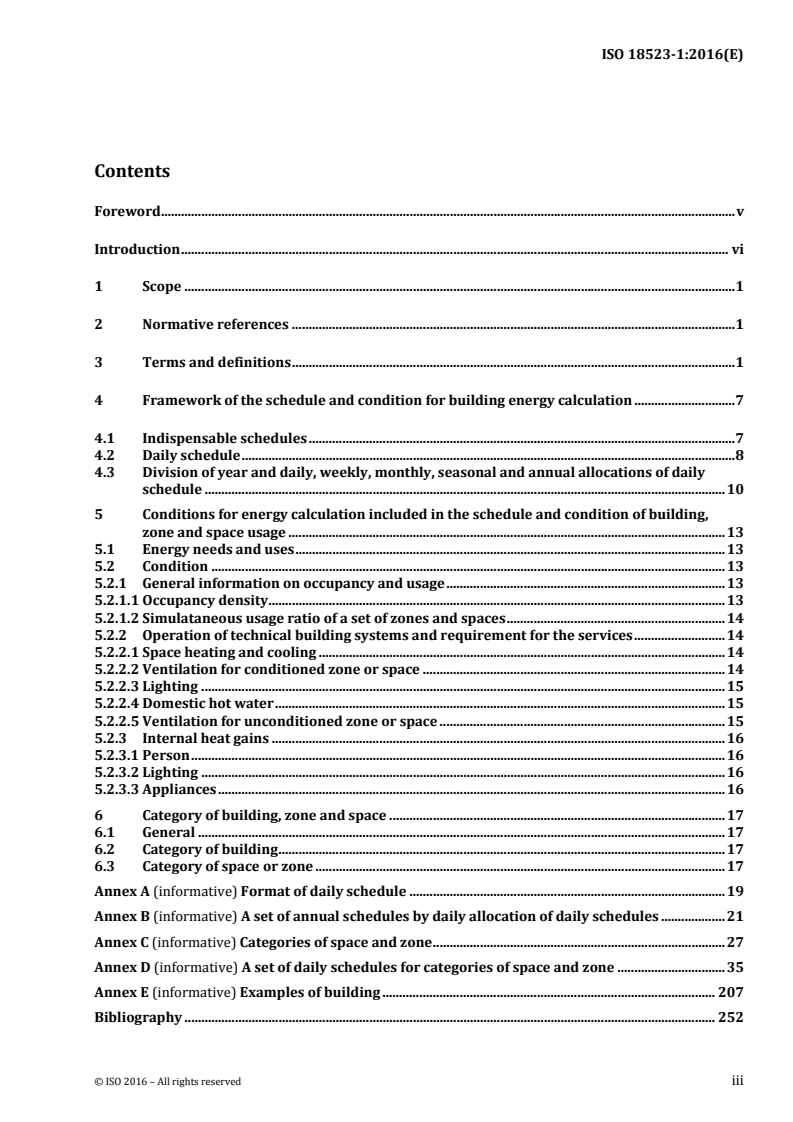
Contents
Foreword . v
Introduction . vi
1 Scope . 1
2 Normative references . 1
3 Terms and definitions . 1
4 Framework of the schedule and condition for building energy calculation . 7
4.1 Indispensable schedules . 7
4.2 Daily schedule . 8
4.3 Division of year and daily, weekly, monthly, seasonal and annual allocations of daily
schedule . 10
5 Conditions for energy calculation included in the schedule and condition of building,
zone and space usage . 13
5.1 Energy needs and uses . 13
5.2 Condition . 13
5.2.1 General information on occupancy and usage . 13
5.2.1.1 Occupancy density . 13
5.2.1.2 Simulataneous usage ratio of a set of zones and spaces . 14
5.2.2 Operation of technical building systems and requirement for the services . 14
5.2.2.1 Space heating and cooling . 14
5.2.2.2 Ventilation for conditioned zone or space . 14
5.2.2.3 Lighting . 15
5.2.2.4 Domestic hot water . 15
5.2.2.5 Ventilation for unconditioned zone or space . 15
5.2.3 Internal heat gains . 16
5.2.3.1 Person . 16
5.2.3.2 Lighting . 16
5.2.3.3 Appliances . 16
6 Category of building, zone and space . 17
6.1 General . 17
6.2 Category of building . 17
6.3 Category of space or zone . 17
Annex A (informative) Format of daily schedule . 19
Annex B (informative) A set of annual schedules by daily allocation of daily schedules . 21
Annex C (informative) Categories of space and zone . 27
Annex D (informative) A set of daily schedules for categories of space and zone . 35
Annex E (informative) Examples of building . 207
Bibliography . 252
© ISO 2016 – All rights reserved iii
iv © ISO 2016 – All rights reserved
Foreword
ISO (the International Organization for Standardization) is a worldwide federation of national
standards bodies (ISO member bodies). The work of preparing International Standards is normally
carried out through ISO technical committees. Each member body interested in a subject for which a
technical committee has been established has the right to be represented on that committee.
International organizations, governmental and non‐governmental, in liaison with ISO, also take part in
the work. ISO collaborates closely with the International Electrotechnical Commission (IEC) on all
matters of electrotechnical standardization.
The procedures used to develop this document and those intended for its further maintenance are
described in the ISO/IEC Directives, Part 1. In particular the different approval criteria needed for the
different types of ISO documents should be noted. This document was drafted in accordance with the
editorial rules of the ISO/IEC Directives, Part 2 (see www.iso.org/directives).
Attention is drawn to the possibility that some of the elements of this document may be the subject of
patent rights. ISO shall not be held responsible for identifying any or all such patent rights. Details of
any patent rights identified during the development of the document will be in the Introduction and/or
on the ISO list of patent declarations received (see www.iso.org/patents).
Any trade name used in this document is information given for the convenience of users and does not
constitute an endorsement.
For an explanation on the meaning of ISO specific terms and expressions related to conformity
assessment, as well as information about ISO's adherence to the World Trade Organization (WTO)
principles in the Technical Barriers to Trade (TBT) see the following
URL: www.iso.org/iso/foreword.html.
The committee responsible for this document is ISO/TC 163, Thermal Performance and energy use in the
built environment.
© ISO 2016 – All rights reserved v
Introduction
There is a strong need to improve the environment to make the evaluation of energy performance of
buildings more reliable and practical, so that energy efficiency of buildings is improved by referring to
the evaluation results. To realize such environment, one important standard on how to prescribe the
ways of using buildings has been missed, even though many assumptions on the building usage have
appeared in standards relevant to the energy calculation.
This document prescribes the indispensable information on the formats to express the usage of
building, zone and space in energy calculation for non‐residential buildings.
vi © ISO 2016 – All rights reserved
INTERNATIONAL STANDARD ISO 18523-1:2016(E)
Energy performance of buildings — Schedule and condition of
building, zone and space usage for energy calculation —
Part 1:
Non-residential buildings
1 Scope
This document specifies the formats to present schedule and condition of building, zone and space
usage, which is to be referred to as input data of energy calculations for non‐residential buildings.
The schedule and condition include schedules of occupancy, operation of technical building systems,
ventilation rate, hot water usage and internal heat gains due to occupancy, lighting and equipment.
This document also gives categories of building, zone and space according to differentiating schedule
and condition.
Depending on necessary minuteness of the energy calculation, different levels of schedule and condition
from the view point of time and space averaging are specified.
The values and categories for the schedule and condition are given in annexes for more information for
the application when the users of this document do not have detailed information on the values and
categories for the schedule and condition.
The schedule and condition in this document is basically different from assumptions in order to
determine the size of technical building systems in the process of design, where possible largest values
are to be assumed. Instead, most usual and average values, which are assumed for the building energy
calculation, are dealt with in this document.
2 Normative references
There are no normative references in this document.
3 Terms and definitions
For the purposes of this document, the following terms and definitions apply.
ISO and IEC maintain terminological databases for use in standardization at the following addresses:
• IEC Electropedia: available at http://www.electropedia.org/
• ISO Online browsing platform: available at http://www.iso.org/obp
3.1 Space
3.1.1
space
part of a room, a room or group of adjacent rooms with assumed uniform properties for all considered
types of zones (3.1.2)
© ISO 2016 – All rights reserved 1
3.1.2
zone
part of a building (3.1.3) consisting of (part of) one or more spaces with assumed uniform properties
related to a specific service or service component, or (in absence of a service) assumed uniform indoor
environmental conditions
3.1.3
building
construction as a whole, including its envelope and all technical building systems (3.3.5), where energy
is used to condition the indoor thermal environment and to provide domestic hot water, lighting
according to visual tasks and other services related to the use of the building
3.1.4
thermally conditioned space
thermally conditioned zone
heated and/or cooled space (3.1.1) or zone (3.1.2)
3.1.5
thermally unconditioned space
thermally unconditioned zone
space (3.1.1) or zone (3.1.2) that is not heated nor cooled
3.2 Schedule
3.2.1
schedule
information on condition(s) of usage of building (3.1.3), zone (3.1.2) or space (3.1.1) throughout a cycle
of period, such as day, week, month, season and year
3.2.2
daily schedule
conditions (3.3.1) of occupancy (3.3.2), service system operations, requirement for the functions of the
service systems and internal heat gains in each time of a day
3.2.3
daily schedule with hourly conditions
set of hourly conditions (3.3.1) of occupancy (3.3.2), service system operations, requirement for the
functions of the service systems and internal heat gains in a day
3.2.4
set of daily schedules
complete set of daily schedules representing usage of a category of building (3.1.3), zone (3.1.2) or space
(3.1.1) in one year
3.2.5
daily operating hours
hours when service system is operated or the length of the hours
3.2.6
annual operating hours
total length of hours in the standard year (3.2.15) when technical building system (3.3.5) is operated
2 © ISO 2016 – All rights reserved
3.2.7
annual schedule
allocation of daily schedule(s) (3.2.2) for one year
Note 1 to entry: Division of the year can be selected from 365 days, 53 weeks, 12 months, seasons or no division [a
set of daily schedules (3.2.4) is uniformly applied throughout the year].
3.2.8
seasonal schedule
allocation of daily schedule(s) (3.2.2) to each season of the year
3.2.9
monthly schedule
allocation of daily schedule(s) (3.2.2) to each month of the year
3.2.10
weekly schedule
allocation of daily schedule(s) (3.2.2) to each week of the year
3.2.11
whole set of annual schedules
complete set of annual schedules (3.2.7) representing usage of all types of building (3.1.3), zone (3.1.2)
and space (3.1.1), as objects of energy calculation (3.3.20)
3.2.12
whole set of seasonal schedules
complete set of seasonal schedules (3.2.8) representing usage of all types of building (3.1.3), zone (3.1.2)
and space (3.1.1), as objects of energy calculation (3.3.20)
3.2.13
whole set of monthly schedules
complete set of monthly schedules (3.2.9) representing usage of all types of building (3.1.3), zone (3.1.2)
and space (3.1.1), as objects of energy calculation (3.3.20)
3.2.14
number of days in one year
total number of days, which shall be 365
3.2.15
standard year
selected year, of which number of day has to be 365 and arrangement of weekdays, weekends and
holidays are referred in weekly, monthly, seasonal and annual schedules (3.2.7)
3.3 Parameters for conditions of building, zone and space usage
3.3.1
condition
status of occupancy (3.3.2), operation of service systems, requirement for the functions of the technical
building systems (3.3.5) and internal heat gains
3.3.2
occupancy
presence of users in building (3.1.3), zone (3.1.2) or space (3.1.1)
© ISO 2016 – All rights reserved 3
3.3.3
occupancy density
number of present user in building (3.1.3), zone (3.1.2) or space per unit floor area of the space (3.1.1)
Note 1 to entry: Occupancy density is used mainly for the calculations for space heating/cooling and ventilation.
3.3.4
simultaneous usage ratio (of a set of spaces)
ratio of the number of zones (3.1.2) or spaces (3.1.1), which belong to a group of zones and spaces and
are occupied or used at the time, to the total number of zones or spaces in the group
Note 1 to entry: This concept is applied to a group of zones or spaces of the same category, such as a group of
guest rooms in hotels, a series of personal office rooms in office buildings, etc.
3.3.5
technical building system
all energy‐using or energy‐distributing components in a building (3.1.3) that are operated to support
the occupant or process functions housed therein
Note 1 to entry: These include HVAC, domestic hot water, illumination, transportation, laundering or similar
functions.
3.3.6
luminaire
apparatus which distributes, filters or transforms the light transmitted from one or more lamps
Note 1 to entry: Except for the lamps themselves, all the parts necessary for fixing and protecting the lamps and,
where necessary, circuit auxiliaries together with the means for connecting them to the electric supply
[SOURCE: CIE S 017/E: 2011, 17–707]
3.3.7
in operation
status of a technical building system (3.3.5), in which the technical building system can function to
satisfy the requirement for the technical building system, such as the set‐point temperature and the
maintained average illuminance (3.3.9)
Note 1 to entry: When the requirement is satisfied without its functioning, the technical building system stands by.
3.3.8
out of operation
status of a technical building system (3.3.5) in which the technical building system cannot function
regardless of the relevant requirement or due to inexistence of any requirement for the technical
building system
3.3.9
maintained average illuminance
value below which the average illuminance over the specified surface is not allowed to fall, lux
[SOURCE: CIE S 017/E: 2011, 17–750]
4 © ISO 2016 – All rights reserved
3.3.10
height of the working plane
height of the plane, on which the assumed visual task is done, from the floor
Note 1 to entry: It is expressed in metres (m).
3.3.11
demand control ventilation
ventilation, of which rate is controlled according to the necessity of the ventilation, such as to the
emission rate of target pollutant
3.3.12
energy need for space heating and cooling
heat to be delivered to or extracted from a conditioned space (3.1.1) to maintain the intended
temperature and/or humidity conditions during a given period of time
3.3.13
energy use for space heating and cooling
energy input to the heating and cooling system to satisfy the energy need for space heating and cooling
(3.3.12)
3.3.14
energy need for ventilation for outdoor air supply
work by electric motors to convey outdoor air to satisfy ventilation requirement
3.3.15
energy use for ventilation for outdoor air supply
energy input to the ventilation system to satisfy the energy need for ventilation for outdoor air supply
(3.3.14)
3.3.16
energy need for domestic hot water
heat to be delivered to the needed amount of domestic hot water to raise its temperature from the cold
network temperature to the prefixed delivery temperature at the delivery point
3.3.17
energy use for domestic hot water
energy input to the domestic hot water system to satisfy the energy need for domestic hot water (3.3.16)
3.3.18
energy use for lighting
energy consumed by luminaires (3.3.6) and lamps
3.3.19
energy use for transportation
energy consumed by equipment for transportation, such as elevators
3.3.20
energy calculation
calculation of energy uses for technical building systems (3.3.5)
© ISO 2016 – All rights reserved 5
3.4 Descriptions for daily schedule
3.4.1
reference ventilation requirement
most probable estimation of outdoor air supply (in volume flow rate per unit floor area or in air change
per hour) to the space (3.1.1) or zone (3.1.2) in compliance with relevant regulation
3.4.2
reference domestic hot water usage
maximum hourly service hot water usage by users of the space (3.1.1) or zone (3.1.2) in volume flow
rate per person, in volume flow rate per unit floor area or in volume flow rate per bed
Note 1 entry: The volume flow rate is calculated with the assumption on hot water temperature.
3.4.3
total daily usage of domestic hot water
total volume of service hot water usage in one day in volume per person, in volume per unit floor area
or in volume per bed
Note 1 entry: The volume flow rate is calculated with the assumption on hot water temperature.
3.4.4
reference occupancy density
maximum hourly occupancy density (3.3.3) of the space (3.1.1) or zone (3.1.2) in person per unit floor
area
Note 1 to entry: To be multiplied by hourly ratios (3.4.12), occupancy density at the time can be calculated.
3.4.5
reference heat gain due to person
maximum hourly total (sensitive and latent) heat gain due to person inside the room or zone (3.1.2) in
watt per unit floor area
Note 1 to entry: To be multiplied by hourly ratios (3.4.12), heat gain due to person at the time can be calculated.
3.4.6
reference sensible heat gain due to person
maximum hourly sensible heat gain due to person inside the room or zone (3.1.2) in watt per unit floor
area
Note 1 to entry: To be multiplied by hourly ratios (3.4.12), sensible heat gain due to person at the time can be
calculated.
3.4.7
reference latent heat gain due to person
maximum hourly latent heat gain due to person inside the room or zone (3.1.2) in watt per unit floor
area
Note 1 to entry: To be multiplied by hourly ratios (3.4.12), latent heat gain due to person at the time can be
calculated.
6 © ISO 2016 – All rights reserved
3.4.8
reference heat gain due to lighting
maximum hourly sensible heat gain due to lighting inside the room or zone (3.1.2) in watt per unit floor
area
Note 1 to entry: To be multiplied by hourly ratios, heat gain due to lighting at the time can be calculated.
3.4.9
reference heat gain due to appliances
maximum hourly total (sensible and latent) heat gain due to appliances inside the room or zone (3.1.2)
in watt per unit floor area
Note 1 to entry: To be multiplied by hourly ratios (3.4.12), heat gain due to appliances at the time can be
calculated.
3.4.10
reference sensible heat gain due to appliances
maximum hourly sensible heat gain due to appliances inside the room or zone (3.1.2) in watt per unit
floor area
Note 1 to entry: To be multiplied by hourly ratios (3.4.12), sensible heat gain due to appliances at the time can be
calculated.
3.4.11
reference latent heat gain due to appliances
maximum hourly latent heat gain due to appliances inside the room or zone (3.1.2) in watt per unit floor
area
Note 1 to entry: To be multiplied by hourly ratios (3.4.12), latent heat gain due to appliances at the time can be
calculated.
3.4.12
hourly ratio
ratio of hourly value of parameters to their reference value
Note 1 to entry: Multiplying hourly ratios by the reference value, hourly values of the parameter can be calculated.
4 Framework of the schedule and condition for building energy calculation
4.1 Indispensable schedules
The building energy calculations are characterized by the division number of the year, the calculation
period or the calculation interval. Each calculation method has its appropriate calculation interval
according to characteristics of the target physical phenomenon (for example, unsteadiness) and
minuteness of the calculation responding to changes of climatic condition, occupants’ behaviour,
behaviour of service systems and so on.
Due to the variety of calculation method, there is a variety of form of the schedule and condition of
building, zone and space usage. Nevertheless, there is a fundamental unit of form, daily schedule, which
shall be included in forms for the schedule and condition. The daily schedule corresponds to the
minimum cycle of building, zone and space usage, and also of climatic and solar condition.
Some nations adopt so called “monthly calculation” for space heating and cooling energy needs and
uses, taking monthly variation of outdoor temperature and solar irradiance into consideration. One
daily schedule for business day and the number of the business days is given to each month for each
type of building, zone and space. Monthly means of outdoor air condition (for example, temperature)
© ISO 2016 – All rights reserved 7
and solar irradiance for different orientations and inclinations are given for the calculation. The
expression of the daily schedule varies from detailed expression with hourly values to simplified
expression such as daily mean values and the like. Additional schedule for closing day can be given in a
simplified way such as only with daily mean values.
Similarly, in so called “seasonal calculation”, one daily schedule for business day and the number of the
business days for each season are given to each season for each type of building, zone and space, and
the calculation is done with seasonal mean values for climatic condition.
For the calculation of more steady phenomena, so called “annual calculation” can work if seasonal
change of solar condition is integrated throughout the year and condensed in specific coefficients.
Nevertheless, one daily schedule for business day and the number of annual business days are
necessary. Additional daily schedule for closing day can be given.
For the calculation of lighting, monthly or yearly calculation is mainly used, but unsteady aspects of
lighting still can be dealt with. In the calculation for lighting, when input parameters such as operating
hours with and without daylight are prescribed, daily schedule as described in the column (2) of Table 1
and annual schedule by monthly allocation of daily schedules (Table 5) or annual schedule without
division of the year (Table 7) should be explicitly given, so that the operating hours for light is well
harmonized with those for other technical systems.
Therefore, for each category of building, zone and space, necessary number of daily schedules (e.g. two
daily schedules for business day and closing day), and one of annual, seasonal, monthly and weekly
schedules shall be given in order that the daily schedules are allocated for the year.
4.2 Daily schedule
The daily schedule shall contain hourly values of condition for one day or shall contain condensed or
simplified information on conditions for the day. With some assumptions, the hourly detailed values can
be generated from condensed or simplified information and used even for detailed calculation. If
necessary, multiple daily schedules representing different daily patterns of usage should be given such
as for weekdays, weekends and holidays. The number of daily schedules depends on minuteness of the
schedule and condition, as well as on the category of building, zone and space under consideration.
The conditions described in the daily schedule are grouped into the following three categories:
a) general information on occupancy and usage of building, zone and space;
b) operation of technical building systems and requirement for their services;
c) internal heat gains.
The basic structure of daily schedule is shown in Table 1.
8 © ISO 2016 – All rights reserved
Table 1 — Framework of daily schedule for building, zone or space
(1) description by hourly (2) condensed or simplified
Parameters and their categories
values for 0 h to 24 h description
a) General Occupancy density Hourly occupancy density Times of start and end of
information on occupancy or total hours of
occupancy and occupancy, and average occupancy
usage density during usage
Simultaneous Hourly simultaneous usage Mean simultaneous usage ratio
usage ratio of a set ratio during usage
of rooms
b) Operation of Space heating Hourly status of space heating Times of start and end of operation,
technical and/or cooling and/or cooling system (in or or total hours of operation
building systems out of operation)
and requirement
Hourly set‐points of room Set‐point temperature and/or
for their building
temperature and/or humidity humidity during operation, and/or
services
information on set‐back operation
Ventilation for Hourly status of ventilation Times of start and end of operation,
thermally system (in or out of operation) or total hours of operation
conditioned zone
Hourly ventilation requirement Ventilation requirement during
or space
operation
Lighting Hourly status of lighting system Times of start and end of operation,
(in or out of operation) or total hours of operation
Maintained average illuminance Maintained average illuminance
and height of working plane and height of working plane
Domestic hot Hourly status of domestic hot Times of start and end of operation,
water water system or total hours of operation
Hourly service hot water usage Daily total hot water usage
Ventilation for Hourly ventilation requirement Ventilation requirement
thermally
Set‐point of room temperature Set‐point of room temperature
unconditioned
(upper limit) (upper limit)
zone or space
c) Internal Person (watt per Hourly heat gains Times of start and end of
heat gains unit floor area) occupancy or total hours of
(sensitive occupancy
and/or latent)
Average heat gains during
occupancy
Lighting (watt per Hourly heat gains Times of start and end of lighting
unit floor area) or total hours of lighting
Average heat gain during operation
Appliances (watt Hourly heat gains Times of start and end of use of
per unit floor appliances or total hours of the
area) usage
Average heat gain during usage
© ISO 2016 – All rights reserved 9
4.2.1 General information on occupancy and usage
The principal parameter for the general information on occupancy and usage is the occupancy density.
It can be given hourly in the day if detailed daily schedule is necessary. In such case, as shown in
examples of the daily schedules in Annex D, the reference occupancy density and hourly ratios can be
used to give hourly occupancy densities.
4.2.2 Operation of technical building systems and requirement for their building services
Daily schedules of operation of technical building systems and of requirement for those (e.g. room
temperature and/or humidity, ventilation requirement, lighting requirements) shall be given hourly in
the day if detailed daily schedule is necessary. The combination of reference ventilation requirement or
reference domestic hot water and hourly ratios can be used to give hourly schedules.
The operational status of technical building systems can be described as “in operation” or “out of
operation”. “In operation” is defined as the status in which the technical building system can function to
satisfy the requirement for the system. When the requirement is satisfied without its functioning, the
technical building system stands by. On the contrary, “out of operation” is defined as the status in which
the technical building system cannot function regardless of the relevant requirement. Instead of giving
the status hourly, the times of start and end can be given or the total hours of daily operation can be
given as condensed or simplified description.
4.2.3 Internal heat gains
Daily schedules of internal heat gains shall be given hourly in the day if detailed daily schedule is
necessary. The combination of reference heat gains such as reference heat gain due to person and
hourly ratios can be used to give hourly schedules.
4.3 Division of year and daily, weekly, monthly, seasonal and annual allocations of daily
schedules
The standard year shall be the year 2015, which has 365 days. Since national holidays and working days
for buildings differs in nations and states, annual schedules can be determined on a national basis, even
though there is a need for any common annual schedule patterns for research purposes. The annual
schedule given in Annex B can be used as such a common annual schedule with daily 365 divisions. The
basic structures of the annual schedule are shown in Table 2.
10 © ISO 2016 – All rights reserved
Table 2 — Annual schedules with different divisions of the year
(1) Daily 365 divisions
The standard year
1 2 3 4 5 6 7 8 ⋅⋅⋅ 358 359 360 361 362 363 364 365
(2) Weekly 53 divisions
The standard year
1 2 3 4 ⋅⋅⋅ 50 51 52 53
(3) Monthly 12 divisions
The standard year
January February March ⋅⋅⋅ October November December
(4) Seasonal 3 divisions
The standard year
Winter Medium Summer Medium Winter
(5) No division of the year
The standard year
Common set of daily schedules throughout the year
The annual schedule shall be made by allocating one of daily schedules to each day or a set of daily
schedules to each week, month or season. Each week, month and season can contain different daily
schedules such as for weekdays and the rest. If there is no need to divide the year, a set of daily
schedules shall be allocated to the whole year without division. For example, for an indoor parking
garage, a set of daily schedules of ventilation and lighting for each of business day and closing day is
specified with numbers of the days as the annual schedule. Structures of the annual schedules by daily,
weekly, monthly, seasonal and yearly allocation are prescribed in Table 3, Table 4, Table 5, Table 6 and
Table 7, respectively.
Table 3 — Annual schedule by daily allocation of daily schedules
(daily schedule allocation is exemplified)
Date #1 #2 #3 #4 #5 #6 #7 #8 #9 #10 #11 #12 #13 #14 ⋅⋅⋅
January
1st 2nd 3rd 4th 5th 6th 7th 8th 9th 10th 11th 12th 13th 14th
⋅⋅⋅
Th. Fr. Sa. Su. Mo. Tu. We. Th. Fr. Sa. Su. Mo. Tu. We.
Daily
c c c c a a a a a b c a a a ⋅⋅⋅
schedule
The daily schedules a, b and c are allocated to weekdays except for Saturdays and Sundays/holidays, respectively.
© ISO 2016 – All rights reserved 11
Table 4 — Annual schedule by weekly allocation of daily schedules
(daily schedule allocation is exemplified)
#1 #2 #3 #4 #5 #6 #7 #8 #9 #10 #11 #12 ⋅⋅⋅
Week
Jan. 26th 16th 23rd 16th
5th 12th 19th 2nd 9th 2nd 9th
1st to to to to
Daily
to to to to to to to ⋅⋅⋅
to Feb. 22n Mar. 22n
schedule 11th 18th 25th 8th 15th 8th 15th
4th 1st d 1st d
a 0 5 4 5 5 5 4 5 5 5 5 5 ⋅⋅⋅
b 0 1 1 1 1 1 1 1 1 1 1 0 ⋅⋅⋅
c 4 1 2 1 1 1 2 1 1 1 1 2 ⋅⋅⋅
Total number of
4 7 7 7 7 7 7 7 7 7 7 7 ⋅⋅⋅
days
The daily schedules a, b and c are allocated to weekdays except for Saturdays, Saturdays and Sundays/holidays, respectively.
Table 5 — Annual schedule by monthly allocation of daily schedules
(daily schedule allocation is exemplified)
Month
Jan. Feb. Mar. Apr. May Jun. Jul. Aug. Sep. Oct. Nov. Dec. Total
Daily
schedule
a 19 19 22 21 19 22 22 21 19 21 20 19 244
b 4 4 3 4 4 4 4 5 4 5 4 4 49
c 8 5 6 5 8 4 5 5 7 5 6 8 72
Total number of
31 28 31 30 31 30 31 31 30 31 30 31 365
days
The daily schedules a, b and c are allocated to weekdays except for Saturdays, Saturdays and Sundays/holidays, respectively.
Table 6 — Annual schedule by seasonal allocation of daily schedules
(daily schedule allocation is exemplified)
Season
Winter Intermediate Summer Total
Daily schedule
a n n n 244 (=n + n + n )
W1 M1 S1 W1 M1 S1
b n n n 49 (=n + n + n )
W2 M2 S2 W2 M2 S2
c n n n 72 (=n + n + n )
W3 M3 S3 W2 M2 S2
Total number of
n + n + n n + n + n n + n + n 365
W1 W2 W3 M1 M2 M3 S1 S2 S3
days
The daily schedules a, b and c are allocated to weekdays except for Saturdays, Saturdays and Sundays/holidays,
respectively.
12 © ISO 2016 – All rights reserved
Table 7 — Annual schedule without division of the year
(daily schedule allocation is exemplified)
Daily schedule Total
a 244
b 49
c 72
Total number of days 365
The daily schedules a, b and c are allocated to
weekdays except for Saturdays, Saturdays and
Sundays/holidays, respectively.
5 Conditions for energy calculation included in the schedule and condition of
building, zone and space usage
5.1 Energy needs and uses
In this document, input parameters for the calculation of the following energy needs and uses are dealt
with.
a) Energy need and use for space heating and cooling.
b) Energy need and use for ventilation for outdoor air supply for conditioned and unconditioned zone
or space.
c) Energy use for lighting.
d) Energy need and use for domestic hot water.
e) Energy use for transportation (i.e. elevators).
5.2 Condition
5.2.1 General information on occupancy and usage
5.2.1.1 Occupancy density
The occupancy density is directly or indirectly related to energy uses of technical building systems, such
as of space heating and cooling, ventilation, lighting, domestic hot water and transportation in the
building. It also represents unused status of the space by zero occupancy density. Total number of
occupants can be calculated by multiplying the occupancy density by the floor area of the space, of
which prescription should be dealt with by calculation methods standardized by other standards.
The occupancy density shall be assumed and given by taking the correlation with relevant conditions
such as hourly status or hours of space heating and cooling, ventilation, lighting and domestic hot water,
as well as with hourly status or hours of internal heat gains.
For lighting, other parameters for occupancy such as the absence factor may be added, but such
parameters relevant to the occupancy should be well coordinated without contradiction.
NOTE The occupancy‐relevant parameter for lighting is given in ISO 20086.
© ISO 2016 – All rights reserved 13
5.2.1.2 Simultaneous usage ratio of a set of zones or spaces
This parameter is not always necessary, but is useful when there is a group of zones or spaces of the
same category and characteristics and the utilization rate of the group is not always full. Demands for
technical building systems are to be reduced by the simultaneous usage ratio.
5.2.2 Operation of technical building systems and requirement for their services
5.2.2.1 Space heating and cooling
As operational conditions for space heating and cooling, status of the space heating and/or cooling
system (in or out of operation) and indoor environmental set‐points (temperature and/or humidity)
shall be given.
There can be different indoor environmental set‐points for a building, zone and space. They
differentiate due to seasons (heating, cooling, intermediate and so on), daily usage (business day,
closing day and so on) and set‐back operation such as for during night. The condition for the set‐point
shall be given in a schedule by referring to the table for the set‐point patterns, as shown in Table 8. If
the set‐point pattern can be allocated to any part of the year without calculations, periods shall be
determined and be specified in the table for each of set‐point patterns. If the set‐point patterns depend
on climatic condition in each day, week and month, determination of the set‐point patterns shall be
done as a part of the energy calculation.
Table 8 — Set-point patterns (symbols, values and notes are exemplified)
During normal operation During set-back operation
Symbol of
Note for set-back
Indoor set- Indoor set- Indoor set-
set-point
Indoor set-point
operation
point point relative point
pattern
relative humidity
temperature humidity temperature
w1 22 °C 40 % — — —
w2 22 °C — — — —
s1 26 °C 50 % — — —
m1 24 °C 50 % — — —
5.2.2.2 Ventilation for thermally conditioned zone or space
The ventilation (outdoor air supply) for thermally conditioned zones or spaces has an influence on the
energy needs for space heating and cooling, as well as the energy use for mechanical ventilation. Status
of the ventilation system (in or out of service) shall be given in the schedule or it shall be assumed to be
the same as space heating and/or cooling system operation. As for ventilation rate during the operation,
there are two ways how to estimate the amount of outdoor air supply, as follows.
a) Estimation by regulated ventilation requirement of the building, zone and space, which can be
defined as per unit floor area or per occupant. The requirement can also be described by acceptable
concentration of target gas. If the requirement per occupant or by the acceptable concentration of
the target gas is adopted, capacity of occupants of the zone or space, which has to be equal to or
larger than the reference occupancy density, shall be assumed. This way is possible even before
fixing detailed specifications of the ventilation system of the space.
b) Estimation by designed air flow rate of the target building, zone and space, which is to be confirmed
by design calculation based on the specifications of adopted ventilation components. The design
value of the ventilation rate can be used, if the value shall be confirmed later in more detailed
design stage of the building and technical building system.
14 © ISO 2016 – All rights reserved
In the energy calculation, when demand control ventilation or any other techniques to control
ventilation rate is considered, the above‐mentioned estimated amount of outdoor air can be adjusted by
taking relevant parameters (e.g. schedule of occupancy density, outdoor temperature and/or humidity)
into consideration.
In the calculation of energy use of the ventilation system, electric power of the designed system is used,
or assumptions on the efficiency of the system, such as a specific fan power, are used with the
ventilation rate.
5.2.2.3 Lighting
The status of the lighting system (in or out of operation) shall be given in the schedule. The status shall
be coordinated with the occupancy of the zone or space, but they are not necessarily the same.
If the effect of dimming control for daylight utilization or any other lighting control methods are
considered, the operation and electric power is adjusted by taking the specification of the control
system and space configuration into consideration.
The energy use for lighting can be estimated by using the duration of the operation and the e
...
INTERNATIONAL ISO
STANDARD 18523-1
First edition
2016-11-15
Energy performance of buildings —
Schedule and condition of building,
zone and space usage for energy
calculation —
Part 1:
Non-residential buildings
Performance énergétique des bâtiments — Plan et conditions
d’utilisation des espaces, zones et bâtiments pour le calcul
d’énergie —
Partie 1: Bâtiments non résidentiels
Reference number
©
ISO 2016
© ISO 2016, Published in Switzerland
All rights reserved. Unless otherwise specified, no part of this publication may be reproduced or utilized otherwise in any form
or by any means, electronic or mechanical, including photocopying, or posting on the internet or an intranet, without prior
written permission. Permission can be requested from either ISO at the address below or ISO’s member body in the country of
the requester.
ISO copyright office
Ch. de Blandonnet 8 • CP 401
CH-1214 Vernier, Geneva, Switzerland
Tel. +41 22 749 01 11
Fax +41 22 749 09 47
copyright@iso.org
www.iso.org
ii © ISO 2016 – All rights reserved
Contents
Foreword . v
Introduction . vi
1 Scope . 1
2 Normative references . 1
3 Terms and definitions . 1
4 Framework of the schedule and condition for building energy calculation . 7
4.1 Indispensable schedules . 7
4.2 Daily schedule . 8
4.3 Division of year and daily, weekly, monthly, seasonal and annual allocations of daily
schedule . 10
5 Conditions for energy calculation included in the schedule and condition of building,
zone and space usage . 13
5.1 Energy needs and uses . 13
5.2 Condition . 13
5.2.1 General information on occupancy and usage . 13
5.2.1.1 Occupancy density . 13
5.2.1.2 Simulataneous usage ratio of a set of zones and spaces . 14
5.2.2 Operation of technical building systems and requirement for the services . 14
5.2.2.1 Space heating and cooling . 14
5.2.2.2 Ventilation for conditioned zone or space . 14
5.2.2.3 Lighting . 15
5.2.2.4 Domestic hot water . 15
5.2.2.5 Ventilation for unconditioned zone or space . 15
5.2.3 Internal heat gains . 16
5.2.3.1 Person . 16
5.2.3.2 Lighting . 16
5.2.3.3 Appliances . 16
6 Category of building, zone and space . 17
6.1 General . 17
6.2 Category of building . 17
6.3 Category of space or zone . 17
Annex A (informative) Format of daily schedule . 19
Annex B (informative) A set of annual schedules by daily allocation of daily schedules . 21
Annex C (informative) Categories of space and zone . 27
Annex D (informative) A set of daily schedules for categories of space and zone . 35
Annex E (informative) Examples of building . 207
Bibliography . 252
© ISO 2016 – All rights reserved iii
iv © ISO 2016 – All rights reserved
Foreword
ISO (the International Organization for Standardization) is a worldwide federation of national
standards bodies (ISO member bodies). The work of preparing International Standards is normally
carried out through ISO technical committees. Each member body interested in a subject for which a
technical committee has been established has the right to be represented on that committee.
International organizations, governmental and non‐governmental, in liaison with ISO, also take part in
the work. ISO collaborates closely with the International Electrotechnical Commission (IEC) on all
matters of electrotechnical standardization.
The procedures used to develop this document and those intended for its further maintenance are
described in the ISO/IEC Directives, Part 1. In particular the different approval criteria needed for the
different types of ISO documents should be noted. This document was drafted in accordance with the
editorial rules of the ISO/IEC Directives, Part 2 (see www.iso.org/directives).
Attention is drawn to the possibility that some of the elements of this document may be the subject of
patent rights. ISO shall not be held responsible for identifying any or all such patent rights. Details of
any patent rights identified during the development of the document will be in the Introduction and/or
on the ISO list of patent declarations received (see www.iso.org/patents).
Any trade name used in this document is information given for the convenience of users and does not
constitute an endorsement.
For an explanation on the meaning of ISO specific terms and expressions related to conformity
assessment, as well as information about ISO's adherence to the World Trade Organization (WTO)
principles in the Technical Barriers to Trade (TBT) see the following
URL: www.iso.org/iso/foreword.html.
The committee responsible for this document is ISO/TC 163, Thermal Performance and energy use in the
built environment.
© ISO 2016 – All rights reserved v
Introduction
There is a strong need to improve the environment to make the evaluation of energy performance of
buildings more reliable and practical, so that energy efficiency of buildings is improved by referring to
the evaluation results. To realize such environment, one important standard on how to prescribe the
ways of using buildings has been missed, even though many assumptions on the building usage have
appeared in standards relevant to the energy calculation.
This document prescribes the indispensable information on the formats to express the usage of
building, zone and space in energy calculation for non‐residential buildings.
vi © ISO 2016 – All rights reserved
INTERNATIONAL STANDARD ISO 18523-1:2016(E)
Energy performance of buildings — Schedule and condition of
building, zone and space usage for energy calculation —
Part 1:
Non-residential buildings
1 Scope
This document specifies the formats to present schedule and condition of building, zone and space
usage, which is to be referred to as input data of energy calculations for non‐residential buildings.
The schedule and condition include schedules of occupancy, operation of technical building systems,
ventilation rate, hot water usage and internal heat gains due to occupancy, lighting and equipment.
This document also gives categories of building, zone and space according to differentiating schedule
and condition.
Depending on necessary minuteness of the energy calculation, different levels of schedule and condition
from the view point of time and space averaging are specified.
The values and categories for the schedule and condition are given in annexes for more information for
the application when the users of this document do not have detailed information on the values and
categories for the schedule and condition.
The schedule and condition in this document is basically different from assumptions in order to
determine the size of technical building systems in the process of design, where possible largest values
are to be assumed. Instead, most usual and average values, which are assumed for the building energy
calculation, are dealt with in this document.
2 Normative references
There are no normative references in this document.
3 Terms and definitions
For the purposes of this document, the following terms and definitions apply.
ISO and IEC maintain terminological databases for use in standardization at the following addresses:
• IEC Electropedia: available at http://www.electropedia.org/
• ISO Online browsing platform: available at http://www.iso.org/obp
3.1 Space
3.1.1
space
part of a room, a room or group of adjacent rooms with assumed uniform properties for all considered
types of zones (3.1.2)
© ISO 2016 – All rights reserved 1
3.1.2
zone
part of a building (3.1.3) consisting of (part of) one or more spaces with assumed uniform properties
related to a specific service or service component, or (in absence of a service) assumed uniform indoor
environmental conditions
3.1.3
building
construction as a whole, including its envelope and all technical building systems (3.3.5), where energy
is used to condition the indoor thermal environment and to provide domestic hot water, lighting
according to visual tasks and other services related to the use of the building
3.1.4
thermally conditioned space
thermally conditioned zone
heated and/or cooled space (3.1.1) or zone (3.1.2)
3.1.5
thermally unconditioned space
thermally unconditioned zone
space (3.1.1) or zone (3.1.2) that is not heated nor cooled
3.2 Schedule
3.2.1
schedule
information on condition(s) of usage of building (3.1.3), zone (3.1.2) or space (3.1.1) throughout a cycle
of period, such as day, week, month, season and year
3.2.2
daily schedule
conditions (3.3.1) of occupancy (3.3.2), service system operations, requirement for the functions of the
service systems and internal heat gains in each time of a day
3.2.3
daily schedule with hourly conditions
set of hourly conditions (3.3.1) of occupancy (3.3.2), service system operations, requirement for the
functions of the service systems and internal heat gains in a day
3.2.4
set of daily schedules
complete set of daily schedules representing usage of a category of building (3.1.3), zone (3.1.2) or space
(3.1.1) in one year
3.2.5
daily operating hours
hours when service system is operated or the length of the hours
3.2.6
annual operating hours
total length of hours in the standard year (3.2.15) when technical building system (3.3.5) is operated
2 © ISO 2016 – All rights reserved
3.2.7
annual schedule
allocation of daily schedule(s) (3.2.2) for one year
Note 1 to entry: Division of the year can be selected from 365 days, 53 weeks, 12 months, seasons or no division [a
set of daily schedules (3.2.4) is uniformly applied throughout the year].
3.2.8
seasonal schedule
allocation of daily schedule(s) (3.2.2) to each season of the year
3.2.9
monthly schedule
allocation of daily schedule(s) (3.2.2) to each month of the year
3.2.10
weekly schedule
allocation of daily schedule(s) (3.2.2) to each week of the year
3.2.11
whole set of annual schedules
complete set of annual schedules (3.2.7) representing usage of all types of building (3.1.3), zone (3.1.2)
and space (3.1.1), as objects of energy calculation (3.3.20)
3.2.12
whole set of seasonal schedules
complete set of seasonal schedules (3.2.8) representing usage of all types of building (3.1.3), zone (3.1.2)
and space (3.1.1), as objects of energy calculation (3.3.20)
3.2.13
whole set of monthly schedules
complete set of monthly schedules (3.2.9) representing usage of all types of building (3.1.3), zone (3.1.2)
and space (3.1.1), as objects of energy calculation (3.3.20)
3.2.14
number of days in one year
total number of days, which shall be 365
3.2.15
standard year
selected year, of which number of day has to be 365 and arrangement of weekdays, weekends and
holidays are referred in weekly, monthly, seasonal and annual schedules (3.2.7)
3.3 Parameters for conditions of building, zone and space usage
3.3.1
condition
status of occupancy (3.3.2), operation of service systems, requirement for the functions of the technical
building systems (3.3.5) and internal heat gains
3.3.2
occupancy
presence of users in building (3.1.3), zone (3.1.2) or space (3.1.1)
© ISO 2016 – All rights reserved 3
3.3.3
occupancy density
number of present user in building (3.1.3), zone (3.1.2) or space per unit floor area of the space (3.1.1)
Note 1 to entry: Occupancy density is used mainly for the calculations for space heating/cooling and ventilation.
3.3.4
simultaneous usage ratio (of a set of spaces)
ratio of the number of zones (3.1.2) or spaces (3.1.1), which belong to a group of zones and spaces and
are occupied or used at the time, to the total number of zones or spaces in the group
Note 1 to entry: This concept is applied to a group of zones or spaces of the same category, such as a group of
guest rooms in hotels, a series of personal office rooms in office buildings, etc.
3.3.5
technical building system
all energy‐using or energy‐distributing components in a building (3.1.3) that are operated to support
the occupant or process functions housed therein
Note 1 to entry: These include HVAC, domestic hot water, illumination, transportation, laundering or similar
functions.
3.3.6
luminaire
apparatus which distributes, filters or transforms the light transmitted from one or more lamps
Note 1 to entry: Except for the lamps themselves, all the parts necessary for fixing and protecting the lamps and,
where necessary, circuit auxiliaries together with the means for connecting them to the electric supply
[SOURCE: CIE S 017/E: 2011, 17–707]
3.3.7
in operation
status of a technical building system (3.3.5), in which the technical building system can function to
satisfy the requirement for the technical building system, such as the set‐point temperature and the
maintained average illuminance (3.3.9)
Note 1 to entry: When the requirement is satisfied without its functioning, the technical building system stands by.
3.3.8
out of operation
status of a technical building system (3.3.5) in which the technical building system cannot function
regardless of the relevant requirement or due to inexistence of any requirement for the technical
building system
3.3.9
maintained average illuminance
value below which the average illuminance over the specified surface is not allowed to fall, lux
[SOURCE: CIE S 017/E: 2011, 17–750]
4 © ISO 2016 – All rights reserved
3.3.10
height of the working plane
height of the plane, on which the assumed visual task is done, from the floor
Note 1 to entry: It is expressed in metres (m).
3.3.11
demand control ventilation
ventilation, of which rate is controlled according to the necessity of the ventilation, such as to the
emission rate of target pollutant
3.3.12
energy need for space heating and cooling
heat to be delivered to or extracted from a conditioned space (3.1.1) to maintain the intended
temperature and/or humidity conditions during a given period of time
3.3.13
energy use for space heating and cooling
energy input to the heating and cooling system to satisfy the energy need for space heating and cooling
(3.3.12)
3.3.14
energy need for ventilation for outdoor air supply
work by electric motors to convey outdoor air to satisfy ventilation requirement
3.3.15
energy use for ventilation for outdoor air supply
energy input to the ventilation system to satisfy the energy need for ventilation for outdoor air supply
(3.3.14)
3.3.16
energy need for domestic hot water
heat to be delivered to the needed amount of domestic hot water to raise its temperature from the cold
network temperature to the prefixed delivery temperature at the delivery point
3.3.17
energy use for domestic hot water
energy input to the domestic hot water system to satisfy the energy need for domestic hot water (3.3.16)
3.3.18
energy use for lighting
energy consumed by luminaires (3.3.6) and lamps
3.3.19
energy use for transportation
energy consumed by equipment for transportation, such as elevators
3.3.20
energy calculation
calculation of energy uses for technical building systems (3.3.5)
© ISO 2016 – All rights reserved 5
3.4 Descriptions for daily schedule
3.4.1
reference ventilation requirement
most probable estimation of outdoor air supply (in volume flow rate per unit floor area or in air change
per hour) to the space (3.1.1) or zone (3.1.2) in compliance with relevant regulation
3.4.2
reference domestic hot water usage
maximum hourly service hot water usage by users of the space (3.1.1) or zone (3.1.2) in volume flow
rate per person, in volume flow rate per unit floor area or in volume flow rate per bed
Note 1 entry: The volume flow rate is calculated with the assumption on hot water temperature.
3.4.3
total daily usage of domestic hot water
total volume of service hot water usage in one day in volume per person, in volume per unit floor area
or in volume per bed
Note 1 entry: The volume flow rate is calculated with the assumption on hot water temperature.
3.4.4
reference occupancy density
maximum hourly occupancy density (3.3.3) of the space (3.1.1) or zone (3.1.2) in person per unit floor
area
Note 1 to entry: To be multiplied by hourly ratios (3.4.12), occupancy density at the time can be calculated.
3.4.5
reference heat gain due to person
maximum hourly total (sensitive and latent) heat gain due to person inside the room or zone (3.1.2) in
watt per unit floor area
Note 1 to entry: To be multiplied by hourly ratios (3.4.12), heat gain due to person at the time can be calculated.
3.4.6
reference sensible heat gain due to person
maximum hourly sensible heat gain due to person inside the room or zone (3.1.2) in watt per unit floor
area
Note 1 to entry: To be multiplied by hourly ratios (3.4.12), sensible heat gain due to person at the time can be
calculated.
3.4.7
reference latent heat gain due to person
maximum hourly latent heat gain due to person inside the room or zone (3.1.2) in watt per unit floor
area
Note 1 to entry: To be multiplied by hourly ratios (3.4.12), latent heat gain due to person at the time can be
calculated.
6 © ISO 2016 – All rights reserved
3.4.8
reference heat gain due to lighting
maximum hourly sensible heat gain due to lighting inside the room or zone (3.1.2) in watt per unit floor
area
Note 1 to entry: To be multiplied by hourly ratios, heat gain due to lighting at the time can be calculated.
3.4.9
reference heat gain due to appliances
maximum hourly total (sensible and latent) heat gain due to appliances inside the room or zone (3.1.2)
in watt per unit floor area
Note 1 to entry: To be multiplied by hourly ratios (3.4.12), heat gain due to appliances at the time can be
calculated.
3.4.10
reference sensible heat gain due to appliances
maximum hourly sensible heat gain due to appliances inside the room or zone (3.1.2) in watt per unit
floor area
Note 1 to entry: To be multiplied by hourly ratios (3.4.12), sensible heat gain due to appliances at the time can be
calculated.
3.4.11
reference latent heat gain due to appliances
maximum hourly latent heat gain due to appliances inside the room or zone (3.1.2) in watt per unit floor
area
Note 1 to entry: To be multiplied by hourly ratios (3.4.12), latent heat gain due to appliances at the time can be
calculated.
3.4.12
hourly ratio
ratio of hourly value of parameters to their reference value
Note 1 to entry: Multiplying hourly ratios by the reference value, hourly values of the parameter can be calculated.
4 Framework of the schedule and condition for building energy calculation
4.1 Indispensable schedules
The building energy calculations are characterized by the division number of the year, the calculation
period or the calculation interval. Each calculation method has its appropriate calculation interval
according to characteristics of the target physical phenomenon (for example, unsteadiness) and
minuteness of the calculation responding to changes of climatic condition, occupants’ behaviour,
behaviour of service systems and so on.
Due to the variety of calculation method, there is a variety of form of the schedule and condition of
building, zone and space usage. Nevertheless, there is a fundamental unit of form, daily schedule, which
shall be included in forms for the schedule and condition. The daily schedule corresponds to the
minimum cycle of building, zone and space usage, and also of climatic and solar condition.
Some nations adopt so called “monthly calculation” for space heating and cooling energy needs and
uses, taking monthly variation of outdoor temperature and solar irradiance into consideration. One
daily schedule for business day and the number of the business days is given to each month for each
type of building, zone and space. Monthly means of outdoor air condition (for example, temperature)
© ISO 2016 – All rights reserved 7
and solar irradiance for different orientations and inclinations are given for the calculation. The
expression of the daily schedule varies from detailed expression with hourly values to simplified
expression such as daily mean values and the like. Additional schedule for closing day can be given in a
simplified way such as only with daily mean values.
Similarly, in so called “seasonal calculation”, one daily schedule for business day and the number of the
business days for each season are given to each season for each type of building, zone and space, and
the calculation is done with seasonal mean values for climatic condition.
For the calculation of more steady phenomena, so called “annual calculation” can work if seasonal
change of solar condition is integrated throughout the year and condensed in specific coefficients.
Nevertheless, one daily schedule for business day and the number of annual business days are
necessary. Additional daily schedule for closing day can be given.
For the calculation of lighting, monthly or yearly calculation is mainly used, but unsteady aspects of
lighting still can be dealt with. In the calculation for lighting, when input parameters such as operating
hours with and without daylight are prescribed, daily schedule as described in the column (2) of Table 1
and annual schedule by monthly allocation of daily schedules (Table 5) or annual schedule without
division of the year (Table 7) should be explicitly given, so that the operating hours for light is well
harmonized with those for other technical systems.
Therefore, for each category of building, zone and space, necessary number of daily schedules (e.g. two
daily schedules for business day and closing day), and one of annual, seasonal, monthly and weekly
schedules shall be given in order that the daily schedules are allocated for the year.
4.2 Daily schedule
The daily schedule shall contain hourly values of condition for one day or shall contain condensed or
simplified information on conditions for the day. With some assumptions, the hourly detailed values can
be generated from condensed or simplified information and used even for detailed calculation. If
necessary, multiple daily schedules representing different daily patterns of usage should be given such
as for weekdays, weekends and holidays. The number of daily schedules depends on minuteness of the
schedule and condition, as well as on the category of building, zone and space under consideration.
The conditions described in the daily schedule are grouped into the following three categories:
a) general information on occupancy and usage of building, zone and space;
b) operation of technical building systems and requirement for their services;
c) internal heat gains.
The basic structure of daily schedule is shown in Table 1.
8 © ISO 2016 – All rights reserved
Table 1 — Framework of daily schedule for building, zone or space
(1) description by hourly (2) condensed or simplified
Parameters and their categories
values for 0 h to 24 h description
a) General Occupancy density Hourly occupancy density Times of start and end of
information on occupancy or total hours of
occupancy and occupancy, and average occupancy
usage density during usage
Simultaneous Hourly simultaneous usage Mean simultaneous usage ratio
usage ratio of a set ratio during usage
of rooms
b) Operation of Space heating Hourly status of space heating Times of start and end of operation,
technical and/or cooling and/or cooling system (in or or total hours of operation
building systems out of operation)
and requirement
Hourly set‐points of room Set‐point temperature and/or
for their building
temperature and/or humidity humidity during operation, and/or
services
information on set‐back operation
Ventilation for Hourly status of ventilation Times of start and end of operation,
thermally system (in or out of operation) or total hours of operation
conditioned zone
Hourly ventilation requirement Ventilation requirement during
or space
operation
Lighting Hourly status of lighting system Times of start and end of operation,
(in or out of operation) or total hours of operation
Maintained average illuminance Maintained average illuminance
and height of working plane and height of working plane
Domestic hot Hourly status of domestic hot Times of start and end of operation,
water water system or total hours of operation
Hourly service hot water usage Daily total hot water usage
Ventilation for Hourly ventilation requirement Ventilation requirement
thermally
Set‐point of room temperature Set‐point of room temperature
unconditioned
(upper limit) (upper limit)
zone or space
c) Internal Person (watt per Hourly heat gains Times of start and end of
heat gains unit floor area) occupancy or total hours of
(sensitive occupancy
and/or latent)
Average heat gains during
occupancy
Lighting (watt per Hourly heat gains Times of start and end of lighting
unit floor area) or total hours of lighting
Average heat gain during operation
Appliances (watt Hourly heat gains Times of start and end of use of
per unit floor appliances or total hours of the
area) usage
Average heat gain during usage
© ISO 2016 – All rights reserved 9
4.2.1 General information on occupancy and usage
The principal parameter for the general information on occupancy and usage is the occupancy density.
It can be given hourly in the day if detailed daily schedule is necessary. In such case, as shown in
examples of the daily schedules in Annex D, the reference occupancy density and hourly ratios can be
used to give hourly occupancy densities.
4.2.2 Operation of technical building systems and requirement for their building services
Daily schedules of operation of technical building systems and of requirement for those (e.g. room
temperature and/or humidity, ventilation requirement, lighting requirements) shall be given hourly in
the day if detailed daily schedule is necessary. The combination of reference ventilation requirement or
reference domestic hot water and hourly ratios can be used to give hourly schedules.
The operational status of technical building systems can be described as “in operation” or “out of
operation”. “In operation” is defined as the status in which the technical building system can function to
satisfy the requirement for the system. When the requirement is satisfied without its functioning, the
technical building system stands by. On the contrary, “out of operation” is defined as the status in which
the technical building system cannot function regardless of the relevant requirement. Instead of giving
the status hourly, the times of start and end can be given or the total hours of daily operation can be
given as condensed or simplified description.
4.2.3 Internal heat gains
Daily schedules of internal heat gains shall be given hourly in the day if detailed daily schedule is
necessary. The combination of reference heat gains such as reference heat gain due to person and
hourly ratios can be used to give hourly schedules.
4.3 Division of year and daily, weekly, monthly, seasonal and annual allocations of daily
schedules
The standard year shall be the year 2015, which has 365 days. Since national holidays and working days
for buildings differs in nations and states, annual schedules can be determined on a national basis, even
though there is a need for any common annual schedule patterns for research purposes. The annual
schedule given in Annex B can be used as such a common annual schedule with daily 365 divisions. The
basic structures of the annual schedule are shown in Table 2.
10 © ISO 2016 – All rights reserved
Table 2 — Annual schedules with different divisions of the year
(1) Daily 365 divisions
The standard year
1 2 3 4 5 6 7 8 ⋅⋅⋅ 358 359 360 361 362 363 364 365
(2) Weekly 53 divisions
The standard year
1 2 3 4 ⋅⋅⋅ 50 51 52 53
(3) Monthly 12 divisions
The standard year
January February March ⋅⋅⋅ October November December
(4) Seasonal 3 divisions
The standard year
Winter Medium Summer Medium Winter
(5) No division of the year
The standard year
Common set of daily schedules throughout the year
The annual schedule shall be made by allocating one of daily schedules to each day or a set of daily
schedules to each week, month or season. Each week, month and season can contain different daily
schedules such as for weekdays and the rest. If there is no need to divide the year, a set of daily
schedules shall be allocated to the whole year without division. For example, for an indoor parking
garage, a set of daily schedules of ventilation and lighting for each of business day and closing day is
specified with numbers of the days as the annual schedule. Structures of the annual schedules by daily,
weekly, monthly, seasonal and yearly allocation are prescribed in Table 3, Table 4, Table 5, Table 6 and
Table 7, respectively.
Table 3 — Annual schedule by daily allocation of daily schedules
(daily schedule allocation is exemplified)
Date #1 #2 #3 #4 #5 #6 #7 #8 #9 #10 #11 #12 #13 #14 ⋅⋅⋅
January
1st 2nd 3rd 4th 5th 6th 7th 8th 9th 10th 11th 12th 13th 14th
⋅⋅⋅
Th. Fr. Sa. Su. Mo. Tu. We. Th. Fr. Sa. Su. Mo. Tu. We.
Daily
c c c c a a a a a b c a a a ⋅⋅⋅
schedule
The daily schedules a, b and c are allocated to weekdays except for Saturdays and Sundays/holidays, respectively.
© ISO 2016 – All rights reserved 11
Table 4 — Annual schedule by weekly allocation of daily schedules
(daily schedule allocation is exemplified)
#1 #2 #3 #4 #5 #6 #7 #8 #9 #10 #11 #12 ⋅⋅⋅
Week
Jan. 26th 16th 23rd 16th
5th 12th 19th 2nd 9th 2nd 9th
1st to to to to
Daily
to to to to to to to ⋅⋅⋅
to Feb. 22n Mar. 22n
schedule 11th 18th 25th 8th 15th 8th 15th
4th 1st d 1st d
a 0 5 4 5 5 5 4 5 5 5 5 5 ⋅⋅⋅
b 0 1 1 1 1 1 1 1 1 1 1 0 ⋅⋅⋅
c 4 1 2 1 1 1 2 1 1 1 1 2 ⋅⋅⋅
Total number of
4 7 7 7 7 7 7 7 7 7 7 7 ⋅⋅⋅
days
The daily schedules a, b and c are allocated to weekdays except for Saturdays, Saturdays and Sundays/holidays, respectively.
Table 5 — Annual schedule by monthly allocation of daily schedules
(daily schedule allocation is exemplified)
Month
Jan. Feb. Mar. Apr. May Jun. Jul. Aug. Sep. Oct. Nov. Dec. Total
Daily
schedule
a 19 19 22 21 19 22 22 21 19 21 20 19 244
b 4 4 3 4 4 4 4 5 4 5 4 4 49
c 8 5 6 5 8 4 5 5 7 5 6 8 72
Total number of
31 28 31 30 31 30 31 31 30 31 30 31 365
days
The daily schedules a, b and c are allocated to weekdays except for Saturdays, Saturdays and Sundays/holidays, respectively.
Table 6 — Annual schedule by seasonal allocation of daily schedules
(daily schedule allocation is exemplified)
Season
Winter Intermediate Summer Total
Daily schedule
a n n n 244 (=n + n + n )
W1 M1 S1 W1 M1 S1
b n n n 49 (=n + n + n )
W2 M2 S2 W2 M2 S2
c n n n 72 (=n + n + n )
W3 M3 S3 W2 M2 S2
Total number of
n + n + n n + n + n n + n + n 365
W1 W2 W3 M1 M2 M3 S1 S2 S3
days
The daily schedules a, b and c are allocated to weekdays except for Saturdays, Saturdays and Sundays/holidays,
respectively.
12 © ISO 2016 – All rights reserved
Table 7 — Annual schedule without division of the year
(daily schedule allocation is exemplified)
Daily schedule Total
a 244
b 49
c 72
Total number of days 365
The daily schedules a, b and c are allocated to
weekdays except for Saturdays, Saturdays and
Sundays/holidays, respectively.
5 Conditions for energy calculation included in the schedule and condition of
building, zone and space usage
5.1 Energy needs and uses
In this document, input parameters for the calculation of the following energy needs and uses are dealt
with.
a) Energy need and use for space heating and cooling.
b) Energy need and use for ventilation for outdoor air supply for conditioned and unconditioned zone
or space.
c) Energy use for lighting.
d) Energy need and use for domestic hot water.
e) Energy use for transportation (i.e. elevators).
5.2 Condition
5.2.1 General information on occupancy and usage
5.2.1.1 Occupancy density
The occupancy density is directly or indirectly related to energy uses of technical building systems, such
as of space heating and cooling, ventilation, lighting, domestic hot water and transportation in the
building. It also represents unused status of the space by zero occupancy density. Total number of
occupants can be calculated by multiplying the occupancy density by the floor area of the space, of
which prescription should be dealt with by calculation methods standardized by other standards.
The occupancy density shall be assumed and given by taking the correlation with relevant conditions
such as hourly status or hours of space heating and cooling, ventilation, lighting and domestic hot water,
as well as with hourly status or hours of internal heat gains.
For lighting, other parameters for occupancy such as the absence factor may be added, but such
parameters relevant to the occupancy should be well coordinated without contradiction.
NOTE The occupancy‐relevant parameter for lighting is given in ISO 20086.
© ISO 2016 – All rights reserved 13
5.2.1.2 Simultaneous usage ratio of a set of zones or spaces
This parameter is not always necessary, but is useful when there is a group of zones or spaces of the
same category and characteristics and the utilization rate of the group is not always full. Demands for
technical building systems are to be reduced by the simultaneous usage ratio.
5.2.2 Operation of technical building systems and requirement for their services
5.2.2.1 Space heating and cooling
As operational conditions for space heating and cooling, status of the space heating and/or cooling
system (in or out of operation) and indoor environmental set‐points (temperature and/or humidity)
shall be given.
There can be different indoor environmental set‐points for a building, zone and space. They
differentiate due to seasons (heating, cooling, intermediate and so on), daily usage (business day,
closing day and so on) and set‐back operation such as for during night. The condition for the set‐point
shall be given in a schedule by referring to the table for the set‐point patterns, as shown in Table 8. If
the set‐point pattern can be allocated to any part of the year without calculations, periods shall be
determined and be specified in the table for each of set‐point patterns. If the set‐point patterns depend
on climatic condition in each day, week and month, determination of the set‐point patterns shall be
done as a part of the energy calculation.
Table 8 — Set-point patterns (symbols, values and notes are exemplified)
During normal operation During set-back operation
Symbol of
Note for set-back
Indoor set- Indoor set- Indoor set-
set-point
Indoor set-point
operation
point point relative point
pattern
relative humidity
temperature humidity temperature
w1 22 °C 40 % — — —
w2 22 °C — — — —
s1 26 °C 50 % — — —
m1 24 °C 50 % — — —
5.2.2.2 Ventilation for thermally conditioned zone or space
The ventilation (outdoor air supply) for thermally conditioned zones or spaces has an influence on the
energy needs for space heating and cooling, as well as the energy use for mechanical ventilation. Status
of the ventilation system (in or out of service) shall be given in the schedule or it shall be assumed to be
the same as space heating and/or cooling system operation. As for ventilation rate during the operation,
there are two ways how to estimate the amount of outdoor air supply, as follows.
a) Estimation by regulated ventilation requirement of the building, zone and space, which can be
defined as per unit floor area or per occupant. The requirement can also be described by acceptable
concentration of target gas. If the requirement per occupant or by the acceptable concentration of
the target gas is adopted, capacity of occupants of the zone or space, which has to be equal to or
larger than the reference occupancy density, shall be assumed. This way is possible even before
fixing detailed specifications of the ventilation system of the space.
b) Estimation by designed air flow rate of the target building, zone and space, which is to be confirmed
by design calculation based on the specifications of adopted ventilation components. The design
value of the ventilation rate can be used, if the value shall be confirmed later in more detailed
design stage of the building and technical building system.
14 © ISO 2016 – All rights reserved
In the energy calculation, when demand control ventilation or any other techniques to control
ventilation rate is considered, the above‐mentioned estimated amount of outdoor air can be adjusted by
taking relevant parameters (e.g. schedule of occupancy density, outdoor temperature and/or humidity)
into consideration.
In the calculation of energy use of the ventilation system, electric power of the designed system is used,
or assumptions on the efficiency of the system, such as a specific fan power, are used with the
ventilation rate.
5.2.2.3 Lighting
The status of the lighting system (in or out of operation) shall be given in the schedule. The status shall
be coordinated with the occupancy of the zone or space, but they are not necessarily the same.
If the effect of dimming control for daylight utilization or any other lighting control methods are
considered, the operation and electric power is adjusted by taking the specification of the control
system and space configuration into consideration.
The energy use for lighting can be estimated by using the duration of the operation and the electric
power for luminaires and lamps, which can be determined by the following ways.
a) In the simplified utilization factor method, the installed lighting power density can be calculated by
using maintained average illuminance, luminaire and lamp performance, and utilization factor as a
function of the luminaire, space reflectance and room index. More detailed method can also be used
for the calculation of the installed lighting power.
b) Total assumed electric power of designed luminaires and lamps for the zone or space, or the target
installed electric power for lighting.
NOTE Calculation methods for lighting are standardized in relevant standards such as ISO 20086.
When internal heat gain due to lighting is generated interactively by using results of energy use
calculation for lighting, more realistic and accurate estimation of the internal heat gain due to lighting
become possible. Such interactive calculation method should be applied in case the visual task and
lighting schemes in spaces and zones are known.
5.2.2.4 Domestic hot water
The amount of service hot water usage shall be given as hourly volume or as total volume used during
the specified period. In addition, assumed hot water temperature and type of faucet or shower nozzle
shall be specified for the calculation of energy need. The saving of service hot water usage by energy‐
saving faucets or shower nozzles shall be evaluat
...
INTERNATIONAL ISO
STANDARD 18523-1
First edition
2016-11-15
Energy performance of buildings —
Schedule and condition of building,
zone and space usage for energy
calculation —
Part 1:
Non-residential buildings
Performance énergétique des bâtiments — Plan et conditions
d’utilisation des espaces, zones et bâtiments pour le calcul
d’énergie —
Partie 1: Bâtiments non résidentiels
Reference number
©
ISO 2016
© ISO 2016, Published in Switzerland
All rights reserved. Unless otherwise specified, no part of this publication may be reproduced or utilized otherwise in any form
or by any means, electronic or mechanical, including photocopying, or posting on the internet or an intranet, without prior
written permission. Permission can be requested from either ISO at the address below or ISO’s member body in the country of
the requester.
ISO copyright office
Ch. de Blandonnet 8 • CP 401
CH-1214 Vernier, Geneva, Switzerland
Tel. +41 22 749 01 11
Fax +41 22 749 09 47
copyright@iso.org
www.iso.org
ii © ISO 2016 – All rights reserved
Contents
Foreword . v
Introduction . vi
1 Scope . 1
2 Normative references . 1
3 Terms and definitions . 1
4 Framework of the schedule and condition for building energy calculation . 7
4.1 Indispensable schedules . 7
4.2 Daily schedule . 8
4.3 Division of year and daily, weekly, monthly, seasonal and annual allocations of daily
schedule . 10
5 Conditions for energy calculation included in the schedule and condition of building,
zone and space usage . 13
5.1 Energy needs and uses . 13
5.2 Condition . 13
5.2.1 General information on occupancy and usage . 13
5.2.1.1 Occupancy density . 13
5.2.1.2 Simulataneous usage ratio of a set of zones and spaces . 14
5.2.2 Operation of technical building systems and requirement for the services . 14
5.2.2.1 Space heating and cooling . 14
5.2.2.2 Ventilation for conditioned zone or space . 14
5.2.2.3 Lighting . 15
5.2.2.4 Domestic hot water . 15
5.2.2.5 Ventilation for unconditioned zone or space . 15
5.2.3 Internal heat gains . 16
5.2.3.1 Person . 16
5.2.3.2 Lighting . 16
5.2.3.3 Appliances . 16
6 Category of building, zone and space . 17
6.1 General . 17
6.2 Category of building . 17
6.3 Category of space or zone . 17
Annex A (informative) Format of daily schedule . 19
Annex B (informative) A set of annual schedules by daily allocation of daily schedules . 21
Annex C (informative) Categories of space and zone . 27
Annex D (informative) A set of daily schedules for categories of space and zone . 35
Annex E (informative) Examples of building . 207
Bibliography . 252
© ISO 2016 – All rights reserved iii
iv © ISO 2016 – All rights reserved
Foreword
ISO (the International Organization for Standardization) is a worldwide federation of national
standards bodies (ISO member bodies). The work of preparing International Standards is normally
carried out through ISO technical committees. Each member body interested in a subject for which a
technical committee has been established has the right to be represented on that committee.
International organizations, governmental and non‐governmental, in liaison with ISO, also take part in
the work. ISO collaborates closely with the International Electrotechnical Commission (IEC) on all
matters of electrotechnical standardization.
The procedures used to develop this document and those intended for its further maintenance are
described in the ISO/IEC Directives, Part 1. In particular the different approval criteria needed for the
different types of ISO documents should be noted. This document was drafted in accordance with the
editorial rules of the ISO/IEC Directives, Part 2 (see www.iso.org/directives).
Attention is drawn to the possibility that some of the elements of this document may be the subject of
patent rights. ISO shall not be held responsible for identifying any or all such patent rights. Details of
any patent rights identified during the development of the document will be in the Introduction and/or
on the ISO list of patent declarations received (see www.iso.org/patents).
Any trade name used in this document is information given for the convenience of users and does not
constitute an endorsement.
For an explanation on the meaning of ISO specific terms and expressions related to conformity
assessment, as well as information about ISO's adherence to the World Trade Organization (WTO)
principles in the Technical Barriers to Trade (TBT) see the following
URL: www.iso.org/iso/foreword.html.
The committee responsible for this document is ISO/TC 163, Thermal Performance and energy use in the
built environment.
© ISO 2016 – All rights reserved v
Introduction
There is a strong need to improve the environment to make the evaluation of energy performance of
buildings more reliable and practical, so that energy efficiency of buildings is improved by referring to
the evaluation results. To realize such environment, one important standard on how to prescribe the
ways of using buildings has been missed, even though many assumptions on the building usage have
appeared in standards relevant to the energy calculation.
This document prescribes the indispensable information on the formats to express the usage of
building, zone and space in energy calculation for non‐residential buildings.
vi © ISO 2016 – All rights reserved
INTERNATIONAL STANDARD ISO 18523-1:2016(E)
Energy performance of buildings — Schedule and condition of
building, zone and space usage for energy calculation —
Part 1:
Non-residential buildings
1 Scope
This document specifies the formats to present schedule and condition of building, zone and space
usage, which is to be referred to as input data of energy calculations for non‐residential buildings.
The schedule and condition include schedules of occupancy, operation of technical building systems,
ventilation rate, hot water usage and internal heat gains due to occupancy, lighting and equipment.
This document also gives categories of building, zone and space according to differentiating schedule
and condition.
Depending on necessary minuteness of the energy calculation, different levels of schedule and condition
from the view point of time and space averaging are specified.
The values and categories for the schedule and condition are given in annexes for more information for
the application when the users of this document do not have detailed information on the values and
categories for the schedule and condition.
The schedule and condition in this document is basically different from assumptions in order to
determine the size of technical building systems in the process of design, where possible largest values
are to be assumed. Instead, most usual and average values, which are assumed for the building energy
calculation, are dealt with in this document.
2 Normative references
There are no normative references in this document.
3 Terms and definitions
For the purposes of this document, the following terms and definitions apply.
ISO and IEC maintain terminological databases for use in standardization at the following addresses:
• IEC Electropedia: available at http://www.electropedia.org/
• ISO Online browsing platform: available at http://www.iso.org/obp
3.1 Space
3.1.1
space
part of a room, a room or group of adjacent rooms with assumed uniform properties for all considered
types of zones (3.1.2)
© ISO 2016 – All rights reserved 1
3.1.2
zone
part of a building (3.1.3) consisting of (part of) one or more spaces with assumed uniform properties
related to a specific service or service component, or (in absence of a service) assumed uniform indoor
environmental conditions
3.1.3
building
construction as a whole, including its envelope and all technical building systems (3.3.5), where energy
is used to condition the indoor thermal environment and to provide domestic hot water, lighting
according to visual tasks and other services related to the use of the building
3.1.4
thermally conditioned space
thermally conditioned zone
heated and/or cooled space (3.1.1) or zone (3.1.2)
3.1.5
thermally unconditioned space
thermally unconditioned zone
space (3.1.1) or zone (3.1.2) that is not heated nor cooled
3.2 Schedule
3.2.1
schedule
information on condition(s) of usage of building (3.1.3), zone (3.1.2) or space (3.1.1) throughout a cycle
of period, such as day, week, month, season and year
3.2.2
daily schedule
conditions (3.3.1) of occupancy (3.3.2), service system operations, requirement for the functions of the
service systems and internal heat gains in each time of a day
3.2.3
daily schedule with hourly conditions
set of hourly conditions (3.3.1) of occupancy (3.3.2), service system operations, requirement for the
functions of the service systems and internal heat gains in a day
3.2.4
set of daily schedules
complete set of daily schedules representing usage of a category of building (3.1.3), zone (3.1.2) or space
(3.1.1) in one year
3.2.5
daily operating hours
hours when service system is operated or the length of the hours
3.2.6
annual operating hours
total length of hours in the standard year (3.2.15) when technical building system (3.3.5) is operated
2 © ISO 2016 – All rights reserved
3.2.7
annual schedule
allocation of daily schedule(s) (3.2.2) for one year
Note 1 to entry: Division of the year can be selected from 365 days, 53 weeks, 12 months, seasons or no division [a
set of daily schedules (3.2.4) is uniformly applied throughout the year].
3.2.8
seasonal schedule
allocation of daily schedule(s) (3.2.2) to each season of the year
3.2.9
monthly schedule
allocation of daily schedule(s) (3.2.2) to each month of the year
3.2.10
weekly schedule
allocation of daily schedule(s) (3.2.2) to each week of the year
3.2.11
whole set of annual schedules
complete set of annual schedules (3.2.7) representing usage of all types of building (3.1.3), zone (3.1.2)
and space (3.1.1), as objects of energy calculation (3.3.20)
3.2.12
whole set of seasonal schedules
complete set of seasonal schedules (3.2.8) representing usage of all types of building (3.1.3), zone (3.1.2)
and space (3.1.1), as objects of energy calculation (3.3.20)
3.2.13
whole set of monthly schedules
complete set of monthly schedules (3.2.9) representing usage of all types of building (3.1.3), zone (3.1.2)
and space (3.1.1), as objects of energy calculation (3.3.20)
3.2.14
number of days in one year
total number of days, which shall be 365
3.2.15
standard year
selected year, of which number of day has to be 365 and arrangement of weekdays, weekends and
holidays are referred in weekly, monthly, seasonal and annual schedules (3.2.7)
3.3 Parameters for conditions of building, zone and space usage
3.3.1
condition
status of occupancy (3.3.2), operation of service systems, requirement for the functions of the technical
building systems (3.3.5) and internal heat gains
3.3.2
occupancy
presence of users in building (3.1.3), zone (3.1.2) or space (3.1.1)
© ISO 2016 – All rights reserved 3
3.3.3
occupancy density
number of present user in building (3.1.3), zone (3.1.2) or space per unit floor area of the space (3.1.1)
Note 1 to entry: Occupancy density is used mainly for the calculations for space heating/cooling and ventilation.
3.3.4
simultaneous usage ratio (of a set of spaces)
ratio of the number of zones (3.1.2) or spaces (3.1.1), which belong to a group of zones and spaces and
are occupied or used at the time, to the total number of zones or spaces in the group
Note 1 to entry: This concept is applied to a group of zones or spaces of the same category, such as a group of
guest rooms in hotels, a series of personal office rooms in office buildings, etc.
3.3.5
technical building system
all energy‐using or energy‐distributing components in a building (3.1.3) that are operated to support
the occupant or process functions housed therein
Note 1 to entry: These include HVAC, domestic hot water, illumination, transportation, laundering or similar
functions.
3.3.6
luminaire
apparatus which distributes, filters or transforms the light transmitted from one or more lamps
Note 1 to entry: Except for the lamps themselves, all the parts necessary for fixing and protecting the lamps and,
where necessary, circuit auxiliaries together with the means for connecting them to the electric supply
[SOURCE: CIE S 017/E: 2011, 17–707]
3.3.7
in operation
status of a technical building system (3.3.5), in which the technical building system can function to
satisfy the requirement for the technical building system, such as the set‐point temperature and the
maintained average illuminance (3.3.9)
Note 1 to entry: When the requirement is satisfied without its functioning, the technical building system stands by.
3.3.8
out of operation
status of a technical building system (3.3.5) in which the technical building system cannot function
regardless of the relevant requirement or due to inexistence of any requirement for the technical
building system
3.3.9
maintained average illuminance
value below which the average illuminance over the specified surface is not allowed to fall, lux
[SOURCE: CIE S 017/E: 2011, 17–750]
4 © ISO 2016 – All rights reserved
3.3.10
height of the working plane
height of the plane, on which the assumed visual task is done, from the floor
Note 1 to entry: It is expressed in metres (m).
3.3.11
demand control ventilation
ventilation, of which rate is controlled according to the necessity of the ventilation, such as to the
emission rate of target pollutant
3.3.12
energy need for space heating and cooling
heat to be delivered to or extracted from a conditioned space (3.1.1) to maintain the intended
temperature and/or humidity conditions during a given period of time
3.3.13
energy use for space heating and cooling
energy input to the heating and cooling system to satisfy the energy need for space heating and cooling
(3.3.12)
3.3.14
energy need for ventilation for outdoor air supply
work by electric motors to convey outdoor air to satisfy ventilation requirement
3.3.15
energy use for ventilation for outdoor air supply
energy input to the ventilation system to satisfy the energy need for ventilation for outdoor air supply
(3.3.14)
3.3.16
energy need for domestic hot water
heat to be delivered to the needed amount of domestic hot water to raise its temperature from the cold
network temperature to the prefixed delivery temperature at the delivery point
3.3.17
energy use for domestic hot water
energy input to the domestic hot water system to satisfy the energy need for domestic hot water (3.3.16)
3.3.18
energy use for lighting
energy consumed by luminaires (3.3.6) and lamps
3.3.19
energy use for transportation
energy consumed by equipment for transportation, such as elevators
3.3.20
energy calculation
calculation of energy uses for technical building systems (3.3.5)
© ISO 2016 – All rights reserved 5
3.4 Descriptions for daily schedule
3.4.1
reference ventilation requirement
most probable estimation of outdoor air supply (in volume flow rate per unit floor area or in air change
per hour) to the space (3.1.1) or zone (3.1.2) in compliance with relevant regulation
3.4.2
reference domestic hot water usage
maximum hourly service hot water usage by users of the space (3.1.1) or zone (3.1.2) in volume flow
rate per person, in volume flow rate per unit floor area or in volume flow rate per bed
Note 1 entry: The volume flow rate is calculated with the assumption on hot water temperature.
3.4.3
total daily usage of domestic hot water
total volume of service hot water usage in one day in volume per person, in volume per unit floor area
or in volume per bed
Note 1 entry: The volume flow rate is calculated with the assumption on hot water temperature.
3.4.4
reference occupancy density
maximum hourly occupancy density (3.3.3) of the space (3.1.1) or zone (3.1.2) in person per unit floor
area
Note 1 to entry: To be multiplied by hourly ratios (3.4.12), occupancy density at the time can be calculated.
3.4.5
reference heat gain due to person
maximum hourly total (sensitive and latent) heat gain due to person inside the room or zone (3.1.2) in
watt per unit floor area
Note 1 to entry: To be multiplied by hourly ratios (3.4.12), heat gain due to person at the time can be calculated.
3.4.6
reference sensible heat gain due to person
maximum hourly sensible heat gain due to person inside the room or zone (3.1.2) in watt per unit floor
area
Note 1 to entry: To be multiplied by hourly ratios (3.4.12), sensible heat gain due to person at the time can be
calculated.
3.4.7
reference latent heat gain due to person
maximum hourly latent heat gain due to person inside the room or zone (3.1.2) in watt per unit floor
area
Note 1 to entry: To be multiplied by hourly ratios (3.4.12), latent heat gain due to person at the time can be
calculated.
6 © ISO 2016 – All rights reserved
3.4.8
reference heat gain due to lighting
maximum hourly sensible heat gain due to lighting inside the room or zone (3.1.2) in watt per unit floor
area
Note 1 to entry: To be multiplied by hourly ratios, heat gain due to lighting at the time can be calculated.
3.4.9
reference heat gain due to appliances
maximum hourly total (sensible and latent) heat gain due to appliances inside the room or zone (3.1.2)
in watt per unit floor area
Note 1 to entry: To be multiplied by hourly ratios (3.4.12), heat gain due to appliances at the time can be
calculated.
3.4.10
reference sensible heat gain due to appliances
maximum hourly sensible heat gain due to appliances inside the room or zone (3.1.2) in watt per unit
floor area
Note 1 to entry: To be multiplied by hourly ratios (3.4.12), sensible heat gain due to appliances at the time can be
calculated.
3.4.11
reference latent heat gain due to appliances
maximum hourly latent heat gain due to appliances inside the room or zone (3.1.2) in watt per unit floor
area
Note 1 to entry: To be multiplied by hourly ratios (3.4.12), latent heat gain due to appliances at the time can be
calculated.
3.4.12
hourly ratio
ratio of hourly value of parameters to their reference value
Note 1 to entry: Multiplying hourly ratios by the reference value, hourly values of the parameter can be calculated.
4 Framework of the schedule and condition for building energy calculation
4.1 Indispensable schedules
The building energy calculations are characterized by the division number of the year, the calculation
period or the calculation interval. Each calculation method has its appropriate calculation interval
according to characteristics of the target physical phenomenon (for example, unsteadiness) and
minuteness of the calculation responding to changes of climatic condition, occupants’ behaviour,
behaviour of service systems and so on.
Due to the variety of calculation method, there is a variety of form of the schedule and condition of
building, zone and space usage. Nevertheless, there is a fundamental unit of form, daily schedule, which
shall be included in forms for the schedule and condition. The daily schedule corresponds to the
minimum cycle of building, zone and space usage, and also of climatic and solar condition.
Some nations adopt so called “monthly calculation” for space heating and cooling energy needs and
uses, taking monthly variation of outdoor temperature and solar irradiance into consideration. One
daily schedule for business day and the number of the business days is given to each month for each
type of building, zone and space. Monthly means of outdoor air condition (for example, temperature)
© ISO 2016 – All rights reserved 7
and solar irradiance for different orientations and inclinations are given for the calculation. The
expression of the daily schedule varies from detailed expression with hourly values to simplified
expression such as daily mean values and the like. Additional schedule for closing day can be given in a
simplified way such as only with daily mean values.
Similarly, in so called “seasonal calculation”, one daily schedule for business day and the number of the
business days for each season are given to each season for each type of building, zone and space, and
the calculation is done with seasonal mean values for climatic condition.
For the calculation of more steady phenomena, so called “annual calculation” can work if seasonal
change of solar condition is integrated throughout the year and condensed in specific coefficients.
Nevertheless, one daily schedule for business day and the number of annual business days are
necessary. Additional daily schedule for closing day can be given.
For the calculation of lighting, monthly or yearly calculation is mainly used, but unsteady aspects of
lighting still can be dealt with. In the calculation for lighting, when input parameters such as operating
hours with and without daylight are prescribed, daily schedule as described in the column (2) of Table 1
and annual schedule by monthly allocation of daily schedules (Table 5) or annual schedule without
division of the year (Table 7) should be explicitly given, so that the operating hours for light is well
harmonized with those for other technical systems.
Therefore, for each category of building, zone and space, necessary number of daily schedules (e.g. two
daily schedules for business day and closing day), and one of annual, seasonal, monthly and weekly
schedules shall be given in order that the daily schedules are allocated for the year.
4.2 Daily schedule
The daily schedule shall contain hourly values of condition for one day or shall contain condensed or
simplified information on conditions for the day. With some assumptions, the hourly detailed values can
be generated from condensed or simplified information and used even for detailed calculation. If
necessary, multiple daily schedules representing different daily patterns of usage should be given such
as for weekdays, weekends and holidays. The number of daily schedules depends on minuteness of the
schedule and condition, as well as on the category of building, zone and space under consideration.
The conditions described in the daily schedule are grouped into the following three categories:
a) general information on occupancy and usage of building, zone and space;
b) operation of technical building systems and requirement for their services;
c) internal heat gains.
The basic structure of daily schedule is shown in Table 1.
8 © ISO 2016 – All rights reserved
Table 1 — Framework of daily schedule for building, zone or space
(1) description by hourly (2) condensed or simplified
Parameters and their categories
values for 0 h to 24 h description
a) General Occupancy density Hourly occupancy density Times of start and end of
information on occupancy or total hours of
occupancy and occupancy, and average occupancy
usage density during usage
Simultaneous Hourly simultaneous usage Mean simultaneous usage ratio
usage ratio of a set ratio during usage
of rooms
b) Operation of Space heating Hourly status of space heating Times of start and end of operation,
technical and/or cooling and/or cooling system (in or or total hours of operation
building systems out of operation)
and requirement
Hourly set‐points of room Set‐point temperature and/or
for their building
temperature and/or humidity humidity during operation, and/or
services
information on set‐back operation
Ventilation for Hourly status of ventilation Times of start and end of operation,
thermally system (in or out of operation) or total hours of operation
conditioned zone
Hourly ventilation requirement Ventilation requirement during
or space
operation
Lighting Hourly status of lighting system Times of start and end of operation,
(in or out of operation) or total hours of operation
Maintained average illuminance Maintained average illuminance
and height of working plane and height of working plane
Domestic hot Hourly status of domestic hot Times of start and end of operation,
water water system or total hours of operation
Hourly service hot water usage Daily total hot water usage
Ventilation for Hourly ventilation requirement Ventilation requirement
thermally
Set‐point of room temperature Set‐point of room temperature
unconditioned
(upper limit) (upper limit)
zone or space
c) Internal Person (watt per Hourly heat gains Times of start and end of
heat gains unit floor area) occupancy or total hours of
(sensitive occupancy
and/or latent)
Average heat gains during
occupancy
Lighting (watt per Hourly heat gains Times of start and end of lighting
unit floor area) or total hours of lighting
Average heat gain during operation
Appliances (watt Hourly heat gains Times of start and end of use of
per unit floor appliances or total hours of the
area) usage
Average heat gain during usage
© ISO 2016 – All rights reserved 9
4.2.1 General information on occupancy and usage
The principal parameter for the general information on occupancy and usage is the occupancy density.
It can be given hourly in the day if detailed daily schedule is necessary. In such case, as shown in
examples of the daily schedules in Annex D, the reference occupancy density and hourly ratios can be
used to give hourly occupancy densities.
4.2.2 Operation of technical building systems and requirement for their building services
Daily schedules of operation of technical building systems and of requirement for those (e.g. room
temperature and/or humidity, ventilation requirement, lighting requirements) shall be given hourly in
the day if detailed daily schedule is necessary. The combination of reference ventilation requirement or
reference domestic hot water and hourly ratios can be used to give hourly schedules.
The operational status of technical building systems can be described as “in operation” or “out of
operation”. “In operation” is defined as the status in which the technical building system can function to
satisfy the requirement for the system. When the requirement is satisfied without its functioning, the
technical building system stands by. On the contrary, “out of operation” is defined as the status in which
the technical building system cannot function regardless of the relevant requirement. Instead of giving
the status hourly, the times of start and end can be given or the total hours of daily operation can be
given as condensed or simplified description.
4.2.3 Internal heat gains
Daily schedules of internal heat gains shall be given hourly in the day if detailed daily schedule is
necessary. The combination of reference heat gains such as reference heat gain due to person and
hourly ratios can be used to give hourly schedules.
4.3 Division of year and daily, weekly, monthly, seasonal and annual allocations of daily
schedules
The standard year shall be the year 2015, which has 365 days. Since national holidays and working days
for buildings differs in nations and states, annual schedules can be determined on a national basis, even
though there is a need for any common annual schedule patterns for research purposes. The annual
schedule given in Annex B can be used as such a common annual schedule with daily 365 divisions. The
basic structures of the annual schedule are shown in Table 2.
10 © ISO 2016 – All rights reserved
Table 2 — Annual schedules with different divisions of the year
(1) Daily 365 divisions
The standard year
1 2 3 4 5 6 7 8 ⋅⋅⋅ 358 359 360 361 362 363 364 365
(2) Weekly 53 divisions
The standard year
1 2 3 4 ⋅⋅⋅ 50 51 52 53
(3) Monthly 12 divisions
The standard year
January February March ⋅⋅⋅ October November December
(4) Seasonal 3 divisions
The standard year
Winter Medium Summer Medium Winter
(5) No division of the year
The standard year
Common set of daily schedules throughout the year
The annual schedule shall be made by allocating one of daily schedules to each day or a set of daily
schedules to each week, month or season. Each week, month and season can contain different daily
schedules such as for weekdays and the rest. If there is no need to divide the year, a set of daily
schedules shall be allocated to the whole year without division. For example, for an indoor parking
garage, a set of daily schedules of ventilation and lighting for each of business day and closing day is
specified with numbers of the days as the annual schedule. Structures of the annual schedules by daily,
weekly, monthly, seasonal and yearly allocation are prescribed in Table 3, Table 4, Table 5, Table 6 and
Table 7, respectively.
Table 3 — Annual schedule by daily allocation of daily schedules
(daily schedule allocation is exemplified)
Date #1 #2 #3 #4 #5 #6 #7 #8 #9 #10 #11 #12 #13 #14 ⋅⋅⋅
January
1st 2nd 3rd 4th 5th 6th 7th 8th 9th 10th 11th 12th 13th 14th
⋅⋅⋅
Th. Fr. Sa. Su. Mo. Tu. We. Th. Fr. Sa. Su. Mo. Tu. We.
Daily
c c c c a a a a a b c a a a ⋅⋅⋅
schedule
The daily schedules a, b and c are allocated to weekdays except for Saturdays and Sundays/holidays, respectively.
© ISO 2016 – All rights reserved 11
Table 4 — Annual schedule by weekly allocation of daily schedules
(daily schedule allocation is exemplified)
#1 #2 #3 #4 #5 #6 #7 #8 #9 #10 #11 #12 ⋅⋅⋅
Week
Jan. 26th 16th 23rd 16th
5th 12th 19th 2nd 9th 2nd 9th
1st to to to to
Daily
to to to to to to to ⋅⋅⋅
to Feb. 22n Mar. 22n
schedule 11th 18th 25th 8th 15th 8th 15th
4th 1st d 1st d
a 0 5 4 5 5 5 4 5 5 5 5 5 ⋅⋅⋅
b 0 1 1 1 1 1 1 1 1 1 1 0 ⋅⋅⋅
c 4 1 2 1 1 1 2 1 1 1 1 2 ⋅⋅⋅
Total number of
4 7 7 7 7 7 7 7 7 7 7 7 ⋅⋅⋅
days
The daily schedules a, b and c are allocated to weekdays except for Saturdays, Saturdays and Sundays/holidays, respectively.
Table 5 — Annual schedule by monthly allocation of daily schedules
(daily schedule allocation is exemplified)
Month
Jan. Feb. Mar. Apr. May Jun. Jul. Aug. Sep. Oct. Nov. Dec. Total
Daily
schedule
a 19 19 22 21 19 22 22 21 19 21 20 19 244
b 4 4 3 4 4 4 4 5 4 5 4 4 49
c 8 5 6 5 8 4 5 5 7 5 6 8 72
Total number of
31 28 31 30 31 30 31 31 30 31 30 31 365
days
The daily schedules a, b and c are allocated to weekdays except for Saturdays, Saturdays and Sundays/holidays, respectively.
Table 6 — Annual schedule by seasonal allocation of daily schedules
(daily schedule allocation is exemplified)
Season
Winter Intermediate Summer Total
Daily schedule
a n n n 244 (=n + n + n )
W1 M1 S1 W1 M1 S1
b n n n 49 (=n + n + n )
W2 M2 S2 W2 M2 S2
c n n n 72 (=n + n + n )
W3 M3 S3 W2 M2 S2
Total number of
n + n + n n + n + n n + n + n 365
W1 W2 W3 M1 M2 M3 S1 S2 S3
days
The daily schedules a, b and c are allocated to weekdays except for Saturdays, Saturdays and Sundays/holidays,
respectively.
12 © ISO 2016 – All rights reserved
Table 7 — Annual schedule without division of the year
(daily schedule allocation is exemplified)
Daily schedule Total
a 244
b 49
c 72
Total number of days 365
The daily schedules a, b and c are allocated to
weekdays except for Saturdays, Saturdays and
Sundays/holidays, respectively.
5 Conditions for energy calculation included in the schedule and condition of
building, zone and space usage
5.1 Energy needs and uses
In this document, input parameters for the calculation of the following energy needs and uses are dealt
with.
a) Energy need and use for space heating and cooling.
b) Energy need and use for ventilation for outdoor air supply for conditioned and unconditioned zone
or space.
c) Energy use for lighting.
d) Energy need and use for domestic hot water.
e) Energy use for transportation (i.e. elevators).
5.2 Condition
5.2.1 General information on occupancy and usage
5.2.1.1 Occupancy density
The occupancy density is directly or indirectly related to energy uses of technical building systems, such
as of space heating and cooling, ventilation, lighting, domestic hot water and transportation in the
building. It also represents unused status of the space by zero occupancy density. Total number of
occupants can be calculated by multiplying the occupancy density by the floor area of the space, of
which prescription should be dealt with by calculation methods standardized by other standards.
The occupancy density shall be assumed and given by taking the correlation with relevant conditions
such as hourly status or hours of space heating and cooling, ventilation, lighting and domestic hot water,
as well as with hourly status or hours of internal heat gains.
For lighting, other parameters for occupancy such as the absence factor may be added, but such
parameters relevant to the occupancy should be well coordinated without contradiction.
NOTE The occupancy‐relevant parameter for lighting is given in ISO 20086.
© ISO 2016 – All rights reserved 13
5.2.1.2 Simultaneous usage ratio of a set of zones or spaces
This parameter is not always necessary, but is useful when there is a group of zones or spaces of the
same category and characteristics and the utilization rate of the group is not always full. Demands for
technical building systems are to be reduced by the simultaneous usage ratio.
5.2.2 Operation of technical building systems and requirement for their services
5.2.2.1 Space heating and cooling
As operational conditions for space heating and cooling, status of the space heating and/or cooling
system (in or out of operation) and indoor environmental set‐points (temperature and/or humidity)
shall be given.
There can be different indoor environmental set‐points for a building, zone and space. They
differentiate due to seasons (heating, cooling, intermediate and so on), daily usage (business day,
closing day and so on) and set‐back operation such as for during night. The condition for the set‐point
shall be given in a schedule by referring to the table for the set‐point patterns, as shown in Table 8. If
the set‐point pattern can be allocated to any part of the year without calculations, periods shall be
determined and be specified in the table for each of set‐point patterns. If the set‐point patterns depend
on climatic condition in each day, week and month, determination of the set‐point patterns shall be
done as a part of the energy calculation.
Table 8 — Set-point patterns (symbols, values and notes are exemplified)
During normal operation During set-back operation
Symbol of
Note for set-back
Indoor set- Indoor set- Indoor set-
set-point
Indoor set-point
operation
point point relative point
pattern
relative humidity
temperature humidity temperature
w1 22 °C 40 % — — —
w2 22 °C — — — —
s1 26 °C 50 % — — —
m1 24 °C 50 % — — —
5.2.2.2 Ventilation for thermally conditioned zone or space
The ventilation (outdoor air supply) for thermally conditioned zones or spaces has an influence on the
energy needs for space heating and cooling, as well as the energy use for mechanical ventilation. Status
of the ventilation system (in or out of service) shall be given in the schedule or it shall be assumed to be
the same as space heating and/or cooling system operation. As for ventilation rate during the operation,
there are two ways how to estimate the amount of outdoor air supply, as follows.
a) Estimation by regulated ventilation requirement of the building, zone and space, which can be
defined as per unit floor area or per occupant. The requirement can also be described by acceptable
concentration of target gas. If the requirement per occupant or by the acceptable concentration of
the target gas is adopted, capacity of occupants of the zone or space, which has to be equal to or
larger than the reference occupancy density, shall be assumed. This way is possible even before
fixing detailed specifications of the ventilation system of the space.
b) Estimation by designed air flow rate of the target building, zone and space, which is to be confirmed
by design calculation based on the specifications of adopted ventilation components. The design
value of the ventilation rate can be used, if the value shall be confirmed later in more detailed
design stage of the building and technical building system.
14 © ISO 2016 – All rights reserved
In the energy calculation, when demand control ventilation or any other techniques to control
ventilation rate is considered, the above‐mentioned estimated amount of outdoor air can be adjusted by
taking relevant parameters (e.g. schedule of occupancy density, outdoor temperature and/or humidity)
into consideration.
In the calculation of energy use of the ventilation system, electric power of the designed system is used,
or assumptions on the efficiency of the system, such as a specific fan power, are used with the
ventilation rate.
5.2.2.3 Lighting
The status of the lighting system (in or out of operation) shall be given in the schedule. The status shall
be coordinated with the occupancy of the zone or space, but they are not necessarily the same.
If the effect of dimming control for daylight utilization or any other lighting control methods are
considered, the operation and electric power is adjusted by taking the specification of the control
system and space configuration into consideration.
The energy use for lighting can be estimated by using the duration of the operation and the electric
power for luminaires and lamps, which can be determined by the following ways.
a) In the simplified utilization factor method, the installed lighting power density can be calculated by
using maintained average illuminance, luminaire and lamp performance, and utilization factor as a
function of the luminaire, space reflectance and room index. More detailed method can also be used
for the calculation of the installed lighting power.
b) Total assumed electric power of designed luminaires and lamps for the zone or space, or the target
installed electric power for lighting.
NOTE Calculation methods for lighting are standardized in relevant standards such as ISO 20086.
When internal heat gain due to lighting is generated interactively by using results of energy use
calculation for lighting, more realistic and accurate estimation of the internal heat gain due to lighting
become possible. Such interactive calculation method should be applied in case the visual task and
lighting schemes in spaces and zones are known.
5.2.2.4 Domestic hot water
The amount of service hot water usage shall be given as hourly volume or as total volume used during
the specified period. In addition, assumed hot water temperature and type of faucet or shower nozzle
shall be specified for the calculation of energy need. The saving of service hot water usage by energy‐
saving faucets or shower nozzles shall be evaluat
...