


ISO/IEC TR 24748-1:2010
(Main)Systems and software engineering — Life cycle management — Part 1: Guide for life cycle management
Systems and software engineering — Life cycle management — Part 1: Guide for life cycle management
ISO/IEC TR 24748-1:2010 provides information on life cycle concepts and descriptions of the purposes and outcomes of representative life cycle stages. It also illustrates the use of a life cycle model for systems in the context of ISO/IEC 15288 and provides a corresponding illustration of the use of a life cycle model for software in the context of ISO/IEC 12207. ISO/IEC TR 24748-1:2010 additionally provides detailed discussion and advice on adapting a life cycle model for use in a specific project and organizational environment. It further provides guidance on life cycle model use by domains, disciplines and specialties. ISO/IEC TR 24748-1:2010 gives a detailed comparison between prior and current versions of ISO/IEC 12207 and ISO/IEC 15288, as well as advice on transitioning from prior to current versions and on using their application guides. The discussion and advice are intended to provide a reference model for life cycle models, facilitate use of the updated ISO/IEC 15288 and ISO/IEC 12207, and provide a framework for the development of updated application guides for those International Standards. ISO/IEC TR 24748-1:2010 is a result of the alignment stage of the harmonization of ISO/IEC 12207 and ISO/IEC 15288.
Ingénierie des systèmes et du logiciel — Gestion du cycle de vie — Partie 1: Guide de gestion du cycle de vie
General Information
- Status
- Withdrawn
- Publication Date
- 28-Sep-2010
- Withdrawal Date
- 28-Sep-2010
- Technical Committee
- ISO/IEC JTC 1/SC 7 - Software and systems engineering
- Drafting Committee
- ISO/IEC JTC 1/SC 7/WG 7 - Life cycle management
- Current Stage
- 9599 - Withdrawal of International Standard
- Start Date
- 28-Apr-2016
- Completion Date
- 14-Feb-2026
Relations
- Effective Date
- 05-Nov-2015
Get Certified
Connect with accredited certification bodies for this standard

BSI Group
BSI (British Standards Institution) is the business standards company that helps organizations make excellence a habit.
BSCIC Certifications Pvt. Ltd.
Established 2006, accredited by NABCB, JAS-ANZ, EIAC, IAS. CDSCO Notified Body.

Intertek India Pvt. Ltd.
Delivers Assurance, Testing, Inspection & Certification since 1993 with 26 labs and 32 offices.
Sponsored listings
Frequently Asked Questions
ISO/IEC TR 24748-1:2010 is a technical report published by the International Organization for Standardization (ISO). Its full title is "Systems and software engineering — Life cycle management — Part 1: Guide for life cycle management". This standard covers: ISO/IEC TR 24748-1:2010 provides information on life cycle concepts and descriptions of the purposes and outcomes of representative life cycle stages. It also illustrates the use of a life cycle model for systems in the context of ISO/IEC 15288 and provides a corresponding illustration of the use of a life cycle model for software in the context of ISO/IEC 12207. ISO/IEC TR 24748-1:2010 additionally provides detailed discussion and advice on adapting a life cycle model for use in a specific project and organizational environment. It further provides guidance on life cycle model use by domains, disciplines and specialties. ISO/IEC TR 24748-1:2010 gives a detailed comparison between prior and current versions of ISO/IEC 12207 and ISO/IEC 15288, as well as advice on transitioning from prior to current versions and on using their application guides. The discussion and advice are intended to provide a reference model for life cycle models, facilitate use of the updated ISO/IEC 15288 and ISO/IEC 12207, and provide a framework for the development of updated application guides for those International Standards. ISO/IEC TR 24748-1:2010 is a result of the alignment stage of the harmonization of ISO/IEC 12207 and ISO/IEC 15288.
ISO/IEC TR 24748-1:2010 provides information on life cycle concepts and descriptions of the purposes and outcomes of representative life cycle stages. It also illustrates the use of a life cycle model for systems in the context of ISO/IEC 15288 and provides a corresponding illustration of the use of a life cycle model for software in the context of ISO/IEC 12207. ISO/IEC TR 24748-1:2010 additionally provides detailed discussion and advice on adapting a life cycle model for use in a specific project and organizational environment. It further provides guidance on life cycle model use by domains, disciplines and specialties. ISO/IEC TR 24748-1:2010 gives a detailed comparison between prior and current versions of ISO/IEC 12207 and ISO/IEC 15288, as well as advice on transitioning from prior to current versions and on using their application guides. The discussion and advice are intended to provide a reference model for life cycle models, facilitate use of the updated ISO/IEC 15288 and ISO/IEC 12207, and provide a framework for the development of updated application guides for those International Standards. ISO/IEC TR 24748-1:2010 is a result of the alignment stage of the harmonization of ISO/IEC 12207 and ISO/IEC 15288.
ISO/IEC TR 24748-1:2010 is classified under the following ICS (International Classification for Standards) categories: 35.080 - Software. The ICS classification helps identify the subject area and facilitates finding related standards.
ISO/IEC TR 24748-1:2010 has the following relationships with other standards: It is inter standard links to ISO/IEC TS 24748-1:2016. Understanding these relationships helps ensure you are using the most current and applicable version of the standard.
ISO/IEC TR 24748-1:2010 is available in PDF format for immediate download after purchase. The document can be added to your cart and obtained through the secure checkout process. Digital delivery ensures instant access to the complete standard document.
Standards Content (Sample)
TECHNICAL ISO/IEC
REPORT TR
24748-1
First edition
2010-10-01
Systems and software engineering — Life
cycle management —
Part 1:
Guide for life cycle management
Ingénierie des systèmes et du logiciel — Gestion du cycle de vie —
Partie 1: Guide de gestion du cycle de vie
Reference number
©
ISO/IEC 2010
PDF disclaimer
This PDF file may contain embedded typefaces. In accordance with Adobe's licensing policy, this file may be printed or viewed but
shall not be edited unless the typefaces which are embedded are licensed to and installed on the computer performing the editing. In
downloading this file, parties accept therein the responsibility of not infringing Adobe's licensing policy. The ISO Central Secretariat
accepts no liability in this area.
Adobe is a trademark of Adobe Systems Incorporated.
Details of the software products used to create this PDF file can be found in the General Info relative to the file; the PDF-creation
parameters were optimized for printing. Every care has been taken to ensure that the file is suitable for use by ISO member bodies. In
the unlikely event that a problem relating to it is found, please inform the Central Secretariat at the address given below.
© ISO/IEC 2010
All rights reserved. Unless otherwise specified, no part of this publication may be reproduced or utilized in any form or by any means,
electronic or mechanical, including photocopying and microfilm, without permission in writing from either ISO at the address below or
ISO's member body in the country of the requester.
ISO copyright office
Case postale 56 • CH-1211 Geneva 20
Tel. + 41 22 749 01 11
Fax + 41 22 749 09 47
E-mail copyright@iso.org
Web www.iso.org
Published in Switzerland
ii © ISO/IEC 2010 – All rights reserved
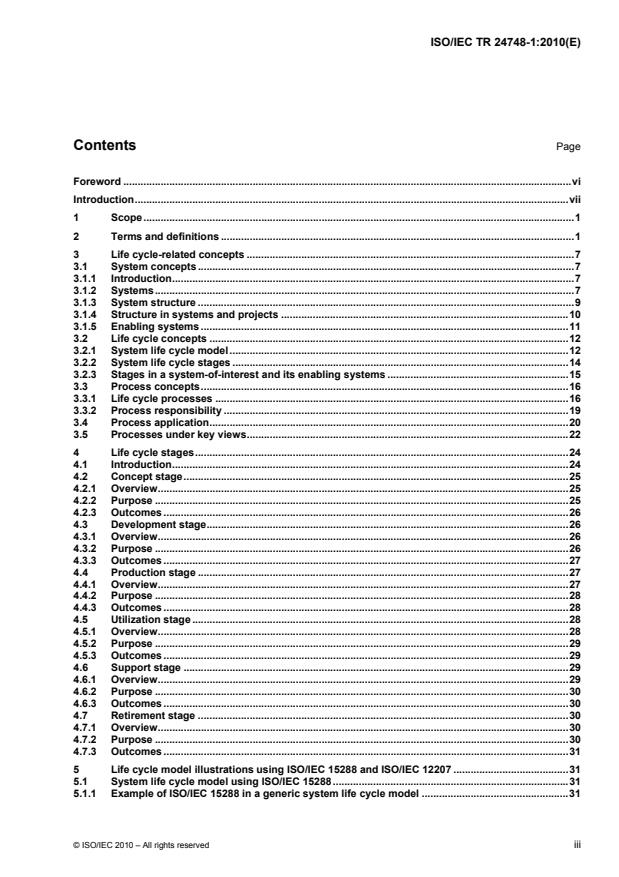
Contents Page
Foreword .vi
Introduction.vii
1 Scope.1
2 Terms and definitions .1
3 Life cycle-related concepts .7
3.1 System concepts .7
3.1.1 Introduction.7
3.1.2 Systems.7
3.1.3 System structure.9
3.1.4 Structure in systems and projects .10
3.1.5 Enabling systems.11
3.2 Life cycle concepts .12
3.2.1 System life cycle model.12
3.2.2 System life cycle stages .14
3.2.3 Stages in a system-of-interest and its enabling systems .15
3.3 Process concepts.16
3.3.1 Life cycle processes .16
3.3.2 Process responsibility.19
3.4 Process application.20
3.5 Processes under key views.22
4 Life cycle stages.24
4.1 Introduction.24
4.2 Concept stage.25
4.2.1 Overview.25
4.2.2 Purpose.25
4.2.3 Outcomes.26
4.3 Development stage.26
4.3.1 Overview.26
4.3.2 Purpose.26
4.3.3 Outcomes.27
4.4 Production stage .27
4.4.1 Overview.27
4.4.2 Purpose.28
4.4.3 Outcomes.28
4.5 Utilization stage .28
4.5.1 Overview.28
4.5.2 Purpose.29
4.5.3 Outcomes.29
4.6 Support stage .29
4.6.1 Overview.29
4.6.2 Purpose.30
4.6.3 Outcomes.30
4.7 Retirement stage.30
4.7.1 Overview.30
4.7.2 Purpose.30
4.7.3 Outcomes.31
5 Life cycle model illustrations using ISO/IEC 15288 and ISO/IEC 12207 .31
5.1 System life cycle model using ISO/IEC 15288.31
5.1.1 Example of ISO/IEC 15288 in a generic system life cycle model .31
© ISO/IEC 2010 – All rights reserved iii
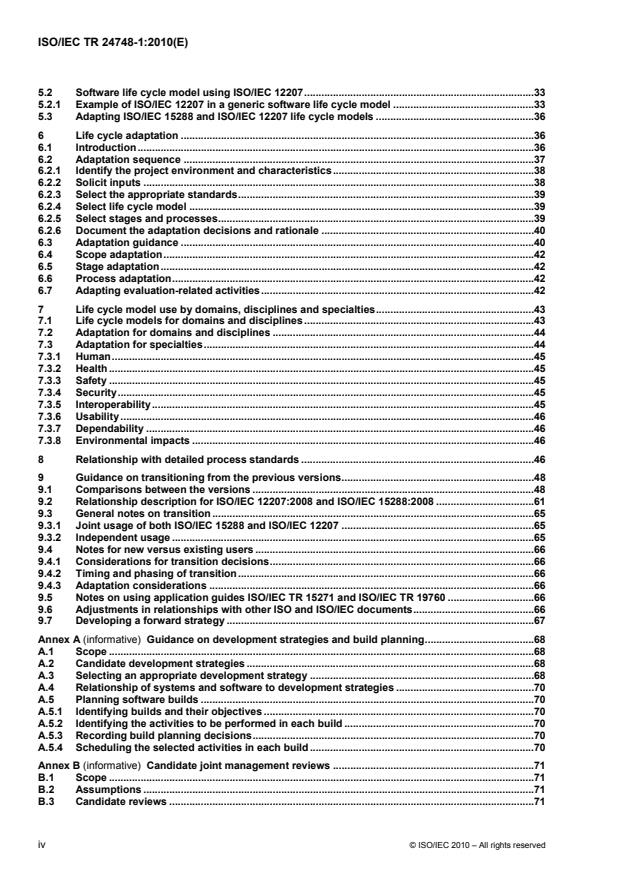
5.2 Software life cycle model using ISO/IEC 12207.33
5.2.1 Example of ISO/IEC 12207 in a generic software life cycle model .33
5.3 Adapting ISO/IEC 15288 and ISO/IEC 12207 life cycle models .36
6 Life cycle adaptation .36
6.1 Introduction.36
6.2 Adaptation sequence .37
6.2.1 Identify the project environment and characteristics.38
6.2.2 Solicit inputs .38
6.2.3 Select the appropriate standards.39
6.2.4 Select life cycle model .39
6.2.5 Select stages and processes.39
6.2.6 Document the adaptation decisions and rationale .40
6.3 Adaptation guidance .40
6.4 Scope adaptation.42
6.5 Stage adaptation.42
6.6 Process adaptation.42
6.7 Adapting evaluation-related activities.42
7 Life cycle model use by domains, disciplines and specialties.43
7.1 Life cycle models for domains and disciplines .43
7.2 Adaptation for domains and disciplines .44
7.3 Adaptation for specialties.44
7.3.1 Human.45
7.3.2 Health.45
7.3.3 Safety.45
7.3.4 Security.45
7.3.5 Interoperability.45
7.3.6 Usability.46
7.3.7 Dependability.46
7.3.8 Environmental impacts.46
8 Relationship with detailed process standards .46
9 Guidance on transitioning from the previous versions.48
9.1 Comparisons between the versions .48
9.2 Relationship description for ISO/IEC 12207:2008 and ISO/IEC 15288:2008 .61
9.3 General notes on transition.65
9.3.1 Joint usage of both ISO/IEC 15288 and ISO/IEC 12207 .65
9.3.2 Independent usage .65
9.4 Notes for new versus existing users .66
9.4.1 Considerations for transition decisions.66
9.4.2 Timing and phasing of transition.66
9.4.3 Adaptation considerations .66
9.5 Notes on using application guides ISO/IEC TR 15271 and ISO/IEC TR 19760 .66
9.6 Adjustments in relationships with other ISO and ISO/IEC documents.66
9.7 Developing a forward strategy .67
Annex A (informative) Guidance on development strategies and build planning.68
A.1 Scope.68
A.2 Candidate development strategies .68
A.3 Selecting an appropriate development strategy .68
A.4 Relationship of systems and software to development strategies .70
A.5 Planning software builds .70
A.5.1 Identifying builds and their objectives .70
A.5.2 Identifying the activities to be performed in each build .70
A.5.3 Recording build planning decisions.70
A.5.4 Scheduling the selected activities in each build .70
Annex B (informative) Candidate joint management reviews .71
B.1 Scope.71
B.2 Assumptions .71
B.3 Candidate reviews.71
iv © ISO/IEC 2010 – All rights reserved
B.3.1 Plan reviews.71
B.3.2 Operational concept reviews.71
B.3.3 System requirements reviews.71
B.3.4 System design reviews.72
B.3.5 Software requirements reviews.72
B.3.6 Software design reviews.72
B.3.7 Test readiness reviews .72
B.3.8 Test results reviews .72
B.3.9 Usability reviews.72
B.3.10 Maintenance reviews.72
B.3.11 Critical requirement reviews .73
B.4 Other resources.73
Annex C (informative) Problem reporting capability.74
C.1 Unified problem reporting .74
C.2 Problem classification.74
Bibliography.76
© ISO/IEC 2010 – All rights reserved v
Foreword
ISO (the International Organization for Standardization) and IEC (the International Electrotechnical
Commission) form the specialized system for worldwide standardization. National bodies that are members of
ISO or IEC participate in the development of International Standards through technical committees
established by the respective organization to deal with particular fields of technical activity. ISO and IEC
technical committees collaborate in fields of mutual interest. Other international organizations, governmental
and non-governmental, in liaison with ISO and IEC, also take part in the work. In the field of information
technology, ISO and IEC have established a joint technical committee, ISO/IEC JTC 1.
International Standards are drafted in accordance with the rules given in the ISO/IEC Directives, Part 2.
The main task of the joint technical committee is to prepare International Standards. Draft International
Standards adopted by the joint technical committee are circulated to national bodies for voting. Publication as
an International Standard requires approval by at least 75 % of the national bodies casting a vote.
In exceptional circumstances, the joint technical committee may propose the publication of a Technical Report
of one of the following types:
⎯ type 1, when the required support cannot be obtained for the publication of an International Standard,
despite repeated efforts;
⎯ type 2, when the subject is still under technical development or where for any other reason there is the
future but not immediate possibility of an agreement on an International Standard;
⎯ type 3, when the joint technical committee has collected data of a different kind from that which is
normally published as an International Standard (“state of the art”, for example).
Technical Reports of types 1 and 2 are subject to review within three years of publication, to decide whether
they can be transformed into International Standards. Technical Reports of type 3 do not necessarily have to
be reviewed until the data they provide are considered to be no longer valid or useful.
Attention is drawn to the possibility that some of the elements of this document may be the subject of patent
rights. ISO and IEC shall not be held responsible for identifying any or all such patent rights.
ISO/IEC TR 24748-1, which is a Technical Report of type 3, was prepared by Joint Technical Committee
ISO/IEC JTC 1, Information technology, Subcommittee SC 7, Software and systems engineering.
ISO/IEC TR 24748 consists of the following parts, under the general title Systems and software
engineering — Life cycle management:
Part 1: Guide for life cycle management
Guides for the application of ISO/IEC 15288 (systems life cycle processes) and ISO/IEC 12207 (software life
cycle processes) will form the subjects of future parts 2 and 3, respectively.
vi © ISO/IEC 2010 – All rights reserved
Introduction
ISO/IEC 15288, Systems and software engineering — System life cycle processes, and ISO/IEC 12207,
Systems and software engineering — Software life cycle processes, each have published guides
(ISO/IEC TR 19760 and ISO/IEC TR 15271, respectively) for the use of each International Standard
individually. The purpose of this Technical Report is to facilitate the joint usage of the process content of the
latest revisions of ISO/IEC 15288 and ISO/IEC 12207 by providing unified and consolidated guidance on life
cycle management of systems and software. This is to help ensure consistency in system concepts and life
cycle concepts, models, stages, processes, process application, key points of view, adaptation and use in
various domains as the two International Standards are used in combination. That will in turn help a project
team design a life cycle model for managing the progress of their project.
This Technical Report will also aid in identifying and planning use of life cycle processes described in
ISO/IEC 15288 and ISO/IEC 12207 that will enable the project to be completed successfully, meeting its
objectives/requirements for each stage and for the overall project. ISO/IEC TR 19760 and ISO/IEC TR 15271
will be replaced by ISO/IEC TR 24748-2 and ISO/IEC TR 24748-3, respectively, to support use of the two
revised International Standards individually.
Besides the above, there is also increasing recognition of the importance of ensuring that all life cycle stages,
and all aspects within each stage, are supported with thorough guidance to enable alignment with any process
documents that might subsequently be created that focus on areas besides systems and software, including
hardware, humans, processes (e.g. review process), procedures (e.g. operator instructions), facilities and
naturally occurring entities (e.g. water, organisms, minerals).
By addressing these needs specifically in this Technical Report, the users of the process-focused
ISO/IEC 12207 and ISO/IEC 15288 will not only benefit from having one document complementarily
addressing the aspect of product or service life cycle: they will also benefit from a framework that links life
cycle management aspects to more than just the systems or software aspects of products or services.
© ISO/IEC 2010 – All rights reserved vii
TECHNICAL REPORT ISO/IEC TR 24748-1:2010(E)
Systems and software engineering — Life cycle management —
Part 1:
Guide for life cycle management
1 Scope
This Technical Report is a guide for the life cycle management of systems and software based on
ISO/IEC 15288 and ISO/IEC 12207. This Technical Report:
• addresses systems concepts and life cycle concepts, models, stages, processes, process application, key
points of view, adaptation and use in various domains;
• establishes a common framework for describing life cycles, including their individual stages, for the
management of projects to provide or acquire either products or services;
• defines the concept and terminology of a life cycle;
• supports the use of the life cycle processes within an organization or a project. Organizations and projects
can use these life cycle concepts when acquiring and supplying either products or services;
• provides guidance on adapting a life cycle model and the content associated with a life cycle or a part of a
life cycle;
• describes the relationship between life cycles and their use in ISO/IEC 15288 (systems aspects) and
ISO/IEC 12207 (software aspects);
• shows the relationships of life cycle concepts to the hardware, human, services, process, procedure,
facility and naturally occurring entity aspects of projects;
• describes how its concepts relate to detailed process standards, for example, in the areas of
measurement, project management and risk management;
• complements domain-specific application guidance in ISO/IEC TR 19760 and ISO/IEC TR 15271.
NOTE When published, ISO/IEC TR 24748-2 and ISO/IEC 24748-3 will cancel and replace ISO/IEC TR 19760
and ISO/IEC TR 15271, respectively.
2 Terms and definitions
For the purposes of this document, the following terms and definitions apply.
2.1
acquirer
stakeholder that acquires or procures a product or service from a supplier
[ISO/IEC 12207:2008 and ISO/IEC 15288:2008]
NOTE The acquirer could be one of the following: buyer, customer, owner, or purchaser.
2.2
acquisition
process of obtaining a product or service
[ISO/IEC 15288:2008]
© ISO/IEC 2010 – All rights reserved 1
2.3
activity
set of cohesive tasks of a process
[ISO/IEC 12207:2008 and ISO/IEC 15288:2008]
2.4
agreement
mutual acknowledgement of terms and conditions under which a working relationship is conducted
[ISO/IEC 12207:2008 and ISO/IEC 15288:2008]
2.5
architecture
fundamental organization of a system embodied in its components, their relationships to each other, and to
the environment, and the principles guiding its design and evolution
[ISO/IEC 42010:2007]
NOTE ISO/IEC 12207 and ISO/IEC 15288 use the word “elements” instead of “components” and this Technical
Report follows that usage.
2.6
audit
systematic, independent and documented process for obtaining audit evidence and evaluating it objectively to
determine the extent to which audit criteria are fulfilled
[ISO 9000:2005]
2.7
baseline
specification or product that has been formally reviewed and agreed upon, that thereafter serves as the basis
for further development, and that can be changed only through formal change control procedures
[ISO/IEC 15288:2008]
2.8
contract
binding agreement between two parties, especially enforceable by law, or a similar internal agreement wholly
within an organization
[ISO/IEC 12207:2008]
2.9
customer
organization or person that receives a product or service
NOTE 1 A customer can be internal or external to the organization.
NOTE 2 Adapted from ISO 9000:2005.
NOTE 3 Other terms commonly used for customer are acquirer, buyer, or purchaser.
[ISO/IEC 12207:2008 and ISO/IEC 15288:2008]
2.10
developer
organization that performs development activities (including requirements analysis, design, testing through
acceptance) during the life cycle process
NOTE Adapted from ISO/IEC 12207:2008.
2 © ISO/IEC 2010 – All rights reserved
2.11
enabling system
system that supports a system-of-interest during its life cycle stages but does not necessarily contribute
directly to its function during operation
NOTE 1 Adapted from ISO/IEC 15288:2008.
NOTE 2 For example, when a system-of-interest enters the production stage, a production enabling system is required.
NOTE 3 Each enabling system has a life cycle of its own. This Technical Report is applicable to each enabling system
when, in its own right, it is treated as a system-of-interest.
2.12
evaluation
systematic determination of the extent to which an entity meets its specified criteria
[ISO/IEC 12207:2008]
2.13
facility
physical means or equipment for facilitating the performance of an action, e.g. buildings, instruments, tools
[ISO/IEC 15288:2008]
2.14
life cycle
evolution of a system, product, service, project or other human-made entity from conception through
retirement
[ISO/IEC 12207:2008 and ISO/IEC 15288:2008]
2.15
life cycle model
framework of processes and activities concerned with the life cycle that may be organized into stages, which
also acts as a common reference for communication and understanding
[ISO/IEC 12207:2008 and ISO/IEC 15288:2008]
2.16
maintainer
individual who, or organization that, performs maintenance activities
NOTE Adapted from ISO/IEC 12207:2008.
2.17
monitoring
examination of the status of the activities of a supplier and of their results by the acquirer or a third party
[ISO/IEC 12207:2008]
2.18
operator
entity that performs the operation of a system
[ISO/IEC 15288:2008]
NOTE 1 The role of operator and the role of user may be vested, simultaneously or sequentially, in the same individual
or organization.
NOTE 2 An individual operator combined with knowledge, skills and procedures may be considered as an element of
the system.
© ISO/IEC 2010 – All rights reserved 3
NOTE 3 In the context of this specific definition, the term entity means an individual or an organization.
2.19
organization
person or a group of people and facilities with an arrangement of responsibilities, authorities and relationships
NOTE 1 Adapted from ISO 9000:2005.
NOTE 2 A body of persons organized for some specific purpose, such as a club, union, corporation, or society, is an
organization.
NOTE 3 An identified part of an organization (even as small as a single individual) or an identified group of
organizations can be regarded as an organization if it has responsibilities, authorities and relationships.
2.20
party
organization entering into an agreement
NOTE In this Technical Report, the agreeing parties are called the acquirer and the supplier.
[ISO/IEC 15288:2008]
2.21
process
set of interrelated or interacting activities which transforms inputs into outputs
[ISO 9000:2005]
2.22
process purpose
high level objective of performing the process and the likely outcomes of effective implementation of the
process
NOTE The implementation of the process should provide tangible benefits to the stakeholders.
[ISO/IEC 12207:2008]
2.23
process outcome
observable result of the successful achievement of the process purpose
[ISO/IEC 12207:2008]
2.24
product
result of a process
[ISO 9000:2005]
2.25
project
endeavour with defined start and finish criteria undertaken to create a product or service in accordance with
specified resources and requirements
NOTE 1 Adapted from ISO 9000:2005.
NOTE 2 A project may be viewed as a unique process comprising co-ordinated and controlled activities and may be
composed of activities from the Project Processes and Technical Processes referred to in this Technical Report.
NOTE 3 A process can also be viewed as a specific instantiation of life cycle processes, adapted within a life cycle
model, to create the service or product for the specific requirements and context of the project.
4 © ISO/IEC 2010 – All rights reserved
2.26
qualification
process of demonstrating whether an entity is capable of fulfilling specified requirements
[ISO/IEC 12207:2008]
2.27
quality assurance
part of quality management focused on providing confidence that quality requirements will be fulfilled
[ISO 9000:2005]
2.28
resource
asset that is utilized or consumed during the execution of a process
[ISO/IEC 15288:2008]
NOTE 1 Resources may include diverse entities such as funds, personnel, facilities, capital equipment, tools, and
utilities such as power, water, fuel and communication infrastructures.
NOTE 2 Resources may be reusable, renewable or consumable.
2.29
retirement
withdrawal of active support by the operation and maintenance organization, partial or total replacement by a
new system, or installation of an upgraded system
[ISO/IEC 12207:2008]
2.30
security
all aspects related to defining, achieving, and maintaining confidentiality, integrity, availability, non-repudiation,
accountability and authenticity of a system
NOTE Adapted from ISO/IEC 13335-1:2004.
2.31
service
performance of activities, work, or duties associated with a product
[ISO/IEC 12207:2008]
2.32
software product
set of computer programs, procedures, and possibly associated documentation and data
[ISO/IEC 12207:2008]
2.33
stage
period within the life cycle of an entity that relates to the state of its description or realization
[ISO/IEC 12207:2008 and ISO/IEC 15288:2008]
NOTE 1 As used in this Technical Report, stages relate to major progress and achievement milestones of the entity
through its life cycle.
NOTE 2 Stages may be overlapping.
© ISO/IEC 2010 – All rights reserved 5
2.34
stakeholder
individual or organization having a right, share, claim, or interest in a system or in its possession of
characteristics that meet their needs and expectations
[ISO/IEC 12207:2008 and ISO/IEC 15288:2008]
2.35
supplier
organization or an individual that enters into an agreement with the acquirer for the supply of a product or
service
[ISO/IEC 12207:2008 and ISO/IEC 15288:2008]
NOTE 1 Other terms commonly used for supplier are contractor, producer, seller, or vendor.
NOTE 2 The acquirer and the supplier may be part of the same organization.
2.36
system
combination of interacting elements organized to achieve one or more stated purposes
[ISO/IEC 12207:2008 and ISO/IEC 15288:2008]
NOTE 1 A system may be considered as a product or as the services it provides.
NOTE 2 In practice, the interpretation of its meaning is frequently clarified by the use of an associative noun, e.g. aircraft
system. Alternatively the word “system” may be substituted simply by a context-dependent synonym, e.g. aircraft, though this
may then obscure a system principles perspective.
2.37
system element
member of a set of elements that constitutes a system
[ISO/IEC 15288:2008]
NOTE A system element is a discrete part of a system that can be implemented to fulfil specified requirements. A
system element can be hardware, software, data, humans, processes (e.g. processes for providing service to users),
procedures (e.g. operator instructions), facilities, materials, and naturally occurring entities (e.g. water, organisms,
minerals), or any combination.
2.38
system-of-interest
system whose life cycle is under consideration in the context of this Technical Report
[ISO/IEC 15288:2008]
2.39
task
requirement, recommendation, or permissible action, intended to contribute to the achievement of one or more
outcomes of a process
[ISO/IEC 12207:2008 and ISO/IEC 15288:2008]
2.40
trade-off
decision-making actions that select from various requirements and alternative solutions on the basis of net
benefit to the stakeholders
[ISO/IEC 15288:2008]
6 © ISO/IEC 2010 – All rights reserved
2.41
user
individual or group that benefits from a system during its utilization
[ISO/IEC 12207:2008 and ISO/IEC 15288:2008]
NOTE The role of user and the role of operator may be vested, simultaneously or sequentially, in the same individual
or organization.
2.42
validation
confirmation, through the provision of objective evidence, that the requirements for a specific intended use or
application have been fulfilled
[ISO 9000:2005]
NOTE Validation is the set of activities ensuring and gaining confidence that a system is able to accomplish its
intended use, goals and objectives (i.e. meet stakeholder requirements) in the intended operational environment.
2.43
verification
confirmation, through the provision of objective evidence, that specified requirements have been fulfilled
[ISO 9000:2005]
NOTE Verification is a set of activities that compares a product of the life cycle against the required characteristics for
that product. This may include, but is not limited to, specified requirements, design description and the system itself.
2.44
version
identified instance of an item
[ISO/IEC 12207:2008]
NOTE Modification to a version of a product, resulting in a new version, requires configuration management action.
3 Life cycle-related concepts
3.1 System concepts
3.1.1 Introduction
This section is included to highlight and to help explain essential concepts on which this Technical Report is
based. These concepts are directly applicable to software, as addressed in ISO/IEC 12207, systems, as
addressed in ISO/IEC 15288, and to hardware, facilities, services, humans, processes and procedures and
naturally occurring entities.
3.1.2 Systems
The systems considered in this Technical Report are man-made and utilized to provide services in defined
environments for the benefit of users and other stakeholders. These systems may be configured with one or
more of the following: hardware, software, services, humans, processes (e.g. review process), procedures
(e.g. operator instructions), facilities and naturally occurring entities (e.g. water, organisms, minerals).
The perception and definition of a particular system, its architecture and its system elements depend on an
observer's interests and responsibilities. One person's system-of-interest can be viewed as a system element
in another person's system-of-interest. Conversely, it can be viewed as being part of the environment of
operation for yet another person's system-of-interest.
© ISO/IEC 2010 – All rights reserved 7
Figure 1 exemplifies the multitude of perceivable systems-of-interest in an aircraft and its environment of
operation. First, the figure in its entirety comprises a transportation system with air, ground and water
elements, which can be a system-of-interest. Next, any one element of the transportation system can be
viewed as a system-of-interest, such as the Air Transport System. The example can be continued through the
levels so that, for example, the display can be an element of the navigation system, which is in turn an
element of the aircraft system within the air transport system. However, from an equally valid perspective,
such as that of display
Ground
Transportation
Air Transport System
System
Ticketing Air traffic
control system
system
Fuel
Airport
distribution
system
system
Aircraft System
Airframe
Life support
system
system
Air Crew
Propulsion
system
Display
NaNavviigatgatiioonn
system
System
system
Flight control
system
Maritime
Global positioning
Transport
receiver system
System
Figure 1 — Typical system view of an aircraft in its environment of use
manufacturers, the display will be their system-of-interest and they will then determine the elements within
their display system. On a deeper level, Figure 1 also illustrates:
a) the importance of defined boundaries that encapsulate meaningful needs and practical solutions;
b) the perception of system structure (in this case, the physical structure, hierarchical in this instance);
c) that an entity at any level in a system structure can be viewed as a system;
d) that a system is comprised of a fully integrated, defined set of subordinate systems;
e) that characteristic properties at a system's boundary arise from the interactions between subordinate
systems;
f) that humans can be viewed as users external to a system (e.g. air crew and navigation system) and
as system elements within a system (e.g. air crew and aircraft);
g) that a system can be viewed as an isolated entity (that is, a product), or as an ordered collection of
functions capable of interacting with its surrounding environment, (i.e. a set of services);
h) that a system can be viewed as part of a larger system of systems and that a system of systems can
be viewed as a system.
8 © ISO/IEC 2010 – All rights reserved
Whatever the boundaries chosen to define the system, the concepts and models in this Technical Report are
generic and permit a practitioner to correlate or adapt individual instances of life cycles to its system concepts
and principles.
In this Technical Report, humans are considered both as users and as elements of a system. In the first case,
the human user is a beneficiary of the operation of the system. In the second case, the human is an operator
carrying out specified system functions, such as those involved in providing a service. An individual can be,
simultaneously or sequentially, a user and an element of a system, for example, the pilot of a private aircraft in
the civil aviation system.
Humans contribute to the performance and characteristics of many systems for numerous reasons, e.g. their
special skills, the need for flexibility and for legal reasons. Whether they are users or operators, humans are
highly complex, with behaviour that is frequently difficult to predict, and they need protection from harm. This
requires that the system life cycle processes address human element factors in the areas of: human factors
engineering, system safety, health hazard assessment, manpower, personnel and training. These issues are
addressed by particular activities and iterations in the life cycle, and are described in more detail in
ISO 13407:1999, Human-centred design processes for interactive systems, and ISO/TR 18529:2000,
Ergonomics — Ergonomics of human-system interaction — Human-centered lifecycle process descriptions.
3.1.3 System structure
The system life cycle processes in this Technical Report are described in relation to a system that is
composed of a set of interacting physical, logical and/or other system elements, depicted in Figure 2, each of
...
Questions, Comments and Discussion
Ask us and Technical Secretary will try to provide an answer. You can facilitate discussion about the standard in here.
Loading comments...