

ISO/TS 19844:2018
(Main)Health informatics — Identification of medicinal products (IDMP) — Implementation guidelines for ISO 11238 for data elements and structures for the unique identification and exchange of regulated information on substances
General Information
- Abstract
This document is used in the implementation of ISO 11238. This document defines substances based on their scientific identity (i.e. what they are) rather than on their use or method of production. ISO 11238 provides the conceptual framework for defining Substances and Specified Substances and for assigning unique identifiers in the context of the ISO IDMP standards. ISO 11238 describes general concepts for defining and distinguishing substances and a high-level model for the structuring of information for substances. This document provides detailed explanations of each type or grouping of substance information, an element-by-element description for implementation of ISO 11238, and examples for a variety of Substances and Specified Substances. This third edition of the document addresses Substances Groups 1 to 3 of the Specified Substances as defined in ISO 11238 and Annexes A, B, C, D, E, F, G, H, I, J and K. It is anticipated that Specified Substances Group 4, as defined in ISO 11238, will be addressed in a subsequent edition of this document. Some information that would typically fall under Specified Substances Group 4 is covered in the Annexes of this document. This information, although not defining of either a Substance or a Specified Substance Group 1, might be essential to distinguishing substances. This document addresses the following: - data elements necessary for defining Substances and Specified Substances Groups 1 to 3; - the logical use of data elements as defined in ISO 11238; - Substances and Specified Substances Groups 1 to 3 business rules for: - determining necessary data elements, - distinguishing and defining materials according to ISO 11238, - triggering the assignment of identifiers. This document does not address the following: - business processes for data management; - implementation of a specific data information system (e.g. a relational database schema); - normative messaging standards for substances; - the maintenance of controlled vocabularies; - the specific global identifier system that should be used; - nomenclature standards for substances.
- Status
- Published
- Publication Date
- 01-Jul-2018
- Technical Committee
- ISO/TC 215 - Health informatics
- Drafting Committee
- ISO/TC 215/WG 6 - Pharmacy and medicines business
- Current Stage
- 9092 - International Standard to be revised
- Start Date
- 29-Nov-2023
- Completion Date
- 29-Aug-2026
Buy Documents
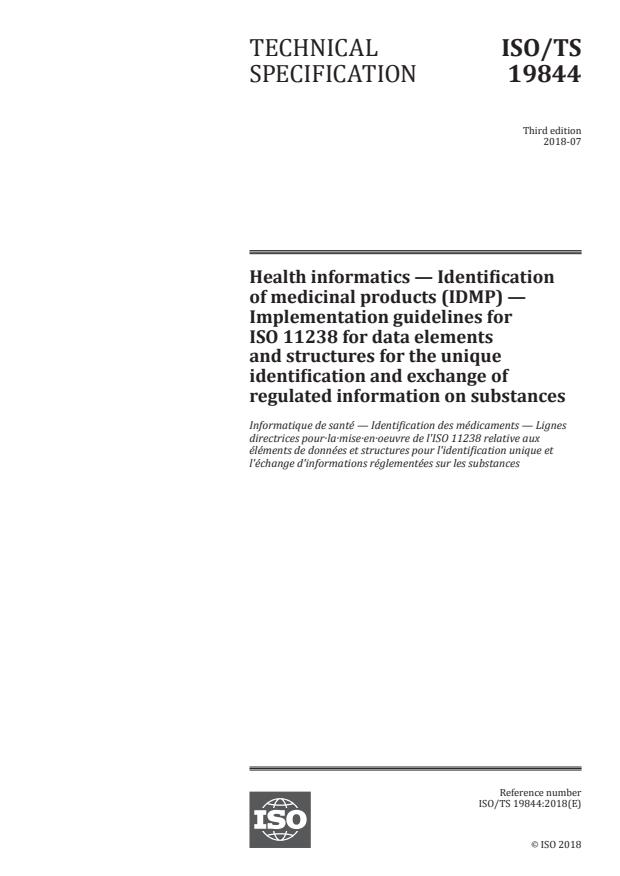

ISO/TS 19844:2018 - Health informatics -- Identification of medicinal products (IDMP) -- Implementation guidelines for ISO 11238 for data elements and structures for the unique identification and exchange of regulated information on substances


REDLINE ISO/TS 19844:2018 - Health informatics — Identification of medicinal products (IDMP) — Implementation guidelines for ISO 11238 for data elements and structures for the unique identification and exchange of regulated information on substances Released:7/2/2018
ISO/TS 19844:2018 - Health informatics — Identification of medicinal products (IDMP) — Implementation guidelines for ISO 11238 for data elements and structures for the unique identification and exchange of regulated information on substances/2/2018
Overview
ISO/TS 19844:2018 - “Health informatics - Identification of medicinal products (IDMP) - Implementation guidelines for ISO 11238” provides practical, element‑by‑element guidance for implementing ISO 11238. It explains how to define and uniquely identify Substances and Specified Substances based on their scientific identity (what they are), rather than use or manufacture. This technical specification supports exchange of regulated substance information by detailing data elements, structures, examples and business rules to implement the IDMP conceptual model.
Key points:
- Implementation guidance for ISO 11238 (IDMP substance model)
- Third edition: addresses Specified Substances Groups 1–3 and Annexes A–K
- Explains data elements, logical usage, examples and identifier‑assignment triggers
- Clarifies what it does not cover (see Related Standards / exclusions)
Key topics and technical requirements
ISO/TS 19844 provides detailed coverage of the data and rules needed to represent substances consistently:
- Substance identification: substance type, substance ID and versioning rules
- Names and naming context: substance name, name type, language, jurisdiction, official names
- Reference sources: citation, source type, IDs and URLs for provenance
- Coding: code, code system, code system ID and status
- Structural information: stereochemistry, molecular formula, structural representations, isotopes
- Quantities and amounts: quantity, limits, units and non‑numeric values
- Source material and biologicals: organism, part, development stage, parent substance
- Modifications and properties: chemical/physical modifications, property types and values
- Substance definitions by class: chemical substances, proteins/peptides, nucleic acids (with examples)
- Business rules: when specific elements are required, how to distinguish materials, and triggers for assigning identifiers
The document is explicit about exclusions: it does not specify data management processes, database schemas, messaging standards, controlled vocabulary maintenance, the global identifier system to use, or substance nomenclature standards.
Applications and who uses it
ISO/TS 19844 is used to implement interoperable substance datasets across regulatory and industry systems. Typical users:
- Regulatory authorities assessing or exchanging substance data
- Pharmaceutical companies and regulatory affairs teams preparing submissions
- Pharmacovigilance and safety databases that need precise substance identifiers
- Health IT vendors and implementers building IDMP‑compliant data models or APIs
- Master data management and terminology specialists aligning substance metadata
Practical benefits:
- Improves consistency of substance identification and provenance
- Enables automated exchange of regulated substance information
- Reduces ambiguity in safety reporting, submissions and product registries
Related standards
- ISO 11238 (primary substance conceptual model for IDMP)
- ISO IDMP family (Identification of Medicinal Products) - ISO conceptual framework for regulated medicinal product information
Keywords: ISO/TS 19844:2018, IDMP, ISO 11238, substance identification, data elements, health informatics, medicinal products, regulatory data standards.
Relations
- Effective Date
- 25-Aug-2026
- Effective Date
- 07-Sep-2024
- Effective Date
- 28-Apr-2018
- Effective Date
- 16-Jul-2016
Buy Documents
ISO/TS 19844:2018 - Health informatics -- Identification of medicinal products (IDMP) -- Implementation guidelines for ISO 11238 for data elements and structures for the unique identification and exchange of regulated information on substances
REDLINE ISO/TS 19844:2018 - Health informatics — Identification of medicinal products (IDMP) — Implementation guidelines for ISO 11238 for data elements and structures for the unique identification and exchange of regulated information on substances Released:7/2/2018
ISO/TS 19844:2018 - Health informatics — Identification of medicinal products (IDMP) — Implementation guidelines for ISO 11238 for data elements and structures for the unique identification and exchange of regulated information on substances/2/2018
Get Certified
Connect with accredited certification bodies for this standard

BSI Group
BSI (British Standards Institution) is the business standards company that helps organizations make excellence a habit.

NYCE
Mexican standards and certification body.
Sponsored listings
Frequently Asked Questions
ISO/TS 19844:2018 is a technical specification published by the International Organization for Standardization (ISO). Its full title is "Health informatics — Identification of medicinal products (IDMP) — Implementation guidelines for ISO 11238 for data elements and structures for the unique identification and exchange of regulated information on substances". This standard covers: This document is used in the implementation of ISO 11238. This document defines substances based on their scientific identity (i.e. what they are) rather than on their use or method of production. ISO 11238 provides the conceptual framework for defining Substances and Specified Substances and for assigning unique identifiers in the context of the ISO IDMP standards. ISO 11238 describes general concepts for defining and distinguishing substances and a high-level model for the structuring of information for substances. This document provides detailed explanations of each type or grouping of substance information, an element-by-element description for implementation of ISO 11238, and examples for a variety of Substances and Specified Substances. This third edition of the document addresses Substances Groups 1 to 3 of the Specified Substances as defined in ISO 11238 and Annexes A, B, C, D, E, F, G, H, I, J and K. It is anticipated that Specified Substances Group 4, as defined in ISO 11238, will be addressed in a subsequent edition of this document. Some information that would typically fall under Specified Substances Group 4 is covered in the Annexes of this document. This information, although not defining of either a Substance or a Specified Substance Group 1, might be essential to distinguishing substances. This document addresses the following: - data elements necessary for defining Substances and Specified Substances Groups 1 to 3; - the logical use of data elements as defined in ISO 11238; - Substances and Specified Substances Groups 1 to 3 business rules for: - determining necessary data elements, - distinguishing and defining materials according to ISO 11238, - triggering the assignment of identifiers. This document does not address the following: - business processes for data management; - implementation of a specific data information system (e.g. a relational database schema); - normative messaging standards for substances; - the maintenance of controlled vocabularies; - the specific global identifier system that should be used; - nomenclature standards for substances.
This document is used in the implementation of ISO 11238. This document defines substances based on their scientific identity (i.e. what they are) rather than on their use or method of production. ISO 11238 provides the conceptual framework for defining Substances and Specified Substances and for assigning unique identifiers in the context of the ISO IDMP standards. ISO 11238 describes general concepts for defining and distinguishing substances and a high-level model for the structuring of information for substances. This document provides detailed explanations of each type or grouping of substance information, an element-by-element description for implementation of ISO 11238, and examples for a variety of Substances and Specified Substances. This third edition of the document addresses Substances Groups 1 to 3 of the Specified Substances as defined in ISO 11238 and Annexes A, B, C, D, E, F, G, H, I, J and K. It is anticipated that Specified Substances Group 4, as defined in ISO 11238, will be addressed in a subsequent edition of this document. Some information that would typically fall under Specified Substances Group 4 is covered in the Annexes of this document. This information, although not defining of either a Substance or a Specified Substance Group 1, might be essential to distinguishing substances. This document addresses the following: - data elements necessary for defining Substances and Specified Substances Groups 1 to 3; - the logical use of data elements as defined in ISO 11238; - Substances and Specified Substances Groups 1 to 3 business rules for: - determining necessary data elements, - distinguishing and defining materials according to ISO 11238, - triggering the assignment of identifiers. This document does not address the following: - business processes for data management; - implementation of a specific data information system (e.g. a relational database schema); - normative messaging standards for substances; - the maintenance of controlled vocabularies; - the specific global identifier system that should be used; - nomenclature standards for substances.
ISO/TS 19844:2018 is classified under the following ICS (International Classification for Standards) categories: 35.240.80 - IT applications in health care technology. The ICS classification helps identify the subject area and facilitates finding related standards.
ISO/TS 19844:2018 has the following relationships with other standards: It is inter standard links to EN ISO 11238:2018, ISO/DTS 19844-1, ISO/TS 19844:2016, ISO/TS 19844:2015. Understanding these relationships helps ensure you are using the most current and applicable version of the standard.
ISO/TS 19844:2018 is available in PDF format for immediate download after purchase. The document can be added to your cart and obtained through the secure checkout process. Digital delivery ensures instant access to the complete standard document.
Standards Content (Sample)
TECHNICAL ISO/TS
SPECIFICATION 19844
Third edition
2018-07
Health informatics — Identification
of medicinal products (IDMP) —
Implementation guidelines for
ISO 11238 for data elements
and structures for the unique
identification and exchange of
regulated information on substances
Informatique de santé — Identification des médicaments — Lignes
directrices pour·la·mise·en·oeuvre de l'ISO 11238 relative aux
éléments de données et structures pour l'identification unique et
l'échange d'informations réglementées sur les substances
Reference number
©
ISO 2018
© ISO 2018
All rights reserved. Unless otherwise specified, or required in the context of its implementation, no part of this publication may
be reproduced or utilized otherwise in any form or by any means, electronic or mechanical, including photocopying, or posting
on the internet or an intranet, without prior written permission. Permission can be requested from either ISO at the address
below or ISO’s member body in the country of the requester.
ISO copyright office
CP 401 • Ch. de Blandonnet 8
CH-1214 Vernier, Geneva
Phone: +41 22 749 01 11
Fax: +41 22 749 09 47
Email: copyright@iso.org
Website: www.iso.org
Published in Switzerland
ii © ISO 2018 – All rights reserved
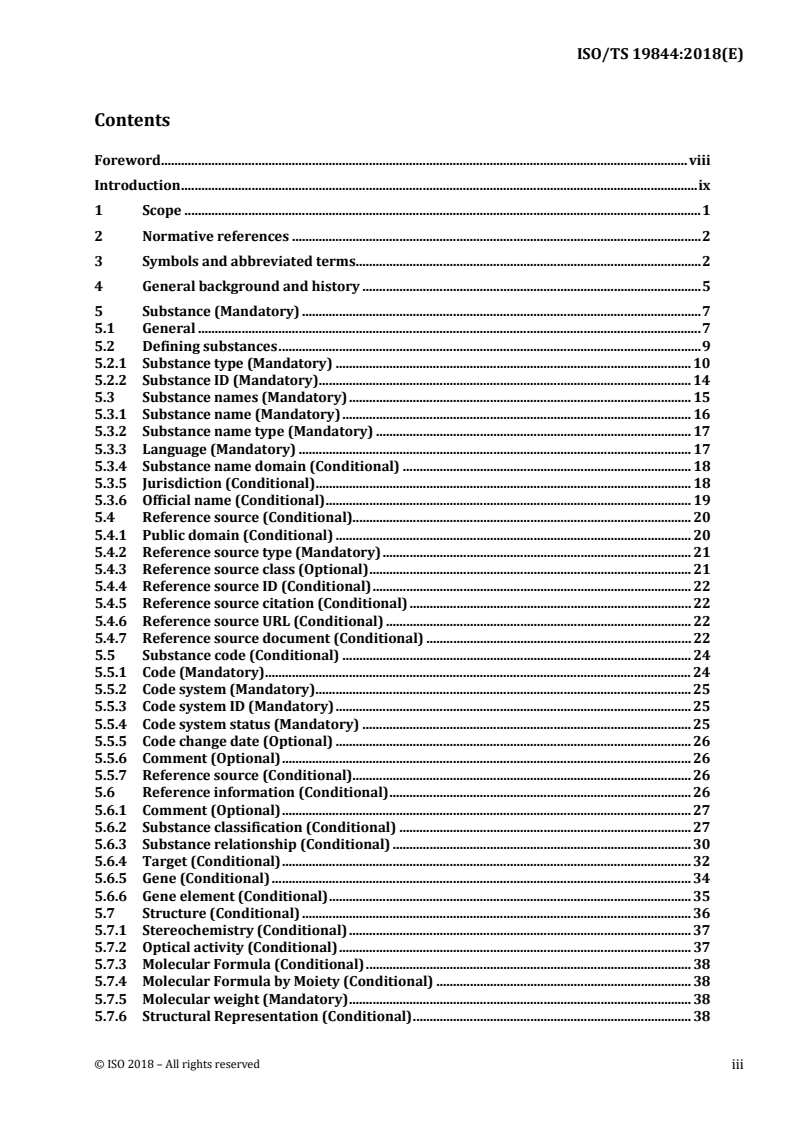
Contents
Foreword . viii
Introduction . ix
1 Scope . 1
2 Normative references . 2
3 Symbols and abbreviated terms . 2
4 General background and history . 5
5 Substance (Mandatory) . 7
5.1 General . 7
5.2 Defining substances . 9
5.2.1 Substance type (Mandatory) . 10
5.2.2 Substance ID (Mandatory) . 14
5.3 Substance names (Mandatory) . 15
5.3.1 Substance name (Mandatory) . 16
5.3.2 Substance name type (Mandatory) . 17
5.3.3 Language (Mandatory) . 17
5.3.4 Substance name domain (Conditional) . 18
5.3.5 Jurisdiction (Conditional) . 18
5.3.6 Official name (Conditional) . 19
5.4 Reference source (Conditional). 20
5.4.1 Public domain (Conditional) . 20
5.4.2 Reference source type (Mandatory) . 21
5.4.3 Reference source class (Optional) . 21
5.4.4 Reference source ID (Conditional) . 22
5.4.5 Reference source citation (Conditional) . 22
5.4.6 Reference source URL (Conditional) . 22
5.4.7 Reference source document (Conditional) . 22
5.5 Substance code (Conditional) . 24
5.5.1 Code (Mandatory) . 24
5.5.2 Code system (Mandatory) . 25
5.5.3 Code system ID (Mandatory) . 25
5.5.4 Code system status (Mandatory) . 25
5.5.5 Code change date (Optional) . 26
5.5.6 Comment (Optional) . 26
5.5.7 Reference source (Conditional). 26
5.6 Reference information (Conditional) . 26
5.6.1 Comment (Optional) . 27
5.6.2 Substance classification (Conditional) . 27
5.6.3 Substance relationship (Conditional) . 30
5.6.4 Target (Conditional) . 32
5.6.5 Gene (Conditional) . 34
5.6.6 Gene element (Conditional) . 35
5.7 Structure (Conditional) . 36
5.7.1 Stereochemistry (Conditional) . 37
5.7.2 Optical activity (Conditional) . 37
5.7.3 Molecular Formula (Conditional) . 38
5.7.4 Molecular Formula by Moiety (Conditional) . 38
5.7.5 Molecular weight (Mandatory) . 38
5.7.6 Structural Representation (Conditional) . 38
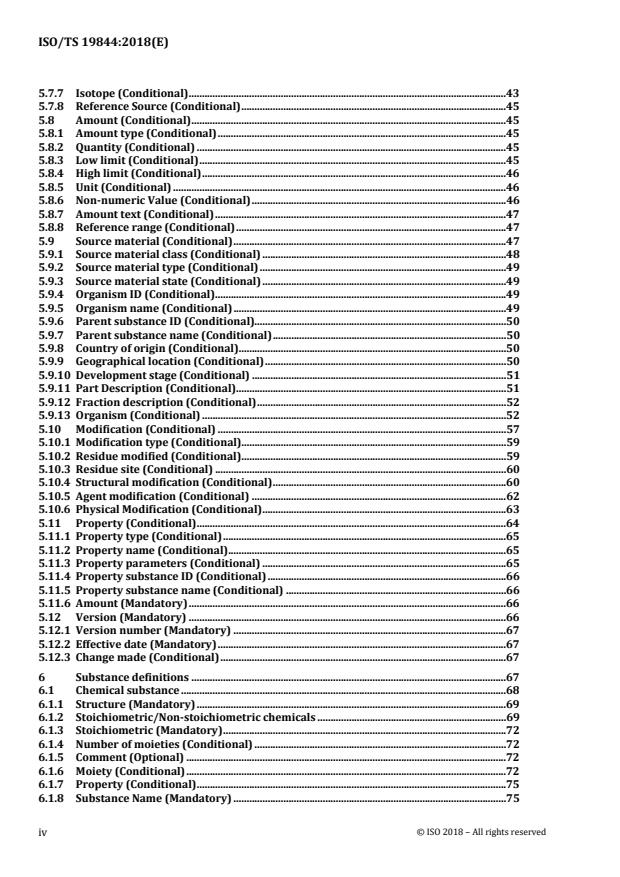
iii
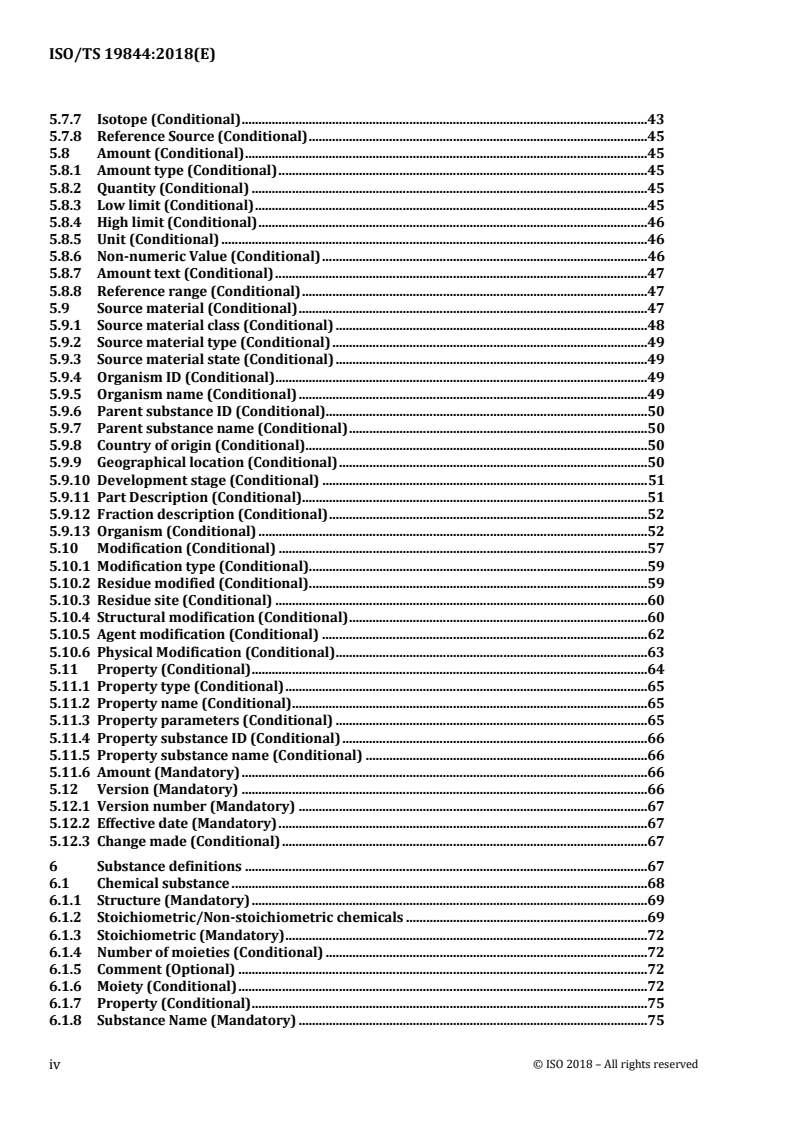
5.7.7 Isotope (Conditional) .43
5.7.8 Reference Source (Conditional) .45
5.8 Amount (Conditional) .45
5.8.1 Amount type (Conditional) .45
5.8.2 Quantity (Conditional) .45
5.8.3 Low limit (Conditional) .45
5.8.4 High limit (Conditional) .46
5.8.5 Unit (Conditional) .46
5.8.6 Non-numeric Value (Conditional) .46
5.8.7 Amount text (Conditional) .47
5.8.8 Reference range (Conditional) .47
5.9 Source material (Conditional) .47
5.9.1 Source material class (Conditional) .48
5.9.2 Source material type (Conditional) .49
5.9.3 Source material state (Conditional) .49
5.9.4 Organism ID (Conditional) .49
5.9.5 Organism name (Conditional) .49
5.9.6 Parent substance ID (Conditional).50
5.9.7 Parent substance name (Conditional) .50
5.9.8 Country of origin (Conditional) .50
5.9.9 Geographical location (Conditional) .50
5.9.10 Development stage (Conditional) .51
5.9.11 Part Description (Conditional) .51
5.9.12 Fraction description (Conditional) .52
5.9.13 Organism (Conditional) .52
5.10 Modification (Conditional) .57
5.10.1 Modification type (Conditional).59
5.10.2 Residue modified (Conditional) .59
5.10.3 Residue site (Conditional) .60
5.10.4 Structural modification (Conditional) .60
5.10.5 Agent modification (Conditional) .62
5.10.6 Physical Modification (Conditional) .63
5.11 Property (Conditional) .64
5.11.1 Property type (Conditional) .65
5.11.2 Property name (Conditional) .65
5.11.3 Property parameters (Conditional) .65
5.11.4 Property substance ID (Conditional) .66
5.11.5 Property substance name (Conditional) .66
5.11.6 Amount (Mandatory) .66
5.12 Version (Mandatory) .66
5.12.1 Version number (Mandatory) .67
5.12.2 Effective date (Mandatory) .67
5.12.3 Change made (Conditional) .67
6 Substance definitions .67
6.1 Chemical substance .68
6.1.1 Structure (Mandatory) .69
6.1.2 Stoichiometric/Non-stoichiometric chemicals .69
6.1.3 Stoichiometric (Mandatory) .72
6.1.4 Number of moieties (Conditional) .72
6.1.5 Comment (Optional) .72
6.1.6 Moiety (Conditional) .72
6.1.7 Property (Conditional) .75
6.1.8 Substance Name (Mandatory) .75
iv
6.1.9 Substance Code (Conditional) . 75
6.1.10 Version (Mandatory) . 76
6.1.11 Reference information (Conditional) . 76
6.1.12 Reference source (Conditional). 76
6.2 Proteins/peptides . 76
6.2.1 Microheterogeneity . 77
6.2.2 Sequence type (Mandatory) . 77
6.2.3 Number of subunits (Mandatory) . 78
6.2.4 Disulfide linkage (Conditional) . 78
6.2.5 Comment (Optional) . 78
6.2.6 Protein subunit (Mandatory) . 78
6.2.7 Molecular weight (Conditional) . 81
6.2.8 Glycosylation (Conditional) . 82
6.2.9 Property (Conditional) . 83
6.2.10 Structure (Conditional) . 84
6.2.11 Substance name (Mandatory) . 84
6.2.12 Modification (Conditional) . 84
6.2.13 Substance code (Conditional) . 84
6.2.14 Source material (Conditional) . 84
6.2.15 Version (Mandatory) . 84
6.2.16 Reference information (Conditional) . 84
6.2.17 Reference source (Conditional). 84
6.3 Nucleic acids . 84
6.3.1 Structure (Conditional) . 85
6.3.2 Sequence type (Mandatory) . 86
6.3.3 Number of subunits (Mandatory) . 86
6.3.4 Area of hybridization (Conditional) . 87
6.3.5 Oligo nucleotide type (Conditional) . 87
6.3.6 Comment (Optional) . 87
6.3.7 Nucleic acid subunit (Mandatory) . 87
6.3.8 Modification (Conditional) . 91
6.3.9 Property (Conditional) . 91
6.3.10 Molecular weight (Conditional) . 92
6.3.11 Substance Name (Mandatory) . 92
6.3.12 Substance Code (Conditional) . 92
6.3.13 Version (Mandatory) . 92
6.3.14 Reference information (Conditional) . 92
6.3.15 Reference source (Conditional). 92
6.4 Polymers . 92
6.4.1 Polymer class (Mandatory) . 93
6.4.2 Polymer geometry (Mandatory) . 94
6.4.3 Copolymer connectivity (Mandatory) . 94
6.4.4 Comment (Optional) . 94
6.4.5 Substance name (Mandatory) . 94
6.4.6 Structure (Mandatory). 94
6.4.7 Monomer set description (Conditional) . 95
6.4.8 Structural repeat (Mandatory) . 96
6.4.9 Molecular weight (Conditional) . 99
6.4.10 Property (Conditional) . 100
6.4.11 Substance code (Conditional) . 100
6.4.12 Version (Mandatory) . 100
6.4.13 Reference information (Conditional) . 100
6.4.14 Modification (Conditional) . 100
v
6.4.15 Source material (Conditional) . 100
6.4.16 Reference source (Conditional) . 100
6.5 Structurally diverse substances. 100
6.5.1 Comment (Optional) . 101
6.5.2 Substance name (Mandatory) . 101
6.5.3 Structure (Conditional) . 102
6.5.4 Property (Conditional) . 102
6.5.5 Molecular weight (Conditional) . 102
6.5.6 SD glycosylation (Conditional) . 102
6.5.7 Modification (Conditional) . 102
6.5.8 Source material (Mandatory) . 102
6.5.9 Substance code (Conditional) . 102
6.5.10 Reference information (Conditional) . 102
6.5.11 Version (Mandatory) . 102
6.5.12 Reference source (Conditional) . 103
6.5.13 Herbals and substances used in the preparation of plant-based allergenic extracts
................................................................................................................................................................. 103
6.5.14 Vaccines . 105
6.5.15 Plasma-derived substance for human blood products and polyclonal antibodies . 105
6.5.16 Allergens. 105
6.5.17 Advanced Therapies and Advanced Vaccines (Genes, Modified Viruses, Cells and
Tissues as Substances) . 105
6.5.18 Minerals . 106
6.6 Mixture . 106
6.6.1 Mixture type (Mandatory) . 107
6.6.2 Is multi-substance starting material (Mandatory) . 107
6.6.3 Constituent component (Mandatory) . 108
6.6.4 Multi-substance starting material property (Conditional) . 109
6.6.5 Modification (Conditional) . 109
6.6.6 Source material (Conditional) . 110
6.6.7 Substance name (Mandatory) . 110
6.6.8 Substance code (Conditional) . 110
6.6.9 Reference information (Conditional) . 110
6.6.10 Version (Mandatory) . 110
7 Specified substance (Conditional) . 110
7.1 Specified Substance Group 1 (Conditional) . 110
7.1.1 Specified substance Group 1 ID (Mandatory) . 111
7.1.2 Substance name (Mandatory) . 111
7.1.3 Substance Code (Conditional). 112
7.1.4 Version (Mandatory) . 112
7.1.5 Reference source (Conditional) . 112
7.1.6 Constituent (Conditional) . 112
7.1.7 Characteristic attribute (Conditional) . 114
7.1.8 Fraction description (Conditional) . 117
7.1.9 Modification (Conditional) . 118
7.1.10 Reference Information (Conditional) . 118
7.1.11 Physical form (Conditional) . 118
7.2 Specified substance Group 2 (Conditional) . 119
7.2.1 Specified Substance Group 2 ID (Mandatory) . 121
7.2.2 Substance Name (Mandatory) . 121
7.2.3 Substance code (Conditional) . 121
7.2.4 Reference source (Conditional) . 121
7.2.5 Reference information (Conditional) . 121
vi
7.2.6 Version (Mandatory) . 121
7.2.7 Manufacturing (Mandatory) . 121
7.3 Specified Substance Group 2 Extended (Conditional) . 126
7.3.1 Specified Substance Group 2 ID (Mandatory) . 126
7.3.2 Substance Name (Mandatory) . 126
7.3.3 Substance code (Conditional) . 126
7.3.4 Reference source (Conditional). 126
7.3.5 Reference information (Conditional) . 126
7.3.6 Version (Mandatory) . 126
7.3.7 Manufacturing (Mandatory) . 127
7.4 Specified Substance Group 3 (Conditional). 131
7.4.1 Specified Substance Group 3 ID (Mandatory) . 131
7.4.2 Substance Name (Mandatory) . 132
7.4.3 Grade (Mandatory) . 132
7.4.4 Version (Mandatory) . 132
7.4.5 Substance code (Conditional) . 132
7.4.6 Reference information (Conditional) . 133
7.4.7 Reference source (Conditional). 133
8 Description of the information modelling principles and practices . 133
8.1 General considerations . 133
8.2 Conceptual overview diagrams . 133
8.3 Section high-level diagrams . 134
8.4 Detailed diagrams . 134
8.4.1 Relationships between classes . 135
8.4.2 Notes . 136
8.4.3 Attributes . 137
8.4.4 Message exchange format . 137
8.4.5 Conformance terminology and context as it relates to the ISO 11238 and
ISO/TS 19844 exchange format . 138
Annex A (informative) Choosing a Substance ID . 139
Annex B (informative) Chemical substance . 141
Annex C (normative) Protein substance . 251
Annex D (informative) Nucleic acid substance . 324
Annex E (normative) Structurally Diverse Substance — Herbal Substance/Herbal Specified
Substance . 346
Annex F (informative) Structurally Diverse Substance, Homeopathic substance . 482
Annex G (informative) Structurally Diverse Substance — Plasma-derived substances . 526
Annex H (normative) Polymer Substance . 592
Annex I (informative) Structurally Diverse, Vaccines . 636
Annex J (informative) Structurally Diverse, Allergen Substances . 796
Annex K (informative) Advanced Therapies and Advanced Vaccines (Genes, Modified
Viruses, Cells and Tissues as Substances) (Placeholder) . 871
Bibliography . 877
vii
Foreword
ISO (the International Organization for Standardization) is a worldwide federation of national standards
bodies (ISO member bodies). The work of preparing International Standards is normally carried out
through ISO technical committees. Each member body interested in a subject for which a technical
committee has been established has the right to be represented on that committee. International
organizations, governmental and non-governmental, in liaison with ISO, also take part in the work. ISO
collaborates closely with the International Electrotechnical Commission (IEC) on all matters of
electrotechnical standardization.
The procedures used to develop this document and those intended for its further maintenance are
described in the ISO/IEC Directives, Part 1. In particular, the different approval criteria needed for the
different types of ISO documents should be noted. This document was drafted in accordance with the
editorial rules of the ISO/IEC Directives, Part 2 (see www.iso.org/directives).
Attention is drawn to the possibility that some of the elements of this document may be the subject of
patent rights. ISO shall not be held responsible for identifying any or all such patent rights. Details of any
patent rights identified during the development of the document will be in the Introduction and/or on
the ISO list of patent declarations received (see www.iso.org/patents).
Any trade name used in this document is information given for the convenience of users and does not
constitute an endorsement.
For an explanation on the voluntary nature of standards, the meaning of ISO specific terms and
expressions related to conformity assessment, as well as information about ISO's adherence to the WTO
principles in the Technical Barriers to Trade (TBT) see the following URL: Foreword - Supplementary
information
The committee responsible for this document is ISO/TC 215, Health informatics.
This third edition cancels and replaces the second edition (ISO/TS 19844:2016), which has been
technically revised.
viii
Introduction
This document provides guidelines for implementing ISO 11238. This document is developed in response
to a worldwide demand for guidance on the implementation of internationally harmonized specifications
for medicinal products. It is one of a group of four implementation guides for a total of five ISO standards
which together provide the basis for the unique identification of medicinal products. The other standards
in this group are:
— ISO 11615, Health informatics — Identification of medicinal products — Data elements and structures
for the unique identification and exchange of regulated medicinal product information;
— ISO 11616, Health informatics — Identification of medicinal products — Data elements and structures
for the unique identification and exchange of regulated pharmaceutical product information;
[2]
— ISO 11239 , Health informatics — Identification of medicinal products — Data elements and
structures for the unique identification and exchange of regulated information on pharmaceutical dose
forms, units of presentation, routes of administration and packaging;
— ISO 11240, Health informatics — Identification of medicinal products — Data elements and structures
for the unique identification and exchange of units of measurement.
The standards for the Identification of Medicinal Products (IDMP) support the activities of medicines
regulatory agencies worldwide by jurisdiction. These include a variety of regulatory activities related to
development, registration and life cycle management of medicinal products as well as pharmacovigilance
and risk management.
The business objective of this implementation guide is to provide a means for exchanging regulatory
substance information. To meet the primary objectives of the regulation of medicines and
pharmacovigilance, it is necessary to exchange medicinal product information in a robust and reliable
manner.
For the purposes of this document, all conditions (e.g. mandatory, conditional, optional) correspond to
the necessary requirements to uniquely and unambiguously identify a substance. Implementation of the
ISO IDMP standards may dictate that mandatory elements for identification be tagged as conditional or
optional, based on regional requirements. If a subclause is identified as ‘optional’ but is implemented in
a specific region, conformance described within that subclause is applicable. The scope of this document
is to identify the scientifically necessary elements for the unique identification of Substances/Specified
Substances.
In this document, “% {v/v}” is used in place of “% volume fraction”.
ix
TECHNICAL SPECIFICATION ISO/TS 19844 :2018
Health informatics — Identification of medicinal products (IDMP)
— Implementation guidelines for ISO 11238 for data elements and
structures for the unique identification and exchange of regulated
information on substances
CAUTION — This document uses colour. This should be taken into consideration when printing.
1 Scope
This document is used in the implementation of ISO 11238. This document defines substances based on
their scientific identity (i.e. what they are) rather than on their use or method of production.
ISO 11238 provides the conceptual framework for defining Substances and Specified Substances and for
assigning unique identifiers in the context of the ISO IDMP standards. ISO 11238 describes general
concepts for defining and distinguishing substances and a high-level model for the structuring of
information for substances. This document provides detailed explanations of each type or grouping of
substance information, an element-by-element description for implementation of ISO 11238, and
examples for a variety of Substances and Specified Substances.
This third edition of the document addresses Substances Groups 1 to 3 of the Specified Substances as
defined in ISO 11238 and Annexes A, B, C, D, E, F, G, H, I, J and K. It is anticipated that Specified Substances
Group 4, as defined in ISO 11238, will be addressed in a subsequent edition of this document. Some
information that would typically fall under Specified Substances Group 4 is covered in the Annexes of this
document. This information, although not defining of either a Substance or a Specified Substance Group 1,
might be essential to distinguishing substances. This document addresses the following:
— data elements necessary for defining Substances and Specified Substances Groups 1 to 3;
— the logical use of data elements as defined in ISO 11238;
— Substances and Specified Substances Groups 1 to 3 business rules for:
determining necessary data elements,
distinguishing and defining materials according to ISO 11238,
triggering the assignment of identifiers.
This document does not address the following:
— business processes for data management;
— implementation of a specific data information system (e.g. a relational database schema);
— normative messaging standards for substances;
— the maintenance of controlled vocabularies;
— the specific global identifier system that should be used;
...
ISOISO /TS 19844:2018
ISO TC 215
Date: 2018-xx07
ISO TC 215/WG 6
Secretariat: ANSI
Health informatics — Identification of medicinal products (IDMP) — Implementation
guidelines for ISO 11238 for data elements and structures for the unique identification
and exchange of regulated information on substances
Informatique de santé — Identification des médicaments — Lignes directrices pour ·la ·mise ·en
·oeuvre desde l'ISO 11238 relative aux éléments de données et structures pour l'identification
unique et l'échange d'informations réglementées sur les substances
Copyright notice
This ISO document is a Draft International Standard and is copyright-protected by ISO. Except as
permitted under the applicable laws of the user's country, neither this ISO draft nor any extract
from it may be reproduced, stored in a retrieval system or transmitted in any form or by any means,
electronic, photocopying, recording or otherwise, without prior written permission being secured.
Requests for permission to reproduce should be addressed to either ISO at the address below or
ISO's member body in the country of the requester.
ISO copyright office
Case postale 56 • CH-1211 Geneva 20
Tel. + 41 22 749 01 11
Fax + 41 22 749 09 47
E-mail copyright@iso.org
Web www.iso.org
Reproduction may be subject to royalty payments or a licensing agreement.
Violators may be prosecuted.
ii
Contents
Foreword . viii
Introduction . ix
1 Scope . 1
2 Normative references . 2
3 Symbols and abbreviated terms . 2
4 General background and history . 5
5 Substance (Mandatory) . 7
5.1 General . 7
5.2 Defining substances . 9
5.2.1 Substance type (Mandatory) . 10
5.2.2 Substance ID (Mandatory) . 14
5.3 Substance names (Mandatory) . 15
5.3.1 Substance name (Mandatory) . 16
5.3.2 Substance name type (Mandatory) . 17
5.3.3 Language (Mandatory) . 17
5.3.4 Substance name domain (Conditional) . 18
5.3.5 Jurisdiction (Conditional) . 18
5.3.6 Official name (Conditional) . 19
5.4 Reference source (Conditional). 20
5.4.1 Public domain (Conditional) . 20
5.4.2 Reference source type (Mandatory) . 21
5.4.3 Reference source class (Optional) . 21
5.4.4 Reference source ID (Conditional) . 22
5.4.5 Reference source citation (Conditional) . 22
5.4.6 Reference source URL (Conditional) . 22
5.4.7 Reference source document (Conditional) . 22
5.5 Substance code (Conditional) . 24
5.5.1 Code (Mandatory) . 24
5.5.2 Code system (Mandatory) . 25
5.5.3 Code system ID (Mandatory) . 25
5.5.4 Code system status (Mandatory) . 25
5.5.5 Code change date (Optional) . 26
5.5.6 Comment (Optional) . 26
5.5.7 Reference source (Conditional). 26
5.6 Reference information (Conditional) . 26
5.6.1 Comment (Optional) . 27
5.6.2 Substance classification (Conditional) . 27
5.6.3 Substance relationship (Conditional) . 30
5.6.4 Target (Conditional) . 32
5.6.5 Gene (Conditional) . 34
5.6.6 Gene element (Conditional) . 35
5.7 Structure (Conditional) . 36
5.7.1 Stereochemistry (Conditional) . 37
5.7.2 Optical activity (Conditional) . 37
5.7.3 Molecular Formula (Conditional) . 38
5.7.4 Molecular Formula by Moiety (Conditional) . 38
5.7.5 Molecular weight (Mandatory) . 38
5.7.6 Structural Representation (Conditional) . 38
iii
5.7.7 Isotope (Conditional) .43
5.7.8 Reference Source (Conditional) .45
5.8 Amount (Conditional) .45
5.8.1 Amount type (Conditional) .45
5.8.2 Quantity (Conditional) .45
5.8.3 Low limit (Conditional) .45
5.8.4 High limit (Conditional) .46
5.8.5 Unit (Conditional) .46
5.8.6 Non-numeric Value (Conditional) .46
5.8.7 Amount text (Conditional) .47
5.8.8 Reference range (Conditional) .47
5.9 Source material (Conditional) .47
5.9.1 Source material class (Conditional) .48
5.9.2 Source material type (Conditional) .49
5.9.3 Source material state (Conditional) .49
5.9.4 Organism ID (Conditional) .49
5.9.5 Organism name (Conditional) .49
5.9.6 Parent substance ID (Conditional).50
5.9.7 Parent substance name (Conditional) .50
5.9.8 Country of origin (Conditional) .50
5.9.9 Geographical location (Conditional) .50
5.9.10 Development stage (Conditional) .51
5.9.11 Part Description (Conditional) .51
5.9.12 Fraction description (Conditional) .52
5.9.13 Organism (Conditional) .52
5.10 Modification (Conditional) .57
5.10.1 Modification type (Conditional).59
5.10.2 Residue modified (Conditional) .59
5.10.3 Residue site (Conditional) .60
5.10.4 Structural modification (Conditional) .60
5.10.5 Agent modification (Conditional) .62
5.10.6 Physical Modification (Conditional) .63
5.11 Property (Conditional) .64
5.11.1 Property type (Conditional) .65
5.11.2 Property name (Conditional) .65
5.11.3 Property parameters (Conditional) .65
5.11.4 Property substance ID (Conditional) .66
5.11.5 Property substance name (Conditional) .66
5.11.6 Amount (Mandatory) .66
5.12 Version (Mandatory) .66
5.12.1 Version number (Mandatory) .67
5.12.2 Effective date (Mandatory) .67
5.12.3 Change made (Conditional) .67
6 Substance definitions .67
6.1 Chemical substance .68
6.1.1 Structure (Mandatory) .69
6.1.2 Stoichiometric/Non-stoichiometric chemicals .69
6.1.3 Stoichiometric (Mandatory) .72
6.1.4 Number of moieties (Conditional) .72
6.1.5 Comment (Optional) .73
6.1.6 Moiety (Conditional) .73
6.1.7 Property (Conditional) .75
6.1.8 Substance Name (Mandatory) .75
iv
6.1.9 Substance Code (Conditional) . 75
6.1.10 Version (Mandatory) . 76
6.1.11 Reference information (Conditional) . 76
6.1.12 Reference source (Conditional). 76
6.2 Proteins/peptides . 76
6.2.1 Microheterogeneity . 77
6.2.2 Sequence type (Mandatory) . 77
6.2.3 Number of subunits (Mandatory) . 78
6.2.4 Disulfide linkage (Conditional) . 78
6.2.5 Comment (Optional) . 78
6.2.6 Protein subunit (Mandatory) . 78
6.2.7 Molecular weight (Conditional) . 81
6.2.8 Glycosylation (Conditional) . 82
6.2.9 Property (Conditional) . 83
6.2.10 Structure (Conditional) . 84
6.2.11 Substance name (Mandatory) . 84
6.2.12 Modification (Conditional) . 84
6.2.13 Substance code (Conditional) . 84
6.2.14 Source material (Conditional) . 84
6.2.15 Version (Mandatory) . 84
6.2.16 Reference information (Conditional) . 84
6.2.17 Reference source (Conditional). 84
6.3 Nucleic acids . 84
6.3.1 Structure (Conditional) . 85
6.3.2 Sequence type (Mandatory) . 86
6.3.3 Number of subunits (Mandatory) . 86
6.3.4 Area of hybridization (Conditional) . 87
6.3.5 Oligo nucleotide type (Conditional) . 87
6.3.6 Comment (Optional) . 87
6.3.7 Nucleic acid subunit (Mandatory) . 87
6.3.8 Modification (Conditional) . 91
6.3.9 Property (Conditional) . 91
6.3.10 Molecular weight (Conditional) . 92
6.3.11 Substance Name (Mandatory) . 92
6.3.12 Substance Code (Conditional) . 92
6.3.13 Version (Mandatory) . 92
6.3.14 Reference information (Conditional) . 92
6.3.15 Reference source (Conditional). 92
6.4 Polymers . 92
6.4.1 Polymer class (Mandatory) . 93
6.4.2 Polymer geometry (Mandatory) . 94
6.4.3 Copolymer connectivity (Mandatory) . 94
6.4.4 Comment (Optional) . 94
6.4.5 Substance name (Mandatory) . 94
6.4.6 Structure (Mandatory). 94
6.4.7 Monomer set description (Conditional) . 95
6.4.8 Structural repeat (Mandatory) . 96
6.4.9 Molecular weight (Conditional) . 99
6.4.10 Property (Conditional) . 100
6.4.11 Substance code (Conditional) . 100
6.4.12 Version (Mandatory) . 100
6.4.13 Reference information (Conditional) . 100
6.4.14 Modification (Conditional) . 100
v
6.4.15 Source material (Conditional) . 100
6.4.16 Reference source (Conditional) . 100
6.5 Structurally diverse substances. 100
6.5.1 Comment (Optional) . 101
6.5.2 Substance name (Mandatory) . 101
6.5.3 Structure (Conditional) . 102
6.5.4 Property (Conditional) . 102
6.5.5 Molecular weight (Conditional) . 102
6.5.6 SD glycosylation (Conditional) . 102
6.5.7 Modification (Conditional) . 102
6.5.8 Source material (Mandatory) . 102
6.5.9 Substance code (Conditional) . 102
6.5.10 Reference information (Conditional) . 102
6.5.11 Version (Mandatory) . 102
6.5.12 Reference source (Conditional) . 103
6.5.13 Herbals and substances used in the preparation of plant-based allergenic extracts
................................................................................................................................................................. 103
6.5.14 Vaccines . 105
6.5.15 Plasma-derived substance for human blood products and polyclonal antibodies . 105
6.5.16 Allergens. 105
6.5.17 Advanced Therapies and Advanced Vaccines (Genes, Modified Viruses, Cells and
Tissues as Substances) . 105
6.5.18 Minerals . 106
6.6 Mixture . 106
6.6.1 Mixture type (Mandatory) . 107
6.6.2 Is multi-substance starting material (Mandatory) . 107
6.6.3 Constituent component (Mandatory) . 108
6.6.4 Multi-substance starting material property (Conditional) . 109
6.6.5 Modification (Conditional) . 109
6.6.6 Source material (Conditional) . 110
6.6.7 Substance name (Mandatory) . 110
6.6.8 Substance code (Conditional) . 110
6.6.9 Reference information (Conditional) . 110
6.6.10 Version (Mandatory) . 110
7 Specified substance (Conditional) . 110
7.1 Specified Substance Group 1 (Conditional) . 110
7.1.1 Specified substance Group 1 ID (Mandatory) . 111
7.1.2 Substance name (Mandatory) . 111
7.1.3 Substance Code (Conditional). 112
7.1.4 Version (Mandatory) . 112
7.1.5 Reference source (Conditional) . 112
7.1.6 Constituent (Conditional) . 112
7.1.7 Characteristic attribute (Conditional) . 114
7.1.8 Fraction description (Conditional) . 117
7.1.9 Modification (Conditional) . 118
7.1.10 Reference Information (Conditional) . 118
7.1.11 Physical form (Conditional) . 118
7.2 Specified substance Group 2 (Conditional) . 119
7.2.1 Specified Substance Group 2 ID (Mandatory) . 121
7.2.2 Substance Name (Mandatory) . 121
7.2.3 Substance code (Conditional) . 121
7.2.4 Reference source (Conditional) . 121
7.2.5 Reference information (Conditional) . 121
vi
7.2.6 Version (Mandatory) . 121
7.2.7 Manufacturing (Mandatory) . 121
7.3 Specified Substance Group 2 Extended (Conditional) . 126
7.3.1 Specified Substance Group 2 ID (Mandatory) . 126
7.3.2 Substance Name (Mandatory) . 126
7.3.3 Substance code (Conditional) . 126
7.3.4 Reference source (Conditional). 126
7.3.5 Reference information (Conditional) . 126
7.3.6 Version (Mandatory) . 126
7.3.7 Manufacturing (Mandatory) . 127
7.4 Specified Substance Group 3 (Conditional). 131
7.4.1 Specified Substance Group 3 ID (Mandatory) . 131
7.4.2 Substance Name (Mandatory) . 132
7.4.3 Grade (Mandatory) . 132
7.4.4 Version (Mandatory) . 132
7.4.5 Substance code (Conditional) . 132
7.4.6 Reference information (Conditional) . 133
7.4.7 Reference source (Conditional). 133
8 Description of the information modelling principles and practices . 133
8.1 General considerations . 133
8.2 Conceptual overview diagrams . 133
8.3 Section high-level diagrams . 134
8.4 Detailed diagrams . 134
8.4.1 Relationships between classes . 135
8.4.2 Notes . 136
8.4.3 Attributes . 137
8.4.4 Message exchange format . 137
8.4.5 Conformance terminology and context as it relates to the ISO 11238 and
ISO/TS 19844 exchange format . 138
Annex A (informative) Choosing a Substance ID . 139
Annex B (informative) Chemical substance . 141
Annex C (normative) Protein substance . 251
Annex D (informative) Nucleic acid substance . 324
Annex E (normative) Structurally Diverse Substance — Herbal Substance/Herbal Specified
Substance . 346
Annex F (informative) Structurally Diverse Substance, Homeopathic substance . 482
Annex G (informative) Structurally Diverse Substance — Plasma-derived substances . 526
Annex H (normative) Polymer Substance . 592
Annex I (informative) Structurally Diverse, Vaccines . 636
Annex J (informative) Structurally Diverse, Allergen Substances . 796
Annex K (informative) Advanced Therapies and Advanced Vaccines (Genes, Modified
Viruses, Cells and Tissues as Substances) (Placeholder) . 872
Bibliography . 878
vii
Foreword
ISO (the International Organization for Standardization) is a worldwide federation of national standards
bodies (ISO member bodies). The work of preparing International Standards is normally carried out
through ISO technical committees. Each member body interested in a subject for which a technical
committee has been established has the right to be represented on that committee. International
organizations, governmental and non-governmental, in liaison with ISO, also take part in the work. ISO
collaborates closely with the International Electrotechnical Commission (IEC) on all matters of
electrotechnical standardization.
The procedures used to develop this document and those intended for its further maintenance are
described in the ISO/IEC Directives, Part 1. In particular, the different approval criteria needed for the
different types of ISO documents should be noted. This document was drafted in accordance with the
editorial rules of the ISO/IEC Directives, Part 2 (see www.iso.org/directives).
Attention is drawn to the possibility that some of the elements of this document may be the subject of
patent rights. ISO shall not be held responsible for identifying any or all such patent rights. Details of any
patent rights identified during the development of the document will be in the Introduction and/or on
the ISO list of patent declarations received (see www.iso.org/patents).
Any trade name used in this document is information given for the convenience of users and does not
constitute an endorsement.
For an explanation on the voluntary nature of standards, the meaning of ISO specific terms and
expressions related to conformity assessment, as well as information about ISO's adherence to the WTO
principles in the Technical Barriers to Trade (TBT) see the following URL: Foreword - Supplementary
information
The committee responsible for this document is ISO/TC 215, Health informatics.
This third edition cancels and replaces the second edition (ISO/TS 19844:2016), which has been
technically revised.
viii
Introduction
This document provides guidelines for implementing ISO 11238. This document is developed in response
to a worldwide demand for guidance on the implementation of internationally harmonized specifications
for medicinal products. It is one of a group of four implementation guides for a total of five ISO standards
which together provide the basis for the unique identification of medicinal products. The other standards
in this group are:
— ISO 11615, Health informatics — Identification of medicinal products — Data elements and structures
for the unique identification and exchange of regulated medicinal product information;
— ISO 11616, Health informatics — Identification of medicinal products — Data elements and structures
for the unique identification and exchange of regulated pharmaceutical product information;
[2]
— ISO 11239 , Health informatics — Identification of medicinal products — Data elements and
structures for the unique identification and exchange of regulated information on pharmaceutical dose
forms, units of presentation, routes of administration and packaging;
— ISO 11240, Health informatics — Identification of medicinal products — Data elements and structures
for the unique identification and exchange of units of measurement.
The standards for the Identification of Medicinal Products (IDMP) support the activities of medicines
regulatory agencies worldwide by jurisdiction. These include a variety of regulatory activities related to
development, registration and life cycle management of medicinal products as well as pharmacovigilance
and risk management.
The business objective of this implementation guide is to provide a means for exchanging regulatory
substance information. To meet the primary objectives of the regulation of medicines and
pharmacovigilance, it is necessary to exchange medicinal product information in a robust and reliable
manner.
For the purposes of this document, all conditions (e.g. mandatory, conditional, optional) correspond to
the necessary requirements to uniquely and unambiguously identify a substance. Implementation of the
ISO IDMP standards may dictate that mandatory elements for identification be tagged as conditional or
optional, based on regional requirements. If a subclause is identified as ‘optional’ but is implemented in
a specific region, conformance described within that subclause is applicable. The scope of this document
is to identify the scientifically necessary elements for the unique identification of Substances/Specified
Substances.
In this document, “% (V/V)”{v/v}” is used in place of “% volume fraction”.
ix
TECHNICAL SPECIFICATION ISO/TS 19844 :2018
Health informatics — Identification of medicinal products (IDMP)
— Implementation guidelines for ISO 11238 for data elements and
structures for the unique identification and exchange of regulated
information on substances
CAUTION — This document uses colour. This should be taken into consideration when printing.
1 Scope
This document is used in the implementation of ISO 11238. This document defines substances based on
their scientific identity (i.e. what they are) rather than on their use or method of production.
ISO 11238 provides the conceptual framework for defining Substances and Specified Substances and for
assigning unique identifiers in the context of the ISO IDMP standards. ISO 11238 describes general
concepts for defining and distinguishing substances and a high-level model for the structuring of
information for substances. This document provides detailed explanations of each type or grouping of
substance information, an element-by-element description for implementation of ISO 11238, and
examples for a variety of Substances and Specified Substances.
This third edition of the document addresses Substances Groups 1 to 3 of the Specified Substances as
defined in ISO 11238 and Annexes A, B, C, D, E, F, G, H, I, J and K. It is anticipated that Specified Substances
Group 4, as defined in ISO 11238, will be addressed in a subsequent edition of this document. Some
information that would typically fall under Specified Substances Group 4 is covered in the Annexes of this
document. This information, although not defining of either a Substance or a Specified Substance Group 1,
might be essential to distinguishing substances. This document addresses the following:
— data elements necessary for defining Substances and Specified Substances Groups 1 to 3;
— the logical use of data elements as defined in ISO 11238;
— Substances and Specified Substances Groups 1 to 3 business rules for:
determining necessary data elements,
distinguishing and defining materials according to ISO 11238,
triggering the assignment of identifiers.
This document does not address the following:
— business processes for data management;
— implementation of a specific data information system (e.g. a relational database schema);
— normative messaging standards for substances;
— the maintenance of controlled vocabularies;
— the specific global id
...
TECHNICAL ISO/TS
SPECIFICATION 19844
Third edition
2018-07
Health informatics — Identification
of medicinal products (IDMP) —
Implementation guidelines for
ISO 11238 for data elements
and structures for the unique
identification and exchange of
regulated information on substances
Informatique de santé — Identification des médicaments — Lignes
directrices pour·la·mise·en·oeuvre de l'ISO 11238 relative aux
éléments de données et structures pour l'identification unique et
l'échange d'informations réglementées sur les substances
Reference number
©
ISO 2018
© ISO 2018
All rights reserved. Unless otherwise specified, or required in the context of its implementation, no part of this publication may
be reproduced or utilized otherwise in any form or by any means, electronic or mechanical, including photocopying, or posting
on the internet or an intranet, without prior written permission. Permission can be requested from either ISO at the address
below or ISO’s member body in the country of the requester.
ISO copyright office
CP 401 • Ch. de Blandonnet 8
CH-1214 Vernier, Geneva
Phone: +41 22 749 01 11
Fax: +41 22 749 09 47
Email: copyright@iso.org
Website: www.iso.org
Published in Switzerland
ii © ISO 2018 – All rights reserved
Contents
Foreword . viii
Introduction . ix
1 Scope . 1
2 Normative references . 2
3 Symbols and abbreviated terms . 2
4 General background and history . 5
5 Substance (Mandatory) . 7
5.1 General . 7
5.2 Defining substances . 9
5.2.1 Substance type (Mandatory) . 10
5.2.2 Substance ID (Mandatory) . 14
5.3 Substance names (Mandatory) . 15
5.3.1 Substance name (Mandatory) . 16
5.3.2 Substance name type (Mandatory) . 17
5.3.3 Language (Mandatory) . 17
5.3.4 Substance name domain (Conditional) . 18
5.3.5 Jurisdiction (Conditional) . 18
5.3.6 Official name (Conditional) . 19
5.4 Reference source (Conditional). 20
5.4.1 Public domain (Conditional) . 20
5.4.2 Reference source type (Mandatory) . 21
5.4.3 Reference source class (Optional) . 21
5.4.4 Reference source ID (Conditional) . 22
5.4.5 Reference source citation (Conditional) . 22
5.4.6 Reference source URL (Conditional) . 22
5.4.7 Reference source document (Conditional) . 22
5.5 Substance code (Conditional) . 24
5.5.1 Code (Mandatory) . 24
5.5.2 Code system (Mandatory) . 25
5.5.3 Code system ID (Mandatory) . 25
5.5.4 Code system status (Mandatory) . 25
5.5.5 Code change date (Optional) . 26
5.5.6 Comment (Optional) . 26
5.5.7 Reference source (Conditional). 26
5.6 Reference information (Conditional) . 26
5.6.1 Comment (Optional) . 27
5.6.2 Substance classification (Conditional) . 27
5.6.3 Substance relationship (Conditional) . 30
5.6.4 Target (Conditional) . 32
5.6.5 Gene (Conditional) . 34
5.6.6 Gene element (Conditional) . 35
5.7 Structure (Conditional) . 36
5.7.1 Stereochemistry (Conditional) . 37
5.7.2 Optical activity (Conditional) . 37
5.7.3 Molecular Formula (Conditional) . 38
5.7.4 Molecular Formula by Moiety (Conditional) . 38
5.7.5 Molecular weight (Mandatory) . 38
5.7.6 Structural Representation (Conditional) . 38
iii
5.7.7 Isotope (Conditional) .43
5.7.8 Reference Source (Conditional) .45
5.8 Amount (Conditional) .45
5.8.1 Amount type (Conditional) .45
5.8.2 Quantity (Conditional) .45
5.8.3 Low limit (Conditional) .45
5.8.4 High limit (Conditional) .46
5.8.5 Unit (Conditional) .46
5.8.6 Non-numeric Value (Conditional) .46
5.8.7 Amount text (Conditional) .47
5.8.8 Reference range (Conditional) .47
5.9 Source material (Conditional) .47
5.9.1 Source material class (Conditional) .48
5.9.2 Source material type (Conditional) .49
5.9.3 Source material state (Conditional) .49
5.9.4 Organism ID (Conditional) .49
5.9.5 Organism name (Conditional) .49
5.9.6 Parent substance ID (Conditional).50
5.9.7 Parent substance name (Conditional) .50
5.9.8 Country of origin (Conditional) .50
5.9.9 Geographical location (Conditional) .50
5.9.10 Development stage (Conditional) .51
5.9.11 Part Description (Conditional) .51
5.9.12 Fraction description (Conditional) .52
5.9.13 Organism (Conditional) .52
5.10 Modification (Conditional) .57
5.10.1 Modification type (Conditional).59
5.10.2 Residue modified (Conditional) .59
5.10.3 Residue site (Conditional) .60
5.10.4 Structural modification (Conditional) .60
5.10.5 Agent modification (Conditional) .62
5.10.6 Physical Modification (Conditional) .63
5.11 Property (Conditional) .64
5.11.1 Property type (Conditional) .65
5.11.2 Property name (Conditional) .65
5.11.3 Property parameters (Conditional) .65
5.11.4 Property substance ID (Conditional) .66
5.11.5 Property substance name (Conditional) .66
5.11.6 Amount (Mandatory) .66
5.12 Version (Mandatory) .66
5.12.1 Version number (Mandatory) .67
5.12.2 Effective date (Mandatory) .67
5.12.3 Change made (Conditional) .67
6 Substance definitions .67
6.1 Chemical substance .68
6.1.1 Structure (Mandatory) .69
6.1.2 Stoichiometric/Non-stoichiometric chemicals .69
6.1.3 Stoichiometric (Mandatory) .72
6.1.4 Number of moieties (Conditional) .72
6.1.5 Comment (Optional) .72
6.1.6 Moiety (Conditional) .72
6.1.7 Property (Conditional) .75
6.1.8 Substance Name (Mandatory) .75
iv
6.1.9 Substance Code (Conditional) . 75
6.1.10 Version (Mandatory) . 76
6.1.11 Reference information (Conditional) . 76
6.1.12 Reference source (Conditional). 76
6.2 Proteins/peptides . 76
6.2.1 Microheterogeneity . 77
6.2.2 Sequence type (Mandatory) . 77
6.2.3 Number of subunits (Mandatory) . 78
6.2.4 Disulfide linkage (Conditional) . 78
6.2.5 Comment (Optional) . 78
6.2.6 Protein subunit (Mandatory) . 78
6.2.7 Molecular weight (Conditional) . 81
6.2.8 Glycosylation (Conditional) . 82
6.2.9 Property (Conditional) . 83
6.2.10 Structure (Conditional) . 84
6.2.11 Substance name (Mandatory) . 84
6.2.12 Modification (Conditional) . 84
6.2.13 Substance code (Conditional) . 84
6.2.14 Source material (Conditional) . 84
6.2.15 Version (Mandatory) . 84
6.2.16 Reference information (Conditional) . 84
6.2.17 Reference source (Conditional). 84
6.3 Nucleic acids . 84
6.3.1 Structure (Conditional) . 85
6.3.2 Sequence type (Mandatory) . 86
6.3.3 Number of subunits (Mandatory) . 86
6.3.4 Area of hybridization (Conditional) . 87
6.3.5 Oligo nucleotide type (Conditional) . 87
6.3.6 Comment (Optional) . 87
6.3.7 Nucleic acid subunit (Mandatory) . 87
6.3.8 Modification (Conditional) . 91
6.3.9 Property (Conditional) . 91
6.3.10 Molecular weight (Conditional) . 92
6.3.11 Substance Name (Mandatory) . 92
6.3.12 Substance Code (Conditional) . 92
6.3.13 Version (Mandatory) . 92
6.3.14 Reference information (Conditional) . 92
6.3.15 Reference source (Conditional). 92
6.4 Polymers . 92
6.4.1 Polymer class (Mandatory) . 93
6.4.2 Polymer geometry (Mandatory) . 94
6.4.3 Copolymer connectivity (Mandatory) . 94
6.4.4 Comment (Optional) . 94
6.4.5 Substance name (Mandatory) . 94
6.4.6 Structure (Mandatory). 94
6.4.7 Monomer set description (Conditional) . 95
6.4.8 Structural repeat (Mandatory) . 96
6.4.9 Molecular weight (Conditional) . 99
6.4.10 Property (Conditional) . 100
6.4.11 Substance code (Conditional) . 100
6.4.12 Version (Mandatory) . 100
6.4.13 Reference information (Conditional) . 100
6.4.14 Modification (Conditional) . 100
v
6.4.15 Source material (Conditional) . 100
6.4.16 Reference source (Conditional) . 100
6.5 Structurally diverse substances. 100
6.5.1 Comment (Optional) . 101
6.5.2 Substance name (Mandatory) . 101
6.5.3 Structure (Conditional) . 102
6.5.4 Property (Conditional) . 102
6.5.5 Molecular weight (Conditional) . 102
6.5.6 SD glycosylation (Conditional) . 102
6.5.7 Modification (Conditional) . 102
6.5.8 Source material (Mandatory) . 102
6.5.9 Substance code (Conditional) . 102
6.5.10 Reference information (Conditional) . 102
6.5.11 Version (Mandatory) . 102
6.5.12 Reference source (Conditional) . 103
6.5.13 Herbals and substances used in the preparation of plant-based allergenic extracts
................................................................................................................................................................. 103
6.5.14 Vaccines . 105
6.5.15 Plasma-derived substance for human blood products and polyclonal antibodies . 105
6.5.16 Allergens. 105
6.5.17 Advanced Therapies and Advanced Vaccines (Genes, Modified Viruses, Cells and
Tissues as Substances) . 105
6.5.18 Minerals . 106
6.6 Mixture . 106
6.6.1 Mixture type (Mandatory) . 107
6.6.2 Is multi-substance starting material (Mandatory) . 107
6.6.3 Constituent component (Mandatory) . 108
6.6.4 Multi-substance starting material property (Conditional) . 109
6.6.5 Modification (Conditional) . 109
6.6.6 Source material (Conditional) . 110
6.6.7 Substance name (Mandatory) . 110
6.6.8 Substance code (Conditional) . 110
6.6.9 Reference information (Conditional) . 110
6.6.10 Version (Mandatory) . 110
7 Specified substance (Conditional) . 110
7.1 Specified Substance Group 1 (Conditional) . 110
7.1.1 Specified substance Group 1 ID (Mandatory) . 111
7.1.2 Substance name (Mandatory) . 111
7.1.3 Substance Code (Conditional). 112
7.1.4 Version (Mandatory) . 112
7.1.5 Reference source (Conditional) . 112
7.1.6 Constituent (Conditional) . 112
7.1.7 Characteristic attribute (Conditional) . 114
7.1.8 Fraction description (Conditional) . 117
7.1.9 Modification (Conditional) . 118
7.1.10 Reference Information (Conditional) . 118
7.1.11 Physical form (Conditional) . 118
7.2 Specified substance Group 2 (Conditional) . 119
7.2.1 Specified Substance Group 2 ID (Mandatory) . 121
7.2.2 Substance Name (Mandatory) . 121
7.2.3 Substance code (Conditional) . 121
7.2.4 Reference source (Conditional) . 121
7.2.5 Reference information (Conditional) . 121
vi
7.2.6 Version (Mandatory) . 121
7.2.7 Manufacturing (Mandatory) . 121
7.3 Specified Substance Group 2 Extended (Conditional) . 126
7.3.1 Specified Substance Group 2 ID (Mandatory) . 126
7.3.2 Substance Name (Mandatory) . 126
7.3.3 Substance code (Conditional) . 126
7.3.4 Reference source (Conditional). 126
7.3.5 Reference information (Conditional) . 126
7.3.6 Version (Mandatory) . 126
7.3.7 Manufacturing (Mandatory) . 127
7.4 Specified Substance Group 3 (Conditional). 131
7.4.1 Specified Substance Group 3 ID (Mandatory) . 131
7.4.2 Substance Name (Mandatory) . 132
7.4.3 Grade (Mandatory) . 132
7.4.4 Version (Mandatory) . 132
7.4.5 Substance code (Conditional) . 132
7.4.6 Reference information (Conditional) . 133
7.4.7 Reference source (Conditional). 133
8 Description of the information modelling principles and practices . 133
8.1 General considerations . 133
8.2 Conceptual overview diagrams . 133
8.3 Section high-level diagrams . 134
8.4 Detailed diagrams . 134
8.4.1 Relationships between classes . 135
8.4.2 Notes . 136
8.4.3 Attributes . 137
8.4.4 Message exchange format . 137
8.4.5 Conformance terminology and context as it relates to the ISO 11238 and
ISO/TS 19844 exchange format . 138
Annex A (informative) Choosing a Substance ID . 139
Annex B (informative) Chemical substance . 141
Annex C (normative) Protein substance . 251
Annex D (informative) Nucleic acid substance . 324
Annex E (normative) Structurally Diverse Substance — Herbal Substance/Herbal Specified
Substance . 346
Annex F (informative) Structurally Diverse Substance, Homeopathic substance . 482
Annex G (informative) Structurally Diverse Substance — Plasma-derived substances . 526
Annex H (normative) Polymer Substance . 592
Annex I (informative) Structurally Diverse, Vaccines . 636
Annex J (informative) Structurally Diverse, Allergen Substances . 796
Annex K (informative) Advanced Therapies and Advanced Vaccines (Genes, Modified
Viruses, Cells and Tissues as Substances) (Placeholder) . 871
Bibliography . 877
vii
Foreword
ISO (the International Organization for Standardization) is a worldwide federation of national standards
bodies (ISO member bodies). The work of preparing International Standards is normally carried out
through ISO technical committees. Each member body interested in a subject for which a technical
committee has been established has the right to be represented on that committee. International
organizations, governmental and non-governmental, in liaison with ISO, also take part in the work. ISO
collaborates closely with the International Electrotechnical Commission (IEC) on all matters of
electrotechnical standardization.
The procedures used to develop this document and those intended for its further maintenance are
described in the ISO/IEC Directives, Part 1. In particular, the different approval criteria needed for the
different types of ISO documents should be noted. This document was drafted in accordance with the
editorial rules of the ISO/IEC Directives, Part 2 (see www.iso.org/directives).
Attention is drawn to the possibility that some of the elements of this document may be the subject of
patent rights. ISO shall not be held responsible for identifying any or all such patent rights. Details of any
patent rights identified during the development of the document will be in the Introduction and/or on
the ISO list of patent declarations received (see www.iso.org/patents).
Any trade name used in this document is information given for the convenience of users and does not
constitute an endorsement.
For an explanation on the voluntary nature of standards, the meaning of ISO specific terms and
expressions related to conformity assessment, as well as information about ISO's adherence to the WTO
principles in the Technical Barriers to Trade (TBT) see the following URL: Foreword - Supplementary
information
The committee responsible for this document is ISO/TC 215, Health informatics.
This third edition cancels and replaces the second edition (ISO/TS 19844:2016), which has been
technically revised.
viii
Introduction
This document provides guidelines for implementing ISO 11238. This document is developed in response
to a worldwide demand for guidance on the implementation of internationally harmonized specifications
for medicinal products. It is one of a group of four implementation guides for a total of five ISO standards
which together provide the basis for the unique identification of medicinal products. The other standards
in this group are:
— ISO 11615, Health informatics — Identification of medicinal products — Data elements and structures
for the unique identification and exchange of regulated medicinal product information;
— ISO 11616, Health informatics — Identification of medicinal products — Data elements and structures
for the unique identification and exchange of regulated pharmaceutical product information;
[2]
— ISO 11239 , Health informatics — Identification of medicinal products — Data elements and
structures for the unique identification and exchange of regulated information on pharmaceutical dose
forms, units of presentation, routes of administration and packaging;
— ISO 11240, Health informatics — Identification of medicinal products — Data elements and structures
for the unique identification and exchange of units of measurement.
The standards for the Identification of Medicinal Products (IDMP) support the activities of medicines
regulatory agencies worldwide by jurisdiction. These include a variety of regulatory activities related to
development, registration and life cycle management of medicinal products as well as pharmacovigilance
and risk management.
The business objective of this implementation guide is to provide a means for exchanging regulatory
substance information. To meet the primary objectives of the regulation of medicines and
pharmacovigilance, it is necessary to exchange medicinal product information in a robust and reliable
manner.
For the purposes of this document, all conditions (e.g. mandatory, conditional, optional) correspond to
the necessary requirements to uniquely and unambiguously identify a substance. Implementation of the
ISO IDMP standards may dictate that mandatory elements for identification be tagged as conditional or
optional, based on regional requirements. If a subclause is identified as ‘optional’ but is implemented in
a specific region, conformance described within that subclause is applicable. The scope of this document
is to identify the scientifically necessary elements for the unique identification of Substances/Specified
Substances.
In this document, “% {v/v}” is used in place of “% volume fraction”.
ix
TECHNICAL SPECIFICATION ISO/TS 19844 :2018
Health informatics — Identification of medicinal products (IDMP)
— Implementation guidelines for ISO 11238 for data elements and
structures for the unique identification and exchange of regulated
information on substances
CAUTION — This document uses colour. This should be taken into consideration when printing.
1 Scope
This document is used in the implementation of ISO 11238. This document defines substances based on
their scientific identity (i.e. what they are) rather than on their use or method of production.
ISO 11238 provides the conceptual framework for defining Substances and Specified Substances and for
assigning unique identifiers in the context of the ISO IDMP standards. ISO 11238 describes general
concepts for defining and distinguishing substances and a high-level model for the structuring of
information for substances. This document provides detailed explanations of each type or grouping of
substance information, an element-by-element description for implementation of ISO 11238, and
examples for a variety of Substances and Specified Substances.
This third edition of the document addresses Substances Groups 1 to 3 of the Specified Substances as
defined in ISO 11238 and Annexes A, B, C, D, E, F, G, H, I, J and K. It is anticipated that Specified Substances
Group 4, as defined in ISO 11238, will be addressed in a subsequent edition of this document. Some
information that would typically fall under Specified Substances Group 4 is covered in the Annexes of this
document. This information, although not defining of either a Substance or a Specified Substance Group 1,
might be essential to distinguishing substances. This document addresses the following:
— data elements necessary for defining Substances and Specified Substances Groups 1 to 3;
— the logical use of data elements as defined in ISO 11238;
— Substances and Specified Substances Groups 1 to 3 business rules for:
determining necessary data elements,
distinguishing and defining materials according to ISO 11238,
triggering the assignment of identifiers.
This document does not address the following:
— business processes for data management;
— implementation of a specific data information system (e.g. a relational database schema);
— normative messaging standards for substances;
— the maintenance of controlled vocabularies;
— the specific global identifier system that should be used;
...