

ISO 16520:2025
(Main)Tourism and related services — Restaurants and catering — Vocabulary
General Information
- Abstract
This document defines terms used in the tourism industry in the field of restaurants and catering. This document applies to restaurants and catering services, which prepare and serve or deliver food and beverages to customers. This document does not apply to the production line of food and beverages.
- Status
- Published
- Publication Date
- 09-Jan-2025
- Technical Committee
- ISO/TC 228 - Tourism and related services
- Drafting Committee
- ISO/TC 228 - Tourism and related services
- Current Stage
- 6060 - International Standard published
- Start Date
- 10-Jan-2025
- Due Date
- 12-May-2025
- Completion Date
- 10-Jan-2025
Overview
ISO 16520:2025 - Tourism and related services - Restaurants and catering - Vocabulary provides a standardized set of terms and definitions for the restaurant and catering sector within the tourism industry. The first edition establishes common language for food and beverage operations that prepare, serve or deliver meals and drinks to customers. It applies to on-site and off-site catering and restaurant services but explicitly excludes production-line food and beverage manufacturing.
Key topics and technical coverage
This vocabulary standard organizes terminology into practical categories to ensure consistent usage across documents, contracts, training and software:
- General terms: definitions such as catering, food and beverage, meal, menu, restaurant, and service.
- Establishments: standardized names and short descriptions for outlets like bar, bistro, cafeteria, fast-food restaurant, fine dining restaurant, food truck, virtual restaurant, pub, food court, and mobile catering.
- Service styles: clear definitions for service methods such as buffet service, table service, plate service (American), platter service (French), silver service, bar service, takeaway, boxed-lunch catering, event catering, on‑premises and off‑premises catering.
- Menu terminology: entries including à la carte, children’s menu, accompaniment and by‑product.
- Meals, foods & beverages; facilities & equipment; job titles; other hospitality terms: structured sections that define common industry vocabulary (e.g., snack, light meal, mise en place, catering roles).
Note: ISO 16520 contains no normative references and functions as a reference vocabulary rather than a set of operational requirements.
Practical applications and users
ISO 16520:2025 is valuable for anyone who needs precise, internationally consistent terminology in the restaurants and catering domain:
- Hospitality managers, restaurateurs and caterers (for policies, training and menus)
- Regulators and tourism authorities (for guidance, classification and communications)
- Standards developers and auditors (to harmonize terminology across related documents)
- Educators and training providers (curriculum, examinations and materials)
- Software developers and platform providers (reservation, delivery, POS and inventory systems)
- Translators, researchers and consumer-information teams who require unambiguous definitions
Using ISO 16520 helps reduce ambiguity in contracts, menus, marketing, regulatory texts and technical documentation, improving international communication across the tourism and hospitality sector.
Related resources
- Prepared by ISO/TC 228 (Tourism and related services).
- Terminology lookup: ISO Online Browsing Platform (https://www.iso.org/obp).
Keywords: ISO 16520:2025, restaurants and catering vocabulary, tourism terminology, food and beverage service, menu terminology, service styles, hospitality industry.
Get Certified
Connect with accredited certification bodies for this standard

Great Wall Tianjin Quality Assurance Center
Established 1993, first batch to receive national accreditation with IAF recognition.
Hong Kong Quality Assurance Agency (HKQAA)
Hong Kong's leading certification body.

Innovative Quality Certifications Pvt. Ltd. (IQCPL)
Known for integrity, providing ethical & impartial Assessment & Certification. CMMI Institute Partner.
Sponsored listings
Frequently Asked Questions
ISO 16520:2025 is a standard published by the International Organization for Standardization (ISO). Its full title is "Tourism and related services — Restaurants and catering — Vocabulary". This standard covers: This document defines terms used in the tourism industry in the field of restaurants and catering. This document applies to restaurants and catering services, which prepare and serve or deliver food and beverages to customers. This document does not apply to the production line of food and beverages.
This document defines terms used in the tourism industry in the field of restaurants and catering. This document applies to restaurants and catering services, which prepare and serve or deliver food and beverages to customers. This document does not apply to the production line of food and beverages.
ISO 16520:2025 is classified under the following ICS (International Classification for Standards) categories: 01.040.03 - Services. Company organization, management and quality. Administration. Transport. Sociology. (Vocabularies); 03.080.30 - Services for consumers; 03.200.01 - Leisure and tourism in general. The ICS classification helps identify the subject area and facilitates finding related standards.
ISO 16520:2025 is available in PDF format for immediate download after purchase. The document can be added to your cart and obtained through the secure checkout process. Digital delivery ensures instant access to the complete standard document.
Standards Content (Sample)
International
Standard
ISO 16520
First edition
Tourism and related services —
2025-01
Restaurants and catering —
Vocabulary
Tourisme et services connexes — Restauration — Vocabulaire
Reference number
© ISO 2025
All rights reserved. Unless otherwise specified, or required in the context of its implementation, no part of this publication may
be reproduced or utilized otherwise in any form or by any means, electronic or mechanical, including photocopying, or posting on
the internet or an intranet, without prior written permission. Permission can be requested from either ISO at the address below
or ISO’s member body in the country of the requester.
ISO copyright office
CP 401 • Ch. de Blandonnet 8
CH-1214 Vernier, Geneva
Phone: +41 22 749 01 11
Email: copyright@iso.org
Website: www.iso.org
Published in Switzerland
ii
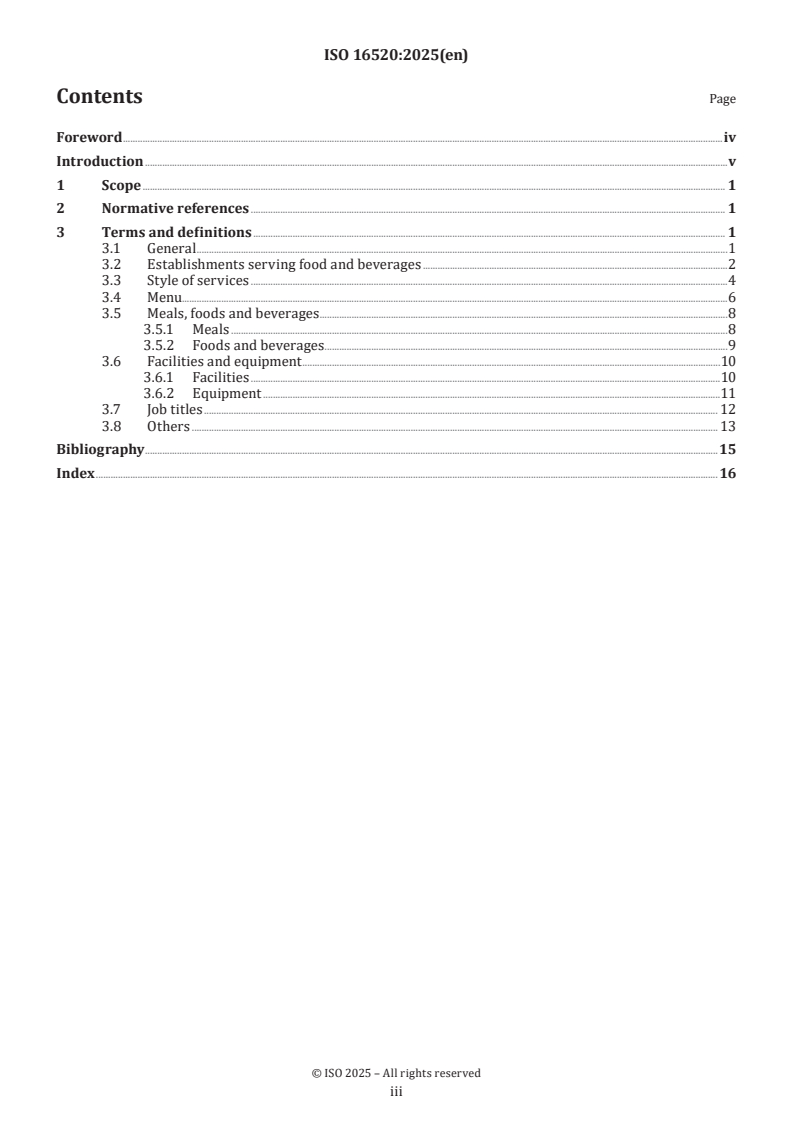
Contents Page
Foreword .iv
Introduction .v
1 Scope . 1
2 Normative references . 1
3 Terms and definitions . 1
3.1 General .1
3.2 Establishments serving food and beverages .2
3.3 Style of services .4
3.4 Menu.6
3.5 Meals, foods and beverages . .8
3.5.1 Meals .8
3.5.2 Foods and beverages . .9
3.6 Facilities and equipment .10
3.6.1 Facilities .10
3.6.2 Equipment .11
3.7 Job titles . 12
3.8 Others . 13
Bibliography .15
Index . 16
iii
Foreword
ISO (the International Organization for Standardization) is a worldwide federation of national standards
bodies (ISO member bodies). The work of preparing International Standards is normally carried out through
ISO technical committees. Each member body interested in a subject for which a technical committee
has been established has the right to be represented on that committee. International organizations,
governmental and non-governmental, in liaison with ISO, also take part in the work. ISO collaborates closely
with the International Electrotechnical Commission (IEC) on all matters of electrotechnical standardization.
The procedures used to develop this document and those intended for its further maintenance are described
in the ISO/IEC Directives, Part 1. In particular, the different approval criteria needed for the different types
of ISO document should be noted. This document was drafted in accordance with the editorial rules of the
ISO/IEC Directives, Part 2 (see www.iso.org/directives).
ISO draws attention to the possibility that the implementation of this document may involve the use of (a)
patent(s). ISO takes no position concerning the evidence, validity or applicability of any claimed patent
rights in respect thereof. As of the date of publication of this document, ISO had not received notice of (a)
patent(s) which may be required to implement this document. However, implementers are cautioned that
this may not represent the latest information, which may be obtained from the patent database available at
www.iso.org/patents. ISO shall not be held responsible for identifying any or all such patent rights.
Any trade name used in this document is information given for the convenience of users and does not
constitute an endorsement.
For an explanation of the voluntary nature of standards, the meaning of ISO specific terms and expressions
related to conformity assessment, as well as information about ISO's adherence to the World Trade
Organization (WTO) principles in the Technical Barriers to Trade (TBT), see www.iso.org/iso/foreword.html.
This document was prepared by Technical Committee ISO/TC 228, Tourism and related services.
Any feedback or questions on this document should be directed to the user’s national standards body. A
complete listing of these bodies can be found at www.iso.org/members.html.
iv
Introduction
Using different terms for one meaning in technical texts can cause misunderstanding. This can occur in
particular when the users of the technical texts are based in different areas. One word can be used in one
region for one defined meaning, but the same word can have a different meaning in a different region.
Vocabularies can act as a common language resource for users all over the world. Vocabularies can help the
standard developers in the related field, and can also be used as reliable references for other stakeholders
such as regulators, industry, consumers, universities, etc. to reach a common understanding while
researching, writing articles, studying, etc.
This document functions as a basic resource for all stakeholders in the restaurant and catering industry, as
well as for their customers and other users.
v
International Standard ISO 16520:2025(en)
Tourism and related services — Restaurants and catering —
Vocabulary
1 Scope
This document defines terms used in the tourism industry in the field of restaurants and catering.
This document applies to restaurants and catering services, which prepare and serve or deliver food and
beverages to customers.
This document does not apply to the production line of food and beverages.
2 Normative references
There are no normative references in this document.
3 Terms and definitions
ISO and IEC maintain terminology databases for use in standardization at the following addresses:
— ISO Online browsing platform: available at https:// www .iso .org/ obp
— IEC Electropedia: available at https:// www .electropedia .org/
3.1 General
3.1.1
catering
business of providing food and beverage (3.1.2) services (3.1.6) at a remote site
Note 1 to entry: Examples of remote sites can include a hotel, hospital, pub (3.2.20), aircraft, cruise ship, park, festival,
wedding, school or private event.
3.1.2
food and beverage
meals (3.1.3) and drinks which may be prepared and delivered in different ways and styles
3.1.3
meal
food and beverages (3.1.2) consumed at a certain time of day
3.1.4
menu
price list of food and beverages (3.1.2) that can be ordered in a food and beverages establishment
3.1.5
restaurant
establishment where food and beverages (3.1.2) are prepared in a kitchen and served to customers
Note 1 to entry: The food and beverages are intended to be consumed on site, taken away by the customer or delivered
to customers.
3.1.6
service
provision of meals (3.1.3) in a restaurant (3.1.5), by which food and beverages (3.1.2) are delivered to the
customers, after being prepared.
EXAMPLE Buffet service (3.3.4), table service (3.3.23)
3.2 Establishments serving food and beverages
3.2.1
bar
establishment equipped with a counter selling alcoholic or non-alcoholic beverages, and where light food is
sometimes served depending on the specialization
3.2.2
barbecue restaurant
establishment offering a range of food items that are cooked in part, using live fire or smoke
3.2.3
bistro
small restaurant (3.1.5), serving simple meals (3.1.3)
Note 1 to entry: Bistros are defined mostly by the foods they serve (e.g. home-style cooking and slow-cooked foods
like cassoulet or a bean stew).
3.2.4
buffet
self-service offer displaying food and beverages (3.1.2) which the customer can freely choose, in variety and
quantity
3.2.5
buffet car
railway coach which serves snacks (3.5.1.15) and drinks which may be taken back to the seats
3.2.6
cafeteria
restaurant (3.1.5) in which the customers serve themselves or are served at a counter and may take the food
to the tables to eat
Note 1 to entry: Cafeterias are also referred to as "self-serving establishments".
3.2.7
casual dining restaurant
restaurant (3.1.5) that serves moderately priced food and beverages (3.1.2) in a relaxed and friendly
atmosphere
3.2.8
coffee shop
establishment where hot and cold beverages, cakes, sometimes sandwiches, light meals (3.1.3), and coffee
beans are served and/or sold
3.2.9
concession stand
stall booth
stall without place for sitting from which customers can purchase light snacks (3.5.1.15) and beverages, as
well as fully prepared meals (3.1.3)
3.2.10
dinner theatre
restaurant (3.1.5) in which a play is presented after or during the meal (3.1.3)
3.2.11
drive-in restaurant
drive-through restaurant
restaurant (3.1.5) in which food is ordered and served indoors and also through a window to motorists in
their vehicles
3.2.12
family-style restaurant
type of restaurant (3.1.5) in which food is brought to the table in large platters or serving dishes, in order for
the customers to serve themselves
3.2.13
fast-food restaurant
quick-service restaurant (QSR)
limited menu restaurant (3.2.18) characterized both by its fast-food (3.5.1.9) cuisine and by minimal table
service (3.3.23)
Note 1 to entry: Fast food restaurants can be open 24 hours or offer continuous service (3.1.6).
3.2.14
fine dining restaurant
gourmet
full-service restaurant (3.1.5) with sophisticated and expensive meal (3.1.3) and beverage services (3.1.6), in
an elegant and formal atmosphere
3.2.15
food court
section of a commercial or institutional centre that hosts a collection of food vendors, where food and
beverages (3.1.2) can be purchased for taking away, or for being consumed on site
3.2.16
food truck
vehicle that may move from place to place, in which food can be cooked and served
3.2.17
international restaurant
restaurant (3.1.5) providing food and beverages (3.1.2) typical of different nations or different cultures
3.2.18
limited-menu restaurant
restaurant (3.1.5) with a small selection of food and beverages (3.1.2)
Note 1 to entry: Restaurants delivering or serving food such as pizza, kebab, etc. are examples for this kind of
restaurant.
3.2.19
mobile catering
serving food directly from a vehicle, cart or truck which is designed for that purpose
Note 1 to entry: Mobile catering is common at outdoor events, such as concerts, and in business districts.
3.2.20
pub
establishment where alcoholic beverages are served and consumed
Note 1 to entry: A pub is differentiated from a bar (3.2.1) based on the decoration, opening times and type of beverages
and food served (e.g. no hot beverage in the evening, finger food available).
Note 2 to entry: In a pub, it is quite common to play darts or other games.
3.2.21
quick casual restaurant
restaurant (3.1.5) that serves light food and beverages (3.1.2) which normally offers a "grab-and-go"
experience
Note 1 to entry: "Grab-and-go" can refer to a pre-packaged meal (3.1.3) or snack (3.5.1.15) that is ready to take quickly
when there is little time.
3.2.22
restaurant car
railway coach where passengers can sit, eat and drink
3.2.23
self-service restaurant
restaurants (3.1.5) such as a cafeteria (3.2.6), where meals (3.1.3) are self-served
3.2.24
service bar
relatively small bar (3.2.1) where service bartenders (3.7.2) prepare beverages for servers (3.7.10) to present
to customers
3.2.25
snack bar
establishment providing light food and beverages (3.1.2) for consumption where customers commonly sit or
stand at a counter
3.2.26
traditional restaurant
restaurant (3.1.5) providing traditional food and local beverages in a specific style, specially aimed at
ethnic cuisine
3.2.27
virtual restaurant
restaurant (3.1.5) that has a full menu (3.1.4) offered online for collection or delivery that does not offer
restaurant services (3.1.6) on the premises
3.3 Style of services
3.3.1
bar direct service
method of bar service (3.3.2) where the drinks are prepared in full, in front of the customer
Note 1 to entry: Bar direct service requires beverages, utensils, bottles, and glasses to be transported in a tray or
appropriate cart.
3.3.2
bar service
service (3.1.6) where the customer orders, pays and collects food and beverages (3.1.2) from a bar (3.2.1)
3.3.3
boxed-lunch catering
lunch in a box, typically prepared by a caterer (3.7.5) for a customer’s dining needs
3.3.4
buffet service
service (3.1.6) where food is displayed on tables and where customers take plates then proceed to the buffet
(3.2.4) to be served or self-served
3.3.5
butler style service
service (3.1.6) in which food and beverages (3.1.2) are served by butlers
3.3.6
cafeteria service
counter service
service (3.1.6) in which food and beverages (3.1.2) are served at a counter
3.3.7
cart service
variation of table service (3.3.23) used by servers (3.7.10) for preparing menu (3.1.4) items beside the
customers’ table in the dining room
3.3.8
catering service
service (3.1.6) provided by a caterer (3.7.5)
3.3.9
cocktail party
cocktail reception
serving food and beverages (3.1.2) to standing customers
3.3.10
contract catering
providing food and beverages (3.1.2) under the terms of a contract
3.3.11
corporate catering
catering services (3.3.8) for business customers, organized by a catering (3.1.1) company
3.3.12
dine in
style of service (3.1.6), which refers to consuming the meal (3.1.3) within certain establishments, such as
restaurant (3.1.5), home or canteen.
3.3.13
event catering
catering services (3.3.8) at an event that can include cooking on site
3.3.14
mise en place, (fr.)
setting out of tableware (3.6.2.15) in a restaurant (3.1.5), ready for customers
3.3.15
off-premises catering service
outside catering
catering (3.1.1) in which the food is transported from an off-site kitchen to the event venue
3.3.16
on-premises catering service
catering (3.1.1) in which the food and beverages (3.1.2) are provided by the caterers (3.7.5) exclusively at the event
3.3.17
outdoor catering
catering (3.1.1) for large numbers of people in the open air
3.3.18
plate service
style of restaurant table service (3.3.23) in which food is portioned and plated in the kitchen before being
served to customers
Note 1 to entry: Plate service is called “American service” in some countries.
3.3.19
platter service
table service (3.3.23) style in which servers (3.7.10) carry platters and present them to the customers for
approval, and the customers serve themselves using serving cutlery (3.6.2.3)
Note 1 to entry: Platter service is called “French service” in some countries.
3.3.20
silver service
style of restaurant (3.1.5) table service (3.3.23), in which the server (3.7.10) transfers food from a serving
dish to the customer
...