

ISO 24758-2:2025
(Main)Fine bubble technology — Evaluation method for determining the reactive oxygen species in ultrafine bubble dispersions — Part 2: APF (3'-(p-aminophenyl) fluorescein) assay
General Information
- Abstract
This International Standard specifies the evaluation methods for ROS in pollutant abatement through FB-facilitated advanced oxidation treatment.
- Status
- Published
- Publication Date
- 27-Oct-2025
- Technical Committee
- ISO/TC 281 - Fine bubble technology
- Drafting Committee
- ISO/TC 281/WG 2 - Fine bubble characterization and measurement
- Current Stage
- 6060 - International Standard published
- Start Date
- 28-Oct-2025
- Due Date
- 04-Jun-2027
- Completion Date
- 28-Oct-2025


Overview
ISO 24758-2:2025 - Fine bubble technology - Evaluation method for determining the reactive oxygen species in ultrafine bubble dispersions - Part 2: APF (3'-(p-aminophenyl) fluorescein) assay defines a standardized fluorescence-based method for detecting and quantifying reactive oxygen species (ROS) generated in microbubble (MB) and ultrafine bubble (UFB) dispersions. The document specifies use of the APF assay to evaluate ROS relevant to pollutant abatement and FB-facilitated advanced oxidation treatments, with sensitivity down to submicromolar levels.
Key topics and technical requirements
- Scope and targets: Procedures for measuring ROS such as hydroxyl radical (·OH), superoxide anion (O2·−), singlet oxygen (1O2), hydrogen peroxide (H2O2) and dissolved ozone in UFB/MB systems.
- Principle: APF (3'-(p-aminophenyl) fluorescein) is a fluorescein-based probe that becomes highly fluorescent after oxidation (O-dearylation) by strong oxidants; fluorescence intensity correlates with ROS concentration.
- Reagents and controls: Lists required chemicals, positive controls and methods for generating representative ROS (hydroxyl radicals, superoxide, singlet oxygen, H2O2) for calibration.
- Apparatus & environment: Requirements for measuring instruments, sample preparation, and environmental conditions to ensure reproducible fluorescence readings.
- Procedure: Stepwise method including standard curve development for individual ROS, fluorescence response characterization (·OH, dissolved ozone, H2O2, superoxide, singlet oxygen), ROS identification protocols, and interpretation guidelines.
- Reporting: Required result formats and testing condition documentation; annexes provide example test results (e.g., H2O2 detection after UFB + plasma treatment).
Practical applications
- Evaluating advanced oxidation processes (AOPs) and pollutant abatement in water and wastewater treatment using fine bubble technology.
- Assessing disinfecting and oxidation performance of ozone UFBs and other FB-enabled treatments.
- Research into biological effects of ROS in agriculture (plant and aquaculture systems) where UFBs influence growth or stress responses.
- Quality control and R&D for manufacturers of UFB generators, oxygenation systems, and environmental treatment equipment.
Who should use this standard
- Environmental and water treatment engineers
- Analytical and research laboratories working on AOPs or FB technologies
- Agricultural and aquaculture researchers studying oxidative effects
- Manufacturers and conformity assessment bodies involved in fine bubble products
Related standards
- ISO 24758-1 (probe‑based kinetic models for ROS measurement) - complements Part 2
- ISO 23015 - Fine bubble measurement techniques
- ISO 20480-1:2017 - Fine bubble terminology and general principles
Keywords: ISO 24758-2:2025, APF assay, ultrafine bubble (UFB), reactive oxygen species, fine bubble technology, hydroxyl radical, hydrogen peroxide, pollutant abatement, advanced oxidation.
Frequently Asked Questions
ISO 24758-2:2025 is a standard published by the International Organization for Standardization (ISO). Its full title is "Fine bubble technology — Evaluation method for determining the reactive oxygen species in ultrafine bubble dispersions — Part 2: APF (3'-(p-aminophenyl) fluorescein) assay". This standard covers: This International Standard specifies the evaluation methods for ROS in pollutant abatement through FB-facilitated advanced oxidation treatment.
This International Standard specifies the evaluation methods for ROS in pollutant abatement through FB-facilitated advanced oxidation treatment.
ISO 24758-2:2025 is classified under the following ICS (International Classification for Standards) categories: 07.030 - Physics. Chemistry. The ICS classification helps identify the subject area and facilitates finding related standards.
ISO 24758-2:2025 is available in PDF format for immediate download after purchase. The document can be added to your cart and obtained through the secure checkout process. Digital delivery ensures instant access to the complete standard document.
Standards Content (Sample)
International
Standard
ISO 24758-2
First edition
Fine bubble technology —
2025-10
Evaluation method for determining
the reactive oxygen species in
ultrafine bubble dispersions —
Part 2:
APF (3'-(p-aminophenyl)
fluorescein) assay
Technologie des fines bulles — Méthode d'évaluation pour
déterminer les espèces réactives de l'oxygène dans les dispersions
de bulles ultrafines —
Partie 2: Dosage de l'APF (3'-(p-aminophenyl) fluorescein)
Reference number
© ISO 2025
All rights reserved. Unless otherwise specified, or required in the context of its implementation, no part of this publication may
be reproduced or utilized otherwise in any form or by any means, electronic or mechanical, including photocopying, or posting on
the internet or an intranet, without prior written permission. Permission can be requested from either ISO at the address below
or ISO’s member body in the country of the requester.
ISO copyright office
CP 401 • Ch. de Blandonnet 8
CH-1214 Vernier, Geneva
Phone: +41 22 749 01 11
Email: copyright@iso.org
Website: www.iso.org
Published in Switzerland
ii
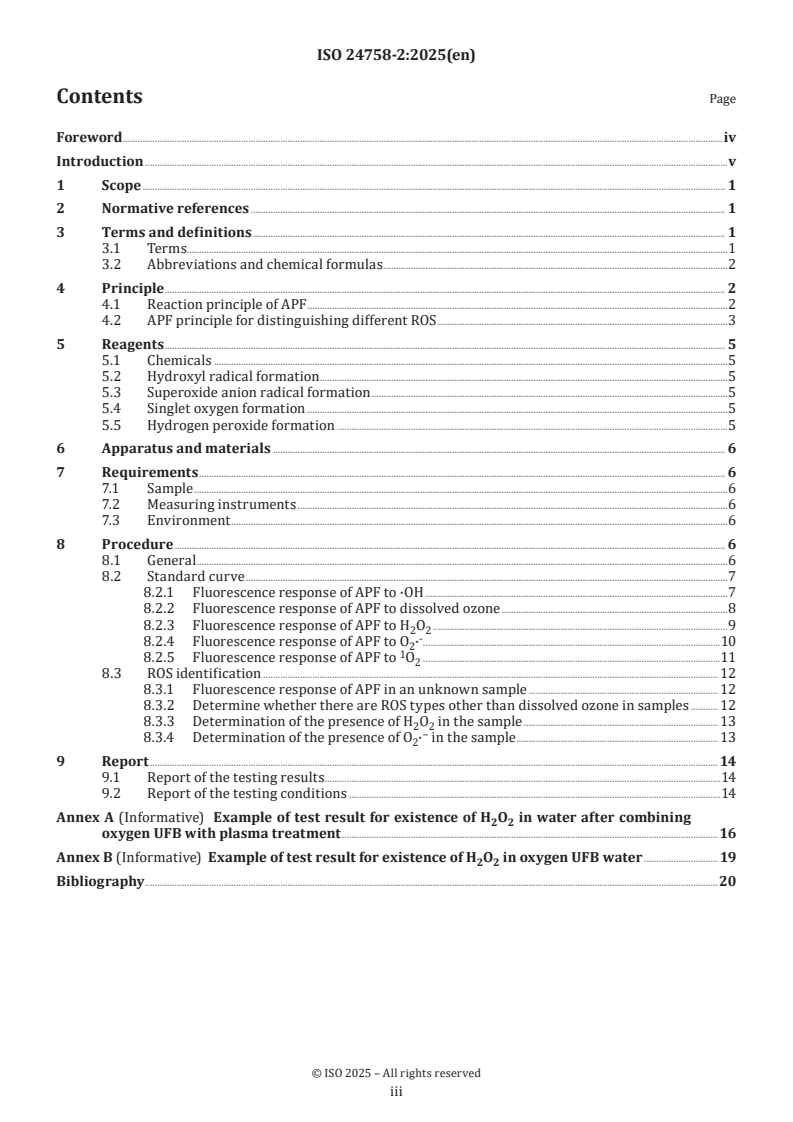
Contents Page
Foreword .iv
Introduction .v
1 Scope . 1
2 Normative references . 1
3 Terms and definitions . 1
3.1 Terms.1
3.2 Abbreviations and chemical formulas .2
4 Principle . 2
4.1 Reaction principle of APF .2
4.2 APF principle for distinguishing different ROS .3
5 Reagents . 5
5.1 Chemicals .5
5.2 Hydroxyl radical formation .5
5.3 Superoxide anion radical formation .5
5.4 Singlet oxygen formation .5
5.5 Hydrogen peroxide formation .5
6 Apparatus and materials . 6
7 Requirements . 6
7.1 Sample .6
7.2 Measuring instruments .6
7.3 Environment .6
8 Procedure . 6
8.1 General .6
8.2 Standard curve .7
8.2.1 Fluorescence response of APF to ·OH .7
8.2.2 Fluorescence response of APF to dissolved ozone .8
8.2.3 Fluorescence response of APF to H O .9
2 2
-
8.2.4 Fluorescence response of APF to O · .10
8.2.5 Fluorescence response of APF to O .11
8.3 ROS identification . 12
8.3.1 Fluorescence response of APF in an unknown sample . 12
8.3.2 Determine whether there are ROS types other than dissolved ozone in samples . 12
8.3.3 Determination of the presence of H O in the sample . 13
2 2
−
8.3.4 Determination of the presence of O · in the sample . 13
9 Report . 14
9.1 Report of the testing results.14
9.2 Report of the testing conditions .14
Annex A (Informative) Example of test result for existence of H O in water after combining
2 2
oxygen UFB with plasma treatment .16
Annex B (Informative) Example of test result for existence of H O in oxygen UFB water . 19
2 2
Bibliography .20
iii
Foreword
ISO (the International Organization for Standardization) is a worldwide federation of national standards
bodies (ISO member bodies). The work of preparing International Standards is normally carried out through
ISO technical committees. Each member body interested in a subject for which a technical committee
has been established has the right to be represented on that committee. International organizations,
governmental and non-governmental, in liaison with ISO, also take part in the work. ISO collaborates closely
with the International Electrotechnical Commission (IEC) on all matters of electrotechnical standardization.
The procedures used to develop this document and those intended for its further maintenance are described
in the ISO/IEC Directives, Part 1. In particular, the different approval criteria needed for the different types
of ISO document should be noted. This document was drafted in accordance with the editorial rules of the
ISO/IEC Directives, Part 2 (see www.iso.org/directives).
ISO draws attention to the possibility that the implementation of this document may involve the use of (a)
patent(s). ISO takes no position concerning the evidence, validity or applicability of any claimed patent
rights in respect thereof. As of the date of publication of this document, ISO had not received notice of (a)
patent(s) which may be required to implement this document. However, implementers are cautioned that
this may not represent the latest information, which may be obtained from the patent database available at
www.iso.org/patents. ISO shall not be held responsible for identifying any or all such patent rights.
Any trade name used in this document is information given for the convenience of users and does not
constitute an endorsement.
For an explanation of the voluntary nature of standards, the meaning of ISO specific terms and expressions
related to conformity assessment, as well as information about ISO's adherence to the World Trade
Organization (WTO) principles in the Technical Barriers to Trade (TBT), see www.iso.org/iso/foreword.html.
This document was prepared by Technical Committee ISO/TC 281, Fine bubble technology.
A list of all parts in the ISO 24758 series can be found on the ISO website.
Any feedback or questions on this document should be directed to the user’s national standards body. A
complete listing of these bodies can be found at www.iso.org/members.html.
iv
Introduction
Recently, fine bubble technology has gained extensive application in the agricultural and environmental
fields. Investigations reveal that air microbubbles (MBs) and ultrafine bubbles (UFBs) can enhance the
growth of plants, shellfish, and yeast. Furthermore, ozone UFBs are proven effective in removing residual
pesticides from vegetables, inactivating microorganisms, and reducing organic material in wastewater.
Despite these promising outcomes, the mechanisms underpinning the fine bubble process are not entirely
understood. A key factor is the generation of reactive oxygen species (ROS).
A moderate ROS level positively influences growth, while a higher concentration effectively disinfects
pathogens and degrades pollutants in water purification systems. However, detecting the physiological
level of ROS is challenging, necessitating more sensitive methodologies. Fluorescence methodology,
complemented by suitable probes, emerges as an ideal solution for ROS detection due to its high sensitivity
and ease of data collection. Therefore, this document recommends the 3’-(p-aminophenyl) fluorescein (APF)
assay for detecting and quantifying ROS in UFB solutions.
Among ROS, the most biologically significant and extensively studied are hydroxyl radical (·OH), superoxide
·− 1
anion radical (O ), singlet oxygen ( O ), and hydrogen peroxide (H O ). The 3’-(p-aminophenyl) fluorescein
2 2 2 2
(APF) assay requires strong oxidizing power for the ipsosubstitution reaction. Given the varying oxidizing
powers of these ROS, APF’s fluorescence responses to each differ. This variability allows the differentiation
of the ROS types using APF.
In ISO 24758-1, the application of probe-based kinetic models for measuring the cumulative concentrations
of various ROS over time, as well as their real-time concentrations at each treatment interval, is described.
This document outlines methods for detecting ROS in MB and UFB dispersions using the APF assay. This
technique is highly sensitive and capable of detecting ROS at submicromolar levels in MB and UFB dispersed
liquids. Its application is crucial for evaluating MB and UFB technology’s effectiveness in agriculture and
disinfection.
v
International Standard ISO 24758-2:2025(en)
Fine bubble technology — Evaluation method for determining
the reactive oxygen species in ultrafine bubble dispersions —
Part 2:
APF (3'-(p-aminophenyl) fluorescein) assay
1 Scope
·−
This document describes the procedure for testing and evaluating the generation of ROS such as OH, O ,
H O , and O in MB and UFB dispersions using the APF assay.
2 2 3
This method is suited for systems generating ROS at physiological levels, not in large quantities, and
complements the probe kinetic model for detecting H O in MB and UFB dispersions.
2 2
2 Normative references
The following documents are referred to in the text in such a way that some or all of their content constitutes
requirements of this document. For dated references, only the edition cited applies. For undated references,
the latest edition of the referenced document (including any amendments) applies.
ISO 23015, Fine bubble technology—Measurement technique matrix for the characterization of fine bubbles
ISO 20480-1:2017, Fine bubble technology — General principles for usage and measurement of fine bubbles —
Part 1: Terminology
3 Terms and definitions
For the purposes of this document, the terms and definitions given in ISO 23015 and ISO ISO 20480-1 apply.
ISO and IEC maintain terminology databases for use in standardization at the following addresses:
— ISO Online browsing platform: available at https:// www .iso .org/ obp
— IEC Electropedia: available at https:// www .electropedia .org/
3.1 Terms
3.1.1
reactive oxygen species
ROS
chemically reactive species containing oxygen referred to as ROS, encompassing free radicals, such as
·-
superoxide (O ) and hydroxyl radical (·OH), as well as non-radical molecules like hydrogen peroxide (H O )
2 2 2
and singlet oxygen( O )
3.1.2
3’-(p-aminophenyl) fluorescein
APF
fluorescein-based fluorescent probe, highly sensitive, used in biological and chemical studies to detect ROS,
particularly hydroxyl radicals and peroxynitrite anions
Note 1 to entry: APF is often used due to its high sensitivity to specific ROS and is particularly useful for detecting
hydroxyl radicals and peroxynitrite anions in a range of experimental conditions.
3.1.3
positive control
reference sample used to determine the concentration of a substance by comparing it to the minimum
amount of a reagent with known concentration required to produce a visible reaction with a specific volume
of the test solution
3.1.4
standard curve
curve used to analyze the APF's fluorescence response to ROS, illustrating the relationship between known
concentrations of various ROS and their corresponding fluorescence response values
Note 1 to entry: The standard curve establishes a relationship between known ROS concentrations and their
fluorescence responses, serving as a reference for interpreting experimental data and accurately quantifying ROS
levels in samples based on their fluorescence characteristics.
3.2 Abbreviations and chemical formulas
APF 3’-(p-aminophenyl) fluorescein
MB microbubble
UFB ultrafine bubble
FB fine bubble
ROS reactive oxygen species
hROS highly reactive oxygen species
·OH hydroxyl radical
·−
O superoxide anion radical
O singlet oxygen
H O hydrogen peroxide
2 2
O ozone
ONOO– peroxynitrite
2,4-D 2,4-dichlorophenoxyacetic acid
SOD superoxide dismutase
KO potassium superoxide
EP 3-(1,4-epidioxy-4-methyl-1,4-dihydro-1-naphthyl) propionic acid
4 Principle
4.1 Reaction principle of APF
APF operates on a fluorescence-based mechanism, leveraging its unique molecular structure to selectively
detect specific ROS. The molecule comprises a fluorescein core, known for its high fluorescence, attached to
an aminophenyl group. This aminophenyl group is essential for the detection of ROS. In its unreacted state,
the aminophenyl group maintains a configuration that suppresses the fluorescence of the fluorescein core.
This suppression is due to the electron-donating nature of the aminophenyl group, which interferes with the
electronic structure of the fluorescein, resulting in a nonfluorescent or low-fluorescent state.
Upon exposure to certain ROS, particularly those with robust oxidizing properties like ·OH or peroxynitrite
(ONOO–), the aminophenyl group undergoes oxidation. These ROS oxidize the aminophenyl group, changing
its electronic and spatial configuration. This oxidation process neutralizes the electron-donating effect of
the aminophenyl group, thereby lifting the suppression on the fluorescein core.
As a result of the oxidation of the aminophenyl group, the fluorescein core becomes highly fluorescent.
When excited by light at a specific wavelength, it emits a strong fluorescence signal. The intensity of this
fluorescence is directly proportional to the concentration of ROS present: more ROS leads to increased
oxidation of APF molecules, enhancing fluorescence. This selective response to particular ROS types, based
on their ability to oxidize the aminophenyl group, renders APF an effective tool for detecting and quantifying
these species. The reaction mechanism, termed O-dearylation, of APF with high reactivity oxygen species
(hROS) is schematically represented in Figure 1 as follows:
Figure 1 — Scheme of O-dearylation reaction of APF with hROS (reactants do not fluoresce, but the
products exhibit strong fluorescence)
Furthermore, APF demonstrates superior resistance to autoxidation, which is triggered by oxygen and light,
than to other fluorescent probes. When exposed to a fluorescent lamp for 2,5 hours the increase in the APF's
fluorescence was less than 1, while that for 2',7'-dichlorofluorescin diacetate (DCFH) was approximately 2 000.
4.2 APF principle for distinguishing different ROS
The APF assay’s fluorescence response to different ROS varies significantly, enabling the distinction between
various ROS types. The methodology is outlined as follows:
Figure 2 — Schematic of ROS identification using APF
Figure 2 shows a schematic of ROS identification. It demonstrates the APF’s fluorescence response to
different ROS types. We obtained the following results through a comparative analysis of the fluorescent
responses of APF to different ROS types. Assuming that the fluorescence response of APF to ·OH is 1, its
− 1
response to ozone is considerably higher at a value of 100. Meanwhile, its responses to H O , O · , and O
2 2 2 2
are approximately 1/4 500, 1/700, and 1/50 of that for ·OH, respectively. Typically, various types of ROSs
are observed in MB and UFB systems; two or more types may be present simultaneously. Using the method
illustrated in Figure 2, ROS types in a sample can be identified accurately. The identification process involves
several steps.
First, ascertain whether ROS types are present in a sample in addition to O by measuring the O
3 3
concentration in the sample using an O detector. The effect of varying O concentrations on the fluorescent
3 3
response of APF shall be analysed, and the theoretical intensity of the O -induced APF fluorescence at a
specific concentration shall be calculated using a standard curve. This theoretical intensity shall be
compared with that obtained experimentally. If the actual fluorescence intensity of the sample exceeds the
theoretical increase in APF fluorescence intensity caused by O , it indicates the presence of other ROS types
in the sample besides O .
Second, the presence of H O as a ROS produced in MB or UFB dispersions shall be examined. The formation
2 2
of ·OH through a Fenton reaction can lead to a marked increase in fluorescence intensity. Therefore, if no
significant increase is observed after adding ferrous ions to an H O solution, the presence of H O shall be
2 2 2 2
ruled out.
−
Third, the possibility of O · being a ROS produced in MB or UFB dispersions shall be investigated. The
−
catalytic dismutation of O · with superoxide dismutase (SOD) results in H O formation. Adding ferrous
2 2 2
ions to this solution shall yield ·OH, leading to a dramatic increase in fluorescence intensity. If such an
−
increase does not occur, the presence of O · shall be negated.
Finally, you shall aim to identify whether ·OH or O exists in a water sample. Some quenchers such as
benzoic acid and 2,4-dichlorophenoxyacetic acid (2,4-D) are known to react with ·OH but not with O .
Hence, it is assumed that if the fluorescence intensity of MB or UFB dispersions decreases after the addition
of quenchers, the ROS present shall be identified as ·OH. Conversely, if the fluorescence intensity remains
unchanged, the ROS present in the sample shall be identified as O . Short-lived ROS can also be quantified
using the probe-based kinetic model
5 Reagents
5.1 Chemicals
The following chemicals are used as reagents to generate exogenous ROS and to establish a standard curve
that defines the relationship between known ROS concentrations and their corresponding fluorescence
response values:
a) APF (5 mM, Sekisui Medical Co., Ltd., Japan)
b) H O (30 %)
2 2
c) Ferrous iron (II) e.g. iron (II) sulphate
d) Sodium phosphate buffer (0,1 M, pH 7,4)
e) KO powder
5.2 Hydroxyl radical formation
The ·OH is generated via the Fenton reaction. In this process, ferrous iron
...