


ISO 80601-2-69
(Main)Medical electrical equipment — Part 2-69: Particular requirements for the basic safety and essential performance of oxygen concentrator equipment
Medical electrical equipment — Part 2-69: Particular requirements for the basic safety and essential performance of oxygen concentrator equipment
This document specifies requirements for the basic safety and essential performance of an oxygen concentrator in combination with its accessories, hereafter referred to as ME equipment, intended to increase the oxygen concentration of gas intended to be delivered to a single patient. Such oxygen concentrators are typically intended for use in the home healthcare environment by a single patient in various environments including any private and public transportation as well as in commercial aircraft. NOTE 1 Such oxygen concentrators can also be used in professional healthcare facilities. This document is applicable to a transit-operable and non-transit-operable oxygen concentrator. This document is applicable to an oxygen concentrator integrated into or used with other medical devices, ME equipment or ME systems. EXAMPLE 1 An oxygen concentrator with integrated oxygen conserving equipment function or humidifier function. EXAMPLE 2 An oxygen concentrator used with a flowmeter stand. EXAMPLE 3 An oxygen concentrator as part of an anaesthetic system for use in areas with limited logistical supplies of electricity and anaesthetic gases[2]. EXAMPLE 4 An oxygen concentrator with an integrated liquid reservoir function or gas cylinder filling system function. This document is also applicable to those accessories intended by their manufacturer to be connected to an oxygen concentrator, where the characteristics of those accessories can affect the basic safety or essential performance of the oxygen concentrator. NOTE 2 Such accessories can include, but are not limited to, masks, cannulae, extension tubing, humidifiers, carts, carrying cases, external power sources and oxygen conserving equipment. This document does not specify requirements for oxygen concentrators for use with a medical gas pipeline system. If a clause or subclause is specifically intended to be applicable to ME equipment only, or to ME systems only, the title and content of that clause or subclause will say so. If that is not the case, the clause or subclause applies both to ME equipment and to ME systems, as relevant. Hazards inherent in the intended physiological function of ME equipment or ME systems within the scope of this document are not covered by specific requirements in this document except in 7.2.13 and 8.4.1 of the general standard. NOTE 3 See also 4.2 of the general standard.
Appareils électromédicaux — Partie 2-69: Exigences particulières pour la sécurité de base et les performances essentielles des dispositifs concentrateurs d'oxygène
Le présent document spécifie les exigences applicables à la sécurité de base et aux performances essentielles d'un concentrateur d'oxygène en combinaison avec ses accessoires, désigné ci-après sous le terme d'appareil EM, visant à augmenter la concentration en oxygène du gaz destiné à être délivré à un patient unique. De tels concentrateurs d'oxygène sont, en général, destinés à être utilisés dans un environnement de soins à domicile pour un patient unique dans divers environnements, dont les transports publics et privés ainsi que dans les transports aériens. NOTE 1 Ce type de concentrateurs d'oxygène peut également être utilisé dans des établissements de santé. Le présent document est applicable aux concentrateurs d'oxygène opérationnels en déplacement et non opérationnels en déplacement. Le présent document est applicable aux concentrateurs d'oxygène intégrés ou utilisés avec d'autres dispositifs médicaux, appareils EM ou systèmes EM. EXEMPLE 1 Un concentrateur d'oxygène doté d'une fonction d'économiseur d'oxygène intégré ou d'humidificateur intégré. EXEMPLE 2 Un concentrateur d'oxygène utilisé avec un débitmètre. EXEMPLE 3 Un concentrateur d'oxygène faisant partie d'un système d'anesthésie pour utilisation dans des zones avec équipement logistique limité en électricité et en gaz anesthésiques.[2] EXEMPLE 4 Un concentrateur d'oxygène doté d'une fonction de réservoir de liquide intégré ou de système de remplissage de bouteilles de gaz intégré. Le présent document s'applique également aux accessoires destinés par leur fabricant à être raccordés à un concentrateur d'oxygène, du fait que les caractéristiques de ces accessoires peuvent avoir un impact sur la sécurité de base ou sur les performances essentielles du concentrateur d'oxygène. NOTE 2 Les accessoires peuvent comprendre, entre autres, des masques, des canules, des tubulures d'extension, des humidificateurs, des chariots, des coffrets de transport, des sources d'alimentation externes ou des économiseurs d'oxygène. Le présent document ne spécifie pas d'exigences applicables à l'utilisation de concentrateurs d'oxygène avec un système de distribution de gaz médicaux. Si un article ou un paragraphe est spécifiquement destiné à être appliqué uniquement aux appareils EM ou uniquement aux systèmes EM, le titre et le contenu dudit article ou paragraphe l'indiqueront. Si cela n'est pas le cas, l'article ou le paragraphe s'applique à la fois aux appareils EM et aux systèmes EM, selon le cas. Les dangers inhérents à la fonction physiologique prévue des appareils EM ou des systèmes EM dans le cadre du domaine d'application du présent document ne sont pas couverts par des exigences spécifiques contenues dans le présent document, à l'exception de 7.2.13 et 8.4.1 de la norme générale. NOTE 3 Voir également 4.2 de la norme générale.
General Information
- Status
- Not Published
- Current Stage
- 6000 - International Standard under publication
- Start Date
- 03-Dec-2025
- Completion Date
- 14-Feb-2026
Relations
- Effective Date
- 12-Feb-2026
- Effective Date
- 10-Jun-2023
- Effective Date
- 10-Jun-2023
Overview
ISO 80601-2-69 is a specialized international standard under the ISO/IEC 60601 series that sets forth particular requirements for the basic safety and essential performance of oxygen concentrator equipment. This standard applies to medical electrical (ME) equipment designed to increase oxygen concentration in gases delivered to a single patient. It is primarily intended for oxygen concentrators used in home healthcare environments but also covers use in public and private transportation, commercial aircraft, and professional healthcare facilities.
The third edition of this standard, to be published in 2025, reflects updates on measurement uncertainty, marking and labeling, cybersecurity recommendations, and connector requirements, ensuring the latest technologies and safety concerns are addressed.
Key Topics
Scope and Applicability
- Targets oxygen concentrators and their accessories, including masks, cannulae, humidifiers, carts, power sources, and oxygen conserving equipment.
- Covers transit-operable and non-transit-operable oxygen concentrators.
- Applicable to oxygen concentrators integrated with other medical devices or systems, such as:
- Devices with oxygen conserving functions
- Flowmeter stands
- Anaesthetic systems in environments with limited electricity or gas supplies
- Systems with liquid oxygen reservoirs or gas cylinder filling functions
- Excludes oxygen concentrators that operate with medical gas pipeline systems.
Safety and Performance Requirements
- Defines essential performance criteria to ensure safe and effective oxygen delivery.
- Addresses protection against electrical, mechanical, radiation, and temperature hazards.
- Specifies accuracy for controls and instruments, including fault condition handling.
- Emphasizes electromagnetic compatibility to avoid interference during operation.
- Includes cybersecurity recommendations to safeguard device operation and patient data.
Usability and Marking
- Provides guidance for product identification, labeling, and symbol use to promote clear communication and compliance.
- Includes considerations for environmental operating conditions, especially critical for home healthcare and transport use.
Harmonization with Related Standards
- Aligns with general IEC 60601-1 safety standards and collateral standards IEC 60601-1-2 (electromagnetic disturbances), IEC 60601-1-6 (usability), and IEC 60601-1-11 (home healthcare environment).
- Harmonizes with ISO 20417 on medical device labeling requirements.
- Complies with International Medical Devices Regulators Forum (IMDRF) essential principles and European Union Medical Device Regulation (MDR) 2017/745 requirements.
Applications
ISO 80601-2-69 supports the development and assessment of oxygen concentrators used in multiple healthcare settings, such as:
- Home Healthcare: Ensuring patient safety and oxygen delivery reliability in home environments, including variable temperature and humidity conditions.
- Patient Transportation: Guidelines for oxygen concentrators designed for use in vehicles and aircraft, ensuring functionality under transit conditions.
- Professional Healthcare Facilities: Use within hospitals and clinics as standalone devices or integrated into more complex medical systems, including anesthesia applications.
- Emergency and Resource-Limited Settings: Devices with additional features like integrated oxygen conservation or gas filling functions for settings with limited infrastructure.
The standard facilitates product innovation by accommodating advances such as molecular sieve technology and integrated accessory functions while maintaining rigorous safety controls.
Related Standards
- IEC 60601-1: General standard for basic safety and essential performance of medical electrical equipment.
- IEC 60601-1-2: Electromagnetic compatibility requirements for medical devices.
- IEC 60601-1-6: Usability engineering for medical devices.
- IEC 60601-1-11: Requirements for medical devices intended for home healthcare environments.
- ISO 20417: Medical device labeling standards.
- European Union MDR 2017/745: Regulatory requirements for medical device safety and performance.
- ISO 16142-1: Essential principles for medical devices.
Conclusion
ISO 80601-2-69 provides a comprehensive framework for the design, manufacturing, testing, and maintenance of oxygen concentrators. By addressing safety, performance, usability, and labeling, the standard ensures that oxygen concentrators meet stringent international requirements. This supports improved patient outcomes and regulatory compliance in diverse care environments, from home to hospital and transit settings. It is an essential reference for manufacturers, healthcare providers, and regulatory bodies involved in medical respiratory equipment.
Buy Documents


ISO/FDIS 80601-2-69 - Medical electrical equipment — Part 2-69: Particular requirements for the basic safety and essential performance of oxygen concentrator equipment Released:9/23/2025
REDLINE ISO/FDIS 80601-2-69 - Medical electrical equipment — Part 2-69: Particular requirements for the basic safety and essential performance of oxygen concentrator equipment Released:9/23/2025

ISO/FDIS 80601-2-69 - Appareils électromédicaux — Partie 2-69: Exigences particulières pour la sécurité de base et les performances essentielles des dispositifs concentrateurs d'oxygène Released:25. 10. 2025
Get Certified
Connect with accredited certification bodies for this standard

BSI Group
BSI (British Standards Institution) is the business standards company that helps organizations make excellence a habit.

TÜV Rheinland
TÜV Rheinland is a leading international provider of technical services.

TÜV SÜD
TÜV SÜD is a trusted partner of choice for safety, security and sustainability solutions.
Sponsored listings
Frequently Asked Questions
ISO 80601-2-69 is a draft published by the International Organization for Standardization (ISO). Its full title is "Medical electrical equipment — Part 2-69: Particular requirements for the basic safety and essential performance of oxygen concentrator equipment". This standard covers: This document specifies requirements for the basic safety and essential performance of an oxygen concentrator in combination with its accessories, hereafter referred to as ME equipment, intended to increase the oxygen concentration of gas intended to be delivered to a single patient. Such oxygen concentrators are typically intended for use in the home healthcare environment by a single patient in various environments including any private and public transportation as well as in commercial aircraft. NOTE 1 Such oxygen concentrators can also be used in professional healthcare facilities. This document is applicable to a transit-operable and non-transit-operable oxygen concentrator. This document is applicable to an oxygen concentrator integrated into or used with other medical devices, ME equipment or ME systems. EXAMPLE 1 An oxygen concentrator with integrated oxygen conserving equipment function or humidifier function. EXAMPLE 2 An oxygen concentrator used with a flowmeter stand. EXAMPLE 3 An oxygen concentrator as part of an anaesthetic system for use in areas with limited logistical supplies of electricity and anaesthetic gases[2]. EXAMPLE 4 An oxygen concentrator with an integrated liquid reservoir function or gas cylinder filling system function. This document is also applicable to those accessories intended by their manufacturer to be connected to an oxygen concentrator, where the characteristics of those accessories can affect the basic safety or essential performance of the oxygen concentrator. NOTE 2 Such accessories can include, but are not limited to, masks, cannulae, extension tubing, humidifiers, carts, carrying cases, external power sources and oxygen conserving equipment. This document does not specify requirements for oxygen concentrators for use with a medical gas pipeline system. If a clause or subclause is specifically intended to be applicable to ME equipment only, or to ME systems only, the title and content of that clause or subclause will say so. If that is not the case, the clause or subclause applies both to ME equipment and to ME systems, as relevant. Hazards inherent in the intended physiological function of ME equipment or ME systems within the scope of this document are not covered by specific requirements in this document except in 7.2.13 and 8.4.1 of the general standard. NOTE 3 See also 4.2 of the general standard.
This document specifies requirements for the basic safety and essential performance of an oxygen concentrator in combination with its accessories, hereafter referred to as ME equipment, intended to increase the oxygen concentration of gas intended to be delivered to a single patient. Such oxygen concentrators are typically intended for use in the home healthcare environment by a single patient in various environments including any private and public transportation as well as in commercial aircraft. NOTE 1 Such oxygen concentrators can also be used in professional healthcare facilities. This document is applicable to a transit-operable and non-transit-operable oxygen concentrator. This document is applicable to an oxygen concentrator integrated into or used with other medical devices, ME equipment or ME systems. EXAMPLE 1 An oxygen concentrator with integrated oxygen conserving equipment function or humidifier function. EXAMPLE 2 An oxygen concentrator used with a flowmeter stand. EXAMPLE 3 An oxygen concentrator as part of an anaesthetic system for use in areas with limited logistical supplies of electricity and anaesthetic gases[2]. EXAMPLE 4 An oxygen concentrator with an integrated liquid reservoir function or gas cylinder filling system function. This document is also applicable to those accessories intended by their manufacturer to be connected to an oxygen concentrator, where the characteristics of those accessories can affect the basic safety or essential performance of the oxygen concentrator. NOTE 2 Such accessories can include, but are not limited to, masks, cannulae, extension tubing, humidifiers, carts, carrying cases, external power sources and oxygen conserving equipment. This document does not specify requirements for oxygen concentrators for use with a medical gas pipeline system. If a clause or subclause is specifically intended to be applicable to ME equipment only, or to ME systems only, the title and content of that clause or subclause will say so. If that is not the case, the clause or subclause applies both to ME equipment and to ME systems, as relevant. Hazards inherent in the intended physiological function of ME equipment or ME systems within the scope of this document are not covered by specific requirements in this document except in 7.2.13 and 8.4.1 of the general standard. NOTE 3 See also 4.2 of the general standard.
ISO 80601-2-69 is classified under the following ICS (International Classification for Standards) categories: 11.040.10 - Anaesthetic, respiratory and reanimation equipment. The ICS classification helps identify the subject area and facilitates finding related standards.
ISO 80601-2-69 has the following relationships with other standards: It is inter standard links to FprEN ISO 80601-2-69, ISO 5348:2021, ISO 80601-2-69:2020. Understanding these relationships helps ensure you are using the most current and applicable version of the standard.
ISO 80601-2-69 is available in PDF format for immediate download after purchase. The document can be added to your cart and obtained through the secure checkout process. Digital delivery ensures instant access to the complete standard document.
Standards Content (Sample)
FINAL DRAFT
International
Standard
ISO/FDIS
80601-2-69
ISO/TC 121/SC 3
Medical electrical equipment —
Secretariat: ANSI
Part 2-69:
Voting begins on:
2025-10-07
Particular requirements for
the basic safety and essential
Voting terminates on:
2025-12-02
performance of oxygen
concentrator equipment
Appareils électromédicaux —
Partie 2-69: Exigences particulières pour la sécurité de base
et les performances essentielles des dispositifs concentrateurs
d'oxygène
RECIPIENTS OF THIS DRAFT ARE INVITED TO SUBMIT,
This draft is submitted to a parallel vote in ISO and in IEC.
WITH THEIR COMMENTS, NOTIFICATION OF ANY
RELEVANT PATENT RIGHTS OF WHICH THEY ARE AWARE
AND TO PROVIDE SUPPOR TING DOCUMENTATION.
IN ADDITION TO THEIR EVALUATION AS
BEING ACCEPTABLE FOR INDUSTRIAL, TECHNO-
ISO/CEN PARALLEL PROCESSING LOGICAL, COMMERCIAL AND USER PURPOSES, DRAFT
INTERNATIONAL STANDARDS MAY ON OCCASION HAVE
TO BE CONSIDERED IN THE LIGHT OF THEIR POTENTIAL
TO BECOME STAN DARDS TO WHICH REFERENCE MAY BE
MADE IN NATIONAL REGULATIONS.
Reference number
ISO/FDIS 80601-2-69:2025(en) © ISO 2025
FINAL DRAFT
ISO/FDIS 80601-2-69:2025(en)
International
Standard
ISO/FDIS
80601-2-69
ISO/TC 121/SC 3
Medical electrical equipment —
Secretariat: ANSI
Part 2-69:
Voting begins on:
Particular requirements for
the basic safety and essential
Voting terminates on:
performance of oxygen
concentrator equipment
Appareils électromédicaux —
Partie 2-69: Exigences particulières pour la sécurité de base
et les performances essentielles des dispositifs concentrateurs
d'oxygène
RECIPIENTS OF THIS DRAFT ARE INVITED TO SUBMIT,
This draft is submitted to a parallel vote in ISO and in IEC.
WITH THEIR COMMENTS, NOTIFICATION OF ANY
RELEVANT PATENT RIGHTS OF WHICH THEY ARE AWARE
AND TO PROVIDE SUPPOR TING DOCUMENTATION.
© ISO 2025
IN ADDITION TO THEIR EVALUATION AS
All rights reserved. Unless otherwise specified, or required in the context of its implementation, no part of this publication may
BEING ACCEPTABLE FOR INDUSTRIAL, TECHNO-
ISO/CEN PARALLEL PROCESSING
LOGICAL, COMMERCIAL AND USER PURPOSES, DRAFT
be reproduced or utilized otherwise in any form or by any means, electronic or mechanical, including photocopying, or posting on
INTERNATIONAL STANDARDS MAY ON OCCASION HAVE
the internet or an intranet, without prior written permission. Permission can be requested from either ISO at the address below
TO BE CONSIDERED IN THE LIGHT OF THEIR POTENTIAL
or ISO’s member body in the country of the requester.
TO BECOME STAN DARDS TO WHICH REFERENCE MAY BE
MADE IN NATIONAL REGULATIONS.
ISO copyright office
CP 401 • Ch. de Blandonnet 8
CH-1214 Vernier, Geneva
Phone: +41 22 749 01 11
Email: copyright@iso.org
Website: www.iso.org
Published in Switzerland Reference number
ISO/FDIS 80601-2-69:2025(en) © ISO 2025
ii
ISO/FDIS 80601-2-69:2025(en)
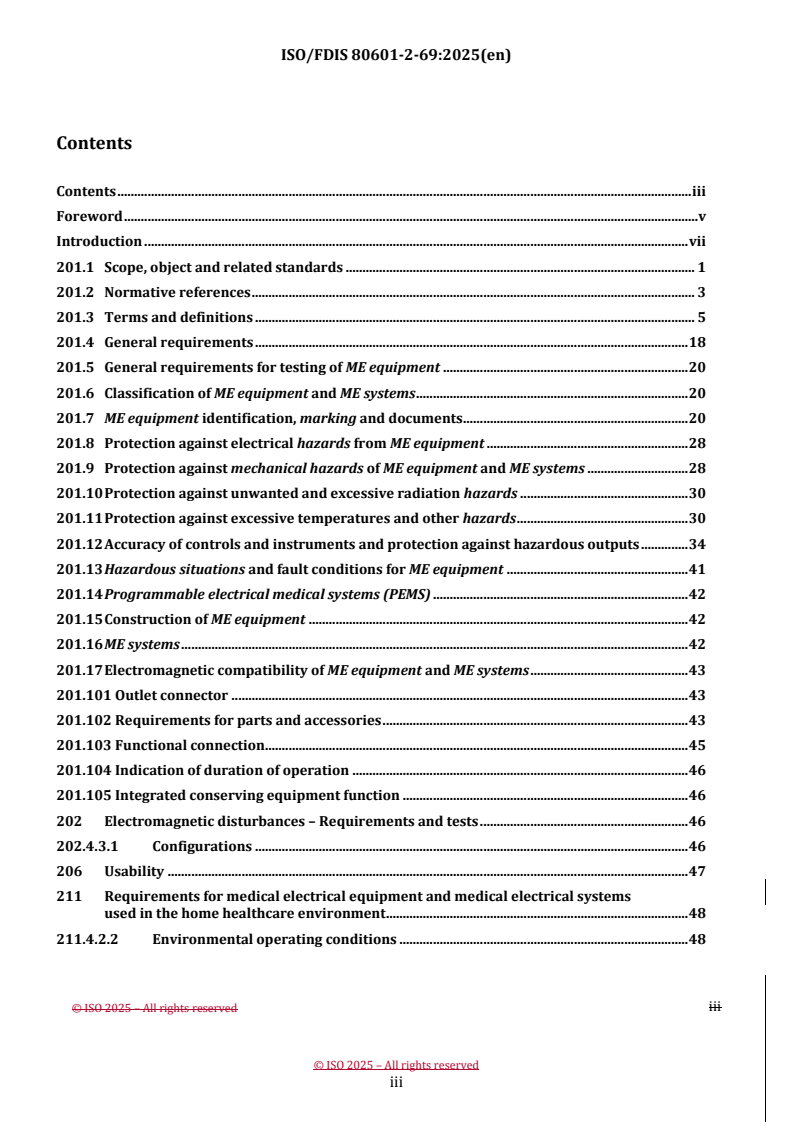
Contents
Contents . iii
Foreword . v
Introduction . vii
201.1 Scope, object and related standards . 1
201.2 Normative references . 3
201.3 Terms and definitions . 4
201.4 General requirements . 16
201.5 General requirements for testing of ME equipment . 18
201.6 Classification of ME equipment and ME systems . 19
201.7 ME equipment identification, marking and documents . 19
201.8 Protection against electrical hazards from ME equipment . 26
201.9 Protection against mechanical hazards of ME equipment and ME systems . 26
201.10 Protection against unwanted and excessive radiation hazards . 28
201.11 Protection against excessive temperatures and other hazards . 28
201.12 Accuracy of controls and instruments and protection against hazardous outputs . 32
201.13 Hazardous situations and fault conditions for ME equipment . 38
201.14 Programmable electrical medical systems (PEMS) . 38
201.15 Construction of ME equipment . 39
201.16 ME systems . 39
201.17 Electromagnetic compatibility of ME equipment and ME systems . 39
201.101 Outlet connector . 39
201.102 Requirements for parts and accessories . 40
201.103 Functional connection. 42
201.104 Indication of duration of operation . 42
201.105 Integrated conserving equipment function . 42
202 Electromagnetic disturbances – Requirements and tests . 43
202.4.3.1 Configurations . 43
206 Usability . 43
211 Requirements for medical electrical equipment and medical electrical systems
used in the home healthcare environment. 44
211.4.2.2 Environmental operating conditions . 44
Annex C (informative) Guide to marking and labelling requirements for ME equipment
and ME systems . 45
Annex D (informative) Symbols on marking . 50
iii
ISO/FDIS 80601-2-69:2025(en)
Annex AA (informative) Particular guidance and rationale . 52
Annex BB (informative) Reference to the IMDRF essential principles and labelling
guidances . 60
Annex CC (informative) Terminology — alphabetized index of defined terms . 64
Bibliography. 68
iv
ISO/FDIS 80601-2-69:2025(en)
Foreword
ISO (the International Organization for Standardization) is a worldwide federation of national standards
bodies (ISO member bodies). The work of preparing International Standards is normally carried out through
ISO technical committees. Each member body interested in a subject for which a technical committee has
been established has the right to be represented on that committee. International organizations,
governmental and non-governmental, in liaison with ISO, also take part in the work. ISO collaborates closely
with the International Electrotechnical Commission (IEC) on all matters of electrotechnical standardization.
The procedures used to develop this document and those intended for its further maintenance are described
in the ISO/IEC Directives, Part 1. In particular, the different approval criteria needed for the different types
of ISO documents should be noted. This document was drafted in accordance with the editorial rules of the
ISO/IEC Directives, Part 2 (see www.iso.org/directives).
Attention is drawn to the possibility that some of the elements of this document may be the subject of patent
rights. ISO shall not be held responsible for identifying any or all such patent rights. Details of any patent
rights identified during the development of the document will be in the Introduction and/or on the ISO list of
patent declarations received (see www.iso.org/patents).
Any trade name used in this document is information given for the convenience of users and does not
constitute an endorsement.
For an explanation of the voluntary nature of standards, the meaning of ISO specific terms and expressions
related to conformity assessment, as well as information about ISO's adherence to the World Trade
Organization (WTO) principles in the Technical Barriers to Trade (TBT), see
www.iso.org/iso/foreword.html.
This document was prepared jointly by Technical Committee ISO/TC 121, Anaesthetic and respiratory
equipment, Subcommittee SC 3, Respiratory devices and related equipment used for patient care, and
Technical Committee IEC/TC 62, Medical equipment, software, and systems, Subcommittee SC D, Particular
medical equipment, software, and systems, in collaboration with the European Committee for Standardization
(CEN) Technical Committee CEN/TC 215, Respiratory and anaesthetic equipment, in accordance with the
Agreement on technical cooperation between ISO and CEN (Vienna Agreement).
This third edition cancels and replaces the second edition (ISO 80601-2-69:2020), which has been
technically revised.
The main changes compared to the previous edition are as follows:
— updated references, where appropriate;
— harmonization with ISO 20417, where appropriate;
— updated uncertainty of measurement requirements;
— added marking requirements for gas intake port, external gas sources and MR compatibility;
— requirements for processing of the enclosure;
— added cybersecurity recommendations; and
— updated connector requirements.
v
ISO/FDIS 80601-2-69:2025(en)
A list of all parts in the ISO and IEC 80601 series can be found on the ISO and IEC websites.
Any feedback or questions on this document should be directed to the user’s national standards body. A
complete listing of these bodies can be found at www.iso.org/members.html.
vi
ISO/FDIS 80601-2-69:2025(en)
Introduction
Oxygen supplementation can be part of management of patients with chronic, acute-on-chronic or acute
respiratory disorders. The amount of supplemental oxygen depends on the individual patient’s needs under
various conditions. The managing healthcare team typically prescribes the endpoint of treatment, for
example a target value for oxygen saturation. The amount of supplemental oxygen can be controlled by the
flowrate.
The goal of long-term oxygen therapy is to keep the oxygen saturation above a target value in patients that
require supplemental oxygen. The flowrate should be adjusted for rest, exertion and sleep to meet the
individual patient’s needs under these various conditions. Ideally, the resting flowrate is adjusted to
maintain SpO greater than the target value as indicated by pulse oximetry.
Supplemental oxygen is supplied by various sources: medical gas pipeline systems, oxygen concentrators,
compressed gas cylinders and liquid oxygen reservoirs. Oxygen concentrators produce oxygen-enriched air
from room air for delivery to a patient requiring oxygen therapy. The most common oxygen concentrator
uses molecular sieve beds to filter and concentrate oxygen molecules from the ambient air, generating
oxygen concentrations of typically 90 % to 96 %. The main component of this type of oxygen concentrator is
the molecular sieve, which adsorbs nitrogen from air to produce a product gas, which is a mixture of
typically up to 95 % oxygen and 5 % of other gases. The periodic adsorbing and purging of nitrogen is
referred to as the pressure swing adsorption process.
Long-term oxygen therapy has been demonstrated in randomized, controlled clinical trials to prolong
survival in patients with chronic respiratory disease and documented hypoxemia. Typical sources of
therapeutic long-term oxygen therapy include gaseous oxygen from cylinders or from liquid oxygen and
oxygen from an oxygen concentrator.
In this document, the following print types are used:
— requirements and definitions: roman type;
— test specifications and terms defined in Clause 3 of the general standard, in this particular document or as
noted: italic type; and
— informative material appearing outside of tables, such as notes, examples and references: in smaller type.
Normative text of tables is also in a smaller type.
In referring to the structure of this document, the term.
— “clause” means one of the three numbered divisions within the table of contents, inclusive of all
subdivisions (e.g. Clause 201 includes subclauses 201.7, 201.8, etc.); and
— “subclause” means a numbered subdivision of a clause (e.g. 201.7, 201.8 and 201.9 are all subclauses of
Clause 201).
References to clauses within this document are preceded by the term “Clause” followed by the clause
number. References to subclauses within this particular document are by number only.
In this document, the conjunctive “or” is used as an “inclusive or” so a statement is true if any combination of
the conditions is true.
For the purposes of this document, the auxiliary verb:
— “shall” indicates a requirement;
vii
ISO/FDIS 80601-2-69:2025(en)
— "should” indicates a requirement;
— "may” indicates a permission;
— "can" indicates a possibility or capability; and
— "must" is used to express an external constraint.
Annex C contains a guide to the marking and labelling requirements in this document.
Annex D contains a summary of the symbols referenced in this document.
Requirements in this document have been decomposed so that each requirement is uniquely delineated.
This is done to support automated requirements tracking .
viii
FINAL DRAFT INTERNATIONAL STANDARD ISO/FDIS 80601-2-69:2025(en)
Medical electrical equipment
Part 2-69:
Particular requirements for the basic safety and essential
performance of oxygen concentrator equipment
201.1 Scope, object and related standards
IEC 60601-1:2005+AMD1:2012+AMD2:2020, Clause 1 applies, except as follows:
NOTE The general standard is IEC 60601-1:2005+AMD1:2012+AMD2:2020.
201.1.1 Scope
IEC 60601-1:2005+AMD1:2012+AMD2:2020, 1.1 is replaced by:
This document specifies requirements for the basic safety and essential performance of an oxygen
concentrator in combination with its accessories, hereafter referred to as ME equipment, intended to increase
the oxygen concentration of gas intended to be delivered to a single patient. Such oxygen concentrators are
typically intended for use in the home healthcare environment by a single patient in various environments
including any private and public transportation as well as in commercial aircraft.
NOTE 1 Such oxygen concentrators can also be used in professional healthcare facilities.
This document is applicable to a transit-operable and non-transit-operable oxygen concentrator. This
document is applicable to an oxygen concentrator integrated into or used with other medical devices,
ME equipment or ME systems.
EXAMPLE 1 An oxygen concentrator with integrated oxygen conserving equipment function or humidifier function.
EXAMPLE 2 An oxygen concentrator used with a flowmeter stand.
EXAMPLE 3 An oxygen concentrator as part of an anaesthetic system for use in areas with limited logistical supplies of
electricity and anaesthetic gases .
EXAMPLE 4 An oxygen concentrator with an integrated liquid reservoir function or gas cylinder filling system function.
This document is also applicable to those accessories intended by their manufacturer to be connected to an
oxygen concentrator, where the characteristics of those accessories can affect the basic safety or essential
performance of the oxygen concentrator.
NOTE 2 Such accessories can include, but are not limited to, masks, cannulae, extension tubing, humidifiers, carts,
carrying cases, external power sources and oxygen conserving equipment.
This document does not specify requirements for oxygen concentrators for use with a medical gas pipeline
system.
ISO/FDIS 80601-2-69:2025(en)
If a clause or subclause is specifically intended to be applicable to ME equipment only, or to ME systems only,
the title and content of that clause or subclause will say so. If that is not the case, the clause or subclause
applies both to ME equipment and to ME systems, as relevant.
Hazards inherent in the intended physiological function of ME equipment or ME systems within the scope of
this document are not covered by specific requirements in this document except in 7.2.13 and 8.4.1 of the
general standard.
NOTE 3 See also 4.2 of the general standard.
201.1.2 Object
IEC 60601-1:2005+AMD1:2012+AMD2:2020, 1.2 is replaced by:
The object of this document is to establish particular basic safety and essential performance requirements for
an oxygen concentrator (as defined in 0) and its accessories.
NOTE 1 Accessories are included because the combination of the oxygen concentrator and the accessories needs to be
adequately safe. Accessories can have a significant impact on the basic safety or essential performance of an oxygen
concentrator.
0 0
NOTE 2 This document has been prepared to address the relevant essential principles and labelling principles
guidances of the International Medical Devices Regulators Forum (IMDRF) as indicated in Annex BB.
NOTE 3 This document has been prepared to address the relevant essential principles of safety and performance of
ISO 16142-1:2016 as indicated in Annex CC.
NOTE 4 This document has been prepared to address the relevant general safety and performance requirements of
European regulation (EU) 2017/745 as indicated in Annex DD.
201.1.3 Collateral standards
IEC 60601-1:2005+AMD1:2012+AMD2:2020, 1.3 applies with the following addition:
IEC 60601-1-2:2014+AMD1:2020, IEC 60601-1-6:2010+AMD1:2013+AMD2:2020 and
IEC 60601-1-11:2015+AMD1:2020 apply as modified in Clauses 202, 206 and 211 respectively. IEC 60601-1-
3 and IEC 60601-1-9 do not apply. All other published collateral standards in the IEC 60601-1 series apply as
published.
201.1.4 Particular standards
Replacement:
In the IEC 60601 series, particular standards define basic safety and essential performance requirements, and
may modify, replace or delete requirements contained in the general standard and collateral standards as
appropriate for the particular ME equipment under consideration.
A requirement of a particular standard takes priority over the general standard.
For brevity, IEC 60601-1+AMD1:2012+AMD2:2020 is referred to in this document as the general standard.
Collateral standards are referred to by their document number.
The numbering of clauses and subclauses of this document corresponds to that of the general standard with
the prefix “201” (e.g. 201.1 in this document addresses the content of Clause 1 of the general standard) or
applicable collateral standard with the prefix “20x”, where x is the final digit(s) of the collateral standard
ISO/FDIS 80601-2-69:2025(en)
document number (e.g. 202.4 in this document addresses the content of Clause 4 of the IEC 60601-1-2
collateral standard, 211.4 in this document addresses the content of Clause 4 of the IEC 60601-1-11collateral
standard, etc.). The changes to the text of the general standard are specified by the use of the following
words.
— "Replacement" means that the clause or subclause of the general standard or applicable collateral
standard is replaced completely by the text of this document.
— "Addition" means that the text of this document is additional to the requirements of the general
standard or applicable collateral standard.
— "Amendment" means that the clause or subclause of the general standard or applicable collateral
standard is amended as indicated by the text of this document.
Clauses, subclauses, figures or tables which are additional to those of the general standard are numbered
starting from 201.101. However, due to the fact that definitions in the general standard are numbered 3.1
through 3.147, additional definitions in this document are numbered beginning from 201.3.201. Additional
annexes are lettered AA, BB, etc., and additional items aa), bb), etc.
Subclauses, figures or tables which are additional to those of a collateral standard are numbered starting
from 20x, where “x” is the number of the collateral standard, e.g. 202 for IEC 60601-1-2, 211 for IEC 60601-
1-11, etc.
The term "this document" is used to make reference to the general standard, any applicable collateral
standards and this particular document taken together.
Where there is no corresponding clause or subclause in this document, the clause or subclause of the general
standard or applicable collateral standard, although possibly not relevant, applies without modification;
where it is intended that any part of the general standard or applicable collateral standard, although possibly
relevant, is not to be applied, a statement to that effect is given in this document.
201.2 Normative references
The following documents are referred to in the text in such a way that some or all of their content constitutes
requirements of this document. For dated references, only the edition cited applies. For undated references,
the latest edition of the referenced document (including any amendments) applies.
IEC 60601-1:2005+AMD1:2012+AMD2: 2020, Clause 2 applies, except as follows:
Replacement:
ISO 15223-1:2021, Medical devices — Symbols to be used with medical device labels, labelling and information
to be supplied — Part 1: General requirements
IEC 61672-1:2013, Electroacoustics — Sound level meters — Part 1: Specifications
Addition:
ISO 3744:2010, Acoustics — Determination of sound power levels and sound energy levels of noise sources
using sound pressure — Engineering methods for an essentially free field over a reflecting plane
ISO 4871:1996, Acoustics — Declaration and verification of noise emission values of machinery and equipment
ISO/FDIS 80601-2-69:2025(en)
ISO 7396-1:2016+AMD1:2017, Medical gas pipeline systems — Part 1: Pipeline systems for compressed
medical gases and vacuum
ISO 14937:2009, Sterilization of health care products — General requirements for characterization of a
sterilizing agent and the development, validation and routine control of a sterilization process for medical
devices
ISO 17256:2024, Anaesthetic and respiratory equipment — Respiratory therapy tubing and connectors
ISO 17664-1:2021, Processing of health care products — Information to be provided by the medical device
manufacturer for the processing of medical devices — Part 1: Critical and semi-critical medical devices
ISO 17664-2:2021, Processing of health care products — Information to be provided by the medical device
manufacturer for the processing of medical devices — Part 2: Non-critical medical devices
ISO 18562-1:2024, Biocompatibility evaluation of breathing gas pathways in healthcare applications — Part
1: Evaluation and testing within a risk management process
ISO 20417:2021, Medical devices — Information to be supplied by the manufacturer
ISO 80601-2-67:2025, Medical Electrical Equipment — Part 2-67: Particular requirements for basic safety and
essential performance of oxygen conserving equipment
IEC 60601-1:2005+AMD1:2012+AMD2: 2020, Medical electrical equipment — Part 1: General requirements
for basic safety and essential performance
IEC 60601-1-2:2014+AMD1:2020, Medical electrical equipment — Part 1-2: General requirements for basic
safety and essential performance — Collateral Standard: Electromagnetic disturbances — Requirements and
tests
IEC 60601-1-8:2006+AMD1:2012+AMD2:2020, Medical electrical equipment — Part 1-8: General
requirements for basic safety and essential performance — Collateral Standard: General requirements, tests
and guidance for alarm systems in medical electrical equipment and medical electrical systems
IEC 60601-1-11:2015+AMD1:2020, Medical electrical equipment — Part 1-11: General requirements for basic
safety and essential performance — Collateral standard: Requirements for medical electrical equipment and
medical electrical systems used in the home healthcare environment
IEC 62366-1:2015+AMD1:2020, Medical devices – Application of usability engineering to medical devices
IEC 62570:2014, Standard practice for marking medical devices and other items for safety in the magnetic
resonance environment
IEC Guide 115:2023, Application of uncertainty of measurement to conformity assessment activities in the
electrotechnical sector
201.3 Terms and definitions
For the purposes of this document, the terms and definitions given in
IEC 60601-1:2005+AMD1:2012+AMD2:2020, and the following apply.
ISO and IEC maintain terminology databases for use in standardization at the following addresses:
— ISO Online browsing platform: available at https://www.iso.org/obp
ISO/FDIS 80601-2-69:2025(en)
— IEC Electropedia: available at https://www.electropedia.org/
NOTE An index of defined terms is found in Annex EE.
Addition:
201.3.201
accompanying information
information accompanying or marked on a medical device or accessory for the user or those accountable for
the installation, use, processing, maintenance, decommissioning and disposal of the medical device or
accessory, particularly regarding safe use
Note 1 to entry: The accompanying information shall be regarded as part of the medical device or accessory.
Note 2 to entry: The accompanying information can consist of the label, marking, instructions for use, technical
description, installation manual, quick reference guide, etc.
Note 3 to entry: Accompanying information is not necessarily a written or printed document but can involve auditory,
visual, or tactile materials and multiple media types (e.g. CD/DVD-ROM, USB stick, website).
[SOURCE: ISO 20417:2021, 3.2, modified — deleted note 4.]
201.3.202
alarm condition delay
time from the occurrence of a triggering event either in the patient, for physiological alarm conditions, or in the
equipment, for technical alarm conditions, to when the alarm system determines that an alarm condition
exists
[SOURCE: IEC 60601-1-8:2006+AMD1:2012+AMD2:2020, 3.2]
201.3.203
alarm limit
threshold used by an alarm system to determine an alarm condition
[SOURCE: IEC 60601-1-8:2006+AMD1:2012+AMD2:2020, 3.3]
201.3.204
alarm setting
alarm system configuration, including but not limited to:
– alarm limits;
– the characteristics of any alarm signal inactivation states; and
– the values of variables or parameters that determine the function of the alarm system
Note 1 to entry: Some algorithmically-determined alarm settings can require time to be determined or re-determined.
[SOURCE: IEC 60601-1-8:2006+AMD1:2012+AMD2:2020, 3.8]
ISO/FDIS 80601-2-69:2025(en)
201.3.205
attack
attempt to destroy, expose, alter, disable, steal or gain unauthorized access to or make unauthorized use of
an asset
[SOURCE: IEC 81001-5-1:2021, 3.5]
201.3.206
biocompatibility
ability to be in contact with a living system without producing an unacceptable adverse effect
Note 1 to entry: Medical devices may produce some level of adverse effect, but that level may be determined to be
acceptable when considering the benefits provided by the medical device.
[SOURCE: ISO 18562-1:2024, 3.6]
201.3.207
cleaning
removal of contaminants to the extent necessary for further processing or for intended use
Note 1 to entry: Cleaning consists of the removal of adherent soil (e.g. blood, protein substances, and other debris)
from the surfaces, crevices, serrations, joints, and lumens of a medical device by a manual or automated process that
prepares the items for safe handling or further processing.
[SOURCE: ISO 17664-2:2021, 3.1, modified — replaced 'and/or' with 'or'.]
201.3.208
connector
fitting to join two or more components
EXAMPLE Connectors for low-pressure hose assembly are any of a range of mating components intended to maintain
gas specificity by the allocation of a set of different diameters to the mating connectors for each particular gas.
[SOURCE: ISO 4135:2022, 3.1.4.5]
201.3.209
conserving equipment
ME equipment intended to conserve supplemental oxygen by delivering gas intermittently and synchronized
with the patient's inspiratory cycle
Note 1 to entry: Conserving equipment can be electrically or pneumatically powered.
[SOURCE: ISO 80601-2-67:2025, 201.3.207]
201.3.210
continuous flow
gas flowing continuously through the breathing system, with a proportion intermittently passing to the
patient's lung whenever the airway pressure is raised by the ventilator or an operator action, or flow is
demanded by a patient's inspiratory effort
ISO/FDIS 80601-2-69:2025(en)
Note 1 to entry: For the purposes of this document, ventilator is taken to include oxygen concentrator.
[SOURCE: ISO 19223:2019, 3.7.8, modified — deleted notes and added note 1.]
201.3.211
cybersecurity
state where information and systems are protected from unauthorized activities, such as access, use,
disclosure, disruption, modification, or destruction to a degree that the related risks to violation of
confidentiality, integrity, and availability are maintained at an acceptable level throughout the life cycle
[SOURCE: IEC 81001-5-1:2021, 3.30]
201.3.212
disinfection
process to reduce the number of viable microorganisms to a level previously specified as being appropriate
for a defined purpose
[SOURCE: ISO 17664-1:2021, 3.3]
201.3.213
distributed alarm system
alarm system that involves more than one item of equipment of a ME system intended for delivery of alarm
conditions with technical confirmation
Note 1 to entry: The parts of a distributed alarm system can be widely separated in distance.
Note 2 to entry: A distributed alarm system is intended to notify operators of the existence of an alarm condition.
Note 3 to entry: Technical confirmation means that each element of a distributed alarm system confirms or guarantees
the successful delivery of the alarm condition to the next element or appropriate technical alarm conditions are created.
[SOURCE: IEC 60601-1-8:2006+AMD1:2012+AMD2:2020, 3.17]
201.3.214
emergency medical services environment
EMS environment
actual conditions and settings, in which operators interact with the ME equipment or ME system, in and
around the scene of an emergency outside of a professional healthcare facility where a patient can be given
medical care, basic or advanced life support as well as during professional transport to a professional
healthcare facility or between professional healthcare facilities
EXAMPLE 1 Responding to and providing life support at the scene of an emergency to a patient reported as
experiencing injury or illness in a pre-hospital setting, and transporting the patient, while continuing such life support
care, to an appropriate professional healthcare facility for further care.
EXAMPLE 2 Providing monitoring, treatment or diagnosis during transport between professional healthcare
facilities.
Note 1 to entry: The EMS environment is not considered to be part of the professional healthcare environment.
ISO/FDIS 80601-2-69:2025(en)
Note 2 to entry: Use of equipment intended for the EMS environment and temporarily used in the home healthcare
environment by emergency medical personnel is considered use in the EMS environment.
Note 3 to entry: The operators of equipment intended for the EMS environment are presumed to be healthcare
professional operators.
Note 4 to entry: Emergency medical services are known by various names in different countries and regions.
Note 5 to entry: Transport includes road, rotary and fixed-wing ambulances.
[SOURCE: IEC 60601-1-12:2014+AMD1:2020, 3.1, modified —replaced “professional medical personnel or
personnel with relevant specialized training” with “healthcare professional operators” and replaced original
note 3 with new note 1.]
201.3.215
essential function
function or capability that is required to maintain basic safety, essential performance, a minimum of clinical
functionality as specified by the manufacturer, and operational availability for the medical device
Note 1 to entry: Essential functions include, but are not limited to, the safety instrumented function (basic safety and
essential performance), the control function and the availability of urgently needed functions and such allowing the
operator to view and manipulate the medical device safely with the most urgently needed performance (operational
availability). The loss of essential function is commonly termed loss of protection, loss of control and loss of view
respectively.
Note 2 to entry: The term is derived from IEC 62443-4-2:2019, 3.1.20, and has been refined for the purpose and scope
of this document.
[SOURCE: IEC/TR 60601-4-5:2021, 3.10]
201.3.216
essential principles
essential principles of safety and performance
fundamental high-level requirements that when complied with ensure a medical device is safe and performs
as intended
[SOURCE: ISO 16142-1:2016, 3.3]
201.3.217
exhaust port
port through which exhaust gas is discharged to the atmosphere or to an anaesthetic gas scavenging system
[SOURCE: ISO 19223:2019, 3.14.2]
201.3.218
firecall
method established to provide emergency access to a secure medical device
Note 1 to entry: In an emergency situation, unprivileged users can gain access to key systems to correct the problem.
When a firecall is used, there is usually a review process to ensure that the access was used properly to correct a
problem. These methods generally either provide a one-time use user identifier (ID) or one-time password or other
suitable measures.
ISO/FDIS 80601-2-69:2025(en)
Note 2 to entry: Also referred to as "break glass" feature.
[SOURCE: IEC/TR 60601-4-5:2021, 3.11]
201.3.219
flow-direction-sensitive component
component or accessory through which gas flow is in one direction only for proper functioning or patient
safety
[SOURCE: ISO 4135:2022, definition 3.1.7, modified — added ‘or accessory’ and “has to be” with “is”.]
201.3.220
gas intake port
port through which gas is drawn for use by the patient
Note 1 to entry: Gas is drawn at a sub-ambient pressure at a gas intake port, in opposition to an inlet, at which gas is
provided by a medical gas supply system.
[SOURCE: ISO 4135:2022, 3.1.4.21, modified — replaced “apposition” with ”opposition”.]
201.3.221
gas output port
port of the ventilator through which gas is delivered at respiratory pressures to an operator-detachable part
of a breathing system
Note 1 to entry: For the purposes of this document, ventilator is taken to include respiratory high-flow therapy
equipment.
[SOURCE: ISO 19223:2019, 3.14.3, modified — added note.]
201.3.222
gas pathway
interior surfaces, over which gases or liquids that can be inspired, in a medical device bounded by the ports
through which gases or liquids enter and leave the medical device including the patient interface or the
interior surfaces of enclosures that are in contact with gases or liquids that can be inspired
EXAMPLE 1 The breathing system, inlet filter, gas mixer, blower and internal piping.
EXAMPLE 2 Enclosed chamber of an incubator including the mattress or the inner surface of an oxygen hood.
EXAMPLE 3 The inner surfaces of breathing tubes, tracheal tubes or masks and mouthpieces.
Note 1 to entry: The gas pathway is bounded by the fluid ports through which gases or liquids enter the medical device
or accessory. This can include the patient interface or the interior surfaces of enclosures that are in contact with gases or
liquids that can be inspired.
Note 2 to entry: The gas pathway can include some surfaces in the expiratory pathway.
Note 3 to entry: Patient contact surfaces such as the outer surfaces of a tracheal tube or the cushion of a mask are
evaluated according to the ISO 10993 series.
[SOURCE: ISO 18562-1:2024, 3.11, modified — replaced “ports” with “fluid ports”.]
ISO/FDIS 80601-2-69:2025(en)
201.3.223
home healthcare environment
dwelling place in which a patient lives or other places where patients are present, excluding the professional
healthcare environment and the EMS environment
EXAMPLE Other places include in a car, bus, train, boat or plane, in a wheelchair or walking outdoors.
Note 1 to entry: Nursing homes are considered home healthcare environments.
Note 2 to entry: In some countries, nursing homes are considered professional healthcare facilities.
[SOURCE: IEC 60601-1-11:2015+AMD1:2020, 3.1, modified —deleted notes 1 and 3, modified note 2 as new
note 1 and added note 2.]
201.3.224
humidifier
device that adds water in the form of droplets or vapour, or both, to the inspired gas
Note 1 to entry: This term includes vaporising, bubble-through and ultrasonic humidifiers and active heat and moisture
exchangers (HMEs).
[SOURCE: ISO 4135:2022, 3.7.2.1]
201.3.225
immunity
the ability of ME equipment or an ME system to perform without degradation in the presence of an
electromagnetic disturbance
[SOURCE: IEC 60601-1-2:2014+AMD1:2020, 3.8]
201.3.226
information for safety
information provided to the operator or the responsible organization as a risk control measure
EXAMPLE 1 Warnings, precautions or contraindications.
EXAMPLE 2 Instructions for use of a medical device or accessory to prevent use error or avoid a hazardous situation.
EXAMPLE 3 Explanation of a safety feature of a medical device or accessory.
Note 1 to entry: Information for safety may be included in any or all types of information supplied by the manufacturer.
Note 2 to entry: Information for safety can be located on the display of a medical device.
[SOURCE: ISO 20417:2021, 3.9, modified — replaced “user” with “operator”.]
201.3.227
information supplied by the manufacturer
information related to the identification and use of a medical device or accessory, in whatever form provided,
intended to ensure the safe and effective use of the medical device or accessory
ISO/FDIS 80601-2-69:2025(en)
Note 1 to entry: For the purposes of this document, e-documentation is included in information supplied by the
manufacturer.
Note 2 to entry: For the purposes of this document, shipping documents and promotional material are excluded from
information supplied by the manufacturer. However, some authorities having jurisdiction can consider such
supplemental information as information supplied by the manufacturer.
Note 3 to entry: The primary purpose of information supplied by the manufacturer is to identify the medical device and
its manufacturer, and provide essential information about its safety, performance, and appropriate use to the user or
other relevant persons.
[SOURCE: ISO 20417:2021, 3.10, modified — deleted note 4.]
201.3.228
inlet
opening through which gas or other material is pushed by an elevated upstream pressure
[SOURCE: ISO 4135:2022, 3.1.4.26, modified — deleted note.]
201.3.229
inlet connector
connector on an inlet
EXAMPLE Connection on a low-flow nasal cannula that connects to the outlet of oxygen therapy tubing.
Note 1 to entry: An inlet connector can be gas-specific, but this should be indicated with the post-coordinated term gas-
specific inlet connector.
[SOURCE: ISO 4135:2022, 3.1.4.26.1]
201.3.230
instructions for use
IFU
portion of the accompanying information that is essential for the safe and effective use of a medical device or
accessory directed to the user of the medical device
Note 1 to entry: For the purposes of this document, a user can be either a lay user or professional user with relevant
specialized training.
Note 2 to entry: For the purposes of this document, instructions for the professional processing between uses of a
medical device or accessory can be included in the instructions for use.
Note 3 to entry: The instructions for use, or portions thereof, can be located on the display of a medical device or
accessory.
Note 4 to entry: Medical devices or accessories that can be used safely and effectively without instructions for use are
exempted from having instructions for use by some authorities having jurisdiction.
[SOURCE: ISO 20417:2021, 3.11, modified — deleted note 5.]
ISO/FDIS 80601-2-69:2025(en)
201.3.231
lay
lay person
term referring to non-professional or professional without relevant specialized training
EXAMPLE Lay operator, lay responsible organization.
[SOURCE: IEC 60601-1-11:2015+AMD1:2020, 3.2]
201.3.232
marking
information, in text or graphical format, durably affixed, printed, etched (or equivalent) to a medical device
or accessory
Note 1 to entry: For the purposes of this document, the term marked is used to designate the corresponding act.
Note 2 to entry: For the purposes of this document, marking is different from ‘direct marking’ as commonly described
in unique device identification (UDI) standards and regulations. A UDI ‘direct marking’ is a type of marking.
[SOURCE: ISO 20417:2021, 3.16, modified — deleted note 3.]
201.3.233
mask
device which provides a non-invasive interface between the patient’s airway and a patient-connection port
or other connection to a source of respirable gas
[SOURCE: ISO 4135:2022, 3.8.6.4]
201.3.234
maximum limited
...
ISO/FDIS 80601-2-69:2025(EEn)
ISO TC 121/SC 3
2025-06-0208-13
Secretariat: ANSI
Medical electrical equipment — Part 2-69: Particular requirements
for the basic safety and essential performance of oxygen
concentrator equipment
Appareils électromédicaux -- Partie 2-69: Exigences particulières pour la sécurité de base et les
performances essentielles des dispositifs concentrateurs d'oxygène
FDIS stage
Warning for WDs and CDs
This document is not an ISO International Standard. It is distributed for review and comment. It is subject
to change without notice and may not be referred to as an International Standard.
Recipients of this draft are invited to submit, with their comments, notification of any relevant patent
rights of which they are aware and to provide supporting documentation.
ISO/FDIS 80601-2-69:2025(en)
All rights reserved. Unless otherwise specified, no part of this publication may be reproduced or utilized otherwise in
any form or by any means, electronic or mechanical, including photocopying, or posting on the internet or an
intranet, without prior written permission. Permission can be requested from either ISO at the address below or
ISO’s member body in the country of the requester.
ISO copyright office
Ch. de Blandonnet 8 • CP 401
CH-1214 Vernier, Geneva, Switzerland
Tel. + 41 22 749 01 11
Fax + 41 22 749 09 47
copyright@iso.org
www.iso.org
ii
ii
ISO/FDIS 80601-2-69:2025(en)
Contents
Contents . iii
Foreword . v
Introduction . vii
201.1 Scope, object and related standards . 1
201.2 Normative references . 3
201.3 Terms and definitions . 5
201.4 General requirements . 18
201.5 General requirements for testing of ME equipment . 20
201.6 Classification of ME equipment and ME systems . 20
201.7 ME equipment identification, marking and documents . 20
201.8 Protection against electrical hazards from ME equipment . 28
201.9 Protection against mechanical hazards of ME equipment and ME systems . 28
201.10 Protection against unwanted and excessive radiation hazards . 30
201.11 Protection against excessive temperatures and other hazards . 30
201.12 Accuracy of controls and instruments and protection against hazardous outputs . 34
201.13 Hazardous situations and fault conditions for ME equipment . 41
201.14 Programmable electrical medical systems (PEMS) . 42
201.15 Construction of ME equipment . 42
201.16 ME systems . 42
201.17 Electromagnetic compatibility of ME equipment and ME systems . 43
201.101 Outlet connector . 43
201.102 Requirements for parts and accessories . 43
201.103 Functional connection. 45
201.104 Indication of duration of operation . 46
201.105 Integrated conserving equipment function . 46
202 Electromagnetic disturbances – Requirements and tests . 46
202.4.3.1 Configurations . 46
206 Usability . 47
211 Requirements for medical electrical equipment and medical electrical systems
used in the home healthcare environment. 48
211.4.2.2 Environmental operating conditions . 48
iii
iii
ISO/FDIS 80601-2-69:2025(en)
Annex C (informative) Guide to marking and labelling requirements for ME equipment
and ME systems . 49
Annex D (informative) Symbols on marking . 54
Annex AA (informative) Particular guidance and rationale . 56
Annex BB (informative) Reference to the IMDRF essential principles and labelling
guidances . 65
Annex CC (informative) Terminology — alphabetized index of defined terms . 70
Bibliography. 74
iv
iv
ISO/FDIS 80601-2-69:2025(en)
Foreword
ISO (the International Organization for Standardization) is a worldwide federation of national standards
bodies (ISO member bodies). The work of preparing International Standards is normally carried out through
ISO technical committees. Each member body interested in a subject for which a technical committee has
been established has the right to be represented on that committee. International organizations,
governmental and non-governmental, in liaison with ISO, also take part in the work. ISO collaborates closely
with the International Electrotechnical Commission (IEC) on all matters of electrotechnical standardization.
The procedures used to develop this document and those intended for its further maintenance are described
in the ISO/IEC Directives, Part 1. In particular, the different approval criteria needed for the different types
of ISO documents should be noted. This document was drafted in accordance with the editorial rules of the
ISO/IEC Directives, Part 2 (see www.iso.org/directives).
Attention is drawn to the possibility that some of the elements of this document may be the subject of patent
rights. ISO shall not be held responsible for identifying any or all such patent rights. Details of any patent
rights identified during the development of the document will be in the Introduction and/or on the ISO list of
patent declarations received (see www.iso.org/patents).
Any trade name used in this document is information given for the convenience of users and does not
constitute an endorsement.
For an explanation of the voluntary nature of standards, the meaning of ISO specific terms and expressions
related to conformity assessment, as well as information about ISO's adherence to the World Trade
Organization (WTO) principles in the Technical Barriers to Trade (TBT), see
www.iso.org/iso/foreword.html.
This document was prepared jointly by Technical Committee ISO/TC 121, Anaesthetic and respiratory
equipment, Subcommittee SC 3, Respiratory devices and related equipment used for patient care, and
Technical Committee IEC/TC 62, Medical equipment, software, and systems, Subcommittee SC D, Particular
medical equipment, software, and systems, in collaboration with the European Committee for Standardization
(CEN) Technical Committee CEN/TC 215, Respiratory and anaesthetic equipment, in accordance with the
Agreement on technical cooperation between ISO and CEN (Vienna Agreement).
This third edition cancels and replaces the second edition (ISO 80601-2-69:2020), which has been
technically revised.
The main changes compared to the previous edition are as follows:
— updated references, where appropriate;
— harmonization with ISO 20417, where appropriate;
— updated uncertainty of measurement requirements;
— added marking requirements for gas intake port, external gas sources and MR compatibility;
— requirements for processing of the enclosure;
v
v
ISO/FDIS 80601-2-69:2025(en)
— added cybersecurity recommendations; and
— updated connector requirements.
A list of all parts in the ISO and IEC 80601 series can be found on the ISO and IEC websites.
Any feedback or questions on this document should be directed to the user’s national standards body. A
complete listing of these bodies can be found at www.iso.org/members.html.
vi
vi
ISO/FDIS 80601-2-69:2025(en)
Introduction
Oxygen supplementation can be part of management of patients with chronic, acute-on-chronic or acute
respiratory disorders. The amount of supplemental oxygen depends on the individual patient’s needs under
various conditions. The managing healthcare team typically prescribes the endpoint of treatment, for
example a target value for oxygen saturation. The amount of supplemental oxygen can be controlled by the
flowrate.
The goal of long-term oxygen therapy is to keep the oxygen saturation above a target value in patients that
require supplemental oxygen. The flowrate should be adjusted for rest, exertion and sleep to meet the
individual patient’s needs under these various conditions. Ideally, the resting flowrate is adjusted to
maintain SpO greater than the target value as indicated by pulse oximetry.
Supplemental oxygen is supplied by various sources: medical gas pipeline systems, oxygen concentrators,
compressed gas cylinders and liquid oxygen reservoirs. Oxygen concentrators produce oxygen-enriched air
from room air for delivery to a patient requiring oxygen therapy. The most common oxygen concentrator
uses molecular sieve beds to filter and concentrate oxygen molecules from the ambient air, generating
oxygen concentrations of typically 90 % to 96 %. The main component of this type of oxygen concentrator is
the molecular sieve, which adsorbs nitrogen from air to produce a product gas, which is a mixture of
typically up to 95 % oxygen and 5 % of other gases. The periodic adsorbing and purging of nitrogen is
referred to as the pressure swing adsorption process.
Long-term oxygen therapy has been demonstrated in randomized, controlled clinical trials to prolong
survival in patients with chronic respiratory disease and documented hypoxemia. Typical sources of
therapeutic long-term oxygen therapy include gaseous oxygen from cylinders or from liquid oxygen and
oxygen from an oxygen concentrator.
In this document, the following print types are used:
— requirements and definitions: roman type;
— test specifications and terms defined in Clause 3 of the general standard, in this particular document or as
noted: italic type; and
— informative material appearing outside of tables, such as notes, examples and references: in smaller type.
Normative text of tables is also in a smaller type.
In referring to the structure of this document, the term.
— “clause” means one of the three numbered divisions within the table of contents, inclusive of all
subdivisions (e.g. Clause 201 includes subclauses 201.7, 201.8, etc.); and
— “subclause” means a numbered subdivision of a clause (e.g. 201.7, 201.8 and 201.9 are all subclauses of
Clause 201).
References to clauses within this document are preceded by the term “Clause” followed by the clause
number. References to subclauses within this particular document are by number only.
In this document, the conjunctive “or” is used as an “inclusive or” so a statement is true if any combination of
the conditions is true.
vii
vii
ISO/FDIS 80601-2-69:2025(en)
For the purposes of this document, the auxiliary verb:
— “shall” indicates a requirement;
— "should” indicates a requirement;
— "may” indicates a permission;
— "can" indicates a possibility or capability; and
— "must" is used to express an external constraint.
Annex C contains a guide to the marking and labelling requirements in this document.
Annex D contains a summary of the symbols referenced in this document.
Requirements in this document have been decomposed so that each requirement is uniquely delineated.
This is done to support automated requirements tracking .
viii
viii
FINAL DRAFT INTERNATIONAL STANDARD ISO/FDIS 80601-2-69:2025(en)
Medical electrical equipment
Part 2-69:
Particular requirements for the basic safety and
essential performance of oxygen concentrator equipment
201.1 Scope, object and related standards
IEC 60601-1:2005+AMD1:2012+AMD2:2020, Clause 1 applies, except as follows:
NOTE The general standard is IEC 60601-1:2005+AMD1:2012+AMD2:2020.
201.1.1 Scope
IEC 60601-1:2005+AMD1:2012+AMD2:2020, 1.1 is replaced by:
This document specifies requirements for the basic safety and essential performance of an oxygen
concentrator in combination with its accessories, hereafter referred to as ME equipment, intended to increase
the oxygen concentration of gas intended to be delivered to a single patient. Such oxygen concentrators are
typically intended for use in the home healthcare environment by a single patient in various environments
including any private and public transportation as well as in commercial aircraft.
NOTE 1 Such oxygen concentrators can also be used in professional healthcare facilities.
This document is applicable to a transit-operable and non-transit-operable oxygen concentrator. This
document is applicable to an oxygen concentrator integrated into or used with other medical devices,
ME equipment or ME systems.
EXAMPLE 1 An oxygen concentrator with integrated oxygen conserving equipment function or humidifier function.
EXAMPLE 2 An oxygen concentrator used with a flowmeter stand.
EXAMPLE 3 An oxygen concentrator as part of an anaesthetic system for use in areas with limited logistical supplies of
electricity and anaesthetic gases .
EXAMPLE 4 An oxygen concentrator with an integrated liquid reservoir function or gas cylinder filling system function.
This document is also applicable to those accessories intended by their manufacturer to be connected to an
oxygen concentrator, where the characteristics of those accessories can affect the basic safety or essential
performance of the oxygen concentrator.
NOTE 2 Such accessories can include, but are not limited to, masks, cannulae, extension tubing, humidifiers, carts,
carrying cases, external power sources and oxygen conserving equipment.
ISO/FDIS 80601-2-69:2025(en)
This document does not specify requirements for oxygen concentrators for use with a medical gas pipeline
system.
If a clause or subclause is specifically intended to be applicable to ME equipment only, or to ME systems only,
the title and content of that clause or subclause will say so. If that is not the case, the clause or subclause
applies both to ME equipment and to ME systems, as relevant.
Hazards inherent in the intended physiological function of ME equipment or ME systems within the scope of
this document are not covered by specific requirements in this document except in 7.2.13 and 8.4.1 of the
general standard.
NOTE 3 See also 4.2 of the general standard.
201.1.2 Object
IEC 60601-1:2005+AMD1:2012+AMD2:2020, 1.2 is replaced by:
The object of this document is to establish particular basic safety and essential performance requirements for
an oxygen concentrator (as defined in 0) and its accessories.
NOTE 1 Accessories are included because the combination of the oxygen concentrator and the accessories needs to be
adequately safe. Accessories can have a significant impact on the basic safety or essential performance of an oxygen
concentrator.
0 0
NOTE 2 This document has been prepared to address the relevant essential principles and labelling principles
guidances of the International Medical Devices Regulators Forum (IMDRF) as indicated in Annex BB.
NOTE 3 This document has been prepared to address the relevant essential principles of safety and performance of
ISO 16142-1:2016 as indicated in Annex CC.
NOTE 4 This document has been prepared to address the relevant general safety and performance requirements of
European regulation (EU) 2017/745 as indicated in Annex DD.
201.1.3 Collateral standards
IEC 60601-1:2005+AMD1:2012+AMD2:2020, 1.3 applies with the following addition:
IEC 60601-1-2:2014+AMD1:2020, IEC 60601-1-6:2010+AMD1:2013+AMD2:2020 and
IEC 60601-1-11:2015+AMD1:2020 apply as modified in Clauses 202, 206 and 211 respectively. IEC 60601-1-
3 and IEC 60601-1-9 do not apply. All other published collateral standards in the IEC 60601-1 series apply as
published.
201.1.4 Particular standards
Replacement:
In the IEC 60601 series, particular standards define basic safety and essential performance requirements, and
may modify, replace or delete requirements contained in the general standard and collateral standards as
appropriate for the particular ME equipment under consideration.
A requirement of a particular standard takes priority over the general standard.
ISO/FDIS 80601-2-69:2025(en)
For brevity, IEC 60601-1+AMD1:2012+AMD2:2020 is referred to in this document as the general standard.
Collateral standards are referred to by their document number.
The numbering of clauses and subclauses of this document corresponds to that of the general standard with
the prefix “201” (e.g. 201.1 in this document addresses the content of Clause 1 of the general standard) or
applicable collateral standard with the prefix “20x”, where x is the final digit(s) of the collateral standard
document number (e.g. 202.4 in this document addresses the content of Clause 4 of the IEC 60601-1-2
collateral standard, 211.4 in this document addresses the content of Clause 4 of the IEC 60601-1-11collateral
standard, etc.). The changes to the text of the general standard are specified by the use of the following
words.
— "Replacement" means that the clause or subclause of the general standard or applicable collateral
standard is replaced completely by the text of this document.
— "Addition" means that the text of this document is additional to the requirements of the general
standard or applicable collateral standard.
— "Amendment" means that the clause or subclause of the general standard or applicable collateral
standard is amended as indicated by the text of this document.
Clauses, subclauses, figures or tables which are additional to those of the general standard are numbered
starting from 201.101. However, due to the fact that definitions in the general standard are numbered 3.1
through 3.147, additional definitions in this document are numbered beginning from 201.3.201. Additional
annexes are lettered AA, BB, etc., and additional items aa), bb), etc.
Subclauses, figures or tables which are additional to those of a collateral standard are numbered starting
from 20x, where “x” is the number of the collateral standard, e.g. 202 for IEC 60601-1-2, 211 for IEC 60601-
1-11, etc.
The term "this document" is used to make reference to the general standard, any applicable collateral
standards and this particular document taken together.
Where there is no corresponding clause or subclause in this document, the clause or subclause of the general
standard or applicable collateral standard, although possibly not relevant, applies without modification;
where it is intended that any part of the general standard or applicable collateral standard, although possibly
relevant, is not to be applied, a statement to that effect is given in this document.
201.2 Normative references
The following documents are referred to in the text in such a way that some or all of their content constitutes
requirements of this document. For dated references, only the edition cited applies. For undated references,
the latest edition of the referenced document (including any amendments) applies.
IEC 60601-1:2005+AMD1:2012+AMD2: 2020, Clause 2 applies, except as follows:
Replacement:
ISO 15223-1:2021, Medical devices — Symbols to be used with medical device labels, labelling and information
to be supplied — Part 1: General requirements
ISO/FDIS 80601-2-69:2025(en)
IEC 61672-1:2013, Electroacoustics — Sound level meters — Part 1: Specifications
Addition:
ISO 3744:2010, Acoustics — Determination of sound power levels and sound energy levels of noise sources
using sound pressure — Engineering methods for an essentially free field over a reflecting plane
ISO 4871:1996, Acoustics — Declaration and verification of noise emission values of machinery and equipment
ISO 7396-1:2016+AMD1:2017, Medical gas pipeline systems — Part 1: Pipeline systems for compressed
medical gases and vacuum
ISO 14937:2009, Sterilization of health care products — General requirements for characterization of a
sterilizing agent and the development, validation and routine control of a sterilization process for medical
devices
ISO 17256:2024, Anaesthetic and respiratory equipment — Respiratory therapy tubing and connectors
ISO 17664-1:2021, Processing of health care products — Information to be provided by the medical device
manufacturer for the processing of medical devices — Part 1: Critical and semi-critical medical devices
ISO 17664-2:2021, Processing of health care products — Information to be provided by the medical device
manufacturer for the processing of medical devices — Part 2: Non-critical medical devices
ISO 18562-1:2024, Biocompatibility evaluation of breathing gas pathways in healthcare applications — Part
1: Evaluation and testing within a risk management process
ISO 20417:2021, Medical devices — Information to be supplied by the manufacturer
ISO 80601-2-67:2025, Medical Electrical Equipment — Part 2-67: Particular requirements for basic safety and
essential performance of oxygen conserving equipment
IEC 60601-1:2005+AMD1:2012+AMD2: 2020, Medical electrical equipment — Part 1: General requirements
for basic safety and essential performance
IEC 60601-1-2:2014+AMD1:2020, Medical electrical equipment — Part 1-2: General requirements for basic
safety and essential performance — Collateral Standard: Electromagnetic disturbances — Requirements and
tests
IEC 60601-1-8:2006+AMD1:2012+AMD2:2020, Medical electrical equipment — Part 1-8: General
requirements for basic safety and essential performance — Collateral Standard: General requirements, tests
and guidance for alarm systems in medical electrical equipment and medical electrical systems
IEC 60601-1-11:2015+AMD1:2020, Medical electrical equipment — Part 1-11: General requirements for basic
safety and essential performance — Collateral standard: Requirements for medical electrical equipment and
medical electrical systems used in the home healthcare environment
IEC 62366-1:2015+AMD1:2020, Medical devices – Application of usability engineering to medical devices
IEC 62570:2014, Standard practice for marking medical devices and other items for safety in the magnetic
resonance environment
ISO/FDIS 80601-2-69:2025(en)
IEC Guide 115:2023, Application of uncertainty of measurement to conformity assessment activities in the
electrotechnical sector
201.3 Terms and definitions
For the purposes of this document, the terms and definitions given in
IEC 60601-1:2005+AMD1:2012+AMD2:2020, and the following apply.
ISO and IEC maintain terminology databases for use in standardization at the following addresses:
— ISO Online browsing platform: available at https://www.iso.org/obp
— IEC Electropedia: available at https://www.electropedia.org/
NOTE An index of defined terms is found in Annex EE.
Addition:
201.3.201
accompanying information
information accompanying or marked on a medical device or accessory for the user or those accountable for
the installation, use, processing, maintenance, decommissioning and disposal of the medical device or
accessory, particularly regarding safe use
Note 1 to entry: The accompanying information shall be regarded as part of the medical device or accessory.
Note 2 to entry: The accompanying information can consist of the label, marking, instructions for use, technical
description, installation manual, quick reference guide, etc.
Note 3 to entry: Accompanying information is not necessarily a written or printed document but can involve auditory,
visual, or tactile materials and multiple media types (e.g. CD/DVD-ROM, USB stick, website).
[SOURCE: ISO 20417:2021, 3.2, modified — deleted note 4.]
201.3.202
alarm condition delay
time from the occurrence of a triggering event either in the patient, for physiological alarm conditions, or in the
equipment, for technical alarm conditions, to when the alarm system determines that an alarm condition
exists
[SOURCE: IEC 60601-1-8:2006+AMD1:2012+AMD2:2020, 3.2]
201.3.203
alarm limit
threshold used by an alarm system to determine an alarm condition
[SOURCE: IEC 60601-1-8:2006+AMD1:2012+AMD2:2020, 3.3]
ISO/FDIS 80601-2-69:2025(en)
201.3.204
alarm setting
alarm system configuration, including but not limited to:
– alarm limits;
– the characteristics of any alarm signal inactivation states; and
– the values of variables or parameters that determine the function of the alarm system
Note 1 to entry: Some algorithmically-determined alarm settings can require time to be determined or re-determined.
[SOURCE: IEC 60601-1-8:2006+AMD1:2012+AMD2:2020, 3.8]
201.3.205
attack
attempt to destroy, expose, alter, disable, steal or gain unauthorized access to or make unauthorized use of
an asset
[SOURCE: IEC 81001-5-1:2021, 3.5]
201.3.206
biocompatibility
ability to be in contact with a living system without producing an unacceptable adverse effect
Note 1 to entry: Medical devices may produce some level of adverse effect, but that level may be determined to be
acceptable when considering the benefits provided by the medical device.
[SOURCE: ISO 18562-1:2024, 3.6]
201.3.207
cleaning
removal of contaminants to the extent necessary for further processing or for intended use
Note 1 to entry: Cleaning consists of the removal of adherent soil (e.g. blood, protein substances, and other debris)
from the surfaces, crevices, serrations, joints, and lumens of a medical device by a manual or automated process that
prepares the items for safe handling or further processing.
[SOURCE: ISO 17664-2:2021, 3.1, modified — replaced 'and/or' with 'or'.]
201.3.208
connector
fitting to join two or more components
EXAMPLE Connectors for low-pressure hose assembly are any of a range of mating components intended to maintain
gas specificity by the allocation of a set of different diameters to the mating connectors for each particular gas.
[SOURCE: ISO 4135:2022, 3.1.4.5]
ISO/FDIS 80601-2-69:2025(en)
201.3.209
conserving equipment
ME equipment intended to conserve supplemental oxygen by delivering gas intermittently and synchronized
with the patient's inspiratory cycle
Note 1 to entry: Conserving equipment can be electrically or pneumatically powered.
[SOURCE: ISO 80601-2-67:2025, 201.3.207]
201.3.210
continuous flow
gas flowing continuously through the breathing system, with a proportion intermittently passing to the
patient's lung whenever the airway pressure is raised by the ventilator or an operator action, or flow is
demanded by a patient's inspiratory effort
Note 1 to entry: For the purposes of this document, ventilator is taken to include oxygen concentrator.
[SOURCE: ISO 19223:2019, 3.7.8, modified — deleted notes and added note 1.]
201.3.211
cybersecurity
state where information and systems are protected from unauthorized activities, such as access, use,
disclosure, disruption, modification, or destruction to a degree that the related risks to violation of
confidentiality, integrity, and availability are maintained at an acceptable level throughout the life cycle
[SOURCE: IEC 81001-5-1:2021, 3.30]
201.3.212
disinfection
process to reduce the number of viable microorganisms to a level previously specified as being appropriate
for a defined purpose
[SOURCE: ISO 17664-1:2021, 3.3]
201.3.213
distributed alarm system
alarm system that involves more than one item of equipment of a ME system intended for delivery of alarm
conditions with technical confirmation
Note 1 to entry: The parts of a distributed alarm system can be widely separated in distance.
Note 2 to entry: A distributed alarm system is intended to notify operators of the existence of an alarm condition.
Note 3 to entry: Technical confirmation means that each element of a distributed alarm system confirms or guarantees
the successful delivery of the alarm condition to the next element or appropriate technical alarm conditions are created.
[SOURCE: IEC 60601-1-8:2006+AMD1:2012+AMD2:2020, 3.17]
ISO/FDIS 80601-2-69:2025(en)
201.3.214
emergency medical services environment
EMS environment
actual conditions and settings, in which operators interact with the ME equipment or ME system, in and
around the scene of an emergency outside of a professional healthcare facility where a patient can be given
medical care, basic or advanced life support as well as during professional transport to a professional
healthcare facility or between professional healthcare facilities
EXAMPLE 1 Responding to and providing life support at the scene of an emergency to a patient reported as
experiencing injury or illness in a pre-hospital setting, and transporting the patient, while continuing such life support
care, to an appropriate professional healthcare facility for further care.
EXAMPLE 2 Providing monitoring, treatment or diagnosis during transport between professional healthcare
facilities.
Note 1 to entry: The EMS environment is not considered to be part of the professional healthcare environment.
Note 2 to entry: Use of equipment intended for the EMS environment and temporarily used in the home healthcare
environment by emergency medical personnel is considered use in the EMS environment.
Note 3 to entry: The operators of equipment intended for the EMS environment are presumed to be healthcare
professional operators.
Note 4 to entry: Emergency medical services are known by various names in different countries and regions.
Note 5 to entry: Transport includes road, rotary and fixed-wing ambulances.
[SOURCE: IEC 60601-1-12:2014+AMD1:2020, 3.1, modified —replaced “professional medical personnel or
personnel with relevant specialized training” with “healthcare professional operators” and replaced original
note 3 with new note 1.]
201.3.215
essential function
function or capability that is required to maintain basic safety, essential performance, a minimum of clinical
functionality as specified by the manufacturer, and operational availability for the medical device
Note 1 to entry: Essential functions include, but are not limited to, the safety instrumented function (basic safety and
essential performance), the control function and the availability of urgently needed functions and such allowing the
operator to view and manipulate the medical device safely with the most urgently needed performance (operational
availability). The loss of essential function is commonly termed loss of protection, loss of control and loss of view
respectively.
Note 2 to entry: The term is derived from IEC 62443-4-2:2019, 3.1.20, and has been refined for the purpose and scope
of this document.
[SOURCE: IEC/TR 60601-4-5:2021, 3.10]
ISO/FDIS 80601-2-69:2025(en)
201.3.216
essential principles
essential principles of safety and performance
fundamental high-level requirements that when complied with ensure a medical device is safe and performs
as intended
[SOURCE: ISO 16142-1:2016, 3.3]
201.3.217
exhaust port
port through which exhaust gas is discharged to the atmosphere or to an anaesthetic gas scavenging system
[SOURCE: ISO 19223:2019, 3.14.2]
201.3.218
firecall
method established to provide emergency access to a secure medical device
Note 1 to entry: In an emergency situation, unprivileged users can gain access to key systems to correct the problem.
When a firecall is used, there is usually a review process to ensure that the access was used properly to correct a
problem. These methods generally either provide a one-time use user identifier (ID) or one-time password or other
suitable measures.
Note 2 to entry: Also referred to as "break glass" feature.
[SOURCE: IEC/TR 60601-4-5:2021, 3.11]
201.3.219
flow-direction-sensitive component
component or accessory through which gas flow is in one direction only for proper functioning or patient
safety
[SOURCE: ISO 4135:2022, definition 3.1.7, modified — added ‘or accessory’ and “has to be” with “is”.]
201.3.220
gas intake port
port through which gas is drawn for use by the patient
Note 1 to entry: Gas is drawn at a sub-ambient pressure at a gas intake port, in opposition to an inlet, at which gas is
provided by a medical gas supply system.
[SOURCE: ISO 4135:2022, 3.1.4.21, modified — replaced “apposition” with ”opposition”.]
201.3.221
gas output port
port of the ventilator through which gas is delivered at respiratory pressures to an operator-detachable part
of a breathing system
ISO/FDIS 80601-2-69:2025(en)
Note 1 to entry: For the purposes of this document, ventilator is taken to include respiratory high-flow therapy
equipment.
[SOURCE: ISO 19223:2019, 3.14.3, modified — added note.]
201.3.222
gas pathway
interior surfaces, over which gases or liquids that can be inspired, in a medical device bounded by the ports
through which gases or liquids enter and leave the medical device including the patient interface or the
interior surfaces of enclosures that are in contact with gases or liquids that can be inspired
EXAMPLE 1 The breathing system, inlet filter, gas mixer, blower and internal piping.
EXAMPLE 2 Enclosed chamber of an incubator including the mattress or the inner surface of an oxygen hood.
EXAMPLE 3 The inner surfaces of breathing tubes, tracheal tubes or masks and mouthpieces.
Note 1 to entry: The gas pathway is bounded by the fluid ports through which gases or liquids enter the medical device
or accessory. This can include the patient interface or the interior surfaces of enclosures that are in contact with gases or
liquids that can be inspired.
Note 2 to entry: The gas pathway can include some surfaces in the expiratory pathway.
Note 3 to entry: Patient contact surfaces such as the outer surfaces of a tracheal tube or the cushion of a mask are
evaluated according to the ISO 10993 series.
[SOURCE: ISO 18562-1:2024, 3.11, modified — replaced “ports” with “fluid ports”.]
201.3.223
home healthcare environment
dwelling place in which a patient lives or other places where patients are present, excluding the professional
healthcare environment and the EMS environment
EXAMPLE Other places include in a car, bus, train, boat or plane, in a wheelchair or walking outdoors.
Note 1 to entry: Nursing homes are considered home healthcare environments.
Note 2 to entry: In some countries, nursing homes are considered professional healthcare facilities.
[SOURCE: IEC 60601-1-11:2015+AMD1:2020, 3.1, modified —deleted notes 1 and 3, modified note 2 as new
note 1 and added note 2.]
201.3.224
humidifier
device that adds water in the form of droplets or vapour, or both, to the inspired gas
Note 1 to entry: This term includes vaporising, bubble-through and ultrasonic humidifiers and active heat and moisture
exchangers (HMEs).
[SOURCE: ISO 4135:2022, 3.7.2.1]
ISO/FDIS 80601-2-69:2025(en)
201.3.225
immunity
the ability of ME equipment or an ME system to perform without degradation in the presence of an
electromagnetic disturbance
[SOURCE: IEC 60601-1-2:2014+AMD1:2020, 3.8]
201.3.226
information for safety
information provided to the operator or the responsible organization as a risk control measure
EXAMPLE 1 Warnings, precautions or contraindications.
EXAMPLE 2 Instructions for use of a medical device or accessory to prevent use error or avoid a hazardous situation.
EXAMPLE 3 Explanation of a safety feature of a medical device or accessory.
Note 1 to entry: Information for safety may be included in any or all types of information supplied by the manufacturer.
Note 2 to entry: Information for safety can be located on the display of a medical device.
[SOURCE: ISO 20417:2021, 3.9, modified — replaced “user” with “operator”.]
201.3.227
information supplied by the manufacturer
information related to the identification and use of a medical device or accessory, in whatever form provided,
intended to ensure the safe and effective use of the medical device or accessory
Note 1 to entry: For the purposes of this document, e-documentation is included in information supplied by the
manufacturer.
Note 2 to entry: For the purposes of this document, shipping documents and promotional material are excluded from
information supplied by the manufacturer. However, some authorities having jurisdiction can consider such
supplemental information as information supplied by the manufacturer.
Note 3 to entry: The primary purpose of information supplied by the manufacturer is to identify the medical device and
its manufacturer, and provide essential information about its safety, performance, and appropriate use to the user or
other relevant persons.
[SOURCE: ISO 20417:2021, 3.10, modified — deleted note 4.]
201.3.228
inlet
opening through which gas or other material is pushed by an elevated upstream pressure
[SOURCE: ISO 4135:2022, 3.1.4.26, modified — deleted note.]
201.3.229
inlet connector
ISO/FDIS 80601-2-69:2025(en)
connector on an inlet
EXAMPLE Connection on a low-flow nasal cannula that connects to the outlet of oxygen therapy tubing.
Note 1 to entry: An inlet connector can be gas-specific, but this should be indicated with the post-coordinated term gas-
specific inlet connector.
[SOURCE: ISO 4135:2022, 3.1.4.26.1]
201.3.230
instructions for use
IFU
portion of the accompanying information that is essential for the safe and effective use of a medical device or
accessory directed to the user of the medical device
Note 1 to entry: For the purposes of this document, a user can be either a lay user or professional user with relevant
specialized training.
Note 2 to entry: For the purposes of this document, instructions for the professional processing between uses of a
medical device or accessory can be included in the instructions for use.
Note 3 to entry: The instructions for use, or portions thereof, can be located on the display of a medical device or
accessory.
Note 4 to entry: Medical devices or accessories that can be used safely and effectively without instructions for use are
exempted from having instructions for use by some authorities having jurisdiction.
[SOURCE: ISO 20417:2021, 3.11, modified — deleted note 5.]
201.3.231
lay
lay person
term referring to non-professional or professional without relevant specialized training
EXAMPLE Lay operator, lay responsible organization.
[SOURCE: IEC 60601-1-11:2015+AMD1:2020, 3.2]
201.3.232
marking
information, in text or graphical format, durably affixed, printed, etched (or equivalent) to a medical device
or accessory
Note 1 to entry: For the purposes of this document, the term marked is used to designate the corresponding act.
Note 2 to entry: For the purposes of this document, marking is different from ‘direct marking’ as commonly described
in unique device identification (UDI) standards and regulations. A UDI ‘direct marking’ is a type of marking.
[SOURCE: ISO 20417:2021, 3.16, modified — deleted note 3.]
ISO/FDIS 80601-2-69:2025(en)
201.3.233
mask
device which provides a non-invasive interface between the patient’s airway and a patient-connection port
or other connection to a source of respirable gas
[SOURCE: ISO 4135:2022, 3.8.6.4]
201.3.234
maximum limited pressure
P
lim,max
highest airway pressure that can occur during normal use or under single fault condition
[SOURCE: ISO 4135:2022, 3.1.4.41.3]
201.3.235
outlet
opening through which gas leaves a device or component
[SOURCE: ISO 4135:2022, 3.1.4.40]
201.3.201
201.3.236
outlet
opening through which gas leaves a device or component
[SOURCE: ISO 4135:2022, 3.1.4.40]
201.3.202
medical gas pipeline system
combination of a supply system, monitoring and alarm system and a pipeline distribution system with
terminal units for provision
...
PROJET FINAL
Norme
internationale
ISO/FDIS
80601-2-69
ISO/TC 121/SC 3
Appareils électromédicaux —
Secrétariat: ANSI
Partie 2-69:
Début de vote:
2025-10-07
Exigences particulières pour la
sécurité de base et les performances
Vote clos le:
2025-12-02
essentielles des dispositifs
concentrateurs d'oxygène
Medical electrical equipment —
Part 2-69: Particular requirements for the basic safety and
essential performance of oxygen concentrator equipment
LES DESTINATAIRES DU PRÉSENT PROJET SONT
INVITÉS À PRÉSENTER, AVEC LEURS OBSERVATIONS,
NOTIFICATION DES DROITS DE PROPRIÉTÉ DONT ILS
AURAIENT ÉVENTUELLEMENT CONNAISSANCE ET À
FOURNIR UNE DOCUMENTATION EXPLICATIVE.
Ce projet est soumis à un vote parallèle à ISO et à IEC.
OUTRE LE FAIT D’ÊTRE EXAMINÉS POUR
ÉTABLIR S’ILS SONT ACCEPTABLES À DES FINS
INDUSTRIELLES, TECHNOLOGIQUES ET COM-MERCIALES,
AINSI QUE DU POINT DE VUE DES UTILISATEURS, LES
PROJETS DE NORMES
TRAITEMENT PARALLÈLE ISO/CEN
INTERNATIONALES DOIVENT PARFOIS ÊTRE CONSIDÉRÉS
DU POINT DE VUE DE LEUR POSSI BILITÉ DE DEVENIR DES
NORMES POUVANT
SERVIR DE RÉFÉRENCE DANS LA RÉGLEMENTATION
NATIONALE.
Numéro de référence
ISO/FDIS 80601-2-69:2025(fr) © ISO 2025
PROJET FINAL
ISO/FDIS 80601-2-69:2025(fr)
Norme
internationale
ISO/FDIS
80601-2-69
ISO/TC 121/SC 3
Appareils électromédicaux —
Secrétariat: ANSI
Partie 2-69:
Début de vote:
Exigences particulières pour la 2025-10-07
sécurité de base et les performances
Vote clos le:
2025-12-02
essentielles des dispositifs
concentrateurs d'oxygène
Medical electrical equipment —
Part 2-69: Particular requirements for the basic safety and
essential performance of oxygen concentrator equipment
LES DESTINATAIRES DU PRÉSENT PROJET SONT
INVITÉS À PRÉSENTER, AVEC LEURS OBSERVATIONS,
NOTIFICATION DES DROITS DE PROPRIÉTÉ DONT ILS
AURAIENT ÉVENTUELLEMENT CONNAISSANCE ET À
FOURNIR UNE DOCUMENTATION EXPLICATIVE.
Ce projet est soumis à un vote parallèle à ISO et à IEC.
DOCUMENT PROTÉGÉ PAR COPYRIGHT
OUTRE LE FAIT D’ÊTRE EXAMINÉS POUR
ÉTABLIR S’ILS SONT ACCEPTABLES À DES FINS
© ISO 2025 INDUSTRIELLES, TECHNOLOGIQUES ET COM-MERCIALES,
AINSI QUE DU POINT DE VUE DES UTILISATEURS, LES
Tous droits réservés. Sauf prescription différente ou nécessité dans le contexte de sa mise en œuvre, aucune partie de cette
PROJETS DE NORMES
TRAITEMENT PARALLÈLE ISO/CEN
INTERNATIONALES DOIVENT PARFOIS ÊTRE CONSIDÉRÉS
publication ne peut être reproduite ni utilisée sous quelque forme que ce soit et par aucun procédé, électronique ou mécanique,
DU POINT DE VUE DE LEUR POSSI BILITÉ DE DEVENIR DES
y compris la photocopie, ou la diffusion sur l’internet ou sur un intranet, sans autorisation écrite préalable. Une autorisation peut
NORMES POUVANT
être demandée à l’ISO à l’adresse ci-après ou au comité membre de l’ISO dans le pays du demandeur.
SERVIR DE RÉFÉRENCE DANS LA RÉGLEMENTATION
NATIONALE.
ISO copyright office
Case postale 401 • Ch. de Blandonnet 8
CH-1214 Vernier, Genève
Tél.: +41 22 749 01 11
E-mail: copyright@iso.org
Web: www.iso.org
Publié en Suisse Numéro de référence
ISO/FDIS 80601-2-69:2025(fr) © ISO 2025
ii
ISO/FDIS 80601-2-69:2025(fr)
Sommaire Page
Sommaire Page . iii
Avant-propos . v
Introduction . vii
201.1 Domaine d'application, objet et normes connexes . 1
201.2 Références normatives . 3
201.3 Termes et définitions . 5
201.4 Exigences générales . 18
201.5 Exigences générales relatives aux essais des appareils EM . 20
201.6 Classification des appareils EM et des systèmes EM . 21
201.7 Identification, marquage et documentation des appareils EM . 21
201.8 Protection contre les dangers d'origine électrique provenant des appareils EM . 28
201.9 Protection contre les dangers mécaniques des appareils EM et systèmes EM . 28
201.10 Protection contre les dangers dus aux rayonnements involontaires ou
excessifs . 31
201.11 Protection contre les températures excessives et autres dangers . 31
201.12 Précision des commandes et des instruments et protection contre les caractéristiques de
sortie dangereuses . 35
201.13 Situations dangereuses et conditions de défaut pour les appareils EM . 41
201.14 Systèmes électromédicaux programmables (SEMP) . 41
201.15 Construction de l'appareil EM . 42
201.16 Systèmes EM . 42
201.17 Compatibilité électromagnétique des appareils EM et des systèmes EM . 43
201.101 Raccord de sortie . 43
201.102 Exigences applicables aux parties et accessoires . 43
201.103 Connexion fonctionnelle . 45
201.104 Indication de la durée de fonctionnement . 45
201.105 Fonction d'économiseur intégrée . 46
202 Perturbations électromagnétiques - Exigences et essais . 46
202.4.3.1 Configurations . 46
206 Aptitude à l'utilisation . 47
211 Exigences relatives à l'équipement médical électrique et aux systèmes médicaux
électriques utilisés dans les applications de soins à domicile . 48
211.4.2.2 Conditions de fonctionnement environnementales . 48
iii
ISO/FDIS 80601-2-69:2025(fr)
Annexe C (informative) Guide pour les exigences de marquage et d'étiquetage pour les
appareils EM et systèmes EM . 49
Annexe D (informative) Symboles et marquage . 54
Annexe AA (informative) Recommandations particulières et justifications . 56
Annexe BB (informative) Référence aux principes essentiels et aux recommandations
d'étiquetage de l'IMDRF . 66
Annexe CC (informative) Terminologie — Index alphabétique des termes définis . 71
Bibliographie . 84
iv
ISO/FDIS 80601-2-69:2025(fr)
Avant-propos
L'ISO (Organisation internationale de normalisation) est une fédération mondiale d'organismes nationaux
de normalisation (comités membres de l'ISO). L'élaboration des Normes internationales est en général
confiée aux comités techniques de l'ISO. Chaque comité membre intéressé par une étude a le droit de faire
partie du comité technique créé à cet effet. Les organisations internationales, gouvernementales et non
gouvernementales, en liaison avec l'ISO participent également aux travaux. L'ISO collabore étroitement avec
la Commission électrotechnique internationale (IEC) en ce qui concerne la normalisation électrotechnique.
Les procédures utilisées pour élaborer le présent document et celles destinées à sa mise à jour sont décrites
dans les Directives ISO/IEC, Partie 1. Il convient, en particulier, de prendre note des différents critères
d'approbation requis pour les différents types de documents ISO. Le présent document a été rédigé
conformément aux règles de rédaction données dans les Directives ISO/IEC, Partie 2
(voir www.iso.org/directives).
L'attention est attirée sur le fait que certains des éléments du présent document peuvent faire l'objet de
droits de propriété intellectuelle ou de droits analogues. L'ISO ne saurait être tenue pour responsable de ne
pas avoir identifié de tels droits de propriété et averti de leur existence. Les détails concernant les références
aux droits de propriété intellectuelle ou autres droits analogues identifiés lors de l'élaboration du document
sont indiqués dans l'Introduction et/ou dans la liste des déclarations de brevets reçues par l'ISO
(voir www.iso.org/brevets).
Les appellations commerciales éventuellement mentionnées dans le présent document sont données pour
information, par souci de commodité, à l'intention des utilisateurs et ne sauraient constituer un engagement.
Pour une explication de la nature volontaire des normes, la signification des termes et expressions
spécifiques de l'ISO liés à l'évaluation de la conformité, ou pour toute information au sujet de l'adhésion de
l'ISO aux principes de l'Organisation mondiale du commerce (OMC) concernant les obstacles techniques au
commerce (OTC), voir www.iso.org/avant-propos.
Le présent document a été élaboré conjointement par le comité technique ISO/TC 121, Matériel d'anesthésie
et de réanimation respiratoire, sous-comité SC 3, Appareils respiratoires et équipements connexes utilisés pour
les soins aux patients, et le comité technique IEC/TC 62, Appareils, logiciels et systèmes médicaux, sous-comité
SC D, Appareils, logiciels et systèmes médicaux particuliers, en collaboration avec le comité technique
CEN/TC 215, Équipement respiratoire et anesthésique, du Comité européen de normalisation (CEN),
conformément à l'Accord de coopération technique entre l'ISO et le CEN (Accord de Vienne).
Cette troisième édition annule et remplace la deuxième édition (ISO 80601-2-69:2020), qui a fait l'objet
d'une révision technique.
Les principales modifications par rapport à l'édition précédente sont les suivantes :
— mise à jour des références, le cas échéant ;
— harmonisation avec l'ISO 20417, le cas échéant ;
— mise à jour des exigences d'incertitude de mesure ;
— ajout des exigences de marquage pour l'orifice d'aspiration du gaz, les sources de gaz externes et la
compatibilité RM ;
— exigences relatives au traitement de l'enveloppe ;
v
ISO/FDIS 80601-2-69:2025(fr)
— ajout des recommandations en matière de cybersécurité ; et
— mise à jour des exigences en matière de raccord.
Une liste de toutes les parties de la série ISO et IEC 80601 se trouve sur les sites web de l'ISO et de l'IEC.
Il convient que l'utilisateur adresse tout retour d'information ou toute question concernant le présent
document à l'organisme national de normalisation de son pays. Une liste exhaustive desdits organismes se
trouve à l'adresse www.iso.org/fr/members.html.
vi
ISO/FDIS 80601-2-69:2025(fr)
Introduction
La supplémentation en oxygène peut faire partie de la gestion des patients présentant des troubles
respiratoires chroniques, aigus ou aigus en plus d'être chroniques. La quantité de supplément d'oxygène
varie en fonction des besoins individuels du patient dans différentes conditions. L'équipe chargée de gérer
les soins de santé prescrit habituellement l'objectif du traitement, par exemple une valeur cible pour la
saturation en oxygène. La quantité de supplément d'oxygène peut être contrôlée par le débit.
Le but d'une oxygénothérapie à long terme est de maintenir la saturation en oxygène au-dessus d'une valeur
cible chez les patients nécessitant un supplément d'oxygène. Il convient d'ajuster le débit pour le repos,
l'effort physique et le sommeil afin de satisfaire aux besoins individuels du patient dans ces différentes
conditions. En principe, le débit au repos est ajusté de sorte à maintenir une SpO supérieure à la valeur cible
selon l'oxymétrie de pouls.
Le supplément d'oxygène est fourni par différentes sources : des systèmes de distribution de gaz médicaux,
des concentrateurs d'oxygène, des bouteilles de gaz comprimé et des réservoirs d'oxygène liquide. Les
concentrateurs d'oxygène produisent de l'air enrichi en oxygène provenant de l'air ambiant en vue d'une
fourniture à un patient nécessitant une oxygénothérapie. Les concentrateurs d'oxygène les plus courants
utilisent des lits de tamis moléculaires pour filtrer et concentrer les molécules d'oxygène de l'air ambiant, en
générant des concentrations en oxygène habituellement comprises entre 90 % et 96 %. Le principal
composant de ce type de concentrateur d'oxygène est le tamis moléculaire, qui adsorbe l'azote de l'air afin de
produire un gaz habituellement constitué d'un mélange de 95 % d'oxygène et de 5 % d'autres gaz.
L'adsorption et la purge périodiques de l'azote constituent le processus d'adsorption par oscillation de la
pression.
Des essais cliniques randomisés contrôlés ont démontré que l'oxygénothérapie à long terme prolongeait la
survie des patients atteints d'une maladie respiratoire chronique avec une hypoxémie établie. Les sources
habituelles d'oxygénothérapie thérapeutique à long terme comprennent l'oxygène gazeux provenant de
bouteilles ou d'oxygène liquide et l'oxygène provenant d'un concentrateur d'oxygène.
Dans le présent document, les polices et caractères suivants sont employés :
— exigences et définitions : caractères romains ;
— modalités d'essais et termes définis à l'Article 3 de la norme générale, dans le présent document ou en
note : caractères italiques ; et
— indications de nature informative apparaissant hors des tableaux, telles que les notes, exemples et
références : petits caractères. Le texte normatif à l'intérieur des tableaux est également en petits caractères.
Concernant la structure du présent document, le terme :
— « article » désigne l'une des trois sections numérotées dans le sommaire, avec toutes ses subdivisions
(par exemple l'Article 201 inclut les paragraphes 201.7, 201.8, etc.) ; et
— « paragraphe » désigne une subdivision numérotée d'un article (par exemple 201.7, 201.8 et 201.9 sont
tous des paragraphes appartenant à l'Article 201).
Dans le présent document, les références à des articles sont précédées du terme « Article » suivi du numéro
de l'article concerné. Dans le présent document, les références aux paragraphes utilisent uniquement le
numéro du paragraphe concerné.
vii
ISO/FDIS 80601-2-69:2025(fr)
Dans le présent document, la conjonction « ou » est utilisée comme un « ou inclusif » ; une affirmation est
donc vraie si une combinaison quelconque des conditions est vraie.
Pour les besoins du présent document :
— « doit » (« shall ») exprime une exigence ;
— « il convient de » (« should ») exprime une exigence ;
— « peut » (« may ») exprime une permission ;
— « peut » (« can ») indique une possibilité ou une capacité ; et
— « doit » (« must ») est utilisé pour exprimer une contrainte externe.
L'Annexe C contient un guide pour le marquage et les exigences d'étiquetage dans le présent document.
L'Annexe D contient un résumé des symboles référencés dans le présent document.
Les exigences du présent document ont été divisées de manière à ce que chacune d'entre elles soit délimitée
individuellement. Cela permet de prendre en charge le suivi automatisé des exigences.
viii
PROJET FINAL Norme internationale ISO/FDIS 80601-2-69:2025(fr)
Appareils électromédicaux —
Partie 2-69 :
Exigences particulières pour la sécurité de base et les
performances essentielles des dispositifs concentrateurs
d'oxygène
201.1 Domaine d'application, objet et normes connexes
L'IEC 60601-1:2005+AMD1:2012+AMD2:2020, Article 1, s'applique, avec les exceptions suivantes :
NOTE La norme générale est l'IEC 60601-1:2005+AMD1:2012+AMD2:2020.
201.1.1 Domaine d’application
L'IEC 60601-1:2005+AMD1:2012+AMD2:2020, 1.1 est remplacé par :
Le présent document spécifie les exigences applicables à la sécurité de base et aux performances essentielles
d'un concentrateur d'oxygène en combinaison avec ses accessoires, désigné ci-après sous le terme
d'appareil EM, visant à augmenter la concentration en oxygène du gaz destiné à être délivré à un patient
unique. De tels concentrateurs d'oxygène sont, en général, destinés à être utilisés dans un environnement de
soins à domicile pour un patient unique dans divers environnements, dont les transports publics et privés
ainsi que dans les transports aériens.
NOTE 1 Ce type de concentrateurs d'oxygène peut également être utilisé dans des établissements de santé.
Le présent document est applicable aux concentrateurs d'oxygène opérationnels en déplacement et non
opérationnels en déplacement. Le présent document est applicable aux concentrateurs d'oxygène intégrés ou
utilisés avec d'autres dispositifs médicaux, appareils EM ou systèmes EM.
EXEMPLE 1 Un concentrateur d'oxygène doté d'une fonction d'économiseur d'oxygène intégré ou d'humidificateur
intégré.
EXEMPLE 2 Un concentrateur d'oxygène utilisé avec un débitmètre.
EXEMPLE 3 Un concentrateur d'oxygène faisant partie d'un système d'anesthésie pour utilisation dans des zones avec
Error! Reference source not found.
équipement logistique limité en électricité et en gaz anesthésiques .
EXEMPLE 4 Un concentrateur d'oxygène doté d'une fonction de réservoir de liquide intégré ou de système de
remplissage de bouteilles de gaz intégré.
Le présent document s'applique également aux accessoires destinés par leur fabricant à être raccordés à un
concentrateur d'oxygène, du fait que les caractéristiques de ces accessoires peuvent avoir une incidence sur la
sécurité de base ou sur les performances essentielles du concentrateur d'oxygène.
ISO/FDIS 80601-2-69:2025(fr)
NOTE 2 Les accessoires peuvent comprendre, entre autres, des masques, des canules, des tubulures d'extension, des
humidificateurs, des chariots, des coffrets de transport, des sources d'alimentation externes ou des économiseurs
d'oxygène.
Le présent document ne spécifie pas d'exigences applicables à l'utilisation de concentrateurs d'oxygène avec
un système de distribution de gaz médicaux.
Si un article ou un paragraphe est spécifiquement destiné à être appliqué uniquement aux appareils EM ou
uniquement aux systèmes EM, le titre et le contenu dudit article ou paragraphe l'indiqueront. Si cela n'est pas
le cas, l'article ou le paragraphe s'applique à la fois aux appareils EM et aux systèmes EM, selon le cas.
Les dangers inhérents à la fonction physiologique prévue des appareils EM ou des systèmes EM dans le cadre
du domaine d'application du présent document ne sont pas couverts par des exigences spécifiques
contenues dans le présent document, à l'exception de 7.2.13 et 8.4.1 de la norme générale.
NOTE 3 Voir également 4.2 de la norme générale.
201.1.2 Objet
L'IEC 60601-1:2005+AMD1:2012+AMD2:2020, 1.2 est remplacé par :
Le présent document est destiné à spécifier des exigences particulières concernant la sécurité de base et les
performances essentielles applicables à un concentrateur d'oxygène (comme défini en 0) et à ses accessoires.
NOTE 1 Les accessoires sont inclus du fait que la combinaison du concentrateur d'oxygène et des accessoires nécessite
un niveau de sécurité adéquat. Les accessoires peuvent avoir un impact significatif sur la sécurité de base ou sur les
performances essentielles d'un concentrateur d'oxygène.
Error! Reference source not found.
NOTE 2 Le présent document a été élaboré pour satisfaire aux principes essentiels pertinents
Error! Reference source not found.
et aux recommandations relatives aux principes d'étiquetage de l'International Medical Devices
Regulators Forum (IMDRF), comme indiqué à l'Annexe BB.
NOTE 3 Le présent document a été élaboré pour satisfaire aux principes essentiels de sécurité et de performance
pertinents de l'ISO 16142-1:2016, comme indiqué à l'Annexe CC.
NOTE 4 Le présent document a été élaboré pour satisfaire aux exigences générales de sécurité et de performances
Error! Reference source not found.
pertinentes du Règlement de l'Union européenne (UE) 2017/745 , comme indiqué à
l'Annexe DD.
201.1.3 Normes collatérales
L'IEC 60601-1:2005+AMD1:2012+AMD2:2020, 1.3 s'applique avec l'ajout suivant :
L'IEC 60601-1-2:2014+AMD1:2020, l'IEC 60601-1-6:2010+AMD1:2013+AMD2:2020 et
l'IEC 60601-1-11:2015+AMD1:2020 s'appliquent telles que modifiées dans les Articles 202, 206 et 211,
respectivement. L'IEC 60601-1-3 et l'IEC 60601‑1‑9 ne s'appliquent pas. Toutes les autres normes
collatérales publiées dans la série IEC 60601-1 s'appliquent telles que publiées.
201.1.4 Normes particulières
Remplacement :
Dans la série IEC 60601, des normes particulières définissent les exigences relatives à la sécurité de base et
aux performances essentielles, et peuvent modifier, remplacer ou supprimer des exigences contenues dans la
ISO/FDIS 80601-2-69:2025(fr)
norme générale et les normes collatérales, selon ce qui est approprié pour l'appareil EM particulier
considéré.
Une exigence d'une norme particulière prévaut sur l'exigence correspondante de la norme générale.
Par souci de concision, le présent document fait référence à l'IEC 60601-1+AMD1:2012+AMD2:2020 comme
norme générale. Les normes collatérales sont désignées par leur numéro de document.
La numérotation des articles et des paragraphes du présent document correspond à celle de la norme
générale avec le préfixe « 201 » (par exemple, dans le présent document, 201.1 reprend le contenu de
l'Article 1 de la norme générale) ou de la norme collatérale applicable avec le préfixe « 20x », où x est le(s)
dernier(s) chiffre(s) du numéro de document de la norme collatérale (par exemple, dans le présent
document, 202.4 reprend le contenu de l'Article 4 de la norme collatérale IEC 60601-1-2, 211.4 reprend le
contenu de l'Article 4 de la norme collatérale IEC 60601-1-11, etc.). Les changements apportés au texte de la
norme générale sont spécifiés en utilisant les termes suivants.
— « Remplacement » signifie que l'article ou le paragraphe de la norme générale ou de la norme collatérale
applicable est remplacé totalement par le texte du présent document.
— « Ajout » signifie que le texte du présent document s'ajoute aux exigences de la norme générale ou de la
norme collatérale applicable.
— « Modification » signifie que l'article ou le paragraphe de la norme générale ou de la norme collatérale
applicable est modifié comme cela est indiqué par le texte du présent document.
Les articles, paragraphes, figures ou tableaux qui s'ajoutent à ceux de la norme générale sont numérotés à
partir de 201.101. Toutefois, compte tenu du fait que les définitions de la norme générale sont numérotées
de 3.1 à 3.147, les définitions qui s'ajoutent dans le présent document sont numérotées à partir de 201.3.201.
Les lettres AA, BB, etc., et aa), bb), etc., sont respectivement attribuées aux annexes et éléments
supplémentaires.
Les paragraphes, figures ou tableaux qui s'ajoutent à ceux d'une norme collatérale sont numérotés à partir
de 20x, où « x » désigne le numéro de la norme collatérale, par exemple 202 pour IEC 60601-1-2, 211 pour
l'IEC 60601-1-11, etc.
Le terme « le présent document » permet de faire référence en même temps à la norme générale, aux normes
collatérales applicables et au présent document particulier.
Lorsqu'il n'existe aucun article ni aucun paragraphe correspondant dans le présent document, l'article ou le
paragraphe de la norme générale ou de la norme collatérale applicable, même éventuellement sans intérêt,
s'applique sans modification. Lorsqu'il est envisagé que toute partie de la norme générale ou de la norme
collatérale applicable, bien qu'éventuellement intéressante, ne doit pas être appliquée, une indication est
donnée à cet effet dans le présent document.
201.2 Références normatives
Les documents suivants sont cités dans le texte de sorte qu'ils constituent, pour tout ou partie de leur
contenu, des exigences du présent document. Pour les références datées, seule l'édition citée s'applique.
Pour les références non datées, la dernière édition du document de référence s'applique (y compris les
éventuels amendements).
IEC 60601-1:2005+AMD1:2012+AMD2: 2020, Article 2 s'applique, avec les exceptions suivantes :
ISO/FDIS 80601-2-69:2025(fr)
Remplacement :
ISO 15223-1:2021, Dispositifs médicaux — Symboles à utiliser avec les étiquettes, l'étiquetage et les
informations à fournir relatifs aux dispositifs médicaux — Partie 1 : Exigences générales
IEC 61672-1:2013, Électroacoustique — Sonomètres — Partie 1 : Spécifications
Ajout :
ISO 3744:2010, Acoustique — Détermination des niveaux de puissance acoustique et des niveaux d'énergie
acoustique émis par les sources de bruit à partir de la pression acoustique — Méthodes d'expertise pour des
conditions approchant celles du champ libre sur plan réfléchissant
ISO 4871:1996, Acoustique — Déclaration et vérification des valeurs d'émission sonore des machines et
équipements
ISO 7396-1:2016+AMD1:2017, Systèmes de distribution de gaz médicaux — Partie 1 : Systèmes de distribution
de gaz médicaux comprimés et de vide
ISO 14937:2009, Stérilisation des produits de santé — Exigences générales pour la caractérisation d'un agent
stérilisant et pour la mise au point, la validation et la vérification de routine d'un processus de stérilisation pour
dispositifs médicaux
ISO 17256:2024, Matériel d'anesthésie et de réanimation respiratoire — Tubulures pour thérapie respiratoire
et raccords
ISO 17664-1:2021, Traitement de produits de soins de santé — Informations relatives au traitement des
dispositifs médicaux à fournir par le fabricant du dispositif — Partie 1 : Dispositifs médicaux critiques et semi-
critiques
ISO 17664-2:2021, Traitement de produits de soins de santé — Informations relatives au traitement des
dispositifs médicaux à fournir par le fabricant du dispositif — Partie 2 : Dispositifs médicaux non critiques
ISO 18562-1:2024, Évaluation de la biocompatibilité des chemins de gaz respiratoire utilisés dans le domaine
de la santé — Partie 1 : Évaluation et essais au sein d'un processus de gestion du risque
ISO 20417:2021, Dispositifs médicaux — Informations à fournir par le fabricant
ISO 80601-2-67:2025, Appareils électromédicaux — Partie 2-67 : Exigences particulières pour la sécurité de
base et les performances essentielles des économiseurs d'oxygène
IEC 60601-1:2005+AMD1:2012+AMD2: 2020, Appareils électromédicaux — Partie 1 : Exigences générales
pour la sécurité de base et les performances essentielles
IEC 60601-1-2:2014+AMD1:2020, Appareils électromédicaux — Partie 1-2 : Exigences générales pour la
sécurité de base et les performances essentielles — Norme collatérale : Perturbations électromagnétiques —
Exigences et essais
IEC 60601-1-8:2006+AMD1:2012+AMD2:2020, Appareils électromédicaux — Partie 1-8 : Exigences générales
pour la sécurité de base et les performances essentielles — Norme collatérale : Exigences générales, essais et
guide pour les systèmes d'alarme des appareils et des systèmes électromédicaux
ISO/FDIS 80601-2-69:2025(fr)
IEC 60601-1-11:2015+AMD1:2020, Appareils électromédicaux — Partie 1-11 : Exigences générales pour la
sécurité de base et les performances essentielles — Norme collatérale : Exigences pour les appareils
électromédicaux et les systèmes électromédicaux utilisés dans l'environnement des soins à domicile
IEC 62366-1:2015+AMD1:2020, Dispositifs médicaux — Partie 1 : Application de l'ingénierie de l'aptitude à
l'utilisation aux dispositifs médicaux
IEC 62570:2014, Pratiques normalisées relatives au marquage des appareils médicaux et des éléments de
sûreté divers dédiés aux environnements de résonance magnétique
IEC Guide 115:2023, Application de l'incertitude de mesure aux activités d'évaluation de la conformité dans le
secteur électrotechnique
201.3 Termes et définitions
Pour les besoins du présent document, les termes et les définitions donnés dans
l'IEC 60601-1:2005+AMD1:2012+AMD2:2020 ainsi que les suivants s'appliquent.
L'ISO et l'IEC tiennent à jour des bases de données terminologiques destinées à être utilisées en
normalisation, consultables aux adresses suivantes :
— ISO Online browsing platform : disponible à l'adresse https://www.iso.org/obp
— IEC Electropedia : disponible à l'adresse https://www.electropedia.org/
NOTE Un index alphabétique des termes définis est disponible à l'Annexe EE.
Ajout :
201.3.201
informations d'accompagnement
informations accompagnant ou marquées sur un dispositif médical ou un accessoire à destination de
l'utilisateur ou des personnes responsables de l'installation, de l'utilisation, du traitement, de la
maintenance, de la mise en service et de la mise au rebut du dispositif médical ou de l'accessoire, en
particulier concernant une utilisation sûre
Note 1 à l'article : Les informations d'accompagnement doivent être considérées comme faisant partie intégrante du
dispositif médical ou de l'accessoire.
Note 2 à l'article : Les informations d'accompagnement peuvent consister en une étiquette, un marquage, des
instructions d'utilisation, une description technique, un manuel d'installation, un guide de référence rapide, etc.
Note 3 à l'article : Les informations d'accompagnement ne sont pas nécessairement écrites ou imprimées, mais peuvent
comprendre des supports sonores, visuels ou tactiles et des médias multiples (par exemple : CD/DVD-ROM, clé USB,
site Internet).
[SOURCE : ISO 20417:2021, 3.2, modifié — Note 4 supprimée.]
ISO/FDIS 80601-2-69:2025(fr)
201.3.202
délai de condition d'alarme
temps qui s'écoule entre l'apparition d'un événement déclenchant, soit sur le patient pour les conditions
d'alarmes physiologiques, soit dans l'appareil pour les conditions d'alarmes techniques, et le moment où le
système d'alarme détermine qu'une condition d'alarme existe
[SOURCE : IEC 60601-1-8:2006+AMD1:2012+AMD2:2020, 3.2]
201.3.203
limite d'alarme
seuil utilisé par un système d'alarme pour déterminer une condition d'alarme
[SOURCE : IEC 60601-1-8:2006+AMD1:2012+AMD2:2020, 3.3]
201.3.204
réglages de l'alarme
configuration du système d'alarme, incluant au moins :
– les limites d'alarme ;
– les caractéristiques de tout état de désactivation de signal d'alarme ; et
– les valeurs des variables ou des paramètres qui déterminent la fonction du système d'alarme
Note 1 à l'article : Certains réglages de l'alarme déterminés par des algorithmes peuvent exiger un délai pour être
déterminés ou re-déterminés.
[SOURCE : IEC 60601-1-8:2006+AMD1:2012+AMD2:2020, 3.8]
201.3.205
attaque
tentative de détruire, de rendre public, de modifier, d'invalider, de voler ou d'utiliser sans autorisation un
actif, ou de faire un usage non autorisé de celui-ci
[SOURCE : IEC 81001-5-1:2021, 3.5]
201.3.206
biocompatibilité
aptitude à être en contact avec un système vivant, sans produire d'effet indésirable inacceptable
Note 1 à l'article : Les dispositifs médicaux peuvent produire un certain niveau d'effet indésirable, mais ce niveau peut
être considéré comme acceptable au vu des bénéfices fournis par le dispositif médical.
[SOURCE : ISO 18562-1:2024, 3.6]
201.3.207
nettoyage
élimination des contaminants jusqu'à obtention de l'état nécessaire à la poursuite du traitement ou jusqu'à
obtention de l'état désiré
ISO/FDIS 80601-2-69:2025(fr)
Note 1 à l'article : Le nettoyage consiste à éliminer les souillures adhérentes (par exemple, sang, substances protéiques
et autres débris) des surfaces, fentes, cannelures, joints et lumières d'un dispositif médical, par le biais d'un procédé
manuel ou automatique qui prépare les articles à une manipulation en toute sécurité ou à la poursuite du traitement.
[SOURCE : ISO 17664-2:2021, 3.1, modifié — « et/ou » remplacé par « ou ».]
201.3.208
connecteur
pièce destinée à établir une liaison de continuité entre deux ou plusieurs composants
EXEMPLE Les raccords destinés aux flexibles de raccordement à basse pression sont tout élément d'une gamme
d'éléments d'accouplement destinés à maintenir la spécificité du gaz par l'attribution d'un ensemble de diamètres
différents aux raccords d'accouplement pour chaque gaz particulier.
[SOURCE : ISO 4135:2022, 3.1.4.5]
201.3.209
économiseur
appareil EM prévu pour économiser le supplément d'oxygène en délivrant du gaz de manière intermittente
et synchronisée en suivant le cycle d'inspiration du patient
Note 1 à l'article : Un économiseur peut être doté d'une alimentation électrique ou pneumatique.
[SOURCE : ISO 80601-2-67:2025, 201.3.207]
201.3.210
débit continu
gaz circulant en continu dans le système respiratoire, avec une partie passant par intermittence dans le
poumon du patient, que la pression des voies aériennes soit augmentée par le ventilateur ou par une action de
l'opérateur ou qu'un débit soit requis par un effort inspiratoire du patient
Note 1 à l'article : Aux fins du présent document, le ventilateur est considéré comme incluant le concentrateur
d'oxygène.
[SOURCE : ISO 19223:2019, 3.7.8, modifié — Notes supprimées et Note 1 ajoutée.]
201.3.211
cybersécurité
état de protection des informations et des systèmes contre les activités non autorisées telles que l'accès,
l'utilisation, la divulgation, l'interruption, la modification ou la destruction à un degré auquel les risques liés à
la violation de la confidentialité, de l'intégrité et de la disponibilité sont maintenus à un niveau acceptable
tout au long du cycle de vie
[SOURCE : IEC 81001-5-1:2021, 3.30]
201.3.212
désinfection
procédé visant à réduire le nombre de micro-organismes viables à un niveau préalablement spécifié comme
approprié pour son utilisation définie
ISO/FDIS 80601-2-69:2025(fr)
[SOURCE : ISO 17664-1:2021, 3.3]
201.3.213
système d'alarme réparti
système d'alarme qui implique plus d'un élément d'équipement d'un système EM destiné à fournir des
conditions d'alarme accompagnées d'une confirmation technique
Note 1 à l'article : Les parties d'un système d'alarme réparti peuvent être situées à très grande distance les unes des
autres.
Note 2 à l'article : Un système d'alarme réparti est destiné à informer les opérateurs de l'existence d'une condition
d'alarme.
Note 3 à l'article : La confirmation technique signifie que chaque élément d'un système d'alarme réparti confirme ou
garantit la transmission réussie de la condition d'alarme au prochain élément ou que des conditions d'alarmes
techniques appropriées sont créées.
[SOURCE : IEC 60601-1-8:2006+AMD1:2012+AMD2:2020, 3.17]
201.3.214
environnement des services médicaux d'urgence
environnement SMU
conditions et contextes réels dans lesquels des opérateurs interagissent avec les appareils EM ou les
systèmes EM dans et à proximité des lieux d'une intervention d'urgence hors d'un établissement de soins
professionnel où un patient peut recevoir des soins médicaux, une réanimation de base ou avancée, ainsi que
pendant le transport professionnel vers un établissement de soins professionnel ou entre des établissements
de soins professionnels
EXEMPLE 1 Réaction à une situation d'urgence et prestation d'un maintien de la vie sur les lieux d'une intervention
d'urgence à un patient réputé blessé ou malade dans un contexte préhospitalier, transport du patient vers un
établissement de soins professionnel approprié en vue d'un soin supplémentaire, et ce, tout en poursuivant les soins de
maintien de la vie.
EXEMPLE 2 Prestation de services de surveillance, de traitement ou de diagnostic pendant le transport entre des
établissements de soins professionnels.
Note 1 à l'article : L'environnement SMU n'est pas considéré comme faisant partie de l'environnement de soins
professionnels.
Note 2 à l'article : L'utilisation d'appareils destinés à l'environnement SMU et utilisés provisoirement dans
l'environnement des soins à domicile par le personnel médical d'urgence est considérée comme une utilisation dans
l'environnement SMU.
Note 3 à l'article : Les opérateurs d'appareils destinés à l'environnement SMU sont supposés constituer des opérateurs
professionnels de soins de santé.
Note 4 à l'article : Les services médicaux d'urgence sont connus sous diverses appellations dans différents pays et
régions.
Note 5 à l'article : Le transport inclut les ambulances routières et les ambulances aériennes.
ISO/FDIS 80601-2-69:2025(fr)
[SOURCE : IEC 60601-1-12:2014+AMD1:2020, 3.1, modifié — Remplacement de « personnel médical
professionnel ou le personnel disposant d'une formation spécialisée appropriée » par « opérateurs
professionnels de soins de santé » et remplacement de la Note 3 d'origine par la nouvelle Note 1.]
201.3.215
fonction essentielle
fonction ou capacité nécessaire au maintien de la sécurité de base, des performances essentielles, du minimum
de fonctionnalité clinique tel que spécifié par le fabricant et de la disponibilité opérationnelle du dispositif
médical
Note 1 à l'article : Les fonctions essentielles comprennent, sans toutefois s'y limiter, la fonction équipée pour la sécurité
(sécurité de base et performances essentielles), la fonction de commande et la disponibilité immédiate de fonctions
indispensables qui permettent à l'opérateur de voir et de manipuler le dispositif médical en toute sécurité, tout en
assurant le maintien des performances minimales (disponibilité opérationnelle). La perte d'une fonction essentielle est
communément appelée « perte de protection », « perte de contrôle » ou « perte de visibilité », selon le cas.
Note 2 à l'article : Le terme est issu de l'IEC 62443-4-2:2019, 3.1.20, et sa définition a été adaptée pour les besoins et le
domaine d'application du présent document.
[SOURCE : IEC/TR 60601-4-5:2021, 3.10]
201.3.216
principes essentiels
principes essentiels de sécurité et de performances
exigences fondamentales de haut niveau qui, lorsqu'elles sont respectées, assurent qu'un dispositif médical
est sûr et fonctionne comme prévu
[SOURCE : ISO 16142-1:2016, 3.3]
201.3.217
orifice d'évacuation
orifice à travers lequel le gaz d'évacuation s'échappe dans l'atmosphère ou dans un système d'évacuation
des gaz anesthésiques
[SOURCE : ISO 19223:2019, 3.14.2]
201.3.218
appel d'urgence
méthode établie permettant de fournir un accès d'urgence à un dispositif médical sécurisé
Note 1 à l'article : Dans une situation d'urgence, des utilisateurs non privilégiés peuvent avoir accès aux systèmes clés
pour corriger le problème. Lorsqu'un appel d'urgence est utilisé, un processus de révision est généralement prévu afin
de s'assurer que l'accès a été utilisé correctement pour corriger un problème. Ces méthodes prévoient généralement un
identifiant (ID) d'utilisateur à usage unique ou un mot de passe à usage unique ou d'autres mesures appropriées.
Note 2 à l'article : Également appelé fonction « bris de glace ».
[SOURCE : IEC/TR 60601-4-5:2021, 3.11]
ISO/FDIS 80601-2-69:2025(fr)
201.3.219
dispositif sensible au sens du débit
dispositif ou accessoire à travers lequel le courant gazeux ne s'écoule que dans une seule direction pour que
soient assurés le fonctionnement correct du dispositif et/ou la sécurité du patient
[SOURCE : ISO 4135:2022, définition 3.1.7, modifié — Ajout de « ou accessoire » et « ne doit s'écouler que »
remplacé par « ne s'écoule que ».]
201.3.220
orifice d'aspiration du gaz
orifice par lequel le gaz est aspiré pour être utilisé par le patient
Note 1 à l'article : Le gaz est aspiré à une pression sub-ambiante au niveau d'un orifice d'aspiration du gaz, en
opposition à une entrée, au niveau duquel le gaz est fourni par un système d'alimentation en gaz médicaux.
[SOURCE : ISO 4135:2022, 3.1.4.21, modifié — « apposition » remplacé par « opposition ».]
201.3.221
orifice de sortie
orifice du ventilateur à travers lequel le gaz est délivré à la pression respiratoire à une partie démontable par
l'opérateur du système respiratoire
Note 1 à l'article : Aux fins du présent document, le ventilateur est considéré comme incluant les équipements de
thérapie respiratoire à haut débit.
[SOURCE : ISO 19223:2019, 3.14.3, modifié — Note ajoutée.]
201.3.222
chemin de gaz
surfaces intérieures, sur lesquelles s'écoulent les gaz ou les liquides pouvant être inspirés, dans un dispositif
médical délimité par les orifices par lesquels les gaz ou les liquides entrent dans le dispositif médical et en
sortent, y compris l'interface patient ou les surfaces intérieures des enveloppes en contact avec les gaz ou les
liquides pouvant être inspirés
EXEMPLE 1 Système respiratoire, filtre d'entrée, mélangeur de gaz, turbine et tuyauterie interne.
EXEMPLE 2 Chambre fermée d'un incubateur, y compris le matelas ou la surface intérieure d'une cloche de Hood.
EXEMPLE 3 Surfaces intérieures des tubes respiratoires, des sondes trachéales ou des masques et les embouts.
Note 1 à l'article : Le chemin de gaz est délimité par les orifices de passage des fluides par lesquels les gaz ou les liquides
pénètrent dans le dispositif médical ou l'accessoire. Cela peut inclure l'interface patient ou les surfaces intérieures des
enveloppes en contact avec les gaz ou les liquides pouvant être inspirés.
Note 2 à l'article : Le chemin de gaz peut inclure certaines surfaces du chemin expiratoire.
Note 3 à l'article : Les surfaces en contact avec le patient telles que les surfaces extérieures d'une sonde trachéale ou le
coussinet d'un masque respiratoire sont évaluées conformément à la série
...
Questions, Comments and Discussion
Ask us and Technical Secretary will try to provide an answer. You can facilitate discussion about the standard in here.
Loading comments...