

oSIST prEN 746-1:2020
(Main)Industrial thermoprocessing equipment - Part 1: Common safety requirements for industrial thermoprocessing equipment
General Information
- Abstract
This document specifies the general safety requirements common to industrial furnaces and associated processing equipment (TPE).
This document deals with the significant hazards, hazardous situations or hazardous events relevant to TPE, as listed in Annex A, when TPE is used as intended and also under conditions of misuse that are reasonably foreseeable by the manufacturer.
This document specifies the requirements intended to be met by the manufacturer to ensure the safety of persons and property during commissioning, start-up, operation, shut-down, maintenance periods and dismantling, as well as in the event of foreseeable faults or malfunctions that can occur in the equipment.
These general safety requirements apply to all TPE, unless an exception is given in other parts of EN°746 dealing with specific equipment. The provisions of other parts of EN°746 that directly apply to specific types of TPE take precedence over the provisions of this document.
This document is not applicable to blast furnaces, converters (in steel plants), boilers, fired heaters (including reformer furnaces or cracking furnaces) in the petrochemical and chemical industries or equipment not covered under EN°ISO°12100.
This document or parts of this document can be used to blast furnaces, converters (in steel plants), boilers, fired heaters (including reformer furnaces or cracking furnaces) in the petrochemical and chemical industries or equipment not covered under EN°ISO°12100
- Status
- Not Published
- Public Enquiry End Date
- 31-Mar-2020
- Technical Committee
- I13 - Imaginarni 13
- Current Stage
- 98 - Abandoned project (Adopted Project)
- Start Date
- 21-May-2024
- Due Date
- 26-May-2024
- Completion Date
- 21-May-2024

Overview
oSIST prEN 746-1:2020 establishes the common safety requirements for industrial thermoprocessing equipment (TPE). Developed by the Slovenian Institute for Standardization (SIST), this draft European standard addresses the significant hazards associated with industrial furnaces and their associated processing equipment. The document covers safety provisions required for the commissioning, operation, maintenance, shut-down, and dismantling phases, ensuring the protection of personnel and property. These general safety requirements are applicable unless superseded by specific requirements outlined in other parts of the EN 746 series.
This standard is critical for manufacturers and operators aiming for regulatory compliance and improved risk management in industrial environments involving high-temperature processing.
Key Topics
Scope and Applicability
- Applies broadly to industrial furnaces and their processing equipment, except for specific exclusions (e.g., blast furnaces, boilers, certain petrochemical and chemical industry equipment).
- Intended to address reasonably foreseeable misuse as well as intended use.
Hazards and Risk Management
- Identification and mitigation of significant hazards listed in Annex A, including mechanical, electrical, thermal, chemical, and ergonomic risks.
- Covers hazardous situations such as crushing, shearing, entanglement, drawing-in, impact, high-pressure ejection, and slip/trip/fall hazards.
Design and Construction
- Structural integrity, stability, and longevity under normal and accidental loads.
- Accessibility, maintenance clearances, and emergency escape provisions.
- Protective measures for movement of materials, prevention of hazardous emissions, fire and explosion prevention, and safeguarding against electrical, noise, vibration, and radiation hazards.
Safety and Protective Systems
- Integration with emergency stop devices, guarding, interlocking systems, and warning signage.
- Requirements for safe access (stairs, walkways, platforms) and marking of non-accessible zones.
Verification and Maintenance
- Procedures for compliance verification.
- Instructions for safe use, warning systems, handbooks, and regular maintenance protocols.
Applications
This standard holds crucial value in the design, manufacturing, and operational phases of industrial thermoprocessing equipment. Key applications include:
- Industry Sectors:
- Metallurgical, metal-working, glass, ceramics, cement, lime, gypsum, waste incineration, and other thermal process industries.
- Operational Safety:
- Ensures the safety of operators and maintenance personnel during all stages - from installation to dismantling.
- Facilitates compliance with the EU Machinery Directive and related safety legislation.
- Manufacturer Responsibilities:
- Guides manufacturers in risk assessment, safety device implementation, and ergonomic design.
- Process Optimization:
- Enables reliable process operation by preventing foreseeable faults, minimizing downtime, and safeguarding against hazardous events.
Adherence to oSIST prEN 746-1:2020 supports operational excellence, minimizes accidents, and aligns organizations with international best practices for industrial furnace safety.
Related Standards
EN 746 Series:
- EN 746-2: Safety of combustion and fuel handling systems.
- EN 746-3: Safety of generation and use of protective and reactive atmosphere gases.
- EN 746-11: Safety requirements for protective systems.
General Machinery Safety:
- EN ISO 12100: Safety of machinery - General principles for design, risk assessment, and risk reduction.
- EN 60204-1: Electrical equipment of machines - General requirements.
Other Relevant References:
- EN 14120, EN 14119: Guards and interlocking devices.
- EN 13850, EN 13857: Emergency stops and safety distances.
- EN ISO 11690-2: Noise control for workplaces with machinery.
- EN IEC 60079-0: Explosive atmospheres - General equipment requirements.
For comprehensive safety and regulatory compliance in industrial thermoprocessing, it is essential to implement oSIST prEN 746-1:2020 alongside these related standards. This approach supports a systematic framework for achieving optimal workplace safety and efficient industrial processing.
Relations
- Effective Date
- 18-Jan-2023
- Effective Date
- 08-Aug-2018
Get Certified
Connect with accredited certification bodies for this standard

DVS-ZERT GmbH
German welding certification society.
CARES (UK Certification Authority for Reinforcing Steels)
UK certification for reinforcing steels and construction.
EWF/IIW (European/International Welding Federation)
International welding personnel certification.
Sponsored listings
Frequently Asked Questions
oSIST prEN 746-1:2020 is a draft published by the Slovenian Institute for Standardization (SIST). Its full title is "Industrial thermoprocessing equipment - Part 1: Common safety requirements for industrial thermoprocessing equipment". This standard covers: This document specifies the general safety requirements common to industrial furnaces and associated processing equipment (TPE). This document deals with the significant hazards, hazardous situations or hazardous events relevant to TPE, as listed in Annex A, when TPE is used as intended and also under conditions of misuse that are reasonably foreseeable by the manufacturer. This document specifies the requirements intended to be met by the manufacturer to ensure the safety of persons and property during commissioning, start-up, operation, shut-down, maintenance periods and dismantling, as well as in the event of foreseeable faults or malfunctions that can occur in the equipment. These general safety requirements apply to all TPE, unless an exception is given in other parts of EN°746 dealing with specific equipment. The provisions of other parts of EN°746 that directly apply to specific types of TPE take precedence over the provisions of this document. This document is not applicable to blast furnaces, converters (in steel plants), boilers, fired heaters (including reformer furnaces or cracking furnaces) in the petrochemical and chemical industries or equipment not covered under EN°ISO°12100. This document or parts of this document can be used to blast furnaces, converters (in steel plants), boilers, fired heaters (including reformer furnaces or cracking furnaces) in the petrochemical and chemical industries or equipment not covered under EN°ISO°12100
This document specifies the general safety requirements common to industrial furnaces and associated processing equipment (TPE). This document deals with the significant hazards, hazardous situations or hazardous events relevant to TPE, as listed in Annex A, when TPE is used as intended and also under conditions of misuse that are reasonably foreseeable by the manufacturer. This document specifies the requirements intended to be met by the manufacturer to ensure the safety of persons and property during commissioning, start-up, operation, shut-down, maintenance periods and dismantling, as well as in the event of foreseeable faults or malfunctions that can occur in the equipment. These general safety requirements apply to all TPE, unless an exception is given in other parts of EN°746 dealing with specific equipment. The provisions of other parts of EN°746 that directly apply to specific types of TPE take precedence over the provisions of this document. This document is not applicable to blast furnaces, converters (in steel plants), boilers, fired heaters (including reformer furnaces or cracking furnaces) in the petrochemical and chemical industries or equipment not covered under EN°ISO°12100. This document or parts of this document can be used to blast furnaces, converters (in steel plants), boilers, fired heaters (including reformer furnaces or cracking furnaces) in the petrochemical and chemical industries or equipment not covered under EN°ISO°12100
oSIST prEN 746-1:2020 is classified under the following ICS (International Classification for Standards) categories: 25.180.01 - Industrial furnaces in general. The ICS classification helps identify the subject area and facilitates finding related standards.
oSIST prEN 746-1:2020 has the following relationships with other standards: It is inter standard links to SIST EN 746-1:2000+A1:2009, SIST EN 746-1:2000+A1:2009. Understanding these relationships helps ensure you are using the most current and applicable version of the standard.
oSIST prEN 746-1:2020 is associated with the following European legislation: EU Directives/Regulations: 2006/42/EC; Standardization Mandates: M/396. When a standard is cited in the Official Journal of the European Union, products manufactured in conformity with it benefit from a presumption of conformity with the essential requirements of the corresponding EU directive or regulation.
oSIST prEN 746-1:2020 is available in PDF format for immediate download after purchase. The document can be added to your cart and obtained through the secure checkout process. Digital delivery ensures instant access to the complete standard document.
Standards Content (Sample)
SLOVENSKI STANDARD
01-marec-2020
Industrijska termoprocesna oprema - 1. del: Splošne varnostne zahteve za
industrijsko termoprocesno opremo
Industrial thermoprocessing equipment - Part 1: Common safety requirements for
industrial thermoprocessing equipment
Industrielle Thermoprozessanlagen und dazugehörige Prozesskomponenten -
Sicherheitsanforderungen - Teil 1: Allgemeine Sicherheitsanforderungen an industrielle
Thermoprozessanlagen
Équipements thermiques industriels - Partie 1: Prescriptions générales de sécurité pour
les équipements thermiques industriels
Ta slovenski standard je istoveten z: prEN 746-1
ICS:
25.180.01 Industrijske peči na splošno Industrial furnaces in general
2003-01.Slovenski inštitut za standardizacijo. Razmnoževanje celote ali delov tega standarda ni dovoljeno.
DRAFT
EUROPEAN STANDARD
NORME EUROPÉENNE
EUROPÄISCHE NORM
January 2020
ICS 25.180.01 Will supersede EN 746-1:1997+A1:2009
English Version
Industrial thermoprocessing equipment - Part 1: Common
safety requirements for industrial thermoprocessing
equipment
Équipements thermiques industriels - Partie 1: Industrielle Thermoprozessanlagen und dazugehörige
Prescriptions générales de sécurité pour les Prozesskomponenten - Sicherheitsanforderungen - Teil
équipements thermiques industriels 1: Allgemeine Sicherheitsanforderungen an industrielle
Thermoprozessanlagen
This draft European Standard is submitted to CEN members for enquiry. It has been drawn up by the Technical Committee
CEN/TC 186.
If this draft becomes a European Standard, CEN members are bound to comply with the CEN/CENELEC Internal Regulations
which stipulate the conditions for giving this European Standard the status of a national standard without any alteration.
This draft European Standard was established by CEN in three official versions (English, French, German). A version in any other
language made by translation under the responsibility of a CEN member into its own language and notified to the CEN-CENELEC
Management Centre has the same status as the official versions.
CEN members are the national standards bodies of Austria, Belgium, Bulgaria, Croatia, Cyprus, Czech Republic, Denmark, Estonia,
Finland, France, Germany, Greece, Hungary, Iceland, Ireland, Italy, Latvia, Lithuania, Luxembourg, Malta, Netherlands, Norway,
Poland, Portugal, Republic of North Macedonia, Romania, Serbia, Slovakia, Slovenia, Spain, Sweden, Switzerland, Turkey and
United Kingdom.
Recipients of this draft are invited to submit, with their comments, notification of any relevant patent rights of which they are
aware and to provide supporting documentation.
Warning : This document is not a European Standard. It is distributed for review and comments. It is subject to change without
notice and shall not be referred to as a European Standard.
EUROPEAN COMMITTEE FOR STANDARDIZATION
COMITÉ EUROPÉEN DE NORMALISATION
EUROPÄISCHES KOMITEE FÜR NORMUNG
CEN-CENELEC Management Centre: Rue de la Science 23, B-1040 Brussels
© 2020 CEN All rights of exploitation in any form and by any means reserved Ref. No. prEN 746-1:2020 E
worldwide for CEN national Members.
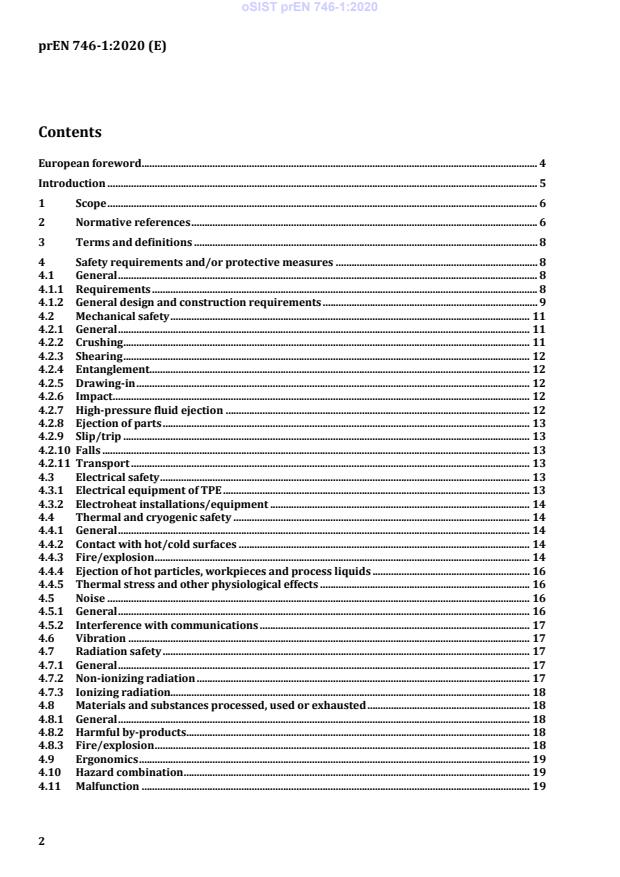
Contents
European foreword . 4
Introduction . 5
1 Scope . 6
2 Normative references . 6
3 Terms and definitions . 8
4 Safety requirements and/or protective measures . 8
4.1 General . 8
4.1.1 Requirements . 8
4.1.2 General design and construction requirements . 9
4.2 Mechanical safety . 11
4.2.1 General . 11
4.2.2 Crushing . 11
4.2.3 Shearing . 12
4.2.4 Entanglement. 12
4.2.5 Drawing-in . 12
4.2.6 Impact . 12
4.2.7 High-pressure fluid ejection . 12
4.2.8 Ejection of parts . 13
4.2.9 Slip/trip . 13
4.2.10 Falls . 13
4.2.11 Transport . 13
4.3 Electrical safety . 13
4.3.1 Electrical equipment of TPE . 13
4.3.2 Electroheat installations/equipment . 14
4.4 Thermal and cryogenic safety . 14
4.4.1 General . 14
4.4.2 Contact with hot/cold surfaces . 14
4.4.3 Fire/explosion . 14
4.4.4 Ejection of hot particles, workpieces and process liquids . 16
4.4.5 Thermal stress and other physiological effects . 16
4.5 Noise . 16
4.5.1 General . 16
4.5.2 Interference with communications . 17
4.6 Vibration . 17
4.7 Radiation safety . 17
4.7.1 General . 17
4.7.2 Non-ionizing radiation . 17
4.7.3 Ionizing radiation. 18
4.8 Materials and substances processed, used or exhausted . 18
4.8.1 General . 18
4.8.2 Harmful by-products . 18
4.8.3 Fire/explosion . 18
4.9 Ergonomics . 19
4.10 Hazard combination . 19
4.11 Malfunction . 19
4.11.1 Failure of power supply and auxiliary fluids . 19
4.11.2 Errors of fitting/assembly during installation. 19
4.11.3 Effect of malfunction of control system/component safety devices . 19
4.12 Missing and incorrectly fitted safety devices . 20
4.12.1 General . 20
4.12.2 Power supply disconnection devices . 20
5 Verification . 20
6 Information for use . 23
6.1 General requirements . 23
6.2 Location and nature of the information for use . 24
6.3 Signals and warning devices . 24
6.3.1 General . 24
6.3.2 Marking . 24
6.3.3 Personnel protection . 25
6.3.4 Warning signs . 25
6.4 Instruction handbooks/manuals . 25
Annex A (informative) List of significant hazards . 27
Annex B (informative) List of common industrial furnaces and associated processing
equipment . 38
B.1 Metallurgical and metal-working plants . 38
B.2 Glass-making plants . 39
B.3 Ceramic-manufacturing plants . 39
B.4 Cement-, lime- and gypsum-manufacturing plants . 40
B.5 Chemical/petrochemical plants . 40
B.6 Waste incineration . 41
B.7 Other industries . 41
Annex C (informative) Typical test report . 42
Annex D (informative) Work-permit authorization . 44
Annex ZA (informative) Relationship between this European Standard and the essential
requirements of Directive 2006/42/EC aimed to be covered . 47
Bibliography . 51
European foreword
This document (prEN 746-1:2020) has been prepared by Technical Committee CEN/TC 186 “Industrial
thermoprocessing - Safety”, the secretariat of which is held by DIN.
This document is currently submitted to the CEN Enquiry.
This document will supersede EN 746-1:2010.
Based on EN 746-1:2010, ISO 13577-1 was developed in 2016. This ISO standard differs considerably
from the original EN 746-1:2010. The contents of this completely renewed prEN 746-1:2020 are based
on ISO 13577-1:2016).
This document has been prepared under a mandate given to CEN by the European Commission and the
European Free Trade Association, and supports essential requirements of EU Directive(s).
For relationship with EU Directive(s), see informative Annex ZA, which is an integral part of this
document.
Introduction
This document is a type-C standard as stated in EN ISO 12100:2010.
The machinery concerned and the extent to which hazards, hazardous situations or hazardous events are
covered are indicated in the Scope of this document.
When requirements of this type-C standard are different from those which are stated in type-A or -B
standards, the requirements of this type-C standard take precedence over the requirements of the other
standards for machines that have been designed and built according to the requirements of this type-C
standard.
Industrial furnaces and associated processing equipment (TPE) generally consists of the following
components:
— processing chambers (e.g. steel construction with lining or without lining);
— heating systems;
— protective system;
— control and instrumentation system/operator-control level.
NOTE As stated in the scope, prEN 746-1:2020 does not cover blast furnaces, converters (in steel plants),
boilers and equipment not covered by EN ISO 12100:2010.
The requirements for protective systems are specified in prEN 746-11:2020.
1 Scope
This document specifies the general safety requirements common to industrial furnaces and associated
processing equipment (TPE).
This document deals with the significant hazards, hazardous situations or hazardous events relevant to
TPE, as listed in Annex A, when TPE is used as intended and also under conditions of misuse that are
reasonably foreseeable by the manufacturer.
Annex B provides a list of common industrial furnaces and associated processing equipment.
This document specifies the requirements intended to be met by the manufacturer to ensure the safety
of persons and property during commissioning, start-up, operation, shut-down, maintenance periods and
dismantling, as well as in the event of foreseeable faults or malfunctions that can occur in the equipment.
These general safety requirements apply to all TPE, unless an exception is given in other parts of
EN 746 series dealing with specific equipment. The provisions of other parts of EN 746 that directly apply
to specific types of TPE take precedence over the provisions of this document.
This document is not applicable to
— blast furnaces, direct reduction furnaces and gas converters;
— steam and hot water boilers;
— fired appliances in the refining, petrochemical and chemical industries;
— sulphur thermal reactors ("Claus plants").
As long as no other standard is applicable for thermoprocess equipment (TPE), the requirements of this
standard are applicable.
2 Normative references
The following documents are referred to in the text in such a way that some or all of their content
constitutes requirements of this document. For dated references, only the edition cited applies. For
undated references, the latest edition of the referenced document (including any amendments) applies.
EN 349:1993+A1:2008, Safety of machinery — Minimum gaps to avoid crushing of parts of the human body
EN 547-1:1996+A1:2008, Safety of machinery — Human body measurements — Part 1: Principles for
determining the dimensions required for openings for whole body access into machinery
EN 547-2:1996+A1:2008, Safety of machinery — Human body measurements — Part 2: Principles for
determining the dimensions required for access openings
prEN 746-2:2020, Industrial furnaces and associated processing equipment — Safety — Part 2:
Combustion and fuel handling systems1
prEN 746-3:2020, Industrial furnaces and associated processing equipment — Safety — Part 3: Generation
and use of protective and reactive atmosphere gases
See ISO 13577-3:2016.
Protective systems1
EN 1547:2001+A1:2009, Industrial thermoprocessing equipment — Noise test code for industrial
thermoprocessing equipment including its ancillary handling equipment
ISO 7000:2019, Graphical symbols for use on equipment — Registered symbols
ISO 7010:2019, Graphical symbols — Safety colours and safety signs — Registered safety signs
EN ISO 7243:2017, Ergonomics of the thermal environment - Assessment of heat stress using the WBGT (wet
bulb globe temperature) index (ISO 7243:2017)
EN ISO 7731:2008, Ergonomics — Danger signals for public and work areas — Auditory danger signals
(ISO 7731:2003)
EN ISO 7933:2004, Ergonomics of the thermal environment — Analytical determination and interpretation
of heat stress using calculation of the predicted heat strain (ISO 7933:2004)
ISO 11429:1996, Ergonomics — System of auditory and visual danger and information signals
EN ISO 11690-2:1996, Acoustics ― Recommended practice for the design of low-noise workplaces
containing machinery ― Part 2: Noise control measures (ISO 11690-2:1996)
EN ISO 12100:2010, Safety of machinery — General principles for design — Risk assessment and risk
reduction (ISO 12100:2010)
ISO 13574:2015, Industrial furnaces and associated processing equipment — Vocabulary
EN ISO 13732-1:2008, Ergonomics of the thermal environment — Methods for the assessment of human
responses to contact with surfaces — Part 1: Hot surfaces (ISO 13732-1:2006)
EN ISO 13850:2015, Safety of machinery — Emergency stop function — Principles for design (ISO
13850:2015)
EN ISO 13849-1:2015, Safety of machinery — Safety-related parts of control systems — Part 1: General
principles for design (ISO 13849-1:2015)
EN ISO 13857:2008, Safety of machinery — Safety distances to prevent hazard zones being reached by
upper and lower limbs (ISO 13857:2008)
EN ISO 14118:2018, Safety of machinery — Prevention of unexpected start-up (ISO 14118:2017)
EN ISO 14119:2013, Safety of machinery — Interlocking devices associated with guards — Principles for
design and selection (ISO 14119:2013)
EN ISO 14120:2015, Safety of machinery — Guards — General requirements for the design and
construction of fixed and movable guards (ISO 14120:2015)
The graphical symbol collections of ISO 7000, ISO 7001 and ISO 7010 are also available on line in the ISO web
store. For more information, consult http://www.iso.org/iso/fr/publications_and_e-products/databases.htm.
EN ISO 14122-2:2016, Safety of machinery — Permanent means of access to machinery — Part 2: Working
platforms and walkways (ISO 14122-2:2016)
EN ISO 14122-3:2016, Safety of machinery — Permanent means of access to machinery — Part 3: Stairs,
stepladders and guard-rails (ISO 14122-3:2016)
EN ISO 14123-1:2015, Safety of machinery — Reduction of risks to health resulting from hazardous
substances emitted by machinery — Part 1: Principles and specifications for machinery manufacturers (ISO
14123-1:2015)
EN IEC 60079-0:2018, Explosive atmospheres — Part 0: Equipment — General requirements (IEC 60079-
0:2017)
EN 60204-1:2018, Safety of machinery — Electrical equipment of machines — Part 1: General
requirements (IEC 60204-1:2016)
EN 60519 (all parts), Safety in electroheat installations (IEC 60519 (all parts))
EN 60519-6:2011, Safety in electroheat installations — Part 6: Specifications for safety in industrial
microwave heating equipment (IEC 60519-6:2011)
EN 60825-1:2014, Safety of laser products — Part 1: Equipment classification and requirements (IEC
60825-1:2014)
EN 61310-1:2008, Safety of machinery — Indication, marking and actuation — Part 1: Requirements for
visual, acoustic and tactile signals (IEC 61310-1:2007)
EN 61310-2:2008, Safety of machinery — Indication, marking and actuation — Part 2: Requirements for
marking (IEC 61310-2:2007)
EN 62061:2005, Safety of machinery — Functional safety of safety-related electrical, electronic and
programmable electronic control systems (IEC 62061:2005)
EN 62598:2013, Nuclear instrumentation — Constructional requirements and classification of radiometric
gauges (IEC 62598:2011)
3 Terms and definitions
For the purposes of this document, the terms and definitions given in EN ISO 12100:2010 and
ISO 13574:2015 apply.
ISO and IEC maintain terminological databases for use in standardization at the following addresses:
— IEC Electropedia: available at http://www.electropedia.org/
— ISO Online browsing platform: available at https://www.iso.org/obp
4 Safety requirements and/or protective measures
4.1 General
4.1.1 Requirements
The TPE shall comply with the safety requirements and/or protective measures described in Clause 4
and shall be verified in accordance with Clause 5. In addition, the TPE shall be designed in accordance
with the principles of EN ISO 12100:2010 for relevant hazards, but not significant hazards, which are
dealt with by this document.
Anticipated significant hazards are listed in Table A.1.
For ease of reference, Table A.1 also indicates the corresponding preventive measures and should be used
in conjunction with Clauses 4, 5 and 6.
Where particular requirements of the other parts of the EN 746 series apply, they shall supplement or
modify these general safety requirements.
4.1.2 General design and construction requirements
4.1.2.1 General
The manufacturer shall maintain evidence that all safety requirements of the design have been fulfilled.
The structural assembly, steel sections, auxiliaries and services (utilities) that form part of the TPE shall
be stable, suitable for function and the intended use.
In particular, the design shall include solutions and constructional details relating to the following:
— static stability of the TPE, including structures intended for containing the processed materials and
the materials entering and leaving the TPE;
— accessibility;
— maintenance and cleaning clearances;
— movement of material and machinery;
— safety in operation;
— health and safety at the workplace;
— protection against fire and prevention of explosion;
— emissions from the process;
— protection against earthquakes where seismic intensity exceeds 325 gal, as determined by the
seismic zone.
Cut-off, regulating and measuring devices, pipework and tanks carrying or containing fluids, which are
likely to solidify and/or have high viscosity, shall be protected against the effects of solidification and
subsequent blockage.
If internal parts of the TPE require frequent inspection, they shall be either provided with lighting
appropriate to the structure and the nature of the process or the user shall be advised to install suitable
lighting.
The design of the TPE and the action of the regulating and safety devices shall prevent:
a) unintended release of flammable or hazardous fluids to the outside of the TPE;
b) a backflow of flammable or hazardous fluids to pipes not intended for such fluids; and
c) flashback in the pipework.
The safety devices shall:
— be suitable for the range of adjustment required for the regulation of the TPE; and
— not cause one device inadvertently to over-ride another.
Safety devices shall be fitted in such a manner that they are accessible and protected against harmful
effects. In particular, they shall withstand continuous operation in the area in which they are to be used.
Auxiliary fluids, such as lubricants, dielectric, diathermic and dynamic fluids, shall be selected to
minimize the hazard of their products of combustion resulting from a fire.
Drains that form part of the TPE shall discharge into a suitably isolated sump. Means shall be provided
for the collection and removal of such discharges.
Pipework distribution systems forming part of the TPE shall be designed to withstand corrosion.
Pipework distribution systems that form part of the equipment and can become dangerous if subjected
to extreme temperatures or pressures, wide variations in temperature or pressures, or voltage shall be
marked.
4.1.2.2 Stability
The TPE structures shall be designed to withstand their static and dynamic loads. The TPE shall be
designed for normal and foreseeable accidental thermal static and dynamic working stresses, including
those resulting from overpressurization or operation below atmospheric pressure.
The design shall also take account of vibration, wind pressure, impact and other foreseeable external
forces, including earthquakes.
4.1.2.3 Access
All parts of the TPE to which personnel require to have access for operation and maintenance shall be
served by adequate means of access, preferably fixed. Stairways, platforms and service floors shall be safe
and shall be equipped with adequate safeguards (see 4.2.10). Inspection and service floors of the TPE
shall be safe, well lit, well ventilated, protected against heat radiation and be fire-resistant (see 4.4.3.1).
Account shall be taken of the need for emergency escape routes to avoid the trapping of personnel in the
event of hazardous situations (such as fire or the build-up of toxic gases).
4.1.2.4 Roofs and covers
Where the roofs or covers of the TPE (e.g. ceramic kilns or melting TPE) have been designed to be walked
on, they shall be accessible by a safe means.
Roofs or covers to which access is not intended shall be marked and designated as not accessible and
shall be adequately guarded to prevent access.
Roofs or covers that have to be walked on for operating, maintenance and inspection purposes and that
are more than 1 m above floor level shall be accessible through safe ascents and shall be fitted with
railings to prevent falls. Where the heat source is located in the roof, for example in the ceramics or glass
industry, one escape route shall be available in front of, and one behind, the firing zone, one of which shall
be a stairway. For design requirements, see 4.1.2.5.
4.1.2.5 Access channels and stairs
In general, the design of access channels and stairs shall be in accordance with EN ISO 14122-2:2016 and
EN ISO 14122-3:2016. For channels intended for repair purposes below tunnel furnaces or kilns the
unobstructed passage way shall be at least 1,80 m high by 0,70 m wide, and be accessible through two
stairways, one of which shall be in front of, and the other behind, the firing zone. If the stairways are in
the area of the firing zone, emergency exits shall be available in front of, and behind, the firing zone.
4.2 Mechanical safety
4.2.1 General
The design shall be such as to avoid injury by movement of the machinery parts of the TPE, by crushing,
shearing, entanglement, drawing-in or impact. It shall also prevent hazardous situations arising where
high-pressure fluids are used or where parts of the TPE and processed material are liable to be ejected.
The stability of the TPE during operation and the safety of the access areas around the TPE shall also be
considered.
Where the construction of the TPE includes
— corners and projections,
— passages of reduced height,
— manhole covers, drains, etc.
they shall be protected and marked in such a way as to minimize the hazard.
Emergency stop devices shall be in accordance with EN ISO 13850:2015.
4.2.2 Crushing
The design shall incorporate means to minimize hazard to personnel arising from:
— movement of materials and machinery;
— automation;
— suspended loads;
— falling materials;
— moving parts.
All moving machinery that can present a hazard shall be guarded wherever practicable. Where guarding
is not practicable, audible and/or visual signals shall be provided. Strategically positioned emergency
stop mechanisms shall be provided to stop potentially hazardous moving machinery.
Guarding, where provided, shall comply with EN ISO 14119:2013 and EN ISO 14120:2015.
Any traversing part of the TPE or material carried by it shall not be closer to any fixed structure than the
safety distance requirements given in EN 349:1993+A1:2008 .
The design of the TPE shall take account of the minimum distance requirement.
4 5
See EN 349:1993+A1:2008 , EN ISO 13857:2008, EN 547-1:1996+A1:2008 and/or
EN 547-2:1996+A1:2008 .
Note: Reference in ISO 13577-1 is: ISO 13854.
Note: Reference in ISO 13577-1 is: ISO 13854.
Note: Reference in ISO 13577-1 is: ISO 15534-1.
Note: Reference in ISO 13577-1 is: ISO 15534-1.
4.2.3 Shearing
Where possible, shear traps shall be eliminated by:
a) filling the gaps or reducing the maximum clearance between the moving parts, such that parts of the
body cannot enter the gap, and
b) increasing the minimum clearance between the shearing parts, such that parts of the body can enter
7 8
the gap safely (see EN 349:1993+A1:2008 and EN 547-1:1996+A1:2008 ).
Where it is not possible to avoid the creation of a shear trap, adequate guarding shall be used (see
EN ISO 14119:2013 and EN ISO 14120:2015).
Means shall be provided to prevent unintentional closure or opening of moving parts (e.g. doors,
conveyors and elevators) during operation and maintenance.
4.2.4 Entanglement
Design measures shall be taken, or suitable guards shall be provided, to prevent entanglement by rotating
shafts, conveyors and transmission machinery (see EN ISO 14120:2015).
4.2.5 Drawing-in
Design measures shall be taken, or suitable guards shall be provided, to avoid drawing-in (see
EN ISO 14120:2015).
4.2.6 Impact
NOTE Impact hazards are caused by objects which act against the inertia of the body but do not penetrate.
The speed, force or torque, and inertia of the moving parts shall be kept to a minimum by the designer, in
order to reduce the possibility of injury. Where this is not practicable, adequate guarding or safety devices
shall be provided. Where guarding or safety devices cannot be provided, a perimeter fence shall be
provided.
4.2.7 High-pressure fluid ejection
In order to minimize the risk of injury caused by the ejection of fluids, such as compressed air, steam and
high pressure hydraulic oil or water:
— all components within the system shall be operated within their manufacturer's specifications and
all parts of the system shall be protected against overpressure;
— verification of leaktightness shall be achieved by pressure testing to at least the intended operating
pressure; and
— any pressure relief device shall be verified by testing in accordance with the manufacturer's
instructions.
Piping should be permanent. Where the use of flexible hoses is unavoidable, equipment suitable for the
most arduous duty and operating conditions likely to be experienced shall be used. If flexible hoses are
used for hydraulic oil, they shall be shielded from ignition sources (e.g. hot surfaces). Replacement
intervals shall be defined in the instruction handbook.
Note: Reference in ISO 13577-1 is: ISO 13854.
Note: Reference in ISO 13577-1 is: ISO 15534-1.
NOTE For fuel gases and liquid fuel, prEN 746-2:2020 specifies requirements for piping including flexible
tubing.
4.2.8 Ejection of parts
In order to minimize the risk that a body can be crushed or penetrated by material or parts of the
equipment that have been ejected unexpectedly or accidentally, adequate guarding shall be provided (see
EN ISO 14120:2015).
4.2.9 Slip/trip
Working platforms shall be designed so as to provide a level standing space of adequate size, with a firm
foothold. Walkways shall be made from materials which remain as slip resistant as practicable under
working conditions, and suitable guard rails, posts and toe boards shall be provided.
Where necessary, a fixed access ladder with handholds or a stairway with handrails or some other
suitable means shall be provided to give safe and convenient access to all equipment needing adjustment,
lubrication or maintenance.
4.2.10 Falls
Where the design of the TPE or the movement of TPE requires floor openings which can constitute a
hazard, automatic guards, safety warning devices (see 6.3) or barriers shall be provided.
4.2.11 Transport
Where applicable, TPE shall be designed for transport. Instructions for transport shall be provided.
4.3 Electrical safety
4.3.1 Electrical equipment of TPE
4.3.1.1 General
Electrical equipment of any TPE located in the same unit(s) up to the defined TPE limits shall be suitable
for their function and intended use. A risk assessment shall be done for each emergency condition and
the results shall determine the action to take on the electrical energy supply to the TPE.
Electrical equipment of TPE shall be in accordance with EN 60204-1:2018. However, the requirement to
meet EN 62061:2005 and/or EN ISO 13849-1:2015 in EN 60204-1:2018, 9.4.1 is not applicable where
the requirements of the protective system specified in prEN 746-11:2020 apply.
The functional requirements to which the protective systems according to prEN 746-11:2020 apply are
specified in the other parts of EN 746 series.
For electroheat installations where electrical energy is directly used as the heating energy, see 4.3.2.
Piping that conveys flammable fluids shall not be installed in channels, ducts, pipes or trenches carrying
electrical conductors, unless an explosion-proof method is provided in accordance with
EN IEC 60079-0:2018 suitable for the applicable hazardous area.
Where it is necessary during commissioning, pre-commissioning, maintenance or fault-finding
operations to gain access to live parts appropriate interlocks, protection systems or guarding shall be
incorporated (see EN ISO 14119:2013 and EN ISO 14120:2015).
Where electrostatic effects can cause loss of normal control and present a hazardous situation, safety
shut-down or stopping devices shall be fitted to those parts of the TPE affected.
Electrical conductors and devices shall not be located in areas affected by the discharge of hot
components or openings, exhausts and vents for hot gases, vapours or fluids.
4.3.1.2 External influences
The TPE shall be designed to minimize hazards resulting from known external influences on the electrical
power, controls and systems.
Disconnection and/or restoration of the electricity supply shall not cancel the safety and interlock
conditions.
The electrical control system shall be suitably protected or guarded against mechanical damage from
operations within the TPE environment.
NOTE Such influences can be beyond the boundaries defined within the scope of this document and are
intended to be dealt with in contract with/among the supplier, agent importers and/or users of the TPE.
4.3.2 Electroheat installations/equipment
Electroheat installations/equipment as part of TPE under the scope of this document shall be suitable for
their function and intended use. They shall be in accordance with the relevant parts of IEC 60519 series.
4.4 Thermal and cryogenic safety
4.4.1 General
The manufacturer shall design the TPE to prevent unintended contact with workpieces, flames, surfaces
or devices, which can be at elevated temperatures or below ambient temperatures.
NOTE Such influences can be beyond the boundaries defined within the scope of this part of the EN 746 series
and are intended to be dealt with in contract with/among the supplier, agent importers and/or users of the TPE.
4.4.2 Contact with hot/cold surfaces
Precautions shall be taken to prevent contact with operating controls at elevated or below ambient
temperature either accidentally or while operating them.
Where it is not possible, for process reasons or other constraints, to maintain surface temperature at an
appropriate level, steps should be taken to prevent hot operating controls from being touched. Wherever
possible, this shall be by means of guards complying with EN ISO 14120:2015.
If these measures are not practicable, areas of elevated temperatures shall be indicated by means of
suitable marking, warning signs, etc. (see 6.3). In addition, attention shall be drawn in the technical
documentation to the presence of such hazards.
Where it is not possible to avoid contact with controls, etc. that are at elevated or below ambient
temperatures, requirements for protective clothing shall be included in the instruction handbook.
4.4.3 Fire/explosion
4.4.3.1 Fire
The TPE shall be designed to minimize fire hazards resulting from overheating or those inherent in the
TPE from operating at elevated temperatures.
The design and construction of the TPE shall prevent the leakage of hot gases, combustion products and
flames, other than via designed flues, vents and doors, etc.
In particular, the following shall be considered:
a) discharge of hot gases or flames from openings;
b) loading and unloading of workpieces.
Where the TPE is heated by gaseous, liquid or solid fuel, the fuel circuits shall be designed to prevent
leakage. In addition, the fuel circuits shall be capable of withstanding foreseeable mechanical damage.
Further guidance for gaseous and liquid fuels is given in prEN 746-2:2020.
Where hydraulic oil-actuated components are used, piping and hydraulic equipment shall be protected
from overheating. Any oil leakage shall be prevented from reaching hot parts by suitable design and
location.
Heat-transfer fluids shall be non-toxic and shall not exceed the maximum temperature specified by the
manufacturer. The humidity and oxygen content in the fluid shall not exceed levels specified by the
manufacturer. These values shall be specified in the instruction handbook.
Where considering the maximum level of the heat-transfer fluid, account shall be taken of its expansion
during normal working conditions. The system shall be fitted with safety vents which are protected
against the ingress of hazardous contaminants (e.g. moisture and air).
Heat-transfer fluid systems shall be provided with a safety device to prevent over-temperature.
Suitable safety devices shall be fitted where any one of the following parameters impact safety:
— pressure;
— temperature;
— level (of fluid);
— flow.
For further guidance, see prEN 746-2:2020.
Where used, fire extinguishing system(s) shall be installed on the TPE at positions where there is the
greatest risk of fire occurring. Particular attention shall be paid to the selection of the type of extinguisher
for use.
4.4.3.2 Explosion
The TPE shall be designed and constructed in such a way as to avoid any risk of explosion posed by the
TPE itself or by gases, liquids, dusts, vapours and other substances produced or used by the TPE.
The design shall incorporate means to avoid the explosive co-existence of a flammable substance and an
oxidizing agent (usually air) within the flammability limits with an ignition source (see
prEN 746-2:2020).
Attention shall be given to work pieces that are not themselves flammable but that may, by design or
otherwise, be coated with substances that can give rise to a flammable mixture.
Pressure relief(s) from an ignited flammable mixture shall be provided, unless it can be shown that the
mixture cannot exceed 25 % of the lower flammability limit (LFL), the ignited flammable mixture is safely
vented by other means or an ignited flammable mixture is safely contained.
Pressure reliefs shall be positioned such that they are unimpeded, both inside and outside the TPE, and
shall discharge in such a mann
...