

oSIST prEN IEC 63187-1:2025
(Main)Systems engineering - System safety - Complex systems in defence programmes Part 1 - Concepts, terminology and requirements
General Information
- Abstract
- Status
- Not Published
- Public Enquiry End Date
- 30-Oct-2025
- Technical Committee
- MOV - Measuring equipment for electromagnetic quantities
- Current Stage
- 4020 - Public enquire (PE) (Adopted Project)
- Start Date
- 09-Sep-2025
- Due Date
- 27-Jan-2026
- Completion Date
- 03-Dec-2025

Overview
prEN IEC 63187-1:2025 - Systems engineering - System safety - Complex systems in defence programmes - Part 1: Concepts, terminology and requirements is a CLC/IEC committee draft (CDV) that establishes foundational concepts, terminology and mandatory requirements for applying systems engineering to system safety in defence programmes. The document focuses on managing risk, defining safety objectives and requirements, and structuring lifecycle and organisational arrangements for highly complex defence systems. Note: this is a committee draft for vote and is still subject to change; it should not be used as a normative reference until published.
Key topics and requirements
The standard emphasizes practical systems-engineering controls for system safety and covers:
- Definitions and terminology: standardized systems engineering and safety vocabulary to support consistent communication across defence programmes.
- Principles and guidance: informative principles and usage notes that explain rationale and application.
- Organisation and independence: requirements for governance, responsibilities, and technical/departmental/organisational independence to avoid conflicts of interest.
- System-of-interest life cycle: lifecycle definition and consistency of lifecycle models across engineering layers.
- Safety objectives and requirements: establishing safety objectives, deriving safety requirements and applying Measure of Importance (MoI) for hazards, detriments and requirements.
- Systems engineering processes: mandatory and recommended processes including acquisition/supply agreements, project planning, risk management, configuration & information management, verification, validation, integration, operation, maintenance and disposal.
- Transverse requirements: traceability, derived requirements and documentation needed to demonstrate safety compliance.
- Enabling systems: selection, qualification and assurance of supporting systems (Type 1/Type 2) and their deployment, integration and user documentation.
- Realised system elements: routes to realisation, specification and acceptance processes for elements supplied or integrated into the system.
- Annex A (normative): general concept and rationale covering systems engineering concepts, risk model, MoI use and hazard ownership.
Practical applications and users
This standard is intended for:
- Systems engineers and safety engineers working on defence programmes who need a consistent framework for system safety.
- Defence contractors and suppliers designing, integrating or qualifying complex system elements.
- Programme managers, procurement authorities and certification authorities who require structured requirements, traceability and assurance evidence.
- Quality, configuration and risk management teams implementing lifecycle and governance controls.
Use cases include establishing safety requirements in acquisition contracts, defining supplier acceptance criteria for realised elements, and integrating enabling systems while maintaining independence and traceability.
Related standards
prEN IEC 63187-1:2025 is aligned with broader systems engineering, safety and defence acquisition practices and should be used alongside applicable IEC/ISO and national defence standards and procurement regulations to achieve compliance and certification.
Get Certified
Connect with accredited certification bodies for this standard

DVS-ZERT GmbH
German welding certification society.
CARES (UK Certification Authority for Reinforcing Steels)
UK certification for reinforcing steels and construction.
EWF/IIW (European/International Welding Federation)
International welding personnel certification.
Sponsored listings
Frequently Asked Questions
oSIST prEN IEC 63187-1:2025 is a draft published by the Slovenian Institute for Standardization (SIST). Its full title is "Systems engineering - System safety - Complex systems in defence programmes Part 1 - Concepts, terminology and requirements". This standard covers: Systems engineering - System safety - Complex systems in defence programmes Part 1 - Concepts, terminology and requirements
Systems engineering - System safety - Complex systems in defence programmes Part 1 - Concepts, terminology and requirements
oSIST prEN IEC 63187-1:2025 is classified under the following ICS (International Classification for Standards) categories: 25.040.01 - Industrial automation systems in general; 25.040.40 - Industrial process measurement and control; 95.020 - Military in general. The ICS classification helps identify the subject area and facilitates finding related standards.
oSIST prEN IEC 63187-1:2025 is available in PDF format for immediate download after purchase. The document can be added to your cart and obtained through the secure checkout process. Digital delivery ensures instant access to the complete standard document.
Standards Content (Sample)
SLOVENSKI STANDARD
01-oktober-2025
Sistemsko inženirstvo - Sistem varnosti tveganja- Kompleksni sistemi v
obrambnih programih - 1. del. Koncepti, terminologija in zahteve
Systems engineering - System safety - Complex systems in defence programmes Part 1
- Concepts, terminology and requirements
Ingénierie des systèmes - Sécurité des systèmes - Systèmes complexes dans les
programmes de défense Partie 1 - Concepts, terminologie et exigences
Ta slovenski standard je istoveten z: prEN IEC 63187-1:2025
ICS:
25.040.01 Sistemi za avtomatizacijo v Industrial automation
industriji na splošno systems in general
95.020 Vojaštvo na splošno Military in general
2003-01.Slovenski inštitut za standardizacijo. Razmnoževanje celote ali delov tega standarda ni dovoljeno.
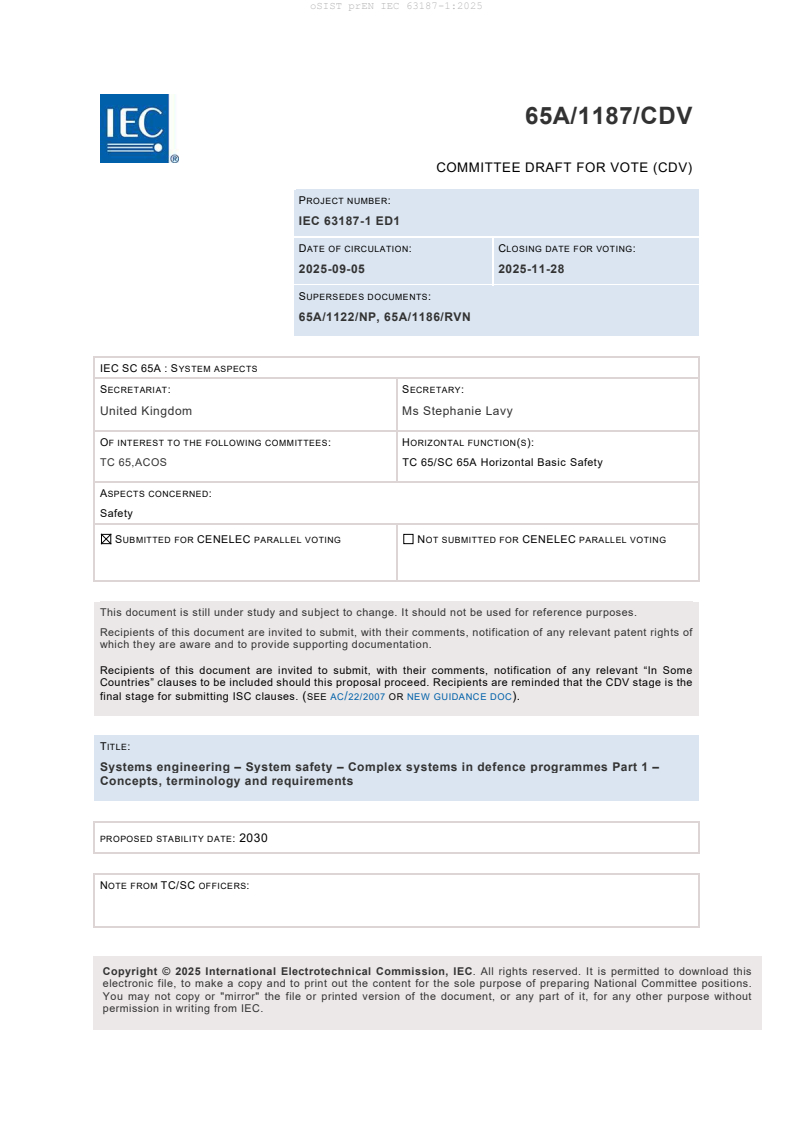
65A/1187/CDV
COMMITTEE DRAFT FOR VOTE (CDV)
PROJECT NUMBER:
IEC 63187-1 ED1
DATE OF CIRCULATION: CLOSING DATE FOR VOTING:
2025-09-05 2025-11-28
SUPERSEDES DOCUMENTS:
65A/1122/NP, 65A/1186/RVN
IEC SC 65A : SYSTEM ASPECTS
SECRETARIAT: SECRETARY:
United Kingdom Ms Stephanie Lavy
OF INTEREST TO THE FOLLOWING COMMITTEES: HORIZONTAL FUNCTION(S):
TC 65,ACOS TC 65/SC 65A Horizontal Basic Safety
ASPECTS CONCERNED:
Safety
SUBMITTED FOR CENELEC PARALLEL VOTING NOT SUBMITTED FOR CENELEC PARALLEL VOTING
This document is still under study and subject to change. It should not be used for reference purposes.
Recipients of this document are invited to submit, with their comments, notification of any relevant patent rights of
which they are aware and to provide supporting documentation.
Recipients of this document are invited to submit, with their comments, notification of any relevant “In Some
Countries” clauses to be included should this proposal proceed. Recipients are reminded that the CDV stage is the
final stage for submitting ISC clauses. (SEE AC/22/2007 OR NEW GUIDANCE DOC).
TITLE:
Systems engineering – System safety – Complex systems in defence programmes Part 1 –
Concepts, terminology and requirements
PROPOSED STABILITY DATE: 2030
NOTE FROM TC/SC OFFICERS:
electronic file, to make a copy and to print out the content for the sole purpose of preparing National Committee positions.
You may not copy or "mirror" the file or printed version of the document, or any part of it, for any other purpose without
permission in writing from IEC.
IEC CDV 63187-1 © IEC 2025
1 IEC 63187-1
3 Systems engineering – System safety – Complex systems in defence
4 programmes
7 Part 1 – Concepts, terminology and requirements
IEC CDV 63187-1 © IEC 2025
11 CONTENTS
13 FOREWORD . 7
14 INTRODUCTION . 9
15 1 Scope . 11
16 2 Normative references . 11
17 3 Definitions and symbols . 11
18 3.1 Systems engineering terms . 12
19 3.2 General safety terms . 14
20 3.3 Specific use of common terms . 18
21 3.4 Symbols . 20
22 4 Principles (Informative) . 21
23 5 Guide to using this document (informative) . 23
24 6 Conformance to this document . 23
25 7 Organisation and independence . 24
26 7.1 Objective . 24
27 7.2 Requirements for organisation . 24
28 7.2.1 General . 24
29 7.2.2 Management, governance and leadership . 24
30 7.2.3 Responsibilities . 25
31 7.3 Independence . 25
32 7.3.1 Description . 25
33 7.3.2 Technical independence . 26
34 7.3.3 Departmental independence . 26
35 7.3.4 Organisational independence . 26
36 7.3.5 Requirements . 26
37 8 System-of-interest life cycle (informative) . 27
38 8.1 Objective . 27
39 8.2 Life cycle definition . 27
40 8.3 Consistency of life cycle models through systems engineering layers . 28
41 9 Safety objectives, safety requirements, categorisation and design criteria . 28
42 9.1 Objective . 28
43 9.2 Safety objective . 28
44 9.3 Safety requirements . 29
45 9.4 Categorisation of measure of importance . 30
46 9.4.1 General . 30
47 9.4.2 Measure of importance for detriments . 30
48 9.4.3 Measure of importance for hazards . 30
49 9.4.4 Measure of importance for safety objectives . 30
50 9.4.5 Measure of importance for safety requirements: . 31
51 9.5 Design criteria for realisation . 31
52 9.5.1 General . 31
53 9.5.2 Design criteria for realised system elements . 31
54 10 Systems engineering processes . 32
55 10.1 Objective . 32
IEC CDV 63187-1 © IEC 2025
56 10.2 General requirements for systems engineering processes . 32
57 10.3 Agreement processes . 32
58 10.3.1 Acquisition . 32
59 10.3.2 Supply . 35
60 10.4 Organisational project enabling processes . 38
61 10.4.1 Life cycle model management . 38
62 10.4.2 Infrastructure management . 39
63 10.4.3 Portfolio management . 39
64 10.4.4 Human resource management . 40
65 10.4.5 Quality management . 41
66 10.4.6 Knowledge management . 41
67 10.5 Technical management processes . 42
68 10.5.1 Project planning process . 42
69 10.5.2 Project assessment and control process . 43
70 10.5.3 Decision management process . 44
71 10.5.4 Risk management process . 45
72 10.5.5 Configuration management process . 46
73 10.5.6 Information management process . 47
74 10.5.7 Measurement process . 47
75 10.5.8 Quality assurance process . 48
76 10.6 Technical processes . 49
77 10.6.1 Business or mission analysis process . 49
78 10.6.2 Stakeholder needs and requirements definition process . 51
79 10.6.3 System requirements definition process . 53
80 10.6.4 System architecture definition process . 55
81 10.6.5 Design definition process . 58
82 10.6.6 System analysis process . 60
83 10.6.7 Implementation process . 62
84 10.6.8 Integration process . 63
85 10.6.9 Verification process . 64
86 10.6.10 Transition process . 66
87 10.6.11 Validation process . 68
88 10.6.12 Operation process . 70
89 10.6.13 Maintenance process . 71
90 10.6.14 Disposal process . 72
91 10.7 Transverse requirements . 73
92 10.7.1 Traceability . 73
93 10.7.2 Derived requirements . 74
94 11 Safety relevant documentation. 74
95 11.1 Objective . 74
96 11.2 Requirements . 78
97 12 Enabling systems selection and qualification . 78
98 12.1 Objective . 78
99 12.2 Type 1 enabling systems. 79
100 12.3 Type 2 enabling systems. 79
101 12.3.1 General . 79
102 12.3.2 Enabling system assurance . 80
103 12.3.3 Enabling system deployment . 80
104 12.3.4 Enabling system user documentation . 83
IEC CDV 63187-1 © IEC 2025
105 12.3.5 Enabling system integration and validation in the usage environment . 83
106 12.3.6 Enabling system configuration management in the enabling system user
107 context . 84
108 12.3.7 Enabling system usage . 84
109 12.3.8 Enabling system development and verification . 84
110 12.3.9 Enabling system confidence evidence. 85
111 13 Realised system elements . 85
112 13.1 Objective . 85
113 13.2 Requirements for realised system element routes . 86
114 13.3 Route to realisation 1 . 86
R
115 13.3.1 General . 86
116 13.3.2 Route to realisation 1 : realised system element specification . 87
R
117 13.3.3 Route to realisation 1R: realised system elements acceptance . 87
118 13.4 Route to realisation 2 . 88
R
119 13.4.1 General . 88
120 13.4.2 Route to realisation 2 : realised system element specification . 88
R
121 13.4.3 Route to realisation 2R: realised system element acceptance . 89
122 13.5 Route to realisation 3 . 89
R
123 13.5.1 General . 89
124 13.5.2 Route to realisation 3 : realised system element specification . 89
R
125 13.5.3 Route to realisation 3R: realised system element acceptance . 90
126 13.6 Route to realisation 4 . 90
R
127 13.6.1 General . 90
128 13.6.2 Route to realisation 4 : realised system element acceptance . 90
R
129 Annex A (normative) IEC 63187-1 general concept and rationale . 93
130 A.1 Introduction . 93
131 A.2 Systems engineering. 93
132 A.2.1 General . 93
133 A.2.2 Systems, system elements and systems hierarchy . 93
134 A.2.3 Iterative and recursive application . 93
135 A.2.4 System levels . 94
136 A.2.5 Enabling systems . 94
137 A.2.6 Outcomes vs output . 95
138 A.2.7 Processes, activities & tasks . 95
139 A.3 Risk concepts . 95
140 A.3.1 General . 95
141 A.3.2 Risk model . 96
142 A.3.3 Aspects of risk . 97
143 A.3.4 Sources of uncertainty . 98
144 A.3.5 Hazard ownership . 99
145 A.3.6 Safety objectives . 99
146 A.3.7 Safety requirements. 100
147 A.4 Measure of importance (MoI) . 100
148 A.4.1 General . 100
149 A.4.2 Establishing the MoI . 100
150 A.4.3 Utilisation of MoI in SE processes. 102
151 A.5 MoI scheme . 102
152 A.5.1 General . 102
153 A.5.2 MoI level . 102
IEC CDV 63187-1 © IEC 2025
154 A.5.3 MoI level transformations . 103
155 A.5.4 MoI composition rules . 103
156 A.5.5 Conditioning factors . 104
157 A.5.6 MoI context . 104
158 Annex B (informative) System-of-interest life cycle . 105
159 B.1 Introduction . 105
160 B.2 System life cycle processes correlation . 105
161 B.3 Concept stage . 105
162 B.3.1 General . 105
163 B.3.2 Purpose . 105
164 B.3.3 Overview . 105
165 B.3.4 Preconditions . 106
166 B.3.5 Outcomes . 106
167 B.3.6 Decision Gates . 107
168 B.4 Development stage . 107
169 B.4.1 General . 107
170 B.4.2 Development stage (ensure safety phase) . 107
171 B.4.3 Development stage (assure safety phase) . 108
172 B.5 Production stage . 109
173 B.5.1 Purpose . 109
174 B.5.2 Overview . 109
175 B.5.3 Preconditions . 109
176 B.5.4 Outcomes . 109
177 B.5.5 Decision Gates . 109
178 B.6 Utilisation/support stage . 109
179 B.6.1 Utilisation Phase . 109
180 B.6.2 Support Phase . 110
181 B.7 Retirement stage . 111
182 B.7.1 Purpose . 111
183 B.7.2 Overview . 111
184 B.7.3 Preconditions . 111
185 B.7.4 Outcomes . 111
186 B.7.5 Decision Gate . 111
187 B.8 Return to previous stages. . 111
188 B.8.1 Purpose . 111
189 B.8.2 Overview . 112
190 B.8.3 Preconditions . 112
191 B.8.4 Decision Gate . 112
192 Annex C (informative) Implementation by very small entities . 113
193 Bibliography (informative) . 115
194 General systems engineering . 115
195 Software engineering . 115
196 General safety aspects . 115
197 Risk management. 115
198 Quality management . 115
199 Reliability . 115
200 Certification . 115
IEC CDV 63187-1 © IEC 2025
202 Figure 1 – Generic system-of-interest life cycle . 28
203 Figure A.1 – Model of risk . 97
205 Table 1 – Derived requirement process outcomes . 76
206 Table 2 – Information object traceability for systems engineering outcomes . 77
207 Table 3 – Enabling system impact categories. 83
208 Table 4 – Enabling system error impact detection and prevention capability categories . 84
209 Table 5 – Enabling system confidence evidence - confidence class. . 86
210 Table 6 – Routes to realisation for realised system elements . 87
211 Table B.1 –Processes correlation with life cycle stages example . 107
IEC CDV 63187-1 © IEC 2025
214 INTERNATIONAL ELECTROTECHNICAL COMMISSION
215 ––––––––––
216 FOREWORD
217 1) The International Electrotechnical Commission (IEC) is a worldwide organization for standardization comprising
218 all national electrotechnical committees (IEC National Committees). The object of IEC is to promote international
219 co-operation on all questions concerning standardization in the electrical and electronic fields. To this end and
220 in addition to other activities, IEC publishes International Standards, Technical Specifications, Technical Reports,
221 Publicly Available Specifications (PAS) and Guides (hereafter referred to as “IEC Publication(s)”). Their
222 preparation is entrusted to technical committees; any IEC National Committee interested in the subject dealt with
223 may participate in this preparatory work. International, governmental and non-governmental organizations liaising
224 with the IEC also participate in this preparation. IEC collaborates closely with the International Organization for
225 Standardization (ISO) in accordance with conditions determined by agreement between the two organizations.
226 2) The formal decisions or agreements of IEC on technical matters express, as nearly as possible, an international
227 consensus of opinion on the relevant subjects since each technical committee has representation from all
228 interested IEC National Committees.
229 3) IEC Publications have the form of recommendations for international use and are accepted by IEC National
230 Committees in that sense. While all reasonable efforts are made to ensure that the technical content of IEC
231 Publications is accurate, IEC cannot be held responsible for the way in which they are used or for any
232 misinterpretation by any end user.
233 4) In order to promote international uniformity, IEC National Committees undertake to apply IEC Publications
234 transparently to the maximum extent possible in their national and regional publications. Any divergence between
235 any IEC Publication and the corresponding national or regional publication shall be clearly indicated in the latter.
236 5) IEC itself does not provide any attestation of conformity. Independent certification bodies provide conformity
237 assessment services and, in some areas, access to IEC marks of conformity. IEC is not responsible for any
238 services carried out by independent certification bodies.
239 6) All users should ensure that they have the latest edition of this publication.
240 7) No liability shall attach to IEC or its directors, employees, servants or agents including individual experts and
241 members of its technical committees and IEC National Committees for any personal injury, property damage or
242 other damage of any nature whatsoever, whether direct or indirect, or for costs (including legal fees) and
243 expenses arising out of the publication, use of, or reliance upon, this IEC Publication or any other IEC
244 Publications.
245 8) Attention is drawn to the Normative references cited in this publication. Use of the referenced publications is
246 indispensable for the correct application of this publication.
247 9) Attention is drawn to the possibility that some of the elements of this IEC Publication may be the subject of patent
248 rights. IEC shall not be held responsible for identifying any or all such patent rights.
249 IEC 63187 has been prepared by subcommittee 65A: System aspects, of IEC technical
250 committee 65: Industrial-process measurement, control and automation. It is an International
251 Standard.
252 The text of this International Standard is based on the following documents:
Draft Report on voting
65A/855/NP 65A/859/RVN
254 Full information on the voting for its approval can be found in the report on voting indicated in
255 the above table.
256 The language used for the development of this International Standard is English.
257 This document was drafted in accordance with ISO/IEC Directives, Part 2, and developed in
258 accordance with ISO/IEC Directives, Part 1 and ISO/IEC Directives, IEC Supplement, available
259 at www.iec.ch/members_experts/refdocs. The main document types developed by IEC are
260 described in greater detail at www.iec.ch/standardsdev/publications.
261 The committee has decided that the contents of this document will remain unchanged until the
262 stability date indicated on the IEC website under "http://webstore.iec.ch" in the data related to
263 the specific document. At this date, the document will be:
264 • reconfirmed,
265 • withdrawn,
IEC CDV 63187-1 © IEC 2025
266 • replaced by a revised edition, or
267 • amended.
269 The National Committees are requested to note that for this document the stability date
270 is 20XX.
271 THIS TEXT IS INCLUDED FOR THE INFORMATION OF THE NATIONAL COMMITTEES AND WILL BE DELETED
272 AT THE PUBLICATION STAGE.
IEC CDV 63187-1 © IEC 2025
274 INTRODUCTION
275 The capabilities of complex and complicated systems can be diverse and pose a wide range of
276 risks resulting, for example, from dynamic aspects of how the system will operate and advances
277 in technology. This has led to:
278 • Systems that exhibit new and often unintended behaviours (emergence) from the interaction
279 of their constituent elements, and with other systems in their operating environment.
280 • Increases in automation and autonomy that imply less reliance on humans in the control loop.
281 • Emergent behaviours that dominate over a traditional focus on linear transactions and intrinsic
282 local hazards.
283 • Systems being characterised by their purpose and behaviour rather than the intrinsic
284 characteristics of their constituent parts.
285 • Systems that are not only a specialisation of an existing domain, but a specialised cross-
286 domain application.
287 NOTE1: In this context, ‘domain’ is used to encompass application domains such as automotive, aerospace,
288 machinery, etc. and domains of engineering such as systems, software, mechanical, etc. .
289 These systems are difficult to comprehend and manage using traditional approaches to safety,
290 leading to a need for more integration of safety into systems engineering and a more holistic
291 approach (system safety).
292 This document acknowledges these challenges and offers a principle based approach,
293 addressing system safety within a systems engineering framework. This framework utilises
294 processes and defined outcomes to enable system safety aspects to be considered using a
295 logical, systematic and consistent approach.
296 This document introduces and uses a number of key concepts, the understanding of which is
297 essential to its application. It is recommended that users of this document familiarise
298 themselves with the structure of the document prior to accessing its detailed clauses, especially
299 by reading the informative annexes.
300 This document can be instantiated multiple times to cover different system-of-interest contexts
301 in the system hierarchy.
302 This framework:
303 − Provides a set of explicit Principles to guide its implementation and conformance.
304 − Proposes a structure covering processes and outcomes to support an iterative and recursive
305 approach to the development of complex system capability from high-level concept through the full
306 lifecycle, including decommissioning/disposal.
307 − Considers system safety as part of systems engineering, especially the consideration of
308 emergence when system elements interact.
309 − Enables the iterative and recursive identification and treatment of hazards, safety objectives and
310 requirements in the context of multi-layered systems.
311 − Enables the use of a variety of other standards in the realisation of system elements. This enables
312 the consolidation of realised elements that use different standards.
313 − Allows for the re-use of realised elements in different contexts where appropriate.
314 − Addresses hazards arising from what the system does, or does not do, rather than intrinsic
315 hazards arising from the what the system is made from.
316 − Does not address Intrinsic (inherent) hazards arising from system elements that are covered by
317 more detailed product specific publications.
IEC CDV 63187-1 © IEC 2025
318 Annexes are provided to support understanding of this document:
319 - Annex A, General concept and rationale: use to understand to concepts used in this
320 document;
321 - Annex B, System-of-interest life cycle: to be read for more information on the life cycle;
322 - Annex C, Implementation by very small entities: for information to very small entities for
323 guidance on specific topics.
324 This document can be considered to form a specialty engineering view of ISO/IEC/IEEE 15288.
325 The requirements of this document are uniquely identified with a header enabling their
326 automatic retrieval by requirement management systems. The objectives of requirement
327 identification are:
328 • Uniqueness of identifier;
329 • Stability against standard future evolutions;
330 • Ease of understanding of relationships between the requirement and the structure of the
331 document.
332 The requirement identification is as follows:
333 REQ_xxx, where xxx is a sequential number.
334 Any criteria associated with a requirement of this document are uniquely identified with a header
335 enabling their automatic retrieval by requirement management systems. The criteria
336 identification is as follows.
337 CRI_xxx_yy where xxx is the parent requirement and yy is a sequential number.
338 NOTE1: criteria are propositions i.e.: they evaluate to true or false.
339 NOTE2: criteria are associated with a parent requirement, and if they evaluate to false then the parent requirement
340 is not satisfied.
341 NOTE3: criteria are not necessarily sufficient for requirement satisfaction.
342 NOTE4: requirements can be associated with criteria providing alternatives for requirement satisfaction.
IEC CDV 63187-1 © IEC 2025
344 1 Scope
345 This document offers a framework for system safety to facilitate the development of complex
346 systems and defence programmes taking into account the specific needs of all stakeholders.
347 This document is applicable to:
348 a) complex systems in scope of defence programmes, including but not limited to protection
349 systems, control systems, and information systems
350 b) systems whose behaviour could have an impact on the safety, and/or on the top level
351 function of the system
352 c) a system-of-interest, whatever its location in a system hierarchy
353 d) those acquiring, specifying, developing, interacting with, using and assessing systems as
354 well as by suppliers of systems and enabling systems
355 This document addresses:
356 e) the achievement of an acceptable level of safety, addressing hazards arising from what the
357 system does, or does not do
358 f) system safety within systems engineering processes as defined by ISO/IEC/IEE 15288:2023
359 g) the consideration of malevolent and unauthorised actions that are relevant to the objectives
360 defined to achieve safety during all system life cycle stages
361 h) requirements for the realisation of safety relevant system elements and properties and for
362 their assurance
363 This document does not directly address:
364 - systems engineering; those aspects are treated in ISO/IEC/IEEE 15288:2023
365 - requirements management; those aspects are treated in IEC 24748-2 [4]
366 - safety methods and techniques; for example per Functional Hazard Analysis, STPA,
367 fault tree analysis, FME(C)A
368 - sub-systems/element realisation; however it includes provisions for:
369 o the realisation and acceptance of products compliant to recognised industry
370 standards
371 o the acceptance of legacy systems
372 2 Normative references
373 The following documents are referred to in the text in such a way that some or all of their content
374 constitutes requirements of this document. For dated references, only the edition cited applies.
375 For undated references, the latest edition of the referenced document (including any
376 amendments) applies.
377 ISO 31000 – Risk management
378 ISO/IEC/IEEE 15288:2023 – System and software engineering – System life cycle processes
379 3 Definitions and symbols
380 For the purposes of this document, the following terms and definitions apply.
381 ISO and IEC maintain terminology databases for use in standardization at the following
382 addresses:
383 • IEC Electropedia: available at https://www.electropedia.org/
384 • ISO Online browsing platform: available at https://www.iso.org/obp
IEC CDV 63187-1 © IEC 2025
385 3.1 Systems engineering terms
386 3.1.1
387 systems engineering
388 transdisciplinary and integrative approach to enable the successful realization, use, and
389 retirement of engineered systems (3.1.2) using systems principles and concepts and scientific,
390 technological and management methods
391 [SOURCE: ISO/IEC/IEEE 15288:2023, 3.50]
392 3.1.2
393 system
394 arrangement of parts or elements that together exhibit a stated behaviour or meaning that the
395 individual constituents do not
396 Note 1 to entry: A system is sometimes considered as a product or as the services it provides.
397 Note 2 to entry: In practice, the interpretation of its meaning is frequently clarified by the use of an associative noun,
398 e.g. aircraft system. Alternatively, the word “system” is substituted simply by a context-dependent synonym (e.g.
399 aircraft), though this potentially obscures a system principles perspective.
400 Note 3 to entry: A complete system includes all of the associated equipment, facilities, material, computer programs,
401 firmware, technical documentation, services, and personnel required for operations and support to the degree
402 necessary for self-sufficient use in its intended environment.
403 [SOURCE: ISO/IEC/IEEE 15288:2023, 3.46]
404 3.1.3
405 system element
406 discrete part of a system (3.1.2) that can be implemented to fulfil specified requirements
407 EXAMPLE Hardware, software, data, humans, processes [e.g. processes for providing service to users], procedures
408 [e.g., operator instructions], facilities, materials, and naturally occurring entities or any combination.
409 [SOURCE: ISO/IEC/IEEE 15288:2023, 3.47]
410 3.1.4
411 system hierarchy
412 structure of a system (3.1.2) whose elements are ranked into levels of subordination
413 3.1.5
414 system-of-interest
415 SoI
416 system (3.1.2) whose life cycle (3.1.16) is under consideration
417 [SOURCE: ISO/IEC/IEEE 15288:2023, 3.48]
418 3.1.6
419 complex system
420 system (3.1.2) where the collective behaviour of the system elements entails emergence of
421 properties that can hardly, if at all, be inferred from properties of those system elements
422 Note 1 to entry: a complex system cannot be understood with a single view or model.
423 [SOURCE: COMPLEX SYSTEMS SOCIETY. About [online, viewed 2025-01-22]. Available from
424 https://cssociety.org/about, modified — Note to entry added, ‘system elements’ substituted for
425 ‘parts’ and rephrased to meet ISO 10241-1:2011 format.]
426 3.1.7
427 enabling system
428 system (3.1.2) that supports a system-of-interest (3.1.5) during its life cycle stages (3.1.17) but
429 does not necessarily contribute directly to its function during operation
430 [SOURCE: ISO/IEC/IEEE 15288:2023, 3.15, modified — Example and notes to entry removed.]
IEC CDV 63187-1 © IEC 2025
431 3.1.8
432 architecture
433 fundamental concepts or properties of a system (3.1.2) in its environment and governing
434 principles for the realization and evolution of this system and its related life cycle (3.1.16)
435 processes (3.1.19)
436 [SOURCE: ISO/IEC/IEEE 15288:2023, 3.5]
437 3.1.9
438 requirement
439 statement that translates or expresses a need and its associated constraints and conditions
440 [SOURCE: ISO/IEC/IEEE 15288:2023, 3.36]
441 3.1.10
442 design, noun
443 specification of system elements (3.1.3) and their relationships, that is sufficiently complete to
444 support a compliant implementation of the architecture (3.1.8)
445 Note 1 to entry: Design provides the detailed implementation-level physical structure, behaviour, temporal
446 relationships, and other attributes of system elements.
447 [SOURCE: ISO/IEC/IEEE 15288:2023, 3.13]
448 3.1.11
449 interface
450 relationship across the boundary between two elements
451 Note 1 to entry: elements can be organisational, physical or functional
...